
|
Help |
| Home - Basic S - Salvation Army (Books) | |
e99 Online Shopping Mall
|
|
Help |
| Home - Basic S - Salvation Army (Books) | |
| 1-20 of 100 | Next 20 |
click price to see details click image to enlarge click link to go to the store
| 1. Christianity in Action: The History of the International Salvation Army by Henry Gariepy | |
 | Hardcover: 308
Pages
(2009-09-15)
list price: US$25.00 -- used & new: US$13.36 (price subject to change: see help) Asin: 0802848419 Average Customer Review: 
Canada | United Kingdom | Germany | France | Japan |
|
Editorial Review Product Description Customer Reviews (1)
| |
| 2. Blood and Fire: The Story of William and Catherine Booth and the Salvation Army by Roy Hattersley | |
 | Hardcover: 480
Pages
(2000-05)
list price: US$26.95 -- used & new: US$12.95 (price subject to change: see help) Asin: 0385494394 Average Customer Review: 
Canada | United Kingdom | Germany | France | Japan |
|
Editorial Review Product Description Customer Reviews (6)
The story is engrossing. William Booth, the pawnbroker's assistant, became a Methodist minister, then an itinerant evangelist, before founding the East London Mission, which eventually became The Salvation Army. Catherine, brought up by Methodist parents, met William in London in 1852, where they fell in love and soon became engaged. It was to be three more years before they were able to marry; at one time during that period they endured over 14 months of almost unbroken separation. They formed a dynamic partnership, each complementing the other. William was an action man, a whirlwind who swept all before him. Though he was not unintelligent, he was anti-intellectual and repeatedly ignored Catherine's frequent urgings for him to study. Catherine by contrast had a powerful mind, wrote forcefully, argued convincingly, and, in spite of her shyness, became a powerful preacher. She had strongly held views about Christians abstaining from alcohol and women being allowed to preach. It is no coincidence that The Salvation Army has always taken a strong stand against alcohol, and women have been prominent in its ministry. Two of its Generals have been women. One of the fascinating aspects of the Booths' story is the motley crowd of eccentrics they attracted to their flag. Many of their early soldiers were recruited literally from the streets, and then immediately put to work to win others to Christ. Some were illiterate, some had been drunks, others prostitutes. This particular volume, however, does not quite capture that diversity. Though The Salvation Army is probably most often thought of today as an organization engaged in social work, the Booths were first and foremost evangelists. To them the social work was secondary, both in terms of emphasis and chronology. Roy Hattersley, the author of this book, was a cabinet minister in a British Labour Government, and his political background gives the book an interesting slant, particularly when he examines The Salvation Army's social work. The book does, however, have some problems. Hattersley seems out of sympathy with the Booths' religious convictions, and tends to sound rather condescending when discussing them. He also does not understand some basic Christian terms such as "sanctification", and frequently uses them inappropriately.In addition the book has too many avoidable errors, which suggests it may have been a rushed job. But it remains both very readable and enjoyable, and is a worthy tribute to two great Christians.
For a far better biography of William and Catherine Booth, get Trevor Yaxley's. And for John Wesley, read John Pollock's.
We needed not worry. Hattersley writes well, every word being closely considered, and brings what is for me the best biography I have yet read about these icons of The Salvation Army.In a "no punches pulled" account, which propels one forward with a real idea of the Booths' enthusiasm and obsession, one reads about how the movement began, survived and ultimately prospered.Unlike many in-house accounts there is no glossing over of the shortcomings of these very human beings, rather we learn how, fired by what the Booths would consider Divine Inspiration, they "pressed forward to the mark of their high calling". Hattersley concludes "It is not necessary to believe in instant sanctification to admire and applaud their work of social redemption."To those of us who do believe we not only admire and applaud but also see the hand of God in all that the Booths did.Hattersley notes that the Army is the only breakaway group from schismatic 19th century Methodism which survives into the twenty-first century.Many of us who believe know the reason - "Blood and Fire" gives enough evidence for every reader to reach his or her own conclusions. ... Read more | |
| 3. William and Catherine: The Life and Legacy of the Booths: Founders of the Salvation Army by Trevor Yaxley | |
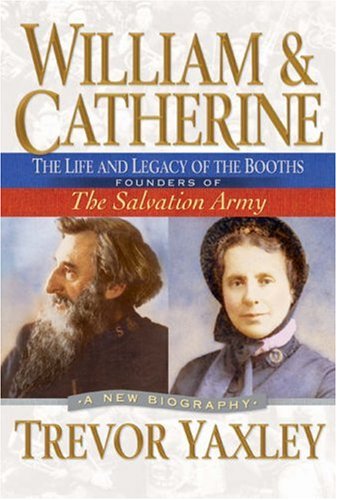 | Hardcover: 304
Pages
(2003-04-01)
list price: US$19.99 -- used & new: US$11.39 (price subject to change: see help) Asin: 0764227602 Average Customer Review:
Canada | United Kingdom | Germany | France | Japan |
|
Editorial Review Product Description Customer Reviews (2)
| |
| 4. The Musical Salvationist Song Book (Kessinger Publishing's Rare Reprints) by Salvation Army | |
 | Hardcover: 280
Pages
(2007-07-25)
list price: US$42.95 -- used & new: US$29.35 (price subject to change: see help) Asin: 0548036454 Canada | United Kingdom | Germany | France | Japan |
|
Editorial Review Product Description | |
| 5. The Most Effective Organization in the U.S.: Leadership Secrets of the Salvation Army by Robert Watson, James Benjamin Brown | |
 | Hardcover: 243
Pages
(2001)
list price: US$25.00 -- used & new: US$8.00 (price subject to change: see help) Asin: 060960869X Average Customer Review:
Canada | United Kingdom | Germany | France | Japan |
|
Editorial Review Product Description Customer Reviews (7)
| |
| 6. Life and Death (Christian Classics) by Catherine Booth, Salvation Army | |
 | Paperback: 108
Pages
(2008-03-17)
list price: US$9.99 -- used & new: US$9.99 (price subject to change: see help) Asin: 1846859697 Canada | United Kingdom | Germany | France | Japan |
| 7. Salvation Army (Semiotext(e) / Native Agents) by Abdellah Taïa | |
 | Paperback: 152
Pages
(2009-04-30)
list price: US$14.95 -- used & new: US$8.78 (price subject to change: see help) Asin: 1584350709 Average Customer Review: 
Canada | United Kingdom | Germany | France | Japan |
|
Editorial Review Product Description Customer Reviews (10)
| |
| 8. An Army Needs An Ambulance Corps: A History of the Salvation Army's Medical Services by Harry Williams | |
 | Hardcover: 240
Pages
(2009-02-01)
-- used & new: US$36.98 (price subject to change: see help) Asin: 085412795X Canada | United Kingdom | Germany | France | Japan |
|
Editorial Review Product Description | |
| 9. Salvation Assault: The History of the Salvation Army in Papua New Guinea by Allen Satterlee | |
 | Paperback: 150
Pages
(2006)
-- used & new: US$25.00 (price subject to change: see help) Asin: 9980860804 Canada | United Kingdom | Germany | France | Japan |
| 10. The blood and fire in Canada : a history of the Salvation Army in the Dominion, 1882-1976 by R. G. Moyles | |
| Paperback: 312
Pages
Isbn: 0887781705 Canada | United Kingdom | Germany | France | Japan | |
| 11. The General Next to God: The Story of William Booth and the Salvation Army by Richard Collier | |
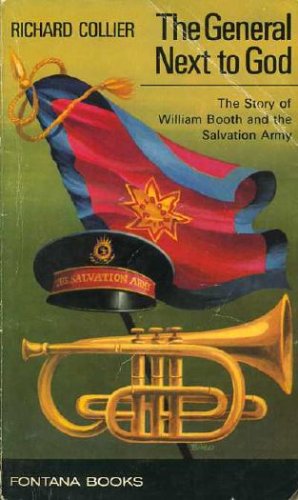 | Paperback: 288
Pages
(1965-06)
list price: US$6.95 Isbn: 0006241638 Average Customer Review: 
Canada | United Kingdom | Germany | France | Japan |
Customer Reviews (2)
| |
| 12. A Bibliography of Salvation Army Literature in English, 1865-1987 (Texts and Studies in Religion) by R. G. Moyles | |
| Hardcover: 209
Pages
(1988-08)
list price: US$109.95 -- used & new: US$39.95 (price subject to change: see help) Asin: 0889468273 Canada | United Kingdom | Germany | France | Japan | |
|
Editorial Review Product Description | |
| 13. Pulling the Devil's Kingdom Down: The Salvation Army in Victorian Britain by Pamela J. Walker | |
 | Hardcover: 360
Pages
(2001-04-02)
list price: US$45.00 -- used & new: US$4.50 (price subject to change: see help) Asin: 0520225910 Average Customer Review:
Canada | United Kingdom | Germany | France | Japan |
|
Editorial Review Product Description The Salvation Army was a neighborhood religion, with a "battle plan" especially suited to urban working-class geography and cultural life. The ability to use popular leisure activities as inspiration was a major factor in the Army's success, since pubs, music halls, sports, and betting were regarded as its principal rivals. Salvationist women claimed the "right to preach" and enjoyed spiritual authority and public visibility more extensively than in virtually any other religious or secular organization. Opposition to the new movement was equally energetic and took many forms, but even as contemporary music hall performers ridiculed the "Hallelujah Lasses," the Salvation Army was spreading across Great Britain and the Continent, and on to North America. The Army offered a distinctive response to the dilemmas facing Victorian Christians, in particular the relationship between what Salvationists believed and the work they did. Walker fills in the social, cultural, and religious contexts that make that relationship come to life. Customer Reviews (1)
| |
| 14. On We March: A memoir of growing up in The Salvation Army by Bette Dowdell | |
 | Paperback: 320
Pages
(2008-10-16)
list price: US$19.95 -- used & new: US$12.62 (price subject to change: see help) Asin: 0971772851 Average Customer Review:
Canada | United Kingdom | Germany | France | Japan |
|
Editorial Review Product Description Customer Reviews (7)
| |
| 15. Marching to Glory: The History of the Salvation Army in the United States, 1880-1992 by Edward H. McKinley | |
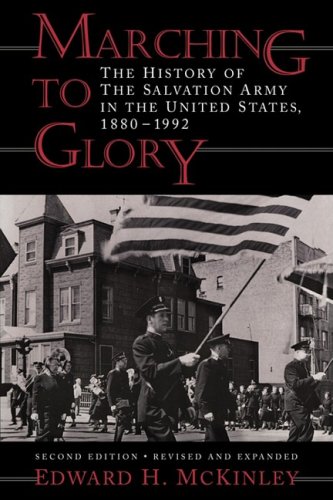 | Paperback: 472
Pages
(1995-10-01)
list price: US$40.00 -- used & new: US$24.99 (price subject to change: see help) Asin: 0802864686 Canada | United Kingdom | Germany | France | Japan |
|
Editorial Review Product Description | |
| 16. William Booth, the General of the Salvation Army by Booth Tucker | |
 | Paperback: 132
Pages
(2001-01-01)
list price: US$13.59 -- used & new: US$13.58 (price subject to change: see help) Asin: 0898751683 Canada | United Kingdom | Germany | France | Japan |
|
Editorial Review Product Description | |
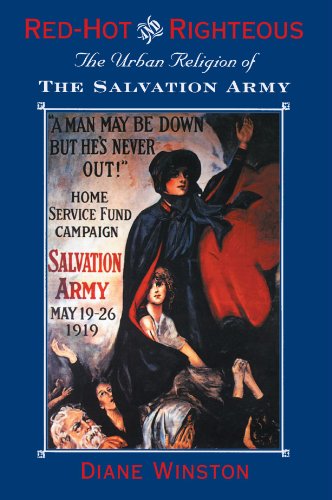
| 17. Red-Hot and Righteous: The Urban Religion of The Salvation Army by Diane Winston | |
 | Paperback: 304
Pages
(2000-10-02)
list price: US$16.95 -- used & new: US$14.99 (price subject to change: see help) Asin: 0674003969 Average Customer Review:
Canada | United Kingdom | Germany | France | Japan |
|
Editorial Review Product Description In this engrossing study of religion, urban life, and commercial culture, Diane Winston shows how a (self-styled "red-hot") militant Protestant mission established a beachhead in the modern city. When The Salvation Army, a British evangelical movement, landed in New York in 1880, local citizens called its eye-catching advertisements "vulgar" and dubbed its brass bands, female preachers, and overheated services "sensationalist." Yet a little more than a century later, this ragtag missionary movement had evolved into the nation's largest charitable fund-raiser--the very exemplar of America's most cherished values of social service and religious commitment. Winston illustrates how the Army borrowed the forms and idioms of popular entertainments, commercial emporiums, and master marketers to deliver its message. In contrast to histories that relegate religion to the sidelines of urban society, her book shows that Salvationists were at the center of debates about social services for the urban poor, the changing position of women, and the evolution of a consumer culture. She also describes Salvationist influence on contemporary life--from the public's post-World War I (and ongoing) love affair with the doughnut to the Salvationist young woman's career as a Hollywood icon to the institutionalization of religious ideals into nonsectarian social programs. Winston's vivid account of a street savvy religious mission transformed over the decades makes adroit use of performance theory and material culture studies to create an evocative portrait of a beloved yet little understood religious movement. Her book provides striking evidence that, counter to conventional wisdom, religion was among the seminal social forces that shaped modern, urban America--and, in the process, found new expression for its own ideals. William Booth, who founded the Army in Britain in 1878, believed heneeded to take religion to the people and urged his followers toimagine a "cathedral of the open air." Salvation Army preachers becamea common sight in the streets of New York. Conservative Christianswere upset by the public spectacle; the Army, however, happily bangedcymbals, beat drums, and sang--their goal was to attractattention. Using contemporary advertising techniques, pageants, andparades, the Salvation Army made a vibrant mark on the urban scene andthe American consciousness. Over time the Army's focus shifted fromproselytizing to practical religion: gaining converts throughreligiously motivated social programs. Soup kitchens, homelessshelters, coal in winter--the Army offered relief to all, regardlessof race, religion, or creed. Its greatest success, however, came whenit sent 250 workers, including a few dozen women, to Europe to providea little bit of home to the boys fighting in the Great War. With theirtrays of doughnuts and pitchers of coffee, the "Sallies" boostedmorale and earned the Salvation Army a tremendous amount ofrespect. Winston's book reveals that she, too, respects both theArmy's mission and its theology, and she tells its story with gracefulprose. Red-Hot and Righteous will interest scholars ofreligious movements and 19th-century urban lifealike. --C.B. Delaney Customer Reviews (4)
"Red Hot and Righteous" tries to be all of these and more, but unfortunately it doesn't work.As a popular history, this is pleasant enough reading, but as a scholarly work it is maddeningly diffuse.Winston's thesis is ill-defined, she fails to address the existing literature on the Salvation Army, and she has no evident theoretical approach.While she addresses the power women had within the Salvation Army, as a feminist history "Red Hot and Righteous" lacks teeth because Winston turns her focus elsewhere rather than fully developing her discussion of women's roles. Winston also uses a very limited range of sources.When presenting the Army's side of the story she leans very heavily on the 'American War Cry'--the Army's own paper.The 'AWC' was sold to the general public to raise funds, and it was thus intended to present the Army and its activities in the best possible light.For an outsider's view of the Salvation Army she relies overwhelmingly on one newspaper--the 'New York Times.'What about ethnic newspapers?What about papers that found their audience primarily among the poor and working class?What did the people the Army aimed its evangelical and charitable activities at think of these predominantly middle-class do-gooders? Winston writes very well, and she gives the Salvation Army the respectful treatment it deserves.But as an academic work, "Red Hot and Righteous" fails to gel.By narrowing her argument and focusing on a specific issue--women's roles and leadership within the Army, the use of popular culture as an evangelical tool, changing depictions of Salvation Army women in books and popular entertainment--and expanding the types of sources used, Winston could have broken new ground.Unfortunately, she keeps stabbing her spade with too little force in too many different places, and as a result she only raises a bit of dust.While I would still recommend this book for a general readership, as a scholar I found it unfocused and ultimately unsatisfying.
| |
| 18. The Authoritative Life Of General William Booth Founder Of The Salvation Army- G. S. Railton by G. S. Railton | |
 | Kindle Edition:
Pages
(2010-02-20)
list price: US$2.99 Asin: B003980F78 Canada | United Kingdom | Germany | France | Japan |
|
Editorial Review Product Description | |
| 19. History of the Salvation Army,Volmue 3 1883-1953: Social Reform & Welfare Work by Robert Sandall, Arch Wiggins | |
| Paperback:
Pages
(1979-06)
list price: US$12.48 Isbn: 0318040182 Canada | United Kingdom | Germany | France | Japan | |
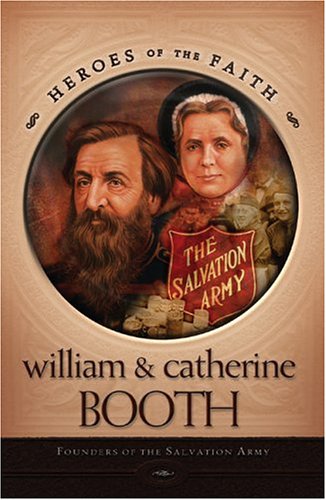
| 20. William and Catherine Booth: Founders of the Salvation Army (Heroes of the Faith) by Helen Kooiman Hosier | |
 | Paperback: 208
Pages
(2005-06-01)
list price: US$2.97 -- used & new: US$29.95 (price subject to change: see help) Asin: 1593106300 Average Customer Review:
Canada | United Kingdom | Germany | France | Japan |
|
Editorial Review Product Description Customer Reviews (2)
| |
| 1-20 of 100 | Next 20 |
 Stick to Politics Roy!