
|
Help |
| Home - Basic T - Tanzania Culture (Books) | |
e99 Online Shopping Mall
|
|
Help |
| Home - Basic T - Tanzania Culture (Books) | |
| Back | 41-60 of 94 | Next 20 |
click price to see details click image to enlarge click link to go to the store
| 41. The Rangi of Tanzania: An introduction to their culture (HRAFlex books, Ethnography series ; FN16-001) by John D Kesby | |
| Unknown Binding:
Pages
(1981)
Asin: B0006E650E Canada | United Kingdom | Germany | France | Japan | |
| 42. Boundless universe: The culture of expansion among the Sukuma-Nyamwezi of Tanzania by Per Brandstrom | |
| Unknown Binding:
Pages
(1990)
Asin: B0006F87UE Canada | United Kingdom | Germany | France | Japan | |
| 43. Death in Bahaya/Banyambo culture and the church's response by Festo Mutaboyelwa E Mutashobya | |
| Unknown Binding:
Pages
(1978)
Asin: B0006WT4XQ Canada | United Kingdom | Germany | France | Japan | |
| 44. East African Hip Hop: Youth Culture and Globalization (Interp Culture New Millennium) by Mwenda Ntarangwi | |
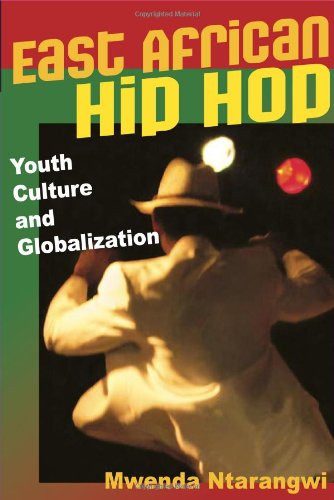 | Paperback: 176
Pages
(2009-09-08)
list price: US$20.00 -- used & new: US$15.43 (price subject to change: see help) Asin: 0252076532 Canada | United Kingdom | Germany | France | Japan |
|
Editorial Review Product Description | |
| 45. TANU Women: Gender and Culture in the Making of Tanganyikan Nationalism, 1955-1965 (Social History of Africa Series) by Susan Geiger | |
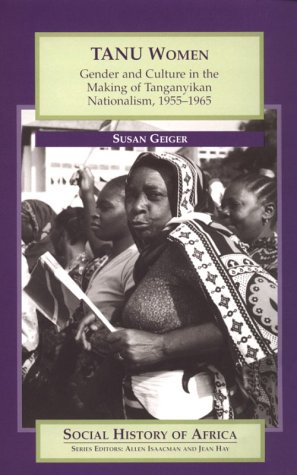 | Paperback: 240
Pages
(1997-10-21)
list price: US$33.75 -- used & new: US$29.75 (price subject to change: see help) Asin: 0435074210 Canada | United Kingdom | Germany | France | Japan |
|
Editorial Review Product Description | |
| 46. People's Representatives. Theory and Practice of Parliamentary Democracy in Tanzania | |
 | Paperback: 212
Pages
(2004-01-01)
list price: US$25.95 -- used & new: US$19.00 (price subject to change: see help) Asin: 9970024388 Canada | United Kingdom | Germany | France | Japan |
|
Editorial Review Product Description | |
| 47. Food, Culture, and Survival in an African City by Karen Coen Flynn | |
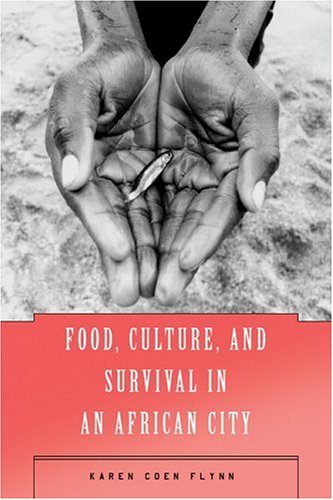 | Paperback: 272
Pages
(2005-07-05)
list price: US$28.00 -- used & new: US$24.87 (price subject to change: see help) Asin: 1403966397 Canada | United Kingdom | Germany | France | Japan |
|
Editorial Review Product Description | |
| 48. The Nyamwezi Today: A Tanzanian People in the 1970s (Changing Culture Series) (Volume 0) by R. G. Abrahams | |
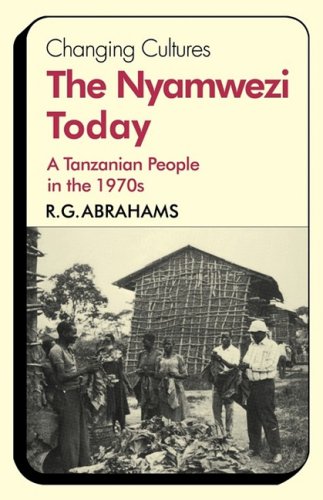 | Paperback: 160
Pages
(1981-05-29)
list price: US$26.99 -- used & new: US$22.27 (price subject to change: see help) Asin: 0521296196 Canada | United Kingdom | Germany | France | Japan |
|
Editorial Review Product Description | |
| 49. Reflections on Tanzania's First Multi-Party Parliament: 1995-2000 by Pius Msekwa | |
 | Paperback: 164
Pages
(2002-01-01)
list price: US$23.95 -- used & new: US$23.94 (price subject to change: see help) Asin: 9976603339 Canada | United Kingdom | Germany | France | Japan |
|
Editorial Review Product Description | |
| 50. Living in the African Savannah (World Cultures) by Nicola Barber | |
 | Paperback: 32
Pages
(2007-10)
list price: US$7.99 -- used & new: US$7.98 (price subject to change: see help) Asin: 1410928233 Canada | United Kingdom | Germany | France | Japan |
|
Editorial Review Product Description How do you count to ten in the Maasai language?What is the jumping dance for young warriors?Why are cattle so important to the Maasai?The Maasai people live in the grasslands in eastern Africa, where there are often long droughts.In this book, you will learn how they survive such harsh conditions.Read about their customs and ceremonies, and how the women make beautiful jewelry. | |
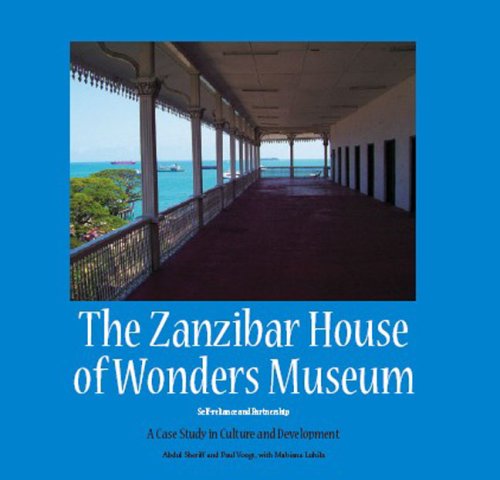
| 51. The Zanzibar House of Wonders Museum: Self-reliance and Partnership, A Case Study in Culture and Development by Abdul Sheriff, Paul Voogt | |
 | Paperback: 80
Pages
(2006-12)
list price: US$35.00 -- used & new: US$35.00 (price subject to change: see help) Asin: 9068324330 Canada | United Kingdom | Germany | France | Japan |
|
Editorial Review Product Description | |
| 52. Pastimes and Politics: Culture, Community and Identity in Post-abolition Urban Zanzibar, 1890-1945 (Eastern African Studies) by Laura Fair | |
| Paperback: 400
Pages
(2002-03-01)
list price: US$16.95 -- used & new: US$50.00 (price subject to change: see help) Asin: 0852557957 Canada | United Kingdom | Germany | France | Japan | |
|
Editorial Review Product Description | |
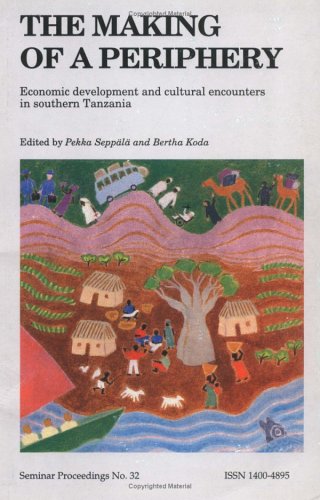
| 53. The Making of a Periphery: Economic Development and Cultural Encounters in Southern Tanzania, Seminar Proceedings No. 32 (Seminar Proceedings (Nordiska Afrikainstitutet), No. 32.) | |
 | Paperback: 186
Pages
(1998-02)
list price: US$28.95 -- used & new: US$69.29 (price subject to change: see help) Asin: 9171064168 Canada | United Kingdom | Germany | France | Japan |
|
Editorial Review Product Description | |
| 54. Historical Archaeology: A Structural Approach in an African Culture (Contributions in Intercultural and Comparative Studies) by Peter R. Schmidt | |
 | Hardcover: 363
Pages
(1978-04-28)
list price: US$126.95 -- used & new: US$126.95 (price subject to change: see help) Asin: 0837198496 Canada | United Kingdom | Germany | France | Japan |
| 55. Kalambo Falls Prehistoric Site: Volume 3, The Earlier Cultures: Middle and Earlier Stone Age (Clark: Kalambo Falls Prehistoric Site) by J. Desmond Clark | |
 | Hardcover: 704
Pages
(2001-10-01)
list price: US$419.99 -- used & new: US$59.98 (price subject to change: see help) Asin: 0521200717 Canada | United Kingdom | Germany | France | Japan |
|
Editorial Review Product Description | |
| 56. Child-Widows Silenced and Unheard: Human Rights Sufferers in Tanzania by Monica Magoke-Mhoja | |
 | Paperback: 288
Pages
(2008-05-23)
list price: US$22.99 -- used & new: US$22.97 (price subject to change: see help) Asin: 1434377873 Canada | United Kingdom | Germany | France | Japan |
|
Editorial Review Product Description | |
| 57. Tanzania: An entry from UXL's <i>Junior Worldmark Encyclopedia of Foods and Recipes of the World</i> | |
| Digital: 12
Pages
(2002)
list price: US$5.90 -- used & new: US$5.90 (price subject to change: see help) Asin: B0024CE3NW Canada | United Kingdom | Germany | France | Japan | |
|
Editorial Review Product Description | |
| 58. Fipa Families: Reproduction and Catholic Evangelization in Nkansi, Ufipa, 1880-1960 (Social History of Africa) by Kathleen R. Smythe | |
 | Paperback: 236
Pages
(2006-05-30)
list price: US$29.95 -- used & new: US$29.95 (price subject to change: see help) Asin: 0325071136 Canada | United Kingdom | Germany | France | Japan |
|
Editorial Review Product Description Ufipa, a labor reserve for Tanganyika, witnessed minimal colonial development. Instead, evangelization by White Fathers' Catholic missionaries began in the 1870s. By the 1950s, the missionaries had secured varying degrees of political, economic and social authority in the region, witnessed by the fact that the vast majority of Fipa had converted to Catholicism. Fipa Families examines how this happened from the Fipa perspective. Initially, employees of the mission sought to oversee the education and moral upbringing of at least one child from each family, substituting boarding school for the care relatives would otherwise have provided. A few mission parents even opted to forego the multiple benefits of grandchildren so a child could pursue the celibate path of a religious vocation. The opportunities of the Catholic Church complemented and competed with Fipa processes of social and biological reproduction, and Catholicism became part of the fabric of Fipa society because of, and despite, its resonance with Fipa culture. At the heart of both Fipa and missionary concerns were the processes of socialization (social reproduction) and biological reproduction, processes carried out within the context of the family. Written primarily for scholars and students of African colonial history, mission history, and family and childhood history, this study is based on a rich collection of oral and documentary sources. Working with this wealth of information, Smythe breaks new ground in placing African social and moral concerns parallel to those of missionaries, resurrecting the study of the family (rather than kinship, lineage, or clan) within African history, and demonstrating at the level of the family and village the ways in which ideas of socialization, reproduction, and education were challenged and re-created in the colonial context in Ufipa. | |
| 59. Socio-Economic Impact of Mining Transnational Corporations: A case of Mererani in Tanzania by AUDAX RUKONGE | |
 | Paperback: 104
Pages
(2010-07-26)
list price: US$63.00 -- used & new: US$60.00 (price subject to change: see help) Asin: 3838333403 Canada | United Kingdom | Germany | France | Japan |
|
Editorial Review Product Description | |
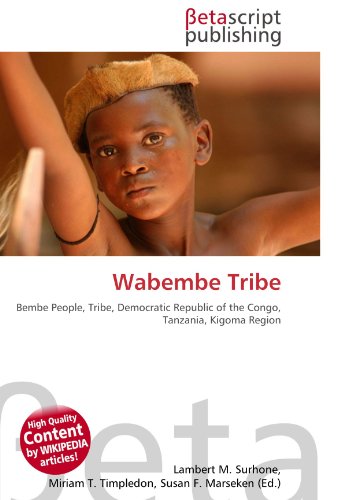
| 60. Wabembe Tribe: Bembe People, Tribe, Democratic Republic of the Congo, Tanzania, Kigoma Region | |
 | Paperback: 76
Pages
(2010-03-13)
list price: US$47.00 -- used & new: US$41.99 (price subject to change: see help) Asin: 6130531001 Canada | United Kingdom | Germany | France | Japan |
|
Editorial Review Product Description | |
| Back | 41-60 of 94 | Next 20 |