e99 Online Shopping Mall

Geometry.Net - the online learning center Help  
Home  - Basic X - Xml Web Publishing (Books)

  1-20 of 100 | Next 20
A  B  C  D  E  F  G  H  I  J  K  L  M  N  O  P  Q  R  S  T  U  V  W  X  Y  Z  

click price to see details     click image to enlarge     click link to go to the store

 
$1.00
1. Web Publishing with XML in Six
2. HTML und Web Publishing Handbuch.
$3.60
3. Cocoon 2 Programming: Web Publishing
 
4. HTML XHTML and CSS Bible Also
 
5. Web Publishing with XML in Six
$18.00
6. Sams Teach Yourself Web Publishing
$37.74
7. MCAD/MCSD Self-Paced Training
$49.99
8. PHP Oracle Web Development: Data
$9.99
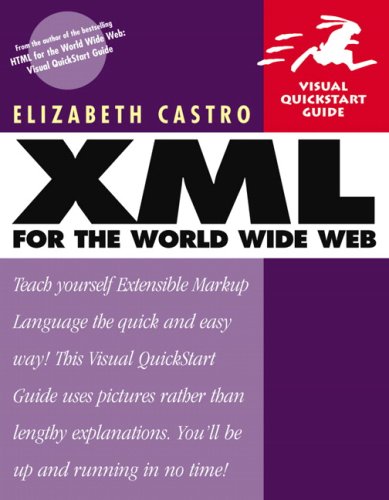
9. XML for the World Wide Web (Visual
$18.12
10. HTML Web Publishing 6-in-1 (6-in-1
$70.35
11. An Introduction to Xml And Web
$5.47
12. Java & XML, 2nd Edition: Solutions
$19.95
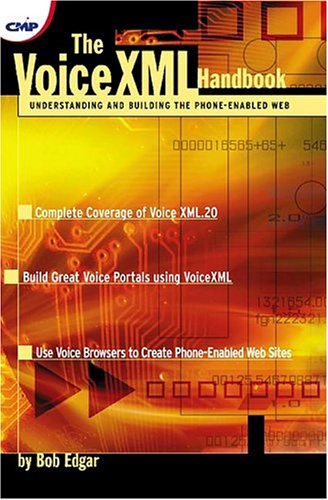
13. The VoiceXML Handbook: Understanding
$7.80
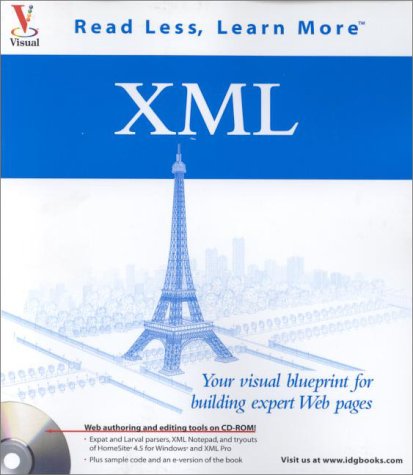
14. XML: Your Visual Blueprint for
$0.99
15. XML Web Documents From Scratch
 
$14.93
16. New Perspectives on Creating Web
$0.01
17. XML Publishing with AxKit
$3.98
18. Web Design with XML: Generating
$395.00
19. ZapNote: Adobe ZapNote: Network
 
$5.95
20. [less than] XML INCHES TOWARD

1. Web Publishing with XML in Six Easy Steps
by Bryan Pfaffenberger
 Paperback: 364 Pages (1998-12)
list price: US$40.95 -- used & new: US$1.00
(price subject to change: see help)
Asin: 0125531664
Average Customer Review: 2.0 out of 5 stars
Canada | United Kingdom | Germany | France | Japan
Editorial Review

Book Description
Anyone creating content for the Web and looking for the easiest way to learn Extended Markup Language (XML) won't find a better source than this book. Readers get a solid grounding in XML in six easy steps. The first step discusses the shortcomings of HTML and introduces XML, with plenty of real-world example. In step two, Web authors learn how to determine which tags they need to add in order to capture the data they are representing. Step three covers how to add tag definitions without writing a Document Type Definition (DTD) and how to use Cascading Style Sheets (CSS) to format new tags. The fourth step introduces the concept of XML DTDs by showing readers how to take advantage of existing DTDs, including Microsoft's Channel Definition Format (CDF). Fifth is how to write a custom DTD; and finally, the sixth step teaches readers how to implement Java-based querying of data structures using LiveAgent Pro, a Java application that incorporates sophisticated XML querying capabilities without requiring users to learn any programming whatsoever.

* Discusses the shortcoming of HTML and introduces XML
* Explains how to add tag definitions without writing a Document Type Definition (DTD) and how to use Cascading Style Sheets (CSS) to format new tags
* Introduces the concept of XML's DTD by showing readers how to take advantage of existing DTDs, including Microsoft's Channel Definition Format (CDF)
* Shows readers how to interpret Java-based querying of their data structures using LiveAgent Pro ... Read more

Customer Reviews (1)

2-0 out of 5 stars Only basic description of XML
The book is very weak in content and has absolutely no practical examples. I'm not an expert in XML, so I won't give a technical estimate, but with new technology like XML one should not only show his favorable opinion, butprovide examples to prove it's value. Title is also very misleading - infact you've got a combination of 'appreciating the need of xml' and XMLshort description. ... Read more


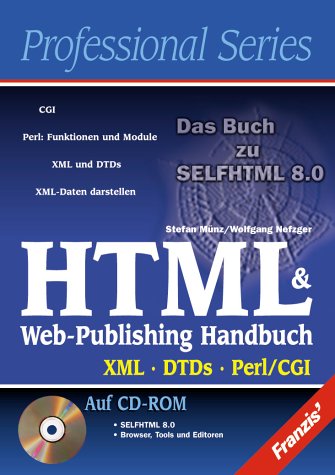
2. HTML und Web Publishing Handbuch. XML, DTDs, Perl, CGI
by Stefan Münz, Wolfgang Nefzger
Hardcover: Pages (2002-04-01)

Isbn: 3772375162
Canada | United Kingdom | Germany | France | Japan

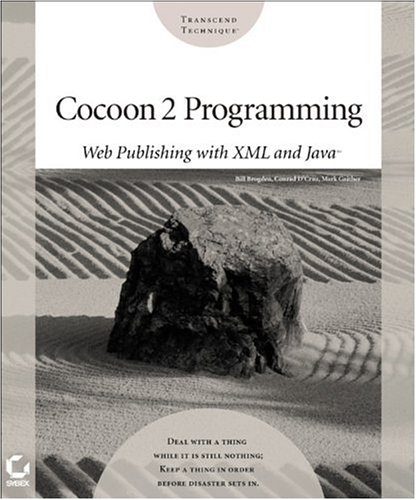
3. Cocoon 2 Programming: Web Publishing with XML and Java
by Bill Brogden, Conrad D'Cruz, Mark Gaither
Paperback: 352 Pages (2002-10-18)
list price: US$39.99 -- used & new: US$3.60
(price subject to change: see help)
Asin: 0782141315
Average Customer Review: 2.0 out of 5 stars
Canada | United Kingdom | Germany | France | Japan
Editorial Review

Book Description
Thanks to the tireless efforts of open-source developers, Cocoon has quickly gained visibility as the preeminent XML-based Web publishing framework. Unfortunately, its documentation remains a significant shortcoming. If you're new to Cocoon, gaining a sense of exactly what you can do with it can be difficult, and actually getting started can be even harder.
Cocoon 2 Programming: Web Publishing with XML and Java clearly explains the value of Cocoon and helps you build on your familiarity with XML and Java Servlets as you design, build, and implement a range of Cocoon applications. You'll begin by learning to control presentation for various platforms, both wired and wireless. Then you'll move on to Cocoon's capabilities for logic control and content management, using both sitemaps and XSP to create a site dynamically generated from a variety of data sources and types.
As you'll see, Cocoon also supports powerful organizing techniques known as design patterns, and you'll master their use in both presentation and content generation. These are essential tools for the planning of your site; for after it's implemented, you'll command powerful techniques for site management and optimization.
The Web's dependence on XML is growing rapidly--and with it the list of companies that have adopted Cocoon. Is Cocoon for you? Cocoon 2 Programming will guide you through your decision and far beyond, providing all the assistance you need to build a dynamic, XML-based site--and keep moving into the future. ... Read more

Customer Reviews (4)

2-0 out of 5 stars Too little too late
Six months ago, as no Cocoon book existed yet, this thin volume could have been interesting, but with the release of Moczar and Aston it is simply not worth the money anymore.

It is often rather superficial and is packed with questionnable fillers à la Wrox: one really wonders why the authors and the publisher felt compelled to include useless 'introductions' to css, xhtml and xsl (and more) in a book on cocoon!

1-0 out of 5 stars Desperately seeking editing
What the authors of this book desperately needed was an editor. This book is a mess. There is no sense of flow. There is no attempt by the authors to explain a topic and then delve further into it building upon what they show us. Instead we get detail. We are told Cocoon is made up of these frameworks and these frameworks use these design patterns and are made up of these pieces which are made up of these pieces. And in the end we know no more than when we started. We are told Cocoon contains these Java classes and are given a sentence explaining each one. We are given lists of SAX classes with no clear explanation of why we should be interested. There are lots of tables and lists and charts that explain nothing. The book never gives a clear explanation of what Cocoon does or how Java fits into Cocoon. The chapter on LogicSheets is a perfect example. There are thirty three tables in this chapter going page after page with no clear explanation of what the tables mean. Then the example at the end of the chapter is so trivial as to be meaningless. In fact, the examples throughout the book are much too simplistic and don't demonstrate the power of Cocoon. There is no question that an enormous amount of research went into this book. It's a shame that the authors weren't able to present that research in a useful way.

2-0 out of 5 stars Dissapointing
When I originally saw this book, I was intrigued by an alternative way of presenting this fairly complicated material and the seemingly relevant examples.I felt that it was generally incomplete and scattered.

Take the section on custom Generators, for example.The example is derived from an example is a previous book written by another Sybex book on XML and JSP, so it seemed like a nice comparison with an alternative technology.The introduction to the example discusses the dynamics of a branching survey and why a custom Generator is sometimes necessary.Unfortunately, the example doesn't follow through on the promise or the lesson.The example code that I downloaded from the website turned out to be incomplete and inconsistent with the book.Although I eventually got the example running, the end result wasn't compelling enough for me to understand the purpose for writing the custom Generator in the first place.

I was dissapointed and frustrated with this book.For those trying to learn about Cocoon I would suggest Zeigeler and Langham's New Riders book (Cocoon: Building XML Applications).

2-0 out of 5 stars ... before disaster sets in.
Deal with a thing while it is still nothing; keep a thing in order before disaster sets in. A quote from Lao Tzu on the cover of this book which the Sybex production team would have done well to have heeded.

It does not help that the competition - Zeigeler and Langham's offering from New Riders - is both clear, structured and liberally sprinkled with examples. This only accentuates the contrast with this exhibit, which leaves the reader as confused after closing the covers as before he or she opened them. No, correction, make that more confused.

There is no lack of substance here, but also no shape, no argument and no goal. Cocoon is a system where data flows naturally from generators, through transformers, and is dispatched on its way by a final serialiser component. Yet, here in chapter four, the authors announce unconvincingly that a explanation in reverse sequence is ... errr ... in order. Off they go explaining serialisers. Fine. Chapter five, bafflingly, skips transformers and discusses site maps. We finally reach generators in chaptereight. Is this the wrong end of the telescope or are we staring into the proverbial liquid filled boot?

It goes on like this, avoiding any form of educative example and meandering though theory without ever fully explaining why and where. To use a generator I need to know what it generates, but I can search in vain for coverage of even a fraction of Cocoon's generators.

The book almost hits its stride in a reasonable explanation of XSP but then blows it , with a chapter on logic sheets. How would you explain what a logic sheet is? Why, obvious! by listing twenty seven tables of unannotated data before offering any explanation how to put this information to use.

Oh dear. I can imagine the work the writers put into this book. It is often very detailed and many long evenings must have been devoted to research. How sad that the editors at Sybex didn't insist that some shape should be battered into the manuscript before it hit the press. ... Read more


4. HTML XHTML and CSS Bible Also Covering Javascript XML Web Design and Publishing
by Bryan Pfaffenberger
 Paperback: Pages (2004)

Isbn: 8126505400
Canada | United Kingdom | Germany | France | Japan

5. Web Publishing with XML in Six Easy Steps
by Bryan Pfaffenberger
 Paperback: Pages (1998)

Asin: B000OH9X1Q
Canada | United Kingdom | Germany | France | Japan

6. Sams Teach Yourself Web Publishing with HTML & XHTML in 21 Days (4th Edition) (Sams Teach Yourself)
by Laura Lemay, Rafe Colburn
Paperback: 816 Pages (2003-05-24)
list price: US$39.99 -- used & new: US$18.00
(price subject to change: see help)
Asin: 0672325195
Average Customer Review: 4.0 out of 5 stars
Canada | United Kingdom | Germany | France | Japan
Editorial Review

Book Description

Sams Teach Yourself Web Publishing with HTML and XHTML in 21 Days, Fourth Edition is a new edition of the best-selling book that started the whole HTML/Web publishing phenomenon.

The entire book has been revised and refined to freshen up its appearance and to bring it up to date with current Web publishing practices and technologies.Yet all the original style, flavor, and features that have made this book so popular since its first edition are retained and expanded upon.

Download Description
An easy-to-understand, thorough tutorial that helps readers quickly master the basics of Web publishing with a variety of technologies. Thoroughly revised and updated to bring the book in line with current Web publishing technologies and practices. The book's classic Laura Lemay writing style is retained and developed, with clear, step-by-step instructions and lots of practical, interesting examples of Web pages. Lifetime sales of over 500,000 units and more than $5 million. Sams Teach Yourself Web Publishing with HTML and XHTML in 21 Days, Fourth Edition is a new edition of the best-selling book that started the whole HTML/Web publishing phenomenon. The entire book has been revised and refined to freshen up its appearance and to bring it up-to-date with current Web publishing practices and technologies. Yet all the original style, flavor, and features that have made this book so popular since its first edition are retained and expanded upon. Laura Lemay is the world's most popular author on HTML and Web development topics. In addition to the best-selling Teach Yourself Web Publishing books she is also co-author of the Sams Teach Yourself Java in 21 Days and Sams Teach Yourself Perl in 21 Days. Rafe Colburn is a programmer and author working in North Carolina. He is the author of Special Edition Using SQL and Sams Teach Yourself CGI in 24 Hours and co-author of Sams Teach Yourself Perl in 21 Days. ... Read more

Customer Reviews (10)

5-0 out of 5 stars Great book
Ok, my written english isn't good at all, but I'd just wanna say how much I love this book. I have been studying html and css for some time now, and I already knew something when I bought this book, and what I think great about it is that it's so detailed about how the things work in html, xhtml and css that it's like if I was learning everything from the beginning again, but this time knowing exactly what I was doing and why.

Well, that's it.. sorry for my english.

5-0 out of 5 stars For both beginners and experts
I've taught HTML and e-commerce at the university level for about a decade now.This book is the best I have found.I use it as my personal reference.I require it for my classes.

It covers the essentials.It gives clear examples.It is organized in a logical order that works.It can be used by someone who has never tried to build a web page, and also has enough 'meat' so that those who have been building pages for years can find useful information and tips throughout.

I just wish I could find books on some of my other subjects that are as well written and organized as this.

3-0 out of 5 stars Ok
This book is ok.I had to get it for a class.The writing is alittle hard to follow, but it is a good reference.

5-0 out of 5 stars Great for beginners
I purchased this book to use in a class I was taking.I had no prior knowledge of HTML, but this book does an excellent job of introducing the reader to designing web pages.I found the chapters very easy to follow and the exercises were kind of fun as you got to practice what you just read about.I highly recommend this to anyone wanting to learn HTML.

1-0 out of 5 stars BBB complaint going on
CD came damaged from xpresstext in which there is a large mark/scratch across the CD using priority shipping and after attempting to notify them and Amazon 4 times, no response until I contacted the BBB and Amazon will not help because I did complain to the BBB. Guess it is up to the BBB now. ... Read more


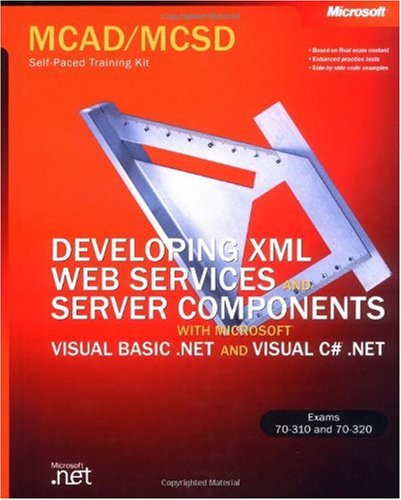
7. MCAD/MCSD Self-Paced Training Kit: Developing XML Web Services and Server Components with Microsoft Visual Basic .NET and Microsoft Visual C# .NET
by Microsoft Corporation, Microsoft Corporation
Hardcover: 688 Pages (2003-01-15)
list price: US$69.99 -- used & new: US$37.74
(price subject to change: see help)
Asin: 0735615861
Average Customer Review: 2.0 out of 5 stars
Canada | United Kingdom | Germany | France | Japan
Editorial Review

Product Description
Developing XML Web Services and Server Components - MCAD/MCSD Self-Paced Training Kit - self-training course - CD ... Read more

Customer Reviews (20)

4-0 out of 5 stars Good Resource for XML Editing
I have found "Developing XML Web Services and Server Components with Microsoft VB.NET" an invaluable tool in XML editor development. It is quite detailed about accessing and manipulating XML data.

1-0 out of 5 stars More confusing
I was reading it as first book for most of the topics, It was total waste of time to read it.

Might help if you are already well expreinced with .NET but not for beginner

1-0 out of 5 stars Very Poorly Written
Judging by the positive reviews, this book must have some merit but it is certainly not in the quality of its writing or its accuracy.Perhaps the editor was reassigned to Longhorn duties.Here are some examples of what you can expect in the first two chapters:

"A COM+ component exists in three states: exists and activated, exists and not activated, and nonexistent."

"The pool objects are not destroyed even after their release from the client application. COM+ retains the destroyed object in the pool for recycling..."

" If the value of the CanStop property is set to False, the SCM does not pass the Stop command to the service application."

It's main value to me is as a syllabus.You can use it to direct your search for better explanations on MSDN and, of course, everyone should have Troelsen's "C# and the .NET Platform" which is the best textbook I have read.Ever.

1-0 out of 5 stars If you find this book useful, don't take the exam yet.
It is at a very basic level. It can be useful for starting in XML webservices, but not enough for the exam.
Some information is outdated.
It has errors. So does the practice test.
Doesn't cover at least one topic which is in the practice test.
The practice test doesn't tell you what is considered the correct answer.
If you find this book useful, you're not yet prepared for the exam.

1-0 out of 5 stars Very Poor
While some chapters are readable, others are very poor (remoting) and some examples just do not work. ... Read more


8. PHP Oracle Web Development: Data processing, Security, Caching, XML, Web Services, and Ajax
by Yuli Vasiliev
Paperback: 396 Pages (2007-08-03)
list price: US$49.99 -- used & new: US$49.99
(price subject to change: see help)
Asin: 1847193633
Average Customer Review: 4.5 out of 5 stars
Canada | United Kingdom | Germany | France | Japan
Editorial Review

Book Description
This practical book for PHP/Oracle developers is built around well explained, easy-to-follow example code to build robust, efficient, secure solutions covering popular current topics on using PHP with Oracle. Assuming no special skill level, experienced author Yuli Vasiliev shows how to install and configure PHP and Oracle; connect PHP to Oracle; move application business logic to Oracle; build transactional applications; use security features; improve performance with caching; employ XML features; implement SOAP web services; build Ajax-driven PHP/Oracle solutions. Building and deploying PHP applications on Oracle Database combines the power and robustness of Oracle with the easy, rapid development of open-source PHP to achieve high-performance, scalable, reliable data-driven web applications with minimal effort. Unlike some other databases, Oracle allows building the key business logic of PHP applications inside the database, moving data processing from web server to database server. ... Read more

Customer Reviews (3)

4-0 out of 5 stars A great introduction to PHP and Oracle and how they play together
This book consists in almost 400 pages of solid content, and is targeted at beginners-to-intermediate PHP and Oracle developers who want to learn or have a deeper understanding of the interaction of the two technologies.

The first chapters highlight the capabilities and advantages of Oracle, cover the installation and connecting procedures, and present some of the alternatives to use Oracle with PHP: using the PHP OCI8 extension directly, and with some popular database abstraction libraries like PEAR::DB, ADOdb, or PDO. A capital sin is it never mentions PEAR::MDB2 ;-)
The central chapters are dedicated to data processing, transaction handling, OO programming, security and caching (also using PEAR::Cache_Lite).
The last chapters are dedicated to XML, XSLT, SOAP and AJAX, and are packed with examples which are more than enough to get you started with those features. All the code examples are laid in a plain and very easy to understand way, yet consistently suggesting some best practices from the very beginning.

The first merit of this book is it shows how you can process data with the DBMS and not just to treat the DBMS like a dumb storage system. For instance, there's a whole chapter explaining how to store, query and transform XML documents with PHP and with Oracle's internal XSLT functions, and there are many examples of STORED PROCEDUREs, TRIGGERs, transaction handling, etc.
A good part of the examples have a strong focus on security too. I found particularly interesting the explanation of alternative techniques to secure your tables, and to mask rows and columns for fine-grained access, using not only VIEWs, but also SPs, multiple schemas, PL/SQL packages, table functions and Virtual Private Database policies. On the PHP side, it goes all the way to create a custom PEAR::Auth container.

One of the most interesting paragraphs of the book describes the usage of Change Notification and notification handlers (a new feature of Oracle Database 10g Rel 2) for caching purposes.

While some of the described techniques aren't Oracle-specific and could be used with any other DBMS and it would have been nice to dive deeper into some other unique Oracle characteristics, that was probably out of scope for an introduction to PHP and Oracle, and it doesn't detract from the merits of this excellent book.

The writing style is clear, even if IMHO it could have been more concise sometimes. For instance, reading continue anticipations and wrap-ups that stress the same concept can get a bit annoying after a while: "In the next chapter we're going to see...", "This chapter covers...", "Now that you have an idea on how...", "In this chapter we've learnt how to...".
Anyway, I guess that it's in the spirit of the old adagio "repetita iuvant", and it may make sense in a technical book. My overall impression is very positive.

5-0 out of 5 stars Clear and useful book
It's rather small, but gives a good overview of PHP, Oracle and AJAX, coupled together. There is only one project example Throughout the whole book, which is enhanced from various aspects. To be precise, they are:

Performance Optimization - views, stored subprograms, triggers, binding variables (Oracle);
caching mechanisms (PHP,Oracle) - intended to reduce amount of data transferred between database and web servers; AJAX - browser-side optimization,

Security - special database schemas coding/decoding algorithms usage(sha1, md5),
Virtual Private Database (VPD) - Oracle

Scalability/Complexity Control - object-oriented approach (PHP5 features, Oracle Object Types)

Unified Data - XML-processing data inside database/PHP server
using XML DB to implement web-service (SOAP, WSDL).

Many of these ideas are rather universal and can be applied to other database servers, web servers and script languages

I would like to emphasize that author is an expert in Oracle, he tries to move almost all business-logic to database server, use native Oracle features (some of them are implemented only in latest Oracle versions). There are also chapters devoted to general database principles (transaction features (ACID), views, stored subprograms, concurrency, views, triggers, stored subprograms) which can be very useful for novice developers.

5-0 out of 5 stars Clear and concise
PHP Oracle Web Development by Yuli Vasiliev, to quote the front, covers data processing, security, caching, XML, Web Services and Ajax. Quite a lot for a mere 360 or so pages.

The book starts off with notes on both PHP and Oracle and describes how to obtain them both and how to get everything up and running using the PHP OCI8 extensions from Oracle. Whilst Oracle is a market leader in the big database arena, many developers will be surprised to learn that the full and unrestricted product is freely downloadable for development purposes - you only need to buy a licence for a production system. Even then, a free cut down version is available if you don't need the full bells and whistles.

So, with everything up and running, the book launches in to the subject at hand. I was immedietely impressed with the author's clear and easily read prose. Every subject is presented with just the right balance of detail with lots of additional notes and background information to help fill in any gaps. The author's real world experience shines through with sections on locking issues and coding for reusability. The section on object-orienation was particularly welcome.

I also liked the fact that the book didn't just cover the core subject of using Oracle with PHP but also covered vital related material such as various security models and a sizeable section on caching techniques. The sections on XML, Web Services via SOAP and Ajax ensure all the current must-have skills are represented. Ajax was presented via an example application which featured all the aspects you'd need including both code and style sheets but I'd have liked a bit more general advice and description here.

The bulk of the book though is the coverage of the OCI8 extentions and here you can find out how to issue a wide variety of SQL statements including using stored procedures, making use of triggers and a good section on transaction handling that didn't just show how to use them but also had useful advice on structuring your code to make best use of them. I would have liked some notes on avoiding things like SQL Injection attacks but that apart, the security section had some interesting nuggets.

The section on object-orientation warrents close inspection if you want to really leverage the power of the tools available in this development environment. It didn't have much on the 'big picture' of how you'd structure applications this way but it does describe how it all works and how to extend existing objects as well as create your own.

I feel I can safely say that if you need to get to grips with PHP in an Oracle environment, you'll find everything you'll need here to get up and running very quickly. The pace, content and structure of the book are all excellent with my only reserve being the assumption that everything works as it is supposed to with not much in the way of troubleshooting advice. That apart, this is a fine book.
... Read more


9. XML for the World Wide Web (Visual QuickStart Guide)
by Elizabeth Castro
Paperback: 272 Pages (2000-11-02)
list price: US$24.99 -- used & new: US$9.99
(price subject to change: see help)
Asin: 0201710986
Average Customer Review: 4.0 out of 5 stars
Canada | United Kingdom | Germany | France | Japan
Editorial Review

Amazon.com
The Visual QuickStart Guide series from Peachpit Press is known forboiling topics down to the essentials, and presenting them in an engaging andefficient way, to get the reader up to speed quickly. In applying this model toXML, author Elizabeth Castro had her work cut out for her.

Fortunately for her readers, Castro has identified successfully the corecomponents of XML, and presented them in a streamlined way. This book doesn'ttackle any of the advanced elements of XML technology, such as SOAP, SAX, orintegration with the Document Object Model (DOM). Instead, it focuses onteaching the basic nuts and bolts of creating XML documents, styling them, anddefining their structure.

This book moves at a fast pace. Document Type Definitions (DTDs), for instance,get only 30 pages of coverage. This tight format comprises simple examples thatillustrate commands and concepts, instead of pages of text. The pages arepresented in a two-column format, so that code fragments can be placed (wisely)side by side with the step-by-step explanatory text. Each topic example issupplemented with one or more useful implementation tips.

For a true grasp of XML and all of its potential, you'll need to follow up thisintroductory tutorial with more reading on the applications of the technologyand case studies. But this little book is a great way to learn the basics of XMLin a weekend. --Stephen W. Plain

Topics covered:

  • XML documents
  • Document Type Definitions(DTDs)
  • Schemas
  • Namespaces
  • XSLT and XPath
  • Cascading style sheets(CSS)
  • XLink
  • XPointer
Book Description
Web-maven Elizabeth Castro, who has penned Peachpit books on HTML, Perl and CGI, and Netscape, now tackles XML--an indispensable tool for creating personalized, updated content for each visitor on your site. Whether you build Web pages for a living or you're taking on a new hobby, XML for the World Wide Web contains everything you need to create dynamic Web sites by writing XML code, developing custom XML applications with DTDs and schemas, transforming XML into personalized Web content through XSLT-based transformations, and professionally formatting XML documents with Cascading Style Sheets.

The real power of XML lies in combining information from varioussources and generating personalized content for different visitors.Castro's easy-to-follow graphics show exactly what XML looks like,and her real-world examples explain how to transform and streamlineyour Web-site creation process by automatically updating content. ... Read more

Customer Reviews (55)

5-0 out of 5 stars Good condition, price, and prompt shipping.
The book came fast and was in good condition.The price was really cheap too.

4-0 out of 5 stars Awesome Beginner's Guide
This book though perhaps has many errors, it is still one of the best concept books out there.This will really get you started with XML smoothly.Some of the XML standards are rather complex, and I find this to be the most palatable material for understanding stuff like XSD and XSLT.

The book covers the basics of XML, how to define your XML schema through DTD, and then several chapters on XSD ("XML Schema and Namespaces") that include simple and complex types.The book follows up with XSML, usage of XPath and text expressions. Later there's coverage of cascading style sheets, XLink and XPointer.

I think there should be a newer version that will make corrections and update the material.I would love a chapter on RELAX-NG, as this is becoming popular to define schema for XML in some circles.

Overall, this is great book to get you started, and I would highly recommend this book as a quick spring board in the world of XML.

2-0 out of 5 stars Errors, Lots and Lots of Errors
37 errors are listed on the author's site.I think I found some new ones as well.The material moves from the specific to general, so that the reader must skip around quite a bit.The aforementioned errors make learning XML very tedious and frustrating.An edit should have done - it is apparent none was.I have used Castro's books in the past and have never experienced the problems I have with this one.I recommend against purchasing this book and I hope Peachpit will not repeat the problems encountered within.

3-0 out of 5 stars Editor needed
Admittedly, I'm only up to the second chapter in this book, but it's clear that Castro needed a better editor.She relies on a frustrating "Type this, then we'll come back to it later" approach (example: naming your DTD, then finding out four pages later HOW to apply that information).Disappointing as her XHTML + CSS and Flash MX books were much tighter in execution.

3-0 out of 5 stars Good overall XML review, but it has gaps
This book does cram a whole lot of information into a tiny space.I will say that, if you are interested in getting started with XML, the book tries to include all the "pieces" you need - like not just XML code, but DTDs and XSLT, etc.

However, the section on XSLT is seriously lacking.I worked on trying to make a VERY BASIC stylesheet yesterday and have yet to get one working.(I'm not new to programming either.)The book gives a lot of "do this, do that" examples, but without explaining the concepts of XSLT more completely and logically, it doesn't really equip you to go out and write stylesheets yourself.I'm disappointed. ... Read more


10. HTML Web Publishing 6-in-1 (6-in-1 Series)
by Todd Stauffer
Paperback: 438 Pages (1997-09-27)
list price: US$29.99 -- used & new: US$18.12
(price subject to change: see help)
Asin: 0789714078
Average Customer Review: 4.5 out of 5 stars
Canada | United Kingdom | Germany | France | Japan
Editorial Review

Book Description
HTML Web Publishing 6-in-1 will cover all facets of Web page design, from HTML basics to "theories" of effective, attention-grabbing Web page creation.Regardless of what browser, system or other specialized requirements the reader is using, the book's more "generalized" approach will appeal to the widest possible audience.While there are several books on HTML design, the uniqueshort, easy-to-follow lesson style of the 6-in-1 guarantees the reader the fastest road to creating Web pages. ... Read more

Customer Reviews (7)

2-0 out of 5 stars To bias
I bought this book recomended by some site. I quickly found out although it does go into some detail of Netscape browser it highly discourages people to use them and goes further by asking them to skip the netscape sections. This book encourages people to support Microsoft and encourages people to use code that is not compatible with other browsers in a since.

A lot of helpfull info in it but because of its bias strategy I give it a 2. Book is somewhat old now but decided to learn the older stuff so what I learned to code would be compatible with almost any browsers. Im gonna have to say I would discourage making this book a choice for your studies.

5-0 out of 5 stars Great Intro Book
This book is a great for anyone wishing to learn HTML.It's clear and very informative.Beginner and intermediate HTML users will find it a great buy.

It's only short-coming is the absence of a list of tags and their uses."HTML 4" by Elizabeth Castro has this, and it is very useful for a quick reference.However the Castro Text is less suited for a beginner.

The 6 in 1 guide covers HTML, CSS, and DHTML as well or better than many texts that cover only one of these subjects.The book really explains why things are done, instead of showing you how to do something but not telling you why you'd want to do it.

You'll be very happy with the book if you're just starting out.

5-0 out of 5 stars HTML Review
Excellent reference book for the beginner in web publishing. HTML is the only way to go and this book will give you a firm understanding of "how to do it". There are a lot of books on this subject, butthis is the one of choice.

4-0 out of 5 stars Terrific book for beginners
This is a terrific book for beginners; it has clear, easy-to-understand examples and gives you info other books assume you already know; like how to actually PUBLISH your site; but it has a couple of shortcomings thatprevent me from giving it five stars.First, the section on VRML is acomplete waste.Secondly, the scripting sections leave a bit to bedesired, but they at least give you an introduction to basic scripting andDHTML.This is a good reference book for amateur web designers and afabulous starter course for HTML newbies; however, more advanced webdevelopers won't benefit at all from it; and even newbies will quicklyoutgrow it.That's a testament to how well it conveys the information!

5-0 out of 5 stars The only HTML book you will ever need!
For the intermediate level HTML programmer, this book covers a wide variety of topics such as style sheets, dynamic HTML, scripting, table and frame design, etc.I refer to it constantly. ... Read more


11. An Introduction to Xml And Web Technologies
by Anders Mller, Michael I. Schwartzbach
Paperback: 542 Pages (2006-03)
list price: US$97.50 -- used & new: US$70.35
(price subject to change: see help)
Asin: 0321269667
Average Customer Review: 5.0 out of 5 stars
Canada | United Kingdom | Germany | France | Japan
Editorial Review

Book Description
This thoroughly class tested text and online tutorial gives a complete introduction to the essentials of the XML standard. It will teach students how to apply web technologies to develop XML based web applications. Through the book, the student will build applications that work together to construct interesting and workable web applications.

Contents

Foreword Preface

I: XML Technologies

1. HTML and Web Pages

2. XML Documents

3. Navigating XML Trees with XPath

4. Schema Languages

5. Transforming XML Documents with XSLT

6. Querying XML Documents with XQuery

7. XML Programming

II: Web Technologies

8. The HTTP Protocol

9. Programming Web Applications with Servlets

10. Programming Web Applications with JSP

11. Web Services

12. A Complete Application

Bibliography Index

Features

* Relies exclusively on open source Java software, and will be tied closely to the online material.* Contains a finely tuned progression of ideas, examples and details. * Shows how to use XML in modern web applications. * Backs up a thorough treatment of its key points with clear, practical examples. * Offers insight and understanding of the concepts, their importance and their application. * Offers a rigorous look at existing standards.

Additional Support Material

* Learning outcomes. * Links to relevant online resources. * Online tests. * Live code for all examples and applications. ... Read more

Customer Reviews (1)

5-0 out of 5 stars The first (and only?) clear, concise, deep, scientific account of the stuff...
This is what I wrote the authors of this book:

Dear Anders and Michael,

I recently purchased your book entitled "An Introduction to XML and Web Technologies". I started reading it and I must say that you have done a wonderful job. It reads with ease and your presentation style is as limpid as pure mountain water. I particularly enjoy the fact that you are doing a masterful and in-depth tutorial of several of the recent outputs of the W3C's language mill without losing your critical mind and making accurate remarks for several annoying idiosyncrasies owing their existence more to historical and political reasons rather than simple efficient scientific design.

At any rate, I congratulate you on an excellent book and look forward to reading more of your didactic and scientific publications.

[...]

It would be very interesting to envisage a book in the style of
yours on the so-called Semantic Web. I, for one, as ILOG's current Principal rep in the W3C Rule Interchange Format WG, would welcome your critical eye and approach to this vast and unchartered domain.

Thanks again for writing this book. I will definitely recommend it as an effective and concise reference to the subject to anyone - whether newbie or old-timer.

Best regards,

-hak
--
Hassan Aït-Kaci, Ph.D, Distinguished Scientist R&D
ILOG, Inc. - http://www.ilog.com/ - Product Division
Surrey, BC, Canada - Fri Aug 25 07:40:40 2006 PST ... Read more


12. Java & XML, 2nd Edition: Solutions to Real-World Problems
by Brett McLaughlin
Paperback: 550 Pages (2001-09)
list price: US$44.95 -- used & new: US$5.47
(price subject to change: see help)
Asin: 0596001975
Average Customer Review: 4.0 out of 5 stars
Canada | United Kingdom | Germany | France | Japan
Editorial Review

Book Description
While the XML "buzz" still dominates talk among Internet developers, the critical need is for information that cuts through the hype and lets Java programmers put XML to work. Java & XML shows how to use the APIs, tools, and tricks of XML to build real-world applications, with the end result that both the data and the code are portable.This second edition of Java & XML adds chapters on Advanced SAX and Advanced DOM, new chapters on SOAP and data binding, and new examples throughout. A concise chapter on XML basics introduces concepts, and the rest of the book focuses on using XML from your Java applications. Java developers who need to work with XML, or think that they will in the future--as well as developers involved in the newpeer-to-peer movement, messaging, or web services--will find the new Java & XML a constant companion.This book covers:

  • The basics of XML, including DTDs, namespaces, XML Schema, XPath, and XSL
  • The SAX API, including all handlers, the SAX 2 extensions, filters, and writers
  • The DOM API, including DOM Level 2, Level 3, and the Traversal, Range, CSS, Events, and HTML modules.
  • The JDOM API, including the core, a look at XPath support, and JDOM as a JSR
  • Using web publishing frameworks like Apache Cocoon
  • Developing applications with XML-RPC
  • Using SOAP and UDDI for web services
  • Data Binding, using both DTDs and XML Schema for constraints
  • Building business-to-business applications with XML
  • Building information channels with RSS and dynamic content with XSP
Includes a quick reference on SAX 2.0, DOM Level 2, and JDOM. ... Read more

Customer Reviews (27)

5-0 out of 5 stars A book worth owning
The author covers some background, but mainly sticks to the business end of dealing with XML using java. The book is set out so you can read the parts that are relevant to getting a particular piece of technology working quickly.

Before reading this book I had never written an XML parser, but within a couple of days I was able to rework a parser to make it work both faster and with a smaller memory footprint by following the guidelines in this book. The details are not covered in great depth, but enough to get a job done, and make this a portabe reference.

Another book worth owning from the O'Reilly press.

4-0 out of 5 stars Good but could be more.
Second editions are always great. However, I find that I dont like all of the API reference in the book. I would rather look at APIs electronically and talk concepts in the book.

4-0 out of 5 stars Good introduction, a little diffuse
Compared with .NET and XML this book tends to wander and rat hole a little. The book covers the basics. The SAX and DOM approaches. It also covers XSLT and serving XML. It also covers advanced topics like Castor, JDOM, and web services. But most of the subjects are covered at a cursory level and do not serve as a complete introduction.

There is a small reference at the end of the book which is not as easy to read as the APIs described in the Nutshell style.

I gave this book four stars because, while it does lack focus, it is a good introduction to the XML APIs for Java. In the third release they should concentrate a little harder editing in some focus and a better reference section at the end.

3-0 out of 5 stars No XML Security
This book doesn't have anything I couldn't find by just looking at samples on Sun's site.

Most of all, it's missing security like XML Signatures, and XML encryption.

3-0 out of 5 stars Pleasant, but flakey
This book is great if you know something about XML and Java. For true beginners, well, it's a stretch. It also starts to show its age, and furthermore, its supporting website - both on the author's web server and O'Reilly's own servers, is sketchy. You will rely on both to use the code mentioned in the book.
Otherwise, it is just an unremarkable information piece about Java and XML. ... Read more


13. The VoiceXML Handbook: Understanding and Building the Phone-Enabled Web
by Bob Edgar
Paperback: 481 Pages (2001-04)
list price: US$39.95 -- used & new: US$19.95
(price subject to change: see help)
Asin: 1578200849
Average Customer Review: 3.5 out of 5 stars
Canada | United Kingdom | Germany | France | Japan
Editorial Review

Book Description
Do you know telephony but need to learn about the Web? Do you know the Web but need to learn telecom? Are you a Webmaster who need to telephony-enable your site?

If you answered "Yes" to any of these questions, then this book is for you. Bob Edgar explains everything you need to understand and use VoiceXML, the "HTML for telephony" which is revolutionizing the industry.

Not a telephony expert? Not a Web expert? No problem, Bob covers all the background you'll need: how the Web works, how telecom and computer telephony work, XML, voice browsers and more. Once you've understood the background, Bob starts with a "Hello, World" application--a VoiceXML page which answers the phone and speaks to you--then leads you step by step through all the features of VoiceXML, including VoiceXML 2.0.

* Graphical Web Browsing, HTML and HTTP * Telecommunications * Computer Telephony * Voice Recognition and Text-to-Speech * XML * VoiceXML Tutorial * Use Voice Browsers to Create Phone-Enabled Web Sites

Bob Edgar, Ph.D., works for Dialogic Corp., an Intel company and a leading manufacturer of computer telephony hardware and software components. Dr. Edgar started his software career as a theoretical physicist running mainframe calculations to simulate realistic quantum fields. Bob later founded and ran Parity Software Development Corp., a manufacturer of telephony software development tools, which was acquired by Dialogic in September 1999. Bob's previous book, "PC Telephony", has been a best-seller in the industry for many years. ... Read more

Customer Reviews (13)

2-0 out of 5 stars VoiceXML for very beginners
The book is a general overview of telephony application and a thin introduction to VoiceXML. It covers important matters in a very rapid and unprecise way. It contains even errors in the examples.

5-0 out of 5 stars An indispensable "how to" reference
In The VoiceXML Handbook: Understanding And Building The Phone-Enabled Web, computer telephony expert Bob Edgar takes the reader through a step-by-step introduction through all the features of VoiceXML (including VoiceXML 2.0). Readers will learn about Graphical Web Browsing, HTML, and HTTP; Telecommunications; Computer Telephony; Voice Recognition and Text-to-Speech; and XML. Also provided are a VoiceXML Tutorial and instructions on using Voice Browsers to crated Phone-Enabled Web Sites. The VoiceXML Handbook is an indispensable "how to" reference for anyone who needs to enhance their website with telephony-enabled technology and ability.

2-0 out of 5 stars Not so informative.
I can find more information on the internet on this subject than reading this book.In fact I turned to the internet while reading this book for answers to the questions this book failed to answer.

5-0 out of 5 stars An Excellent Overview
I am director of user interface design at Audiopoint in Fairfax, Virginia -- a voice portal/voice technology company.I work mostly in human factors, not programming.This book is exactly what I've been looking for, because it gives, I feel, an excellent overview of the many kinds of systems, software, and hardware that are involved in the work I do.I agree with another reviewer, who said that the author clearly states that not all the examples will work in every case, for various reasons.The great plus for me is that, even though my training is not for the most part in technology, I could still understand the book.The author takes you, usually, from the very beginning, and gives you the big, simple picture, which is crucial to have fixed firmly in your mind.This book is making it much easier for me to understand our IT people and talk with techies, and visualize various products which I'd like to see our company launch.So I give this book top rating....

2-0 out of 5 stars Not very informative
As a VoiceXML developer, I looked forward to this book. I was disappointed. Too much time was spent speculating on Version 2.0 and not enough time explaining Version 1.0. If you are looking to learn VoiceXML this is not the book. ... Read more


14. XML: Your Visual Blueprint for Building Expert Web Pages (With CD-ROM)
by Emily A. Vander Veer, Rev Mengle
Paperback: 315 Pages (2000-01-15)
list price: US$24.99 -- used & new: US$7.80
(price subject to change: see help)
Asin: 0764534777
Average Customer Review: 3.0 out of 5 stars
Canada | United Kingdom | Germany | France | Japan
Editorial Review

Book Description
XML (Extensible Markup Language) allows Web developers to enhance database connectivity, enrich pages with specialized data elements, and otherwise move beyond the limitations of HTML. This highly visual tutorial demonstrates over 100 different XML operations, from formulating Document Type Definitions (DTDs) to setting up styles with Extensible Stylesheet Language (XSL). The CD-ROM contains code examples and an e-version of the book. ... Read more

Customer Reviews (11)

1-0 out of 5 stars Wow - this book is just awful.
I borrowed this book from my new team lead, since he wants me to do some XML work on his project.I have absolutely zero experience with XML (or HTML), and I saw this book on his shelf so I borrowed it, hoping it would give me a clue as to what I'm supposed to do for the next few weeks.I am shocked at how little I know after completing the first two chapters!Each two pages is a new concept - which I think is a great idea.But, after you follow along with the examples, there is no description/pic of how it should look in your web browser!How do I know if I'm doing it correctly if I don't have anything to verify it with?It's kind of like reading a programming book that never shows you what the execution of the program is supposed to look like - that's ridiculous!Also, the lessons explain the "what" to do, but not the "why," which is really frustrating when you're trying to REALLY learn something - not just fake your way through it.Stay away from this book.I bet there is a free tutorial on the web that is much better.

1-0 out of 5 stars Horrible book for beginning XML
Horrible book out there for learning XML. Lack of imagination on the part of the authors leads to same, mind-numbing, utterly useless example being used throughout the book.

Can use the book for a quick glance at the XML syntax though, but don't expect to learn anything from the book.

No wonder the book sells for less than $2, and is worth only that much.

4-0 out of 5 stars Good Reference Book
As with all of the visual blueprint book, this is a good reference for those new to XML. I found it easy to reference with. However if you need more explanation, then pick Microsoft step by step or SAMS 24 hours book.

1-0 out of 5 stars This Book STINKS!!
I'm new to XML. My knowledge is fairly limited. And yet in the first 70 pages, I found at least 7 errors. (And bear in mind, each two pages presents one concept; therefore that averages out to one error per new idea.) Some were "screen typos," as in, the text would say "Type a question mark," but the little line to the screen image points to an asterisk. Other times, though, the information is flat-out wrong.

I'd hate to think what would have happened if I new nothing at all about XML, and just accepted these mistakes as gospel.

Suffice to say, I'm going to try to get my money back for this book.

5-0 out of 5 stars The best book on XML for beginners. Worth the money.
This is one of the best books on XML. I bought the book 5 months ago with zero knowledge on XML, now, I'm an XML wizzard, got a raise of 7,000 over the last 3 months for my expertise with XML. This is a all-in-one XML book. It tells you step by step about XML, and it's all XML beginners need. A second best book on XML would be XML Bible, which is 1,300 pages. Would recommend reading the visual book first, then proceed to XML Bible to do some fancy stuff. ... Read more


15. XML Web Documents From Scratch (From Scratch)
by Jesse Liberty, Mike Kraley
Paperback: 288 Pages (2000-03-10)
list price: US$34.99 -- used & new: US$0.99
(price subject to change: see help)
Asin: 0789723166
Average Customer Review: 3.0 out of 5 stars
Canada | United Kingdom | Germany | France | Japan
Editorial Review

Book Description
Jesse Liberty's XML Web Documents from Scratch is a road map to managing and publishing documents using XML and XSL.Concepts and techniques are taught and reinforced as readers create "BiblioTech," a Web-based book reader that displays the text of a book, provides a collapsible outline, and text search capabilities. ... Read more

Customer Reviews (4)

1-0 out of 5 stars DO NOT BUY THIS BOOK!!
I give this book an incredible 2 thumbs down. ... I'm a web developer using technologies other than those discussed in the book, but have used ASP, VB, and SQL Server before. I bought this book because I thought it would help me build an XML application. However, what it does it show you how to use the "poorly" written application the author provides.

The book refers to source code on the "CD", but no CD was ever published with the book... you are required to download the source code from his web site and try and use an extremely bad readme to help get the application set up. Within the book, the author deals with subjects is a somewhat disjointed manner and the book is cluttered with so many sidenotes and "excursions" that I wasn't sure what piece of code I was actually referring to.

The author states several times "don't worry if you're not familiar with" a technology (VB, ASP, or SQL)... "I'll explain all the important stuff later"... but never does!!

The application requires the existance of a SQL database from Chapter 2 on, but the setup of that database isn't discussed until Chapter 6??? Once I did get the application and database setup and running, I could not get past the first conversion of html to xhtml, because there were errors reported in the VB classes provided by the author.

I think the concept of the book was great, but I wish the author had taken more time to develop a worthwhile and useful manuscript that actually dealt with the process of putting together the entire application FROM SCRATCH, in an understandable and sequential process.

I'm not sure what the other five star reviewers were reading, but I strongly do not recommend this book -- unless you are specifically looking to use his application to create a web based (XML) application from converted word documents. And even then, good luck on getting it to work!!

5-0 out of 5 stars Great book for learning how to publish documents to the web!
If you've ever had to complete a project that requires you to publish a Word document to the web, you'll fully appreciate the content in this book.Like Jesse states in his own review, most technical books usually give youall of the terms, definitions, and explanations up front and then try tofollow that up with a useful example (in most cases, these are notpractical examples and don't really help you to learn the material).Iparticularly like the way this book dives right into a specific problem andforces you to learn everything as the project progresses.One of ourcurrent projects requires us to publish a fairly lengthy document to theweb.Although our client currently is not requiring us to move thedocument to XML, we have a feeling that this may someday be a requirementand are approaching this project exactly like the one given in this book. Even if you are not currently involved in a similar project, the benefitsof seeing how XML and XSL can be applied in a real-world project are huge!

1-0 out of 5 stars Scratch This One from Your List!
I bought the book, and can't escape giving it 2 thumbs down. The reasons: First, it was difficult to follow because Liberty didn't give any overview of why he was doing the material in the book, iu.e., the particularsoftware. He just takes advantage of built-in features of ie5 to convertbetween xhtml and xml, etc. There is no larger picture, no understanding,conveyed. All we know is that Jesse Libeerty wants to put this book on theweb and here is the way to do it. Avoid this one and get XML Bible insteadwith your hard-earned money.

4-0 out of 5 stars XML Web Documents from Scratch
Jesse Liberty and Mike Kraley's XML Web Documents from Scratch(QUE Books) is a high-quality XML book for both beginning and advanceddevelopers.By using a practical web application, Liberty and Kraley describe the ins and outs of XML.I have read many other XML guidebooks/manuals, but none of them compare to XML Web Documents from Scratch. The only flaw I found in the book is that the authors refer to a CD that is supposed to be included, but it did not come with the first printing of the book... ... Read more


16. New Perspectives on Creating Web Pages with HTML and XML (New Perspectives (Paperback Course Technology))
by Patrick Carey
 Paperback: 936 Pages (2002-09-03)
list price: US$69.95 -- used & new: US$14.93
(price subject to change: see help)
Asin: 0619101156
Average Customer Review: 3.0 out of 5 stars
Canada | United Kingdom | Germany | France | Japan
Editorial Review

Book Description
A case-based, problem-solving approach to learning how to use HTML and XML with coverage of XHTML. ... Read more

Customer Reviews (2)

4-0 out of 5 stars Overall...a informative book.
I was assigned to study this book for college credit.Although the book is very large (about 1000 pages), I completed studying it in about 2 weeks.I was impressed by how well it was written and was easy to follow.Everything that was taught was then applied to 'hands-on' tutorials.

At the end of each section are various Case problems, which allow you to apply what you've learned and design a sample web page, either in HTML, JavaScript, or XML.You will find that some of the files they give you have supposed 'typos'.However, I think that some of these are intentional.For example, the sections on XML validation though DTD's and Schemas have numerous 'typos' in the included files.But these are necessary to test out your work.

There are a few 'unintentional typos' as well in the book, but you will find that in any course.If I were to complain about anything, it may be that too little attention was given to XHTML and XML.

Overall, this course can be easily grasped by most, from the beginning student to the advanced.

2-0 out of 5 stars Bug Infested, Verbose, Pretty Pictures.
Very high quality paper, printing, photos, and binding.But in my opinion...

The content is low quality.If you have to read this book for a class, you have my sympathies.If you do not absolutely have to read Carey's book, find another HTML book.

XHTML claim:The cover says "Includes XHTML coverage throughout".I found precious little to support that.I did find XHTML code violations all over the book and code files.

Next the errors:I downloaded the student files on 4/27/04.Every code file which I tested with XHTML code validation (strict, transitional, and frameset) failed miserably.There are case (upper/lower) violations.There are mostly tag closing (xhtml) errors throughout.There are unbalanced tags like in figure 5-19 on page 5-20.There are missing quotes like in figure 5-29 on page 5-27.There are instructional (bold) typos like item 3 on page 5-33.There is the demo on the author's web site which does not work (as of this date) on page 6-46.There is the JavaScript if/else error repeated five (5) times on pages 8-31 and 8-32 before getting it right at the bottom of 8-32.There are others.

Verbose:Carey uses too many words, stories, and pages to convey a limited amount of HTML.Maybe he should switch to dime store novels so that he can entertain people who want that.

Off Purpose:Cary spent 2 out of 10 chapters on JavaScript when he should have used the ink to finish the job of covering HTML and CSS.JavaScript is too big of a job to cover in 2 chapters and he did not finish either HTML or CSS first.This makes for a disjointed and incomplete book.

Publisher errors:What was the publisher doing to pass this many problems?This confirms something I read from another reviewer regarding Course Technologies.I doubt quality is very important at Course Technologies / Thompson Learning.These guys are off my "buy list".

The book does have some good information and value, but there are too many problems which get into the way.I wish I had not purchased this very expensive book, or had not marked in it, so that it could be returned. ... Read more


17. XML Publishing with AxKit
by Kip Hampton
Paperback: 200 Pages (2004-01-01)
list price: US$29.95 -- used & new: US$0.01
(price subject to change: see help)
Asin: 0596002165
Average Customer Review: 4.0 out of 5 stars
Canada | United Kingdom | Germany | France | Japan
Editorial Review

Book Description
Web developers rely on XML to separate data from presentation and create a consistent templating system for a web site.Although limited XML-to-HTML conversion is possible within some browsers, web developers creating dynamic or complex sites will find server-side XML transformation a necessity. Unfortunately, until recently, there have been few XML tools available for server-side XML transformation or authoring.AxKit, a mod_perl and Apache-based XML content delivery solution, was designed to meet that need with a cost-effective and efficient plugin architecture. AxKit allows the developer to quickly design modules to create faster web sites, and deliver them in a wide variety of media formats. AxKit also takes care of caching so the developer doesn't have to worry about it. AxKit meets the demands of the web developer nicely, but, as with any new toolkit, there is a learning curve. For developers who want to flatten that learning curve and get right to work with AxKit, XML Publishing with AxKit provides detailed information on how to install, configure, and deploy AxKit effectively. The first book solely devoted to AxKit, XML Publishing with AxKit also offers a concise and focused look at how to create XSLT and XPathScript-based pipelines for XML data transfer. This solidly useful new book presents web programmers with the hands-on knowledge they need to get really creative with AxKit. It features a thorough introduction to XSP (extensible Server Pages), which applies the concepts of Server Pages technologies (embedded code, tag libraries, etc) to the XML world, and covers integrating AxKit with other tools such as Template Toolkit, Apache:: Mason, Apache::ASP, and plain CGI. The book also includes invaluable reference sections on configuration directives, XPathScript, and XSP. With XML Publishing with AxKit, web developers will have all the tools they need to deliver complex XML-based systems quickly, the power to develop their own systems for style sheet negotiation, and the flexibility to design completely new style sheet languages.XML Publishing with AxKit gives those new to XML all the background and the courage they need to jump right in and deploy AxKit. And it gives XML-savvy professionals everything they need to hit the ground running. ... Read more

Customer Reviews (2)

4-0 out of 5 stars XML Publishing for Apache and Perl programmers
XML seems to be on the mind of just about everyone who publishes information to the Internet.The big advantage is the ability to take content and publish it in various formats from a single source.As a general rule when you are talking about XML you are talking about using Java to implement it.AxKit gives the user the ability to publish XML documents using Perl.That means that you will have to have Perl installed to use it.Basically the prerequisites are an Apache server, the mod_perl Apache extension module, an XML parser written in Perl or in C with a Perl interface module, and the AxKit distribution.One you have all that put together and functioning you can start using the book to learn how to publish XML documents with AxKit.The actual techniques in the book are straightforward and well explained.If you are familiar with Perl there is nothing complex here, just a few different things to learn but nothing bizarre.With plenty of sample scripts so you can follow along and write your own following the examples XML Publishing with AxKit is a recommended read for people who are very familiar with Perl and want to get up and running with XML publishing with the minimum of effort.

4-0 out of 5 stars How to publish XML
Suppose you have a bunch of XML data. You want to offer it up on the web and your web server happens to be the most common one, Apache. Perhaps, as Hampton points out, you want to make the data available in various transformed ways - HTML, PDF or RTF, say, as these are very common formats. Each format needs a different operator to generate its output from your XML. Well, you may be in luck. Hampton suggests adopted AxKit as a way to do all this, fully compatible with Apache.

Along the way, he offers concise ways to use XSLT, XSP, RSS and stylesheets. In other words, he gives a motivating context in which to quickly learn the rudiments of these packages. Certainly not comprehensive in each. But this can be a blessing in disguise. For example, the full expressive power of XSLT grammar can be rather daunting to master. So his book also practises an informal but useful subtheme. He gives you a pragmatic minimum acquaintance with various subsidiary packages that are not AxKit itself. A useful extra benefit of the book. ... Read more


18. Web Design with XML: Generating Webpages with XML, CSS, XSLT and Format
by Manfred Knobloch, Matthias Kopp
Paperback: 256 Pages (2002-11-11)
list price: US$70.00 -- used & new: US$3.98
(price subject to change: see help)
Asin: 0470847182
Canada | United Kingdom | Germany | France | Japan
Editorial Review

Book Description
A quick and easy introduction to key XML technologies.
Extensible markup language, or XML, consists of tags indicating the content of the data contained on a page. The neutral, platform-independent format of this mark-up language makes it possible to feed different output channels (Web, WAP, Print) from one information source. In this quick and easy introduction to key XML technologies, Web Design with XML adds another dimension to XML, demonstrating how to generate visual output using XML DTDs, Namespaces, CSS, XSL, and XSLT, all illustrated with examples.
* One basic example file is used throughout the book to demonstrate features of CSS XPath XSLT and FO
* All examples are available for download from the accompanying Web site and can easily be used for server-side web page generation as well as for client-side rendering
* Contains easy-to-use techniques requiring no programming know-how
* Can be used as a concise and readable XSLT reference ... Read more


19. ZapNote: Adobe ZapNote: Network Publishing with XML
by ZapThink, Ronald D. Schmelzer
Digital: 5 Pages (2002-01-07)
list price: US$395.00 -- used & new: US$395.00
(price subject to change: see help)
Asin: B00078U78U
Canada | United Kingdom | Germany | France | Japan
Editorial Review

Book Description
Network publishing is simply an extension of current publishing paradigms that allows users to locate content items on a network and publish them to a variety of destinations, which may or may not be known ahead of time. Adobe has taken a comprehensive approach to network publishing by creating the Extensible Metadata Platform (XMP), a description framework that provides an open standard for XML exchange. XMP encloses metadata inside application files, thus enabling applications such as Digital Rights Management (DRM) and workflow automation. XMP is meant to facilitate easy metadata exchange between applications and systems in integration and publishing workflow systems of all kinds. ... Read more


20. [less than] XML INCHES TOWARD THE MAINSTREAM [greater than].(in electronic publishing)(Internet/Web/Online Service Information): An article from: Customer Interaction Solutions
by Greg Lindsay
 Digital: 4 Pages (2001-02-01)
list price: US$5.95 -- used & new: US$5.95
(price subject to change: see help)
Asin: B0008I5MZW
Canada | United Kingdom | Germany | France | Japan
Editorial Review

Book Description
This digital document is an article from Customer Interaction Solutions, published by Technology Marketing Corporation on February 1, 2001. The length of the article is 1108 words. The page length shown above is based on a typical 300-word page. The article is delivered in HTML format and is available in your Amazon.com Digital Locker immediately after purchase. You can view it with any web browser.

Citation Details
Title: [less than] XML INCHES TOWARD THE MAINSTREAM [greater than].(in electronic publishing)(Internet/Web/Online Service Information)
Author: Greg Lindsay
Publication: Customer Interaction Solutions (Magazine/Journal)
Date: February 1, 2001
Publisher: Technology Marketing Corporation
Volume: 19Issue: 8Page: 7

Distributed by Thomson Gale ... Read more


  1-20 of 100 | Next 20
A  B  C  D  E  F  G  H  I  J  K  L  M  N  O  P  Q  R  S  T  U  V  W  X  Y  Z  

Prices listed on this site are subject to change without notice.
Questions on ordering or shipping? click here for help.

site stats