e99 Online Shopping Mall

Geometry.Net - the online learning center Help  
Home  - Basic X - Xml Web Publishing (Books)

  Back | 41-60 of 100 | Next 20
A  B  C  D  E  F  G  H  I  J  K  L  M  N  O  P  Q  R  S  T  U  V  W  X  Y  Z  

click price to see details     click image to enlarge     click link to go to the store

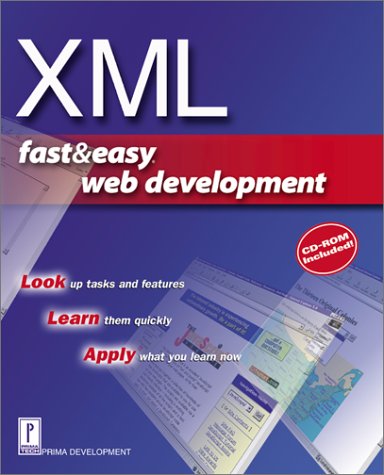
41. Xml Fast & Easy Web Development
$1.00
42. XML and Java: Developing Web Applications
$25.00
43. The LaTeX Web Companion: Integrating
$18.43
44. A Designer's Guide to Adobe InDesign
$2.48
45. Flash and XML: A Developer's Guide
$4.77
46. Visual Basic(R) .NET Developer's
$56.95
47. Efficiency and Effectiveness of
 
$5.95
48. NEW WEB-BASED XML APPLICATION
 
$5.95
49. WORLD WIDE WEB CONSORTIUM ISSUES
 
$5.95
50. WORLD WIDE WEB CONSORTIUM ISSUES
$4.95
51. Cascading Style Sheets: The Designer's
 
$5.95
52. XML: Filling a Data-Description
$39.95
53. Owl: Representing Information
$27.38
54. The XML Schema Companion
$37.80
55. XML and FrameMaker
$6.49
56. Web Application Development with
$0.01
57. HTML 4.0 Intermediate One-Day
 
$9.94
58. New Perspectives on Creating Web
$17.14
59. Cascading Style Sheets for Dummies
$5.42
60. Web-Based Infrastructures: A 4-D

41. Xml Fast & Easy Web Development
by Tim Altom
Paperback: 400 Pages (2002-11)
list price: US$29.99
Isbn: 0761535772
Canada | United Kingdom | Germany | France | Japan
Editorial Review

Book Description
XML can be readily used in a variety of environments and for a range of purposes. Prima Tech's fast & easy approach provides a visual alternative to learning this popular language with step-by-step instructions and actual screen shots. This quick reference is the perfect option for busy Web developers, IT managers, and technical writers--anyone responsible for maintaining and creating documentation and data within an organization. The accompanying CD contains all of the code included in the book. ... Read more


42. XML and Java: Developing Web Applications
by Hiroshi Maruyama, Kent Tamura, Naohiko Uramoto
Paperback: 386 Pages (1999-05-10)
list price: US$39.95 -- used & new: US$1.00
(price subject to change: see help)
Asin: 0201485435
Average Customer Review: 4.0 out of 5 stars
Canada | United Kingdom | Germany | France | Japan
Editorial Review

Amazon.com
Written by three XML researchers from IBM, XML and Java provides a great introduction to the Extensible Markup Language (XML) for the working Java developer. This book proves that you don't have to master all the details of XML to utilize its power for real-world projects on the Web.

After introducing XML and explaining its ability to standardize information exchange in corporate computing, the book turns to today's XML Java parsers, like XML for Java and the Simple API for Java (SAX), which greatly simplify XML development. Using these two APIs, the book shows how to parse an XML document.

Next the authors demonstrate how to create an XML document from scratch as well as modify XML tree structures. They also present a mapping program, which translates XML data from one format to another. (This utility can be used to convert HTML to XML.)

XML can be used to describe content, which the book terms as metacontent. A sample Java servlet listed in the book stores documents posted to a Web site, along with descriptions of its components. JDBC for database programming also receives coverage in an excellent example demonstrating how XML can be parsed into SQL queries and then translated back into other XML documents.

The book also examines how XML exchanges information, principally as an alternative to the Electronic Document Interchange (EDI) format, and then rounds out with XML security, a JavaBeans component version of XML for Java, and a sample Web application that gathers XML content from several travel Web sites. An appendix lists all XML for Java APIs.

In all, with its clear format and standout code examples, XML and Java is an appealing resource for Java developers approaching XML for the first time. --Richard DraganBook Description
XML and Java(tm): Developing Web Applications is a tutorial that will teach Web developers, programmers, and system engineers how to create robust XML business applications for the Internet using the Java technology. The authors, a team of IBM XML experts, introduce the essentials of XML and Java development, from a review of basic concepts to thorough coverage of advanced techniques. Using a step-by-step approach, this book illustrates real-world implications of XML and Java technologies as they apply to Web applications. Readers should have a basic understanding of XML as well as experience in writing simple Java programs.

XML and Java enables you to:

* Develop Web business applications using XML and Java through real-world examples and code* Quickly obtain XML programming skills* Become familiar with Document Object Models (DOM) and the Simple API for XML (SAX)* Understand the Electronic Document Interchange (EDI) system design using XML and Document Type Definition (DTD), including * coverage on automating business-to-business message exchange* Leverage JavaBean components* Learn a hands-on, practical orientation to XML and Java

XML has strong support from industry giants such as IBM, Sun, Microsoft, and Netscape. Java, with its "write once, run anywhere" capabilities, is a natural companion to XML for building the revolutionary Internet applications described in this book. XML and Java demonstrates how developers can harness the power of these technologies to develop effective Web applications. If you want to learn Java-based solutions for implementing key XML features--including parsing, document generation, object tree manipulation, and document processing--there is no better resource than this book.

The accompanying CD-ROM contains extensive cross-platform sample code, plus the latest implementation of IBM's XML for the Java XML processor--fully licensed for commercial use. ... Read more

Customer Reviews (35)

5-0 out of 5 stars One of the best Java/XML books on the market
Even if 9 different authors wrote this book, the logical flow remains intact and the writing style is consistent, clear and concise, without any redundancy. The authors provide plenty of well written, relevant code examples, almost to a level of a cookbook. I was very pleased to see some pretty advanced topics covered in details and, while the focus is on Xerces, JAXP get a good coverage too. In my opinion one of the best Java/XML books on the market

5-0 out of 5 stars Excellent overview of advanced XML for Java developer
I found this book very useful, covers a lot of unique topics
in advanced XML processing, practical and to the point.
Especially enjoyed coverage of advantages and disadvantages
of different techniques.

Would be nice to cover these topics a bit deeper,
little more on architecture.
How about making 3rd edition 1000 pages,
maybe without CD-ROM, put code online
(any XML/Java developer has Internet access now).
And Websphere and DB2 getting outdated very quickly.

5-0 out of 5 stars Get started fast with excellent code
This is the best XML/Java book I've seen to date. Why? It's well written. For example, unlike most books written by more than one or two authors, this book does *not* repeat a lot of material that an author previously addressed. The code contained in the book and on CD is well formatted and doesn't contain a lot of needless fat surrounding the meat; it get's right to the concept they're trying to relate.
I especially liked the chapters written by the lead author (Maruyama) and especially his XML Security chapters. Worth the money - just for the code.
Additionally, the code is well written - example, the import statements list each class; they don't use ".*;"

5-0 out of 5 stars A Clear Exposition on Building Applications on top of XML
[This is a review of the second edition.]
It was with some trepidation that I opened this book. It has 9 authors. Sometimes this many can mean that the style varies widely between chapters, and that there may be little logical continuity. Glad am I to say that this book appears seamless. Thanks probably in part to good editorial management by the publisher.

This is an advanced treatment of XML. It presupposes that you are already familiar with java and XML. The emphasis is on developing higher level applications that use XML as message medium.

As a consequence of 8 of the authors being Japanese, they stress that for internationalisation, XML is a good choice for the medium. It was designed from the ground up to handle Unicode. This is needed to describe Chinese and Japanese, which, out of the major languages, are the hardest to deal with, because of the large number of symbols. You should design your applications to maximise outreach to as large a user base as possible. Native English speakers tend to live in a happy technological cocoon, because leading edge stuff mostly appears first in English speaking countries. It is easy when programming to inadvertantly build into your code restrictions to ascii or extended ascii. Then it becomes much harder larger to remove those. Whereas if you choose XML (andjava), you get internationalisation right out of the box.

The discussion of DOM (Document Object Model) and SAX parsers is very nice. Especially in showing how to add SAX filters, and in quantitative estimates of runtime and memory usage of the two approaches. They make the point that XML processors are the result of intensive intellectual work, and that hence you should use these, instead of writing your own. More reliable, and you can concentrate on higher level issues.

For more advanced XML uses, XML Schemas are described, largely supplanting DTDs, since they allow the easy handling of datatypes (like String and integer) and namespaces.

They give succinct examples of how to connect XML messages to databases via Enterprise Java Beans. In doing so, Java Server Pages and servlets are explained. Very logical progression. Then the Web Services Description Language is introduced, along with showing how to use it with UDDI. Security via XML Digital Signatures and Certificate Authorities is then implemented.

The logic flow is very clear. Plus the accompanying CD with the full example code is a great convenience for learning.

5-0 out of 5 stars The best book on XML Java
This is simply the best book for Java XML. Chapter 2 will guide you through the complacating start-up code and will help you up-and-running in no time. As soon as you finish chapter 2 , u can write a simple but good enough java code to process the xml tree. Chapter 3 is more advanced if you wanna build the xml tree.

I was doing some researches and found this book to be the most helpful book on the market (the other books such as Professional Java XML is the worst book , thus stay away from Professional Java XML because of the lengthy explanation but lacking examples)

There are many parsers for XML, this book focuses on the most popular parser developed by IBM and will prevail over the other parsers. Thus, if you wanna use IBM_developed parsers for your projects, this is the MUST. ... Read more


43. The LaTeX Web Companion: Integrating TeX, HTML, and XML (Tools and Techniques for Computer Typesetting)
by Michel Goossens, Sebastian Rahtz, Eitan M. Gurari, Ross Moore, Robert S. Sutor
Paperback: 560 Pages (1999-06-20)
list price: US$49.99 -- used & new: US$25.00
(price subject to change: see help)
Asin: 0201433117
Average Customer Review: 3.5 out of 5 stars
Canada | United Kingdom | Germany | France | Japan

Customer Reviews (3)

1-0 out of 5 stars out of date, not very useful
This book dates back to 1999, and since I'm writing this in 2006, that's seven years ago. Seven years is a long time for computer documentation. Virtually everything in the book is so far out of date that it's useless. The authors also didn't do a very good job of staying on topic; there are many long digressions that are neither interesting nor useful. In many cases, the authors merely give a broad-strokes outline of how to accomplish a particular task, or talk about several different approaches that have been taken by different people, without concluding with anything very helpful about how to actually accomplish the task.

5-0 out of 5 stars very handy
I am an user of latex on linux for sometime now. The possibillities are uncountable with this excellent software. This book touches on the use of tex and latex for the web. Being not that experienced with all the possibillities this book is very usefull. It is a good introduction for converting latex and tex files to documents for the web. If you can grasp all the stuff in this book you will be able to easily prepare all kinds of documents for the web and in the end save a lot of time lost with programming html yourself.
Don't expect to much examples and user details, it has an excellent index and reference list to get you started.
There is a lot of math stuff in this book, so trying to get a lot of formula's on the web this will certainly be of help. I am not into math so a couple pages could be skipped.
Concluding: want to get started with latex and the web, want to make good documents for the web on a fast and good way, this is the book for you.

5-0 out of 5 stars Almost definitely recommended
I have found this book almost as useful and interesting as the LaTeX Companion. I think that it gives enough information about sharing TeX and LaTeX texts on the web, but the chapters covering pdfTeX and SGML/XMLapplications could be more detailed.
I have found that there is anotherbig problem - with every day coming the information tends to get older andolder. I can fully recommend buying this book today, but I am not sure if Iwould do it once more after half a year has passed.

If you wereinterested in transforming TeX into PDF, I would recommend also the LaTeXGraphics Companion, or some other book introducing the problematic ofPostScript and PDF. ... Read more


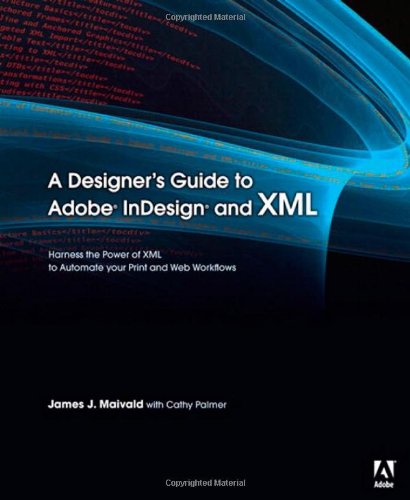
44. A Designer's Guide to Adobe InDesign and XML: Harness the Power of XML to Automate your Print and Web Workflows
by James J. Maivald, Cathy Palmer
Paperback: 336 Pages (2007-12-14)
list price: US$44.99 -- used & new: US$18.43
(price subject to change: see help)
Asin: 0321503554
Average Customer Review: 5.0 out of 5 stars
Canada | United Kingdom | Germany | France | Japan
Editorial Review

Book Description
Is this book for programmers? Written specifically forgraphic designers and production artists already comfortable workingwith Adobe InDesign, this book teaches you how to automate publishingwithout learning a lot of scary code. XML simplifies the process ofmoving content in and out of your layouts and can speed up any print orWeb assignment.

Why should I care about XML? If you’remanaging data-intensive layout projects, and you want to keep that dataconsistent, accurate, and up-to-date, then incorporating XML can help.You can also use XML to automate processes like importing text andlarge numbers of graphics into a layout, or repurposing content fromone application to another. Do I need additional plug-ins or specialsoftware? You need only the powerful features built into InDesign CS2or CS3 to use this book.

How will I learn XML?
Thisguide includes nine easy-to-follow projects with downloadable supportfiles. With these hands-on tutorials, you will learn XML in context. Bythe final project, XML will no longer be a mystery, but a powerful toolyou can use to support your company or clients.

These real-world projects will teach you:
l Business cards: Create a structured layout in InDesign and thenimport XML. Format text automatically and flow the text into multipleexamples.
l Product catalog: Learn how to import XML data into a structured layout using nested styles and cloned text.
l Direct mail and variable data printing: Use XML and InDesign tocreate sophisticated direct mail pieces without costly plug-ins orthird-party software.
l Magazine and newspaper: Build and export magazine-style publications for online distribution.
l Web: Transform XML into XHTML to incorporate directly into your Webpages, or use Cascading Style Sheets to instantly format your exportedXML.
... Read more

Customer Reviews (1)

5-0 out of 5 stars XML for the Rest of Us!
Despite being an Adobe Certified Instructor in InDesign, I never really understood working with XML until I read this book. Maivald and Palmer have taken an otherwise mysterious language and made it clear and understandable for anyone. This book has no peer and is a must for those interested in harnessing the power of XML. ... Read more


45. Flash and XML: A Developer's Guide
by Dov Jacobson, Jesse Jacobson
Paperback: 368 Pages (2001-11-20)
list price: US$39.99 -- used & new: US$2.48
(price subject to change: see help)
Asin: 0201729202
Average Customer Review: 3.5 out of 5 stars
Canada | United Kingdom | Germany | France | Japan

Customer Reviews (21)

1-0 out of 5 stars Not supported any longer
Don't waste your money. This book isn't supported any longer by the author and publisher so the code is no longer on the web. The code inside the book is so disjointed that I found it impossible to follow. They shouldn't be selling expired books.

5-0 out of 5 stars Read this BEFORE you read any other Actionscript books
This book was suprisingly useful. I bought it to understand how to connect Flash to XML server back ends, but it quickly taught me much more that I was not expecting. The true value of this book is teaching how to use Actionscript 1.0 to make Flash Clients talk to servers with the fastest, leanest possible code (Not necessarily XML.)

The author does a great job of teaching how to make reusable, tiny, elegantly structured modules to build a trivia game. The lessons in here should be required reading for any Flash Actionscript programmer BEFORE they can use any fat Actionscript 2.0 components.By reading this book, you can avoid torturing your users with the "Loading Forever" progress bars which result from using Flash without understanding it's elegant, fast loading, optimized roots.

5-0 out of 5 stars A great end- to-end guide
I used this book to add database capabilities to our flash app, and could not have done it with out it. Well, perhaps that's an exaggeration, but it would have taken *significantly* longer.

Getting flash connected to a database requires a combination of good strategy and lots arcane nitpicking details that span multiple knowledge domains. The book brings you along, step by step, in making the app dynamic. The discussions of database design and implementation via PHP and mySQL were very useful.

The book was written during the day of Flash 5, but aside from a couple of outdated screen shots, the ActionScript is current with the version 7.

There were a couple of places where some explanations were a little light, but all in all, it was worth many times the price I paid for it.


3-0 out of 5 stars A disappointing tome
I have to agree with other users who point out the book's awkward construction. It's sort of a mutant blend of a hands-on how-to book and a broader discussion of Flash and XML. As the authors ramble through the creation of an XML-based quiz engine, they abruptly propose different ways of addressing coding issues, then move on to the discussion of another coding aspect without telling you which of the two or three or four options you should have plugged in in order for the next set of code to work with it.

By mid-2004 this approach is even more awkward as you discover that some of the hands-on steps they tell you to carry out no longer work in Flash MX or Flash MX 2004; there's nothing on the cover or the introductory material to warn you that the authors wrote this for Flash 5.

5-0 out of 5 stars Clear and easy to understand.
Authors have deep understanding of the subject, which is
eveident in their clear and simple way of explaining things. ... Read more


46. Visual Basic(R) .NET Developer's Guide to ASP .NET, XML and ADO.NET (White Book)
by Jeffrey P. McManus, Chris Kinsman
Paperback: 608 Pages (2002-03-09)
list price: US$49.99 -- used & new: US$4.77
(price subject to change: see help)
Asin: 0672321319
Average Customer Review: 4.5 out of 5 stars
Canada | United Kingdom | Germany | France | Japan

Customer Reviews (5)

5-0 out of 5 stars Excellent book on ASP, XML, and ADO for VB.Net developers
Every now and then, a book comes along that I feel deserves 5 stars.This is one of those books.This book targets the intermediate Visual Basic.Net developer but someone trying to learn Visual Basic.Net, ASP.Net, ADO.Net, or XML will find that this book is easy to read.Chapters 1 through 10 cover ASP.Net, Chapter 11 covers XML, and Chapter 12 covers ADO.Net. At the end of several chapters, the authors provide a mini-reference.For example, at the end of chapter 11, there is a mini-reference on XML.I use these mini-references on a daily basis. In each chapter the authors have ample examples.The amazing thing is that they all work.I followed every example and with a minor exception of 1 example in the XML Chapter, all of the examples worked.The one exception just required some minor adjustments (using the XML indentation method).This is my first book by Jeffery P. McManus and Chris Kinsman but it won't be the last.I plan to buy their equivalent book on C#.I would also buy any "advanced" books that the authors write.

Pros:Easy to read, ample examples that work, and mini-references at the end of the chapters.

Cons: I would like to see more illustrations in the book.

This book is definitely a "Buy".

5-0 out of 5 stars the rosetta stone!
As an experienced VB and ASP developer, I have spent the last year trying to make some progress in developing ASP.NET applications.5-6 book purchases helped, but I never could really get the hang of it, until I got this book.After a very enjoyable time reading this book, and working through the examples, I am now going back through the other books, getting much more understanding from them.

It's hard for me to say why this book proved to be so much more helpful, but it did.Jeffrey McManus is a good speaker and author, and this is the first book I've read from Chris Kinsman.Maybe it's their language that helped me, maybe it was the subjects they chose to spend time on, but one way or another, this book opened the floodgates for me.

A couple of things I can definitely say that I found to be head and shoulders above other books are:

1) Lack of errors/typos, etc.I'm not saying there aren't any, but this book definitely was not one of those that make it harder to learn simply because you think what you are reading is right, and it isn't.I had zero problems like that.

2) Easy to follow code examples.So many books I've read make their examples too complex, expecting that you know everything that they are doing except for the one narrow thing they are trying to teach you.Like using regular expressions to validate email addresses before you save them to the database, and this in an example of "how to save to the database."This book has none of that junk.Each example cuts to the core of what it is trying to show you, and makes sure to explain it all, step by step.

I can't wait for these guys to team up again.

4-0 out of 5 stars Good reference worth keeping at hand
I would recommend this book for those VB/ASP developers who wish to get a basic guide to migrating to the new .NET technology. It does assume some previous knowledge of ASP development. It is useful as a handy reference for major features of .NET ASP development. I would not recommend it for those just getting started with ASP.NET.

The book is well organized for the amount of subject matter covered. I found it somewhat daunting at first, since the author gets right into the new features of ASP.NET without a lot of background and foundation theory. Some may find this cutting to the chase as a feature, but the subject of migration is no small task.

Going on to the page framework and configuration chapters, however provided a more rewarding journey. The book provides some basic knowledge needed for configuring and deploying an ASP application. This is an important topic that many books do not cover as thoroughly.

The coverage of Web services is quite sufficient to get one started on their way to developing web service based applications. The code examples are well organized and easy to navigate and relate well to illustrate the text. The book is not, however a guide on style or technique - you'll need to develop that elsewhere.

The sections on XML and ADO.NET are enough to get started with a good understanding of how these topics are so importantly tied into ASP.NET applications.

Overall, the authors provide a great deal of detailed information without a lot of unnecessary verbiage. The book makes a reasonably good reference worth keeping at hand. -- Reviewed by Richard S.

4-0 out of 5 stars Very Informative...Easy to Read
This book is very easy to read, and the examples in the book are all easy to follow.It provides enough information for people who are new to .NET and those who need a reference tool. The book has a good background on Visual Basic .NET, ASP.NET, XML, and ADO.NET.Very easy to understand.

Chapter 2 provides good information for migrating from ASP to ASP.NET.It helps ASP 3.0 developers understand the differences between ASP 3.0 and ASP.NET and what needs to be changed.This book also discusses the general idea of Web Services, XML and ADO.NET with very simple examples.Having this makes it very helpful in understanding the corrolation of all the .NET features.You may want to pick up other books if you want to know more about these topics.I was able to use some of the examples in my development work, the examples are very nicely written and very well explained.This book, as is, can be a good tool for both learning .NET and used as a reference in future development work.Irecommend the book. ---Reviewed by Annie W.

5-0 out of 5 stars Money well spent.
This book is good for beginners and mid level .NET developers; it can also be used as a reference, too. It is concise and it contains complete examples (hello W...). The author does not assume that you have VS.NET, which can be a plus for some.

I have other books written by Jeffery McManus. This book is just as good. I would like to see more books written by this author but on the advance side, for those who mainly use VS.NET as their development environment. ... Read more


47. Efficiency and Effectiveness of XML Tools and Techniques and Data Integration over the Web: VLDB 2002 Workshop EEXTT and CAiSE 2002 Workshop DTWeb. Revised Papers (Lecture Notes in Computer Science)
Paperback: 259 Pages (2003-04-28)
list price: US$56.95 -- used & new: US$56.95
(price subject to change: see help)
Asin: 3540007369
Canada | United Kingdom | Germany | France | Japan
Editorial Review

Book Description

This book constitutes the thoroughly refereed joint post-proceedings of the VLDB 2002 Workshop on Efficiency and Effectiveness of XML Tools and Techniques, EEXTT and the CAiSE 2002 Workshop on Data Integration over the Web, DIWeb.

The 10 revised full papers presented were carefully selected during two rounds of reviewing and revision. The papers are organized in topical sections on XML languages, XML modeling and integration, XML storage, benchmarking XML, and data integration over the Web.

... Read more

48. NEW WEB-BASED XML APPLICATION ENABLES DISPARATE SYSTEMS TO SHARE WORKFLOW INFORMATION.: An article from: Software Industry Report
 Digital: 2 Pages (1999-09-20)
list price: US$5.95 -- used & new: US$5.95
(price subject to change: see help)
Asin: B00098Y05Y
Canada | United Kingdom | Germany | France | Japan
Editorial Review

Book Description
This digital document is an article from Software Industry Report, published by Millin Publishing, Inc. on September 20, 1999. The length of the article is 336 words. The page length shown above is based on a typical 300-word page. The article is delivered in HTML format and is available in your Amazon.com Digital Locker immediately after purchase. You can view it with any web browser.

Citation Details
Title: NEW WEB-BASED XML APPLICATION ENABLES DISPARATE SYSTEMS TO SHARE WORKFLOW INFORMATION.
Publication: Software Industry Report (Newsletter)
Date: September 20, 1999
Publisher: Millin Publishing, Inc.
Volume: 31Issue: 18Page: 5

Distributed by Thomson Gale ... Read more


49. WORLD WIDE WEB CONSORTIUM ISSUES XML SCHEMA AS A W3C RECOMMENDATION.(Technology Information): An article from: EDP Weekly's IT Monitor
 Digital: 2 Pages (2001-05-21)
list price: US$5.95 -- used & new: US$5.95
(price subject to change: see help)
Asin: B0008HX4NK
Canada | United Kingdom | Germany | France | Japan
Editorial Review

Book Description
This digital document is an article from EDP Weekly's IT Monitor, published by Millin Publishing, Inc. on May 21, 2001. The length of the article is 549 words. The page length shown above is based on a typical 300-word page. The article is delivered in HTML format and is available in your Amazon.com Digital Locker immediately after purchase. You can view it with any web browser.

Citation Details
Title: WORLD WIDE WEB CONSORTIUM ISSUES XML SCHEMA AS A W3C RECOMMENDATION.(Technology Information)
Publication: EDP Weekly's IT Monitor (Magazine/Journal)
Date: May 21, 2001
Publisher: Millin Publishing, Inc.
Volume: 42Issue: 19Page: 4

Distributed by Thomson Gale ... Read more


50. WORLD WIDE WEB CONSORTIUM ISSUES XML SCHEMA AS A W3C RECOMMENDATION.(Technology Information): An article from: Software Industry Report
 Digital: Pages (2001-05-21)
list price: US$5.95 -- used & new: US$5.95
(price subject to change: see help)
Asin: B0008HX5C0
Canada | United Kingdom | Germany | France | Japan
Editorial Review

Book Description
This digital document is an article from Software Industry Report, published by Millin Publishing, Inc. on May 21, 2001. The length of the article is 549 words. The page length shown above is based on a typical 300-word page. The article is delivered in HTML format and is available in your Amazon.com Digital Locker immediately after purchase. You can view it with any web browser.

Citation Details
Title: WORLD WIDE WEB CONSORTIUM ISSUES XML SCHEMA AS A W3C RECOMMENDATION.(Technology Information)
Publication: Software Industry Report (Newsletter)
Date: May 21, 2001
Publisher: Millin Publishing, Inc.
Volume: 33Issue: 10Page: 8

Distributed by Thomson Gale ... Read more


51. Cascading Style Sheets: The Designer's Edge
by Molly E. Holzschlag
Paperback: 304 Pages (2003-03-11)
list price: US$45.00 -- used & new: US$4.95
(price subject to change: see help)
Asin: 0782141846
Average Customer Review: 3.5 out of 5 stars
Canada | United Kingdom | Germany | France | Japan
Editorial Review

Book Description
CSS is finally supported by all modern web browsers, empowering Web designers to do what they've been hungering to do for years: control layout more precisely, use color more effectively, and expand typographic options beyond the frustrating limitations of the past. So where to begin? Where can you get design-focused instruction on CSS while learning the technical details?

Cascading Style Sheets: The Designer's Edge is precisely the resource you've been looking for. Written by renowned web designer Molly Holzschlag, this book begins with an in-depth look at structured markup, both XHTML and CSS. It then explains how to use CSS to achieve specific design goals involving typography, color, layout, and more. Finally, it deconstructs a series of impressive designs, showing you how the authors used CSS to maximize their efficiency and get exactly the right effect.

Key topics you'll learn about include:
* Writing valid XHTML
* Authoring effective CSS rules
* Working with classes and IDs
* Validating your CSS
* Creating great typographical designs with CSS
* Using CSS for backgrounds, borders, and color
* Creating multiple link styles
* Using absolute positioning
* Working with relative positioning
* Positioning with float
* Creating great CSS layouts ... Read more

Customer Reviews (11)

3-0 out of 5 stars Too Much Fluff
At first glance, I was attracted to this book by its sleek page design. The information is well-organized, sections and chapters are clearly labeled, and there are full-color images included. But upon reading through just part of it, I was disappointed by the amount of pure "fluff" that is included! There is too much info about the history of the internet and html, which I think most people reading this book will already have a handle on. Also, code samples are repeated multiple times, adding a few lines each time, which is totally unnecessary. Finally, there are WAY too many typos! I think a monkey was the editor.

Another complaint I have is that the book doesn't get into the really fun, unique things that you can do with CSS. For a book that claims to be aimed at designers, the samples given are amazingly dull. Don't expect to be wowed! Only in the last two or three chapters are some more advanced techniques shown, and there is no code or explanation of how it's done. (Although a website IS given, and it is accessible at the time that I write this.) Maybe if the book wasn't so redundant about the basics, there would have more room to explain!

Now, having aired my complaints, there are some things I like about the book. Having thumbed through several other CSS manuals, including the much touted Eric Meyers books, I was struck by this books clear explanations and step-by-step examples. It is appropriate for beginners, who won't want to be presented with pages and pages of code. Pictures and colorful borders/highlighting liven up the text.

In sum, I definitely wouldn't pay list price of $45 for this book, but a nice used copy would be great for the beginner CSS writer.

4-0 out of 5 stars Great Book! Terrible Proofreader!
This is perhaps the best book I've seen on style sheets. It isn't overpowering in an attempt to cover EVERYTHING. The author does an outstanding job of showing just how simple style sheets can be. Many other books leave you with the impression that CSS is just another complex web discipline. For me, something very simply expressed in this book suddenly made me "get it" - The fact that background images and colors can be applied to ANY block-level element. This opens up all kinds of design possibilities. My site's table-based layout was so deeply nested that you had to search long and hard just to find the appropriate table data cell to place a sentence in. With this book, which has an entire chapter devoted to deconstructing a table-based layout and reconstructing it with CSS, I was able to reduce my site's pages down to a fraction of their original size, and now the mark-up for those pages looks more like an easy to read text document than a nightmare of table tags. The site looks exactly as intended in all browsers I've tried and has a pristine and sharp appearance. The changeover was fast and easy, and now, because of CSS, changes are as simple as changing a sentence in a document.
My only complaint with this book is that it had a great number of errors in the manuscript: Things like "and" just appearing in the middle of a sentence out of context. It appears that nobody proofread this manuscript. If someone did, he or she needs to go into a different line of work. Proofreaders can't be skimmers. Although this was annoying, and a shame in a large, colorful work, the author's ability to convey the material still came through. Her work was five-star. Sybex's work on getting it ready for print was 2-star at best. Still, it is definitely worth buying and is truly a concise, problem-solving book.

4-0 out of 5 stars Excellent primer on CSS
I grabbed this book at Barnes & Noble and sat in the cafe with a cup of coffee just to check it out. 2 hours later I felt like I had just learned an amazing amount of information.

When I got home I started reading the reviews of this book on Amazon and was dumbfounded by the criticism of this book.

This book is fantastic for the person who hates "computer talk" books. You know what I'm talking about... books that are written so dryly and by people who write so technically that you can barely understand anything you are reading.

This book is like a breath of fresh air. The fact that the author provides a history of SGML, HTML, XHTML, CSS and such is great because it givesyou an underlying basis of knowledge, a foundation from which to grow.

Her style of writing is conversational, perhaps a bit repetitive but that helps drive home the concepts. I did not find it distracting at all. I like this style of writing because it helps me to learn better. The book takes a measured, logical approach to the subject. I put this book down realizing that I had LEARNED the fundamentals of CSS without any confusion whatsoever.

This book is not intended for people already familiar with CSS concepts. It is best for newbies to the subject. I've looked at a lot of CSS books and I would rate this as one of the best I've ever read. Even better than the knowledgable Eric Meyer books. I prefer this author's style of writing compard to Eric's. However, Eric's books are more comprehensive and are better suited for taking you to the next level.

The biggest negative with this book is that there arenumerous typos and errors. an astute reader may pick them out quite easily but it is a very poor reflection on the publisher and that is why I can only rate this book a 4.

5-0 out of 5 stars Solid and Worthwhile Introduction to CSS
For someone new to CSS (and whose genes are not coded in hexadecimal), this is exactly the right book.Instead of providing a semi-random survey of a given technology or an exhaustive listing of its syntax (as so many other computer authors do), this author seeks to provide her readers with an understanding of that technology.Using clear and simple examples, she leads her readers through HTML, XHTML, and CSS in a way that provides a beginner with a solid foundation for understanding how best to approach web page design with CSS.

With this understanding in place, the reader will then be ready to move on to the "Technical Reference Manuals of CSS" that many of the other reviewers of this book seem to wish they had bought instead.

2-0 out of 5 stars Beginners only - and wait for next edition
This book is very beautiful, printed on high quality paper, with high quality screen shots. But it is boring, by repeating the simplest things over and over. If you need to be guided by hand and can't remember what was written on the previous page, you need this book. If you have the slightest idea about CSS already you should put your money elsewhere.

This book could easily be 30% (or more!) smaller. Every sample is repeated, adding one new line to the styles or HTML at the time. Even dummy text is repeated: one half page dummy text is repeated four times! I didn't buy this book to read poetry (or whatever it is).

At the end of the book there's a display of the "gurus" web sites - but not a single line of CSS to show what they did to achieve this! The author doesn't even use her own web site as an example. She could have shown how she built it and why (assuming she knows...?)

I'm sure the author knows CSS inside out (much better than I do). But this book is not for designers nor for implementers. There are no useful, complete samples - a total of seven pages deal with "Experimenting with layout"!!!

Things that are not addressed in this book:
Using alternate style sheets
How to use :focus
The future of CSS - a heads up on CSS2 would have been nice.
How to use attribute selectors (the book says: "The level of control that can be gained by using this type of selector is quite amazing when you think about it". I thought about it, but still think the book should have shown me why it is so "amazing")
How to create ANY layout - you can find the two mentioned on the web in 0.01 second using Google.

Finally, Sybex did a poor job proof reading this book (if they did it!). Beginners should not (and can not?) find and correct errors in code. I wrote Sybex to tell them about 12 specific problems between page 43 and 83 (there are plenty more). They replied "Sorry you didn't like it." ... Read more


52. XML: Filling a Data-Description Gap, Part II.(Technology Information): An article from: Journal of Database Management
by Benjamin Carter
 Digital: Pages (2000-04-01)
list price: US$5.95 -- used & new: US$5.95
(price subject to change: see help)
Asin: B0008GT606
Canada | United Kingdom | Germany | France | Japan
Editorial Review

Book Description
This digital document is an article from Journal of Database Management, published by Idea Group Publishing on April 1, 2000. The length of the article is 3000 words. The page length shown above is based on a typical 300-word page. The article is delivered in HTML format and is available in your Amazon.com Digital Locker immediately after purchase. You can view it with any web browser.

Citation Details
Title: XML: Filling a Data-Description Gap, Part II.(Technology Information)
Author: Benjamin Carter
Publication: Journal of Database Management (Refereed)
Date: April 1, 2000
Publisher: Idea Group Publishing
Volume: 11Issue: 2Page: 30

Distributed by Thomson Gale ... Read more


53. Owl: Representing Information Using the Web Ontology Language
by Lee W. Lacy
Paperback: 302 Pages (2005-01)
list price: US$39.95 -- used & new: US$39.95
(price subject to change: see help)
Asin: 1412034485
Average Customer Review: 4.0 out of 5 stars
Canada | United Kingdom | Germany | France | Japan
Editorial Review

Product Description
Learn how to make your content accessible on the Semantic Web by marking it up using the Web Ontology Language - OWL. ... Read more

Customer Reviews (7)

4-0 out of 5 stars Owl's wisdom
It's a good book, that gives a general overview of semantic web complexities. For people involved it is almost mandatory. As an introduction we would need an user friendly version, with less "syntactical info" and more content oriented and application oriented.
As a technical concern I would be cautious about a "layered" approach to the Semantic Web, instead of a strict layered approach ( remember OSI data communications) I would go to more loosened approach ( remember TCP-IP). But , as a wrap up, it is a very good book. I recommend it.

5-0 out of 5 stars Great overview, valuable information and interesting material
This book is a great tool and asset to have. Understanding the complexity of OWL language and the exciting development on the technologies for building Semantic web is not an easy task.

I really enjoy the writing style of the author who made it easy and as simple as possible for everybody to understand. This is a really great book to have in every teaching class as part of a good introduction of this subject. I really enjoy it and help me a lot to understand how to apply the technology.

3-0 out of 5 stars Be forewarned, amateur publishing has its drawbacks.
On a positive note, this book provided something I needed: a shallow overview of the various technologies comprising the semantic web, from which I can direct my own further in-depth study. After reading this book I will be less clueless in a water cooler conversation about OWL or RDF. For this reason I give it 3 stars and don't wish to trash it entirely.

However, from an instructional standpoint it largely fails to deliver. I had to skip over a great deal of unnecessarily pedantic "faux formal" prose which was useful mostly as sleeping aid. It is neither reference nor tutorial, and I will need further study before making even the simplest use of the technologies discussed. The examples are few, fragmented, and too simplistic to be of much help.

The publisher's note on the inside cover says "This book was published on demand in cooperation with Trafford Publishing." I'm not sure what _on demand_ publishing is all about, but it seems that the book was written and typeset in a word processor's outline mode. I like the idea of grassroots publishing, and I assume that this was a cost effective way for the author to quickly deliver material that is very much needed in the market. However, if you're used to finely crafted and entertaining O'Reilly books, then this one is a bit of a shock. I think the attention of a professional publisher would have produced a book that was easier and more entertaining to read, with a bit of narrative, and a great deal more substantial examples. Pretty text and effective illustrations wouldn't be such a bad thing either, although I mean no insult to whichever of the author's children drew the owl. On the whole, this is not a book that entices me to curl up in front of the fire after a long day to broaden my technical horizons.

2-0 out of 5 stars No better than reading the standards
You would learn more from the Protege OWL pizza tutorials.
The book has no discussion on inferencing or how to actually make an ontology with OWL.
The one example is simply a representation of the hours that a business is open. It could be expressed in plain RDF(S) and does not provide any indication of the power of OWL. For example, it directly specifies the hours for each day. A better example could define hours in terms of the type of day (weekday, weekend, holiday, Thanksgiving) and then infer the hours for each day.
The book uses unusual terminology holonymy, hyponymy, etc. (generalization and composition, respectively)
OWL forms only half the book with the remainder covering URLs, XML,RDF, RDFS. Removing that material would have allowed OWL to be covered in appropriate detail.
Only the XML/RDF serialization is described, which is only used for exchange between tools. There is no discussion of the abstract syntax, N3, Turtle, etc that all provide a more human readable serialization.

4-0 out of 5 stars Good Overview on the Different Technologies Behind the Semantic Web
This book provides an excellent overview on the technologies for building the semantic web.First, the author presents a brief history of the web and explains the concept of the "semantic web."In order to have computers understand web contents and do the corresponding processing of the understood information, such contents cannot be within HTML or XML tags that are only human-understandable.Machines should be able to understand the meanings of those tags through referring to the ontologies behind.Such ontologies are machine-understandable definitions of the concepts and how those concepts are related in the relevant field(s).

Then the author begins the technical explanation on the technologies used for building the semantic web.He starts from URIs and namespaces, then goes up to XML and XMLS Datatypes, RDF and RDF/XML, RDFS and Individuals, OWL, and lastly, applications that can be built to make use of all the layers underneath.When he finishes explaining one layer, he also includes the reasons for the inadequacy of that layer for the semantic web, so as to provide a link to the explanation on the next higher layer.

As for learning the different dialects of OWL, this book is the most detailed with OWL Lite.OWL Lite provides is foundation of OWL DL and OWL Full.The chapters for teaching the OWL language serve as a good introduction before one reads the official OWL manual and OWL language guide.

The writing style of the author is clear and diagrams are provided to give overviews of the different groups of concepts introduced.The complete example about restaurant operating hours at the end is good for enhancing understanding. There are a few typos within some tags in the examples, such as the one on page 167 and there is another one on page 170.
... Read more


54. The XML Schema Companion
by Neil Bradley
Paperback: 336 Pages (2003-11-17)
list price: US$45.99 -- used & new: US$27.38
(price subject to change: see help)
Asin: 0321136179
Average Customer Review: 3.5 out of 5 stars
Canada | United Kingdom | Germany | France | Japan

Customer Reviews (4)

1-0 out of 5 stars Kangaroos jump around less than this book
I purchased this book based upon recommendations listed here on Amazon.I should have looked elsewhere for reviews.This book is absolutely unreadable.The author jumps from topic to topic and then back that it makes my head spin.He refers to future chapters, future concepts, and external resources to distraction.

Specifically, in the midst of discussing simple element constructions, Mr. Bradley includes a paragraph describing television stations in the UK that has no relevance to the examples given.I'm sure he's proud of his heritage and his expertise on television in England, but what does it have to do with XML Schemas or the current example????????

I suspect that Mr. Bradley is a college professor.If he is, he should be forced to sit through recordings of his own lectures.Maybe that would cure him of his unbearable writing style.
.

5-0 out of 5 stars From beginning to the end, XML Schema is explained
Neil Bradley in his fourth book tells you everything you would ever want to know about XML Schemas or better knows as XSD for XML Schema Definition.With the popularity that various XML technologies are attracting these days, every developer, architect and designer needs to know what XML Schema is and how it used.This topic is covered in many other books, but Bradley's book has by far the most extensive, comprehensive and thorough coverage of the topic.It shows that author truly understand the topic at hand, and can convey the message clearly to the reader.The organization of the book starts with the author explaining how the XML Schema standard defines a template that documents created based on that template must conform to, followed by showing the reader how to define reusable data blocks based on the XML Schema language, and it finishes with XML Schema related topic such as namespaces and a rather complete overview what's out there and where to get more information.

Schemas are in a whole different category all by themselves.Every XML document, standard, protocol - basically anything that has anything to do with XML needs to use or to interact with XML Schema in one or another. XML Schemas are used to model both data and narrative XML documents, which means that if you are ever planning on interacting with XML, you better understand XML schemas.I thought that this topic will be very easy, and there is nothing to it... I was wrong.There is a whole lot to cover and once you read Bradley's book you'll know what I am talking about.The standard for schemas is so extensive, that the first few chapters of his book are spent on what the different terminologies mean and how they interrelate.For example, the difference between narrative data (data where the sequence of events and representation matters greatly) and datacenteric documents (order of presenting the data does not matter), and the difference between the schema definition author (the person who creates the schemas) versus the document instance author (people who create well-formed documents) and many others alike.After talking about the basics, the author spends a great deal of time explaining the various components of the XML schema such as elements, attributes, simple data type, complex data types, etc...Understanding these topics is essential in reading the following chapters of the book.
The author uses the same examples throughout the end, so the reader can follow the text and actually understand the topic while the author is presenting it.The code samples are just great.Since the topic is rather abstract, the author had spent a great deal of time using examples to demonstrate the topic at hand better.There were times that I read the example first, and then I went back to read the text, because the visualization is the key in this topic.As with any programming or technical book, the topic and examples start simple and they get much harder as you read the book.The same goes with this book, but the interesting thing is that if you don't know enough about namespaces, the author sends you off to one of the accompanying chapters to read to get ready.The chances are that you don't know enough about namespaces, and the "reference" topics included towards the end of the book become very valuable as you read this book.I thought that I knew namespaces rather well until I read the following:
"... namespaces do not exist as physical entities.There is no namespace definition markup language and no namespace file, object, or interface....namespaces are just a concept.This fact alone has led to much unnecessary confusion..."
In all the books and all the articles and the press and ... that I have read on XML, this little but rather important concept was left out.In one chapter the author has shed more light on a topic of namespaces than an entire book that one would find on the topic.The moral of the story is to read this book cover-to-cover.Even if you think you know it all, still spend the time to read this book.I was amazed at how complicated XML Schemas could get and how powerful they really are.
Some of the advanced topics covered include inheritance and pattern recognition.Both topics are very well explained and covered well.If you know regular expression from Perl, then pattern recognition in schema world would look very familiar to you.The same regular expression rules that are covered in Perl, govern the patterns matching in XML Schemas.What the author adds is concrete examples of how this technique can be used to build powerful schemas.Inheritance is another interesting topic in schemas, as inheritance has made XML schemas very object oriented.Some of your favorite concepts in Java map directly into schemas, and the author actually made table cross referencing the various "key phrases" in Java versus XML Schemas.If you are coming from the OO world of C++ or Java, take a look at this table first.If you are at all familiar with the Eiffel language, you would have a greater appreciation for some of the features of XML Schemas such as the ability to redefine an element or to extend specific parts of a schema.
In closing, if you think you know XML Schema's, think again.This book covers the topic in detail and does so very well.I would recommend this book to be read by any schema designer or a valuable reference for anyone interface with any XML technology.


4-0 out of 5 stars Solid reference work
This is a solid reference work on XML Schema. I wouldn't go looking to it for advice on how to solve particular problems with XML Schema. But if you are looking for a quick reference guide that covers all of the syntax with annotated examples then you have come to the right place. The graphics, which are light-weight and to the point help to illustrate the key points.

Two minor complaints are that the structure of the book is odd (chapters at the end of the book which are clearly appendices are structured as chapters), and the index is also a little short.

On the positive note, XML schema is not a particularly exciting topic and Neil's tone keeps it a light and interesting read.

So far this is the best book I have read on the subject.

4-0 out of 5 stars Namespaces are the key concept
You probably know that XML is descended from SGML, and it thus inherited DTDs, which were then the only means of specifying a document model. That proved adequate for SGML, but its limitations soon became clear in XML. Several alternatives were proposed, but XML Schema seems to be winning. Thus Bradley has delivered a timely exposition. He covers all the features clearly. A brief mention is made of its competitors, Relax NG and Schematron. But they do seem to be fading fast.

The most interesting part of Bradley's text are the chapters on namespaces. Other aspects of Schema are lower level and, while useful, are frankly mundane. By contrast, namespaces are the critical feature of Schema. They let you build on pre-existing schemas that have been published on the web. And you can publish your schemas so that others might benefit. You and those in your field or industry can cooperatively derive a net gain by agreeing and publishing standard definitions. A Network effect.

I assume that you are familiar with HTML. In that, the crucial element are the hyperlinks (the href and src attributes in certain tags). It is these that put the "H" in HTML. Without them, HTML just becomes a limited page markup language. It is that ability to link to arbitrary locations on the Internet which produced the Web. Likewise, in the much heralded Web Services, these exchange data via XML. Which in turn depends on XML Schema to build consistent hyperlinked semantics.

You should read Bradley's chapters on namespaces thoroughly. ... Read more


55. XML and FrameMaker
by Kay Ethier
Paperback: 416 Pages (2004-03-15)
list price: US$49.99 -- used & new: US$37.80
(price subject to change: see help)
Asin: 159059276X
Average Customer Review: 4.5 out of 5 stars
Canada | United Kingdom | Germany | France | Japan
Editorial Review

Book Description

This book is designed to teach anyone working in data-intensive publishing how XML can be leveraged to make the job of presenting data easier. While the XML discussions within the book are general, FrameMaker is used for all of the examples since it supports a wide variety of XML import and export options.

Technology involved: FrameMaker. XML, Windows, Unix

Download Description

This book is designed to teach anyone working in data-intensive publishing how XML can be leveraged to make the job of presenting data easier. While the XML discussions within the book are general, FrameMaker is used for all of the examples since it supports a wide variety of XML import and export options. In addition, Ethier shows you how FrameMaker's powerful formatting features lend themselves to publishing XML documents—without reworking them.

This book is written for a professional audience, including writers, database administrators, developers, and production staff. Ethier also shows you how to

  • Capture or emit XML from existing documents or databases
  • Use XML to create documents that may be published to many other formats
  • Build an “XML round trip” for Adobe FrameMaker 7

Technology Involved
FrameMaker. XML, Windows, Unix

... Read more

Customer Reviews (4)

5-0 out of 5 stars Great Resource
I had been trying to get my hands around Structured FrameMaker for quite some time when I purchased this manual.I am about two-thirds finished with it and I am now successfully creating XML files from FrameMaker.

This manual fills in many holes that I couldn't figure out from the Adobe supplied resources.This manual also has a great tutorial for creating templates that many people may find useful if they are new to template building.

3-0 out of 5 stars Would be better if the sample files were available
No doubt about it, this is a very good book for learning about FrameMaker's interaction with XML. I agree with the other reviewers: this is way better than the info supplied by Adobe in both the FM manual and in the supplementary PDF's that come with FrameMaker. One caveat: the example files available for download from Apress's Web site (the publisher) don't match the narrative in the book. This may be a great disappointment to you as it was to me. Reading along and looking at the pictures in the book was not the same as exploring live examples -- and possibly using them as the basis for my own XML. Still, there were illustrations provided in the book, and with some imagination, there was information to be gained.

5-0 out of 5 stars Saved an outrageous amount of time and frustration
Recently I had to use FrameMaker as authoring tool for DoocBook, it was quite a challenging task because it required learning a lot of new stuff. FrameMaker is a powerful and sophisticated tool, with XML capabilities that were build on top of its SGML legacy, so it's a pretty complex beast to learn. This book was just right on the spot; it allowed me to save an outrageous amount of time and frustration. I don't know if it can be valuable for seasoned FrameMaker users, but I am sure it's a great investment if you have to deal with FrameMaker and XML starting from scratch

5-0 out of 5 stars Debafflement
This is a great introductory crossover text for both xml programmers and FrameMaker users who want a cram course in structured layout. The first third of the book is devoted to FrameMaker for the XML expert-how to set up a document and master pages, create and use style sheets, and manage templates. The rest of the book explains, in clear and concise prose, how to get started with FrameMaker's approach to XML.
Because I am an expert Frame user, I immediately zoomed to the XML stuff, and found it a grand introduction to a complex subject. Before I found this book, I had read the entire 600+-page manual that Adobe supplies with Frame, but didn't feel like I had a solid, fundamental understanding what was going on. After reading this book and working through the tutorials, the information in the user manual suddenly made perfect sense.
This book won't make you an expert in structured FrameMaker-it's a Byzantine subject, complicated by Frame's own quirky implementation (read bugs), plus a startling lack of Frame-specific intro material on the Internet. What it will do, though, is give beginners a good foundation in both Frame and XML. Highly recommended. ... Read more


56. Web Application Development with PHP 4.0 (Landmark)
by Tobias Ratshciller, Till Gerken
Paperback: 416 Pages (2000-07-22)
list price: US$39.99 -- used & new: US$6.49
(price subject to change: see help)
Asin: 0735709971
Average Customer Review: 3.5 out of 5 stars
Canada | United Kingdom | Germany | France | Japan
Editorial Review

Amazon.com
PHP is an open-source Web scripting language that's gaining steam in thedevelopment community, especially in the Apache Web server realm. With a syntaxthat draws heavily on C, PHP appeals to advanced programmers who are moving tothe Web from traditional software development.

Web Application Development with PHP 4.0 isn't your run-of-the-milllanguage tutorial. Authors Ratschiller and Gerken purposely designed its contentto appeal to coders who already are proficient in PHP, but in need of advancedprogramming techniques and high-level application-development skills. Assuming astrong programming foundation, this book can be considered a next-level PHPtutorial.

Drawing on their own experience of what's really important in PHP development,the authors dive into topics such as linked lists and associative arrays. Theyalso weave together topics like security and database access with suchsoftware-development issues as three-tier architecture, versioning, and programrequirements. This balance makes for a nice fit for developers who have masteredthe basics, but are looking to hone their skills to move to the next level.

The book also goes into how to extend PHP by modifying its Zend language enginevia the C source code. A companion CD includes PHP, MySQL, and Apache, as wellas a number of utilities and the source code from the book. If already you'redeep into PHP and want to graduate to guru status, this book's for you.--Stephen W. Plain

Topics covered: Development planning, coding conventions, advanced PHPsyntax, associative arrays, polymorphism and self-modifying code, applicationdesign, HTTP and sessions, PHP normal form, database access with PHP, PHP, andXML, and extending PHP Zend engine.Book Description
As Web sites and intranets become larger and more complex, static HTML files hit their limits. In the first part of Web Application Development with PHP the authors explain PHP's advanced syntax like classes, recursive functions and variables.They present software development methodologies and coding conventions which are a must-know for industry quality products as well as to help making develop faster and more productive.This part covers also many standard algorithms for tree-structures, string sorting and searching.Part Two focuses on the concept of Web Applications (as opposed to single scripts) and gives much insight into user and session management, e-commerce systems, XML applications and WDDX. ... Read more

Customer Reviews (40)

5-0 out of 5 stars An excellent book to upgrade our php skill to the next level
I think this book is a must for every PHP programmer who would like to upgrade their skill to advance level. This book is not for a novice.

If you would like to know the "in and out" of PHP, and becoming expert in PHP, you must buy this book :)

5-0 out of 5 stars You may love or hate this book
You may love or hate this book, since it's not the usual collection of code recipes, it's about application developing, methodologies and good coding practices. Heartily recommended, but only to advanced developers

3-0 out of 5 stars Title is too broad based on material
This book has great content, but the title is too broad for the subject matter.

When I first saw the title of the book, I was excited because I thought it was going to cover PHP web development. Instead, the book explains certain subjects within development, not all "web" development per se either. Talking about proper coding techniques is nice, but not what one would expect based on the title.

I was hoping for coverage on HTTP variables and how to extract data from them when using Form tags. Especially, SELECT tags with multiple selections allowed. Unfortunately, the authors chose to talk about how it works behind the scenes. This is nice to know, but as a developer, I thought the book would have covered more on "development"!

There is some good information on security and on array processing. Its written so the reader can get a good understanding on how web processing is done, problems to avoid, and how to use PHP in a very professional manner. I wouldn't recommend this as a reference book, but as a good book to read for any intermediate or advanced PHP web developer. It could enhance your current skills and coding practices.

As for me, I was hoping for a PHP web development book that provided aspects on using php to build various common web applications, like shopping carts, and how/when to extract HTTP globals, session variables, logins, menus, form tags, etc. This is what I was expecting when I saw the title. While I was dispointed that it didn't cover this material, the book did provide some useful information in certain areas.

4-0 out of 5 stars RE: Good tips and tricks for advanced development.
Definitely not for novices.Is loaded with tips and tricks on data handling, specially liked the session handling techniques in the book.Could've been a bit more in depth though.But good book to get anyhow.

2-0 out of 5 stars Not a PHP4 Book
As another reviewer pointed out, this book was written when php4 was in beta.Despite it's title, this book is NOT a PHP 4.0 book.The extension of every example file throughout the book is .php3. The authors even present a round-about way of maintaining state using the uniqid function and rewriting the url. ??? If you're using PHP3 or if you don't mind filtering out the PHP4 relevant information, you might find this book useful, otherwise look at PHP4 Programming and/or the O'Reilly books. ... Read more


57. HTML 4.0 Intermediate One-Day Course
by DDC Publishing
Spiral-bound: 224 Pages (2000-01-01)
list price: US$30.67 -- used & new: US$0.01
(price subject to change: see help)
Asin: 1562438352
Average Customer Review: 4.0 out of 5 stars
Canada | United Kingdom | Germany | France | Japan
Editorial Review

Book Description
Includes data disk.

HTML 4.0 Intermediate is a continuation of HTML 4.0 Fundamentals. This course teaches students how to create Web sites using more advanced features of HTML 4.0. This full-day course exposes students to frames, advanced frame layout, linking frames, tables, and formatting and nesting tables.

HTML 4.0 Intermediate focuses on the following topics:
Frames
Mixing frame rows and columns
Linking frames
Creating nav bars with linked frames
The NAME and TARGET attributes
New inline frames
Tables
Creating page columns with tables
Spanning table cells over rows and columns
Embedding images and lists in table cells
Nesting tables within tables
Adding color to table cells and rows
Other advanced table functions
Other new features of HTML 4.0
... Read more

Customer Reviews (1)

4-0 out of 5 stars HTML 4.0 Intermediate
The content of the book was easy to understand.Geared toward users with a very basic knowledge of HTML. The layout and format were excellent. My only problem with this book was that the data disk enclosed with the bookdid not match the exercises.I had the same problem with the Fundamentalsbook.I worked around the problem and got the full effect of the lessonsanyway. ... Read more


58. New Perspectives on Creating Web Pages with HTML Third Edition - Introductory (New Perspectives (Paperback Course Technology))
by Patrick Carey
 Paperback: 336 Pages (2002-08-15)
list price: US$38.95 -- used & new: US$9.94
(price subject to change: see help)
Asin: 061910113X
Average Customer Review: 4.5 out of 5 stars
Canada | United Kingdom | Germany | France | Japan
Editorial Review

Book Description
Part of the New Perspectives Series, this text offers a case-based, problem-solving approach to Web site creation using HTML. Includes coverage of XHTML, Web page design and tables. ... Read more

Customer Reviews (4)

5-0 out of 5 stars Definately great for learning on your own
This book is GREAT for self study.I orignally had bought it for a class at college.I found myself reading the book in class instead of listening to the lecture and with some practice at home I was able to learn the firstfour weeks of the class in only a few days.This book is a very good bookfor beginners.The author is very good about explaining the concepts ofHTML by using one main example for each new skill being taught.He couldhave went a little more in depth with frames, but I have yet to find a bookthat explains how to make frames very easily.The author also touches abit of javascript which was nice.Definately worth the money.

4-0 out of 5 stars Good Beginner Book
This book is good for a programmer entering to Web Design. The book gives illustratives examples explaining various facets of HTML and web page design. Explains the concept of table, links, frames very well. Must buythis book if you want to do web programming

5-0 out of 5 stars Excellent for a self-study course!
I thought that this book was very comprehensive and easy to follow.I loved the way they set up a specific case for each tutorial so that you were creating web pages as you learned the new material.

4-0 out of 5 stars A good Book.
This is a good introductory book.Comprehensive and well organized ... Read more


59. Cascading Style Sheets for Dummies
by Damon A. Dean, Ryan Clifford, Bethel Simone Kusz
Paperback: 325 Pages (2001-08-15)
list price: US$24.99 -- used & new: US$17.14
(price subject to change: see help)
Asin: 0764508717
Average Customer Review: 2.5 out of 5 stars
Canada | United Kingdom | Germany | France | Japan
Editorial Review

Book Description
Cascading Style Sheets For Dummies covers the essentials you need to know to incorporate CSS technology into Web projects. This friendly guide covers the enhanced features of the technology that allows you to have total control over the look and feel of your Web projects. ... Read more

Customer Reviews (9)

1-0 out of 5 stars Title Should Say "By Dummies"!
This is absolutely the worst book I have ever attempted to read.I agree with the other reviewers' remarks concerning the author's cutesy feeble attempts at humor.More irritating, however, is his failure to describe adequately the topics on which he touches, and the organization of the book is poor.He tells you part of something in one chapter, and maybe another part of it in another chapter - or not at all.When you apply the instructions he provides, the result often doesn't work, and there is nothing in the book to help you figure out why.

Most of the section headings are extremely stupid puns.Now, I have nothing against puns, mind you, but there is an enormous difference between a smart pun and a stupid one.Damon Dean must not be able to get the smart ones.Yet from a navigational standpoint, using puns in headings is really stupid.The headings are what a reader relies on to locate a topic.Any competent writer knows that.When puns are used in the headings, the reader is at a real loss about the subsumed topic, which completely defeats the purpose of the headings in the first place.

The old adage "If you can't dazzle them with brilliance, baffle them with B. S." no doubt applies here.Generally when a speaker or writer succeeds only in confusing the audience, it's because he doesn't know what he's talking about.I would venture to say that that is the case with Damon Dean.

If this were the only book a person had for learning how to use cascading style sheets, he would give up on the subject altogether before he got halfway through.I, for one, will never waste my money on a "For Dummies" book again!

2-0 out of 5 stars Only if you really are a dummy!
While it's true that the Dummies series are supposed to provide a way for the less-proficient to easily get their feet wet, this installment is so annoyingly scripted as to be headache-inducing. The author attempts to lighten the load by injecting humor into the book. But the jokes are bad and they mostly just clutter the author's run-on sentences. The text is so cutesy at times I found myself actually getting fatigued reading it. This book could be simplified and probably cut down by 50 pages if the author would dispense with the "funny" interjections and just focus on the topic.

Of course, it's just a beginner's guide, so the book serves no practical reference purpose after you get through it.

1-0 out of 5 stars Who edited this book?
The writing in this book is muddy, and like another reviewer here, I had to buy a second book to figure out what this book was saying. Since Dummies books are for beginners, a logical order running from easy to difficult should be used. This author is all over the place.

The above is bad enough, then add to this the obvious fact that the book was merely spell-checked but never looked at by an editor (or at least by one who knows grammar and syntax).

The code isn't consistent, and the index has errors.

Don't buy this book. It was obviously pushed out the publisher's door without any attempt to make sure customers get their money's worth. Don't you get ripped off too.

1-0 out of 5 stars Wow - amazing this ever got published!
The author mingles in many personal remarks which clutters the content substantially, making for a difficult, annoying read.After finding another introductory & intermediate CSS book, & then comparing the two, I can honestly say CSS For Dummies is not organized well, has examples which do not contain vital information or a variety of applications.Based on other books I've own