
|
Help |
| Home - Biology - Bioinformatics (Books) | |
e99 Online Shopping Mall
|
|
Help |
| Home - Biology - Bioinformatics (Books) | |
| 1-20 of 100 | Next 20 |
click price to see details click image to enlarge click link to go to the store
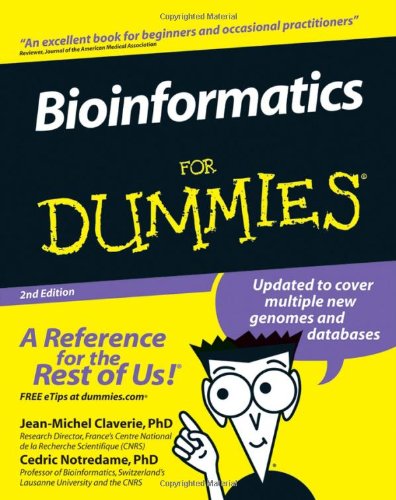
| 1. Bioinformatics For Dummies by Jean-Michel Claverie Ph. D., Cedric Notredame Ph.D. | |
 | Paperback: 456
Pages
(2006-12-18)
list price: US$29.99 -- used & new: US$9.58 (price subject to change: see help) Asin: 0470089857 Average Customer Review: 
Canada | United Kingdom | Germany | France | Japan |
|
Editorial Review Product Description Bioinformatics For Dummies is packed with valuable information that introduces you to this exciting new discipline. This easy-to-follow guide leads you step by step through every bioinformatics task that can be done over the Internet. Forget long equations, computer-geek gibberish, and installing bulky programs that slow down your computer. You’ll be amazed at all the things you can accomplish just by logging on and following these trusty directions. You get the tools you need to: This up-to-date second edition includes newly created and popular databases and Internet programs as well as multiple new genomes. It provides tips for using servers and places to seek resources to find out about what’s going on in the bioinformatics world. Bioinformatics For Dummies will show you how to get the most out of your PC and the right Web tools so you’ll be searching databases and analyzing sequences like a pro! Customer Reviews (18)
| |
| 2. Beginning Perl for Bioinformatics by James Tisdall | |
 | Paperback: 400
Pages
(2001-10-15)
list price: US$39.95 -- used & new: US$25.86 (price subject to change: see help) Asin: 0596000804 Average Customer Review:
Canada | United Kingdom | Germany | France | Japan |
|
Editorial Review Product Description Departing from O'Reilly's earlier monograph Developing Bioinformatic Computer Skills, Tisdall's text is organized aggressively along didactic lines. Nearly all of the 13 chapters begin with twin bullet lists of Perl programming tools and the bioinformatic methods that require them. Likewise, the chapters end with exercises. String concatenation is illustrated with gene splicing, and regular expressions are taught with gene transcription and motif searching. Tisdall emphasizes sequence examples throughout, leading up to an introduction to a Perl interface for the NIH GenBank biological database and the widely used BLAST sequence alignment tool. After a brief discussion of three-dimensional protein structure, he returns to sequence extraction and secondary structure prediction. Tisdall's goal is to boost the beginning programmer into a domain of self-learning. He imparts essential etiquette for the success of programming newbies: use the wealth or resources available, from user documentation to Web site surveys to FAQs to How-To's to news groups and finally to direct personal appeals for help from a senior colleague. A well-plugged-in bioinformatics Perl student will soondiscover Bioperl, an open-source effort to bring research-grade bioinformatic tools to the Perl community. Bioperl is described briefly at the end of Tisdall's book and will reportedly be a forthcoming title of its own in the O'Reilly bioinformatics series. Although he introduces bioinformatics as an academic discipline, Tisdall treats it as a trade throughout his book. He indicates that open questions and computational hard problems exist, but does not describe what they are or how they are being tackled. Ultimately, Tisdall presents bioinformatics as another arrow in a bench scientist'squiver, very much like HPLC, 2D-PAGE, and the various spectroscopies. As odd as a "bioinformatics-as-tool" book may be to its research proponents, the reduction of bioinformatics to trade status both deflates and vindicates the years of research, as Tisdall's work attests. --Peter Leopold Customer Reviews (30)
| |
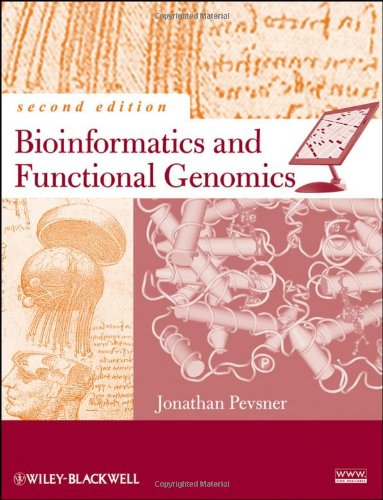
| 3. Bioinformatics and Functional Genomics by Jonathan Pevsner | |
 | Paperback: 992
Pages
(2009-05-04)
list price: US$99.95 -- used & new: US$47.49 (price subject to change: see help) Asin: 0470085851 Average Customer Review:
Canada | United Kingdom | Germany | France | Japan |
|
Editorial Review Product Description Widely received in its previous edition, Bioinformatics and Functional Genomics offers the most broad-based introduction to this explosive new discipline. Now in a thoroughly updated and expanded Second Edition, it continues to be the go-to source for students and professionals involved in biomedical research. This edition provides up-to-the-minute coverage of the fields of bioinformatics and genomics. Features new to this edition include: The book is complemented by lavish illustrations and more than 500 figures and tables—fifty of which are entirely new to this edition. Each chapter includes a Problem Set, Pitfalls, Boxes explaining key techniques and mathematics/statistics principles, Summary, Recommended Reading, and a list of freely available software. Readers may visit a related Web page for supplemental information at www.wiley.com/go/pevsnerbioinformatics. Bioinformatics and Functional Genomics, Second Edition serves as an excellent single-source textbook for advanced undergraduate and beginning graduate-level courses in the biological sciences and computer sciences. It is also an indispensable resource for biologists in a broad variety of disciplines who use the tools of bioinformatics and genomics to study particular research problems; bioinformaticists and computer scientists who develop computer algorithms and databases; and medical researchers and clinicians who want to understand the genomic basis of viral, bacterial, parasitic, or other diseases. Praise for the first edition: "...ideal both for biologists who want to master the application of bioinformatics to real-world problems and for computer scientists who need to understand the biological questions that motivate algorithms." Quarterly Review of Biology "… an excellent textbook for graduate students and upper level undergraduate students." Annals of Biomedical Engineering "…highly recommended for academic and medical libraries, and for researchers as an introduction and reference…" E-Streams Customer Reviews (7)
| |
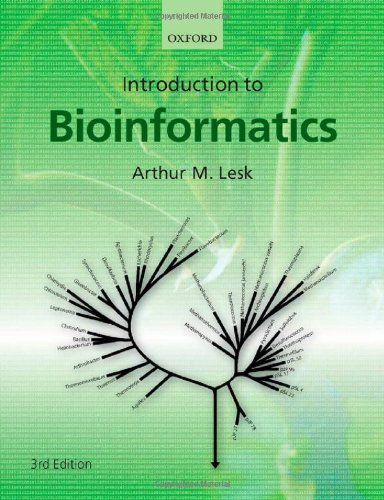
| 4. Introduction to Bioinformatics by Arthur Lesk | |
 | Paperback: 432
Pages
(2008-06-02)
list price: US$49.95 -- used & new: US$38.00 (price subject to change: see help) Asin: 0199208042 Canada | United Kingdom | Germany | France | Japan |
|
Editorial Review Product Description | |
| 5. An Introduction to Bioinformatics Algorithms (Computational Molecular Biology) by Neil C. Jones, Pavel A. Pevzner | |
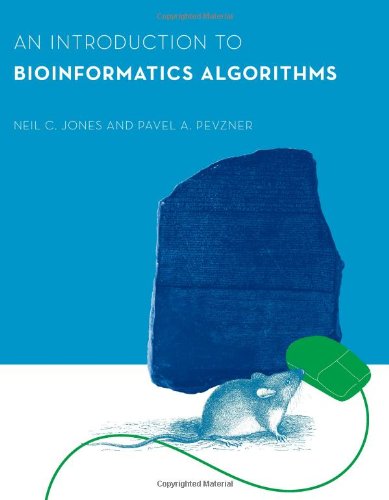 | Hardcover: 454
Pages
(2004-08-01)
list price: US$63.00 -- used & new: US$47.88 (price subject to change: see help) Asin: 0262101068 Average Customer Review:
Canada | United Kingdom | Germany | France | Japan |
|
Editorial Review Product Description Customer Reviews (9)
| |
| 6. Building Bioinformatics Solutions: with Perl, R and MySQL by Conrad Bessant, Ian Shadforth, Darren Oakley | |
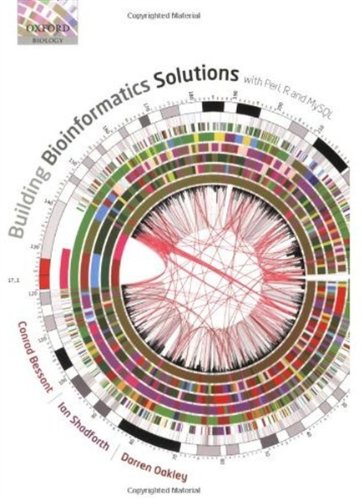 | Paperback: 224
Pages
(2009-02-28)
list price: US$55.00 -- used & new: US$40.89 (price subject to change: see help) Asin: 0199230234 Average Customer Review: 
Canada | United Kingdom | Germany | France | Japan |
|
Editorial Review Product Description Customer Reviews (2)
| |
| 7. Python For Bioinformatics (Jones and Bartlett Series in Biomedical Informatics) by Jason Kinser | |
 | Paperback: 417
Pages
(2008-06-16)
list price: US$69.95 -- used & new: US$22.37 (price subject to change: see help) Asin: 0763751863 Average Customer Review:
Canada | United Kingdom | Germany | France | Japan |
|
Editorial Review Product Description Customer Reviews (2)
| |
| 8. Developing Bioinformatics Computer Skills by Cynthia Gibas, Per Jambeck | |
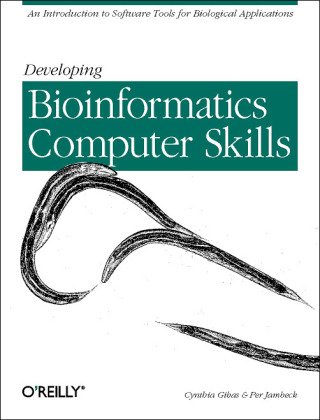 | Paperback: 442
Pages
(2001-04-15)
list price: US$44.99 -- used & new: US$23.89 (price subject to change: see help) Asin: 1565926641 Average Customer Review: 
Canada | United Kingdom | Germany | France | Japan |
|
Editorial Review Product Description Customer Reviews (29)
The 5-star ratings are obvious shills (one reviewer wrote a very long review and has never reviewed anything else)
That said, I found the material a bit uneven. The authors tend to jump from almost trivial stuff to very complex in a heartbeat, and they sometimes use a concept or command before it can be properly understood One example: Introducing the Unix commands head and tail, then moving on to split and csplit. The introduction to regular expressions as needed by csplit follows a few pages later. Nevertheless, I plan to use this book as a companion text to my own sequence of computer classes for biologists, and I think it will serve that purpose very well.
Well, this book is not a self-teaching book by itself. Don't expect that things will become clear to understand after reading this book. If your expectation is just to taste flavor of bioinformatics and to use it as a reference book, then this book is right for you.
However, I think the authors can do a better job in providing more details in certain areas, for example, in Perl programming, and in sequence alignment. Some parts of the book is so simple that the contents in those parts are not quite useful. I would recommend this book to people who are new to Bioinformatics. But not to people who have taken one or two
Bioinformatics is a ripe apple waiting to be eaten. Bioinformatics simply stated is the computational and analytical methods to biological problems. If this sounds like an open ended explanation, it is. In fact, according to O'Reilly's definitive publication on the topic, "Developing Bioinformatics Computer Skills" by Cynthia Gibas and Per Jambeck, there are several different definitions to Bioinformatics, but suffice to say all revolve around applying IT to the management of biological data. Chapters one through six delineate the basics including the typical and common software and hardware requirements for Bioinformatics. I will tell you right now if you want to be successful in this fresh field, you must learn Unix. The book points out why. Unix is used extensively in universities and academia where the abundance of software for scientific data analysis is developed. Not to mention in the mid nineties, the only workstations able to visualize protein data structure in real-time were Silicon Graphics and Sun Unix workstations. Linux fans rejoice! As the book points out, "Linux is an excellent platform for developing software, so there's a rich library of tools available for computational biology and research in general." Sound interesting? At this point you could be overwhelmed and ask yourself, "Where do I start?" Well, you may want to purchase O'Reilly's "Developing Bioinformatics Computer Skills" to see what the fuss is all about, determine whether you have what it takes to succeed in this new field, and most importantly, get an introduction to the software tools for biological applications from the inside out. Bioinformatics is a growing field that will continue for the unforeseeable future. If you're serious about turning around that stagnant IT career and expanding your education, you may find yourself in the same enviable position you were three years ago...needed and wanted! But don't let me mislead you. As the book points out, Bioinformatics is first and foremost a biological science. ... Read more | |
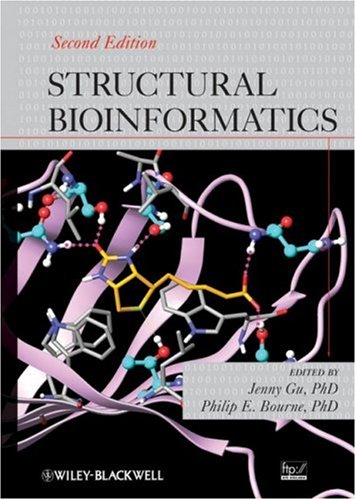
| 9. Structural Bioinformatics (Methods of Biochemical Analysis) | |
 | Hardcover: 1067
Pages
(2009-03-16)
list price: US$99.95 -- used & new: US$69.97 (price subject to change: see help) Asin: 0470181052 Average Customer Review:
Canada | United Kingdom | Germany | France | Japan |
|
Editorial Review Product Description This new edition contains not only thorough updates of the advances in structural bioinformatics since publication of the first edition, but also features eleven new chapters dealing with frontier areas of high scientific impact, including: sampling and search techniques; use of mass spectrometry; genome functional annotation; and much more. Offering detailed coverage for practitioners while remaining accessible to the novice, Structural Bioinformatics, Second Edition is a valuable resource and an excellent textbook for a range of readers in the bioinformatics and advanced biology fields. Praise for the previous edition: "This book is a gold mine of fundamental and practical information in an area not previously well represented in book form.” Biochemistry and Molecular Education “... destined to become a classic reference work for workers at all levels in structural bioinformatics....recommended with great enthusiasm for educators, researchers, and graduate students.” BAMBED "…a useful and timely summary of a rapidly expanding field." Nature Structural Biology "...a terrific job in this timely creation of a compilation of articles that appropriately addresses this issue." Briefings in Bioinformatics Customer Reviews (5)
| |
| 10. Understanding Bioinformatics by Marketa Zvelebil, Jeremy Baum | |
 | Paperback: 798
Pages
(2007-08-29)
list price: US$120.00 -- used & new: US$67.02 (price subject to change: see help) Asin: 0815340249 Average Customer Review:
Canada | United Kingdom | Germany | France | Japan |
|
Editorial Review Product Description Suitable for advanced undergraduates and postgraduates, Understanding Bioinformatics provides a definitive guide to this vibrant and evolving discipline. The book takes a conceptual approach. It guides the reader from first principles through to an understanding of the computational techniques and the key algorithms. Understanding Bioinformatics is an invaluable companion for students from their first encounter with the subject through to more advanced studies. The book is divided into seven parts, with the opening part introducing the basics of nucleic acids, proteins and databases. Subsequent parts are divided into 'Applications' and 'Theory' Chapters, allowing readers to focus their attention effectively. In each section, the Applications Chapter provides a fast and straightforward route to understanding the main concepts and 'getting started'. Each of these is then followed by Theory Chapters which give greater detail and present the underlying mathematics. In Part 2, Sequence Alignments, the Applications Chapter shows the reader how to get started on producing and analyzing sequence alignments, and using sequences for database searching, while the next two chapters look closely at the more advanced techniques and the mathematical algorithms involved. Part 3 covers evolutionary processes and shows how bioinformatics can be used to help build phylogenetic trees. Part 4 looks at the characteristics of whole genomes. In Parts 5 and 6 the focus turns to secondary and tertiary structure – predicting structural conformation and analysing structure-function relationships. The last part surveys methods of analyzing data from a set of genes or proteins of an organism and is rounded off with an overview of systems biology. The writing style of Understanding Bioinformatics is notable for its clarity, while the extensive, full-color artwork has been designed to present the key concepts with simplicity and consistency. Each chapter uses mind-maps and flow diagrams to give an overview of the conceptual links within each topic. Customer Reviews (2)
| |
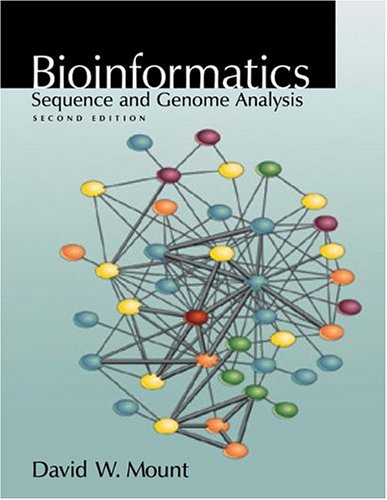
| 11. Bioinformatics: Sequence and Genome Analysis, Second Edition by David W. Mount | |
 | Paperback: 692
Pages
(2004-07-01)
list price: US$95.00 -- used & new: US$87.40 (price subject to change: see help) Asin: 0879697121 Average Customer Review: 
Canada | United Kingdom | Germany | France | Japan |
|
Editorial Review Product Description Customer Reviews (20)
| |
| 12. Mastering Perl for Bioinformatics by James D. Tisdall | |
 | Paperback: 377
Pages
(2003-06)
list price: US$49.99 -- used & new: US$26.89 (price subject to change: see help) Asin: 0596003072 Average Customer Review: 
Canada | United Kingdom | Germany | France | Japan |
|
Editorial Review Product Description Customer Reviews (9)
| |
| 13. Statistical Methods in Bioinformatics: An Introduction (Statistics for Biology and Health) by Warren J. Ewens, Gregory R. Grant | |
 | Hardcover: 588
Pages
(2004-12-21)
list price: US$115.00 -- used & new: US$39.99 (price subject to change: see help) Asin: 0387400826 Average Customer Review:
Canada | United Kingdom | Germany | France | Japan |
|
Editorial Review Product Description Customer Reviews (4)
| |
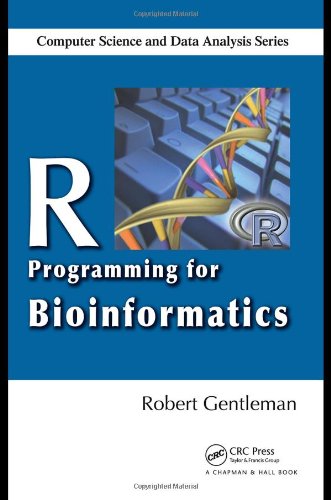
| 14. R Programming for Bioinformatics (Chapman & Hall/CRC Computer Science & Data Analysis) by Robert Gentleman | |
 | Hardcover: 328
Pages
(2008-07-14)
list price: US$73.95 -- used & new: US$62.85 (price subject to change: see help) Asin: 1420063677 Average Customer Review:
Canada | United Kingdom | Germany | France | Japan |
|
Editorial Review Product Description Due to its data handling and modeling capabilities as well as its flexibility, R is becoming the most widely used software in bioinformatics. R Programming for Bioinformatics explores the programming skills needed to use this software tool for the solution of bioinformatics and computational biology problems. Drawing on the author’s first-hand experiences as an expert in R, the book begins with coverage on the general properties of the R language, several unique programming aspects of R, and object-oriented programming in R. It presents methods for data input and output as well as database interactions. The author also examines different facets of string handling and manipulations, discusses the interfacing of R with other languages, and describes how to write software packages. He concludes with a discussion on the debugging and profiling of R code. With numerous examples and exercises, this practical guide focuses on developing R programming skills in order to tackle problems encountered in bioinformatics and computational biology. Customer Reviews (6)
| |
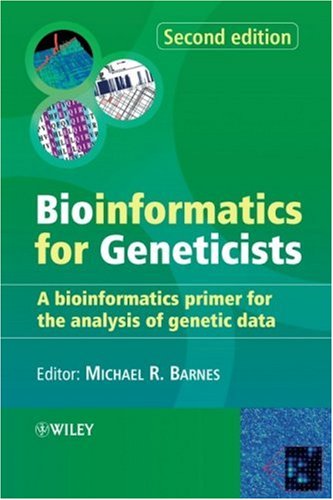
| 15. Bioinformatics for Geneticists: A Bioinformatics Primer for the Analysis of Genetic Data | |
 | Hardcover: 576
Pages
(2007-05-18)
list price: US$220.00 -- used & new: US$173.53 (price subject to change: see help) Asin: 0470026197 Average Customer Review:
Canada | United Kingdom | Germany | France | Japan |
|
Editorial Review Product Description "Without reservation, I endorse this text as the best resource I've encountered that neatly introduces and summarizes many points I've learned through years of experience. The gems of truth found in this book will serve well those who wish to apply bioinformatics in their daily work, as well as help them advise others in this capacity." CIRCGENETICS "This book may really help to get geneticists and bioinformaticians on 'speaking-terms'... contains some essential reading for almost any person working in the field of molecular genetics." EUROPEAN JOURNAL OF HUMAN GENETICS "... an excellent resource... this book should ensure that any researcher's skill base is maintained." GENETICAL RESEARCH “… one of the best available and most accessible texts on bioinformatics and genetics in the postgenome age… The writing is clear, with succinct subsections within each chapter….Without reservation, I endorse this text as the best resource I’ve encountered that neatly introduces and summarizes many points I’ve learned through years of experience. The gems of truth found in this book will serve well those who wish to apply bioinformatics in their daily work, as well as help them advise others in this capacity.” CIRCULATION: CARDIOVASCULAR GENETICS A fully revised version of the successful First Edition, this one-stop reference book enables all geneticists to improve the efficiency of their research. The study of human genetics is moving into a challenging new era. New technologies and data resources such as the HapMap are enabling genome-wide studies, which could potentially identify most common genetic determinants of human health, disease and drug response. With these tremendous new data resources at hand, more than ever care is required in their use. Faced with the sheer volume of genetics and genomic data, bioinformatics is essential to avoid drowning true signal in noise. Considering these challenges, Bioinformatics for Geneticists, Second Edition works at multiple levels: firstly, for the occasional user who simply wants to extract or analyse specific data; secondly, at the level of the advanced user providing explanations of how and why a tool works and how it can be used to greatest effect. Finally experts from fields allied to genetics give insight into the best genomics tools and data to enhance a genetic experiment. Hallmark Features of the Second Edition: Bioinformatics for Geneticists, Second Edition describes the key bioinformatics and genetic analysis processes that are needed to identify human genetic determinants. The book is based upon the combined practical experience of domain experts from academic and industrial research environments and is of interest to a broad audience, including students, researchers and clinicians working in the human genetics domain. Customer Reviews (1)
| |
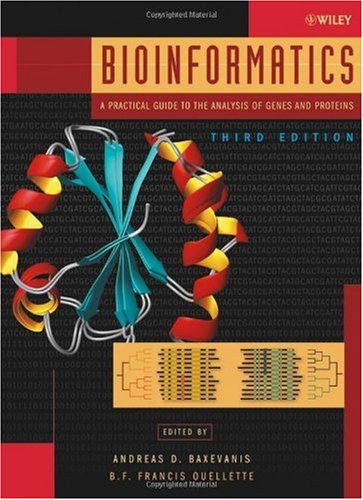
| 16. Bioinformatics: A Practical Guide to the Analysis of Genes and Proteins | |
 | Hardcover: 560
Pages
(2004-10-29)
list price: US$109.95 -- used & new: US$50.50 (price subject to change: see help) Asin: 0471478784 Average Customer Review:
Canada | United Kingdom | Germany | France | Japan |
|
Editorial Review Product Description Customer Reviews (14)
I'd have to agree with the other reviewer that Chapters 1 & 17, which constitute 10% of the book, are wasted paper.No one in 2001 (when the book was published), let alone 2004, needs Chapter 1's lengthy explanation of what e-mail and web browsers are.And the perl program at the anticlimax of Chapter 17 was ... anticlimactic. The book is to a great extent a catalog of available software tools.With the exception of the chapters on multiple alignment and phylogeny, the emphasis is on not on how the tools work but how to operate them -- to the of saying "at this URL there is a web page where you can either paste in your sequence or upload a file".The idea of invoking a program through a Unix command line is more than once presented as a truly daunting prospect.The authors generally do a good job of emphasizing that the programs are the beginning of analysis and not the end; the results must always be viewed somewhat skeptically with an expert eye. If you're coming at the book as a biologist, you will probably find it to be a useful catalog of software, though undoubtedly dated by now.If you're coming at it from the informatics side, you're going to need some background... a book like Dwyer's, Setubal and Meidanis's, or Mount's will get you up to speed on the algorithm aspects of the field with simplified versions of many of the big problems.Then you can look at this book to find good pointers to the ways the real-world versions have been addressed. The book was published three years ago and, being to a large extent an index of the work of others, is necessarily no longer up to date in a fast-moving field.It needs a revision and, in the meantime, it would make more sense to snag a used copy than to pay full price for a new book.
| |
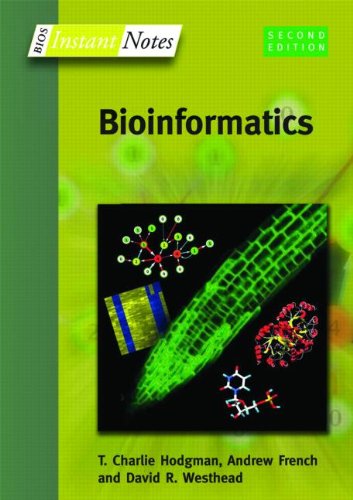
| 17. Instant Notes in Bioinformatics by Charlie Hodgman, Andrew French, David Westhead | |
 | Paperback: 300
Pages
(2009-09-24)
list price: US$40.00 -- used & new: US$29.19 (price subject to change: see help) Asin: 0415394945 Average Customer Review:
Canada | United Kingdom | Germany | France | Japan |
|
Editorial Review Product Description The second edition of Instant Notes in Bioinformatics introduced the readers to the themes and terminology of bioinformatics. It is divided into three parts: the first being an introduction to bioinformatics in biology; the second covering the physical, mathematical, statistical and computational basis of bioinformatics, using biological examples wherever possible; the third describing applications, giving specific detail and including data standards. The applications covered are sequence analysis and annotation, transcriptomics, proteomics, metabolite study, supramolecular organization, systems biology and the integration of-omic data, physiology, image analysis, and text analysis. Customer Reviews (1)
Compared to other primers such as "Developing Bioinformatics Computer Skills", this book contains less unnecessasary figures (e.g., central dogma, etc.), covers wider range of topics, tries to be less verbose. A drawback is that there is little description at an algorithmic level (e.g., dynamic programming). However, the book does a pretty good job in conveying the main ideas about what such algorithms do and why they are needed. I like this book's concise and accurate presentation style much better than lengthy and confusing style found in many other books (e.g., Bioinformatics - David Mount). Another drawback is that font is small. Overall, this book is not bad. I think this book's preface tells you what you can expect from this book, so below I excerpted a paragraph. "We will tell you how to do things, but this is not a software manual for commonly used packages. They have their own manuals that are (mostly) much better than anything we could provide. Many of the methods we describe rely on quite complex mathematical, statistical or computational techniques. Often we choose not to describe these at all, but where we do we have aimed for a simple conceptual understanding." ... Read more | |
| 18. Bioinformatics Programming Using Python: Practical Programming for Biological Data (Animal Guide) by Mitchell L. Model | |
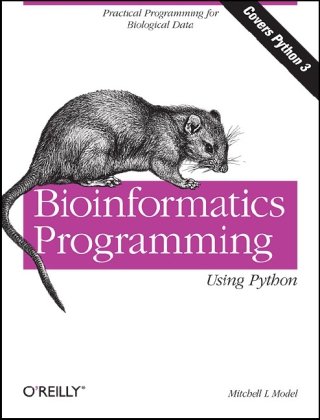 | Paperback: 528
Pages
(2009-12-15)
list price: US$59.99 -- used & new: US$44.38 (price subject to change: see help) Asin: 059615450X Average Customer Review:
Canada | United Kingdom | Germany | France | Japan |
|
Editorial Review Product Description Powerful, flexible, and easy to use, Python is an ideal language for building software tools and applications for life science research and development. This unique book shows you how to program with Python, using code examples taken directly from bioinformatics. In a short time, you'll be using sophisticated techniques and Python modules that are particularly effective for bioinformatics programming. Bioinformatics Programming Using Python is perfect for anyone involved with bioinformatics -- researchers, support staff, students, and software developers interested in writing bioinformatics applications. You'll find it useful whether you already use Python, write code in another language, or have no programming experience at all. It's an excellent self-instruction tool, as well as a handy reference when facing the challenges of real-life programming tasks. Customer Reviews (3)
| |
| 19. Essential Bioinformatics by Jin Xiong | |
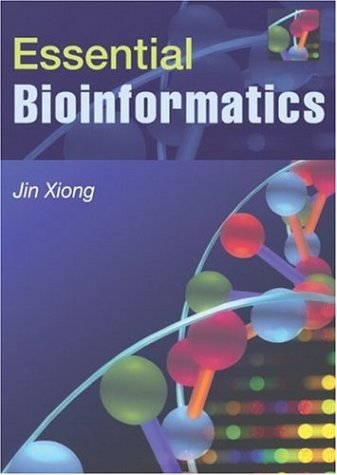 | Paperback: 352
Pages
(2006-03-13)
list price: US$70.00 -- used & new: US$47.06 (price subject to change: see help) Asin: 0521600820 Average Customer Review:
Canada | United Kingdom | Germany | France | Japan |
|
Editorial Review Product Description Customer Reviews (5)
| |
| 20. MicroRNA Profiling in Cancer: A Bioinformatics Perspective | |
 | Hardcover: 300
Pages
(2009-10-01)
list price: US$129.00 -- used & new: US$87.07 (price subject to change: see help) Asin: 9814267015 Canada | United Kingdom | Germany | France | Japan |
|
Editorial Review Product Description | |
| 1-20 of 100 | Next 20 |
 horrible
 One of the worst text-books I have ever read