e99 Online Shopping Mall

Geometry.Net - the online learning center Help  
Home  - Biology - Biotechnology (Books)

  1-20 of 100 | Next 20

click price to see details     click image to enlarge     click link to go to the store

$67.95
1. Best Practices in Biotechnology
$55.00
2. Career Opportunities in Biotechnology
$48.00
3. Building Biotechnology: Starting,
$50.00
4. Molecular Biotechnology: Principles
$40.04
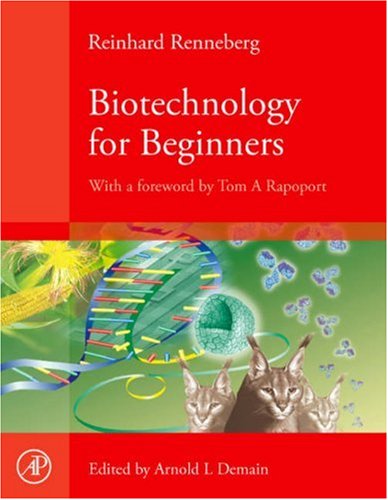
5. Biotechnology for Beginners
$5.99
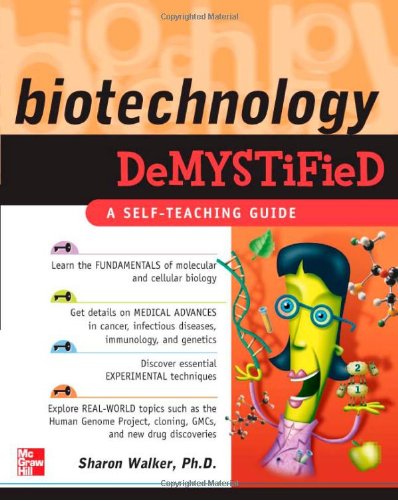
6. Biotechnology Demystified
$53.95
7. Introduction to Biotechnology
$17.31
8. Microbial Biotechnology: Fundamentals
$69.95
9. Biology And Biotechnology: Science,
$91.47
10. Environmental Biotechnology
$60.90
11. Pharmaceutical Biotechnology:
$16.77
12. Building Global Biobrands : Taking
 
$96.95
13. Fundamental Laboratory Approaches
$58.99
14. Basic Laboratory Methods for Biotechnology
$39.60
15. Biotechnology: Demystifying the
$24.69
16. Biotechnology and the Human Good
$8.98
17. From Alchemy to IPO: The Business
$34.46
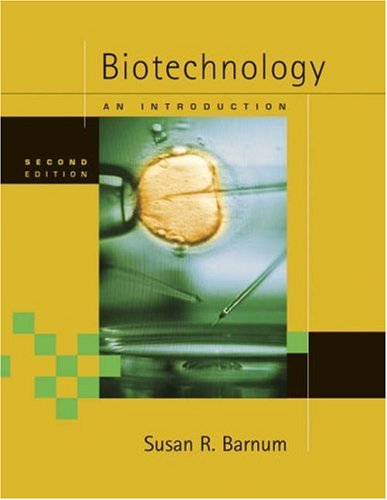
18. Biotechnology: An Introduction
$23.63
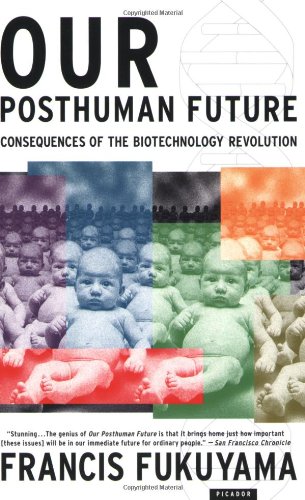
19. Our Posthuman Future: Consequences
$48.00
20. Introduction to Plant Biotechnology

1. Best Practices in Biotechnology Business Development: Valuation, Licensing, Cash Flow, Pharmacoeconomics, Market Selection, Communication, and Intellectual Property
Paperback: 186 Pages (2008-03-01)
list price: US$67.95 -- used & new: US$67.95
(price subject to change: see help)
Asin: 0973467606
Canada | United Kingdom | Germany | France | Japan
Editorial Review

Book Description
These best practices provide a framework upon which to understand critical issues in biotechnology business development. Experts from a wide range of disciplines have composed best practices based on their experiences and expertise, creating a vital toolbox covering a broad spectrum of topics. These best practices will enable you develop a better understanding of the key elements in these operations and empower you to better manage their implementation. ... Read more


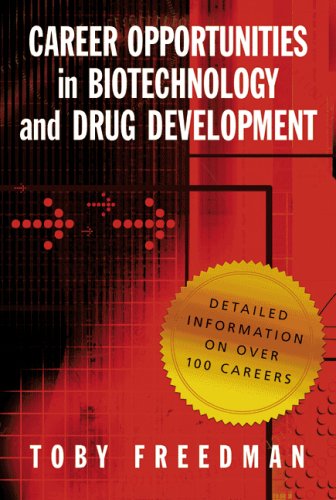
2. Career Opportunities in Biotechnology and Drug Development
by Toby Freedman
Hardcover: 405 Pages (2007-10-01)
list price: US$59.00 -- used & new: US$55.00
(price subject to change: see help)
Asin: 0879697253
Average Customer Review: 5.0 out of 5 stars
Canada | United Kingdom | Germany | France | Japan
Editorial Review

Product Description
As the world of biotechnology has grown in leaps and bounds, so too have the career opportunities. But the choices can be daunting. What types of jobs are available? How do you get your foot in the door? What will your job entail if you become a"Preclinical Project Manager"or a"Process Scientist"? What s the difference between biotech and pharma?

Career Opportunities in Biotechnology and Drug Development provides a comprehensive and systematic overview of careers in the life science industry, with all their ups and downs. The author, Toby Freedman, Ph.D., has conducted interviews with hundreds of key players in the industry, who provide first hand explanations of their day to day roles and responsibilities, and offer key insights into how they landed those jobs in the first place. Careers in everything from discovery research to venture capital are covered in detail.

Each chapter includes valuable sections on preparing yourself for a prospective career: educational requirements and personality characteristics needed; recommendations of books, magazines, and Web site resources; and issues to consider regarding salary and compensation. The book also includes interviewing and job searching tips, as well as suggestions on writing a resume specifically for industry.

Career Opportunities in Biotechnology and Drug Development is an essential guide for science graduates and medical, business, legal, high tech or engineering professionals. With discussions of job security, future trends, and potential career paths, even those already working in industry will find helpful information on how to take advantage of opportunities available within their own companies and elsewhere. This book will help you make wiser and more informed decisions about what role you would like to play in the biotechnology and drug development industry. ... Read more

Customer Reviews (8)

5-0 out of 5 stars Ever dreamed about a job in pharma or biotech?
Many college graduates, and even professionals, often wonder whether working for the pharmaceutical or biotechnology industry is appropriate for them. I am a recent graduate who faced that question. The career and development office at my school recommended Toby Freedman's book "Career Opportunities in Biotechnology and Drug Development". It is the best source of information I have encountered to guide me through the almost endless possibilities of career options in the health care and life sciences industries. By interviewing more than 200 industry executives, she provides in an easy to read format all the information necessary to determine if a career in this industry is for you. It is fun to read and it provides great insight. I highly recommend it.

5-0 out of 5 stars Great biopharma career resource
Career Opportunities in Biotechnology and Drug Development by Toby Freedman, Ph.D. (http://www.careersbiotech.com) is an invaluable tool for anyone pursuing a new career or currently working in biopharma.

Applying for a job is a job in itself. When starting this process, it is difficult to remember everything that needs to be researched and considered for this important life decision. Executive support Web sites like TheLadders.com offer helpful pieces of information, but in this book Dr. Freedman seems to have included everything the job-seeker needs.

The writing style is direct and personal, allowing for quick and enjoyable reading. By the end of Chapter 3, the reader can have a personalized list of to-do items that will increase confidence, and set a realistic expectation of the job seeking experience. Chapter 5 covers the Informational Interview concept. It is a key step in networking that I first learned after paying a career consultant $3,000 after I left clinical practice. Networking is how many people gain entry into biopharma. Part 1 of this book prepares the reader to start networking effectively.

Part II of the book is chaptered by career area over the life cycle of the biopharma product. The reader will gain a clear understanding of each step and how they depend on each other. Chapters are full of definitions and detailed explanations of each role, as well as educational and experience requirements for candidates. Each chapter creates a day-in-the-life-of-this-job picture with pros and cons of the job. Section titles such as "Are You a Good Candidate for Regulatory Affairs?" help readers match position requirements with their personal traits. There is even a list of personal characteristics in each chapter to help rule out a position.

I read the career chapters out of order, starting with the career paths I had always intended to explore. Within the first few paragraphs of each chapter, I was able to decide if this position could work for me. Some of the positions that have always sounded like a fit for me by their name were not even close after gaining the full picture.

Relative salaries and potential career path / job security coverage is realistic and helpful. There is equal weight of discussion across positions from Basic Research roles to CEO and from Discovery stage to Commercial Operations. It even includes Law, Recruiting, and Consulting roles, and advice for non-scientists.

Dr. Freedman interviewed more than 200 people working in biopharma to write this book. In a few hours, readers can leverage this extensive experience for their career planning.

Paul Martinetti, MD
President
Network of Researchers, Doctors, and Scientists
Nords.com

5-0 out of 5 stars Very Informative
So you have a degree in biology or experience in a sector of the biological sciences...what can you do with it? Until I read this book- I pretty much thought i could only 1) go to grad school or 2) become a lab tech.

The book is very helpful in detailing what you can do with your biology degree and even more helpful in helping you decide if this job or that job type is suitable for you.

Book includes flowchart diagrams of where people within the biotechnology and pharma industry can move to in their careers starting from a number of positions ranging from lab technicians and post docs to customer support. Also quite helpful- a list of what traits do and don't' suit a particular career and what to expect of that career choice.


I wish I had this earlier!

5-0 out of 5 stars A great informative book
I learned a lot about the pharmaceutical industry, and am able to navigate my career better after reading the book. Very informative, very easy to read.

5-0 out of 5 stars Great book for those making the career transition
I am making the transition from a career in Hitech to Biotech and found this book to be an amazing resource.First of all, there are techniques for the proper structure and format of your resume as required by this particular field.

The bulk of the book consists of detailed reviews, containing both positive and negative attributes, of all the roles (jobs) that the biotechnology and the pharmaceutical industries have to offer. Unlike most career books this book contains not only the roles and responsibilities but also illuminates the downside or negatives that accompany some positions. Therefore it will greatly help someone entering the field to avoid making a large effort and investment to get a certain type of position only to later find out that they are not tempermentally suited for it. The book is clearly and concisely written with a minimum of fluff but does not get too dry either.A must-have book for anyone thinking of entering the biotech and pharmaceutical industries. I give it five stars. ... Read more


3. Building Biotechnology: Starting, Managing, and Understanding Biotechnology Companies - Business Development, Entrepreneurship, Careers, Investing, Science, Patents and Regulations
by Yali Friedman
Hardcover: 320 Pages (2006-08-01)
list price: US$54.95 -- used & new: US$48.00
(price subject to change: see help)
Asin: 0973467630
Average Customer Review: 4.0 out of 5 stars
Canada | United Kingdom | Germany | France | Japan
Editorial Review

Book Description
Building Biotechnology helps readers start and manage biotechnology companies and understand the business of biotechnology. This acclaimed book describes the convergence of scientific, political, regulatory, and commercial factors that define the scope of biotechnology. In addition to its popularity among business professionals and scientists seeking to apply their skills to biotechnology, Building Biotechnology has also been adopted as a course text in more than fifteen advanced biotechnology programs including MBA programs at UC Irvine, Tepper, and Schulich; the Johns Hopkins biotechnology MS/MBA program; and extension programs at Berkeley and UC San Francisco. This second edition significantly expands upon the foundation laid by the first, updating case law and business models in this dynamic industry and adding significantly more case studies, informative figures and tables. ... Read more

Customer Reviews (16)

5-0 out of 5 stars Very informative overview of the biotech industry
Great book for anyone considering or pursuing a career in biotech/pharma. It covers the basic biology, business and regulatory processes of the industry in a way that is very digestable for a wide array of readers with different backgrounds (i.e. scientists, business professionals, clinicians etc.)It's probably most appropriate for bioscience/business/medical/pharm students, professionals who are fairly new to the industry or to those who already work in the industry but would like to learn a bit more about the others areas of the sector that play significant roles in the research, development & eventually marketing of therapeutic medicines.

5-0 out of 5 stars Great text on many levels.
I have always been interested in the link between a good idea and successful business.This well written text supplies readers with a great overview of biotech, as well as nicely focused examples of the history of the field.
I spent a nice Saturday on the beach reading this book not knowing exactly what to expect.I received an easy to follow enjoyable read that was informative.I ended up reading the entire book twice as well as a number of select chapters numerous times.Each time a picked up the book I got something new out of it.
I would strongly recommend this for any Biotech professional as well as interested MBA students/professionals.It pulls together nicely a number of very important parts to creating a successful start up company (biotech included)
As a scientist my ungood grammar and lack of a more creative summary don't do this outstanding book justice.Worth every penny of $60.

3-0 out of 5 stars Good idea, but fall short on quality.
There are numerous typos, probably one every chapter.The idea behind this book is great, however the author has a very difficult way of explaining the concepts leaving you reading and re-reading sentences over and over again.There needs to be more depth, and a professional review to correct grammer, typo's, and perhaps write more coherently.

The book is good, I would own it, but it really needs major improvments.

4-0 out of 5 stars Good book for a quick, concise overview of the biotech industry
I bought this book for a biotech project management class aside from the required books for the course and found it more helpful than any of the required books (not on project management, but as far as understanding the biotech industry). It provides a very good overview of the biotechnology industry that would be helpful for almost anyone touching this field - investors, professionals considering working in the field, patients considering a new drug therapy or participating in a clinical trial, doctors...I would recommend this book as an excellent first read to get the "lay of the land" followed up by more in-depth research in areas you need/want to know more about. By the way, my whole team ended up using the book to help them each prepare their part of our final project, which was a product development plan that took a novel cancer drug from phase 1 through commercialization. Thus you can see the scope of the book is quite broad and yet direct, the book is only 200 pages plus several useful Appendices (e.g. one is on careers in biotech and another provides and index of websites for different biotech areas).

5-0 out of 5 stars Book Quality
This is in response to the review stating that a book was bound upside down.I would like inform everyone that this was an isolated printer error and in no way reflects the Publishers attention to detail or concerns for quality.Occasionally a make-ready (set-up) copy slips though which is the likely scenario in this case.We (the printer) take full responsibility for any inconvenience or skewed review. ... Read more


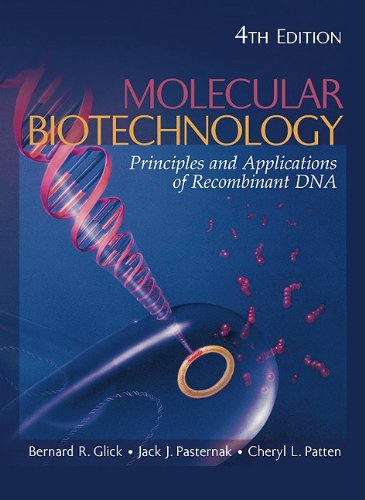
4. Molecular Biotechnology: Principles and Applications of Recombinant DNA
Hardcover: 860 Pages
-- used & new: US$50.00
(price subject to change: see help)
Asin: 1555812244
Average Customer Review: 4.5 out of 5 stars
Canada | United Kingdom | Germany | France | Japan
Editorial Review

Book Description
Completely revised, updated, and expanded, the third edition of thebest-selling Molecular Biotechnology: Principles and Applications ofRecombinant DNA covers the underlying scientific principles and dealsextensively with the many industrial, agricultural, pharmaceutical, andbiomedical applications of recombinant DNA technology. The latest editionoffers greatly expanded coverage of directed mutagenesis and proteinengineering, therapeutic agents, and genetic engineering of plants.Updated chapters reflect recent developments in biotechnology and thesocietal issues related to it, such as cloning, gene therapy, andpatenting and releasing genetically engineered organisms. Over 500figures, including 200 that are new in this edition, illustrate all keyconcepts. "Milestones" summarize important research papers in the historyof biotechnology and their effects on the field. As with previouseditions, the authors clearly explain all concepts and techniques toprovide maximum understanding of the subject, avoiding wherever possibleconfusing scientific jargon and excessive detail. Each chapter concludeswith a summary, references, and review questions. Ideally suited as a text for third- and fourth-year undergraduates as well as graduate students,this book is also an excellent reference for health professionals,scientists, engineers, or attorneys interested in biotechnology. New inthe Third Edition Significantly updated to reflect the advances of thepast five years Various recent examples replace those from the mid-1990sand earlier Over 200 new figures illustrate the added concepts andprinciples Covers the major advances since publication of the previousedition ... Read more

Customer Reviews (4)

5-0 out of 5 stars great
I found the the book in a very good shape. I'm very much satisfied.

5-0 out of 5 stars Fascinating material
I used this book for one of my favorite classes in college on biotechnology.It will show you the cool side of science and all of the neat things you can do with biology and DNA.The level is low enough to where you only need a minimal background to understand it, basic biology classes and preferably genetics.After completing the book you should be excited about the future of biotech, and you will have some understanding about how it works.

5-0 out of 5 stars Good introductory material for the technical
To those who are interested in the functional aspects of the DNA this is the right introductory stuff. It covers areas including basic molecular biology to commercial methods for manipulating the genes. Pretty useful for someone who's more interested in the technology than the biology!

3-0 out of 5 stars Good overview but lacks technical rigor
I am currently using this book for a course in Molecular Biotechnology taught through the chemistry department.Although the book covers a wide range of biotechnology fields, from manipulation of gene expression in prokaryotes and eukaryotes through human gene therapy, it does so in asomewhat shallow and repetitive way.I have also seen clearer and moreconcise diagrams covering similar topics in other biochemistry books, andthere is a paucity of in-depth coverage in any particular area.This isnot necessarily the authors's fault, however, arising from the plethora ofinformation found in the biotechnology field.If someone wants a broadreview of molecular biotechnology, this is a decent book, but if you wantto focus on a specific area within biotechnology, look somewhere else. ... Read more


5. Biotechnology for Beginners
by Reinhard Renneberg
Paperback: 360 Pages (2007-11-22)
list price: US$48.95 -- used & new: US$40.04
(price subject to change: see help)
Asin: 0123735815
Average Customer Review: 4.0 out of 5 stars
Canada | United Kingdom | Germany | France | Japan
Editorial Review

Book Description
Biotechnology is the applied science of using living organisms and their by-products for commercial development. It has grown and evolved to such an extent over the past few years that increasing numbers of professionals work in areas directly impacted by it. For the first time, this book offers an exciting and colorful overview of biotechnology for professionals and students in a wide array of the life sciences including: Genetics, Immunology, Biochemistry, Agronomy, Food Science, and Animal Science. This book also appeals to the lay reader without a scientific background who is interested in an entertaining and informative introduction to the key aspects of biotechnology.

Authors Renneberg and Demain discuss the opportunities and risks of individual technologies and provide historical data in easy-to-reference boxes, highlighting key topics. Biotechnology for Beginners covers all major aspects of the field, from food biotechnology to enzymes, genetic engineering, viruses, antibodies, and vaccines, to environmental biotechnology, transgenic animals, analytical biotechnology, and the human genome. This stimulating book is the most user-friendly source for a comprehensive overview of this complex field.

* Accessible to the lay reader without scientific background knowledge
* Coverage includes all facets of biotechnology applications
* Includes articles from the hottest Scientists: Alan Guttmacher, Carl Djerassi, Frances S. Ligler, Jared Diamond,Susan Greenfield, and more
* Each chapter concludes with a summary, annotated references, links to useful Web sites, and appealing review questions
* More than 600 color figures and over 100 illustrations
* Written in an enthusiastic and engaging style unlike other existing theoretical and dry-style biotechnology books ... Read more

Customer Reviews (6)

4-0 out of 5 stars A book for all who want to know what Biotechnology really is
The book "Biotechnology for Beginners" contains a treasure of knowledge for this interdisciplinary area of science, which makes it a unique book. The multitude of scientific areas making up biotechnology has made it a very hard subject to cover in a comprehensible way in a volume that is not too heavy, both physically and reading it. Many textbooks on Biotechnology are biased with too much molecular biology, forgetting that Biotechnology is so much more, which is shown with abundance in this volume. In this book the use of recombinant DNA is integrated in almost all of the chapters, and then it becomes relevant.The book is well suited for students as an introduction into biotechnology, and also for journalists, policy makers, governmental workers and others that get in contact with the wonderful world of microorganisms and higher cells, and what these are able to do for each of us.

On 360 pages the author and editor give a up to date survey of most of the core areas in which biotechnology has made such a crucial impact on our daily lives.The book is generously illustrated and has very useful "boxes" to cover specific subjects from a historical perspective and they are full of unique information. The whole book is filled with facts, some usually not found in textbooks on Biotechnology. So even though I have been in the field for over 25 years, I found a lot of new information.

It must also be said that there are things to improve, hopefully for the 2nd edition. Specifically there are terms that are used without an explanation. To solve this I suggest a glossary at the start of each chapter with explanation of the key words used in the chapter.Just an example, on page 33 the words enthalpy and non-competitive inhibition are used but not explained whereas hydrophilic and hydrophobic are. There are more cases like this and a glossary would solve this problem.Another problem is that to comprehend some parts of the text you need to have some background knowledge in science, specifically biochemistry, and hopefully today's students have that.

A short remark on the spelling of the synonym for bioreactor. A fermenter is an organism which carries out the process of fermentation. A fermentor is a large growth vessel used to culture microorganisms on a large scale, frequently for the production of some commercially valuable product. In this book fermenter is used for bioreactor throughout. There are also other spelling mistakes which should be corrected in an eventual 2nd edition.

Stefan Rokem
Department of Molecular Genetics and Biotechnology
The Hebrew University of Jerusalem
Israel

5-0 out of 5 stars A sociologist's view
It is often a problem to find books that help you understand the scientific and technical intricacies of a new phenomenon and at the same time shows its historical and social background. Reinhard Renneberg's Biotechnology for Beginners is the best introduction that I have read recently which achieves this purpose eminently. Renneberg takes you on a tour of biotechnology from its origins in fermentation via gene technology to the development of transgenic animals and analysis of the human genome. His core presentation focuses on the scientific explorations and technological achievements, but the supplementary illustrations and boxes presenting historical developments, critical issues or expert opinions enliven the text. Each chapter is also provided with list of recommended literature and websites, together with self-test questions and other aids for discussion of critical issues.

Many popular books on biotechnology tend to engage in partisan discourse on the merits or dangers of the technology, or they try to avoid the controversial issues altogether. Renneberg in my view strikes a good balance, drawing upon many sources of information and opinion.
As a sociologist and historian of science and technology, I am fascinated with the way that he has woven history and persons (and other living organisms) into the presentation of basic facts. In a sense, he complements technical detail with interesting facts about history and social applications in a way that resembles a double helix. The effect is awesome...

3-0 out of 5 stars Can't agree with 1st review
I can't agree with the reviewer above who faulted the translation of the book into `Germlish'. There is no way that reader has to translate each sentence into `true English' as it reads very clearly to me. However, I would agree that the text is a little dry and as such is not as accessible as it could be. I also think the book is more appropriate for undergrad students than for graduates.

3-0 out of 5 stars Misleading title and weak translation
This book is a translation of the German Biotechnologie für Einsteiger published by Spektrum Akademischer Verlag.It contains a broad variety of biotech examples, many historical vignettes, and more graphics and photos than most multi-volume biotech encyclopdias.On the surface it should make for an enlightening and interesting reading experience.

Unfortunately, Biotechnology for Beginners falls short of its potential.For one, it reads more like Germlish than English, and it becomes tiresome to translate each sentence into true English.For another, the book is really an encyclopedia of facts, none addressed in sufficient detail to see how they might fit into a larger picture.The "Beginners" of the title must surely be advanced undergrads or graduate students, since no one without a substantial background in microbiology is likely to benefit in more than a superficial way from this tome.

This is a good book to browse for the interesting fact, figure, or anecdote, but is probably less suitable as a textbook.

5-0 out of 5 stars Cheers!
Science is fun.
Science must make dreams come true, but dreams are images.
Most textbooks forget fun and kill dreams; until now.
Reinhard Renneberg breaks the silencing wall of boredom, boringness, and blindness. His textbook is as funny as a manga, as exciting as Indiana Jones, as titillating as Gustave Klimt, and full of bouquet like a Chateau Latour 1982.
Cheers & Bravo!
... Read more


6. Biotechnology Demystified
by Sharon Walker
Paperback: 276 Pages (2006-08-28)
list price: US$19.95 -- used & new: US$5.99
(price subject to change: see help)
Asin: 0071448128
Average Customer Review: 2.0 out of 5 stars
Canada | United Kingdom | Germany | France | Japan
Editorial Review

Book Description
This self-teaching guide explains the basic concepts and fundamentals in all the major subtopics of biotechnology.The content advances logically from the basics of molecular and cellular biology to more complex topics such as DNA, reproductive cloning, experimental procedures, infectious diseases, immunology, the Human Genome Project, new drug discoveries, and genetic disorders. ... Read more

Customer Reviews (3)

1-0 out of 5 stars What a disappointment
Just to share my experience: Teaching myself biotechnology I had hoped to get a teaching help with this book andgot quite confused after working it through. The MC questions are really misleading. It s a pity... Fortunately, I have had solid knowledge about biotech before reading.
The Series Editors should better ask leading professionals for a review before publishing.

1-0 out of 5 stars biotechnology mystified
I was disappointed with the childish (and confusing) illustrations and more so with the inaccuracies in the basic concepts of DNA that were presented in the first three chapters.While these inaccuracies may not detract from the purpose of the text, they are misleading the reader into a false sense of facts.

4-0 out of 5 stars A study guide for future bioengineers

This book is a study guide that presents examination quizzes at the end of each chapter and a large final exam at the end of the volume. The materials concentrate mostly on the DNA mechanics, monoclonal antibodies, and limited insight into issues of proteomics. Some examples of industrial and medical applications of biotechnology are discussed as well.

Probably the best sections of the book are dedicated to the subjects of stem cells. In particular, the current state of embryonic stem cell research is described very well, including methodological and sociological implications.

Contrary to the subject, this book does not demystify biotechnology, but it gives some insight into what scientists are working on to make this rapidly changing field of science less mysterious.
... Read more


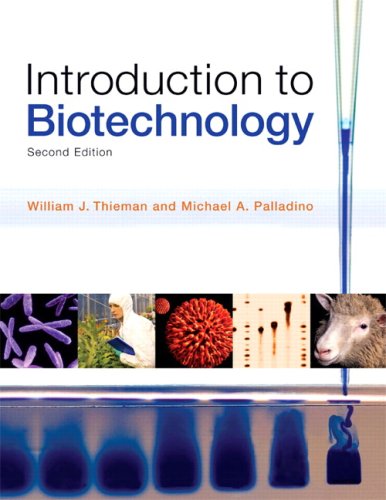
7. Introduction to Biotechnology
by William J. Thieman, Michael A. Palladino, William Thieman
Paperback: 350 Pages (2003-08-08)
list price: US$96.20 -- used & new: US$53.95
(price subject to change: see help)
Asin: 0805348255
Average Customer Review: 4.0 out of 5 stars
Canada | United Kingdom | Germany | France | Japan
Editorial Review

Book Description

Introduction to Biotechnology is the first biotechnology textbook geared specifically for the diverse scientific backgrounds of undergraduate students interested in pursuing a career in biotechnology. With its balanced coverage of basic molecular biology, historical developments, and contemporary applications, the text provides you with the tools and basic knowledge for success in the biotech industry. Author William Thieman chairs one of the leading biotech programs in California (Ventura College), and co-author Michael A. Palladino is a molecular biologist with considerable expertise in directing undergraduate student research in recombinant DNA technology. A comprehensive introduction, including sections on genes & genomes, recombinant DNA technology, forensic analysis, and a variety of biotechnology types such as agricultural and medical. For college instructors, students, or anyone interested in biotechnology.

... Read more

Customer Reviews (2)

4-0 out of 5 stars good textbook for teaching both nonmajors and majors in biology
As a profesor, I use this book in my nonmajors Biology and Society class where it functions well to introduce nonscientist to interesting aspects of biotechnology and the important issues surrounding the science.I also use it in my upper-level genetics class where it works as a nice introduction to biotechnology (and review, in some cases) allowing us to delve deeper into the science and issues using assigned papers. I like it a lot, as do my students; and compared with most textbooks it doesn't cost much. I wish it had more color photographs.

4-0 out of 5 stars How to find a job and make money in biotechnology
The focus of this book is what kinds of jobs and products can be found in the area of applied biology. The science and technology part is found in most of the modern biology texts, but what is lacking is a sense of how to apply that understanding to create new products and solve human problems.

This book is a little pricey and if you are only interested in the science and technology aspect you will be better served by buying a paperback edition of one of the better introductory biology texts. The price of several of the paperback intros to biology are less than this book, have many color plates and in depth coverage more three times the length of this book.

It's that focus on jobs and products that provides the justification for publishing this book. Hopefully it will provoke the authors of the major intro to biology texts to provide more material on where their students can later go for employment and how they can, by giving examples, go on to create products that improve the human condition.

If the reader emerges from their encounter with this book by thinking with an employment and products mindset towards the science and technology of biology than it will have fulfilled (in my mind) what appears to be it purpose. ... Read more


8. Microbial Biotechnology: Fundamentals of Applied Microbiology
by Alexander N. Glazer, Hiroshi Nikaido
Hardcover: 576 Pages (2007-10-01)
list price: US$75.00 -- used & new: US$17.31
(price subject to change: see help)
Asin: 0521842107
Canada | United Kingdom | Germany | France | Japan
Editorial Review

Book Description

Knowledge in microbiology is growing exponentially through thedetermination of genomic sequences of hundreds of microorganisms and theinvention of new technologies such as genomics, transcriptomics, andproteomics, to deal with this avalanche of information.

These genomic dataare now exploited in thousands of applications, ranging from those inmedicine, agriculture, organic chemistry, public health, biomassconversion, to biomining. Microbial Biotechnology. Fundamentals of AppliedMicrobiology focuses on uses of major societal importance, enabling anin-depth analysis of these critically important applications. Some, suchas wastewater treatment, have changed only modestly over time, others,such as directed molecular evolution, or 'green' chemistry, are as currentas today's headlines.

This fully revised second edition provides anexciting interdisciplinary journey through the rapidly changing landscapeof discovery in microbial biotechnology. An ideal text for courses inapplied microbiology and biotechnology courses, this book will also serveas an invaluable overview of recent advances in this field forprofessional life scientists and for the diverse community of otherprofessionals with interests in biotechnology.

... Read more

9. Biology And Biotechnology: Science, Applications, And Issues
by Helen Kreuzer, Adrianne, Ph.D. Massey
Paperback: 669 Pages (2005-07)
list price: US$79.95 -- used & new: US$69.95
(price subject to change: see help)
Asin: 1555813046
Canada | United Kingdom | Germany | France | Japan
Editorial Review

Book Description
Biology and Biotechnology: Science, Applications, and Issues offers aninviting exploration of biotechnology, carefully blending science,consumer applications, regulatory information, and social issues.Providing a strong basis in the fundamentals of biological science, thebook focuses on the material that is needed to understand and evaluatetechnologies that are available to consumers. Biology and Biotechnology is largely intended for ...undergraduate nonmajor science courses; however,biology majors will benefit from the unique perspective. In addition, with its highly readable writing style, this new volume will intrigue membersof the lay public who have little scientific background and seek toeducate themselves on the burgeoning field of biotechnology. ... Read more


10. Environmental Biotechnology
by Bruce E. Rittmann, Perry L. McCarty
Paperback: 768 Pages (2001-01-01)
list price: US$94.49 -- used & new: US$91.47
(price subject to change: see help)
Asin: 0071181849
Average Customer Review: 5.0 out of 5 stars
Canada | United Kingdom | Germany | France | Japan
Editorial Review

Book Description
Written by two of the field's foremost researchers, this comprehensive learning resource presents the biological principles that underlie modern microgbiological treatment technologies designed to improve environmental quality. The first half is focused on the principles, the tools for describing the stoichiometry and energetics of microbial reactions, and for the proper application of kinetics. The second half features applications--with many example problems--to take readers through the procedures to understand how microbial systems work and to design a treatment process. ... Read more

Customer Reviews (1)

5-0 out of 5 stars Excelent Book!!!!
I used this book during my Master in Science (Biofilm modelling). The theory contained in this book is up to date and every chapter in it contains valuable information. It was of great help, chapters are well organized and it covers all important aspects of environmental biotechnology.
A must have for every person related to environmental engineering or sciences. ... Read more


11. Pharmaceutical Biotechnology: Fundamentals and Applications, Third Edition: Textbook Edition
Paperback: 496 Pages (2007-10-30)
list price: US$69.95 -- used & new: US$60.90
(price subject to change: see help)
Asin: 1420044370
Canada | United Kingdom | Germany | France | Japan
Editorial Review

Book Description

Completely revised to reflect significant trends and cutting-edge advances in pharmaceutical biotechnology, including specific therapeutic agents and their applications, this Third Edition provides a well-balanced framework for understanding every major aspect of pharmaceutical biotechnology, including drug development, production, dosage forms, administration, and therapeutic developments. New chapters cover oligonucleotides and siRNA, regulatory issues and drug product approval for biopharmaceuticals, immunogenicity, gene therapy, and various monoclonal antibodies grouped by therapeutic area.Self-assessment questions have also been added to each chapter to reinforce understanding of practical pharmaceutical applications, making this an indispensable volume for classroom use as well as for professional reference in practice or industry.

... Read more

12. Building Global Biobrands : Taking Biotechnology to Market
by Francoise Simon, Philip Kotler
Hardcover: 400 Pages (2003-08-12)
list price: US$35.00 -- used & new: US$16.77
(price subject to change: see help)
Asin: 074322244X
Average Customer Review: 4.5 out of 5 stars
Canada | United Kingdom | Germany | France | Japan
Editorial Review

Book Description
From medicine and defense to food and cosmetics, biotechnological breakthroughs are creating huge new global market opportunities as well as unprecedented challenges. Companies from mega-pharmaceuticals to infotech giants and biotech start-ups must radically rethink their business models. In the first book on the business of biotechnology, Françoise Simon and Philip Kotler combine their biotechnology and marketing ex-pertise to show managers how to innovate with bionetworks, win customers with biobrands, and create sustainable advantage worldwide.

Simon and Kotler explain in clear nontechnical prose how innovation in the new biosector will be driven by a web of cross-industry collaborations, and in particular by three transforming forces: information technology, consumerism, and systems biology. With timely industry cases, the authors demonstrate that by capitalizing on these forces, companies from Hitachi and Siemens to Amgen and Pfizer could become the biotech leaders of the coming decades.

The chapters on building and sustaining biobrands are the centerpiece of this indispensable book. Simon and Kotler present a powerful framework that will enable any manager to redefine and transform traditional models into a new branding paradigm: the global "targeted" model as an alternative to the global "mass market" model. The authors illustrate how each of these models has proven successful in launching such blockbuster drugs as Viagra, Lipitor, Rituxan, and Gleevec.

Relevant to all industries impacted by biotechnology from consumer goods to industrial products, Building Global Biobrands is essential reading for every manager, marketer, analyst, and consultant who must understand the Biotech Century.

... Read more

Customer Reviews (12)

4-0 out of 5 stars A Good Read!
This book, exhaustively researched and daunting to read, sums up all of the most important forces likely to concern a biotech marketer. The authors take a dispassionate, methodical approach, buttress their points with plenty of case evidence and examples, clearly have a grasp of the subject and communicate detailed knowledge of great value to those in the field. Unfortunately, their style is plodding and clinical, replete with passive constructions and impersonal, generally soporific sentences. We believe that those with a real need to know will be glad to brew some strong coffee and grateful to stay the course and become so thoroughly updated. Readers who are intrigued by the field - but not immersed in it - will benefit most from reading the introduction, the first three chapters and the conclusion.

5-0 out of 5 stars A wide and clear-sighted Bio-Business panorama
Françoise Simon and Philip Kotler provide us a concentrate analyse stressed on key-moving-drivers on the Bio-sector. They gave us a wide overview, from R&D leading trend to Marketing implementation and License & Acquisition Business. The two main strengths of this book are the numerous real case studies exposed and the international insight of the whole study(including Europe and Japan).
This book will interest Executives involved in Business Development, Bio-strategy or smart fox wondering what the Bio-sector will look in the fast coming years. This book is different because exhaustive and balanced between Biotech and Big-Pharmas Business model. A unique tool to keep and read again!

5-0 out of 5 stars Outstanding and Insightful
This book is an outstanding resource for anyone in the pharmaceutical or biotechnology industries - or anyone interested in investing in those industries. It provides a wealth of information that cannot be found elsewhere. The analysis of alternative strategies for building stronger product markets is very thorough.

5-0 out of 5 stars A COMPREHENSIVE VIEW OF BIOTECH AND PHARMACEUTICAL MARKETING
This is a very smart book: it is valuable for professionals in all aspects of health care who seek an insight into the global pricing and marketing of medical therapies.

Though not biological scientists, Simon and Kotler impart their treatise with a savvy academic outlook blended with lessons learned in the consulting arena.The authors show an amazing scholarship. They combine knowledge derived from personal acquaintance with key players in the biotechnology and classical pharmaceutical industry with an understanding of the medical applications and implications of drug therapies to weave a rich tapestry of a very complex topic.

Their view ranges from:
· a discussion of the history, politics and costs of biotechnologic research;
· the pricing of new drugs to allow both access and cost recovery (Novartis' introduction of GleevecR);
· the evolution of Big Pharmas' ( e.g. Pfizer, Merck) alliances with smaller bio-tech firms to find innovative therapies,

to the techniques used to maintain brand franchises as patent protection is lost. (Over-the-counter Advil remains a viable brand.)

They are able to keep readers' interest high by providing concise and lively vignettes of many developments in the history of drug introduction and marketing. Among these, they cite:
· Pfizer's promotion of late-entrant LipitorR to become the victor in the statin "races";
· Johnson & Johnson's brilliant recall of TylenolR following deaths due to product tampering and its ability to maintain the brand's prominence for over 30 years; and
· Pfizer's consumer-driven shaping of the market for ViagraR by creatingerectile dysfunction as a new clinical entity.

The future appears to be in the realm of biotechnology with strong BigPharma participation. Whatever the new environment, the basic principles of marketing described in this volume will hold true.

5-0 out of 5 stars Building Global Biobrands: de rigueur for biotech business
Professors Simon and Kotler have done a great job in capturing many of the latest trends in the biotech world, and its continued fusion with the pharmaceuticals business.The thesis of the book is well laid out, and especially useful are the hundreds of company examples and detailed case studies that are used to prove the points.

The book spans the value chain, and offers insights at several levels.I suggest anyone with an interest in the biotech world -- venture capitalists, regulators, entrepreneurs, pharmaceutical company executives, individual investors -- have a reference copy.You will find it to be invaluable! ... Read more


13. Fundamental Laboratory Approaches for Biochemistry and Biotechnology
by Alexander J. Ninfa, David P. Ballou, Marilee Benore Parsons
 Hardcover: 404 Pages (2008-04-11)
list price: US$96.95 -- used & new: US$96.95
(price subject to change: see help)
Asin: 0470087668
Average Customer Review: 3.0 out of 5 stars
Canada | United Kingdom | Germany | France | Japan
Editorial Review

Book Description
Written by active scientists, this book provides readers with a logical framework for conducting modern biochemical and molecular biology research. The authors write with passion, and their love of biochemical research shines through on every page. ... Read more

Customer Reviews (1)

3-0 out of 5 stars i sold this book after i graduated college
now i'm in a field where i wish dearly that I still had it. it's pretty general, and that's why i like it. ... Read more


14. Basic Laboratory Methods for Biotechnology
by Lisa A. Seidman, Cynthia J. Moore
Spiral-bound: 751 Pages (2000-01-19)
list price: US$73.80 -- used & new: US$58.99
(price subject to change: see help)
Asin: 0137955359
Average Customer Review: 5.0 out of 5 stars
Canada | United Kingdom | Germany | France | Japan

Customer Reviews (2)

5-0 out of 5 stars Review:
This is a required college textbook for my daughter.I'll try and remember to let you know if she passes the class.

5-0 out of 5 stars A Keystone For The Laboratory
When I first started work in a lab as an undergrad, I would often learn of crucial tricks after I had already messed up a procedure and lost an hour or more of work. It's ironic how dependent molecular biologists are on that most ancient means of communication: oral tradition.

When I took a biochem lab, I was introduced to the Seidman and Moore text, which is a fantastic teaching source. For the beginner, this book has chapters on basic units of measurement and mathematics, laboratory organization and regulation (including the government bodies which oversee lab safety), writing standards, and web etiquette. No stone is unturned! Even after one gets the basics mastered, this book has tables on plastics and buffers, showing how they react to heat, light, and other critical data--my biochemistry instructor was even suprised by some of the information on plasticware! This is a companion for one's career in the lab. ... Read more


15. Biotechnology: Demystifying the Concepts
by David Bourgaize, Thomas R. Jewell, Rodolfo G. Buiser
Paperback: 416 Pages (1999-10-01)
list price: US$105.60 -- used & new: US$39.60
(price subject to change: see help)
Asin: 0805346023
Average Customer Review: 4.5 out of 5 stars
Canada | United Kingdom | Germany | France | Japan

Customer Reviews (2)

5-0 out of 5 stars Excellent overview of the subject matter and well written!
The text provides an excellent overview of biotechnology for a person at the College level. The book is probably too shallow in depth for someone who wants to actually major in the subject matter. Nonetheless, the book serves its intended purpuse well to introduce biotechnology at a reaonably sophisticated level to the student. The book starts with the basics of organic chemistry principles and expands them to biochemistry. Well done!
All the important technological and commercial concepts relevant to biotechnology are present and explaned well through text as well as diagrams. Perhaps one aspect that science books don't emphasize is writting style. The books is extremely clear and well written and can probably serve as an example of good technical writting style. I highly recommend the book to anyone who is serious about wanting to understand Biotechnology. As long as you hand Freshmand chemistry this book should serve you.

4-0 out of 5 stars Just the basics
If you are looking for a clear and interesting summary of many key concepts of Biotechnology, this book is for you. The author does a nice job of distilling the important concepts for both the scientist and layman alike. For the scientist, the book provides a nice review of the basics, and for the layman, it explains many difficult principles. At the end of each chapter the author also provides a lively discussion of some interesting practical applications and problems solved by Biotechnology. ... Read more


16. Biotechnology and the Human Good
by C. Ben Mitchell, Edmund D. Pellegrino, Jean Bethke Elshtain, John Frederic Kilner, Scott B. Rae
Paperback: 210 Pages (2007-05-15)
list price: US$24.95 -- used & new: US$24.69
(price subject to change: see help)
Asin: 1589011384
Average Customer Review: 5.0 out of 5 stars
Canada | United Kingdom | Germany | France | Japan

Customer Reviews (1)

5-0 out of 5 stars Essential for college-level science libraries
Great scientific and technological advancements benefiting mankind have come from biotech labs - but also some of the greatest ethical concerns have accompanied them, unfortunately. BIOTECHNOLOGY AND THE HUMAN GOOD charts the latest arguments over recent developments in reproductive and genetic science, building a case for stewardship routed in Judeo-Christian theism. What is science's responsibility in promoting the greater good? BIOTECHNOLOGY AND THE HUMAN GOOD is essential for college-level science libraries; particularly those interested in some of the religious foundations of bioethical concerns. ... Read more


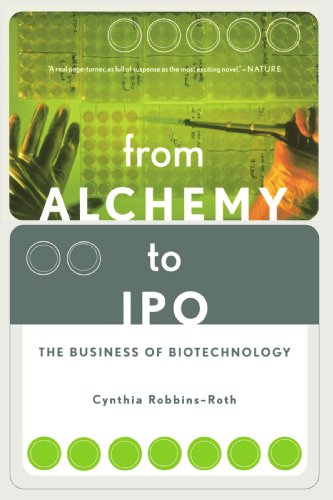
17. From Alchemy to IPO: The Business of Biotechnology
by Cynthia Robbins-Roth
Paperback: 272 Pages (2001-04)
list price: US$17.50 -- used & new: US$8.98
(price subject to change: see help)
Asin: 073820482X
Average Customer Review: 4.0 out of 5 stars
Canada | United Kingdom | Germany | France | Japan
Editorial Review

Amazon
Despite unnerving swings in individual stock valuations--or perhaps because of them--many knowledgeable observers still believe the 21st century will ultimately earn its stripes as the Age of Biotech. Cynthia Robbins-Roth, named by Forbes magazine as one of the industry's top insiders, certainly is among them. And in From Alchemy to IPO, she persuasively argues investors better take heed because they ain't seen nothin' yet. "Most of us think of biotech as medicine or genetically engineered crops," writes Robbins-Roth. But in the very near future, she continues, it also "may make it possible for humans to reach the stars and to change the environment on other planets." Think that's far-fetched? She says developments like this are already in early stages and, in a deliberately proselytizing manner, traces their roots to the current business nitty-gritty, finally focusing on the long-term moneymaking potential. "The biotech world will never be an easy place for investors," she cautions, but with hundreds of ongoing projects "poised to power into the marketplace," there will be plenty of "opportunities for investors and employees alike."Recommended for readers seeking an informed tutorial on this field of the future. --Howard Rothman Book Description
A fascinating glimpse inside the life-and-death business of biotechnology.

"A tour-de-force for anyone who is interested in the biotech industry. I applaud the enormous achievement of Cynthia Robbins-Roth." -Frederick Frank, Senior Managing Director & Vice Chair, Lehman Brothers

"From Alchemy to IPO tells the dramatic story of this revolutionary industry as only an insider can." -George Rathmann, President and CEO, ICOS Corporation, Chairman Emeritus, Amgen

Written by a well-known industry insider, From Alchemy to IPO addresses the coming-of-age of biotech products and companies and traces the history of biotechnology from its early inception in the seventies to today's heyday of new solutions and breakthrough treatments. It describes the amazing entrepreneurial trail of product development, novel business models, and critical trials that eventually pave the way to market. This is the first book to accurately record the inner workings of an industry-biotechnology-that's on the verge of living up to its monumental promise to change the world as we know it. ... Read more

Customer Reviews (21)

4-0 out of 5 stars Good introductory text and overview of the industry
I read From Alchemy to IPO for an MBA course on entrepreneurialism in the pharmaceutical industry. Given my background (undergraduate business, financial analyst role, limited in-depth scientific knowledge), I found this book to be a very useful and balanced guide to both the business and technical aspects of biotechnology.

Robbins-Roth includes enough information on initial public offerings (IPOs) and merger activity among biotech firms to warm the hearts of the most resolute business student, but the drug discovery and development process is also covered in sufficient detail to give the lay reader an understanding for the operational challenges faced by firms in this sector.

Add to this the competent yet necessarily superficial descriptions of more esoteric terms such as monoclonal antibodies and combinatorial chemistry, and you have a solid text that covers the industry and its ongoing challenges very well.

4-0 out of 5 stars Brilliant Overview
This is a great overview of the world of biotech.The author explains the science with clarity and enthusiasm and the introduction this book provides to the corporate side of biotech is also very interesting and well written.

2-0 out of 5 stars bad writing
I read the first 20 pages of this book and quit.It was too painful to keep going.The author's wording in convoluted, tangential, and just plain annoying.She throws out dozens of names from the industry, so many you can't keep them straight.There is poor flow to the writing, so you cannot understand why she is telling you things from one line to the next.The topics of each paragraph jump from one subject to another with abrupt, confusing transitions.I returned the book!

5-0 out of 5 stars Clear and non hyped intro into biotech
I'll be starting a biomedical engineering Ph.D. program in the fall and have read recently a few books on the biotech subject.This one gave the clearest picture of the biotech industries, the companies in them, how to manage and finance them, as well as how to recognize solid biotech companies for investing purposes.A quick and entertaining read for anyone interested in the business behind biotechnology.

2-0 out of 5 stars WAY OVERRATED BOOK ON BIOTECH
to quote another user: "The author's expertise in science, finance, management strategy, and journalism..." the author can write decently and she may know about biotech (hard to judge for me not being a scientist)...BUT her knowledge about management strategy and finance is limited at best...that wouldn't be so bad if she were to stick to write about science...however, she thinks she knows about finance and strategy...who wants to read about strategy should stick with hamel, pralahad, porter etc., who wants to read about finance (valuation) should stick with copeland et al, and who wants to read about ipos should try articles by jay ritter. ... Read more


18. Biotechnology: An Introduction (with InfoTrac)
by Susan R. Barnum
Paperback: 336 Pages (2004-03-09)
list price: US$86.95 -- used & new: US$34.46
(price subject to change: see help)
Asin: 0534492967
Canada | United Kingdom | Germany | France | Japan
Editorial Review

Book Description
Biotechnology instructors require currency, sound pedagogy and a brief objective introduction to a broad range of topics and technologies. Students need an accessible and clear presentation along with hot topics and real-world examples. Susan Barnum meets all these requirements and needs in this second edition of her enormously popular text, BIOTECHNOLOGY: AN INTRODUCTION, Second Edition.Barnum offers a broad view of biotechnology, integrating historical and modern topics. She then describes the processes and methods used to manipulate living organisms or the substances and products from these organisms for medical, agricultural, and industrial purposes. Using case studies and examples, the author rounds out discussions by detailing the technology and how it is applied, including discussions on the implications of biotechnology in such areas as gene therapy, medicine, agriculture, marine biology, and forensics.More complex and difficult-to-teach topics are given special coverage, by providing outlines, bulleted lists, and tables for simplifying and clarifying topics such as immunology, construction of recombinant DNA molecules, relevant lab techniques, monoclonal antibodies, and plant transformation/regeneration. Besides the addition of color, this new edition places more information in boxes to focus on the process of science, the accomplishments of researchers in the field, and real-world examples of biotechnology. In addition, Susan Barnum extends her already excellent objective coverage of the ethical and social implications of biotechnology by focusing on the most relevant topics in a sidebar in each chapter. Commercial, economical, and medical effects of current biotechnology practices are also made clearer and more relevant for students. ... Read more


19. Our Posthuman Future: Consequences of the Biotechnology Revolution
by Francis Fukuyama
Hardcover: 272 Pages (2002-04-17)
list price: US$25.00 -- used & new: US$23.63
(price subject to change: see help)
Asin: B0000BYPNP
Average Customer Review: 3.5 out of 5 stars
Canada | United Kingdom | Germany | France | Japan
Editorial Review

Amazon.com
Maybe we have a future after all: Our Posthuman Future is political historian Francis Fukuyama's reconsideration of his 1989 announcement that history had reached an end. He claims that science, particularly genome studies, offers radical changes, possibly more profound than anything since the development of language, in the way we think about human nature. He makes his case thoroughly and eloquently, rarely dipping into philosophical or critical jargon and consistently maintaining an informal tone.

Fukuyama is deeply concerned about the erosion of the foundations of liberal democracy under pressure from new concepts of humans and human rights, and most readers will find some room for agreement. Ultimately, he argues for strong international regulation of human biotechnology and thoughtfully disposes of the most compelling counterarguments. While readers might not agree that we're at risk of creating Huxley's Brave New World, it's hard to deny that things are changing quickly and that perhaps we ought to consider the changes before they're irrevocable. --Rob LightnerBook Description
A decade after his now-famous pronouncement of 'the end of history,' Francis Fukuyama argues that as a result of biomedical advances, we are facing the possibility of a future in which our humanity itself will be altered beyond recognition. Fukuyama sketches a brief history of man's changing understanding of human nature: from Plato and Aristotle to the modernity's utopians and dictators who sought to remake mankind for ideological ends. Fukuyama argues that the ability to manipulate the DNA of all of one person's descendants will have profound, and potentially terrible, consequences for our political order, even if undertaken with the best of intentions. In Our Posthuman Future, one of our greatest social philosophers begins to describe the potential effects of genetic exploration on the foundation of liberal democracy: the belief that human beings are equal by nature.Download Description
Fukuyama, our greatest social philosopher, weaves a captivating argument centered around an essential question: how the ability to modify human behavior will affect liberal democracy. ... Read more

Customer Reviews (34)

1-0 out of 5 stars Logically unsound neo con ranting
This book is full of things like "human dignity" that the author can't define properly. Building an argument on vague terms is not convincing. It pains me that this man thinks he is a bioethicist... He's a fundamentalist neocon who is not interested in logic. A waste of time.

4-0 out of 5 stars oops---history is not ended
About fifteen years ago Francis Fukuyama, professor of Political Economy at Johns Hopkins University, published a controversial book in which he argued that humanity had made no significant political progress since the French Revolution and that the collapse of communism in 1989 signaled the "end" of history.By "end" Fukuyama meant that western, liberal democracy had triumphed over all political options.

Now he has revised his thesis, not because he thinks it was wrong, but because he failed to factor in the role of science as perhaps the chief engine that drives human history.Science drives any number of interests---technological, economic, ethical, social, and so on, but Fukuyama's concern is that it is increasingly driving our political life.If biotechnology alters human nature, then it will alter our political discourse and options.

How so?Consider the political ramifications of scientific conclusions about the heritability of intelligence, crime, sexuality, and aging.Are some races born more or less intelligent simply due to their genetics?If scientists discover a genetic marker for aggression, should society do anything about it (recall the movie Minority Report)?Already we have experienced the political fallout of the debate whether sexual orientation is the result of genetics or choice.Finally, if science continues to extend the average lifespan of people, what are the implications for increasingly scarce resources?To be sure, when science identifies what it thinks is a causative factor in any of these four examples, it will try to manipulate those same factors for what it thinks is the good.

Fukuyama most fears that when biotechnology alters human nature it alters our commonly accepted notions of human rights, justice and morality.Both human rights and human dignity are at stake.He rejects alarmist views that would over regulate or passively ignore biotechnology.He encourages political institutions to keep a wary eye on ostensible threats and benefits, and cautions about the commercial interests inherent for business and science.Finally, Fukuyama argues with a sense of urgency, saying we need to move now from talking to acting, from recommending to legislating.

5-0 out of 5 stars Letting the Genes Out of the Bottle
Fukuyama says that 1984 presaged the information society, but it has not lead to tyranny of surveillance and propaganda, but rather a decentralized political process in which the individual is empowered to hold the government more accountable. Brave New World presaged the biotech revolution and this concerns him more because it can change the very essence of human nature. The brave new world seeks to seduce us to give up our humanity as we know it for happiness and healthiness that can be brought about supposedly by biotechnology.

Fukuyama examines what will be the consequences of the biotech revolution. Drugs like Prozac and Ritalin can alter our moods to achieve better behavior, but there can also be unwanted side effects. Life extension technologies may lead to gray-haired societies in which older people rigidly rule over the younger ones with their outdated world view. What will happen to the concept of equality, if some are able to breed children with higher intelligence than others? Fukuyama thinks that international rules need to be made to ensure that biotechnology is implemented in an ethical way.

Changes in and explanations of human nature have been attempted or debated over throughout history, even before the biotech revolution.Governments with extreme ideological agendas have sought to modify human nature, but these were crude attempts to do so, considering what may be done with biotechnology in the future. Genetic explanations for human nature, ability, and differences have resurged in recent years, much to the chagrin of those who think that differences and inequality can be explained by environmental factors.

Fukuyama goes on to discuss the book The Bell Curve in which the authors used IQ tests scores to explain differences in average IQ among different races in one of the sections of the book. They also argued that intelligence is largely inherited and stable by adulthood. The book was approved by some conservatives because it explained social hierarchies and contradicted the liberals' belief that equality could be achieved by social engineering. Liberals tend to maintain that intelligence is difficult to measure; conservatives tend to think that intelligence can be objectively measured. Fukuyama says that just because the findings are political incorrect, it doesn't mean they are flawed, and they cannot be dismissed as pseudoscience. Liberals have accused Cyril Burt, a researcher of IQ of falsifying data on twin studies to make it look like that intelligence is largely inherited. In Cyril Burt's case, it was proven that his research was solid, and not falsified. Other researchers in the field have reached a consensus that intelligence is 40 to 50 percent inherited with the rest being influenced by environmental factors such as good nutrition. They disagree with Burt, Hernstein, and Murray that the inheritable percentage is as high as 70 percent. Fukuyama warns us that the IQ and genes issues will not go away in the future as scientists learn more about the subject. Although Fukuyama claims that no one since the bad old days of scientific racism has claimed that blacks are genetically prone to crime, I think Hernstein and Murray argued this indirectly by saying that people with low IQ are more impulsive, less future-oriented, and cannot think out the consequences of their criminal actions as well. Then they claim their research shows that blacks are on the lower end of bell intelligence curve.

Genetic research has also stirred up more controversies about what causes other human differences. The left has argued that sex differences are totally socially constructed, but the research into genetics proves that there is biological differences between males and females. On homosexuality, the tables turn, the right claims it is a matter of lifestyle choice, and the left claims that there is gay gene that makes homosexuals gay. This shows that people will use or not use scientific research to bolster their arguments according to whether it confirms their political or religious beliefs.

Fukuyama describes how drugs to alter moods and behaviors are being pushed by pharmaceutical companies for profit and schools for ideological agendas. Drug companies like Eli Lily have spent millions trying to fend off bad stories about Prozac. ADHD is a problem for the students that is both biological and a controllable behavior problem. Teachers would rather subscribe Ritalin for hyperactive kids rather than discipline them the old fashioned way. Perhaps since corporeal punishment is out of fashion in the schools, medication has become the last resort to replace ineffective discipline. Prozac and Ritalin serve the purposes of androgyny: the former gives more confidence to girls and the latter makes boys more passive. Fukuyama worries about drugs being used to achieve political correct behaviors such these androgynous ones. But people seem to want some sort of happy pill to make them feel better whether it be legal like Prozac or illegal like Ecstasy. Drugs are being used to manipulate behavior just like the soma in Huxley's Brave New World.

Fukuyama looks at the demographics of aging and sees that populations in countries of the south are remaining young, while populations in countries of the north are shrinking in number, growing older, and have a large number of older females. He wonders how this will affect politics for the northern countries. Will they be willing to go to war as much with a shrinking population of youths for fighting and a growing population of peace-minded older females? Fukuyama is worried that by extending life, we will run into problems of quantity over quality of life and the chances of diseases such as Alzheimer's increasing as people get older. There is also political correctness about age that suggests that makes people not want to criticize any problems with the aged or with aging. He brings up the problem of how much do we want to spend on prolonging people's lives after they have finished their careers and raised their kids.

2-0 out of 5 stars Some merit, but overall flawed
By arguing that human rights comes from some vague concept of "dignity" and "familiarity" rather than sentience and feeling, Fukuyama brings to mind the European colonists who considered Africans no more than "common beasts." His philosophy, although argued in a tone that seems reasonable, is at turns startingly narrow-minded and genetically-racist. Not reccomended: readers should look otherwheres for a more balanced and less judgemental review of biotechnology and ethics.

4-0 out of 5 stars Bush position regarding biotechnology written by somebody else...
In this book Fukuyama gives us his thoughts on biotechnology. Basically, he opposes human clonation and any intervention on the design of animals and human beings. Not surprisingly, he was chosen as a member of the President's Council on Bioethics.
Even if the book can be read as a communiqué by the American government, its academic quality remains high. Instead of grounding his argument on religious terms (as the American politicians opposed to biolotechnology do) he uses Kant's and other philosophers arguments.
Since the writting of Trust, Fukuyama has basically written books that set a political position based on academic terms instead of academic works that derive in a political idea. Because of his approaching to power, Fukuyama is losing among the academical community ... Read more


20. Introduction to Plant Biotechnology
by H. S. Chawla
Paperback: 528 Pages (2002-06)
list price: US$48.00 -- used & new: US$48.00
(price subject to change: see help)
Asin: 1578082285
Canada | United Kingdom | Germany | France | Japan

  1-20 of 100 | Next 20

Prices listed on this site are subject to change without notice.
Questions on ordering or shipping? click here for help.

site stats