
|
Help |
| Home - Biology - Botany (Books) | |
e99 Online Shopping Mall
|
|
Help |
| Home - Biology - Botany (Books) | |
| Back | 41-60 of 103 | Next 20 |
click price to see details click image to enlarge click link to go to the store
| 41. Shanleya's Quest:A Botany Adventure for Kids Ages 9-99 by Thomas J. Elpel | |
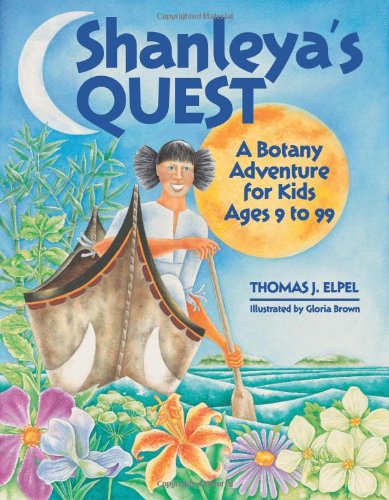 | Hardcover: 32
Pages
(2005-08-30)
list price: US$12.50 -- used & new: US$7.00 (price subject to change: see help) Asin: 1892784165 Average Customer Review: 
Canada | United Kingdom | Germany | France | Japan |
|
Editorial Review Product Description Customer Reviews (2)
| |
| 42. The Healing Forest: Medicinal and Toxic Plants of the Northwest Amazonia (Historical, Ethno-& Economic Botany, Vol 2) by Richard E. Schultes, Robert F. Raffauf | |
 | Hardcover: 500
Pages
(2003-01-01)
list price: US$69.95 -- used & new: US$99.95 (price subject to change: see help) Asin: 0931146143 Average Customer Review: 
Canada | United Kingdom | Germany | France | Japan |
|
Editorial Review Product Description Customer Reviews (2)
| |
| 43. Botany for All Ages: Discovering Nature Through Activities for Children and Adults by Jorie Hunken | |
| Paperback: 184
Pages
(1993-12)
list price: US$16.95 -- used & new: US$46.87 (price subject to change: see help) Asin: 1564402819 Canada | United Kingdom | Germany | France | Japan | |
| 44. Economic Botany: Principles and Practices by G.E. Wickens | |
| Paperback: 556
Pages
(2004-03-31)
list price: US$149.00 -- used & new: US$43.18 (price subject to change: see help) Asin: 140202228X Average Customer Review: 
Canada | United Kingdom | Germany | France | Japan | |
|
Editorial Review Product Description Customer Reviews (1)
| |
| 45. Photo Atlas for Botany by James W. Perry, David Morton | |
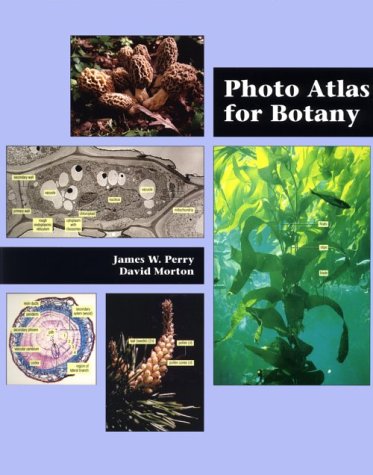 | Paperback: 160
Pages
(1998-01-12)
list price: US$86.95 -- used & new: US$65.00 (price subject to change: see help) Asin: 0534529380 Average Customer Review:
Canada | United Kingdom | Germany | France | Japan |
|
Editorial Review Product Description Customer Reviews (2)
| |
| 46. Principles of Botany: With OLC Card and EText CD-ROM by Gordon Uno, Richard Storey, Randy Moore | |
 | Paperback: 563
Pages
(2001-02-01)
Isbn: 0071123717 Canada | United Kingdom | Germany | France | Japan |
|
Editorial Review Product Description | |
| 47. Catalogue of the Flowering Plants And Gymnosperms of Peru / Catalogo De Las Angiospermas Y Gimnospermas Del Peru (Monographs in Systematic Botany Fro) by Lois Brako | |
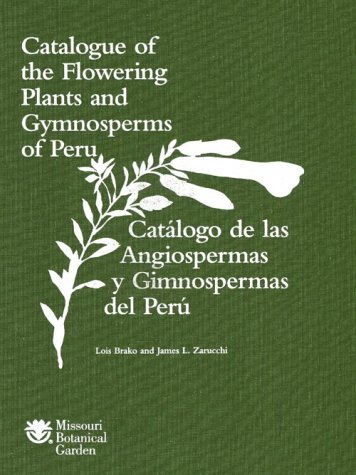 | Hardcover: 1286
Pages
(1993-10)
list price: US$73.50 -- used & new: US$175.00 (price subject to change: see help) Asin: 0915279193 Average Customer Review:
Canada | United Kingdom | Germany | France | Japan |
Customer Reviews (1)
The merit of this book is try to compile all the knowledge of the peruvian plants in a catalogue sorted by families, genera, location, synonimia, and holotype information (mainly herbaria availability). Actually the Brako's effort is the best one until now, to ordering all the information about peruvian flora, becoming as an excellent tool for herbarium and plant material management and as a good support for researchers not only of peruvian flora, but South American flora too. This contribution is not only this at all. The authors Brako and Zarucchi gift us with a short overview study about peruvian flora, its distribution and composition by Alwyn Gentry, which is an excellent material for all of us who are related with teaching and education. Surely, The Catalogue of the Flowering Plants and Gymnosperms of Peru, is not that kind of book who someone expect to read complete, but the kind who everyone interested of peruvian flora would like to have. Its objetive is not make a full description of peruvian plants, families and orders, neither give us excellent pictures and illustrations. Its objetive is make the complete checklist about what we know now. And certainly, it does. ... Read more | |
| 48. The elements of botany for beginners and for schools by Asa Gray | |
 | Paperback: 236
Pages
(2010-07-31)
list price: US$26.75 -- used & new: US$19.17 (price subject to change: see help) Asin: 1176533576 Canada | United Kingdom | Germany | France | Japan |
|
Editorial Review Product Description | |
| 49. Forensic Botany: Principles and Applications to Criminal Casework | |
 | Hardcover: 336
Pages
(2004-07-26)
list price: US$152.95 -- used & new: US$125.00 (price subject to change: see help) Asin: 0849315298 Average Customer Review:
Canada | United Kingdom | Germany | France | Japan |
|
Editorial Review Product Description Customer Reviews (1)
| |
| 50. Beginner's Guide to Botany by C.L. Duddington | |
| Hardcover: 200
Pages
(1970-09-07)
Isbn: 0720703654 Canada | United Kingdom | Germany | France | Japan | |
| 51. "Parts of" Photo Cards-Botany Set of 4 (Tree, Flower-Monocot, Flower-Dicot, Leaf) by Maitri Learning | |
| Cards: 90
Pages
(2007-04-01)
-- used & new: US$69.95 (price subject to change: see help) Asin: B0019ZH9UE Canada | United Kingdom | Germany | France | Japan | |
|
Editorial Review Product Description | |
| 52. Opium Poppy: Botany, Chemistry, and Pharmacology by L. Kapoor | |
 | Paperback: 352
Pages
(1997-02-27)
list price: US$43.95 -- used & new: US$37.62 (price subject to change: see help) Asin: 0789002027 Average Customer Review: 
Canada | United Kingdom | Germany | France | Japan |
|
Editorial Review Product Description Customer Reviews (4)
This book shines in its discussions of poppy horticulture and agricultural. The literature in these areas is highly contradictory and Kapoor does an excellent job synthesizing what is known. Chapter 4 (Agricultural Studies) is well worth the price of the entire book. The thorough discussion of opium poppy botany is also good. For an understanding of the entire poppy family, however, Christopher Grey-Wilson's "Poppies" is far better. Kapoor fails in his discussions of opium alkaloid pharmacology and chemistry. These discussions are almost random in structure and are far from thorough in the research cited. Whenever an individual alkaloid is discussed (even when discussing its role in plant development), the book becomes muddy. This is not surprising, I suppose, because Kapoor is clearly most interested in the plant itself. Too often, Kapoor does not actually synthesize the research in a particular area. Instead, he simply lists it--indicating that he is confused as to the meaning of the work. There is also little discussion of why certain research questions are of interest. Worst of all, none of his chapters have introductions or conclusions. This is true of the book itself. The first chapter is titled "Introduction", but it isn't--it is a history of the opium poppy. Then, instead of ending the book with some kind of overview, the last chapter discusses pain models with an emphasis on how morphine fits in with them. The reason that "Opium Poppy" would contain this chapter--not even written by Kapoor--is unclear. (In fairness, this last non-Kapoor chapter has an introduction and conclusion.) Another problem that makes extracting information from the book difficult is the poor editing done by The Haworth Press. The book is riddled with typographical and grammatical errors. The section headings are a mess; the reader is best to ignore them because they cause much confusion. "Opium Poppy" should be subtitled "Botany, Horticulture, and Agriculture". This is what the author knows and what he is interested in. When he gets too far afield from these areas, the book falls apart. However, in these three areas, the book is indispensable.
| |
| 53. Elements of structural and systematic botany, for high schools and elementary college courses by Douglas Houghton Campbell | |
 | Paperback: 278
Pages
(2010-08-01)
list price: US$27.75 -- used & new: US$20.04 (price subject to change: see help) Asin: 1176590065 Canada | United Kingdom | Germany | France | Japan |
|
Editorial Review Product Description | |
| 54. Parallel Botany by Leo Lionni | |
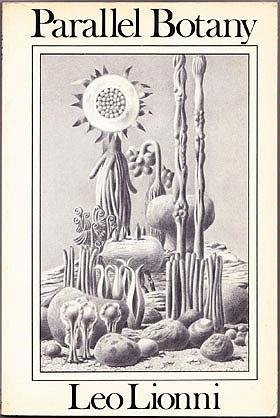 | Paperback: 181
Pages
(1978-06)
list price: US$5.95 Isbn: 0394733029 Average Customer Review:
Canada | United Kingdom | Germany | France | Japan |
Customer Reviews (2)
There are layers and layers of complexity to this spoof, for Mr. Lionni draws the reader into more than the facts and lore of his creations by also intertwining issues about philosophy, language, and the scientific method. He presents multiple points of view bantered by experts in this subject matter, and this debate enlivens the discussion. He firmly roots the research by drawing upon imaginary but real-sounding folk tales and legends, made more real by invoking actual historical figures. Hence, imaginary notes from Magellan's historian or the Greek philosopher Heraclitus are dissected and scrutinized for clues and encounters with various specimens from the realm of parallel plants. Such luminaries as the Swiss biologist Max Spinder or the Greek botanist Professor Spyros Rodokanankis, and many more, espouse their various theories and findings, often disagreeing about their findings and the implications of their research. His methods remind one of both Borges and Lovecraft, two masters at creating real-sounding imaginary worlds supported by tier upon tier of crafted scholarship and science. This book is unique and arguably the last, and the only, word on the subject of parallel botany. Some consider it hilarious, others a mere spoof, but certainly it is more than that, for Mr. Lionni expended considerable effort and time to document this imaginary segment of the plant kingdom. The fact that a major publisher issued the book in hardback suggests someone thought highly of this idea. I take away a sense of astonishment at the amount of detail invoked to underscore the verisimilitude of the premise, and see this book as a wry jab at the reductionistic tendencies of a scientific method that seems at times to value cataloging over understanding our world. (I also once had a vision many years ago that may have come from whatever source Mr. Lionni tapped for Parallel Botany, a vision of an asylum that housed crazed and dangerous plants that I rendered in an oil painting a friend of mine smuggled into the art gallery in the Saturn Bar down in New Orleans.)
There are layers and layers of complexity to this spoof, for Mr. Lionni draws the reader into more than the facts and lore of his creations by also intertwining issues about philosophy, language, and the scientific method. He presents multiple points of view bantered by experts in this subject matter, and this debate enlivens the discussion. He firmly roots the research by drawing upon imaginary but real-sounding folk tales and legends, made more real by invoking actual historical figures. Hence, imaginary notes from Magellan's historian or the Greek philosopher Heraclitus are dissected and scrutinized for clues and encounters with various specimens from the realm of parallel plants. Such luminaries as the Swiss biologist Max Spinder or the Greek botanist Professor Spyros Rodokanankis, and many more, espouse their various theories and findings, often disagreeing about their findings and the implications of their research. His methods remind one of both Borges and Lovecraft, two masters at creating real-sounding imaginary worlds supported by tier upon tier of crafted scholarship and science. This book is unique and arguably the last, and the only, word on the subject of parallel botany. Some consider it hilarious, others a mere spoof, but certainly it is more than that, for Mr. Lionni expended considerable effort and time to document this imaginary segment of the plant kingdom. The fact that a major publisher issued the book in hardback suggests someone thought highly of this idea. I take away a sense of astonishment at the amount of detail invoked to underscore the verisimilitude of the premise, and see this book as a wry jab at the reductionistictendencies of a scientific method that seems at times to value cataloging over understanding our world. (I also once had a vision many years ago that may have come from whatever source Mr. Lionni tapped for Parallel Botany, a vision of an asylum that housed crazed and dangerous plants that I rendered in an oil painting a friend of mine smuggled into the art gallery in the Saturn Bar down in New Orleans.) ... Read more | |
| 55. Careers in Horticulture and Botany (Careers in Series) by Jerry Garner | |
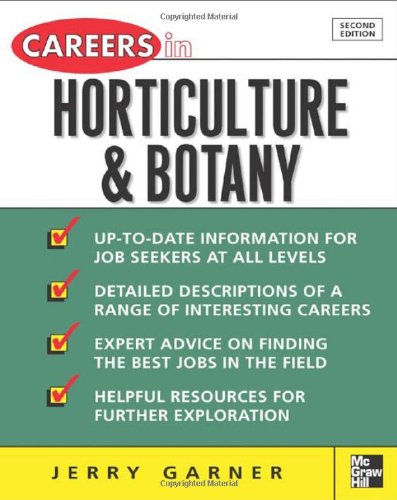 | Paperback: 192
Pages
(2006-09-20)
list price: US$16.95 -- used & new: US$9.16 (price subject to change: see help) Asin: 0071467734 Canada | United Kingdom | Germany | France | Japan |
|
Editorial Review Product Description Find an exciting, fulfilling career in a field where opportunities never stop growing! If you find peace and satisfaction in growing plants and flowers, you should consider making it your profession. It might surprise you to learn just how many different opportunities exist within the horticulture and botany industry. Careers in Horticulture and Botany gives you invaluable tips for finding a job in one of the many areas that make up this diverse field. Whether you like to plant new seedlings or study flora and fauna, this updated edition will help you: | |
| 56. Elements of Structural and Systematic Botany (Classic Reprint) by Douglas Houghton Campbell | |
 | Paperback: 276
Pages
(2010-03-25)
list price: US$9.31 -- used & new: US$9.31 (price subject to change: see help) Asin: 1451009917 Canada | United Kingdom | Germany | France | Japan |
|
Editorial Review Product Description | |
| 57. The Voyage of Governor Phillip to Botany Bay With an Account of the Establishment of the Colonies of Port Jackson and Norfolk Island (1789) by Arthur Phillip | |
 | Kindle Edition:
Pages
(2009-10-04)
list price: US$1.99 Asin: B002RKSRWE Canada | United Kingdom | Germany | France | Japan |
|
Editorial Review Product Description | |
| 58. Class-book of botany: being outlines of the structure, physiology, and classification of plants ; with a flora of the United States and Canada by Alphonso Wood | |
| Paperback: 852
Pages
(2010-09-07)
list price: US$57.75 -- used & new: US$39.96 (price subject to change: see help) Asin: 1171630433 Canada | United Kingdom | Germany | France | Japan | |
|
Editorial Review Product Description | |
| 59. Plant Projects for Young Scientists (Botany) by Salvatore Tocci | |
 | Hardcover: 143
Pages
(2000-09)
list price: US$23.50 -- used & new: US$260.14 (price subject to change: see help) Asin: 0531117049 Canada | United Kingdom | Germany | France | Japan |
| 60. Winter Botany (1918.) by William Trelease | |
 | Paperback: 196
Pages
(2010-01-12)
list price: US$28.01 -- used & new: US$28.01 (price subject to change: see help) Asin: 1153212536 Average Customer Review:
Canada | United Kingdom | Germany | France | Japan |
|
Editorial Review Product Description Customer Reviews (2)
| |
| Back | 41-60 of 103 | Next 20 |