
|
Help |
| Home - Biology - Evolution (Books) | |
e99 Online Shopping Mall
|
|
Help |
| Home - Biology - Evolution (Books) | |
| 1-20 of 98 | Next 20 |
click price to see details click image to enlarge click link to go to the store
| 1. Anarchy Evolution: Faith, Science, and Bad Religion in a World Without God by Greg Graffin, Steve Olson | |
 | Hardcover: 304
Pages
(2010-10-01)
list price: US$22.99 -- used & new: US$14.69 (price subject to change: see help) Asin: 0061828505 Average Customer Review: 
Canada | United Kingdom | Germany | France | Japan |
|
Editorial Review Product Description Most people know Greg Graffin as the lead singer of the punk band Bad Religion, but few know that he also received a PhD from Cornell University and teaches evolution at the University of California at Los Angeles. In Anarchy Evolution, Graffin argues that art and science have a deep connection. As an adolescent growing up when "drugs, sex, and trouble could be had on any given night," Graffin discovered that the study of evolution provided a framework through which he could make sense of the world. In this provocative and personal book, he describes his own coming of age as an artist and the formation of his naturalist worldview on questions involving God, science, and human existence. While the battle between religion and science is often displayed in the starkest of terms, Anarchy Evolution provides fresh and nuanced insights into the long-standing debate about atheism and the human condition. It is a book for anyone who has ever wondered if God really exists. Customer Reviews (15)
| |
| 2. Why Evolution Is True by Jerry A. Coyne | |
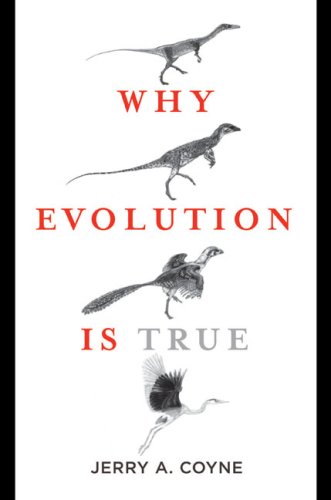 | Hardcover: 304
Pages
(2009-01-22)
list price: US$27.95 -- used & new: US$10.63 (price subject to change: see help) Asin: B002ZNJWJU Average Customer Review:
Canada | United Kingdom | Germany | France | Japan |
|
Editorial Review Product Description Customer Reviews (133)
| |
| 3. Dr. Gundry's Diet Evolution: Turn Off the Genes That Are Killing You and Your Waistline by Dr. Steven R. Gundry | |
 | Paperback: 304
Pages
(2009-03-03)
list price: US$14.95 -- used & new: US$8.82 (price subject to change: see help) Asin: 0307352129 Average Customer Review:
Canada | United Kingdom | Germany | France | Japan |
|
Editorial Review Product Description Customer Reviews (63)
| |
| 4. The Evolution of God (Back Bay Readers' Pick) by Robert Wright | |
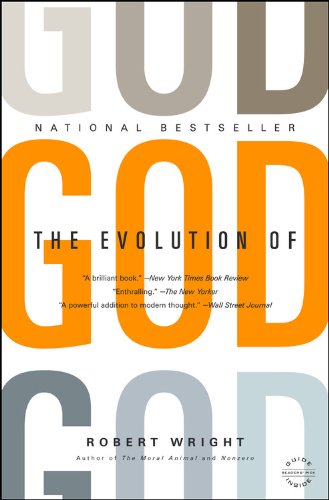 | Paperback: 592
Pages
(2010-05-03)
list price: US$16.99 -- used & new: US$9.56 (price subject to change: see help) Asin: 031606744X Average Customer Review: 
Canada | United Kingdom | Germany | France | Japan |
|
Editorial Review Product Description Customer Reviews (99)
| |
| 5. The Evolution of Calpurnia Tate by Jacqueline Kelly | |
 | Hardcover: 352
Pages
(2009-05-12)
list price: US$16.99 -- used & new: US$5.00 (price subject to change: see help) Asin: 0805088415 Average Customer Review:
Canada | United Kingdom | Germany | France | Japan |
|
Editorial Review Product Description Customer Reviews (54)
| |
| 6. The new physics and its evolution by Lucien Antoine Poincaré | |
 | Paperback: 368
Pages
(2010-08-24)
list price: US$32.75 -- used & new: US$20.68 (price subject to change: see help) Asin: 1177668610 Average Customer Review: 
Canada | United Kingdom | Germany | France | Japan |
|
Editorial Review Product Description Customer Reviews (2)
| |
| 7. Halo: Evolutions: Essential Tales of the Halo Universe by Tobias S. Buckell, B.K. Evenson, Jonathan Goff, Kevin Grace, Tessa Kum, Robt McLees, Eric Nylund, Frank O'Connor, Eric Raab, Karen Traviss, Jeff Vandermeer, Fred Van Lente | |
 | Paperback: 528
Pages
(2009-11-24)
list price: US$14.99 -- used & new: US$6.00 (price subject to change: see help) Asin: B003UHUB86 Average Customer Review:
Canada | United Kingdom | Germany | France | Japan |
|
Editorial Review Product Description Customer Reviews (37)
| |
| 8. Spontaneous Evolution: Our Positive Future (and a Way to Get There from Here) by Bruce H. Lipton Ph.D., Steve Bhaerman | |
 | Hardcover: 432
Pages
(2009-09-15)
list price: US$25.95 -- used & new: US$12.99 (price subject to change: see help) Asin: 1401925804 Average Customer Review:
Canada | United Kingdom | Germany | France | Japan |
|
Editorial Review Product Description We’ve all heard stories of people who’ve experienced seemingly miraculous recoveries from illness, but can the same thing happen for our world? According to pioneering biologist Bruce H. Lipton, it’s not only possible, it’s already occurring. In Spontaneous Evolution, this world-renowned expert in the emerging science of epigenetics reveals how our changing understanding of biology will help us navigate this turbulent period in our planet’s history and how each of us can participate in this global shift. In collaboration with political philosopher Steve Bhaerman, Dr. Lipton invites readers to reconsider: · the “unquestionable” pillars of biology, including random evolution, survival of the fittest, and the role of DNA; · the relationship between mind and matter; · how our beliefs about nature and human nature shape our politics, culture, and individual lives; and · how each of us can become planetary “stem cells” supporting the health and growth of our world. By questioning the old beliefs that got us to where we are today and keep us stuck in the status quo, we can trigger the spontaneous evolution of our species that will usher in a brighter future. Customer Reviews (35)
| |
| 9. Spontaneous Evolution: Our Positive Future and a Way to Get There From Here by Bruce H. Lipton Ph.D., Steve Bhaerman | |
 | Paperback: 432
Pages
(2010-08-01)
list price: US$16.95 -- used & new: US$10.95 (price subject to change: see help) Asin: 1401926312 Average Customer Review:
Canada | United Kingdom | Germany | France | Japan |
|
Editorial Review Product Description We’ve all heard stories of people who’ve experienced seemingly miraculous recoveries from illness, but can the same thing happen for our world? According to pioneering biologist Bruce H. Lipton, it’s not only possible, it’s already occurring. · the “unquestionable” pillars of biology, including random evolution, survival of the fittest, and the role of DNA; · the relationship between mind and matter; · how our beliefs about nature and human nature shape our politics, culture, and individual lives; and · how each of us can become planetary “stem cells” supporting the health and growth of our world. By questioning the old beliefs that got us to where we are today and keep us stuck in the status quo, we can trigger the spontaneous evolution of our species that will usher in a brighter future. Customer Reviews (1)
| |
| 10. The Evolution of Childhood: Relationships, Emotion, Mind by Melvin Konner | |
 | Hardcover: 960
Pages
(2010-05-31)
list price: US$39.95 -- used & new: US$25.05 (price subject to change: see help) Asin: 0674045661 Average Customer Review: 
Canada | United Kingdom | Germany | France | Japan |
|
Editorial Review Product Description This book is an intellectual tour de force: a comprehensive Darwinian interpretation of human development. Looking at the entire range of human evolutionary history, Melvin Konner tells the compelling and complex story of how cross-cultural and universal characteristics of our growth from infancy to adolescence became rooted in genetically inherited characteristics of the human brain. All study of our evolution starts with one simple truth: human beings take an extraordinarily long time to grow up. What does this extended period of dependency have to do with human brain growth and social interactions? And why is play a sign of cognitive complexity, and a spur for cultural evolution? As Konner explores these questions, and topics ranging from bipedal walking to incest taboos, he firmly lays the foundations of psychology in biology. As his book eloquently explains, human learning and the greatest human intellectual accomplishments are rooted in our inherited capacity for attachments to each other. In our love of those we learn from, we find our way as individuals and as a species. Never before has this intersection of the biology and psychology of childhood been so brilliantly described. "Nothing in biology makes sense except in the light of evolution," wrote Dobzhansky. In this remarkable book, Melvin Konner shows that nothing in childhood makes sense except in the light of evolution. Customer Reviews (4)
| |
| 11. The Evolution of Cooperation: Revised Edition by Robert Axelrod | |
 | Paperback: 264
Pages
(2006-12-05)
list price: US$16.95 -- used & new: US$7.87 (price subject to change: see help) Asin: 0465005640 Average Customer Review:
Canada | United Kingdom | Germany | France | Japan |
|
Editorial Review Product Description The Evolution of Cooperation addresses a simple yet age-old question: If living things evolve through competition, how can cooperation ever emerge? Despite the abundant evidence of cooperation all around us, there existed no purely naturalistic answer to this question until 1979, when Robert Axelrod famously ran a computer tournament featuring a standard game-theory exercise called The Prisoner's Dilemma. To everyone's surprise, the program that won the tournament, named Tit for Tat, was not only the simplest but the most "cooperative" entrant. This unexpected victory proved that cooperation--one might even say altruism--is mathematically possible and therefore needs no hidden hand or divine agent to create and sustain it. A great roadblock to the understanding of all sorts of behavior was at last removed. The updated edition includes an extensive new chapter on cooperation in cancer cells and among terrorist organizations. "This book, if read, grasped and applied, could have a profound effect." (Wall Street Journal) "A fascinating, provocative, and important book." (Douglas R. Hofstadter, author of Godel, Escher, Bach) Customer Reviews (47)
| |
| 12. The Greatest Show on Earth: The Evidence for Evolution by Richard Dawkins | |
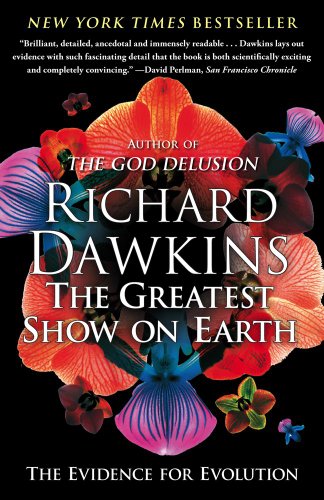 | Paperback: 496
Pages
(2010-08-24)
list price: US$16.99 -- used & new: US$8.50 (price subject to change: see help) Asin: 1416594795 Average Customer Review:
Canada | United Kingdom | Germany | France | Japan |
|
Editorial Review Product Description Customer Reviews (246)
| |
| 13. Life Ascending: The Ten Great Inventions of Evolution by Nick Lane | |
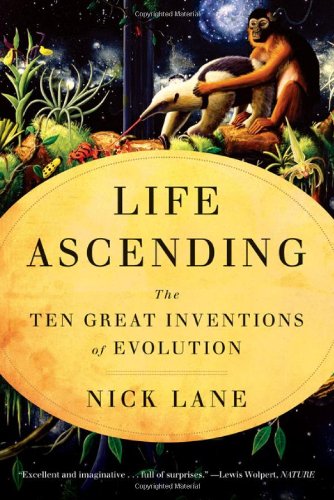 | Paperback: 344
Pages
(2010-06-14)
list price: US$16.95 -- used & new: US$10.02 (price subject to change: see help) Asin: 0393338665 Average Customer Review:
Canada | United Kingdom | Germany | France | Japan |
|
Editorial Review Product Description Customer Reviews (32)
| |
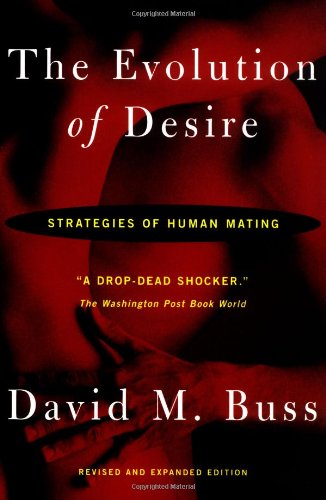
| 14. The Evolution Of Desire - Revised Edition 4 by David M. Buss | |
 | Paperback: 320
Pages
(2003-07)
list price: US$17.95 -- used & new: US$9.56 (price subject to change: see help) Asin: 046500802X Average Customer Review:
Canada | United Kingdom | Germany | France | Japan |
|
Editorial Review Product Description If we all want love, why is there so much conflict in our most cherished relationships? To answer this question, says noted psychologist David Buss, we must look into our evolutionary past. Based on the most massive study of human mating ever undertaken, encompassing more than ten thousand people of all ages from thirty-seven cultures worldwide, The Evolution of Desire is the first book to present a unified theory of human mating behavior. Now in a revised and updated edition, Buss's classic presents the latest research in the field, including startling new discoveries about the evolutionary advantages of infidelity, orgasm, and physical attractiveness. Customer Reviews (50)
| |
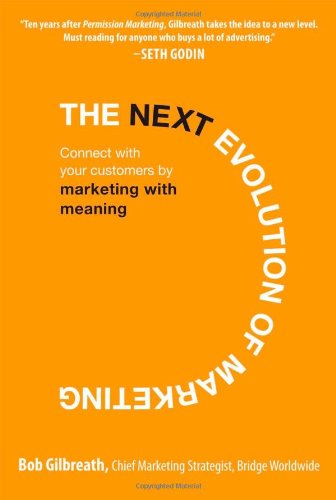
| 15. The Next Evolution of Marketing: Connect with Your Customers by Marketing with Meaning by Bob Gilbreath | |
 | Hardcover: 288
Pages
(2009-09-03)
list price: US$27.95 -- used & new: US$13.97 (price subject to change: see help) Asin: 0071625364 Average Customer Review:
Canada | United Kingdom | Germany | France | Japan |
|
Editorial Review Product Description THE NEW LAWOF MARKETING “The Next Evolution ofMarketing is a true beaconfor all brand builders.Many books claim that,Bob’s book delivers.” “Some timeless truthsrestored for modernmarketing—and many newones added. An inspiringreminder of the value ofbrand behavior and how tomake it happen.” “Persuasion has given wayto sharing, and marketingwill never be the same.” ”Bob Gilbreath brilliantlyshows why we’re nolonger living in our fathers’marketing era. Better yet,he details how marketingworks best when it addsvalue to people’s lives, andhe provides a playbookfor success.” “This book provides aframework and compellingexamples for creating thenext generation of cultureleadingbrands.” ABOUT THE BOOK: Marketing with Meaning—The Breakthrough Strategy for Connecting with Customers! The old interruptive model of marketingdoesn’t work. Customers are tuning out.They no longer listen to in-your-face messages.Instead, they demand meaning inthe brands they buy and the marketing thatreaches them. Marketing strategist Bob Gilbreath’s hotnew concept, Marketing with Meaning,represents the next evolutionary step in aprogression following direct marketing andpermission marketing. This groundbreakingmethodology engages customers and winstheir business by adding value to their lives.Rather than pushing a product or service,Marketing with Meaning woos customers byoffering them something of value independentof purchase. In The Next Evolution of Marketing, Gilbreathunveils a revolutionary new approach tobusiness that fills the gaping voids left inbottom lines when people started tuning out.Gilbreath describes the marketing revolutionnow underway and the powerful forces drivingit. Inside, he provides Marketing withMeaning success stories, including: This first-ever comprehensive model for creatingand managing a meaningful marketingcampaign uses in-depth case studies of successfulcampaigns and explains how to developand execute a solid strategy for meetingcustomers’ needs. It also arms you with anoriginal set of metrics for precisely measuringthe effectiveness of your initiatives. You simply cannot afford to get left behind inadvertising’s “golden age” of interrupt, tell,and sell marketing. Marketing with Meaningis how your customers demand business bedone today and tomorrow. The Next Evolutionof Marketing is your guide to survivingand thriving in this marketing revolution. Customer Reviews (19)
| |
| 16. The Evolution of Technical Analysis: Financial Prediction from Babylonian Tablets to Bloomberg Terminals by Andrew W. Lo, Jasmina Hasanhodzic | |
 | Hardcover: 212
Pages
(2010-09-22)
list price: US$29.95 -- used & new: US$12.25 (price subject to change: see help) Asin: 1576603490 Canada | United Kingdom | Germany | France | Japan |
|
Editorial Review Product Description Whether driven by mass psychology, fear or greed of investors, the forces of supply and demand, or a combination, technical analysis has flourished for thousands of years on the outskirts of the financial establishment. In The Evolution of Technical Analysis: Financial Prediction from Babylonian Tablets to Bloomberg Terminals, MIT's Andrew W. Lo details how the charting of past stock prices for the purpose of identifying trends, patterns, strength, and cycles within market data has allowed traders to make informed investment decisions based in logic, rather than on luck. The book The Evolution of Technical Analysis explores the fascinating history of technical analysis, tracing where technical analysts failed, how they succeeded, and what it all means for today's traders and investors. | |
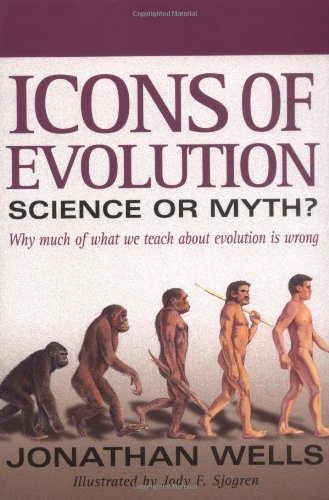
| 17. Icons of Evolution: Science or Myth? Why Much of What We Teach About Evolution is Wrong by Jonathan Wells | |
 | Paperback: 338
Pages
(2002-01)
list price: US$16.95 -- used & new: US$6.82 (price subject to change: see help) Asin: 0895262002 Average Customer Review:
Canada | United Kingdom | Germany | France | Japan |
|
Editorial Review Product Description Customer Reviews (201)
| |
| 18. Evolution, Second Edition by Douglas Futuyma | |
 | Hardcover: 545
Pages
(2009-04-06)
list price: US$112.95 -- used & new: US$70.00 (price subject to change: see help) Asin: 0878932232 Average Customer Review:
Canada | United Kingdom | Germany | France | Japan |
|
Editorial Review Product Description Customer Reviews (16)
| |
| 19. The 10,000 Year Explosion: How Civilization Accelerated Human Evolution by Gregory Cochran, Henry Harpending | |
 | Paperback: 304
Pages
(2010-10-19)
list price: US$16.95 -- used & new: US$8.00 (price subject to change: see help) Asin: 0465020429 Average Customer Review:
Canada | United Kingdom | Germany | France | Japan |
|
Editorial Review Product Description Customer Reviews (37)
| |
| 20. Style Evolution: How to Create Ageless Personal Style in Your 40s and Beyond by Kendall Farr | |
 | Hardcover: 208
Pages
(2009-04-07)
list price: US$22.50 -- used & new: US$6.24 (price subject to change: see help) Asin: B003156AZA Average Customer Review:
Canada | United Kingdom | Germany | France | Japan |
|
Editorial Review Product Description Customer Reviews (22)
| |
| 1-20 of 98 | Next 20 |
 A Good Defense of Intelligent Design
 Good information, often presented with unwarranted arrogance.
 DR GUNDRY'S DIET EVOLUTION