
|
Help |
| Home - Book Author - Gissing George (Books) | |
e99 Online Shopping Mall
|
|
Help |
| Home - Book Author - Gissing George (Books) | |
| Back | 21-40 of 42 | Next 20 |
click price to see details click image to enlarge click link to go to the store
| 21. In the Year of Jubilee (Everyman Paperback Classics) by George Gissing | |
 | Paperback: 423
Pages
list price: US$7.95 -- used & new: US$9.93 (price subject to change: see help) Asin: 0460875337 Average Customer Review: 
Canada | United Kingdom | Germany | France | Japan |
|
Editorial Review Book Description Customer Reviews (1)
On the surface, IYJ is a story common to Victorian-era novels.People are obsessed with the thought of inheriting money, making sure they are viewed as 'refined' rather than 'working class', and the notion of 'family values' is taken to an extreme.However in IYJ we finally see the emergence of the middle class, people who are in white collar jobs and who see the value in working (rather than living off of someone else's fortune).And most shocking for a Victorian novel, the most forceful character is a young woman who actually seeks out work to keep her life interesting (and not depend on her estranged husband). IYJ is well-written, thought-provoking without being preachy, andshould be held in esteem on par with the works from James, Eliot, Wharton and, indeed, other works from George Gissing. ... Read more | |
| 22. By the Ionian Sea: Notes of a Ramble in Southern Italy (Marlboro Travel) by George Gissing | |
 | Paperback: 146
Pages
(1996-07-24)
list price: US$17.00 -- used & new: US$4.94 (price subject to change: see help) Asin: 0810160102 Average Customer Review: 
Canada | United Kingdom | Germany | France | Japan |
|
Editorial Review Amazon.com Customer Reviews (2)
And yet this is perhaps Gissing's most charming book. He becomes ill, is taken care of by strangers, does his best to escape the clutches of the local bands of outlaws, and succeeds in his quest to see a corner of Europe known to few outside of Italy. I highly recommend this book as the best introduction to a writer who deserves a revaluation of his literary reputation. ... Read more | |
| 23. With Gissing In Italy: Memoirs Of Brian Boru Dunne by Brian Boru Dunne | |
| Hardcover: 216
Pages
(1999-04-01)
list price: US$36.95 -- used & new: US$19.91 (price subject to change: see help) Asin: 0821412582 Average Customer Review: 
Canada | United Kingdom | Germany | France | Japan | |
Customer Reviews (4)
| |
| 24. Gissing and the City: Cultural Crisis and the Making of Books in Late Victorian England | |
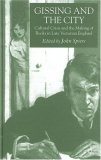 | Hardcover: 288
Pages
(2006-03-02)
list price: US$85.00 -- used & new: US$53.00 (price subject to change: see help) Asin: 1403997721 Canada | United Kingdom | Germany | France | Japan |
|
Editorial Review Book Description | |
| 25. Orwell and Gissing by Mark Connelly | |
 | Hardcover: 126
Pages
(1997-11)
list price: US$32.95 -- used & new: US$32.95 (price subject to change: see help) Asin: 0820433306 Canada | United Kingdom | Germany | France | Japan |
|
Editorial Review Book Description | |
| 26. Portraits in Charcoal: George Gissing's Women by James Haydock | |
 | Paperback: 316
Pages
(2004-07-23)
list price: US$19.45 -- used & new: US$12.45 (price subject to change: see help) Asin: 141845074X Canada | United Kingdom | Germany | France | Japan |
|
Editorial Review Book Description | |
| 27. George Gissing at Work: A Study of His Notebook Extracts from My Reading (1880-1920 British Authors Series) by Pierre Coustillas, Patrick Bridgwater | |
 | Hardcover: 196
Pages
(1988-01)
list price: US$25.00 Isbn: 0944318010 Canada | United Kingdom | Germany | France | Japan |
| 28. Unsettled Accounts: Money and Narrative in the Novels of George Gissing (Anthem Nineteenth Century Studies) by Simon J. James | |
 | Paperback: 200
Pages
(2004-03)
list price: US$19.95 -- used & new: US$12.50 (price subject to change: see help) Asin: 1843311089 Canada | United Kingdom | Germany | France | Japan |
|
Editorial Review Book Description In the first full-length study of money in the work of this perplexing, compelling writer -- described by George Orwell as "perhaphs the best novelist England has produced" -- Simon J. James examines how Gissing's work dramatizes the hold of capital on every facet of everyday life, including love, art, virtue and morality. Unsettled Accounts situates Gissing's work within Victorian anxieties over society's transformation by changes in the nature of its economy -- that money's power was both ever-increasing, and a malevolent influence. Gissing's best-known novels, such as The Odd Women and his celebrated novel of literary life New Grub Street, expose the competitive individualism of Victorian society. Unsettled Accounts locates Gissing's novels alongside the place of money in other nineteenth-century writing, in particular the novels of Charles Dickens, a key influence. This study also examines the range of Gissing's preoccupations, from the condition of the working class, to the making of sexual difference, to the comodification of art, and demonstrates why Gissing's dissident but accurate representations of the emergent modernity of late nineteenth-century urban culture deserve a unique place in English literary history. Unsettled Accounts constitutes both a valuable introduction to Gissing's work and a groundbreaking study of the contexts which shaped the development of his work. This book will be compelling reading not only for anyone interested in Gissing, but also for readers concerned with the economics of the Victorian novel, and with fin-de-siècle literary culture. | |
| 29. George Gissing: A Bibliographical Study (St Paul's Bibliographies, No 12) by Michael Collie | |
| Hardcover: 192
Pages
(1986-01)
list price: US$70.00 Isbn: 090679529X Canada | United Kingdom | Germany | France | Japan | |
| 30. Alien Art: A Critical Study of George Gissing's Novels by Michael Collie | |
| Hardcover: 205
Pages
(1978-06)
list price: US$31.00 Isbn: 0208017313 Canada | United Kingdom | Germany | France | Japan | |
| 31. George Gissing: Voices Of The Unclassed (The Nineteenth Century Series) | |
 | Hardcover: 163
Pages
(2005-07-31)
list price: US$100.00 -- used & new: US$91.44 (price subject to change: see help) Asin: 0754636755 Canada | United Kingdom | Germany | France | Japan |
| 32. George Gissing Critical Essays: Critical Essays (Critical Studies Series) | |
| Hardcover: 214
Pages
(1981-04)
list price: US$26.50 Isbn: 0389200611 Canada | United Kingdom | Germany | France | Japan | |
| 33. By the Ionian Sea: Notes of a Ramble in Southern Italy (Lost and Found Series) by George Gissing | |
 | Paperback: 159
Pages
(2003-10)
list price: US$15.00 -- used & new: US$9.88 (price subject to change: see help) Asin: 1566564948 Canada | United Kingdom | Germany | France | Japan |
|
Editorial Review Book Description In 1897 the Victorian novelist George Gissing undertook a brief but eventful journey in southern Italy. His itinerary took him from Naples to Reggio di Calabria, via Paola, Cosenza, Crotone, and Squillace, through the area once known as Magna Graecia. Meditating on the vestiges of Greco-Roman civilization, Gissing visited tombs, temples, museums, and cathedrals in search of the imprint of antiquity and "that old world which was the imaginative delight of my boyhood." The result was By the Ionian Sea, first published in 1901. By turns lyrical and melancholy, Gissing's masterpiece of travel writing alternates between light and dark, life and death, Paganism and Christianity. Looking at Italy in both its classical and contemporary dimensions, By the Ionian Sea celebrates Calabria's rich cultural past and beautiful landscapes while providing a candid account of hardship and poverty in southern Italy. More than a century after its first publication, this is the first critical edition of the book in English. | |
| 34. George Gissing: A Biography by Michael Collie | |
| Hardcover:
Pages
(1977-06)
list price: US$25.00 Isbn: 0208017003 Canada | United Kingdom | Germany | France | Japan | |
| 35. George Gissing: A Critical Biography by Jacob Korg | |
| Paperback: 311
Pages
(1980-08)
list price: US$10.00 Isbn: 0295956798 Canada | United Kingdom | Germany | France | Japan | |
| 36. New Grub Street by George Gissing | |
 | Paperback: 564
Pages
(2007-09-14)
list price: US$16.95 -- used & new: US$13.16 (price subject to change: see help) Asin: 1551115026 Average Customer Review:
Canada | United Kingdom | Germany | France | Japan |
|
Editorial Review Book Description New Grub Street is the only one of Gissing's two dozen novels never to have gone out of print, and is widely considered to be his masterpiece. This edition includes an introduction and a rich selection of historical material on the literary world of London through the centuries, authorship as a profession, and Gissing's life and work. Customer Reviews (12)
Why do I say this so confidently?Well, as Gissing was particularly self-aware and as he was particularly oppressed when writing "New Grub Street," in this novel he writes about what it's like to be a writer in London in the 1880's and 1890's.He essentially writes about his own life and those he find around him, all of whom are trying to make a living on writing. Gissings seems to portray himself through the main character, Reardon. When the story opens, Reardon is struggling.His sophisticated wife is getting fed up with their impoverished lifestyle and with her husband's inability to write decent material.Reardon, a sensitive soul, is floundering under mounting pressure and stress.He is torn between his desire to write sophisticated, meaningful material and the public demand for "fluff."The more stressed laid on him, the less he is able to create and stick with any plausible fiction novel.He becomes more and more fererish and unable to work, and he is devastated as he loses his wife's love and respect. Around this central character Reardon, Gissing builds a very full and weighty cast of characters.A small sampling of these characters are: I found myself continually amazed at Gissing's amazing ability to get into the head of many individuals in his large cast and to see how the world makes sense through each's eyes.Gissing also provides us with a wealth of information about the Victorian publishing scene.It was amazing to read that writers and publishers then were struggling with the same issues writers and publishers are struggling with today. Additionally, Gissing gives you an unglorified look at poverty and the impoverished educated class of London at that time.While Dickens' works on the poor is idyllic and sentimental, Gissing simply relates the life he has known.There is nothing exceptional or amazing, and Gissing seems to argue that poverty takes character out of a man rather then build up a man's character. Overall, I found this to be a fascinating piece...though perhaps a slow read.For those interested in publishing, writing, realistic portrayals of Victorian England, or other such topics, this is a fantastic work.
Milvain identifies as vulgar the most lucrative market for the product of the man of letter's labor.The vulgarians, or "quarter educated," drive the market (479), and since they have been determined to desire nothing more than chatty ephemera, they have successfully opened an insuperable gulf between material success in writing and artistic success.Reardon's psychologically penetrating novels just aren't in demand.Therefore, there emerges quite an interesting conceptual shift within the nascent hegemony of the quarter-educated as established by their purchasing power: what was once considered healthy artistic integrity has transmuted into a peculiar kind of petit bourgeois hubris, if, in the new paradigm, the writer is more an artisan than an artist.Therefore, Reardon's artistically-compromised and padded three-volume novel, written with no other end in mind than to pander to the vulgar reader, nonetheless achieves only modest success because, the fact that it is indistinguishable from countless other similar works glutting the market aside, his novel is infected from his irrepressible integrity, and thus his novel becomes a strange sort of counterfeit, a psychological narrative masquerading as a popular novel.Reardon thus becomes a sort of Coriolanus among writers. Milvain, on the other hand, is a sort of Henry Ford among writers; he reveals his particular genius when offering advice to his sister Maud about how to write religious works for juveniles: "I tell you, writing is a business.Get together half-a-dozen fair specimens of the Sunday school prize; study them; discover the essential points of such a composition; hit upon new attractions; then go to work methodically, so many pages a day" (13).In other words, Jasper has managed to streamline and to mechanize the writing process.He studies previous works, abstracts formulae from them, isolates the elements of these formulae, and then deploys and rearranges these elements to give his own writing a patina of originality.By treating writing as an exercise in manipulating formulae, Jasper exchanges "authenticity" (whatever that word means anymore) for the convenience and efficiency of not having to grapple with his own potentially mutable and recalcitrant genius.Jasper did not invent writing, just as Ford did not invent the automobile.But like Ford did with automobile manufacture, Milvain discovers those aspects of writing that lend themselves to mechanical reproduction.Thus he is able to capitalize on his time and effort, and effectively becomes the very machine Reardon believes himself to be but never actually becomes because of his lingering notions of artistic integrity (352). Also of interest is the fact that Albert Yule is a sort of synthesis of Milvain and Reardon.Like Milvain, Yule attempts to streamline his own literary production by delegating some of the labor to his daughter Marian.However, like Reardon, Yule clings to the superannuated notion of the necessary individuality of writing: "[h]is failings, obvious enough, were the results of a strong and somewhat pedantic individuality ceaselessly at conflict with unpropitious circumstances" (38).In other words, Yule fails to recognize the obsolescence of the lone, learned genius within the realm of literary production.A market of vulgarians who demand occasional literary confections simply does not expect Works of individual genius.Moreover, even if they were in demand, works of individual genius are too ponderously inefficient to keep pace with the rate at which they are consumed.Therefore, Yule straddles the either/or proposition personified by Reardon and Milvain: One may preserve his artistic integrity and write "for the ages"--hence Yule, Biffen, and Reardon's fetishization of Shakespeare, Coleridge and authors of classical antiquity--and starve in the process, or one may write "for the moment" and actually turn a respectable profit. The shadow of Charles Darwin indeed looms large over the events and characters of New Grub Street. The growth market brought about by the advent of the "quarter-educated" vulgar class, and their discretionary income coupled with their callow aesthetic sensibilities and truncated attention spans, represents a nascent economic, if not ecological niche, for certain social creatures to occupy.However, it's not simply a matter of being able to adapt one's skills to the tastes of these consumers.One must also be a prodigious enough writer to keep pace with an equally prodigious rate of consumption.Individuals like Milvain and Whelpdale are adequately adapted to this niche in that they satisfy the demands of this niche in terms of both content and output.Reardon panders to the vulgar taste only grudgingly and after long resistance and thereby cannot meet the production demands of this niche.Biffen absolutely refuses to pander at all.Alfred Yule does attempt to pander, but his mode of literary production is too inefficient to meet production demands, and he is also largely ignorant of vulgar literary taste.While more in touch with the vulgar reader than her father, Marian Yule is as inefficient in her literary production as her father.Therefore, each of the characters named above are equally maladaptive, albeit for various reasons, and thus their extinction by the novel's end strikes the reader as somehow inevitable.Whereas Milvain and Reardon's widow Amy are left to come together as the triumphant niche occupants and thus reproduce themselves in their offspring, should they decide to produce any.
The anti-heroes of "New Grub Street" are presented to us as the novel begins - Jasper Milvain is a young, if somewhat impoverished, but highly ambitious man, eager to be a figure of influence in literary society at whatever cost.His friend, Edwin Reardon, on the other hand, was brought up on the classics, and toils away in obscurity, determined to gain fame and reputation through meaningful, psychological, and strictly literary fiction.Family matters beset the two - Jasper has two younger sisters to look out for, and Edwin has a beautiful and intelligent wife, who has become expectant of Edwin's potential fame.Throw into the mix Miss Marian Yule, daughter of a declining author of criticism, whose own reputation was never fully realized, and who has indentured his daughter to literary servitude, and we have a pretty list of discontented and anxious people struggling in the cut-throat literary marketplace of London. Money is of supreme importance in "New Grub Street," and it would be pointless to write a review without making note of it.As always, the literary life is one which is not remunerative for the mass of people who engage upon it, and this causes no end of strife in the novel.As Milvain points out, the paradox of making money in the literary world is that one must have a well-known reputation in order to make money from one's labours.At the same time, one must have money in order to move in circles where one's reputation may be made.This is the center of the novel's difficulties - should one or must one sacrifice principles of strictly literary fame and pander to a vulgar audience in order to simply survive?The question is one in which Reardon finds the greatest challenges to his marriage, his self-esteem, and even his very existence.For Jasper Milvain and his sisters, as well as for Alfred and Marian Yule, there is no question that the needs of subsistence outweigh most other considerations. "New Grub Street" profoundly questions the relevance of classic literature and high culture to the great mass of people, and by proxy, to the nation itself.For England, which propagated its sense of international importance throughout the nineteenth century by encouraging the study of English literature in its colonial holdings, the matter becomes one of great significance.The careers of Miss Dora Milvain and Mr. Whelpdale, easily the novel's two most charming, endearing, and sympathetic characters, attempt to illustrate the ways in which modern literature may be profitable to both the individual who writes it and the audiences towards which they aim.They may be considered the moral centers of the novel, and redeem Gissing's work from being entirely fatalistic. "New Grub Street" is a novel that will haunt me for quite some time.As a "man of letters" myself, I can only hope that the novel will serve as an object lesson, and one to which I may turn in hope and despair.The novel is well written, its characters and situations drawn in a very realistic and often sympathetic way.Like the ill-fated "ignobly decent" novel of Mr. Biffen's, "Mr. Bailey, Grocer," "New Grub Street" may seem less like a novel, and more like a series of rambling biographical sketches, but they are indelible and lasting sketches of literary lives as they were in the original Grub Street, still yet in Gissing's time, and as they continue to-day.Very highly recommended. ... Read more | |
| 37. The Poetry of George Gissing (Studies in British Literature) | |
| Hardcover: 185
Pages
(1995-05)
list price: US$109.95 Isbn: 0773491481 Canada | United Kingdom | Germany | France | Japan | |
| 38. George Gissing: The Cultural Challenge by John Sloan | |
| Hardcover: 172
Pages
(1989-02)
list price: US$39.95 Isbn: 0312024096 Canada | United Kingdom | Germany | France | Japan | |
| 39. Gissing in Context by Adrian Poole | |
| Hardcover: 231
Pages
(1975-06)
list price: US$33.50 Isbn: 0874717442 Canada | United Kingdom | Germany | France | Japan | |
| 40. The Paradox of Gissing by David Grylls | |
| Hardcover: 240
Pages
(1986-10)
list price: US$55.00 Isbn: 0048000817 Canada | United Kingdom | Germany | France | Japan | |
| Back | 21-40 of 42 | Next 20 |
 A Bit Disappointing