e99 Online Shopping Mall

Geometry.Net - the online learning center Help  
Home  - Book Author - Wallace Alfred Russel (Books)

  Back | 21-40 of 44 | Next 20
A  B  C  D  E  F  G  H  I  J  K  L  M  N  O  P  Q  R  S  T  U  V  W  X  Y  Z  

click price to see details     click image to enlarge     click link to go to the store

 
21. Land nationalisation its necessity
 
22. Is Mars habitable? A critical
 
23. Man 's place in the universe;
 
24. My Life: A Record of Events and
 
25. Land nationalisation. its necessity
 
26. Land nationalisation. its necessity
 
27. Travels on the Amazon
 
28. Contributions to the theory of
 
29. Bad times an essay on the present
 
30. A dissertation on the true age
 
31. Natural selection and tropical
$37.32
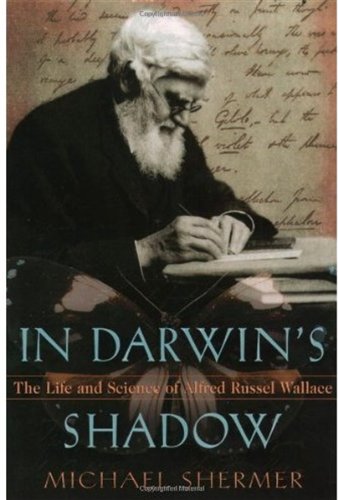
32. In Darwin's Shadow: The Life and
$20.35
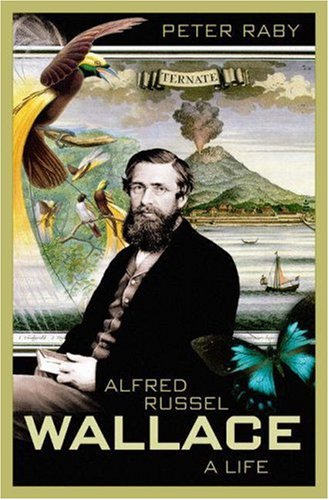
33. Alfred Russel Wallace: A Life.
$67.99
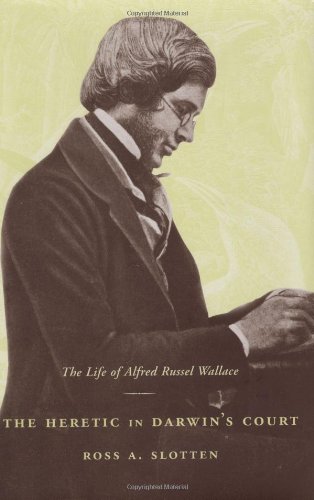
34. The Heretic in Darwin's Court:
$130.10
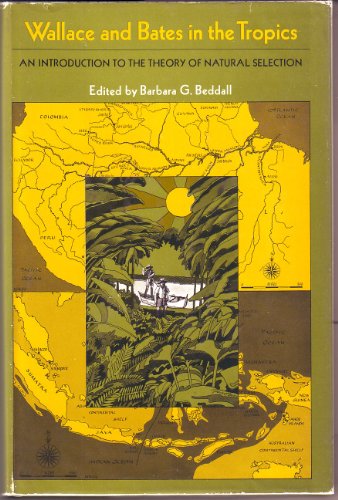
35. Wallace and Bates in the Tropics:
36. The Alfred Russel Wallace Reader:
$24.98
37. An Elusive Victorian: The Evolution
$121.69
38. Iquitos 1910: Roger Casement and
$9.27
39. Batu-Angas: Envisioning Nature
 
40. Narrative of Travels on Amazon

21. Land nationalisation its necessity and its aims
by Alfred Russel (1823-1913) Wallace
 Hardcover: Pages (1906)

Asin: B0018UKS62
Canada | United Kingdom | Germany | France | Japan

22. Is Mars habitable? A critical examination of Professor Percival
by Wallace. Alfred Russel. 1823-1913.
 Paperback: Pages (1907-01-01)

Asin: B002WTUZDO
Canada | United Kingdom | Germany | France | Japan

23. Man 's place in the universe; a study of the results of scientif
by Wallace. Alfred Russel. 1823-1913.
 Paperback: Pages (1903-01-01)

Asin: B002WTR208
Canada | United Kingdom | Germany | France | Japan

24. My Life: A Record of Events and Opinions. With Facsimile Letters, Illustrations and Portraits. Two Volumes.
by Alfred Russel (1823-1913). WALLACE
 Hardcover: Pages (1905-01-01)

Asin: B000N53J1O
Canada | United Kingdom | Germany | France | Japan

25. Land nationalisation. its necessity and its aims; being a compar
by Wallace. Alfred Russel. 1823-1913.
 Paperback: Pages (1882-01-01)

Asin: B002WTVZW4
Canada | United Kingdom | Germany | France | Japan

26. Land nationalisation. its necessity and its aims being a compari
by Wallace. Alfred Russel. 1823-1913.
 Paperback: Pages (1892-01-01)

Asin: B002WU2RY8
Canada | United Kingdom | Germany | France | Japan

27. Travels on the Amazon
by Alfred Russel, 1823-1913 Wallace
 Paperback: Pages (2009-10-26)

Asin: B003O559FE
Canada | United Kingdom | Germany | France | Japan

28. Contributions to the theory of natural selection. A series of es
by Wallace. Alfred Russel. 1823-1913.
 Paperback: Pages (1871-01-01)

Asin: B002WUE6EC
Canada | United Kingdom | Germany | France | Japan

29. Bad times an essay on the present depression of trade. tracing i
by Wallace. Alfred Russel. 1823-1913.
 Paperback: Pages (1885-01-01)

Asin: B002WULLF4
Canada | United Kingdom | Germany | France | Japan

30. A dissertation on the true age of the world : in which is determined the chronology of the period from creation to the Christian era
by Alfred Russel, 1823-1913 Wallace
 Paperback: Pages (2009-10-26)

Asin: B003O73GFW
Canada | United Kingdom | Germany | France | Japan

31. Natural selection and tropical nature; essays on descriptive and
by Wallace. Alfred Russel. 1823-1913.
 Paperback: Pages (1895-01-01)

Asin: B002WU1AIW
Canada | United Kingdom | Germany | France | Japan

32. In Darwin's Shadow: The Life and Science of Alfred Russel Wallace: A Biographical Study on the Psychology of History
by Michael Shermer
Hardcover: 448 Pages (2002-08-15)
list price: US$50.00 -- used & new: US$37.32
(price subject to change: see help)
Asin: 0195148304
Average Customer Review: 3.5 out of 5 stars
Canada | United Kingdom | Germany | France | Japan
Editorial Review

Product Description
Virtually unknown today, Alfred Russel Wallace was the co-discoverer of natural selection with Charles Darwin and an eminent scientist who stood out among his Victorian peers as a man of formidable mind and equally outsized personality. Now Michael Shermer rescues Wallace from the shadow of Darwin in this landmark biography. Here we see Wallace as perhaps the greatest naturalist of his age--spending years in remote jungles, collecting astounding quantities of specimens, writing thoughtfully and with bemused detachment at his reception in places where no white man had ever gone. Here, too, is his supple and forceful intelligence at work, grappling with such arcane problems as the bright coloration of caterpillars, or shaping his 1858 paper on natural selection that prompted Darwin to publish (with Wallace) the first paper outlining the theory of evolution. Shermer also shows that Wallace's self-trained intellect, while powerful, also embraced surprisingly naive ideas, such as his deep interest in the study of spiritual manifestations and seances. Shermer shows that the same iconoclastic outlook that led him to overturn scientific orthodoxy as he worked in relative isolation also led him to embrace irrational beliefs, and thus tarnish his reputation.As author of Why People Believe Weird Things and founding publisher of Skeptic magazine, Shermer is an authority on why people embrace the irrational. Now he turns his keen judgment and incisive analysis to Wallace's life and his contradictory beliefs, restoring a leading figure in the rise of modern science to his rightful place. ... Read more

Customer Reviews (11)

1-0 out of 5 stars "In Darwin's Shadow" aptly titled
Michael Shermer's attempt at analyzing the life and work of Wallace falls short on so many levels it's hard to know where to begin. One thing is sure, he has done more to darken the shadow than lift it from, arguably next to Darwin, Victorian England's greatest naturalist.

Shermer's attempt to identify Wallace as a "heretic personality" is vague and inconsistly applied. The claim that Wallace succumbed to scientism is so wide of the mark that once the astonishment of the claim wears off one is left wondering if Shermer ever really read Wallace!

This is simply the worst of an increasing number of Wallace biographies. Ill conceived and poorly argued, for those seeking to know this fascinating naturalist better almost any starting place would be better than here.My suggestion? Start with Wallace himself, MY LIFE: A Record of Events and Opinion.

3-0 out of 5 stars Oxford University Press pricing!
Others have commented on the contents, so I will comment on production values.The book is nicely produced, with a generous supply of useful illustrations.BUT!Don't pay Oxford University Press's exorbitant price ($50 list), shop for a good used copy instead.When OUP first published this in 2002 it was $35 (list), so they've increased it by $15 in just 7 years.

I always feel sad when an author like Shermer has the availability of his book limited by a rapacious (or maybe just inefficient?) publisher like OUP.

4-0 out of 5 stars Wallace matters, so this book matters
I felt I got a well-rounded view of Wallace as a person from this book. And I felt the treatment was fair, fairer than I expected from an arch-skeptic of and enemy of anything spiritual, Wallace's "weakness." Omitted, though, was adequate coverage of some of Wallace's strongest arguments against natural selection. As I understand it, Wallace said that the talents induced in us by civilization must have been built into our species at inception, but through not being useful prior to civilization should have been lost through disuse, here following Darwin's terminology. A good argument. Just as the author gets here the discussion shifts onto sexual selection and "the problem of incipient stages," as if the author's nerve failed. Otherwise I thought this a good "life."

3-0 out of 5 stars Darwin forever under a cloud....
After reading a review in NY review of books of Shermer's book I snapped out of my previous opinion and decided to revise my previous review here. Distracted by the issues raised in A. Brackman's book, A Delicate Arrangement, 'rebutted' by Shermer, I wavered wrongly in my original view at what appears now as a clever whitewash of Darwin.
Putting Brackman's arguments to one side for the nonce, the plain fact of the matter is that Darwin was, and has been ever since, engineered by Big Science propaganda into the exclusive icon for the discovery of evolution. And is Shermer just the fellow for this displacement job on Wallace. Wallace confuses people because they think that Darwin on the descent of man is established science, when the reality is that an immense con job has always finessed the fact that science has no conclusive theory here, and Wallace honestly pointed it out. Period.
As to the rest of Shermer's arguments in his book, viz. on the 'science' of history, they are without merit and constitute another of the 'bilge and balderdash' necessary to cover up the fact that there is no science of history, also.
The whole Darwin field is addicted to a pack of lies and it seems all parties have lost the ability to distinguish truth from distortion. Reviewing the details of the Ternate affair, we seem to see the ambitious Darwin concerned to rescue his priority, after years of so doubting his theory he couldn't publish it, and getting his priority by rigging the priority list and rushing into print. We have spent over a century beholden to this farce. Time for a little skepticism.

4-0 out of 5 stars In the shadow no longer
Alfred Russel Wallace seems to rate hardly more than a footnote in the history of the theory of evolution.Like most who have studied this subject, I knew of Wallace's mutual discovery of the theory and evidence in support of it. I knew too of Darwin's generous introduction of the man as a co-discoverer, and even of the theory that that introduction might have been more premeditated and less generous that it appears.In some of my reading I had even learned of Wallace's "defection" to spiritualism.However, where Darwin's life is everywhere paraphrased and his thoughts on the subject of evolution almost subject to canonization, Wallace's life and thoughts seemed just to have "fallen out" of the picture.Michael Shermer's book, In Darwin's Shadow, The Life and Science of Alfred Russel Wallace, provides a more detailed look at Wallace the man and scientist.It also looks at the subject of how history and biography reflects the psychology of their time-in some ways, he does so unintentionally.

In many ways A. R. Wallace, though not a formally educated man, was more of a research scientist than Darwin.He apparently plunged into the pursuit of regional studies with a vengeance for most of his youth, some twelve years abroad, studying natural subjects in their native habitat. Whether it was beetles in the tropics, indigenous people in their native and in their European dominated settings, the communities of animals characteristic of different regions in Southeast Asia, or the geology of various regions, etc, his studies were extensive and detailed.According to Shermer, he logged in over 20,000 miles on various collecting trips, and just on his Malay trip collected almost 125,000 specimens, over a thousand of which were new species (p. 14).

His reputation for openness and exposure to new experiences was amazing, especially for the day, and recognized even by those who did not necessarily agree with his opinions.His written output was prolific and varied, with topics ranging from ancient history, animal behavior, botany, ethics, history of science, linguistics, plurality of worlds, phrenology, spirtualism, taxonomy, womens rights, agricultural economics, literature and poetry, poor laws, and trade regulation (p. 15).Shermer indicates that even into old age Wallace wrote on a variety of subjects and had a life-time average output that ranks high, even when compared to modern writers like Gould, Sagan, and Ernst Mayr.

While I found Shermer's historical matrix model interesting, I felt that I learned more about how history and biography are created in our own time and what it says about us than I did about Wallace or his contemporaries.The matrix model seems to smack of psychobabble and Oprah "awarenesses" and introduces a lot of introspection into the possible effects of birth order, etc. on behavior.It tries to hard to get at the "whys?" of human behavior and motivation for which there is little proof for or against.It was only once the author got into the life and times of the man himself that I could more easily settle into Wallace's world.For one thing, I understood better what the flap about the man's delving into spiritualism was all about.I also learned where Wallace and Darwin differed, even from the beginning, in their own individual approach to evolution, and why Darwinian evolution is the model that gained the greatest respect and serves as the foundation of modern theories.

I think more than anything, the book introduces the reader to the fact that science is a communal thing, a human thing, and is subject to the vicissitudes of other human endeavors: chance, political and social prejudices, personalities and egos, readiness for new ideas, plain old mistakes, etc.I learned again that scientific discoveries occur in tandem, when the world is ready to receive them, that they're sort of "in the air."I learned that more than one person can come up with the same or similar idea, putting their own personal stamp on the concept, thereby forwarding human knowledge just a little bit more.I learned that scientists can be wrong or partly wrong about their topic and can be wrong or partly wrong about topics outside their expertise, and most importantly, that reputation should not be given total credence without proper thought.Because a person is famous does not mean that their opinions are any more valid than anyone else's.

An enlightening biography of an interesting man.While I think that Darwin's is the more carefully thought out and supported theory of evolution, I think that Wallace was the more interesting and happier person.I suspect it would have been more fun to have known him than to have known Darwin. ... Read more


33. Alfred Russel Wallace: A Life.
by Peter Raby
Hardcover: 352 Pages (2001-08-01)
list price: US$45.00 -- used & new: US$20.35
(price subject to change: see help)
Asin: 0691006954
Average Customer Review: 4.0 out of 5 stars
Canada | United Kingdom | Germany | France | Japan
Editorial Review

Product Description
In 1858, Alfred Russel Wallace, aged thirty-five, weak with malaria, isolated in the Spice Islands, wrote to Charles Darwin: he had, he said excitedly, worked out a theory of natural selection. Darwin was aghast--his work of decades was about to be scooped. Within two weeks, his outline and Wallace's paper were presented jointly in London. A year later, with Wallace still on the opposite side of the globe, Darwin published On the Origin of Species.

This new biography of Wallace traces the development of one of the most remarkable scientific travelers, naturalists, and thinkers of the nineteenth century. With vigor and sensitivity, Peter Raby reveals his subject as a courageous, unconventional explorer and a man of exceptional humanity. He draws more extensively on Wallace's correspondence than has any previous biographer and offers a revealing yet balanced account of the relationship between Wallace and Darwin.

Wallace lacked Darwin's advantages. A largely self-educated native of Wales, he spent four years in the Amazon in his mid-twenties collecting specimens for museums and wealthy patrons, only to lose his finds in a shipboard fire in the mid-Atlantic. He vowed never to travel again. Yet two years later he was off to the East Indies on a vast eight-year trek; here he discovered countless species and identified the point of divide between Asian and Australian fauna, 'Wallace's Line.'

After his return, he plunged into numerous controversies and published regularly until his death at the age of ninety, in 1913. He penned a classic volume on his travels, founded the discipline of biogeography, promoted natural selection, and produced a distinctive account of mind and consciousness in man. Sensitive and self-effacing, he was an ardent socialist--and spiritualist. Wallace is one of the neglected giants of the history of science and ideas. This stirring biography--the first for many years--puts him back at center stage, where he belongs. ... Read more

Customer Reviews (9)

5-0 out of 5 stars A good pairing with a darwin biography
If you want to enrich your picture of where the theory of evolution came from,how men saw it emerge "on the ground," rather than in specimen jars and private laboratories, this is a great complement to any life of Darwin.Wallace was a much wider and woollier adventurer than Darwin.As a professional collector he had to be, and he lived in strange parts of the world rather than just drop by on cruise as Darwin had the luxury to do.I was especially moved by the story about Wallace's experience adopting and trying to sustain the life of an infant orangutan in Borneo or thereabouts.Wallace must have been a much more restless man than Darwin, more of the brew of industrial revolution and 19th century culture in turmoil.Take Me With You When You Go

5-0 out of 5 stars Wallace may have seen something further than Darwin
As the great scientist Newton said " I see further for I stand on the shoulders of giants".Wallace may have seen further than Darwin when he suggested that we have souls that make us human.Ofcourse these kinds of things are hard to emperically observe by scientists that is the reason why they are skeptical but not everything has to be observed.It is true that "observation is the key to knowledge" but Einstein said that "imagination is much more important than knowledge".Probably Wallace knew that not everything could be explained by science because not everything could be observed.So even though Darwin was right about his observations of the process of evolution, Wallace saw further when he imagined that most probably we have souls that make us not only the highest form of animal but the only animals that has a soul, a human.Science cannot observe everything....there are things meant to be imagined along with our observations, that is how we could see further.

4-0 out of 5 stars curiosity made the man
an elegant and fascinating account of a true pioneer of natural history and evolution. One must really be curious and patient to get into this book, as there are innumerable details given on not just this man's life but his actual work. The book proves to be an illuminating academic biography that deserves its place among other excellent biographies in your collection.

4-0 out of 5 stars An informative overview
Victorian Britain was a time of exploration, industrial advance, social and political experiments and scientific speculation.Although many key figures appeared, few covered so many elements of this dynamic as did Alfred Russell Wallace.From almost desparately poor beginnings, Wallace became a dedicated explorer and specimen collector.Raby's sympathetic portrayal of this complex character is a good introduction.Wallace travelled and collected far more widely than did his contemporary Charles Darwin.That both developed the same concept, evolution of species by natural selection, was the result of keen powers of observation.Wallace's wide-spread interests took his attention into areas Darwin either ignored or avoided.Unlike the retiring Darwin, Wallace was at the forefront of many issues, speaking and writing on many issues.Some of these, as Raby carefully recounts, led him into difficulties, both financial and intellectual.

Raby traces the development of a man who almost beggars analysis.Wallace's life was dogged by near penury due to family commitments and lack of regular employment.His decision to explore the upper Amazon basin was almost an act of desparation, but it led to a lifelong interest in nature and "primitive" people.Overcoming the loss of four years of exploration and study, he recovered deftly with a long-term examination of the East Indies archipelago.Early flirtations with socialist ideals gave him a more sympathetic view of indigenous people than the average Victorian Briton.He adopted a strong sense of independence from authoritarian measures, leading him to oppose land enclosures and vaccination, which he saw as doing more harm than good.The great issue in his later years was spiritualism.This last proved a stumbling block to his scientific ambitions.Although many authors disparage this interest as demeaning, in Raby's view it is simply another aspect of Wallace's probing intellect.

The primary concern with Wallace remains his co-authorship of evolution by natural selection.Darwin's insight occupied his thinking for two decades while he considered evidence.Wallace had been considering the issue for several years, finally synthesising his ideas during confinement from a malarial attack.Wallace never disputed Darwin's priority nor his superiority as a scientific genius, although recent historians have taken up his "cause" in an attempt to erode Darwin's reputation.Raby examines these claims in some detail, either refuting them or questioning the validity of the evidence.Wallace diverged from Darwin's version of natural selection in some details, most notably over human evolution.In line with his spiritualism, Wallace insisted the human mind could not be an adaptation and must be the result of influence by a "higher power".He wasn't alone in that view either then or now.

Raby's examination of the life of another "tormented evolutionist" is an engaging read and fluent introduction to this charismatic figure.With his long life encompassing an era of many new ideas, Wallace doesn't stand out in the history of science nearly as much as is his due.This book goes far in restoring his image.Raby's prose style is clear and expressive without descending into unnecessary adulation of his subject.The greatest lack is in his failure to place Wallace more fully in the context of his times.Since that would cover the whole of the Victorian era and beyond, we may forgive this curtailment.There are, after all, numerous works providing that overview.A valuable summary for the reader interested in exploration, natural science and Victorian personalities. [stephen a. haines - Ottawa, Canada]

4-0 out of 5 stars worth reading
Bronowski's Ascent of Man acquainted me with the main facts of Wallace's life. Frankly, that sufficed... Raby did not delve deeply enough into aspects of Wallace's character or contributions. The value of Raby's detailed biography lies not in learning more about Wallace's travels or seances, but in hiscareful, evenhanded examination of the relation between Darwin and Wallace.

Anybody pondering accusations of conspiracy would be well advised to read this book. The ending is particularly well done. ... Read more


34. The Heretic in Darwin's Court: The Life of Alfred Russel Wallace
by Ross A. Slotten
Hardcover: 602 Pages (2004)
list price: US$85.00 -- used & new: US$67.99
(price subject to change: see help)
Asin: 0231130104
Average Customer Review: 5.0 out of 5 stars
Canada | United Kingdom | Germany | France | Japan
Editorial Review

Product Description
During their lifetimes, Alfred Russel Wallace and Charles Darwin shared credit and fame for the independent and near-simultaneous discovery of natural selection. Together, the two men spearheaded one of the greatest intellectual revolutions in modern history, and their rivalry, usually amicable but occasionally acrimonious, forged modern evolutionary theory. Yet today, few people today know much about Wallace. The Heretic in Darwin's Court explores the controversial life and scientific contributions of Alfred Russel Wallace -- Victorian traveler, scientist, spiritualist, and co-discoverer with Charles Darwin of natural selection. After examining his early years, the biography turns to Wallace's twelve years of often harrowing travels in the western and eastern tropics, which place him in the pantheon of the greatest explorer-naturalists of the nineteenth century. Tracing step-by-step his discovery of natural selection -- a piece of scientific detective work as revolutionary in its implications as the discovery of the structure of DNA -- the book then follows the remaining fifty years of Wallace's eccentric and entertaining life.In addition to his divergence from Darwin on two fundamental issues -- sexual selection and the origin of the human mind -- he pursued topics that most scientific figures of his day conspicuously avoided, including spiritualism, phrenology, mesmerism, environmentalism, and life on Mars.Although there may be disagreement about his conclusions, Wallace's intellectual investigations into the origins of life, consciousness, and the universe itself remain some of the most inspired scientific accomplishments in history. This authoritative biography casts new light on the life and work of Alfred Russel Wallace and the importance of his twenty-five-year relationship with Charles Darwin. ... Read more

Customer Reviews (7)

5-0 out of 5 stars A very useful study of the great evolutionist
Ross Slotten, an American family doctor, has written a fine biography of Alfred Wallace, the 19th century's greatest explorer-naturalist and the co-discoverer of evolution.

Wallace's 1858 essay `On the tendency of varieties to depart indefinitely from the original type' outlined the theory of evolution and pushed Darwin into publishing his The origin of species by means of natural selection in 1859. They "had discovered a true natural system, one without a predetermined balance, teleology, or divine plan." Natural selection made a creator unnecessary: developments were not due to some prior purpose or design. Mind had evolved from matter, not matter from a Mind.

Darwin and Wallace united two ideas - the survival of the fittest, and the common origin and divergence of species. Natural selection was like the human practice of selecting among domestic animals and plants.

Wallace spent 12 years in the western and eastern tropics collecting and studying insects, birds, fish, plants and mammals. He wrote up his experiences in A narrative of travels on the Amazon (1853) and The Malay Archipelago (1869). He pioneered the study of biogeography, writing the classics The geographical distribution of animals (1876) and Island life (1880).

He later turned to spiritualism because of the death of his first-born son. As Slotten writes, "Wallace tried to do the impossible in attempting to reconcile religion and science."

Wallace also wrote, Bad times: an essay on the present depression of trade, tracing it to its sources in enormous foreign loans, excessive war expenditure, the increase of speculation and of millionaires, and the depopulation of the rural districts, with suggested remedies (1885), which sounds quite up-to-date!

He had abounding intellectual curiosity and tirelessly sought truth and justice. The Times wrote of his `restless, always creative, and original intelligence'.

Wallace said that Darwin's Origin of species was the greatest book since Isaac Newton's Principia, writing that Darwin's name "should, in my opinion, stand above that of every philosopher of ancient or modern times." Together, Darwin and Wallace had overthrown creationism and, as Slotten writes, "This was arguably the greatest intellectual revolution in modern Western history."

5-0 out of 5 stars Superb
An artfully written, rigorously researched, deeply compelling exposition of a most remarkable human life.It is a travesty that the modern world has nearly forgotten Mr. Wallace.Mr. Slotten has done a great service to history with this important book.

5-0 out of 5 stars A. R. Wallace as he really was.
This is by far the best of several recent biographies of Wallace. As a biographer myself, it is hard for me to grasp how Dr. Totten, as a physician, ever found the time to do the meticulous research for this book. While it contains a wealth of end notes, the narrative does not make difficult reading. The author does not insert his own biases in his treatment of the portion of the book that deals in Wallace's spiritualiam.

5-0 out of 5 stars Should it be called the Darwin-Wallace Theory?
The story of Darwin's voyage around the world in the Beagle is well known. He used his observations and the time (you have a lot of time on a sailing ship) to develop the basics of the theory of evolution. After his return to England, he wrote up his findings but did not publish them.

Wallace spent a long time making similar observations, but was haunted by ill fortune. For instance his collection of specimens laboriously collected was being shipped to England when the ship they were on caught fire, and the specimens were lost.

Wallace's thoughts though were running along similar lines with that of Darwin. When he was getting ready to publish people told Darwin that his theories were about to be published by Wallace.Darwin then rushed his theory into print and now the theory is Darwin's theory rather than Wallace's theory.

What isn't very well known is that Darwin and Wallace were able to then work together for many years to further develop the theory. Perhaps a better name would be the Darwin-Wallace theory.

This is a very well written addition to the literature and Dr. Slotten's obvious dedication comes through.

5-0 out of 5 stars Wallace's breakthrough...followed by Darwin
The place of Wallace in the rise of modern evolutionary theory and its confusions is always a contentious one, and the record shows the persistent, but let us hope, not permament distortion of the facts of the case. The record should show that Wallace produced the first version of what Darwin later got credit for. It's that simple, and any honest profession would move to correct the injustice. But not here, the stakes are too high, and the agenda too ambitious to allow that to happen.

The facts speak for themselves and all biographers tend to 'fumble' the ball here. No fumble at all, it is a fixed necessity of compromise with the Darwin propaganda machine. Let us grant the excesses of some claims that Darwin plagiarized Wallace. Even so the sleight of hand pulled off by Darwin and his gang as to the Ternate paper should be a minimum charge against the paradigm dogmatists here.
This useful and always interesting new biography of Wallace, in a recent slew of such, manages reasonably well to navigate the fudge that occurs here in all cases except those in the wake of Brackman's A Delicate Arrangement which attempted an expose of the great cover story here.
In many ways, this issue of Darwin's rigged priority apart, this is one of the best of the genre and fills in a lot of gaps, especially as to the later Wallace with his ventures into spiritualism. Current scientism finds spiritualism silly superstition. No doubt this is the case, but the false reductionism of Darwinism in action is no less silly and totally fails to grapple with the far greater complexity of man known for millennia. It dawned on Wallace that the methodology emerging couldn't possibly constitute a theory of man's evolution and the way it has totally amputated its subject matter in the regime of brainwashing that has taken over the subject. In a context where to even mention a Buddhist sutra is to be called an irrationalist the true 'evolutionary psychology' of man has become almost a taboo subject. These tactics will come to a bad end sooner or later, and at that point the dissent of Wallace on the evolutionary emergence of man will come into its own again against the false reputation of that iconic imposter, Charles Darwin frantic for his priority at the receipt of the Ternate letter.
... Read more


35. Wallace and Bates in the Tropics: An Introduction to the Theory of Natural Selection, Based on the Writings of Alfred Russel Wallace & Henry Walter Bates
Hardcover: 241 Pages (1969-06)
list price: US$5.95 -- used & new: US$130.10
(price subject to change: see help)
Asin: 0027086801
Canada | United Kingdom | Germany | France | Japan
Editorial Review

Product Description
Based on the writings of Alfred Russel Wallace and Henry Walter Bates and their contributions to the theory of natural selection. ... Read more


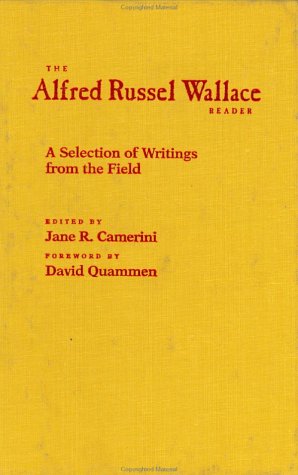
36. The Alfred Russel Wallace Reader: A Selection of Writings from the Field (Center Books in Natural History)
Hardcover: 248 Pages (2001-11-15)
list price: US$50.00
Isbn: 0801867819
Average Customer Review: 4.5 out of 5 stars
Canada | United Kingdom | Germany | France | Japan
Editorial Review

Product Description
The first book to reintroduce Alfred Russel Wallace, a contemporary of Darwin whose theory of evolution through natural selection spurred Darwin to finish Origin of the Species.

Long overshadowed by his contemporaries Charles Darwin and Thomas H. Huxley, Alfred Russel Wallace was an English naturalist and pioneer evolutionist whoresearched biological diversity through extensive exploration and travel. Independent of Darwin, Wallace developed a theory of evolution through natural selection, which ultimately spurred Darwin to complete and publish his own Origin of Species. Famous for drawing "Wallace's Line," the boundary line separating the Asian and Australian zoological regions, Wallace's studies of the distribution of plants and animals pioneered an evolutionary approach to global and island biogeography. The Alfred Russel Wallace Reader: A Selection of Writings from the Field is the first book to reintroduce Wallace to a general readership beyond the cadre of scientists and historians familiar with his work. ... Read more

Customer Reviews (2)

5-0 out of 5 stars Historic Justice for A.R. Wallace
Jane Camerini has performed a great service to all who are
interested in evolutionary theory. Wallace deserves to be
regarded as the co-founder of the modern theory of evolution.
He also wrote on a wide range of scientific and social topics.
Camerini's introductory remarks to each of the essays in this
collection help put them in their context.

4-0 out of 5 stars a Wallace reader for the layperson
Jane Camerini's slender anthology of Wallace's writings (and writings about him) is intended to provide an introduction to the great naturalist, primarily through his adventures in the field. Camerini has chosen a format for presenting this information very similar to that provided by another Wallace scholar, Barbara Beddall, whose "Wallace and Bates in the Tropics" was published way back in 1969. Camerini supplements excerpts from four books with her own introductory commentaries and a few additional Wallace essays, hoping that this will give the reader unfamiliar with his accomplishments some feel for them. I think she succeeds in this endeavor. The book is well organized and presented, including a number of interesting photos and figures, and Camerini's editorial commentaries are mostly right on target. Yet I cannot help but feel the brevity of the treatment will leave some readers puzzled. I'm not sure that the decision to include several essays of a more technical nature in a 200 page work was well advised; the gap between the fieldwork studies and Wallace's thought is considerable--not unfathomable, but not straightforward either--and the average reader may need more help than Camerini gives to appreciate the transition. Alternately, it might have been interesting to dwell strictly on the field studies--incorporating a greater diversity of excerpts--and then merely to refer to his future philosophical directions in a page or two of editorial comment at the end. Still, an interesting contribution to Wallace studies, and one which is likely to both complement and not duplicate the several others that will be appearing over the next months. ... Read more


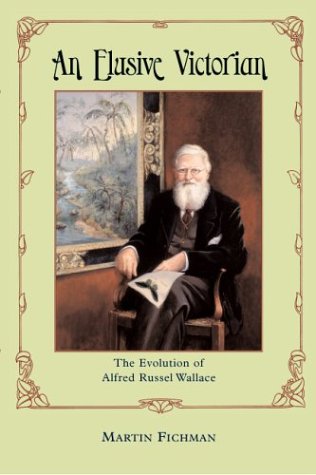
37. An Elusive Victorian: The Evolution of Alfred Russel Wallace
by Martin Fichman
Hardcover: 416 Pages (2004-02-01)
list price: US$43.00 -- used & new: US$24.98
(price subject to change: see help)
Asin: 0226246132
Average Customer Review: 5.0 out of 5 stars
Canada | United Kingdom | Germany | France | Japan
Editorial Review

Product Description

Codiscoverer of the theory of evolution by natural selection, Alfred Russel Wallace should be recognized as one of the titans of Victorian science. Instead he has long been relegated to a secondary place behind Darwin. Worse, many scholars have overlooked or even mocked his significant contributions to other aspects of Victorian culture. With An Elusive Victorian, Martin Fichman provides the first comprehensive analytical study of Wallace's life and controversial intellectual career.

Fichman examines not only Wallace's scientific work as an evolutionary theorist and field naturalist but also his philosophical concerns, his involvement with theism, and his commitment to land nationalization and other sociopolitical reforms such as women's rights. As Fichman shows, Wallace worked throughout his life to integrate these humanistic and scientific interests. His goal: the development of an evolutionary cosmology, a unified vision of humanity's place in nature and society that he hoped would ensure the dignity of all individuals.

To reveal the many aspects of this compelling figure, Fichman not only reexamines Wallace's published works, but also probes the contents of his lesser known writings, unpublished correspondence, and copious annotations in books from his personal library. Rather than consider Wallace's science as distinct from his sociopolitical commitments, An Elusive Victorian assumes a mutually beneficial relationship between the two, one which shaped Wallace into one of the most memorable characters of his time. Fully situating Wallace's wide-ranging work in its historical and cultural context, Fichman's innovative and insightful account will interest historians of science, religion, and Victorian culture as well as biologists.
(20040702) ... Read more

Customer Reviews (1)

5-0 out of 5 stars best treatment yet
Although it is premature to think that the continuing attention to Alfred Russel Wallace (1823-1913) merits the notion a "Wallace Industry" is underway (as is the case with Darwin), this new study certainly stokes the fire. It is, simply, the best monographic analysis of Wallace's life and work yet produced. Fichman uses a contextualist approach to create a treatment which is roughly chronological/biographical in organization, yet deviates as necessary (and often) to explore the nature of, and influences on, Wallace's thought--which ranged all the way from evolutionary biology, astronomy, and other hard sciences to spiritualism, social criticism, and land reform.

Wallace is "elusive" because his world view was both all-encompassing, and rather complex. A chronic problem with Wallace investigations has been an unwillingness by most scholars to read enough of his vast output to get a complete idea of what he was about. As a result, the common view has been that he in part gave up on natural selection around 1866 to adopt spiritualist (and later socialist) beliefs: the so-called "change of mind" hypothesis. As Fichman reveals, a newer point of view is emerging: that Wallace's stance had always been more or less teleological, that he probably always did consider man to be a "special case," and that both natural selection and spiritualism--equally and necessarily--fit into this stance as he explored its logical ramifications.

I am still not easy with Fichman's view that Wallace was a theist: his spiritualism was based on the perspective that the "world of spirit" constituted a *natural* reality, obeying laws of organization like the rest of nature--and this was the case, regardless of whether he actually turns out to be right or not. Still, Fichman uses the "*no* change of mind" hypothesis to explore a lot of interesting things in Wallace's work, including its connections to the ideas of Charles Peirce and William James, and his wholehearted commitment to the means of social progress. The ramifications for today's world, moreover, are extraordinary: it really *is* possible to maintain an internally consistent philosophy leading both to good science, and to a healthy, far-seeing--and spiritual--humanitarianism.

This book is heartily recommended to anyone who is seriously committed to the goal of understanding our place in the cosmos. ... Read more


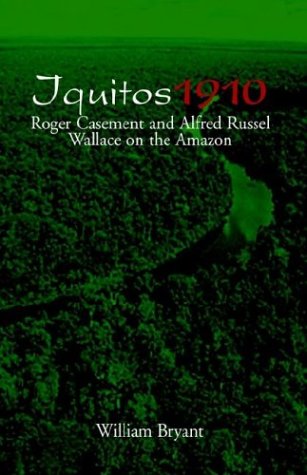
38. Iquitos 1910: Roger Casement and Alfred Russel Wallace on the Amazon
by William Bryant
Paperback: 248 Pages (2003-05)
list price: US$21.99 -- used & new: US$121.69
(price subject to change: see help)
Asin: 1401094538
Canada | United Kingdom | Germany | France | Japan
Editorial Review

Product Description
Iquitos 1910 is based on the underground gay classic--Roger Casement?s description in his own of his voyage of investigation in the Putumayo region of the Amazon, withrelated passages on Alfred Russel Wallace who explored the same region in the mid 19th century.Memo Strozzi, aspiring writer and amateur entomologist, travels in the Amazon in search of Casement and Wallace, reaching Iquitos and later Tabatinga in Colombia where he is captured and gang raped by FARC guerrillas.Later, escaping, he makes his way up the Putumayo where he visits the old rubber stations.Iquitos 1910 also contains the Memo?s secret diaries, much like Casement?s in tone.This is a book of personal exploration, natural history, travel, eroticism and literary fun.

... Read more

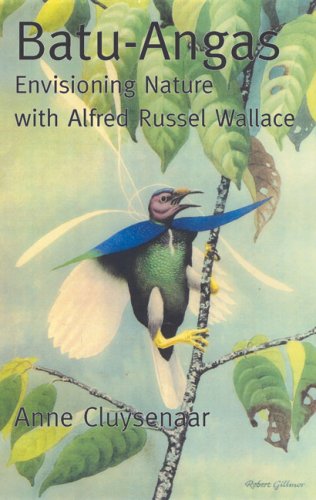
39. Batu-Angas: Envisioning Nature with Alfred Russel Wallace
by Anne Cluysenaar
Paperback: 96 Pages (2008-11-01)
list price: US$19.95 -- used & new: US$9.27
(price subject to change: see help)
Asin: 1854114646
Canada | United Kingdom | Germany | France | Japan
Editorial Review

Product Description

This assortment of poems draws inspiration from the discoveries of 19th-century British scientist Alfred Russel Wallace—known for his explorations of the Amazonian rainforest, the Malay archipelago, and closely associated with Charles Darwin and the theory of evolution. This collection traces Wallace’s travels and expeditions, recalling the scientist’s first impressions of exotic flora and fauna recalled in his journals and includes illustrations and photographs of specimens collected by Wallace during his journeys.

... Read more

40. Narrative of Travels on Amazon and Rio Negro (World History)
by Alfred Russell Wallace
 Hardcover: 363 Pages (1969-12)
list price: US$75.00
Isbn: 0838302513
Canada | United Kingdom | Germany | France | Japan
Editorial Review

Product Description
An informative travel book by the co-discoverer, with Darwin, of the principle of natural selection. ILLUS. with maps.

THIS TITLE IS CITED AND RECOMMENDED BY:Books for College Libraries; Cambridge Bibliography of English Literature. ... Read more


  Back | 21-40 of 44 | Next 20
A  B  C  D  E  F  G  H  I  J  K  L  M  N  O  P  Q  R  S  T  U  V  W  X  Y  Z  

Prices listed on this site are subject to change without notice.
Questions on ordering or shipping? click here for help.

site stats