
|
Help |
| Home - Book Author - Wallace Alfred Russel (Books) | |
e99 Online Shopping Mall
|
|
Help |
| Home - Book Author - Wallace Alfred Russel (Books) | |
| Back | 41-44 of 44 |
click price to see details click image to enlarge click link to go to the store
|
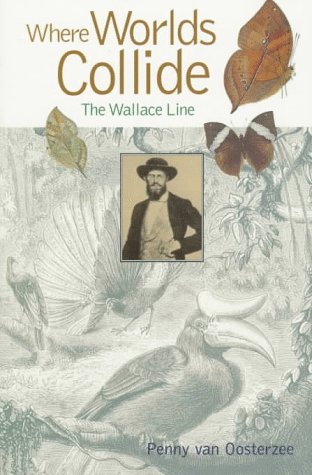
| 41. Where Worlds Collide: The Wallace Line (Comstock Book) by Penny Van Oosterzee | |
 | Paperback: 234
Pages
(1997-09)
list price: US$23.50 -- used & new: US$62.70 (price subject to change: see help) Asin: 0801484979 Average Customer Review: 
Canada | United Kingdom | Germany | France | Japan |
|
Editorial Review Product Description In Where Worlds Collide, van Oosterzee follows Wallace's journeys through the islands of South East Asia. She draws on Wallace's natural history travelogue, The Malay Archipelago, a book he wrote after spending the years from 1854 to 1862 in Malaysia, Indonesia, and New Guinea. Explaining his theory and how it has been interpreted by biologists, van Oosterzee also re-creates Wallace's sense of excitement with his discoveries. She devotes a chapter to the diversity of butterfly wing patterns, for example, because Wallace was so enamored of them. Customer Reviews (4)
This book is a treat.It is that rare amalgamation ofbiography, the geologic history of the Malay archipelago and an account of the geology and biodiversity of the Malay archipelago with maximal interest to any biologist or anyone who has the slightest interest in the wildlife of Austro-Asia. It goes into exquisite detail into the formation of endemic species on island communities and bemoans the lack of botanical exposure in most studies.It also has one or two spectacular maps of ancient SE Asia.More maps and diagrams would have aided the discussion about localities which are usually very obscure to most readers. This book deserves to be talked about and will certainly benefit the wildlife and our appreciation of Wallace and that region in all facets.Thank you Penny.
| |
| 42. Just Before the Origin: Alfred Wallace's Theory of Evolution by John Langdon Brooks | |
| Hardcover: 284
Pages
(1984-02)
list price: US$84.50 Isbn: 0231056761 Average Customer Review:
Canada | United Kingdom | Germany | France | Japan | |
|
Editorial Review Product Description John Langdon Brooks acts as a scientific detective as he reveals Wallace’s theories and compares the insights of both men in this fascinating study. Customer Reviews (4)
Is science the triumphant march of objective truth being revealed by noble seekers of the truth or is science polluted by human ambition just like any other human endeavor? Was Darwin the saintly seeker of the truth we learned about in school or a mere mortal? If he was a mere mortal, how did he achieve the great revolution in evolutionary thought? Extraordinary ideas must be rooted in extraordinary human experiences. We are taught that Darwin was the prepared mind in the right place at the right time, that his voyage around the world opened his eyes to patterns in the geographical variations in the diversity of life. If so, why did so many years pass between his voyage and the publication of his ideas on evolution? Might it be important that in science, as in all of life, it is not just what you know but who your friends are? The conventional rationalization for Darwin's delay in publishing on natural selection is multi-fold. First, it seems likely that Darwin feared the very nature of his discovery. He could well imagine the outrage that would be stimulated by any theory that finally toppled the Judeo-Christian view of man as having been created by God in His image. Second, because of that fear, Darwin felt compelled to marshal a large amount of supporting data, enough to ensure that announcement of his theory would be decisive and able to withstand all resistance. There is third component to the conventional story that seems to explain what finally ended Darwin's dithering over the theory. Alfred Wallace was ready to publish his own version of the theory based on his own extensive observations as a naturalist. John Langdon's analysis of Wallace's work suggests a variation on the standard theme. What if Darwin's main reason for delay in publication was personal dissatisfaction with his theory, not dissatisfaction with the amount or quality of supporting evidence? What if it was Wallace's more extensive data set that provided the basis for the key idea that finally overcame Darwin's own lack of faith in the theory of natural selection, finally allowing Darwin the courage to publish? And what if Darwin never admitted this critical role of Wallace's work? Since the dawn of Western Science, research proposals and manuscripts have been submitted to respected scientific peers in order that well considered decisions can be made about the support of research and the publication of new ideas. Most agree that it is wrong for a senior scientist to read the ideas of a young scientist, appropriate those ideas and exploit them, while at the same time rejecting the requests of the young scientist for support or publication of completed work. And yet, scientists are only human. What if you have worked on a problem for 20 years, for many years feeling on the verge of a breakthrough, then one sad day you realize that some young upstart has reached the finish line before you? This is the most delicate question raised by Langdon's book. What did Darwin do when confronted with this situation? In our society, science is a source of fame, wealth, and power. Those who wield this power defend the existing system. If a few eggs get broken, a few Wallaces get handed the dirty end of the stick, well, that's life. Its a dog eat dog world out there, and only the fittest can be expected to survive. Such is the standard view. But life is change. What is the origin of change? Even a mighty dinosaur might be replaced by a small mouse. Listen for a squeaking sound coming Just Before The Origin.
| |
| 43. Archipelago : Islands of Indonesia by Gavan Daws, Marty Fujita | |
 | Hardcover: 266
Pages
(1999-11-23)
list price: US$60.00 -- used & new: US$99.98 (price subject to change: see help) Asin: 0520215761 Average Customer Review: 
Canada | United Kingdom | Germany | France | Japan |
|
Editorial Review Product Description In this richly illustrated book, historian Gavan Daws and biologist MartyFujita follow Wallace's trail through the islands of Indonesia, visitingthe Moluccas, Bali, Irian Jaya, and other extraordinary treasuries ofbiological diversity--for, as they point out, although Indonesia comprisesonly 1.3 percent of the world's surface, it harbors nearly a quarter of theworld's species. Their naturalistic travelogue includes a carefuldiscussion of Wallace's ideas and of how he came to hold them through thecourse of his remarkable body of fieldwork. In doing so, they emphasize theimportance of Wallace's contributions to demographics, the theory of islandbiodiversity, and other tenets of modern biological thought. The result isan unusually instructive, and unusually handsome, book of scientificadventure. --Gregory McNamee Customer Reviews (5)
I'm not a big fan of the "Coffee Table Book" but this is an exception.While it might be tempting to only look at the pictures, the text is in such a interesting format that reading it turns out to be such a breeze that you will be done before you notice.
| |
| 44. ORIGINS & SPECIES (Harvard Dissertations in the History of Science) by Hodge | |
| Hardcover: 759
Pages
(1991-06-01)
list price: US$172.00 Isbn: 0824072529 Canada | United Kingdom | Germany | France | Japan | |
| Back | 41-44 of 44 |
 Amateurish Overview with Horrendous Factual Errors
 Interesting background, but an axe to grind