
|
Help |
| Home - Chemistry - Computational Chemistry (Books) | |
e99 Online Shopping Mall
|
|
Help |
| Home - Chemistry - Computational Chemistry (Books) | |
| 1-20 of 100 | Next 20 |
click price to see details click image to enlarge click link to go to the store
| 1. Introduction to Computational Chemistry by Frank Jensen | |
 | Paperback: 624
Pages
(2006-12-13)
list price: US$80.00 -- used & new: US$54.73 (price subject to change: see help) Asin: 0470011874 Average Customer Review: 
Canada | United Kingdom | Germany | France | Japan |
|
Editorial Review Product Description Customer Reviews (5)
| |
| 2. Handbook of Computational Quantum Chemistry by David B. Cook | |
 | Paperback: 832
Pages
(2005-08-02)
list price: US$39.95 -- used & new: US$22.13 (price subject to change: see help) Asin: 0486443078 Average Customer Review: 
Canada | United Kingdom | Germany | France | Japan |
|
Editorial Review Product Description Customer Reviews (3)
| |
| 3. Essentials of Computational Chemistry: Theories and Models by Christopher J. Cramer | |
 | Paperback: 618
Pages
(2004-11-22)
list price: US$70.00 -- used & new: US$53.89 (price subject to change: see help) Asin: 0470091827 Average Customer Review: 
Canada | United Kingdom | Germany | France | Japan |
|
Editorial Review Product Description Customer Reviews (6)
| |
| 4. Computational Chemistry: A Practical Guide for Applying Techniques to Real World Problems by David Young | |
 | Hardcover: 408
Pages
(2001-03-07)
list price: US$135.00 -- used & new: US$85.50 (price subject to change: see help) Asin: 0471333689 Average Customer Review: 
Canada | United Kingdom | Germany | France | Japan |
|
Editorial Review Product Description Customer Reviews (2)
| |
| 5. Computational Chemistry Workbook: Learning Through Examples by Thomas Heine, Jan-Ole Joswig, Achim Gelessus | |
 | Paperback: 250
Pages
(2009-11-17)
list price: US$55.00 -- used & new: US$43.28 (price subject to change: see help) Asin: 3527324429 Canada | United Kingdom | Germany | France | Japan |
|
Editorial Review Product Description | |
| 6. A Computational Approach to Chemistry (Physical Chemistry Texts) by David Michael Hirst | |
| Paperback: 452
Pages
(1990-03)
list price: US$55.00 -- used & new: US$177.31 (price subject to change: see help) Asin: 0632027436 Canada | United Kingdom | Germany | France | Japan | |
|
Editorial Review Product Description | |
| 7. Computational Methods in Quantum Chemistry: Quantum Chemistry (World Scientific Series in Contemporary Chemical Physics) by A. A. Hasanein, Myron W. Evans | |
| Hardcover: 241
Pages
(1996-06)
list price: US$61.00 -- used & new: US$61.00 (price subject to change: see help) Asin: 981022611X Canada | United Kingdom | Germany | France | Japan | |
|
Editorial Review Product Description Chapter 3 is a description of the Hartree-Fock self-consistent fieldmethod, which is developed systematically for atoms. TheBorn-Oppenheimer approximation is introduced, and the numericalmethods presented one by one thereafter in a logically consistent waythat should be accessible to undergraduates. These include LCAO,Hartree-Fock-SCF method for molecules, Roothaan LCAO-MO-SCF method,and electron correlation energy. Chapter 4 is devoted to the more sophisticated computational methodsin quantum chemistry, with an introduction to topics that include: thezero differential overlap approximation; Huckel MO theory ofconjugated molecules; Pariser-Parr-Pople MO method; extended Huckeltheory; neglect of differential overlap methods; invariance in spacerequirements; CNDO; INDO; NDDO; MINDO; MNDO; AM1; MNDO-PM3; SAM1;SINDO1; CNDO/S; PCILO,X?; and ab initio methods. This is followed by an introduction to Moller-Plesset perturbationtheory of many electrons, and coupled perturbed Hartree Fock theory,with a description of the coupled cluster method. Finally Chapter 5applies these methods to problems of contemporary interest. The book is designed to be a junior/senior level text in computationalquantum mechanics, suitable for undergraduates and graduates inchemistry, physics, computer science, and associated disciplines. | |
| 8. Computational Chemistry (Oxford Chemistry Primers, 29) by Guy H. Grant, W. Graham Richards | |
 | Paperback: 96
Pages
(1995-05-11)
list price: US$25.00 -- used & new: US$20.93 (price subject to change: see help) Asin: 019855740X Average Customer Review:
Canada | United Kingdom | Germany | France | Japan |
|
Editorial Review Product Description Customer Reviews (2)
The authors carry this forward, using concise mathematics, to derive electron distributions and small-scale molecular conformations. The third chapter addresses conformations of larger molecules, starting with rigorous computations of each conformation's energy, then backing down to some approximation techniques. The fourth chapter packs in a number of concepts, prehaps too many: solvation, statistical mechanics, and a little bit of molecular mechanics. Chapter five skims over protein and DNA folding, and chapter 6 discusses small-molecule (drug) interactions with proteins. Although the authors start the book noting the intense computational requirements, they never give explicit techniques for performing those computations efficiently. The math is the abstract form, close to the quantum mechanics, and rarely the form of a practical computation. In fact, the math is abstract enough that I'd be hard pressed to come up with real limits of integration in many cases. The authors make some effort to use their equations to support intuitive understanding, but sometimes focus too much on the formulas themselves instead of their meanings. I can't fault the book for being written in 1995 - by the standards of computational chemistry, that's a bit dated now. Still, almost all of its references date from 1990 or earlier. They weren't the freshest even when the book was written. The book does give a broad view, high-level survey of the quantum mechanical view of chemistry. It omits many more modern practices though: finite element approximations to molecule structure, grammar-based analysis of RNA folding, and Markov models for structure prediction. It also omits the knowledge needed to reduce abstract physics to practical calculations. Use this as an introductory survey, but use other books for knowledge you can put to work.
| |
| 9. Computational Organic Chemistry by Steven M. Bachrach | |
 | Hardcover: 496
Pages
(2007-07-16)
list price: US$140.00 -- used & new: US$45.00 (price subject to change: see help) Asin: 0471713422 Canada | United Kingdom | Germany | France | Japan |
|
Editorial Review Product Description | |
| 10. Computational Drug Design: A Guide for Computational and Medicinal Chemists by D. C. Young | |
 | Hardcover: 307
Pages
(2009-02-12)
list price: US$105.00 -- used & new: US$81.15 (price subject to change: see help) Asin: 047012685X Canada | United Kingdom | Germany | France | Japan |
|
Editorial Review Product Description Computational Drug Design covers all of the major computational drug design techniques in use today, focusing on the process that pharmaceutical chemists employ to design a new drug molecule. The discussions of which computational tools to use and when and how to use them are all based on typical pharmaceutical industry drug design processes. Following an introduction, the book is divided into three parts: Part One, The Drug Design Process, sets forth a variety of design processes suitable for a number of different drug development scenarios and drug targets. The author demonstrates how computational techniques are typically used during the design process, helping readers choose the best computational tools to meet their goals. Part Two, Computational Tools and Techniques, offers a series of chapters, each one dedicated to a single computational technique. Readers discover the strengths and weaknesses of each technique. Moreover, the book tabulates comparative accuracy studies, giving readers an unbiased comparison of all the available techniques. Part Three, Related Topics, addresses new, emerging, and complementary technologies, including bioinformatics, simulations at the cellular and organ level, synthesis route prediction, proteomics, and prodrug approaches. The book's accompanying CD-ROM, a special feature, offers graphics of the molecular structures and dynamic reactions discussed in the book as well as demos from computational drug design software companies. Computational Drug Design is ideal for both students and professionals in drug design, helping them choose and take full advantage of the best computational tools available. Note: CD-ROM/DVD and other supplementary materials are not included as part of eBook file. | |
| 11. Encyclopedia of Computational Chemistry, 5 Volume Set by Paul von Ragu? Schleyer | |
 | Hardcover: 3580
Pages
(1998-11-25)
list price: US$6,615.00 -- used & new: US$640.00 (price subject to change: see help) Asin: 047196588X Canada | United Kingdom | Germany | France | Japan |
|
Editorial Review Product Description "The Encyclopedia of Computational Chemistry represents the most comprehensive effort yet to cover the field of computational chemistry in its full breadth. This effort has been successful in most points and the ECC is thus a must-have for all chemistry libraries". | |
| 12. Computational Chemistry and Molecular Modeling: Principles and Applications by K. I. Ramachandran, Gopakumar Deepa, Krishnan Namboori | |
 | Paperback: 397
Pages
(2010-11-30)
list price: US$99.00 -- used & new: US$79.11 (price subject to change: see help) Asin: 3642095984 Canada | United Kingdom | Germany | France | Japan |
|
Editorial Review Product Description The gap between introductory level textbooks and highly specialized monographs is filled by this modern textbook. It provides in one comprehensive volume the in-depth theoretical background for molecular modeling and detailed descriptions of the applications in chemistry and related fields like drug design, molecular sciences, biomedical, polymer and materials engineering. Special chapters on basic mathematics and the use of respective software tools are included. Numerous numerical examples, exercises and explanatory illustrations as well as a web site with application tools (http://www.amrita.edu/cen/ccmm) support the students and lecturers. | |
| 13. Simple Theorems, Proofs and Derivations in Quantum Chemistry (Mathematical and Computational Chemistry) by Istvan Mayer | |
 | Paperback: 352
Pages
(2010-11-02)
list price: US$159.00 -- used & new: US$159.00 (price subject to change: see help) Asin: 1441933891 Canada | United Kingdom | Germany | France | Japan |
|
Editorial Review Product Description | |
| 14. Annual Reports in Computational Chemistry 2, Volume 2 | |
 | Hardcover: 346
Pages
(2006-09-05)
list price: US$234.00 -- used & new: US$39.99 (price subject to change: see help) Asin: 0444528229 Canada | United Kingdom | Germany | France | Japan |
|
Editorial Review Product Description | |
| 15. Computational Chemistry: Introduction to the Theory and Applications of Molecular and Quantum Mechanics (Volume 0) by Errol G. Lewars | |
 | Paperback: 488
Pages
(2003-03-01)
list price: US$115.00 -- used & new: US$69.83 (price subject to change: see help) Asin: 1402074220 Average Customer Review:
Canada | United Kingdom | Germany | France | Japan |
|
Editorial Review Product Description Computational Chemistry: Introduction to the Theory and Applications of Molecular and Quantum Mechanics is an invaluable tool for teaching and researchers alike. The book provides an overview of the field, explains the basic underlying theory at a meaningful level that is not beyond beginners, and it gives numerous comparisons of different methods with one another and with experiment. The following concepts are illustrated and their possibilities and limitations are given: potential energy surfaces; Topics are placed in a historical context, adding interest to them and removing much of their apparently arbitrary aspect. The large number of references, to all significant topics mentioned, should make this book useful not only to undergraduates but also to graduate students and academic and industrial researchers. Customer Reviews (2)
Lewars introduces the easy parts in a clear enough way. Potential energy surfaces make sense. Molecular mechanics has a good, intuitive feel - it's the springs-and-balls model, elaborated to include plane and dihedral angles, representing force fields derived from other sources. After that (i.e., after p. 80), it's quantum mechanics for a few hundred pages. The premise is that the layout of electrons across a molecule determines its chemistry, and that the wave function tells where the electrons will be. Since the wave equations can't be solved exactly for anything with two or more electrons (!), it's actually approximations to quantum. That leads to two levels of opacity: quantum itself, and all the facts that were scraped off in the approximation process. At this point, the chice is binary: become fluent in quantum, or move on. There are a few nuggets to be had for the non-fluent, including some of the techniques for solving these horrendous integrals. Mostly, though, I moved on. After the "ab initio" quantum mechanical methods, Lewars presents the semi-empirical models. These deal with simplified models of wave functions. Unlike ab initio methods, which stand on almost purely theoretical models, semi-empirical methods are informed by experimental data. They are based on the electron wave functions, as are the ab initio methods, but use approximations calibrated by experimental results. The book's final section presents density functional theory (DFT), another technique for estimating where the electrons will be. This book demands a lot of the reader, more than I came in with or had time to develop. I was able to use it to get a working vocabulary of the major kinds of computations, the general categories of approach to modeling, and a rough idea of the techniques and complexities involved. I need a little more information than that, but not the immediate leap into the deep end presented here. I look forward to a review by someone more knowledgeable. For now, my only real criticism of this book is lack of glossary. Initialisms and acronyms abound. It would have made the going a lot easier if the book had one place where I could refresh my memory on the dozens or hundreds of abbreviations. ... Read more | |
| 16. Molecular Electrostatic Potentials, Volume 3: Concepts and Applications (Theoretical and Computational Chemistry) | |
 | Hardcover: 680
Pages
(1996-12-06)
list price: US$408.00 -- used & new: US$282.05 (price subject to change: see help) Asin: 0444823530 Canada | United Kingdom | Germany | France | Japan |
|
Editorial Review Product Description This volume opens with a survey chapter by one of the original pioneers of the use of the electrostatic potential in studies of chemical reactivity, Jacopo Tomasi. Though the flow of the succeeding chapters is not stringently defined, the overall trend is that the emphasis changes gradually from methodology to applications. Chapters discussing more theoretical topics are placed near the end. Readers will find the wide variety of topics provided by an international group of authors both convincing and useful. | |
| 17. Non-Covalent Interactions: Theory and Experiment (RSC Theoretical and Computational Chemistry Series) by Pavel Hobza, Klaus Müller-Dethlefs | |
 | Hardcover: 225
Pages
(2009-12-14)
list price: US$159.00 -- used & new: US$115.00 (price subject to change: see help) Asin: 1847558534 Canada | United Kingdom | Germany | France | Japan |
|
Editorial Review Product Description This book aims to understand the main aspects of non-covalent chemistry (mainly in the gas phase) and specifically compares the experimental and theoretical data available for non-covalent complexes and subsequent problems associated with this comparison. | |
| 18. Chemistry from First Principles by Jan C. A. Boeyens | |
 | Paperback: 322
Pages
(2010-11-30)
list price: US$109.00 -- used & new: US$109.00 (price subject to change: see help) Asin: 9048179076 Average Customer Review:
Canada | United Kingdom | Germany | France | Japan |
|
Editorial Review Product Description "Chemistry from First Principles" examines the appearance of matter in its most primitive form. It features the empirical rules of chemical affinity that regulate the synthesis and properties of molecular matter, analyzes the compatibility of the theories of chemistry with the quantum and relativity theories of physics, formulates a consistent theory based on clear physical pictures and manageable mathematics to account for chemical concepts such as the structure and stability of atoms and molecules. This text also explains the self-similarity between space-time, nuclear structure, covalent assembly, biological growth, planetary systems, and galactic conformation. Customer Reviews (1)
| |
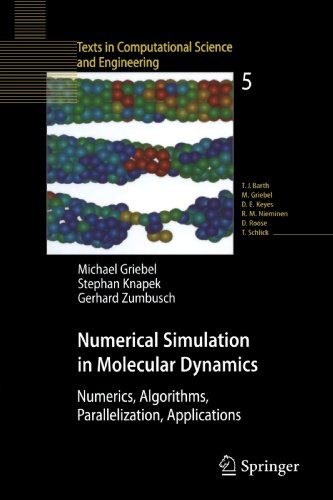
| 19. Numerical Simulation in Molecular Dynamics: Numerics, Algorithms, Parallelization, Applications (Texts in Computational Science and Engineering) by Michael Griebel, Stephan Knapek, Gerhard Zumbusch | |
 | Paperback: 476
Pages
(2010-11-02)
list price: US$59.95 -- used & new: US$48.31 (price subject to change: see help) Asin: 3642087760 Canada | United Kingdom | Germany | France | Japan |
|
Editorial Review Product Description This book details the necessary numerical methods, the theoretical background and foundations and the techniques involved in creating computer particle models, including linked-cell method, SPME-method, tree codes, amd multipol technique. It illustrates modeling, discretization, algorithms and their parallel implementation with MPI on computer systems with distributed memory. The text offers step-by-step explanations of numerical simulation, providing illustrative code examples. With the description of the algorithms and the presentation of the results of various simulations from fields such as material science, nanotechnology, biochemistry and astrophysics, the reader of this book will learn how to write programs capable of running successful experiments for molecular dynamics. | |
| 20. Computational Photochemistry, Volume 16 (Theoretical and Computational Chemistry) | |
 | Hardcover: 368
Pages
(2005-12-27)
list price: US$249.00 -- used & new: US$108.24 (price subject to change: see help) Asin: 0444521100 Canada | United Kingdom | Germany | France | Japan |
|
Editorial Review Product Description | |
| 1-20 of 100 | Next 20 |
 Not a good book
 A nice practical guide for the non-specialist