e99 Online Shopping Mall

Geometry.Net - the online learning center Help  
Home  - Computer - Home Automation (Books)

  1-20 of 100 | Next 20

click price to see details     click image to enlarge     click link to go to the store

$9.90
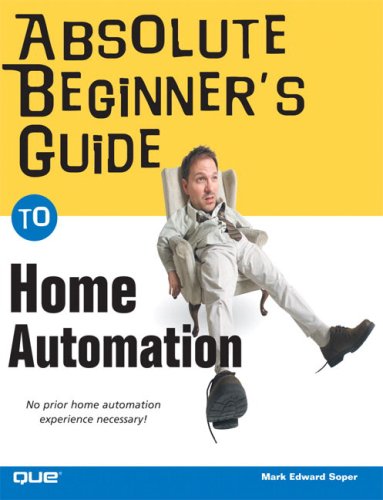
1. Absolute Beginner's Guide to Home
$40.17
2. Home Automation Basics - Practical
$11.82
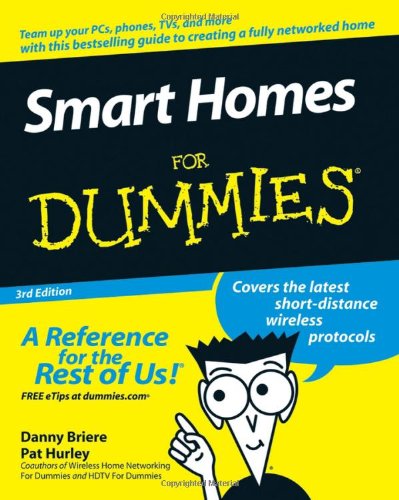
3. Smart Homes For Dummies (For Dummies
$6.95
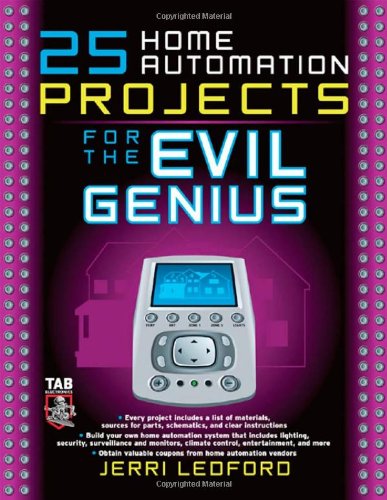
4. 25 Home Automation Projects for
$5.92
5. Linux Smart Homes For Dummies
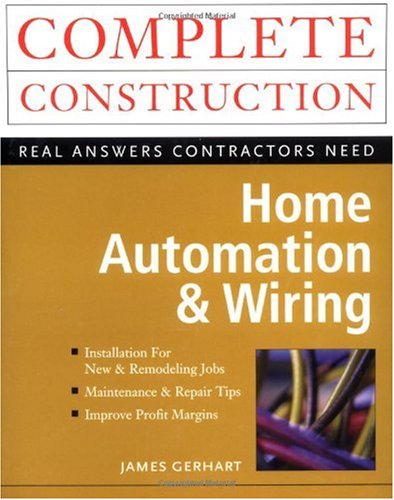
6. Home Automation & Wiring
$52.94
7. Technologies for Home Networking
$13.52
8. Smart Home Hacks: Tips & Tools
$30.00
9. Latest Technology in Automated
$8.97
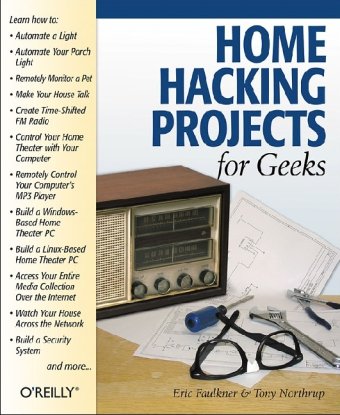
10. Home Hacking Projects for Geeks
$13.96
11. Home Networking: The Missing Manual
$10.00
12. Home Networking: A Visual Do-It-Yourself
$11.38
13. Absolute Beginner's Guide to Home
$2.95
14. PC Toys: 14 Cool Projects for
$7.48
15. Home Networking Annoyances: How
$11.35
16. Home Automation II - LiteTouch
$39.07
17. Inside the Smart Home
 
$9.50
18. The Complete Guide to Home Automation
 
$9.98
19. Approaching Home Automation: A
$6.31
20. Geek House: 10 Hardware Hacking

1. Absolute Beginner's Guide to Home Automation (Absolute Beginner's Guide)
by Mark Edward Soper
Paperback: 384 Pages (2005-06-18)
list price: US$21.99 -- used & new: US$9.90
(price subject to change: see help)
Asin: 0789732076
Average Customer Review: 4.0 out of 5 stars
Canada | United Kingdom | Germany | France | Japan
Editorial Review

Book Description

Get the home of tomorrow, today! Absolute Beginner's Guide to Home Automation will help you turn your ordinary home into a high-tech haven. Want to schedule your lights to turn on while you're on vacation? Stuck late at work and want to start the roast you put in the crock pot this morning? You can make it all happen with the help of existing 110V electrical wiring in your home and this step-by-step tutorial. Through simple, do-it-yourself instructions, you will walk through the process of outfitting every room in your home with a network connection that you can control with a few clicks on your computer keyboard. Complete with illustrations and photographs, Absolute Beginner's Guide to Home Automation will have you riding the wave of the future in no time.

... Read more

Customer Reviews (1)

4-0 out of 5 stars make an overall plan first
The book is mostly about developing nifty controls using X10. In this field, X10 is by far the dominant controller. Soper explains why, by describing numerous varied ways to have it control items in the typical household. It is probably simpler to read this book than thumb through the official X10 documentation. Soper does not require that you have a deep technical background to implement the book's methods.

Aside from the specific automation methods, he also offers a chapter on planning what you might want to and be able to automate in your home. Here is where you can start, to devise an overall plan, in a top-down fashion, rather than plunge into hooking up one or two gadgets. That can come later. The chapter is good for helping decide, especially within the constraints of a budget, which surely applies to many readers.

The book also points out a strong point about the latest X10 devices. These can be wireless, hugely easing installation. No awkward and unsightly wires trailing along your floors and walls. ... Read more


2. Home Automation Basics - Practical Applications Using Visual Basic 6 (Sams Technical Publishing Connectivity Series)
by Thomas Leonik
Paperback: 304 Pages (2000-07-01)
list price: US$63.95 -- used & new: US$40.17
(price subject to change: see help)
Asin: 0790612143
Average Customer Review: 3.5 out of 5 stars
Canada | United Kingdom | Germany | France | Japan
Editorial Review

Book Description
This book explores the world of Visual Basic 6 programming with respect to real-world interfacing and control on a beginner to intermediate level, with a home automation system.Includes HVAC systems, water pumps, temperature controls and more. ... Read more

Customer Reviews (10)

5-0 out of 5 stars Communication Protocol's and VB
Mr. Leonik is correct in his feeling with regard to the title given to his book, it is in fact not representative of the material inside. I can't imagine someone just getting involved with home automation (or wanting to learn about the subject) choosing this book as a starting point. Visual Basic is a huge programming language that takes years to develop a proficiency in. Writing effective communication protocol software in any language is no easy task and it is only a small part of VB capability. As a Vb programmer I had heard about Mr. Leonik's book through the "VB Grapevine". I had been searching for a book that covered this subject for a Modbus project I was working on. Of the 50 or so VB books in my library none of them covered this subject, so when I learned about this book and after reading Mr. Leonik's writeup I knew this was a book that I had to have in my library. I was not disappointed -- the information and program contained in Chapter 5 was well worth every penny (just the algorithm for CRC computation was enormously helpful). This book filled a void (no pun intended) in my arsenal of VB knowledge (and my library). Thanks, Mr. Leonik, from myself and my fellow VB programmers for the useful knowledge.

3-0 out of 5 stars Need to repackage
The general intent of the author is interesting but he blows it by writing the book based on the AB PLC which is expensive and not generally popular with Hobbyists and DIY folks.
The book will certainly have a lot more appeal had it been written based on PIC's or Basic stamp microcontrollers. However, I found the chapters on RS232 interfacing very useful and am keeping it for that reason.

2-0 out of 5 stars Just a copy of AB manual
After reading the authors review I bought this book. It has nothing just a copy of DF1 protocol for Allen Bradley PLC (Unprotected Reads and Write). This book is a basic book not for advanced users.

2-0 out of 5 stars Home Automation for people with too much money
This book will leave you scratching your head. Do not pay too much for it and you won't be disappointed. When it gets right down to it you might as well look for a plc with o.e. software because that's what you will need. Nice discussions on electrical basics and interfacing but just not practical or user friendly.There are just too many different devices to chase down and no real guidance as to where to get them. Writers should have non-technical people read their material before they publish.

5-0 out of 5 stars Great Book and reference
I've read a lot of books on VB and PLC's but the book that I think about most and use as handy reference is Tom Leonik's --Home Automation Basics - Pratical apps using VB6.This book is fun and to the point.The example of a home monitor is cool and the material presented in the book can easily be applied to many different applications.

The one reviewer who stated that you needed PLC software... obviously did not read the book.PLC software is only needed to program the PLC.The PLC in this application performs conditioning of inputs and stores key information in non-volatile ram.The book creates a driver to communicate with the PLC in VB no other software is required.This is an amazing task and it works. ... Read more


3. Smart Homes For Dummies (For Dummies (Home & Garden))
by Danny Briere, Pat Hurley
Paperback: 432 Pages (2007-07-23)
list price: US$21.99 -- used & new: US$11.82
(price subject to change: see help)
Asin: 0470165677
Average Customer Review: 4.5 out of 5 stars
Canada | United Kingdom | Germany | France | Japan
Editorial Review

Book Description
Do you long to listen to your favorite CD from anywhere in your house? To set up a wireless network so you can access the Internet in any room? To install an iron-clad security system? To fire up the coffee pot while you’re still asleep and wake up with automated lighting? Smart home technology can help you do just that!

Smart Homes For Dummies, Third Edition, shows you how easy it can be to create and live in a cutting-edge, fully connected home—without breaking your bank account. With this user-friendly guide, you’ll discover all the latest trends and gadgets in home networking, automation, and control that will help you make life more enjoyable and comfortable for your entire family. We help you plan for things such as flat-screen TVs, intercom systems, whole-home audio systems, gaming consoles, and satellite systems. We talk about your wiring (and wireless) options and introduce you to the latest technologies, such as VoIP and Bluetooth. You’ll see how to:

  • Build your home network on a budget
  • Turn your home into an entertainment center
  • Access the Internet from any room
  • Get VoIP on your phone network
  • Boost in-home wireless and cell phone signals
  • Connect your computer to your TV
  • Secure your home and property
  • Increase your home’s resale value
  • Avoid common networking pitfalls
  • And much, much more

Complete with a resource list for more information and neat toys of the future, Smart Homes For Dummies is your plain-English, twenty-first century guide to a fully wired home! ... Read more

Customer Reviews (39)

4-0 out of 5 stars An excellent orientation; a mediocre how-to
This book was very useful in providing an organized and cross-referenced overview of all the systems and sub-systems and technologies that can be utilized in constructing a smart home.The best thing about it is that the authors manage to maintain good objectivity - it's not a glorified sales pitch for any particular manufacturer.The book is very useful for making decisions about what technologies to incorporate in your home.Audio and video may be a given, but the authors also address phone systems, home security, computer network (wireless and cabled), voice control systems, video cameras, lighting, and more.

The principal weakness is that the book doesn't really tell you how to create a smart home plan.It is weak on examples.If you're sitting down with a set of blueprints and this book, there are a lot of missing pieces to the puzzle (placement and types of outlets and switchplates, dedicated circuitry for the media room, in-wall or in-ceiling speaker placement for audio or surround sound setups, conduit layout, drawing and notating plans for the electrician, and so on).

It's very well written, with a personal and humorous touch from the authors and you can easily sit down and read it cover to cover in one day.But it's rich in information, so I'd suggest reading it with a highlighter handy for the things that grab your attention.

4-0 out of 5 stars Good Guidance
Lots of info for x10 systems but not leaning to any particular vendor.Very much like that they wrote from personal experience. I did wish they were a bit more clear in regards to whole house audio, but the section on impedance was adequate.

5-0 out of 5 stars Food for thought.
My husband and I are in the midst of a major remodel/expansion of our 1968 tract home so we have read pretty much every remodeling book we could find.This book offers a lot of information and food for thought on how to bring an outdated home into the technology age.Our budget is not unlimited and this book helped us decide which features were essential to add now and what could be added later (and how to add the foundation work while the walls were stripped to the studs for those future improvements to save us money in the long run).This book does not give reviews on specific products, that is not it's purpose.Technology is changing so fast, that any product reviews would have been obsolete by the time the book hit the shelves.I recommend you use this book to plan out the framework for your smart house and use magazines like THE PERFECT VISION, HOME THEATER, etc. to fill in the blanks.My husband subscribed to both magazines through Amazon (very inexpensively) for 2 years and did a lot of research on the Internet before making his preliminary choices.Since we aren't at the "fun stage" of our remodel yet, where we get to go buy all the equipment, those choices might still change because prices our dropping and items that were out of our price range 2 years ago are now more affordable.The bottom line is this book is the BEST for helping you plan your smart house because it is easy to understand by even those of us who are not tech savy (like me) and it shows you options that you may have never even thought of before.And believe me, in a remodel the time for thought, planning and innovation is before you put the drywall back up!

5-0 out of 5 stars Good reading.
I am very much into the X-10 gadgets and have been for several years. This book was intended for the average DUMMY homeowner interested in inexpensive home security and automation. Although I own other books on this particular subject, I found this one to be the most down to earth.

2-0 out of 5 stars Only for dummies
Very little information of any real help here.No reviews of current equipment, or help in wiring.Very basic descriptions of home automation.Only for the truly dumb. ... Read more


4. 25 Home Automation Projects for the Evil Genius
by Jerri Ledford
Paperback: 288 Pages (2006-12-20)
list price: US$24.95 -- used & new: US$6.95
(price subject to change: see help)
Asin: 0071477578
Average Customer Review: 1.0 out of 5 stars
Canada | United Kingdom | Germany | France | Japan
Editorial Review

Book Description

TURN YOUR HOME SWEET HOME INTO AN AUTOMATED, EVIL GENIUS PARADISE!

Your home may be your castle-but can it cook your dinner? Well, with the help of 25 Home Automation Projects for the Evil Genius, you can teach it to do just that, along with dozens of other affordable, enjoyable things that will transform your humble abode into a wickedly automated living environment.

But fear not-you don't need an engineering degree to complete the projects in this book. That's because technology maven Jerri L. Ledford skillfully provides you with a firm understanding of the basic wiring, networking, and equipment demands for home automation. She then leads you step by step through each application, offering clearly worded and heavily diagramed guidance that will truly satisfy your inner Evil Genius.

With the help of just a few household tools, you'll be able to bring info-age automation to:

  • Indoor and outdoor lighting
  • Security and surveillance
  • Climate regulation
  • Entertainment systems
  • Personal reminders
  • Plant care
  • Remote monitoring of kids and pets
  • Keyless entry
  • Wireless TV
  • And many more!

Plus, you'll gain access to discounts from a variety of home automation product manufacturers, to make your projects even more economical. With 25 Home Automation Projects for the Evil Genius, easy living is now automatic!

... Read more

Customer Reviews (2)

1-0 out of 5 stars This book is just terrible
I wish I had heeded the warnings of the other reviewer that panned this book, but I found a used copy from an Amazon vendor at a really low price and figured "what the heck."Well, no price is low enough for this volume.Even free it wouldn't be worth the postage.

Fortunately you don't have to read for long to discover that this book is a waste of time. The second chapter, tantalizingly titled "Intruder Alert: Outdoor Lighting" is 5 pages long. In those 5 pages it basically says "Go to a home supply store; buy an outdoor light with motion sensor; install it."It is impressive that the author was able to drag that out to 5 pages!What did I expect of a chapter entitled "Intruder Alert" in a book named "25 Home Automation Projects for the Evil Genius"?I dunno - how about building a system involving multiple lights and multiple sensors that communicate through some automated system.Or maybe a system that uses high-power lights to blind and disorient an intruder.Or at least something that requires a soldering iron!

If you make it past chapter 2, Chapter 4 tells you how to install a thermostat.Let me save you the trouble of reading it.It says "Go to a home supply store; buy a modern setback thermometer with whatever features you would like that is compatible with your home; Remove your old thermostat; install the new one."Chapter 5, excitingly named "Speak Up! Installing Voice Controls" spends 3 of its 6 pages showing you how to run the installation setup app for the voice control program on your PC.I'm not talking about some arcane ritual, it literally shows you screen shots of the freaking setup wizard.Give me a break!If you aren't able to install an application on your PC, you are not ready for home automation.

I am amazed that this book was ever published.I am amazed that it is still in print.I have never read any other Evil Genius books, and after this one I don't intend to.

1-0 out of 5 stars A disappointment from cover to cover for an evil genius.
To start this review I will quote an excerpt from the front cover:
"Every project includes a list of materials, sources for parts, schematics, and clear instructions.Build your own home automation system that includes lighting, security, surveillance and monitors, climate control, entertainment, and more"

Anyone who is familiar with the "Evil Genius" series of books knows that they are famous for DIY projects created by hacking existing items for new purposes.This book is not one of them.There should be a disclaimer on the front of this book that says "REQUIRES WINDOWS XP FOR MOST PROJECTS AND A LOCAL HOME IMPROVEMENT STORE".Nothing about this book is spectacular.In fact Ms. Ledford has simply taken the instructions out of the boxes of products bought from Lowes or Home Depot, and compiled them into a 25 chapter book.You don't build ANYTHING.Everything is purchased ready to use right out of the box.Please reread the excerpt above now.Why the need to mentions materials, parts, or schematics.Why does it say "build your own".If there had been anything at all in this book that came close to the history of the "evil genius" series OR if the book contained anything that resembles what is spelled out on the front and back covers, then I would have given it more than 1 star.As far as this book is concerned, all you need to do is go to your local home improvement warehouse and buy whatever home automation item you want.Then bring it home and follow the instructions supplied with the purchased item.I also challenge anyone to find the words "windows" or "software" on the covers of this book.Has Ms. Ledford not considered that not everyone uses a MS product?TAB Electronics has had really great books come from their presses, but their editors drop the ball on this one.It needs "evil genius" removed from it's cover.It should actually have the title "25 Ready To Use Home Automation Products".If you are a fan of the previously released "evil genius" books then stay away from this one.If you want help installing something you purchased and a little bit of theory behind how it works, then by all means this is the book for you (you just better have a MS enabled computer handy). ... Read more


5. Linux Smart Homes For Dummies (For Dummies (Computer/Tech))
by Neil Cherry
Paperback: 364 Pages (2006-08-14)
list price: US$24.99 -- used & new: US$5.92
(price subject to change: see help)
Asin: 0764598236
Average Customer Review: 5.0 out of 5 stars
Canada | United Kingdom | Germany | France | Japan
Editorial Review

Book Description
A Linux smart home is about controlling and monitoring devices and information around your home using a standard personal computer, Linux, and its vast array of open source tools. You don’t have to be a master programmer to create one. If you like to tinker with Linux, Linux Smart Homes For Dummies will guide you through cool home automation projects that are as much fun to work on as they are to use.

Home automation used to be limited to turning on lights and appliances, and maybe controlling your thermostat and lawn sprinkler, from your computer. While you still might not be able to create all the Jetsons’ toys, today you can also

  • Build a wireless network
  • Create and set up a weather station
  • Automate your TV and sound system
  • Spy on your pets when you’re not home
  • Set up an answering system that knows what to do with calls
  • Increase your home’s security

If you know how to use Linux and a few basic development tools — Perl, the BASH shell, development libraries, and the GNU C compiler—Linux Smart Homes For Dummies will help you do all these tricks and more. For example, you can

  • Discover the best sources for Linux-based home automation devices
  • Set up a wireless network, create a wireless access point, build a bridge between wired and wireless networks, and route your own network traffic
  • Build a personal video recorder with MythTV that will record to DVD, or set up a wireless streaming music system
  • Create a smart phone system that takes messages and forwards them to your fax, modem, or answering machine
  • Build a weather station that notifies you of severe weather alerts
  • Control and secure your home automation network, and even check on your house when you’re away

The bonus CD-ROM includes all kinds of cool open source software for your home automation projects. Linux Smart Homes For Dummies even includes lists of cool gadgets to check out and great ways to automate those boring household chores. A smart home’s a happy home! ... Read more

Customer Reviews (1)

5-0 out of 5 stars The Ultimate Geek
This book helps you to define and set up a complete home automation system. It is obviously based on the Linux operating system, and presumes that you have at least some idea about getting a Linus distribution, getting it installed and have a few development tools. The applications he discusses fit into several different categories: Entertainment, X10 controller, Weather, and of course in today's world - security.

There is a CD included with the book. It does not contain a Linux distribution, but instead several shareware programs that the home automater should find useful. These applications are all designed around Linux of course. If you should choose to automate your house using that other operating system, you don't want to use this book but instead 'Smart Homes For Dummies.'

Setting up a home system like this one is just about the ultimate in geek-dom, and very educational. Have Fun! ... Read more


6. Home Automation & Wiring
by James Gerhart
Paperback: 322 Pages (1999-03-31)
list price: US$39.95
Isbn: 0070246742
Average Customer Review: 3.0 out of 5 stars
Canada | United Kingdom | Germany | France | Japan
Editorial Review

Book Description
Demand for fully automated homes is growing so why not get a jump on this highly lucrative market? With this book, you can easily install the most modern systems and efficient for complete personal control of entertainment, temperature and light, water, communications, security, and more and satisfy the skyrocketing consumer demand for state-of-the-art home technology. Step by step, you'll learn how to put together these systems to deliver maximum programmed energy savings to your clients, not to mention great investment potential. Home Automation is an all-in-one, planning-and-how-to kit for creating dream homes of the future, not 5 years from now, not 10 years from now, but today. It shows you how to: compare the hottest technologies, using this book's lists, descriptions, and evaluations, from plug-and-play to custom designs; add interoperability, infrared, and radio systems; configure and install wiring and connections; create an advanced plumbing system, with automation, temperature-balancing, maximal efficiency, spas and pools, and automated watering of indoor and outdoor plants; automate heat, air conditioning, and ventilation for energy savings and comfort; design and install top-of-the-line communications, phones, intercoms, networks, and more; create exciting home entertainment systems; build cutting-edge security into your homes; design stunning, energy-efficient automated lighting; and market these new wares to an eagerly waiting public. ... Read more

Customer Reviews (11)

2-0 out of 5 stars Out Of Date
I'm not very satisfied with this book.It's a very basic and also out of date version of Home Automation techniques.It takes a very basic approach to home automation and does not offer much helpful info about current techniques.

5-0 out of 5 stars Complete Home Automation -- Why Not Get a Jump?
No book, especially dealing with construction topics, can be everything to everybody.This is probably THE best on a fairly recent topic of specialization and competitiveness among the top-quality contractors.

One reviewer below says he got "7 things" out of the book.That is a great value!Even one or two are worth the price, in the commercial world!Some will get more, some less.

We particularly liked the focus of the author:Real Answers Contractors Need, Improve Profit Margins, Building Cutting Edge Security Into Homes, Automated Lighting that is both stunning and efficient, Home Theater, Flat Panel Plasma Displays ....

Includes whole chapters on plumbing, home security, entertainment, and lighting.An appendix on data communications and cable manufacturers... How many other books are out there on these subjects now?

Highly recommended, since it's a small investment in the long run.

5-0 out of 5 stars The first book I read about home automation
This was the first book I picked out of the shelf to read about home automation.I found it very useful and informative.I read about 50 pages before I had to leave.I wanted to come back and buy the book.I am not sure why so many people seem to dislike this book.Anyway I consider this a good book.I am going to go back and browse through some of the other books suggested and decide which one to buy.

2-0 out of 5 stars In serious need of update
With the pace home automation as been changing, this book should be considered "out of date" and hopefully soon be "out of print."While the author does seek to enlighten readers, the focus of the book is out-of-touch with main stream home automation thinking in 2002.Even the control systems referenced are no-longer near the cutting edge. While references to structured wiring still ring true, the techniques for reaching a total intregated system have changed.I was so disappointed with this book I actually returned to Amazon as I felt it could not enhance my library in any regard. As an alternative I would suggest "Home Automation for Dummies."

1-0 out of 5 stars Not worth the paper its printed on
If there ever was a case for false advertising, this book takes it all the way.The back cover claims that after reading you will be able to install some of the most modern systems.This book is nothing more than a brief discussion about some of the things that can be automated in the home. The wiring that is covered in the book is juvenile at best.If I had previewed the book at a book store I most definitely would not have purchased book.Pass on this one. ... Read more


7. Technologies for Home Networking
Hardcover: 218 Pages (2008-02-11)
list price: US$79.95 -- used & new: US$52.94
(price subject to change: see help)
Asin: 0470073748
Canada | United Kingdom | Germany | France | Japan
Editorial Review

Book Description
The purpose of this book is to bridge the gap between wireless networking and service research communities who have hitherto confined their work to their respective specialties.  It not only focuses on the latest technology enablers for speedier and more reliable wireless networking in the home, but also integrates these enablers to provide workable end-to-end solutions from a user's perspective.  The scope is limited to approaches that will enhance the user's experience in consuming content in the private and secure setting of the home. ... Read more


8. Smart Home Hacks: Tips & Tools for Automating Your House (Hacks)
by Gordon Meyer
Paperback: 328 Pages (2004-10-25)
list price: US$24.95 -- used & new: US$13.52
(price subject to change: see help)
Asin: 0596007221
Average Customer Review: 4.0 out of 5 stars
Canada | United Kingdom | Germany | France | Japan
Editorial Review

Book Description
So much of what is commonplace today was once considered impossible, or at least wishful thinking. Laser beams in the operating room, cars with built-in guidance systems, cell phones with email access.There's just no getting around the fact that technology always has, and always will be, very cool.But technology isn't only cool; it's also very smart. That's why one of the hottest technological trends nowadays is the creation ofsmart homes. At an increasing rate, people are turning their homes into state-of-the-art machines, complete with more switches, sensors, and actuators than you can shake a stick at.Whether you want to equip your home with motion detectors for added security, install computer-controlled lights for optimum convenience, or even mount an in-home web cam or two purely for entertainment, the world is now your oyster.Ah, but like anything highly technical, creating a smart home is typically easier said than done.Thankfully, Smart Home Hacks takes the guesswork out of the process.Through a seemingly unending array of valuable tips, tools, and techniques, Smart Home Hacks explains in clear detail how to use Mac, Windows, or Linux to achieve the automated home of your dreams.In no time, you'll learn how to turn a loose collection of sensors and switches into a well-automated and well-functioning home no matter what your technical level may be.Smart Home Hacks covers a litany of stand-alone and integrated smart home solutions designed to enhance safety, comfort, and convenience in new and existing homes.Kitchens, bedrooms, home offices, living rooms, and even bathrooms are all candidates for smart automation and therefore are all addressed in Smart Home Hacks.Intelligently written by engineering guru and George Jetson wannabe, Gordon Meyer, Smart Home Hacks leaves no stone unturned.From what to purchase to how to use your remote control, it's the ultimate guide to understanding and implementing complete or partial home automation. ... Read more

Customer Reviews (11)

5-0 out of 5 stars X10 For Beginners
I'm a SW developer and I just got this book because I was curious about HomeAutomation, I had no idea about it and this book really cleared my mind easy reading and amazingly easy to implement If you're a beginner I totally recommend it!

4-0 out of 5 stars Interesting and Informative reading.
I am very into the X-10 gadgets and have been for several years. This book was intended for the average homeowner interested in inexpensive home security. The only thing it lacks is diagrams and layouts for the systems it covered.

4-0 out of 5 stars Very Interesting Book: So many ideas, so little money!
This book presents a great variety of ideas for using the X10 protocol. I'm sure every reader will find several ideas or projects interesting enough to try.

Although I've been using X10 products for over five years, I have found this book to be a very useful reference. What I like about it is that it starts off with the very basics and move through to the esoteric ... something for everyone.

I recommend this book to the beginner or to the experienced. I'm glad I bought it: I refer to it all the time.

3-0 out of 5 stars Occasional gem, but disappoints overall
"Smart Home Hacks" provides a basic introduction to X10-based home automation, a technology that's been around since the 1970s.For the most part, the book just scratches the surface of the subject and often goes off on unrelated tangents, such as an example of how to build a robot lawnmower.What's missing is a more comprehensive overview of X10-compatible modules and the different ways they might be used to solve home automation problems.For example, irrigation is a very practical application that's ideal for a computer, and there are X10-based models, such as the Rain8 made by WGL designs. But the author chooses to ignore irrigation because of a perceived flooding hazard, even though the Rain8 has an internal limiter that shuts off the water even if no X10 "off" signal is received. Many pages are devoted to computer automation systems sending text-base messages, but no mention is made of voice-based solutions which are much more practical and cost-effective. The newer software applications that are available are impressive but it's amazing how primitive the available hardware is. The book fails to mention one of the biggest obstacles to X10 deployment: the need for a "neutral" (white) wire in household wiring. Since most light switches are wired with a simple 2-wire loop-back for economic reasons, it would require expensive re-wiring to use X10 switches.And, unless I missed it, it fails to discuss the problem of X10 signals not being passed to the "other side" of typical 2-phase house wiring. Only a passing mention is made to the new INSTEON technology that improves upon the old X10 protocol.So, although the book appears to be "current" it reads like it was written five years ago. "Smart Home Hacks" works best as sort of an idea cookbook.You'll find yourself bouncing around from one "recipe" to another but often finding most cool ideas can't be cooked up because of various obstacles (cost, permits, electronic expertise, obscure hardware, and so on).

5-0 out of 5 stars SMART HOME HACKS: Tips & Tools for Automating Your House
SMART HOME HACKS: Tips & Tools for Automating Your House
Gordon Meyer
O'Reilly Media Inc.
ISBN: 0-596-00722-1

For years we have heard of how computers can provide benefits around the house. Television news programs show research labs using computers in conjunction with special equipment for recording or controlling test. I have often wondered, "How is this accomplished?"

Smart Home Hacks introduces you to previously hidden benefits our computers can provide. With software available for Macintosh and other operating systems we learn to control many items in and around our home from our computer's CPU.

How is this done... using the existing 120 VAC wiring in our walls to transmit and receive signals via X10 transmitter and receivers around your house. Whether controlling 12 volt landscaping lights, the timing cycles for your pool pump, or simply turning lights and sound on and off for security reasons, from the ground up Gordon Meyer's Smart Home Hacks explains the process.

Your computer can send messages to your cell phone, pager, or e-mail account. Driveway lights can be set to come on and remain on for a given period of time, and sprinkler systems can be controlled by your home computer. Meyer takes readers from the basics of X10 codes to starting your hot tub and having it ready when you get home.

For those wanting a computer to work for them this book even shows you how to monitor and plot heating oil fuel consumption. With broadband Internet service you can monitor Fido's actions when you are away from the house by adding video camera(s) and a link to the Internet.

To add cost effectiveness to a home, SMART HOME HACKS: Tips & Tools for Automating Your House is a great addition to a home library. Additionally, it should be considered as an ideal gift. ... Read more


9. Latest Technology in Automated Home Control: System Design Manual
by Robert N. Bucceri
Paperback: 201 Pages (2003-12)
list price: US$39.95 -- used & new: US$30.00
(price subject to change: see help)
Asin: 0970005725
Average Customer Review: 4.5 out of 5 stars
Canada | United Kingdom | Germany | France | Japan
Editorial Review

Book Description
Latest Technology in Automated Home Control is an easy to follow system design, installation and programming manual. This book is a must for anyone taking a hands-on approach to automating their residence. Learn how to design, install and program powerful residential automation systems by following the 'Example Home' room-by-room, step-by-step format.

This publication centers around a fully illustrated' Example Home' that realistically describes and demonstrates various methods of automating practically any electrical load found in the home.

This book includes system design information required to automate both interior and exterior lighting, ceiling fans, attic ventilation fans, window coverings, air conditioning systems, pools and spas, multi-zone audio/video systems, multi-zone sprinkler systems, garage doors, property access gates, security camera surveillance systems, integrated security systems and much more!

The primary intention of the 'Example Home' format is to provide the reader with a concise fast-track and easy means of learning and applying automated home control design concepts to their own personal projects. This unique whole house approach will provide basic as well as advanced design and interface methods. Realistic scenarios are also provided to help the reader understand what could be experienced during the process of automating a home. For example, at the beginning of Chapter Two, this manual describes a scenario of a system designer individual who approaches the 'Example Home' for the first time for the purpose of examining the house prior to designing the home automation system. This individual looks at the electrical loads in the home and how they are manually controlled to obtain the information required to automate these devices. The design individual also performs an X10 signal strength test and electrical noise test to potentially find any problems with the existing electrical system. This process is easily performed and is described in a step-by-step format. This information is then used to provide the appropriate solutions before a system is designed. After the design individual has determined what there is to work with in the 'Example Home', the design process leads the reader from room-to-room to teach the appropriate design techniques for each and every application.

Programming the system is only required when a Home Controller is incorporated as part of the design.Residential automation systems that do not utilize a Home Controller can provide powerful automation features;however, they cannot provide the wealth of control possibilities, versatility, convenience and decisionmaking capabilities that a Home Controller can furnish. Programming is easy to perform and should not intimidate anyone. The programming is written the same way a human naturally thinks.

IF button number one on a transmitter is pushed and it is after sunset, THEN the Home Controller will run the`Entertainment Mode'.

IF the Garage door is open and it is 10;00 PM Sunday through Saturday, THEN the Home Controller will automatically close the garage door (Check garage door closed).

IF I push a secure transmitter button from my car when arriving home, THEN activate the `Arriving Home Mode'.This mode will open the garage door, disarm the security system, turn on a light in each room only IF it is after sunset for safety purposes, turn on some favorite music, change the heating and cooling temperature set-points and any other control function you wish to occur.

The various design sections of this manual also contains the programming lines of a wide variety of `Events' or `Modes of Operation' that provide the family with many valuable features to fit their lifestyle. This makes it easy for you to program your automation system without having to come up with ideas from scratch.

The information contained in this book can make your home more convenient, comfortable, secure, fun, and energy efficient.

Features X10 PowerLine Carrier and Hardwired I/O based Protocols. ... Read more

Customer Reviews (10)

4-0 out of 5 stars For Advanced Users
I work in the industry of home automation and am frequently providing wiring specs for window treatments (high and low voltage).I have never come across a do it yourself integrator; typically it is a team of people - and together the combined experience and knowledge makes the job go smoothly.The book was helpful but a very small population is going to be able to grasp it.Go to web: www.automatedshading.com for more information for our small piecce of the puzzle.

2-0 out of 5 stars Buy this book only if you have an electrical engineering degree
I purchased this book because I was interested in smart wiring my home for some basic automation.Although I'm familiar with electrical wiring diagrams this book is not for a person looking to make a couple of cool updates to his/her house or apartment.

Personally I was disappointed with the content of this book.

4-0 out of 5 stars Very thorough overview of the Home Automation topic
I've ordered both books from the author and I must say they were quite an eye opener. I've been browsing through the internet for various sources and unfortunately these two books are some of the very few in existance. Both books are more like an technical implementation manual intended for x10 system integrators and are packed with details, suggestions and walkthroughs. Both books focuses mainly on wiring and logical setup. But they go in details of how to actualy do things right. There are numerous examples, floorplans, blueprints for everyone's taste or occasion.
These books are not for everyone, they are too tecnical and way too specific although they do contain some general information. I gave 4 stars due to the way knowledge is presented (sometimes quite difficult to read) and becouse of the lack of information on computer software controlled systems. Otherwise splendid work.

4-0 out of 5 stars Good book, a little dated
Home/Office automation is growing so fast that few printed books could keep up.This book gets basic wiring principles and organization worked out right away, and then proceeds to X-10 coverage and programming.I will use the basic principles laid out for years to come, but it may be better to skip the X-10 stuff and the specific cable types it recommends (Cat5e should be replaced with Cat6, etc).The book also focuses on Internet in the Home/Office based on a stand-alone PC that acts as a server.Routers with firewalls are now the way to go.The programming code does however hold basic structure and logic that is carried over into newer technologies, so it's worth going over.The illustrations could also be updated, but that's already been said.Overall, it was worth the money, and I would recommend this book for anyone who wants to get a good comprehensive coverage of home automation.

4-0 out of 5 stars A good book on X-10 implementation, nothing on Structured Wiring
I am writing this review because this book was one of Amazon's recommendations when I looked for "Structured Wiring".The only information about structured wiring in this book are a couple of references to his other book on structured wiring, which is not particularly well reviewed.

While I was not interested in an X-10 system when I bought this book, I found that it had a lot of interesting ideas for controlling a home beyond the usual opening and closing drapes, turning lights on and off with a remote control.My own personal bias is that controlling such functions from a remote instead of a switch is not much of an automation improvement.For me the more interesting subjects were topics such as:Interfacing a home controller to an alarm system to integrate their functions; controlling electrical loads such as your electrical water heater, HVAC, and attic fan to save energy, controlling sprinklers, etc.; using a single button to turn off all of the lights in you house before going to bed, etc.

The book is intended to be read from cover to cover.It is a step by step description of how to fully automate an example home.While I haven't implemented such a system, the examples appear to me to be more than adequate to come up with your own implementation.

I gave the book 4 stars instead of 5 for several reasons:The layout/format/typeface makes the book a bit harder to read than most books.It could also use some editing (spelling and grammar errors that sometimes have you scratching your head for a few seconds).

Would I buy the book again?Absolutely:I just wish that they had done a better job producing it. ... Read more


10. Home Hacking Projects for Geeks (Hacks)
by Tony Northrup, Eric Faulkner
Paperback: 336 Pages (2004-12-16)
list price: US$29.95 -- used & new: US$8.97
(price subject to change: see help)
Asin: 0596004052
Average Customer Review: 3.5 out of 5 stars
Canada | United Kingdom | Germany | France | Japan
Editorial Review

Book Description
Take a geek and a PC, add one soldering iron, a home, and a copy of Home Hacking Projects for Geeks, and you'll give new meaning to the term, "home improvement." From fearless neophytes to tool-wielding masterminds, the home hacker in any geek will find new inspiration and plenty of hands-on guidance to take on a variety of home-transforming projects once relegated to the world of sci-fi. This fun new guide combines creativity with electricity and power tools to achieve cool--and sometimes even practical--home automation projects.Never again will you have to flip a light switch when you enter a room or use a key to open your front door.With a few off-the-shelf devices, some homemade hardware, and a little imagination, you can be living in your own high-tech habitat.Home Hacking Projects for Geeks shows hackers of all ability levels how to take on a wide range of projects, from the relatively small but energy-conscious automating of light switches, to building home theaters using Windows or Linux-based PCs, to more complicated projects like building home security systems that rival those offered by professional security consultants.Each project includes a conceptual diagram, a "What You Need List" and a small "Project Stats" section that describes the relative difficulty, time involved, and cost of the project.What's more, each project is a workable, practical way to improve your home--something unique that you can customize for your individual needs.The thirteen projects in Home Hacking Projects for Geeks are divided into three categories: Home Automation, Home Entertainment Systems, and Security, and include projects such as:

  • Remotely Monitor Your Pet
  • Make Your House Talk
  • Remotely Control Your Computer's MP3 player
  • Create Time-Shifted FM Radio
  • Watch Your House Across the Network
  • Build a Home Security System
If you've ever thought the Jetsons had it made, or looked around your house and thought, "I could make that better " then you're ready for Home Hacking Projects for Geeks. ... Read more

Customer Reviews (9)

1-0 out of 5 stars Not what youi might call worth while
Since I am a computer engineer I was hoping to find that this book offered some home projects let alone hacks. First let me state that this book doesn't offer any"Hacking Projects". To be honest it barely offers any "Home projects". Fortunately for me I have a friend who is an electrical engineer. This book is extremely misleading. More than half of the projects listed in this book simply can not be accomplished because the projects mentioned severely lack the required information or were never honestly tested to see if the might actually work. A good part of this book suggests you will need a skill set of 3 out of 5 to accomplish a given task. What it doesn't say it that you will need significantly more money and electrical knowledge than this book will ever provide. Many of the projects listed here are extremely costly and provide little advantage to some running it through a computer. In addition, you will have to know a computer language [Pearl] in order to get remote benefit from any project. Having looked over the Pear scripts I have found some mistakes in the programming. It seems to me that O'Reilly just wanted to sell a book.

2-0 out of 5 stars One big commercial for X-10... the product
Nothing in the splash page, back cover or anywhere with info letting you know it is almost 100% about the X10 hardware. I already own a house full of X10 stuff, so the fact that I wasted money on this book burns my soul. Not one thing deals with how to set up, rig or configure any of the projects without having to spend money on whichever X-10 product will do the job. If I wanted that I would just buy the product and read the installation guide that comes with it.
The author suckered me into buying the book... don't let him sucker you!

3-0 out of 5 stars Interesting but nothing innovative
A great deal of the projects in this book are basically various forms of X10 module automation.The projects include how to automate a light with motion sensing, how to remotely monitor your pet, creating a whole house audio or time shifted audio, a keyless entry system, and intrusion detection and deterrence.For each project the items are detailed, the software described in detail, information is included on where to locate them, assembly instructions, scripts, and everything else you need to complete it.Only basic skills are needed for each project.Each project includes information on estimated cost, time and difficulty ratings so you can easily decide which ones you will tackle and which ones you may not want to.Home Hacking Projects for Geeks is recommended to anyone wanting to have a little fun with home electronics.

3-0 out of 5 stars Fun but not completely original
Home Hacking Projects for Geeks is a really fun book to read which also provides instructions on how to perform some very interesting home improvements.This book reminded me a little bit of O'Reilly's other book "Smart Home Hacks", only the hacks in this book are not all specifically smart-home related.In any case, some of the hacks in the other book mentioned are also found in this book."Home Hacking Projects", however, does contain some fun projects I haven't seen anywhere else.

Some of the more interesting projects in this book include how to remotely monitor your pet, creating time shifted radio, and how to make your home talk.One thing I really enjoyed about this book is that examples are provided for both a Linux and Windows environment.Additionally, configuration information is provided for your router, if the completed project is to be accessible from outside your home network.

While there are some projects included in this book that you might find elsewhere, this book does an excellent job of providing clear and detailed instructions, including wiring diagrams (if applicable), screen shots of configuration information, and a lot of other things that make the successful completion of these projects much more likely.You'll have a blast automating your home with this book.

4-0 out of 5 stars integration
The cover of the book deliberately harkens back to a retroness of some earlier decade. The 70s perhaps. The projects discussed are however of quite recent vintage. One useful improvement in this book, over earlier ones in this series, are the visual slider estimates at the start of each chapter. There are 3, for cost, time and difficulty. Gives you another handle to quickly assess what you might tackle.

Many projects revolve around integration. How to build some hardware electrical gadget and hook it up in some fashion to your computer. So that the computer can get data from it, or control it. The software components of these projects is kept very minimal. The authors are clearly aware that the likeliest readers are hands-on folks. Who might think that there's already too much software in the book. ... Read more


11. Home Networking: The Missing Manual
by Scott Lowe
Paperback: 263 Pages (2005-07-01)
list price: US$24.95 -- used & new: US$13.96
(price subject to change: see help)
Asin: 059600558X
Average Customer Review: 4.5 out of 5 stars
Canada | United Kingdom | Germany | France | Japan
Editorial Review

Book Description
Millions of computers around the world today are connected by the Internet, so why is it still so hard to hook up a few PCs in you own home? Whether you want to share an Internet connection, install WiFi, or maybe just cut down on the number of printers you own, home networks are supposed to help make your life easier. Instead, most aspiring home networkers get lost in a confusing maze of terms and technologies: 802.11g, Fast Ethernet, Cat 5 cable (or was it Cat 5e?), Powerline, and on and confusingly on. That's where Home Networking: The Missing Manual comes in. Using clear language, straightforward explanations, and a dash of humor, this book shows you how to do everything you need to set up a home network. Coverage includes:WiFi, Ethernet, or Powerline? There are several kinds of digital pipes that you can use to create your network, and none of them have friendly names. This book tells you what they are, explains the pros and cons of each, and helps you figure out what you need to buy, and how to install it.Windows and Mac info included. Half the battle in home networking takes place after you've bought your gear and plugged it in. That's because the routers, network adapters, and cables that you need get you only part way towards networking nirvana. Whether you've got PCs or Macs or both, you'll need help tweaking your computers' settings if you want to get all your machines talking to each other. This book covers most known operating system flavors, including Windows XP, 2000, Me, and 98, and Mac OS X and OS 9. Fun things to do with your network. The real fun starts once your network is up andrunning. This book shows you how to do much more than simply share an Internet connection and a printer. You'll learn how to stream music from your PCs to your stereo, how to display pictures on your TV, how to hook up game consoles to your network, and more!Most important, this book helps you understand the difference between what you need to know to create and use your home network and what's best left to those looking for a career as a system administrator. In Home Networking: The Missing Manual you'll find everything you need to get your network running-and nothing more. ... Read more

Customer Reviews (10)

4-0 out of 5 stars Your guide to home networking
If new to networking stop, look, and read Home Networking: The Missing Manual. Scott Lowe did it again by explaining the how to establish a network for your computer(s) and associated devises. He explains networking both Macintosh and Windows Operating Systems, printing, file sharing, and data storage using systems ranging from power lines to wireless.

Not included (nor expected), but of personal interest to me, would be information about controlling home devises with X10 through powerline communication.

Home Networking: The Missing Manual is a great book for those wanting implement either wired or wireless communication networking.

3-0 out of 5 stars It still doesn'twork
The book is clear and it's easy to follow the steps in setting up a home network. Unfortunately the book assumes nothing will go wrong and when it does,and it did for me, there are no steps outlined to help determine what is wrong.

5-0 out of 5 stars The BEST
This manual explained many things in a simple format.I would recommend it to ANYONE who is not well versed in home networking.It is easy to read and understand.I had my network and a friend's network up and running in no time thanks to the information in this manual!

2-0 out of 5 stars Deals with the basics only
This book is a good introduction to the basics of networking, but provides very little "advanced" information.Most of what's in the book can be found on any number of web sites dedicated to the subject of networking.I was looking for more of an understanding of the nitty gritty details of computer networks, but didn't find what I was looking for in this book.There's very little troubleshooting information, which is a surprise given how often "troubles" arise when networking computers.

5-0 out of 5 stars Best for network neophytes
This book is most likely to be useful to computer networking neophytes--but probably _not_ to someone who has already built networks.In other words, if you have worked around IT and networks for several years, it may not be for you.But it might be just the thing to give your friend who wants to network his computers and doesn't know where to start--before you start helping him string cables.

It starts with explanations of the basics--for example, discussions of wired and wireless networks, the three types of network adapters (PCI, USB, and PC card), and the purpose of routers.

Networking of Windows computers, Macs, and combinations of them, are all included.

Some major topics are
. Ethernet, powerline, and wireless (WiFi) (a chapter for each)
. Criteria for choosing from among these, including a "How does the future look?" comparison--useful to avoid being stuck with orphan technology.
. Components used in the network, with their descriptions and purposes
. Steps in setting up the network (here one might wish to consult the instructions specific to the equipment used, but this book provides useful background)
. Chapters on configuration details (naming computers, user accounts, sharing files and printers, etc.
. Networking Macs, Windows computers, and combinations thereof
. Remote use (GoToMyPC, etc.)

One other nice feature of the book is its brevity--about 250 pages.Coverage of Linux might be worth adding a few more pages. ... Read more


12. Home Networking: A Visual Do-It-Yourself Guide (Networking Technology)
by Brian Underdahl
Paperback: 216 Pages (2004-09-10)
list price: US$24.95 -- used & new: US$10.00
(price subject to change: see help)
Asin: 1587201275
Average Customer Review: 4.5 out of 5 stars
Canada | United Kingdom | Germany | France | Japan
Editorial Review

Book Description

The only home networking book you'll ever need

Setting up a home network doesn't need to be difficult. You can use this easy-to-understand reference to set up your home network, secure it, and turn it into an entertainment network. Don't be fooled by other guides-it can be this simple:

  • It's Easy-Set up your home network with this visual step-by-step guide.
  • Quit Wasting Time and Money-Buy the network gadgets and equipment you need.
  • Make It Secure-Use simple tips to make your network secure.
  • Wow the Neighbors-Turn your home network into an entertainment network.
  • What Went Wrong-Fix common problems you might encounter while setting up your network.
  • ... Read more

    Customer Reviews (12)

    2-0 out of 5 stars Don't waste your money
    This book has lots of nice pictures.. but for learning home networking it is juvenile and lacks depth of explanation across multiple network routers, connection nodes, and how-tos.Don't waste your money.

    3-0 out of 5 stars An Expanded Linksys Manual
    This would be an excellent getting started guide if it was included with a Linksys product, but it is disappointing as a separate purchase.Most of the step-by-step instructions presume that you have purchased a Linksys product.If you use another brand, this book may not give you much help.Even if you have a Linksys product, don't expect much coverage of intermediate or advanced topics.For instance, the book mentions remotely controlling a network computer, but it doesn't explain how to do it other than to briefly mention a few programs.I was expecting a little better coverage based on the previous reviews.

    5-0 out of 5 stars Nice Intro to Home Networking
    This was a helpful and easy to understand guide book to home networking. I'm sure I'll reuse it as a reference guide for future networking projects. It covers the basics and provides detailed illustration for windows based wireless and ethernet networks. You'll learn about choosing the right network for you, what hardware options to buy, installation, setup, security, sharing.

    5-0 out of 5 stars A Dummies Guide from Cisco with Linksys Plugs
    Not that many years ago, many people felt they needed either a technician or a 12-year-old to install and set-up a PC.Many homes now are starting to have more than one PC.Yet broadband connections and high quality printers are expensive if you buy one for each PC.How can those costs be reduced?Add a home network.

    Before you faint with anxiety, look at this very simple book.It will guide you through the few technical questions you need to address and give you complete and simple directions you can easily follow (but feel free to recruit a 12-year-old to help you).

    Before you are done reading, you will also realize that you may also benefit from being able to put noisy printers in quiet places, eliminate cables, and do lots of neat applications (like visually monitor your children's rooms and front door) with your network.

    If you are like me, you've heard that wireless networks can easily be hacked into.This book tells you how to address those very real security problems.

    As I stand on the brink of our first home network, I am clutching this book in both hands . . . and am ready to launch myself into familial shared cyberspace saying, "I think I can do it.I think I can do it.I think I can do it."And I know you can!

    The only annoying quality about this book comes from the many plugs for Linksys products.But that's better than not having photographs and examples, so I bore with it.

    This book is not only simple; you can read it very quickly.

    It could have been greatly improved though by concentrating the material throughout around whether you want a wired or wireless network after providing an initial chapter that helped you choose one or the other.Now, you have to slog through every page to find all the information you need for one or the other.Perhaps in a future edition, this book will be updated to deal with that problem.

    5-0 out of 5 stars Great little book for home networkers...
    I have read many of Mr. Underdahl's technical books over the years. I was in the bookstore recently and saw this on the shelf... I work in the IT arena and am always looking for books for my clients that can provide walkthroughs in a simple and clear, but competent, delivery. This is one of them. Sat down and read about half of it in the store and was very impressed. Definitely not for an advanced IT person or someone who wants heavy nuts-and-bolts type info, but for the 99.9% of the population that wants to get that home network up and running and also learn how to strengthen it and make it better and more useful (say, home office users), this is a great start. ... Read more


13. Absolute Beginner's Guide to Home Networking (Absolute Beginner's Guide)
by Mark Edward Soper
Paperback: 384 Pages (2004-10-23)
list price: US$18.95 -- used & new: US$11.38
(price subject to change: see help)
Asin: 078973205X
Average Customer Review: 4.0 out of 5 stars
Canada | United Kingdom | Germany | France | Japan
Editorial Review

Book Description

Finally, there is a guide to home networking that was written for true beginners! The Absolute Beginner's Guide to Home Networking goes far beyond traditional printer or Internet sharing and is geared to help you understand home network types and concepts, install, configure and interconnect various types of wired and wireless networks. This easy-to-understand guide will help you achieve the desired goals of entertainment, information access and home security control with Windows, MacOS and Linux-based systems. Soon you will learn to share and enhance entertainment and even integrate business network hardware with a home network to exploit telecommuting, work-from-home and remote education opportunities.

Download Description
Finally, there's an authoritative guide to home networking. Absolute Beginner's Guide to Home Networking goes far beyond traditional printer or Internet sharing, and is geared to help readers:* Understand home network types and concepts.* Install, configure and interconnect various types of wired and wireless networks to achieve the desired goals of entertainment, information access, and home security/control with Windows, MacOS, and Linux-based systems.* Use the home network to share and enhance entertainment (digital audio and video) and recreation (Internet access, online gaming, IM and video chat) options.* Integrate business network hardware (notebooks with Intel Centrino technology, Wi-Fi or Intel PRO/100 or PRO/1000 wired Ethernet) with a home network to exploit telecommuting, work-from-home, and remote education opportunities via Internet, VPN, and remote-access connections.* Manage and control home lighting, HVAC, and security within the home and remotely.* Manage, protect and troubleshoot the home network. ... Read more

Customer Reviews (1)

4-0 out of 5 stars Great guide for beginners
This book by Mark Soper delivers the essential information about home networking.I have recommended the book to several friends after using it myself for building a home network.If you are a novice and need help getting started or want to plan and deploy your first home network - this will be a great guide.Soper uses personal experience and humor to help you overcome any fear of technology.I found the book to be practical and a useful step-by-step map for setting up home networks.Bravo! ... Read more


14. PC Toys: 14 Cool Projects for Home, Office, and Entertainment
by Barry Press, Marcia Press
Paperback: 336 Pages (2003-11-07)
list price: US$29.99 -- used & new: US$2.95
(price subject to change: see help)
Asin: 076454229X
Average Customer Review: 3.5 out of 5 stars
Canada | United Kingdom | Germany | France | Japan
Editorial Review

Book Description
Come on out and play

You can only surf the Net so long. You can only play so much video poker. So if you're a PC addict who's ready for some new fun, this book is your toybox. Each of the 14 projects inside includes a parts list, suggestions for finding the needed equipment, clues to the cost, helpful Web links, and complete directions. What's that? You have a few ideas of your own? Check out the suggestions in the final chapter, and start inventing your own PC toys.

The Toys

Each with a complete materials list and detailed, illustrated instructions

  1. TiVo-like video recorder
  2. MP3 or CD jukebox
  3. Coffeepot controller
  4. Telescope tracking station
  5. Workout monitor
  6. Home surveillance with Internet remote access
  7. Fridge and freezer monitor
  8. Fish tank monitor
  9. Auto diagnostic center
  10. In-car navigation system
  11. Weather station
  12. Robots
  13. Networked video games
  14. Model train controller

CD-ROM includes

  • Trial version of Pinnacle Studio
  • Visual GPS, freeware, and SocketWatch, shareware version
  • Demo versions of GoldWave and Nero Burning ROM
  • Unreal Tournament 2003 demo
... Read more

Customer Reviews (12)

1-0 out of 5 stars For people with more dollars than sense
I've been building computers (soldering parts on circuit boards - not just plugging in a couple of cards and a power supply like people who say they "build" computers these days), but I thought some of the ideas mentioned in the description of this book sounded cool.Alas, as another reviewer pointed out, it basically directs you to go out and buy a bunch of pre-made stuff, plug it together, and turn it on.Expensive, inflexible, and not very educational.I mean... "Telescope Tracking Station": first, buy an expensive Meade telescope.Then, buy an expensive telescope tracking controller from the same company.Finally, plug it in and turn it on.Please.And the author seems to be hung up on Microsoft products and/or commercial software.There are _lots_ of pieces of free software available on the Internet that will let you do the things he talks about in the book - without spending a bundle with Microsoft or some other big company.And you'll learn something in the process.Skip this book, unless you've got lots of money and know little to nothing about PCs and software.

1-0 out of 5 stars All of it can be found on the web for free

This is just a repackaging of info freely available on the web.

2-0 out of 5 stars Very disappointing
I was immediately disappointed after I received this book and first browsed through it. The authors' idea of a "project" is buying some off the shelf gadget and plugging it into your PC. I don't need a book to explain THAT.

Oh, and if you don't know what an MP3 file is, HERE ARE ALL THE DETAILS. What rubbish. Of the 14 "projects" maybe 3 or 4 are easier with this book, but the chances of you're being interested in one of those seems poor.

If you get the chance to look this thing over before buying you'll quickly know if it's for you. If you have any experience interfacing PC's at all, just skip this book.

2-0 out of 5 stars Pass this book up
It does give you step by step on how to complete these projects; but it will cost you.Example telescope tracker parts list runs about $900, then you can connect it to a PC.Build a PVR uses a P3933 with 512MB ram.I don't have one of those sitting on a shelf.This cook book shows you what software to buy, cables and plug and play modules, but does not teach anything.I guess I wanted to solder something.Please try to find a copy and flip through it before you buy it.

4-0 out of 5 stars Very "old school" retro flavour
Ever wonder what fun things you could do with your PC, aside from playing games? Barry and Marcia Press offer some suggestions. These involve integrating your PC in some ingenious fashion to your surroundings. Quite distinct from running games or surfing the web.

Actually, while they deal with the latest PCs, there is a definite retro flavour to this book. You see, before the web arose, most PCs were standalone, or perhaps connected to a LAN if the PCs were in a workplace. But home PCs were usually on their own lonesome selves. Plus, the games of that era lacked the intensive graphics and complexity of logic of today's offerings. So quite often, PCs were used by hobbyists who were hardware buffs. This goes all the way back to the Homebrew Computer Club of San Francisco in the 1970s.

So if you try some of the book's projects, like monitoring your fish tank or your fridge or freezer, or making a control centre for model trains, you are actually indulging in an "old school" ethos. ... Read more


15. Home Networking Annoyances: How to Fix the Most Annoying Things About Your Home Network (Annoyances)
by Kathy Ivens
Paperback: 224 Pages (2005-01-25)
list price: US$24.95 -- used & new: US$7.48
(price subject to change: see help)
Asin: 0596008082
Average Customer Review: 3.5 out of 5 stars
Canada | United Kingdom | Germany | France | Japan
Editorial Review

Book Description
The beauty of a home network is that it can make life so easy--what could be better than sharing an Internet connection so that everyone can be online at the same time? With home networking you can move files from one computer to another, share resources, print to a single printer or multiple printers from any computer in the house, and IM the kids when they're holed up in their rooms.And the downside?Anyone who's ever had to troubleshoot a network glitch doesn't need to ask that question. The simple words, "Why can't I print? Why can't I get to the Internet? Why does my computer say 'Access Denied' today, when it worked fine yesterday?" are enough to send the home network administrator running for cover. And the concept of "network security" can keep the soundest sleeper tossing and turning all night.Currently, more than 8 million homes in the US have installed a network of some kind, and within five years, that number is expected to jump to 37 million. This speaks to the availability of easy-to-install home networking products. Unfortunately, there's also a glut of potential headaches that can occur after installation (and during, sometimes) with no warning label on the box saying, "This product sure to cause annoyances."But help is here. Home Networking Annoyances will ease the headaches and annoyances of anyone who runs a home network. This book tackles all the common annoyances associated with running your network--whether it's wired or wireless, or a combination thereof. Its friendly, off-the-cuff approach will put you in a position of power over those home networking glitches, including file sharing, printing, cabling, security, and much more.You'll find dozens of on-target tips, workarounds, and fixes that will help you improve your home networking experience in every way possible. Whether you're a mainstream business user or a home user with newly installed network hardware, you've probably had your patience tested by frustrating network maintenance issues. Take a stand against annoyances now: just as the bestselling PC Annoyances brought peace and happiness to PC users everywhere, Home Networking Annoyances is your ticket to serenity. ... Read more

Customer Reviews (4)

5-0 out of 5 stars The Book Quickly Solved a Problem I had
I have a home network. Well, really it's a small network in a home that I use for business. I don't know if that's a home or business network. But anyway, I have one.

It's working at the moment.

The reason it's working is because I bought this book. The data comes in on a DSL line into a D-Link router. I usually write things like IP address, login name, password, etc. on a slip of paper and tape it to the bottom of the device. I have a good memory, but short, and this helps.

No login name oe password on the router. I picked up this book, and on page 28 there the annoyance -- Getting to the router. Here she gives the IP address of the router (and those of Belkin, Linksys, and Netgear) as well as the default user names and passwords.

Fixing just one problem like this makes this book well worth while. And reading the rest of the book (fast to read because you only look at the annoyance and skip the answer if it doesn't apply to your problem of the moment) gave me several better understandings of some of the problems that I've faced before.

This is a beginning to intermediate level book on home networking. It's a lot more than just annoyances.

1-0 out of 5 stars A Missed Opportunity
To quote a friend of mine "This book has the wrong name. Instead of being called "Home Networking Annoyances," the name of the book should be "Why Windows Is Hard To Network." Yes, this book does talk all about home networking, but it only mentions Windows operating systems." Any one using any other operating system should not waste their time or money. It is unfortunate that the author is so narrow in her view as the topic is of considerable interest to many users of computers other than those operating under Windows.

4-0 out of 5 stars clear explanations
A grab-bag of hardware and software fixes. Logically, the book starts with discussing hardware problems. Simply because if you can't overcome some of these, you won't have any software problems. Frankly, this hardware section is the most important part of the book. Grubby, but often occurring issues like how to run ethernet between rooms or floors in a building. It's things like this that make some people opt for wireless connections. Much cleaner and easier, right? Well, Ivens explains that you get other problems. Like a greater risk of evesdropping. Or your wireless transmissions might be blocked by metal objects in your environment.

Don't take the "Home" in the book's title too literally. Much of the book can be germane to you having to set up a network in a workplace.

A lot of the book's value is in how Ivens plainly and simply explains the problems and their fixes. In very nontechnical terms that make it clear what you can do to resolve the problems.

4-0 out of 5 stars Deep into networking
It would be easy to think of a whole variety of things as networking, web clients, email, ftp. This book works at a lower level than that, debugging routers, internet connectivity, file sharing, and the basics. Though the basics can be difficult. If I could fault the book it would be that the exposition for some of the recipes are a little too short. Simply introducing a solution as opposed to walking through it at a reasonable depth. That being said, sometimes sign posts are as valuable as step-by-step maps. ... Read more


16. Home Automation II - LiteTouch Systems (Sams Technical Publishing Connectivity Series)
by James van Laarhoven
Paperback: 259 Pages (2000-07-01)
list price: US$63.95 -- used & new: US$11.35
(price subject to change: see help)
Asin: 0790612267
Average Customer Review: 5.0 out of 5 stars
Canada | United Kingdom | Germany | France | Japan
Editorial Review

Book Description
James Van Laarhoven explores the very comprehensive home automation system from LiteTouch Systems.This book will aid in the installation, maintenance and programming of the LiteTouch 2000.Includes lighting, audio, installation, blueprint reading, video and more. ... Read more

Customer Reviews (3)

5-0 out of 5 stars A Real Pleasure
A wonderful help for a remodeler.We have used this manual as a bible for our kitchen & bath designs.A easy to read and use book.

5-0 out of 5 stars Litetouch made easy!
We have a complete Litetouch System in our home.VanLaarhoven's book has proved invaluable to us when we need answers in a hurry.His trouble shooting techniques have shown us the way every time.We are so happy to have found his comprehensive, easy-to-read and understand manual.

5-0 out of 5 stars Home Automation Basics II
This book is mainly geared toward the 2000 and the 5000LC LiteTouch Automation Systems.The content covers practical installation and troubleshooting, but also includes an automation component section that gives specifications along with some practical tips.The goal of the book is to break-down the technology into separate events that will allow the technician/electrician and homeowner a way to comfortably deal with LiteTouch