
|
Help |
| Home - Environment - Agriculture (Books) | |
e99 Online Shopping Mall
|
|
Help |
| Home - Environment - Agriculture (Books) | |
| Back | 41-60 of 100 | Next 20 |
click price to see details click image to enlarge click link to go to the store
| 41. Accounting for the environment in agriculture: An Economic Research Service report (Technical bulletin) by James Hrubovcak | |
| Unknown Binding: 27
Pages
(1995)
-- used & new: US$149.95 (price subject to change: see help) Asin: B0006QBJI0 Canada | United Kingdom | Germany | France | Japan | |
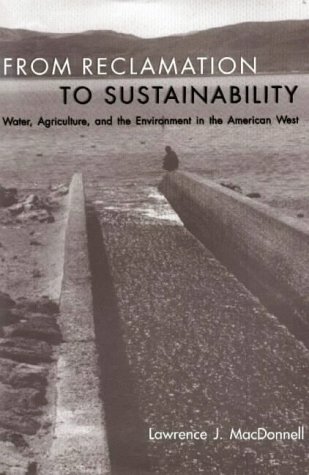
| 42. From Reclamation to Sustainability: Water, Agriculture, and the Environment in the American West by Lawrence J. MacDonnell | |
 | Hardcover: 384
Pages
(1999-11)
list price: US$37.50 -- used & new: US$21.95 (price subject to change: see help) Asin: 0870815334 Canada | United Kingdom | Germany | France | Japan |
|
Editorial Review Book Description All four regions tell of the essential role water has played in western agriculture and the importance of this agriculture for settlement of much of the West.They also exemplify the many difficulties of turning prairie and desert into productive croplands, and MacDonnell describes the sometimes extraordinary human committment and effort that made this possible. Now, however, western water resources have been developed beyond their sustainable capacity in an attempt to irrigate as much land as possible, and MacDonnell illustrates the consequences of this overdevelopment, including declining rural communities, dewatered streams incapable of supporting native species, and degraded water quality.He also provides examples of efforts torepair some of the damages and of the challenges involved in such restoration. MacDonnell argues that sustainable use of the West's water resources depends on reducing the gap between diverted water and used water,restoring the functional ecological integrity of water sources, allowing uses of developed water to change, and effective collaborative public/private processes that help reconcile competing interests in water.He concludes that the manner in which the West moves toward sustainable use of its limited water resources--particularly as it affects irrigated agriculture--matters at least as much as achieving sustainable use.It matters because the choices we make will have important consequences for the future West. | |
| 43. The physical environment and agriculture of the Sacramento-San Joaquin delta region of California: With reference to the similar peat soil areas of the Hulah region of Israel by M. Y Nuttonson | |
| Unknown Binding: 265
Pages
(1963)
Asin: B0007EJIS4 Canada | United Kingdom | Germany | France | Japan | |
| 44. Reducing environmental impacts of agriculture by using a fine particle suspension nitrification inhibitor to decrease nitrate leaching from grazed pastures ... Agriculture, Ecosystems and Environment] by H.J. Di, K.C. Cameron | |
 | Digital:
Pages
list price: US$8.95 -- used & new: US$8.95 (price subject to change: see help) Asin: B000RR51Y6 Canada | United Kingdom | Germany | France | Japan |
|
Editorial Review Book Description | |
| 45. Organic Agriculture, Environment and Food Safety (Environmental and Natural Resources Series) | |
| Paperback: 258
Pages
(2002-10)
list price: US$33.00 -- used & new: US$33.00 (price subject to change: see help) Asin: 9251048193 Canada | United Kingdom | Germany | France | Japan | |
|
Editorial Review Book Description | |
| 46. Crop Seed and Soil Environment (Reference book - Ministry of Agriculture, Fisheries, and Food) by Fish.& Food, Min.of Agriculture | |
| Paperback: 156
Pages
(1980-04)
Isbn: 0112403417 Canada | United Kingdom | Germany | France | Japan | |
| 47. Biotechnology for Food, Agriculture and Environment, Vol. 1 by Devarajan Thangadurai | |
| Hardcover:
Pages
(2006)
-- used & new: US$74.36 (price subject to change: see help) Asin: 8189233459 Canada | United Kingdom | Germany | France | Japan | |
| 48. Abundance of selected insect species in natural and agricultural habitats of a tropical upland (Leyte, Philippines) [An article from: Agriculture, Ecosystems and Environment] by G. Szinicz, K. Martin, J. Sauerborn | |
| Digital:
Pages
list price: US$8.95 -- used & new: US$8.95 (price subject to change: see help) Asin: B000RR52AY Canada | United Kingdom | Germany | France | Japan |
|
Editorial Review Book Description | |
| 49. Agriculture and Environment by Courtney, Briggs, David J. Briggs | |
| Paperback: 456
Pages
(1989-10)
list price: US$36.67 Isbn: 0582004136 Canada | United Kingdom | Germany | France | Japan | |
| 50. Agriculture, Trade and the Environment: The Pig Sector (Agriculture, Trade and the Environment) by Organisation for Economic Co-Operation and Development | |
| Paperback: 188
Pages
(2003-10)
list price: US$54.00 -- used & new: US$12.50 (price subject to change: see help) Asin: 926410416X Canada | United Kingdom | Germany | France | Japan | |
| 51. Further evidence of continent-wide impacts of agricultural intensification on European farmland birds, 1990-2000 [An article from: Agriculture, Ecosystems and Environment] by P.F. Donald, F.J. Sanderson, I.J. Burfield, van Bo | |
| Digital: 7
Pages
(2006-09-01)
list price: US$10.95 -- used & new: US$10.95 (price subject to change: see help) Asin: B000P6NY4S Canada | United Kingdom | Germany | France | Japan |
|
Editorial Review Book Description | |
| 52. Agriculture, Trade, and the Environment: Discovering and Measuring the Critical Linkages | |
| Hardcover: 311
Pages
(1996-06)
list price: US$85.00 -- used & new: US$15.00 (price subject to change: see help) Asin: 0813388961 Average Customer Review: 
Canada | United Kingdom | Germany | France | Japan | |
Customer Reviews (1)
It was not until the beginning of this decade thatenvironmentalists truly began to discover the environmental relevance of trade issues.The singular event of the GATT decision on the Tuna/Dolphin case ensured the battle between trade proponents and environmentalists would be joined.Since then, it has been an "Us" versus "Them" attitude, from both trade liberalization proponents and environmentalists.The free trade advocates, having been around for many years, did not welcome the environmentalist's intervention.The debate is still framed by two questions "How does trade liberalization harm the environment?" and "How do environmental protection measures interfere with trade liberalization?" It is within this context that Agriculture, Trade, & The Environment must be reviewed. OVERVIEW Agriculture, Trade, & The Environment has a promising title.Trade versus environment debates have more often than not neglected agricultural issues.A book that "discovers linkages" between trade and the environment, without neglecting agriculture, has the potential to advance long-standing traditional view-points.Unfortunately, the reader will be disappointed.While the book does a good job of presenting the traditional free market argument that increasing public wealth will increase the public's desire for environmental protection, it does not seriously address agricultural aspects of the trade versus environment debate. Part of the book consists of papers presented at a symposium titled "Agriculture, Trade and the Environment: Understanding and Measuring the Critical Linkages" sponsored by the International Agricultural Trade Research Consortium, an organization made up of 160 economists from 16 countries.The other chapters were invited contributions.Almost all of the authors are economists. The book includes a few good chapters and an excellent introduction to the pro-trade liberalization perspective.It does not deal well with agricultural issues and is mostly a rehash of economic models and arguments in favor of trade liberalization.In particular, the book emphasizes the theory that free trade, like a rising tide, lifts all boats, thus protecting also the environment.In the final chapter, it is admitted that "though the conference was intended to be agriculturally oriented, the larger issues related to the general environment quickly emerged as the focus" (p. 301).Agriculture, Trade and the Environment provides further proof that purist economics is an inadequate tool kit for environmental policy-making.Yet another glaring over-sight, the editors did not include any chapters on environmental economics theory such as those from University College London, the London School of Economics, or even the World Bank. The editors have organized the papers and the invited contributions into four parts.The first few chapters deal with the linkages of trade and the environment to international institutions. Second, the linkages between trade, renewable resources, and international environmental goods are explored.The third part discusses ways to measure these linkages.The fourth section deals with the identification of future research needed. DISCOVERING THE CRITICAL LINKAGES: TRADE, INTERNATIONAL INSTITUTIONS AND THE ENVIRONMENT The ever-present Jagdish Bhagwati repeats the assertion that there is a positive correlation between income growth and the demand for environmental protection.Howard Gruenspecht looks at whether the suggested trade/environment linkages are valid, and whether there are other more cynical motivations for the environmentalists to interfere in trade talks.Ambassador Michael Smith, who identifies himself as a major player in trade and environment negotiations, reveals that he conducts his work on two principles "(1) that traders are, at heart, environmentalists ...; and (2) that carried to an extreme, the international crusade of environmentalists can end up hurting everyone" (p. 42).This clearly is a biased view that does not suggest one who is seeking balance. Steve Charnovitz once again proposes his Global Environmental Organization that should operate along side of the World Trade Organization just like the International Labor Organization.In so doing, he fails to acknowledge the need for reform of the international trade regime which has been at the forefront of the trade and environment debate since Our Common Future was published in 1987.A chapter by Ballenger and Krissoff provides an adequate summary of one of the NAFTA environmental side agreements but devolves into a shallow and unconvincing account of interviews of environmental groups' and farm groups' positions on NAFTA related environmental provisions. DISCOVERING THE CRITICAL LINKAGES: TRADE, RENEWABLE RESOURCES AND INTERNATIONAL ENVIRONMENTAL GOODS G.M. Heal leads off with a chapter on the management of international environmental goods. This is followed by Graciela Chichilnisky's discussion of property rights and the search for an equilibrium model for North-South trade. She concludes with the simplistic notion that the "South overproduces, but primarily because the North overconsumes" (p.107) and that "all in all, property rights improvements in the South could check the main economic source of overuse: prices which are below social costs" (p.106).Therefore, Chichilnisky ignores the fact that natural resource prices in the North are also well below social costs. Diao and Roe also try to tackle the North-South general equilibrium model.This section of the book ends with a chapter by John Walley on how to quantify trade and environment linkages.He points out that standard environmental regulation that supposedly interferes with trade actually has little effect.However, if instead a carbon tax were adopted, global production and trade patterns would be strongly impacted. MEASURING THE CRITICAL LINKAGES This part of the book, which includes six competent chapters, finally begins to deal with the issues related to agriculture.The authors discuss the economic effects of environmental policies on the agriculture sectors in the United States and Europe.Unfortunately, the chapters perpetuate the one-sided perspective of the book by continuing to suggest that environmental issues have no place in trade liberalization talks (remember the rising tide). KEY QUESTIONS AND RESEARCH NEEDS The lead sentence in this section says almost all that needs to be said: "Most of the research that has already been done on the relationship between expanded agricultural trade and environmental protection is theoretical, incomplete, and lacks sufficient empirical content" (p. 281). JED V5N4 ... Read more | |
| 53. Major natural resource management concerns in South Asia (Food, agriculture, and the environment discussion paper) by Gerard J Gill | |
| Unknown Binding: 29
Pages
(1995)
Asin: B0006QE7ZM Canada | United Kingdom | Germany | France | Japan | |
| 54. Ideal and saturated soil fertility as bench marks in nutrient management [An article from: Agriculture, Ecosystems and Environment] by B.H. Janssen, P. de Willigen | |
| Digital: 14
Pages
(2006-08-01)
list price: US$10.95 -- used & new: US$10.95 (price subject to change: see help) Asin: B000RR9CO6 Canada | United Kingdom | Germany | France | Japan |
|
Editorial Review Book Description | |
| 55. Chemistry, Agriculture and the Environment | |
| Hardcover: 620
Pages
(1991-06)
list price: US$160.00 Isbn: 0851862284 Canada | United Kingdom | Germany | France | Japan | |
| 56. Science Agriculture and Environment in the Former Soviet Union | |
| Paperback:
Pages
(1993-02)
list price: US$21.95 Isbn: 0871685396 Canada | United Kingdom | Germany | France | Japan | |
| 57. Food, Agriculture, and the Environment: Environment and Man, Vol. Two by John Lenihan, William W. Fletcher | |
| Hardcover: 130
Pages
(1976-01-01)
Isbn: 0124435025 Canada | United Kingdom | Germany | France | Japan | |
| 58. The CAP and Green Agriculture (Environment) by David Harvey | |
| Paperback: 30
Pages
(1991-04-16)
-- used & new: US$9.52 (price subject to change: see help) Asin: 1872452248 Canada | United Kingdom | Germany | France | Japan | |
| 59. Sustainable Agriculture and the Environment: Perspectives on Growth and Constraints | |
| Paperback: 189
Pages
(1992-01)
list price: US$52.00 Isbn: 0813385075 Canada | United Kingdom | Germany | France | Japan | |
| 60. Agriculture and the Environment: Issues and Policies by OECD | |
| Paperback: 37
Pages
(1998-03-02)
list price: US$8.00 Isbn: 9264160485 Canada | United Kingdom | Germany | France | Japan | |
|
Editorial Review Book Description | |
| Back | 41-60 of 100 | Next 20 |