
|
Help |
| Home - Health Conditions - Alzheimers (Books) | |
e99 Online Shopping Mall
|
|
Help |
| Home - Health Conditions - Alzheimers (Books) | |
| 1-20 of 112 | Next 20 |
click price to see details click image to enlarge click link to go to the store
| 1. 100 Simple Things You Can Do to Prevent Alzheimer's and Age-Related Memory Loss by Jean Carper | |
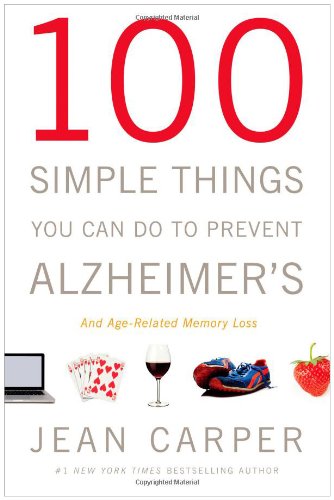 | Hardcover: 336
Pages
(2010-09-20)
list price: US$19.99 -- used & new: US$9.95 (price subject to change: see help) Asin: 0316086851 Average Customer Review: 
Canada | United Kingdom | Germany | France | Japan |
|
Editorial Review Product Description Customer Reviews (18)
| |
| 2. Learning to Speak Alzheimer's: A Groundbreaking Approach for Everyone Dealing with the Disease by Joanne Koenig Coste | |
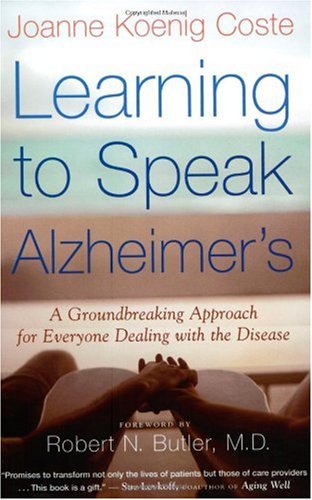 | Paperback: 256
Pages
(2004-09-08)
list price: US$14.95 -- used & new: US$8.51 (price subject to change: see help) Asin: 0618485171 Average Customer Review: 
Canada | United Kingdom | Germany | France | Japan |
|
Editorial Review Product Description Customer Reviews (49)
| |
| 3. A Caregiver's Guide to Alzheimer's Disease: 300 Tips for Making Life Easier | |
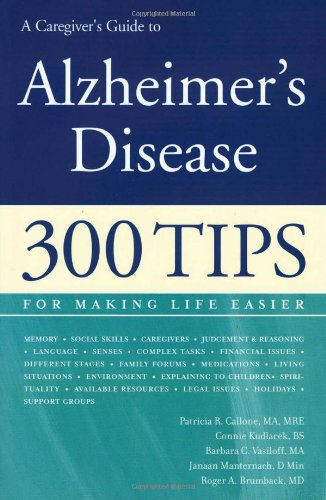 | Paperback: 128
Pages
(2005-12-28)
list price: US$16.95 -- used & new: US$9.79 (price subject to change: see help) Asin: 1932603166 Average Customer Review:
Canada | United Kingdom | Germany | France | Japan |
|
Editorial Review Product Description *Section A:The four stages of Alzheimer's with hundreds of practical tips for coping at each level *Section B:Q&A for caregivers, including legal and financial issues, medication, helping children understand, handling the holidays and more. *Section C:Resources and websites. This is an essential book for all those who want to focus on the capabilities that remain instead of those that have been lost. Customer Reviews (17)
| |
| 4. The Alzheimer's Action Plan: The Experts' Guide to the Best Diagnosis and Treatment for Memory Problems by P. Murali Doraiswamy M.D., Lisa P. Gwyther M.S.W., Tina Adler | |
 | Hardcover: 496
Pages
(2008-04-15)
list price: US$26.95 -- used & new: US$6.62 (price subject to change: see help) Asin: B002KHMZQ8 Average Customer Review:
Canada | United Kingdom | Germany | France | Japan |
|
Editorial Review Product Description Is it really Alzheimer’s? How to find out and intervene early to maintain the highest quality of life Customer Reviews (19) | |
| 5. The 36-Hour Day: A Family Guide to Caring for People with Alzheimer Disease, Other Dementias, and Memory Loss in Later Life, 4th Edition by Nancy L. Mace, Peter V. Rabins | |
 | Paperback: 352
Pages
(2006-10-09)
list price: US$17.95 -- used & new: US$9.66 (price subject to change: see help) Asin: 0801885094 Average Customer Review:
Canada | United Kingdom | Germany | France | Japan |
|
Editorial Review Product Description Revised in 2006 for its twenty-fifth anniversary, this best-selling book is the "bible" for families caring for people with Alzheimer disease, offering comfort and support to millions worldwide. In addition to the practical and compassionate guidance that have made The 36-Hour Day invaluable to caregivers, the fourth edition is the only edition currently available that includes new information on medical research and the delivery of care. The new edition includes: -new information on diagnostic evaluation-resources for families and adult children who care for people with dementia-updated legal and financial information-the latest information on nursing homes and other communal living arrangements-new information on research, medications, and the biological causes and effects of dementia Also available in a large print edition Praise for The 36-Hour Day: Customer Reviews (110)
| |
| 6. Alzheimer's from the Inside Out by Richard Taylor | |
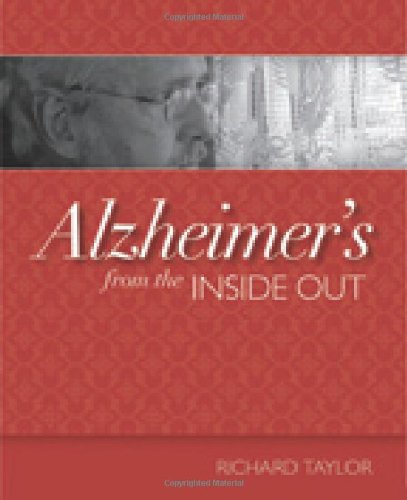 | Paperback: 224
Pages
(2006-12-31)
list price: US$19.95 -- used & new: US$10.52 (price subject to change: see help) Asin: 1932529233 Average Customer Review:
Canada | United Kingdom | Germany | France | Japan |
|
Editorial Review Product Description Richard Taylor provides illuminating responses to these and many other questions in this collection of provocative essays. Diagnosed with Alzheimer’s disease at age 61, the former psychologist courageously shares an account of his slow transformation and deterioration and the growing division between his world and the world of others. With poignant clarity, candor, and even occasional humor, more than 80 brief essays address difficult issues faced by those with Alzheimer’s disease, including This rare, insightful exploration into the world of individuals with Alzheimer’s disease is a captivating read for anyone affected personally or professionally by the devastating disease. Individuals with early-stage Alzheimer’s disease will take comfort in the voice of a fellow traveler experiencing similar challenges, frustrations, and triumphs. Family and professional caregivers will be enlightened by Taylor’s revealing words, gaining a better understanding of an unfathomable world and how best to care for someone living in it. Customer Reviews (24)
| |
| 7. Alzheimer's Early Stages: First Steps for Family, Friends and Caregivers by Daniel Kuhn | |
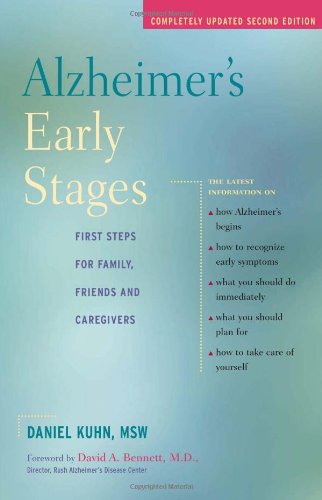 | Paperback: 304
Pages
(2003-03-27)
list price: US$16.95 -- used & new: US$7.80 (price subject to change: see help) Asin: 0897933974 Average Customer Review:
Canada | United Kingdom | Germany | France | Japan |
|
Editorial Review Product Description Customer Reviews (22)
| |
| 8. The Anti-Alzheimer's Prescription: The Science-Proven Prevention Plan to Start at Any Age by Vincent Fortanasce | |
 | Paperback: 352
Pages
(2009-08-04)
list price: US$15.00 -- used & new: US$4.14 (price subject to change: see help) Asin: B00342VERY Average Customer Review:
Canada | United Kingdom | Germany | France | Japan |
|
Editorial Review Product Description Customer Reviews (27)
| |
| 9. Jan's Story: Love lost to the long goodbye of Alzheimer's by Barry Petersen | |
 | Paperback: 206
Pages
(2010-06-15)
list price: US$15.95 -- used & new: US$9.40 (price subject to change: see help) Asin: 1933016442 Average Customer Review:
Canada | United Kingdom | Germany | France | Japan |
|
Editorial Review Product Description Customer Reviews (39)
| |
| 10. Inside Alzheimer's: How to Hear and Honor Connections with a Person who has Dementia by Nancy Pearce | |
 | Paperback: 320
Pages
(2007-08-01)
list price: US$19.95 -- used & new: US$12.34 (price subject to change: see help) Asin: 0978829905 Average Customer Review:
Canada | United Kingdom | Germany | France | Japan |
|
Editorial Review Product Description Customer Reviews (7)
| |
| 11. Living Your Best With Early-Stage Alzheimer's: An Essential Guide by Lisa Snyder | |
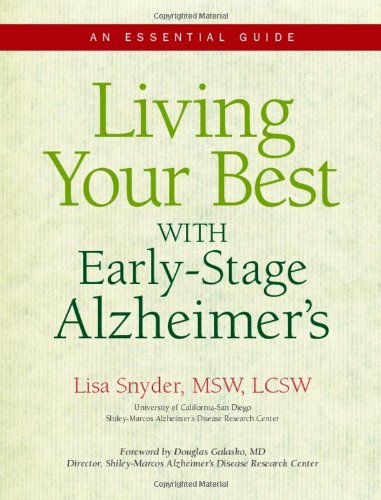 | Paperback: 288
Pages
(2010-04-15)
list price: US$18.95 -- used & new: US$9.25 (price subject to change: see help) Asin: 1934716030 Average Customer Review:
Canada | United Kingdom | Germany | France | Japan |
|
Editorial Review Product Description Customer Reviews (7)
| |
| 12. What If It's Not Alzheimer's?: A Caregiver's Guide to Dementia (Updated & Revised) | |
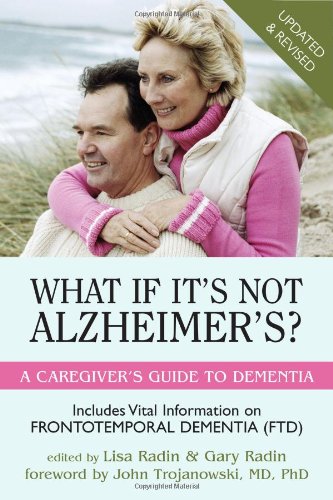 | Paperback: 360
Pages
(2008-03-27)
list price: US$22.98 -- used & new: US$12.46 (price subject to change: see help) Asin: 1591025842 Average Customer Review:
Canada | United Kingdom | Germany | France | Japan |
|
Editorial Review Product Description Beginning with a focus on the medical facts, the first part defines and explores FTD as an illness distinct from Alzheimer's disease. Also considered are clinical and medical care issues and practices, as well as such topics as finding a medical team and rehabilitation interventions. The next section on managing care examines the daily care routine including exercise, socialization, adapting the home environment, and behavioral issues. In the following section on caregiver resources, the contributors identify professional and government assistance programs along with private resources and legal options. This newly revised edition follows recent worldwide collaboration in research and provides the most current medical information available, a better understanding of the different classifications of FTD, and more clarity regarding the role of genetics. A completely new chapter 5 enlightens the reader about the various drugs that are now being used with FTD patients and also delves into a number of nonmedical options. The wealth of information offered in these pages will help both healthcare professionals and caregivers of someone suffering from frontotemporal dementia. Customer Reviews (14)
| |
| 13. The Myth of Alzheimer's: What You Aren't Being Told About Today's Most Dreaded Diagnosis by Peter J. Whitehouse, Daniel George | |
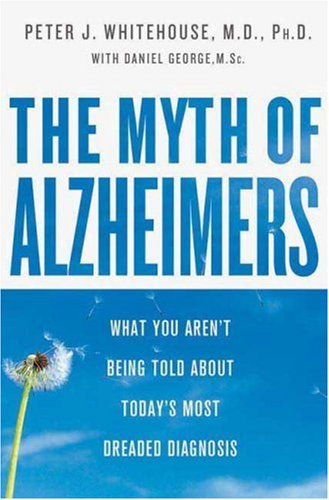 | Hardcover: 319
Pages
(2008-01-08)
list price: US$25.95 -- used & new: US$8.45 (price subject to change: see help) Asin: B001PO6AMC Average Customer Review:
Canada | United Kingdom | Germany | France | Japan |
|
Editorial Review Product Description Dr. Peter Whitehouse will transform the way we think about Alzheimer’s disease. In this provocative and ground-breaking book he challenges the conventional wisdom about memory loss and cognitive impairment; questions the current treatment for Alzheimer’s disease; and provides a new approach to understanding and rethinking everything we thought we knew about brain aging. Peter J. Whitehouse, M.D., Ph.D., one of the best known Alzheimer’s experts in the world, specializes in neurology with an interest in geriatrics and cognitive science and a focus on dementia. He is the founder of the University Alzheimer Center (now the University Memory and Aging Center) at University Hospitals Case Medical Center and Case Western Reserve University where he has held professorships in the neurology, neuroscience, psychiatry, psychology, organizational behavior, bioethics, cognitive science, nursing, and history. He is also currently a practicing geriatric neurologist. With his wife, Catherine, he founded The Intergenerational School, an award winning, internationally recognized public school committed to enhancing lifelong cognitive vitality. Daniel George, MSc, is a research collaborator with Dr. Whitehouse at Case Western Reserve University in Cleveland, Ohio, and is currently pursuing a Doctorate in Medical Anthropology at Oxford University in England. “I don’t have a magic bullet to prevent your brain from getting older, and so I don’t claim to have the cure for AD; but I do offer a powerful therapy—a new narrative for approaching brain aging that undercuts the destructive myth we tell today. Most of our knowledge and our thinking is organized in story form, and thus stories offer us the chief means of making sense of the present, looking into the future, and planning and creating our lives. New approaches to brain aging require new stories that can move us beyond the myth of Alzheimer’s disease and towards improved quality of life for all aging persons in our society. It is in this book that your new story can begin." -Peter Whitehouse, M.D., Ph.D. Customer Reviews (14)
| |
| 14. Preventing Alzheimer's: Ways to Help Prevent, Delay, Detect, and Even Halt Alzheimer's Disease and OtherForms of Memory Loss by William Rodman Shankle, Daniel G. Amen | |
 | Paperback: 304
Pages
(2005-06-07)
list price: US$15.95 -- used & new: US$6.75 (price subject to change: see help) Asin: 0399531602 Average Customer Review:
Canada | United Kingdom | Germany | France | Japan |
|
Editorial Review Product Description Customer Reviews (13)
| |
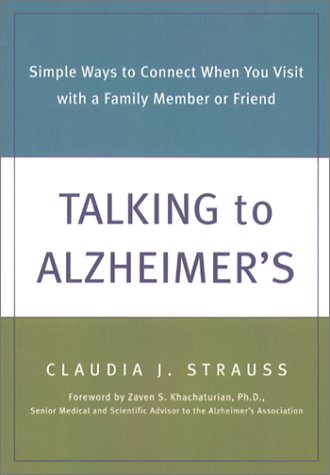
| 15. Talking to Alzheimer's: Simple Ways to Connect When You Visit with a Family Member or Friend by Claudia J. Strauss | |
 | Paperback: 168
Pages
(2002-01-09)
list price: US$16.95 -- used & new: US$4.83 (price subject to change: see help) Asin: 1572242701 Average Customer Review:
Canada | United Kingdom | Germany | France | Japan |
|
Editorial Review Amazon.com Review Much of the book discusses methods of easing conversation during visits, as well as ways to manage the emotions that can surface in difficult times. From asking open-ended questions like, "How did your day go?" to gently reintroducing yourself to lifelong friends, the pointers here are written with kindness, and they focus on maintaining dignity for all involved. Short sections include tips on involving children in your visits and a welcome list of resources that spans organizations, Web sites, and additional books; this straightforward advice even includes expected response time to Web site inquiries. Instead of an index, you'll find a list of topics, so you can find immediate answers on "ending a conversation" and "when to insist." One lengthy chapter covers the heartbreakers, such as dealing with refusals to eat or listening to tearful requests to be taken home. Author Claudia Strauss acknowledges the difficulty of these situations honestly, while at the same time providing simple words that can help diffuse the issues and open the path for joyful visits that benefit everyone involved. --Jill Lightner Customer Reviews (15)
| |
| 16. Voices Of Alzheimer's: Courage, Humor, Hope, and Love in the Face of Dementia by Betsy Peterson | |
 | Paperback: 255
Pages
(2004-11-01)
list price: US$13.95 -- used & new: US$3.32 (price subject to change: see help) Asin: B0009309O0 Average Customer Review:
Canada | United Kingdom | Germany | France | Japan |
|
Editorial Review Product Description Customer Reviews (9)
| |
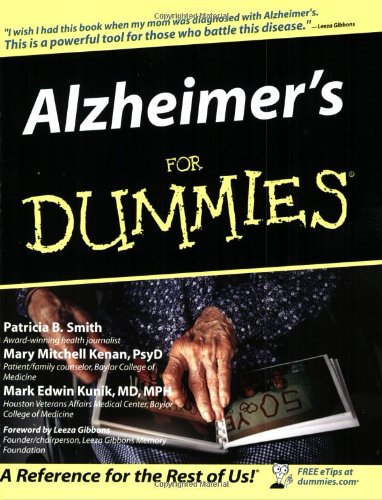
| 17. Alzheimer's for Dummies by Patricia B. Smith, Mary M. Kenan Psy.D., Mark Edwin Kunik M. D.M. P. H. | |
 | Paperback: 384
Pages
(2003-10-31)
list price: US$21.99 -- used & new: US$1.39 (price subject to change: see help) Asin: 0764538993 Average Customer Review: 
Canada | United Kingdom | Germany | France | Japan |
|
Editorial Review Product Description If you have a family member or close friend who’s suffering from Alzheimer’s Disease and you’re looking for current, useful information, then Alzheimer’s For Dummies is for you. This reference guide also is helpful if you Alzheimer’s For Dummies takes a realistic look at Alzheimer’s Disease, what it is and what it isn’t. It offers pertinent, easy-to-understand advice for dealing with the myriad concerns and responsibilities that a primary caregiver must assume when managing an Alzheimer’s patient. Here’s a sampling of the information you’ll find in this valuable guide: Television personality Leeza Gibbons, whose mother was stricken with AD, writes in the foreword of this book, “There is no upside to keeping your head in the sand. This book is a crucial step in your new fight. Arm yourself with the knowledge waiting for you in these pages. It will help you find answers and resources as you adjust to your new reality.” Customer Reviews (8)
During my mother's bout with Alzheimer's, I looked for resources that would give me clear understanding and answers of what was happening now and what was going to happen down the road. This book is one of several that I have on the subject. It does not make light of the disease or the issues being faced, but does present good information in a way that is understandable and clear. ... Read more | |
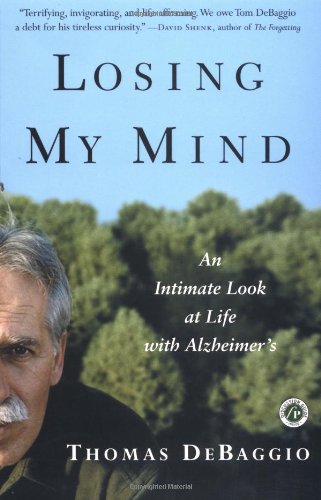
| 18. Losing My Mind : An Intimate Look at Life with Alzheimer's by Thomas DeBaggio | |
 | Paperback: 224
Pages
(2003-03-04)
list price: US$14.00 -- used & new: US$2.31 (price subject to change: see help) Asin: 0743205669 Average Customer Review:
Canada | United Kingdom | Germany | France | Japan |
|
Editorial Review Product Description "We are foolish, those of us who think we can escape the traps of aging," writes Tom DeBaggio. "I was one of them, dreaming of a perfect and healthy old age....Now, at fifty-eight, I realize the foolishness of my dreams as I watch my brain self-destruct from Alzheimer's." Losing My Mind is DeBaggio's extraordinary account of his early onset Alzheimer's, a disease that "silently hollows the brain" and slowly "gobbles memory and destroys life." But with DeBaggio's curse came an unexpected blessing: the ability to chart the mechanics and musings of his failing mind. Whether describing the happy days of his youth or lamenting over the burden his disease has placed upon his loved ones, DeBaggio manages to inspire the reader with his ability to function, to think, and ultimately to survive. By turns an autobiography, a medical history, and a book of meditations, Losing My Mind is a testament to the splendor of memory and a triumphant celebration of the human spirit. While his history is recounted in chronological order, these memories--of his childhood; marriage to his wife, Joyce; their years in writing and politics; his passion for herbs and the growing of a successful business--are interspersed with unrelated musings on everything from his cat's sudden deafness to losing his wallet. Clips from articles on Alzheimer's research are sprinkled around, and statistics like the $174,000 that a patient spends on the disease over a lifetime are sobering. Throughout the book, he clearly speaks of his diagnosis as a "sentence"; the lack of a cure is dwelt on in many sections, and a story about an accidental overdose of his prescriptions is particularly grim. This is not a book that supplies any "power of positive thinking" messages, but instead shows the daily struggle of a man coming to terms with a terrible disease. Poignant and thoughtful, DeBaggio's life will hold meaning for anyone who has been touched by Alzheimer's. --Jill Lightner Customer Reviews (30)
| |
| 19. The Alzheimer's Project: Momentum in Science by John Hoffman, Susan Froemke | |
 | Hardcover: 224
Pages
(2009-05-11)
list price: US$25.95 -- used & new: US$0.15 (price subject to change: see help) Asin: B002UXRZC6 Average Customer Review:
Canada | United Kingdom | Germany | France | Japan |
|
Editorial Review Product Description This companion book to the HBO Documentary Films series explores the cutting-edge research on Alzheimer's disease that is creating new hope for the future. Alzheimer's disease is the second most-feared illness in America, following cancer. It affects as many as 5 million Americans, a number that could soar to 16 million by 2050. It is estimated that, unless effective preventions are discovered, 10 million baby boomers will eventually develop this irreversible and devastating brain disorder. Until recently, medical news on Alzheimer’s disease was not comforting. But in the past few years, advances in many scientific areas—from diagnostic imaging to genetic analysis—have led to an explosion of knowledge with implications for treatment and prevention. This is an exciting time of discovery in Alzheimer's research. Through The Alzheimer’s Project film series, HBO Documentary Films illuminates the vital breakthroughs occurring in the field. One of the central films in this series, Momentum in Science, brings us inside the laboratories and clinics of the nation’s top scientists and physicians who are clearing the path to a deeper understanding of Alzheimer’s disease. By capturing the exhilaration of these scientists and casting light on their groundbreaking discoveries, the film seeks to bring a wider understanding of the disease and new hope for future treatment. This book offers an even closer look at the advances of this scientific frontier. It investigates the complex cascade of events that occurs inside the brain when someone has Alzheimer’s disease and shows how scientists are working to interrupt this process and ultimately prevent the disease. In accessible prose, it examines specific evidence of momentous progress, from the triumphant discovery of the unique role of the beta-amyloid and tau proteins, to the use of PET scans to track changes in the brain and the analyses of cerebrospinal fluid to identify biomarkers that will help us predict who will develop the disease in the future. It also looks at current drug development and at what we can do as individuals to potentially reduce our risk of developing the disease. The Alzheimer’s Project: Momentum in Science is a fascinating story of scientific discovery that shows what recent breakthroughs might mean for improving our chances of remaining cognitively vital throughout a long life. Customer Reviews (4) | |
| 20. I'm Still Here: A Breakthrough Approach to Understanding Someone Living with Alzheimer's by John Zeisel | |
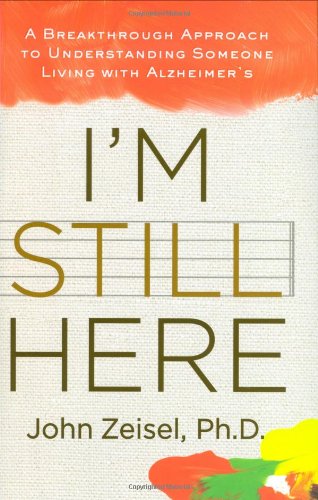 | Hardcover: 272
Pages
(2009-01-22)
list price: US$24.95 -- used & new: US$3.61 (price subject to change: see help) Asin: 1583333355 Average Customer Review:
Canada | United Kingdom | Germany | France | Japan |
|
Editorial Review Product Description Customer Reviews (13)
| |
| 1-20 of 112 | Next 20 |
 100 Simple Things You Can Do to Prevent Alzheimer's and Age-Related Memory Loss
 A Helpful Guide
 I know, I know