e99 Online Shopping Mall

Geometry.Net - the online learning center Help  
Home  - Math Discover - Fuzzy Logic (Books)

  1-20 of 100 | Next 20

click price to see details     click image to enlarge     click link to go to the store

$88.13
1. A First Course in Fuzzy Logic,
$60.48
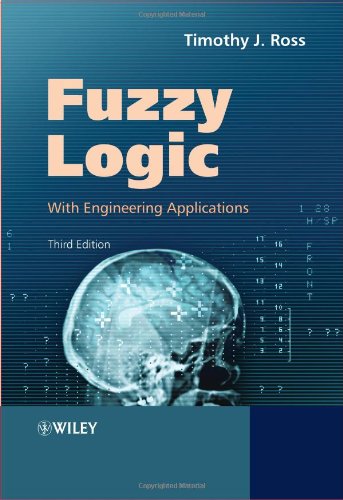
2. Fuzzy Logic with Engineering Applications
$11.85
3. Fuzzy Thinking: The New Science
$77.74
4. Fuzzy Sets and Fuzzy Logic: Theory
$80.00
5. Fuzzy Logic: Intelligence, Control,
$3.75
6. Fuzzy Logic Get Fuzzy 2
$72.90
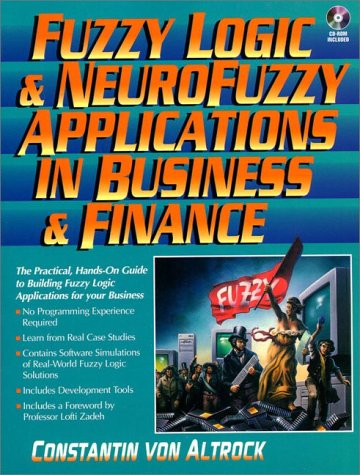
7. Fuzzy Logic and NeuroFuzzy Applications
$17.36
8. An Introduction to Fuzzy Logic
$2.48
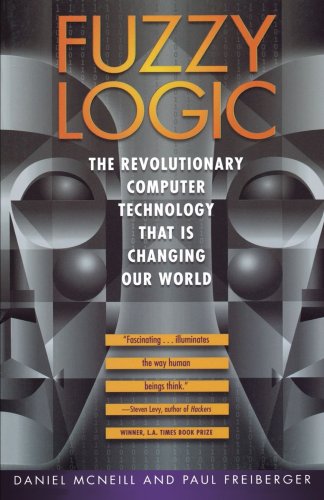
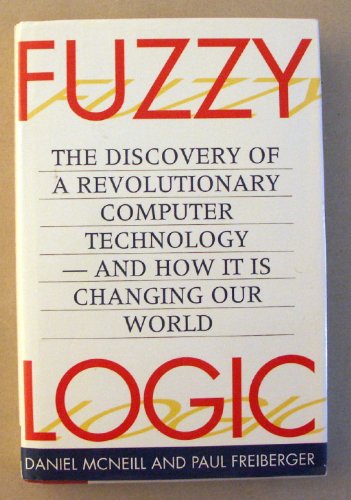
9. Fuzzy Logic: The Revolutionary
$31.31
10. An Introduction to Many-Valued
$44.05
11. An Introduction to Fuzzy Logic
$68.96
12. Uncertain Rule-Based Fuzzy Logic
$15.96
13. Fuzzy Logic for Beginners
$35.37
14. Fuzzy Logic for Embedded Systems
$129.00
15. Type-2 Fuzzy Logic: Theory and
$67.14
16. Introduction to Fuzzy Logic using
$20.99
17. Deviant Logic, Fuzzy Logic: Beyond
$80.71
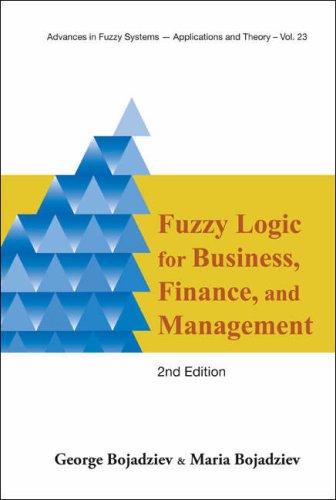
18. Fuzzy Logic for Business, Finance,
$80.15
19. Neuro-Fuzzy and Soft Computing:
$123.98
20. Fuzzy Logic and the Semantic Web

1. A First Course in Fuzzy Logic, Third Edition
by Hung T. Nguyen, Elbert A. Walker
Hardcover: 440 Pages (2005-10-06)
list price: US$99.95 -- used & new: US$88.13
(price subject to change: see help)
Asin: 1584885262
Average Customer Review: 4.5 out of 5 stars
Canada | United Kingdom | Germany | France | Japan
Editorial Review

Book Description
A First Course in Fuzzy Logic, Third Edition continues to provide the ideal introduction to the theory and applications of fuzzy logic. This best-selling text provides a firm mathematical basis for the calculus of fuzzy concepts necessary for designing intelligent systems and a solid background for readers to pursue further studies and real-world applications.New in the Third Edition:· A section on type-2 fuzzy sets - a topic that has received much attention in the past few years · Additional material on copulas and t-norms · More discussions on generalized modus ponens and the compositional rule of inference · Complete revision to the chapter on possibility theory · Significant expansion of the chapter on fuzzy integrals · Many new exercisesWith its comprehensive updates, this new edition presents all the background necessary for students and professionals to begin using fuzzy logic in its many-and rapidly growing- applications in computer science, mathematics, statistics, and engineering. ... Read more

Customer Reviews (3)

5-0 out of 5 stars prof. review
thisis the best intro to fuzzy ever writen....im a university prof on the subject of AI so...Ive read tons of books on the subject and this is by far the best intro to fuzzy even for those who ll be learning on their own... very simple put and yet very abording on the matter!

4-0 out of 5 stars A First Course in Fuzzy Logic
If you are looking for a book on Fuzzy Logic Theory, this is a good book. It explains the mathematical basis of fuzzy logic, the mathmatical symbols used, provides proofs for theorems, etc. The chapters and sections areclearly labeled in the table of contents, making it easy to zero in on atopic. It is a College Text Book, with problems to solve at the end of eachchapter. Selected problems have answers in the back of the book.Unfortunately, that wasn't the type of book that I expected or needed. Iwas looking more for the hands on, how to, type of book. That is the onlyreason it did not get 5 stars.

5-0 out of 5 stars Outstanding, for people who are interested in this area
This is the clearest explanation and application of fuzzy logic that has been published. It is thorough, without being arcane or pedantic. ... Read more


2. Fuzzy Logic with Engineering Applications
by Timothy J. Ross
Paperback: 650 Pages (2004-08-16)
list price: US$80.00 -- used & new: US$60.48
(price subject to change: see help)
Asin: 0470860758
Average Customer Review: 4.0 out of 5 stars
Canada | United Kingdom | Germany | France | Japan
Editorial Review

Book Description
Fuzzy logic refers to a large subject dealing with a set of methods to characterize and quantify uncertainty in engineering systems that arise from ambiguity, imprecision, fuzziness, and lack of knowledge. Fuzzy logic is a reasoning system based on a foundation of fuzzy set theory, itself an extension of classical set theory, where set membership can be partial as opposed to all or none, as in the binary features of classical logic.

Fuzzy logic is a relatively new discipline in which major advances have been made over the last decade or so with regard to theory and applications.  Following on from the successful first edition, this fully updated new edition is therefore very timely and much anticipated. Concentration on the topics of fuzzy logic combined with an abundance of worked examples, chapter problems and commercial case studies is designed to help motivate a mainstream engineering audience, and the book is further strengthened by the inclusion of an online solutions manual as well as dedicated software codes.

Senior undergraduate and postgraduate students in most engineering disciplines, academics and practicing engineers, plus some working in economics, control theory, operational research etc, will all find this a valuable addition to their bookshelves. ... Read more

Customer Reviews (7)

1-0 out of 5 stars LOADED WITH ERRATA
I purchased the book for a graduate level engineering course.Perhaps the other raters are orders of magnitude smarter than I, because I found the book to be extremely difficult to understand, almost to the point of laughability.The narrative is unnecessarily complex in my opinion, requiring a serious student to read and reread multiple times until a concept can be grasped.And you better have a dictionary handy because you will likely come across terms that even a well educated person will not recognize.To make matters worse, the text is LOADED with errata.On several occasions I struggled for hours working through examples in various chapters, pulling my hair out and not getting it, only to discover later after confronting the professor that the example was wrong.Not only are there numerical errors laced throughout the text and in the answer appendix, but there are MANY instances where the concept/strategy is not fully explained in an example, leaving you to scratch your head as to why particular variables and their value were chosen (not calculated), why a certain step was performed or not performed, and why certain "tactical decisions" were made as you make your way through a procedure.Several of the sketches are sloppy too where the accompanying narrative does not always match with what the sketch is telling you.
For a rather complex subject, the last thing you need is to struggle with the text.There are so many errors, and so many instances where a complex idea or example is not fully explained that I would recommend purchasing other reference material; at least until the 3rd edition of this text comes out and corrects most of the errata.

2-0 out of 5 stars Much better fuzzy logic books are out there.
With the exception of Ch. 1, the first part of the book is o.k. To see my problem with chapter 1, simply look at the article on bounded rationality he uses in his discussion of a chess game.First, several parts of the article are coppied word for word directly in his text;I have no problem with this, but they should appear in quotes.Second, I don't think his analysis of the article is accurate.
Ross does an excellent job of introducing binary logic and extending the results to fuzzy logic.However, other than this one chapter, the rest of the rest of the book is not worth the read.A much better book is by Yager and Filev.I went with Ross' text because it was published in 2004 (you know, latest is greatest) compared to the 1995 publishing of Yager's book.Don't make the same mistake, just get Yager's book; you will learn more and save yourself some money!

5-0 out of 5 stars Excelent for a fisrt course in fuzzy logic and systems
The way the fuzzy paradigm is introduced and developed is very inspiring for those that come from more traditional ways of thinking. The author makes the transition from classical logic to fuzzy logic in a very clear way. The fields of aplication of fuzzy logic are very well represented in the book. I would stongly support the author to publish a second edition of the book.

5-0 out of 5 stars excellent reference book
Very good book for a solid background on Fuzzy Logic.Highly reccomented.Ross is a very involved author and enthousiastic supporter of Fuzzy logic theory use in problem solving.Try to solve some of the problems in the book.They provide much inside on real applications of the fuzzy logic Theory

5-0 out of 5 stars The least fuzzy book on fuzzy logic
If you decide to buy a book on fuzzy logic or applications of fuzzy logic, this is absolutely the best book for introductory level. In other words, this source gives a non-fuzzy and comprehensive knowledge to reader.
I strongly recommend this book to everybody for an exact comprehensive introduction to the theory of Zadeh. ... Read more


3. Fuzzy Thinking: The New Science of Fuzzy Logic
by Bart Kosko
Paperback: 336 Pages (1994-10-10)
list price: US$18.60 -- used & new: US$11.85
(price subject to change: see help)
Asin: 0006547133
Average Customer Review: 2.5 out of 5 stars
Canada | United Kingdom | Germany | France | Japan

Customer Reviews (44)

1-0 out of 5 stars Horrible
There might be something interesting or even brilliant in this book, but it's impossible to get past his hubris.The reader is supposed to be impressed with his lifestyle and his exploits, but it's just arrogant drivel.It's like a pathetic nerd's "American Psycho", but the butchering of his contemporaries' ideas is only in his imagination.

3-0 out of 5 stars Hard to get past Kosko's arrogance
When FT sticks to rigorous exposition -- of the science, history, and philosophical underpinnings of Fuzzy Logic -- it's a fine book.For all of BK's obvious intelligence (he's a major contributor to the fuzzy science field and a deep thinker on a range of subjects), he is also exceedingly, distractingly, and tiresomely arrogant -- the arrogance of youth, perhaps.I'll be interested to read BK's scientific writings, but am less inclined to read his other popular works.FT has a lot of wheat, but loads and loads of chaff as well.

4-0 out of 5 stars An important book that failed
Denotation and connotation ... fuzzy logic is losing the battle of Semantics to the ordinary.
Fozzy is a cute bear in a children's puppet show.
and fuzzy logic is "bad thinking"in the popular mind and usage.
"Gradu-Weighted Logic" would be more effective usage than fuzzy logic
no matter what it has come to mean to philosophers, mathematicians engineers and even musicians.
In the long run the philosophical aspect is probably
the most important while fuzzy engineering has turned into a Japanese fad.
We needed this book ( which is well written and informative) , but we needed more
the ideas behind "fuzzy thinking" to
be taken seriously. Fuzzy Engineering

1-0 out of 5 stars Fuzzily Verboze and seriously zilly book
Somehow raced through the book ... could fuzzily make out that the author could be an intelligent guy having contributed to the knowledge of fuzzy theory and practice... but (he) could have stayed thus if only he didn't write this book ... so Aristotlian-wise 100% lousy a book but Buddha wise some 5% good a book...

1-0 out of 5 stars Title is apt

Unfortunately, this book says more about the author than the subject. If you want a book that demonstrates a problem, illustrates a potential solution and its applications; then don't buy this. This is a very personal and hence cloudy view of the subject matter. There is some useful information in this book but it is hidden behind the grand philosophical statements or buried in the foot notes.

Has this author ever met an empirical scientist, rather than mathematicians or philosophers. Scientists love measuring things.
No scientist would ask the question 'Is an apple red or green?' They would pose the question 'How much pigment (in milligrams) of each of a series of colours does each apple have?' Or in truth something far more obtuse. In fact the fuzzy logic treatment would be a bit black and white for most scientists.


I suspect that there is a great deal more to the subject that the author communicates and I felt a bit cheated that there was not more substance in this book.

Did I miss something? If I did then the book did not work to convey the subject. If I didn't then fuzzy logic is one of a myriad of tools to handle uncertainty, and thus is a small branch of probability.


... Read more


4. Fuzzy Sets and Fuzzy Logic: Theory and Applications
by George J. Klir, Bo Yuan
Paperback: 592 Pages (1995-05-21)
list price: US$93.33 -- used & new: US$77.74
(price subject to change: see help)
Asin: 0131011715
Average Customer Review: 5.0 out of 5 stars
Canada | United Kingdom | Germany | France | Japan
Editorial Review

Book Description

Reflecting the tremendous advances that have taken place in the study of fuzzy set theory and fuzzy logic from 1988 to the present, this book not only details the theoretical advances in these areas, but considers a broad variety of applications of fuzzy sets and fuzzy logic as well.Theoretical aspects of fuzzy set theory and fuzzy logic are covered in Part I of the text, including: basic types of fuzzy sets; connections between fuzzy sets and crisp sets; the various aggregation operations of fuzzy sets; fuzzy numbers and arithmetic operations on fuzzy numbers; fuzzy relations and the study of fuzzy relation equations.Part II is devoted to applications of fuzzy set theory and fuzzy logic, including: various methods for constructing membership functions of fuzzy sets; the use of fuzzy logic for approximate reasoning in expert systems; fuzzy systems and controllers; fuzzy databases; fuzzy decision making; and engineering applications. For everyone interested in an introduction to fuzzy set theory and fuzzy logic.

... Read more

Customer Reviews (4)

5-0 out of 5 stars Care is needed
I would hesistate to give anything less than a 5 star review to anything on fuzzy set theory in the wide sense.Make no mistake reading this book is worth your time.Yet, some significant problems do exist with this text.
First off, read the proofs in this carefully and figure out if they do work.Klir and Yuan know that appealing to contradiction in theorem proving doesn't often work out in fuzzy theory.Yet, they go ahead and use it almost recklessly.One example is their proof on fuzzy numbers that says that they are all continuous on pages 99 to 100.After about a full, condensed page of mathematical reasoning they say that left fuzzy numbers are continuous from the left and that right fuzzy numbers are continuous from the right.After their supposed "proof" they claim that "The implication of Theorem 4.1 is that every fuzzy number be represented in the form of (4.1)."4.1 shows a discontinuous fuzzy number.A jump discontinuity to speak more specifically.Consequently, their supposed "theorem" doesn't exactly work as a "theorem".Perhaps I misunderstand and they have some different idea of continuity.I don't get it though and neither does any other mathematician, as any break in a function whatsoever means discontinuity.
More interestingly, some of their axioms for fuzzy set don't hold.For instance, on page 62 Axiom i1 (i for intersection) says that i(a, 1)=a, which they label as the "boundary conidition."This does hold for drastic products.However, it doesn't hold for all fuzzy intersections.As Buckley and Eslami point out the axioms or necessary conditions for fuzzy intersections work out as "(1) 0<=a, b<=1 and i(a, b) is in
[0, 1]; (2) i(1, 1)=1; and (3) i(0, 1)=i(1, 0)=i(0, 0)=0."Consquently, (ab)/max{a, b, .5} qualifies as a fuzzy intersections.Here i(.6, .4)=.24/.6=24/60=2/5=.4
I don't exactly mean the above to significantly downgrade the work of Klir and Yuan.Their collection of papers of Zadeh does have signficant value, even if it costs a lot.The sheer enormity and very comprehensive nature of this quasi-encyclopedia makes it worth the read.The problems are interesting and challenging, if you choose to do them.I do appreciate the authors mentioning that the problems are meant to enchance the reader's understanding.That Klir and Yuan provide a comprehensive bibliography and consulted many, many original papers before and while writing their text alone indicates they do know something and did some thinking here.Their graphs do help to illustrate their ideas.So, I do advise that you read the book.Just read carefully.

4-0 out of 5 stars First bible of fuzzy systems theory since Dubois and Prade.
A comprehensive and authoritative presentation of developments in themathematics of fuzzy systems theory over the past thiry years. While thebasic mathematics are presented, this book is not for the casual reader,but for those seriously interested in fuzzy systems theory. If the readerdoes not have a good mathematical background, he or she will find this booktough going. Coverage of theoretical fuzzy concepts is quite complete,including theory of fuzzy sets, fuzzy arithmetic, fuzzy relations,possiblity theory, fuzzy logic and uncertainty-based information.

Theapplications section presents theory which could be useful in applicationsrather than the applications themselves. References are given, but nodistinction is made between theoretical work and real-world applications,and many of the references are old and out-of-date.

For a reference bookon fuzzy mathematics, this book is superb; as a pointer to real-worldapplications, it leaves something to be desired.

5-0 out of 5 stars Robust treatment of fuzzy logic has interdisciplinary appeal
George and Bo have been as thorough and lucid in preparing this book aswell as George explicated systems thinking in the very first book of his Iread, "An Approach to General Systems Theory." Here, as there,without compromising mathematical rigor, the goal of this book is toelaborate its subject matter in such a robust manner that it hasmultidisciplinary appeal. As always, the reader is given a flexible, almostinteractive, access to the what, why and how of fuzzy thinking. Despite theexception taken by Professor Lotfi A. Zadeh, the "founder of fuzzylogic," the percipient reader will appreciate the authors' unusualassociation of "fuzzy measure," that is, the degree of beliefthat a particular element belongs to a crisp set, (not the degree ofmembership in the set), with Possibility Theory so as to clarify thedifferences between fuzzy set theory and probability theory. Theillustrative applications are not only case studies that one may pick andchoose from for examination and emulation but also constituteincontrovertible evidence of the successful and promising realization ofthe fuzzy paradigm. As a former professor of engineering at RutgersUniversity, I found the 79-page Instructor's manual helpful for self- orextended study and Iassume it would be valuable for teaching. I have readmany books on fuzzy logic and I judge this to be the most balanced to date,(early 1998), - not filled with C++ code or trying to sell a softwarepackage nor is it theoretically daunting - it is simply an invitingdemonstration of how fuzzy logic clears up foggy modeling and analysis.

5-0 out of 5 stars One of the most important book to learn about fuzzy logic
The book presents the mathematical theory of fuzzy logic including theorems and demonstrations. There are one part of applications of this logic in many distint areas like engineering, medicine, economics and others. ... Read more


5. Fuzzy Logic: Intelligence, Control, and Information
by John Yen, Reza Langari
Hardcover: 548 Pages (1998-11-23)
list price: US$139.00 -- used & new: US$80.00
(price subject to change: see help)
Asin: 0135258170
Average Customer Review: 2.5 out of 5 stars
Canada | United Kingdom | Germany | France | Japan

Customer Reviews (4)

5-0 out of 5 stars Graduate student
I think this is a serious Fuzzy Logic book for the serious
graduate students. In other words, it is not a 'Fuzzy Logic
for Dummies'! It is clear and complete. I could learn Fuzzy Logic from this book without any problem in two weeks. There are several errors in the book. However, they are obvious and easy to find. Therefore, they did not disturb me at all.
By the way, examples are useful, and lastly, Chapter 2 is perfect to give the overvall concepts about fuzzy logic. If you have a CS/CENG background, I strongly suggest this book.

1-0 out of 5 stars Terrible Text
I'd have given it 0 star if that's an option. It's full of errors, "cryptic" sentences encoded in the authors' proprietory RSA encryption algorithm, and "core dumped" information. Can't believe that Prentice Hall would publish such junk.

1-0 out of 5 stars horrible text
As a graduate student who had to buy and use this book for a class, I strongly discourage using this book for teaching or for beginners to fuzzylogic.The problems created from the errors in problems and theorms causesmore difficulty than working the actual problems.

I would have given thisbook two stars, except for the fact that there are not nearly enoughexamples to complement the theorms.Neglecting examples and leaving thereader with just a long algorithm (which may or may not have typos) is finefor a reference, but not for a book that presents these concepts to thenovice.

I consider this book $95 not well spent.

3-0 out of 5 stars *LOT* of errors in the book
The book has a lot of errors in it -- some like errors in numbering the problems, are totally inexcusable.

The authors seem to lack a definite approach to teaching Fuzzy Logic. I felt that the book is a whole bunch of(useful) information dumped in front of the reader, and its upto the readerto figure out how the pieces fit together.

There are some topics whichneed deeper explanations. There are also places where the authors show someconcepts, totally assuming that the reader understands the mathematicalrelations shown.

If you want to buy this book, I suggest you wait for thenext edition! I sincerely hope that it will be better. ... Read more


6. Fuzzy Logic Get Fuzzy 2
by Darby Conley
Paperback: 128 Pages (2002-04-01)
list price: US$10.95 -- used & new: US$3.75
(price subject to change: see help)
Asin: 0740721984
Average Customer Review: 4.5 out of 5 stars
Canada | United Kingdom | Germany | France | Japan
Editorial Review

Book Description
Cats are famous for being aloof, but "cat-titude" reaches new heights in Get Fuzzy, the bitingly funny comic strip from cartoonist Darby Conley. Wry and witty, Get Fuzzy is a hilarious portrait of single life with pets.Rob Wilco is the human who heads the household, but it's really Bucky the cat who's in charge. Satchel is a gentle pooch with a sensitive soul who tries to remain neutral, but frequently ends up on the receiving end of Bucky's mischief. Together, this trio makes it through the trials and tribulations of daily life as an unlikely team.Darby Conley's first book was a runaway hit; this second, Fuzzy Logic, will likely hit the same funny bone of everyone who enjoys their pets with an attitude. ... Read more

Customer Reviews (60)

4-0 out of 5 stars Funny!
these books just crack me up, my only complaint is they are too short! I never want to put them down, and read the whole thing in one sitting.

5-0 out of 5 stars A Get Fuzzy Reading Guide
I won't go into how fantastic this comic strip is, but it is easily my favorite comic strip of all time. :)

For the uninitiated, there are 6 collections so far and three treasuries.The seventh collection is not yet released.

Please keep in mind that each treasury is two collections put together, so as far as I know the treasuries are the same as two of the collections, except I believe the treasuries have the Sunday comics in color while the collections have them in black and white.

In chronological order, the collections are:

1. The Dog is Not a Toy: House Rule #4
2. Fuzzy Logic: Get Fuzzy 2
3. The Get Fuzzy Experience
4. Blueprint for Disaster
5. Say Cheesy: A Get Fuzzy Collection 5
6. Scrum Bums
7. I'm Ready for My Movie Contract: A Get Fuzzy Collection (not yet released)

The treasuries are:

1. Groovitude (encompassing collections 1 and 2).
2. Bucky Katt's Big Book of Fun (encompassing collections 3 and 4).
3. Loserpalooza (encompassing collections 5 and 6).

These comics are beyond hilarious, and I would highly recommend them to pet lovers/haters of all ages. :)

5-0 out of 5 stars Fuzzy Logic, wonderful as always
What is so amazing to me is that Get Fuzzy has from the very beginning been extremely funny and the charactersfully conceived.The level of excellence and humor is always in place.One can't go wrong getting a Fuzzy book.A great present for the entire household and important for those who collect Get Fuzzy and want to be able to return to Fuzzy world just by opening a book.

5-0 out of 5 stars I love Bucky
What can I say, I'm a sucker for Bucky and Sachel.This book is a compilation of past strips that are wonderfully hilarious.

5-0 out of 5 stars Best comic
I think think this is one of the greatest comics ever! I read them all day. So you should read them too!
Edward a sixth grader ... Read more


7. Fuzzy Logic and NeuroFuzzy Applications in Business and Finance
by Constantin von Altrock
Paperback: 400 Pages (1996-11-18)
list price: US$39.95 -- used & new: US$72.90
(price subject to change: see help)
Asin: 0135915120
Average Customer Review: 3.5 out of 5 stars
Canada | United Kingdom | Germany | France | Japan

Customer Reviews (5)

2-0 out of 5 stars OK Book Marred by Crippleware
I recently used the book in an introductory AI class.I found it short on good descriptions of the basics, and long on 'user manual' information on FuzzyTech.This was not bad in itself, but FuzzyTech is a VERY complex program and the 'trial version' on the CD will not let you save ANY files or projects.This means you have to do all your learning in one session, or start over the next day.It would have been far more useful if the company had limited the size of the project you could save.I won't use this book again.

5-0 out of 5 stars Good book to explore Fuzzy Logic solutions
I found this book to be a worthwhile read. I agree with the other reviewers that it covers Fuzzytech quite extensively, but a completely working version of fuzzytech ships with the book, so it is possible to follow all the examples in the book. The book triggered some good ideas for me as to how to implement fuzzy logic in the business environment. It does not try to be a very academical book, although various discussions are given to explain Fuzzy Logic. If you are prepared to use Fuzzytech as tool to play around with examples, then this is a good book.

4-0 out of 5 stars If you plan on learning the Fuzzytech program, you need this
As a user of the fuzzy logic program that von Altrock's company makes, I have found that this book is absolutely necessary. The truly weird thing is that Inform, the software publisher, doesn't tell you about this book, when it should be included with every Fuzzy program that they sell. The manual that is included with the program is wretchedly bad; dull, confusing, and pointless. Only worse. Once you discover this book, much of the operational confusion surrounding Fuzzytech will be cleared up. However, von Altrock cannot resist a certain measure of obscurity. NeuroFuzzy applications is direct and clear, but leaves plenty of understanding gaps between one implementation and another. Von Altrock needs to expand this text and provide a wider range of specifics and details. For instance, until very recently, Fuzzytech suffered from a limited ability to read data files. This placed the program far behind the curve of contemporary usage. This is badly needed information; how does the progam really work ? Since this is the ONLY readable volume on the subject, von Altrock and Inform would be well advised to do a more thorough job of linking theory to practice.

5-0 out of 5 stars Finally something for practitioners
I was looking for a good technology to implement risk assessment systems and a colleague pointed me to fuzzy logic. Browsing the various books, I was flooded with mathematical theory and application notes that just claimed, fuzzy is good because it is fuzzy, and gave no hints of what was really done. Altrock's book is different. It goes right to the point and shows you all the works with examples. While the first examples are rather simplistic and only serve a didactic use, the more complicated case studies are quite useful. What is really helpful is the attached software. However, the attached CD is a bit outdated. but I was able to download an updated version of the software examples.

1-0 out of 5 stars Fuzzy logic and neurofuzzy applications in business and fina
This book has a promising blurb which lead to me buy it. I was greatly disappointed. The blurbs suggested that the book would have plenty of detailed examples for the use of fuzzy logic in business and finance. Theexamples were there, but few and far in between, without the detail thatwould have made them useful case studies. Instead the author spends almostthe entire book on one *single* fuzzy logic software called fuzzytech. Thebook is more like a manual for fuzzytech applications than it is anexposition on the use of fuzzy logic for business and finance. ... Read more


8. An Introduction to Fuzzy Logic for Practical Applications
by Kazuo Tanaka
Paperback: 148 Pages (1996-11-15)
list price: US$84.95 -- used & new: US$17.36
(price subject to change: see help)
Asin: 0387948074
Average Customer Review: 4.5 out of 5 stars
Canada | United Kingdom | Germany | France | Japan
Editorial Review

Book Description
Fuzzy logic has become an important tool for a number of different applications ranging from the control of engineering systems to artificial intelligence. In this concise introduction, the author presents a succinct guide to the basic ideas of fuzzy logic, fuzzy sets, fuzzy relations, and fuzzy reasoning, and shows how they may be applied. The book culminates in a chapter which describes fuzzy logic control: the design of intelligent control systems using fuzzy if-then rules which make use of human knowledge and experience to behave in a manner similar to a human controller. Throughout, the level of mathematical knowledge required is kept basic and the concepts are illustrated with numerous diagrams to aid in comprehension. As a result, all those curious to know more about fuzzy concepts and their real-world application will find this a good place to start. ... Read more

Customer Reviews (7)

5-0 out of 5 stars A perfect intorduction to fuzzy logic
After spending some time trying to grasp the concepts of fuzzy logic and fuzzy sets, I found this book. This is THE book to start if you want to get a quick introduction to what fuzzy logic is, and how to use fuzzy sets as a tool. I highly recommend this book if you are having problems following other books in fuzzy logic. There is an example for every concept that is introduced, making it really easy to follow and understand

4-0 out of 5 stars Good introduction, with some errors
This 136 page book provides a brief introduction to fuzzy logic and applications.However, I have to disagree with the comment that symbols are always defined when used, as many are not.

Also, I think the book may have suffered in translation, as there are quite a few errors, especially in the translation of formulas.For example, on page 27 is an incontrovertable mangling of De Morgan's laws.In other places, symbols are left out, subscripts and superscripts are inexplicably moved around, and shading for graphs and tables is mentioned many places in the text but mysteriously not present in the graphs and tables referred to.

Fortunately, Tanaka goes over the same topic from multiple prespectives, in most cases allowing the reader to figure out what is going on.As an introduction, this book would definitly have benefited from a table of symbols.However, overall, a good introduction to (or review of) the topic.

5-0 out of 5 stars Fast entry to notation
I purchased this book to gain enough information to read a technical paper.Fuzzy logic is new to my industry (petroleum) and my 1970's education did not provide any background.The book took less than an evening to absorb and provided more than enough understanding of the notation and basic operations that I was able to read my paper and start building an interest in deploying Fuzzy logic in my daily work.Other books are needed to fully apply the methodology.However, sufficient demonstration of basic fuzzy arithmetic was provided to know that 2 times 3 divided by 2 is not necessarily 3.

I shared the book with a mathematically oriented associate and she had similar experiances.

Overall, a great introduction with just enough information for a cursory review and enough detail to help determine need or interest for a more detailed presentation.

4-0 out of 5 stars Breezy Intro to Fuzzy Logic
I was impressed by the fact that most symobology used in the book is defined during its first use.There are a few symbols like 'sup' on page 38 that I'm still unclear about.

There are five basic chapters in the book:
1 Introduction
2 Fuzzy Set Theory
3 Fuzzy Relations
4 Fuzzy Reasoning
5 Fuzzy Logic Control

Chapter 1 is a brief two page intro to the concept.The chapter on Fuzzy Set Theory gets into the basics. I've read the descriptions of Fuzzy Logic in MathLab's Fuzzy Logic module and so was prepared for most what is in this chapter.As such, I'm still somewhat unclear as how Cartesion Products and Extension Principles are applicable to the whole concept of Fuzzy Logic.

In the chapter on Fuzzy Relations, further use of extensions is used along with the properties of composition.Simple matrix math is used in some cases to arrive at results in some of the examples.

The fourth chapter, which is about Fuzzy Reasoning, includes reasoning based upon Mamdani's Direct Method, Takagi & Sugeno's Fuzzy Modelling, and the Simplified Method.It is in this chapter where the earlier mechanisms of composition are utilizied.Defuzzification, which is final step of any fuzzy logic process, is lightly described with a brief reference to the standard centroid calculation.

The final chapter is light on formulas, and offers up a high level description of the superiority of fuzzy logic over PID controllers, and how the former can help the latter obtain better control in some situations.

After having taken a first read of this book, I'll have to go through it again to see if I can better relate Fuzzy Relations to the remainder of the book.In addition, now that I've got a better grasp on fuzzy symbology, I believe I'm ready to move on to the more heavy duty books of the subject area.

5-0 out of 5 stars Excellent starting point
This book gives you an excellent introduction to Fuzzy Logic Concepts, Reasoning and Applications.

I am a Practitioner of Industrial Process Control, and was looking for a book to learn about Fuzzy Logic. The book did it in a simple way, with many examples and explanation for every topic to make even easier my introduction to this area.
... Read more


9. Fuzzy Logic: The Revolutionary Computer Technology That Is Changing Our World
by Daniel Mcneill
Paperback: 320 Pages (1994-04-14)
list price: US$14.00 -- used & new: US$2.48
(price subject to change: see help)
Asin: 0671875353
Average Customer Review: 4.0 out of 5 stars
Canada | United Kingdom | Germany | France | Japan

Customer Reviews (9)

5-0 out of 5 stars A must read - The History of a revolutionary technology
"Imagine a technology so revolutionary that it gives computers the ability to make decisions more like human beings"

This is a book about the history of this technology, but be aware this is not an academic, scientific or engineering book.

An excellent reading if you like to know a little bit about the behind the scenes, the lives, and stories that surround the development of this fascinating technology. Fuzzy logic is a technology so great, that in my opinion, it single handed advanced the science of artificial intelligence, in a way that it wouldn't have been possible without the concepts that support Fuzzy Logic.

As Earl Cox Said: "If you are curious about fuzzy logic, buy this book. If you are working with fuzzy logic, buy this book. If you have never heard about fuzzy logic, buy this book....The Rosetta Stone of fuzzy logic".

Again,...be aware....this is not an academic, scientific or engineering book about mathematics or logics. Its just a Hot science book about the history of Fuzzy Logic.

1-0 out of 5 stars Disapointment; this is not a book on logic
The book claims to be a introduction to fuzzy logic. Though I now know something about the development of fuzzy logic, it has not developed my understanding of fuzzy logic. This introduction is just too simplistic. It lets you think you understand, but you really do not. The book do not contain any logic at all, no proofs, no methods and no exercises. It should not be taken as a book on logic, but a book ofn the history of logic.

5-0 out of 5 stars Excellent
McNeill does a great job in picturing the initial introduction of Fuzzy Sets, rejection by US companies, and the developments of Japanese companies. This book contains the best historical recolection on Fuzzy Logic.

5-0 out of 5 stars History and Philosophy of Fuzzy Logic
'Fuzzy Logic: A Revolutionary Computer Technology that is changing our world', a book by Daniel McNeill and Paul Freiberger, is all about the history and philosophy of fuzzy logic. This book was written nearly a decade from now and the main body consists of 275 pages of text (pp. 9 to 283). It took me 2 weeks to finish reading this book since I underlined important terms, concepts, and names of the people who contributed to the development of fuzzy logic. Without underlining, I think anyone can read this book in less than a week. The book has the following advantages and disadvantages:
Advantages:
1. It has quotations from famous people at the beginning of each chapter.
2. It is comprehensive.
3. It has been a major source of reference of most websites on fuzzy logic.
4. It is lightweight and measures approximately 7' x 5' inches.
Disadvantages:
1. It contains only a few diagrams.
2. It is monochromatic (lacks color).
3. It is generally non-technical.
I understand its predominantly non-technical approach (3rd disadvantage) because I assumed that there has been a lack of English technical references for fuzzy logic in the early 90's. Therefore, these are my comments/suggestions:
Comments/Suggestions:
1. I suggest that the authors revise the book to include 2 parts:
a. Fuzzy Logic: History and Philosophy
b. Fuzzy Logic: Concepts and Applications
2. The revised version should include more mathematical diagrams/models, sample problems with solutions, and exercises with odd-numbered solutions.
3. The revised version should include technical references such as 'Heaven in a Chip: Fuzzy Visions of Society and Science in the Digital Age' by Bart Kosko, 'Learning and Soft Computing: Support Vector Machines, Neural Networks, and Fuzzy Logic Models' by Vojislav Kecman, 'Genetic Fuzzy Systems: Evolutionary Tuning and Learning of Fuzzy Knowledge Bases' by Oscar Cordon, 'Fuzzy Engineering' by Bart Kosko, and Fuzzy Logic and Neuro Fuzzy Applications Explained' by Constantin Von Altrock.
4. The revised version should include sample applications with simulation using free downloadable fuzzy logic software/program from the internet such as FuzzyLib 2.0 and Simple Inference Engine 1.0 which are currently both available...

3-0 out of 5 stars Starts off good but fizzles
This book tries to cover the subject area of fuzzy systems, starting at the origins and working forward. I did enjoy the beginning and the writing style made me keep reading even when the subject matter was thin but towards the end of the book I was floundering. I came away with a desire to learn more about fuzzy systems and a good idea as to what are their concepts and limitations. I think this book could have used another 10 years of subject matter to fill the pages though. ... Read more


10. An Introduction to Many-Valued and Fuzzy Logic: Semantics, Algebras, and Derivation Systems
by Merrie Bergmann
Paperback: 344 Pages (2008-01-14)
list price: US$36.99 -- used & new: US$31.31
(price subject to change: see help)
Asin: 0521707579
Canada | United Kingdom | Germany | France | Japan
Editorial Review

Book Description
This volume is an accessible introduction to the subject of many-valued and fuzzy logic suitable for use in relevant advanced undergraduate and graduate courses. The text opens with a discussion of the philosophical issues that give rise to fuzzy logic - problems arising from vague language - and returns to those issues as logical systems are presented.For historical and pedagogical reasons, three-valued logical systems are presented as useful intermediate systems for studying the principles and theory behind fuzzy logic. ... Read more


11. An Introduction to Fuzzy Logic and Fuzzy Sets (Advances in Soft Computing)
by James J. Buckley, Esfandiar Eslami
Paperback: 285 Pages (2002-10-29)
list price: US$59.95 -- used & new: US$44.05
(price subject to change: see help)
Asin: 3790814474
Average Customer Review: 5.0 out of 5 stars
Canada | United Kingdom | Germany | France | Japan
Editorial Review

Book Description
This book is to be the starting point for any curriculum in fuzzy systems in fields like computer science, mathematics, business/economics and engineering. It covers the basics leading to: fuzzy clustering, fuzzy pattern recognition, fuzzy database, fuzzy image processing, soft computing, fuzzy applications in operations research, fuzzy decision making, fuzzy rule based systems, fuzzy systems modeling, fuzzy mathematics. It is not a book designed for researchers - it is where you really learn the "basics" needed for any of the above-mentioned applications. ... Read more

Customer Reviews (1)

5-0 out of 5 stars Concise
Buckley and Eslami's notation and some of their ideas on fuzzy sets might go deeper than many others.I've found this book intriguing to say the least.You'll find this a very concise "no-nonsense" sort of math book.Ideas get explained in a few sentences or in a few paragraphs, and then come the exercises!And you'll find even more new ideas, not mentioned in the reading, in the exercises.I do like this sort of style of learning mathematics, because it actively gets you involved.
This book and others on fuzzy set theories do require a decent understaning of crisp set theory.So, if one hasn't taken a course or read a book on crisp set theory you might want to check out a copy of Seymour Lipschutz's Schaum's Outline "Theory and Problems of Set Theory."Knowing some basic calculus will also help.Some advantages of this book lie in that it helps one to separate the idea of fuzzy intersections and fuzzy unions from the standard and useful idea of t-norms and t-conorms.Sections on fuzzy geometry, fuzzy trignometry also seem interesting as these ideas have not yet gotten much development.
I think I've detected a potential error in the text in that it gives an integral for an equation that had to have had part of the integral as negative.But, this seems relatively minor.The book could easily get improved if the author(s) provided solved examples of their exercises, or at least answers.Something like a Schaum's Outline of Fuzzy Set Theory would be an excellent idea!
I appreciate simple things in this text like the authors not saying "prove this truth table..." and instead saying "prove or disprove...", and not saying "prove" in general, but rather saying "show". ... Read more


12. Uncertain Rule-Based Fuzzy Logic Systems: Introduction and New Directions
by Jerry M. Mendel
Paperback: 576 Pages (2001-01-01)
list price: US$103.00 -- used & new: US$68.96
(price subject to change: see help)
Asin: 0130409693
Canada | United Kingdom | Germany | France | Japan

13. Fuzzy Logic for Beginners
by Masao Mukaidono
Paperback: 105 Pages (2001-02-28)
list price: US$18.00 -- used & new: US$15.96
(price subject to change: see help)
Asin: 9810245343
Average Customer Review: 2.0 out of 5 stars
Canada | United Kingdom | Germany | France | Japan
Editorial Review

Book Description
Introductory text in fuzzy logic, for those who have no previousexperience with the topic. Aims to demonstrate to the reader how one canapply fuzzy theory to real problems, explaining the basics of the theoryitself, and fundamental applications of the theory in modern life.Softcover, hardcover not yet available. ... Read more

Customer Reviews (5)

1-0 out of 5 stars huge disapointment
I am an engineer and have read a lot of books on science, math and
of course engineering.But I have never read a book this bad in
English. Apparently, translator's mother tongue is not English.
I am inclined to blame the publisher who publishes a book without
checking the credential of the translator. My recommendation is:
do not waist your money on this book.

1-0 out of 5 stars This book says nothing!
I agree with Mr. Lentini. If you want to learn something about fuzzy logic - look for some other book. This is actually a booklet that only characterizes Fuzzy Logic in a very childish manner. The translator is an utter ignorant: Leibnitz is called "Ripunitz" and Aristole is "Alistoter" or something like that (probably following the Japanese transcription...). Even 1 cent is a waste for it.

3-0 out of 5 stars Its for beginners, it says so in the title.
While I would agree that the text of the book is a poor translation from the original Japanese (my guess is they waved it in the general direction of an editor while he was distracted) and there is not much in the way of technical depth to the book, it seems to me to very nicely and concisely capture the spirit of the "Fuzzy" movement.

All in all I think its a great introduction if you are wondering what all this fuzzy nonsense is about anyway, but don't plan on reading it twice.

1-0 out of 5 stars Don't Waste Your Time
I had hoped to get a concise introduction to fuzzy logic from this book. But the author only discusses fuzzy logic at the highest level, not much more deeply than most newspaper and magazine articles. The original text was clearly written in Japanese, and the translation is among the worst I've dealt with in the science and mathematical subjects.

In short, apply the money you would spend for this book to one that is more expensive but actually useful. Just accept that getting to know fuzzy will not be cheap!

3-0 out of 5 stars Fuzzy Translation for Logic Beginners
I found this text to be a satisfactory introduction to the principles of Fuzzy Logic. I don't think that the book presents the relevant information to developing a fuzzy system, but rather tries to excite the viewer with useless examples of fuzzy systems.

It did answer and explain in detail fuzzy logic and the history behind the controversial mathematical concept. To predict the characteristic of something based on a table of measured values is something whose problem lies in the implementation of such a process. It would take a good amount of testing to find how much torque is needed to counteract the steering in commuter trains. The previous sentence was one of the examples used in the text. ... Read more


14. Fuzzy Logic for Embedded Systems Applications (Embedded Technology)
by Ahmad Ibrahim
Paperback: 312 Pages (2003-09-26)
list price: US$64.95 -- used & new: US$35.37
(price subject to change: see help)
Asin: 0750676051
Average Customer Review: 4.0 out of 5 stars
Canada | United Kingdom | Germany | France | Japan
Editorial Review

Book Description
Fuzzy Logic for Embedded Systems Applications, by a recognized expert in the field, covers all the basic theory relevant to electronics design, with particular emphasis on embedded systems, and shows how the techniques can be applied to shorten design cycles and handle logic problems that are tough to solve using conventional linear techniques. All the latest advances in the field aree discussed and practical circuit design examples presented.

Fuzzy logic has been found to be particularly suitable for many embedded control applications. The intuitive nature of the fuzzy-based system design saves engineers time and reduces costs by shortening product development cycles and making system maintenance and adjustments easier. Yet despite its wide acceptanceand perhaps because of its nameit is still misunderstood and feared by many engineers. There is a need for embedded systems designersboth hardware and softwareto get up to speed on the principles and applications of fuzzy logic in order to ascertain when and how to use them appropriately.

Fuzzy Logic for Embedded Systems Applications provides practical guidelines for designing electronic circuits and devices for embedded systems using fuzzy-based logic. It covers both theory and applications with design examples.

* Unified approach to fuzzy electronics from an engineering point of view
* Easy to follow with plenty of examples
* Review and evaluation of free resources ... Read more

Customer Reviews (4)

5-0 out of 5 stars Fuzzy Logic for Embedded Systems Applications
The book is written in a language that makes it accessible to beginners in the field of fuzzy logic as well as experts, since it contains top notch research on the state of the art of the topic.
Embedded system design using fuzzy logic algorithms is made easy through practical examples.
I thoroughly enjoyed the book. If you want a concise, well written book that is not overbearing and is actually very user friendly and you are interested in fuzzy logic application algorithms this is your book.

2-0 out of 5 stars Too much padding, too many typos
While this book does provide a reasonable overview, I found it rather disappointing.

It has too many errors. With highly technical material, it is imperative that the information is correct or else you can't trust it. For example a minus instead of a plus does not help when explaining terminology.

Only half the book is really about fuzzy logic. There is far too much padding eg. 1.large diagrams showing Moore's Law and the layers in an IC gate. These are not subjects that should be covered in a book on fuzzy logic and one is forced to conclude that the author had a page quota to be reached and did it by adding these secions and large verbose reference sections.

A worked example or an appendix showing an algorithm in C would have been far more useful.

5-0 out of 5 stars Embedded Applications with "Fuzzy Logic"
For someone looking for fuzzy modeling and control into embedded systems this book is excellent. The author provides a firm fuzzy concepts necessary to design intelligent systems and gives the reader a solid background for further studies and real world applications. Embedded systems design case studies overview is something that all embedded system developers should understand but many don't take the time. It is thorough, without being arcane or pedantic.

In summary the book contains the right material, it is presented in an easy to absorb manor and is practically oriented. I highly recommended it to embedded engineering students, or engineers and managers facing the challenges of fuzzy logic based project. I'll consider five stars for this book.

3-0 out of 5 stars Good but many errors
Good introduction about fuzzy logic plus a ton of web resources. I gave it 3 stars because so many wording errors in this book. ... Read more


15. Type-2 Fuzzy Logic: Theory and Applications (Studies in Fuzziness and Soft Computing)
by Oscar Castillo, Patricia Melin
Hardcover: 244 Pages (2008-03-01)
list price: US$129.00 -- used & new: US$129.00
(price subject to change: see help)
Asin: 3540762833
Canada | United Kingdom | Germany | France | Japan
Editorial Review

Book Description

This book describes new methods for building intelligent systems using type-2 fuzzy logic and soft computing techniques. Soft Computing (SC) consists of several computing paradigms, including type-1 fuzzy logic, neural networks, and genetic algorithms, which can be used to create powerful hybrid intelligent systems. The authors extends the use of fuzzy logic to a higher order, which is called type-2 fuzzy logic. Combining type-2 fuzzy logic with traditional SC techniques, we can build powerful hybrid intelligent systems that can use the advantages that each technique offers. We consider in this book the use of type-2 fuzzy logic and traditional SC techniques to solve pattern recognition problems in realworld applications.

This book is intended to be a major reference for scientists and engineers interested in applying type-2 fuzzy logic for solving problems in pattern recognition, intelligent control, intelligent manufacturing, robotics and automation. This book can also be used as a textbook or major reference for graduate courses like the following: soft computing, intelligent pattern recognition, computer vision, applied artificial intelligence, and similar ones.

... Read more

16. Introduction to Fuzzy Logic using MATLAB
by S.N. Sivanandam, S. Sumathi, S. N. Deepa
Hardcover: 430 Pages (2006-11-16)
list price: US$89.95 -- used & new: US$67.14
(price subject to change: see help)
Asin: 3540357807
Average Customer Review: 1.0 out of 5 stars
Canada | United Kingdom | Germany | France | Japan
Editorial Review

Book Description

Fuzzy Logic, at present is a hot topic, among academicians as well various programmers. This book is provided to give a broad, in-depth overview of the field of Fuzzy Logic. The basic principles of Fuzzy Logic are discussed in detail with various solved examples. The different approaches and solutions to the problems given in the book are well balanced and pertinent to the Fuzzy Logic research projects. The applications of Fuzzy Logic are also dealt to make the readers understand the concept of Fuzzy Logic. The solutions to the problems are programmed using MATLAB 6.0 and the simulated results are given. The MATLAB Fuzzy Logic toolbox is provided for easy reference.

... Read more

Customer Reviews (1)

1-0 out of 5 stars Awaste of money
I use Matlab's fuzzy logic toolbox for my classes, and from the title guessed that this book might serve as a handy tutorial and reference guide for my students. Instead I found the book poorly organised and typeset, hardly illuminating and full of language errors. No way I could use this book in class. Much more insight into the subject matter is to be gained, and a lot of money to be saved, by reading Matlab's own help files. ... Read more


17. Deviant Logic, Fuzzy Logic: Beyond the Formalism
by Susan Haack
Paperback: 318 Pages (1996-12-15)
list price: US$25.00 -- used & new: US$20.99
(price subject to change: see help)
Asin: 0226311341
Average Customer Review: 3.5 out of 5 stars
Canada | United Kingdom | Germany | France | Japan
Editorial Review

Book Description

Initially proposed as rivals of classical logic, alternative logics have become increasingly important in areas such as computer science and artificial intelligence. Fuzzy logic, in particular, has motivated major technological developments in recent years.

Susan Haack's Deviant Logic provided the first extended examination of the philosophical consequences of alternative logics. In this new volume, Haack includes the complete text of Deviant Logic, as well as five additional papers that expand and update it. Two of these essays critique fuzzy logic, while three augment Deviant Logic's treatment of deduction and logical truth. Haack also provides an extensive new foreword, brief introductions to the new essays, and an updated bibliography of recent work in these areas.

Deviant Logic, Fuzzy Logic will be indispensable to students of philosophy, philosophy of science, linguistics, mathematics, and computer science, and will also prove invaluable to experienced scholars working in these fields.


... Read more

Customer Reviews (2)

2-0 out of 5 stars This is the best response to fuzzy logic?
Wow, what a disappointment this book is!First, it is quite pricey considering it is simply a collection of Haack's papers that have been published in various journals; one would expect better editing and perhaps even a glossary but this simply copies the papers verbatim.

For those who are beginners in formal logic or who have been out of the field for a while you will likely have problems beginning in the first chapter.Who remembers the definition of "wff"?

No, Haack should have completely rewritten the papers to make the ideas and arguments approachable for all readers of this book or at least she should have included something like "intended for the graduate level philosophy student" to make her intention clear.The book needs expansion of ideas beginning with some basics as well as some "niceties" such as a glossary of acronyms and some good editing.

That said, the basic premise of the book is rather a sad statement on the present level of thinking inside formal logic.Haack quite plainly states "I do not beleve truth comes in degrees"...Indeed.From a scientific/mathematical/engineering background, I find that quite a loaded statement and indicative of a completely closed pre-postmodernist mind.

Considering the work done in mathematics, computing and science since Godel by people like Turing, Chaitin and Prigogine showing the inconsistencies that may be found at the core of formal Aristotelian-based logic and its derivatives perhaps Haack should leave her foxhole.Yes, there is no reason to keep defending formal logic's shortcomings has long since disappeared along with Newton's view of the universe.

In the end, I would highly recommend anyone thinking about purchasing this book to consider the validity of "truth does not come in degrees" and then go and buy "Fuzzy Set Theory" and Perlovsky's latest.

5-0 out of 5 stars Postmodernist Logic
One of the most interesting thing about deviant logic is its widespreaddismissal by the academic community despite the widespread application offuzzy logic to home appliances and engineering devices and other aspects.Susan Haack has addressed the lacunae admirably in this wonderful book andshe deserves every kudos for it. It is pitched at a not-too-technical leveland should appeal to all layman and also the academics. ... Read more


18. Fuzzy Logic for Business, Finance, and Management (Advances in Fuzzy Systems U Applications and Theory) (Advances in Fuzzy Systems - Applications and Theory)
by George Bojadziev, Maria Bojadziev
Hardcover: 252 Pages (2007-04-24)
list price: US$85.00 -- used & new: US$80.71
(price subject to change: see help)
Asin: 9812706496
Canada | United Kingdom | Germany | France | Japan
Editorial Review

Product Description
This is truly an interdisciplinary book for knowledge workers in business, finance, management and socio-economic sciences based on fuzzy logic. It serves as a guide to and techniques for forecasting, decision making and evaluations in an environment involving uncertainty, vagueness, impression and subjectivity. Traditional modeling techniques, contrary to fuzzy logic, do not capture the nature of complex systems especially when humans are involved. Fuzzy logic uses human experience and judgement to facilitate plausible reasoning in order to reach a conclusion. Emphasis is on applications presented in the 27 case studies including Time Forecasting for Project Management, New Product Pricing, and Control of a Parasit-Pest System. ... Read more


19. Neuro-Fuzzy and Soft Computing: A Computational Approach to Learning and Machine Intelligence
by Jyh-Shing Roger Jang, Chuen-Tsai Sun, Eiji Mizutani
Paperback: 614 Pages (1996-09-26)
list price: US$112.20 -- used & new: US$80.15
(price subject to change: see help)
Asin: 0132610663
Average Customer Review: 5.0 out of 5 stars
Canada | United Kingdom | Germany | France | Japan
Editorial Review

Book Description

Neuro-Fuzzy Modeling andSoft Computing places particular emphasis on the theoretical aspects ofcovered methodologies, as well as empirical observations and verifications ofvarious applications in practice. Neuro-Fuzzy Modeling and SoftComputing is oriented toward methodologies that are likely to be ofpractical use. Itincludes exercises, some of which involve MATLABprogramming tasks to provide readers with hands-on programming experiences forpractical problem-solving. Each chapter also includes a reference list to theresearch literature so that readers may pursue topics in greater depth. This book is suitable as a self-study guideby researchers who want to learn basic and advanced neuro-fuzzy and softcomputing within the framework of computational intelligence.

... Read more

Customer Reviews (2)

5-0 out of 5 stars Perfect !
A comprehensive guide concerned with understanding basics, modeling, analyzing Neuro-Fuzzy Networks. The examples and the illustraions are clear with a lot of Matlab codes. I recommend this book.

5-0 out of 5 stars This is a very good introductory text on the subject.
The book provides a good overview to a wide disciplines of knowledge including fuzzy sets, neural nets, genetic algorithms and their composite use for developing high performance intelligent systems.The principles areexplained with many examples and illustrations. The book is highly readablefor its simplicity in presentation style. It is useful to anyone interestedin this broad discipline. ... Read more


20. Fuzzy Logic and the Semantic Web (Capturing Intelligence)
Hardcover: 496 Pages (2006-04-03)
list price: US$155.00 -- used & new: US$123.98
(price subject to change: see help)
Asin: 0444519483
Average Customer Review: 4.0 out of 5 stars
Canada | United Kingdom | Germany | France | Japan
Editorial Review

Book Description
These are exciting times in the fields of Fuzzy Logic and the Semantic Web, and this book will add to the excitement, as it is the first volume to focus on the growing connections between these two fields. This book is expected to be a valuable aid to anyone considering the application of Fuzzy Logic to the Semantic Web, because it contains a number of detailed accounts of these combined fields, written by leading authors in several countries. The Fuzzy Logic field has been maturing for forty years. These years have witnessed a tremendous growth in the number and variety of applications, with a real-world impact across a wide variety of domains with humanlike behavior and reasoning. And we believe that in the coming years, the Semantic Web will be major field of applications of Fuzzy Logic.


This book, the first in the new series Capturing Intelligence, shows the positive role Fuzzy Logic, and more generally Soft Computing, can play in the development of the Semantic Web, filling a gap and facing a new challenge. It covers concepts, tools, techniques and applications exhibiting the usefulness, and the necessity, for using Fuzzy Logic in the Semantic Web. It finally opens the road to new systems with a high Web IQ.


Most of today's Web content is suitable for human consumption. The Semantic Web is presented as an extension of the current web in which information is given well-defined meaning, better enabling computers and people to work in cooperation.For example, within the Semantic Web, computers will understand the meaning of semantic data on a web page by following links to specified ontologies. But while the Semantic Web vision and research attracts attention, as long as it will be used two-valued-based logical methods no progress will be expected in handling ill-structured, uncertain or imprecise information encountered in real world knowledge. Fuzzy Logic and associated concepts and techniques (more generally, Soft Computing), has certainly a positive role to play in the development of the Semantic Web. Fuzzy Logic will not supposed to be the basis for the Semantic Web but its related concepts and techniques will certainly reinforce the systems classically developed within W3C.


In fact, Fuzzy Logic cannot be ignored in order to bridge the gap between human-understandable soft logic and machine-readable hard logic. None of the usual logical requirements can be guaranteed: there is no centrally defined format for data, no guarantee of truth for assertions made, no guarantee of consistency. To support these arguments, this book shows how components of the Semantic Web (like XML, RDF, Description Logics, Conceptual Graphs, Ontologies) can be covered, with in each case a Fuzzy Logic focus.


Key features.


- First volume to focus on the growing connections between Fuzzy Logic and the Semantic Web.

- Keynote chapter by Lotfi Zadeh.

- The Semantic Web is presently expected to be a major field of applications of Fuzzy Logic.

- It fills a gap and faces a new challenge in the development of the Semantic Web.

- It opens the road to new systems with a high Web IQ.

- Contributed chapters by Fuzzy Logic leading experts.

- First volume to focus on the growing connections between Fuzzy Logic and the Semantic Web.

- Keynote chapter by Lotfi Zadeh.

- The Semantic Web is presently expected to be a major field of applications of Fuzzy Logic.

- It fills a gap and faces a new challenge in the development of the Semantic Web.

- It opens the road to new systems with a high Web IQ.

- Contributed chapters by Fuzzy Logic leading experts. ... Read more

Customer Reviews (1)

4-0 out of 5 stars automation to build the Semantic Web?
Sanchez suggests that in order to build out the Semantic Web, the use of fuzzy logic will be inevitable. The Semantic Web is an attempt to use primarily automated methods, that mostly still have to be devised, to "understand" web pages. The problem is that these pages are geared towards human wetware comprehension. And pages are often badly cast, with typos and just different uses of the same terminology. Due to the impreciseness of any human written language.

To analyse these, the papers in the book offer fuzzy approaches. Instead of using binary valued logic. A very promising direction that may prove fruitful.

The book also contains a keynote paper by Lotfi Zadeh, the founder of fuzzy logic. This paper looks at the search problem. One which has already made Google into one of the great computer companies. Zadeh considers how searching can be improved, beyond the now standard link analysis pioneered by Google. ... Read more


  1-20 of 100 | Next 20

Prices listed on this site are subject to change without notice.
Questions on ordering or shipping? click here for help.

site stats