e99 Online Shopping Mall

Geometry.Net - the online learning center Help  
Home  - Math Discover - Geometry Applications (Books)

  1-20 of 100 | Next 20

click price to see details     click image to enlarge     click link to go to the store

$49.95
1. Computational Geometry: Algorithms
$115.28
2. Semi-Riemannian Geometry With
 
$35.24
3. Geometry : Explorations and Applications
$122.00
4. Geometry, Spinors and Applications
$80.95
5. College Geometry: A Problem Solving
$69.25
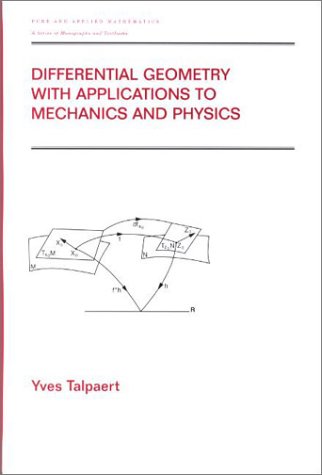
6. Differential Geometry and its
$80.49
7. Geometry and Its Applications,
$103.47
8. L2-Invariants: Theory and Applications
$77.00
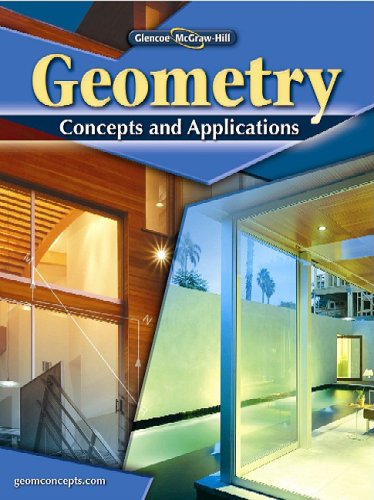
9. Geometry: Concepts and Applications,
$68.98
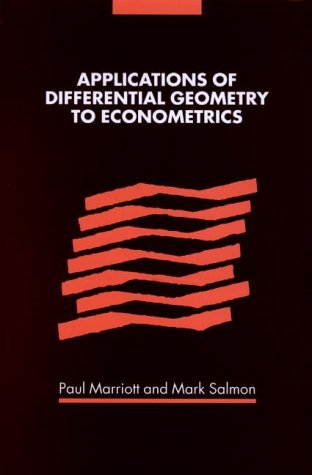
10. Applications of Differential Geometry
$5.32
11. Geometry: Concepts and Applications,
$38.90
12. Numerical Geometry of Images:
$42.50
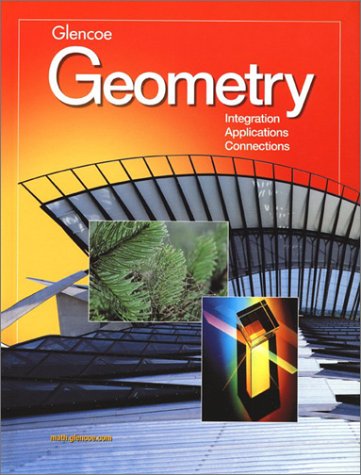
13. Geometry: Integration, Applications,
$7.45
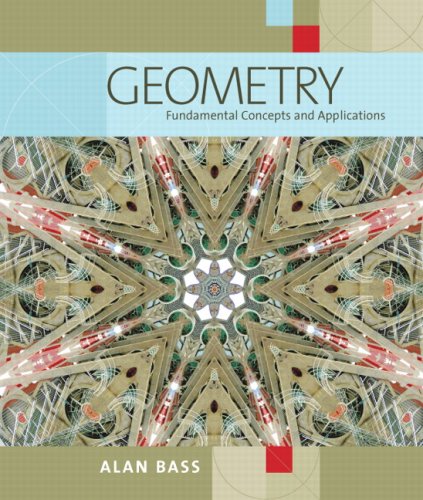
14. Geometry: Fundamental Concepts
$59.00
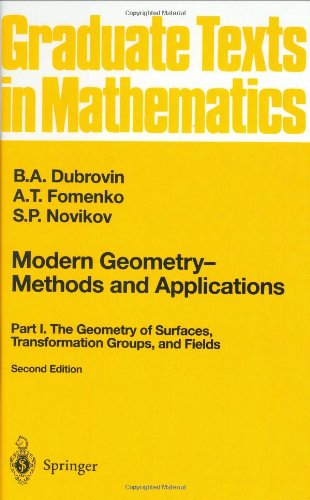
15. Modern Geometry - Methods and
$35.81
16. Projective Geometry: From Foundations
$32.96
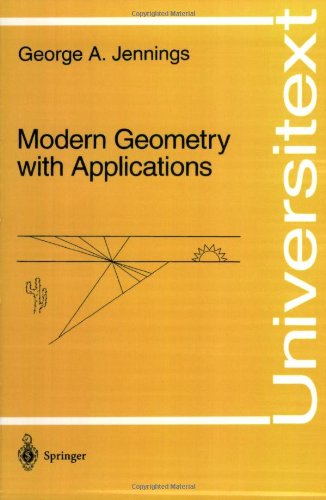
17. Modern Geometry with Applications
 
18. Basic Math, Algebra, and Geometry
$54.19
19. Fractal Geometry: Mathematical
 
$12.34
20. Geometry: Explorations And Applications

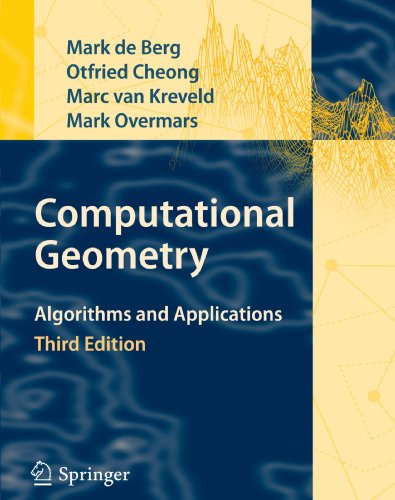
1. Computational Geometry: Algorithms and Applications
by Mark de Berg, Otfried Cheong, Marc van Kreveld, Mark Overmars
Hardcover: 386 Pages (2008-04)
list price: US$49.95 -- used & new: US$49.95
(price subject to change: see help)
Asin: 3540779736
Average Customer Review: 4.5 out of 5 stars
Canada | United Kingdom | Germany | France | Japan
Editorial Review

Book Description

This well-accepted introduction to computational geometry is a textbook for high-level undergraduate and low-level graduate courses. The focus is on algorithms and hence the book is well suited for students in computer science and engineering. Motivation is provided from the application areas: all solutions and techniques from computational geometry are related to particular applications in robotics, graphics, CAD/CAM, and geographic information systems. For students this motivation will be especially welcome. Modern insights in computational geometry are used to provide solutions that are both efficient and easy to understand and implement. All the basic techniques and topics from computational geometry, as well as several more advanced topics, are covered. The book is largely self-contained and can be used for self-study by anyone with a basic background in algorithms.

In this third edition, besides revisions to the second edition, new sections discussing Voronoi diagrams of line segments, farthest-point Voronoi diagrams, and realistic input models have been added.

... Read more

Customer Reviews (15)

5-0 out of 5 stars A very nice introduction to the field
The authors did a great job of introducing the reader to all the important aspects of the field of computational geometry while keeping it simple and understandable.

5-0 out of 5 stars Excellent Background
This book is extremely well written, easy to understand, and actually is the standard text for Computational Geometry classes, as far as I know.The only thing I didn't like about it was that there seemed to be a few errors in some of the pseudocode.But, it's to be expected when publishing a textbook, and I think it'll probably be cleared up in future editions.

Overall, great book.I'd recommend it to anyone taking graphics or a computational geometry class.

4-0 out of 5 stars good source of many methods
The authors amass an impressive array of algorithms related to finding geometrical properties. Where these algorithms are performed on a computer. The book itself does not advocate any particular programming language. The algorithms are given in pseudocode, and you are expected to manually convert these to code in your choice of language. Given the calibre of the discussion in the text, which suggests that the readers are quite experienced, then this manual step should be easy to most.

There are numerous contexts in which the text might prove useful. Ranging from graphics to GIS to robotics. Thus, there is an entire chapter on the planning of robotic motion. The robot can in general translate and rotate.

Each chapter comes with an exercise set. Which helps make the book suitable as a graduate or even undergraduate text.

3-0 out of 5 stars Important book but substandard layout and typesetting
This is one of the really few computational geometry books available. It fills a niche and does it decently. However it could be better:

1. The chapter layout is not very good. There are many "revisiting this" and "we saw in chapter so-and-so".

2. The mathematical proofs are often written in a single paragraph full of "English" interspersed with mathematical notation, instead of the tried and true way of numbered equations and one-per explanations. This makes for disconcerting reading.

3. The book in general could have done with more math and code, and less "English", not to mention more and better diagrams -- they tend to be sparsely detailed (ie. a picture is worth only a hundred words). The arrangement of diagrams also needs to be better: some are in the margins, some are in the middle, again not easy and intuitive to follow.

Hopefully a future edition will address this issues.

4-0 out of 5 stars Good Introduction but look elsewhere for detailed reference
Pro:
(1) Each chapter begins with a practical example. For example, the chapter computing intersections of lines starts with a discussion of a map-making application that goes into enough detail to see how the algorithms they present would be useful. This is a considerable step up from the common practice in algorithms literature of motivation by way of vaguely mentioning some related field (i.e. "These string matching algorithms are useful in computational biology"). This book does a much better job of motivating the material it presents, but if you're primarily interested in the abstract problem, these sections can be skipped.

(2) Each chapter is relatively self-contained. Feel free to skip ahead to subjects that interest you.

(3) Surprisingly readable. Unlike most technical material, one can read an entire chapter in a single sitting without missing much. Generally, each chapter will develop a single algorithm for a single kind of problem.

(4) It's very up to date. This second edition is less than two years old, it includes some new results in the field.

Con:
(1) Algorithms are only given in pseudocode. The emphasis is on describing algorithms and data structures clearly and completely. If you're looking for a "cookbook" with code to copy and paste into an application, perhaps O'Rourke's "Computational Geometry in C" would be a better choice.

(2) There are many important advanced results that are not discussed in the main text. An obvious example is the first chapter, which describes a well-known convex hull algorithm that takes O(n log n) time but algorithms that are faster for most inputs are mentioned only in the "Notes and Comments" at the end of the chapter. Someone interested in lots of gory details would be well-served to combine this book with Boissonnat and Yvinec's more detailed and mathematical "Algorithmic Geometry". ... Read more


2. Semi-Riemannian Geometry With Applications to Relativity, 103, Volume 103 (Pure and Applied Mathematics)
by Barrett O'Neill
Hardcover: 468 Pages (1983-06-28)
list price: US$142.00 -- used & new: US$115.28
(price subject to change: see help)
Asin: 0125267401
Average Customer Review: 4.0 out of 5 stars
Canada | United Kingdom | Germany | France | Japan
Editorial Review

Book Description
This book is an exposition of semi-Riemannian geometry (also called pseudo-Riemannian geometry)--the study of a smooth manifold furnished with a metric tensor of arbitrary signature. The principal special cases are Riemannian geometry, where the metric is positive definite, and Lorentz geometry. For many years these two geometries have developed almost independently: Riemannian geometry reformulated in coordinate-free fashion and directed toward global problems, Lorentz geometry in classical tensor notation devoted to general relativity. More recently, this divergence has been reversed as physicists, turning increasingly toward invariant methods, have produced results of compelling mathematical interest. ... Read more

Customer Reviews (6)

5-0 out of 5 stars The Best Introduction to General Relativity
If you want to engage in a serious study of general relativity, then you must master the mathematical language of semi-Riemannian manifolds in which it is cast. Sadly, the development of classical Riemannian geometry as studied by pure mathematicians only parallels the development of semi-Riemannian geometry in the early stages;eventually, the two subjects diverge rather drastically.For example, the famous Hopf-Rinow Theorem, one of the cornerstones of modern Riemannian geometry, simply has no Lorentzian analogue at all;every single equivalence in the theorem fails in Lorentzian geometry.Thus, one could master all five volumes of Spivak's definitive treatment of Riemannian geometry and still be unprepared to deal with light cones, timelike, null and spacelike geodesics, and the multitude of other uniquely semi-Riemannian constructs that appear in general relativity.O'Neill's wonderful book, which first appeared in 1983, provides the well-prepared reader with a mathematically rigorous, thorough introduction to both Riemannian and semi-Riemannian geometry, showing how they are similar and pointing out clearly where they differ.After developing the mathematical machinery in the early chapters, the last part of the book turns to general relativity by offering lucid introductions to the Robertson-Walker cosmological models (Big Bang singularities), the Schwarzschild model for a single non-rotating star (including black holes), and a brief introduction to Penrose-Hawking causality theory.If you would like to study a pure Riemannian text in parallel with this one, I would recommend the text by Boothby, written at a comparable level of difficulty, which remains one of the clearest and most accessible Riemannian geometry texts on the market.For the serious reader who wishes to continue on with a study of the Kerr solution to Einstein's equations, modeling the exterior spacetime of a rotating star, O'Neill wrote an entire book on the subject in 1995, now difficult to find but well worth tracking down.This 1995 text contains one of the clearest, most accessible
introductions available to the difficult subjects of the algebraic classification of the Weyl curvature tensor and the corresponding Petrov classification of spacetimes.I studied from O'Neill's 1983 text when it first came out and I have continued to use it as the primary text for an advanced undergraduate course I have taught over the past 20 years.It is not an "easy" text to read, but then, I have never found the "easy" introduction to differential geometry and general relativity.The reviewer who says this is not a suitable first text is simply in error;there is no better first text on the subject.If you have studied linear algebra, advanced calculus, and a little topology, then with dedication and hard work, you can learn more from O'Neill's text than from many of the far more popular recent texts, written by physicists, which attempt to circumvent the mathematics insofar as is possible while introducing general relativity.This is a perilous course for which the serious student will pay dearly later on, when she/he wants to study any of the many areas of modern physics in which differential geometry (differential forms, bundle theory, connections on a principle fiber bundle, gauge theory, etc.) plays an essential role.

3-0 out of 5 stars Great book, terrible print quality
This is a wonderful book, with a clear, concise and precise exposition of the fundamental idea in riemannian and semi-riemannian geometry.Although I would not recommend it as a first text, it will be the text that you continue to reference later, and turn to when you want the best mathematical treatment.

However, I do not recommend that you buy a new copy.The print quality is terrible; the binding is poor, but even worse, the text quality is absurd.I have been using a library copy with cloth binding and sharp, clear text.It is obvious that the new printing in the green cover is based on a photocopy of the original rather than a new typesetting.While this means that no errors have been introduced, I found it painful to read.I would suggest looking for a used copy.

So 5 stars for the book, but only 3 stars for this printing.

1-0 out of 5 stars Very good contents but..
The only drawback, and it is a serious one, is the binding. For a such expensive book, one could expect a DECENT binding, but the outcome is a SHAME.

So 5 star for the contents an 0 for the binding

5-0 out of 5 stars Addendum
This book is now available at Amazon.co.uk!

Its contents are: Manifold Theory. Tensors. Semi-Riemannian Manifolds. Semi-Riemannian Submanifolds. Riemannian and Lorentz Geometry. Special Relativity. Constructions.Symmetry and Constant Curvature. Isometries. Calculus of Variations.Homogeneous and Symmetric Spaces. General Relativity; Cosmology.Schwarzschild Geometry. Causality in Lorentz Manifolds.

Let's go buy it!

5-0 out of 5 stars Excellent for beginner and experienced mathematicians
This is one of the best books on Differential Geometry I've ever read. It includes a clear exposition of all the basic results and then goes on to the most deep aspects of the subject, making it useful for undergraduateand graduate students, as well as experienced working mathematicians. It'sa pitty that it's no longer available. ... Read more


3. Geometry : Explorations and Applications
by Aichele
 Hardcover: Pages (1998-01-01)
list price: US$92.52 -- used & new: US$35.24
(price subject to change: see help)
Asin: 0395722853
Average Customer Review: 3.5 out of 5 stars
Canada | United Kingdom | Germany | France | Japan

Customer Reviews (2)

2-0 out of 5 stars This is book is completely lacking in everything.
This book is lacking in examples, diagrams and as well as facts and information. The diagrams that are present do not provide the necessary information to actually LEARN form the book. As a result, we have to deviate from the textbook making it completely comfusing. DO NOT BUY THIS BOOK. It is simply not worth it.

I suggest Prentice Hall if you need a book, after using Prentice Hall for several years; I find it completely helpful and easy to learn from.

The book has few examples and it doesn't show HOW to do the problem, rather, it just explains what the problem is and quickly gives the solution. The chapters are organized in a fashionable manner but it is lacking in material, the answers are at the back of the book but what really ticks me off is the 'real life problems'. They give 4-5 of those in a lesson and they take at least half an hour of think and writing [that doesn't involve math' and then on the test, they never show up becuase the problem had nothing to do with the chapter. The book is just lacking in materials. Look at the publiciation date. 1998--this book is just wayyy out dated.

5-0 out of 5 stars The perfect one!
Now this is type of Geometry book it should be. More examples, answer key, and a glossary. Unlike that complicated Michael Serra Geometry book from hell. ... Read more


4. Geometry, Spinors and Applications (Springer Praxis Books / Mathematics)
by Donal J. Hurley, Michel A. Vandyck
Hardcover: 392 Pages (2000-02-29)
list price: US$153.00 -- used & new: US$122.00
(price subject to change: see help)
Asin: 1852332239
Average Customer Review: 5.0 out of 5 stars
Canada | United Kingdom | Germany | France | Japan
Editorial Review

Book Description
This text is a self-contained, comprehensive treatment of the tensor and spinor calculus of space-time manifolds with as few technicalities as correct treatment allows. Both the physical and geometrical motivation of all concepts are discussed, helping the reader to go through the technical details in a confident manner. Several physical theories are discussed and developed beyond standard treatment using results in the book. Both the traditional "index" and modern "coordinate-free" notations are used side-by-side in the book, making it accessible to beginner graduate students in mathematics and physics. The methods developed offer new insights into standard areas of physics, such as classical mechanics or electromagnetism, and takes readers to the frontiers of knowledge of spinor calculus. ... Read more

Customer Reviews (1)

5-0 out of 5 stars superbly written
I highly recommend this book to anyone interested in spinor calculus. The authors' primary goal is to investigate the problem of defining Lie and covariant differentiation of spinor fields. This they do, but in addition, they carefully cover a number of standard topics and a number that I'd not seen elsewhere (such as the decomposition of a connection into constituents including the contorsion & metric-incompatibility tensors) in an extremely lucid way. ... Read more


5. College Geometry: A Problem Solving Approach with Applications (2nd Edition)
by Gary L. Musser, Lynn Trimpe, Vikki R. Maurer
Hardcover: 656 Pages (2007-03-11)
list price: US$111.60 -- used & new: US$80.95
(price subject to change: see help)
Asin: 0131879693
Average Customer Review: 3.5 out of 5 stars
Canada | United Kingdom | Germany | France | Japan
Editorial Review

Book Description

For courses in Geometry or Geometry for Future Teachers.

This popular book has four main goals: 1. to help students become better problem solvers, especially in solving common application problems involving geometry; 2. to help students learn many properties of geometric figures, to verify them using proofs, and to use them to solve applied problems; 3. to expose students to the axiomatic method of synthetic Euclidean geometry at an appropriate level of sophistication; and 4. to provide students with other methods for solving problems in geometry, namely using coordinate geometry and transformation geometry. Beginning with informal experiences, the book gradually moves toward more formal proofs, and includes special topics sections.

... Read more

Customer Reviews (3)

4-0 out of 5 stars A solid introduction to geometry that emphasizes learning through problem solving
One of the problems a number of math students face is learning how to think about the problems they face.They simply never develop the necessary tool set that will allow them to understand what the problem is asking and what they should do to attack it.Once they have an answer, they are not sure if they have found the correct answer.This is a fine BASIC text for college and high school students who want to get a handle on dealing with geometry.If you have a deep mathematics background and are looking for an advanced college text on geometry, this is probably not for you.

However, if you want to learn the basics on how to think about geometry and a lot of help on how to solve a variety of geometric problems, this is a terrific text and will be a big help.I enjoy the way the text engages the student from the very beginning and asks him or her to THINK.It isn't a bunch of material to memorize.What the authors do is build the student's understanding through problem solving.If the student will take the time to work the problems and not give up on the problems he or she finds difficult, the understanding will come and will be more ingrained in his or her thought processes than would happen through memorization.

There are lots of geometric drawings, as one would hope, and there are a number of applications of geometry to real life and that should help the student, as well.Again, this is meant as a basic geometry text and can be suitable for a good high school student as well as non-majors in college that want to get an introduction to the basics of geometry.

1-0 out of 5 stars not college level
This book is pitched at an extremely low level
quite beyond anything in the 'math for poets'
category - often dropping below even that of high
school.Indeed, the book compares unfavorably
with the canonical hs text by Jacobs.To give
just one example, it takes the authors 273 pages
to get to the ideaof cross multiplication [a staple
in the repertoire of any decent middle school
student].In particular, math majors as well
as anyone interested in the subject should
steer clear of this and consider instead books by
Pedoe, Court, Coxeter, etc.If you are looking
for a problem oriented approach to geometry, try
the relevant offering in the Schaum's series
[acknowledged masters of this approach].
In the meantime, let's not sacrifice any more trees
for products as weak as this.

5-0 out of 5 stars An outstanding introduction to geometric thought
This is one of the few introductory level texts I have seen that gives some of the real flavor of mathematics, without being too challenging for beginning students.The initial section on problem solving is modelled on the famous book by Polya, "How to solve it," and has many simple but thought-stimulating problems.The following sections develop plane and solid geometry with many illustrated problems and interesting historical notes.The final chapters carefully introduce geometric proofs.There are also review sections on simple algebraic manipulations and basic logic, as well as a short section on the implications of alternate parallel postulates.Overall, the text has a well thought out development of basic skills and concepts, and enough interesting tidbits from more "advanced" topics to challenge the imagination of any student. ... Read more


6. Differential Geometry and its Applications (Classroom Resource Materials) (Classroom Resource Materials)
by John Oprea
Hardcover: 510 Pages (2007-07-10)
list price: US$69.95 -- used & new: US$69.25
(price subject to change: see help)
Asin: 0883857480
Average Customer Review: 3.5 out of 5 stars
Canada | United Kingdom | Germany | France | Japan
Editorial Review

Product Description
Differential geometry has a long, wonderful history.It has found relevance in areas ranging from machinery design to the classification of four-manifolds to the creation of theories of nature's fundamental forces to the study of DNA. This book studies the differential geometry of surfaces with the goal of helping students make the transition from the compartmentalized courses in a standard university curriculum to a type of mathematics that is a unified whole. It mixes together geometry, calculus, linear algebra, differential equations, complex variables, the calculus of variations, and notions from the sciences. Differential geometry is not just for mathematics majors.It is also for students in engineering and the sciences.The mix ofideas offer students theopportunity to visualize concepts through the use of computer algebra systems such as Maple. The book emphasizes that this visualization goes hand-in-hand with the understanding of the mathematics behind the computer construction. Students will not onlyseegeodesics on surfaces, but they will also observe the effect that an abstract result such as the Clairaut relation can have on geodesics. Furthermore, the book shows how the equations of motion of particles constrained to surfaces are actually types of geodesics.The book is rich in results and exercises that form a continuous spectrum, from those that depend on calculation to proofs that are quite abstract. ... Read more

Customer Reviews (3)

5-0 out of 5 stars clearest undergrad differential geometry text around
This is a very well-written text on modern differential geometry for undergraduates. The content of the book is similar to O'Neill's "Elementary Differential Geometry" (e.g. covariant derivatives, shape operators), but it's easier to read. There are many undergrad texts around -- O'Neill, do Carmo, Pressley -- but this one is the most lucidly written one hands-down.

Afer going through Oprea, one might like to tackle O'Neill's "Elementary Differential Geometry" and Vols 2-4 of Spivak's "Comprehensive Introduction to D.G."

Like O'Neill, Oprea develops surface theory using the shape operator. But Oprea takes shortcuts and doesn't develop the theory in quite the same generality as O'Neill does. For example, Oprea doesn't introduce differential forms and the exterior calculus. As a consequence, Oprea restricts himself to the Serret-Frenet equations whereas O'Neill introduces Cartan's structural equations -- of which Serret-Frenet is simply a special case -- as the method of moving frames in full generality. The structural equations are then used (by O'Neill) in both curve and surface theory.

4-0 out of 5 stars Nice introduction and applications of differential geometry
I found this book to be a fine introduction to this subject. I was particularly pleased with the practical examples outlined in the book. Even though I am not extremely proficient with Maple, I found the exercises using this software provided important illustrations of applications.

2-0 out of 5 stars Not a text for a rigorous mathematics course
This book is not to be used as a rigorous introduction to differential geometry.There are some definitions and theorems that are casuallydescribed, and the motive behind particular definitions are vague. Thosenot interested in MAPLE might find constant instructions for MAPLEannoying. Not to be completely negative, there are some good excercizes inthe text that I especially enjoyed. ... Read more


7. Geometry and Its Applications, Second Edition
by Walter A. Meyer
Hardcover: 560 Pages (2006-02-21)
list price: US$98.95 -- used & new: US$80.49
(price subject to change: see help)
Asin: 0123694272
Average Customer Review: 5.0 out of 5 stars
Canada | United Kingdom | Germany | France | Japan
Editorial Review

Book Description
Meyer's Geometry and Its Applications, Second Edition, combines traditional geometry with current ideas to present a modern approach that is grounded in real-world applications. It balances the deductive approach with discovery learning, and introduces axiomatic, Euclidean geometry, non-Euclidean geometry, and transformational geometry. The text integrates applications and examples throughout and includes historical notes in many chapters.

The Second Edition of Geometry and Its Applications is a significant text for any college or university that focuses on geometry's usefulness in other disciplines. It is especially appropriate for engineering and science majors, as well as future mathematics teachers.

* Realistic applications integrated throughout the text, including (but not limited to):
- Symmetries of artistic patterns
- Physics
- Robotics
- Computer vision
- Computer graphics
- Stability of architectural structures
- Molecular biology
- Medicine
- Pattern recognition
* Historical notes included in many chapters
* Instructor's Manual with solutions available for all adopters of the text ... Read more

Customer Reviews (2)

5-0 out of 5 stars Good practical book
This book is a good college level textbook, with a lot of practical applications for geometry.Good for a college text to prepare geometry teachers to deal with questions from students like, "What will I ever need to use geometry for?"I really liked that the book has solutions to the odd numbered problems and the sections in each chapter on how geometry applies to everyday problems faced in physics and engineering.The CD was a nice supplement to use with geometers sketchpad.

5-0 out of 5 stars THE BOOK OF IDEAS
I got this book as a second hand and shortly its very very nice book.
The applications are very smart and clear ,
Its contexts and illustrations are adequate ,precise and really easy to read and understand.
I realy loved this book ,and i guess this is how the geometry Should be taught as rich ideas with apps not in abstract form.
You will find a nice proof for fermat's least time principle,
and lots lots more intersting ideas good for physics and computer
graphics programming.
This book really worth any price. ... Read more


8. L2-Invariants: Theory and Applications to Geometry and K-Theory (Ergebnisse der Mathematik und ihrer Grenzgebiete. 3. Folge / A Series of Modern Surveys in Mathematics)
by Wolfgang Lück
Hardcover: 595 Pages (2002-09-17)
list price: US$159.00 -- used & new: US$103.47
(price subject to change: see help)
Asin: 3540435662
Canada | United Kingdom | Germany | France | Japan
Editorial Review

Book Description
In algebraic topology some classical invariants - such as Betti numbers and Reidemeister torsion - are defined for compact spaces and finite group actions. They can be generalized using von Neumann algebras and their traces, and applied also to non-compact spaces and infinite groups. These new L2-invariants contain very interesting and novel information and can be applied to problems arising in topology, K-Theory, differential geometry, non-commutative geometry and spectral theory. It is particularly these interactions with different fields that make L2-invariants very powerful and exciting. The book presents a comprehensive introduction to this area of research, as well as its most recent results and developments. It is written in a way which enables the reader to pick out a favourite topic and to find the result she or he is interested in quickly and without being forced to go through other material. ... Read more


9. Geometry: Concepts and Applications, Student Edition
by McGraw-Hill
Hardcover: 878 Pages (2007-05-04)
list price: US$88.60 -- used & new: US$77.00
(price subject to change: see help)
Asin: 0078799147
Average Customer Review: 3.0 out of 5 stars
Canada | United Kingdom | Germany | France | Japan
Editorial Review

Book Description
An ideal program for struggling students

Geometry: Concepts and Applications covers all geometry concepts using an informal approach. ... Read more

Customer Reviews (2)

5-0 out of 5 stars Great examples and relatable!
Having taught from this book, I think it's a great curriculum to use with students who aren't interested in theory, but would rather know "why are we doing this?"This book branches out into how geometry is found in culture, such as art, and applied in daily living.If you are more interested in answering students' questions about "when are we ever going to use this?" than you are about writing proofs all the time, this is a perfect book for you.

1-0 out of 5 stars this is the worst
I love mathematics and read math book of all sorts, including textbooks. I teach music theory (which is similar to math) at the college level, and have been doing so for the last 18 years. This is the worst math book I have ever seen. Where are the brillant proofs of Euclid? This is a hodgepodge of history, so-called music, and diverse topics thrown into one book, that consists of mearly formulaes and prove it yourself theorems. The Pythagorean formula is circular, if you can follow it back far enough. There are no concepts or brillant ideas, only "you do it this way" as in the old calculus books. The authors are all school teachers, with one college teacher (wow). The school teachers have been complaining for years about how bad the "new math" was when the mathematicians wrote the texts; now it is their turn and they have turned my child off to math by their dull pedantic book. I think all schools should review this book before using it. ... Read more


10. Applications of Differential Geometry to Econometrics
Hardcover: 334 Pages (2000-09-18)
list price: US$99.00 -- used & new: US$68.98
(price subject to change: see help)
Asin: 0521651166
Canada | United Kingdom | Germany | France | Japan
Editorial Review

Book Description
Differential geometry has become a standard tool in the analysis of statistical models, offering a deeper appreciation of existing methodologies and highlighting the issues that can be hidden in an algebraic development of a problem. This volume is the first to apply these techniques to econometrics. An introductory chapter provides a brief tutorial for those unfamiliar with the tools of differential geometry. The following chapters offer applications of geometric methods to practical solutions and offer insight into problems of econometric inference. ... Read more


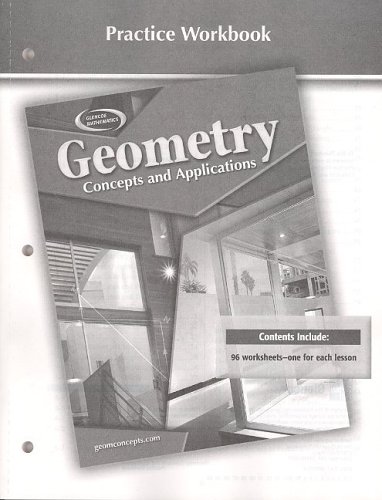
11. Geometry: Concepts and Applications, Practice Workbook
by McGraw-Hill
Paperback: 96 Pages (2005-02-05)
list price: US$5.32 -- used & new: US$5.32
(price subject to change: see help)
Asin: 0078696224
Canada | United Kingdom | Germany | France | Japan

12. Numerical Geometry of Images: Theory, Algorithms, and Applications
by Ron Kimmel
Hardcover: 209 Pages (2003-10-31)
list price: US$49.95 -- used & new: US$38.90
(price subject to change: see help)
Asin: 0387955623
Average Customer Review: 5.0 out of 5 stars
Canada | United Kingdom | Germany | France | Japan
Editorial Review

Book Description
Numerical Geometry of Images examines computational methods and algorithms in image processing. It explores applications like shape from shading, color-image enhancement and segmentation, edge integration, offset curve computation, symmetry axis computation, path planning, minimal geodesic computation, and invariant signature calculation. In addition, it describes and utilizes tools from mathematical morphology, differential geometry, numerical analysis, and calculus of variations. Graduate students, professionals, and researchers with interests in computational geometry, image processing, computer graphics, and algorithms will find this new text / reference an indispensable source of insight of instruction. ... Read more

Customer Reviews (2)

5-0 out of 5 stars Numerical Geometry of Images
A very well-written, interesting and useful book covering a wide range of topics in image processing and computer vision and beyond. A good balance between theory and implementation issues that make the things work. A 100% recommendation to students and specialists in the field.


5-0 out of 5 stars Some additional info.
The book is an extended version of my lecture notes. Including
introduction to variational methods, differential geometry,
level sets and fast marching numerical methods, and geometric active
contours for segmentation with Matlab pseudo code, 3D face recognition,
texture mapping and more applications.

Thanks to the many who bought the book. ... Read more


13. Geometry: Integration, Applications, Connections Student Edition
by Boyd, Burrill, Cummins
Hardcover: 910 Pages (2000-05-26)
list price: US$89.32 -- used & new: US$42.50
(price subject to change: see help)
Asin: 0078228808
Canada | United Kingdom | Germany | France | Japan

14. Geometry: Fundamental Concepts and Applications
by Alan Bass
Paperback: 176 Pages (2007-04-29)
list price: US$13.33 -- used & new: US$7.45
(price subject to change: see help)
Asin: 0321473310
Canada | United Kingdom | Germany | France | Japan
Editorial Review

Book Description
This Geometry workbook makes the fundamental concepts of geometry accessible and interesting for college students and incorporates a variety of basic algebra skills in order to show the connection between Geometry and Algebra. ... Read more


15. Modern Geometry - Methods and Applications: Part I: The Geometry of Surfaces, Transformation Groups, and Fields (Graduate Texts in Mathematics)
by B.A. Dubrovin, A.T. Fomenko, S.P. Novikov
Hardcover: 492 Pages (1991-11-11)
list price: US$74.95 -- used & new: US$59.00
(price subject to change: see help)
Asin: 0387976639
Average Customer Review: 4.5 out of 5 stars
Canada | United Kingdom | Germany | France | Japan
Editorial Review

Book Description
This is the first volume of a three-volume introduction to modern geometry, with emphasis on applications to other areas of mathematics and theoretical physics. Topics covered include tensors and their differential calculus, the calculus of variations in one and several dimensions, and geometric field theory. This material is explained in as simple and concrete a language as possible, in a terminology acceptable to physicists. The text for the second edition has been substantially revised. ... Read more

Customer Reviews (3)

5-0 out of 5 stars Why you should buy this book
There's some great material that professor Novikov presents in this three volume set, indispensible to the mathematician and physicist.What seperates it (and elevates it) from it's numerous competitors in the differential geometry textbook line is the following:

1.He presents pretty much every idea in multiple ways and from multiple viewpoints, illustrating the ubiquity and flexibility of the ideas.
2.He gives concrete examples of the concepts so you can see them in action.The examples are selected from a very wide range of physical problems.
3.He presents the ideas in a formal setting first but then gives them in a form useful for actual computation or working problems one would actually encounter.
4.He segregates the material cleanly into what I would call "algebraic" and "differential" sections.Thus, if you are interested in only a specific viewpoint or topic, you can fairly well read that section independent of the others.The book's chapters are for the most part independent.
5.There is virtually no prerequisite knowledge for this text, and yet it provides enough to not bore even the "sophisticated reader", for even they will no doubt learn something from the elegeant presentation.

I only own the first volume, but I have looked at the others in libraries and I would say for the most part the above holds for them too, making this three-volume set truly a masterpiece, a pearl in the sea of mathematical literature.

Anyone iterested in a readable, relevant, viable introduction to the huge world of differential gometry will not be disappointed.

5-0 out of 5 stars Best book to begin differential geometry with ..
Written by prominent mathematicians it is the one of the best books on the topic .
The language of the book is very simple so it is suitable for physics ...

4-0 out of 5 stars Required background reading...
..if you want to understand the much of Arnol'd's book on classical mechanics. Written for physicists in language that physicists can follow, the book starts with advanced calculus (geometry of surfaces and curves in 2D and 3D) and provides a readable and informative introduction to Riemannian geometry, including connections defined by structure coefficients of a Lie algebra, all the way through gauge theories. However, the books by Schutz and by Nakahara cover interesting topics not included here, so see them as well. ... Read more


16. Projective Geometry: From Foundations to Applications
by Albrecht Beutelspacher, Ute Rosenbaum
Paperback: 268 Pages (1998-02-13)
list price: US$43.00 -- used & new: US$35.81
(price subject to change: see help)
Asin: 0521483646
Canada | United Kingdom | Germany | France | Japan
Editorial Review

Book Description
This book introduces the basic ideas of mathematical proof to students embarking on university mathematics. The emphasis is on helping the reader to understand and construct proofs and write clear mathematics. The authors achieve this by exploring set theory, combinatorics and number theory, which include many fundamental mathematical ideas. This material illustrates how familiar ideas can be formulated rigorously, provides examples demonstrating a wide range of basic methods of proof, and includes some of the all time great classic proofs. The book presents mathematics as a continually developing subject. Material meeting the needs of readers from a wide range of backgrounds is included. The over 250 problems include questions to interest and challenge the most able student but also plenty of routine exercises to help familiarize the reader with the basic ideas. ... Read more


17. Modern Geometry with Applications (Universitext)
by George A. Jennings
Paperback: 187 Pages (1997-06-12)
list price: US$54.95 -- used & new: US$32.96
(price subject to change: see help)
Asin: 038794222X
Average Customer Review: 3.5 out of 5 stars
Canada | United Kingdom | Germany | France | Japan
Editorial Review

Book Description
This is an introduction to the theory and applications of modern geometry. It differs from other books in its field in its emphasis on applications and its discussion of Special Relativity as a major example of a non-Euclidean geometry. Besides Special Relativity, it covers two other important areas of non-Euclidean geometry: spherical geometry (used in navigation and astronomy) and projective geometry (used in art). In addition, it reviews many useful topics from Euclidean geometry, emphasizing transformations, and includes a chapter on conics and planetary orbits. Applications are stressed throughout the book. Every topic is motivated by an application and many additional applications are given in the exercises. The book would be an excellent introduction to higher geometry for those students, especially prospective mathematics and teachers, who need to know how geometry is used in addition to its formal theory. ... Read more

Customer Reviews (2)

2-0 out of 5 stars Amateurish
Chapter 1 on Euclidean geometry displays the author's poor taste as well as his profound misconception of what it means to prove something. We learn on page 19 that the area of a triangle is (1/2)(base)(height). The only justification for this is that it is "often" clear by cutting and pasting. Fine. We don't have to prove every little thing. But then there follows a "proposition 1.8.1" in which Jennings supposedly "proves", by using this formula, that moving the tip of a triangle along a line parallel to the base doesn't change its area. Jennings is also very fond of isometries and use them to "prove" SAS congruence. Since the discussion of isometries is purely descriptive, with no claims to axiomatic status, this essentially amounts to saying that "the triangles are congruent because I say so", no matter how much it is padded with fancy language (let T be the isometry such that this-and-that, etc.). Although this proof is questionable, at least here Jennings is in the company of Euclid (I.4). But Jennings quickly proves himself unworthy of such dignified company by proving SSS using the cosine theorem, which is certainly not Euclid's proof (I.8). Some other parts of the book are less disastrous, especially when Jennings borrows lots of material from Courant & Robbins and Hilbert & Cohn-Vossen. Still, Jennings almost manages to destroy even these beautiful things through thoroughly tasteless exposition; the proofs typically consist of elaborate justifications of trivial details by mountains of useless symbolism while the key ideas are not addressed at all ("It is important to note that [something completely trivial]: this is because blah, blah, blah, define L(z_4*), blah, blah, blah. It is clear that [important step], so we're done."). It is also ridiculous to claim that "projective geometry blossomed during the eighteenth [century]" (p. 115).

5-0 out of 5 stars Excellent elementary introduction to modern geometry
I am a Ph.D student in the field of symplectic geometry and topology. This book introduces the foundations of modern geometry in a beautiful and a very clear way,and I am saying this having some experience with geometry and topology books. If you are a skilled high school student or an under graduate student for mathematics or related area,this is a good book to start with in understanding what is modern geometry. The level of the book is about undergraduate level using very elementary notions. The content of the book is: Euclidean geometry and its logical foundations(so one could understand the motivation of the other geometries), Sphirical geometry,conic sections,Projective geometry,and the ending chapter is about the geometrical foundations of special relativity. The approach is not theorem-proof style but rather a more intuitive approch!. This is a recommended book. ... Read more


18. Basic Math, Algebra, and Geometry with Applications
 Hardcover: Pages (2007-01)

Isbn: 0536105952
Canada | United Kingdom | Germany | France | Japan

19. Fractal Geometry: Mathematical Foundations and Applications
by Kenneth Falconer
Paperback: 366 Pages (2003-11-14)
list price: US$70.00 -- used & new: US$54.19
(price subject to change: see help)
Asin: 0470848626
Average Customer Review: 5.0 out of 5 stars
Canada | United Kingdom | Germany | France | Japan
Editorial Review

Book Description
Since its original publication in 1990, Kenneth Falconer's Fractal Geometry: Mathematical Foundations and Applications has become a seminal text on the mathematics of fractals. It introduces the general mathematical theory and applications of fractals in a way that is accessible to students from a wide range of disciplines. This new edition has been extensively revised and updated. It features much new material, many additional exercises, notes and references, and an extended bibliography that reflects the development of the subject since the first edition.
* Provides a comprehensive and accessible introduction to the mathematical theory and applications of fractals.
* Each topic is carefully explained and illustrated by examples and figures.
* Includes all necessary mathematical background material.
* Includes notes and references to enable the reader to pursue individual topics.
* Features a wide selection of exercises, enabling the reader to develop their understanding of the theory.
* Supported by a Web site featuring solutions to exercises, and additional material for students and lecturers.
Fractal Geometry: Mathematical Foundations and Applications is aimed at undergraduate and graduate students studying courses in fractal geometry. The book also provides an excellent source of reference for researchers who encounter fractals in mathematics, physics, engineering, and the applied sciences.
Also by Kenneth Falconer and available from Wiley:
Techniques in Fractal Geometry
ISBN 0-471-95724-0

Please click here to download solutions to exercises found within this title:

http://www.wileyeurope.com/fractal ... Read more

Customer Reviews (5)

5-0 out of 5 stars A rare find
I agree with all that was said by the other reviews here but add one important point. The physical layout, (typeface, drawings, whitespace etc.) of this book is brilliantly done. This is often overlooked by the producers of technical works who do it "on the cheap", but it is vital if one is to use the book day after day, as I have had to.

While the subject matter is not easy, this is an excellent book to motivate one to get stuck into the underlying mathematics. The reward is a little insight into the often beatiful theorems and practical results found in this stimulating field of study.

5-0 out of 5 stars What every student should know about fractals.
Fractals make headlines from time to time[--are they everywhere?], and and they make lovely color pictures; but they are also part of a substantial mathematical theory, one with an
exciting mathematical history. This very important book presents
the subject in a way that it can be taught to students, and it starts with the basics, systematically, step by step, building up the material. Or it can be used for selfstudy! It has great exercises too! In view of the many applications to geometric analysis, to PDE, and to statistics, it is likely that fractal geometry will soon be a standard math course taught in many (more) math departments. By now it is widely recognized that the selfsimilarity aspects of the wavelet algorithms are key to their sucess. The book came out in 1990, and the author has an equally attractive book on the subject from 1985[The geometry of fractal sets] with a slightly more potential theoretic bent.

5-0 out of 5 stars Theoretical as well as practical insight
The first part of the book is essentially of a theoretical nature, with a thorough treatment of fractal geometry at a mathematical point of view. The second part on the other hand provides a flavour of the problems of fractal geometry in practice...so mathematicians as well as people interested in applications only should both find this book interesting. The maths are not easy but quite "understandable" for science undergrads...some notions of calculus or topology would help... but the introduction is excellent and allows anyone to follow the course of the book (but for understanding the proofs a good math background is required).

Excellent for understanding the geometrical properties of fractals.

5-0 out of 5 stars Exposes fractal geometry as a real mathematical discipline.
I appreciate Falconer's books on fractal geometry because they show the topic as it really is: a whole mathematical discipline on its own right and not just a nice temporary fashion.

It begins introducing basictopological concepts and then proceeds to develop the theory for severalpossible definitions of fractal dimension, showing the relations betweenthem. Then it explores deeply the local geometry of different kinds offractal objects, and studies some other geometrical situations, like thepojection of fractals (ever thought of a DIGITAL sundial? Here it isdescribed!).

The book also includes a lot of applications to other areasof mathematics and physics, a great amount of graphics, and muchmore.

The text is suitable from third year undergraduate school and on.It is a larger but lighter version of "The Geometry of FractalSets".

5-0 out of 5 stars One of the best books on fractals to be found anywhere!
The book opens the doors of mathematics: it isn't an easy door, but well worth the effort. It bridges the gap between beginner texts and advanced study and covers the basic material in a hard hitting manner. Those looking for "giltz" should look elsewhere. It is a book of great understanding and depth. Your unique Associates ID is:thefractaltransl. ... Read more


20. Geometry: Explorations And Applications
 Paperback: Pages (1998-06-30)
list price: US$12.92 -- used & new: US$12.34
(price subject to change: see help)
Asin: 0395937884
Canada | United Kingdom | Germany | France | Japan

  1-20 of 100 | Next 20

Prices listed on this site are subject to change without notice.
Questions on ordering or shipping? click here for help.

site stats