e99 Online Shopping Mall

Geometry.Net - the online learning center Help  
Home  - Mathematicians - American Mathematicians (Books)

  Back | 21-40 of 100 | Next 20

click price to see details     click image to enlarge     click link to go to the store

$15.00
21. Benjamin Banneker: American Scientific
 
22. Proceedings of the International
$29.00
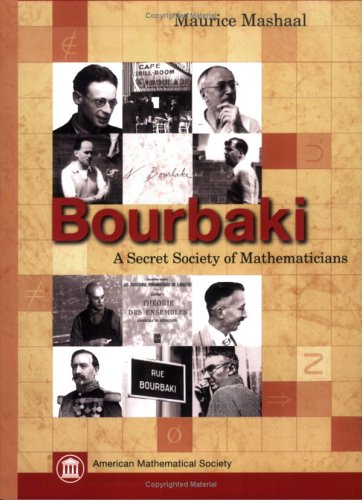
23. Bourbaki: A Secret Society of
$37.00
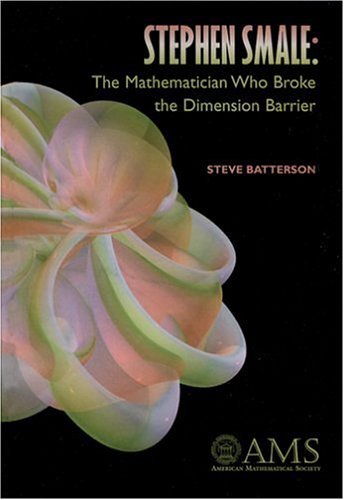
24. Stephen Smale: The Mathematician
 
$5.95
25. Career opportunities for mathematicians.
$47.60
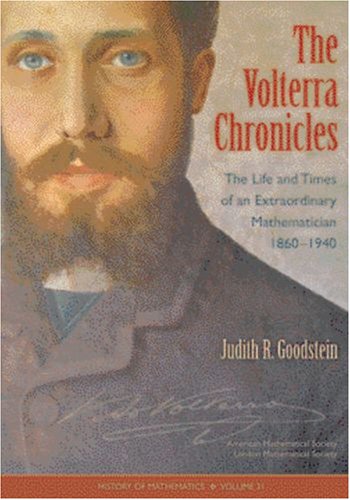
26. The Volterra Chronicles: The Life
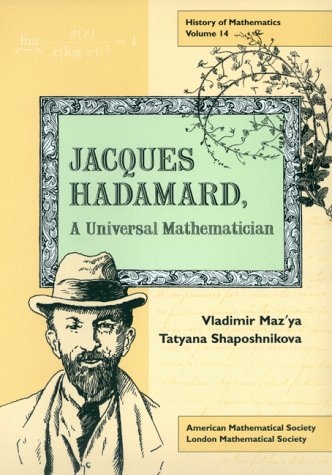
27. Jacques Hadamard: A Universal
 
$3.17
28. A Mathematician Reads the Newspaper
 
$12.00
29. Levi Ben Gerson's Prognostication
 
$146.09
30. Chapter 16 of Ramanujan's Second
 
$12.95
31. Satan is a Mathematician: Poems
 
$5.95
32. Numerologies.: An article from:
 
$16.35
33. Persuasion for a Mathematician
$24.97
34. The Hinge of the World: In Which
 
$5.95
35. Mathematics forty years after
 
$2.20
36. Accept No Limitations: A Black
$10.17
37. Mathematicians in Love
$10.98
38. Endless Frontier: Vannevar Bush,
 
39. Robert Lee Moore, 1882-1974
 
40. The influence of French mathematicians

21. Benjamin Banneker: American Scientific Pioneer (Signature Lives) (Signature Lives)
by Myra Weatherly
Library Binding: 112 Pages (2006-05-30)
list price: US$31.93 -- used & new: US$15.00
(price subject to change: see help)
Asin: 0756515793
Canada | United Kingdom | Germany | France | Japan

22. Proceedings of the International Congress of Mathematicians. Volume II: Conference in Algebra, Analysis, Applied Mathematics, and Topology
by American Mathematical Society
 Hardcover: Pages (1952)

Asin: B0013KHBEE
Canada | United Kingdom | Germany | France | Japan

23. Bourbaki: A Secret Society of Mathematicians
by Maurice Mashaal
Paperback: 260 Pages (2006-06-01)
list price: US$29.00 -- used & new: US$29.00
(price subject to change: see help)
Asin: 0821839675
Average Customer Review: 5.0 out of 5 stars
Canada | United Kingdom | Germany | France | Japan
Editorial Review

Product Description
The name Bourbaki is known to every mathematician. Many also know something of the origins of Bourbaki, yet few know the full story. In 1935, a small group of young mathematicians in France decided to write a fundamental treatise on analysis to replace the standard texts of the time. They ended up writing the most influential and sweeping mathematical treatise of the twentieth century, Les élements de mathématique.Maurice Mashaal lifts the veil from this secret society, showing us how heated debates, schoolboy humor, and the devotion and hard work of the members produced the ten books that took them over sixty years to write. The book has many first-hand accounts of the origins of Bourbaki, their meetings, their seminars, and the members themselves. He also discusses the lasting influence that Bourbaki has had on mathematics, through both the Élements and the Seminaires. The book is illustrated with numerous remarkable photographs.ReadershipStudents, mathematicians, and historians interested in the group of mathematicians known as Bourbaki. ... Read more

Customer Reviews (1)

5-0 out of 5 stars Interesting for fans of Bourbaki's texts
This is very interesting for fans of any of Bourbaki's mathematics texts.It has photos of many of the members taken at their meetings, and information about how the group operated.You'd never know it from the final product, but their original goal was to write a calculus book!Several of the founding members had just begun teaching, and they were unhappy with the standard French calculus text of the day--a multivolume work by Goursat that they considered out of date.They decided to write a little bit of background material on algebra and general topology, and somehow ended up with the books we all know and love.
The book also describes the personality quirks of the members, and has some commentary on the contents of the various texts of Bourbaki.It doesn't explain technical details like why Bourbaki chose to define integrals the way they did.
If you didn't major in math, this book probably won't interest you. ... Read more


24. Stephen Smale: The Mathematician Who Broke the Dimension Barrier
by Steve Batterson
Hardcover: 306 Pages (2000-02)
list price: US$37.00 -- used & new: US$37.00
(price subject to change: see help)
Asin: 0821820451
Average Customer Review: 5.0 out of 5 stars
Canada | United Kingdom | Germany | France | Japan
Editorial Review

Book Description
In 1957 Stephen Smale startled the mathematical world by showing that, in a theoretical sense, it is possible to turn a sphere inside out. A few years later, from the beaches of Rio, he introduced the horseshoe map, demonstrating that simple functions could have chaotic dynamics. His next stunning mathematical accomplishment was to solve the higher-dimensional Poincaré conjecture, thus demonstrating that higher dimensions are simpler than the more familiar three. In 1966 in Moscow, he was awarded the Fields Medal, the most prestigious prize in mathematics.

Smale's vision and influence extended beyond mathematics into two vastly different realms. In 1965 in Berkeley, he initiated a program with Jerry Rubin of civil disobedience directed at ending the Vietnam War. And as a mineral collector, he accumulated a museum-quality collection that ranks among the finest in the world. Despite these diverse accomplishments, Smale's name is virtually unknown outside mathematics and mineral collecting. One of the objectives of this book is to bring his life and work to the attention of a larger community.

There are few good biographies of mathematicians. This makes sense when considering that to place their lives in perspective requires some appreciation of their theorems. Biographical writers are not usually trained in mathematics, and mathematicians do not usually write biographies. Though the author, Steve Batterson, is primarily a mathematician, he has long been intrigued by the notion of working on a biography of Smale. In this book, Batterson records and makes known the life and accomplishments of this great mathematician and significant figure in intellectual history. ... Read more

Customer Reviews (1)

5-0 out of 5 stars A marvelous book
This book not only provides a useful description of some of the theory at a level technical enough to be satisfying, but also gives a fascinating view into the life and thinking of a Field's Medal winner (1966).Who would have guessed that the future Field's Medal Winner received a C in Calculus II and Physics and that he had a B- average Jr. year at the University of Michigan?And perhaps particularly heartening to those who have been through the graduate school experience, that he was less favored than Munkries and received an ultimatum from the chairman to improve (and that in graduate school, according to Raul Bott, Smale sat in the back and it wasn't clear he was always paying attention). But, of course, Smale more than redeems himself resulting in a storied career and a reputation that surpasses the boundaries of his specialties.This is a marvelous book. ... Read more


25. Career opportunities for mathematicians. (Annual Jobs Issue)(Career Reports/Mathematics and Science): An article from: The Black Collegian
by Valerie L. Thomas
 Digital: 7 Pages (1993-03-01)
list price: US$5.95 -- used & new: US$5.95
(price subject to change: see help)
Asin: B00091ZX98
Canada | United Kingdom | Germany | France | Japan
Editorial Review

Book Description
This digital document is an article from The Black Collegian, published by iMinorities, Inc. on March 1, 1993. The length of the article is 2087 words. The page length shown above is based on a typical 300-word page. The article is delivered in HTML format and is available in your Amazon.com Digital Locker immediately after purchase. You can view it with any web browser.

From the supplier: Career guidance is presented for mathematicians and those unfamiliar with the wide variety of professions available after a mathematics degree. Statistics demonstrate the field's high demand up to the year 2000, while expected salaries are summarized. Afro-Americans, not enough of whom are mathematicians or scientists, are advised to realize that competence will not be an issue among peers should they be hired. Instead, interpersonal skills should be further developed. Finally, Afro-American mathematicians are encouraged to contribute to the black community by teaching.

Citation Details
Title: Career opportunities for mathematicians. (Annual Jobs Issue)(Career Reports/Mathematics and Science)
Author: Valerie L. Thomas
Publication: The Black Collegian (Magazine/Journal)
Date: March 1, 1993
Publisher: iMinorities, Inc.
Volume: v23Issue: n4Page: p144(4)

Distributed by Thomson Gale ... Read more


26. The Volterra Chronicles: The Life and Times of an Extraordinary Mathematician 1860-1940 (History of Mathematics)
by Judith R. Goodstein
Hardcover: 310 Pages (2007-02-13)
list price: US$59.00 -- used & new: US$47.60
(price subject to change: see help)
Asin: 0821839691
Average Customer Review: 5.0 out of 5 stars
Canada | United Kingdom | Germany | France | Japan
Editorial Review

Product Description
The life of Vito Volterra, one of the finest scientists and mathematicians Italy ever produced, spans the period from the unification of the Italian peninsula in 1860 to the onset of the Second World War--an era of unparalleled progress and unprecedented turmoil in the history of Europe. Born into an Italian Jewish family in the year of the liberation of Italy's Jewish ghettos, Volterra was barely in his twenties when he made his name as a mathematician and took his place as a leading light in Italy's modern scientific renaissance. By his early forties, he was a world-renowned mathematician, a sought-after figure in European intellectual and social circles, the undisputed head of Italy's mathematics and physics school--and still living with his mother, who decided the time was ripe to arrange his marriage. When Italy entered World War I in 1915, the fifty-five-year-old Volterra served with distinction and verve as a lieutenant and did not put on civilian clothes again until the Armistice of 1918. By 1925, he was president of the world's oldest scientific society, the Accademia dei Lincei, the founder and president of Italy's National Research Council, a mentor to the brilliant and restless Enrico Fermi, and "Mr. Italian Science" to the rest of the world. But none of this was enough to keep the government of Benito Mussolini from stripping him of all his honors and affiliations in 1931, when he was one of only twelve professors in the entire country to refuse to sign an oath of loyalty to the Fascist regime.This book, based in part on unpublished personal letters and interviews, traces the extraordinary life and times of one of Europe's foremost scientists and mathematicians, from his teenage struggles to avoid the stifling life of a "respectable" bank clerk in Florence, to his seminal mathematical work--which today influences fields as diverse as economics, physics, and ecology--and from his spirited support of Italy's scientific and democratic institutions during ... Read more

Customer Reviews (4)

5-0 out of 5 stars Life of a great mathematician
Vito Volterra, one of the finest scientists and mathematicians Italy ever produced, is best known for his theory of functionals, which led to his later contributions in integral and integro-differential equations; for his interest in solid state physics, astronomy and mathematical biology, whose importance he was among the first to stress. In Goodstein's words "Volterra's life exemplifies the post-unification rise of Italian mathematics, its prominence in the first quarter of the twentieth century, and its precipitous decline under Mussolini... The meteoric rise and tragic fall of Volterra and his circle thus constitutes a lens through which we may examine in intimate detail the fortunes of Italian science in an epic scientific age".
Born in Ancona, into a rather poor Jewish family in the year of the liberation of Italy's Jewish ghettos, Volterra showed very early promise in mathematics. He attended the University of Pisa, where he graduated in physics and where he became professor of rational mechanics in 1883. Ten years later he moved to Turin and in 1900 to Rome, where he taught mathematical physics at the University "La Sapienza". Volterra, an enthusiastic patriot, in 1905 was elected a senator of the Kingdom of Italy on grounds of high scientific standing. In his 1907 talk for the inauguration of the first congress of the Italian Society for the Progress of the Sciences, Volterra proudly drew a comparison between his era and the Renaissance: "In that time of the wonderful restoration of intellectual life, Italy became the very center of universal scientific thought. Today, I venture to wish that the destiny reserved for us not be a lesser one, as the pure and authentic Italian soul rises and takes shape, reviving our thought and restoring to us our ancient country". During World War I, already well into his 50s, he joined the Italian Army and worked on the development of airships. His hopes for Italian science were soon to be betrayed. When Benito Mussolini took power, Volterra joined the opposition to Fascism, and in 1931 he was one of the twelve university professors (over more than a thousand) who refused to take a mandatory oath of loyalty. He was compelled to resign his university post and membership of scientific academies in Italy (he belonged to quite a number of them all over the world), and, during the following years, he lived largely abroad.
This very elegant book, based in part on unpublished private letters and documents, interviews, and personal contacts of the author with members of the scientist's family during her frequent stays in Italy, tells the quite unique life of an extraordinary person in a country and in an age characterized by dramatic events. Judith Goodstein traces a full-size portrait of the man, both in his private and public life. All around him, she draws a vivid picture of the very strong and somewhat suffocating ties within the Volterra family; of the very high quality of the gifted group of mathematicians who interacted with Volterra; of the intriguing happenings in the Italian academic community; of the dramatic conditions of intellectuals in a country that was gradually sinking from a freshly built democracy into a coarse Fascist regime. There are also flavorful glimpses on the scientific communities abroad, in Europe as well as and in North and South America. When in the USA, Volterra lectured in French, though admitting "that at the present time the most indispensable language seems to be English".
It would be hard to provide highlights of the story, so many are the facts, the ideas, the emotions, the surprises the reader will meet along this beautifully depicted historical journey. The book will be of interest not only to scientists, but also to historians and to other learned people: it can be read like a novel, where attention paid to meaningful details and little known episodes conveys a realistic picture of the life of Italians in those years - and of the Jewish community in particular - better than many academic historical essays would.
Bravo Goodstein: elegance, style, thorough insight... the reader will feel that she herself was a witness on the scene.

Andrea Frova
(Professor of Physics, Università "La Sapienza", Roma)
and Mariapiera Marenzana
(Professor of History and Italian Literature)

5-0 out of 5 stars A Master Mathematician
Amust-read foryour specialreading list this summer is The Volterra Chronicles by Judith Goodstein. This book gives a very well-written and detailedaccount of a renowned Jewish Italian mathematician, Vito Volterra, and his rise to fame during a very turbulentperiod inItalian history (1860-1940). For thosenot familiar with Vito Volterra and his scientific and mathematicalwork, Dr. Goodstein offers bothan exciting and captivating biographyof a great and noble mathematician.

5-0 out of 5 stars Good Read
This book was very enjoyable to read. I recommend it to anyone who would like to learn more about the academic life in Italy during these very interesting times. The portrait of the customs of an Italian Jewish family, to which Volterra belonged, is particularly well drawn.

5-0 out of 5 stars The Rise and Fall of Italian Mathematics & Science 1960-1940
The Volterra Chronicles: The Life and Times of an Extraordinary Mathematician 1860-1940

Vito Volterra, one of the great Italian scientists and mathematicians, lived during tumultuous times spanning the years of the Italian unification to the outbreak of the Second World War.He was born into a middle class Jewish family His early years were spent in the Jewish ghetto of Ancona under the eyes of his protective mother who tried to discourage him from a career in mathematics.At twenty-three he became a tenured professor at Pisa and by 1900 he was appointed professor at the University of Rome.

Goodstein has constructed a detailed record of Volterra's personal life by gaining access to the Volterra family's letters and photographs.She provides rich insights into the Italian scientific and mathematical achievements and vividly records the Italian academic world and the response to the national political scene.

This biography is a powerful tribute to a man who dominated the field of mathematics. He developed the areas of integral and differential equations, worked in the field of elastic media and then branched into the area of theoretical ecology and began to apply his mathematical expertise to biological systems.

The ascendancy of Fascism brought the golden age of science and mathematics in Italy to an end.It is interesting that there was a disproportionately large number of Jews within Italian science and mathematics.Mussolini's regime was actively anti-Semitic and barred Jewish scientists and mathematicians from holding university posts and membership in scientific organizations.

In 1931 Vito Volterra was one of only twelve Italian university professors who refused to sign the oath of allegiance to the Fascist government required by all members of the faculty, which resulted in his expulsion from the scientific community. Volterra's life parallels the rise and decline of Italian mathematics and science and provides us with a lens to examine the fortunes of Italian science during this time period. ... Read more


27. Jacques Hadamard: A Universal Mathematician (History of Mathematics, V. 14)
by V. G. Mazia, T. O. Shaposhnikova
Hardcover: 574 Pages (1998-01)
list price: US$79.00
Isbn: 0821808419
Average Customer Review: 5.0 out of 5 stars
Canada | United Kingdom | Germany | France | Japan

Customer Reviews (1)

5-0 out of 5 stars A fascinating biography of a great scientist
The biography is written brilliantly and is quite fascinating. The 98-year long life of Hadamard was extraordinary, filled with fantastic joys, like playing the violin with Albert Einstein, and terrible hardships, as losinghis three sons in the two World Wars. He was a man of amazing activity andgreat social commitment, being involved in the struggle for human rights.In his lifetime, the world was a scene of tremendous perturbations andchanges in all respects, and so also in the area of science, where Hadamardwas a great driving force especially in mathematics, but also in physics,mechanics, psycology of invention etc. Little did he realise during hiscareer that his matrices later would be used in the coding theory oftoday.

The chapters about Hadamard's work in mathematical physicscontains a lot of untraditional, interesting and almost unknown material.It is hard to find elsewhere such a complete and clearly written survey ofthe history ofthe disproval of several "obvious" hypotheses.

The textis tastefully mixed with illustrations and the occasional anecdote makes ita quite entertaining read. I can higly recommend it to anybody, fromundergraduate students to high-level professionals. ... Read more


28. A Mathematician Reads the Newspaper
by John Allen Paulos
 Hardcover: 224 Pages (1995-04)
list price: US$18.00 -- used & new: US$3.17
(price subject to change: see help)
Asin: 0465043623
Average Customer Review: 4.0 out of 5 stars
Canada | United Kingdom | Germany | France | Japan
Editorial Review

Amazon.com
In this book the author of Innumeracy : Mathematical Illiteracy and Its Consequences reveals the hidden mathematical angles in countless media stories.His real life perspective on the statistics we rely on and how they can mislead is for anyone interested in gaining a more accurate view of their world.The book is written with a humorous and knowledgeable style that makes it great reading.Book Description
In this book the author of Innumeracy : Mathematical Illiteracy and Its Consequences reveals the hidden mathematical angles in countless media stories.His real life perspective on the statistics we rely on and how they can mislead is for anyone interested in gaining a more accurate view of their world.The book is written with a humorous and knowledgeable style that makes it great reading. ... Read more

Customer Reviews (32)

3-0 out of 5 stars When did you last read the Newspaper?
"Don't believe everything you read in the papers" - more or less sums up what John Allen Paulos says in this Mathematician's eye-view of the printed news. But I would take that caveat a step further - especially in the light of today's news media: "Don't believe what you hear or see either!" Mainstream media it seems, is way to easy to manipulate, subjugate and otherwise coerce into only telling stories which the powers-that-be want the people to hear. Who decides what is written about? Who decides what ends up on television? This book was written at a time when the Internet was not quite the ubiquitous source of information it is today. Heck, in 1995 - even to someone like me, the word "Amazon" still conjured up the image of a lush, steamy rainforest somewhere in South America. In this light, the book represents a sort of snapshot of history in the days when people still had a modicum of respect for print on pulp from (possibly) rainforest trees, delivered every morning to their doorsteps. Strangely enough, this book may even serve as an epitaph to the Newspaper itself.

The book is actually structured like a regular newspaper, however with insightful (if a little mathematical) criticism by the author himself. You won't need a degree to understand what he is saying, however you will require some basic (High School level) knowledge of Statistics and Probability. John A.Paulos is a Ph.D. in Mathematical Logic - and thus he frames most of his arguments in an Aristotelian fashion, avoiding the cryptographic symbolism which pollutes (or, clarifies?) modern day mathematics. In short, you can read this book without a pencil and paper. What makes the book delightful however, is the author's ever-present sense of humor (which I suspect is a little funnier to those with some mathematical background themselves!)

The only problem I have with this book is the subject matter itself. I do believe that eventually, newspapers will go the way of the dinosaur. And maybe in another 65 million years or so, sapient beings will wonder at how strangely attached our minds were to the woody pulp of Amazonian trees.

5-0 out of 5 stars Excellent book
I love this book. It gives concrete numbers to common sense -- and not-so-common sense. I particularly liked how Paulos uses examples from all areas of life. The political/voting section is especially interesting!

4-0 out of 5 stars good sequel to Innumeracy appropriate for news readers and writers
This 1995 Paulos book is written in the form of a newspaper, with many short chapters not particularly related to each other, grouped into sections--politics, economics, and the nation; local, business, and social issues; lifestyle, spin, and soft news; science, medicine, and the environment; and food, book reviews, sports, obituaries. Each chapter is headed with an actual newspaper headline that bears some relation to the topic discussed.

The book has a few minor repetitions from Paulos' other works, but is mostly new material. It is entertainingly written and informative, providing useful information about how to critically analyze a wide variety of subjects, suitable for both readers and writers of newspapers and other forms of news reporting, including blogs.

5-0 out of 5 stars THE VIRTUE OF QUANTITATIVE SELFISHNESS
As a mathematician who has, in the past year, been reading a few volumes of Ayn Rand and who has a degree of familiarity with the works of John Allen Paulos, including A Mathematician Reads the Newspaper, I have wondered how Rand and Paulos would have gotten along with each other. In a day and age where many have turned to faith or reason, where the former seems to more frequently be exclusive of the latter, there are numerous affinities that can be characterized between the two authors, both of whom have asserted to be on the side of reason. In the review of this book, I will try to draw out these similarities while assuming that I am one of the first at this particular attempt.

A Mathematician Reads the Newspaper is a getting back to basics reference to helping one interpret his or her surroundings from both empirical and metaphysical points of view. Where Rand's philosophy of Objectivist Ethics provides sound arguments on why people should try to be rational thinkers as opposed to mere altruists who defer their opinions and conclusions to those of others, Paulos' mathematical logic in this book provides applications on how rationalism can be a guide to enable one's discernment between what is fact and what is misinformation.

I do not know John Allen Paulos' view on philosophy, but I think that, with his expertise in mathematics and mathematics' presence in the real world, his works, so far, have, in their own feasible way, supplemented the ideological and social constructs developed by Ayn Rand and those belonging to her particular think tanks. Why? Because, like Rand during her day, Paulos has academically crusaded against anti-intellectual, collectivist dogmas.

Just as Rand endorsed the establishment of an objectivist philosophy to form the best of arguments and conclusions on the basis of utilizing the highest levels of reasoning, Paulos, in this book, has emphasized the field of mathematics in the same regard. From both schools of thought, objectivist philosophy and mathematics, have been wars declared on fearmongers, feel good doctors and snake oil salesmen who use emotionally driven ideologies that ultimately disappoint and faulty statistics to deceive the masses, whether intentional or not.

Where one in the humanities might cite cases of altruism and the abandonment of reason in the context of placing blind faith in the manifestos of how society should be, Paulos warns that the same parallels can occur in mathematics, where one can be deceived into thinking that what are direct, cause and effect correlations are actually apples and oranges comparisons. Throughout A Mathematician Reads the Newspaper, Paulos uses examples that seem nonmathematical, such as racism, crime, everyday gossip, drug testing, etc. and demonstrates how a lack of mathematical understanding can hinder one's total perspective of the aforementioned.

In conclusion, I would like to say that Paulos, with the themes and tones set in A Mathematician Reads the Newspaper, has carried on the works of many an outstanding scholar and has left words of admonition fit for those absolutist, intellectual elites who claim to have all the answers in the domains of their respective fields. They are as follows: "Always be smart; seldom be certain...Whether we admit it or not, it seems that we all tend to rise to our level of uncertainty. We master the easy links, the local correspondences, the ways to get by...New understanding develops, but we tend to keep pushing until we come up against social and physical phenomena that are too complex for us to grasp or foresee in any detail."


4-0 out of 5 stars Would make a good discussion book in all kinds of classes
This is a more accessible exposition of his ideas in his previous book, `Innumeracy'. It consists of a very eclectic collection of short essays that I think can be illuminating in a myriad of class settings: science, critical thinking, philosophy, math, and journalism, to name some.

By its nature, however, it can be somewhat redundant. Also, the point of a good number of the essays seemed elusive at first reading. I found a lot of his footnotes more interesting and worthy of further discussion, and would've liked them to become expanded into their own essay.

Besides the print media, his criticism and advice can be suitably applied to the electronic media and beyond.
... Read more


29. Levi Ben Gerson's Prognostication for the Conjunction of 1345 (Transactions of the American Philosophical Society)
by Bernard R. Goldstein, David Pingree
 Paperback: 60 Pages (1990-11)
list price: US$12.00 -- used & new: US$12.00
(price subject to change: see help)
Asin: 0871698064
Canada | United Kingdom | Germany | France | Japan

30. Chapter 16 of Ramanujan's Second Notebook Theta Functions and Q-Series (Memoirs of the American Mathematical Society)
by C. Adiga, B. Berndt, S. Bhargava, G. Watson
 Paperback: 85 Pages (1985-03)
list price: US$20.00 -- used & new: US$146.09
(price subject to change: see help)
Asin: 0821823167
Canada | United Kingdom | Germany | France | Japan

31. Satan is a Mathematician: Poems of the Weird, Surreal and Fantastic
by Keith Allen Daniels
 Paperback: 168 Pages (1998-10-01)
list price: US$12.95 -- used & new: US$12.95
(price subject to change: see help)
Asin: 0963120360
Average Customer Review: 4.0 out of 5 stars
Canada | United Kingdom | Germany | France | Japan
Editorial Review

Book Description
Satan is a Mathematician is a huge new collection of science fiction, fantasy and horror poems by "one of the foremost science fiction poets of our time." (Dreams & Nightmares) The title poem and several others are Rhysling Award finalists. ... Read more

Customer Reviews (1)

4-0 out of 5 stars Wide Ranging Collection of Interesting SF/Fantasy Poetry
Here is Satan is a Mathematician, a collection of poems, dating from as far back as 1980, but mostly from the 1990's, which cover a wide range of subjects, science-fictional, fantastical, horrific, and scientific. KeithAllen Daniels is an interesting poet, and at the high end of his range isvery fine.

The book is subtitled "Poems of the Weird, Surreal, andFantastic", which is pretty much what we get.In a previous draft ofthis review I dithered about trying to define "SF poetry", or"Fantastic poetry".To some extent I was interested indisproving the existence of such a beast: after all, poetry is about soundand emotion (and ideas), and at least the first two seem not to bedefinable in genre terms.But then, some poems really are about ideas, andideas, famously, are the stuff of much science fiction.And some emotionsare perhaps best evoked by images from SF or the fantastic.A trivialconclusion, I'm afraid.I will say, though, that it seems to me that Iread poetry of all sorts for the same reasons: sound and emotion, while Iread science fiction, at times, for explicitly different (neither superioror inferior) reasons than I read mainstream fiction.Enough, though.Whatof the poems at hand?

One of my favorites is "The Poetasters'Cafe", which takes a harsh look at the contemporary"coffeehouse" fashion for poetry readings and overly confessionalwriting.It's a fine poem, but it's not SF, unless the use of vocabularysuch as "coelecanth" and "phagocyte" is sufficient toso mark a poem.On the other hand, "Sciomancy Nights", anotherfine effort, uses an explicitly fantastical device, raising the spirits ofthe dead to speak to them, to consider, in a slightly humorous manner, fourhistorical figures (Bierce, Archimedes, Aldous Huxley, Lincoln).Anotherangle Daniels uses is pure science: "The Discourse of the Stones"imagines "deep time" through the history of rock.Not SF poetry,perhaps, but "geology poetry".

On the whole these areinteresting poems.Occasionally Daniels seems to believe that an exoticuse of vocabulary is sufficient to make a sequence of words poetry; onother occasions, the poems seem not much but doggerel.But that is tocomplain about the lesser works of what is, after, quite a long collectionby poetry standards.The best poems here are very good.For example,"Leap to Infinity" is a lovely double haiku: "A doe's leg,fractured/ in mid-leap and torn in half/ hangs from the barbed wire.Onthe ground beneath/ her body has fallen far/ behind her spirit."Orthe fine extended metaphor in "Lithic": "in caverns of theforebrain/ suffering forms grottos/ of fanciful dripstone ...".Or from"The Poetasters' Café": "There the poets are mired in self/like insects in pitcher plants/ of their own device."

Anyoneinterested in contemporary poetry would do well to check out this book. And if you are also interested in SF and fantasy, attuned to the vocabularyand images of science and "the weird, surreal, and fantastic",you'll be even more likely to be attracted by Keith Allen Daniels' favoredimage sets. ... Read more


32. Numerologies.: An article from: American Scholar
by Vijay Seshadri
 Digital: 6 Pages (2004-09-22)
list price: US$5.95 -- used & new: US$5.95
(price subject to change: see help)
Asin: B00084C02E
Canada | United Kingdom | Germany | France | Japan
Editorial Review

Book Description
This digital document is an article from American Scholar, published by Phi Beta Kappa Society on September 22, 2004. The length of the article is 1540 words. The page length shown above is based on a typical 300-word page. The article is delivered in HTML format and is available in your Amazon.com Digital Locker immediately after purchase. You can view it with any web browser.

Citation Details
Title: Numerologies.
Author: Vijay Seshadri
Publication: American Scholar (Refereed)
Date: September 22, 2004
Publisher: Phi Beta Kappa Society
Volume: 73Issue: 4Page: 93(4)

Distributed by Thomson Gale ... Read more


33. Persuasion for a Mathematician
by Joanne Page
 Paperback: 123 Pages (2003-01)
list price: US$21.00 -- used & new: US$16.35
(price subject to change: see help)
Asin: 0973214031
Canada | United Kingdom | Germany | France | Japan

34. The Hinge of the World: In Which Professor Galileo Galilei, Chief Mathematician and Philosopher to His Serene Highness the Grand Duke of Tuscany, and His Holiness Urban VIII
by Richard N. Goodwin
Hardcover: 209 Pages (1998-06)
list price: US$25.00 -- used & new: US$24.97
(price subject to change: see help)
Asin: 0374170029
Canada | United Kingdom | Germany | France | Japan

35. Mathematics forty years after Sputnik.: An article from: American Scholar
by Solomon W. Golomb
 Digital: 20 Pages (1998-03-22)
list price: US$5.95 -- used & new: US$5.95
(price subject to change: see help)
Asin: B000986F52
Canada | United Kingdom | Germany | France | Japan
Editorial Review

Book Description
This digital document is an article from American Scholar, published by Phi Beta Kappa Society on March 22, 1998. The length of the article is 5741 words. The page length shown above is based on a typical 300-word page. The article is delivered in HTML format and is available in your Amazon.com Digital Locker immediately after purchase. You can view it with any web browser.

From the supplier: Changes in mathematicians' attitudes between 1957 and 1997 are described. The past emphasis on "pure" mathematics in graduate school, the historical records of mathematicians' interest in applications for their ideas, the influence of significant texts, and a brief history of space exploration by satellites are recounted. Many current fields depend on applying sophisticated mathematics.

Citation Details
Title: Mathematics forty years after Sputnik.
Author: Solomon W. Golomb
Publication: American Scholar (Refereed)
Date: March 22, 1998
Publisher: Phi Beta Kappa Society
Volume: v67Issue: n2Page: p89(11)

Distributed by Thomson Gale ... Read more


36. Accept No Limitations: A Black Woman Encounters Corporate America
by Marjorie L. Kimbrough
 Paperback: 144 Pages (1991-02)
list price: US$14.00 -- used & new: US$2.20
(price subject to change: see help)
Asin: 0687006945
Average Customer Review: 5.0 out of 5 stars
Canada | United Kingdom | Germany | France | Japan

Customer Reviews (1)

5-0 out of 5 stars The Author's Perspective
This book tells of my personal, 28 year journey in Corporate America from Los Angeles to Atlanta to Chicago and back to Atlanta. In each professional position, I was the first African American hired, and I experienced the type of racism and sexism during the 60's, 70's, and 80's that,unfortunately, many women and minorities still experience today.

My bookdeals with the situations in which a single woman finds herself, thechanges that a married woman must deal with, and the challenges of theworking and traveling mother.

I am extremely proud of this, my firstbook, because it won for me the Georgia Author of the Year in the area ofNonfiction. My publisher was so pleased that I was asked to write a sequeldetailing how I overcame the racism and sexism. That sequel was BeyondLimitations, and it is based on self-esteem, success, and sustenance.

Ihave discovered that women and minorities easily identify with theexperiences I discuss, but white males have said that the book has helpedthem to understand what women and minorities have to contend with. If thebook makes them better managers and coworkers, I am grateful. ... Read more


37. Mathematicians in Love
by Rudy Rucker
Paperback: 368 Pages (2008-07-08)
list price: US$14.95 -- used & new: US$10.17
(price subject to change: see help)
Asin: 0765320398
Average Customer Review: 4.5 out of 5 stars
Canada | United Kingdom | Germany | France | Japan
Editorial Review

Book Description

Reality is never more unpredictable than when two mathematicians are in love with the same girl, and can change the world to get her.

Bela and Paul, two wild young mathematicians, are friends and roommates, and both are in love with Alma, Bela’s girlfriend. They fight it out by changing reality using cutting-edge math. The contemporary world they live in is not quite this one, but much like Berkeley, California, and the two graduate students are trying to finish their degrees and get jobs. It doesn’t help that their unpredictable advisor Roland is a mad mathematical genius who has figured out a way to predict specific bits of the future that can cause a lot of trouble…and that he’s starting to see monsters in mirrors.

When Bela and Paul mess around with reality, all heaven and hell break loose. Those monsters of Roland’s were really there, but who are they?

This novel is a romantic comedy with a whole corkscrew of SF twists from the writer who twice won the Philip K. Dick Award for best SF novel.

... Read more

Customer Reviews (3)

5-0 out of 5 stars Surfer mathpunks rule, dog!
Another very entertaining Rucker novel -- one of his best. Surfer mathpunk rules, dog!

You won't be surprised to learn that Robert Sheckley was his first inspiration to write SF -- see rudyrucker[dot]com[slash]mathematiciansinlove

Interesting guy. Cute pix, too. He has a massive pdf of notes for the book online -- -- but for heaven's sake, don't read it first! Some (spoiler-free) samples:

"In principle you could hypertunnel from a Zone B world, butin practice you can't get the tech together.The evil rays revel in chaotic class-threeand class-four zones." -- p.183

"What is wrong with those stubborn, clannish SF fans, Frek is exactly the kind of book they want, for heaven's sake, it's just like Lord of the Rings or Henry Potteror The Golden Compass..." --p.185

Very cool book, from an underappreciated author. If you've never tried a Rucker, this would be a good place to start.

Happy reading--
Peter D. Tillman

3-0 out of 5 stars Wackyland
There aren't too many books that attempt to make a story out of mathematical theories, but this one gives it a go. In some ways, this book does a pretty good job of satirizing academia, political and financial shenanigans, patent law, video blogging, and the sub-genre of alternate realities.

It's the story of two Ph.D. candidates working on their doctoral thesis, who along with their advisor come up with a method to accurately model complex everyday happenings, so accurately that the future can be predicted, at least for the short term. Rather than being a very staid story of how to develop and publish the theory, however, it flies off in multiple directions, as both students fall in love with the same lady; their advisor, while brilliant, is also very egotistical and more than a little round the bend; everyone is suddenly subject to being plastered all over the net due to the distribution of cheap vlogging camera rings; playing in a rock band is, it seems, as important as developing his theory for one of the candidates; murder and rigging elections go hand in hand; and then it gets really weird with various odd aliens poking their snouts in to see just how predictable these 'humans' are.

Unhappily, while I found all these ideas made for great hodge-podge of story, the characters themselves neither engaged me nor were fully believable. Nor could I fully buy into the idea that current real-time and near future events would be fully computationally tractable, even with the caveat that the 'reality' of the starting world of this story was 'docile', not subject to truly random events. The last third of the book that deals with the consequences of how the theorem is implemented seems to be an adventure in pure wackiness, and doesn't seem to grow out of the initial theorem at all, though it is a fine example of fractal mathematics and infinite recursion as applied to 'alternate' realities. At least some of the mathematical statements will probably lose those readers without a solid background in the field, not good when the story arc depends on said mathematics.

Some fascinating concepts, some good skewering of some of today's trends and societal behaviors, but a story line that is out of control, with characters that aren't quite real people.

---Reviewed by Patrick Shepherd (hyperpat)

5-0 out of 5 stars amusing not by the numbers satire
In the university, the two mathematic graduate students, Bela Kis and Paul Bridge, are roommates who share much in common besides trying to obtain a PH.D by the numbers and a flat.Both are advised by maniacal mathematician Dr. Roland Haut and each enjoys the lifestyle of an advanced student living in college towns like Humelocke and Klownetown where the zaniest crazies of the universe come together to discuss the meaning of life (more often than not with various forms debating existence).However, what they most share in common is the love of Alma Ziff who is more or less Bela's girlfriend though she zips the bridge at times to be with Paul.

The two roommates compete for who gets the girl at a time when their insane faculty advisor has begun developing a mathematical model that predicts the future; that is when he is not seeing monsters.Jumping off of Mad Haut's theory, Bela and Paul inventing the paracomputer "Gobubble" that predicts even more accurately the future as their advisor's monsters prove real and their love triangle even more acutely convex than keenly isosceles than either student calculated.

Rudy Rucker lampoons politics, universities, mathematical theories, and humanity as he spins a terrific romantic science fiction satire that takes readers where they have never been before with perhaps the only recent exception being the author's novel FREAK AND THE ELIXIR.The math is highbrow insanity as the shortest distance between two points is an arc, but also augments the humorous story line.Haut is way outside the circle of sanity while Bela and Paul argue number theory to determine who ends up with Alma, monsters aside.Readers will appreciate this zany tale that proves the sum of the angles of a romantic triangle does not equal 180 degrees.

Harriet Klausner
... Read more


38. Endless Frontier: Vannevar Bush, Engineer of the American Century
by G. Pascal Zachary
Paperback: 528 Pages (1999-06-11)
list price: US$32.00 -- used & new: US$10.98
(price subject to change: see help)
Asin: 0262740222
Average Customer Review: 5.0 out of 5 stars
Canada | United Kingdom | Germany | France | Japan
Editorial Review

Book Description
As a young professor at MIT in the 1920s, Vannevar Bush (1890-1974) did seminal work on analog computing and was a co-founder of Raytheon, whose initial success was based on long-lasting radio tubes. But he is best known for his role in Washington during World War II: as President Roosevelt's adviser, he organized the Manhattan Project and oversaw the work of 6,000 civilian scientists designing new weapons. His 1945 report "Science -- The Endless Frontier" spurred the creation of a system of public support for university research that endures to this day.

Although he helped to give rise to the military-industrial complex, Bush was a skeptical observer of the interplay between science and politics. He warned against the dangers of an arms race and led a failed effort to halt testing of the hydrogen bomb. This balanced and gracefully written biography brings to life an American original and his times. ... Read more

Customer Reviews (4)

5-0 out of 5 stars Biography of great scientific leader and public servant
Zachary deserves great credit for writing a book that offers many virtues and lessons of lasting relevance. Because the author's commitment is worthy of his subject, this book should have timeless value.The roles for science and technology and how best to harness them for prosperity and for security to enable the preservation of peace are questions which transcend any particular time.

The subtitle, Engineer of the American Century, is justified.Bush contributed to American society in many ways.He was a fecund, tireless inventor, helping launch Raytheon Corporation.He was dedicated to boosting the Massachusetts Institute of Technology (MIT) and thereby strengthening society through teaching and seeking practical knowledge.He was a pioneer and convenor of advances in computing.

Clear-mindedly appreciating the gathering evil of Nazi Germany, Bush decided to do something, as typical. He left MIT and got to Washington as head of the Carnegie Institution.Though a Republican, he persuaded President Franklin Roosevelt that those who were technically educated needed to be harnessed within a National Defense Research Committee, in service to their nation's needs.By helping harness the extraordinary abilities of civilian and academic technologists to serve their nation in meeting the challenges of World War II, Bush helped unleash a cornucopia of inventions and advances in thinking, with extraordinary economic legacies (computing, electronics, medicine, radar).

A few words from Zachary:
--Bush's "was a life not of looking back, but of charging ahead."
--He had a "commitment to excellence and integrity that reinforced his belief in the power of one person to make a difference."
--"Bush shared Eisenhower's unease about the alliance between academia, the military, and industry"
--"The proliferation of nuclear weapons, the rise of environmental hazards, and the evident political partisanship of many scientists - all combined to engender a cynicism in the public about the aims and evidence of science."

Several other books of possible interest in relation to the contributions of technologists:
Philip Taubman, Secret Empire (2003)
James Phinney Baxter, Scientists Against Time (1946)
Biographies of Edwin Land
James Killian, Sputniks, Scientists, and Eisenhower (1977). Killian was a 1950s Bush, down to earth and his book is movingly endowed with wisdom.

5-0 out of 5 stars Vannevar Bush a key player in American military strength
More than one person has written on this page that Vannevar Bush is "little known", "forgotten", etc. I am only 54 years old, but I remember seeing Bush's name in print many, many times while growing up. He was always described as crucial to American military and technological supremacy since 1943 or so. A few of his accomplishments: He mobilized American science and engineering during WWII. His leadership was crucial to the Manhattan project. His differential analyzer led to MIT's Lincoln Labs playing an important role in the rise of information technology. He was Claude Shannon's teacher.

5-0 out of 5 stars Vannevar like beaver
This is a very well written and entertaining book about a scientific administrator who played a major effort in organizing the technical responses required to anticipate and successfully meet the challenges ofWWII. His skillful analysis, technical comprehension and politicalastuteness not only provided outstanding leadership at the time but shapedthe intractions of goverment, industry and the academic community in such afashion as to remain intact to this time. One comes awawy with an enormousrespect for Dr. Bush. He must have been one tough character and difficultto deal with but he got the jobs done. It is a pity that his battles withAdmiral Ernest King have, to my knowledge, never been documented. Theissues they disagreed about were not trivial and their interactions musthave been awesome. I read this book shortly after completing Tycho's Islandand the similarity between the two men and the administrative issues theydealt with is both striking and illuminating.

Good men are hard to findand good books about them deserve our attention.

5-0 out of 5 stars An excellent biography of an important but little known man.
A very interesting and thorough biography of Vannevar Bush, who more than any other individual is responsible (for good or for ill) for the shape of today's scientific establishment.Well-written and engaging, with lots of interesting historical tidbits and good insight on the personalities involved.Excellent! ... Read more


39. Robert Lee Moore, 1882-1974
by Raymond Louis Wilder
 Unknown Binding: Pages (1976)

Asin: B00072XZ94
Canada | United Kingdom | Germany | France | Japan

40. The influence of French mathematicians at the end of the eighteenth century upon the teaching of mathematics in American colleges
by Lao Genevra Simons
 Unknown Binding: Pages (1931)

Asin: B0008D19FE
Canada | United Kingdom | Germany | France | Japan

  Back | 21-40 of 100 | Next 20

Prices listed on this site are subject to change without notice.
Questions on ordering or shipping? click here for help.

site stats