
|
Help |
| Home - Mathematicians - American Mathematicians (Books) | |
e99 Online Shopping Mall
|
|
Help |
| Home - Mathematicians - American Mathematicians (Books) | |
| Back | 41-60 of 100 | Next 20 |
click price to see details click image to enlarge click link to go to the store
| 41. The Work and Impact of Benjamin Banneker: An entry from Gale's <i>Science and Its Times</i> by Elizabeth D. Schafer | |
| Digital: 4
Pages
(2000)
list price: US$5.90 -- used & new: US$5.90 (price subject to change: see help) Asin: B0027UWRAW Canada | United Kingdom | Germany | France | Japan | |
|
Editorial Review Product Description | |
| 42. Banneker, Benjamin: An entry from Macmillan Reference USA's <i>Macmillan Reference USA Science Library: Mathematics</i> by Jacqueline Leonard | |
| Digital: 2
Pages
(2002)
list price: US$1.90 -- used & new: US$1.90 (price subject to change: see help) Asin: B002676RR0 Canada | United Kingdom | Germany | France | Japan | |
|
Editorial Review Product Description | |
| 43. Mathematical Sciences Professional Directory by American Mathematical Society | |
| Paperback: 224
Pages
(1998-10)
list price: US$50.00 Isbn: 0821809342 Canada | United Kingdom | Germany | France | Japan | |
| 44. Robert Lee Moore, 1882-1974 by Raymond Louis Wilder | |
| Unknown Binding:
Pages
(1976)
Asin: B00072XZ94 Canada | United Kingdom | Germany | France | Japan | |
| 45. Endless Frontier: Vannevar Bush, Engineer of the American Century by G. Pascal Zachary | |
 | Paperback: 528
Pages
(1999-06-11)
list price: US$34.00 -- used & new: US$17.90 (price subject to change: see help) Asin: 0262740222 Average Customer Review: 
Canada | United Kingdom | Germany | France | Japan |
|
Editorial Review Product Description "This fascinating biography, superbly researched, well organized andengagingly written, will probably become the standard work on Bush andremain so for years to come." -- Roger Bridgman, The NewScientist As a young professor at MIT in the 1920s, Vannevar Bush (1890-1974) didseminal work on analog computing and was a cofounder of Raytheon, whoseinitial success was based on long-lasting radio tubes. But he is bestknown for his role in Washington during World War II: as PresidentRoosevelt's advisor, he organized the Manhattan Project and oversaw thework of 6,000 civilian scientists designing new weapons. His 1945 report"Science--The Endless Frontier" spurred the creation of a system ofpublic support for university research that endures to this day. Although he helped to give rise to the military-industrial complex, Bushwas a skeptical observer of the interplay between science and politics.He warned against the dangers of an arms race and led a failed effort tohalt testing of the hydrogen bomb. This balanced and gracefully writtenbiography brings to life an American original and his times. Customer Reviews (4)
Good men are hard to findand good books about them deserve our attention.
| |
| 46. Quantum Fields and Strings: A Course for Mathematicians by Pierre Deligne | |
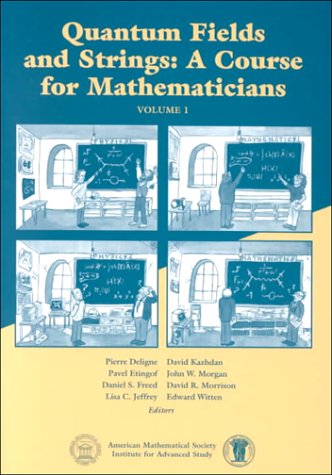 | Paperback: 723
Pages
(2000-04-27)
list price: US$32.00 -- used & new: US$31.68 (price subject to change: see help) Asin: 0821820125 Average Customer Review: 
Canada | United Kingdom | Germany | France | Japan |
|
Editorial Review Product Description In 1996-97 the Institute for Advanced Study (Princeton, NJ) organized a special year-long program designed to teach mathematicians the basic physical ideas which underlie the mathematical applications. The purpose is eloquently stated in a letter written by Robert MacPherson: "The goal is to create and convey an understanding, in terms congenial to mathematicians, of some fundamental notions of physics ... [and to] develop the sort of intuition common among physicists for those who are used to thought processes stemming from geometry and algebra." These volumes are a written record of the program. They contain notes from several long and many short courses covering various aspects of quantum field theory and perturbative string theory. The courses were given by leading physicists and the notes were written either by the speakers or by mathematicians who participated in the program. The book also includes problems and solutions worked out by the editors and other leading participants. Interspersed are mathematical texts with background material and commentary on some topics covered in the lectures.These two volumes present the first truly comprehensive introduction to this field aimed at a mathematics audience. They offer a unique opportunity for mathematicians and mathematical physicists to learn about the beautiful and difficult subjects of quantum field theory and string theory. Customer Reviews (3)
| |
| 47. Quantum Mechanics for Mathematicians (Graduate Studies in Mathematics) by Leon A. Takhtajan | |
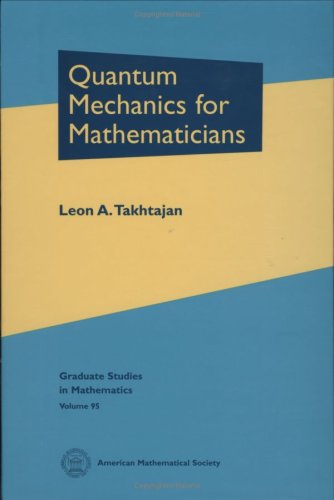 | Hardcover: 387
Pages
(2008-08-15)
list price: US$69.00 -- used & new: US$69.00 (price subject to change: see help) Asin: 0821846302 Canada | United Kingdom | Germany | France | Japan |
|
Editorial Review Product Description | |
| 48. Chaotic Elections! A Mathematician Looks at Voting by Donald G. Saari | |
 | Paperback: 159
Pages
(2001-04-03)
list price: US$25.00 -- used & new: US$14.95 (price subject to change: see help) Asin: 0821828479 Average Customer Review:
Canada | United Kingdom | Germany | France | Japan |
|
Editorial Review Product Description This expository book shows how mathematics can help to identify and characterize a disturbingly large number of paradoxical situations that result from the choice of a voting procedure. Moreover, rather than being able to dismiss them as anomalies, the likelihood of a dubious election result is surprisingly large. These consequences indicate that election outcomes--whether for president, the site of the next Olympics, the chair of a university department, or a prize winner--can differ from what the voters really wanted. They show that by using an inadequate voting procedure, we can, inadvertently, choose badly. To add to the difficulties, it turns out that the mathematical structures of voting admit several strategic opportunities, which are described. Finally, mathematics also helps identify positive results: By using mathematical symmetries, we can identify what the phrase "what the voters really want" might mean and obtain a unique voting method that satisfies these conditions. Saari's book should be required reading for anyone who wants to understand not only what happened in the presidential election of 2000, but also how we can avoid similar problems from appearing anytime any group is making a choice using a voting procedure. Reading this book requires little more than high school mathematics and an interest in how the apparently simple situation of voting can lead to surprising paradoxes. Customer Reviews (4)
The obvious solution is to choose the counting method before the election, not afterwards, but there are perils to watch out for nonetheless.Saari goes into depth about these dangers. This depth often gets very technical, something Saari is up front about.Less than half the book is really aimed for the lay reader; the remainder is aimed more towards mathematicians.Nonetheless, I recommend this book for everyone interested in the democratic process; even if you can't get into the math, there are still enough important insights to make this book more than worthwhile.
Second, Saari's insights into the role of symmetry in three-person elections are beautiful. He shows that even if none of the three (or more) candidates can beat all of the others head-to-head there is still interesting information present. When resolving cyclic ambiguities (George beats Bill, Bill beats Ross, Ross beats George) Saari's mathematical insights may be quite useful. However, I have to take Saari to task for his criticism of Approval Voting (where you simply indicate yes or no for each candidate). He points out that the Approval winner cannot be predicted based solely on people's preference orders (e.g. I might like Ross better than Bill or George, and Bill better than George). Saari sees this as a defect, because "anybody could win." Approval, however, makes use of different information. Which of those candidates pass your threshold? Vote yes for all that you find acceptable. Seen in this light, Approval is a perfectly rational policy. Also, Saari doesn't think too highly of the Condorcet criterion:If one candidate can beat all others in one-on-one contests then that candidate should win.It is true that sometimes no candidate meets that criterion, and in those cases Saari's analysis provides important insights on how to resolve the situation.However, sometimes there is in fact one person who can beat all others one-on-one.In that case, no amount of analysis can change the fact that the Condorcet candidate is preferred over all others, and should win. Finally, Saari gives short shrift to strategic considerations. If everybody is honest his analysis gives excellent advice on running elections.However, his methods have loopholes that voters and candidates can exploit, trying to get the best outcome even if it means indicating an insincere preference order. Ultimately, the study of elections has to balance two different approaches: Understanding what the people want based on the info they give, and understanding whether the system gives them incentives to give insincere info. Saari has great insight into the first part, but he doesn't seem as interested in the second part.
At this time, Saari seems to be the world's leading researcher in the mathematics of voting and group decision making. While most of the general public, in the US at least, has remained almost entirely ignorant of the paradoxes of voting, mathematicians have recognized and struggled with them for centuries, since they recognized that the widespread rule that 'a plurality shall elect' can result in the election of the voters' least preferred candidate; for example, when there are 3 candidates, the plurality winner may be a candidate who is the last choice of up to two-thirds of the voters. Saari's recently published research papers, which resolve many of these profoundly difficult mind stumpers, and the recent US Presidential election, not to mention the begging and pleading of mathematical simpletons like myself, combined to motivate Saari to write this book. If you are at all interested in having your vote properly accounted for in everything from selecting your group's next officer, to future national elections, I recommend this book to you. I guarantee that you will learn something worthwhile from it. Let me add one last personal note for Wisconsin readers. I am briefly cited in this book in regard to the use of an alternative to the plurality voting procedure, called the 'Second Choice' procedure, in state primaries of Wisconsin's 'Progressive Era.' The use of such alternatives in the history of Wisconsin, and other states, proves that such electoral reforms are actually possible, given a sufficiently educated and motivated electorate. Saari has done the analysis, and made it accessible. Now, it is up to us to educate ourselves, and other voters, and then, in the light of our newfound knowledge, to demand more democratic election procedures. Also recommended: Principles of Electoral Reform ... Read more | |
| 49. A Mathematician's Survival Guide: Graduate School and Early Career Development by Steven G. Krantz | |
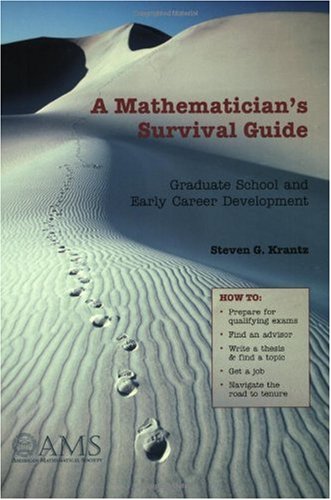 | Paperback: 240
Pages
(2003-07-29)
list price: US$29.00 -- used & new: US$26.10 (price subject to change: see help) Asin: 082183455X Average Customer Review:
Canada | United Kingdom | Germany | France | Japan |
|
Editorial Review Product Description In his inimitable and forthright style, Steven Krantz addresses the major issues of graduate school, including choosing a program, passing the qualifying exams, finding an advisor, writing a thesis, and getting that first job. As with his earlier guide, How to Teach Mathematics, he avoids generalities, giving clear advice on how to handle real situations. The book also contains a description of the basic elements of a mathematical education, as well as a glossary and appendices on the structure of a typical department and university and the standard academic ranks. Steven G. Krantz is an accomplished mathematician and an award-winning author. He has published 130 research articles and 45 books. He has worked in many different types of mathematics departments, supervised both masters and doctoral students, and is currently the Chair of the Mathematics Department at Washington University in St. Louis. Customer Reviews (9)
| |
| 50. Famous Puzzles of Great Mathematicians by Miodrag S. Petkovic | |
 | Paperback: 325
Pages
(2009-09-02)
list price: US$36.00 -- used & new: US$30.78 (price subject to change: see help) Asin: 0821848143 Canada | United Kingdom | Germany | France | Japan |
|
Editorial Review Product Description | |
| 51. Chapter 16 of Ramanujan's Second Notebook Theta Functions and Q-Series (Memoirs of the American Mathematical Society) by C. Adiga, B. Berndt, S. Bhargava, G. Watson | |
| Paperback: 85
Pages
(1985-03)
list price: US$21.00 -- used & new: US$176.98 (price subject to change: see help) Asin: 0821823167 Canada | United Kingdom | Germany | France | Japan | |
| 52. Mathematicians in Love by Rudy Rucker | |
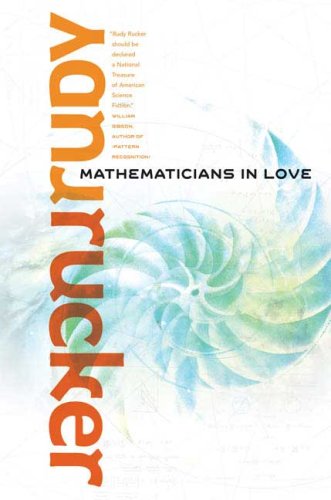 | Paperback: 368
Pages
(2008-07-08)
list price: US$15.95 -- used & new: US$5.74 (price subject to change: see help) Asin: B003156BPO Average Customer Review:
Canada | United Kingdom | Germany | France | Japan |
|
Editorial Review Product Description Reality is never more unpredictable than when two mathematicians are in love with the same girl, and can change the world to get her. Customer Reviews (5) | |
| 53. The Survival of a Mathematician by Steven G. Krantz | |
 | Paperback: 310
Pages
(2008-12-22)
list price: US$39.00 -- used & new: US$37.13 (price subject to change: see help) Asin: 0821846299 Canada | United Kingdom | Germany | France | Japan |
|
Editorial Review Product Description | |
| 54. Portraits of the Earth: A Mathematician Looks at Maps (Mathematical World) by Timothy G. Feeman | |
 | Paperback: 123
Pages
(2002-09-30)
list price: US$28.00 -- used & new: US$25.07 (price subject to change: see help) Asin: 0821832557 Canada | United Kingdom | Germany | France | Japan |
|
Editorial Review Product Description --from the Preface Portraits of the Earth exemplifies the AMS's mission to bring the power and vitality of mathematical thought to the nonexpert. It is designed to teach students to think logically and to analyze the technical information that they so readily encounter every day. Maps are exciting, visual tools that we encounter on a daily basis: from street maps to maps of the world accompanying news stories to geologic maps depicting the underground structure of the earth. This book explores the mathematical ideas involved in creating and analyzing maps, a topic that is rarely discussed in undergraduate courses. It is the first modern book to present the famous problem of mapping the earth in a style that is highly readable and mathematically accessible to most students. Feeman's writing is inviting to the novice, yet also interesting to readers with more mathematical experience. Through the visual context of maps and mapmaking, students will see how contemporary mathematics can help them to understand and explain the world. Topics explored are the shape and size of the earth, basic spherical geometry, and why one can't make a perfect flat map of the planet. The author discusses different attributes that maps can have and determines mathematically how to design maps that have the desired features. The distortions that arise in making world maps are quantitatively analyzed. There is an in-depth discussion on the design of numerous map projections--both historical and contemporary--as well as conformal and equal-area maps. Feeman looks at how basic map designs can be modified to produce maps with any center, and he indicates how to generalize methods to produce maps of arbitrary surfaces of revolution. Also included are end-of-chapter exercises and laboratory projects. Particularly interesting is a chapter that explains how to use Maple® add-on software to make maps from geographic data points. This book would make an excellent text for a basic undergraduate mathematics or geography course and would be especially appealing to the teacher who is interested in exciting visual applications in the classroom. It would also serve nicely as supplementary reading for a course in calculus, linear algebra, or differential geometry. Prerequisites include a solid grasp of trigonometry and basic calculus. | |
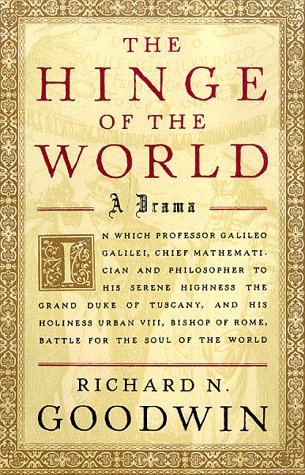
| 55. The Hinge of the World: In Which Professor Galileo Galilei, Chief Mathematician and Philosopher to His Serene Highness the Grand Duke of Tuscany, and His Holiness Urban VIII by Richard N. Goodwin | |
 | Hardcover: 209
Pages
(1998-06)
list price: US$25.00 -- used & new: US$53.99 (price subject to change: see help) Asin: 0374170029 Canada | United Kingdom | Germany | France | Japan |
|
Editorial Review Product Description | |
| 56. Persuasion for a Mathematician by Joanne Page | |
 | Paperback: 123
Pages
(2003-01)
list price: US$21.00 -- used & new: US$7.95 (price subject to change: see help) Asin: 0973214031 Canada | United Kingdom | Germany | France | Japan |
| 57. Satan is a Mathematician: Poems of the Weird, Surreal and Fantastic by Keith Allen Daniels | |
| Paperback: 168
Pages
(1998-10-01)
list price: US$12.95 Isbn: 0963120360 Average Customer Review: 
Canada | United Kingdom | Germany | France | Japan | |
|
Editorial Review Product Description Customer Reviews (1)
The book is subtitled "Poems of the Weird, Surreal, andFantastic", which is pretty much what we get.In a previous draft ofthis review I dithered about trying to define "SF poetry", or"Fantastic poetry".To some extent I was interested indisproving the existence of such a beast: after all, poetry is about soundand emotion (and ideas), and at least the first two seem not to bedefinable in genre terms.But then, some poems really are about ideas, andideas, famously, are the stuff of much science fiction.And some emotionsare perhaps best evoked by images from SF or the fantastic.A trivialconclusion, I'm afraid.I will say, though, that it seems to me that Iread poetry of all sorts for the same reasons: sound and emotion, while Iread science fiction, at times, for explicitly different (neither superioror inferior) reasons than I read mainstream fiction.Enough, though.Whatof the poems at hand? One of my favorites is "The Poetasters'Cafe", which takes a harsh look at the contemporary"coffeehouse" fashion for poetry readings and overly confessionalwriting.It's a fine poem, but it's not SF, unless the use of vocabularysuch as "coelecanth" and "phagocyte" is sufficient toso mark a poem.On the other hand, "Sciomancy Nights", anotherfine effort, uses an explicitly fantastical device, raising the spirits ofthe dead to speak to them, to consider, in a slightly humorous manner, fourhistorical figures (Bierce, Archimedes, Aldous Huxley, Lincoln).Anotherangle Daniels uses is pure science: "The Discourse of the Stones"imagines "deep time" through the history of rock.Not SF poetry,perhaps, but "geology poetry". On the whole these areinteresting poems.Occasionally Daniels seems to believe that an exoticuse of vocabulary is sufficient to make a sequence of words poetry; onother occasions, the poems seem not much but doggerel.But that is tocomplain about the lesser works of what is, after, quite a long collectionby poetry standards.The best poems here are very good.For example,"Leap to Infinity" is a lovely double haiku: "A doe's leg,fractured/ in mid-leap and torn in half/ hangs from the barbed wire.Onthe ground beneath/ her body has fallen far/ behind her spirit."Orthe fine extended metaphor in "Lithic": "in caverns of theforebrain/ suffering forms grottos/ of fanciful dripstone ...".Or from"The Poetasters' Café": "There the poets are mired in self/like insects in pitcher plants/ of their own device." Anyoneinterested in contemporary poetry would do well to check out this book. And if you are also interested in SF and fantasy, attuned to the vocabularyand images of science and "the weird, surreal, and fantastic",you'll be even more likely to be attracted by Keith Allen Daniels' favoredimage sets. ... Read more | |
| 58. A3 & His Algebra: How a Boy from Chicago's West Side Became a Force in American Mathematics by Nancy E. Albert | |
 | Paperback: 366
Pages
(2005-01-18)
list price: US$23.95 -- used & new: US$16.16 (price subject to change: see help) Asin: 0595328172 Average Customer Review:
Canada | United Kingdom | Germany | France | Japan |
|
Editorial Review Product Description This first-hand account of the life of a world-renowned American mathematician is written by Albert’s daughter. Her memoir, which favors a general audience, offers a personal and revealing look at the multidimensional life of an academic who had a lasting impact on his profession. SOME QUOTATIONS FROM PROFESSOR ALBERT:“There are really few bad students of mathematics. There are, instead, many bad teachers and bad curricula…”“The difficulty of learning mathematics is increased by the fact that in so many high schools this very difficult subject is considered to be teachable by those whose major subject is language, botany, or even physical education.”“It is still true that in a majority of American universities the way to find the Department of Mathematics is to ask for the location of the oldest and most decrepit building on campus.”“The production of a single scientist of first magnitude will have a greater impact on our civilization than the production of fifty mediocre Ph.D.’s.”“Freedom is having the time to do research…Even in mathematics there are ‘fashions’. This doesn’t mean that the researcher is controlled by them. Many go their own way, ignoring the fashionable. That’s part of the strength of a great university.”Customer Reviews (2)
| |
| 59. A Mathematician Reads The Newspaper by John Allen Paulos | |
| Hardcover: 224
Pages
(1995-04-06)
list price: US$18.00 -- used & new: US$4.44 (price subject to change: see help) Asin: 0465043623 Average Customer Review:
Canada | United Kingdom | Germany | France | Japan | |
|
Editorial Review Product Description Customer Reviews (34)
| |
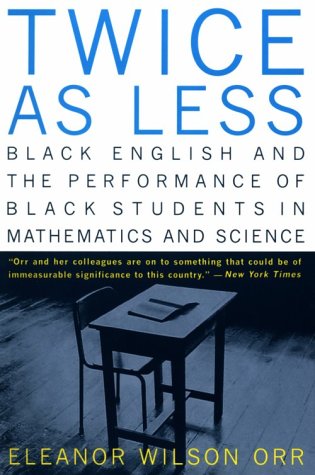
| 60. Twice as Less by Eleanor W Orr | |
 | Paperback: 252
Pages
(1997-10-17)
list price: US$19.95 -- used & new: US$2.75 (price subject to change: see help) Asin: 0393317412 Average Customer Review:
Canada | United Kingdom | Germany | France | Japan |
|
Editorial Review Product Description Customer Reviews (1)
| |
| Back | 41-60 of 100 | Next 20 |
 Wackyland
 Underwhelming