
|
Help |
| Home - Mathematicians - European Mathematicians (Books) | |
e99 Online Shopping Mall
|
|
Help |
| Home - Mathematicians - European Mathematicians (Books) | |
| 1-19 of 19 |
click price to see details click image to enlarge click link to go to the store
| 1. European Mathematician Introduction: Kazimierz Kuratowski, Lodovico Ferrari, Rolf Nevanlinna, Viggo Brun, Thomas Fincke, François D'aguilon | |
 | Paperback: 666
Pages
(2010-09-15)
list price: US$71.75 -- used & new: US$71.75 (price subject to change: see help) Asin: 1157552366 Canada | United Kingdom | Germany | France | Japan |
|
Editorial Review Product Description | |
| 2. The Mind of the Mathematician by Michael Fitzgerald, Ioan James | |
 | Hardcover: 196
Pages
(2007-05-18)
list price: US$32.00 -- used & new: US$17.73 (price subject to change: see help) Asin: 0801885876 Canada | United Kingdom | Germany | France | Japan |
|
Editorial Review Product Description What makes mathematicians tick? How do their minds process formulas and concepts that, for most of the rest of the world's population, remain mysterious and beyond comprehension? Is there a connection between mathematical creativity and mental illness? In The Mind of the Mathematician, internationally famous mathematician Ioan James and accomplished psychiatrist Michael Fitzgerald look at the complex world of mathematics and the mind. Together they explore the behavior and personality traits that tend to fit the profile of a mathematician. They discuss mathematics and the arts, savants, gender and mathematical ability, and the impact of autism, personality disorders, and mood disorders. These topics, together with a succinct analysis of some of the great mathematical personalities of the past three centuries, combine to form an eclectic and fascinating blend of story and scientific inquiry. | |
| 3. Mathematicians under the Nazis by Sanford L. Segal | |
 | Hardcover: 536
Pages
(2003-06-09)
list price: US$90.00 -- used & new: US$66.62 (price subject to change: see help) Asin: 069100451X Average Customer Review: 
Canada | United Kingdom | Germany | France | Japan |
|
Editorial Review Product Description The effects of the Nazi regime on the lives of mathematicians ranged from limitations on foreign contact to power struggles that rattled entire institutions, from changed work patterns to military draft, deportation, and death. Based on extensive archival research, Mathematicians under the Nazis shows how these mathematicians, variously motivated, reacted to the period's intense political pressures. It details the consequences of their actions on their colleagues and on the practice and organs of German mathematics, including its curricula, institutions, and journals. Throughout, Segal's focus is on the biographies of individuals, including mathematicians who resisted the injection of ideology into their profession, some who worked in concentration camps, and others (such as Ludwig Bieberbach) who used the "Aryanization" of their profession to further their own agendas. Some of the figures are no longer well known; others still tower over the field. All lived lives complicated by Nazi power. Presenting a wealth of previously unavailable information, this book is a large contribution to the history of mathematics--as well as a unique view of what it was like to live and work in Nazi Germany. Customer Reviews (1)
| |
| 4. Frauenuntypische Bildungsbiographien: Diplom-Mathematikerinnen (European university studies. Series VI, Psychology) (German Edition) by Kristin Gisbert | |
| Perfect Paperback: 237
Pages
(1995)
Isbn: 3631482809 Canada | United Kingdom | Germany | France | Japan | |
| 5. European Women in Mathematics: Proceedings of the 13th General Meeting University of Cambridge, UK 3-6 September 2007 | |
 | Hardcover: 199
Pages
(2010-03-31)
list price: US$88.00 -- used & new: US$66.34 (price subject to change: see help) Asin: 9814277673 Canada | United Kingdom | Germany | France | Japan |
|
Editorial Review Product Description | |
| 6. European Women in Mathematics: Proceedings of the Tenth General Meeting | |
 | Hardcover: 420
Pages
(2003-03)
list price: US$196.00 -- used & new: US$179.46 (price subject to change: see help) Asin: 9812381902 Canada | United Kingdom | Germany | France | Japan |
|
Editorial Review Product Description | |
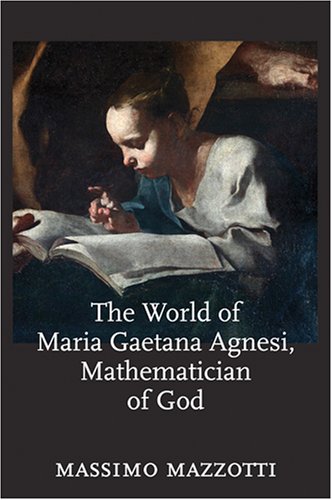
| 7. The World of Maria Gaetana Agnesi, Mathematician of God by Massimo Mazzotti | |
 | Hardcover: 240
Pages
(2007-10-24)
list price: US$51.95 -- used & new: US$27.53 (price subject to change: see help) Asin: 0801887097 Canada | United Kingdom | Germany | France | Japan |
|
Editorial Review Product Description She is best known for her curve, the witch of Agnesi, which appears in almost all high school and undergraduate math books. She was a child prodigy who frequented the salon circuit, discussing mathematics, philosophy, history, and music in multiple languages. She wrote one of the first vernacular textbooks on calculus and was appointed chair of mathematics at the university in Bologna. In later years, however, she became a prominent figure within the Catholic Enlightenment, gave up the academic world, and devoted herself to the poor, the sick, the hungry, and the homeless. Indeed, the life of Maria Agnesi reveals a complex and enigmatic figure -- one of the most fascinating characters in the history of mathematics. Using newly discovered archival documents, Massimo Mazzotti reconstructs the wide spectrum of Agnesi's social experience and examines her relationships to various traditions -- religious, political, social, and mathematical. This meticulous study shows how she and her fellow Enlightenment Catholics modified tradition in an effort to reconcile aspects of modern philosophy and science with traditional morality and theology. Mazzotti's original and provocative investigation is also the first targeted study of the Catholic Enlightenment and its influence on modern science. He argues that Agnesi's life is the perfect lens through which we can gain a greater understanding of mid-eighteenth-century cultural trends in continental Europe. | |
| 8. Emil J. Gumbel: Weimar German Pacifist and Professor (Studies in Central European Histories) by Arthur D. Brenner | |
 | Hardcover: 227
Pages
(2002-02-01)
list price: US$147.00 -- used & new: US$130.47 (price subject to change: see help) Asin: 0391041010 Canada | United Kingdom | Germany | France | Japan |
|
Editorial Review Product Description | |
| 9. Proceedings of the International Congress of Mathematicians, Madrid 2006 (International Congress of Mathematicians//Proceedings) by Marta Sanz-Sole | |
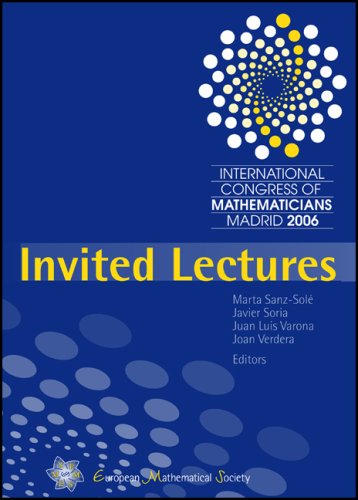 | Hardcover: 4500
Pages
(2007-02-15)
list price: US$428.00 -- used & new: US$400.00 (price subject to change: see help) Asin: 3037190221 Canada | United Kingdom | Germany | France | Japan |
|
Editorial Review Product Description | |
| 10. Trends in Physics 1984: Proceedings of the 6th General Conference of the European Physical Society Vol 1 by J & Pantoflicek, J Janta | |
| Paperback:
Pages
(1984)
Asin: B000K3E5N0 Canada | United Kingdom | Germany | France | Japan | |
| 11. Mathematicians Fleeing from Nazi Germany: Individual Fates and Global Impact by Reinhard Siegmund-Schultze | |
 | Paperback: 504
Pages
(2009-07-06)
list price: US$49.50 -- used & new: US$37.79 (price subject to change: see help) Asin: 0691140413 Average Customer Review: 
Canada | United Kingdom | Germany | France | Japan |
|
Editorial Review Product Description Customer Reviews (2)
| |
| 12. Skating on Thin Ice by Anatol Rapoport | |
 | Paperback: 200
Pages
(2002-04)
list price: US$16.95 -- used & new: US$3.60 (price subject to change: see help) Asin: 1571430849 Average Customer Review: 
Canada | United Kingdom | Germany | France | Japan |
Customer Reviews (1)
| |
| 13. Discoveries: Lewis Carroll in Wonderland (Discoveries (Abrams)) by Stephanie Lovett Stoffel | |
 | Paperback: 175
Pages
(1997-02-01)
list price: US$12.95 -- used & new: US$49.95 (price subject to change: see help) Asin: 0810928388 Average Customer Review: 
Canada | United Kingdom | Germany | France | Japan |
|
Editorial Review Product Description Customer Reviews (8)
Is there anyone out there that knows what the name of thewriting style used by Mr. Carroll.For instance his characters are tellinga story to someonesmallMr. Carroll aims his text at a small animal. The small animal answers back in small type.When someone is running andtalking, there are long drawn out sentences.
Joel Birenbaum, presidentof the Lewis Carroll Society of North America
| |
| 14. DESCARTES, REN (15961650): An entry from Charles Scribner's Sons' <i>Europe, 1450 to 1789: An Encyclopedia of the Early Modern World</i> by STEVEN NADLER | |
| Digital: 3
Pages
(2004)
list price: US$3.90 -- used & new: US$3.90 (price subject to change: see help) Asin: B001UICQIU Canada | United Kingdom | Germany | France | Japan | |
|
Editorial Review Product Description | |
| 15. Maths and the Greeks (Maths & History) by John Davies | |
 | Spiral-bound: 114
Pages
(2002-06-28)
-- used & new: US$61.46 (price subject to change: see help) Asin: 1902239946 Canada | United Kingdom | Germany | France | Japan |
| 16. Lewis Carroll and Alice (New Horizons) by Stephanie Lovett Stoffel | |
| Paperback: 176
Pages
(1997-06-02)
list price: US$10.98 -- used & new: US$75.95 (price subject to change: see help) Asin: 0500300755 Canada | United Kingdom | Germany | France | Japan | |
|
Editorial Review Product Description | |
| 17. The Wonderful World of Simon Stevin: Magic is No Magic by J. T. Devreese, G. Vanden Berghe | |
 | Hardcover: 352
Pages
(2007-11-09)
list price: US$190.00 -- used & new: US$132.81 (price subject to change: see help) Asin: 1845640926 Canada | United Kingdom | Germany | France | Japan |
|
Editorial Review Product Description | |
| 18. Codebreakers: Arne Beurling and the Swedish Crypto Program During World War II by Bengt Beckman | |
 | Hardcover: 259
Pages
(2002-11-26)
list price: US$43.00 -- used & new: US$42.99 (price subject to change: see help) Asin: 0821828894 Canada | United Kingdom | Germany | France | Japan |
|
Editorial Review Product Description The author, Bengt Beckman, for many years was the head of the cryptanalysis department of the Swedish signal intelligence agency. In writing this book, he made extensive use of its archives. He also interviewed many people who participated in the Swedish wartime intelligence effort. He describes in detail Beurling's attack on the G-Schreiber system as well as attacks on several other wartime crypto systems, noting high points from the history of Swedish cryptology. The book will appeal to a broad audience of readers, from historians and biography buffs to mathematicians to anyone with a passing interest in cryptology and cryptanalysis. This English edition has been translated by Kjell-Ove Widman, Director of Sweden's Mittag-Leffler Insitute. Also on cryptography and available from the AMS is "Cryptography: An Introduction." | |
| 19. Archimedes and the Roman Imagination by Mary Jaeger | |
 | Hardcover: 248
Pages
(2008-04-02)
list price: US$75.00 -- used & new: US$66.00 (price subject to change: see help) Asin: 0472116304 Canada | United Kingdom | Germany | France | Japan |
|
Editorial Review Product Description The great mathematician Archimedes, a Sicilian Greek whose machines defended Syracuse against the Romans during the Second Punic War, was killed by a Roman after the city fell, yet it is largely Roman sources, and Greek texts aimed at Roman audiences, that preserve the stories about him. Archimedes' story, Mary Jaeger argues, thus becomes a locus where writers explore the intersection of Greek and Roman culture, and as such it plays an important role in Roman self-definition. Jaeger uses the biography of Archimedes as a hermeneutic tool, providing insight into the construction of the traditional historical narrative about the Roman conquest of the Greek world and the Greek cultural invasion of Rome. By breaking down the narrative of Archimedes' life and examining how the various anecdotes that comprise it are embedded in their contexts, the book offers fresh readings of passages from both well-known and less-studied authors, including Polybius, Cicero, Livy, Vitruvius, Plutarch, Silius Italicus, Valerius Maximus, Johannes Tzetzes, and Petrarch. "An absolutely wonderful book on a truly original and important topic. As Jaeger explores neglected texts that together tell an important story about the Romans' views of empire and their relationship to Greek cultural accomplishments, so she has written an important new chapter in the history of science. A genuine pleasure to read, from first page to last." "This elegantly written and convincingly argued project analyzes Archimedes as a vehicle for reception of the Classics, as a figure for loss and recovery of cultural memory, and as a metaphorical representation of the development of Roman identity. Jaeger's fastening on the still relatively obscure figure of the greatest ancient mathematician as a way of understanding cultural liminality in the ancient world is nothing short of a stroke of genius." "Archimedes and the Roman Imagination forms a useful addition to our understanding of Roman culture as well as of the reception of science in antiquity. It will make a genuine contribution to the discipline, not only in terms of its original interpretative claims but also as a fascinating example of how we may follow the cultural reception of historical figures." Cover art: Benjamin West. Cicero Discovering the Tomb of Archimedes. Yale University Art Gallery. John Hill Morgan, B.A. 1893, LL.B. 1898, M.A. (Hon.) 1929, Fund. | |
| 1-19 of 19 |