e99 Online Shopping Mall

Geometry.Net - the online learning center Help  
Home  - Nobel - Bellow Saul (Books)

  1-20 of 100 | Next 20
A  B  C  D  E  F  G  H  I  J  K  L  M  N  O  P  Q  R  S  T  U  V  W  X  Y  Z  

click price to see details     click image to enlarge     click link to go to the store

$20.80
1. Saul Bellow: Novels 1956-1964:
$24.94
2. Collected Stories
$28.26
3. Adventures of Augie March, The
$4.99
4. Herzog (Penguin Classics)
$7.41
5. Dangling Man (Penguin Classics)
$42.70
6. Ravelstein
$25.00
7. Saul Bellow (Bloom's Modern Critical
$7.35
8. Seize the Day (Penguin Classics)
$9.95
9. Herzog
$18.99
10. Conversations With Saul Bellow
$20.45
11. Saul Bellow: Novels 1944-1953:
$3.61
12. Humboldt's Gift (Penguin Classics)
$5.98
13. To Jerusalem and Back (Penguin
$89.95
14. The Critical Response to Saul
$8.46
15. Mr. Sammler's Planet (Penguin
$4.75
16. Saul Bellow: A Biography of the
 
$0.99
17. Him With His Foot in His Mouth
 
18. Herzog
$7.90
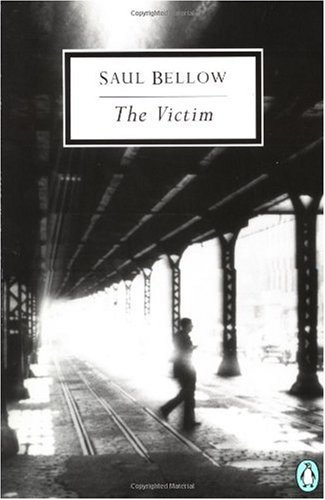
19. The Victim (Penguin Classics)
$0.06
20. The Actual : A Novella

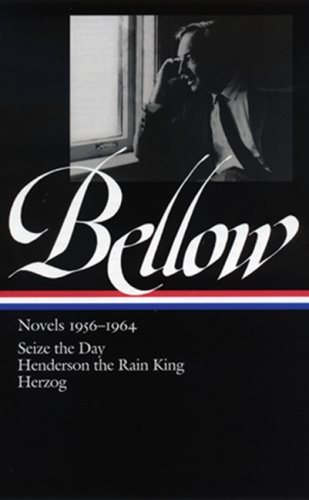
1. Saul Bellow: Novels 1956-1964: Seize the Day, Henderson the Rain King, Herzog (Library of America)
by Saul Bellow
Hardcover: 800 Pages (2007-01-11)
list price: US$35.00 -- used & new: US$20.80
(price subject to change: see help)
Asin: 159853002X
Average Customer Review: 5.0 out of 5 stars
Canada | United Kingdom | Germany | France | Japan

Customer Reviews (3)

5-0 out of 5 stars Bellow Vol.2
Another great collection of Bellow's works. Hope the Library of America comes out with the next volume sooner than a year.

5-0 out of 5 stars A beautiful edition of three powerful works by an American master
These are three very fine, even great, novels.Of course, one doesn't simply dash through Bellow.Each page requires and rewards close reading.While Bellow has been criticized for putting some things in his novels to show off his vast erudition, I found those details interesting and that they contributed to an understanding of the characters in each story.

The first novel is also the shortest."Seize the Day" is about a middle-aged man who has lost his way in life.Tommy Wilhem can't escape his father or his wife.He hasn't ever found a way to get a footing in life or to carve out a place of success for himself.Tommy's mother died too soon, and it seems his father is living too long.Not that we wish the old guy would die, but because he is so focused on himself that he has become a competitor to his son and does not respond as much of a father, let alone an indulgent one.The wife Wilhelm has left won't give him a divorce (this is before no-fault divorces) and is using everything at her disposal to punish Tommy.Should Tommy surrender and come home emasculated?Yes, Wilhelm has or had a girlfriend, but he doesn't even pull that off well.

Tommy is so desperate for approval that he first went to Hollywood to become the movie star a crooked agent said he could be.The central part of the story involves the investment strategies of Dr. Tamkin.Tommy hopes against reason that Tamkin can succeed and get him not only out of the financial pit he is in, but make him a success so he can finally be his own man.Well, a man of any kind.Some read the end of the story as Tommy finding a place for himself at last and that he will turn things around.I think this is a quite optimistic gloss on what the text actually says.

"Henderson the Rain King" is actually a lot of fun.While many have made the observation that Eugene Henderson's initials, the big gun, Africa, and hunting all betoken a satire of Hemingway, the writing is nothing like his.There is no doubt that Bellow is poking fun at a great many schools of then modern writing, but he is also dealing with the same kinds of themes teased out in "Seize the Day", but in comic form and drawn on a much larger canvas.

Henderson is a huge and physically imposing middle-aged man who is quite wealthy.However, he didn't earn the money, nor was he supposed to get it by inheritance.His father didn't have much use for him, but the favored son died and so the $3 million went to Eugene when dear old Dad died.Henderson was also quite unsuccessful in love, though he did have some adventures along those lines.He can never settle on anything because of the inner voice that cries out "I want, I want, I want".He is able to still the voice for a time with each new thing he tries, whether it is pig farming, playing the violin, painting, taking on a new lover, or adventuring in Africa.

It is this adventuring in Africa that provides the central adventures of the story and the title of the book.It is so much fun that I have to leave it for you to read and enjoy.It isn't all comic, though there are some serious, and some tender moments.The ending does leave the door open for hope that Henderson has found a way to quiet that voice at last.However, it is also possible to read it as another temporary respite and that Eugene will need to find another distraction to throw himself into in order to find another spot of peace.

"Herzog" is unquestionably a masterpiece.This book seems to be the fulfillment of Bellow's desire for "an American novel that might more optimistically search for the `sealed treasure' of ordinary life" [from the entry for 1960 of the chronology provided in this edition].The actual story of the book occupies only a few days in the life of Moses Elkanah Herzog.Don't you think that name is significant?Is he Moses the lawgiver?Hardly.What about the liberator - the one drawn forth in the reed basket or the one who draws his people out of slavery from Egypt to the Promised Land?Or is Bellow using ironically?What about the contrast between the English - American Moses verses the Yiddish - Hebrew Moshe that we hear him called by his stepmother?Which is he, really?Is he both the assimilated American still rooted in his childhood Yiddish?The middle name, Elkanah, means "God created" and refers to several different Levites (priestly class) in the Bible.Might this be a reference to his being a professor?A Ph.D.?The idea that the modern priests are the professors and educated elite?Again, there would be a certain sense of irony here, because Moses has quit his job, and a great deal of the book is him rejecting and commenting on the whole range of modern thought (as it was in the early 1960s).

Herzog is worn out.And very much like Tommy Wilhelm and Eugene Henderson, he suffers from a kind of impotence of the soul.His promiscuity is actually evidence of the sickness in his soul rather than a sign of robustness.He has former wife and son he threw over for a beautiful younger model, but she threw him over and cuckolded him with his "best friend" and took the daughter they had away to Chicago.It is obvious that Herzog wants her as a kind of possession and how that beauty makes him feel about himself.But it is a story that is richly played out in this large novel.Along the way, Herzog also had a longish relationship with a Japanese woman who was devoted to him, but he threw her away, too.At the time of the novel, he is involved with a strong woman named Ramona, and one of the results of her strength, which he needs and loves, is to run away from her to visit some friends.Immediately after arriving at his friends' home, he flees them, as well.

The story is famous for his impotent letter writing to historical figures, world authorities, friends, enemies, doctors, shrinks, and many other folks.But he rarely sends any of them.He does send a telegram to Ramona towards the end of the novel.

This is an amazingly detailed work that achieves a great deal in revealing the inner life of its protagonist.It was a best seller in its day and won the national book award.It is hard for me to believe that a great many of those who bought it read it from cover to cover.Maybe I am wrong.The topics of divorce, sexual affairs, cuckoldry, and madness were much more taboo than it would soon become.Maybe it was those subjects that caught the imagination of the public.However, there is nothing sensational or erotic in this work of art.That would be left to the pulp novelists such as Jacqueline Susann and an army of others beginning a few years later.

I do want to share one contrary thought that kept coming back to me as I read these novels.To these post-this and post-post-that sophisticates for whom all belief is provincial and even childish and for whom their sexual desires and phantasies become their gods and all important self-definition.Look at the wreckage of your lives, the lost wives, husbands, and children.Look at the lack of lasting happiness.Notice the need for pharmacological assistance to fight depression.Might I suggest something?Make your family the center of your life and give up the sexual fantasies and dalliances.Keep your children close and set aside the things that detract from these foundational values.Oh, I know this sounds so hick and, worst of all, center-of-the-country values.But it really isn't that.It is a form of happiness that actually works.Maybe it doesn't make for interesting novels, plays, movies, or TV shows, but those matter nothing at all.Keep your first wife or your first husband, (after you chose each other carefully - not for narcissistic reasons) and both focus on each other and your kids.Life will actually be better, and you will need a lot less legal and chemical help.Really.

All three of these novels are quite memorable.Bellow's importance has been recognized as has the quality of his work.He was awarded the Nobel Prize for literature and was also given many other awards throughout his life."Seize the Day" was made into a movie starring Robin Williams in 1986, but I can't find it in print anywhere.One of the things I do wonder about is having twenty-year-old college students read these works.It isn't that they can't read them, of course they can.However, it is hard for me to see how they can relate to these middle aged folks without having lived more and experienced more of the vagaries of real life.

This is a fine edition from the Library of America with a great chronology of Bellow's life and some notes on the text.

5-0 out of 5 stars The best of Bellow in one great volume
This remarkable volume contains what are in my opinion the three best novels of Bellow. One is the remarkable short novel, 'Seize the Day' the second is his African adventure the wildly comic 'Henderson' the third , his arguably best book, 'Herzog'. Herzog is his great meditation on history and civlization as he traces five - days in the life of Moses Herzog, a former university teacher, a historian, who is struggling to survive in the wake of his divorce from his second wife. In the course of this work Herzog writes letters to the living and the dead, including the famous dead a feature which gives special life to the book. In 'Seize the Day' the upper West Side of New York is the scene of the hero, Tommy Wilhelm's loss of a hold on his own life. As he pleads for money with his successful patronizing father Dr. Adler he falls into the clutches of the charlatan- wiseman Temkin and blows his last seven- hundred dollars on a speculative venture Temkin has recommended. The pathos of this tale of money- machine- murder of the soul- is great. It is a masterpiece of concise comic description and deep insight into the human heart. The final funeral scene is a truly great one.
These novels are among the finest twentieth- century American Literature has given us.
'Library of America' has done a service by putting them together in one most attractive volume. ... Read more


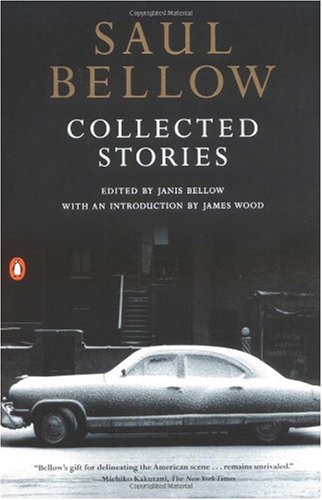
2. Collected Stories
by Saul Bellow
Paperback: 464 Pages (2002-11-28)
list price: US$18.60 -- used & new: US$24.94
(price subject to change: see help)
Asin: 0140292896
Average Customer Review: 4.5 out of 5 stars
Canada | United Kingdom | Germany | France | Japan
Editorial Review

Amazon.com
Saul Bellow's Collected Stories, handpicked by the author, display the depth of character and acumen of the Nobel laureate's narrative powers. While he has garnered acclaim as a novelist, Bellow's shorter works prove equally strong. Primarily set in a sepia-toned Chicago, characters (mostly men) deal with family issues, desires, memories, and failings--often arriving at humorous if not comic situations. In the process, these quirky and wholly real characters examine human nature.

The narrative is straightforward, with deftly handled shifts in time, and the prose is concise, sometimes pithy, with equal parts humor and grace. In "Looking for Mr. Green," Bellow describes a relief worker sized up by tenants: "They must have realized that he was not a college boy employed afternoons by a bill collector, trying foxily to pass for a relief clerk, recognized that he was an older man who knew himself what need was, who had more than an average seasoning in hardship. It was evident enough if you looked at the marks under his eyes and at the sides of his mouth." This collection should appeal both to those familiar with Bellow's work and to those seeking an introduction. --Michael FerchBook Description
"Simply the best writer we have." (The New York Times BookReview)

Viking's publication of Saul Bellow's most recent novel, Ravelstein, wasan event that garnered unanimous critical acclaim and placed its author back inthe spotlight as one of America's literary treasures. Now, for the first timeever, here is a collection of shorter works chosen by Bellow himself: favoritestories that follow the arc of his distinguished career. CollectedFiction gathers together stories from Mosby's Memoirs, Him withHis Foot in His Mouth, and Something to Remember Me By, as well as anearly story that to date has appeared only in Esquire magazine. Thisvolume contains a preface by Bellow's wife, Janis, and an introduction by JamesWood and includes celebrated stories such as "Leaving the Yellow House" and"What Kind of Day Did You Have?" and the novella The BellarosaConnection. Throughout, Bellow's trademark theme of self-awakening, hisstunning ability to re-create a bygone Chicago, and his unique comic wisdom aremagnificently illustrated. This collection is both a handsome anthology Bellow'savid readers will treasure and a superb introduction to those unacquainted withhis genius. ... Read more

Customer Reviews (8)

5-0 out of 5 stars Cultural Americana: Stories with Depth and Texture
Saul Bellow selected the stories in this anthology which span the era of the late 1940s to mid-1950s. It includes a broad range of people, places, and topics. Each story is a richly textured, deep memory file of detail, depth, and description making every sentence and paragraph a work of artistic merit. Saul Bellow shares his Chicago roots and delving further, his ancestral Russian Jewish heritage. Other settings for his stories are New York, New Jersey, and New England. He uses densely packed carefully chosen, correct words to paint a colorful reality with many shades and hues ... He can pinpoint the important life issues of his characters describing their personality and behavior to maximum effect. His use of time is highly effective, the main character could be an adult, whose memories of specific events and people which had an impact on his life are woven throughout a story. The memory could be an everyday occurence but it takes on meaning and value because as life unfolds and one ages ... the mind naturally connectsemotions with one's personal history.

This Nobel Prize for Literature winning author provides winding caverns of reality which the reader enters ... to explore the unforgettable life experiences of characters whose philosophical, ethical, and moral outlooks are described.

Here is a small sample of the above,
from "Cousins": "Disorder if it does not murder you brings certain opportunities. You wouldn't guess that when I sit in my Holy Sepulchre apartment at night (the surroundings that puzzled Eunice's mind when she came to visit: 'All these Oriental rugs and lamps, and so many books,' she said), wouldn't guess that I am concentrating on strategies for pouncing passionately on the freedom made possible by dissolution. Hundreds of books, but only half a shelf of those that matter. You don't get more goodness from more knowledge ..." [p. 234] In this story, Bellow discusses the relationship between love and hate with some startling but very accurate conclusions.

There is a kind of nostalgia and sentiment for the past in his stories where memories, places, and people are thoroughly examined and explored, few authors can match this writing style and achieve the same results. These memories about the past take on a kind of sacredness. Saul Bellow examines sentiments and feelings to create a dynamic story by unraveling the complex emotions associated with past relationships. Each thread in every story is woven neatly, tightly, and with consideration for all the senses, sight, sound, touch and taste. Indeed, all the stories are so enormously rich and dense, each is a book unto itself.
Erika Borsos (erikab93)

5-0 out of 5 stars 'The Old System'
There is one story in this collection 'The Old System' which is one of the best stories I have ever read. I love it in part because it captures the spirit and feeling of two worlds I know well, one is the upstate New York Troy- Albany area world, the other is the world of Jewish religious Yiddish speaking immigrants to America. But I think even more than this what I find in this story is a story of family love and hate, of passion and intensity in human relationships. The story is fundamentally of the relationship between a brother and sister who ostensibly become estranged over a family inheritance,a ring. The brother a master maneuver and real estate mogul has risen from poor origins to wealth, and a world and a level beyond that of his resentful sister. She cuts him off. But in a dramatic reconciliation scene at the close of the story there is an incredible depth of tenderness and resignation and wisdom.
My abstract words are a poor summary of this remarkable story. It carries such a weight of meaning in it, said and unsaid, that I cannot possibly describe it.
In my judgment it is a very great story, one of the greatest.

1-0 out of 5 stars Boring boredom from The Boremaster
Am I the only Earthling who hates Bellow more than life itself? Somehow I doubt it. Bellow's so profoundly shallow he makes Jacqueline Susann look like a paragon of psychological depth. Contrary to Martin Amis's claim, Saul happens to be a soulless wonder.

I discovered Bellow by way of Woody Allen (himself a master boremonger). Woody wrote a story called NO KADDISH FOR WEINSTEIN, which I later found out was a parody of Bellow. NO KADDISH was pure cartoon comedy, so I made the assumption that Bellow himself had actual depth & resonance. Boy was I wrong. Most of Bellow's stuff is as cartoonish as Woody's stuff. And it might bore you to know that both Saul & Woody are terminally addicted to the exact sort of self-congratulatory lit-chat name-dropping that infects Martin Amis's stuff.

The obvious question is why COLLECTED STORIES contains an introduction by James Wood instead of one by Amis. And I think I know the answer: pure laziness on Amis's part. Amis probably didn't have enough time to make the publishing deadline. (He was too busy coining deathless phrases like "a navel traumatized by bijouterie".)

But the bigger question is: what in the name of Crap does James Wood see in Bellow? Because I sure as heck can't see it. Wood keeps gushing about Bellow's descriptive verbiage and metaphor-coinage to the point where Wood sounds just like Amis. My guess is that Wood is intrigued by Bellow's vague Platonic religioso palavering. (This Platonism is also present in RAVELSTEIN.)

I'm not *entirely* ill-disposed toward Saul. I admire him for breaking Amis's heart by damning NIGHT TRAIN with faint praise. Plus ya gotta admire Saul for butching it out and outliving Bob Hope. I genuinely did Saul's taste in snap-brim hats. He's commendable for a multitude of reasons. Unfortunately, the manufacture of Fine Quality Entertainment isn't one of them.

5-0 out of 5 stars Mr. Bellow, One ofOur Living National Treasures
It would be superfluous to add anything to Mr. Wood's introductory essay. The story "The Bellarosa Connection", for my part, is worth the price of the book.

5-0 out of 5 stars On Bellow
Critics have often named Saul Bellow and Faulkner in the same laudatory, esteeming sentence.This juxtaposition is most correct in its comparison of the respective artistry of their short story craft.Bellow is a superior novelist and writer.

This is a superb collection of short stories.The Preface is finely and charmingly written by Janis Bellow, which allows us a brief, intimate glimpse of Bellow the writer.

This anthology includes: "The Bellarosa Connection," "Looking for Mr. Green," "Zetland," "Mosby's Memoirs," and "Something to Remember Me By," among others.

Long live the urban Jewish intelligentsia.I also highly recommend Bellow's novels, esp. Augie March, Humboldt's Gift, and Ravelstein. ... Read more


3. Adventures of Augie March, The (50th Anniv. Edition)
by Saul Bellow
Hardcover: 608 Pages (2003-09-15)
list price: US$29.95 -- used & new: US$28.26
(price subject to change: see help)
Asin: B0009GIDW2
Average Customer Review: 4.0 out of 5 stars
Canada | United Kingdom | Germany | France | Japan
Editorial Review

Book Description
Introduction by Martin Amis ... Read more

Customer Reviews (55)

4-0 out of 5 stars Inchoate Bellow tries to flex his genius (with mixed results)
Augie March is a modern Coloumbus discovering America.Bellows, master of the complicated single character narrative, paints Augie's childhood strongly illuminating his relationship to money.Augie was born poor.This is contrasted with Grandma Lauch's desire to have Augie and his brother Simon become gentlemen.She strives to teach them manners without the world to match the image materially.She eventually gets thrown away into a old age home where they rarely visit.Characters are disposed of, like Augie's mother, who goes to a home for the blind and his other brother George, a mental handicapped boy.George eventually marries rich and then disposes of Augie all together after Augie is no longer a viable product for marriage to one of his wife's daughters.Augie trades on his cowtowing and good looks to break into wealth circles, but this is far from a novel of manners.Augie's grit reflects that of all social classes, that of all of America. Simon goes as far as to boorishly tear his new mother-in-laws clothes off at the dinner table in a joke as to how poorly she dressed.Augie paints himself as a victim to everyone else's plans, they are never his own.A friend gets pregnant and comes to Augie to help with an abortion. Another suggests that he start stealing books.When he begins stealing quarters as a child from his job, it was again someone else's idea.It is only when he decides to get surgery to allow him to join the military does he start to live for himself.But ultimately he is tied up by an insane crewmate whose life he saved, again plays victim to luck and chance.It reminded me of the Stephen Crane story "The Open Boat" with all its naturalistic undertones.If this victimization and materialism has a sort of counterpoint it may be suggested that it comes in love.However, emotion falls behind the ability of a man to take care of a woman financially, or provide her with copious excitement.The "connections" that form fall away.Like many (all of the Bellows books I have read) the main character is a free wielding one man army of insatiable cravings ("I want I want," says Henderson).I found myself less interested in Augie than Henderson or Herzog.Bellows vignette style, along with providing multifarious facts about a character falls short at times for its failure to outline Augie's motives.I can follow what he does, and be interested in what he does, but without a impetus I can understand why some people mentioned they had a hard time finishing this book.I did not, however.I love Bellow's philosophical styling's and would have liked to see a stronger singular perspective been developed for Augie.This is a bildungsroman that never matures.Perhaps another viewpoint would be to read this in a post-modern light where ennui and nihilism and Marxism coalesce for the character that is going everywhere and nowhere at once.However I believe this has been said better (Gravity's Rainbow) and more simply (On the Road).And if Bellows later works are any indication he seems to be more of a modernist writer.This is a great artist who has not found a solid enough footing to produce the cohesive novels of his later years.Any part of the book, isolated, is a great read.

5-0 out of 5 stars The Great American Novel
For a while I was intrigued by the description of "The Adventures of Augie March" as a "great American novel" because all the time that Augie spends in Chicago (and a couple suburbs) could have come from Dickens, transplanting Depression-era Chicago for Victorian London and Mrs. Renling for Miss Haversham, and so forth.When I thought about it deeper and looked more closely I decided what gave this "great American novel" status is not the story itself but the underlying sense of optimism as Augie never loses hope even after the love of his life leaves him and his Merchant Marine freighter gets torpedoed.It's that same spirit that sent explorers to these shores and propelled pioneers ever westward in search of Manifest Destiny.

For the obligatory plot summary, this is the story of Augie March.He grows up with his feeble-spirited mother and focused brother Simon under the control of "Grandma" Lauch, who is not their real grandma but an imperial Russian immigrant.As he gets out into the workforce (this being the Roaring Twenties he does so at a very young age) Augie works a variety of legal and illegal jobs for people like the paraplegic real estate guru Einhorn, the fussy Mrs. Renling, and his brother among others.He joins an attempt to smuggle in Canadian immigrants, steals and resells books to fund his education, and makes some shady dealings for a shady New York lawyer in post-WWII Europe.Along the way, Augie is always in search of the meaning of life.He thinks he finds it after following the beautiful Thea to Mexico to train an eagle to hunt lizards, then again after she breaks his heart and he marries the aspiring actress Stella.But in the end it's the journey that's more important than finding any concrete answer.

As far as criticisms go the sentences are often long and wordy and overloaded with obscure references to ancient history and religion and literature.Some of the characters like the Einhorns and Renlings and his in-laws the Magnuses seem largely repetitious.It's also a little too convenient that whenever Augie seems to be in a jam some old acquaintance pops up to give him a job or some advice.

But I'm willing to look past that and embrace the spirit of the story, the optimism of a man searching for meaning among meaninglessness.Compared to that, other concerns are really just a trifle.

BTW, if you're a fan of Dickens or contemporaries like John Irving then this is right up your alley.It is truly a classic.

1-0 out of 5 stars Dislikable Narrator
Augie is born in the early nineteen-hundreds in Chicago.He doesn't have a father.Nobody seems to know who, exactly, left his simple-minded mother alone with Augie, his ambitious older brother Simon, and their mentally retarded younger brother George.Right from childhood, Augie floats from one thing to the next, influenced by whomever he is with.An old woman who appoints herself the boys' surrogate grandmother moves in and tries to shape their lives, and Augie works the jobs she sets up, tells the lies she instructs him to tell, and hands over his money to her.

During his teen years, Augie continues to drift from one situation to the next, letting himself fall in with thieves and becoming one of them, or letting himself fall in with rich folks and feeling at home with them.

Girls flatter him and get him to do things for them--travel long distances, lend them money, help them escape from unpleasant husbands.Augie seems to always feel like he is meant for better things than the rest of those around him.He talks about taking the high road, not allowing the rich couple for whom he works adopt him and make him their heir or not consenting to marry his brother Simon's rich cousin-in-law.But then Augie never finds his own path to greatness, or, indeed, does anything notable in his life.It seems that all of his self-important ideals simply allow him to live as a bum without having to feel guilty about it.

I found the story very draggy, and I really disliked the character of Augie.He had no motivation to do anything and his so-called "adventures" consisted of him following whomever had recently caught his attention into whatever scheme he or she proposed, regardless of the consequences or the hardship his actions caused those surrounding him.This was a tough book to finish.

4-0 out of 5 stars Simply Epic
I completely understand why many people commented that they could not get into the book. It took me four go's before I got into it enough to finish it, but once I pushed past the first 30 pages or so, you start to see the brilliance of the novel and the brilliance of Saul Bellow. This novel may very well be the last "epic" and truly expansive novel to have been written, quite frankly, because it's so difficult to juggle social commentary and heady ideas in an interesting package. I'm certain any review of mine would fail to do the book justice, but one way to look at it is an "On the Road" with textual meat to it, in that Bellow heaps on the observation and the commentary where Kerouac leaves it alone. Augie is a traveller who tries to find his own way in the world, only to ultimately reach a somewhat stagnant, but fulfilling place in the world. The novel has everything you would need for pleasure in that enough action takes place to satiate you, but it also speaks to you on a deeper, almost spiritual level as it asks you to look at the world and your place and question whether your actions and their results were ever really in your control. Kudos to Bellow for a solid and memorable work, one that belongs in the American canon.

5-0 out of 5 stars The Best Novel EVER to come out of 20th Cent. America
Forgive me for gushing, but this is a work unequaled among modern American novels. Bellow's novels are invariably thoughtful, playful, funny and profound, and this is his greatest.

No, (as the reviews below attest) its not a novel to dip into between servings of the latest pablum masking as literature. It takes a little work on the reader's part, as do all of Bellow's works, but the pay-off is enormous.

It's instructive that reviewers below who've panned the book haven't read other Bellow before coming to Augie March. Bellow's writing style - long, elegant sentences full of digressions and asides - can be difficult until you find their rythmn, which typically takes 50-100 pages, but once you do the poetry of the book carries you along with little effort. And Augie March is the densest of Bellow's books, so the learning curve can be longer than usual, certainly when you havent read other Bellow.

Stick with the book. like all great literature, it rewards concentrated reading. ... Read more


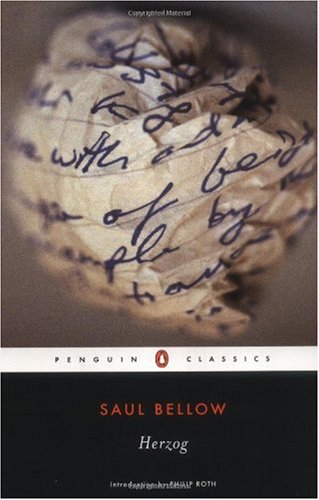
4. Herzog (Penguin Classics)
by Saul Bellow
Paperback: 400 Pages (2003-02-25)
list price: US$15.00 -- used & new: US$4.99
(price subject to change: see help)
Asin: 0142437298
Average Customer Review: 3.5 out of 5 stars
Canada | United Kingdom | Germany | France | Japan
Editorial Review

Amazon.com
A novel complex, compelling, absurd and realistic, Herzog became a classic almost as soon as it was published in 1964. In it Saul Bellow tells the tale of Moses E. Herzog, a tragically confused intellectual who suffers from the breakup of his second marriage, the general failure of his life and the specter of growing up Jewish in the middle part of the 20th century. He responds to his personal crisis by sending out a series of letters to all kinds of people. The letters in total constitute a thoughtful examination of his own life and that which has occurred around him. What emerges is not always pretty, but serves as gritty foundation for this absorbing novel.Book Description
In one of his finest achievements, Nobel Prize winner Saul Bellow presents a multifaceted portrait of a modern-day hero, a man struggling with the complexity of existence and longing for redemption.

Introduction by Philip RothDownload Description
This concise supplement to Saul Bellow's Herzog helps students understand the overall structure of the work, actions and motivations of the characters, and the social and cultural perspectives of the author. ... Read more

Customer Reviews (62)

5-0 out of 5 stars Herzog The Pain King.
"If I am out of my mind, it's all right with me, thought Moses Herzog" (p. 3).

In his adulterous drama, Herzog (1964), Saul Bellow's (1915-2005) title character suffers an intellectual and spiritual crisis following the failure of his second marriage. He contemplates killing his ex-wife and her lover with a loaded pistol. Although Moses Herzog (whose name is drawn from a minor character in James Joyce's Ulysses) is a brilliant Jewish intellectual, he is also a failed husband, a failed father, a failed academic, and a failed writer. He is the father of two children (Marco and June), one from each of his two marriages. Those marriages (the first to Daisy; the second to Madeleine) have left him unable to fully commit to his current relationship with another woman (Ramona).

The plot of Bellow's novel is thin and there is little action, as most of the novel occurs in Herzog's head where he lives. It opens in Ludleyville, Massachusetts, where Herzog spends much of his time writing unsent letters to friends, family members (his dead mother), major philosophers and famous figures (Freud, Nietzsche, Teilhard de Chardin, and President Eisenhower), and to God. The letters are his attempts "to explain, to have it out, to justify, to put in perspective, to clarify, to make amends," and they offer as much insight into Herzog's present state of mind as they do into his previous relationships. They reveal his disappointment with modern life and materialism, and express his concern that American culture is destroying its intellectuals. Herzog left his first marriage out of boredom and loneliness. His second marriage ended with the devastating discovery that Madelaine had deceived him by having an affair with their mutual friend, Valentine Gersbach. Cuckolded and humiliated, Herzog's academic training has not prepared him to deal with this painful experience. His personal crisis becomes the psychological turning point which forces Herzog to take a critical spiritual and intellectual inventory of himself. He realizes he has "unfinished business" in his life. Meanwhile, Madelaine and Herzog's brother, Will, believe Herzog should be hospitalized. Eventually, however, he discovers "the light of truth is never far away, and no human being is too negligible or corrupt to come into it," and discontinues writing letters.

Moses Herzog is Bellow's greatest character, or as Philip Roth says in his Introduction, "American literature's Leopold Bloom" with "a mind that is a mind" (p. xvi). Bellow's writing here is erudite, beautiful, witty, insightful, poignant, and truly profound, and in light of Herzog, it is no surprise that he was later awarded the Nobel Prize in Literature. Herzog is my favorite Bellow novel, and it is among my ten all-time favorite novels.

G. Merritt

5-0 out of 5 stars Bellow against Nihlism
What role does the intellect play in both an individual life and the wider culture?This is the exploration that lies at the heart of "Herzog," the deeply philosophical novel by Saul Bellow.Moses Herzog is a man under the spell of writing letters to anyone under the sun, dead or alive.This habit leads others to suspect his mental stability, though in fact he is "confident, cheerful, clairvoyant, and strong." This is not always obvious when reading his manic, incomplete letters, or observing his choices and behavior regarding his family and career.Yet, Herzog's untidy, frustrating life, full of yearning and error, supplies an apt metaphor for the novel's wider philosophical position: man must face his own life, his own ordinariness, and seek value.To do otherwise is nihilism, and to hope for a tidy, unified fulfillment is a dream.

While Moses Herzog in his world, and Saul Bellow and ours, are widely identified as exemplars of the intellectual, this novel is keenly aware of the limits of thought and erudition, and deeply suspicious of the learned.Above all, Herzog rejects the idea authentic experience resides in the life of the mind, or more specifically, in theory and abstraction.One can't think fulfillment.Values and relationships provide fulfillment.Yet our philosophical tradition has begun to reject value, and become elitist and nihilistic.Socrates began in saying that he only knew that he knew nothing, and we have gone no farther than the idea that life and value are nothing and philosophy is only a word game. Herzog is

"...tired of the modern form of historicism that sees in this civilization the defeat of the best hopes of Western religion and thought, what Heideggar calls the second Fall of Man into the quotidian or ordinary.... The question of these modern centuries,..-The strength of a man's virtue or spiritual capacity measured by his ordinary life."

To be learned in not to be more moral or valuable, and there is a troubling malice behind the aesthetic revulsion towards modern society.

"Reaching at last the point of denying the humanity of the industrialized, "banalized" masses.It was easy for the wastelanders to be assimilated to totalitarianism.Here the responsibility of the of artists remains to be assessed.To have assumed, for instance, that the deterioration of language and its debasement was tantamount to dehumanization led straight to cultural fascism."

This naturally leads to the exhortation, "The world should love lovers; but not theoreticians. Never theoreticians.Show them the door.Ladies, throw out the bastards!

And what of the plot?The story lacks a neat, plotted drama, and its details are not what stick with me, but it has its moments.The central conflict is the relationship between Herzog and a younger, hipper love, and his separation from their daughter.It does devolve into tedium at times, but as I reflect on the novel, I rarely recall those moments.Too many modern novels involve the tawdry affairs of the cultural elite.Yet, "Herzog" is successful because it is juxtaposed with Herzog's thought.An argument in favor of the ordinary is well supported by conflicts that can't be regarded as romantic.The story should be ordinary.

Yet make no mistake, this is a novel of ideas.To underline every insight is to use much ink.The advantage of couching all of this thought into a novel is that, paradoxically, the aphorisms can stand on their own.They don't have to be absorbed in, or tailored to a broader philosophical scheme or thesis.Herzog writes to Schopenhaur, and I wonder if Bellow would share Nietzsche's appreciation of Schopenhaur's willingness to contradict himself, to affirm that all contradiction can not be ironed out of experience.Man is not a syllogism.

Just as our fall from grace provided us with a necessary distance to recognize and appreciate, though not comprehend, God, so does thought and art augment our experience, make us more aware of it, and allow us to frame it differently.However, Herzog gains no actual, practical guidance as to the living of his own life.Witness the mess that is Moses Herzog's life."But can thought wake you from the dream of existence?Not if it becomes a second realm of confusion, another more complicated dream, the dream of intellect, the delusion of total explanation."

"Herzog" requires reflection and re-reading.There are moments of tedium, but it remains tremendous force in favor of humanity."We have ground to hope that a Life is something more than such a cloud of particles, mere facticity.Go through what is comprehensible, and you conclude that only the incomprehensible gives any light."But there is light.This is life-affirming, melancholy, and inspiring.True art.

5-0 out of 5 stars The modern consciousness
Herzog is a novel showing Bellow writing at his highest pitch: all that wide and deep intelligence, deep water thinking, the formidable awareness of American postwar society and its origins throughout history, the dynamic social and personal forces that clutter around a man's head, clouding his thinking.

I can't think of a single post war novel that features better characterisation than Herzog. Moses is a prime Bellovian character - formidably intellectual, though directing his intellect not at any specific practical means, but more a custodian of the soul, a deep moralist. He wants to know how a man should live his life in the modern world; does the individual consciousness have any significance any more?

Although one of the most intelligent men in America, Herzog is clueless when it comes to the practicalities of life. His second wife, Madeline, a strong willed woman has cuckolded him for his erstwhile friend, Valentine Gersbach, a man who swings his wooden leg 'like a gondolier', and taken custody of his daughter. Moses goes through the gears of mental instability during the few summer weeks over which the novel takes place. He writes impassioned letters, all unsent, to philosophers, presidents, successful academic colleagues, ultimately God, frenzidly trying to work out his personal plight, deeply probing deeply Tolstoy's maxim that kings are the slaves of history, the individual life is the highest form of consciousness.

Amidst a cast of superbly drawn characters - Will and Shura, his practical, wealthy, conventionally successful brothers, his manipulative ex wife, his sensual Latin lover Ramona, his shrink, his lawyer, Moses gradually works towards some sort of pact, an acceptance with modern reality, a way to let the wild forces of modernity run their course without struggling too much.

One caveat - Bellow writes in a strongly masculine tradition. He is not one of these kaleidoscopic voices that hones in on a wide range of view points. His locus is the highly academic, intelligent, male (and laced with Jewish) consciousness. Not so fashionable these days. This novel may not be for everyone.

5-0 out of 5 stars THE REAL DEAL
There's big-time grade inflation on this forum and no one is guiltier of this practice than me. I feel that if the book is entertaining, fits together tightly, stretches my thinking, and has passages of beauty, well, give it five stars. As the author of two novels that were finally self-published, I figure: Why make success even harder for the author?

Within this context, I'd say that HERZOG is also a five-star book, except that it's much much better. This is because in each of these categories--entertainment, structure, insight, and beauty--HERZOG is truly superb. It's off the charts.

The narrative line of HERZOG is simple. Essentially, this presents the thoughts and experiences of Moses Herzog over a few days as he travels from New York to Martha's Vineyard, back to New York, then to Chicago and ultimately to the Berkshires.

But as Herzog travels (and writes his zany letters), Bellow provides a spectrum of many characters who are both fully realized and who offer some choice to Herzog, which is somehow a reflection of, or parallel to, his own problems. The amazing thing about this is that these choices always come out of character. No one in HERZOG is simply a thin veil worn by Bellow to preach or to fill out a point in the argument.

Can the universe be considered benevolent? Or is reality crazy, cruel, and mercenary? These are the questions that torment Herzog on his journey. Certainly, there are plenty of high-minded professorial letters, with Herzog heckling Nietzsche and so on. But many of these letters are simply educated fun and it's the people that Herzog knows who really carry and explore the argument. It's absolutely brilliant stuff.

At the same time, Bellow organizes many of these characters in "V". At one corner is Moses Herzog, a self-absorbed academic who, in his own mind, is benevolent albeit befuddled. At another is Madeline, his ex-wife, in whom craziness and selfishness mix in a single dark brew. Then, Bellow arranges his characters on this "V" so that differences gradually narrow and ultimately disappear in Herzog's brother Willie, who helps Herzog at his nadir.

Near the end of this novel, Herzog plays a game with his little daughter June: try to distinguish between the world's shortest tall man and its tallest short man, its hairiest bald man and its baldest hairy man. Ultimately, this is also what Bellow does with his characters, showing that benevolence and pragmatism can finally exist in a single decent and sane person.

The flawless structure of this novel, however, is only part of its brilliance. Here's my favorite bit of Bellow's prose. It's funny, probably a professorial reference to Whitman, and straight out of Herzog's character: "...what it means to be a man. In a city. In a century. In transition. In a mass. Transformed by science. Under organized power. Subject to tremendous controls. In a condition caused by mechanization. After the late failure of radical hopes. In a society that was no community and devalued the person. Owing to the multiplied power of numbers which made the self negligible. Which spent military billions against foreign enemies but would not pay for order at home..."

READ THIS GREAT BOOK

2-0 out of 5 stars I cannot perpetuate this myth of greatness
I cried.No, scratch that, I sobbed...from boredom. ... Read more


5. Dangling Man (Penguin Classics)
by Saul Bellow
Paperback: 160 Pages (2006-09-26)
list price: US$13.00 -- used & new: US$7.41
(price subject to change: see help)
Asin: 0143039873
Average Customer Review: 4.5 out of 5 stars
Canada | United Kingdom | Germany | France | Japan
Editorial Review

Book Description
Expecting to be inducted into the army, Joseph has given up his job and carefully prepared for his departure to the battlefront. When a series of mix-ups delays his induction, he finds himself facing a year of idleness. Bellow’s first novel documents Joseph’s psychological reaction to his inactivity while war rages around him and his uneasy insights into the nature of freedom and choice. ... Read more

Customer Reviews (13)

5-0 out of 5 stars A trial, but a rather silly one.
I made a terrible mistake in my first reading of Dangling Man.Hailed as one of the great works to come out of World War II America, I figured that it was great in the conventional way that war novels are great.My expectations were horribly violated by the book's form (it is a journal) and by the subject matter (a man in the doldrums because of bureaucratic and self-imposed inaction while waiting to be drafted).I was not expecting an existential mediation on the human condition conducted on that most bland of World War II fronts--the American home front.

Because of this violation of expectations, I was initially put off by the book.This was ultimately extremely wrong- headed.The genius of this work lies in how it uses the vast historical background of the war and unemployment to show Joseph, the fictional journal keeper, descend further and further into his own personal short-comings, narcissism, and irascibility.A mixture of pessimism and comical farce, the reader of the work is privy to the inner workings of a personality that is watching its degradation.

We find at the journal's opening that Joseph has been awaiting conscription for several months.Initially believing that he was to be mobilized within several weeks of his initial notice of mobilization, Joseph had left his regular work-a-day life behind him in order to concentrate on putting all his affairs in order.Government bureaucracy interceded to make this much more complicated than it otherwise should have been.Because of his Canadian nationality and because of certain completely reasonable regulations, Joseph found himself in a position that would have been familiar to many of his generation only a few years before during the Depression; out of work and with a lot of time on his hands.

A somewhat bookish and highly intellectual person, Joseph and his infinitely patient wife Iva, both welcomed the free time as a chance for study and as an extended vacation.As time wears on though, and it really wears on Joseph, he develops not only an intelligent critical viewer of friends, family, the war, and society, but also an unbearable wretch as he goes further and further into himself.Every disgusting personality trait that Joseph possess becomes exacerbated and almost beyond his control.To many readers of this work in 1944, this would have resonated with their personal experiences with political and economic redundancy, or with what they saw occur in their families and communities during the Depression.For Joseph though, this would have to much more alienating than it would have been for him just a few years before.During the Depression, it was plain to see that if you were unemployed, you were part of a vast multitude of the like.With full employment during the war, the opposite would have been true.Joseph really is alienated from the mainstream of America.

Although Joseph's irrational side is what we are first exposed to, his insights into what America is and is becoming because of the war and the prosperity it is bringing in its wake are, from the perspective of the early twenty-first century, nearly prophetic.The very hard learned lesson of the depression, that what is good for the wealthy is not necessarily good for the country and ultimately not even the wealthy, is fading fast from even the memory of small business owners like Joseph's tailor acquaintance, Mr. Fanzel.After long period of economic marginality, Fanzel is up to his ears in orders.Abandoning not only his poverty, he has also abandoned much of his human feeling since his time has become valuable beyond any previous comparisons.His outlook on life is best summed up in Joseph's opening reflection in the journal entry he recounts a recent conversation with him: "Look out for yourself, and the world will be best served." (109) His thinking are a blandly frightening caricature of everything that went wrong with America before the Depression--this includes a positive reference to a newspaper piece by the disgraced President Hoover that argued for more war profiteering.Joseph sees in Fanzel's behavior a great amount of rationalized selfishness that would allow Fanzel, and any others that conformed to his way of thinking, to accept human degradation as moral, if not a necessity. This is a sentiment Joseph can not abide, and its growth does not bode well for the post-war history of America.

What is truly terrifying to Joseph though is the thought of being a bystander.Not only of being bystander during the war, but of being a bystander period.He remembers as traumatic experiences that he had as a child when his mother died and nightmares where he was forced to take a powerless position in the wake of a massacre.These are just some of the extreme cases of where he feels himself impotent.He feels and sees the entire world going about him, without him and without need--though there is plenty of regard--for him.Joseph is not at home with feeling doubtful or is any good in the morally ambiguous circumstances the war has given birth to.As a supporter of the American war effort Joseph is ambivalent enough and honest enough to say that "between their imperialism and ours, if a full choice were possible, I would take ours.Alternatives, and particularly desirable alternatives, grow on imaginary trees." (84)Joseph's need to end his status as a bystander will eventually overtake some of his ambivalence about the war, but I would be giving away a great deal if I explained how.Joseph unfortunately gives in to a need for regimentation that the rest of the country is allowing itself to be subjected to as necessary to win the war.It is sad to witness, especially since this comes at the books end.

Joseph's recounting is comic-opera in many instances.The lack activity that he tries to accustom himself to leads into extreme tension and hyper-sensitivity.He constantly feels his dignity insulted by the actions of those around him and as far as he is concerned no can do right.Joseph had some lousy personality traits prior to his period of dangling--he was a know-it-all Communist, an adulterer, and something of a brawler--but in the eleven months that he is waiting to be called to duty, he becomes an out and out prick.He is unwilling to accept either his friends, families, or wife's personal foibles while he expects them to all tolerate his meanness and irritability.He is slowly but surely turning into a hypocritical and petty man, incapable of compassion for anyone but himself.He describes his brother's wife after giving him a very mild reproach for spanking their daughter as finding her "farther on the hellward side than ever." (78)He denounces his wife and all women in general, as naturally given to frivolity and not teachable simply because Iva has not bent totally to his will. (98)At one point early on in the book he even makes a huge seen in a restaurant, embarrassing a friend when a former comrade from the Communist Party that he abandoned does not acknowledge.Joseph is bent on picking fights wherever he can find them, and to recount all of them would be redundant.The book makes obvious that if Joseph is not descending into madness, he is at least descending into silliness and absurdity.

One sees in this book all the aspects of intellect and personal struggle that will characterize Bellow's novels and short stories during the more than half-century after this work's publication.In Dangling Man we are given the very ordinary situation of a man living in a burdensome situation trying to use his intellect as guide to get closer to a proper way of living. The war as background is extraordinary, but the situation is anything but that.

5-0 out of 5 stars High-Quality Existentialist Novella
Some consider this novella Bellow's worst piece.At the other extreme, it has been compared to Dostoevsky's "Notes From the Underground".I am in the latter camp."Dangling Man" might not strike chords quite as high as Dostoevsky's "Notes", but it's at least in the same ballpark.The April 8 and April 9 entries (the book is written in journal form), on the last two pages of the book, bring everything home, and put this book among the top ten of existentialist fiction.

For those who may have read a full-length novel or two of Bellow's, and found it/them overly heavy and tortured, try his early novellas, especially "Dangling Man".

4-0 out of 5 stars His First Novel Contains Some Good Writing
I am a Bellow fan and have read most of his novels.

Saul Bellow wrote two manuscripts in the early 1940s. One was so bad that he threw it out. The second was published and this is it. "Dangling Man" is probably his worst novel, or tied with "The Actual,"but there are some good passages. Many think that this book is among his best and that he lost his way in later years. I completely disagree and thought the present book lacks warmth, depth, and the charm of the later books. Technically speaking, the book is compact and well written, but not an entertaining novel.

The the book came out in 1944. It had good book reviews and the publisher liked the book but they only sold a small number of copies. Still, it was enough to go on to another book. It would not be among the Bellow books that I would read. However, being new to Bellow myself, I did read it first and thought that it was well written but overall just so so. After reading all his other novels I concluded that this is probably the worst novel, and it is nothing like his later works.

In case you are new to Bellow, his novels reflect his life, his writings, and his five marriages during his five active decades of writing. He hit his peak as a writer around the time of "Augie March" in 1953 and continued through to the Pulitzer novel "Humbolt's Gift" in 1973. He wrote from the early 1940s through to 2000. His novels are written in a narrative form, and the main character is a Jewish male, usually a writer but not always, and he is living in either in New York or Chicago. Bellow wrote approximately 13 novels plus other works. Bellow progressed a long way as a writer over the five decades. The early novels "Dangling Man" and "The Victim" were written 25 years before his peak. Those were heavy slow reads. "Dangling Man" is often boring, and Bellow was in search of his writing style in that period of the 1940s. Some compare his style in "Dangling Man" with Dostoevsky's "Notes from the Underground." Having read both I would say that "Notes" is brilliant while "Dangling Man" is at best average and sometimes a bit boring.

The book is short. It follows the Bellow pattern: a narrative about a Jewish man livig in Chicago or New York. Here it is Chicago. The central character, Joseph, does simple day to day activities such as going out for lunch. He has quit his job and waits for his draft orders for WWII. The only memorable excitement is a confrontation between Joseph and his niece in the attic. Bellow describes the Joseph's life as "a narcotic dullness." Around 75% of the way through the book becomes a terrible bore, its own "narcotic dullness" and I was more than happy to see the end of the book.

There are many small touches that we see in subsequent Bellows novels such as the wealthy brother. There are many sections that beautifully written and I quote this passage:

"On the platform the rush-hour crowds were melting under the beams of oncoming trains. Each train was followed by an interval of darkness, when the twin colored lamps of the rear car hobbled around the curve. Sparks from the street below were caught and blanketed in the heavy, flat ladder of ties."

In later years, Bellow himself would be critical of this novel since his style had not developed and it was somewhat inhibited when he first started.

Lukewarm recommendation, 4 stars. He has many better novels.

4-0 out of 5 stars Some of his best writing
This early novella actually contains some of Bellow's best writing. Set in 1942-43, it is the diary of a young man waiting to be drafted (Bellow himself was deferred so long that eventually he joined the Merchant Marine). Although the self-centered story of Joseph waiting for his draft call becomes annoying at times--it brings to mind the criticism made about James Joyce's "Portrait of the Artist as a Young Man," namely that it focuses too intently on the author gazing into a mirror in unblinking self-regard--Bellow manages to insert some wonderful lyric passages into the diary form of the story.

For someone of my age (71) it's especially nostalgic to read the contemporary references to the World War II era: "both doors of the phonograph were open;" the songs "Mr. Five-by-five" and "Chattanooga Choo-Choo;" rationing of leather goods, sugar, coffee, gasoline, and butter; hoarding; the conga; baking days and washing days; the navy transport plane called the Catalina; a blacked out street lamp bent over a curb on a rainy night; war mothers knitting mufflers; "Your Hit Parade;" doors shut with pneumatic arms; pants in the new style saving cloth, without cuffs; Bataan.

Bellow cites other telling details that resonated with me personally: "I was forever buying books...As long as they surrounded me they stood as guarantors of an extended life..." "I fell back into bed and spent an hour or so...watching the dark beams from the slats of the blind wheeling on the upper wall."

Bellow's protagonist is a "reflective man" who suffers from a feeling of strangeness, who seeks to know who he is. Like his literary successor, Augie March, he is fenced around, less than a whole man. He holds lengthy internal debates with his Other whom he calls "But on the Other Hand, Tu As Raison Aussi."

Yet he can appreciate the majesty of nature: "The clouds were sheared back from a mass of stars chattering in the hemispheric blackness--the universe, this windy midnight, out on its eternal business."

The author's magnificent ability with words stops the reader cold: "For every need there is an entrepreneur, by a marvelous providence. You can find a man to bury your dog, rub your back, teach you Swahili, read your horoscope, murder your competitor."

There is a great deal of autobiographical reference in this work: Bellow actually grew up on St. Dominique Street in Montreal, mentioned in the text; in Chicago he lived near Humboldt Park, also referred to. Though the story is short on plot--a drunken party, a fight, a long period of waiting and privation, a stressed marriage--his writing can reach inside the reader's gut, as in his description of the pleasure he took in shining shoes as a child (in my case it was polishing coins): "the stove shone on the davenport and on the oilcloth and on my forehead, drawing the skin pleasantly. I did not clean shoes because I was praised for it, but because of the work and the sensations of the room, closed off from the wet and the fog of the street, with its locked shutters and the faint green of the metal pipes along the copings of its houses." In fact, his descriptions of the slum inhabited by Joseph have a strongly Dickensian ring: "chimneys pointed heavenward in openmouthed exhaustion...houses, their doors and windows open, drawing in the freshness, were like old drunkards of consumptives taking a cure....[T[he smeary blind eyes of windows...in hope of an impossible rejuvenation."

"Dangling Man" is an underappreciated, under read marvel.

3-0 out of 5 stars Boring man
craftsmanship makes a man a perfect reporter of thoughts?

NO it makes a man enthralled by himself.

IF this man had any worthwhile thoughts that did not focuus on himself, I did not see them

Since this book based on real events,

we have leeway to examine real world events and when a man can not find a job when able bodied men are off to war I call him 4 letter words - dull and lazy. As dull as the book.

his prose might be exemplary but his account of life shows such a pitiful man who cant interface with real people who perform real tasks, not just those of the mind.

The assualt on the neice reflected some satisfying real event for a change, unit lit revelaed his pruriet interest in beating a girl.

I hope when he went into the army, he found some of that Physcial labor he was unable to perform before enlistment.
... Read more


6. Ravelstein
by Saul Bellow, Rémy Lambrechts
Paperback: 265 Pages (2002-03-14)
-- used & new: US$42.70
(price subject to change: see help)
Asin: 2070759148
Average Customer Review: 3.5 out of 5 stars
Canada | United Kingdom | Germany | France | Japan
Editorial Review

Amazon.com
Throughout the 1980s and 1990s, Saul Bellow confined himself to shorter fictions. Not that this old master ever dabbled in minimalism: novellas such as The Actual and The Bellarosa Connection are bursting at the seams with wit, plot, and the intellectual equivalent of high fiber. Still, Bellow's readers wondered if he would ever pull another full-sized novel from his hat. With Ravelstein, the author has done just that--and he proves that even in his ninth decade, he can pin a character to the page more vividly, and more permanently, than just about anybody on the planet.

Character is very much the issue in Ravelstein, whose eponymous subject is a thinly disguised version of Bellow's boon companion, the late Allan Bloom. Like Bloom, Abe Ravelstein has spent much of his career at the University of Chicago, fighting a rearguard action against the creeping boobism and vulgarity of American life. What's more, he's written a surprise bestseller (a ringer, of course, for The Closing of the American Mind), which has made him into a millionaire. And finally, he's dying--has died of AIDS, in fact, six years before the opening of the novel. What we're reading, then, is a faux memoir by his best friend and anointed Boswell, a Bellovian body-double named Chick:

Ravelstein was willing to lay it all out for me. Now why did he bother to tell me such things, this large Jewish man from Dayton, Ohio? Because it very urgently needed to be said. He was HIV-positive, he was dying of complications from it. Weakened, he became the host of an endless list of infections. Still, he insisted on telling me over and over again what love was--the neediness, the awareness of incompleteness, the longing for wholeness, and how the pains of Eros were joined to the most ecstatic pleasures.
Ravelstein is a little thin in the plot department--or more accurately, it has an anti-plot, which consists of Chick's inability to write his memoir. But seldom has a case of writer's block been so supremely productive. The narrator dredges up anecdote after anecdote about his subject, assembling a composite portrait: "In approaching a man like Ravelstein, a piecemeal method is perhaps best." We see this very worldly philosopher teaching, kvetching, eating, drinking, and dying, the last in melancholic increments. His death, and Chick's own brush with what Henry James called "the distinguished thing," give much of the novel a kind of black-crepe coloration. But fortunately, Bellow shares Ravelstein's "Nietzschean view, favorable to comedy and bandstands," and there can't be many eulogies as funny as this one.

As always, the author is lavish with physical detail, bringing not only his star but a large gallery of minor players to rude and resounding life("Rahkmiel was a non-benevolent Santa Claus, a dangerous person, ruddy, with a red-eyed scowl and a face in which the anger muscles were highly developed"). His sympathies are also stretched in some interesting directions by his homosexual protagonist. Bellow hasn't, to be sure, transformed himself into an affirmative-action novelist. But his famously capacious view of human nature has been enriched by this additional wrinkle: "In art you become familiar with due process. You can't simply write people off or send them to hell." A world-class portrait, a piercing intimation of mortality, Ravelstein is truly that other distinguished thing: a great novel. --James MarcusBook Description
Abe Ravelstein is a brilliant professor at a prominent midwestern university and a man who glories in training the movers and shakers of the political world. He has lived grandly and ferociously-and much beyond his means. His close friend Chick has suggested that he put forth a book of his convictions about the ideas which sustain humankind, or kill it, and much to Ravelstein's own surprise, he does and becomes a millionaire. Ravelstein suggests in turn that Chick write a memoir or a life of him, and during the course of a celebratory trip to Paris the two share thoughts on mortality, philosophy and history, loves and friends, old and new, and vaudeville routines from the remote past. The mood turns more somber once they have returned to the Midwest and Ravelstein succumbs to AIDS and Chick himself nearly dies.

Deeply insightful and always moving, Saul Bellow's new novel is a journey through love and memory. It is brave, dark, and bleakly funny: an elegy to friendship and to lives well (or badly) lived. ... Read more

Customer Reviews (114)

4-0 out of 5 stars Slight Work of Great Writer
If you love Bellow as I do, this is both thrilling and disappointing. Thrilling, because it is Bellow. One is reminded throughout of his voice, his humor, his zest for life, his oddball modesty, his thrilling observations. Disappointing, because this is not a great work of fiction,but rather a disguised biography of a friend, lovingly remembered. Bellow succeeds partially in laying bare his subject, but his strategy of avoiding Ravelstein/Bloom's ideas creates a barrier to the sort of breakthrough work one might have hoped for. It is fun to hear again and again about Ravelstein's preferences in music, crystal, ties, and the rest, but in the end this material goes nowhere. Bellow is not about to criticize his beloved friend, but without insight, irony, or both, these descriptive passages become shallow observations. Ravelstein's ideas, had Bellow tried to do something with them, would have added to the portrait by showing the man's value to civilization. Simply stating his greatness is not enough. This is especially true when we take into consideration the fact of Ravelstein/Bloom's enormous influence, which Bellow makes reference to on numerous occasions. The gossipy, rude, sloppy, effete snob portrayed here does not seem to be a great loss at all.

4-0 out of 5 stars The most brilliant cigarette smoker since Edward R. Murrow
Abe Ravelstein, who taught political philosophy at an American university, was one of the most brilliant minds of his generation.Ravelstein was a truly larger than life man.So what if, against his doctor's orders, he continued to chain smoke a day after he was admitted to the hospital?

The real problem is that Ravelstein is dying of AIDS.Ravelstein comissioned a close friend of his, Chick, the task of writing Ravelstein's memoirs after Ravelstein died.Rather than choosing an individual well-versed in political philosophy, he picks Chick, who would present Ravelstein from a more personal viewpoint.

Ravelstein was fortunate in having a large coterie of admiring students around him.Perhaps the major reason for his loyal following was related to Ravelstein's prime requirement for someone becoming his student would be to forget everything that his parents heretofore taught him.No reason for a pupil's mind to be clogged with useless and extraneous information. Interestingly, one of Ravelstein's students, the lovely Rosamund, marries Chick and proves to be a loving and extremely helpful partner to Chick.

I am more than a little disappointed that Mr. Bellow omitted Chick's actual memoirs of Abe Ravelstein from this memorable book.Or, could it be that the book that I just finished reading is...?

5-0 out of 5 stars Remembering Ravelstein.
"You don't easily give up a creature like Ravelstein to death" (p. 253).

Ravelstein (2000) is Saul Bellow's (1915-2005) final novel. Written in the form of a memoir, Bellow's short novel struggles to address the legacy of its title character, Abe Ravelstein, and--like Walt Whitman--sees the death question as the question of questions.It offers a compelling character study of Ravelstein told primarily through dialogue and anecdotes arising out of a friendship between two academics, Ravelstein and "Chick," both University of Chicago professors. Bellow modeled the friendship on his own friendship with Allan Bloom (The Closing of the American Mind).The novel opens six years after the AIDS-related death of Ravelstein, during which time Chick has been unable to complete his memoir until only after surviving a life-threatening illness of his own.

Like Bloom, Ravelstein was an intellectual critic of the dumbing down of America, and became both famous and wealthy by writing a bestselling book in the same genre as the Closing of the American Mind.(Bloom basically asserts in the Closing of the American Mind that, in a society ruled by public opinion, and preoccupied with questions of Health, Sex, Race and War, higher education places greater value on commercial pursuits than the philosophic quest for truth or the pursuits of honor and glory.) In writing his memoir, Chick remembers Ravelstein as a complicated man, a great thinker, a Renaissance man, and most of all, as a true friend with a love for cigarettes, espressos, erudite dialogue, and Paris (where Bellow's novel is set, in part).

Professor Bloom (1930-92), a conservative philosopher and social critic, was a bachelor who never married. By revealing Bloom was gay and likely died of complications from HIV-AIDS in 1992, Bellow's novel caused a stir when it was published in 2000. Bellow defended his novel by saying Bloom always encouraged him to tell it all.

G. Merritt

4-0 out of 5 stars Read another's review
Anyone interested in interesting reviews should check out Michael Davis' interpretive essay of this book in his Wonderlust.

5-0 out of 5 stars Friendship and love
It was easy for him to write a popular book.Indeed, teaching was a sort of popularization.Abe Ravelstein, through informal means, sent the narrator, Chick, back to Plato's SYMPOSIUM.Ravelstein believed the sprited were drawn to love and the bourgeoisie feared violent death.He wanted his students to cast aside their parents' beliefs.Chick's wife, Rosamund, had been one of Abe's students.

Ravelstein had entered the University of Chicago at age fifteen.Two decades later he returned as a full professor.Now, the large man from Dayton, Ohio, HIV postive, was dying.Abe had visited Chick in New Hampshire even though he didn't like the country.On such visits he had told Chick about affairs conducted by Chick's then wife, Vela.

It was a characteristic of Abe Ravelstein that he was very interested in the domestic arrangements of his students and his friends.In illness, in dying, there were many visitors.In the end the students waited, but Abe was no longer teaching, no longer holding court.

Abe Ravelstein had felt that his friend Chick had failed to consider his existence, his place, as a Jew.A mad form of nihilism had prevailed in Germany and other countries in the twentieth century.Chick believed that it had been hard for him to be a Jew amidst American language.American language was so hopeful.

When Ravelstein died, Chick discovered that it had been his habit to tell Abe new things whenever the men met.Chick had been chosen to do the portrait, the memoir of Ravelstein.The task was completed six years later.

The real-life model for Abe Ravelstein is Allan Bloom.One of the supporting characters is evidently based on Isaiah Berlin.This late work of Saul Bellow is both amazingly erudite and funny.I guess another appropriate adjective is exuberant. ... Read more


7. Saul Bellow (Bloom's Modern Critical Views)
Hardcover: 256 Pages (2000-06)
list price: US$45.00 -- used & new: US$25.00
(price subject to change: see help)
Asin: 0877546223
Canada | United Kingdom | Germany | France | Japan
Editorial Review

Book Description
Saul Bellow is regarded as the strongest American novelist of his generation. His works are examined here, including Herzog, Humboldt's Gift, and Seize the Day.

This title, Saul Bellow, part of Chelsea House Publishers' Modern Critical Views series, examines the major works of Saul Bellow through full-length critical essays by expert literary critics. In addition, this title features a short biography on Saul Bellow, a chronology of the author's life, and an introductory essay written by Harold Bloom, Sterling Professor of the Humanities, Yale University. ... Read more


8. Seize the Day (Penguin Classics)
by Saul Bellow
Paperback: 144 Pages (2003-05-27)
list price: US$14.00 -- used & new: US$7.35
(price subject to change: see help)
Asin: 0142437611
Average Customer Review: 4.5 out of 5 stars
Canada | United Kingdom | Germany | France | Japan
Editorial Review

Book Description
GBF Discussion; Guide online

Introduction by Cynthia Ozick. ... Read more

Customer Reviews (22)

5-0 out of 5 stars A remarkable small novel
The main character in Saul Bellow's novel is Tommy Wilhelm. He now lives with his father at the Gloriana Hotel in New York. Everything he has ever undertaken has gone wrong. He never managed to complete his studies. He was dragged to Hollywood by an old friend, Maurice Venice, who promised him a career as a film star with Kaskia Films. But then it turned out that Venice was simply a pimp and Wilhelm ended up by working in a restaurant in California. Later he married Margaret, he had two sons Paulie and Tommy and found a job with a company called Rojax Corporation. When he was dismissed his marriage broke up and Wilhelm's father's wrath reached the point when he refused to give his son a single penny.
When Wilhelm meets psychologist Dr Tamkin, he is drawn into speculation in commodities at one of the branches of a good Wall Street house. Wilhelm clings to the hope that his luck is about to turn - he has given the last of his money to Dr Tamkin. Is Tamkin ripping Wilhelm off or is he offering him one last chance to make it out of his mess?
A moving portrait of a man with sensitive feelings, a soft heart, a brooding nature and a tendency to be confused under the many pressures of life.

2-0 out of 5 stars Boring plodding book - 120 pages and still too long
Somewhere after realism stopped being about murder and turned to ordinary people doing ordinary things, the literati thought it'd be a great innovation to present the most boring people in society acting out boring lives. The works of Arthur Miller represent this genre quite completely. Forgetting that everyone is unique in some way or the other and we all have quirks, these books chose to focus on the most pathetic individuals and claim them as Everyman.

Tommy Wilhelm is one of the biggest losers in fiction. He's whining about his wife and children. His father doesn't understand him. His acting career was a bust and his sales career is dead. So he invests with a confidence man and spends most of the book worrying that this guy will rip him off. Of course, this guy does rip him off; so he gets to hear "I told you so" from both his wife and his father. You don't like him. He's not interesting. The entirety of the book is to take an unlikeable drone and make him whine for 100 pages.

Besides the historical significance (who knew that poor people ever lived on the Upper West Side?) the book is a trifle and a waste of time. Even at 120 pages, it's much too long.

4-0 out of 5 stars Of Fathers and Sons
I recently finished reading Martin Amis's EXPERIENCE: A MEMOIR in which he cites Saul Bellow as a literary father figure (moreso, it seems, than his own author father Kingsley Amis). This made me want to read something by Bellow and since SEIZE THE DAY is a short novel (114 pages) from his peak period I chose to read this book first. Cynthia Ozick's introductory essay was not a very helpful introduction to the book. She quotes heavily from the novel, which is a bit of a spoiler. Perhaps it would have been better to read her essay after reading the novel.

First published in 1956, the novel is about a middle-aged man in New York City who is separated from his wife (and sons) and living in a residential hotel, the Gloriana, the same hotel where his father keeps a separate apartment. I appreciated this book as a portrait of a middle-aged, middle class white male in mid-twentieth century America. One feels both sympathy for and frustration with the main character, Tommy Wilhelm. He's intelligent and well-meaning, but also weak and easily swayed by others' opinion of him and what he needs to do to become a "success." A failed Hollywood actor, he seems startled to learn, like Willie Loman, that personal attractiveness is not always enough to ensure success. His disappointment in himself is echoed by his own father, Dr. Adler, who is unwilling to give him words of encouragement (or the much-needed financial aid his son seeks). But his birth father is not the only father figure in his life to betray or disappoint him. There was also Maurice Venice, the sleazy agent who encouraged Wilhelm to drop out of college to pursue a career in pictures. And then, in the present day of the story (the entire novel unfolds in a single day like the much longer ULYSSES) there is Dr. Tamkin, a dubiously credentialed psychiatrist, who lures Wilhelm to invest in lard in the Chicago commodities market, precipitating the primary crisis of the novel. Against this tortured backdrop is the story of Wilhelm's own efforts to remain a visible and active part in his own sons' lives while trying to initiate a divorce from their mother. While some readers may perceive the depiction of the "blood-sucking" Margaret as misogynistic, Bellow's depiction of this failed relationship seems authentic, especially for the era he was writing about. Fathers' rights were few and women, even separated and divorced women, were expected to stay at home and take care of their children. And in the end, SEIZE THE DAY is a novel without either untarnished heroes or blameless victims. Even disappointing father figures can speak profound truths, as Dr. Tamkin does when he tells Wilhelm, "Don't marry suffering. Some people do. They get married to it, and sleep and eat together, just as husband and wife. If they go with joy they think it's adultery." In SEIZE THE DAY Bellow has given us a powerful meditation on what it means to pursue the soul's deepest desires and to mourn the many deaths and losses even the most optimistic among us is bound to encounter living out the life they've been given.

5-0 out of 5 stars A Day in the Life
I found this book immensely satisfying in its form and its substance.Yet I felt quite relieved to finish it.The main character Wilhelm's feeling of oppression and despair was so contagious that like him, I as the reader felt that I was searching for relief.And all in the space of one day - or in fact, less than a day.A day in the life.
As the story progresses, it does not progress.It stands still, and Wilhelm is still trapped in his search for the simple, the beautiful.That is, until the last page, when he sinks into "the happy oblivion of tears."The readers, feels like clapping and cheering with every tear he sheds.
This is a man's world, where people "make a killing" in the growing complexities of 1950s New York.Even old men are caught in the obsession of making money.One gets the feeling there is no space for women here.
Although the hypnotic Dr Tamkin holds sway over Wilhelm, his main conflict is with his father - depicted as a vain, cold old man.Wilhelm suffers from that coldness.He is trying to find the warmth.
Bellow seems able to sum up a character in one paragraph.Also, in a Dickensian way, the appearance of the character IS the character.
This is a complete gem of a novel.We are taken through an important day in the life of Wilhelm, in the intensity of New York on the edge of the modern world, vividly depicted.It is a book you will want to dip back into time and again, for its beautiful pearls of language and emotion.

4-0 out of 5 stars Review of seize the Day
The book was pretty goo, never would have read it if i didn't need it for my English class ... Read more


9. Herzog
by Saul Bellow
Hardcover: Pages (1964)
-- used & new: US$9.95
(price subject to change: see help)
Asin: B000H2O1PQ
Canada | United Kingdom | Germany | France | Japan

10. Conversations With Saul Bellow (Literary Conversations Series)
by Gloria L. Cronin
Paperback: 324 Pages (1994-12)
list price: US$20.00 -- used & new: US$18.99
(price subject to change: see help)
Asin: 0878057188
Average Customer Review: 4.0 out of 5 stars
Canada | United Kingdom | Germany | France | Japan
Editorial Review

Book Description
For over forty years Saul Bellow has been writing fiction thatdenounces the destructive forces that have dominated the literature of thiscentury--existential nihilism and historicist pessimism. In novel afternovel--The Adventures of Augie March, Herzog, Humbolt's Gift, Mr. Sammler'sPlanet, and others--he has tried to restore the integrity of the privatelife, the value of human feeling, and the primacy of social contract, whileproclaiming each individual's perennial access to age-old truths.

In this collection of interviews spanning the period from 1953 to 1991,Bellow elaborates further upon his fictional treatment of these ideas. Herethe reader finds the wit and urbane commentary that typify this marvelouswriter. He speaks with his interviewers of the changing role of fiction,the literary establishment, and the place of literature in modern life.Since no definitive biography of Bellow has yet been written, theseinterviews provide valuable insights into the writer that many argue to bethe pre-eminent American novelist of the post-World War II era. ... Read more

Customer Reviews (1)

4-0 out of 5 stars Talking about ideas
This book contains interviews spanning from 1953 to 1994, usually precipitated after the release of a novel, but topics range from the state of literature, to his own quest for understanding.For some of these, Bellow had a chance to review and edit the completed transcript, and the words are well crafted.There is some biographic info included (e.g., Dr. Goldenweiser assured him he wasn't cut out for science.His papers had "to much style"), but generally Bellow avoids the trapping of "cultural furniture", and it's gossip-like quality. The best of these conversations focus on ideas and novels.Many of the books contain autobiographical characteristics that comes out in the writing,as Bellow says, "My faults of character emerge in my writing". But when talking about Sammler, he warns that a character has his own logic. "I do not choose such a person for the purpose of expressing my own religious views". The two most biographical pieces are contained in "It all adds up", his book of non-fiction. The index is nicely done, and allows for easily finding material about a particular novel.

Bellow remains optimistic about the role of art in society "Maybe civilization is dying, but it still exists, and meanwhile we have our choice: we can either rain more blows on it, or try to redeem it".Although "What you call optimism may be nothing more that an mismanaged, misunderstood, vitality".There are interesting antidotes about Chicago, his beloved city, for example, when Mayor Daley presented Bellow a check, a reporter asked if he had read Herzog, Daley responded "I've looking into it". There is a fun piece with Gloria Steinman who spends a day in Chicago with him.During one interview he talks of writing a non-fiction book on Chicago, but that evolved into the "Dean's December. One of my favorite quotes is "I'm happy when the revisions are big.I'm not speaking of stylistic revisions, but revisions in my own understanding. ....Exceptional things must be attempted if the game is to be worth the candle".Other interviews are now available online. ... Read more


11. Saul Bellow: Novels 1944-1953: Dangling Man, The Victim, and The Adventures of Augie March (Library of America)
by Saul Bellow
Hardcover: 1029 Pages (2003-09-15)
list price: US$35.00 -- used & new: US$20.45
(price subject to change: see help)
Asin: 1931082383
Average Customer Review: 4.0 out of 5 stars
Canada | United Kingdom | Germany | France | Japan
Editorial Review

Book Description
Saul Bellow's rare talent has not only earned critical accolades, including the Nobel Prize, it has also made his books perennial bestsellers. Now, in a historic collector's edition celebrating the 50th anniversary of the classic The Adventures of Augie March, readers will rediscover the novels that laid the foundation for Bellow's towering career.

The comic tour-de-force The Adventures of Augie March (1953) introduced to American literature a startlingly original expressiveness-uninhibited, jazzy, infused with Yiddishisms and Depression-era voices. Ebullient irony bears Bellow's prose aloft. March comes of age in a Chicago bustling with characters as large and vital as the city itself, and his travels abroad lead him through love's byways and the disappointments of vanishing youth. Martin Amis calls it "the Great American Novel" for its "fantastic inclusiveness, its pluralism, its qualmless promiscuity. . . . Everything is in here."

Bellow's sparer first two novels possess a more Flaubertian precision. Dangling Man (1944) penetrates the psychology of a jobless man's anxiousness as he awaits draft orders. The Victim (1947), an increasingly nightmarish story of one man's extraordinary claims on a casual acquaintance, explores our obligations to others and the unfathomable workings of chance. After a half century, Bellow's earliest novels remain as fresh, incisive, and entertaining as ever. Included in this edition are helpful notes and a chronology of the author's life. ... Read m