e99 Online Shopping Mall

Geometry.Net - the online learning center Help  
Home  - Nobel - Einstein Albert (Books)

  Back | 21-40 of 100 | Next 20
A  B  C  D  E  F  G  H  I  J  K  L  M  N  O  P  Q  R  S  T  U  V  W  X  Y  Z  

click price to see details     click image to enlarge     click link to go to the store

$2.72
21. Sterling Biographies: Albert Einstein:
$1.97
22. Albert Einstein (DK Biography)
$7.62
23. Genius: A Photobiography of Albert
$7.26
24. The Meaning of Relativity, Fifth
$12.99
25. Einstein's 1912 Manuscript on
$5.63
26. Relativity: Special and General
$6.28
27. Einstein A to Z
$4.26
28. Albert Einstein (Compass Point
$11.37
29. Albert Einstein, The Human Side
$9.00
30. Autobiographical Notes
 
$5.01
31. The imaginative mathematician:
$2.95
32. Einstein's Universe
$46.51
33. The Collected Papers of Albert
$7.00
34. Driving Mr. Albert: A Trip Across
$9.95
35. A Stubbornly Persistent Illusion:
$8.91
36. Odd Boy Out: Young Albert Einstein
$7.00
37. Ask Albert Einstein
$1.65
38. Dear Professor Einstein (Albert
 
$3.99
39. Young Albert Einstein
40. Albert Einstein (Impact Books-

21. Sterling Biographies: Albert Einstein: The Miracle Mind (Sterling Biographies)
by Tabatha Yeatts
Paperback: 128 Pages (2007-08-01)
list price: US$5.95 -- used & new: US$2.72
(price subject to change: see help)
Asin: 1402732287
Canada | United Kingdom | Germany | France | Japan

22. Albert Einstein (DK Biography)
by Frieda Wishinsky
Paperback: 128 Pages (2005-08-01)
list price: US$4.99 -- used & new: US$1.97
(price subject to change: see help)
Asin: 0756612470
Average Customer Review: 4.0 out of 5 stars
Canada | United Kingdom | Germany | France | Japan
Editorial Review

Book Description
DK¹s acclaimed DK Biography series tackles two of history¹s most colorful figures in Harry Houdini and Albert Einstein. Perfect for book reports or summer reading, the DK Biography series brings a new clarity and narrative voice to history¹s most colorful figures. ... Read more

Customer Reviews (5)

3-0 out of 5 stars ALBERT EINSTEIN
An engaging biography of 20th century icon Albert Einstein that examines the Nobel Prize winning scientist from many different angles: a lackadaisical student who loved to learn; a brilliant thinker whose ideas brought him fame but not necessarily understanding; a staunch pacifist in a era of war who felt compelled to sign a letter to President Roosevelt regarding the need for the U.S. to build the atomic bomb before the Germans; a secular Jew who became a spokesman for the Zionist cause.Wishinky's text is generally clear and thorough, blending the personal and professional into one linear whole. He is portrayed throughout as a man whose intellect dominated his life, at times to the detriment of those around him.Numerous quotes illuminate his relationships with a multitude of influences, from family friends and acquaintances to infamous scientists and statesmen, including Chaim Weitzmann, who invited Einstein to accompany him on a tour of the United States in 1921 in order to raise funds for the establishment of a Jewish state.An abundance of visual references, photographs, and supplemental sidebars compliment the narrative, providing an important historical context for the events in his life as well as his thinking.While Einstein's famous theories are explained in general terms, the explanations are difficult to understand, potentially leaving young readers as mystified as many of those who came to hear his lectures (for a more enlightening alternative, see Einstein: Visionary Scientist by John B. Severance).Still, this is a useful work, one suitable for both reports and general interest.Reviewed by Teri Markson

5-0 out of 5 stars Outstanding biography for young people!
I just finished reading Albert Einstein, and I rushed over to post this review. This is an outstanding entry in a fine series. The author, Frieda Wishinsky, really makes you understand Albert Einstein both as a scientist and as a human being. Her clear yet thoughtful text lets readers explore the contradictions of a brilliant man--and still shows Einstein as a towering giant of the 20th century. Great book, highly recommended!

4-0 out of 5 stars Albert Einstein Life
This book is very interesting.It is all about Alberts life, from when he was born till when he died.This is a very advanced book.Every single moment of this book will have you hanging on the edge of your seat.
One thing that I thought was really cool in this book was how he helped on the atomic bomb for world war one and world war two.A reason why I think you should read this book because Albert Einstein was a very interesting man and he had a very interesting life. That is why I think you should read this book.

4-0 out of 5 stars Albert Einstein Life
This book is very interesting.It is all about Alberts life, from when he was born till when he died.This is a very advanced book.Every single moment of this book will have you hanging on the edge of your seat.
One thing that I thought was really cool in this book was how he helped on the atomic bomb for world war one and world war two.A reason why I think you should read this book because Albert Einstein was a very interesting man and he had a very interesting life. That is why I think you should read this book.

3-0 out of 5 stars Excellent Short Biography
My 5th grade son read this for a book report.It was a very good introduction to Einstein's life and the social and political environment that surrounded him.As with other DK books, this one has many photos -- of Einstein, the places he lived or studied, and of other historical figures that were an influence on his life.The many illustrations tend to catch the reader's eye and thereby draw the reader into the narrative.The biography includes the difficulties of his childhood and his later personal life and paints a very human picture of what otherwise is an icon of science.My son was impressed that Einstein was an indifferent student who cut many of his classes and was considered by his teachers as a "lazy dog."Yet, he later succeeded in solving some of the greatest challenges in physics.In other words, a person's talents as an adult are not necessarily predicted by success (or lack thereof) in school.

There are appropriately simple explanations of Einstein's principal papers (which a non-scientist adult reader would find illuminating) and good anecdotes of the circumstances in which he got his ideas. Take, for example, this passage about his conception of the Equivalence Principle:" 'I was sitting on a chair in my patent office in Bern. Suddenly, a thought struck me: If a man falls freely he would not feel his weight. I was taken aback.' . . . This led him to conclude that gravity (the force of the earth's pull on all objects) and acceleration (the force of an object falling freely) are equivalent."

4th/5th graders might find the writing in the book a little advanced and adults will find this a fascinating quick read.A real bargain at $4.99. ... Read more


23. Genius: A Photobiography of Albert Einstein (Photobiographies)
by Marfe Ferguson Delano
Hardcover: 64 Pages (2005-03-01)
list price: US$17.95 -- used & new: US$7.62
(price subject to change: see help)
Asin: 0792295447
Average Customer Review: 5.0 out of 5 stars
Canada | United Kingdom | Germany | France | Japan
Editorial Review

Book Description
This photobiography of Albert Einstein publishes to coincide with the year that marks the 100th anniversary of what has been described as Einstein's "miraculous year" and the 50th anniversary of his death. In 1905 Einstein published three important papers describing ideas that changed science forever and eventually had an effect on much of modern life. The most famous of these ideas was his theory of relativity, which took a startling new approach to space and time.In signature National Geographic photobiography format, author Marf, Feguson Delano covers the life and times of Einstein from his childhood to his death, with a particular emphasis on his scientific contributions. She draws connections between Einstein's ideas and modern technology, so that kids can see how his theories led to technologies they take for granted. She discusses Einstein's theory on the structure of light, in which he theorized that light behaved not only like a wave but also like a stream of particles, providing the basis for television, lasers, and semiconductors. Einstein's theory of relativity paved the way for the atomic bomb and opened up an understanding of many things, from the Big Bang to black holes.Ferguson Delano discusses the power of Einstein's ideas, and their influence not only on science but on art, music, and even literature and politics. She places Einstein in context as a world figure and discusses the causes he supported, including nuclear disarmament and civil liberties. And she provides the context of world events as they affected Einstein's life, including the rise of Hitler and World War II.Running text, raised quotes, and extraordinary archival photographs all stunningly designed and handsomely produced make this entry in the National Geographic photobiography series one of the most attractive and compelling yet.The publication date will coincide with celebration of Einstein's life and achievements. In recognition of Einstein's ideas and his influence on modern life, the year 2005 has been declared the "World Year of Physics" (WYP) by such organizations as the American Institute of Physics, the American Physical Society, the American Association of Physics Teachers, and the International Union of Pure and Applied Physics. The theme for the WYP celebration in the U.S. is "Einstein in the 21st Century." Organizers are planning large-scale national projects, including a poster contest for elementary school students. ... Read more

Customer Reviews (1)

5-0 out of 5 stars Genius:A photobiography of Albert Einstein
I ordered this book for my mentally challenged son, hoping it would be simple enough for him to grasp, and it fulfilled my hopes very well.It's simple, yet comprehensive, and the photographs are superb. ... Read more


24. The Meaning of Relativity, Fifth Edition: Including the Relativistic Theory of the Non-Symmetric Field (Princeton Science Library)
by Albert Einstein
Paperback: 192 Pages (2004-11-01)
list price: US$16.95 -- used & new: US$7.26
(price subject to change: see help)
Asin: 0691120277
Average Customer Review: 5.0 out of 5 stars
Canada | United Kingdom | Germany | France | Japan
Editorial Review

Amazon.com
In 1921, a young Albert Einstein traveled to America to give four lectures at Princeton University, paving the way for a more complete acceptance of his theory of general relativity.These lectures are published together as The Meaning of Relativity, and were revised with each new edition until Einstein's death.Despite Einstein's profession that he thought without using words, his examples and descriptions of the relativistic world he perceived are clear and easy to follow.Unfortunately for nontechnical readers, his presentation requires deep diversions into mathematics often enough to break up the flow of his narrative, and they may find this rough terrain.But for the mathematically sophisticated or the devoted scientific historian, these lectures are profoundly illuminating--Einstein's bright, quiet genius shines through in the simplicity and economy of his writing. Two appendices follow the lectures: the first covers advances and experimental verifications after 1921; the second, "Relativistic Theory of the Non-Symmetric Field," was Einstein's last scientific paper. The Meaning of Relativity documents a revolution in progress and yields to the careful student deeper truths than those found in physics textbooks.--Rob Lightner Book Description

In 1921, five years after the appearance of his comprehensive paper on general relativity and twelve years before he left Europe permanently to join the Institute for Advanced Study, Albert Einstein visited Princeton University, where he delivered the Stafford Little Lectures for that year. These four lectures constituted an overview of his then controversial theory of relativity. Princeton University Press made the lectures available under the title The Meaning of Relativity, the first book by Einstein to be produced by an American publisher. As subsequent editions were brought out by the Press, Einstein included new material amplifying the theory. A revised version of the appendix "Relativistic Theory of the Non-Symmetric Field," added to the posthumous edition of 1956, was Einstein's last scientific paper.

... Read more

Customer Reviews (8)

5-0 out of 5 stars A dense, but brilliant, collection of lectures
Laymen, such as myself, are familiar with the equation e=mc2; yet how many of us non-scientists actually know what this means?Einstein explains this in a series of four lectures.While the explaination is clear, the mathematics behind it (and the implications of relativity theory) are far from easy for the layperson to understand.

The first section on space and time in pre-relativity physics provides the foundation for exactly why his theories are so revolutionary.I was able to digest this without much difficulty.The real challenges (for me at least) began with his explaination of special and general relativity - that space, time and light are dependent on each other, and in fact are (hence the name) all relative ... a real mind-bender.Sadly, I was unable to make it through the second half of the lecture on general relativity - too abstract for one who is not a scientist by training or vocation.

Nonetheless it is a worthwhile (if difficult) read.For those who are weak in mathematics (Euclidian geometry or below) much of the details will be incomprehensable; don't let this dissuade you - part of the genius of Einstein is his ability to explain what the mathematics proves.A seminal work in science, and highly recommended for those with the patience, training or deeply committed interest in the subject.

5-0 out of 5 stars A Classic Collection
This book is an excellent collection of 'lectures' by Einstein himself and present the 'eventual' form of the Special & General Theories of Relativity (as in the 1950s). A handy accompaniment to undergraduate study in relativity, the book is a *mathematical* exposition into its broad features - and is NOT by any means a popular/lay account of what the theories mean. The title of the book may be a little dis-orienting in this regard - but the subtitle should lay to rest any doubts!

Einstein starts with pre-relativity physics formulated in the language of tensors and moves on to present the Special Theory using the same apparatus. The next two chapters delve really deep into the philosophy of the General Theory (GR) complete with equations. The Appendices are further advanced topics in GR - and may be of interest only to graduate students.

For a non-physicist like me, with a sufficent background in the requisite mathematics and some prior exposure to the topic, this book was a real treat. It is a classic well worth its place in a personal library. This book is, however, not recommended for those who are looking for something along the lines of Hawkings' A Brief History of Time.

5-0 out of 5 stars The Meaning of Relativity by Albert Einstein
Einstein's theory seeks to unite time, space and impliedly
distance and light phenomena into a rational set of equations which are congruent to the Euclidian geometry. In essence,
the concept of time is meaningless except in relation to
light . Without light, there would be no reference point
for measuring distance in space because the whole area would
be dark and unidentifiable for scientific measurement and
comparison purposes. The use of the volumetric triple integral
seeks to make a measurement on 3-planes.i.e. x,y and z
Later in the work, Einstein explains that the laws of
configuration of rigid bodies with respect to K' do not agree
with the laws of configuration of rigid bodies that are
in accordance with Euclidean geometry. He provides an example
wherein two similar clocks rotate simultaneously on the
periphery and the center of a circle, then judged from K- the
clock on the periphery will go slower than the clock at the
center. He explains this difference as the result of the
gravitational field influence as determinants in the metric
laws of the space and time continuum. What happens when the
clocks are in a perfect vacuum? In addition, time travel is
a function of how light travels. Finite differences in the
radii of the clocks (periphery and center) imply distances with
slight changes in respect to the time light takes to travel
from one end of the radii (periphery or center) to the other.
In the Riemann Tensor, Einstein depicts an amorphous masse
dependent upon the path of displacement. The outline of the
masse approximates a square so that the area or volume is
determinate by approximation to the closest geometric form
to the amorphous massei.e.a square

On page 92, Einstein states that the rate of a clock is slower
the greater is the masse of the ponderable matter in the
neighborhood. This comports with the theory and computation
of inertia. As the base and height increases, the inertial
computation is geometrically greater in accordance with the
formulas of inertia [ ((b x h^3)/12)]. In the discussion of
Mach, Einstein states that the inertia of a body must increase
when ponderable masses are piled in the neighborhood. This is
proven by computing inertia utilizing more massive bases and
heights. As the base and height increases, the inertial
computation is geometrically greater thereby proving that the
inertia of a body must increase when ponderable masses are
piled up in the neighborhood.

Einstein discusses the theory of Mach in relation to inertia
and the mutual action of bodies. The actual measurement of
Mach has at least 3 different levels; namely, subsonic,
sonic and supersonic measurements

Einstein argues that the hypothesis that the universe is
infinite and Euclidean at infinity is complicated from the
relativistic point of view. The universe expands and contracts .
Accordingly, the nature tends to approximate non-Euclidean
or quasi-Euclidean objects in the evolution toward the
expansive and infinite state which Einstein postulates as
potentially Euclidean in order.

Einstein argues against an infinite space by stating:

" 1. From the standpoint of the theory of relativity , to postulate a closed universe is very much simpler than to postulate the corresponding boundary condition at infinity
of the quasi-Euclidian structure of the universe.

2. The idea that Mach expressed, that inertia depends upon the mutual action of bodies, is contained, to a first approximation,
in the equations of the theory of relativity; it follows from these equations that inertia depends, at least in part upon
mutual actions between masses.

3. An infinite universe is possible only if the mean density
of matter in the universe vanishes. Although such an assumption is logically possible, it is less probable than the assumption that there is a finite mean density of matter in the universe."

Critique:

The idea of a closed universe is simpler. It comports with experience. For instance, why does Haley's Comet return every
75 years. The idea of an infinite universe would imply the existence of a less dense outer-superstructure. As objects hurled in space, they would be drawn into the less dense regions. The idea of a bounded universe implies a boundary
to ricochet speeding objects. Otherwise, every speeding object
would continue into an infinite universe with a denseless
path of space.

To prove the third postulate, scientists must have better information on the mean density at the outer edges of the universe. Does density remain constant or does it evaporate
with greater distances toward the universe boundary regions?
If a boundary exists as postulated in the finite universe,
what is the boundary? Is the boundary a wall in space?
If so, what exists beyond the wall? At the corners of the universe, what structures exist to modulate areas of higher
density and less density or infinitestimal density?
In addition, there is a theory of an expanding universe.
How does the universe expand and what outer region accomodates
this expansion. The idea of an expanding universe admits to
an expanding boundary. Again, this poses the earlier question.
i.e. There must be free space to accomodate an expanding
universe. Is this free space dense or denseless.

This concept is similar to a computer gigobyte superstructure.
Users can define different regions on the computer disc.
These regions consist of utilized space and free space.
Conceptually, the universe may be seen in the same way.
It consists of both bounded and unbounded space.

5-0 out of 5 stars Will never collect dust....
There are numerous books on general relativity currently on the market, and these range in difficulty from those written for the beginner or the layman, those written for graduate students in physics, and research monographs covering specialized topics. It is always refreshing to go back to the originator of the subject, and take part in his special insights on the topic. Philosophers and historians of science can definitely benefit from a perusal of this book.

The author begins this book with a discussion of the origin of the concepts of space-time, the emphasis being partly philosophical and partly psychological, and the reader can see the origin of the author's operationalism in reading this introduction. He is clearly against the philosophers who attempt to remove concepts from experience and put them in his words "in the intangible heights of the a priori". The motion of rigid bodies is used to set up a discussion of Euclidean geometry and linear orthogonal transformations. The author emphasizes the role of the physicist in discerning whether a system of geometry is true or not, contrary to the pure mathematician. Examples of geometrical invariants, such as the Cartesian line element and the volume element are discussed, along with the role of vectors and tensors. Both of these are used as means by which one can give expression to the independence of Cartesian coordinates. Maxwell's equations are put in tensor notation as an example of covariance with respect to Cartesian coordinate transformations. All of this is done to motivate the theories of special and general relativity.

The theory of spectial relativity is treated in chapter 2, the author introducing his famous principle of special relativity. The author poses the problem of calculating the coordinates and time in an inertial system moving with uniform translation relative to another. He shows how this problem is solved by assuming that time and space are absolute, and if the coordinate axes of the systems are parallel to one another, the Galilean transformations result. Newton's equations of motion are covariant under these transformations, but Maxwell equations are not (but the author chooses not to show this explicitly). He then gives an in-depth discussion of how the Lorentz transformations arise as being those that guarantee the covariance of the Maxwell equations. The author also discusses the signature of the Lorentz metric and how it is related to the light cone. He ends the chapter by developing the energy tensor of the electromagnetic field and matter.

The author's rejection of inertial frames as being priveleged leads him in the beginning of the next chapter to a short philosophical critique of the principle of inertia. This leads to a discussion of the principle of equivalence and to the origin of the general theory of relativity, a theory which the author developed, amazingly, single-handedly, and which he clearly believes is very much superior to classical mechanics. The intuition to be gained by reading this chapter is invaluable for serious students of general relativity. One can see the simplicity and power of the author's arguments, relying on keen physical intuition and sound use of mathematics. In particular, the author's heuristic derivation of the gravitational field equations from Poisson's equation is briliant. In addition, he is not ashamed to interject philosophical argumentation into his writing, particularly in his discussion of Mach's principle. Such discussions are becoming more rare among physicists at the present time.

5-0 out of 5 stars Einstein goes deeper.
The Meaning of Relativity is an advanced book. The title should have made it clear. Einstein delves here into what his theory
actually MEANS. That is, what must we change (if anything...) in our world conception, in the way we think, as a consequence of his immense discovery. Just think that he meddled with time, a concept static since so long that it is registered deep in our DNA: our concept of time goes back to the epoch where our main purpose was to survive the day
(sounds familiar? No, no, it was different! It was permanent. What you experience now is transient...)
So what? Read it! It is a marvellous book. Perhaps you will have to reach for other, more elementary, books, in this enterprise. All right! That almost characterizes a book worth reading. So... go on! It will repay your efforts. It IS doable. You will come out, for instance,with a precise CONSTRUCTION OF SPACE! Your brains will be enriched.You deserve that! ... Read more


25. Einstein's 1912 Manuscript on the Special Theory of Relativity
by Hanoch Gutfreund
Paperback: 176 Pages (2004-05-17)
list price: US$29.95 -- used & new: US$12.99
(price subject to change: see help)
Asin: 0807615323
Average Customer Review: 4.5 out of 5 stars
Canada | United Kingdom | Germany | France | Japan
Editorial Review

Book Description
"The influence of Einstein's contributions on so many branches of physics is such that if one wanted to describe its full extent, it would be hard to know where to begin. His work and discoveries...are so fundamental that each achievement alone would have guaranteed him a prominent place in the history of physics. But what brought him unprecedented fame outside his own discipline is undoubtedly his theory of relativity, which revolutionized the old, established Newtonian picture of space, time, and gravitation."—Professor Hanoch Gutfreund, from the Introduction

This volume, an abridged version of our cloth, slipcased edition, presents one of the most influential scientific documents of the twentieth century: Albert Einstein's exposition of the theory of relativity. Each of the seventy-two handwritten pages are reproduced and are accompanied by an English translation of the original German text.

A tribute to Einstein's genius, Einstein's 1912 Manuscript on the Special Theory of Relativity opens with a brief essay by Hanoch Gutfreund, a chronology of Einstein's life, a selection of quotes by Einstein, and, to introduce the manuscript, a detailed description of the manuscript, its contents, publication history, and provenance. The manuscript pages themselves then follow, reproduced in full color, with the English translation facing each page.

Subtle variations in paper and ink are clearly visible in the excellent reproductions, indicating where and when Einstein drafted certain parts. Because the manuscript shows extensive reworking, it reveals Einstein's thought processes more than any other of his handwritten works.

Providing a glimpse into one of the greatest minds of the last century, Einstein's 1912 Manuscript is for anyone fascinated by Einstein and the impact of his revolutionary theory. 72 color pages. ... Read more

Customer Reviews (2)

5-0 out of 5 stars Einstein's notes
There are many beautiful elements fot hsi book:

1. The opening of the book has qotations of life observed from Einstein that have nothing to do with physics or math. They are priceless.

2. The layout is such that on the right --you have the actual notebook ledger in Einstein's handwriting. On the right, there is typed text, clearly defining what the text is.

The large layout of this book is done very well and is a treat to anyone who wants to see the details of this man's mind in action.

4-0 out of 5 stars A very nice gift
This book contains a facsimile of the hand written draft of the original relativity paper by Albert Einstein. The quality of the facsimile is great, and it is quite interesting to see the corrections made by A.E. to the draft.

The paper itself is surprisingly readable as the mathematical notation used is still very much current. Reading the paper requires first-year calculus and physics, so this book is definitely not for everybody.

The left side of the page contains a translation in English of the facsimile of the original in German, which appears on the right side of the page. ... Read more


26. Relativity: Special and General Theory
by Albert Einstein
Paperback: 108 Pages (2007-05)
list price: US$6.99 -- used & new: US$5.63
(price subject to change: see help)
Asin: 1572154691
Canada | United Kingdom | Germany | France | Japan

27. Einstein A to Z
by Karen C. Fox, Aries Keck
Paperback: 320 Pages (2004-07-20)
list price: US$17.95 -- used & new: US$6.28
(price subject to change: see help)
Asin: 0471466743
Average Customer Review: 4.5 out of 5 stars
Canada | United Kingdom | Germany | France | Japan
Editorial Review

Book Description
Einstein was the twentieth century's most celebrated scientist - a man who developed the theory of relativity, revolutionised physics and became an iconic genius in the popular imagination. Essays range from the reasonably scientific including the theory of relativity, to the odd and engaging, such as Einstein's brain, his favourite jokes and films. Einstein A to Z provides a vibrant overview of the man and his achievements.Download Description
Einstein was the twentieth century's most celebrated scientist - a man who developed the theory of relativity, revolutionised physics and became an iconic genius in the popular imagination. Essays range from the reasonably scientific including the theory of relativity, to the odd and engaging, such as Einstein's brain, his favourite jokes and films. Einstein A to Z provides a vibrant overview of the man and his achievements. ... Read more

Customer Reviews (7)

5-0 out of 5 stars Readable, informative, and handy
This is a good introduction to the life of Albert Einstein, beloved physicist and Time magazine Man of the 20th Century.

Biographies about Albert Einstein can be divided into two categories: those written before 1987 when his papers and voluminous correspondence were made public, and after when the peccadillos of his life became more widely known.Authors Karen C. Fox and Aries Keck treat us to more than a few of those peccadillos, including his offer to marry either his cousin Elsa Lowenthal or her daughter Ilse, remarking that he was in love with both women, but wanted to have a child with Ilse!

Einstein biographies can also be categorized according to what the biographer chooses to emphasize, Einstein's private life or his scientific accomplishments, or both.In this book you can choose by letter which part of Einstein's life you want to read about.The alphabetical entries begin with "Absentmindedness" and end with "Zionism."In between are such entries as "Cosmological Constant," "Einstein, Mileva Maric" (Einstein's first wife), "Jokes about Einstein," the "Michelson-Morley Experiment," "Princeton," "Twin Paradox," etc..In all there are 114 entries, a Timeline, an Introduction, a Selected Bibliography, and an Index.The entries are like little self-contained essays.They are well-written, informative and without any kind of bias while revealing that Einstein is definitely a man worth writing about.

Here's an Einstein joke.Einstein's driver used to sit in the back of the lecture hall while Einstein lectured.He sat there so many times that he said he could probably give the lecture himself.One day Einstein took him up on the idea, and the driver gave a flawless lecture with Einstein watching from the back of the room.At the end there was a question, and the lecturer said that "...the answer to that question is so simple, I bet that even my driver, sitting up at the back could answer it." (p. 148)

Sometimes I like to compare Einstein to other great scientists much as some people compare baseball players.What are the greatest baseball players of all time?I won't hazard an opinion, but my three greatest scientists are Einstein, Newton and Darwin in no particular order.Certainly Einstein is the most celebrated.Reading this "biography" makes that clear.

I was struck with just how human the authors make Einstein appear with his very human failings as a father and a husband along with his nearly superhuman accomplishments as a physicist.I was especially struck with Einstein's stubborn streak.Even at the time of his death in 1955 he still did not fully accept quantum mechanics, being especially disenchanted with the notion of "entanglement," which he called "spooky action at a distance."This is somewhat ironic since Einstein, along with his good friend Niels Bohr (with whom he had many spirited, even heated, discussions), Max Born, Max Planck, Werner Heisenberg, and others were the architects of QM.

What makes this book so agreeable is how handy it is for dipping into and finding something out about Einstein and his work, and how gracefully and informatively it is written.

One last point.Fox and Keck do mention Einstein's famous disdain for socks.They speculate that he didn't like to wear them not merely because he didn't care about his appearance, "but possibly because they were physically uncomfortable." (p. 59)Maybe, but since I gotten older and have had time to think long and hard on this most interesting subject, I can report that the real reason that Einstein didn't like to wear socks is he didn't like to bend over and pull them on or push them off.If you've ever tried to put on a tight pair of socks, you know what I mean.

Bottom line: fun to read, nontechnical with just enough science for the layperson to appreciate.

5-0 out of 5 stars Surprsingly entertaining and informative
At first glance, could there be a worse way to present the life and work of a deep and complex figure like Einstein than chopping him up into 300 pages of encyclopedia entries? Much to my surprise, this fresh approach to Einstein by science writers Karen Fox and Aries Keck really works. It helps that every entry is well researched and sparkingly written, but even the inevitable repetitions turn out to be helpful, often reinforcing an important idea or presenting it from a different angle. I read the book from beginning to end on a long airplane trip, and found it as enjoyable and engrossing as any book I've read recently.

Even though I've read many books about Einstein, and written a chapter about him in my book _Science Firsts_, I found quite a lot in _Einstein A to Z_ that was new to me. For example, I did not know that the German army was aware of the possibility of an atomic bomb as early as 1924, or how intensely Einstein was monitored by the FBI from 1932 on, or that Life magazine once labelled Einstein a Communist dupe or fellow traveller. I also thought the authors did a great job of tracing the evolution of Einstein's philosophical thoughts about science, from a very hard-nosed version of Mach's positivism (physics should deal only with observables) that guided his earliest work to a view that embraced the necessity of hypothesizing intangibles such as the gravitational field.

My only quibble with the authors was what I felt was their somewhat apologetic depiction of Einstein's lifelong battle against political repression wherever her encountered it. This was as central to Einstein as his science. He was outspoken in his battles against fascism and anti-Semitism in Germany, McCarthyism in the U.S., the nuclear arms race, and excessive nationalism wherever he saw it, including, as the authors point out, in Israel. His political views may or may not play well in America today, but they certainly don't need to be apologized for.

I don't think Einstein A to Z should be the only book about Einstein a person reads, but it certainly can hold its own with the more traditionally organized biographies. It's well worth reading.

Robert Adler, author of _Science Firsts: From the Creation of Science to the Science of Creation_; and _Medical Firsts: From Hippocrates to the Human Genome_.

5-0 out of 5 stars I guess I AM the right audience. . .
I picked this up and was amazed when it was 3 hours later and I'd let everything else I was supposed to do in the afternoon slip by me.I'm NOT a scientist, so perhaps it's not aimed at people who already know a lot about Einstein, but it was just the perfect level for me.I liked the stories about his life interwoven with information about his theories.The format of the book -- it's made of lots of entries on subjects from his relationships with women to his work on the atom bomb -- really worked for me, and I'd love to see other biographies organized like this!

3-0 out of 5 stars I guess I'm not the intended customer on this one.
I guess I'm not the intended customer on this one. It read like a stack of high school book reports and the writing style felt somewhat clichéd. The information is there though. Could easily be given a yellow "Einstein for Dummies" cover.

5-0 out of 5 stars Accessible information for the non-scientist
This book is a great first-stop for students researching Einstein's life and works as well as those who want to gain some insight on Einstein but don't want to read a textbook. The book's easy-to-read sections teach you enough on that particular topic to feel satisfied by what you've learned or confident enough to take your research further with a more in-depth source. I really like books that can draw me into science by showing the human side of a scientist; for me, it makes complicated theories that much more accessible. I would even recommend this book to a book club. Whether you read it in its entirety or read just the sections of particular interest to you, the book could really open up a great discussion about one of the world's biggest science icons. ... Read more


28. Albert Einstein (Compass Point Early Biographies series) (Compass Point Early Biographies)
by Dana Meachen Rau
Paperback: 32 Pages (2003-06-01)
list price: US$7.95 -- used & new: US$4.26
(price subject to change: see help)
Asin: 0756510503
Canada | United Kingdom | Germany | France | Japan
Editorial Review

Product Description
A biography of Albert Einstein, a scientist and physicist who had many new ideas or theories about the way the world works. ... Read more


29. Albert Einstein, The Human Side
by Albert Einstein
Paperback: 176 Pages (1981-05-01)
list price: US$18.95 -- used & new: US$11.37
(price subject to change: see help)
Asin: 0691023689
Average Customer Review: 5.0 out of 5 stars
Canada | United Kingdom | Germany | France | Japan
Editorial Review

Book Description

Modesty, humor, compassion, and wisdom are the traits most evident in these personal papers, most of them never before published, from the Einstein archives. The illustrious physicist wrote as thoughtfully to an Ohio fifth-grader, distressed by her discovery that scientists classify humans as animals, as to a Colorado banker, who asked whether he believed in a personal God. Witty rhymes, and exchange about fine music with Queen Elizabeth of Belgium, and expressions of his devotion to Zionism are but some of the highlights found in this rare, warm enriching book.

... Read more

Customer Reviews (2)

5-0 out of 5 stars Einstein, the Human side
It is so good now I want to buy his biography!

5-0 out of 5 stars Einstein the mensch
Einstein's longtime secretary (1928-1955) Helen Dukas and Professor Banesh Hoffman who together had written a biography of Einstein here collect some of his correspondance, his very humane replies on a great variety of subjects.
The work is small but it does reveal Einstein's character. His humor and modesty and wisdom are everywhere in evidence. Einstein's writing often has an aphoristic quality, and there are many memorable sayings in the work.
A small sample of them follow:

" As for the search for truth ,I know from my own painful searching , with its many blind alleys, how hard it is to take a reliable step, be it ever so small, towards the understanding of that which is truly significant."

"With fame I become more and more stupid, which of course, is a very common phenomenon. There is far too great a disproportion between what one is, and what others think one is, or at least what they say they think one is.But one has to take it all with good humor"

"Where the world ceases to be the scene of our personal hopes and wishes, where we face it as free beings admiring, asking and observing, there we enter the realm of Art and Science. If what is seen and experienced is portrayed in the language of logic, we are engaged in science. If it is communicated through forms whose connections are not accessible to the conscious mind but recognized intuitively as meaningful ,then we are engaged in art.Common to both is the loving devotion to that which transcends personal concern and volition."

This volume touches upon many sides of Einstein, his humanitarianism, devotion to peace, his Zionism, his sense of the beauty that is to be revealed through the objective understanding ofthe universe."

The book takes the form of the questions his correspondents asked ( Most often given in paraphrased form by the authors of the book) and Einstein's responses to their questions.

If I had one question to ask him it would be, " How is it that it was given to one human being in one relatively short period of time to totally transformMankind's understanding of nature? Why do you think that you were the one given this miraculous power?
... Read more


30. Autobiographical Notes
by Albert, Einstein
Paperback: 96 Pages (1991-10-01)
list price: US$15.00 -- used & new: US$9.00
(price subject to change: see help)
Asin: 0812691792
Average Customer Review: 5.0 out of 5 stars
Canada | United Kingdom | Germany | France | Japan
Editorial Review

Book Description
Delivered with warmth, clarity, and humor, this brief is the closest Einstein ever came to writing an autobiography. Although a very personal account, it is purely concerned with the development of his ideas, saying little about his private life or about the world-shaking events through which he lived. Starting from little Albert's early disillusionment with religion and his intense fascination with geometry, the narrative presents Einstein's "epistemological credo" then moves through his dissatisfaction with the foundations of Newtonian physics to the development of his own special and general theories of relativity, and his opposition to some of the assumptions of quantum theory. ... Read more

Customer Reviews (1)

5-0 out of 5 stars The life devoted to objective understanding of nature
This is the autobiographical sketch which Paul Arthur Schillp requested from Einstein for the volume devoted to him in' The Living Philosophers Series'. In other words this particular book is one - chapter of a much larger volume , reprinted at the centennial neither of Einstein's birth or death, but of his annus mirabilis 1905 when he wrote the five papers that revolutionized Mankind's understand of the physical world.
Einstein was sixty- seven when he wrote this , and he in his usual lightly humorous vein said that it might constitute an ' obituary '. In fact Einstein lived for nine more years. But of course the great scientific work was done over twenty- five years before he wrote this sketch.
In the sketch Einstein traces his own scientific development, and describes briefly his major discoveries.
He also explains at the outset his early understanding that the world of human wishes, desires and subjectivities was not to be his prime realm of concern. He wished to be among those who lived in what he regarded as the refined realm of understanding the physical nature and world as a whole. The quest for the impersonal and objective truth through the hard work of thought is the central theme of Einstein's life. And if it yielded him long years of frustration it also provided him with miraculous revelation of a kind the world as a whole would come to wonder at, and be transformed by. ... Read more


31. The imaginative mathematician: Albert Einstein (McGraw-Hill reading : leveled Books)
by Suzanne Weyn
 Unknown Binding: Pages (2001)
-- used & new: US$5.01
(price subject to change: see help)
Asin: 0021852553
Canada | United Kingdom | Germany | France | Japan

32. Einstein's Universe
by Nigel Calder
Hardcover: 176 Pages (1988-11-02)
list price: US$7.99 -- used & new: US$2.95
(price subject to change: see help)
Asin: 0517385708
Average Customer Review: 4.0 out of 5 stars
Canada | United Kingdom | Germany | France | Japan
Editorial Review

Book Description
This brilliantly written book unlocks the astounding implications of Einstein's revolutionary theories on the nature of science, time and motion.It far surpasses any previous explanation of Relativity for laymen. ... Read more

Customer Reviews (13)

4-0 out of 5 stars UNDERSTANDING AN IMPORTANT WORLDVIEW
The book "EINSTEIN'S UNIVERSE" by NIGEL CALDER is a very good choice as a primer, not simly to learn facts, but to understand the intricate and conclusive ways of thinking of the genius ALBET EINSTEIN, whom our world owes so much. The chapters are clearly anounced by their titles, and each chapter starts with a summery of fife lines, wich can also be rered after
finishing the chapter for personal confirmation, but also, if the reader
is looking for some item long after he read the book.
As the book is written in an easy to read english, i enjoyed its reading very much.

3-0 out of 5 stars Good, but not the best, and a little outdated
I though that Calder did an excellent job of simplifying relativity theory, which I suppose was his goal.I found myself wishing that he had not simplified quite so much, and explained WHY things happen instead of WHAT happens, as he tends to do sometimes.In addition to that, this book is a little behind the times when it comes to theories (though Calder can hardly be blamed for that, seeing as he wrote it before these new theories were developed).Overall, it is a good introduction to relativity theory, very easy to understand, but you will probably need another deeper book or two to really get a grasp on it.

5-0 out of 5 stars The Universe Made Simple? Fascinating!
How does one go about taking our immense universe--with all its galaxies, quasars, neutron stars, etc.--and put it into words that a high school senior could understand? Not only that, but include all of Albert Einstein's mind boggling theories on the universe and still make it interesting to read?

Ladies and gentleman, I give you Einstein's Universe. A book written by Nigel Calder. Mr. Calder delves deep into the inner workings of two of the most complex things known to man, the universe and Einstein's brain. He does so with great confidence, writing in the first person, as if it were Einstein himself explaining his theories. This leads to a feeling of intimacy while reading about the creation of the universe and many other topics related to the giant realm we call home. Nigel Calder does a superb job of presenting the theories and the evidence, and then always proceeding to explain how it all fits together.

If you've got a hankerin' for something juicy sweet to read, and enjoy pondering the ways of the great big black thing way up there, I highly recommend Einstein's Universe. Enjoy!

4-0 out of 5 stars Relativity Made Easy!
For a long time I've desired an understanding of relativity.Having just finished this book, I have achieved my goal -- without struggling with impossible equations.Thank you, Nigel Calder.

Due to the complex subject, this book isn't a particularly easy read.But the author keeps it very interesting and does as good a job as possible in translating the theories into understandable concepts.If you want to understand how gravity, time, space, energy, and mass are all tied together via relativity, then this book is for you.

There is an incredible amount of information packed into the pages.The famous equation E=Mc2 has never meant anything to me, but after reading just the first 25 pages of this book, I was able to explain to my wife the meaning and significance of the equation and some of the thought processes that led Einstein to develop it!I feel so much smarter now!

There were only a few places where I thought the author could have done a better job explaining some concepts, and some illustrations here and there would have been helpful.But if you are capable of understanding the Doppler effect, you are capable of understanding the major concepts of relativity.

Now I feel ready to tackle the basics of quantum theory!

4-0 out of 5 stars Descriptive and Energetic
Mr. Calder has done an outstanding job writing a book about relativity that non-physicists can read and enjoy. Mr. Calder writes with such clarity, such tangible descriptions, and such succinct summaries of the theory that the reader can begin to incorporate the implications of the theory into one's own worldview.

For instance, the author devotes much time and energy describing the possibilities of the universe being either open or closed (essentially, will the universe expand indefinitely, or will it eventually contract). By the time Mr. Calder begins to describe the metaphysical implications of these possibilities, the conscientious reader is already prepared to explore them on his own.

This ability to communicate science with such clarity as to allow a lay reader, whom I certainly am in physics, to be able to consider the implications of science, is a great complement to the author. Unfortunately, I am a hostage to much of what I read in science, so often having to rely on the author to describe the science as well as its implications.

In addition to summarizing and communicating extremely difficult material very well, Mr. Calder also writes with a great deal of energy and excitement. The author clearly shares his excitement about the subject matter to the reader.

This is an excellent read for anyone interested in the history of science and its implications. ... Read more


33. The Collected Papers of Albert Einstein, Volume 5: The Swiss Years: Correspondence, 1902-1914
by Albert Einstein
Paperback: 384 Pages (1995-01-24)
list price: US$50.00 -- used & new: US$46.51
(price subject to change: see help)
Asin: 0691000999
Canada | United Kingdom | Germany | France | Japan
Editorial Review

Book Description

Every document in The Collected Papers of Albert Einstein appears in the language in which it was written, and supplementary paperback volumes present the English translations if all non-English materials. For those desiring a supplement to Volume 5, for instance, this paperback includes translations of correspondence that give a much richer picture of Einstein in his twenties and thirties than we ever had. In addition to illuminating the personal aspects of his life, the letters document his scientific activity: his concentration for years on the unfathomable problems of quanta and radiation, his extensive knowledge of experimental physics, his many fruitful interactions with experimentalists, and finally his long struggle to generalize the 1905 theory of relativity to include gravitation and accelerated frames of reference. This paperback translation does not include notes or annotation of the documentary volume and is not intended for use without the original language documentary edition, which provides the extensive editorial commentary necessary for a full historical and scientific understanding of the documents.

... Read more

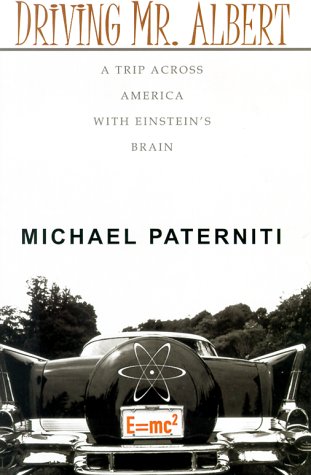
34. Driving Mr. Albert: A Trip Across America With Einstein's Brain
by Michael Paterniti
Hardcover: 307 Pages (2000-12)
list price: US$29.95 -- used & new: US$7.00
(price subject to change: see help)
Asin: 0783892985
Average Customer Review: 3.5 out of 5 stars
Canada | United Kingdom | Germany | France | Japan
Editorial Review

Amazon.com
Driving Mr. Albert chronicles the adventures of an unlikely threesome--a freelance writer, an elderly pathologist, and Albert Einstein's brain--on a cross-country expedition intended to set the story of this specimen-cum-relic straight once and for all.

After Thomas Harvey performed Einstein's autopsy in 1955, he made off with the key body part. His claims that he was studying the specimen and would publish his findings never bore fruit, and the doctor fell from grace. The brain, though, became the subject of many an urban legend, and Harvey was transformed into a modern Robin Hood, having snatched neurological riches from the establishment and distributed them piecemeal to the curious and the faithful around the world.

The brain itself has seen better days, its chicken-colored chunks floating in a smelly, yellow, formaldehyde broth, yet its beatific presence in the book, riding serenely in the trunk of a Buick Skylark, encased in Tupperware, reflects the uncertainty of Einstein's life. Was he a sinner or a saint, a genius or just lucky? Harvey guards the brain as if it were his own. From time to time, he has given favored specialists a slice or two to analyze, but the results have been mixed. Physiologically, Einstein's brain may have been no different from anyone else's, but plenty of people would like the brain to be more than it is, including Paterniti:

I want to touch the brain. Yes, I've admitted it. I want to hold it, coddle it, measure its weight in my palm, handle some of its fifteen billion now-dormant neurons. Does it feel like tofu, sea urchin, bologna? What, exactly? And what does such a desire make me?One of a legion of relic freaks? Or something worse?

Traversing America with Harvey and his sacred specimen, Paterniti seems to be awaiting enlightenment, much as Einstein did in his last days. But just as the great scientist failed to come up with a unifying theory, Paterniti's chronicle dissolves at times into overly sincere efforts to find importance where there may be none, and it walks a fine line between postmodern detachment and wide-eyed wonderment. Despite this, or perhaps because of it, the book offers an engrossing portrait of postatomic America from what may be the ultimate late-20th-century road trip. --Therese Littleton Book Description
Albert Einstein's brain floats in formaldehyde in a Tupperware® bowl in a gray duffel bag in the trunk of a Buick Skylark barreling across America. Driving the car is Michael Paterniti, a young journalist from Maine. Sitting next to him is an eighty-four-year-old pathologist named Thomas Harvey who performed the autopsy on Einstein in 1955--and simply removed the brain and took it home. And kept it for over forty years.

On a cold February day, the two men and the brain leave New Jersey and light out on I-70 for sunny California, where Einstein's perplexed granddaughter, Evelyn, awaits. And riding along as the imaginary fourth passenger is Einstein himself, an id-driven genius, the original galactic slacker with his head in the stars.

Part travelogue, part memoir, part history, part biography, and part meditation, Driving Mr. Albert is one of the most unique road trips in modern literature. With the brain as both cargo and talisman, Paterniti perceives every motel, truck-stop diner, and roadside attraction as a weigh station for the American dream in the wake of the scientist's mind-blowing legacy. Finally, inspired by the man who gave a skeptical world a glimpse of its cosmic origins, this extraordinary writer weaves his own unified field theory of time, love, and the power to believe, once again, in eternity. ... Read more

Customer Reviews (101)

5-0 out of 5 stars AS A WRITER...
...I must report with envy that I had to keep inturrupting the story to comment on how very much I was enjoying the writing. I rank this craftsman on a level with Charlie Pellegrino and David Guterson. Ialso publish and edit and I'm a wrtiting coach so I don't have a lot of read time these days, but this is one writer I brake for. The odd characters pop right off the page and run around the room and get you to thinking, "but don't I know this guy?"...and make you realize that they are living people just like Uncle Jake and grandad, and perhaps in some of the same ways, and this is what a really good wrtiter does-- make you see your own life with clarity. You drive this book like the author drove the car with the tupperware treasure (?) in the trunk, and the country materializes outside the windshield and in the diverse living-rooms where they sat and shared meals with typical Americans... all different, all slightly dysfunctional or dissatisfied or disturbing, again, like life... and the various aspects of living and questioning and trying and losing take form, with this journey as the alarm-clock, the wake-up call. Read it and don't be in so much of a hurry.

5-0 out of 5 stars A fresh story and a unique style
I first picked up this book about three years ago, but with so little time to read, it just sat on my overcrowded bookshelf. I always joke to friends that I am a Book Buyer, not a Book Reader, and as a result my shelves are full of interesting tales just waiting for my life to slow down a bit so I can enjoy them.

I regret that I let this one sit idle for so long!

As a writer myself, I always appreciate a fresh story, and it has been a long time since I read a book that was this original. What began as an article in Harper's Weekly has been magnificently transformed into a real page-turner.

Author Michael Paterniti became interested in a story, an urban legend actually, about a pathologist named Dr. Thomas Harvey who was charged with performing Albert Einstein's autopsy and subsequently absconded with the genius's brain in 1955. For over 40 years, he has been preparing a study on his specimen, causing controversy at every turn. At best, some believe he is unqualified for such an important scientific task. At worst, he is accused of stealing something that did not rightfully belong to him.

Eventually Michael tracks him down, they become friends, of sorts, and ultimately embark on a road trip from New Jersey to California to meet with Einstein's granddaughter Evelyn.

The unlikely pair begin the cross-country journey of a lifetime, visiting museums and friends along the way, taking in the scenery, and trying to figure each other out. Michael is at a crossroads in his relationship with girlfriend Sara, and he uses the time to think about what she means to him, what their future might hold, and what he really wants out of life.

They stop at a strange cement sculpture museum called the Garden of Eden, created by "American maverick" Samuel Perry Dinsmoor. The museum's deceased founder's body is the grand finale of their tour, as they are led into a dark mausoleum with a coffin specially designed by Dinsmoor himself.

Michael and Dr. Harvey also stop at the Lyndon B. Johnson Presidential Library & Museum, and a small place called the Bradbury Science Museum in Los Alamos, site of the infamous Manhattan Project that developed the atomic bomb.

I was struck by Michael's observation that "The museum...is most glaringly defined by what its curators seem to have forgotten about the bomb." He goes on to describe how the exhibits never mention the Enola Gay, the horrific aftermath of the explosions, or the scores of Japanese civilian casualties. It made me think about how powerful we curators are as the "editors" of history, how what we choose to leave out is sometimes as important as what we choose to include.

At times, the book is a bit repetitive, especially when the duo repeatedly orders their food in some slice of Americana diner, or when Dr. Harvey yet again dismisses Michael's request to see the brain for himself. But such episodes are not common in the pages of this book. (At times, the scientific explanations were a bit over this historian's head, but that is to be expected from someone who never set foot in a physics class - not even in high school!)

Seamlessly woven into the story, the author shares biographical snapshots of Einstein's life, insights from people who knew Dr. Harvey, and all kinds of tidbits to delight the trivia aficionado.

Michael's sense of humor really resonates. His writing style is readable, yet full of depth. His similes are original and his words are fresh. I wholeheartedly agree with the Boston Globe, who wrote, "In a world in which it seems that all the good ideas have been taken, it is singular."

I couldn't put it down. I'm only sorry I didn't pick it up sooner!

4-0 out of 5 stars Oddball travelogue...
In Walter Isaacson's new biography, Einstein: His Life and Universe, he recommends Driving Mr. Albert: A Trip Across America with Einstein's Brain by Michael Paterniti.This book is filled with interesting facts, great observations, but above all, it's a fun read.Driving Mr. Albert reminds me of the oddball travelogues I've come to enjoy written by Tony Horwitz (Confederates in the Attic, Blue Latitudes, etc.).

When Einstein died in Princeton Hospital in 1955, the pathologist who performed the autopsy, Dr. Thomas Harvey, took the brain for himself.He did it without the permission of the family, but when it was discovered, the family allowed him to keep the brain provided that any results were to be published in scientific journals.Harvey rationalized his actions by saying that he wanted to research the brain to discover the key to Einstein's brilliance.Unfortunately, Harvey was not a neurologist and didn't really have the knowledge to perform a proper study of any brain, let alone Einstein's.He gave out parcels of the brain to various scientists, but until many decades after Einstein's death, nothing definitive was able to be determined.In the meantime, Harvey switched jobs, moved around the country, and all the while, he kept Einstein's brain with him.

A young writer, Michael Paterniti, became fascinated by the story of the brain and befriended Thomas Harvey when the doctor was 85 years old.Harvey mentioned that he'd like to travel to California to meet Evelyn Einstein, Einstein's step-granddaughter.So Paterniti volunteered to be his chauffeur, and they set out from New Jersey with pieces of Einstein's brain in tow.The main story is not the destination but the things that happen along the way.Some of the stops (like Los Alamos) have ties to Einstein, while others (Las Vegas) do not.Throughout the journey, Dr. Harvey remains almost as much of a mystery as the brain.Not only does he not reveal any secrets, but he is also reluctant to show the brain to Paterniti.Paterniti hopes for a glimpse of the brain--perhaps when Harvey falls asleep.He writes "I want to touch the brain.Yes, I've admitted it.I want to hold it, coddle it, measure its weight in my palm...Does it feel like tofu, sea urchin, bologna?What exactly?And what does that desire make me?One of the legion of relic freaks?"

Driving Mr. Albert is a great compliment to Isaacson's more serious and in-depth biography.Paterniti writes that "having Einstein's brain in the trunk rearranges the way you see everything."Reading Mr. Paterniti will rearrange the way you perceive Albert Einstein.


4-0 out of 5 stars A Buick Skylark named Desire
As Paterniti remarks in the prologue to the book, "Desire is a tricky thing."It can make even the most mundane activity the first step in a journey of unimaginable unraveling discovery, or it can just simply prolong the mundane.When a stalled career and a dissolving romantic situation left the author in a state of malaise and boredom, he was willing to try anything just to break the stagnation.What better cure, when the opportunity bizarrely presented itslef, than to take a cross country drive with the doctor who had performed the autopsy on Albert Einstein and who had absconded with the great scientist's brain; that the brain was still in the possession of this doctor and would make the same road trip, only made the desire more pronounced.

Thus was the unlikely partnership of Michael Paterniti, Dr. Thomas Harvey and Albert Einstein's pickled brain formed.Ostensibly, the purpose of this trip was so that Dr. Harvey could present what was left of Einstein's brain (there had been numerous pieces and bits sent out to brain experts over the years) to the scientist's granddaughter who was living at the time in Berkeley; and in performing this hadj, perhaps, absolve himself from all the criticism and guilt that Harvey had been living with ever since the autopsy.In spite of some very interesting characters encountered along the road (William Burroughs, literally on his last legs, makes a cameo appearance) the trip never lived up to a life transforming event for the three pilgrims, and slowly dwindled into the realm of the mundane: motels, greasy meals, and endless stretches of road, the by-products of any cross country drive.

Because even the most bizarre situation (like driving across America with Einstein's brain sloshing around in a Tupperware container) is only a temporary reprieve from the mundane, any book describing such freakish events shares the same danger.The book reads something like a Seinfeld episode, where nothing really happens but is so well presented that the audience is enthralled nevertheless.Paterniti has a nice style and in some descriptions even reaches the poetic, and throughout the book manages to keep the reader's interest.I don't, however, share some of the reviewers positive opinions of the author as a "travel writer."Paterniti makes too many mistakes.For example, he describes approaching Santa Fe, NM as zagging "through saguaro and scrub, in the shadow of the Jemez Mountains."Apparently the author and his editors need to do some research.There is not a saguaro anywhere (except maybe in a desert museum) on I-40, and the Jemez Mountains form the western backdrop for Santa Fe, not the eastern.Then again, this book deals quite a bit with relativity and just perhaps ....

4-0 out of 5 stars It's not really a travelogue
This book is first of all a research project of Albert Einstein and second a biography of Mr Harvey who saved Albert's brain for over 40 years.Then it's a memoir and philosophical rant of the author's feelings toward his girfriend Sara. The travel came in fourth as a backdrop to all of the above.Still, it's a very good read with a unique angle.

The book is well-written and well researched but at times during the read the author jumps from present to future or even the past and throws the reader off course.He'll write about a conversation with Harvey in the car and then jump with something like "after this trip I did some research on what Harvey said and discovered that..." which was unnecessary for the reader.It kept me from truly experiencing the STORY of the trip with Einstein's brain.He should have kept those comments for the end of the story.

I learned a lot about Einstein from reading this book, though.I learned that Einstein had little respect for women and had therefore trouble keeping a relationship.He had an illigitimate child.He seemed self-absorbed.And what truly fascinated me was how much Einstein was hounded by the FBI, both while alive and also post mortem.But how could a man with some proclaimed genius be so scatter-brained?He died at the age of 76 with signs of dymensia.His brain only weighed 2.7 pounds, which is no means a record.

I was hoping this book would be more of a travelogue, obviously, because I love traveling, both vicariously and in reality.On the first day together on the road with Mr Harvey, there is very little description of the landscape passing the passengers by.The New Jersey Turnpike gets mentioned on page 32, Philadelphia on page 39, The Susquehanna River on page 40, Columbus, OH on page 44, and the Indiana-Illinois border on page 59 as "two states conjoined like Siamese twins."If you haven't traveled I-70 as often as I have, then all this means nothing to you because nothing more gets mentioned of the surroundings during the trip.Those places are merely mentioned to pinpoint the reader on a map.

Things do wrap up better once the two reach Kansas and the trip really begins from there to California. ... Read more


35. A Stubbornly Persistent Illusion: The Essential Scientific Works of Albert Einstein
Hardcover: 468 Pages (2007-11-26)
list price: US$29.95 -- used & new: US$9.95
(price subject to change: see help)
Asin: 0762430036
Average Customer Review: 5.0 out of 5 stars
Canada | United Kingdom | Germany | France | Japan
Editorial Review

Book Description
"People like us, who believe in physics, know that the distinction between past, present, and future is only a stubbornly persistent illusion."--Albert Einstein

Best-selling author and physicist Stephen Hawking assembles the most groundbreaking works by Albert Einstein together into one volume. From the text that revealed the famous "Theory of Relativity"--renowned as the most important scientific discovery of the 20th Century--to his significant works on quantum theory, statistical mechanics, and the photoelectric effect, here are the writings that changed physics, and subsequently, the way we view the world.

Einstein also thought deeply on both political issues and religious thought, so many of Einstein's philosophical essays are included. Hawking provides introductions to each work, which provides both historical and scientific perspective. From the papers that shaped modern scientific thought to Einstein's later musings on his landmark findings, A Stubbornly Persistent Illusion is a collection of Einstein's most important work, with commentary from our greatest living physicist. ... Read more

Customer Reviews (1)

5-0 out of 5 stars Einstein's seminal works commented on by Stephen Hawking
The most highly celebrated and recognized scientist alive today, Stephen Hawking has assembled, in this volume, highlights of Einstein's groundbreaking scientific works, such as his Special Theory of Relativity (1905) and his General Theory of Relativity (1915).

Also included are Einstein's thoughtful views on politics, religion, the history and development of physics, and the interplay between science and the world.

In a chapter titled "Selections from Out of My Later Years," Hawking discusses Einstein's reservations concerning quantum mechanics: "Einstein pointed out that if we were able to investigate microscopic phenomena on the smallest scales, we would be able to find deterministic relations." In other words, Einstein had serious doubts about the validity of Heisenberg's Uncertainty Principle, and rejected the fundamentally probabilistic nature of reality espoused by those who held to the workings of chance and randomness at the quantum (microscopic) level. "God does not play dice with the universe," he famously opined; "God is subtle but he is not malicious." He held adamantly (some would say stubbornly) to his belief that physical reality is, at bottom, deterministic.

Hawking gives brief introductions to each of Einstein's papers, thereby providing helpful historical and scientific perspectives.

Einstein once said, "Do not worry about your difficulties in mathematics. I can assure you mine are still greater." Yeah, right! Einstein is much too modest.

In a sense, however, Einstein is correct. Although this volume is replete with mathematical equations, one can read between the lines and gain an improved understanding of his revolutionary theories of spacetime and gravitation.

Einstein makes us smile with his wry humor: "Today I am described in Germany as a 'German savant,' and in England as a 'Swiss Jew.' Should it ever be my fate to be represetned as a bete noire, I should, on the contrary, become a 'Swiss Jew' for the Germans and a 'German savant' for the English."

The book's title of comes from another Einstein quote, "People like us, who believe in physics, know that the distinction between past, present, and future is only a stubbornly persistent illusion." ... Read more


36. Odd Boy Out: Young Albert Einstein (Bccb Blue Ribbon Nonfiction Book Award (Awards))
by Don Brown
Hardcover: 32 Pages (2004-09-27)
list price: US$16.00 -- used & new: US$8.91
(price subject to change: see help)
Asin: 0618492984
Average Customer Review: 4.5 out of 5 stars
Canada | United Kingdom | Germany | France | Japan
Editorial Review

Book Description
When he was born in 1879, Albert was a peculiarly fat baby with an unusually big and misshaped head.When he was older, he hit his sister, frustrated his teachers, and had few friends.But Albert's strange childhood also included his brilliant capacity for puzzles and problem solving: the mystery of a compass's swirling needle, the intricacies of Mozart's music, the secrets of geometryset his mind spinning with ideas.In fact, Albert Einstein's ideas were destined to change the way we know and understand the world and our place in the universe. In spare, precise text filled with graceful detail and accompanied by sometimes humorous, sometimes lonely portraits, Don Brown introduces us to the less than magnificent beginnings of an odd boy out.The result is a tender rendering of the adventures of growing up for one of the most important thinkers of the twentieth century. ... Read more

Customer Reviews (2)

4-0 out of 5 stars Relatively (ha ha) good
If every adult biographer has his or her own personal style, why should the case be any different for children's book biographers?And when it comes to picture book biographies, certain names come to mind.David Adler, of course, though his books are so uncommonly dull that I tend to pity the children I hand them to (being a children's librarian and all).Peter Sis, though his bios require a great deal of time and patience to parse.James Rumford to some extent, though "Sequoyah" is probably his best bio to date.No, when it comes down to it Don Brown is the picture book biographer that nine of ten kids prefer every time.I don't have any actual statistics to back that statement up, I just say what I see.And what I see is an author who is able to take unknown heroes (Mary Kingsley, Alice Ramsey, Ruth Law, etc.) and too well-known heroes (Albert Einstein, Mark Twain, etc.) and give them interesting picture book biographies that kids will both relate to and love.

We all know some basic facts about Einstein.He was a guy with a head of white unruly hair.When you yell, "Hey, Einstein!", you are making reference to the fact that he was once a genius.So how much do you know about this great man as a child?In this book, Brown introduces us to Albert from day one (March 14, 1879, to be exact).As a boy, Albert has his good moods and he has his bad moods.In a good mood he can create a house of cards fourteen stories high and ponder the mysteries of a compass for fun.In a bad mood he is prone to hitting his little sister, terrifying his tutor, and getting so upset that his nose turns white.As we watch, Albert is given an amazing amount of freedom.He wanders the Munich streets alone at the age of four.He discovers geometry with the help of a friendly medical student.The book progresses and we learn a little about Albert's personality from offhand comments."Soldiers on parade excite the boys.They disturb Albert".At end of this journey, Albert comes up with theory of relativity and, "For the world, Einstein comes to mean not fat baby, or angry child, or odd boy, but great thinker".And now our children can understand where all genius has its beginnings.In the ordinary and familiar.

What I enjoyed about the book was that Brown doesn't linger on just the good things in Einstein's life.No child's a saint, and Albert is no exception.Brown humanizes this latter-day god, giving him a family, a childhood, and a history that kids today (in spite of their love of computerization and high-tech toys) will understand.Who amongst us doesn't recognize Albert's reluctance to engage in organized sports as something we, or someone we know, have also felt?The story is laid out beautifully.The illustrations are little more haphazard.Granted, I really liked the picture of Albert engaged in a temper tantrum.His little fists are clenched and his nose, true to the text, is a slightly whitish color.By and large these pen and ink pictures colored in with watercolors work well.There's just the occasional oddity.When teachers wonder if Albert is dull-witted, Brown illustrates a disturbingly glazed-eyed kid who reinforces their concern.It's a peculiar picture, but there's no denying that it conveys the text well.

I saw Mr. Brown speak not too long ago to a gathering of librarians, and I found that I was not especially impressed with him as a person.Nonetheless, the man does nice work.And of the work that he has done, "Odd Boy Out" is probably one of his best.It's a beautifully rendered story that kids will prefer far above and beyond similar Einstein biographies.Not genius, but pretty darn close.

5-0 out of 5 stars Odd boy out is one great book!
Odd boy out is a wonderful book with nice illustraions of the life of Albert Einstein.
Albert was born a fat baby with a big head. He had a bad temper
and was condsidered very odd. He didn't like to play sports, and hewas disturbed with the things other boys liked. Einstein grows and soon becomes what we know as the famous scientist Einstein. ... Read more


37. Ask Albert Einstein
by Lynne Barasch
Hardcover: 40 Pages (2005-10-07)
list price: US$16.00 -- used & new: US$7.00
(price subject to change: see help)
Asin: 0374304351
Average Customer Review: 5.0 out of 5 stars
Canada | United Kingdom | Germany | France | Japan
Editorial Review

Book Description

An introduction to the very human side of Albert Einstein
April’s older sister, Annabel, is in danger of failing math, so April enlists the help of a famous scientist, sending a math problem to Albert Einstein at his home in Princeton, New Jersey. While April waits for an answer, she pictures all the things Einstein might be doing instead: working on his own math problems, playing his violin, riding his bicycle, gardening, sailing, helping other children with their homework – all things that he is known to have enjoyed. But time is running out for Annabel, who doesn’t know that help is on the way. And when it comes, it takes April to show that Einstein has given Annabel a clue so that she can solve the problem herself.

Energetic watercolor-and-ink pictures illustrate this sprightly little-sister-to-the-rescue story based on an actual event. The math problem and solution are included.
... Read more

Customer Reviews (1)

5-0 out of 5 stars Anyone can ask
Fifteen-year-old Annabel's despair over her math h