e99 Online Shopping Mall

Geometry.Net - the online learning center Help  
Home  - Nobel - Feynman Richard P (Books)

  1-20 of 100 | Next 20
A  B  C  D  E  F  G  H  I  J  K  L  M  N  O  P  Q  R  S  T  U  V  W  X  Y  Z  

click price to see details     click image to enlarge     click link to go to the store

$7.90
1. What Do You Care What Other People
$7.95
2. Safecracker Suite: Drumming and
 
3. "What Do You Care What Other People
$7.12
4. Perfectly Reasonable Deviations
$8.85
5. Surely You're Joking Mr. Feynman
$3.76
6. The Pleasure of Finding Things
$13.97
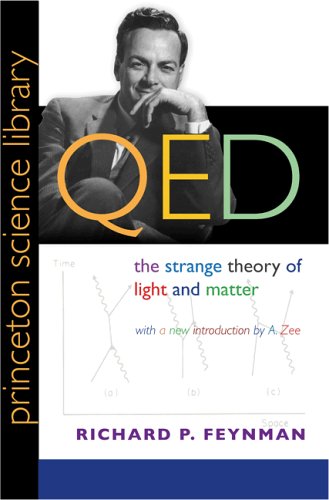
7. QED: The Strange Theory of Light
$110.00
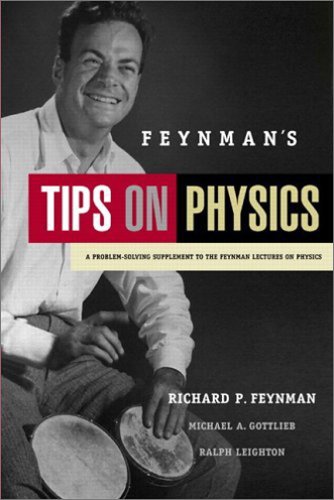
8. The Feynman Lectures on Physics
 
$19.95
9. PERFECTLY REASONABLE DEVIATIONS
 
10. Six Easy Pieces: Essentials of
$17.15
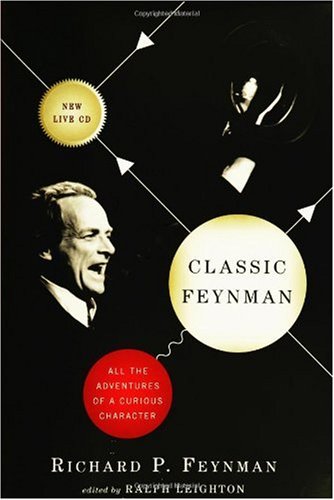
11. Classic Feynman: All the Adventures
$12.73
12. The Character of Physical Law
 
$177.49
13. Statistical Mechanics (Frontiers
14. Esta Ud. de Broma, Sr. Feynman?
15. The Meaning Of It All: Thoughts
$18.75
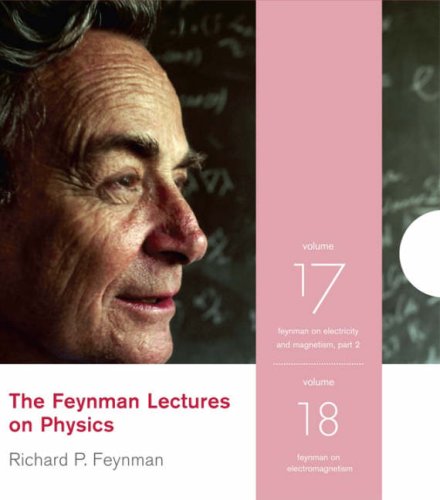
16. The Feynman Lectures on Physics,
 
17. Feynman's Lost Lecture
$499.99
18. The Art of Richard P. Feynman:
$36.00
19. The Feynman Lectures on Physics,
$27.11
20. Feynman on Flow (The Feynman Lectures

1. What Do You Care What Other People Think?: Further Adventures of a Curious Character
by Richard Phillips Feynman, Richard P. Feynman
Paperback: 256 Pages (2001-01)
list price: US$14.95 -- used & new: US$7.90
(price subject to change: see help)
Asin: 0393320928
Average Customer Review: 4.5 out of 5 stars
Canada | United Kingdom | Germany | France | Japan
Editorial Review

Amazon.com
A thoughtful companion volume to the earlierSurely You Are Joking Mr. Feynman!. Perhaps the most intriguing parts of the book are the behind-the-scenes descriptions of science and policy colliding in the presidential commission to determine the cause of the Challenger space shuttle explosion; and the scientific sleuthing behind his famously elegantO-ring-in-ice-water demonstration. Not as rollicking as his other memoirs, but in some ways more profound.Book Description
The best-selling sequel to "Surely You're Joking, Mr. Feynman!"--funny, poignant, instructive. One of the greatest physicists of the twentieth century, Richard Feynman possessed an unquenchable thirst for adventure and an unparalleled ability to tell the stories of his life. "What Do You Care What Other People Think?" is Feynman's last literary legacy, which he prepared as he struggled with cancer. Among its many tales--some funny, others intensely moving--we meet Feynman's first wife, Arlene, who taught him of love's irreducible mystery as she lay dying in a hospital bed while he worked nearby on the atomic bomb at Los Alamos. We are also given a fascinating narrative of the investigation of the space shuttle Challenger's explosion in 1986, and we relive the moment when Feynman revealed the disaster's cause by an elegant experiment: dropping a ring of rubber into a glass of cold water and pulling it out, misshapen. A New York Times bestseller. ... Read more

Customer Reviews (61)

4-0 out of 5 stars A Wonderful Treatise
I have always liked reading about Dr.Feynman!Infact it all started with Surely..Mr.Feynman. This book goes out to show that any guy, can split his time between love and work(which is most often missing from these high profile Scientists/Physicist).
His desire to know the root cause of Challenger mishap, and how he goes on to demonstate what transpired the failure of Challenger mishap is very inspiring.
All in All a good buy if you are an ardent fan of him!

4-0 out of 5 stars A curious character indeed, and furious
The book does not give as much pleasure and joy as 'Sure you're joking...", however the section on shuttle crash analysis is of highest interest and justifies alone the reading.

4-0 out of 5 stars Feynman...The Scientific Entertainer
In this sequel to "surely you must be joking Mr. Feynman," Richard Feynman once again uses his cunningness and his scientific genius to entertain. This book starts off with a brief history of him and his scientific career. Then it goes on to his wife's death. This is a very sad excerpt of the story and in this part, he communicates with you the sorrow he goes through, showing he does truly love his wife. During this portion you realize that although he is a brilliant man and is nearly untouchable in the scientific realm, he is still down to earth and goes through every thing that we do. Also in this book is the main feature, the Challenger investigation. The Challenger exploded shortly after leaving the ground and NASA wanted to know why. They pull in a group of the top scientists, mathematicians and some other random people that don't have names. Their job is to see what went wrong with the Challenger in an effort to stop this mistake from being repeated. Feynman and the others work in Washington D.C. over six months. He finally figured out and proved, with simply a glass of ice water and a part off of the Challenger, what the problem was. He used his ingenious brain and his sense of humor to establish his point and to show NASA their miniscule piece that was causing such a major problem. This book is incredibly funny and is not such a book that has large vocabulary and crazy concepts never heard by normal human ears. It is an easy read and a fun read.

4-0 out of 5 stars Must-read one
This is one of my favourite books.

Interesting life of one intelligent person with atypical sense of humour with interesting style of thinking.

Long part about physics may be boring for some kinds of people, but it still also contain a lot of interesting to read. Either way if you are absolutely out of physics you will maybe close this book on first sites of the second part.

5-0 out of 5 stars So Much Wisdom in A Small Book
As others have noted this is the perfect companion to Reflections...... which I listened to on a long road trip. However this book needs to be read and the content savored while Reflections is more entertainment.

The Challenger investigation shines light on all that is wrong with Washington and the good people who perform despite the system. The book is worth reading if for only these chapters. These chapters are also must reading for anyone who read the 9/11 report and either believes it or completely distrusts it. Sadly the Washington insiders are masters at controlling independent panels from the Kennedy investigation to the most recent policical investigations. The term independent panel simply does not exist in DC. Sadly too many on the Challenger panel were working hard to protect that which most needed to be fixed. I believe the same truth holds true with the 9-11 investigation where the "scope" was carefully crafted to avoid potholes.

What's refreshing is Feynman's refusal to go along and also the coaching he received from the USAF general along the way.

Non technical, the book is suitable for interested readers from 10-100. Great illustration of how much positive impact can come from one great mind. ... Read more


2. Safecracker Suite: Drumming and Storytelling
by Richard P. Feynman
Audio CD: Pages (1997-07-01)
list price: US$15.00 -- used & new: US$7.95
(price subject to change: see help)
Asin: 1584900199
Average Customer Review: 4.5 out of 5 stars
Canada | United Kingdom | Germany | France | Japan
Editorial Review

Book Description
"The Chief" tells his most infamous story: cracking the safes containing the secrets to the atomic bomb!Mixed in are drumming sessions, in original recordings made by Ralph Leighton. Hear it all on this incredible audio CD!Profits from the sale of this CD benefit cancer research. ... Read more

Customer Reviews (3)

5-0 out of 5 stars A Feynman Must Have
If you are a Feynman fan, this is for you. The drumming selections punctuated with classic stories is priceless. Everytime I listen to it I hear something I missed before. Always funny and always entertaining. It's a great way to introduce his humor and intellect to those who never knew him and to those of us who wish we did.

5-0 out of 5 stars Hypnotic music and evocative language
I've about worn out my copy (on tape) and need to find a new copy.I'm glad to find it's on CD even if I may have to search a while to find it. This is the tape I keep in the player in the car because it always sounds fresh.The drumming pieces make good traveling music if you really crank it up!After listening many times I think the drumming is surprisingly good with varied tempos and effects and it's obvious Richard and Ralph had fun doing it.Richard's storytelling is wonderful because the language is early 20th century, without any chance to edit or polish.To hear Richard's voice relating his own experiences is a treasure for those of us who never met him.The format of interspersing the narratives with the music is especially effective.And yes, the "Orange Juice" song is one of the best cuts, if you know that Feynman liked to make up his own words and languages.

4-0 out of 5 stars The one to have if you are to limit to one audio record
Quite different from "Feynman Volumes" (which only 1st volume has been released to this date--Ralph Leighton hopes he'll be able to release 3 or 4 more items, and so do we) in that it doesn't consist of araw record of a story, but rather in many items mixed up. Other pieces aremostly drums, but most noticeable is a Feynman's imitation of Japanese!orhis extemporized "Orange Juice" song, running "gimme gimmegimme orange juice". The story is what constitutes the middle part of"Safecracker meets safecracker" in "Surely You're joking MrFeynman", from hacking in Los Alamos to, quite ironically, thesafecrackers' meeting at the end of the story which is not included. May beRalph will release the whole story as part of another volume. If you're nottoo sure what item start your collection with, I suggest you begin withVolume 1, encourage Ralph to produce more such items, and pursue withthese. ... Read more


3. "What Do You Care What Other People Think?"Further Adventures Of A
by Richard Phillips Feynman, Richard P. Feynman
 Audio Cassette: Pages (2001-07-10)
list price: US$40.00
Isbn: 0736671781
Canada | United Kingdom | Germany | France | Japan

4. Perfectly Reasonable Deviations From The Beaten Track: The Letters Of Richard P. Feynman
by Richard Phillips Feynman, Michelle Feynman
Hardcover: 486 Pages (2005-04-05)
list price: US$26.00 -- used & new: US$7.12
(price subject to change: see help)
Asin: B000NIJ4E2
Average Customer Review: 5.0 out of 5 stars
Canada | United Kingdom | Germany | France | Japan
Editorial Review

Amazon.com
Finding out about someone by reading their correspondence is a fundamentally different thing than reading their biography. Letters offer both more intimacy with the subject and at the same time a crucial distance--the exact distance the letter-writer intended from the people to whom he was writing. In Perfectly Reasonable Deviations from the Beaten Track, Michelle Feynman collects her famous father's letters to reveal a warm, honest man with high expectations for himself, his loved ones, and the human race. Long before Richard Feynman won the Nobel Prize, he was a smart, skinny graduate student at Princeton, writing letters to his mother and relating the mundane details of college life. "Dear Mom.... The raincoat came O.K. It is very nice," he writes. By the time he finished his Ph.D., Feynman had fallen for Arline Greenbaum, who had already been diagnosed with tuberculosis. Their tragically short marriage is set in letters against Feynman's first job--working on the atomic bomb project at Los Alamos, New Mexico.

Even while working on top secret physics, Feynman was an enthusiastic correspondent, jumping eagerly at the chance to encourage a young scientist, correct a public misperception, or tell a goofy joke to his family. Self-effacing, charmingly down to earth, and occasionally cranky, these letters cover Feynman's entire career, although in the fits and starts one would expect from a collection such as this. His own words to students, spouses, daughters, and fellow scientists reveal Feynman's brilliance far more effectively than any biographical lens ever could. --Therese LittletonBook Description
"I'm an explorer, OK? I like to find out!"

One of the towering figures of twentieth-century science, Richard Feynman possessed a curiosity that was the stuff of legend. Even before he won the Nobel Prize in 1965, his unorthodox and spellbinding lectures on physics secured his reputation amongst students and seekers around the world. It was his outsized love for life, however, that earned him the status of an American cultural icon-here was an extraordinary intellect devoted to the proposition that the thrill of discovery was matched only by the joy of communicating it to others.

In this career-spanning collection of letters, many published here for the first time, we are able to see this side of Feynman like never before. Beginning with a short note home in his first days as a graduate student, and ending with a letter to a stranger seeking his advice decades later, Perfectly Reasonable Deviations from the Beaten Track covers a dazzling array of topics and themes, scientific developments and personal histories. With missives to and from scientific luminaries, as well as letters to and from fans, family, students, crackpots, as well as everyday people eager for Feynman's wisdom and counsel, the result is a wonderful de facto guide to life, and eloquent testimony to the human quest for knowledge at all levels.

Feynman once mused that "people are 'entertained' enormously by being allowed to understand a little bit of something they never understood before." As edited and annotated by his daughter, Michelle, these letters not only allow us to better grasp the how and why of Feynman's enduring appeal, but also to see the virtues of an inquiring eye in spectacular fashion. Whether discussing the Manhattan Project or developments in quantum physics, the Challenger investigation or grade-school textbooks, the love of his wife or the best way to approach a problem, his dedication to clarity, grace, humor, and optimism is everywhere evident.

.... on Richard Feynman:

"The most original mind of his generation." -Freeman Dyson

"An honest man, the outstanding intuitionist of our age, and a prime example of what may lie in store for anyone who dares to follow the beat of a different drum." -Julian Schwinger

"An original, brilliant, curious, energetic, eclectic, ebullient, gregarious, and consummately iconoclastic human being with a passion for science, a taste for first principles, and a view of reality that was uniquely his." - The Washington Post

"He is everything you want and expect a scientist to be: charming, skeptical, funny, blindingly intelligent." - The Guardian (UK)

"A chain reaction is not a bad analogy for Feynman's life. From a critical mass of gray matter it goes off in all directions, producing both heat and light." - Time

"For him knowledge did not describe; it acted and accomplished. . . . The science he helped create was like nothing that had come before." -James Gleick

"Here was both a showman and a very practical thinker. . . . It is unlikely that the world will see another Richard Feynman." -Paul Davies

"The more one reads of Feynman, the more one falls in love with his refreshingly enthusiastic view of the world." -Alan Guth

"He may have emitted light as well as words." -David Park ... Read more

Customer Reviews (20)

5-0 out of 5 stars Feynman raw
If you are familiar with feynman this is just what you would expect from this great man. This is him uncut and uncensord. When ever i feel like smiling and gain some inspiration i pick this book up and flip to a random page, it works everytime.

5-0 out of 5 stars Feynman on Feynman
My main motivation for reading "Perfectly Reasonable Deviations" was to gain further insight into Feynman's personality and value system by the direct and reliable method of studying verbatim his interactions with other people.He has been so thoroughly enshrined (perhaps not unwillingly) as a brilliant, difficult, puckish character that I couldn't help being a bit puzzled about what he was "really" like.

In assembling this volume, Feynman's daughter Michelle has selected a variety of correspondence ranging from professional relations with colleagues to private exchanges with friends and, occasionally, complete strangers.I think it is in the latter case that we learn the most about Feynman.He was willing to pay close attention not only to people who admired him, but also to those who offered crazy ideas, or unfair criticism, or even ad-hominem invective.Well after becoming a Nobel prize winner, he continued to compose detailed explanations for, and invite replies from, people who could try anyone's patience.As an experienced debater-by-correspondence, he had a talent for cutting to the quick of a dispute and, while remaining perfectly courteous, nudging the contender into a corner from which escape was impossible short of offering something new or conceding the point.Whether arguing scientifically, graciously acknowledging praise, or simply trying to shake off a persistent bore, Feynman never failed to be insightful and thought-provoking.

The early part of the book covers Feynman's relationship with his first wife Arline, who died of tuberculosis in an Albuquerque sanatorium while he worked on the atomic bomb project at Los Alamos.His decision to marry Arline, regardless of her uncertain health and against the advice of friends and relatives, speaks to the strength and depth of his commitment.Many extremely personal letters are included which illuminate the couple's mutual devotion as well as his loving acceptance of the frustration and uncertainty forced on both of them by the relentlessly worsening disease.

Feynman's attitude toward religion is revealed in several places, particularly during a 1959 television interview.In addition to critiquing the widespread notion that morality is tied to piety, he says quite succinctly that "The religious theory of the world ...doesn't fit with what you see."

In a number of letters Feynman explains the prickly positions on academic conventions and courtesies that helped to make him a legendary outsider.A representative example was his refusal to provide evaluations of former students and colleagues when they were already at the requesting institution.He essentially said:Look here, this person is working right under your nose and you know more about him or her than I do, so decide for yourself!

There are a few instances where an alert editor could have caught misreadings, for example "Serbeis" for the [Robert] Serbers on page 76, and "1023" for ten to the 23rd power on page 174.All in all, this collection constitutes a fascinating and skillfully-produced window into one of the world's most intriguing minds.

5-0 out of 5 stars Wit, wisdom, and always humble affection for people from the genius of our time
If there was one intellect that dominated the latter half of the 20th century, it would be Dr. Richard Feynman. Yet, despite winning a Nobel prize and his early work on the Manhattan project and his years of original yet simple and creative approaches to complex problems, his humility and true affection for other people never waivered. He was one of those rare people who could touch our hearts as effectively, possibly even more, than he could touch our minds. He was one who gave new meaning to the idea of thinking outside the box and who never passed up a chance to remind us all of what is really important in life.

Some of his letters will make you cry with the emotion he could express to those he loved. Others will strike you for their humility displayed in teaching without condescending or apologies to those he feared he had offended. A truly great man with a great intellect and great ability to communicate his thoughts.This is the human side of one who had been named "the world's smartest man" by Omni magazine.And we are all fortunate to know him through this collection.

5-0 out of 5 stars Wonderful collection
Having read "Surely you're joking, Mr Feynmann", I had wondered about his relationship with his first wife, because she was hardly mentioned.

This book sets that right, with some fascinating and personal letters. In particular, the letter he wrote a year after her death hit me very hard, and I don't consider myself sentimental.

And that's just the first part of the book...if you like Feynmann, this is a must have.

5-0 out of 5 stars Perfectly Reasonable Deviations from the beaten Track
Feynman inspires the pursuit of truth in this spin-driven world. ... Read more


5. Surely You're Joking Mr. Feynman
by Richard P. Feynman
Paperback: 322 Pages (1989-03-01)
list price: US$13.95 -- used & new: US$8.85
(price subject to change: see help)
Asin: 0553346687
Average Customer Review: 4.5 out of 5 stars
Canada | United Kingdom | Germany | France | Japan
Editorial Review

Amazon.com
A series of anecdotes shouldn't by rights add up to anautobiography, but that's just one of the many pieces of receivedwisdom that Nobel Prize-winning physicist Richard Feynman (1918-88)cheerfully ignores in his engagingly eccentric book, a bestsellerever since its initial publication in 1985. Fiercely independent (readthe chapter entitled "Judging Books by Their Covers"), intolerant ofstupidity even when it comes packaged as high intellectualism (checkout "Is Electricity Fire?"), unafraid to offend (see "You JustAsk Them?"), Feynman informs by entertaining. It's possible toenjoy Surely You're Joking, Mr. Feynman simply as a bunch ofhilarious yarns with the smart-alecky author as know-it-all hero. Atsome point, however, attentive readers realize that underneath all themerriment simmers a running commentary on what constitutes authenticknowledge: learning by understanding, not by rote; refusal to give upon seemingly insoluble problems; and total disrespect for fancy ideasthat have no grounding in the real world. Feynman himself had allthese qualities in spades, and they come through with vigor and vervein his no-bull prose. No wonder his students--and readers around theworld--adored him. --Wendy SmithBook Description
The outrageous exploits of one of this century's greatest scientific minds and a legendary American original. In this phenomenal national bestseller, the Nobel Prize-winning physicist Richard P. Feynman recounts in his inimitable voice his adventures trading ideas on atomic physics with Einstein and Bohr and ideas on gambling with Nick the Greek, painting a naked female toreador, accompanying a ballet on his bongo drums and much else of an eyebrow-raising and hilarious nature. A New York Times bestseller; more than 500,000 copies sold. ... Read more

Customer Reviews (222)

5-0 out of 5 stars Loved this book!
I loved this book, could hardly put it down, and bought it for several friends. Brilliant and funny, this Nobel laureate penned a delightful memoir. I recommend it for anyone remotely interested in science who wants to get inside a genius's mind. Seldom are we offered such an opportunity.

5-0 out of 5 stars Dr Feynman was unique in his approach to life and physics...
I have re-read this book at least a half dozen times, and always find it a fresh read. Too bad there are not enough teachers out there with is spirit and interest in not only 'finding things out' but in getting the students to think differently, to want to find how nature works.

His zany adventures growing up, during the war and thereafter are funny and irreverent , inspiring in their own way; there are serious moments in the book as well, pertaining to education, books, and the Challenger disaster.
If you enjoy this one, read Tuva or Bust as well.

5-0 out of 5 stars Dr. Feynman is a cool dude.
Wonderful book for anyone to read...great stories about a very interesting man.Would also recommend "What do you care..." by Feynman as well.

5-0 out of 5 stars Awesome book!!!
This book is absolutely hilarious!!Who knew that a Noble Laureate Physicist could be such a facinating guy?This book does NOT require any technical ability to fully enjoy.It is easy to read, and hard to put down.Dr. Feynman not only challenges authority, but he plays pranks on them; and very few can challange his superior intellect.A must read!!!

5-0 out of 5 stars Wonderful!
I rarely read biographies and so I began this book with some hesitation.After a few pages reading Feynman's unique viewpoints and candor, it was difficult to put it down.Feynman was truly a great American, Scientist and Eccentric.

I found a great deal of inspiration in his definition of science and his highly rational but playful, free-thinking way of looking at the world and himself.

I ordered several other of his books and look forward to them greatly. ... Read more


6. The Pleasure of Finding Things Out: The Best Short Works of Richard P. Feynman
by Richard P. Feynman
Paperback: 270 Pages (2000-08)
list price: US$15.00 -- used & new: US$3.76
(price subject to change: see help)
Asin: 0738203491
Average Customer Review: 4.0 out of 5 stars
Canada | United Kingdom | Germany | France | Japan
Editorial Review

Amazon.com
Why do we do science?Beyond altruistic and self-aggrandizing motivations, many of our best scientists work long hours seeking the electric thrill that comes only from learning something that nobody knew before.The Pleasure of Finding Things Out, a collection of previously unpublished or difficult-to-find short works by maverick physicist Richard Feynman, takes its title from his own answer.From TV interview transcripts to his acceptance speech for the Nobel Prize, we see his quick, sharp wit, his devotion to his work, and his unwillingness to bow to social pressure or convention.It's no wonder he was only grudgingly admired by the establishment during his lifetime--read his "Minority Report to the Space Shuttle Challenger Inquiry" to see him blowing off political considerations as impediments to finding the truth.

Feynman had a fantastic sense of humor, and his memoirs of his Manhattan Project days roil with fun despite his later misgivings about nuclear weapons. Though one or two pieces are a bit hard to follow for the nontechnical reader, for the most part the book is easygoing and engaging on a personal rather than a scientific level.Freeman Dyson's foreword and editor Jeffrey Robbins's introductions to each essay set the stage well and are respectful without being worshipful. Though Feynman has been gone now for many years, his work lives on in quantum physics, computer design, and nanotechnology; like any great scientist, he asked more questions than he answered, to give future generations the pleasure of finding things out. --Rob LightnerBook Description
The national best seller--an unparalleled collection of timeless writings by one of the most beloved and original thinkers of the twentieth century.

The Pleasure of Finding Things Out is a magnificent treasury of the best short works of Richard Feynman, from interviews and speeches to lectures and printed articles. A sweeping, wide-ranging collection, it presents an intimate and fascinating view of a life in science-a life like no other.

From Feynman's ruminations on science in our culture to his Nobel Prize acceptance speech, this book will fascinate anyone interested in the world of ideas. Newcomers to Feynman will be moved by his wit and his deep understanding of the natural world and of the human experience; longtime admirers will discover many treasures available nowhere else. ... Read more

Customer Reviews (54)

4-0 out of 5 stars ABOUT BEING HUMAN
A WONDERFUL AND INSIGHTFUL LOOK INTO THE MIND OF NOT ONLY A BRILLIANT SCIENTIST, BUT A DOWN TO EARTH HUMAN BEING AS WELL.WHETHER A SCIENTIFIC ORNON-SCIENTIFIC THINKER, THERE IS MUCH TO BE LEARNED ABOUT LIFE FROM THIS UNCHARACTERISTIC MAN, FATHER AND HUSBAND.

5-0 out of 5 stars great thoughts of a nobel laureate in physics
Richard Feynman was a great physicist of the 20th Century. He was unconventional but had a way of making physics interesting to students and lay people alike. When I was an undergraduate at Stony Brook in 1969, I took freshman physics from Lamb and Fowler. They had their own notes for our reference but used Feyman's lectures as the course text. Because it lacked structure it was a difficult book (actually two volumes) to learn from. It clearly inspired our professors and many of Feynman's Cal Tech students as well. For me and most of my classmates at Stony Brook we found that buying a copy of the conventional text by Halliday and Resnick was necessary to get us through the course. In this collection of works Feynman has a discussion where he eplains the difficulty of teaching and motivating. He admits that he has not figured out how to do it. His father's approach to investigation worked well on his son but not his daughter. She wanted structure and repetition. He proposes trying many different approaches so as to reach as many students as possible.
Robbins has collected a number of interesting short articles,publications and interviews that show the type of person Feynman was and his dedication to physics. This came about for him through the pleasure that comes with discovering how things really work.

This is the common theme in the book. He discusses his experience at Los Alamos during the Manhattan project, mainly covering his dislike for the security and censorship that was part of this crucial phase in the development of the atomic bomb. I also enjoyed reading about his theories regarding how small computers may one day be. My favorite chapter is his frank and careful minority report on the Challenger Space Shuttle disaster.

If you have read and liked Feynman before, this will not disappoint you. It comes with a very interesting foreward by Freeman Dyson and an editor's introduction to prepare you for what is ahead.

4-0 out of 5 stars Feynman a long time hero!
Getting to know Dr. Feynman is greatly fascilitated by this book. It's recommended to science oriented readers.

5-0 out of 5 stars Great enjoyment in audio version
This is not the place to start with Feynman. I have read many of his works, such as "Surely You're Joking" and the "Genius" bio about him. Yes, I suppose I am a partial victim of Feyman's self-promotion and colorful life that lends itself to so much entertaining material. I don't care. What he says speaks to me in many ways, even when he steps into religion and other areas in which he is no formal expert.

Because of my familiarity with Feynman, I often knew more or less what was coming on some of the topics. However, I wanted to try the audio book because much of the content is Feynman telling stories or giving a lecture meant more to be heard than read. Here I believe the production really scores. Feynman's conversational style, even for complicated topics, is very effective. The narrator even vaguely sounded a bit as Feynman would (at least as I recall), minus the NY accent.

A counter-example may be the report on the Challenger disaster, with Feynman's famous keen analysis that is better read than heard. There is a bit more repetition than I would have preferred. Perhaps that was unavoidable while still retaining the integrity of the chapters. It's a little difficult to skim a tape.

The audio book accomplished what I wanted: it refreshed my recollection of Feynman and his work, it entertained in the parts where it meant to entertain, it educated when he wanted to educate, and it prompted much contemplation while on the road, which is ultimately what Feynman the teacher wanted from his audiences.

4-0 out of 5 stars A great piece of work...
This is the first book I have ready by Feynman, and I must admit, I am yearning to read more of his work.

While the book is a compilation of his speeches over the years, the topics covered are as relevant today as the time when the speeches were delivered.Many of the things Feynman spoke about in the 50's and 60's have come true today -especially the miniature devices that he mentions in his talks.

The breadth of topics is excellent as well - he touches on Religion and Science, Teaching of Science, The Room at the Bottom (miniaturization), and offers very simple, yet profound views on what is, and what can be.

It takes guts to admit that such an accomplished man may have blind spots and bodies of knowledge he knows nothing about; Feynman is not afraid to make such statements.This is not only the sign of a genius, but also of one who has intellectual honesty, and the willingness to face things for what they are.I wish more teachers, professors, engineers, doctors, and scientists would be that forthcoming. ... Read more


7. QED: The Strange Theory of Light and Matter
by Richard P. Feynman
Paperback: 176 Pages (1988-10-01)
list price: US$16.95 -- used & new: US$13.97
(price subject to change: see help)
Asin: 0691024170
Average Customer Review: 5.0 out of 5 stars
Canada | United Kingdom | Germany | France | Japan
Editorial Review

Book Description

Famous the world over for the creative brilliance of his insights into the physical world, Nobel Prize-winning physicist Richard Feynman also possessed an extraordinary talent for explaining difficult concepts to the nonscientist. QED--the edited version of four lectures on quantum electrodynamics that Feynman gave to the general public at UCLA as part of the Alix G. Mautner Memorial Lecture series--is perhaps the best example of his ability to communicate both the substance and the spirit of science to the layperson.

The focus, as the title suggests, is quantum electrodynamics (QED), the part of the quantum theory of fields that describes the interactions of the quanta of the electromagnetic field-light, X rays, gamma rays--with matter and those of charged particles with one another. By extending the formalism developed by Dirac in 1933, which related quantum and classical descriptions of the motion of particles, Feynman revolutionized the quantum mechanical understanding of the nature of particles and waves. And, by incorporating his own readily visualizable formulation of quantum mechanics, Feynman created a diagrammatic version of QED that made calculations much simpler and also provided visual insights into the mechanisms of quantum electrodynamic processes.

In this book, using everyday language, spatial concepts, visualizations, and his renowned "Feynman diagrams" instead of advanced mathematics, Feynman successfully provides a definitive introduction to QED for a lay readership without any distortion of the basic science. Characterized by Feynman's famously original clarity and humor, this popular book on QED has not been equaled since its publication.

... Read more

Customer Reviews (70)

5-0 out of 5 stars It takes a genius to make it simple
Feynman picks the thing that is simplest in the quantum world, a single particle, and explains it using no math.Instead of equations, the quantum theory in this book consists entirely of pictures.But this is not a popularization in the usual sense.This is not gossip about science.This actually is quantum theory in a very simple case.For anyone who wants to know how the universe is put together, this is an astonishing mind opener.

5-0 out of 5 stars Mind-blowing
Feynman makes it easy for the curious amateur to understand.This book is accessible and mind-blowing.Everyone should read it. And there is little if any math so don't be intimidated.

4-0 out of 5 stars Just the facts, Ma'am
In the Introduction to the 'Strange Theory of Light and Matter' Feynman tells us that what he likes to talk about is the "part of physics that is known, rather than a part that is unknown." And he goes on to give us a thumbnail sketch, a "physicist's history of physics," which shows how physicist's, in their quest to describe the world, continually reduce a group of seemingly unrelated phenomenon to a single phenomenon. So heat and sound were found, thanks to Newton, to be reducible to laws of motion, while electricity, magnetism and light were reducible to Maxwell's electromagnetic wave. In this way physicist's explain the world.

Here one is almost tempted to say that they proceed much as religion and ideology do. Religion has from the beginning of recorded history been taking phenomenon and feelings, like storms and suffering or aging and despair, and molding them into an internally coherent explanation of all that is and was and will be. They do this by separating the relevant from the incidental, then uncovering the essential by excluding the accidental. They simplify. In similar ways ideologues like the communists take what at one time were discreet incidents and disparate facts (for instance, the poverty of the third world and imperialism) and weave them into a grand general explanation. Is science merely the latest avatar of religion? - Or perhaps it is an ideology without tears?

Not so fast! Feynman goes on to show us that attempts to explain the atomic world foundered on the laws of motion. He shows us that the rescue of those shipwrecked on the shoals of classical theory involved the invention of a new, counter-intuitive theory, Quantum Mechanics. He then goes on, while discussing a small portion of that theory, to give us the (deliberately) hilarious and 'absurd' example of how physicists predict how many photons, out of a given number, will be reflected back from a surface. 'Draw little arrows on a piece of paper' and watch the clock, he tells us. And with no explanation as to why this procedure works! Of course, for physics, what matters is that it does work. Physicists have been forced "away from making absolute predictions to merely calculating the probability of an event." But where is the essential, the eternal, the necessary?

Perhaps this is what Feynman is driving at. Science describes, it doesn't explain why. We should all wonder at that. The great 'philosophical' questions that drive theology and political ideology are beyond the purview of physics. Science doesn't create worlds; nor does it 'interpret' or change them, it simply describes what it finds. (It is technology that changes the world.) Freud saw fit to end one of his books by saying that 'our science is no illusion, but it would be an illusion to believe you can find elsewhere what it does not offer.' But how much truer this is of physics! One is then perhaps not surprised to come away from this little book wondering exactly what the status of philosophy, psychoanalysis, politics and religion would be in a genuinely scientific world.

But of course there will never be, given human irrationality, an entirely scientific human culture. This book is a superb introduction to quantum electrodynamics. It's 'experimentalism' and agnosticism towards grand philosophical explanations I found very congenial and convincing. Feynman is an engaging personality and this is an entertaining book. While one doesn't need a degree in physics and math to understand him a lay competence and interest in math and physics is certainly necessary. For those of us still living in a Newtonian world, a dwindling number to be sure, this book will have several surprising moments. But that really is part of the show!

5-0 out of 5 stars The shortest, clearest and "most physical" description of quantum theory without compromise in the accuracy
I had read a few books on quantium physics before, some are serious textbooks, and some are books for general readers, without even a single equation. This book, catagorized as the latter case, is the shortest, clearest and "most physical" description I've ever read.

It really tells you what the physicsts are doing behind the equations. I felt I solved many of the puzzles I had before, especially the intuitive meaning of the wave function and how the amplitudes really combine "visually".

It's a must read if you have tried other books on quantum theory but get confused (which I think is very likely). One major difference of this book from other books is Feynman didn't try to invent analogous but confusing things to explain difficult concepts. He really introduces you the subject itself.

4-0 out of 5 stars Whew! Worth the effort...
Feynman believed that if you truly understand a concept than you should be able to express it in a way that any educated person can understand it. Thus you have a smallish book (based on lectures) on some of the most obtuse subjects in physics in a way that is entertaining, readable, and understandable.

This is no "Surely You're Joking Mr. Feynman" (if you haven't read it you should...) but still shows his wit and curiosity. One reason I think the book is so good is that he was instrumental in working out many of the ideas he presents so he's not just repeating someone else's work.

The concepts can be hard to grasp but the book is well worth the trouble. ... Read more


8. The Feynman Lectures on Physics including Feynman's Tips on Physics: The Definitive and Extended Edition
by Richard P. Feynman, Robert B. Leighton, Matthew Sands
Hardcover: Pages (2005-08-08)
list price: US$195.00 -- used & new: US$110.00
(price subject to change: see help)
Asin: 0805390456
Average Customer Review: 5.0 out of 5 stars
Canada | United Kingdom | Germany | France | Japan
Editorial Review

Book Description
This revised edition of Feynman’s legendary lectures includes extensive corrections Feynman and his colleagues received and Caltech approved. This boxed set provides Volumes 1-3 together with Feynman’s Tips on Physics making this the complete and definitive set of The Feynman Lectures on Physics. For all readers interested in physics. ... Read more

Customer Reviews (34)

5-0 out of 5 stars originality
My sister bought this set for me 33 years ago when I was 14 and just finishing Resnick and Holiday.It was fun, inspiring, sometimes obtuse but lead me to appreciate physics as an "engineer's" textbook like R&H never could.I am not a physicist but physical thinking has never left me largely because of these lectures.Most critics of these lectures simply can't follow Feynman.I will confess that I couldn't at times either but when I could, it's exhilarating!

5-0 out of 5 stars A masterpiece
A masterpiece!
If you study physics, you must have it.
It's the Holy Bible of the Physics

5-0 out of 5 stars A warning.
I feel there are enough reviews of this material that you can decide for yourself on whether to purchase them or not.I am merely writing this review because of the BUY WITH... option that might confuse some buyers into purchasing this AS WELL AS Feynman's Tips on Physics.You should note thatthe Definitive and Extended Edition already contains this book, and it does not need to be purchased seperately. Most people are aware of this, but I wanted to simply warn those who might not have noticed.

5-0 out of 5 stars A Great Introduction to Physics - By a Great Physicist
I am a mobile telecom software professional by career but have great interest in Physics. Perhaps my interest was recently renewed and I read/try understanding on a lot of advanced and interesting topics. But somehow I felt that I would need a refresher on my school time physics (as I was almost out of touch with Physics for almost 13 years). Based on the previous recommendations I went ahead for these lectures and I find that I made the right choice. The best part for me was that the lectures explain the 'why' of Physics, rather than just presenting equations illustrating the principles of Physics. Also, I found myself developing some dramatic new understanding on elementary principles of Physics, which I never had earlier. I would recommend a book like Resnick & Halliday + Irodov (my personal school time favourites) for some problem solving for physics first-timers as a complement to these lectures (as they do not contain problems ... I have no issues with that, I just like knowing more on what Feynman had to say on Physics).

5-0 out of 5 stars Best collection ever
This is the best collection of Physics lectures for undergrads, I have ever seen, it is very thought provoking and stimulating for their development of scientific vistion, highly recommended. ... Read more


9. PERFECTLY REASONABLE DEVIATIONS FROM THE BEATEN TRACK, The Letters of Richard P. Feynman
by Michelle, Edited and with Additional Commentary By, Foreword By Timothy Ferris Feynman
 Paperback: Pages (2005)
-- used & new: US$19.95
(price subject to change: see help)
Asin: 0739462199
Canada | United Kingdom | Germany | France | Japan

10. Six Easy Pieces: Essentials of Physics Explained by Its Most Brilliant Teacher
by Richard P. Feynman
 Audio Download: Pages
list price: US$31.00
Asin: B0009IINX4
Average Customer Review: 4.5 out of 5 stars
Canada | United Kingdom | Germany | France | Japan
Editorial Review

Book Description
This set couples a book containing the six easiest chapters from Richard Feynman's landmark work,Lectures on Physics--specifically designed for the general, non-scientist reader--with the actual recordings of the late, great physicist delivering the lectures on which the chapters are based. The six compact discs are "music" CDs, not CD-ROMs.Nobel Laureate and genius-at-large Richard Feynman gave these lectures just once, to a group of Caltech undergraduates in 1961 and 1962. He is a startlingly lucid, agile, contagiously enthusiastic communicator, and hearing him deliver these lectures himself in his broad New York accent is a great experience. ... Read more

Customer Reviews (51)

5-0 out of 5 stars A worthy read
Although it is a transcribed version of a spoken lecture, Feynman's eloquence and enthusiasm nonethless makes it's way onto the page, decades after he spoke these words.His articulation of the basic concepts of physics is truely remarkable and I whole-heartedly recommend this book for those beginning their studies in physics and those beginning their teaching career physics.This is, in particular, a good book for the struggling student, as well as for the struggling teacher.

4-0 out of 5 stars Good, but perhaps a bit too easy and a bit unfocused.
The intention of this review is to give the reader enough information to decide whether or not to read this book.That Feynman was perhaps the foremost physicist of the middle of the 20th century goes without saying.He was also a great educator and popularize of the most complex ideas of classical and modern physics.All well and good, but what about this book?

In short -- I enjoyed this book, but thought that it was a bit unfocused.This was due to the fact that the book was taken from his three-volume lecture series on physics, which was prepared from his lectures to undergraduates of Cal Tech in the early 60's.The editors chose what they considered to be the six easiest lectures and put them in a single small volume, as contrasted to the three much larger volumes that make up the whole series of lectures. The lectures included in the book were not consecutive lectures from the whole series, so there was a bit of a continuity problem with the flow of the text.Also, because so much has been left out from the complete lecture series, the subjects that are covered are done so in a very fragmentary manner.Read this book to get a flavor for Feynman as a teacher, but not to get a complete picture of any of the subjects that are covered.While I liked the book, I liked Feynman's "The Character of Physical Law" even more.It was also based on a series of lectures (covering some of the same material), but all of the lectures in that series were provided and as a result the book was more focused and self contained.I recommend both books, but if you only want to read one, I would recommend "The Character of Physical Law". Both give a flavor of Feynman's teaching style and they are making me consider buying the full three volume lecture series, even though the list price for the three books (plus a volume on problem solving) is almost $200.

In more detail -- The lectures covered in this small book are:
--- Atoms in motion - Very general overview of atoms, molecules and their relation to vapor pressure, melting and solidification.Very general and very elementary.Well suited for a high school student.
--- Basic Physics - Very general overview of the scientific method, classical and modern physics.Also very general and suitable for a high school student.
--- The Relation of Physics to Other Sciences - Here, in my opinion, Feynman digresses quite a bit, throwing in a bit of chemistry (including the Krebs cycle) and a bit of biology (including DNA).This chapter is suitable for an advanced high school student or undergraduate college student.
--- Conservation of Energy - These last three chapters start the meat of the book, focusing of basic physics topics.The conservation of energy is taught from a simple analogy of the conservation of children's blocks. He follows the same approach he used to describe the first law of thermodynamics; using the concept of reversible machines being the most efficient possible to derive the law of conservation of energy. If one assumes the law of the conservation of energy one can prove that a reversible machine will be as efficient as possible, so both are statements of the same thing.I knew this approach from a study of thermodynamics and while not stated as such, Feynman allowed me to see that the concepts of reversibility and the conservation law are not only the same thing but that they are much more general than just applying to thermodynamics This alone was worth the price of the book.It illustrates the power of his teaching style.
--- The Theory of Gravitation - I was disappointed with this chapter.Instead of following Newton's thinking he states Newton's law of gravitation at the beginning of the chapter and then mentioned that it came directly for Keppler's second and third law.I was hoping for more.This chapter illustrates the difficulty in choosing just a chapter from a larger work.These ideas are developed more completely in the complete lecture series (there is also a separate book containing Feynman's lost lecture on this subject).On the plus side, there was an excellent discussion of why there are two tides pre day, not just one.Feynman, corrects the off stated idea that the second tide is due to the moon pulling on the earth.Again, in my opinion, this discussion is also worth the price of the book.
--- Quantum Behavior - This is taught from the standpoint of the two-slit interference experiment with photons and electrons.This touches the heart of quantum behavior, but just touches it.Again there is much, much more in the complete set of lectures.

All in all --Some of the lectures were a bit too easy.The choice of only 6 easy lectures from a three-volume set of lectures made the text somewhat unfocused.Some of the lectures were very incomplete, but they are all pure Feynman. (The unfocused and incomplete nature of the text was due to the fact the this book is only a fragment of a much larger work.)Feynman makes physics exciting (or at least interesting) and provides information to readers of all backgrounds.I recommend this book to high school students, first year college students and teachers.Those with a more advanced physics background may find this book a bit too basic, but they may see new ways of looking at things.I also recommend Feynman's "The Character of Physical Law", which covers some of the same material, but in a somewhat more focused manner.In fact I liked it more than this book.I gave it five stars and this book only four.

4-0 out of 5 stars Interesting historical perspective
This is the kind of book to pick up from the library out of curiosity, as opposed to buying it. I am a big Feynman fan and wanted to see what he said all those years ago about these basic topics, as opposed to wanting to learn much from the content. If you are pretty informed about basic physics, then you won't find much you didn't know. Feynman's approach to the problem is certainly interesting, and he manages to given six different overview chapters with almost no mathematics. He also offered some insights that I had either never thought of or had long forgotten.

One nice benefit is how often Feynman says, "we don't know this yet" or equivalent, and to compare that to the reality 40+ years later. For several items, we of course still don't know. He could have covered much of basic physics without wandering into the "don't know" explanations, but that wouldn't have been Feynman then, would it?

I can also understand why many of the Cal Tech freshman didn't appreciate the lectures and attendance faded, according to the introduction. The work of actual problem solving techniques with gravity and the other topics was offloaded to the sections with other staff.

The book is short and not difficult to read, so it may be worth a look. I'd rank it back of various other books by Feynman as far as pleasure for the casual reader who is not himself or herself a teacher.

3-0 out of 5 stars Reads very quickly
I have heard of Feynman's collection of physics lectures for a long time and had intended reading them "one of these days" but never seemed to get to it.When a couple of friends and I formed a book club to discuss science and other types of expository prose, and one of them suggested this book, I decided "this is the day."

In reading Six Easy Pieces, I had a distinct sympathy with Feynman's undergraduate students.The man's mind must have run at the speed of light, ideas just firing off like gunshots.For a decade that had only reel to reel tape recorders, and big ones at that, the only resort for the student taking notes would have to have been a strong skill at shorthand.

I had expected a more difficult and thorough book, but the author presents a very simple, almost too brief, analysis of basic physics in this volume, which is a section of a larger text based on his lectures.In it he illustrates the close association, even a basic underpinning, of other sciences by physics.He notes relationships with earth sciences, particularly geology, with astronomy/cosmology, biology, and chemistry in particular.What he doesn't do is go into very great detail on how these areas relate to one another, his discussion of chemistry being the most thorough of them.

The book is very short, and the author spends much of it on the history and relationships of physics as a science.It is more like a general introduction written to preface material presented later in the course.He does a nice job of explaining the issue of particle/wave duality in electromagnetic and other waves in the final chapter of the book, which also suggests that the bulk of the book is "introductory" in nature and that more is to come later.

Athough the author presents some equations and graphs, those who are math-shy needn't be daunted; they are straight forward and helpful in understanding the points the author makes.Furthermore, Feynman's narative style goes very rapidly.He jumps from topic to topic, intercalating brief stories and amusing comments to put his message across in an entertaining manner, rather than in a ponderous discussion or chalk boards full of formulae.

Although the reader who has no physics background may enjoy learning something of the field through this book, I suspect those with a science background may find one of the more recent books on the subject more informative.


5-0 out of 5 stars Comments on Feynman's "Six Easy Pieces"
The book is relative short, but all Feynman writings are excellent.Dispite holding a degree in Physics, I did not find the "pieces" all that easy, but very worth-while reading.The lectures increased in difficulty, but all helped me understand the subjects better.(I'm only bitter about not being aware of Feynman and his writings / lectures when I was an undergrad in college.)I expect to re-read this little volume multiple times, because dispite it's claim to be "easy", the material is very rich, and mostly Feynman leads you from the known to the unknown.I certainly recommend this book to all students of physics, from high school students to graduate students.Other science and medical students will probably benefit from it also.Interested layman may find it worth attempting. ... Read more


11. Classic Feynman: All the Adventures of a Curious Character
by Richard P. Feynman
Hardcover: 608 Pages (2005-11-07)
list price: US$29.95 -- used & new: US$17.15
(price subject to change: see help)
Asin: 0393061329
Average Customer Review: 5.0 out of 5 stars
Canada | United Kingdom | Germany | France | Japan
Editorial Review

Book Description
An omnibus edition celebrating a great scientific mind and a legendary American original—including a live recording.

Richard Feynman (1918-1988) thrived on outrageous adventures. In the phenomenal national bestsellers "Surely You're Joking, Mr. Feynman!" and "What Do You Care What Other People Think?" the Nobel Prize-winning physicist recounted in an inimitable voice his adventures trading ideas on atomic physics with Einstein and Bohr and ideas on gambling with Nick the Greek, painting a naked female toreador, accompanying a ballet on his bongo drums, solving the mystery of the Challenger disaster, and much else of an eyebrow-raising, hugely entertaining, and astounding nature. One of the most influential and creative minds of recent history, Feynman also possessed an unparalleled ability as a storyteller, a delightful coincidence celebrated in this special omnibus edition of his classic stories. Now packaged with an hour-long audio CD of the 1978 "Los Alamos from Below" lecture, Classic Feynman offers readers a chance to finally hear a great tale in the orator's own voice. ... Read more

Customer Reviews (4)

5-0 out of 5 stars Inspirational
The stories in this book gave be belly laughs, and they also made me think.

5-0 out of 5 stars curious indeed
This is a wonderful read....a chance to listen to a great scientist with a wonderful quirky mind.It is all interesting, some of it very touching, but the part on the investigation of the Challenger explosion is a classic study in bureaucratic malingering.

5-0 out of 5 stars Witty and interesting
A interesting view of life through the eyes of a down to earth genius.

5-0 out of 5 stars Two books in one + CD...
I have purchased almost all Feynman books so far.

Be forewarned.This book is a compilation of "Surely your joking..." and "What do you care what..." plus a bonus CD audio recording of a talk which was "in-te-res-ting" ( a Feynmanism).

If I had realized this, I would only have bought this book instead of all three.

For a more global and thorough exposition of his life, consider Gleick's '93 book "Genius".

For those wondering if they should find anything out about Feynman...There was a student that was asked if he wanted to come along to hear Feynman speak."No.I'm going to study instead."Years later he was still kicking himself for passing up the opportunity.Feynman has this effect.Once you find out about him, you'll probably want to have done so earlier.

What's in store for you is a look back from the 20's to the 80's through the eyes of a physicist that married his sweet heart against the advice of family and lost her to tuberculosis a short time before a cure, rubbed elbows with the greats Einstein, Bohr, Dyson, Schwinger, Fermi etc, patrioticly worked on anti-aircraft defenses, helped build the atomic bomb, was bold enough to look at it directly behind a windshield that blocked the harmful ultra violet, cracked safes, deciphered Mayan hieroglyphs, learned to speak and taught in Portuguese, ironed out the problems in Quantum Electrodynamics, went around Caltech acting weird from a concussion for three weeks before any one noticed, "Well, next time say something!", he scolded. The '65 Nobel prize: "You'll raise more of a fuss if you refuse it.", learned to draw, play drums, inspired nanotechnologists,quantum computing research and after surviving 10 years of cancer helped trackdown the problem with the Space Shuttle Columbia and lastly said: "I'd hate to die twice.It's boring!"
... Read more


12. The Character of Physical Law (Penguin Press Science)
by Richard P. Feynman
Paperback: 192 Pages (1992-10-29)
list price: US$16.50 -- used & new: US$12.73
(price subject to change: see help)
Asin: 0140175059
Average Customer Review: 4.5 out of 5 stars
Canada | United Kingdom | Germany | France | Japan
Editorial Review

Book Description
In these Messenger Lectures, originally delivered at Cornell University and recorded for television by the BBC, Richard Feynman offers an overview of selected physical laws and gathers their common features into one broad principle of invariance. He maintains at the outset that the importance of a physical law is not "how clever we are to have found it out, but . . . how clever nature is to pay attention to it," and tends his discussions toward a final exposition of the elegance and simplicity of all scientific laws. Rather than an essay on the most significant achievements in modern science, The Character of Physical Law is a statement of what is most remarkable in nature. Feynman's enlightened approach, his wit, and his enthusiasm make this a memorable exposition of the scientist's craft.

The Law of Gravitation is the author's principal example. Relating the details of its discovery and stressing its mathematical character, he uses it to demonstrate the essential interaction of mathematics and physics. He views mathematics as the key to any system of scientific laws, suggesting that if it were possible to fill out the structure of scientific theory completely, the result would be an integrated set of mathematical axioms. The principles of conservation, symmetry, and time-irreversibility are then considered in relation to developments in classical and modern physics, and in his final lecture Feynman develops his own analysis of the process and future of scientific discovery.

Like any set of oral reflections, The Character of Physical Law has special value as a demonstration of the mind in action. The reader is particularly lucky in Richard Feynman. One of the most eminent and imaginative modern physicists, he was Professor of Theoretical Physics at the California Institute of Technology until his death in 1988. He is best known for his work on the quantum theory of the electromagnetic field, as well as for his later research in the field of low-temperature physics. In 1954 he received the Albert Einstein Award for his "outstanding contribution to knowledge in mathematical and physical sciences"; in 1965 he was appointed to Foreign Membership in the Royal Society and was awarded the Nobel Prize. ... Read more

Customer Reviews (26)

5-0 out of 5 stars Everybody's physicist
Dr. Feynman's love of science is most evident when he does presentations for non-professionals. His descriptions are complete and clear, helping us truly understand without the overwhelming mathematics that is his stock in trade. I am a physicist myself, and I still learn something every time I read one of his books. Try "You Must Be Kidding" for another fun trip.

5-0 out of 5 stars A great book by a great scientist.
A great book by a great scientist.
Richard Feynman was a genius, a great scientist and a great teacher.This book is a testament to all three of these contentions.As the title states, this book is about physical laws: what they are, what they are not and why they require mathematics for their complete understanding.While the need to understand physical laws in terms of mathematics is stressed, this book uses almost no math, and none beyond basic high school math is required.

The book is based on 7 lectures, each of which is covered by an approximately 25-page chapter.These chapters cover: the law of gravitation, the relation of mathematics to physics, the great conservation principals, symmetry in physical law, distinction of past and future, probability and uncertainty, and seeking new laws.These chapters touch on classical physics, relativistic physics and quantum mechanics, all in a fluid and continuous manner.This book is not, however, a physics text because it does not discuss how to solve specific problems.It is, however, a great adjunct to those texts as it goes deeper into what physical laws really mean.

The stated audience for this book is people who are interested in science, but may have little or no background in this field.This is not to say that people who are well versed in the physical sciences would get nothing from this book.Quite the contrary, the more your scientific background the more you will get from the time spent with this book.Theoretical physicists may already understand all of what Professor Feynman is teaching, so this may be old hat to them.They may, however, still enjoy the presentation, so even they may get something from this book.As someone with an advanced degree in the physical sciences, but not in theoretical physics, I found this book to be mind expanding.Feynman gets to the heart of physical laws in ways that I had never considered. For instance, he provides one of the best descriptions of the first and second laws of thermodynamics that I have ever read, but never mentions them as laws per se, as he shows that they are manifestations of more fundamental laws.(Actually, he shows that there is no single set of fundamental laws, as many different ones could be used as the starting point to get to the same conclusions.)College physics students should love this book.It should be of immeasurable help in their more fully understanding what their texts may only hint at.Those with only a high school physics background should also get a lot from this book, but it may be a bit of a hard slog for them.

4-0 out of 5 stars Review of "The Character of Physical Law" by Baldassarrini
I have learnt a lot of things that I didn't know from this book and also new concepts and new ways of looking at physical matters, but have also found many passages difficult to understand and even controversial. The style is too "popularized" for my taste, despite the great admiration I - a simple civil engineer - have for a great physicist like Richard Feynman

5-0 out of 5 stars What we really mean by mathematics is careful reasoning
My title is one sentence from these lectures.I was a math major, and had never heard my subject decribed so well.

The 12yrold son of friend of mine watched the six hours of videotape from which this book was transcribed in a single sitting, utterly refusing to stop.

This is Feynman at his absolute best, sharing his unique insights into the most fascinating subjects of all.

I wish Amazon would offer every reviewer the opportunity to give one book six stars, meaning 'better than the best'.For me, this book would get the six.

5-0 out of 5 stars Excellent,Highly Accessable
This book Transcribed from A series of lecture presented by Feynman in 1964, makes me wish I had been lucky enough to have study under the man. It is totally accessible, in a way I have never experienced before from any other author. He makes you a partner in the discovery in a way that makes you feel that you understand (and don't understand) the fundamental issues as he does, Rather than use this as a vehicle to present his intellect. Truly remarkable, and the epitome of a brilliant teacher ... Read more


13. Statistical Mechanics (Frontiers in physics)
by Richard P. Feynman
 Hardcover: 400 Pages (1972-12)
list price: US$27.50 -- used & new: US$177.49
(price subject to change: see help)
Asin: 0805325085
Average Customer Review: 4.5 out of 5 stars
Canada | United Kingdom | Germany | France | Japan

Customer Reviews (6)

4-0 out of 5 stars A Solid Overview
The Feynman Lectures on Statistical Mechanics contain a great deal of very useful information, and each page is full of solid work without bothering too much with unnecessary details. The book also covers all the bases very well, hitting plenty of good examples, such as spin waves, and the obligatory superconductivity chapter is a solid introduction.

My only complaint is that the ordering of the book is a little haphazard. I understand that it is difficult to include quantum and classical statistical mechanics in one continuous run, but the book seems to jump around a bit.

All this considered, the book is probably a must-buy for people interested in statistical physics, as it is one of the better general overview books available (I despise the Reif; it needs to be updated and completely rearranged), and, as an added bonus, you get to see the Onsager solution to the 2-D Ising model. Cheers!

5-0 out of 5 stars a tremendous book
when i was undergrad, i read Prof. Kerson Huang's stat mech. i think that book is good. everything is covered systematically, but everything is explained 'evenly'. if u r a careful reader, u still get the ideas of the essence, like partition function plays the central role of stat mech, etc.

now, i am reading feynman's book. it's totally diff from huang's. it's full of excitement. he put the principle of stat mech which is the relation b/w partition function and probability at the very beginning. all the other aspects in stat mech follow so straight forword and there are endless novel derivations in this book. i feel many of my previous understandings are interconnected by reading this book.

it's simply great, just like the other books written by feynman.

3-0 out of 5 stars Style over substance.
Feynman was one of the most accomplished physicists in the 2nd half of the 20th century.His publications speak for themselves.However, as represented in this set of lecture notes, I do not find him as a pedagogue more enlightening than others.I bought and read this book in grad school, and found it to be a nice quick intro to several topics (spin waves and such).I did not, and still don't find the exposition physically exceptionally profound.One difference though, is the fact that Feynman, with his fame, could afford to be rather informal in his presentation.Any unsatisfactory aspects would be accepted as the mysterious ways of a 'genius'.If you are a student and would like to learn to solve problems on your own, forget this one.What this book gives you is a little 'attitude', aside from a quick intro, which most of us haven't earned the right to put on, of doing physics.Try it.Try to be as unorthodox and informal as he was, and you will mostly end up with nonsense.

5-0 out of 5 stars extraordinary Masterpiece!
Richard Feynman said:"What I cannot create, I do not understand!". I am really amazed by his unique style of doing physics: he always create anything from scratch, always has his unique point of view, even on an old problem. All I can say about Feynman is Genius!!!
This book is about Feynman's extraordinary viewpoint on statistical mechanics. I can bet that this is an unique S.M book.
but i don't think it's for beginner, I suggest you should finish a standard statistical mechanics course before you read this one.
I can not find suitable words to admire this great book, so I quit here, but in the end, I strongly recommend this book to all physicists, physics-major students!

5-0 out of 5 stars Statistics that "moos you along"
A classic by one of the best. I wish I could say I understand
it all, but it rings true in many ways. His famous quote
"I can definitely say that Nobody understands Quantum Mechanics"
is perhaps this biggest "Moo Clue". ... Read more


14. Esta Ud. de Broma, Sr. Feynman?
by Richard P. Feynman
Paperback: 403 Pages (1992-02)
list price: US$79.00
Isbn: 8420695475
Average Customer Review: 5.0 out of 5 stars
Canada | United Kingdom | Germany | France | Japan

Customer Reviews (1)

5-0 out of 5 stars Maravillosas Historias de una vida...
Es impresionante como esta recopilación de vivencias de Richard Feynman permiten delinear la personalidad de un personaje que logró un premio Nóbel en física y se formó a partir de una vida común que nos refleja episodios de nuestra propia existencia; tan comunes y corrientes como cualquiera de nosotros.
La genialidad está en su capacidad de percibir e interpretar la realidad a partir de la mayor simpleza de la misma.
Un verdadero ejemplo de vida. ... Read more


15. The Meaning Of It All: Thoughts of a Citizen-Scientist
by Richard P. Feynman
Paperback: 133 Pages (2005-03-16)
list price: US$13.95
Asin: B000C4SODO
Average Customer Review: 4.0 out of 5 stars
Canada | United Kingdom | Germany | France | Japan
Editorial Review

Amazon.com
In this series of lectures originally given in 1963, which remained unpublished during Richard Feynman's lifetime, the Nobel-winning physicist thinks aloud on several "meta"--questions of science. What is the nature of the tension between science and religious faith? Why does uncertainty play such a crucial role in the scientific imagination? Is this really a scientific age?

Marked by Feynman's characteristic combination of rationality and humor, these lectures provide an intimate glimpse at the man behind the legend."In case you are beginning to believe," he says at the start of his final lecture, "that some of the things I said before are true because I am a scientist and according to the brochure that you get I won some awards and so forth, instead of your looking at the ideas themselves and judging them directly...I will get rid of that tonight. I dedicate this lecture to showing what ridiculous conclusions and rare statements such a man as myself can make." Rare, perhaps. Irreverent, sure. But ridiculous? Not even close.Book Description
Many appreciate Richard P. Feynman's contributions to twentieth-century physics, but few realize how engaged he was with the world around him-how deeply and thoughtfully he considered the religious, political, and social issues of his day. Now a wonderful book-based on a previously unpublished, three-part public lecture he gave at the University of Washington in 1963-shows us this other side of Feynman, as he expounds on the inherent conflict between science and religion, on people's distrust of politicians, and on our universal fascination with flying saucers, faith healing, and mental telepathy. ... Read more

Customer Reviews (46)

5-0 out of 5 stars If you know that you are not sure . . .


Every now and then comes a gem of a book, and this is one of the classics of American literature on the basis of common sense, intelligence and a rational way to resolve the unknown.

"All other aspects and characteristics of science can be understood directly when we understand that observation is the ultimate and final judge of the truth of an idea," Feynman states.Instead of jumping to conclusions based on instinct or an ideology, Feynman sought meanings from direct observation.It's a rare and revolutionary quality, especially in a time when most ideas are based on satisfying conservative or liberal prejudices.Feynman was a master of careful observation instead of careless ideology.

Okay, so much for his curriculum vitae.One essential quality of this book comes from three lectures delivered in a distinguished setting.Instead of a thousand pages to outline an idea, a lecture is limited to essential facts based on the ability of the human behind to stay comfortably seated and the mind not to drowse into a nap.This isn't Cuba where the faithful endure hour-upon-hour of lectures by Comrade Drone;it's America, where speakers must be brief, blunt, brilliant and finished in time for another cup of coffee or even a potty break.

Feynman demolishes the rigid ideologies of politics and religion without attacking either;he describes religion as an essential quality in the human experience, but he stays away from mandatory belief that is not based on observed facts.Even then, he points out how observations change with new knowledge.

For him, life was the most precious experience possible because it was continual learning.His tone is conversational, not pedantic;he's a wise teacher chatting comfortably to average listeners and not an abstruse scientist debating arcane theories among colleagues.Think of Abraham Lincoln describing democracy as "of the people, by the people, for the people . . ."Compare the hundreds of pages used by Alexis de Tocqueville to describe 'Democracy in America' and you will understand the ability of a rare few people to concisely capsulize the heart of an issue.It explains why an honest politician cannot be successful but a good scientist is always a delight.

In everyday terms, Feynam doesn't talk "of science, by science, for science."He does better;he explains how anyone can develop a similar rational approach to life on the basis "all scientific knowledge is uncertain."

Instead of rigid orthodoxies and ideologies, Feynman says, "If we were not able or did not desire to look in any new direction, if we did not have a doubt or recognize ignorance, we would not get any new ideas.There would be nothing worth checking, because we would know what is true."

It's a rare quality.Most people don't like to think;they prefer Harry Potter to hoary principles.It's not a book for the smugly self-satisfied or the religious zealot, it's for the unsure who are seeking knowledge.The scientific method assures those with insight to realize "If you know that you are not sure, you have a chance to improve the situation."

This book is priceless in content and well worth the modest cost.It's fortunate it is reprinted, and it's a delight that so many have reviewed it so well.


5-0 out of 5 stars Enlighted thoughts of an intelligent man
By reading this book everyone can appreciate the richness of Richard Feynman, not only as a scientist, but as a man of undoubtable intelligence.
In this book Feynman discusses interesting aspects of society, from politics to religion and their relationship with science. I suggest reading this book, independently of your attitude towards physics and science!

3-0 out of 5 stars A pleasant read
I would describe this book as a "classic Feynman". It is witty, upbeat and very honest. The content is timeless in the sense that his "scientist view" of society and politics is very pure and well grounded in the scientific approach. The examples are well chosen and the book is therefor a pleasant read as I am sure it must have been a very pleasant set of lectures to attend. I did however also find the purity its pitfall. It leaves you somewhat unsatisfied. He demonstrates convincingly that the choices to be made in society are choices that contain values that must be derived outside science and then he more or less stops. This is scientifically commendable and correct but does leave you clammering for his personal opinion. Perhaps this shows an obsession of current times to want to extract the motivation behind every thought by discussion the point of reference of the author, he does actually comment on this behaviour and correctly points out that in science the motivation should be irrelevant. How true.

2-0 out of 5 stars Feynman's three speeches do not impress in written form
Richard Feynman has been my favorite author-scientist.But having read this book, I wish I hadn't.Feynman's other books have been good.They impressed me.This book did not.

These three speeches may have been good, as speeches.This book, as a book, struck me as mediocre.Whole paragraphs, indeed whole pages, were difficult to understand.Throughout the book, distilling out meaningful ideas was hard work.As I struggled through the first two speeches, I thought "this will get better."It did not.The third speech was the worst.

All that tends to drag down my opinion of Feynman as a whole.Clearly many other people liked this book.Perhaps they were able to pick some gems out of the dross.Or maybe just reading more Feynman -- even not very good Feynman -- was good enough for them.

But as much as I like Shakespeare, I am never going to go see (or worse yet read) Titus Andronicus.For the same reason, I wish I had not read this book.My view of Feynman and his work has fallen a bit from the heights where I wish it remained.

5-0 out of 5 stars Its title says it all and it is indeed one of the greates books I have ever read
Mr. Feynman wrote in this book how the basic things in life, such as its meaning if any are.

His writting style is even simpler than Einstein's while his ideas are just as profound.

The book is very thin and it is an easy read, so you learn a lot by reading very few pages and this is really extraordinary. ... Read more


<