
|
Help |
| Home - Nobel - Haber Fritz (Books) | |
e99 Online Shopping Mall
|
|
Help |
| Home - Nobel - Haber Fritz (Books) | |
| 1-20 of 45 | Next 20 |
click price to see details click image to enlarge click link to go to the store
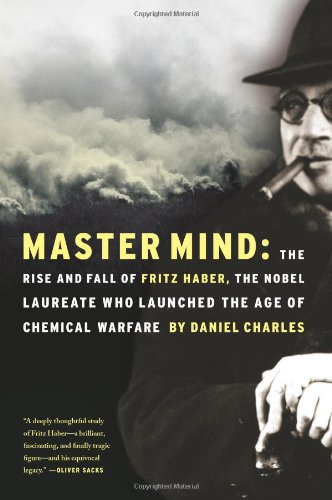
| 1. Master Mind: The Rise and Fall of Fritz Haber, the Nobel Laureate Who Launched the Age of Chemical Warfare by Daniel Charles | |
 | Hardcover: 336
Pages
(2005-08-01)
list price: US$24.95 -- used & new: US$2.95 (price subject to change: see help) Asin: 0060562722 Average Customer Review: 
Canada | United Kingdom | Germany | France | Japan |
|
Editorial Review Product Description FRITZ HABER -- a Nobel laureate in chemistry, a friend of Albert Einstein, a German Jew and World War I hero -- may be the most important scientist you have never heard of. The Haber-Bosch process, which he invented at the turn of the twentieth century, revolutionized agriculture by converting nitrogen to fertilizer in quantities massive enough to feed the world. The invention has become an essential pillar for life on earth; some two billion people on our planet could not survive without it. Yet this same process supplied the German military with explosives during World War I, and Haber orchestrated Germany's use of an entirely new weapon -- poison gas. Eventually, Haber's efforts led to Zyklon B, the gas later used to kill millions -- including Haber's own relatives -- in Nazi concentration camps. Haber is the patron saint of guns and butter, a scientist whose discoveries transformed the way we produce food and fight wars. His legacy is filled with contradictions, as was his personality. For some, he was a benefactor of humanity and devoted friend. For others, he was a war criminal, possessed by raw ambition. An intellectual gunslinger, enamored of technical progress and driven by patriotic devotion to Germany, he was instrumental in the scientific work that inadvertently supported the Nazi cause; a Jew and a German patriot, he was at once an enabler of the Nazi regime and its victim. Master Mind is a thought-provoking biography of this controversial scientist, a modern Faust who personifies the paradox of science, its ability to create and to destroy. It offers a complete chronicle of his tumultuous and ultimately tragic life, from his childhood and rise to prominence in the heady days of the German Empire to his disgrace and exile at the hands of the Nazis; from early decades as the hero who eliminated the threat of starvation to his lingering legacy as a villain whose work led to the demise of millions. Customer Reviews (11)
| |
| 2. Enriching the Earth: Fritz Haber, Carl Bosch, and the Transformation of World Food Production by Vaclav Smil | |
 | Paperback: 338
Pages
(2004-04-01)
list price: US$27.00 -- used & new: US$21.97 (price subject to change: see help) Asin: 0262693135 Average Customer Review:
Canada | United Kingdom | Germany | France | Japan |
|
Editorial Review Product Description Customer Reviews (4)
"In the United Kingdom more than half of all nitrogen fertilizer has been applied to grasslands.A Royal Society study found that in the late 1970s average applications on pastures surpassed the inputs to arable land (172 vs. 135 kg N/ha), and that synthetic compounds accounted for 57-63% of all inputs.The overall use of fertilizer nitrogen in the United Kingdom rose by almost 50% between the late 1970s and the mid 1980s, but it declined afterwards, and its average during the late 1990s has been only about 20% higher than a generation earlier, which means that the synthetic fertilizers supply between 65 and 70% of all nitrogen inputs.But high-yielding winter wheat -- the 1998 mean was 7.97 t/ha -- still receives more than 180 kg N/ha, double the amount applied in 1970 when the yield was around 4 t/ha, and the secular correlation between the rising applications of inorganic nitrogen and rising harvests is obvious (fig. 7.8)." Now imagine 300 more pages of text just like that, and you get the idea.There is no *story* here, just data.It's a shame, because there is definitely a story to be told. The material on the Haber process itself is better, but not great.In particular, the author can't seem to choose the level of the audience: descriptions of chemistry alternate between being too simplistic and assuming too much.Details essential to understanding often seemed to be missing, while details of no apparent relevance are in abundance.I don't really care whether the process takes place under 137 vs. 152 atmospheres; but I do care *why* the pressure is so critical, which is never explained. I really wanted to like this book more than I did.There *is* plenty of good material here, but you have to sort through a lot of empty statistics to get it, and the omission of key pieces of scientific explanation makes for a painfully frustrating read.
The book can get a little technical at times, with chemical formulas and schematics of the instruments.While I found this information useful, some people might find it overwhelming.If you skip over the techincal parts, the book is very well written for the average person. These little known scientists really changed the world as we know it.When you think about it, what has Einstein done for you lately?These guys put food on the table. ... Read more | |
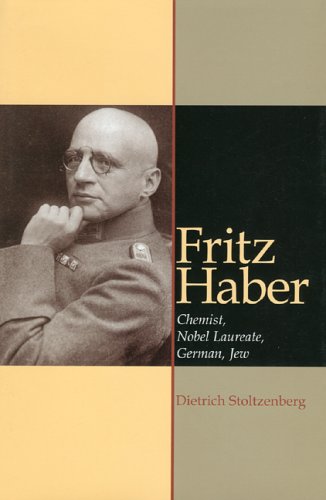
| 3. Fritz Haber: Chemist, Nobel Laureate, German, Jew: A Biography by Dietrich Stoltzenberg | |
 | Hardcover: 336
Pages
(2005-06-01)
list price: US$40.00 -- used & new: US$40.00 (price subject to change: see help) Asin: 0941901246 Average Customer Review: 
Canada | United Kingdom | Germany | France | Japan |
|
Editorial Review Product Description Customer Reviews (3)
| |
| 4. Fritz Haber - Chemiker Nobelpreistrager Deutscher Jude (German Edition) by D Stoltzenberg | |
 | Paperback: 683
Pages
(1999-10)
list price: US$47.00 Isbn: 3527295739 Average Customer Review:
Canada | United Kingdom | Germany | France | Japan |
|
Editorial Review Product Description Customer Reviews (1)
Fritz Haber was one of the most important, and now almost unknown, scientists ofthe early 20th Century - and one of the most ambivalent of all German Jews. Haber discovered a process for fixing atmospheric nitrogen, thus makingpossible the development of artificial fertilizers - and freeing Germanyfrom dependence on imported nitrate for the production of gunpowder.Hewas the true father of the Green Revolution, "the man who broughtbread from the air" - and the man who almost won the first World Warsingle-handedly for Germany, for without gunpowder production fromnitrogren fixation, Germany, cut off from nitrate imports, could not havestayed in the first World War, or begun the second - only to be dismissedby the Nazis and die in exile in Switzerland.But this is not why Haber'sname is not spoken.It was Fritz Haber,patriotic German Jew, who createdpoison gas.And that is why Haber has been not so much overlooked, asdeliberately ignored. Stoltzenberg's book therefore fills a substantialgap.This review is written from the German text, which is clear andstraightforward with few rhetorical flourishes, although highly technicalin places.Those looking for pop psychoanalysis or gruesome battlefieldscenes will be disappointed, as the tone is restrained and understatedthroughout.Stoltzenberg has unusual advantages in handling this difficultsubject.He is a professional chemist himself, the son of a chemist whowas a close associate of Haber during and after WWI, had access to materialcollected for a biography in the 1950s but unwritten at that time, andsupplemented that with years of research in government and privatearchives.This massive book is meticulously documented, almost entirelyfrom contemporary sources, most never published, and will surely be thestandard biography. Apologists for Haber's close friend, Albert Einstein,have excused his work on the atomic bomb on the grounds that he was reallyan abstract scientist, who didn't understand what he was doing, and thatanyway he was a pacifist who acted only because of the Holocaust. Stoltzenberg makes it clear that these excuses don't apply to Haber.Haberwas an intensely patriotic German.He deliberately invented poison gas (orrather a whole family of gases).He persuaded the government into its use,over the initial opposition of the army; was present at the first gasattack at Ypres (and always felt afterwards that if the army had believedhim, and had been ready to follow up with a full-scale attack through thebroken French and British lines, the war could have been won at that point- and at least a few historians have agreed with him).He organized theentire system of gas research, production, and supply, including thedevelopment and production of gas masks, and was present at numerous otherattacks on both the western and eastern fronts. Stoltzenberg describes himas "besessen" -obsessed. He continued gas research secretly afterthe war, passing off the post-war development of Zyklon under the noses ofthe Allied Control Commission as a pesticide.And he never apologized orfelt that he had acted wrongly. However, the book is not limited toHaber's wartime activities.Stoltzenberg also discusses in equal detailthe rest of Haber's life.These subjects include: his pre-war years inKarlsruhe, according to the author, the happiest and most successful of hislife, and the development of the nitrogen fixation process, including thecomplicated negotiations between the university, industry, and government;the equally complicated negotiations over Haber's move to Berlin, and thecreation of an entirely new division of the Kaiser Wilhelm (now MaxPlanck)Institute, lavishly financed and built to Haber's specifications;the years spent rebuilding the Institute after the war; the controversialaward of the Nobel Prize; his failed search for gold in sea water; and hispersonal life.As might be expected of a man who was effectively marriedto his work, Haber's two marriages were both failures; his first wife shotherself and his second ended in divorce.His closest relationships werewith his colleagues, and here he shone, being regarded with tremendousrespect and affection.Haber was never a solitary genius, but a hands-onand hugely effective team leader, who could organize and inspireoutstanding work in the most difficult circumstances. The dismissal ofJews by the Nazis was a particularly devastating blow to Haber, a manutterly indifferent to religion, but who had always felt himself as, andbeen regarded by the German government as, an intense patriot.However,the story that Hitler personally called Haber into his office and fired himwas apparently a journalistic fantasy; according to Stoltzenberg, it wasMax Planck who demanded a personal interview with Hitler in order to pleadfor his Jewish colleagues, and who personally endured Hitler's irrationalranting.The experience was not repeated.Haber left for England, but wasnot especially happy.He died in Switzerland, and was buried there. Stoltzenberg accepts the official view that Haber, having been ill foryears, not least due to his own constant exposure to poisonous gases, died,in the presence of his son and his own doctor, of a heart attack - or, of abroken heart. This is not a book for the casual reader,and Jews especially may find it emotionally painful.However, thosereaders with a serious interest in Haber, the history and sociology ofscience, the military history of WWI, German Jews, or the Holocaust willfind it well worth their effort and expense. ... Read more | |
| 5. Fritz Haber, 1868-1934: Eine Biographie (German Edition) by Margit Szollosi-Janze | |
 | Hardcover: 928
Pages
(1998)
-- used & new: US$79.56 (price subject to change: see help) Asin: 3406435483 Canada | United Kingdom | Germany | France | Japan |
| 6. Between Genius And Genocide The Tragedy Of Fritz Haber, Father Of Chemical Warfare by Daniel Charles | |
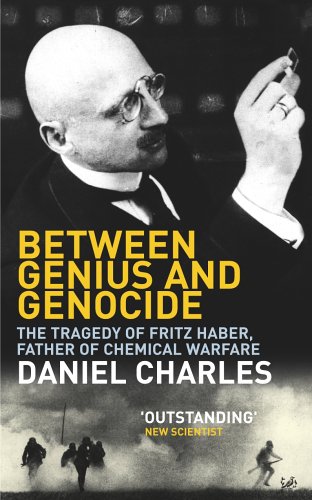 | Paperback: 336
Pages
(2006)
Isbn: 1844130924 Canada | United Kingdom | Germany | France | Japan |
| 7. Story of Fritz Haber by Morris Goran | |
| Hardcover: 212
Pages
(1967-12)
list price: US$15.95 Isbn: 0806107561 Average Customer Review: 
Canada | United Kingdom | Germany | France | Japan | |
Customer Reviews (2)
| |
| 8. Gazelles and Their Relatives: A Study in Territorial Behavior (Noyes Series in Animal Behavior, Ecology, Conservation, and Management) by Fritz R. Walther, Elizabeth C. Haber, Gerald A. Grau | |
 | Hardcover: 252
Pages
(1984-01-14)
list price: US$99.95 -- used & new: US$91.73 (price subject to change: see help) Asin: 0815509286 Canada | United Kingdom | Germany | France | Japan |
|
Editorial Review Product Description | |
| 9. Grundriss Der Technischen Elektrochemie Auf Theoretischer Grundlage (German Edition) by Fritz Haber | |
 | Paperback: 594
Pages
(2010-04-02)
list price: US$44.75 -- used & new: US$24.77 (price subject to change: see help) Asin: 1148335927 Canada | United Kingdom | Germany | France | Japan |
|
Editorial Review Product Description | |
| 10. Thermodynamik Technischer Gasreaktionen: Sieben Vorlesungen (German Edition) by Fritz Haber | |
| Paperback: 320
Pages
(2010-04-09)
list price: US$30.75 -- used & new: US$18.06 (price subject to change: see help) Asin: 1148742301 Canada | United Kingdom | Germany | France | Japan | |
|
Editorial Review Product Description | |
| 11. Thermodynamics of technical gas-reactions: seven lectures by Fritz Haber, Arthur Becket Lamb, William L Jolly | |
 | Paperback: 380
Pages
(2010-08-24)
list price: US$33.75 -- used & new: US$23.03 (price subject to change: see help) Asin: 1177672499 Canada | United Kingdom | Germany | France | Japan |
|
Editorial Review Product Description | |
| 12. Les apprentis sorciers: Haber, von Braun, Teller (Science ouverte) (French Edition) by Michel Rival | |
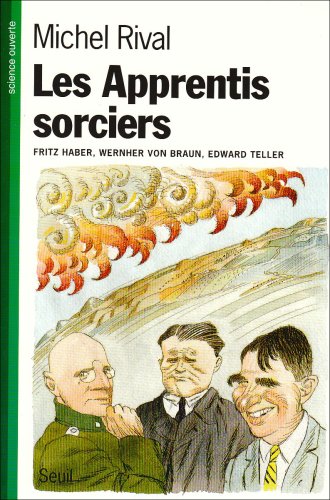 | Paperback: 234
Pages
(1996)
-- used & new: US$49.99 (price subject to change: see help) Asin: 2020215152 Canada | United Kingdom | Germany | France | Japan |
| 13. The Chemical Industry: 1900-1930 : International Growth and Technological Change by Ludwig Fritz Haber | |
| Hardcover: 448
Pages
(1971-06)
list price: US$24.75 Isbn: 0198581335 Canada | United Kingdom | Germany | France | Japan | |
| 14. The idol of progress: the pursuit of knowledge was his true faith. And in many ways, it remains ours today.(Fritz Haber): An article from: Sojourners Magazine by Daniel Charles | |
| Digital: 7
Pages
(2006-08-01)
list price: US$9.95 -- used & new: US$9.95 (price subject to change: see help) Asin: B000JJ4IY6 Canada | United Kingdom | Germany | France | Japan | |
|
Editorial Review Product Description | |
| 15. German Chemical Engineers: Fritz Haber | |
 | Paperback: 38
Pages
(2010-05-31)
list price: US$14.14 -- used & new: US$14.13 (price subject to change: see help) Asin: 1156289653 Canada | United Kingdom | Germany | France | Japan |
|
Editorial Review Product Description | |
| 16. Naissance à Wroclaw: Fritz Haber, Edith Stein, Christian Wolff, Ernst Cassirer, Norbert Elias, Manfred Von Richthofen, Günther Anders (French Edition) | |
| Paperback: 404
Pages
(2010-08-04)
list price: US$47.42 -- used & new: US$36.04 (price subject to change: see help) Asin: 1159826803 Canada | United Kingdom | Germany | France | Japan | |
|
Editorial Review Product Description | |
| 17. Haber, Fritz: An entry from Macmillan Reference USA's <i>Chemistry: Foundations and Applications</i> by Joachim Schummer | |
| Digital: 2
Pages
(2004)
list price: US$2.90 -- used & new: US$2.90 (price subject to change: see help) Asin: B000M4QFV2 Canada | United Kingdom | Germany | France | Japan | |
|
Editorial Review Product Description “Chemistry: Foundations and Application” is an accessible four-volume set that covers chemistry’s laws, processes, applications and sub-disciplines, reviews the history of the field, including modern research and practical applications, and includes biographies of scientists past and present. Varied topics that examine and explain chemistry's many branches, including inorganic, industrial, atmospheric and computational chemistry, and biotechnology allow students and general-interest readers alike to explore the myriad ways in which chemistry plays an important role in daily life. | |
| 18. Biography - Haber, Fritz (1868-1934): An article from: Contemporary Authors Online by Gale Reference Team | |
 | Digital: 8
Pages
(2006-01-01)
list price: US$9.95 -- used & new: US$9.95 (price subject to change: see help) Asin: B0007SHJDQ Canada | United Kingdom | Germany | France | Japan |
|
Editorial Review Product Description | |
| 19. Chimiste Allemand: Wilhelm Ostwald, Friedrich Wöhler, Kurt Alder, Otto Paul Hermann Diels, Fritz Haber, Justus Von Liebig, Friedrich Accum (French Edition) | |
 | Paperback: 400
Pages
(2010-08-01)
list price: US$47.05 -- used & new: US$35.76 (price subject to change: see help) Asin: 1159639256 Canada | United Kingdom | Germany | France | Japan |
|
Editorial Review Product Description | |
| 20. Technical University of Berlin Alumni: Wernher Von Braun, Albert Speer, Eugene Wigner, Konrad Zuse, Fritz Haber, Alfred Stieglitz | |
 | Paperback: 272
Pages
(2010-09-14)
list price: US$35.16 -- used & new: US$26.72 (price subject to change: see help) Asin: 1155757769 Canada | United Kingdom | Germany | France | Japan |
|
Editorial Review Product Description | |
| 1-20 of 45 | Next 20 |
 sloppy history
 Too many statistics, not enough science and history
 Full of information; scientific, personal, and political.