e99 Online Shopping Mall

Geometry.Net - the online learning center Help  
Home  - Nobel - Heisenberg Werner (Books)

  1-20 of 100 | Next 20
A  B  C  D  E  F  G  H  I  J  K  L  M  N  O  P  Q  R  S  T  U  V  W  X  Y  Z  

click price to see details     click image to enlarge     click link to go to the store

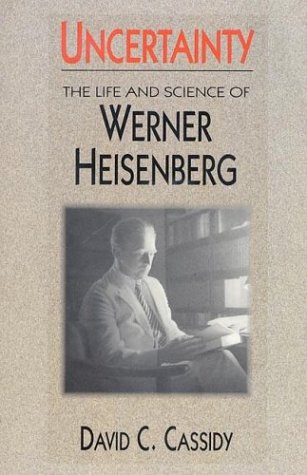
1. Uncertainty: The Life and Science
$7.91
2. Physics and Philosophy: The Revolution
$12.00
3. Encounters with Einstein
$14.99
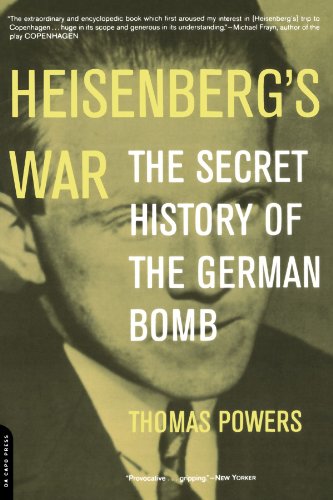
4. Heisenberg's War: The Secret History
 
5. The physical principles of the
 
6. Physics and beyond;: Encounters
$15.00
7. Werner Heisenberg : A Bibliography
$12.00
8. Michael Frayn's "Copenhagen" in
$17.95
9. Philosophical Problems of Quantum
$65.43
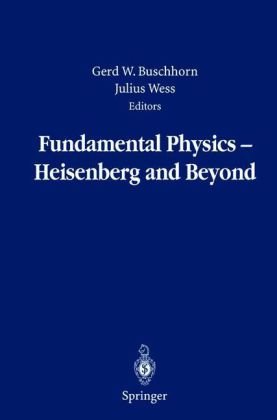
10. Fundamental Physics - Heisenberg
 
11. Die Jahrhundertwissenschaft: Werner
$21.95
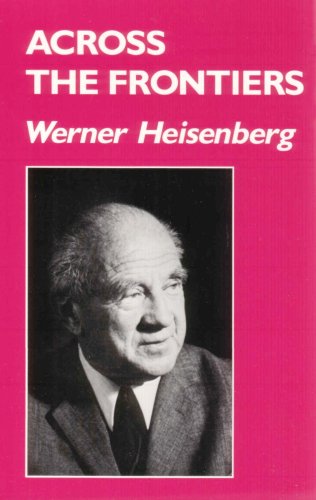
12. Across the Frontiers
 
13. Quantum mechanics and objectivity;:
 
14. Inner Exile: Recollections of
 
15. Werner Heisenberg, 1901-1976
 
$1.95
16. Heisenberg, Werner: An entry from
 
17. Das politische Leben eines Unpolitischen:
 
18. Quantum Mechanics and Objectivity
19. Werner Heisenberg. Das selbstvergessene
 
20. Bayerische Gestalten: 74 Lebensbilder

1. Uncertainty: The Life and Science of Werner Heisenberg
by David C. Cassidy
Paperback: 688 Pages (1993-08-15)
list price: US$21.95
Isbn: 0716725037
Average Customer Review: 4.5 out of 5 stars
Canada | United Kingdom | Germany | France | Japan
Editorial Review

Book Description
Werner Heisenberg's genius and his place at the forefront of modern physics are unquestioned. His decision to remain in Germany throughout the Third Reich and his role in Hitler's atomic bomb project are still topics of heated debate. UNCERTAINTY is David Cassidy's compelling portrait of this brilliant, ambitious, and controversial scientist. It is the definitive Heisenberg biography, as well as a striking evocation of the development of quantum physics, the rise of Nazism, and the dawn of the atomic age. ... Read more

Customer Reviews (8)

5-0 out of 5 stars Complete biography
As the reviews in at the backcover stated, the writer deals thoroughly and fairly with the controversies surrounding this great scientist. This book gives a good overview of the man himself, his science, and the times he lived through. It is one of those works of enormous scope, that will probably not be topped. Just like the Making of the Atomic bomb or other alike tour the force works, it makes me wonder how many letters, sources, and interviews must have been worked through to make the picture come alive.
This is the definitive work on Heisenberg, and it gives also the best explanation of how the quantum Copenhagen interpretation as well as the uncertainty principle work! So it is recommended for historians, for scientists, or people who have an interest in both. Very highly recommended!

5-0 out of 5 stars Great stuff!!
"Uncertainty" is an outstanding piece of biographical and history of science writing.The only shortcomings of the book, in my view, are: 1) the short shrift it gives to WH's life and career post-WWII; and 2) its sometimes overly abstruse exposition of WH's science.Concerning this last point, Cassidy is clearly writing for an expert (or at least highly sophisticated lay) audience.Though I got the gist of much of the specialist detail in "Uncertainty", I would have appreciated and greatly profited from some more general discussion along the way.That said, Cassidy paints the science in sufficiently broad strokes that even the non-specialist can grasp (with some effort!) something of the beauty and complexity of quantum physics.I have always been fascinated with quantum physics.Having just finished "Uncertainty" I am all the more intent on brushing up my math and doing some serious study of the discipline.Books like "Uncertainty" inspire the quest for knowledge.Cassidy is to be commended.

5-0 out of 5 stars WOW what a book - 5 stars*****
A must for everyone. I would like to express my gratitude to his wife Janet for her many years of encourangement.If it was not for her would this great book have been created?Thank you Janet for the awesome book ( and i almost forgot to the author David Cassidy)

4-0 out of 5 stars A very serious book about a very serious matter
This book is not for the lighthearted.It is an excellent account of the life of Werner Heisenberg and of the strong nationalism that blinsided him to the situation in Nazi Germany. His brilliance as a first rate physicist notwithstanding, the book shows by example what happens to science when it becomes totally subservient to a totalitarian regime and shows the problems of regional politics overtaken by a ruthless dictator in the funding of science.The fine line that Heisenberg walked did not diminished his scientific accomplishment but did not excuse him from his participation in a scientific enterprise that could very well have changed the course of history had it been successful, a Nazi A-bomb.The book is also a lesson on the results of elitism in science and it shows how the Nazis cheated themselves from an even greater role in nuclear physics because of their policies.

4-0 out of 5 stars Heisenberg is Great
This book is superb as a biography and as history of Quantum Mechanics. As you read the pages you grow together with Heisenberg in his daily life and his achievements in Physics. You start to understand how the Quantum Mechanics was founded, how trial and error methods eventually developed into such a fundemental theory. The book is very voluminious but if you have patient in reading it on each line you live the life of a great man. I found it very interesting that even though he is one of the great founders of the Quantum Physics, he had more vacations than me and enjojed the life better than me. It shows that to be a good scientist you just have to carry your brain and think while wandering in the country side. Isn't it great. Apparently he did not even know Matrix Theory until Bohr showed him. Every page is full with history, science and suprise. Story is so vivid that you can even visualise the streets of Munich or other German towns as you read the book. Grat book,a lot of pages in fine print but worth of it. ... Read more


2. Physics and Philosophy: The Revolution in Modern Science
by Werner Heisenberg
Paperback: 256 Pages (2007-05-01)
list price: US$13.95 -- used & new: US$7.91
(price subject to change: see help)
Asin: 0061209198
Average Customer Review: 5.0 out of 5 stars
Canada | United Kingdom | Germany | France | Japan
Editorial Review

Book Description

The seminal work by one of the most important thinkers of the twentieth century, Physics and Philosophy is Werner Heisenberg's concise and accessible narrative of the revolution in modern physics, in which he played a towering role. The outgrowth of a celebrated lecture series, this book remains as relevant, provocative, and fascinating as when it was first published in 1958. A brilliant scientist whose ideas altered our perception of the universe, Heisenberg is considered the father of quantum physics; he is most famous for the Uncertainty Principle, which states that quantum particles do not occupy a fixed, measurable position. His contributions remain a cornerstone of contemporary physics theory and application.

... Read more

Customer Reviews (12)

5-0 out of 5 stars a physicist with philosophical depth
This is an excellent work due in large part to Heisenberg's acumen both as a physicist and a philosopher.Unfortunately,even some of the great physicists have been somewhat shallow philosophers.For whatever reason(probably the fact that his father was a professor of classical studies),Heisenberg had a very good grasp of many philosophical viewpoints.He was able to mostly avoid the cartesian bifurcation that traps most physicists even to this day.He understood that much of the "trouble" with Quantum Mechanics was caused by our unwillingness to let go of the bad metaphysical assumptions that became implicit in classical physics.Overall, this is an excellent book for anyone who wants to understand the beauty of Quantum Mechanics with eyes wide open.

5-0 out of 5 stars From one observer to another
As I was reading this intelligent and provocative manuscript, I could not help think why this was not part of my undergraduate physics course. For anyone who wants to know how quantum physics came to be, this is certainly the book to read. I was completely surprised how many of the aspects of modern science we take for granted today would not be in the classroom if not for quantum physics. The linking to classical philosophy was equally stirring.

5-0 out of 5 stars Truly Brilliant
I am not sure that anyone truly appreciates the fundamentals of quantum physics.But, for someone who has done a great deal of reading on the topic and possesses an advanced degree in a relatively unrelated field (clinical psychology), this is a very readable book on Heisenberg's thinking related to quantum physics.For those who know anything about quantum physics, however, it cannot be overemphasized that this is, in fact, only one perspective on quantum physics (though, probably, the most accepted).Heisenberg was one of the originators (along with Wolfgang Pauli and, particulary, Niels Bohr) of the Copenhagen interpretation of quantum physics.For anyone interested in a more deep analysis of the thought that went along with the development of this incredibly groundbreaking thoery, I recommend this book highly!

5-0 out of 5 stars Classic introduction to quantum reality and implications for Philosophy
Since the 17th century, philosophers have been struggling with the implications science has for classical philosophical questions.In a way, the relationship between science and philosophy is one that has always occured in Western philosophy; Socrates, Plato, Aristotle, and also the medievals grappled with science and what relation it had to philosophy, but with the apparent triumph of science in the 20th century as mankind's premier way of knowledge, the questions are all the more urgent.

While Heisenberg wrote this book seventy or so years ago, it remains a classic for two reasons.One, Heisenberg himself was one of the pioneers of quantum mechanics, and second, he is widely read in the Western philosophical tradition.He shows an excellent understanding of Aristotle and Kant, and proceeds to argue where he feels philosophers have it right, and wrong, in the light of science.Like many scientists he argues for a more process based approached to the world rather than seeing reality as a static and timeless entity, and that space is not really empty and that the microworld is different from the macroworld and is more a place of potentiality than actuality.

This work remains a beautiful exploration of the relationship between two ways of exploring the world and is essential reading for philosophers and scientists alike.

4-0 out of 5 stars Lots of great ideas but...
For reader response contact respectfulempiricist@yahoo.com

Like so many great thinkers, Heisenberg attempts to create a unifying philosophy about the sciences. He seeks to correlate human behavior and beliefs with physics. With scientific breakthroughs theories become more abstract and it makes it more difficult to understand. The lectures that form this book explain the events leading to his famous theory, the relevance of Physics to philosophy and the moral imperatives of scientists.

Werner Heisenberg, the renowned physicist and 1932 Nobelist, is remembered by most of us as the developer of the Theory of Indeterminacy.Simply put, "The more precisely the Position (of a particle) is determined, the less precisely its Momentum is known" This Theory was developed in an intensive "Think Tank" conference that took place in Copenhagen in 1927.

He describes of how the abstruse proofs of Physics (as well as other sciences) must be made comprehensible to lay people. The accelerated changes in the sciences are based on the ever increasing new information and discovery. This creates a cognitive dissonance in the public and a common way to deal with that mental rift is reactionary. The results of scientific thinking may contradict some of our common ideas as those ideas become beliefs rather than science. Through folklore or youthful and innocent experimentation or by other means we often come to understand aspects of the world that have no basis in reality. We want to cling to them in the face of sound theory.

The book is a complicated effort. Heisenberg wants us to be thinking of the impact of scientific advance on our society and values. His is a liberal perspective. This seems to be routine for the leading physicists who worked in early atomic fission. His presentation is not woven together neatly and the book requires rereads and extensive notes in order to make sense of it. The book also contains several different messages. Another reviewer may read the same book and find different aspects of it to be the kernel of Heisenberg's intent.

The fact that it is awkwardly compiled requires intensity on the reader's part. Ultimately it is felt that Heisenberg points are taken, are sincere and that he sought a better future based on scientific breakthrough and design.
... Read more


3. Encounters with Einstein
by Werner Heisenberg
Paperback: 152 Pages (1989-10-01)
list price: US$17.95 -- used & new: US$12.00
(price subject to change: see help)
Asin: 0691024332
Average Customer Review: 4.5 out of 5 stars
Canada | United Kingdom | Germany | France | Japan
Editorial Review

Book Description

In nine essays and lectures composed in the last years of his life, Werner Heisenberg offers a bold appraisal of the scientific method in the twentieth century--and relates its philosophical impact on contemporary society and science to the particulars of molecular biology, astrophysics, and related disciplines. Are the problems we define and pursue freely chosen according to our conscious interests? Or does the historical process itself determine which phenomena merit examination at any one time? Heisenberg discusses these issues in the most far-ranging philosophical terms, while illustrating them with specific examples.

... Read more

Customer Reviews (4)

5-0 out of 5 stars Excellent book
This is one of the most fluent book written over modern physics even for the non-physicist. His ideas on scientific tradition and scientific prejudice is quite striking. Definitely recommended. This is one book which I wished to be thicker...

5-0 out of 5 stars Essays from Heisenberg's Later Years, 1972-1975
These essays were first published by Seabury Press in 1983 under the title Tradition in Science. A new edition, titled Encounters with Einstein And Other Essays on People, Places, and Particles, was published in 1989 by Princeton University Press.

Throughout his life Werner Heisenberg shared his enthusiasm for physics and philosophy, frequently giving presentations to general audiences. Several essays address the history of quantum physics. Others are more technical and include topics like cosmic radiation, particle physics, and closed-theories in physics. All essays are well-crafted and should be accessible to a wide audience.

Heisenberg only met Einstein on a few occasions. The title essay, Encounters with Einstein, describes these encounters, including a final meeting at Princeton a few months before Einstein's death. While he admitted that he had never discussed politics with Einstein, Heisenberg did comment on Einstein's pacifism. Heisenberg does not discuss his own beliefs, nor his role in WWII Germany.

At several points in this collection Heisenberg expresses his concerns with the theoretical direction that particle physics was taking in the early 1970s. In his essay "What is an Elementary Particle?", he expresses his doubts regarding quark theory. It was interesting to see Heisenberg in one essay lamenting Einstein's reluctance to accept quantum theory while elsewhere he himself was having difficulty with quark theory.

I highly recommend these essays for any reader wishing to become more acquainted with Heisenberg. Also, as a follow-up I suggest reading Philosophical Problems of Quantum Physics, a collection of Heisenberg's lectures that span 1932-1948.

The more persistent reader might be interested in Physics and Philosophy: The Revolution in Modern Science.This work by Heisenberg is more philosophical and requires careful reading. This volume benefits from a lengthy and scholarly overview by F. S. C. Northrop, Sterling Professor of Philosophy and Law, Yale University.

4-0 out of 5 stars The retrospective of a man with a two-sided past
This book reminds me a great deal of, "A Mathematician's Apology" by Hardy. Like Hardy, Heisenberg is in his last years, and knows that his productive ones are behind him. Therefore, he puts forward a series of essays and lectures that are a retrospective of his activity in physics as well as some philosophical thoughts concerning where he believes it is going.
Heisenberg was a Nobel prize winner and the first enunciator of the uncertainty principle that bears his name. For these reasons, his thoughts on some of the consequences of the principle are well worth reading. However, Heisenberg is also known for other, more dark reasons. He was the director of the German atomic projects in World War II and seemed to have little difficulty in working under the Nazi tyranny while many of his colleagues were hounded and executed. He also proved to be an effective survivor, becoming the head of the Max Planck Institute of Physics in West Germany after the war.
This involvement with the Nazis makes the chapter "Encounters and Conversations with Albert Einstein" fascinating reading. From it, you would not know about his record of collaboration with the regime that tried to exterminate Einstein and his ideas. One must read that chapter very carefully and do a great deal of reading between the lines to really understand what is being said. The fact that Einstein was willing to meet with Heisenberg after the war tells a lot more about Einstein that it does about Heisenberg.
This book is interesting as much for what is not said as it is for what is said. This was an opportunity for Heisenberg to say something about his involvement in some very bad things as well as to put forward thoughts about physics. The first was missed and the second was a hit. If you are interested in some thoughts about how physics has evolved this century from one of best practitioners, then this is a book that will interest you.

4-0 out of 5 stars Insight and inspiration
This is an excellent bedside book for anyone interested in the development of quantum mechanics by one of its primary discoverers. This small book of short essays provides insight into the life and personality of one of thegreatest (and most enigmatic) physicists of the 20th century.This is nota technical book, nor is it an introduction to (or explaination of) quantumtheory. Rather, each essay provides a unique sidebar on a variety of topicsto which WH has either contributed directly or considered in detail.Heisenberg is a lucid and concise writer of remarkable insight. ... Read more


4. Heisenberg's War: The Secret History of the German Bomb
by Thomas Powers
Paperback: 644 Pages (2000-07-01)
list price: US$27.50 -- used & new: US$14.99
(price subject to change: see help)
Asin: 0306810115
Average Customer Review: 4.0 out of 5 stars
Canada | United Kingdom | Germany | France | Japan
Editorial Review

Book Description
The inspiration for Michael Frayn's Tony Award-winning play Copenhagen, Heisenberg's War tells of the interplay between science and espionage, morality and military necessity, and paranoia and cool logic that marked the German bomb program and the allied response to it. On the basis of dozens of interviews and years of research, Thomas Powers concludes that Werner Heisenberg, who was the leading figure in the German atomic effort, consciously obstructed the development of the bomb and in a famous 1941 meeting with his former mentor Neils Bohr in effect sought to dissuade the Allies from their pursuit of the bomb. ... Read more

Customer Reviews (15)

5-0 out of 5 stars The relative nature of history
This is a solid, well-researched book that presents Heisenberg ina fair light, for once.

One of the problems with reader/reviewer bias is that many people are pre-disposed to finding fault with any suggestions that conflict with what they want to hear or believe. Regarding the Farm Hall recordings, some people have latched onto the idea that Heisenberg and others knew of the build up of the Holocaust, but continued to work for the Bomb project.

What they are usually referring to is a section in which Heisenberg talked about five Jewish scientists, whom he obviously cared about, who had been arrested and later killed; and even though Heisenberg was talking openly about putting out feelers to see if they could be helped or saved (which alone could have put him at great risk), this somehow translates into guilt in some people's eyes.

As for him 'not co-operating with Hitler'... nobody in their right mind could possibly think that was an option. As I believe the book shows, Heisenberg did the next best thing, which was to work half-heartedly on the German Bomb. He basically killed it in 1942.

The fact that Heisenberg could come up with the correct basic bomb structure - path and critical mass analysis, in very short order almost certainly means that he could have brainstormed the right methodology years earlier if the German scientists had been 100% committed to producing a bomb for Hitler. If they had been Nazis.

To me, this fine book is one more step in the right direction, in underscoring the very fact that not all Germans were Nazis.

Hitler may have been a charismatic leader, but he made so many catastrophic errors, such as the insane decision to declare war on the USA in the hope that the Japanese would help him against the Russians - they never lifted a finger - that it is as true to say that Hitler lost the War as to say that the Allies won it.

A fair and highly recommended book.

2-0 out of 5 stars Somewhat dull / Unconvincing Theme
My first criticism is that the book has way too much minutia which made it dull.I had to really plough through some of it and my reading was interruped by many naps.

The second criticism is of the main thesis:That Werner Heisenberg sabotaged the German bomb effort deliberately.I believe his comment at Farm Hall ("How could the Americans have separated two tons of U235?") was a spontaneous statement made by a man who had, until that moment, believed that he was the leader of the pack, and suddenly realized he was the Captain of the Bavarian Little League.It was a reflection of his confusion, shock and ego deflation, not a calculated deception of his fellow scientists.I just looked at the design specs of his Uranium machine in Haigerloch and it has no control rods.More confusion! It is difficult to recapture the total gestalt of the German scientist's predicament.Some of the parts of it were fear of failure.Associated with this is a lack of boldness on any of their parts.There was no Groves in Germany (as in Leslie R. Groves). If you work for Franklin Roosevelt and spend 2 billion dollars and fail, you would get fired and spend the rest of your life testifying before Congress.Do that with Hitler and you wouldn't get fired, you would get fired upon!There was a belief on the part of the nazi gov. that the war would be won soon.The held from 1930 until 1942.No sense of urgency!But Heisenberg was not an engineering physicist.He was no Fermi.That is part of it too.To say he sabotaged the German program as part of a heroic effort is simple historical revisionism for the purpose of presenting a new twist.

If you read this, read "Hitler's Uranium Club" by Jeremy Bernstein to get the right balance on this.

2-0 out of 5 stars Scholarly but unpersuasive -- and heavy with details
While I found this book interesting and informative when it dwelled upon the personalities and contributions of the physicists who discovered and explored the field of quantum mechanics prior to WW2, I found two problems with the book as it entered the war.First, it spent too much time, at least for me, on the details of minor episodes and players.In this sense, I might have appreciated the treatment had I been a scholar researching the field - but I wasn't.Hence, I often found the reading dull.Second, I found Powers' ultimate thesis - that Heisenberg purposefully delayed the German atomic bomb program - unpersuasive.It appeared to me that Powers often strained his interpretation of the facts to make them conform to his thesis.For example, when reviewing Heisenberg's "Farm Hall" statement in August 1945 that two tons of U235 was required to make an atomic bomb, Powers suggests that because Heisenberg articulated the appropriate lesser amount a week later,and because he purportedly suggested at an earlier date that a bomb could be the size of a football, his "two ton" statement was a purposeful "error." Equally persuasive, if not more, is the simple thought that Heisenberg did indeed grossly overestimate what was required, thereby prompting him to tell Speer in 1942 that a bomb was impractical. This is not to say that Powers is necessarily wrong.I simply believe that based on the facts he presents, the issue remains debatable.

5-0 out of 5 stars One of the best written books I have ever read!
This book is amazing on so many different levels I am not really sure where to begin. It is an amazingly well written, compelling, insightful, and utterly fascinating book on it's own. Fortunately, it is so much more than just a really well written book, it is TRUE story that everyone needs to read. It is book about a true hero, a courageous man who risked his life and his reputation to save tens of millions of lives. I don't really want to give too much away, but it answers a question that many World War 2 historians want to know: WHY didn't the Germans create the Atomic Bomb? Well, there is one word for why, Heisenberg. This man stayed in Germany and deliberately sabotaged the Nazi's attempts to make the bomb.
In a world where people struggle to find heroes and gather up courage it is a shame not many people know this story. I think many people would be amazed at the sacrafices one very proud man would endure to save the world. Please read this book, you will not be disappointed.

5-0 out of 5 stars How History should be written
Heisenberg's War shouldn't be called just Heisenberg's war: it should be called Physics During World War 2 or something of that nature. This book does not concentrate solely on Werner Heisenberg, the great theoretical physicist, but also on the Los Alsos mission of America, specific characters within that mission and other important physicists throughout the world. Knowing little about Physics before reading this book (having only completed an AP course in high school) Powers educates the reader on the basis of Physics that needs to be known to fully understand the book and it's subject. In fact, this book took me 3 months to read, the longest it has ever taken me to read a book, because I would attempt to learn the physics being taught. It was a thoroughly rewarding experience. Nonetheless, if you have no interest in physics, I suggest you skip this book. This was a complete history and Powers managed to get many first hand accounts, most surprisingly, in my opinion, from Carl Friedrich von Weiszacker, Heisenberg's most brilliant pupil and fellow member of the Uranverein (read the book and you'll understand). A new conclusion is drawn about why Heisenberg and his fellow German physicists didn't build an atomic bomb, in contrast to the old conclusion which suggested it was due to, in short, 'bumbling Nazis'. Powers suggests the Heisenberg and his cohorts didn't want to build a bomb for Hitler. Though he does respect the fact that perhaps there were also several important flaws in their thinking; for example, Heisenberg thought a bomb could run with slow molecules, which, apparently, it couldn't (I'm no scientists). Overall, this is a complete history which is, at points, a page turner and I suggest anyone with an interest in the politics behind World War 2 of Physics purchase it. ... Read more


5. The physical principles of the quantum theory,
by Werner Heisenberg
 Unknown Binding: Pages (1951)

Asin: B0007HGDB6
Average Customer Review: 4.0 out of 5 stars
Canada | United Kingdom | Germany | France | Japan

Customer Reviews (6)

1-0 out of 5 stars Bad from title to end
The only thing mysterious here is how this great scientist has managed to muddle up his own theory in this book to the point where its unintelligible.It takes him a chapter to state that the electron does not have a velocity or a path in the classical sense.And why give this book such a blatant appealing title to lure beginners to pay money for this trash.No examples or end-of-chapter problems either.Read Lev Landau instead.

4-0 out of 5 stars A Good Hard Read
I was pleasantly surprised by this book. It uses technical language (which can at times can become difficult), to express the physical context surrounding the development of Quantum mechanics, and deal with the matter at hand (pardon the pun). Quantum theory has a reputation as being difficult, confronting and unbelievable. However this book expresses logically and in detail, the physical principles of the Quantum theory, by the great Werner Heisenberg himself.
A great book if your thought needs provoking...

5-0 out of 5 stars Heisenberg's motivation
Not really for beginners in spite of appearances, this book sketches Heisenberg's path in discovering the canonical commutation rules of quantum mechanics. After trying unsuccessfully for years to quantize the helium atom via the Bohr-Sommerfeld quantization rules (which attempt Einstein had already explained in 1917 to be hopeless, because the classical 3-body problem is nonintegrable), Heisenberg was finally motivated by the example of relativity (where absolute time had to be abandoned) to give up the assumption that the position and momentum of a point particle are simultaneously predictable. To follow Heisenberg's reasoning the reader must first understand action-angle variables in classical mechanics. With Einstein's 1917 paper in hindsight, the three body problem representing the helium atom energy spectrum was finally approximated semi-clasically around 1990 based on a path-integral approximation to a chaotic Hamiltonian system.

5-0 out of 5 stars A classic in quantum mechanics
This book is the standard introduction to - well, to the physical principles underlying the mathematical formalism of quantum mechanics. While it is dated in terms of that mathematical formalism, it has never been superseded in its analyses. Every serious student of quantum physics will encounter it, sooner or later, in the original or in paraphrases in newer monographs on quantum theory.

4-0 out of 5 stars Quantum theory is really misterious !!
This really helping me to understand more about the Quantum Theory, I think this book is need to be read by everyone who study physic or by someone who interested by physical theory. I have been read this book forseveral times and I stil never feel bored. I think this book is reallyinteresting. Thank's ... Read more


6. Physics and beyond;: Encounters and conversations (World perspectives)
by Werner Heisenberg
 Hardcover: 247 Pages (1971)

Asin: B0006D5VMI
Average Customer Review: 5.0 out of 5 stars
Canada | United Kingdom | Germany | France | Japan

Customer Reviews (4)

5-0 out of 5 stars The inspiration for contemporary pragmatism
Heisenberg's two philosophies:

Physics and Beyond contains Heisenberg's most sophisticated statements of his philosophy of quantum theory, and is also a watershed inspiration for the contemporary pragmatist philosophy of science that prevails in academia today.

The mutually contrary philosophies of Einstein and Bohr produced Heisenberg's two inconsistent philosophies of quantum theory.Bohr's influence resulted in Heisenberg's doctrine of closed-off theories in his "Notion of a 'Closed Theory' in Modern Science" in Heisenberg's book titled Across the Frontiers.

Einstein's semantics of observation:

The alternative, which is the contemporary pragmatist philosophy of science, is due to a conversation with Einstein as related in Heisenberg's "Quantum Mechanics and a Talk with Einstein (1925--1926)", the fifth chapter of this book.In this conversation Einstein told Heisenberg that it is the theory that decides what the physicist can observe.This view of the semantics of observation contradicts not only the views of Bohr and the positivists but also Heisenberg's own doctrine of closed-off theories.

In the next chapter, "Fresh Fields (1926-1927)", Heisenberg described his implementation of Einstein's advice: Firstly he reconsidered the idea that what is observed in the cloud chamber is a trajectory, such that the theory that was deciding what is being observed is the Newtonian theory.

Secondly using Einstein's thesis that the theory decides what can be observed, Heisenberg concluded that the processes involved in any experimental observation in microphysics must satisfy the laws of quantum theory. He then derived the mathematics of the uncertainty principle, in which the observations are governed by a limit that is a function of Plank's constant.

Einstein's ontology for relativity:

Heisenberg's re-interpretation is not only semantical but also ontological.He described as the "decisive" step in the development of special relativity, Einstein's rejection of Lorentz's distinction between "apparent time" and "actual time" in the interpretation of the Lorentz transformation equation, and Einstein's taking "apparent time" to be physically real time, while rejecting the Newtonian concept of absolute time as real time.

Heisenberg's scientific realism:

This is a realistic interpretation of relativity theory, and Heisenberg applied it to his quantum theory.Therefore instead of asking himself how he could express in the Newtonian mathematical scheme a given experimental situation, notably the Wilson cloud chamber experiment, Heisenberg asked whether only such experimental situations can arise in nature as can be described in the formalism of his matrix mechanics.The new question is a question about what can arise or exist in reality. Today academic pragmatist philosophers of science call this interpretative practice "scientific realism."

And more...

For more on Heisenberg Google my book titled History of Twentieth-Century Philosophy of Science and select BOOK IV at my web site philsci with free downloads.

Thomas J. Hickey

5-0 out of 5 stars Incredible Book. Mind in Motion of a Great Scientist.
Werner Heisenberg is the one great, if not provocative figures of the 20th. century Science.Famous for his Uncertainty Principle and formulation of Quantum Mechanics.

Unfortunately, the two great great theories of the 20th. century science, quantum theory and relavity theory was formulated in Central Europe during the two World Wars. Heisenberg, born in 1901 was a witness to the World War I, World II and the Cold War.

Heisenberg reflects this in detail.How does one deal with political chaos and diaster during the Hitler reign in Germany. He himself decided to stay in Germany.Bohr, Fermi, Einstein all fled Europe, he decided to stay.

Enrico Fermi tells in 1939 "America is a bigger and freer country.Leave the ballast of the past, pettiness of the Old World, One can start anew in the New World."

History will forever debate the Heisenberg of World War II.

Part history, part science, but the most interesting is his encounters with the great scientist of the 20th century. Science you can learn from any textbook.

Moreover, his emphasis on experiment, experiment data, experimental observation as basis for all science is important here.

Written in "conversation" form, we meet and hear the great scientist of the 20th century.Sommerfeld was his teacher, Wolfgang Pauli his classmate.He fellow scientist Born, Neils Bohr, Enrico Fermi, Paul Dirac, Einstein and many other greats are here.

This book makes them all human because they had to struggle to come "discover" science and the political diaster that engulfed Europe in the first half of 20th. century.Edward Teller "Mr. H-Bomb" was student of Heisenberg.All has to grapple with politics and history.

This book should be back in Print.Book is the mind in motion of a great scientist.With discovery of atomic theory, the linking of science and politics is joined forever.Science can never just be science and politics just be politics.

Unfornate but true. Knowledge renders power.No one is more "powerful" than scientist now and in the future.

Once you know the "laws of nature", you then can be "master of nature".

5-0 out of 5 stars An Introduction to Modern Physics
This is an absolutely fascinating book when read between thelines.Werner Heisenberg (best known for his uncertainty principle,but also remembered as one of the few truly great scientists who nevertheless swore allegiance to the Nazis) explains, in his own words, why his leadership of the German atom bomb project in WWII was morally defensible.

Heisenberg was, in his moment of glory, in the unique position of being the intellectual better of both Niels Bohr and Albert Einstein.He explains this at some length in his book, which consists of stilted, imaginary conversations he had or "would have had" with other scientists.According to Werner, he used his powerful intellect to deliberately mislead the Nazis and to thwart the German atom bomb project.If you believe this, you will also believe that he did it in order to "save German youth." It's a complex work in which Werner comes off as less than courageous.

If you've ever felt intimidated by Heisenberg (and who wouldn't be?) you will appreciate Lindemann (the legendary mathematician) dismissing him as worthless.Also worth reading are Heisenberg's hopelessly antiquated views on biology, language, music and philosophy . .. you will feel better, because you know more than he ever did, even though he formalized quantum mechanics.

This book is a good introduction to modern physics.It shows both the reasoning and the cultural context that led to this still-rather-dubious abstraction.Quantum mechanics is more comprehensible when you understand the characters who invented it.

Heisenberg was a great thinker.His antiquated values serve as a reminder that one can be both brilliant and deluded at the same time.

5-0 out of 5 stars The thought process of a physicist.
While it suffers from a somewhat "clunky" writing style, this book is extremely interesting. Heisenberg introduces the reader to his world. The reader learns of the thoughts that led to his discoveries, the process by which these discoveries were made, and, almost as a side-note, the reader is acquainted with Heisenberg as a person.

A great deal of controversy has surrounded Heisenberg's Uncertainty Principle.For a long time many people did not accept it as true.Now that it has been largely accepted, there is still a great deal of difficulty in understanding it.This book will aid the non-scientist in getting a better idea of what it is all about and in understanding why it was necessary. ... Read more


7. Werner Heisenberg : A Bibliography of His Writings, Second, Expanded Edition
by David C. Cassidy
Paperback: 226 Pages (2001-01-20)
list price: US$15.00 -- used & new: US$15.00
(price subject to change: see help)
Asin: 1576041158
Canada | United Kingdom | Germany | France | Japan
Editorial Review

Book Description
A complete bibliography of all of the scientific and non-scientific writings of German physicist Werner Heisenberg from 1922 to 2001. Heisenberg was the inventor of the uncertainty principle in quantum mechanics. The listing contains cross-references to all reprints, translations, and excerpts of his writings, as well as guides to his collected works and to the essential Heisenberg writings for technical and non-technical audiences. ... Read more


8. Michael Frayn's "Copenhagen" in Debate: Historical Essays and Documents on the 1941 Meeting Between Niels Bohr and Werner Heisenberg
by Matthias Dörries
Paperback: 195 Pages (2005-08-01)
list price: US$12.00 -- used & new: US$12.00
(price subject to change: see help)
Asin: 0967261724
Canada | United Kingdom | Germany | France | Japan
Editorial Review

Product Description
In 1941, two of the world's leading scientists met in Nazi-occupied Denmark. They were old friends, a mentor and his brilliant former protégé, and together they had changed the world of physics. But one was German and a leading figure in Hitler's nuclear fission program. The other was Danish, half-Jewish, and a statesman in the global physics community. The meeting between Werner Heisenberg and Niels Bohr broke off in embarrassment and strained their relationship for the rest of their lives. What was said – what exactly happened that night – has been fiercely debated ever since. Michael Frayn's Tony Award-winning drama Copenhagen takes the controversial encounter to the stage. Was Heisenberg trying to forestall the development of nuclear weapons? Carrying out atomic espionage? Or just clumsily seeking personal rapprochement across a political chasm? Frayn's characters play through the different interpretations and find that their understandings, like quantum mechanics itself, are rooted in uncertainty. Michael Frayn illuminates the complexities of self-knowledge, memory, and the very possibility of recapturing the past. The production of Copenhagen stirred up a vigorous exchange between the playwright and historians of science. In 2002, the publicity prompted Bohr's family to release previously unavailable documents pertaining to the infamous conversation. In light of the new information, historians were forced to examine the incident yet again. Michael Frayn's Copenhagen in Debate collects essays specially written by leading historians in reaction to the play and the new documents. They debate Frayn's depiction, shed light on the mystery at its center, and reflect on the relation between history and drama.What conclusions can be drawn from Copenhagen? That is for the reader to decide. By special arrangement with the Niels Bohr Archive in Copenhagen, Bohr's now-famous documents are reproduced in this volume. ... Read more


9. Philosophical Problems of Quantum Physics
by Werner Heisenberg
Paperback: Pages (1979-06)
list price: US$18.00 -- used & new: US$17.95
(price subject to change: see help)
Asin: 0918024153
Average Customer Review: 4.5 out of 5 stars
Canada | United Kingdom | Germany | France | Japan

Customer Reviews (2)

4-0 out of 5 stars Heisenberg - Physics and Philosophy Lectures 1932-48
Werner Heisenberg was respected for his intriguing lectures on the philosophical implications of the new physics, what is now known as quantum physics. He avidly shared his fascination with man's changing concept of reality, and the contribution of quantum physics to a more fundamental understanding of reality.

And yet, he took pains to explain that quantum physics was only one explanation of reality. He concludes one lecture with a remarkable statement: Revere those things beyond science which really matter and about which it is so difficult to speak.

Heisenberg's lectures span the period in German history, 1932 - 1948, that witnessed the growth of Nazism, the dictatorship of Adolph Hitler, the devastating war in Europe, the systematic genocide of the European Jews, the total military defeat of Germany, and the division of Germany. Nonetheless, these philosophical investigations make no references to the staggering political and military events in Europe. They seem to have been presented in a vacuum.

The final lecture, a commencement speech at Gottingen University in July, 1946, was an exception. Heisenberg now questions the proper role of scientists in the modern world, their conflicting role as a contributing member of the international community of scientists versus their role in the service of their own country. He talks of the "frightening aspect of our present-day existence", not just the atomic bomb, but the potential for "chemical means of destroying life", the "practical possibility to produce infectious diseases artificially", and "perhaps worse, even the biological development of man may be influenced in the direction of some predetermined selective breeding".

Heisenberg likes to begin his discussions of quantum theory by tracing man's efforts to define reality, beginning with classical Greek philosophy. He argues that reality as defined by quantum theory today is actually closer to early Greek concepts than was the deterministic, objective reality that was the foundation of Newtonian physics.

Despite the passage of several decades and major advances in physics, these lectures are still thought provoking and stimulating. Heisenberg himself will long be remembered for his contributions to quantum physics. I suspect that his lectures on the philosophical problems underlying modern physics will not be forgotten either.

5-0 out of 5 stars Was Heisenberg a great physicist? CERTAINLY!
I have always thought of physics as the most marvelous branch of science.It is the field which has granted us Laplace's demon, Pauli's exclusion, Heisenberg's uncertainty, Schroedinger's cat, Wigner's friend, theCopenhagen interpretation and Everett's quantum universes (among otherconceptions).At the center of it all, where the boundaries of physics andphilosophy overlap, we find the great Werner Heisenberg directing traffic. In many ways, Heisenberg's uncertainty principle (1926) was the snowballthat got the discipline of quantum mechanics rolling. Years later,Richard P. Feynman was quoted as saying that every new discovery intheoretical physics since H's uncertainty principle was merely a re-statingof the uncertainty principle.

This book deals with many of thephilosophical problems associated with QM such as how observation effects"reality" (if there is such a thing) and the disturbing wave /particle duality which is exhibited by matter.In short, QM has changedalmost everything insofar as how we interpret the "actual" world. We are forced to revise what used to be common sense notions such as areality that is independent of an observer.And, as H writes on page 18,there is no turning back: "The hope that new experiments will yet leadus back to objective events in time and space, or to absolute time, areabout as well founded as the hope of discovering the end of the worldsomewhere in the unexplored regions of the Antartic."

And so, thebest we can do is to try to cope with the myriad unsettling (if not absurd)implications of quantum mechanics.Heisenberg entertains many and variedthoughts on this subject & delivers them in a lucid fashion.

The bookalso discusses some of the concepts of classical physics, some of whichstill hold & some which do not.H goes into detail regarding thetheories of light & colour which were devised by such great minds ofthe past as Newton and Goethe.

The last chapter in the book deals withthe hope that science can be used as a medium by which diverse cultures maylearn to understand each other.After all, even though the politicalparadigms and ideas of nation A differ from those of nation B, 1+1 still =2 in both places.Scientific truths can transcend national prejudices andsuspicions.That, among other things, is one of its endearing traits.

Iwould highly recommend this book for any and all people who are interestedin science, philosophy or the philosophy of science.It is an exquisitebook of science written by one of science's greatest champions. ... Read more


10. Fundamental Physics - Heisenberg and Beyond
by Gerd Buschhorn
Hardcover: 172 Pages (2004-08-05)
list price: US$72.95 -- used & new: US$65.43
(price subject to change: see help)
Asin: 3540202013
Canada | United Kingdom | Germany | France | Japan
Editorial Review

Book Description

Quantum mechanics, formulated by Werner Heisenberg in 1925, belongs among the greatest achievements of physics. "Fundamental Physics: Heisenberg and Beyond" combines personal tributes to Werner Heisenberg with assessments of his impact on current and future developments in physics. The first part presents two essays commemorating Werner Heisenberg's 100th birthday, and these are complemented by a short and nicely illustrated biographical note in the appendix. In the second part, incisive articles by ten world-leading scientists explain important developments in fundamental physics to a broader community of interested scientists.

... Read more

11. Die Jahrhundertwissenschaft: Werner Heisenberg u. d. Physik seiner Zeit
by Armin Hermann
 Hardcover: 275 Pages (1977)

Isbn: 3421027056
Canada | United Kingdom | Germany | France | Japan

12. Across the Frontiers
by Werner Heisenberg
Paperback: 229 Pages (1990-10)
list price: US$22.00 -- used & new: US$21.95
(price subject to change: see help)
Asin: 0918024811
Average Customer Review: 4.0 out of 5 stars
Canada | United Kingdom | Germany | France | Japan

Customer Reviews (2)

5-0 out of 5 stars This book contains the most moving description of discovery!!!
I do not understand why the person from Cardiff only gave it 3 stars. Even the most distinguished physicists of all time have commented upon a page in this book which falls in the same vein as people like Beethoven being satisfied with the 9th at its end. Consider these lines "I concentrated on demonstrating that the conservation law held, and one evening I reached the point where I was ready to determine the individual terms in the energy table, or, as we put it today, in the energy matrix, by what would now be considered an extremely clumsy series of calculations. When the first terms seemed to accord with the energy principle, I became rather excited, and I began to make countless arithmetical errors. As a result, it was almost three o'clock in the morning before the final result of my computations lay before me. The energy principle held for all the terms, and I could no longer doubt the mathematical consistency and coherence of the kind of quantum mechanics to which my calculations pointed. At first, I was deeply alarmed. I had the feeling that, through the surface of atomic phenomena, I was looking at a strangely beautiful interior, and felt almost giddy at the thought that I now had to probe this wealth of mathematical structures nature had so generously spread out before me. I was far too excited to sleep, and so, as a new day dawned, I made for the southern tip of the island, where I had been longing to climb a rock jutting out into the sea. I now did so without too much trouble, and waited for the sun to rise". These lines rank among the most vivid in the description of scientific discovery. It is strikingly beautiful and the man is pretty much telling us how he gave birth to MATRIX MECHANICS AND THE UNCERTAINITY PRINCIPLE. Beauty in exposition warrants 5 stars, not a platry 3

3-0 out of 5 stars All in all a very satisfying book.
Werner Heisenberg is one of the most famous physicists in the history of the development of the quantum theory, his name is attached to the famous uncertainty principle dictating the inablity to both measure the position and the velocity of a particle with the same degree of accuracy at the same time, one accurate measurement leads to inaccuracy in the other. This book does not discuss Heisenberg's science but rather his own interest in discussing science as part of the whole human endeavour. It is a book of essays ranging from the philosophy of Wolfgang Pauli, the state of education in German universities, the use of abstraction in science and art, the truths inherent in science and religion to Einstein's lifetime work. Most of the essays are obtained from the transcripts of lectures or talks Heisenberg gave at various times during the 50's, 60's and 70's. His writing is straightforward without the subtlety of say Schroedinger in his "What is Life" but nonetheless quite deep at times. As you go through each essay you find that a small gem usually awaits, sometimes it is a simple statement and at other times its more hidden. His discussions are intelligent and thought provoking often allowing the reader to progress further in his own thinking and developing the ideas themselves. Heisenberg makes no rash statements much as his own scientific career has shown when he states something there is real meaning behind it. Heisenberg is willing to consider much that others would rather look past. Heisenberg does not dismiss religion or philosophy which many others do, thinking both to be unnecessary for science, rather he is willing to consider the ideas present in both and even as being other ways to reach truth. He possesses a good judge of character as his essay on Einstein suggests. All in all a very satisfying book. ... Read more


13. Quantum mechanics and objectivity;: A study of the physical philosophy of Werner Heisenberg,
by Patrick A Heelan
 Unknown Binding: 207 Pages (1965)

Asin: B0006BNLP4
Canada | United Kingdom | Germany | France | Japan

14. Inner Exile: Recollections of a Life With Werner Heisenberg
by Elizabeth Heisenberg
 Hardcover: 170 Pages (1984-03)
list price: US$40.50
Isbn: 0817631461
Average Customer Review: 4.0 out of 5 stars
Canada | United Kingdom | Germany | France | Japan

Customer Reviews (1)

4-0 out of 5 stars A very thoughtful work.
I have only read the original german edition of this book ("Das Politische Leben Eines Unpolitischen" --Piper). Even though the book was written by his widow Elisabeth, it struck me as a serious andthoughtful attempt to provide a balanced picture of Heisenberg's actionsand motivations during the war. Anyone interested in Heisenberg and/or thestory of a good man faced with an impossible moral dilemma will enjoy thisbook. ... Read more


15. Werner Heisenberg, 1901-1976
by Armin Hermann
 Unknown Binding: 146 Pages (1976)

Asin: B0006CWUP0
Canada | United Kingdom | Germany | France | Japan

16. Heisenberg, Werner: An entry from Macmillan Reference USA's <i>Chemistry: Foundations and Applications</i>
by Todd W. Whitcombe
 Digital: 4 Pages (2004)
list price: US$1.95 -- used & new: US$1.95
(price subject to change: see help)
Asin: B000M4QFX0
Canada | United Kingdom | Germany | France | Japan
Editorial Review

Book Description

Chemistry: Foundations and Application is an accessible four-volume set that covers chemistrys laws, processes, applications and sub-disciplines, reviews the history of the field, including modern research and practical applications, and includes biographies of scientists past and present. Varied topics that examine and explain chemistry's many branches, including inorganic, industrial, atmospheric and computational chemistry, and biotechnology allow students and general-interest readers alike to explore the myriad ways in which chemistry plays an important role in daily life.

... Read more

17. Das politische Leben eines Unpolitischen: Erinnerungen an Werner Heisenberg
by Elisabeth Heisenberg
 Hardcover: 201 Pages (1980)

Isbn: 3492025528
Canada | United Kingdom | Germany | France | Japan

18. Quantum Mechanics and Objectivity : A Study of the Physical Philosophy of Werner Heisenberg
by Patrick A. Heelan
 Paperback: Pages (1965)

Asin: B000XCNP84
Canada | United Kingdom | Germany | France | Japan

19. Werner Heisenberg. Das selbstvergessene Genie.
by Ernst Peter Fischer
Hardcover: 286 Pages (2001-09-01)

Isbn: 3492038557
Canada | United Kingdom | Germany | France | Japan

20. Bayerische Gestalten: 74 Lebensbilder von Herzog Tassilo III. bis Werner Heisenberg
by Karl Wieninger
 Hardcover: 399 Pages (1981)

Isbn: 3880340617
Canada | United Kingdom | Germany | France | Japan

  1-20 of 100 | Next 20
A  B  C  D  E  F  G  H  I  J  K  L  M  N  O  P  Q  R  S  T  U  V  W  X  Y  Z  

Prices listed on this site are subject to change without notice.
Questions on ordering or shipping? click here for help.

site stats