e99 Online Shopping Mall

Geometry.Net - the online learning center Help  
Home  - Nobel - Marquez Gabriel Garcia (Books)

  1-20 of 100 | Next 20
A  B  C  D  E  F  G  H  I  J  K  L  M  N  O  P  Q  R  S  T  U  V  W  X  Y  Z  

click price to see details     click image to enlarge     click link to go to the store

$9.56
1. Collected stories
 
$7.85
2. Collected Novellas: Leaf Storm,
$4.73
3. Otono Del Partriarca, El
$4.57
4. La Increible y Triste Historia
$13.70
5. Memoria De Mis Putas Tristes /
$12.65
6. Conversations With Gabriel Garcia
$15.45
7. Del amor y otros demonios
$23.00
8. Vivir para contarla
$19.80
9. Crónica de una muerte anunciada
$11.98
10. Memories of My Melancholy Whores
$9.50
11. Gabriel Garcia Marquez (Spanish
12. Memories of My Melancholy Whores
 
$13.19
13. Chronicle of a Death Foretold
$67.64
14. Leaf Storm (Picador Books)
 
$105.84
15. Cien años de soledad
$7.89
16. The Autumn of the Patriarch (P.S.)
$7.85
17. In Evil Hour
$8.65
18. El amor en los tiempos del cólera
$24.94
19. Of Love And Other Demons
$6.14
20. Cronica de una muerte anunciada

1. Collected stories
by Gabriel Garcia Marquez
Hardcover: 292 Pages (1999-06)
list price: US$14.60 -- used & new: US$9.56
(price subject to change: see help)
Asin: 0140157565
Average Customer Review: 5.0 out of 5 stars
Canada | United Kingdom | Germany | France | Japan
Editorial Review

Book Description
Short stories by the 1982 Nobel laureate in literature and author of One Hundred Years of Solitude. "The stories are rich and startling . . . confident and elegant . . . magical."John Updike, The New Yorker ... Read more

Customer Reviews (9)

5-0 out of 5 stars Highly Recommend This Short Story Collection: Good Reading.
You might not like or understand every story, but this is a good read.

Gabriel José de la Concordia García Márquez(1927 - ), or simply Gabo as he was known, was born in Columbia. He started as a journalist, then he became an editor, and a publisher. He won the 1982 Nobel Prize in Literature. García Márquez has lived mostly in Mexico and Europe and currently lives in Mexico City. The 80 years old author is credited with introducing or popularizing magical realism in modern literary fiction.

Some of his works have been classified as both fiction and non-fiction: Chronicle of a Death Foretold (Crónica de una muerte anunciada) (1981), tells the tale of a revenge killing, and Love in the Time of Cholera (El amor en los tiempos del cólera) (1985), is loosely based on the story of his parents' courtship. Many of his works, including those two, take place in the "García Márquez universe." The settings and characters are continued from one book to the next. The stories and novels cross genres and include magical realism: flying people, flying objects, the dead who can still think, etc. He has eight novels and numerous shorter works.

His novel One Hundred Years of Solitude (Cien años de soledad) (1967), has sold more than 36 million copies worldwide.

Based on his writings, it strikes the general that since he has written many short stories and only 8 novels, then it would be interesting to read some of his short stories. At the present time there are three books on the English market, although more have been printed. Five have been printed in the last 30 years, and three are still popular: the present book, The Collected Novellas, and Leaf Storm: and other Stories. Leaf storm has seven stories. The Collected Novellas has Leaf Storm plus two others: No One Writes to the Colonel and Chronicle of a Death Foretold.

The present book has the widest selection since it has 26 stories, long and short, that cover both realism and magical realism. Also, some are aimed at children. I enjoyed the collection and put it in the same class as Joyce's Dubliners, or similar in terms of enjoyment.

My only slight criticism is that his children's stories seem very adult. Some will be surprised with the realism and the lack of magic in many stories.

5-0 out of 5 stars EnchantinglySurreal
Marquez takes you into a magical tour throughout this wonderful short story book that you can read repeatedly and never tire from it. He is a master at his art and always engulfs you with a subject simply by using his unique surreal style of putting things together in writing.
I have read this book several times in both languages Spanish and English, and grasped more of his "magical realism" in Spanish, simply because it was originally written in that language and there is always something lost during translation, although the English version was pretty decent. Marquez's words are vivid and visual, as you read the stories you imagine them on a movie screen.

The Man With Enormous Wings is a great one, a shabby old man with wings falls from the sky during a heavy rainfall in some tiny South American village, and since the people that live there are superstitious they assume he's an angel from the far away heavens. So they decide to put him in a chicken coop and spread the word that there is an angel in town so people from all over the place come around with bizarre ailments such as a man that could not sleep because the noise from the stars kept him awake at night. Another woman could not stop counting and she had run out of numbers to count. Well, it goes on and on and nothing happens. The freak with wings becomes sick and somehow manages to fly away flapping it's wings like a vulture while Elisenda is cutting onions.

Then there is The Handsomest Drowned Man in the World, about some children, playing by the sea and seeing some bulky mass approaching them. At first, they think it is an enemy ship, but discover it is a dead body. The kids drag him into the town and all the women in the village start fussing all over him, especially because he was a big man. They clean him up but couldn't find clothes big enough for him to wear since he was a large man, and they decide to name him Esteban which means Stephen in English, I guess because he looked like a gringo. The men in the village start to get a little jealous about the women fuss too much over this dead Esteban. The women make up stories about what his life would have been like, what he might have done for a living, and felt sorrow over this orphan corpse. Eventually after the women grieve tremendously for Esteban, they gather flowers, hold a funeral, and he's thrown back into the sea (this was supposed to be a children's story).

Well, there are twenty four more wonderful stories in this book that you must read including Erendira and her Heartless Grandmother, and Death Constant Beyond Love.

5-0 out of 5 stars Stories by a Master
This collection of twenty six stories by Nobel Laureate Garcia Marquez was first published as a whole in 1984, although the stories were previously published in three separate volumes.As a consequence, two translators are credited here:Gregory Rabassa for the stories from EYES OF A BLUE DOG and THE INCREDIBLE AND SAD TALE OF INNOCENT ERENDIRA AND HER HEARTLESS GRANDMOTHER, and J. S. Bernstein for the stories from BIG MAMA'S FUNERAL.Both scholars and avid followers will appreciate the chronological ordering of these tales as well as the dating of first publication from 1947 to 1972 to see the progression of a much heralded talent.

As befitting the work of a master, every story is wonderfully told, with deft touches that make each memorable.Many, particularly the early stories, deal with death, particularly the separation of consciousness from the physical body, and many explore the messiness of love.Several combine the two.In "Death Constant Before Love," a politician suffering from a terminal disease falls in love with a girl given to him as a political favor."The Third Resignation" tells the tale of a seven year old boy who falls into a coma and then grows up in a coffin in his mother's house.Three times, he resigns himself to death."There Are No Thieves In This Town" chronicles the foolishness of a man who steals three billiard balls from a local pool hall and who loses his wife and unborn child for it. Always, Garcia Marquez's exception talent for storytelling carries these tales alone with a romantic and mystical eye for human vulnerability.His style is never rushed, always lingering over the moment, which gives even the shortest stories the feel of a novella.Not all these stories embrace the magic realism for which the author is famous, although the reader will emerge bewitched all the same.

5-0 out of 5 stars The best collection of short stories I've ever read!
Gabriel Garcia Marquez is one of the most incredible writers I have ever encountered. He is a profound storyteller. In fact, his work is like a beautiful Magritte painting filled with surreal images. I marvel at the translator. I can't imagine translating "Eyes of a Blue Dog." How on earth was he able to translate such a complicated story? It's incredible! The other stories are amazing as well. My favorites are "Big Mama's Funeral" and "A Very Old Man With Enormous Wings." Each story has a special dose of magical realism. I look forward to reading other books from this author. I highly recommend this book.

5-0 out of 5 stars Stunning!
Marquez is amazing. I've read other writings of his before, including the "One Hundred Years of Solitude," but these stories totally stunned me. Marquez paints a colorful and magical world around you. His stories flow like a river, you go with the flow unable to stop till you get to the end, and at the end he leaves you thirsty for more.

Marquez is an artist, and his stories are colorful, screamingly colorful pieces of art... ... Read more


2. Collected Novellas: Leaf Storm, No One Writes to the Colonel, Chronicle of a Death Foretold
by Gabriel Garcia Marquez
 Paperback: 256 Pages (1991-10)
list price: US$13.00 -- used & new: US$7.85
(price subject to change: see help)
Asin: 0060921285
Average Customer Review: 4.0 out of 5 stars
Canada | United Kingdom | Germany | France | Japan
Editorial Review

Book Description
Three of Garcia Marquez's classic short novels--Leaf Storm, No One Writes to the Colonel, and Chronicle of a Death Foretold--available in one volume. ... Read more

Customer Reviews (4)

5-0 out of 5 stars Gabo is great from the beginning
LEAF STORM:

'Leaf Storm' is known as the first novella published by Gabriel García Márquez. And from this debut is possible to see how big he would become one day.This book tells a very simple story that acquires multiple levels as it is told.

After the death of an infamous doctor of Macondo his only friends, this friend's daughter and her son gather to the funerals. The dead man is known as the devil and everyone hates him. His death made the city very happy. As the story is unfolded, we learn why he's so hated and how come the threesome ended up there to mourn him.

Using multiple points of views, Gabo gives the three protagonists chances to speak to themselves and we can find out how dreadful is to each of one be there. The writer is able to switch the point of view, and also the language --after all, a little boy does not speak as an old man. This is one of the remarkable qualities of this wonderful novella.

This is the very first time that the imaginary place Macondo appears in Gabo's story and it became a seminal place of his stories --among them the masterpiece 'A Hundred years of solitude'.

4-0 out of 5 stars Two out of three ain't bad.
The less said about 'Leaf Storm,' the better, I think.It was Garcia Marquez's first piece of long fiction, written in his twenties, and the truth is, it's not very good.Actually, it's pretty bad.It's overwritten in that 'bad Faulkner' way, and it lacks anything that would make for an interesting story--compelling characters, powerful conflicts, interesting ideas--none of these are to be found therein.It feels as if it should have received quite a bit of revision before publication.As it stands, its only real value is as an embryonic draft of One Hundred Years of Solitude.

'No One Writes to the Colonel,' on the other hand, is a truly excellent story.It's a slow, meditative piece with very little action, chronicling a month or so in the life of the title character and his wife in a stagnant Colombian town as he waits in vain for the pension, which he has been owed for fifteen years, to arrive in the mail.Although it's a subdued story saturated with sorrow and regret, it also features a strong undercurrent of hope which cannot be extinguished.The Colonel is an inspiring character, and, after One Hundred Years of Solitude, his story is my favorite thing I've read by Garcia Marquez.Apparently there's been a movie made of it, but I have no desire to see it.

'Chronicle of a Death Foretold' is also very good.It tells of the events surrounding and leading up to a brutal murder which ultimately implicates an entire town.Featuring the recollections of dozens of characters who were involved in the event, peripherally or seriously, it weaves a mesmerizing web of small events that all happen just the wrong way.The death is indeed 'foretold;' it could easily have been prevented by just about anyone in the story, yet somehow, no one does.In spite of knowing what's going to happen from the beginning, the story remains riveting, and even suspenseful, throughout.Don't miss it.

This volume is certainly a must-own for Garcia Marquez fans.Combined with Collected Stories, it includes the entire body of his early short fiction--so don't buy Leaf Storm and Other Stories, No One Writes to the Colonel and Other Stories, Innocent Erdendira and Other Stories, or Chronicle of a Death Foretold.They're redundant.No sense flinging money out windows, eh?Cheers!

4-0 out of 5 stars Great Affordable Collection
Here between the bounds of this paperback we have 3 very good translations of short novels from the hand of Marquez...although I have yet to fully grasp "Leaf Storm", it does offer to the reader a sort of prelude to "Macondo"...although don't expect the world to be potrayed asit was in "One Hundred years of Solitude". ...the 2nd novella"No One Writes Colonel" is a great read...here is everyday life,as the colonel awaits a letter...however it is the third novella,"Chronicle of a Death Foretold" that drew me in, as a grippingpage turner. Marquez holds our interest with his detailed account, eventhough we already know the outcome. It is a great collection and a goodfollow up if you have finished "One Hundred Years of Solitude".Highly recommended because in this edition you get al three works, whilstyou could pay up to thrice as much if you pursued them seperately....

4-0 out of 5 stars poor colonel
I read this novel which was written in spanish for part of my spanish A level course at school. I am now at university and have decided to do a topic about Garcia Marques as his work was so insperational to me. Thenovel portrays a poor mans strugle for survival and has a theme of povertyand deceipt running throughout the novel. The colonel is a symbol of hopewhilst his wife is the complete opposite. The colonel waitsfor a letterthat never arrives and at the end of the novel the colonel has to forcehimself to wake up to reality which is displayed by the ironic use of theword 'mierda' at the end of the novel. The imagery and language used in thenovel is excellent and i would definatly recommend this novel. ... Read more


3. Otono Del Partriarca, El
by Gabriel Garcia Marquez
Paperback: 304 Pages (2006-02-07)
list price: US$8.95 -- used & new: US$4.73
(price subject to change: see help)
Asin: 0307350525
Canada | United Kingdom | Germany | France | Japan

4. La Increible y Triste Historia de la Candida Erendira y de Su Abuela Desalmada (Contemporanea)
by Gabriel Garcia Marquez
Paperback: 160 Pages (2006-02-07)
list price: US$8.95 -- used & new: US$4.57
(price subject to change: see help)
Asin: 0307350487
Canada | United Kingdom | Germany | France | Japan

5. Memoria De Mis Putas Tristes / Memories of My Melancholy Whores
by Gabriel Garcia Marquez
Paperback: 128 Pages (2004-11)
list price: US$13.95 -- used & new: US$13.70
(price subject to change: see help)
Asin: 9500725878
Average Customer Review: 3.5 out of 5 stars
Canada | United Kingdom | Germany | France | Japan
Editorial Review

Product Description
"El año de mis noventa años quise regalarme una noche de amor loco con una adolescente virgen. Me acordé de Rosa Cabarcas, la dueña de una casa clandestina que solía avisar a sus buenos clientes cuando tenía una novedad disponible. Nunca sucumbí a ésa ni a ninguna de sus muchas tentaciones obscenas, pero ella no creía en la pureza de mis principios. También la moral es un asunto de tiempo, decía, con una sonrisa maligna, ya lo verás." En un nuevo acto de magia narrativa, el genial autor de Cien años de soledad nos regala una suntuosa y deslumbrante historia, cuyo lirismo y musicalidad apasionará a los lectores. ... Read more

Customer Reviews (46)

3-0 out of 5 stars well written...that is about it.
This book is well written, Garcia Marquez could do nothing else than good writing...but this book did not capture me. When I finished it I realized that I did learn some things and it made me think, but really it was not worth the crudeness in order to get there.

5-0 out of 5 stars Vaya novela!
Este libro es fascinante y encantador! Su manera de hacer volar la imaginacion es impresionante y la forma de mantener al lector volando por el mundo de su historia!

2-0 out of 5 stars Still Garcia Marquez
I have to tell you that I am a great admirer. I ve read a lot of his work. I didnt like this one particularly. The story line was flat, the characters were not developed the way he usually does. But still the beauty of his writting is impossible to ignore.

4-0 out of 5 stars Gabo sigue siendo Gabo...
Si en este libro pretendes encontrar la sátira de Los Funerales de la Mamá Grande; la magia y complejidad de Cien Años de Soledad; el drama de Relato de un Náufrago; la determinación de El Amor en los Tiempos del Cólera; o la melancolía de Extraños Peregrinos: Doce Cuentos; te llevarás una gran desilusión. Pero en cambio, si tus ambiciones son mucho menores, y te dejas llevar ligeramente, sin prejuicios ni tapujos, a través de las breves líneas de este escrito, disfrutarás quizá de una de las historias de amor más sentidas, más profundas y más honestas, salidas de la pluma del creador de Macondo.

5-0 out of 5 stars Simple, conmovedora, triste y tal vez real...
Oscar Castro, escritor chileno, escribió "La vida simplemente". Gabriel García Márquez presenta otro perfil de un mismo entorno que al parecer ha sido una constante en el desarrollo de una cultura latinoamericana de la primera mitad del siglo XX.
Esta novela llena de relatos de vivencias de un octogenario personaje que se enamora de una muchacha adolescente que se inicia en un burdel, es muy interesante cómo el autor hace gala de su ingenio para jugar con el tiempo dejando algunos entretenidos acertijos a sus lectores...
... Read more


6. Conversations With Gabriel Garcia Marquez (Literary Conversations Series)
by Gabriel Garcia Marquez
Paperback: 200 Pages (2005-12)
list price: US$20.00 -- used & new: US$12.65
(price subject to change: see help)
Asin: 1578067847
Canada | United Kingdom | Germany | France | Japan
Editorial Review

Book Description
Gabriel García Márquez (b. 1927) is a sophisticated literary artist who has attained broad popularity. His masterpiece, One Hundred Years of Solitude, has sold tens of millions of copies world wide. His later works have enjoyed equally astounding sales. His achievement as an author received the highest official recognition with the Nobel Prize for Literature in 1982.

Conversastions with Gabriel García Márquez starts with the years just following the phenomenal success of One Hundred Years of Solitude and goes on through his most recent, turn-of-the-century exchanges. We learn a great deal about his impoverished childhood, his Caribbean roots, his life as an indifferent student, his apprenticeship as a journalist, his days of hunger in Europe, his primary literary influences, the inspiration that led to the writing of his most renowned novel, the difficulties brought by fame, and his leftist opinions. Works such as The Autumn of the Patriarch, Love in the Time of Cholera, The General in His Labyrinth, and News of a Kidnapping are discussed in detail.

When interviewed by journalists from Hispanic countries, García Márquez opens up and chats spontaneously and frankly about all sorts of topics, including himself. Some of those conversations, now translated into English for the first time, are gathered in this volume. They offer a fascinating glimpse of the Colombian genius at his most down-to-earth, informal, and relaxed.Taken together with seminal pieces from The Atlantic Monthly, The New York Times Book Review, and other English-language periodicals, Conversations with Gabriel García Márquez offers a nuanced, multifaceted view of one of contemporary literature's greatest masters. ... Read more


7. Del amor y otros demonios
by Gabriel Garcia Marquez, Gabriel Garcia Márquez
Paperback: 190 Pages (1994)
list price: US$22.95 -- used & new: US$15.45
(price subject to change: see help)
Asin: 8439704534
Average Customer Review: 4.5 out of 5 stars
Canada | United Kingdom | Germany | France | Japan
Editorial Review

Book Description
El genio de Gabriel García Márquez ... Read more

Customer Reviews (18)

5-0 out of 5 stars excelent book
un muy buen libro .
te mantiene en suspenzo queriendo saber que va a suceder, no pude parar de leer hasta terminarlo.

5-0 out of 5 stars Pequeños grandes personajes.
En el amor no importa la postura política, tampoco importan las diferencias sociales o la edad o la tradición, pareciera decir García Márquez. Pero no explicita. Simplemente pone en juego elementos contradictorios que se resuelven con la muerte. Describe minuciosamente las diferencias, los choques, las distancias que conviven en una cultura que se muestra homogénea ante los ojos del mundo, pero que está carcomida en sus entrañas más profundas.
La vida de dos pequeños personajes que podrían no modificar en absoluto el discurrir de la humanidad pero que, en su intenso amor, en su propia tragedia, ponen de manifiesto la injusticia de las verdades innertes que rigen la vida actual. Una luz de esperanza que se apaga con el sufrimiento y la muerte, reescriben a Romeo y Julieta en el seno de las sociedades latinoamericanas, donde las diferencias y las supersticiones deberían reconciliarse a partir de un relato que nos pone a pensar qué sería de nosotros sin el amor, qué absurda injusticia vive en los prejuicios que no entienden de otra cosa más que de su propia indiferencia para continuar vivos. Y Sierva María debe morir para que nosotros lo entendamos de una vez por todas.Excelente.

5-0 out of 5 stars Uno de mis favoritos.
Quizas no es el libro mas famoso de Garcia Marquez, pero es uno de mis favoritos. Bellamente escrito, ligero, divertido, interesante, ingenioso. Refleja muy bien los pensamientos de la epoca colonial y su intolerancia. Una bella historia de amor (entre Cayetano y Sierva Maria), rodeada por historias de pseudo-amor (el de los padres de Sierva Maria, por ejemplo).

2-0 out of 5 stars Refrito...
Tras tres o cuatro excelentes libros (El coronel no tiene quien le escriba, Cien años de soledad, El otoño del patriarca, El amor en los tiempos del cólera), García Márquez se ha dedicado a verle la cara a sus lectores, que seguimos esperando un poco más de sus libros más recientes. Cuando no compra sus historias - por ejemplo Relato de un náufrago, Noticia de un secuestro - o escribe cuentos patéticamente malos (no se hagan, ¿a quién le gustan los Doce cuentos peregrinos?), simplemente refritea sus novelas, es decir, expone temas ya tomados en cuentos publicados anteriormente y los entrelaza para formar una historia más extensa. Es éste el caso de Del amor y otros demonios. Si quieres leer el libro únicamante por el estilo y el realismo mágico, adelante. Siempre he dicho que GGM es un poeta y su estilo es bellísimo, y ni se diga, junto a Kafka y Rulfo es de los grandes del realismo mágico. Pero desde el punto de vista de la trama...no lo recomendaría. Lee mejor los cuatro libros que mencioné arriba, y luego ya verás que a comparación, Del amor y otros demonios es una narración más bien sosa.

5-0 out of 5 stars tenia que ser el gabo.....
indudablemente una de las mejores produciones de Marquez, una historia que nos narra las contrariedades de los amores imposibles, mientras nos pintauna semblanza del rigurozo y esquisito periodo criollo, me atrevo a decirque esta a la altura de macondo (cien años de soledad). es una obra quecualquiera que ah estado enamorado de quien socialmente no debe,tiene queleer"si padre estoy poseido... por el peor de los demonios elAMOR..." ... Read more


8. Vivir para contarla
by Gabriel Garcia Marquez
Hardcover: 592 Pages (2002-11-29)
list price: US$25.00 -- used & new: US$23.00
(price subject to change: see help)
Asin: B000AXRTQK
Average Customer Review: 5.0 out of 5 stars
Canada | United Kingdom | Germany | France | Japan
Editorial Review

Book Description
Vivir para contarla is the extraordinary story of Gabriel Garcia Marquez’s early life. It is a recreation of his formative years, from his birth in Colombia in 1927, through his evocative childhood to the time he became a journalist. The Nobel laureate offers us the memory of his childhood and adolescence, the years that shaped his creative imagination, and, with time, would become the basis of the fiction that makes up much of twentieth-century literature in Spanish and indeed the world.

In these pages Garcia Marquez reveals the echoes of peoples and stories that we meet in One Hundred Years of Solitude, Love in the Time of Cholera, No One Writes to the Colonel, and Chronicle of a Death Foretold. Vivir para contarla is a guide to readers of his entire work, an indispensable companion to many unforgettable passages which, with the reading of this memoir acquire a new perspective.

The description from the book:

Vivir para contarla es, probablemente, el libro más esperado de la década, compendio y recreación de un tiempo crucial en la vida de Gabriel García Márquez. En este apasionante relato, el premio Nobel colombiano ofrece la memoria de sus años de infancia y juventud, aquellos en los que se fundaría el imaginario que, con el tiempo, daría lugar a algunos de los relatos y novelas fundamentales en la literatura en lengua española del siglo XX.

Estamos ante la novela de una vida a través de cuyas páginas García Márquez va descubriendo ecos de personajes e historias que han poblado obras como Cien años de soledad, El amor en los tiempos del cólera, El coronel no tiene quien le escriba o Crónica de una muerte anunciada y convierten Vivir para contarla en una guía de lectura para toda su obra, en acompañante imprescindible para iluminar pasajes inolvidables que, tras la lectura de estas memorias, adquieren una nueva perspectiva. ... Read more

Customer Reviews (33)

5-0 out of 5 stars It Stands Unique by Itself!!!
Although I can consider myself a GGM fiction fan, I encountered "Vivir Para Contarla" utterly more attention-grabbing than any of his other works.Perhaps It was just the fact that he related his real life, from the time before his birth until he was something like twenty eight years old, in such a magical way that I could just not put the book down for more than a few moments. I could come across in this volume with so much of the background that made the genius in Gabo, that I could not accept it as factual. Actually I was so beguiled by the story, by the idiosyncrasy of his large and astonishing family, by the actual brilliance and intelligence of the child, the adolescent and the young man in Gabo, that I unreservedly supposed I was immersed in one more of this author's accomplishments. He relates his non precedent childhood and early adolescent years as a conspicuous reader and writer of poems and stories- which he memorized and recited by hearth-, as a distinguished picture drawer, as a notable singer, as an extremely timid person, in sum: as another character out of its novellas and short stories.He, at the same time, enriches our reading with his detailed and exhaustive career as an anonymous young journalist in Colombia, who spends an awesome amount of his free time discussing literature with his fellow workers and friends, at a time period when literature was the coolest matter to be involved in.However, the social and political backgrounds of his whereabouts are so precise and stuck to Colombian and the World's historic and social events, that henceforth what he conveys us in this first volume of his autobiography must have a great deal of reality in it.
In spite of the fact that a myriad of the characters, locations and events that we find as basis for his novellas and short stories come out of his real life, I do not believe it imperative to be acquainted to any of his other masterpieces in order to devour and absolutely enjoy this volume. It stands unique by itself!
I am anxiously waiting for the subsequent volumes of this trilogy, however due to the actual author's sickness; I don't believe we will be receiving the complete trilogy at all.

5-0 out of 5 stars Muy mala encuadernación por Knopf
El libro es buenísimo, particularmente el estilo de Gabo es genial y lo que lo hace aun mas meritorio es que se trata de un relato autobiográfico. Lamentablemente tengo que advertirles de un error de encuadernación en la edición de pasta dura (hardcover) las hojas vienen mal cortadas, he ya ordenado dos libros y los dos vienen con el mismo defecto. La editorial KNOPF ha hecho un muy mal trabajo. Mi recomendación... busquen otras editoriales.

5-0 out of 5 stars Vivir para Contarla
El autor es un relator latinoamericano costumbrista. El realismo magico es lo comun y corriente en esos pagos. De ilusion tambien se vive. Quiza algun dia se inspire en escribir una novela sobre el realismo magico de la tragedia cubana, dada su intima afinidad con el Doctor Fidel Castro Ruz.

5-0 out of 5 stars Una magnífica crónica de los años que modelaron la imaginación de Garcia Marquez
"Living to Tell the Tale," ("Vivir Para Contarla"), is the first book in a planned trilogy that will make up the memoirs of Gabriel Garcia Marquez, the renown Colombian writer who initially won public acclaim in the mid-1960s for his novel "One Hundred Years of Solitude." At that time, Garcia Marquez, a journalist and writer, had never sold more than 700 copies of a book. While driving his family through Mexico, he had a veritable brainstorm. He remembered his grandmother's storytelling technique - to recall fantastic, improbable events as if they had actually happened - literally. That was the key to recounting the life of the imaginary village of Macondo and her inhabitants. He turned the car around and drove back home to begin "One Hundred Years of Solitude" anew. To my mind it is one of the 20th century's best works of fiction, and was highlighted in the citation awarding Garcia Marquez the 1982 Nobel Prize in Literature.

"Living to Tell The Tale" relates the early years of the author's life, although some of the book's most important incidents predate Garcia Marquez's birth. The impact of these experiences, the people and their stories, were to have a powerful effect on him, as a man and as a writer. This is the tale of his parents' courtship, marriage and the birth of their children, Garcia Marquez, (Gabito), the oldest, and his ten siblings. It tells of his early years which were spent in Aracataca, in the home of his maternal grandparents. His grandfather, Colonel Nicolás Ricardo Márquez Mejía, was a Liberal veteran of the War of a Thousand Days. He was supposedly a storyteller of great repute. The Colonel told his young grandson that there was no greater burden than to have killed a man. Later García Márquez would put these words into the mouths of his characters. His grandmother, Tranquilina Iguarán Cotes, had a major influence on Gabriel's life also. Another great source of stories, her mind was filled with superstitions and folklore, and she gossiped away with her numerous sisters within hearing range of young "Gabito." No matter how fantastic her statements, she always delivered them as if they were the absolute, verifiable truth. This was the style which was to effect Garcia Marquez's fiction, sometimes called "magical realism." These women filled the house with stories of ghosts, premonitions and omens - all of which were studiously ignored by her husband. He had little interest in "women's beliefs."

Aracataca was a small village, a banana town on the Caribbean coast, where poverty was the norm and violence was an everyday occurrence. On December 6, 1928, in the Cienaga train station, near Aracataca, 3,000 striking banana workers were shot and killed by troops from Antioquia. Although still a baby, this event, recounted to him, was to have a profound effect on the author. The incident was officially forgotten and omitted from Colombian history textbooks.

In 1940, when he was twelve, Gabo was awarded a scholarship to a secondary school for gifted students, run by Jesuits. The school, the Liceo Nacional, was in Zipaquirá, a city 30 miles to the north of Bogotá. It was during his school years, 1940s and 50s, that he was first drawn to poetry - a national obsession in Colombia. Verse was revered as an art form, and also as an effective means of social and political commentary. He and his friends, fellow students, would read aloud and discuss poetry late into the night. The youths admired a group of poets called the piedra y cielo ("stone and sky") and they were strongly influenced by Juan Ramon Jimenez and Pablo Neruda. Too poor to buy his own books, Gabo would devour novels borrowed from friends.

While still a boy, he decided he wanted to be a writer. The people who surrounded him in his childhood later became instrumental when developing the characters and the storylines for his novels. "Love In The Time of Cholera" was inspired by the romance between his mother and father. And his grandfather, who had twelve children, (some say 16), by two different women, became Colonel Aureliano Buendia in "One Hundred Years of Solitude."

One of the most powerful episodes of the book tells of the period called "La Violencia." In 1948 the Liberal presidential candidate, Jorge Eliecer Gaitan, was assassinated. The murder led to rioting, and left approximately 2500 dead on the streets of Bogota, during "el Bogotázo." Political violence and repression followed. One of the buildings that burned was the pension where Garcia Marquez lived, and his manuscripts were destroyed along with his living quarters. The National University was closed and he was forced to go to the university in Cartagena. Garcia Marquez began his career as a journalist, writing stories and commentary for a Liberal newspaper in Cartegana. Later he moved to the coastal city of Barranquilla where he began to associate with a group of young writers who admired modernists like Joyce, Woolf and Hemingway, and introduced Marquez to Faulkner. In 1954 he returned to Bogota, as a reporter for El Espectador.

Garcia Marquez begins his book, however, not with his real birth in 1928, but with his "birth as a writer," at age 22. He and his mother took a trip from Baranquilla, where he was working as a reporter, to his childhood home in Aracataca, now virtually a ghost town. They were going to sell the ancestral house. Vivid memories were stirred up here, memories which electrified his imagination. This trip was to change the course of his writing life. "With the first step I took onto the burning sands of the town, Aracataca instantly became Macondo, an earthly paradise of desolation and nostalgia." His one great subject became his family, "which was never the protagonist of anything, but only a witness to and victim of everything." His is not a chronological autobiography. Garcia Marquez cuts back and forth through time to show how memory colors experience. As he says in the book's epigraph, "Life is not what one lived, but what one remembers and how one remembers it in order to recount it."

Humor, dry wit, a sense of the absurd, is a trademark throughout the novels of Gabriel Garcia Marquez, and this autobiography is full of his deadpan humor. His anecdotes of his many mistresses and cafe society are wonderful. "Living To Tell The Tale" is not a conventional literary memoir. It is a magical combination of memoir and national history written in the author's remarkable voice. It is his personal mythology, from the repertoire which birthed Macondo. The narrative is intimate and sincere, filled with bewitching details and descriptions. In spite of poverty, and the political turmoil so prevalent in Colombia during his lifetime, Gabo acknowledges his early years were filled with joy, a sense of well-being and encouragement from many people. Garcia Marquez leaves us, at the end of this volume, with a glimpse of his future love, his wife, ""wearing a green dress with golden lace in that year's style, her hair cut like swallows' wings, and with the intense stillness of someone waiting for a person who will not arrive."

Bravo Gabriel Garcia Marquez!!
JANA

3-0 out of 5 stars I prefer his fiction
This book is the first in a series.Frankly, I hope that in his next memoir there iwll be more about his literary writing b/c this doesn't cover his marvelous literary career at all.

The first sections of the book which deal with his childhood and schooling are comic and moving, with great turns of phrase and details about his grandfather and large family.What I found less interesting were the accounts of his journalism career.Apart from a very compelling section about a political asassination and its aftermath, I was a little bored. Even worse, I did not feel that some of his bohemian friends were distinguished from each other.

I am going to go back and reread The General in His Labyrinth and the novels that I so adore.I just prefer them. ... Read more


9. Crónica de una muerte anunciada
by Gabriel Garcia Marquez, Gabriel Garcia Márquez
Paperback: 126 Pages (1981)
list price: US$19.80 -- used & new: US$19.80
(price subject to change: see help)
Asin: 8439703864
Average Customer Review: 5.0 out of 5 stars
Canada | United Kingdom | Germany | France | Japan

Customer Reviews (16)

5-0 out of 5 stars Fantastic!
Only an author as talented as Gabriel Garcia Marques is able to write a novel which its name tells you the end and you still can't stop reading it. Fantastic!

5-0 out of 5 stars Non Traditional Novel, MASTERPIECE
First things first.Gabriel Garcia Marquez is a NOBEL price winner.He is a highly recognized writer.Honestly, I might not be qualified to critique his caliber.

Some of his writings are not easy to read.This one is short, but an atypical masterpiece.It is used in College as an example of a novel that does not follows the traditional introduction - climax - resolution path.Instead the writer returns back in time in every chapter and "retell" the story from a different character point of view.The main character is killed in every one of the chapters!And the poor soul was not guilty!

By the way, do give you a little extra time to figure out what is going on.This piece is not hard to read, the Spanish used is more contemporary and concised.But if youfeel a little lost at the begining, it is OK.You are not really at the beginning of the story.You are at one of its many climax-ending points.

YOU WILL LIKE IT.YOU WILL NOT FORGET IT.

5-0 out of 5 stars Muy Bueno!
I have been learning Spanish for 4 years now, and I have had my share at reading very boring and not very well written books in Spanish, and fortunately, some but very few good ones. One is Lazarillo de Tormes, and another is Cronica de Una Muerte Anunciada de Garcia Marquez. I have to say that even if i didn't know that Garcia Marquez was the man that made the literature of Columbia more noticed all over the world, and won the Nobel Prize for this work, and was most well known and famous for One Hundred Years of Solitude (which i hope to read in Spanish as well), i would have still been enamored into his style and what he represents in his works. Obviously, he's speaking for the culture and heritage of the people, and does it very well that from this book alone we learn a lot about it. At times i wish that in Spanish classes we could read books such as these that represent people in Spanish speaking countries in a better light. In other words, i wish we could read Spanish literature like this. I was surprised in how easily i followed this book without constantly relying on my Spanish dictionary. I highly recommend this book.

2-0 out of 5 stars Binding is Terrible for this version
Don't be fooled by a cute cover and cheap price. The binding for this edition of the book is terrible. I have gone through three books (and I take good care) because all the pages have fallen out just from bending the book back and forth.

I love Garcia Marquez and he is somebody you will want to read again. But this paperback edition won't allow it - the book will break first!!!

Thanks.

En otras palabras, este edicion del libro es de calidad terrible. Ya han roto tres copias del mismo libro en un mes de estudiarlo, que mucho que trato no romperlo.

Escoga otra edicion si quiere comprar este novela fantastica.

5-0 out of 5 stars INCREIBLE
Es increible conocer el final de un libro y aun así estar tan intrigado por como sucede o como se llega al final del libro. García Marquez titula claramente su obra Crónica de una Muerte Anunciada porque desde el primer par de hojas ya sabemos que Santiago Nassar va a ser asesinado. Increiblemente las dudas de como? porque? donde? y quien? empiezan a resolverse a lo largo de las páginas. Al final, armamos el rompecabezas, y todo parece caer en su lugar. Definitivamente es una de las mejores obras descriptivas de lengua española, y definitivamente una historia que se debe leer y que se va a recordar. ... Read more


10. Memories of My Melancholy Whores
by Gabriel Garcia Marquez
Hardcover: 128 Pages (2005-10-25)
list price: US$20.00 -- used & new: US$11.98
(price subject to change: see help)
Asin: B000W0K0X0
Average Customer Review: 4.0 out of 5 stars
Canada | United Kingdom | Germany | France | Japan
Editorial Review

Amazon.com
"The year I turned ninety, I wanted to give myself the gift of a night of wild love with an adolescent virgin."So begins Memories of My Melancholy Whores, and it becomes even more unlikely as the novel unfolds.This slim volume contains the story of the sad life ofan unnamed, only slightly talented Colombian journalist and teacher, never married, never in love, living in the crumbling family manse.He calls Rosa Cabarcas, madame of the city's most successful brothel, to seek her assistance.Rosa tells him his wish is impossible--and then calls right back to say that she has found the perfect girl.

The protagonist says of himself: "I have never gone to bed with a woman I didn't pay ... by the time I was fifty there were 514 women with whom I had been at least once ... My public life, on the other hand, was lacking in interest:both parents dead, a bachelor without a future, a mediocre journalist ... and a favorite of caricaturists because of my exemplary ugliness."

The girl is 14 and works all day in a factory attaching buttons in order to provide for her family.Rosa gives her a combination of bromide and valerian to drink to calm her nerves, and when the prospective lover arrives, she is sound asleep.Now the story really begins.The nonagenarian is not a sex-starved adventurer; he is a tender voyeur.Throughout his 90th year, he continues to meet the girl and watch her sleep.He says, "This was something new for me. I was ignorant of the arts of seduction and had always chosen my brides for a night at random, more for their price than their charms, and we had made love without love, half-dressed most of the time and always in the dark, so we could imagine ourselves as better than we were ... That night I discovered the improbably pleasure of contemplating the body of a sleeping woman without the urgencies of desire or the obstacles of modesty."

Márquez's style never falters throughout this recounting of his life and his exploration of love, found at an unexpected time and place.The erstwhile lover is still capable of being surprised--and fulfilled.After an absence of ten years, it is a treat to have another parable from the master. --Valerie Ryan ... Read more

Customer Reviews (100)

5-0 out of 5 stars The stranger at home
The pitfalls of consumerism: I had bought expensive tickets for uncomfortable seats in a concert of Lorin Maazel and his NY big band. They gave me Rossini, Mozart, and Brahms, and all was nice and as expected, and that was highly unsatisfactory, because we want to have our expectations exceeded.
So I went home grumbling and picked up this little book from my daughter's bookshelf. And then GGM made things right for me. Far better than expected. Not just the colorful tale of a macho braggard that the title might suggest. Rather something like a retrospective bucket list. Lots of enchanting observations on age.
'My notion of youth was so flexible I never thought it was too late.' Let's buy him a ticket to the Nicholson movie.
'I was tormented by the little daemon who whispers into our ear the devastating replies that we didn't give.' See: that's the advantage of Amazon, we can change our statements.
For some of my AFs: there is a cat in the story, and lots of music!
And by the way, the Noble committee did get it right once in a while.

5-0 out of 5 stars Beautiful story of old age and love
I am new to Gabriel Garcia Marquez's work, but having read and enjoyed "Love in the Time of Cholera", I wanted more. My family is Colombian, and the way Marquez describes the scenery and everything around the main character, I can actually picture it, as well as understand the cultural nuances. This story is a nameless older man, who having never married, decides to spend his ninetieth birthday with a virgin. Instead of enjoying the carnal pleasure, he finds her asleep, and is enamored of how young and beautiful she is. He begins to make a habit ofgoing to the brothel just to watch her sleep. As time passes, he comes to fall in love with this girl that he's never met, but has only watched sleep. His curmudgeon ways change, and he comes to love life, and realize what a better place the world is when you have love. A great read.

5-0 out of 5 stars AMAZING!
Not only is the my all time favorite Garcia Marquez book, it's one of my most favorite books ever. I've read several of his books and this one was especially good. So beautifully written, I got totally lost in it and couldn't put it down till I was done!

3-0 out of 5 stars Short but Worthwhile
Another reviewer said that this shouldn't be your first Marquez novel...but it was mine.

In a premise that feels even more outrageous these days with so much information available about child abuse and prostitution around the globe, this novel (novella) manages to steer away from a horrific, sordid reality to dig deeply into a 90-year-old man's discovery of love.Never mentioning his own name, the old man decides to celebrate his 9th decade by deflowering a teenage virgin in a brothel he's used for most of his adult life.Sad details of his empty experience and disconnected life leak out as he prepares for his memorable birthday.

But if you're reading this for taboo titillation, think again: the story takes a different route as the Old Man makes some interesting new discoveries while reflecting on his sexual past.

Comparing this story to Nabokov's LOLITA, Humbert falls for his nymphet and eventually takes her, suffering for his love and ultimately paying with his life (both figuratively and literally) but the Old Man here can't bring himself to bite that apple, so to speak, and eventually falls more deeply in love with his slumbering teen.

The story follows the next year as the Old Man becomes weary, weathered, desirous, yearning, young, making observations on a wasted life and the renewing power of love at any age.

I only wished there was more (what was behind the murder of the banker?would more remembrances of the girls he paid for slow the book down?).There was some really solid writing here, well worth reading.

Check it out.

3-0 out of 5 stars A Fresh Read
A short novel of good quality. Read it due to curiosity stemmed from its recent ban in Iran. Enjoyed it and am glad I did read this interesting novel although it was a short one. ... Read more


11. Gabriel Garcia Marquez (Spanish Reader)
by Gabriel Garcia Marquez
Library Binding: 205 Pages (2000-07)
list price: US$17.88 -- used & new: US$9.50
(price subject to change: see help)
Asin: 0618048251
Canada | United Kingdom | Germany | France | Japan

12. Memories of My Melancholy Whores
by Gabriel Garcia Marquez
Paperback: 128 Pages (2007)

Isbn: 0141028734
Average Customer Review: 4.0 out of 5 stars
Canada | United Kingdom | Germany | France | Japan

Customer Reviews (100)

5-0 out of 5 stars The stranger at home
The pitfalls of consumerism: I had bought expensive tickets for uncomfortable seats in a concert of Lorin Maazel and his NY big band. They gave me Rossini, Mozart, and Brahms, and all was nice and as expected, and that was highly unsatisfactory, because we want to have our expectations exceeded.
So I went home grumbling and picked up this little book from my daughter's bookshelf. And then GGM made things right for me. Far better than expected. Not just the colorful tale of a macho braggard that the title might suggest. Rather something like a retrospective bucket list. Lots of enchanting observations on age.
'My notion of youth was so flexible I never thought it was too late.' Let's buy him a ticket to the Nicholson movie.
'I was tormented by the little daemon who whispers into our ear the devastating replies that we didn't give.' See: that's the advantage of Amazon, we can change our statements.
For some of my AFs: there is a cat in the story, and lots of music!
And by the way, the Noble committee did get it right once in a while.

5-0 out of 5 stars Beautiful story of old age and love
I am new to Gabriel Garcia Marquez's work, but having read and enjoyed "Love in the Time of Cholera", I wanted more. My family is Colombian, and the way Marquez describes the scenery and everything around the main character, I can actually picture it, as well as understand the cultural nuances. This story is a nameless older man, who having never married, decides to spend his ninetieth birthday with a virgin. Instead of enjoying the carnal pleasure, he finds her asleep, and is enamored of how young and beautiful she is. He begins to make a habit ofgoing to the brothel just to watch her sleep. As time passes, he comes to fall in love with this girl that he's never met, but has only watched sleep. His curmudgeon ways change, and he comes to love life, and realize what a better place the world is when you have love. A great read.

5-0 out of 5 stars AMAZING!
Not only is the my all time favorite Garcia Marquez book, it's one of my most favorite books ever. I've read several of his books and this one was especially good. So beautifully written, I got totally lost in it and couldn't put it down till I was done!

3-0 out of 5 stars Short but Worthwhile
Another reviewer said that this shouldn't be your first Marquez novel...but it was mine.

In a premise that feels even more outrageous these days with so much information available about child abuse and prostitution around the globe, this novel (novella) manages to steer away from a horrific, sordid reality to dig deeply into a 90-year-old man's discovery of love.Never mentioning his own name, the old man decides to celebrate his 9th decade by deflowering a teenage virgin in a brothel he's used for most of his adult life.Sad details of his empty experience and disconnected life leak out as he prepares for his memorable birthday.

But if you're reading this for taboo titillation, think again: the story takes a different route as the Old Man makes some interesting new discoveries while reflecting on his sexual past.

Comparing this story to Nabokov's LOLITA, Humbert falls for his nymphet and eventually takes her, suffering for his love and ultimately paying with his life (both figuratively and literally) but the Old Man here can't bring himself to bite that apple, so to speak, and eventually falls more deeply in love with his slumbering teen.

The story follows the next year as the Old Man becomes weary, weathered, desirous, yearning, young, making observations on a wasted life and the renewing power of love at any age.

I only wished there was more (what was behind the murder of the banker?would more remembrances of the girls he paid for slow the book down?).There was some really solid writing here, well worth reading.

Check it out.

3-0 out of 5 stars A Fresh Read
A short novel of good quality. Read it due to curiosity stemmed from its recent ban in Iran. Enjoyed it and am glad I did read this interesting novel although it was a short one. ... Read more


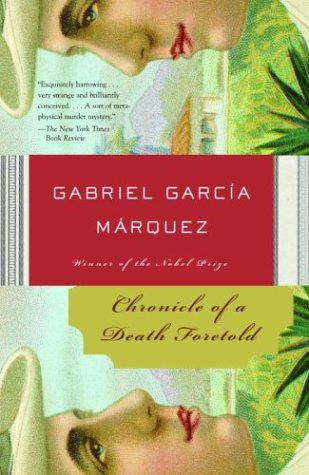
13. Chronicle of a Death Foretold
by Gabriel Garcia Marquez
 Unknown Binding: Pages (1993-09)
list price: US$13.19 -- used & new: US$13.19
(price subject to change: see help)
Asin: 0780733169
Average Customer Review: 4.0 out of 5 stars
Canada | United Kingdom | Germany | France | Japan
Editorial Review

Book Description
"EXQUISITELY HARROWING . . . . Very strange and brilliantly conceived. . . . A sort of metaphysical murder mystery. . . . The murder will stand among the innumerable murders of modern literature as one of the best and most powerfully rendered."
A mysterious and haunting tale of romance and murder, that begins with the marriage of a man and a woman in love. But when he inexplicably mistreats his beloved on the night of the wedding, he is in turn murdered by her brothers, and we are left with a strange sense of inevitability and passions gone terribly awry. ... Read more

Customer Reviews (113)

5-0 out of 5 stars Short, powerful, surprising
It is a very short novel, actually more of a long "short story" than a novel.
Eventhough we know the outcomes of the protagonists from the first few pages and while the book is supposed to have no surprises - it is actually captivating, with powerful depictions of human nature, mysterious and (without ruining anything by way of disclosure) - Marquez still manages to astonish the reader.

5-0 out of 5 stars ahhhh...
i like this author and the way he writes...his characters seem to always be connected, but either way, this book is now one of my favorites...not only does the title catch your eye, but the story and characters make it so much more interesting and fascinating...he describes each encounter and event without really "describing" it,what i mean to say is, that just reading through you can almost understand the time period and what each character was like and even what the village was like as a whole...i would definitely recommend this book to anyone who enjoys great reading...

5-0 out of 5 stars "Fatality Makes Us Invisible"
This is not a sweet, comfortable tale.From the first sentence, we know what the center of the story is, and we learn how it unfolds - inevitably, with a sense of fatalism.The whole town knows what will happen, and they are powerless to stop it - in fact, in various ways, the collection of characters that inhabit the hot, fragrant, unnamed town on the Caribbean coast actually make a murder possible.
It is extremely hard to describe this novel.It is short, complex, disturbing, confusing.The murder victim almost sleepwalks through the novel, pale and haunted, until the last few pages detailing his horrible death.The story has flashbacks, hallucinations, dreams and visions.For those who do not love Latin American literature, it may be a difficult read.It is peopled with many characters who merely touch on each other's lives.The person who tells the story is a shadowy figure, more of an observer than truly involved in the story.The setting is vividly drawn - the scents and sounds of the town, and above all, the stench of death.The ending, though "foretold" by fate, still raises questions in the reader's mind.How, why did it happen?Well, simply because it had to.

5-0 out of 5 stars What a book !!!
I do not know what to write in here! but you know something guys? once I woke up form this dream, I just said WooOOooW !!!!

it is one hell of a Caribbean Gospel !!!

5-0 out of 5 stars typical example of garcía márquez's works
gabriel garcía márquez is, without a doubt, the most original author of our time. his style is seemingly simplistic, but one must pay close attention in order to fully comprehend the story, sometimes even putting the book down and reflecting for a second what has just happened.
this book is amazing, the story of santiago nasar is a very intriguing one, and all the mysteries surrounding his death are absolutely fascinating. ... Read more


14. Leaf Storm (Picador Books)
by Gabriel Garcia Marquez, Gabriel Garcia Marquez
Paperback: 146 Pages (1979-05-11)
-- used & new: US$67.64
(price subject to change: see help)
Asin: 0330256882
Average Customer Review: 5.0 out of 5 stars
Canada | United Kingdom | Germany | France | Japan

Customer Reviews (3)

5-0 out of 5 stars Gabo is great from the beginning
'Leaf Storm' is known as the first novella published by Gabriel García Márquez. And from this debut is possible to see how big he would become one day. This book tells a very simple story that acquires multiple levels as it is told.

After the death of an infamous doctor of Macondo his only friends, this friend's daughter and her son gather to the funerals. The dead man is known as the devil and everyone hates him. His death made the city very happy. As the story is unfolded, we learn why he's so hated and how come the threesome ended up there to mourn him.

Using multiple points of views, Gabo gives the three protagonists chances to speak to themselves and we can find out how dreadful is to each of one be there. The writer is able to switch the point of view, and also the language --after all, a little boy does not speak as an old man. This is one of the remarkable qualities of this wonderful novella.

This is the very first time that the imaginary place Macondo appears in Gabo's story and it became a seminal place of his stories --among them the masterpiece 'A Hundred years of solitude'.

5-0 out of 5 stars Dreamy
I loved this novella and the short stories that were included in the volume.

"Leaf Storm" isn't a conventionally plotted novella.Instead, it's more of a dreamy and dreamlike character study of three people and their reactions to the suicide (or possible murder) of the town outcast and recluse.When the novella ends, we are left with many unanswered questions, but still, we feel fulfilled for we sense there are things about this suicide/murder that it's best simply not to know.

I have to disagree with opinions that Gregory Rabassa didn't do a good job with the translation.I think he did a superb job.He not only translated the story for us, he managed to capture the rain-soaked, steamy melancholy that is the essence of Gabriel Garcia Marquez.Rabassa is well-known as having been one of the world's premier translators and it's easy to see why.

I loved the two fantasy stories, "The Hansomest Drowned Man in the World" and "A Very Old Man With Enormous Wings."They are filled with the brand of magical realism that only Gabo can write and are just wonderful.I also liked "Monologue of Isabel Watching it Rain in Macondo" and "Ghost Ship."

This book gives us a glimpse into the world of Macondo and it's a very seductive glimse indeed.

5-0 out of 5 stars The book that started it all......
This wonderful book by GABO was the first one he wrote.So, it is very subject to the rules of writing.Later on the author would change completely to get the highest level at EL OTOñO DEL PATRIARCA, passing by "ONE HUNDRED YEARS OF SOLITUDE".The story is a killing that the author did not witness but that everybody in Colombia knew, and nobody talked about.Maybe because of fear for their own safety.GABO's grandfather told him the story when he was less than 6 years old.As a grown up he investigated by himself.The story happens at the Banana Plantation in Northern Colombia, where the explotator owned the life of their workers because they did no follow the law.American gringos bought the final product.A revolution wanted to start but was stopped by the worst masacre ever in that area.I read this book the first time whenit was published by chapters in the local newspaper.Then we knew that this man was going to be the greatest of all times, the Mohamad Ali of the Spanish literature in the 20th century.This book is a must for everybody interested in GABO's work. Jose ... Read more


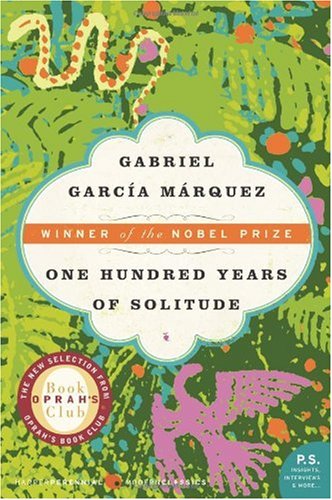
15. Cien años de soledad
by Gabriel Garcia Marquez, Gabriel Garcia Márquez
 Paperback: 504 Pages (1999)
list price: US$22.95 -- used & new: US$105.84
(price subject to change: see help)
Asin: 8439703872
Average Customer Review: 4.5 out of 5 stars
Canada | United Kingdom | Germany | France | Japan
Editorial Review

Amazon.com
A dense jungle of magic and literary gusto, this book pulls you in and engulfs you with its richness and beauty. Saying it is a story of a family is like saying the New Testament is a book about a carpenter. Following the family here reveals the history of several generations, and the passions, thoughts, and myths of a labyrinth of people, related and not. Gabriel Garcia Marquez is a gifted writer, and nowhere does he write with the fervor that he does in One Hundred Years of Solitude, a pleasurable ride unmatched in modern literature.Book Description
This the most important novels written by this author which everyone must read. With this novel he won the 1982 Novel Prizze in Literature. ... Read more

Customer Reviews (66)

5-0 out of 5 stars La mejor novela de nuestros tiempos! Es obligatorio leerla!
Este es un libro fascinante, lleno de realismo mágico, aventuras, drama y pasión. Un libro con el que se puede identificar cualquier latinoamericano por todo lo que tiene de cotidiano y de supersticioso. La historia tiene ciertas similitudes con la Biblia (Génesis, Exodo, Evangelios) , con las Mil y Una Noches y otras literaturas; lo que hacen que leerla le parezca a uno muy familiar aparte de que el lenguaje que utiliza García Márquez es muy sencillo y cotidiano. Nadie que la lea olvidará jamás a Ursula, o a Fernanda del Carpio, a Remedios la Bella o a cualquiera de los Aurelianos o José Arcadios. Es un libro adictivo para aquellos que dan sus primeros pasos en la buena literatura.

Después del Quijote, la mejor novela escrita en español, pero también la mejor novela contemporanea de nuestros tiempos. Es por eso, impresindible leer esta genial novela.

Un atractivo extra de esta edición son las notas al pie de página que da Jacques Joset, que permiten al lector aclarar muchas dudas acerca de donde tomá el autor nombres de personajes o de lugares. A mi en lo personal, me resulto mucho más interesante, ya que tenia ciertas dudas como de donde se inspiró García Márquez para hablar del Duque de Marlborough, de Rocamadour, o de Francisco El Hombre.

1-0 out of 5 stars I hate this book!!!!
It's well-written and the characters arewell developed, but I must say that the story is just horrible. I'm sorry, but if this is the best literature of Latin America, I'd rather not read anymore of it. I really don't know why people like this book!
I'll stick to good Brazilian literature, such as Machado de Assis.

4-0 out of 5 stars Cien años de soledad
Gabriel Garcia Marquez's masterpiece describes the history of Latin America with the Buendía family through Marquez's use of magic-realism.The novel takes the reader on a journey where anything and everything is possible.This is the heart of Latin America.

5-0 out of 5 stars The day that the magic realism invaded the literature!
What definitively marked this subduing novel throughout the Pantheon of the immortality was to have got the perfect balance between an organic depicting coherence and a winged concatenation of fevered delirium; the accurate involvement between Eros and Psyche, that invisible sensation of getting into a new universe of unlimited possibilities, where we agree to become accomplices of this master of ceremony; wizard of the dreamy landscapes and old shaman of the word.

The multiple web of pertinent circumstances that surround that small village named Macondo were so bewitching interweaved and magically disposed that produced a febrile positive effervescence in the reader, because as the cathartic experience demands, there are neither rules nor roads. The terrible humidity of Macondo overwhelms us and in the meantime leads to new coordinates of the historic perspective, where time and space are badly drawn and the sensation of vertigo and insecurity involves the reader.


With this work, Garcia Marquez not only achieved that coveted pearl so many times described in Mythology that represents the summon of the creative pinnacle; besides he opened the gate for the rest of the world to discover that famous phrase, wedged by Vasconcelos: "Latin America: the cosmic race"

We can find similar parallelisms if we take a look around: Picasso and Guernica, Schubert and his String Quintet Op.163

This pyramidal feat so many times desired and so few times achieved, not only consolidated the prestige of his creator, but simultaneously allowed the rest of the world to acquire a vertiginous interest for other notable writers of the fantastic literature, such Onetti, Horacio Quiroga, Borges, Bioy Casares, Cortazar or Miguel Angel Asturias.

1-0 out of 5 stars Horrible book
It seems as though the author's gimmick has worked.Let's write a book in a "circular" time and place pattern and confuse the hell out of all the readers.Yes, we get it, the style of writing is symbolic of the cycle of life described in the book: it is a never-ending cyclic nightmare!What most annoys me about this book, however, is the literary snobbery of pseudo-literary fans who drop the name Gabriel Garcia Marquez as if he were the biggest literary genius of all time just because he wrote a book with almost no punctuation and a jumbled up storyline!Yes, life in the Caribbean is just as frustrating as this book, and no, don't live there or read this book if you don't want to drive yourself nuts. ... Read more


16. The Autumn of the Patriarch (P.S.)
by Gabriel Garcia Marquez
Paperback: 280 Pages (2006-03-01)
list price: US$13.95 -- used & new: US$7.89
(price subject to change: see help)
Asin: 0060882867
Average Customer Review: 4.5 out of 5 stars
Canada | United Kingdom | Germany | France | Japan
Editorial Review

Book Description

One of Gabriel García Márquez's most intricate and ambitious works, The Autumn of the Patriarch is a brilliant tale of a Caribbean tyrant and the corruption of power.

From charity to deceit, benevolence to violence, fear of God to extreme cruelty, the dictator of The Autumn of the Patriarch embodies the best and the worst of human nature. Gabriel García Márquez, the renowned master of magical realism, vividly portrays the dying tyrant caught in the prison of his own dictator-ship. Employing an innovative, dreamlike style, and overflowing with symbolic descriptions, the novel transports the reader to a world that is at once fanciful and real.

... Read more

Customer Reviews (38)

3-0 out of 5 stars The Terror of the Miracle
Unlike other writers who embed the Christian ideals and symbolism into their work to evoke mystery and majesty, Marquez uses a religious vernacular to cast the dictator into the same shadow of doubt into which he wants the reader to hold the god figure. Marquez' countless allusions to Christ and his Mother render the reader into a surrealistic land of never-ending make-believe deaths and resurrections.

The Autumn of the Patriarch rends the "terror of the miracle" (p. 237) in the form of the macabre mini-miracles of Marquez' magical realism: the general who sprouts fish scales, the general's weathered skin turning into infant skin, the cows who eat from paintings, leaving little doubt that these miracles dominate the novel. What is less evident is that Marquez' assertions after these or the more debased miracles occurring in the form of tyranny are a screed against the dictatorial nature of religion. The dictator is not the anti-Christ but rather the reverse embodiment of Jesus Christ. The General of the Universe becomes the King of the Universe and neither comes out well ahead of the game in the telling.

The accumulation of religious detail is sometimes so evident and overpowering that one wonders whether Marquez is merely ornamenting the Roman Catholic Latin American culture begun by Spanish clerics in the 1500s. However, religious imagery and incantation cannot convey a sense of religiosity within the dictatorship because they blaspheme rather than uphold a religious connotation of the novel. If the General "[remembers] suddenly that cow was written with a c" then Marquez also writes god with a lowercase `g.' (p237)

The General's meditations on the aloneness of power stand as counterpoint and counterpart of his partner in the game of all-powerfulness. The General does becomes Christ meandering in the desert of his solitude, wondering if his lofty perch is worth enduring.Like the General who is pained since birth with his malformed [...], Christ was born to and had no choice but to endure. For Marquez, the question is not one of endurance but rather a perdurance of "uncountable years." The General and Christ suffer the "fiction of commanding without power, of being exalted without glory and of being obeyed without authority." (p. 254) Marquez fuses the actions of the debased General by debasing the inauthenticity of Christ.

5-0 out of 5 stars Marquez at his best - a masterpiece
Amazing.
I have no other words describing this book. The narrative style, for those complaining - is in my humble opinion Marquez BEST : spell binding magic realism.
The book details in long and convoluted sentences the minutiae of every day life of a maniac, a universal type of tyrant - which just happens to be caught in Marquez writer's cross hairs in South America. It may be one of the many South American dictators and it could easily be one of their European monster counterparts. Marquez is sometimes sublime, often bold and always funny in a strange way. Recommended !

5-0 out of 5 stars A universal masterpiece
I have read the Hebrew translation and parts of the English one. Translation-wise the Hebrew one is an amazing work fully capture the spirit and richness of the Language. One of those that makes you wonder if the original one is as good as the translated one (and, yes, I know it is much better). As for the book, in my view, it is the best work of Gabriel Garcia Marquez so far, and I believe I have read all of his books.

5-0 out of 5 stars An Epic Latin-American Poem
This novel, written in a stream of incessant imagery of beauty and cruelty, is a masterpeice of narrative skill. One must be 'in the mood' to tackle the work which is dense and whose language is difficult at first. I say at first because, once underway, and the narrative understood, the book unfolds like a dream.
This book is a testament to Marquez's skill. The events that take place (three hundred donkey-pulled pianos falling into a ravine/ the attempt to hide two thousand children)are almost beyond comprehension. I finished the book last night and was beside myself. The use of language and imagery will stay with me forever. This book alone should've earned Marquez his Nobel prize.
And don't think the style of the novel is pretensious or used to make something easy difficult. There are many literary devices at play but all to serve the purpose of the story.
This book should also be interesting for anyone curious about the lonliness and insanity of despotism.
And don't be fooled by Oprah and the critics, 'One Hundred Years of Solitude' is NOT his best book by any means. "The Autumn of the Patriarch" is where 'magical-realism' really comes to life.
For anyone intersted in contemporary literature or something wholly original, this novel is a must.

5-0 out of 5 stars Gabo's prose masterpiece
While it lacks the startling originality and narrative sweep of "One Hundred Years of Solitude," this novel is Gabriel Garcia-Marquez's masterpiece of prose. The story is good and the many surreal touches are magnificent and deployed to great political effect (the selling of the sea, for example, is an unforgettable image of impoverished nations selling their natural resources to wealthy nations and only suffering from the transaction), but the real story here is Gabo's prose: he channels William Faulkner to create a style that's as sinuous and labyrinthine--and beautiful--as anything yet accomplished in our Western Hemisphere. ... Read more


17. In Evil Hour
by Gabriel Garcia Marquez
Paperback: 192 Pages (1991-11-20)
list price: US$13.95 -- used & new: US$7.85
(price subject to change: see help)
Asin: 0060919647
Average Customer Review: 3.5 out of 5 stars
Canada | United Kingdom | Germany | France | Japan
Editorial Review

Book Description
Written just before One Hundred Years of Solitude, this fascinating novel of a Colombian river town possessed by evil points to the author's later flowering and greatness. ... Read more

Customer Reviews (13)

5-0 out of 5 stars The dawn of the dead
"In Evil Hour" is one of the early novels written by Gabriel Garcia Márquez. Published in 1962, it was previous to his "A Hundred Years of Solitude" and "The Autumn of the Patriarch", some of his most famous novels and that consolidated his style. Considering that, one can say that this novel is really good. It is not as fine tuned as his best works, there is no Magical Realism in here -- actually, the book is quite realist -- but it is such an engaging and well conceived story that it is impossible to stop reading.

The narrative is set in a small town ruled by a peculiar mayor. He fills the role of both mayor and deputy -- in other words, he is the law in that place. The citizens having been facing a small problem. Every morning someone finds in his, her door a bulleting anonymously written telling a gossip about him, her or the family. The strange thing is that the fact stated in the piece of paper is known by everyone, despite people not talking about it. So what is making the citizens tense is not what will be said but who is saying those things.

Solving this mystery is a job to the nameless mayor, but he is not very interested in it. To his knowledge this kind of gossip will stop sooner or later. He has a very interesting role in the book, since he is such a dubious character. As the reading progress, one can notice that he can't be simply described as good or evil. It is much more complex than that. So are townspeople. Márquez make them appealing folks with very interesting background stories to keep the pages moving.

"In Evil Hour" deals with politics, but in a very subtle way. Hints are given here and there about the recent changes the town has faced. The past seems to have been obscure, but we are never certain of that. Márques exploit heavy subjects that darken Latin American History with grace and seriousness and his peculiar sense of humor. And in the end we seem to have spent some time in that village, and however much we may have enjoyed it, we may not be willing to come back to that place -- although one may want to reread this book one of these days.

4-0 out of 5 stars Off-stage action
"In Evil Hour" is a swift portrait of a Colombian town that connects the awful force of oppressive regimes to the bald paranoia of a town feeding itself rumor after rumor about its own citizens.The themes are there, but might seem obtuse upon your first reading.Still, the book pretty clearly says that tyranny leads to an abandonment of sense and a mean discontent, a desire to assert yourself by shaming the powerful when you have no democratic outlet for expression.This is a novel of the quietly disenfranchised and supposedly pious succumbing to the base desires of an evil hour.

The salilent point in grasping it all comes when you realize a lot of essential action is implied.Marquez has called Faulkner his "master" and here, while Marquez is still developing his own voice, he borrows heavily on Faulkne