e99 Online Shopping Mall

Geometry.Net - the online learning center Help  
Home  - Nobel - Milosz Czeslaw (Books)

  1-20 of 100 | Next 20
A  B  C  D  E  F  G  H  I  J  K  L  M  N  O  P  Q  R  S  T  U  V  W  X  Y  Z  

click price to see details     click image to enlarge     click link to go to the store

$11.99
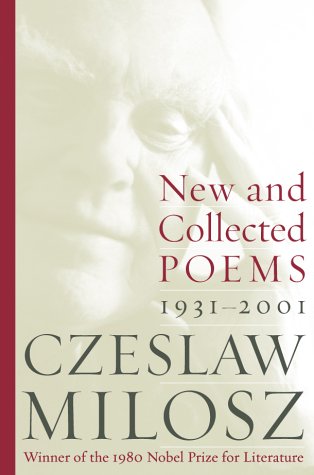
1. New and Collected Poems: 1931-2001
$6.75
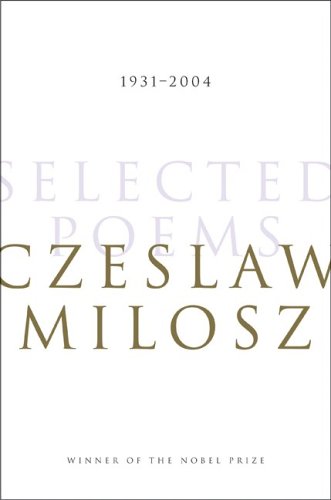
2. Selected Poems: 1931-2004
 
$27.49
3. The History of Polish Literature,
$12.11
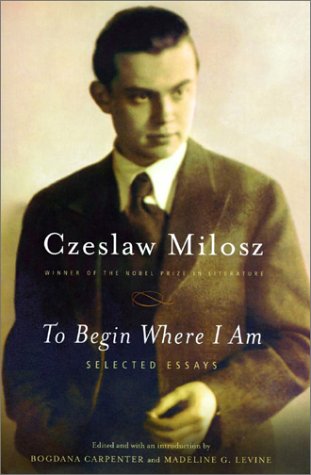
4. To Begin Where I Am: Selected
$4.95
5. A Book of Luminous Things: An
$14.49
6. Czeslaw Milosz: Conversations
 
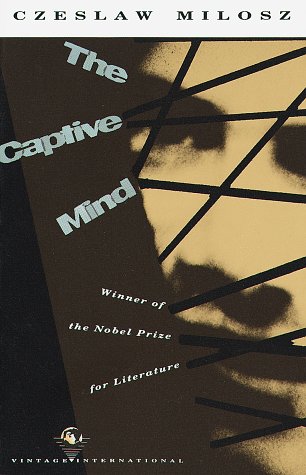
7. The captive mind
$5.98
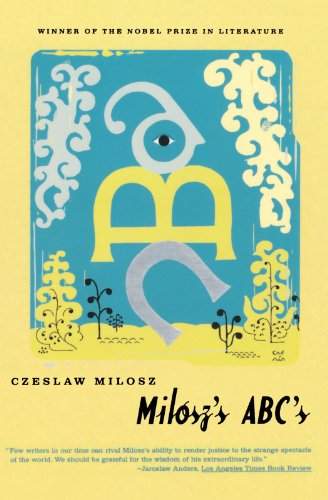
8. Milosz's ABC's
$12.98
9. The Land of Ulro
$7.50
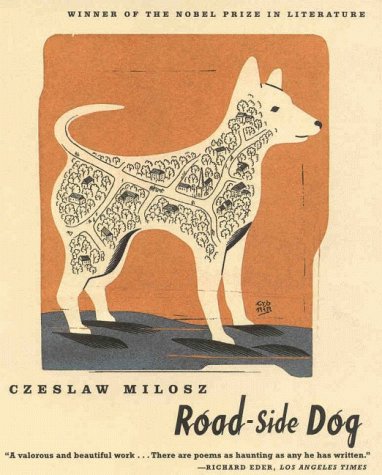
10. Road-side Dog
$85.00
11. Striving Towards Being: The Letters
$9.03
12. Talking to My Body
13. The Noble Traveller
$89.95
14. A Treatise on Poetry
$14.18
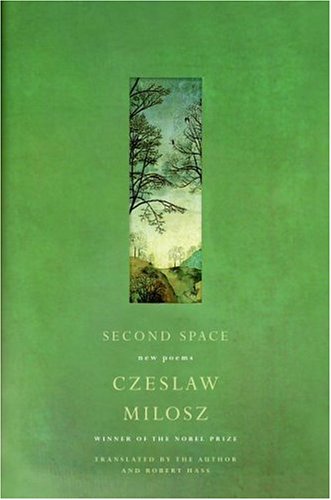
15. Second Space : New Poems
 
16. The land of Ulro / Czeslaw Milosz
$2.45
17. Facing The River
$46.95
18. Dynamics of Being, Space, and
$11.60
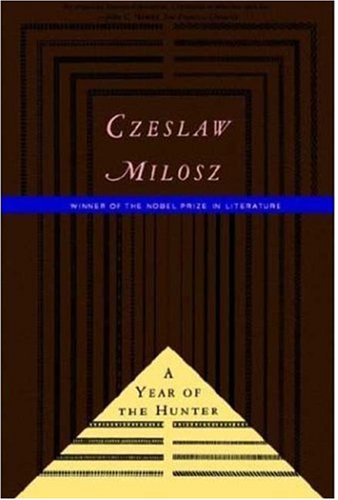
19. A Year of the Hunter
$8.27
20. The Issa Valley: A Novel

1. New and Collected Poems: 1931-2001
by Czeslaw Milosz
Paperback: 800 Pages (2003-04-01)
list price: US$19.95 -- used & new: US$11.99
(price subject to change: see help)
Asin: 0060514485
Average Customer Review: 5.0 out of 5 stars
Canada | United Kingdom | Germany | France | Japan
Editorial Review

Book Description

New and Collected Poems: 1931-2001 celebrates seven decades of Czeslaw Milosz's exceptional career. Widely regarded as one of the greatest poets of our time, Milosz is a master of probing inquiry and graceful expression. His poetry is infused with a tireless spirit and penetrating insight into fundamental human dilemmas and the staggering yet simple truth that "to exist on the earth is beyond any power to name."

Czeslaw Milosz worked with the Polish Resistance movement in Warsaw during World War II and defected to France in 1951. His work brings to bear the political awareness of an exile -- most notably in A Treatise on Poetry, a forty-page exploration of the world wars that rocked the first half of the twentieth century. His later poems also reflect the sharp political focus through which this Nobel laureate never fails to bear witness to the events that stir the world.

Digging among the rubble of the past, Milosz forges a vision that encompasses pain as well as joy. His work, wrote Edward Hirsch in the New York Times Book Review, is "one of the monumental splendors of poetry in our age." With more than fifty new poems, this is an essential collection from one of the most important voices in contemporary poetry.

... Read more

Customer Reviews (6)

5-0 out of 5 stars Spanning Seven Decades with a Humble Muse......


In the very last poem of this, the greatest collection of Milosz's works, he so lucidly begins.......

Late Ripeness by Czeslaw Milosz

Not soon, as late as the approach of my ninetieth year,
I felt a door opening in me and I entered
the clarity of early morning.

One after another my former lives were departing,
like ships, together with their sorrow.........

******************

This wonderful collection spans a lush and lavish 70 long years; years magically molded in the hands of a cunning and capable and wise prophet of our times.
Milosz yearns for a 'tangible reality' to maintain the health of poetry. He is accessible even to the untrained ear.....for it is ultimately in the lack of illusion that his work shines and reverberates.

In his introduction, he concludes that "poetry has always been for me a participation in the humanly modulated time of my contemporaries."

And we see this simple humility reflected in the last verses of his final poem of this collection.
*************************

Moments from yesterday and from centuries ago -
a sword blow, the painting of eyelashes before a mirror
of polished metal, a lethal musket shot, a caravel
staving its hull against a reef - they dwell in us,
waiting for a fulfillment.

I knew, always, that I would be a worker in the vineyard,
as are all men and women living at the same time,
whether they are aware of it or not.

**************************************

This rich collection will transport you back and forth in time with a gifted, yet humble master of distillation, distance and destiny!


5-0 out of 5 stars From the master's hand
Few poets have as eloquently and profoundly mapped out the manic contours of the twentieth century as have Czeslaw Milosz.And even fewer poets have truly lived through what they wrote.In both categories, Milosz stands as a towering giant, a massive oak which has weathered the most savage of storms and the sweetest of sunshines.Anyone interested in walking along the trial and tribulation-filled path of the last century would be wise to pick up this ultimate testament to Milosz's life and work.

This tome covers the entire expanse of Milosz's writing career, from his early years in Lithuania, where he followed the Frnech symbolists in writing image-dense lyrics, to his twilight years in Berkeley and Krakow, where his majestic voice evolved into that of a prophet's. Each poem exudes the light and darkness of the various stations along his life. Young student in Vilnius,journalist in pre-war Warsaw, the contemplative and distanced survivor of the Warsaw Uprising, the awe-struck immigrant never quite at home in his new land.All of these stops are painted with a wry and mediatative hand. Milosz's work is that of the thinker.His mind soars above the peaks and abysses of his life, well-distanced from the churning seas of emotion.He never delves into the passion of the moment, into the realm of the subjective.Milosz spent his childhood years wanting to be a naturalist and his objective, scientist-like perspective dominates throughout his work. In the Miloszian world, we are all parts of a much greater whole, our individual tears and spurts of temporary joy matter little in the grand picture of things.And it is this global picture that Milosz attempts to put down on the canvas.Thus, it comes as no surprise that the physical world is Milosz's favorite backdrop, and even when it appears absent, it's scent is still traceable.His formative years spent in the wilds of Lithuania gave him a fatalistic faith in the indestructible permanence of things, that no doubt helped him endure the hell of WW II Poland.

While detachement is Milosz's telltale signature, our human presence in the machine of history is really what these poems attempt to divulge.Like his country, Milosz experienced firsthand two totalitarian beasts, that of Nazi Germany and of Soviet Russia.Yet, Milosz's credo is not one of naive heroism, as is much in Polish poetry.His message is far more universal with its 'human, all too human' colors.For him, the true heros were those who managed to survive, to exist and to stubbornly hold on to some semblance of human dignity whilst all around bestiality reigned.The boy on the barricades of Warsaw who died nameless and faceless, this is the best we can do. Milosz avoids pointing the finger at the big beasts themselves, but instead asks us to examine our hearts. 'Did you really need to plunge into an abyss, To compose systems rather than settling into the fairy tale.'

Milosz's later poems carry the weight of a life lived through extraordinary circumstances. A life neither excessively noble nor excessively evil.Milosz's writes of and for the survivor, for most of us, who reach life's end with a complex mesh of guilt and content. 'I feel relief thinking I was no better and no worse than many, and that together with them I wait for forgiveness.'Like Shakespeare before him, Milosz's lasting message is one of humility before our sad condition, before our sad history, and most of all, before our merciful Maker.The hardest of lessons, but also the most important.

5-0 out of 5 stars 70 years of a life lived in poetry
Particularly interesting in this volume, and not I think available in any of the individual volumes alone, is the whole experience of his 70 years struggling with the demons of war and Communism and his own survivor's guilt.Many people have written about such things, many good and enlightening things have been said.But here is a man who struggled for seventy years, whose attitudes and balances evolved, who can comment not only on the experience, but the experience seen from perspectives of ten and twenty and forty and seventy years--and can comment on his own perspectives with an additional insight.You can, and should, read this volume like a novel, cover to cover, straight through, and watch him as he finds his accommodations, and as they crumble and are remade.

5-0 out of 5 stars Milosz and Shakespeare: Best Poets of all Time
Milosz's poetry has a kind of energy that makes you want to shout on a rooftop: read this book. Any poet of any stature writes poems that fail to rise to the level of masterpieces, but in this book of 750 pages they are few and far between.The translator deserves much credit for these poem read as if they were originally written in English.
I used to think that Paul Celan captured the horror of war torn Europe the best, but Milosz now wins the title. The first books of this collection are harrowing and wistful.
The books written from California and France take a more metaphysical tone but never fail to be touching and humane.
The most recent poems detailing growing old are often funny but always reminiscent of just how much he has paid for growing up during wartime.
Shakespeare and Milosz had their fingers on the pulse of thehuman condition and have created poems that will truly last forever.
I recommend this book even to people who do not normally read poetry. It has changed me--- for the better.

5-0 out of 5 stars After 9.11
After September 11th, I, a formerly avid reader, could no longer read anything but news, dreadful news.A lifelong subscriber to the New Yorker, I picked up an issue which magically opened to a poem by Milosz.I think it was the first or second issue that followed the bombings.

The poem provided one of those rare moments where one feels transformed by words, where life is worth living again because someone said something so beautifully that it was again worth it to continue on.

I don't even know if Milosz wrote that poem specifically in response to what happened on September 11th; surely he saw greater horrors in Poland than we can even imagine.Yet ever since, his words have granted me peace, not only from the fear of annihilation through disaster, but from the ultimate annihilation of death.

I also love that he's still writing at ninety.I love how, against all odds, he decided to fall the way of faith.

I read one of his poems each night, like a prayer, like a song. ... Read more


2. Selected Poems: 1931-2004
by Czeslaw Milosz
Hardcover: 304 Pages (2006-04-01)
list price: US$24.95 -- used & new: US$6.75
(price subject to change: see help)
Asin: 0060188677
Average Customer Review: 5.0 out of 5 stars
Canada | United Kingdom | Germany | France | Japan
Editorial Review

Book Description

Selected Poems: 1931-2004

celebrates Czeslaw Milosz's lifetime of poetry. Widely regarded as one of the greatest poets of our time, Milosz is a master of expression and probing inquiry. Life opened for Czeslaw Milosz at a crossroads of civilizations in northeastern Europe. This was less a melting pot than a torrent of languages and ideas, where old folk traditions met Catholic, Protestant, Judaic, and Orthodox rites. What unfolded next around him was a century of catastrophe and madness: two world wars, revolutions, invasions, and the murder of tens of millions, all set to a cacophony of hymns, gunfire, national anthems, and dazzling lies. In the thick of this upheaval, wide awake and in awe of living, dodging shrapnel, imprisonment, and despair, Milosz tried to understand both history and the moment, with humble respect for the suffering of each individual. He read voraciously in many languages and wrote masterful poetry that, even in translation, is infused with a tireless spirit and a penetrating insight into fundamental human dilemmas and the staggering yet simple truth that "to exist on the earth is beyond any power to name." Unflinching, outspoken, timeless, and unsentimental, Milosz digs through the rubble of the past, forging a vision -- and a warning -- that encompasses both pain and joy. "His intellectual life," writes Seamus Heaney, "could be viewed as a long single combat with shape-shifting untruth."

... Read more

Customer Reviews (1)

5-0 out of 5 stars Calling Us Back to Ourselves
What I love most about reading modern poetry is the open friendliness of the poets.I usually have two or three books in the works and picking them up and reading them is like sitting down with the poets in my kitchen and having a wide ranging conversation with a really smart friend over coffee.Not Milosz.Reading Milosz is like enjoying an evening in someone's formal living room, silent as an invited guest should be.It is a privilege to read these poems.Here is a contemporary who lived through it all and was not ground to dust.Here is a survivor who grew suspicious of all -- ALL -- easy solutions and was absolutely confident that, whatever The World threw at him -- and by extension, at us -- he could wrap his mind around it.Seamus Heaney's introduction says Milosz was "tender toward innocence, tough-minded when faced with brutality and injustice."In the end, he retained his awe of the natural world and his believe in the holiness of everyday things.In short, when Milosz sees us being distracted by the insistence of externals, people and things that feast on our enegy leaving us with nothing, he calls us back to ourselves, the point from which everything is adorned with meaning for each of us, the context in which even the most horrible is endurable. ... Read more


3. The History of Polish Literature, Updated edition
by Czeslaw Milosz
 Paperback: 570 Pages (1983-10-24)
list price: US$27.50 -- used & new: US$27.49
(price subject to change: see help)
Asin: 0520044770
Average Customer Review: 5.0 out of 5 stars
Canada | United Kingdom | Germany | France | Japan
Editorial Review

Book Description
This book is a survey of Polish letters and culture from its beginnings to modern times. Czeslaw Milosz updated this edition in 1983 and added an epilogue to bring the discussion up to date. ... Read more

Customer Reviews (1)

5-0 out of 5 stars Standard Polish Literature history Survey
This volume became the standard text of Polish literary history in English when first published in 1984 because it was the only modern one and written by the leading western expert on the topic.I used it in a Polish literary history survey course and compared it with the standard Polish texts of that era of less than free expression in Poland.While necessarily not as encyclopedic as thebooks from Warsaw or Krakow, it covered the highlights, and there are many of them, of the entire sweep of the topic, including a section on himself.It is still the standard in English.There may be something from the new Poland that supersedes it, but I don't know.It is vital for understanding the rich tradition of literature in Polish that has always been treated on the margins of world literature.For example, it helps to put Chopin's Ballades into perspective and enrich one's understanding of his intellectual milieu before he left Warsaw to join the Polish emigration--and Milosz covers that as well.Buy it. ... Read more


4. To Begin Where I Am: Selected Essays
by Czeslaw Milosz
Hardcover: 480 Pages (2001-10-31)
list price: US$30.00 -- used & new: US$12.11
(price subject to change: see help)
Asin: 0374258902
Average Customer Review: 5.0 out of 5 stars
Canada | United Kingdom | Germany | France | Japan
Editorial Review

Book Description

A comprehensive selection of essays--some never before translated into English--by the Nobel Laureate.

To Begin Where I Am brings together a rich sampling of poet Czeslaw Milosz's prose writings.Spanning more than a half century, from an impassioned essay on human nature, wartime atrocities, and their challenge to ethicalbeliefs, written in 1942 in the form of a letter to his friend Jerzy Andrzejewski, to brief biographical sketches and poetic prose pieces from the late 1990s, this volume presents Milosz the prose writer in all his multiple, beguiling guises.The incisive, sardonic analyst of the seductive power of communism is also the author of tender, elegiac portraits of friends famous and obscure; the witty commentator on Polish complexes writes lyrically of the California landscape. Two great themes predominate in these essays, several of which have never appeared before in English: Milosz's personal struggle to sustain his religious faith, and his unswerving allegiance to a poetry that is "on the side of man."
... Read more

Customer Reviews (2)

5-0 out of 5 stars Elegant and Sophisticated Prose
I highly recommend this volume to anyone.Along with his recently published New and Collected Poems(Ecco Press), Milosz stands tall as one of the most accomplished writers in the modern era.This volume of essays is highly personal and eloquent.His prose style is immediate and vivid, capturing insights of history and the "poetic."His work on Jeffers is remarkable.This is a poet of our time--his thought triumphs over despair and the ills of the human condition.He has witnessed some of the most deliberate atrocities in world history--his essays evoke a wisdom based on personal remembrance-and there is no better vision of our predicament than what is offered here.

5-0 out of 5 stars A Poet's Religious Humanism
Czeslaw Milosz is a renowned writer of both poetry and prose. He received the Nobel Prize for literature in 1980.In his long life, he has seen and written about many of the events of the Twentieth Century, including the Russian Revolution, the Holocaust, the Warsaw Uprising, and the rise and fall of communism. He served as a diplomat from Poland to the United States following WWII. Among his books is an incisive critique of communism titled "The Captive Mind".

"To begin where I am" is a selection of Milosz's essays published between 1942 and 1998, some written initially in English, but most written in Polish.The essays are wide-rangingin theme and capture a great deal of the scope ofMilosz's passions.The good introduction to the book by Bogdana Carpenter and Madeline Levine point out that Milosz "has centered his writings on a few fundamental philosophical questions: the meaning of history; the existence of evil and suffering; the transience of all life; theascendance of a scientific worldview andthe decline of the religious imagination." The essays are well-arranged into four main sections.

The first group of essays titled "These Guests of Mine" is primarily historical and descriptive in character. I enjoyed particularly Milosz's description of Wilno(Vilna) in his "Dictionary of Wilno Streets."

For me the heart of the book is in the second and third parts, titled "On the Side of Man" and "Against Incomprehensible Poetry."We learn a great deal about a writer by his discussions of those who have influenced him.In this book,Miloscz's essays on the American poet Robinson Jeffers, on the Russian philospher Lev Shestov, and on the French theological thinker Simone Weil are highly thoughtful.They reveal a writer both struggling for a commitment to religion, to Catholicism in particular, in the face of a scientific and material worldview which he finds inconsistent with it, and a writer committed to humanism, to the best in man and culture.They are an inspiring and difficult set of commitments, and Milosz discusses them eloquently.

In Part 3 of the book, the centerpiece is the title essay "Against Incomprehensible Poetry".In this essay, Milosz develops insights from W.H. Auden and makes them his own.Auden had said "there is only one thing that all poetry must do,it must praise all it can for being and for happening." (p.381). This insight becomes the basis of a critique of much obscurantism in modern poetry.We are privileged to hear, in the book, a discussion of the continuing value of poetry and informed discussion of many poets worth knowing, from Whitman, Blake,and Jeffers to many of Milosz's Polish contempories.These latter writers are unknown to me, but Milosz makes one wish for them as companions through his discussions.

The fourth part of the book. "In Constant Amazement", is brief and consists of a collection of aphorisms. The aphorism I found most striking discusses the nature of human sexuality.It begins: "Men and women carry within their imagination an image of themselves and of others as sexual beings and often that is the only thing that humanizes them." (p. 436)

This book helped me with my own thinking and reflection.I hope it will help you with yours as well. ... Read more


5. A Book of Luminous Things: An International Anthology of Poetry
Hardcover: 320 Pages (1996-09)
list price: US$28.00 -- used & new: US$4.95
(price subject to change: see help)
Asin: 0151001693
Average Customer Review: 4.5 out of 5 stars
Canada | United Kingdom | Germany | France | Japan
Editorial Review

Book Description

Nobel laureate Czeslaw Milosz selects and introduces 300 of his favorite poems in this “magnificent collection” that ranges “widely across time and continents, from eighth century China to contemporary americanca” (San Francisco Chronicle).
... Read more

Customer Reviews (15)

5-0 out of 5 stars Anyone can find great value in this collection
Poetry collections can be quite valuable things - picking one up rather than a body of work by a single author frees one of the apprehension that comes with committing to that author's work and the possibility that said author's work might not be worth owning in such a concentrated format. Conversely, a collection of multiple authors can open a reader up to poets they may have never come across otherwise. Indeed, that was one of Milosz's aims in putting together this compendium - to largely deflect the focus from the accepted and reliable canon (though Robert Frost and D.H. Lawrence do find their way in somehow) as well as provide work from an international selection of authors (though the concentration is frustratingly biased toward English, Polish and Chinese language works - not a bad thing in of itself, but it does play against the international appeal to some degree). The other criteria is that the poems be "short, clear, readable and, to use a compromised term, realist, that is, loyal toward reality and attempting to describe it as concisely as possible" (p. xv). The work rarely sways from this description, though like any good author Milosz isn't afraid to break his own rules. What you arrive at in the end, then, is a collection of easily approachable, short works of poetry that tend to shy away from a philosophical or fantastic focus. That is not to say that the philosophic and fantastic are not there in the poets' intentions, thoughts and/or subtext, but they do not overwhelm the pieces. As for the editor's contributions, he formats each page by introducing the poems with a few sentences about them printed above, but I found that the best way to read the work was to start with the poem itself and then read the editor's note. I felt that reading these notes undermined the sense of mystery and discovery that comes with navigating one's way through a new poem, though reading these thoughts after usually provided me with some new insight into the piece. However, I did feel that his interpretations left little room for argument and undermined the multiple layers that many of the works here comprise. It was as if there could be no individual readings that differed from what Milosz thought - though this was not always the case, and more obvious in his tone than his content. Another point of bother was his critique of some of the works; for example, his note on Jean Follain's "School and Nature" - "Frankly, the modernist technique consisting of unexpected associations is not to my liking, as at the end of this poem, in which drops of blood fall upon a road. In order to understand this, we must presume that there are hunters in the neighborhood, that they shot a bird, and that a wounded bird flies over the road" (p. 162). These are rare, but when they are there I can see no constructive purpose; if someone likes the image they may feel embarrassed or frustrated that the editor has forced them into arguing with them, and if they interpret the image a different way than his literal understanding, an unconfident reader may feel, again, embarrassed, and one more sure of themselves may feel irritated at the editor's apparent limitations. In any event, I can see no good in this type of note, especially in that it is printed before the poem itself and thus one may be inclined to read it before the poem, probably putting a damper on their experience. As I said before, however, this type of thing doesn't happen too often, and when it does we can forgive it, because, qualms aside, this is a very good collection of poetry. Though not every piece is awe inducing, to ask this would be somewhat ludicrous, and more often than not the works were quite enjoyable. I found many that touched me deeply, and almost all of them had multiple ways in which they could be interpreted, multiple layers and viewpoints, and thus one can come back to any number of poems again and again. Layers aside, these are all works that are short, approachable and enjoyable enough to be reread multiple times, and as long as one knows to read the editor's note after, not before as the format suggests, the poem itself, anyone can find great value in this collection.

4-0 out of 5 stars Collection surprisingly wide scope, but terse.
Milosz has assembled a refreshingly broad spectrum of Chinese, European, and American poetry into a solid collection.What I like about the works is that the language is terse, short, and powerful, though not always a hit with me.The Chinese works are like this, succinct, subtle, and surprisingly accessible.

5-0 out of 5 stars Truly luminous collection
A stellar collection of the world's poetry.Read the poetry first, though, before letting Milosz's comments sway you in any direction.Interesting to see what he thought, which wasn't always my take.Some lovely jewels of poetry.Some old, some new.

5-0 out of 5 stars The Book of Luminous Things by Czeslaw Milosz
This book has a collection of nearly 300 or more short poems which are concise and simple to read. The author is a prize-winner in Literature. He selected poems from many different countries and set forth excerpts for the reader to enjoy. A strength of the work is that it provides a wide range of literary style in a single work. This book would be perfect for literature enthusiasts and arts academicians . Here are samples:

" In broad daylight. I dream I am with her."


At night, I dream she is still at my side. She carries her kit of colored Threads. "
by Mei Yao Ch 'en


A Voice
"They mutilate.They torment each other with words as if they had another life to live." by Rosewicz


The book is well-organized. The presentation contains poetry
for little-known and well-known authors.

It would make a great gift for a student, elderly person or literary enthusiast. The price is reasonable for the value provided.

5-0 out of 5 stars An anthology of epiphanies
To call this excellent collection of poems an "international" anthology is a bit presumptuous. The bulk of the poems were written by poets whose native language is American (88), Chinese (53), Polish (35) or French (16). The selection, however, aptly reflects the geographical stations in the life of the Nobel Prize winner of 1980, Czeslaw Milosz. Born in 1911, he lived in Poland until 1951 when he emigrated to France. In 1960, invited by the University of California, he moved to Berkeley where he lived and worked until his death in August 2004. During the Second World War he lived in Warsaw, writing for the underground presses - which probably explains why only one German poem (by Rilke) appears in this book. To put this in perspective: poetry in German ranks on the same level as Inuit poetry here, one poem each.

But never mind. After swallowing my national cultural pride, I admit that "A Book of Luminous Things" is my favorite anthology of poetry. By a wide margin. Milosz did not simply compile a "best of" collection; he created a very personal, intimate book. The poems collected in this anthology are as much about the joy of living as they are about the awareness that old age may bring. What they teach are attention to the particular and appreciation of the transitory. Milosz's proposition for the collection was to present poems, "whether contemporary or a thousand years old, that are, with few exceptions, short, clear, readable and, to use a compromised term, realist, that is, loyal toward reality and attempting to describe it as concisely as possible. Thus they undermine the widely held opinion that poetry is a misty domain eluding understanding."

Milosz titled the last chapter of his anthology "History." At first, I found it a strange choice to conclude such a personal book with a chapter of poems that for the most part deal with the inhuman crimes perpetrated in the 20th century. A strange choice in particular because the preceding chapter titled "Non-attachment" would have given the book a final note of calm and serenity. Eventually, however, I considered the last chapter quite appropriate for a poet like Milosz who was committed to realism and political activism. As much as Milosz may have admired the attitude of non-attachment - illustrated with ultimate skill by the Chinese poets in this anthology - the formative experience of his life were the unspeakable deeds of cruelty committed by Germans in his home country.

A Book of Luminous Things begins with a very short chapter titled "Epiphany." Epiphany, Milosz explains, is an unveiling of reality. What in Greek was called 'epiphaneia' meant the appearance, the arrival, of a divinity among mortals or its recognition under a familiar shape of man or woman. Epiphany thus interrupts the everyday flow of time and enters as one privileged moment when we intuitively grasp a deeper, more essential reality hidden in things or persons. This definition of epiphany informs Milosz's understanding of realism. It is in fact an understanding that goes back to Heraclitus in European intellectual history and to Chuang Tzu in Chinese intellectual history - although admittedly the poems in this anthology are more easily accessible than most of the fragments of Heraclitus and Chuang Tzu.

It is difficult to praise this book highly enough. Indirectly, surreptitiously it is a wonderful portrait of the old Czeslaw Milosz who was in his mid-eighties when he compiled it. It is also an intimate guided tour through poetry, with introductions to every chapter and short, illuminating comments on almost every poem. It is full of unexpected discoveries, especially when it comes to some contemporary female poets like Wislawa Szymborska (1923- ; Nobel Prize for Literature 1996), Denise Levertov (1923-1997), and Anna Swir (1909-1984). And finally, A Book of Luminous Things is one of the most impressive and inspiring documents of the plentiful harvest that can come with experience and age:

THE GREATEST LOVE (by Anna Swir)

She is sixty. She lives
the greatest love of her life.

She walks arm-in-arm with her dear one,
her hair streams in the wind.
Her dear one says:
"You have hair like pearls."

Her children say:
"Old fool."
... Read more


6. Czeslaw Milosz: Conversations (Literary Conversations Series)
Paperback: 217 Pages (2006-05)
list price: US$20.00 -- used & new: US$14.49
(price subject to change: see help)
Asin: 1578068290
Average Customer Review: 5.0 out of 5 stars
Canada | United Kingdom | Germany | France | Japan
Editorial Review

Book Description
Czeslaw Milosz (1911-2004) felt that part of his role as a poet and critic was to bear witness to bloodshed and terror as well as to beauty. He survived the Soviet invasion of his beloved Lithuania, escaped to Nazi-occupied Warsaw where he joined the Socialist resistance, then witnessed the Holocaust and the razing of the Warsaw Ghetto. After persecution and censorship triggered his defection in 1951, he found not relief but the anguish of solitude and obscurity.

In the years of loneliness and labor, Milosz continued writing poems and essays, learning to love his privacy and preoccupations, enjoying the devotion of his students at the University of California, Berkeley. International fame came like lightning when Milosz won the 1980 Nobel Prize for Literature.

Czeslaw Milosz: Conversations collects pieces from a wide range of sources over twenty-five years and includes an unpublished interview between Milosz and his friend and fellow Nobel Laureate poet Joseph Brodsky. This volume acquaints us with a man whose work, life, and thought defy easy characterizations. He is a sensualist with a scholar's penchant for history, as likely to celebrate Heraclitus as the hooks on a woman's corset. He is a devout but doubting Catholic, and a thinker tinged with a heretical sensibility. ... Read more

Customer Reviews (2)

5-0 out of 5 stars Czeslaw Milosz: Conversations
The greatest poet, along with Rilke, of the twentieth century . This collection of interviews, almost exclusively since the Nobel Prize year, only demonstrates the generosity and elegance of the great master and , to my delight, the good man. Like Matisse, Milosz grows in our hearts as we find more about the artist. The great artists are differentiated by their scope, depth, and convivial openness to eternity, as it enlarges their vision, poem by poem, painting by painting, created in the blood of heartache and the courage of faiththat goodness endures.

a must read, give yourself a gift, spend time with this book

5-0 out of 5 stars Time spent with a genius.
I am indebted to Ms.Haven for bringing Dr. Milosz and his conversations to the world. A literary giant and genius,he was an unassuming and humble man . Such accomplishments,such trials and suffering and yet through his poetry and writing,he strove to make a better world for us all. He bled
for us all,still able to retain his faith. Superb.
M.Baker ... Read more


7. The captive mind
by Czeslaw Milosz
 Unknown Binding: 251 Pages (1981)

Asin: B0006E4NRG
Average Customer Review: 4.5 out of 5 stars
Canada | United Kingdom | Germany | France | Japan
Editorial Review

Book Description
The best known prose work by the winner of the 1980 Nobel Prize for Literature examines the moral and intellectual conflicts faced by men and women living under totalitarianism of the left or right. ... Read more

Customer Reviews (15)

5-0 out of 5 stars Essential
This book is outstanding. It's one of the few books I really wish everyone was familiar with. I mean that. A lot of times if a book is really good, I sort of like that I've read it and other people haven't. It gives me sort of a shallow, self absorbed kick. This one is too good for that though.

One word to the wise, this book is not simply about how bad communism is/was, though it adresses that in detail. It's also about how any form of totalitarianism, which squelches thre freedom of the human mind is totally awful. So the way to read this is not really to say, "hey look this proves that those leftists/rightists I've always hated are totally evil and screwed up." No, it's more to look at any absolutist ideology being peddled a little bit askance. Whether it's right wing radio, or left wing marches led by A.N.S.W.E.R. anyone who thinks they are right %100 of the time is probably a shady character. I didn't make that up, I got it from the quote he used in the front of the book. But I was too lazy to go downstairs and grab the book to get the exact quote. So there you have it. This book is incredible.I'm pretty confident you'll like it. Unless you're some kind of psycho (sorry If I'm hurting your feelings).

4-0 out of 5 stars This will help you understand the real affect of communism on a country
Without a doubt this book is one of historical perspective.The reason it is important, is that it was written in 1953, by a man who had seen how fascism, dictatorship, genocide, communism and stalinism does not just to people but to a society as a whole.

Milosz lived in Poland between the two world wars, and watched how a nation that had been eliminated by three countries, one hundred and thirty years ago; can itself, become a war monger and a destroyer of 'other' cultures in the name of rebirth.He then saw another nation (Hitler's Germany) waste it's people and soul trying to prove that they were superior to everyone else.Lastly, he watched a nation, supposedly in the name of the 'people' destroy other nations and cultures in the name of those same people.

Stalin said that the death of one man is a tragedy, the death of millions are just statistics.Stalin of course was a great maker of statistics.When the 'People's Democracies' were created in Eastern Europe after WWII, their stated objective was to create a classless society, for the enhancement of the proletariat.Unfortunely, not everyone wanted to be enhanced.But, under the theory that, it is better to imprison twenty innocent people than to miss one criminal, millions were killed, tortured, and dispossessed; in order to create a 'worker's paradise'.

Milosz's stories are a warning to those that would collaborate in their own destruction.

4-0 out of 5 stars Visions of the Utopian Ideal
Looking at modern day people of the left, I often notice that they have a vision of their ideologies, whether socialist, feminist, multiculturalist, etc. etc. etc., that is utopian in nature and almost impenetrable to negative feedback about the actual consequences of their policies.Exactly what is it in the human psyche that allows some ideologies to hook into someone's consciousness with such tenacity?

Czeslaw Milosz had the same questions in his day when communism was in the ascendancy on the world stage and appeared to have the winds of history at its back.He wrote THE CAPTIVE MIND in an attempt to address such issues by telling us the stories of several authors captured by the communist ideal.The result is a classic book still timely to the same issues today as we read of talented individuals willing to sell their talents, and alas their souls, over to an ideal of human perfection while justifying the trail of mass destruction and slaughter that came about instead.

In one major way, I am disappointed with the book.One of the more powerful statements that I read about totalitarian ideologies of the past was that there were numerous people outside of the ideological circle screaming their heads off about what was going on.Yet there was some mechanism or mechanisms within the ideology itself which prevented such negative feedback from entering the loop.My own experience with ideologues has demonstrated this time and again.It is just breathtaking to hear the unbelievable verbal gymnastics and mental contortions used to maintain a belief in one's sytem.I was hoping that THE CAPTIVE MIND would explore the pschological infrastructure of the totalitarian mentality far more than it does.Well, I cannot have everything, I suppose.

A reader should be aware that THE CAPTIVE MIND can be a tad difficult.Milosz often switches perspectives from his voice to others to hypotheticals and back again without clearly delineating the shifts.This can make a cursory reading ineffective and possibly even misleading.The book is not that hardgoing, so taking one's time is recommended.


5-0 out of 5 stars Another peal to truth against totalitarian, war apologist confused
"... This book speaks of the horrors of communism, a crime against humanity that killed tens of millions and a crime that many of the perpetrators still haven't been called to account for. Instead, we get "anti-war" rallies sponsored by these same butchers...."

Woah. Obviously this reviewer cheers for libertarian ideology, but these lines really show the way the modern conservative movement has in effect mutated and desecrated the great ideas of classical liberals and libertarians.

You must think that the current US foreign policy, militarism, and a national defense centralized in the pentagon protects Christian liberty from totalitarianism, right? And that common private individuals excercising their constitutional rights are unpatriotic stalinist terrorist liberty-haters? Right?

In Bourne's words, "War is the HEALTH OF THE STATE (emphasis added)". The wars governments have waged are the very main inoculator for the expansion of centralized States. Especially in regards to the US, where anti-communism transformed the conservative movement into chickenhawk clones squawking for big government and BIG morality administered by Washington DC.

It is the state which must draft civilians, or take their lives to fight for government in a war. Any enemy is suspect by the state, and always enough the very civilians in that government who dissent are some of the biggest "enemies" of the government in wartime, the "butcher" war veterans (who have actually seen service), little old ladies and average Americans.

War engorges the government to naturally take away the rights of the citizenry. National defense brings with it suppresion of liberty. The above reviewer is with his neoconservative sympathizers apologizing for all totalitarians who wage violence against innocents by that very arrogant, paternalistic badgering against the hated anti-war protestors, some of which are the true conservatives and know what a society of liberty needs: peace (maybe some actual defense too, how about it, Dubya?)


Now, to the actual book. A brilliant defense of liberal values from a nation of liberal thinkers, bravely through its history defending the best of the West for the East. Milosz and his dreamlike style should be best read in the original slavic for the full effect (like most foreign books), but its another anti-statist classic if its read in english anyway.

5-0 out of 5 stars The reasons why
I often wonder as I read about the horrors committed by the worst regimes in history, how the people that perpetrate crimes against humanity can live with themselves. What is the motive and reasoning of those who praise the slaughter of innocents?

The Captive Mind sheds a little bit of light into these darkest corners of the human psyche. It describes the path that leads righeous people on the road to immorality, written by a man who, along with his friends and comerads, traveled that road but took another path before he came to his final destination. ... Read more


8. Milosz's ABC's
by Czeslaw Milosz
Paperback: 320 Pages (2002-01-09)
list price: US$14.00 -- used & new: US$5.98
(price subject to change: see help)
Asin: 0374527954
Average Customer Review: 3.5 out of 5 stars
Canada | United Kingdom | Germany | France | Japan
Editorial Review

Book Description

Memories, dreams and reflections from the Nobel Laureate

The ABC book is a polish genre-a loose form related to a hypertext novel-composed of short, alphabetically arranged entries.In Milosz's conception, the ABC book becomes a sort of autobiographical reference book, combining entries concerning characters from his earlier work with references to some of his memory poems. He also writes of real, historical figures like Camus who were particularly influential during his formative years, and of broader topics such as "The City," "Unhappiness," and "Money." Another fascinating entry in Milosz's bold opus, Milosz's ABCs is an engaging tribute to a brilliant mind.
... Read more

Customer Reviews (2)

4-0 out of 5 stars What I learned from this ABC book...
Most entries in this alphabetized soup of cultural what's what and who's who are devoted to fellow Lithuanians and Poles--names that will be obscure to most readers.However, there are some exceptions.The late poet, Joseph Brodsky, merits his first admirable mention on page 8 when Milosz mentions Brodsky's resignation from the Academy of Arts & Letters.(He is mentioned again on pages 136 and 247).Did you know that Dosteovsky hated London, "the capital city of capitalism?"Milosz held major antipathy toward Simone de Beavoir--the woman and her writing."I could not forgive her and Sartre their baseness in their joint attack on Camus" (apparently Camus was a lone ally of his at Gallimand Publishing).He's right on the money as he coins Berkeley's "anticonformists" in his "'Blasphemy" entry:"I became sufficiently acquainted with the herd thinking of leftists and its fruit in the form of political correctness."There are cruel, uncalled-for comments on Polish writer Maria Dabrowska.The first negative mention of writer Witold Gombrowicz is on page 22 when he declared that French is a superior language to Polish language;on page 215 Milosz even calls Gombrowica a "demon."Then I learned that Wilno was an important center of Jewish culture "...on a world scale."Milosz unwittingly writes a paen to Wilno in the Witold Hulewicz entry.Noticeably absent from the ABC's is the late writer Jerzy Kosinski who only earns a snide aside early on in the text.Milosz burns Arthur Koestler, albeit in a 5-page entry (one of the longest in the book);he burns him by basically saying that he suffers from Small Man Syndrome.Admiring words describe Polish Studies professor Manfred Kridl (you MUST read what happened to Kridl when appointed to Columbia University on p. 177).Milosz is complimentary to the works and personhood of poet/writer Denise Levertov.And the yukky Henry Miller?Milosz declares "If there were no Miller, there would probably be no Allen Ginsberg" (okay, I'll take my chances).He proposes that Darwin borrowed some philosophy from Schopenhauer.And did you know that American writer Jack London held socialist views?And was widely translated in Russian?My two fave entries in ABC's are "Obligations" and "Stupidity of the West."Within the former are his strident feelings about base Polish culture:he hates the peasant dances and he gets tired of Chopin getting drug out for every occasion.In the latter (Stupidity), he laments the lack of imagination in the West "...that Los Angelos should not even exist...it horrifies me."The Yalta tragedy comes up as does 1992 Bosnis with the West ignoring THAT holocaust.Apparently Carl Jung was skeptical of the Western mind's ability to grasp Eastern spirituality...and that's it folks.A few of the things I learned in Milosz's ABC's!

3-0 out of 5 stars More for the friends.
Autobiography in alphabetical form: the author remembers the friends (mostly) and the foes he met, and the places he lived in or visited during his long life.
I feel that this book is more written for the people he met themselves, or for their friends and descendants, rather than for outsiders like me, who don't know 80 to 90 % of the subjects or items treated; although some comments on, for instance, Amalrik, Henry Miller, Schopenhauer or Walt Whitman are worth-while reading.
On the other hand, some very well known names, like Witold Gombrowicz, are left out.
There is one big thread in the lives of all these commemorated people: war and revolution.
Only for insiders. ... Read more


9. The Land of Ulro
by Czeslaw Milosz
Paperback: 304 Pages (2000-05-22)
list price: US$15.00 -- used & new: US$12.98
(price subject to change: see help)
Asin: 0374519374
Average Customer Review: 5.0 out of 5 stars
Canada | United Kingdom | Germany | France | Japan
Editorial Review

Book Description

This major prose work, originally published in English in 1985, is both a moving spiritual self-portrait and an unflinching inquiry into the genesis of our modern afflictions. A man who was raised a Catholic in rural Lithuania, lived through the Nazi occupation of Poland, and emerged, first in Europe and then in America, as one of our most important men of letters, speaks here of the inherited dilemmas of our civilization in a voice recognizable for its honesty and passion.
... Read more

Customer Reviews (1)

5-0 out of 5 stars Compare Ulro, a realm of spiritual pain, to Gombrowicz
There are particular paths in the field of intellectual history that are so famous, after years of study, anyone is likely to expect certain names to appear in a certain order.For those familiar with the work of William Blake, Czeslaw Milosz's title THE LAND OF ULRO suggests an explanation of a particular vision in some obscure prophetic and poetic work.A scholarly approach would include an index in which all the pages mentioning Ulro could be identified and checked sequentially or by particular topics to clarify how Ulro is understood in this book.But actually, Czeslaw Milosz is a poet, winner of the 1980 Nobel Prize for Literature, who summed up the twentieth century in a book called ROAD-SIDE DOG (1998) by remembering a slow trip by two-horse wagon."And always we were barked at by a dog, assiduous in its duty.That was the beginning of the century; this is its end."(NEW AND COLLECTED POEMS (1931-2001), p. 645).

Rather than being an intellectual history, this is more like a memoir of intellectual roots that was written in Polish (ZIEMIA ULRO) in 1977, and a Preface in English by Czeslaw Milosz dated 1984 apologizes for "too many allusions to poets and critics unavailable in English translation."(p. vi).The translator Louis Iribarne provides notes on pages 277-287 for many of the names in the text, and seems particularly knowledgeable about Witold Gombrowicz (1904-69) on pages 277-278 and characters from his novel FERDYDURKE Professor Pimko and Miss Youthful on page 279.The poet Adam Mickiewicz (1798-1855) has a ballad "The Romantic" on pages 97-99, translated into English by W. H. Auden.Considered "The first in Polish literature to bear the title of a *wieszcz*--a vatic bard endowed with the properties of a charismatic national leader" (p. 282) Mickiewicz is also explained with reference to his major works, including a play in which "its poet-hero Gustav [is] reborn as the rebel Konrad."(p. 283).People who have already read FERDYDURKE as a comic romp on the Polish pride in Polish poets might approach THE LAND OF ULRO as a more serious contemplation of the same theme by someone who deserves the respect that comedy lacks.

Gombrowicz and Czeslaw Milosz were both educated in law before achieving fame as authors who spent much of their lives in the West.THE LAND OF ULRO attempts to explain how the study of literature is so much like a dog chasing its own tale that legal studies seem closer to reality.The ultimate state of our culture is suggested by the reflection in this book on seeing a photograph of Albert Einstein on the wall of a restaurant.

"I stared up at the face, recalling how moved, how humbly respectful I had been, when many years ago I had made his acquaintance at Princeton.To me he was not only a scientist; he had stepped quite suddenly from the pages of ARS MAGNA and LES ARCANES."(p. 226).

That observation is from the end of section 35 of this book.Section 31 begins with the observation, "In 1924 a small book by Oscar Milosz was published in Paris under the Latin title ARS MAGNA.It consisted of five chapters or, as he called them, `metaphysical poems,' the first of which was written in 1916.LES ARCANES, written in 1926 and published in 1927, is both a sequel to and an expanded version of the first book."(p. 187)."Both make fiercely difficult reading, exasperating . . ."(p. 188).Section 16 began with the identification of "my distant cousin, Oscar Wladyslaw Milosz, who wrote under the name of O. V. de L. Milosz."(p. 61).Skipping over section 34, I noticed a mention of Milton that I had long expected to find during the book's many references to William Blake:

"The rebellion of the angels, which begot the power of evil, was, in effect, a catastrophe affecting the whole of creation, even if it did not produce another, equally powerful extreme opposed to good.The first catastrophe is closely related to the second, the sin of our parents.In Dante's DIVINE COMEDY the earth's center is occupied by the fallen (literally, headlong from heaven) angel, Satan.Milton's PARADISE LOST treats the rebellion of angels as a cosmic catastrophe.William Blake, though poetically indebted to Milton, `corrects' him by exonerating Satan, because, said Blake, he rebelled against a false God, the autocratic Jehovah.For Blake, as I have said, the catastrophe occurred with the breakup of the unity of the human-divine family."(pp. 214-215).

Section 26 begins with, "To speak of Swedenborg is to violate a Polish taboo that prohibits writers from taking a serious interest in religion."(p. 135).For one thing, his books were in Latin."But a reading public of enlightened, philosophically minded ladies and salon wits, either ignorant of Latin or deficient in it, now had to be addressed in the new international language of French."(p. 141).Near the end of section 26, summarizing his visionary style, "The tension between Swedenborg's pedestrian style, stripped of poetic fancy, and the substance of his message conceals a richness difficult to name, before which we stand as before Escher's geometric drawings exploiting the paradoxes of three-dimensional space.Despite the cloying repetitiveness and manifold tautologies, Swedenborg makes profitable reading, even if one is in no way moved to become a Swedenborgian."(p. 147).Section 28 reveals, "Blake was born in 1757--the year of the Last Judgment, according to Swedenborg--and the significance of his birth date was not lost on him."(p. 158).Blake's THE BOOK OF THEL (1789) is like:

He who has never tasted bitterness
Will never taste sweetness in heaven.(p. 163).

Blake's great poem "Milton" is quoted on pages 172-174, compared to a Swedenborgian maxim, and quoted again on pages 179-180, without specifically mentioning the poet Milton, except as Northrup Frye binds "when Blake and Milton elaborate theories of history" (FEARFUL SYMMETRY, p. 195) (Milosz, p. 182). ... Read more


10. Road-side Dog
by Czeslaw Milosz
Paperback: 224 Pages (1999-11-29)
list price: US$14.00 -- used & new: US$7.50
(price subject to change: see help)
Asin: 0374526230
Average Customer Review: 4.5 out of 5 stars
Canada | United Kingdom | Germany | France | Japan
Editorial Review

Book Description

"I went on a journey in order to acquaint myself with my province, in a two-horse wagon with a lot of fodder and a tin bucket rattling in the back. The bucket was required for the horses to drink from. I traveled through a country of hills and pine groves that gave way to woodlands, where swirls of smoke hovered over the roofs of houses, as if they were on fire, for they were chimneyless cabins; I crossed districts of fields and lakes. It was so interesting to be moving, to give the horses their rein, and wait until, in the next valley, a village slowly appeared, or a park with the white spot of a manor in it. And always we were barked at by a dog, assiduous in its duty. That was the beginning of the century; this is its . I have been thinking not only of the people who lived there once but also of the generations of dogs accompanying them in their everyday bustle, and one night-I don't know where it came from-in a pre-dawn sleep, that funny and tender phrase composed itself: a road-side dog." --Road-Side Dog
... Read more

Customer Reviews (3)

4-0 out of 5 stars Musings of a master
Milosz writes so sparingly, so effortlessly and with such whimsicality (one cover reviewer refers to Milosz' essential "elusiveness") that one is simply not aware of technique.I am reminded of the way that the notes of a Mozart symphony or Bach cantata seem to spring forth in perfect order yet with absolute spontaneity.Having recently read the novel "The Issa Valley" I was not disappointed in "The Road-side Dog" although the form is completely different.The latter consists of a collection of one paragraph to several page prose vignettes and similarly sparing poems.If a great short story writer takes the reader on a journey and communicates insights in in several pages, Milosz in this book does the same in no more than several paragraphs.Discovering Milosz in the last 12 months has made a wonderful impact on my literary life.

Philip Pogson

5-0 out of 5 stars Perhaps even worthy of "wise"
Milosz has given us another wonderful book - one firmly planted in memories but not obcessed with the past.A wonderful section is devoted to poetic ideas that he has never written which he offers as potential ideasfor those who are younger.Unlike many who espouse religion, he is veryopen regarding sexual desires and as such he appears to be a whole andgenuine person not a literary front.As for the quality of his poetry andprose, there is a reason he was awarded a Nobel Prize for Literature - thisbook confirms the appropriateness of that award.

5-0 out of 5 stars Milosz is a reader's delight.
He is able to see into the human heart and condition from childhood to old age and then to describe its humor, wonderment, joy and sadness in poetry-like prose.Guaranteed to claim a permanent place in your reading"heart." ... Read more


11. Striving Towards Being: The Letters of Thomas Merton and Czeslaw Milosz
by Thomas Merton, Czeslaw Milosz
Hardcover: 177 Pages (1996-12)
list price: US$21.00 -- used & new: US$85.00
(price subject to change: see help)
Asin: 0374271003
Average Customer Review: 4.5 out of 5 stars
Canada | United Kingdom | Germany | France | Japan
Editorial Review

Amazon.com
These letters, written from 1958 to 1968, trace the growing friendship and fascinating arguments between the Trappist monk Thomas Merton and Czeslaw Milosz, the poet who was later exiled from his native Poland, yet went on to win the 1980 Nobel Prize in literature. The quest to make sense out of the human condition is the bridge between their worlds of literature and religion, and the two men have a lot to say to one another. Is humanity inherently good? Can art save us from ourselves? Can war be justified? These letters are worth reading strictly for the quality of the writing and the thinking, but they are also valuable as literary biography and cultural history. ... Read more

Customer Reviews (2)

4-0 out of 5 stars 4.1 stars:A candid, sharp, sane, respectful exchange
This volume consists of about a decade's worth of correspondence (1959-68) between the sometimes sagacious Trappist monk Thomas Merton and the Lithuanian-born Polish poet Czeslaw Milosz, later to become a Nobel laureate for Literature.Milosz was residing in Paris when the correspondence began, but he soon moved to Berkeley, California, to teach at the university.Merton was writing from Gethsemani, Kentucky, apart from one or two notes from his travel in 1968.

These are two alert minds, discussing everything from Communism to segregation, Catholicism to television, campus unrest to poetry.We see in Milosz a salubrious skepticism toward some of Merton's progressive enthusiasms, and even a sharp critique of those who would equate the flaws of American capitalism with the grave sins of Stalinism (Milosz uses the word "injustice" rather pointedly).During campus unrest at Berkeley, Milosz notes that the More Compassionate Than Thou seem to have compassion for everyone but "squares."Milosz is neither pacifist nor anarch, and in one or two instances provides a valuable counterpoint to Merton's views -- particularly on communism, which Milosz saw up close.

Interesting, to see the views of both men concur about the liturgical changes in the Catholic Church (not much enthusiasm for them); about confession, Milosz explains some "problems" he has had, and Merton gives us his views on what occurs during the Sacrament.There is much about poetry -- one or two poems by each author are included -- and about a magazine which Merton edited in his final days, "Monks Pond."

Mertonians will enjoy this volume, and even persons such as this reviewer, whose respect for Merton is not to be confused with discipleship or idolatry.Milosz has a sharp mind, able to discourse with breathtaking ease about Marx, Hegel, and the heresy of Socinianism (?!) -- about the plight of four Polish writers nicknamed Alpha, Beta, Gamma, Delta -- about the spirit of the Sixties & some of its less palatable side effects.I was inspired by "Striving Towards Being" to explore the poetry of Czeslaw Milosz, and was not disappointed.

5-0 out of 5 stars A Moment of Clarity Captured
Czeslaw Miloscz and Thomas Merton have always been two of my favorite writers; until this book I had not known they were friends.This book celebrates that rare thing I remember from youth: a friendship of ideas between kindred spirits.These letters were written at the beginning of the 1960's -- a rare moment of cultural clarity on both sides of the "iron curtain."Forty years later, with the triumph of capitalism and our so-called "individualism" all but assured, with religious questions making the daily news, it is a good thing to step back and view the world's conversation as it was beginning, when there were two poets for whom ideas and ethics were living and breathing and more exciting than money.God, freedom, community -- they're all here as well as prophetic looks at mass media, individualism and other buzz words.Milosz and Merton really make them buzz.Read this. ... Read more


12. Talking to My Body
by Anna Swirszczynska, Anna Swir
Paperback: 159 Pages (1996-06)
list price: US$16.00 -- used & new: US$9.03
(price subject to change: see help)
Asin: 155659108X
Average Customer Review: 5.0 out of 5 stars
Canada | United Kingdom | Germany | France | Japan
Editorial Review

Book Description
poetry, tr by C. Milosz & L. Nathan ... Read more

Customer Reviews (5)

5-0 out of 5 stars Fierce
Fierce. That about sums it up, whether she writes a zen like poem on love and loss("like an eye and an eyelid/united by a tear " in "Sad Lovers") or sex ("you come to me at night,you are an animal/a woman and an animal can be joined/by the night only" in "A Bitch." ) One of her finest poems, discussed by Roger Housden in one of his "Ten Poems" series is here as well, "Thank You,My Fate." She was a remarkable person, fighting in the Polish underground, a nurse in the Warsaw ghetto, once an hour away from execution. Herfierceness comes from her life, one lived fully and in the toughest of circumstances. Copper Canyon has done us a service in unearthing her work from the Polish.

5-0 out of 5 stars Precious stones
Rare is the poet who can put so much into so little.Anna Swir is one such poet. She writes...I am filled with love...as a great tree with the wind...as a sponge with the ocean...as a great life with suffering...as time with death.So childishly simple.So matter-of-fact and straightforward.Yet, so very correct. So very rich. As is each and every verse within this magnificent collection.

For many years ignored in her native Poland, Anna Swir has become discovered anew for the rest of the world thanks to fellow Pole and poet, Czeslaw Milosz.Working alongside American poet Leonard Nathan, Milosz cut these gems of rare beauty and wisdom with an exacting knife.Anna's very unique voice comes across as piercing and original as if she had written these poems in English.

If Anna has a soulmate in verse it might be that other solitary siren of the female voice, Emily Dickinson. Whereas Emily explored the hidden corners of the spirit, Anna's subjects center around the body, especially the female one and most of all, what it means to traverse this life as a woman. While her topics range from her impoverished childhood in pre-war Poland to the unspeakable years between 1939 and 1945, Anna's main focus of attention is the examination of love, especially its physical component. Written in a style that is abrupt and yet abundant in both meaning and image, these poems celebrate the joys of the carnal.From a refreshingly female perspective.No roses here, no champagne glasses clinking in the distance, no pink hazes to suffocate on, these poems sketch a reality as it was experienced. For example, the poet praises her thigh as the prime reason for love in her life...It is only thanks to your good looks I can take part in the rites of love.Beware though, those looking for the strictly erotic would best look elsewhere.Anna Swir's world is a dualistic one, one of our crude and cruel instincts and also one of the spiritual promise sometimes found beyond them.The fragrance in the stench.The love in the gratification. The hope in the ruins.Of the act of lust, she writes in deadpan prose...You inseminated me and I gave birth to pearls...

Swir tries to shine light into those dark caverns where love is seemingly absent but isn't.Moreover, her poems strive to find a common denominator in all human experience irregardless of the moral element.Cynics might call this a quest for our common animality. I dare to call it a quest for our common humanity.That place where the sun shines with an equal intensity for both saint and sinner alike...She was an evil stepmother.She does not remember that she was evil.But she knows that she is cold.

With her deceptively simple style, Swir sometimes surprises the condescendant reader with stings of metaphoric (sometimes even aphoristic) brilliance that force one to stop and ponder.On her mother's death, she coldly muses...when it was over I was a corpse myself.Corpses do not cry.Or with brutal candor, she dissects the facade of romance...The greatest happiness you give me is that I don't love you.Freedom. Or about our very vain existence itself...You make among the trees a nest for our love.But look at the flowers you've crushed.

Each poem in this collection is a precious stone.Some more valuable than others, but each has its own sheen, shine and spirit. Anna Swir's voice is unparalleled in its uniqueness.Not only does she give a fresh insight into being a woman, but also an even fresher insight into being human.And for a better understanding of both, these poems are a great place to start.

5-0 out of 5 stars powerful and stirring
What can I say. The world is lucky to have the work of Anna Swir. I read her book again and again. Each time, I feel renewed, more easily accepting my own journey.

5-0 out of 5 stars A must read for women...
Anna Swir writes some of the most beautiful and deeply stirring poems I have ever read. It dives into the frailty AND the power of this womans spirit. Her poems paint pictures in your mind so real and tangible it is guranteed to leave you grasping for emotions and feelings that you may not have known existed within you. I say that it's a must read for women, and I know that coming from a man that is kind of a silly statement.But believe me, Anna writes from a unique and touchingly feminist point of view that in my humble opinion, all women would find both refreshing and inspirational. Here's a preview of her work I found to be beautiful:"THE GREATEST LOVE... She is sixty. She lives the greatest love of her life. She walks arm in arm with her dear one, her hair streams in the wind. Her dear one says, You have hair like pearls. Her children say, Old fool."Poems about old women are hard to find, as if they were taboo, or not worth mentioning in pretty prose. Anna Swir relates often to the matriarch as a symbol of timeless beauty and strength. One final:"THANK YOU MY FATE... Great humility fills me, great purity fills me, I make love with my dear as if I made love dying, as if I made love praying, tears pour over my arms and his arms. I don't understand what I feel, I'm crying, I'm crying, it's humility as if I were dead, gratitude, I thank you my fate, I'm unworthy, how beautiful this life."The book is also filled with some statements on her life, which after reading and understanding what she was surrunded by, leaves you in absolute awe every time you swim through her poems. Please, read these poems.You can thank me afterwards.

5-0 out of 5 stars Very Enjoyable!
This volume of Anna Swir's poetry was translated by Nobel Prize-winnner Czeslaw Milosz with the help of Leonard Nathan.Anna Swir writes in simple free-verse about her parents, her childhood in Poland, death, love, and growing old.Most of the poems are very brief, though some are long enough to fill two pages.And though brief, they are all full of emotion. ... Read more


13. The Noble Traveller
by Oscar Vladislav De L. Milosz, O.V. De Milosz, O.V. Milosz
Paperback: 488 Pages (1984-11-19)
list price: US$14.95
Isbn: 0940262169
Average Customer Review: 5.0 out of 5 stars
Canada | United Kingdom | Germany | France | Japan
Editorial Review

Book Description
"Transmitted by oral tradition to initiates of the Middle Ages and of modern times, Noble Traveller is the secret name of initiates of antiquity. The last time that it was pronounced in public was on May 30, 1786, in Paris at a session of Parliament devoted to the cross-examination of a famous defendant, victim of a pamphleteer, Theveneau de Morande. Initiates' wanderings did not differ from ordinary travels for study except that their itinerary, though apparently haphazard, rigorously coincided with the adept's most secret aspirations and gifts." —O.V. de L. Milosz, "The Arcana," Exegetic Note, verse 46

Born in 1877, Oscar Vladislas de Lubicz Milosz was a mystical poet, metaphysician, dramatist, Biblical exegete, and novelist. His roots were Lithuanian and Jewish, whereas he was educated in France and wrote in French.

The Noble Traveller contains Milosz's two main works of mystical philosophy, "Ars Magna" and "The Arcana." Also included: a generous selection of his poetry; an extensive chronology of his life; and photographs. This volume constitutes a complete introduction to this important literary, philosophical, and spiritual writer. ... Read more

Customer Reviews (1)

5-0 out of 5 stars The Noble Traveller leaves deep tracks
An extraordinary collection of work by an extraordinary man. Milosz inhabits a world almost competely removed from that of most modern readers. A Lithuanian by choice and descent (explained in the introductions to the book) Milosz worked for the Lithuanian legation to the League of Nations during the crisis over Vilnius (Poland occupied it) concurrently generating major works of poetry. A small review cannot do justice to the poet, nor to the soul of a great man. It's amazing how fresh his speculations are even today, although he died shortly before WWII. He seems to have been a real modern day prophet. He predicted WWII, he predicted the disappearnce of Lithuania, and then her wholesale reemergence into the fresh air after a period of great tribulation and suffering. The reader should compare his comments here in this book to the actual situation in the EU today. His characterization of Bolshevism here also deserves attention.

Besides being intimately involved with the events of his and our day, Milosz was also a student of eastern languages and wisdom. He knew the Bible in Hebrew. He was as concerned it seems with his Semitic roots as with his aristocratic Baltic roots and the reader will recognize some of that influence in his poetry and writing.

The book itself is divided into several sectons. The first ( although actually the various introductions constitute a section unto themselves) is his verse in French and English translation. Later come his dialogues or plays I guess. His super-mystical writing if I remember is inthe Great Arcana, or Ars Magna. His commentary in the back is as rich as his work towards the middle of the book.

Some may be surprised to learn he was the mentor and second uncle of the Nobel prize-winning Polish writer Czeslaw Milosz. The younger Milosz's perspective on Polish politics is markedly gentler to the Polish side, an accident of birth on the wrong side of the river it seems. Czeslaw Milosz's introduction to this book is quite interesting also.

The geneology of the family of Oskaras Milasius (the Lithuanian variant of his name) coud fill a book itself, with the crest bestowed by Mazovian royalty "Bozawiola" (not a stop on the Warsaw train system, it means Will of God), the ancient Wendish ancestors from Lusatia, etc. All of it is rustic and perhaps hard for Americans to conceptualize, which is just exactly why they should read this book. English and other peoples may like it as well. ... Read more


14. A Treatise on Poetry
by Czeslaw Milosz
Hardcover: 144 Pages (2001-04-01)
list price: US$23.00 -- used & new: US$89.95
(price subject to change: see help)
Asin: 0060185244
Average Customer Review: 5.0 out of 5 stars
Canada | United Kingdom | Germany | France | Japan
Editorial Review

Book Description

The Nobel Prize-winning poet Czeslaw Milosz began his remarkable A Treatise on Poetry in the winter of 1955 and finished it in the spring of 1956. It was published originally in parts in the Polish émigré journal Kultura. Now it is available in English for the first time in this expert translation by the award-winning American poet Robert Hass.

A Treatise on Poetry is a great poem about some of the most terrible events in the twentieth century. Divided into four sections, the poem begins at the end of the nineteenth century as a comedy of manners and moves with a devastating momentum through World War I to the horror of World War II. Then it takes on directly and plainly the philosophical abyss into which the European cultures plunged.

"Author's Notes" on the poem appear at the end of the volume. A stunning literary composition, these notes stand alone as brilliant miniature portraits that magically re-create the lost world of prewar Europe.

A Treatise on Poetry evokes the European twentieth century, its comedy and terror and grief, with the force and expressiveness of a great novel. A tone poem to a lost time, a harrowing requiem for the century's dead, and a sober meditation on history, consciousness, and art: here is a masterwork that confronts the meaning of the twentieth century with a directness and vividness that are without parallel.

... Read more

Customer Reviews (2)

5-0 out of 5 stars A great poet's most important work
This long and complex poem poses the explicit against the inexplicit, the aesthetic against the historical, nature against culture and history, history against freedom and human aspiration. The preface prescribes a simple enough formula for poetry: plain language "in the mother tongue," images, rhythm, dreaminess. But it notes that poetry written to this formula "was bypassed by the dry sharp world." That world is Poland of the first half of the twentieth century. The problem posed by this treatise is how poetry can account for reality, specifically the reality of history, and still function aesthetically. The problem occurs not because an allegiance to history is an adequate response to human difficulties-individual memory, freedom, and universal aesthetic ideals are superior to it-but because history represents a necessity that must be adequately acknowledged. The simple answer is that poetry must include the actual world, and not settle for merely recording emotions, as some of the poets of Milosz's youth did. But this is more easily said than done. Talented poets, many of them named in the Treatise, have failed to find adequate ways of accounting for historical reality. Negotiating between aesthetic idealism and coruscating rationalism, uniting "Freedom and Necessity," is the task Milosz sets for himself. The poem is divided into four parts, plus the brief preface. "Beautiful Times," the first section, depicts Krakow, the seat of polish culture, around 1900. The second section, "The Capital," set in Warsaw, assesses poet by poet the state of Polish poetry before the Second World War, and criticizes its inability to account for the massive rush of history that was about to occur. The third and most powerful section, "The Spirit of History," depicts through scenes of the Occupation in Poland the terrible consequence of Nazi and Polish idealism. Both represent the failure of history, culture, and language to form coherent and realistic world-views: Nazi idealism undermined by inhuman brutality, Polish idealism betrayed by incoherent and outdated romanticism. The last section, set in Pennsylvania, considers America as an escape from history and culture into nature, which Milosz finds "hostile to art," and examines the implications for a poet of being in such a place (he would soon return to Europe) after the great failure of poetry and culture embodied in the war.

5-0 out of 5 stars A reading experience and textual event not to be missed.
Every poet should read this seminal work. And if you're not a poet, you should read "A Treatise" to understand poetry, learn history and tune into your inner self. It is a reading experience and a textual event that should not be missed.Milosz has written one of the great poems of our century. It is a shame that it took half a century to get the full English translation out, which corrects a serious deficit in the cultural terms of trade between Poland and the English-speaking world. It is as if Shakespeare's Hamlet or Othello has only just been translated into Polish. If you're familiar with "The Wasteland" of TS Eliot, you will compare "A Treatise on Poetry" very favourably to to the 1922 modernist classic.Indeed, it is an improvement on Eliot's masterpiece in four crucial respects. First, "A Treatise" maintains an overall structure and form that the amorphous "Wasteland" lacks. The English translation may not have retained the metrical structure of the original, but conveys the sense of form Milosz carefully constructed to carry his theme.Second, although the poem manipulates myth and symbols to register the brutal truths of our century, it does not shy from recording historical events or capturing the drama of individual lives. Despite its wide historical canvas, stories of our innermost being are told and you will enter the skin of real lives long consigned to dust. Third, the poem addresses you at several levels. Its tone ranges from the bright, breezy and hopeful to the elegaic and tragic and downshifts to a deep and quiet understanding.The modulations in mood and voice are exceptionally rendered, making the reading of the poem an experience in itself. Fourth, "A Treatise on Poetry" lives up to its title without ever being ponderous, technical or trite. Reading the detailed notes to illuminate the symbolic shorthand of the verse enhances your reading experience. With an intimate understanding of Polish poetry, its pracititioners and their interaction with the driving forces of the first half-century, Milosz offers a compelling portrait of poetry's potential, its limitations, and its reach. You will come away despairing of humanity, but sanguine about the value and use of poetry. In conclusion, Milosz has written a great work of art that defies easy paraphrase, facile criticism or quick comparisions. It must simply be experienced. I am quite confident that it will be considered one of the greatest poems of our century in the years ahead. ... Read more


15. Second Space : New Poems
by Czeslaw Milosz
Hardcover: 112 Pages (2004-10-01)
list price: US$23.95 -- used & new: US$14.18
(price subject to change: see help)
Asin: B000FA4UJC
Average Customer Review: 5.0 out of 5 stars
Canada | United Kingdom | Germany | France | Japan
Editorial Review

Book Description
Nobel laureate Czeslaw Milosz's most recent collection Second Space marks a new stage in one of the great poetic pilgrimages of our time. Few poets have inhabited the land of old age as long or energetically as Milosz, for whom this territory holds both openings and closings, affirmations as well as losses. "Not soon, as late as the approach of my ninetieth year, / I felt a door opening in me and I entered / the clarity of early morning," he writes in "Late Ripeness." Elsewhere he laments the loss of his voracious vision -- "My wondrously quick eyes, you saw many things, / Lands and cities, islands and oceans" -- only to discover a new light that defies the limits of physical sight: "Without eyes, my gaze is fixed on one bright point, / That grows large and takes me in."

Second Space is typically capacious in the range of voices, forms, and subjects it embraces. It moves seamlessly from dramatic monologues to theological treatises, from philosophy and history to epigrams, elegies, and metaphysical meditations. It is unified by Milosz's ongoing quest to find the bond linking the things of this world with the order of a "second space," shaped not by necessity, but grace. Second Space invites us to accompany a self-proclaimed "apprentice" on this extraordinary quest. In "Treatise on Theology," Milosz calls himself "a one day's master." He is, of course, far more than this. Second Space reveals an artist peerless both in his capacity to confront the world's suffering and in his eagerness to embrace its joys: "Sun. And sky. And in the sky white clouds. / Only now everything cried to him: Eurydice! / How will I live without you, my consoling one! / But there was a fragrant scent of herbs, the low humming of bees, / And he fell asleep with his cheek on the sun-warmed earth." ...