e99 Online Shopping Mall

Geometry.Net - the online learning center Help  
Home  - Nobel - Schweitzer Albert (Books)

  1-20 of 100 | Next 20
A  B  C  D  E  F  G  H  I  J  K  L  M  N  O  P  Q  R  S  T  U  V  W  X  Y  Z  

click price to see details     click image to enlarge     click link to go to the store

$10.68
1. Out of My Life and Thought (The
$15.93
2. Albert Schweitzer: A Biography
$10.57
3. The Quest of the Historical Jesus
$8.95
4. Animals, Nature, and Albert Schweitzer
$6.68
5. The Words of Albert Schweitzer
$25.00
6. The Mysticism of Paul the Apostle
$8.38
7. Albert Schweitzer: Essential Writings
$18.67
8. The Philosophy of Civilization:
 
9. Albert Schweitzer: reverence for
$16.74
10. Albert Schweitzer's Mission: Healing
$12.49
11. Reverence for Life: The Ethics
$7.99
12. The Spiritual Life (Ecco Companions)
$13.73
13. Schweitzer: A Biography
$2.89
14. The Primeval Forest (The Albert
$20.68
15. Albert Schweitzer: An Anthology
 
16. Albert Schweitzer: Friend of All
 
$28.95
17. Albert Schweitzer's gift of friendship
 
$29.50
18. Albert Schweitzer's Mission: Healing
 
19. ALBERT SCHWEITZER: AN ANTHOLOGY
$69.95
20. Albert Schweitzer's Reverence

1. Out of My Life and Thought (The Albert Schweitzer Library)
by Albert Schweitzer, Antje Bultmann Lemke
Paperback: 296 Pages (1998-10-14)
list price: US$18.95 -- used & new: US$10.68
(price subject to change: see help)
Asin: 0801860970
Average Customer Review: 5.0 out of 5 stars
Canada | United Kingdom | Germany | France | Japan
Editorial Review

Amazon.com
Out of My Life and Thought is the autobiography of Albert Schweitzer, the theologian, musician, scientist, and medical missionary who won the Nobel Peace Prize in 1952 (and donated his prize to build a leper colony). Schweitzer's autobiography is a masterful and motley blend of confession, narrative, adventure, and philosophy. The chapters about how he came to writeThe Quest for the Historical Jesus and The Mysticism of Paul the Apostle are indispensable summaries of and apologies for those books; the chapter called "I Resolve to Become a Jungle Doctor" is a model of Rilke-style life-changing decision; and the chapters on Bach and on organs are full of fascinating historical and mechanical detail. For contemporary readers, Out of My Life and Thought may be most compelling for its epilogue, which describes the ethical mysticism that Schweitzer called "Reverence for Life," which he achieved in his later years. The epilogue is full of stirringly Germanic passages such as the following: "Once man begins to think about the mystery of his life and the links connecting him with the life that fills the world, he cannot but accept, for his own life and all other life that surrounds him, the principle of Reverence for Life. He will act according to this principle of the ethical affirmation of life in everything he does. His life will become in every respect more difficult than if he lived for himself, but at the same time it will be richer, more beautiful, and happier. It will become, instead of mere living, a genuine experience of life." Because Schweitzer believed Christianity implied such world-encompassing reverence, he had the confidence and faith to "demand from Christianity that it reform itself in the spirit of sincerity and with thoughtfulness, so it may become conscious of its true nature." --Michael Joseph GrossBook Description

" Out of My Life and Thought shatters the old myth and allows us to glimpse the real Albert Schweitzer, a man whose moral example is as relevant and compelling in the 1990s as it was in the 1930s on first publication. Eloquent and heartfelt."-- Los Angeles Times

Of the many highly esteemed books Albert Schweitzer penned in his life, he valued his autobiography the most. He had become a legend and he wanted to remind readers that he was just a man, and a man who had learned from many others. He had been fortunate to be in the right places at the right times, to meet people of thought and sympathy. He wanted to report his debts to them. He wanted to clarify his reasons and methods for his undertakings and to respond to some of his critics. And, he wished to honor something greater than he was--reverence for life. Reverence for Life became his life's motto, and it brought him pain as well as joy as he sought to respect how precious and unique each life is. Schweitzer believed there was a way to live in the world, accept it, take joy from it--and who could know this better than a man who had placed himself so much in it, given so much for it, and had been ready to receive experience as a gift to be thankful for.

In addition to a preface by Rhena Schweitzer Miller and Antje Bultmann Lemke, this translation incorporates revisions and additions Schweitzer made for the French translation of 1960 and those he made for thirty years in his own copy of the original German edition.

"This fascinating volume is the autobiography of the world-famous missionary doctor, organist, philosopher, theologian, and Nobel Peace Prize-winner, newly translated, researched, and corrected on the basis of recently discovered material."-- Booklist

"An authentic twentieth-century classic. Few books in our time have had a greater impact on the life and values of untold numbers of people."--Norman Cousins

... Read more

Customer Reviews (10)

4-0 out of 5 stars Jewels of Wisdom and Perspective
This book is not an easy read, but it is an interesting and worthwhile read.The chapter on why Dr. Schweitzer chose to be a medical missionary to Africa is especially interesting and meaningful.His thoughts on "Reverence For Life" are interesting and worthwhile reading, most provacative. His wide array of talent, abiltiy and interests are amazing and especially interesting, almost beyond belief and comprehension. His experiences as prisoner of war are revealing and somewhat shocking. At times the book gets tedious, especially in his philosophical thought,but don't let that stop you for slow you down.This book is well worth the read.

Do men like Albert Schweitzer exist anymore?Could or would our culture let them exist?

5-0 out of 5 stars A book that matters...
This is an elegant though brief memoir written by the great man himself. One should not expect too much detail, however, as the text only gives us glimpses into the man's life and the singular events that shaped who he was and what he became and, more importantly, what he accomplished. Schweitzer focuses mainly on the development of his theological and philosophical thought, beginning with his early endeavours leading to his famous work, `The Quest for the Historical Jesus'. From this point, he continues on towards the shaping of his magnum opus, `Philosophy of Civilization'. It is in this section of the text that he discusses two worldviews of life-affirmation and life-denial and pessimism. This work evolves into his philosophical perspective of Reverence for Life.

The biography ends in the year 1931, well before the advent of the Second World War. Schweitzer was only fifty-six years of age when he penned this work, well before receiving the Nobel Peace Prize, living and working for another forty-four years. Curiously, when his publisher requested that he write an autobiography, he was hesitant, as he was more or less still in his prime. However, as he wrote to his publisher fourteen years later on his seventieth birthday, memory fades with age, and he believed that writing about himself at that stage of his life, he could put down those important memories that remained fresh in his mind.

Schweitzer is certainly an inspiration - a man of immense strength, physically, emotionally and spiritually, with an almost endless capacity for work. The man worked in the most difficult of circumstances. Practicing medicine in intense tropical heat, day after day, disease run rampant; constant worry over funds to purchase much needed medical supplies. Moreover, the terrible events of two world wars - the odds he worked against to maintain the Lambarene Hospital, to my mind, is simply unimaginable. But the man persisted, rising every morning to meet disease, suffering, violence, death and loneliness.

This is an inspiring little book, charming and entertaining.

4-0 out of 5 stars For students of this great mind, this is a must read.
There is no better short book available on the mind and thoughts of Albert Schweitzer than this book.His theology on Jesus and Paul, his thoughts on Bach and organ building, his philosophy on Reverence for Life are all laid out here.

George Marshall (see my review of Marshall's excellent biography: Schweitzer) once asked Dr. Schweitzer what professors would best provide him an education on Schweitzer's thoughts.He replied that Marshall should not go to professors but "read my books!No one can express the ideas of a man as well as he has expressed them himself.... read my books".

Bob Frost of "Biography Magazine" once wrote, "Albert Schweitzer is not exactly forgotten today, but his name won't crop up in daily conversation. Fifty years ago, though, people talked about Schweitzer all the time. An American magazine selected him, ahead of Albert Einstein, as the "world's greatest living nonpolitical person."He was the subject of an Oscar-winning documentary, won the Nobel Peace Prize, and appeared on the cover of Time magazine. Fueled by idealism and burning spiritual passion, this medical missionary led one of the most intense lives of the 20th century."

Be apprized that "Out of my Life and Thoughts" is not an easy read.Dr. Schweitzer's theology and philosophy, though dense, is not incomprehensible.And due to the translation from French to English, you many find yourself reading a passage multiple times to get the gist his thoughts.

That said, for students of this great mind, this is a must read.Strongly recommended.4.5 stars.

5-0 out of 5 stars Schweitzer's life and thought:
"Since my first years at the university I had grown increasingly to doubt the idea that mankind is steadily moving toward improvement. My impression was that the fire of its ideas was burning out without anyone noticing or worrying about it. ... What was just and equitable seemed to be pursued with only lukewarm zeal. I noticed a number of symptoms of intellectual and spiritual fatigue in this generation that is so proud of its achievements."
Albert Schweitzer was a man of action -- humanitarian, theologian, historian, musician, musical technologist, medical doctor, author, philosopher, missionary, professor, environmentalist, prisoner of war, recipient of the Nobel Prize. He writes an interesting autobiography, which is not surprising when one considers the breadth of his interests and of his achievements in science, the humanities and the arts. In his later years he was perhaps the most widely admired and respected person in the Western world.
Jimmy Carter offers a foreword in this volume; it is economical, a mere six sentences. Schweitzer's philosophical work may be well studied, but does not particularly distinguish itself in this volume (with some notable exceptions). His theological work (i.e., Christology) is generally questionable -- bound to Enlightenment fallacies of a "historical Jesus." I was happy to be concurrently reading the thoughts of a far better theologian, CS Lewis, on the idea of "discovering" a "historical" Jesus. While some of Schweitzer's ideas are [rightly] not highly regarded, his "life and thought" makes for unusually interesting biography. His "reverence for life" precept certainly has great value, but seems to be a less profoundly unique idea than he held it to be. Perhaps my view here is merely ignorant of the world in which Schweitzer lived.
He considered this book to be his best, or at least his preferred, writing, but if you are going to read only one book considering theological and historical exegetics, this is probably the wrong book. On the other hand, Schweitzer makes many observations cleanly and powerfully: "Our world rots in deceit. Our very attempt to manipulate truth itself brings us to ... [a truth] based on a skepticism that has become belief... It is superficial and inflexible." Kant had observed the intellectual paralysis of such "a skepticism that has become belief," but Schweitzer goes further, recognizing it as an even deeper spiritual paralysis.
While Schweitzer's Christology is, at the least, arguable, his firm commitment to Christ's commandment of love is a strong example of the Christian life led in the light of its Teacher's example. The author is [rightly] given to referring to Christianity as "the religion of love." In this aspect, Schweitzer at once offers the non-Christian a true image of Christianity and offers the Christian an important, if gentle, reminder. "[God] announces Himself in us as the will to love. The First Cause of Being, as He manifests Himself in nature, is to us always impersonal. To the First Cause of Being that is revealed to us in the will to love, however, we relate as to an ethical personality." And quoting Paul: "Love never faileth: but where there be knowledge it shall be done away."

5-0 out of 5 stars An inspiring journey with a true disciple of Christ
Albert Schweitzer was an acclaimed organist, a world authority on Bach, a church pastor and principal of a theological seminary, a university professor with a doctorate in philosophy, and above all a humanitarian. This book gives a stunning account of how he grew into his ideals and I would recommend this book to anyone who is interested in ethics or philosophy. I was left with an urge to read more about this true human, who believed and practiced the basic principle of goodness, as I finished reading the book. Schweitzer's faith in what he believes in and how he transforms it to the needy is absolutely inspiring. The epilogue of the book is very thought provoking as it gives a clear idea of his vision and the relevance of it in the world we live in. ... Read more


2. Albert Schweitzer: A Biography (The Albert Schweitzer Library)
by James Brabazon
Paperback: 555 Pages (2000-10)
list price: US$24.95 -- used & new: US$15.93
(price subject to change: see help)
Asin: 0815606753
Average Customer Review: 4.5 out of 5 stars
Canada | United Kingdom | Germany | France | Japan

Customer Reviews (5)

5-0 out of 5 stars Thorough and inspiring
Brabazon thoroughly researched Dr. Schweitzer through reading his personal and professional writings as well as talking to a remarkable number of people who knew him.The result is a book that goes far in providing an understanding of a remarkable personality and a marvelous soul.

4-0 out of 5 stars Thoroughly researched, fair, and readable
Any biographer attempting to write a life of Albert Schweitzer is facing a herculean task.One must be knowledgeable in widely disparate areas of endeavor: medicine, theology, philosophy, and music.Moreoever, one has to wade through mountains of letter correspondence, books, and articles written by and about Albert Schweitzer, not to mention a willingness to research his family and geographical background.Finally, travel to the places Schweitzer lived and interviews with those who knew him take time and effort to properly digest.James Brabazon has done a magnificent job in combining all these variables into a first rate biography of an amazing man.Not only that, he has fairly evaluated the man and his ideas in light of both the praise and censure Schweitzer received.Moreover, except in a few places where technical writing was necessary, the book seldom drags and makes for good reading, the kind that keeps one interested and wanting more, even when it's time for bed.

Brabazon is clearly won over by Schweitzer's life and ideas, a true disciple.The positive side of this is that he is able to explain (and sometimes defend) Schweitzer's ideas and actions in a convincing fashion.Unlike many who criticized Schweitzer based on cursory observations, Brabazon's thoroughness and enthusiasm allow him to select various passages from letters or works to show Schweitzer's attitudes and philosophies with lucidity.The down side of this (and the reason this book gets four stars instead of five) is that Brabazon shares the same blind spots Schweitzer did, especially with respect to his dubious theology.Schweitzer simply assumed (without hard data or proof) many of his doubts about the veracity of the New Testament; from these assumptions, he built up a very elaborate system of belief that when it comes right down to it is not Christianity but rather ideas that decades later would come to be labeled as New Age.Brabazon seems to think that Schweitzer's work is "objective" and that the reason for much of its unpopularity had to do with its upsetting the status quo as well as local historical factors (such as suspicion of anything German with the advent of World War I).He never openly entertains the idea that many people just plain 'ole don't find Schweitzer's arguments convincing.Nor does he seem to see that if Schweitzer's hubristic assumptions turn out to be wrong - namely, that the New Testament IS historically reliable, that the miracles did occur, that the resurrection did occur, that Jesus did think he was the messiah, that Jesus did not die for an illusion, et. al. - his ENTIRE theological system collapses like a house of cards.(Reader's interested in an alternative to the "if miraculous, then unhistorical" bias against biblical passages may consult C.S. Lewis's essay "Modern Theology and Biblical Criticism" in the book "Christian Reflections".)

Brabazon manages to give a fairly even account of Schweitzer for almost the entire book.Unfortunately, in his epilogue, the hagiography he had been at some pains to avoid comes gushing in as he sums up Schweitzer's life with melodramatic hyperbole, e.g.,"He was normal, in fact, to an abnormal degree.He was superhumanly human.He was excessively balanced."(Abnormally normal?Superhumanly human?Balanced..excessively??)

Still, taking it all in all, this was a very, very good biography, thoroughly researched, well written, and for the most part fair.He successfully tells the STORY of Schweitzer's life and gives a good idea of what life was like for him as a youth, student, pastor, musician, and physician working under physically demanding circumstances in Gabon, Africa.The second edition is valuable for the additional light thrown on Schweitzer's marriage with Hélène and his valuable role in helping to sway public opinion to bring to light the problems of nuclear testing, eventually resulting in the Test Ban Treaty in August of 1963.If one can manage to take the theology presented in it with a very large grain of salt, one can agree with what Conor Cruise O'Brien wrote: "This biography is, I think, unlikely to be superseded."

5-0 out of 5 stars An engrossing and thorough biography.
This second edition of Brabazon's incredible biography contains new material regarding the relationship between Schweitzer and his wife, Helene, due to the discovery of numerous letters between them. The author also adds material in the later chapters, focusing on the antagonism that erupted between the United States government and the old doctor, as Schweitzer and other activists, such as Albert Einstein and philosopher, Bertrand Russell, exposed to the public at large the fall-out hazards of the hydrogen bomb testing that the government wanted to keep secret, as the Cold War was then in full swing. This new material is rich in insight, revealing that Albert Schweitzer the myth, the modern saint, "The Greatest Man in the World", was indeed human, and whose long and arduous work in West Africa, paved the way, or at least set an example for present day and future humanitarians.

What is most striking about this man was his incredible capacity for work. He held Doctorates in three major subjects - theology, philosophy and medicine and was an accomplished organist and world expert on Bach. Schweitzer's published works in theology, philosophy and music remain in circulation, which continue to shed light in these areas. His "Reverence for Life" philosophy on the surface, appears almost too simplistic, but on closer examination, is a worldview that encompasses an attitude of mind, that if practiced, could radically change the world for the better. Schweitzer was not a philosopher of the abstract variety, at home in an ivory tower creating complex theories that only a select few would understand. As the man said and wrote many times, "he lived his argument" and his accomplishments certainly prove this.

Brabazon's biography of this great man is thorough. He delightfully brings together Schweitzer's letters, books, articles, and interviews with friends, colleagues and family, including sermons from his early career as a young minister, that tells us that his love of Jesus and the foundations of his philosophy was already set in his mind and spirit, well before embarking into his long and productive life. Brabazon brings Schweitzer to life in these pages as only a great biographer wholly connected to their subject can do. It is extremely well written and engaging.

If you are only slightly interested in one of the great humanitarians of the twentieth century, an intellectual, a man of God, Samaritan, healer and example of goodness, read this engrossing biography - a labor of love and inspiring in every sense.

5-0 out of 5 stars A New Light Cast On Schweitzer
Albert Schweitzer was at first ignored, then recognized and finally lionized by the world at large, though he preferred to remain at his clinic, or as he put it, "a prisoner of Lambarene." Those of us who have followed his life in serious fashion have often wondered about the exact role of his wife and soul mate, Helene, and now, thanks to James Brabazon, we know. This revised and newly edited biography is at once spell binding and searching as it delves into their relationship as well as Albert's battle with church doctrine and the powers that be. As a former seminarian, now preparing to take a one man AV show about Albert on the road ("Scenes from A Life,") I can assure prospective readers that the book will not disappoint them. If you want to meet the real Schweitzer, warts and all, this is the place to have such an encounter. It will both stun and shock, delight and dismay, but it casts a bright light upon the life of this remarkable man, arguably the quintessential heroic figure of the 20th century. Enjoy!

4-0 out of 5 stars Revised edition due Fall, 2000
Syracuse University Press is publishing a revised edition of this book in the Fall of 2000. The new edition will be greatly expanded, making use of newly discovered correspondence covering the ten-year secret relationshipbetween Albert Schweitzer and Helene Bresslau, the woman he was to marry.To Helene alone he revealed every corner of his mind, and heart, spillingthe thoughts and feelings that he kept carefully hidden from everyone elsewho knew him. Here are the struggles of a genius in the making - and alsoan intensely passionate and quite extraordinary relationship, in whichHelene emerges as a rare woman and a worthy partner.

These "loveletters" (long thought to be lost but found in an old suitcase bySchweitzer's daughter) have been translated by Antje Lemke, SymposiumAdvisory Board member and Schweitzer scholar, and will be published in acomplete book by Syracuse University Press. Brabazon said, "I have hadthe privilege of reading these letters and can assure you that they makefascinating reading."

Also new to the general public Brabazon's newedition will give the amazing account of the deep suspicion of the U.S.State Department towards Schweitzer, due to his strong opposition to thehydrogen bomb tests and his refusal to be silenced about the genetichazards of nuclear explosions.

Lawrence Wittner, State University of NewYork, and Symposium Advisory Board Member, wrote an article,"Blacklisting Schweitzer," in the May-June,1995, Bulletin of theAtomic Scientists where he told for the first time, thanks to thethen-recent declassification of key government documents, the dimensions ofa bitter conflict between Dr. Schweitzer and the U.S. Government. AsProfessor Wittner wrote, "To millions, Albert Schweitzer was a saint.But to the Eisenhower crew, he was a dangerous nuisance."

Brabazonwill be a guest speaker and sign books on Friday, October 13, at theSouthern Festival of Books in Nashville, Tennessee. ... Read more


3. The Quest of the Historical Jesus
by Albert Schweitzer
Paperback: 416 Pages (2005-02-11)
list price: US$16.95 -- used & new: US$10.57
(price subject to change: see help)
Asin: 0486440273
Average Customer Review: 4.5 out of 5 stars
Canada | United Kingdom | Germany | France | Japan
Editorial Review

Book Description

Groundbreaking study that established the reputation of the famed theologian traces the search for the historical person of Jesus. Schweitzer examines works of more than 50 18th- and 19th-century authors and scholars and concludes that many of the earlier historical reconstructions of Christ were largely fantasies. The criterion for all subsequent studies.
... Read more

Customer Reviews (13)

5-0 out of 5 stars Hasn't Lost a Bit of Relevance
Though it could benefit from 20th-century discoveries about the nature of Jewish apocalyptic, Schweitzer's majestically written, often devastating analysis of the covert theology-as-history of German academia is timeless. He gives all a fair shake, particularly Strauss, certainly the 19th century's boldest and most original quester, and finally shows that all are insufficient to account for the (apparently quite embarrassing) fact of Jesus' intense eschatology. His work is still applicable to the innumerable "liberal" portraits we're treated to nowadays (one thinks especially of John Dominic Crossan, though I find much of his work laudatory for other reasons), to say nothing of the televangelist's Jesus or the nauseating, "your best friend" youth-group Jesus. Indispensable.

5-0 out of 5 stars Heroic Scholars
This is the greatest book ever written about the historical Jesus, and it should be required reading for every college student. It is brilliant, profound, thrilling, and fairly easy to read (no Greek quotations to puzzle over, and lots of colorful phrases).The book is an intellectual detective story embedded in the solid framework of a chronological survey, vividly illuminating the theories of dozens of courageous New Testament scholars from about 1750 to 1900.

Schweitzer spends little time on supernaturalist theologians, Catholic or Protestant, and their ancient mythological god, "Jesus Christ."Instead he focuses on pioneering, critical, inquiring scholars such as Reimarus, Bahrdt, Venturini, Paulus, Hase, Schleiermacher, Strauss, Weisse, Bauer, Renan, Ghillany, and others, who sincerely sought the real Jesus of history, long covered up with magic and metaphysics.

Conservative and/or supernaturalist Christians often like to claim that Schweitzer's book shows how previous Jesus researchers mistakenly depicted a Jesus who merely reflected themselves and their own soft modern times - a "gentle Jesus meek and mild," or such like.That generalization is partly true, but mostly very misleading.The "liberalism" of those 18th and 19th century scholars actually consisted of their common naturalism, their search for natural explanations for the bizarre stories in the gospels.They were not so much mistaken as they were correct (or at least more correct than their supernaturalist opponents).They were not so much failures as they were successes, even heroes.Schweitzer emphasizes their collective heroism on the first page of his book.And his own naturalistic understanding of the man Jesus as a stark and mistaken prophet of apocalypse certainly has more in common with the other naturalistic views he surveys than with the entrenched supernaturalist camp.

By way of preparation, anyone not very familiar with the four gospels should first spend several days carefully reading all of them (or at the very least Mark and John) and taking good notes before beginning to read Schweitzer's dense book.That preparation will vividly reveal some of the glaring differences (and similarities) among the gospels.The historical reality behind those largely fictional gospels is the major focus of the scholars whom Schweitzer discusses.He makes it clear that the different versions of the mind of Jesus and the course of his career depicted in each of the four gospels are as much to blame for the many different scholarly "lives" of Jesus as are those scholars and their times.

After reading Schweitzer's "Quest," or at least a sizeable portion of it, please share it with friends or family members and ask them to do likewise for others.Spread the good word.Discuss it at length.We Americans especially, given our gullibility and inclination to extremes, urgently need to know the sobering facts behind our ancient religious legends.

5-0 out of 5 stars Misunderstood classic
For over one hundred years people have been misinterpreting this book, or at least focusing on a secondary issue.Yes, Schweitzer does show how views of Jesus mirror the culture of the writers who write about him.But that is not as important as the fact that the Jesus who emerges from scholarship is probably not very appealing to modern people.He was not a loving Saviour giving his life for others.He was a Jewish apocalyptic prophet interested only in divine intervention to save Israel and destroy the Romans and other ungodly gentiles.He failed in that God did not intervene, neither to save Israel not to save Jesus from death.Thus Christianity as we know it is a hoax, a delusion, a fairy tale.This is the meaning of Schweitzer's great discovery.

5-0 out of 5 stars albert schweitzer is my hero.
The Quest of the Historical Jesus made me question my faith. This is not a bad thing as per Milton:
...Then wherefore shunned or feared
By us who rather double honor gain
From his surmise proved false, find peace within,
Favor from Heav'n, our witness, from th' event?
And what is faith, love, virtue unassayed,
Alone, without exterior help sustained?
By the way, I first checked this book out from the library and read half of it before I bought this one. The one at the library had the blue cover with a drawn picture of Jesus on the front. i expected to get the brown one with Schweitzer on the cover but was pleased to receive the blue one instead. long story short, if you order this book you probably won't get the brown one but the blue one that is on the browse sample page front cover.

5-0 out of 5 stars Monumental
THE QUEST OF THE HISTORICAL JESUS is Albert Schweitzer's monumental attempt to review and comment on the research done on the historical Jesus mostly in the nineteenth century. The book covers the work of Herman Samuel Reimarus, Paulus, David Friedrich Strauss, Bruno Bauer and many others.

Strauss was particularly important since his analysis of the Gospels' miraculous stories was that they were mythical. For this he was attacked by other scholars of his time although his basic idea about the mythical character of the biblical miracles has steadily gained popularity among academics. Schweitzer, on the other hand, saw Jesus as a prophet who had a strong apocalyptic message for the world. Everything Jesus said and did was influenced by his belief that the end was near, according to Schweitzer.

Schweitzer's work helped to lay the groundwork for future research on the historical Jesus. All subsequent research, including that of the Jesus Seminar, has owed a debt to Albert Schweitzer. ... Read more


4. Animals, Nature, and Albert Schweitzer
Paperback: 96 Pages (1988-11)
list price: US$12.95 -- used & new: US$8.95
(price subject to change: see help)
Asin: 0961722517
Average Customer Review: 4.5 out of 5 stars
Canada | United Kingdom | Germany | France | Japan
Editorial Review

Book Description
This unique and highly-acclaimed small volume shows - primarily through Dr. Schweitzer's own words - how his philosophy of "reverence for life" developed, from childhood, as his long life unfolded.

It demonstrates how the philosopher-physician-musician carried out his philosophy at his African hospital, in Europe and the U.S.A and how he inspired the animal protection and environmental awakening.

It describes his bond with individual animals and how he coped with the paradox of the "will-to-live" vs. "the will-to-live."

His memorable words, the sensitive commentary and the appealing photographs combine to present forcefully and gracefully Dr. Schweitzer's guidance to all persons troubled by disrespect of the natural word and all that dwell therein.

This book, which was originally published in 1982, has gone into eight printings. ... Read more

Customer Reviews (3)

4-0 out of 5 stars I wish Schweitzer were here now.
This small volume exposes a compassionate, caring and thoughtful man.At the time Schweitzer was living, speaking out for animals - and all living things - wasn't a popular thing to do.He wasn't shy about voicing his feelings, though, and he spoke about animals and their value with great eloquence.This book contains many wonderful quotations, gives a brief but interesting introduction to Schweitzer's life.I've had this book for many years and still find myself enjoying it, learning from it, and valuing it.

5-0 out of 5 stars A "must have" for humane educators
There are many books about Albert Schweitzer, and I have a lot of them.If the reader is specifically interested in the "Reverence for Life" aspect of Dr. Schweitzer's life, definitely check out this book.He was such a multi-faceted man but this book is specifically about how his "Reverence for Life" philosophy related to the animal world, indeed all the natural world.In small written tidbits this book takes the reader on the whole journey from his questions about animal life as a child through to his philosophy of respect for animal life as an adult.I would still encourage any Schweitzer afficianado (sp?) to check out biography-type books of his life to get the whole picture but for those interested specifically in his views on animals and "Reverence for Life", this is the book for you!

5-0 out of 5 stars An excellent introduction to the compassion of Schweitzer.
Albert Schweitzer (along with Joseph Campbell) should be required reading for all.No one says it better than Schweitzer and there are so many gems in this book.It is a small book which you can open to any page and read aparagraph or two.It is broken into small segments with wonderfulpictures. Schweitzer lived his message."We must realize that alllife is valuable and that we are united to all life.From this knowledgecomes our spiritual relationship with the universe" - AlbertSchweitzer.Buy ten and pass them on! ... Read more


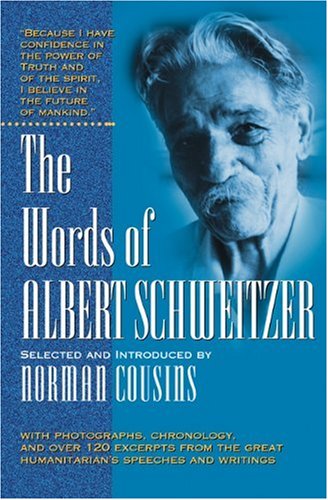
5. The Words of Albert Schweitzer (Words of Series)
by Norman Cousins
Paperback: 112 Pages (1996-11)
list price: US$11.95 -- used & new: US$6.68
(price subject to change: see help)
Asin: 1557042918
Average Customer Review: 5.0 out of 5 stars
Canada | United Kingdom | Germany | France | Japan
Editorial Review

Book Description
Inspiring selections on Knowledge and Discovery, Reverence for Life, Faith, The Life of the Soul and Civilization and Peace.21 photos, chronology. ... Read more

Customer Reviews (2)

5-0 out of 5 stars Albert Schweitzer - Spiritual Man of the Century
Although I am a scientist and I appreciate Einstein being chosen as Man of the Century, I feel that Albert Schweitzer would have been a more compelling choice.It is true that Einstein represents the science andtechnology that is taking us at a breathless pace into the new millenium. But just where is is taking us?

Schweitzer's scholarship in medicine,music, and religion could easily have led him to a highly successfulacademic career at a university.But he did not choose this path.Rather,he put his knowledge of medicine to use at a primitive level by servingnatives in a remote part of Africa.It was a courageous, soulworthydecision.For that reason it is worth learning everything we can aboutthis man whose mind was capable of such unique comprehension andaction.

I am very grateful that Norman Cousins put his editorial skillsto use in selecting words of Albert Schweitzer to pass on to us.Cousinsis correct in the Introduction when he says "The greatness ofSchweitzer rests not just on what he has done but on what other have donebecause of him."

The words in the text are classified under sixheadings: Knowledge and Discovery, Reverence for Life, Faith, The Life ofthe Soul, The Musician as Artist, and Civilization and Peace.Also, anexcerpt is given from Schweitzer's 1952 Nobel Peace Prize acceptancespeech.

The quotations range from humorous to subline; from "Anorgan is like a cow; one does not look at its horns so much as at itsmilk," to "The history of our time is characterized by a lack ofreason which has no parallel in the past."It is a fearsomeaccusation for a generation that prides itself on the good job it has donein harnessing reason to science.Schweitzer further reflects that "wehave sought to live and to carry on with a civilization which has noethical principle behind it."

With the example of Schweitzer's lifeof dedication and service we can perhaps see a glimmering of the ethicalprinciple that is missing in today's world.By living a life of sacrificeand service, his soul grows steadfastly without bound.

5-0 out of 5 stars Wonderful introduction to the great humanitarian.
As printed in the Editor's Note, I first suggested the ides of this book to the publisher and corresponded with Norman Cousins.In l995 I wrote a multimedia musical dramatization called the "Words of Albert Schweitzer and the Music of Bach>"This acclaimed production is available to churches and universities.It was prsented March l at Syracuse University, New York.Thurston Moore ... Read more


6. The Mysticism of Paul the Apostle (The Albert Schweitzer Library)
by Albert Schweitzer
Paperback: 440 Pages (1998-11-09)
list price: US$25.00 -- used & new: US$25.00
(price subject to change: see help)
Asin: 0801860989
Canada | United Kingdom | Germany | France | Japan
Editorial Review

Book Description

Immediately after the Gospels, the New Testament takes up the history of the early Christian Church, describing the works of the twelve disciples, and introducing Paul, the man whose influence on the history of Christianity is beyond calculation. Teacher, preacher, conciliator, diplomat, theologian, rule giver, consoler, and martyr, his life and writings became foundations for Christianity. Paul inspired a vast, serious, and intelligent literature that seeks to recapture his meaning, his thinking, and his purpose.

In his letters to early Christian communities, Paul gave much practical advice about organization and orthodoxy. These treated the early Christian communities as something more than a group of people who believed in the same faith: they were people bound together by a common spirit unknown before. The significance of that common spirit occupied the greatest of Christian theologians from Athanasius and Augustine through Luther and Calvin.

In The Mysticism of Paul the Apostle Albert Schweitzer goes against Luther and the Protestant tradition to look at what Paul actually writes in the Epistles to the Romans and Galatians: an emphasis upon the personal experience of the believer with the divine. Paul's mysticism was not like the mysticism elsewhere described as a soul being at one with God. In the mysticism he felt and encouraged, there is no loss of self but an enriching of it; no erasure of time or place but a comprehension of how time and place fit within the eternal. Schweitzer writes that Paul's mysticism is especially profound, liberating, and precise. Typical of Schweitzer, he introduces readers to his point of view at once, then describes in detail how he came to it, its scholarly antecedents, what its implications are, what objections have been raised, and why all of this matters. To students of the New Testament, this book opens up Paul by presenting him as offering an entirely new kind of mysticism, necessarily and exclusively Christian.

"There is at least one other point that Albert Schweitzer scores here... The hard-won recognition that divine authority and human freedom ultimately cannot be in conflict must never be taken for granted, and the irony that the thought of Paul has repeatedly been invoked to undo that recognition truly does make this insight one of 'the permanent elements.'"--from the Introduction

... Read more

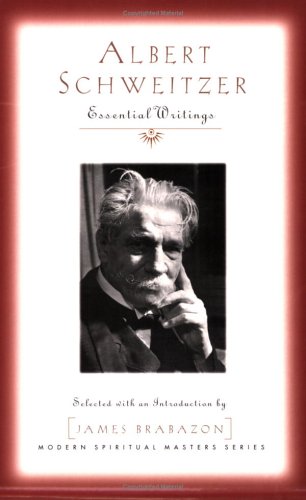
7. Albert Schweitzer: Essential Writings (Modern Spiritual Masters)
by James Brabazon
Paperback: 176 Pages (2005-10-31)
list price: US$16.00 -- used & new: US$8.38
(price subject to change: see help)
Asin: 1570756023
Canada | United Kingdom | Germany | France | Japan

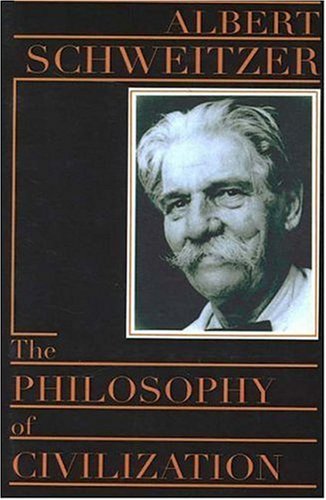
8. The Philosophy of Civilization: Part I, the Decay and the Restoration of Civilization : Part Ii, Civilization and Ethics
by Albert Schweitzer, C. T. Campion
Paperback: 347 Pages (1987-09)
list price: US$29.00 -- used & new: US$18.67
(price subject to change: see help)
Asin: 0879754036
Average Customer Review: 5.0 out of 5 stars
Canada | United Kingdom | Germany | France | Japan

Customer Reviews (2)

5-0 out of 5 stars I Agree With The Other Reviewer
This book should be more widely known.It should be taught about in schools from kindergarten on up----well, at least the main idea of "reverence for life" should be taught.It's a little "deep" in places but you'll feel enriched in the end.Recommended.

5-0 out of 5 stars Classic of Global (NOT WESTERN) Civilization
Einstein was not the Person of the 20th Century. Not by a long shot. Albert Schweitzer wins that distinction hands down. In the 20th and 21st century, too much emphasis has been placed on the relationship between technological advances and the corresponding impact on society. Schweitzer simply transcended achievement by weaving a legacy of the most accomplished Renaissance Man in the last 200 years. Combining intellectual brilliance and an amazing thirst for humanitarian service, Schweitzer simply made the world a much better place. He accomplished more in one life time than anyone I can think of.

The Philosophy of Civilization is a monument. This was Schweitzer's labor of love, and predictably, he produced yet another masterpiece. Reading Schweitzer should be required reading in philosophy, humanities, and religious studies at all universities and colleges in America. He should be the standard by which all GLOBAL thought is measured. ... Read more


9. Albert Schweitzer: reverence for life;: The inspiring words of a great humanitarian (Hallmark editions)
by Albert Schweitzer
 Hardcover: 62 Pages (1971)

Isbn: 0875292038
Canada | United Kingdom | Germany | France | Japan

10. Albert Schweitzer's Mission: Healing and Peace
by Norman Cousins, Albert Schweitzer
Paperback: 324 Pages (1985-10-01)
list price: US$21.95 -- used & new: US$16.74
(price subject to change: see help)
Asin: 0393331229
Canada | United Kingdom | Germany | France | Japan

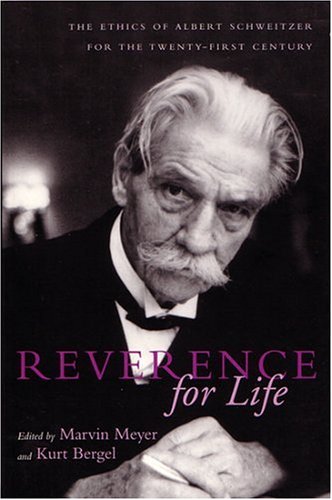
11. Reverence for Life: The Ethics of Albert Schweitzer for the Twenty-First Century
Paperback: 272 Pages (2002-10)
list price: US$19.95 -- used & new: US$12.49
(price subject to change: see help)
Asin: 081562977X
Average Customer Review: 4.5 out of 5 stars
Canada | United Kingdom | Germany | France | Japan
Editorial Review

Book Description
This collection of essays builds on the contributions of Albert Schweitzer's philosophy of "Reverence for Life" as it pertains to our world today. ... Read more

Customer Reviews (2)

4-0 out of 5 stars Excellent Reinforcement
If you've read Dr. Schweitzer's "Reverence for Life", you should enjoy this compilation of letters and papers regarding and reinforcding Schweitzer's ethic.The included writings are authored by everyone from Graduate students to correspondents and Albert Schweitzer himself.Very enjoyable reading.

5-0 out of 5 stars With an eclectic variety of soul-searching commentaries
Collaboratively and expertly edited by Marvin Meyer (Griset Professor of Bible and Christian Studies, Chapman University, Orange, California) and Kurt Bergel (Professor Emeritus, Chapman University and founder/co-director of the Chapman University Albert Schweitzer Institute), Reverence for Life: The Ethics Of Albert Schweitzer For The Twenty-First Century is an inherently impressive selection of profound essays by humanitarian Albert Schweitzer, enhanced with an eclectic variety of soul-searching commentaries on his thoughts and recommendations. Among Schweitzer's presented and scrutinized works are sermons, letters, as well as tidbits of his personal autobiography and deep philosophy. Reverence For Life is highly recommended as life-affirming, fundamental and thoughtfully constructed reading. ... Read more


12. The Spiritual Life (Ecco Companions)
by Albert Schweitzer
Paperback: 355 Pages (1999-02-01)
list price: US$15.00 -- used & new: US$7.99
(price subject to change: see help)
Asin: 0880014660
Average Customer Review: 3.0 out of 5 stars
Canada | United Kingdom | Germany | France | Japan

Customer Reviews (1)

3-0 out of 5 stars An Inroduction To Schweitzer
Albert Schweitzer wrote on a wide range of topics. This book is an excellent introduction to Schweitzer's views on art, music, philosophy, religion, ethics, colonialism, science, and more. What I found frustratingis that the book consists of short extracts from Schweitzer's writings. Itis like looking at still photographs of scenes from a movie rather thanwatching the complete film. Or eating appetizers and never getting the fullmeal. The book's format did not allow me to experience the fullness ofSchweitzer's thoughts on any subject. To be fair, the editor, Charles R.Joy, states that it is his hope that the reader will be motivated to readSchweitzer's works in their full as a result of reading this anthology. Iappreciated the biographical chronology at the end of the book. It gave agood overview of Schweitzer's work and extensive travels. ... Read more


13. Schweitzer: A Biography
by George Marshall, David Poling
Paperback: 392 Pages (2000-05-17)
list price: US$25.00 -- used & new: US$13.73
(price subject to change: see help)
Asin: 0801864550
Average Customer Review: 5.0 out of 5 stars
Canada | United Kingdom | Germany | France | Japan
Editorial Review

Book Description

He was an accomplished organist and interpreter of Bach, a crusader for world peace, and a winner of the Nobel Peace Prize. He made his philosophy of "reverence for life" an ethic for the world. The hospital he founded in Lambaréné (still in operation in present-day Gabon) is a model of what Europeans might have given to Africans throughout colonial history. But above all, Albert Schweitzer (1875-1965) was a talented and compassionate human being. This biography probes beyond the timeworn image of Schweitzer as "the old man in the pith helmet" to reveal the philosopher, scholar, husband, father, humanitarian, and liberal rebel in a conservative church.

... Read more

Customer Reviews (2)

5-0 out of 5 stars Sensitive, moving and inspiring...
This is a fine biography of one of the greatest humanitarians of the twentieth century. During his lifetime, (ninety years) Schweitzer the great man transformed into Schweitzer the great myth; the great white hope, saving the bodies and souls of the primitive black man of Africa. In our post colonial age, with its post modern, abstract cultural theories of the `other', Schweitzer became an easy target for cultural critics, using the man and his work as representative of everything evil about the self-perceived superiority of Western man over `primitive cultures'. It is without question, that, for the most part, European imperialism justified their greedy exploitation of developing countries as efforts to `civilize' them. Our culture, knowledge and religion were superior to these `savages', and while we stole their natural resources, we gave them enlightenment. Further to this, however, as we stole and enlightened, we also gave them our diseases, which, in some cases, virtually wiped out entire peoples. From the very beginning, Albert Schweitzer was aware of the European's injustices to these people, and deeply felt some kind of atonement or restitution had to be made.Schweitzer's intention was to essentially help; his inspiring example paved the way for present humanitarian organizations to make a difference or at least become more effective in their aid. This biography successfully dismantles the `great white hope' myth, and presents the man as an insightful critic of Western values and traditional theology, a man who lived his philosophy - or as Schweitzer said, "Live his argument". One can never truly understand or judge someone based on what they say or what they write; only through the results of a person's actions can we really know them. Marshall and Poling's biography of Schweitzer includes his writing and many quotes from conversations and interviews, but argue his greatness from the stand point of his actions. In other words, his fifty years of service and the establishment of the Lambarene hospital, speaks for itself.

Schweitzer became aware of his mission to serve his fellow travellers on this planet somewhat late in life. An established philosopher and theologian at age thirty, a principal of a respected seminary, he awoke one morning to realize everything life had given him, and it was time to give back. After reading an article calling for trained medical staff to work in West Africa, he knew what he needed to do. Against heavy opposition from family and friends, he returned to university as a mature-aged student to study medicine, attaining his degree. The public know much about his early life but as his daughter, Rhena Schweitzer, writes in the Forward, "It is the first biography that gives an account of the last years of my fathers live. It helps explain and dissipates some of the false ideas about his relationship to the Africans." This book dispels these falsehoods and myths, and is also a sensitive and objective appraisal of a man and his life.

An inspiring read.

5-0 out of 5 stars 'My Life Is My Argument' Albert Schweitzer
A brilliant bravo to a task well done. G. Marshall & D. Poling have captured succinctly the life of the last of the 'Enlightenment' minds. Albert Schweitzer was true to the principles of reason, naturalism and thought. He took these principles and undauntedly applied them to his religion and his culture. Albert Schweitzer was a critic of Christianity and modern civilization and this book captures Albert Schweitzer, "the critic".

In the world and church around him he saw conformity and the lack of individual reflection. This is a book about a nonconformism, a brilliant theologian/philosopher and a humanitarian genius.

Unlike other biographies of Schweitzer I have read, these authors write with a fluid, engaging style, pulling you closer to the man that they knew and profiled. Albert Schweitzer lived 90 years and the length of his life is a challenge that biographers must face. They must capture the individualistic spirit of Albert Schweitzer youth, the brilliance of his middle years and the tenacity of his old age.

Albert Schweitzer's Nobel Peace Prize in 1953 spoke of his sacrificial work in Africa, his vital practical philosophy of life, his call to clear comprehension of the historic Jesus that Christianity needs to embrace, his musical brilliance, his compassion for the animal kingdom and his love of healing. Yet, to brush stroke with ink a portrait of this unbelievable figure is a demanding undertaking and Marshall and Poling have done it right, and they did right to one of the greatest personalities of the twentieth century. Strongly recommended. 4.5 Stars. ... Read more


14. The Primeval Forest (The Albert Schweitzer Library)
by Albert Schweitzer, Rhena Schweitzer Miller
Paperback: 240 Pages (1998-07-06)
list price: US$25.00 -- used & new: US$2.89
(price subject to change: see help)
Asin: 0801859581
Average Customer Review: 4.0 out of 5 stars
Canada | United Kingdom | Germany | France | Japan
Editorial Review

Book Description
"There, in this sorry world of ours, goes a great man."-Albert Einstein, on Albert SchweitzerIn July of 1913, thirty-eight-year-old medical doctor Albert Schweitzer gave up his position as a respected professor at the University of Strasbourg and celebrated authority on music and philosophy in order to go as a physician to French Equatorial Africa (present-day Gabon). The Primeval Forest is Schweitzer's own fascinating story of these eventful years--a thrilling tale of his amazingly successful attempt to practice modern medicine and surgery in the face of wild elephant raids, marauding leopards, famine, an flood-a story rich in human interest and high drama.Schweitzer describes how he and his wife, a qualified nurse, worked to establish a hospital in the steaming jungle at Lambaréné. At first they treated patients in the open air, amid unbelievably primitive conditions-with few drugs, medicines, or adequate instruments. But they worked tirelessly, caring for as many as forty cases a day, battling the misery caused by sleeping sickness, leprosy, pestilence, and plague. And, as the years went on, they gradually built a more permanent hospital to alleviate the terrible suffering of the Congo people."Here, in Dr. Schweitzer's own words, is the inspiring and unforgettable account of his years in Africa; his thrilling jungle adventures, and his amazing experiences in bringing modern medicine and surgery to the French Congo. The record of Schweitzer's day-by-day experience is told so vividly that a responsive reader cannot fail to relive these stirring events."-Richmond Times-Dispatch ... Read more

Customer Reviews (4)

5-0 out of 5 stars Aclassictext and insight into a great doctor...
Although a great admirer of Dr. Albert Schweitzer for some years, it is only now that the opportunity has presented itself to finally read and relish the doctor's own account of his beginnings and reasons for working in equatorial Africa.

Schweitzer's reason(s) for giving up his position as professor in the University of Strasbourg, his prolific literary work, his ground-breaking work on Bach, (he was the world authority at the time) and his music... the doctor writes,

"I had read about the physical miseries of the natives in the virgin forests; I had heard about them from missionaries, and the more I thought about it the stranger it seemed to me that we Europeans trouble ourselves so little about the great humanitarian task which offers itself to us in far-off lands." (P. 9)

Dr. Schweitzer has a lot to say concerning the extensive damages wrought on the native African as a result of colonialism. We take their natural resources as if they were our own; we have given them our diseases; we have given them alcoholism and we push the Word of the Lord down their throats and some how justify this pillage & plunder as "civilizing the savages". Schweitzer, first and foremost, realized that the colonized natives are experiencing great suffering in terms of the many diseases that plague the continent, and felt that he, a white man, needed to take responsibility; therefore he chose to become a medical doctor at the age of thirty. Once attaining his qualifications, he set out with his wife to West Africa amongst the many protests from his contemporaries.

This book was first published in 1922, but Schweitzer set sail for Africa in July 1913, to go on and establish his famous hospital in Lambarene, West Africa. The hardships in establishing a hospital in such primitive conditions to then begin treating the natives straight away with little or adequate medical supplies is almost unthinkable, but he forged on, building the hospital, treating horrific disease and dealing with the culture of the West African. He writes about the belief system of the native's (fetishist) and the affect of their conversion to Christianity.

There is a chapter the doctor devotes entirely to the most prevalent tropical diseases he comes across most weeks and months. These descriptions are graphic, truly conveying the horror and utter suffering the patient experiences if left untreated.

In Dr. Schweitzer's conclusion, he writes about something he calls "The Fellowship of those who bear the Mark of Pain." In distilled terms, anyone who has experienced great pain and has been treated to a successful outcome should realize the extent of pain and suffering of the native African. This empathy should awake the white man, and force them to help with the aid of modern medicine, the pain and suffering of the native African.

Any medical student or doctor thinking about working in primitive conditions in any developing country, should certainly read this book. I believe it is inspiring in every sense of the word.

5-0 out of 5 stars Deeply insightful regarding the philantropic benefit of European colonialism
This book is a very frank account of a French medical missionary's experiences in Central Africa. The length to which Schweitzer went to ease the suffering of the native tribes is touching and displays a great deal of empathy and dedication. It showcases the concern of a medically advanced society for the less fortunate. The number of lives saved by the provision of modern European medicine that would certainly have been lost without his intervention is deeply disturbing.

1-0 out of 5 stars deeply offensive for us natives of Gabon
I read this book out of curiosity because my grandmother remembers Dr. Schweitzer very well. I found this book very offensive because of the imperialistic language of "superior Europeans coming to the rescue of inferior childlike Blacks". He calls us "children of nature" and "savages." Read the book, it's all in there.

4-0 out of 5 stars Candid and well written
This book will have most of its appeal to those with interest in medicine, missionary work, or anthropology.It consists of Schweitzer's medical case histories, travels, hospital administrative chores, reflections on African and European culture, and general overview of his first decade and a half in Gabon on the west coast of Africa.Schweitzer's candid comments about the Africans and the harsh conditions under which he worked help make this book better than the average account of third world philanthropic endeavors.Schweitzer shows true insight and compassion for those he came to help and I found the book highly engaging. ... Read more


15. Albert Schweitzer: An Anthology
by Albert Schweitzer
Paperback: 352 Pages (2006-03-03)
list price: US$31.95 -- used & new: US$20.68
(price subject to change: see help)
Asin: 1425387233
Canada | United Kingdom | Germany | France | Japan
Editorial Review

Book Description
Selections From The Writings Of The Philosopher, Theologian, Musician And Humanitarian With A Chronological Summary Of Dr. Schweitzer's Life And A Biographical Introduction. ... Read more


16. Albert Schweitzer: Friend of All Life (A Rookie Biography)
by Carol Greene
 Paperback: Pages (1994-01)
list price: US$4.95
Isbn: 0516442589
Canada | United Kingdom | Germany | France | Japan

17. Albert Schweitzer's gift of friendship
by Erica Anderson
 Hardcover: 152 Pages (1964)
-- used & new: US$28.95
(price subject to change: see help)
Asin: B0006BM5RO
Canada | United Kingdom | Germany | France | Japan

18. Albert Schweitzer's Mission: Healing and Peace
by Norman Cousins
 Hardcover: 320 Pages (1985-10)
list price: US$16.95 -- used & new: US$29.50
(price subject to change: see help)
Asin: 0393022382
Canada | United Kingdom | Germany | France | Japan
Editorial Review

Book Description
In 1952, Dr. Albert Schweitzer was awarded the Nobel Peace Prize for his work as a medical missionary in Africa.At that point, his career included--as well as medicine--theology, music and philosophy.His final quest was to wake the public to the dangers of nuclear war.

Norman Cousins visited Schweitzer in Africa.The friendship that grew from this meeting gave rise to a rich correspondence, most of it dealing with the arms race.

That correspondence forms the core of this volume, though letters from Dwight D. Eisenhower, John F. Kennedy, Jawaharlal Nehru and Nikita Kruschev are included.

"The body of letters is deeply revealing, intrinsically interesting and of profound historical significance." (Publisher's Source) ... Read more


19. ALBERT SCHWEITZER: AN ANTHOLOGY
 Paperback: Pages (1947)

Asin: B000H29CYG
Canada | United Kingdom | Germany | France | Japan

20. Albert Schweitzer's Reverence for Life
by Mike W. Martin
Hardcover: 124 Pages (2007-11-21)
list price: US$69.95 -- used & new: US$69.95
(price subject to change: see help)
Asin: 0754661067
Canada | United Kingdom | Germany | France | Japan

  1-20 of 100 | Next 20
A  B  C  D  E  F  G  H  I  J  K  L  M  N  O  P  Q  R  S  T  U  V  W  X  Y  Z  

Prices listed on this site are subject to change without notice.
Questions on ordering or shipping? click here for help.

site stats