e99 Online Shopping Mall

Geometry.Net - the online learning center Help  
Home  - Nobel - Wiesel Elie (Books)

  1-20 of 100 | Next 20
A  B  C  D  E  F  G  H  I  J  K  L  M  N  O  P  Q  R  S  T  U  V  W  X  Y  Z  

click price to see details     click image to enlarge     click link to go to the store

$4.00
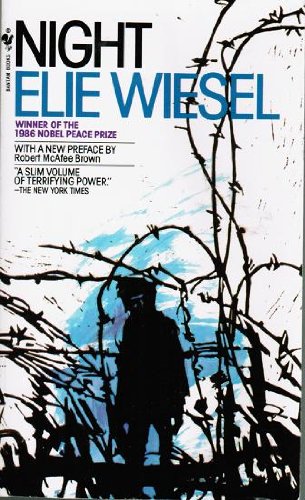
1. Night (Oprah's Book Club)
 
$5.95
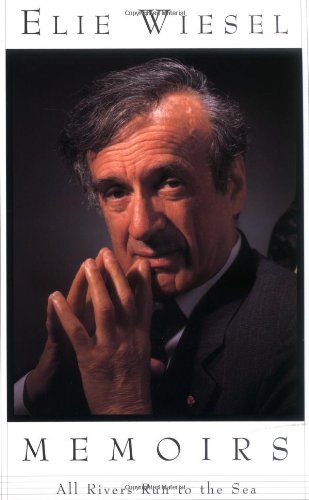
2. All Rivers Run to the Sea: Memoirs
$11.00
3. After the Darkness: Reflections
$18.61
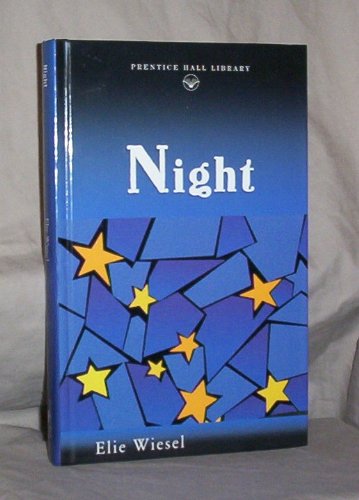
4. Night; with Connections
$4.27
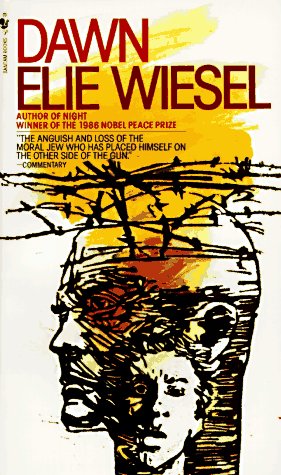
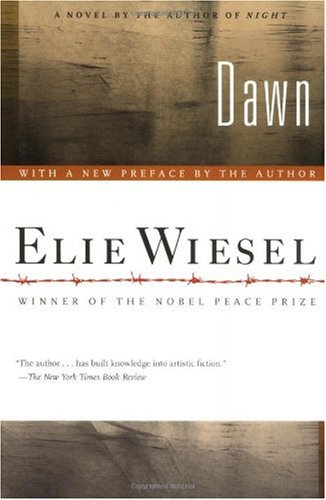
5. Dawn
$4.64
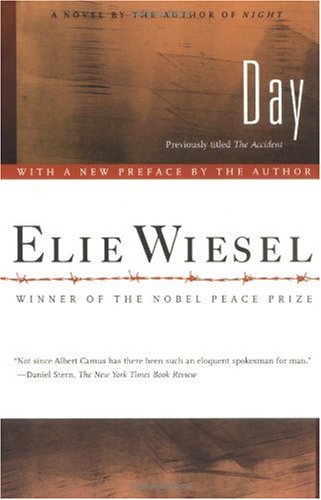
6. Day: A Novel
$10.51
7. Night
$2.99
8. Conversations with Elie Wiesel
 
$8.71
9. The Forgotten
 
10. Night
 
$24.00
11. Elie Wiesel: Messenger to All
$7.31
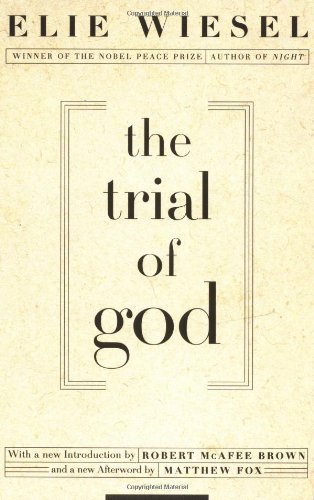
12. The Trial of God
$25.00
13. Night, Dawn, and Day (B'Nai B'Rith
$8.98
14. And the Sea Is Never Full: Memoirs,
$10.28
15. Night
$9.31
16. Elie Wiesel: Spokesman for Remembrance
$4.95
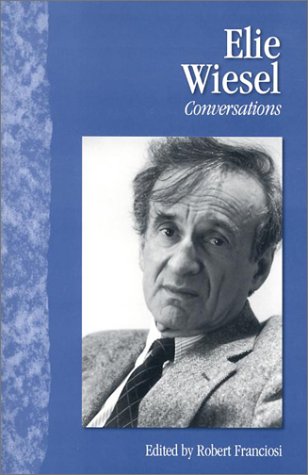
17. Elie Wiesel: Conversations (Literary
 
18. Night
 
$25.00
19. The Fifth Son: A Novel
 
20. The Night Trilogy: Night / Dawn

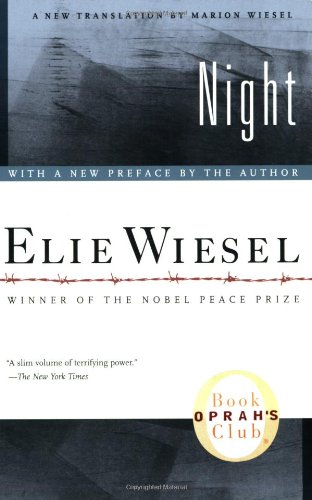
1. Night (Oprah's Book Club)
by Elie Wiesel
Paperback: 144 Pages (2006-01-16)
list price: US$9.00 -- used & new: US$4.00
(price subject to change: see help)
Asin: 0374500010
Average Customer Review: 4.5 out of 5 stars
Canada | United Kingdom | Germany | France | Japan
Editorial Review

Amazon.com
In Nobel laureate Elie Wiesel's memoir Night, a scholarly, pious teenager is wracked with guilt at having survived the horror of the Holocaust and the genocidal campaign that consumed his family. His memories of the nightmare world of the death camps present him with an intolerable question: how can the God he once so fervently believed in have allowed these monstrous events to occur? There are no easy answers in this harrowing book, which probes life's essential riddles with the lucid anguish only great literature achieves. It marks the crucial first step in Wiesel's lifelong project to bear witness for those who died.Book Description

A New Translation From The French By Marion Wiesel

Night is Elie Wiesel’s masterpiece, a candid, horrific, and deeply poignant autobiographical account of his survival as a teenager in the Nazi death camps. This new translation by Marion Wiesel, Elie’s wife and frequent translator, presents this seminal memoir in the language and spirit truest to the author’s original intent. And in a substantive new preface, Elie reflects on the enduring importance of Night and his lifelong, passionate dedication to ensuring that the world never forgets man’s capacity for inhumanity to man.

Night offers much more than a litany of the daily terrors, everyday perversions, and rampant sadism at Auschwitz and Buchenwald; it also eloquently addresses many of the philosophical as well as personal questions implicit in any serious consideration of what the Holocaust was, what it meant, and what its legacy is and will be.
... Read more

Customer Reviews (599)

5-0 out of 5 stars Could we ever forget?,

It is no use trying to describe the story, as it is darkest than its title (the Night).I suggest for everyone to read and discover it for yourself... I think it is only good that it is a rather short story. It is too heartbreaking to make it any longer. I respect Oprah to find the most meaningful stories for her Book Club. Another great title from Oprah's Book Club that I recently read is Middlesex: A Novel (Oprah's Book Club)

1-0 out of 5 stars written
One of the most moving and powerful books I've read. Elie Wiesel is a master in literature and shared his Holocaust experience with authenticity, pain and honesty. A must read...

5-0 out of 5 stars A Timeless Guide to Being Human
I first read "Night" in college and, even then, was struck by its power. No one who reads it can ever forget the child hanging or the despair of the camps. Now, having read it again, I am struck by how timeless the book is. Elie Wiesel's book has profound emotional honesty. Because he emerged from Hell to tell it, the book also is a guide for all of us about going through suffering in life without hating or losing or humanity.

At one point, this book was hundreds of pages long, but Elie Wiesel has wisely let silence speak as loudly as words in this memoir. It is a modern day Book of Job by a brilliant humanitarian.

Lawrence J. Epstein, author of "At the Edge of a Dream: The Story of Jewish Immigrants on New York's Lower East Side."

5-0 out of 5 stars Amazing book that will change your views of the Holocaust
This book is absolutely amazing. I learned so much about the Holocaust because of this book. It's a true story, very sad & tragic, yet Elie Wiesel was lucky enough to survive to tell his story. This translation was really easy to read & it brought a new light on the Holocaust for me. I would definitely recommend to anyone.

5-0 out of 5 stars Amazing
I read this book back in high school and it stayed with me ever since. ... Read more


2. All Rivers Run to the Sea: Memoirs
by Elie Wiesel
 Paperback: 464 Pages (1996-10-22)
list price: US$16.00 -- used & new: US$5.95
(price subject to change: see help)
Asin: 0805210288
Average Customer Review: 4.5 out of 5 stars
Canada | United Kingdom | Germany | France | Japan
Editorial Review

Amazon.com
The long-awaited memoirs of Wiesel, winner of the 1986 Nobel PeacePrize, tell the story of his happy childhood in the Carpathian Mountains, his subsequent years of hell in Auschwitz and Buchenwald, and his post-warlife in France, where he discovered his voice as a writer.Highly recommended.Book Description
From his early years with his loving Jewish family to the horrors of Auschwitz to his life as a Nobel Prize-winning novelist, Elie Wiesel tells his story. Passionate and poignant, All Rivers Run to the Sea is an unforgettable book of love and rage, doubt and faith, despair and trust, and ultimately, of wisdom. of photos. ... Read more

Customer Reviews (21)

5-0 out of 5 stars Memoirs of a a gadol b'Israel
This spectacular memoir of Elie Wiesel, the great author and voice of conscience, begins with his boyhood in the small Transylvanian village of Sighet.

A pious child, with a great thirst for Jewish knowledge, a student of Torah and Talmud, and fascinated with the Kabbalah. Elie is swept into the Nazi ghetto and then death cams where he loses his parents and his beautiful little blond sister Tzipora, all of whom perished in the Nazi furnaces.

He writes in memory of his losses:

"If only I could recapture my father's wisdom, my little sister's innocent grace. If only I could recapture the rage of the resistance fighter, the suffering of the mystic dreamer, the solitude of the orphan in a sealed cattle car, the death of each and every one of them. If only I could step out of myself and merge with them".

Wiesel writes of the prophecy told to his mother by the Wizhnitz Rabbi that her son would become a gadol b'Israel (a great man in Israel) but that she would not live to see it.

Wiesel records some of the horrors he witnessed in the death camps such as live children being thrown into furnaces by the Nazis, and laments the inaction by the Allies to do anything about the extermination they knew was taking place of the Jews- saving Jews was not a priority for the Allies either.

He mentions that most of the Jews who collaborated with the Nazis were intellectuals- not surprising in light of the fact hat most Jews who have thrown themselves into the campaign of hate against their fellow Jews in Israel.

He writes about the liberation of the death camps by the Allies after the war, and how one of the youngest child survivors of Buchenwald was eight year old Israel Meir Lau, later to be the Chief Ashkenazic Rabbi of Israel. In his section of his travels around the world as a young man during the early 1950s he writes of his great compassion at the plight of poverty-stricken children in India.

Wiesel records his life in a youth home for Jewish refugees in Paris and the fate of displaced Jews after World War II, his life as a journalist for Israeli newspaper Yedioth Ahronot for whom he covered the Eichmann trial, civil rights struggles, the Six Day War, the 1968 Student insurrections in France, and other world events.

He has always been greatly interested in philosophy and parapsychology and writes of his discussions with such great leaders as Golda Meir and David
Ben-Gurion, as well as the greatest thinkers of the day. He writes of his great love for Israel and it's people for which he has been attacked by the hate-filled bigots of the International Left. He also took a strong stand for persecuted Soviet Jewry during the 1960s and 1970s. Elie Wiesel also writes of his great compassion for humanity as a whole, such as his pain at seeing the suffering of destitute children during his travels in India. But unlike certain Jews of the Left, he does not see a contradiction between this and his great love of Israel and the Jewish people- Ahavat Israel.

He writes with great compassion, passion, anger, sadness and hope.
In a plea for the plight of his own people today, especially the youth and children of Israel today targeted by terror and forces of genocide (such as Hamas, Hezbollah and the Ahmadinejad regime- as well as all who are sympathetic to these anti-Jewish elements) he penned an open letter to President Bush stating: "Please remember that the maps on Arafat's uniform and in Palestinian children's textbooks show a Palestine encompassing not only all of the West Bank but all of Israel, while Palestinian leaders loudly proclaim that 'Palestine extends from the Jordan River to the Mediterranean Sea, from Rosh Hanikra (in the North) to Rafah (in Gaza). Please remember Danielle Shefi, a little girl in Israel. Danielle was five. When the murderers came, she hid under her bed. Palestinian gunmen found and killed her anyway. Think of all the other victims of terror in the Holy Land. With rare exceptions, the targets were young people, children and families. Please remember that Israel--having lost too many sons and daughters, mothers and fathers--desperately wants peace. It has learned to trust its enemies' threats more than the empty promises of 'neutral' governments".
Elie Wiesel is a true voice of truth and conscience.

5-0 out of 5 stars disagree with "mediocre" label
I found this a very compelling read, lasting over several readings. It's true the author did not stick tightly to chronological order, but anyone who has read his fiction knows his style tends to be very esoteric and rather free-floating (I personally do not care for his fiction, which I admit I do find to go over my head). However, as a reader, I certainly got a feel for emotions he felt throughout different experiences in his life. I found the last scene describing his emotions before and during his wedding to be really profound. It's true that there is a lot of Jewish content in this book, which may cause some of his analogies etc. to be less accessible to someone from a different background. However, for someone who wants to read a first-hand Holocaust experience without very strong graphic details, I do recommend it. (As a side note, just last week I actually attended a speech by Mr. Wiesel, and he is really a personable, funny, self-effacing and sweet man, not the really sad and somber person you might expect from his writings. I was surprised by this, pleasantly so!)

5-0 out of 5 stars My own small word
I would strongly recommend that all readers on Amazon read the review whose title caption is ' Remember'. It is far more extensive and far better than the small remarks I am about to post.
Elie Weisel is the one human being who more than any other has helped the world understand the horror of the Shoah , the Holocaust the Nazi destruction of one - third of the Jewish people six million human beings.
For this he should always have a place in the historical consciousness of both the Jewish people and mankind.
His memoir is at times very moving .For those who know his other work and his masterpiece ' Night' there will be much familiar here, though here the story is enriched by greater detail.
I find myself whenever I am reading Weisel unable to really judge in abstract or purely literary terms. His significance as a human being, as a witness as one who has spoken to me in my own life is so great that my feeling is closer to reverence than anything else.
I read this book with the idea that any additional detail about his life and work, any additional understanding of his thought about Man's relation to G-d would be worthwhile. I read this work as I will read all his future works as an admiring student of a great teacher.
May he be blessed by many more years of great creative work.

5-0 out of 5 stars 6 stars?
This is one of the times when I think we should be able to go higher than 5 stars. Elie Wiesel's All Rivers Run to the Sea gave us a more in-depth look to the concentration camp survivor. He really gives us a rich experience in weaving together the threads of his past, from his days in school to the horror in the concentration camps, right up to his days of being a journalist, and ending with him as a groom. You really get a feel for the type of person he is as well - a wonderful, compassionate, and intelligent man. If you've read Night already, you're definitely going to want to check this out.

4-0 out of 5 stars The book All Rivers Run to the Sea was a great book
I read the book All Rivers Run to the Sea, by Elie Wiesel.This book is about his amazing journey all throughout the Holocaust.Elie was split apart from his family and had to experience the worst pain that you could imagine all on his own.I think this book is very depressing but it also makes you think about how glad and grateful you should be for having a family who loves and cares for you.
Elie Wiesel is a very skilled writer and he easily makes you picture in your mind what he is writing about.I think that this book would be well suited for people who are either twelve or older. It is also well suited for people who enjoy reading about the Holocaust and all the people who experienced it.This book is more of a bibliography rather than a fairy tale so you have to be willing to read a lot.This book is also very long and at some parts it gets a little confusing but at other times it is really hard to put the book down.I do not think that this would be a very good book for teachers to have their students read in class because of the length.I think that they should use one of Wiesel other great books on the Holocaust.
I really enjoyed this book and the style of Elie's writing.He described every thing very well and he kept my attention throughout the whole book.I hope that others get the chance to read this book and learn as much as I did about the Holocaust.This is a very good book and is well suited for young adults and people who are older as well.It teaches you a lot and makes you think about your life. This was a very good book and I hope others will read this book and get as much out of it as I did. ... Read more


3. After the Darkness: Reflections on the Holocaust
by Elie Wiesel
Hardcover: 48 Pages (2002-10-22)
list price: US$20.00 -- used & new: US$11.00
(price subject to change: see help)
Asin: 0805241825
Average Customer Review: 5.0 out of 5 stars
Canada | United Kingdom | Germany | France | Japan
Editorial Review

Book Description
A poignant, powerful distillation of the Holocaust experience from the internationally acclaimed writer and Nobel laureate.

In his first book, Night, Elie Wiesel described his concentration camp experience, but he has rarely written directly about the Holocaust since then. Now, as the last generation of survivors is passing and a new generation must be introduced to mankind’s darkest hour, Wiesel sums up the most important aspects of Hitler’s years in power and provides a fitting memorial to those who suffered and perished. He writes about the creation of the Third Reich, Western acquiescence, the gas chambers, and memory. He criticizes Churchill and Roosevelt for what they knew and ignored, and he praises little-known Jewish heroes. Augmenting Wiesel’s text are testimonies from survivors, who recall, among other moments and events: the establishment of the Nurembourg Laws, Kristallnacht, transport to the camps, and liberation.

With this book — richly illustrated with 45 photographs from the U.S. Holocaust
Museum -- Wiesel proves once again the ineluctable importance of bearing witness. ... Read more

Customer Reviews (6)

5-0 out of 5 stars after the darkness
I believe this book is a wonderful introduction to the history and events leading up to, and including the horrible years of the holocaust.I gave it to my grandaughter who is ten years old.I am a child of a survivor.The book is a valuable part of education of a time that now seems so distant, and when most of the survivors have died.It speaks for them to future generations
nd as always, Elie Wiesel is warm, and honest, but never bitter.We are now the witnesses for those who experienced hell.

5-0 out of 5 stars Yes of course, ""Reflection on the Holocaust""!!!
Those who do not believe that there was, and still is, a legend in the name of 'Holocaust' are kindly invited to visit Ghaza and Lebanon (North and notably South) to look and see how such a word is actually pronounced.
They will see a thorough destruction involving extensive loss of life through a carnage of fire and cold-blood slaughter of civilians.

Thank you.

5-0 out of 5 stars Powerful, Haunting
Dare to stick you head and heart into the cruelity of mankind and you come away from this powerful book enlightened--and looking over your shoulder at today's racism. An equally moving book is Walking the Trail, One Man's Journey Along the Cherokee Trail of Tears by Jerry Ellis.

5-0 out of 5 stars Excellent Book
This is the third book I read by Elie Wiesel, first I read "Night" which is my favorite, second I read "The Forgotten" which I thought was very good too. Now this one, is much shorter but the tetimonials by other Holocaust victims and the photographs makes it an excellent book. The generation of WWII survivors are dying and we need books like these to keep reminding us and future generations of the horrors of the war, so we don't repeat it.

5-0 out of 5 stars A short overview of history's greatest evil
Elie Wiesel is the writer who more than any other made the world aware of the Holocaust. He through the years has been a voice of remembrance for the victims, a voice of integrity and courage, a witness of what isthe greatest example of Man's inhumanity to Man known in human history. For the Holocaust was the deliberate effort of Nazi Germany, a people sitting in the center of Europpean civilization to wholly destroy, man, woman and child the entire Jewish people. One third of the Jewish people was murdered in the years 1939-1945, and the greatest share of European Jewry destroyed.
Now in this work Elie Wiesel presents a small historical over-view of the Shoah, and accompanies this with testimonies of others who passed through this world of nightmare.
It is a short moving volume, another work of invaluable testimony. ... Read more


4. Night; with Connections
by Elie Wiesel
Hardcover: 193 Pages (1999-10)
list price: US$19.85 -- used & new: US$18.61
(price subject to change: see help)
Asin: 0030554624
Average Customer Review: 4.5 out of 5 stars
Canada | United Kingdom | Germany | France | Japan
Editorial Review

Amazon.com
In Nobel laureate Elie Wiesel's memoir Night, a scholarly, pious teenager is wracked with guilt at having survived the horror of the Holocaust and the genocidal campaign that consumed his family. His memories of the nightmare world of the death camps present him with an intolerable question: how can the God he once so fervently believed in have allowed these monstrous events to occur? There are no easy answers in this harrowing book, which probes life's essential riddles with the lucid anguish only great literature achieves. It marks the crucial first step in Wiesel's lifelong project to bear witness for those who died.Book Description

Night -- A terrifying account of the Nazi death camp horror that turns a young Jewish boy into an agonized witness to the death of his family...the death of his innocence...and the death of his God. Penetrating and powerful, as personal as The Diary Of Anne Frank, Night awakens the shocking memory of evil at its absolute and carries with it the unforgettable message that this horror must never be allowed to happen again.
... Read more

Customer Reviews (924)

5-0 out of 5 stars Night
Night by Elie Wiesel is an excellent first hand account into the atrocities the Jew endured at the German prisoner and slave labor camps of World War II.This volume gives students additional connections into understanding the situations.Excellent version!!!

5-0 out of 5 stars A simple, succinct, harrowing story
This is the true story of Holocaust survivor Elie Wiesel. A religious Jew, Wiesel was a young boy during the German invasion. He and his family were taken captive by the Nazis and put into the concentration camps where he witnessed atrocities that destroyed his family and shattered his faith.

Told simply and succintly, this first person account is haunting. Wiesel speaks with a numb detachment, sensationalizing nothing. He asks for no pity. He simply describes what he saw.

It is only one person's point-of-view of perhaps the most important event in modern history, but his testimony feels as big as the Holocaust itself. That this is one of millions of stories that could be told is shocking again, even if you've seen movies or read other books on the topic. You come away from this book with a better understanding of what happened, and many unanswerable questions as to why it happened.

As other reviewers have suggested, this book should be required reading for all high school students.

4-0 out of 5 stars incredible
This was amazing book. This book takes you on the journey of a Jewish boy during the Nazi reign. You may know the stories of the concentration camps but you really can't imagine what they felt like. I would recomend this book to any one.

5-0 out of 5 stars Greatbook...influencedthe epic
Read a book like this and it might influence you to write a concept piece.
By the way the title of this is Night not "darkness"Ted Leonard.

5-0 out of 5 stars Night


The author is such a good writer that you'll almost hear the squeak of rusty railroad cars along with muffled sounds of hopelessness from within as they roll down the tracks to the concentration camps.

You can almost smell the odors of less than humane living conditions mingled with the acrid smoke from the crematoriums upon arriving at the death camps.

You'll almost be able to see the look of death in the eyes of the living who have given up as well as the emaciated bodies of those whose suffering had finally ceased.

You'll almost feel the nagging hunger pains of those who sometimes must go without food for days at a time and the bone-drilling cold ache of hands and feet not protected from the sub-zero temperatures.

But you'll also sense the author's strong will to persevere the inhumane cruelties inflicted upon his people to return to the land of the living one day. He did survive and tells his story in a non-fiction selection that reads like a novel.

"Night" by Elie Weisel relates the atrocities of the Holocaust through the eyes of a teenage Jewish boy. As in "The Diary of Anne Frank" and "Schindler's List", it's an unforgettable story that should never EVER be forgotten.
... Read more


5. Dawn
by Elie Wiesel
Paperback: 96 Pages (2006-03-21)
list price: US$9.00 -- used & new: US$4.27
(price subject to change: see help)
Asin: 0809037726
Average Customer Review: 3.5 out of 5 stars
Canada | United Kingdom | Germany | France | Japan
Editorial Review

Book Description

“The author…has built knowledge into artistic fiction.”—The New York Times Book Review

Elisha is a young Jewish man, a Holocaust survivor, and an Israeli freedom fighter in British-controlled Palestine; John Dawson is the captured English officer he will murder at dawn in retribution for the British execution of a fellow freedom fighter. The night-long wait for morning and death provides Dawn, Elie Wiesel’s ever more timely novel, with its harrowingly taut, hour-by-hour narrative. Caught between the manifold horrors of the past and the troubling dilemmas of the present, Elisha wrestles with guilt, ghosts, and ultimately God as he waits for the appointed hour and his act of assassination. Dawn is an eloquent meditation on the compromises, justifications, and sacrifices that human beings make when they murder other human beings.
... Read more

Customer Reviews (6)

4-0 out of 5 stars Life and Death Matters
Have you ever had to do something very serious that you did not really want to do? Dawn,is an extraordinary novel written by Elie Wiesel, a surviovor in the Holocaust. Dawn is not in any way connected to Night or Day. Dawn is about responsibility and dity, unlike Night or Day. This novel is about a young boy that has been given the responsibility of executing John Dawson, a British soldier. He holds John hostage and brings him food, I know surprising right? The reason he brings John food is because he does not want John to die with an empty stomach. Later he feels sorrow for John Dawson. What will he do? I would have to say the young boy, main character is my favorite character in Dawn because he changes for the best, I think. This is definitely a novel I would read again because the first time you read it you can not comprehend it very well. I recommend Night, Dawn and Day but I would also recommend it for pleasure read only. You can not do any research on the Holocaust with these three books. I hope you take the time to read them.

4-0 out of 5 stars One of Elie Wiesel's amazing novels
"Dawn" is an extraordinary fiction novel. "Dawn" is not in any way connected to "Night" or "Day". Unlike "Night", "Dawn" is all about responsibility and duty. This novel is about a young boy that has given the responsibility of executing one of the British soldiers, named John Dawson. He holds the man hostage and brings him food because he does not want the hostage to have an empty stomach. Later he feels sorrow for the man. It is crazy how he used to be beaten for no specific reason but yet he is beating and starving Dawson for no good reason either. This is an amazing book to read. I definitely recommend it for others but I would read it for pleasure only. It is not the book you would read to find out information on the Holocaust or World War II.

3-0 out of 5 stars Flawed, but still has it's moments
This book would have been better served as short story in an anthology. I thought there was too much padding in order to make this a "short novel". Even as a short novel, "Dawn" barely exceeds 80 pages.

To address the content of the story, the main theme is the futility of the cycle of violence and reprisal. The narrator is assigned to execute a hostage in a nationalistic conflict. The story illustrates the narrator's internal moral stuggle in carrying out his task. There are some flashbacks to the narrator's youth, which I thought used some mixed metaphors and didn't contribute much to the story. But nevertheless, these are largely interpretive to the reader.

Certainly not as good as Night, and probably some of Wiesel's other works. But someone interested in reading more Wiesel might find some value in this book.

3-0 out of 5 stars Confusion
This book had a very slow start but as you read into it more, it got better. I did not have a very strong liking for this book because of the mindset the main character was in.He seemed to be going insane with his own thoughts and haunts of his past after he joined the Freedom Movement.Also the slow start to this book didn't have anything to catch my eye and reel me in.For people that like real life drama's and books that make you feel like your apart of the story, this is a good book for them.

4-0 out of 5 stars Best of Trilogy
Dawn is my favorite book in Elie Wiesel's trilogy (Night, Dawn, The Accident). I believe it has the most literary value-it put me in someone else's head. ... Read more


6. Day: A Novel
by Elie Wiesel
Paperback: 128 Pages (2006-03-21)
list price: US$9.00 -- used & new: US$4.64
(price subject to change: see help)
Asin: 0809023091
Average Customer Review: 3.5 out of 5 stars
Canada | United Kingdom | Germany | France | Japan
Editorial Review

Book Description

"Not since Albert Camus has there been such an eloquent spokesman for man." --The New York Times Book Review

The publication of Day restores Elie Wiesel’s original title to the novel initially published in English as The Accident and clearly establishes it as the powerful conclusion to the author’s classic trilogy of Holocaust literature, which includes his memoir Night and novel Dawn. “In Night it is the ‘I’ who speaks,” writes Wiesel. “In the other two, it is the ‘I’ who listens and questions.”

In its opening paragraphs, a successful journalist and Holocaust survivor steps off a New York City curb and into the path of an oncoming taxi. Consequently, most of Wiesel’s masterful portrayal of one man’s exploration of the historical tragedy that befell him, his family, and his people transpires in the thoughts, daydreams, and memories of the novel’s narrator. Torn between choosing life or death, Day again and again returns to the guiding questions that inform Wiesel’s trilogy: the meaning and worth of surviving the annihilation of a race, the effects of the Holocaust upon the modern character of the Jewish people, and the loss of one’s religious faith in the face of mass murder and human extermination.
... Read more

Customer Reviews (4)

4-0 out of 5 stars The Dawn and Day review
The books Dawn(Second book in trilogy of Night) and Day(Third book in trilogy of Night) are written by Elie Wiesel and they are both about life after the holocaust which was the worst thing that could ever happen in my opinion.

Dawn is the second book in the trilogy Night by Elie Wiesel. Elisha is the main character in this book and he is actually living as a terrorist in British-controlled Palistine. The scary part is that he is ordered to kill an English officer. He can't choose between horrors of the past and dilemmas is the present. You have to read to find out what he does because I don't want to give it away.

The book Day is the last book about the Holocaust by Elie Wiesel and it is a very strong ending to the three books I think. One of the main questions that Elie asks himself throughout the book is "Is it ever possible for Holocaust survivors to create new lives for themselves without remembering their old ones?" and I personaly think that it is a great question to ask yourself because it might be possible to but it is probably really hard to do that if you want to forget your past but remember people in it.

All three of the books should give you an idea of how lucky you are to live in this time period and give you a strong idea of what life used to be like and what life is like for Holocaust survivors now.

5-0 out of 5 stars Truly Heartfelt
I disagree with the other comments.Of course, this may not be for everyone. It was full of self and ramblings.I, however, felt very much connected to this story.Especially with all its confusion.I think that was the point.He wrote this story so beautifully, I couldn't put it down.

3-0 out of 5 stars Builds to nothing but it still haunts us after we are done
There is not much to this novel but it's effective when you finish it. When I was done the book i thought what really happend what was the point of the book and I came to a cunclusion it's about life and to see how a memory will haunt you the rest of your life and it show us if we can forgive god and to see if we belive in god. Not much ahppend through out the book I enjoyed the holicost flashback. Overall it's not as good as night and I havent read dawn yet so ic an not say but it's enjoyable.

2-0 out of 5 stars The climax to the Night trilogy fizzles (2.5 stars)
Day is superior to both Night and Dawn, the first two books in Elie Wiesel's Night trilogy. However, six aspects of Day really bug me:

First, Day's plot lacks cohesion and is out of chronological order, unlike Night and Dawn. The heart of a novel should either consist of either solid storytelling and an advancing plot or delicately crafted interwoven stories. In Day, it is instead largely a jumble of disparate memories - typically of women in steamy situations. This is not conducive to seamless communication.

Second, Wiesel originally wrote The Accident separately from Dawn and Night. As such, it is the least connected to the other two books. He decided at some point to change the title to Day, tack it on to his first two books, and call the resulting mumbo-jumbo a "trilogy." This is sloppy, self-centered, and ultimately irritating because now students at my school are required to read all three volumes.

Third, my same old complaint about Wiesel's writing holds true in Day: too much crying! I find it absurd how many times people cry in the Night trilogy - readers of Night and Dawn (as many of you readers this review are) can attest to this. Rather than making his readers more sympathetic to the feelings of his characters, Wiesel conditions them to indifference with this blatant overuse of sadness.

Fourth, Wiesel's comparisons in Day are too often uncreative at best, stale at worst. Too often he compares one woman to another, typically his mother or grandmother. Comparing one woman to another does nothing. These comparisons would be acceptable once or twice, but, one's patience wears thin after reading paragraph after paragraph of them. Wiesel should keep in mind that he is writing to other people who did not grow up with these women. Much more interesting and effective would be to compare the women to romantic inanimate objects such as the sun, the moon, or a budding rose.

Fifth, Wiesel shies away from many chances to show us a lurking literary prowess throughout Day. These opportunities crop up whenever somebody "talked for hours." It's hard to imagine that these terse, two-dimensional characters are really capable of speaking for hours without seeing the monologue on paper. Why does Wiesel hold these soliloquies back from us?

Sixth, and last, Wiesel doesn't vary his sentence structure enough, in Day or either of the other books in his Night trilogy. This is a run-of-the-mill high school error, and I'm surprised that neither he, nor Oprah, nor the legions of devoted oprah&wiesel fans pick up on this. His short, choppy sentences should be reserved those rare pulse-pounding moments, but Wiesel uses them everywhere.

I will quote from the text to illustrate my points:

Kathleen's face was twisted with pain. She looked like a sorceress who has lost her true face from having put on too many masks. A great fire burned around her. Suddenly she cried out and began to sob. My mother, I had never seen my mother cry. (p.74)

Kathleen. Tears were coming to her eyes. My mother didn't cry. At least not when other people were there. She only offered her tears to God.
Kathleen looked a little like my mother; she had her high forehead, and her chin had the same pure lines. But Kathleen wasn't dead. And she was crying. (p.89)

These selections are the concluding paragraphs of two back-to-back chapters. And yet they say the same thing. That's not any kind of plot advancement that I've ever heard of. I hung my head upon reading the following, though I agree with it:

Nothing is more sacred than life, or healthier, or greater, or more noble. To refuse life is a sin; it's stupid and mad. You have to accept life, cherish it, love it, fight for it as if it were a treasure, a woman, a secret happiness. (p.67)

This "profound" realization flies in the face of what the narrator previously thought - that life wasn't worth fighting for. However, I knew that "life is all we have" before I even knew who Wiesel was. I know we humans must simultaneously struggle for our lives while still finding time to cherish them. I don't need an emotionally-estranged Holocaust-survivor narrator to take me by the hand and lead me through the way he discovered that truth, which is essentially the only task that Day accomplishes for society. Day certainly doesn't make one happier, unless one derives pleasure from knowing one can write better than a Nobel Peace Prize winner. I cannot speak for how this book affects other readers, however. Perhaps this book will save someone from suicide someday?

I will make you suffer though one more irresistible passage before I quit:

In the beginning she didn't cry. We were on the same level. We dealt with each other like equals. We were free. Each one free from himself and free from the other. When I didn't feel like keeping a date, I didn't. She did the same. And neither of us was angry or even hurt. When I didn't talk for a whole night, she didn't try to make me explain. The familiar question asked by lovers, "What are you thinking about?" didn't enter our conversations. Hardness had become our religion. Nothing was said that wasn't essential. We tried to convince each other that we could live, hope, and despair, alone. Each kiss could have been the last. At any moment the temple could have collapsed. The future didn't exist since it was useless. At night we made love silently, almost like our own witnesses. A stranger watching us in the street could easily have taken us for enemies. Rightly so, perhaps. True enemies aren't always the ones who hate each other. (p.90)

I prefer that my novels not read like Chicken Soup for the Soul.

Gyula arrives near the end of the book, providing the comic relief and fog-cutting outsider's insight that the rest of Wiesel's Night trilogy needed so desperately to keep from being the bore that it was. In Gyula's laughing light and portrait-mirror, the narrator sees himself for who he truly has become and discovers that he needs to change his outlook. Day was a more satisfying novel than either Night or Dawn in part due to this resolution and promised change in attitude.

I have concluded my reading of the Night trilogy, and of Wiesel, for good. I can't wait to discuss this trilogy in English class - fur will fly, for sure, as most readers of Wiesel whom I've met become insta-fans. I will conclude by saying this - if you enjoyed Night and Dawn, then Day will be right up your alley. ... Read more


7. Night
by Elie Wiesel
Paperback: 128 Pages (1981-08-27)
list price: US$16.50 -- used & new: US$10.51
(price subject to change: see help)
Asin: 0140060286
Canada | United Kingdom | Germany | France | Japan

8. Conversations with Elie Wiesel
by Elie Wiesel, Richard D. Heffner
Paperback: 208 Pages (2003-02-04)
list price: US$12.00 -- used & new: US$2.99
(price subject to change: see help)
Asin: 0805211411
Average Customer Review: 5.0 out of 5 stars
Canada | United Kingdom | Germany | France | Japan
Editorial Review

Amazon.com
Elie Wiesel, the 1986 Nobel Prize Winner, Holocaust survivor, and authorof more than 40 books, has something to say about almost everything.Conversations with Elie Wiesel, containing highlights from more than 20television interviews with journalist Richard D. Heffner, gathers some ofWiesel's best thoughts on subjects such as "The Intellectual in Public Life,""On Being Politically Correct" "Religion, Politics... and Tolerance." The book has a few broad, unifying themes--most notably the dynamics of individualand community responsibility, and the proper role of the state in our lives. But Conversations contains no sustained arguments. It is, instead,the record of a mind in action--the passionate thoughts of a person whose confidence in the significance of his own life is the ground of his generositytowards others:

I have the feeling, honestly, that my life is anoffering. I could have died every minute between '44 and '45. So once I havereceived this gift, I must justify it. And the only way to justify life is byaffirming the right to life of anyone who needs such affirmation.
--Michael Joseph GrossBook Description
Conversations with Elie Wiesel is a far-ranging dialogue with the Nobel Peace Prize-winner on the major issues of our time and on life’s timeless questions.

In open and lively responses to the probing questions and provocative comments of Richard D. Heffner—American historian, noted public television moderator/producer, and Rutgers University professor—Elie Wiesel covers fascinating and often perilous political and spiritual ground, expounding on issues global and local, individual and universal, often drawing anecdotally on his own life experience.

We hear from Wiesel on subjects that include the moral responsibility of both individuals and governments; the role of the state in our lives; the anatomy of hate; the threat of technology; religion, politics, and tolerance; nationalism; capital punishment, compassion, and mercy; and the essential role of historical memory.

These conversations present a valuable and thought-provoking distillation of the thinking of one of the world’s most important and respected figures—a man who has become a moral beacon for our time.


From the Hardcover edition. ... Read more

Customer Reviews (3)

5-0 out of 5 stars A moral voice for the Mankind
Elie Wiesel here speaks with Richard Heffern on major questions of our moral and ethical life. The fourteen chapters of this work discuss such questions as "Am I My Brother's Keeper" " The Role of the Intellectual In Public Life" " The State: Its Proper Role in Our Life " " On Being Politically Correct" "Nationalism and Upheaval" " The Anatomy of Hate"
"Taking Life Can it be an Act of Compassion?" " Making ourselves over in whose Image?" " The Mystic character of Memory" " Anti-Semitism"
Heffern a veteran broadcaster is an extremely intelligent moderator. Wiesel is as always wise and humane . He for instance in the opening dialogue talks about the problem many of us face, of where to focus our attentions in a world in which there are so many problems, so much suffering, so much need for help. Wiesel the witness of the 'Shoah' whose book 'Night' perhaps more than any other made a wider publc feel the horror of the 'Holocaust' is not simply a spokesman for the Jewish people, but for all of Mankind. He is a person who cares and has done much to help. His description of his first efforts in Biafra shows once again how he extended his caring for all of mankind.
Anyone who wishes to have real insight into the moral and political dilemnas facing Mankind today should read this outstanding book.

5-0 out of 5 stars Written by a master
How does one review a book by Wiesel? He speaks the truth,is a modern day "righteous Jew",and makes one think of the meanings of life

5-0 out of 5 stars Thought-provoking conversations
Elie Wiesel is an extraordinary figure in history and literature.As a Jew who survived the Holocaust and horrors of the concentration camps when he was but a child, he has spent his life questioning the very nature of his faith and his fellow human beings.In "Conversations With Elie Wiesel" readers are given the opportunity to hear his viewpoint on a wide range of topics that concern America, and the entire world, today.

These conversations have been honed from numerous interviews with Richard D. Heffner, moderator of the public television show "The Open Mind."Together these two men discuss religion, tolerance, hate, compassion, capital punishment - almost every so-called hot button that exists in the political, social and moral concerns of our world.Elie Wiesel proves himself to be a thoroughly intelligent man, who raises questions even while recognizing that some may never be answered.His distinct experiences and his Jewish faith play a role in all that he says or does.

These conversations are interspersed with interludes that give true Wiesel fans insights into the inner workings of his mind.Wiesel argues for the necessary role of compassion in human interactions.We need to care about our brothers, in spite of our differences, if there is to be any peace and understanding within our world.He holds out hope for the day when everyone could come together and put aside all the differences and squabbles that separate us and tear us apart.This truly is a thought-provoking read for anyone interested in religion, philosophy, and the fate of our world. ... Read more


9. The Forgotten
by Elie Wiesel
 Paperback: 320 Pages (1995-01-31)
list price: US$15.00 -- used & new: US$8.71
(price subject to change: see help)
Asin: 0805210199
Average Customer Review: 5.0 out of 5 stars
Canada | United Kingdom | Germany | France | Japan
Editorial Review

Book Description
A profoundly moving novel about a Holocaust survivor's struggle to remember both the heroic and the shameful events of his past, and about his American-born son's need to assimilate his father's life into his own. "A book of shattering force that offers a message of urgency to a world under the spell of trivia and the tyranny of amnesia."--Chicago Tribune Book World. ... Read more

Customer Reviews (2)

5-0 out of 5 stars The Remembrance of Things Past
As always with an Elie Wiesel book, the topic of the Holocaust and its aftershocks are explored in lyrical depth."The Forgotten" is no different, as it explores the memories of Elhanan Rosenbaum, just as he struggles with losing his memory to an incurable disease.He desperately tries to pass his memories onto his son so that they will never die, even if he does.

"The Forgotten", like most of Wiesel's books, weaves back and forth through time and between different narrators.At times the transitions between these various changes is a little choppy, but the stories all interconnect in the end.Elhanan's son, Malkiel, struggles with the task his father has assigned him.He cannot fathom how he is to possibly hold and retain his father's memories along with his own.And when his father asks him to take a pilgrimage to his hometown, both are unsure as to what to look for, but know that an answer must exist there that will free Elhanan's painful memories and grant him peace.

Wiesel has devoted his life to searching for meaning in what has happened to the Jewish people.As a survivor of the Holocaust, he has a tremendous witness to bear.That aspect of being a witness plays a large role in "The Forgotten".As Malkiel finally realizes, he must do what his father no longer can."I will bear witness in his place; I will speak for him.It is the son's duty not to let his father die."And it is the duty of the world not to let the past slip into oblivion.Lest we forget.

5-0 out of 5 stars Moving on several levels
The Forgotten explores both the holocaust experiences of the aging father, and his new horror of losing his memory.Both are intensely moving, whether seen through his own eyes, or those of his son struggling tofulfill a difficult obligation. Like all of Elie Wiesel's writings, thisbook stays with you and influences your own thinking on many topics.A sadstory, unforgettable.

Professor Wiesel did me the honor of writing a blurb for my novel, The Heretic (Library of American Fiction), which describes anti-Judaism on the eve of the Spanish Inquisition. I also invite you to consider my new novel, A Good Conviction, the story of a young man in Sing Sing prison, wrongly convicted of a crime he did not commit. ... Read more


10. Night
by Elie Wiesel
 Paperback: Pages (1972)

Asin: B000GR5I0Y
Canada | United Kingdom | Germany | France | Japan

11. Elie Wiesel: Messenger to All Humanity
by Robert McAfee Brown
 Paperback: 266 Pages (1989-04)
list price: US$24.00 -- used & new: US$24.00
(price subject to change: see help)
Asin: 0268009201
Canada | United Kingdom | Germany | France | Japan

12. The Trial of God
by Elie Wiesel
Paperback: 208 Pages (1995-11-14)
list price: US$13.00 -- used & new: US$7.31
(price subject to change: see help)
Asin: 0805210539
Average Customer Review: 4.5 out of 5 stars
Canada | United Kingdom | Germany | France | Japan

Customer Reviews (6)

5-0 out of 5 stars Disturbing
This is a disturbing book that tells a disturbing story.Since other reviewers have done a great job providing a synopsis of the book I will go right to the matter of what I think of it.In many ways I was dissapointed.I would have much rather that Wiesel wrote about the trial that he witnessed in Auschwitz rather than placing it in a Ukrainian villege.However, I think he tried and for some reason could not do it. My personal opinion is that the original trial was too painful. So, the play seems to have been inspired by actual events but goes off in another direction entirely. Or does it?I have trouble deciding.

There are many layers to this play - just like the four levels introduced by Bachya ben Asher for the interpretation of scripture: peshat, or "plain meaning"; derash, or "rabbinic aggadah"; derekh hassekhel, or "philosophical"; and sod, or "kabbalistic." The discerning, or knowledgable, reader will find all those levels present in this work.Wiesel is never an easy writer to read or to understand, and this play is no different.

5-0 out of 5 stars Judgment at Night
As with all of Elie Wiesel's work, the central premise is to explore the question of Jews and their suffering throughout history."The Trial of God" is an interesting departure from his better-known works, in that it is a drama, a play staged during the Jewish holiday of Purim.Based on events that Wiesel witnessed while in Auschwitz, "The Trial of God" accuses the Creator of the Universe of being guilty of neglect to his chosen people.And even though the trial takes place in the seventeenth century, the modern world is very much alive in the facts and accusations.

The trial takes place in 1649, in a Ukrainian village that has been decimated by a pogrom; only two Jews remain, Berish the innkeeper, and his silenced daughter Hanna.Three traveling minstrels arrive and upset Berish.They want to stage a Purim play for all the Jews in the village, without knowing about the devastation of the recent raids.Berish allows them to enact a play as long as he can choose the subject matter; he wishes for a trial to condemn God over what has happened to the Jews and he will serve as prosecutor.The minstrels accept, but can find no one to play the defense attorney for God, until a stranger (who seems to be known by all) arrives to defend God and his actions (or inaction).

Much of the course of the play is devoted to setting up the trial (which doesn't begin until Act Three).Until that time, the reader learns much about the history of Berish and what he witnessed, as well as what makes him so angry towards God.When the stranger arrives to defend God, he does not allow Berish to use the dead as proof or witnesses for one must only think of the living.Tension mounts throughout the course of the play, thanks to news that a mob is gathering once again to kill the remaining Jews.Finally the trial must be abandoned in order for the men to defend themselves, and the play ends, questions unanswered, no verdict given.

The ending may seem like a disappointment to some readers, but it is the only one that is realistic.As Mendel (the minstrel who acts as head judge) puts it, "The verdict will be announced by someone else, at a later stage.For the trial will continue - without us."For how can humanity cast judgment upon God, upon themselves, when they don't have all the answers?As Wiesel once said, "I do not have any answers, but I have some very good questions."The most important thing is that questions are raised, even when the may go unanswered.It is not for us to explain away and answer the desperate plight of the Jewish people, but it is for us to ask and question and to make sure that what has happened is never forgotten.

5-0 out of 5 stars Amazing and Insightful
As in all his works, Elie Wiesel shares with his readers in "The Trial of God" the simultaneous pain and hope that he feels when he thinks about the role that God has played in his life. This play--and it's exactly that, a play--is full of banter between the characters, humor, and even sexual innuendo, but it also addresses a very serious issue... one man's conflict with the God that he feels has betrayed him. I am a Christian, but I still truly enjoyed reading this and thinking about my personal relationship with this same God. I would encourage anyone to read this - it's a great purchase!

5-0 out of 5 stars A Trial of Faith
While interred in Auschwitz, Elie Wiesel witnessed a trial.While such things are not unusual, this trial was.It was unusual because of the defendant: God.God was tried for violating the covenant by turning his back in silence on the Jewish people in their greatest hour of need.God was tried in absentia, without anyone present being willing to take on the role of God's defense attorney.God was declared guilty, after which the "court" prayed.Contradiction?Perhaps.But this incident, which served as the inspiration for *The Trial of God*, is part of the long Jewish tradition of arguing with God.While Job is God's most famous interlocuter, we cannot forget the dispute the founder of the Jewish people, Abraham, had with God over the destruction of Sodom and Gomorrah.The trial of God is really a trial of faith; this is why the "court" prayed.They are torn between their devotion to God and their complete disappointment in God's silence.This struggle of faith is the story of *The Trial of God*, in which it is the least faithful of all, Satan, that comes to God's defense.Wiesel is fond of retelling a story about two Holocaust survivors, one a rabbi, who meet after liberation.The survivor asks the rabbi how, after all that has happened, he can continue to believe in God.The rabbi retorts by asking how, after all that has happened, can the other *not* believe in God.Wiesel has often echoed this paradox in his own sentiments.This is the paradox which *the Trial of God* presents us; it is a story of doubting trust and trusting doubt which, as Wiesel suggests, might be reconcilable only in protest.Perhaps *The Trial of God* is Wiesel's act of faith; perhaps it is an act of condemnation.I suspect that for Wiesel it is both.Anyone who pays careful attention to this work will be highly rewarded by it, not because of the answers it gives (for it gives none), but (in good Wieselian style) for the questions it raises.

2-0 out of 5 stars A huge disappointment
The vast majority of the book has no relation to the title.There are great passages, but they are largely buried under dozens of pages of yammering prelude, silly bickering, and attempts at drunken humor.James Morrow's Blameless in Abaddon covers the same theme with much greater depth and breadth. ... Read more


13. Night, Dawn, and Day (B'Nai B'Rith Judaica Library)
by Elie Wiesel
Hardcover: 318 Pages (1985-08)
list price: US$30.00 -- used & new: US$25.00
(price subject to change: see help)
Asin: 0876688970
Average Customer Review: 5.0 out of 5 stars
Canada | United Kingdom | Germany | France | Japan

Customer Reviews (4)

5-0 out of 5 stars A powerful coping tool
I read this book when going through a particularly difficult loss.While I share very little in common with the author, I found all three stories to be profound and touching.While I cannot be thankful for the suffering and tragedy that Elie Wiesel experienced, I will always appreciate that he wrote about it.

4-0 out of 5 stars Night/Dawn/Day
This was one bound volume of Wiesel's first three books, which concern the Holocaust, survival, and humanity.Night is Wiesel's personal memoir, which relates his personal story before and during World War II, as he and his father are separated from his mother and sister and interned in a series of concentration camps.Dawn is the story of a member of the movement to free Palestine from British occupation and Day concerns how one could move from a past that consumes one's every thought (or even if one should).

Quote: "Never shall I forget these things, even if I am condemned to live as long as God Himself.Never."

I read Night in high school, and always think of it as being a particularly long book, which it is not.Wiesel manages to pack more than I would think possible into a little over a hundred pages, which relates the story of himself and his family during the Holocaust.It is a beautifully written work that relates a terrible story.I found the story of Wiesel's loss of faith and the relationship he had with his father particularly memorable.If you somehow missed this in high school, pick it up, if you didn't, find it again.It's worth it.Dawn and Day are not as catching as the first work, but are still interesting in their own way.

5-0 out of 5 stars The Fire!The Furnace!Look, over there!
The cries of a madwoman on an Auschwitz-bound cattle car are just one of many portents shepherding doomed souls on their way to Nazi furnaces.In "Night", the first of three books in this collection, Elie Wiesel recountshis deportation to the death camps where the rest of his family perished. The tragic weight of his witness to this obscene cruelty burdens the readerwith the fates of the inmates and his reflections on the meaning of evil. Wiesel questions his god and his faith.He sees sons kill fathers:"Meir.Meir, my boy! Don't you recognize me? I'm your father... you're hurting me...you're killing your father!I've got some bread... for you too... for youtoo..." (p.106), and becomes intimate with death.

In "Dawn", Wiesel hasmigrated to Palestine and faces the duty to execute a captured prisoner. His long night of contemplation and uncertainty exposes his preoccupationwith killing and killers and again with death: "Death," Kalman, thegrizzled master, told me, "is a being without arms or legs or mouth orhead; it is all eyes. If ever you meet a creature with eyes everywhere, youcan be sure that it is death." (p.140).It is a preoccupation to besqueezed only from one who has not fully lost his faith or his humanity.Abeggar explains the face of the night:"Listen," he said, digging hisfingers into my arm."I'm going to teach you the art of distinguishingbetween day and night.Always look at a window, and failing that look intothe eyes of a man.If you see a face, any face, then you can be sure thatnight has succeeded day.For, believe me, night has a face." (p.126) Fear, night, suffering, and evil are his companions, and he explores themconstantly."Being afraid is nothing.Fear is only a color, a backdrop, alandscape." (p.174).

Until, in "Day", he survives a terrible accidentand is faced with his own complacent acceptance of mortality.He struggleswith the urge to explain to his talented young doctor the futility offighting againstdeath, and reaches an epiphany when he understands thetragedy of splashing others with his suffering."Suffering brings out thelowest, the most cowardly in man.There is a phase of suffering you reachbeyond which you become a brute:beyond it you sell your soul - and worse,the souls of your friends - for a piece of bread, for some warmth, for amoment of oblivion, of sleep." (p.247).

These stories are powerful andfrightening,.Death is an implacable enemy, but also a partner for lifewho never goes away and will always win in the end.Wiesel has stared atevil, his stories are wrenching.

5-0 out of 5 stars The most emotional account of the Holocaust
This book should simply be read by everyone interested in Judiasm or the Holocaust.Just read it! ... Read more


14. And the Sea Is Never Full: Memoirs, 1969-
by Elie Wiesel
Paperback: 448 Pages (2000-11-07)
list price: US$15.95 -- used & new: US$8.98
(price subject to change: see help)
Asin: 0805210296
Average Customer Review: 4.5 out of 5 stars
Canada | United Kingdom | Germany | France | Japan
Editorial Review

Amazon.com
And the Sea Is Never Full is Elie Wiesel's memoir of the period between 1969 and the present. Wiesel, an esteemed writer (his Night is among the greatest memoirs of the Holocaust) and political activist, begins the book remembering a challenge given to himself at age 40: "I will become militant. I will teach, share, bear witness. I will reveal and try to mitigate the victims' solitude." He defends dissidents in the Soviet Union; draws attention to the atrocities of Cambodia and Bosnia; and fights apartheid in South Africa. He attacks Holocaust deniers, stands with Lech Walesa in Poland, visits Albania as a representative of President Clinton, and wins the Nobel Peace Prize. Wiesel's tragic boyhood compelled him to work very hard to love the world. He has learned to do so, and this memoir, like all of his best writing, teaches its reader to love the world while looking directly at its greatest terrors. --Michael Joseph GrossBook Description
As this concluding volume of his moving and revealing memoirs begins, Elie Wiesel is forty years old, a writer of international repute. Determined to speak out more actively for both Holocaust survivors and the disenfranchised everywhere, he sets himself a challenge: "I will become militant. I will teach, share, bear witness. I will reveal and try to mitigate the victims' solitude." He makes words his weapon, and in these pages we relive with him his unstinting battles. We see him meet with world leaders and travel to regions ruled by war, dictatorship, racism, and exclusion in order to engage the most pressing issues of the day. We see him in the Soviet Union defending persecuted Jews and dissidents; in South Africa battling apartheid and supporting Mandela's ascension; in Cambodia and in Bosnia, calling on the world to face the atrocities; in refugee camps in Albania and Macedonia as an emissary for President Clinton. He chastises Ronald Reagan for his visit to the German military cemetery at Bitburg. He supports Lech Walesa but challenges some of his views. He confronts Francois Mitterrand over the misrepresentation of his activities in Vichy France. He does battle with Holocaust deniers. He joins tens of thousands of young Austrians demonstrating against renascent fascism in their country. He receives the Nobel Peace Prize. Through it all, Wiesel remains deeply involved with his beloved Israel, its leaders and its people, and laments its internal conflicts. He recounts the behind-the-scenes events that led to the establishment of the Holocaust Museum in Washington, D.C. He shares the feelings evoked by his return to Auschwitz, by his recollections of Yitzhak Rabin, and by his memories of his own vanished family. This is the magnificent finale of a historic memoir. ... Read more

Customer Reviews (8)

5-0 out of 5 stars Elie Wiesel: The Voice of the Jews
After ten years of silence about his experiences in the hell of the Nazi reign, Elie Wiesel has unleashed a literary and humanitarian career, utilizing his pen and memories as means to spread peace and stop hate and violence.And the Sea is Never Full, the memoirs of Elie Wiesel from the year 1969, is more than the attempt of a Holocaust survivor to come to terms with the world that betrayed him; it contains lessons learned by one who has seen the worst of humanity and who still finds the avenue for having faith in people.That avenue, for Elie Wiesel, is God.
Born to devout Jewish parents on September 30th, 1928 in Sighet, Hungary, Elie Wiesel spent his childhood absorbed in literature and the study of Hasidic Judaism by request of his father, Shlomo Wiesel, who encouraged Elie to take upon the knowledge of Judaic history and culture.He lived his life very peacefully in Sighet, a town with an enormous population of Jews, with his parents and his three sisters.This happiness was viciously torn away from Elie when the Nazis invaded Hungary in 1944 and the Wiesel family was sent to the Nazi concentration camp Auschwitz.This time marks the beginning of the observations and influences that would lead Elie to devote his life to human rights and nonviolence work, as he narrates in And the Sea is Never Full.10 years pass.These memoirs are an addition to the endless list of literary works that Elie Wiesel began after writing Night in 1958, his first narrative about his experiences in Auschwitz and Buchenwald, the vision of his father's torture to death, and the deaths of his mother Sara and sister Tsipora.Taking on an extensive amount of literary writings and responsibilities, Elie Wiesel's writing and political activism for the African apartheid, Israeli, and other conflicts earns him the Nobel Peace Prize in 1986 for the influence of his pressure for peace.
The memoirs have one clear focus, and that is on the power of hate, indifference, and religion.And the Sea is Never Full relates the actions and thoughts of Elie Wiesel molded by his Holocaust experience, though it is filled with Judaic parables dispersed throughout the text as Elie Wiesel encounters new people, each one portrayed in a very raw and human light, each one a child of God.Elie Wiesel presents himself, more than anything, as a Jew and unyielding worshiper of God.He lives his life by the ideals that his Jewish childhood taught him: "It is because it is difficult if not impossible to sing, to pray, to hope that we must trip.[...] Let one person, just one, extend his hand to a beggar, a fugitive, a refugee, and life will be become meaningful for others" (Wiesel 29).
His words constantly spell out his own reflections on the events that occur in his life after 1969; And the Sea is Never Full is more a diary, a journal into the mind of a man struggling to do everything in his power to prevent the repetition of the Holocaust.Wiesel is a master traveler in his text, darting from country to country, city to city to participate in committees for Holocaust remembrance events, UNESCO planning, and to teach at City College in New York and at Boston University.We meet and lose Bea, one of Wiesel's sisters who survived the Holocaust; we meet Gorbachev, Francois Mitterrand, Hiroshima survivors, and officials of the KGB.We visit Israel and become completely involved in the strategy and hardships of securing an Israeli state, while learning about Wiesel's observations and involvement in the world events of the time.No unpleasant descriptions or life characterizations are spared.The writing is opinionated and passionate.The story is true.
While And the Sea is Never Full achieves its goal for being the personal statement of a Holocaust survivor, a global activist, and a writer, it leaves the reader confused as to what Wiesel's thoughts are concerning violence.He does not leave any room for doubt on his beliefs for peace and the importance on avoiding human indifference, but he contradicts himself with his pride in the Israeli army and its military strategy.It leaves us wondering what he respects more, an ideal or a country.What does he believe is the solution to the hate and conflict in the world?As a leader, educator, and activist, his memoirs would do well to present more of his opinion on the state of the world.
And the Sea is Never Full is a captivating account of a man who saw much of the world and created a change in every place he visited.It leaves the reader wanting to learn more about Elie Wiesel's past and the little events and images that led to his activism and writing.Night is a common educational tool, but rarely is Elie Wiesel as commonly discussed as Martin Luther King, Jr. and Gandhi.And the Sea is Never Full presents his thoughts loud and clear, pushing for more knowledge and understanding into the influences of human evil and human forgiveness.

4-0 out of 5 stars Fascinating
I do appreciate an author with a point of view about things and if nothing else Wiesel has that. His autobiography tells the story of a man with a mission, a passion, and strong convictions.

5-0 out of 5 stars The continuation of a great man's story
Elie Weisel in my eyes is a great man. He is the witness of the most horrible evil in human history , who somehow managed to help make the character of that Evil known to the world. He is a devoted writer and a foremost spokesman and defender of the Jewish people. But he is also has a special role in working to help the suffering and the persecuted throughout the world. Years ago in Biafra he was there to try and help the Ibo. And since then he has time and again placed himself at risk to help others. As a teacher and writer his work bears not only the mark of his poetic and G-d haunted soul, but of his enormous devotion to the good of humanity. This volume picks up the story of his life when at forty he decides to make a more determined effort to help the suffering of humanity. It tells the story of journeys and struggles .Often he is met by opposition but he is fueled by the determination to stand for the suffering. As a truthteller he dared confront the President of the United States over the obscenity of Bitburg . His deeds go before him and his words are a light to mankind. May G-d bless him and his work for the future.

3-0 out of 5 stars very personal
I loved the first biography by Elie Wiesel, All Rivers Run to the Sea.I loved his objectivity, his detached but sharp view on the incredible and often cruel incidents that happened in his life, as well as his reserved but firm believe and philosophy you can see behind it.I was fascinated by the personal story of this incredible person and was impressed by the power of his quiet words that was much powerful than too emotional accounts on the tragedy that we often hear.

However this book, And the Sea is Never Full, is very different from the previous volume. It is much more emotional and more centred around his phiolosophy on his religion.I am givingonly 3 stars, not because it's not good - people who are interested in Wiesel's religious believe and stands most likely will find it interesting - but because I expected more stories on his life (and philosophy behind it) not believe itself, and found this book a bit too personal, as if written for himself rather than for readers.

5-0 out of 5 stars An Inspirational Man, An Important Book
Easily one of the best autobiographies of the last half of the century (when coupled with Volume One).It is almost hard to believe that a man with such vision, such drive, such intelligence could have written almostan understated autobiography which reads as easily as any novel on yoursummer reading list.

I strongly reccomend that anyone who wants to learnand be inspired by one man's drive to remember and honor (amd ensure thatno one else forgets), read both volumes of this elegant autobiography. ... Read more


15. Night
by Elie; Translated from the French by Wiesel, Marion Wiesel
Paperback: 144 Pages (2006)
-- used & new: US$10.28
(price subject to change: see help)
Asin: 0140189890
Canada | United Kingdom | Germany | France | Japan

16. Elie Wiesel: Spokesman for Remembrance (Holocaust Biographies (Nonfiction))
by Linda N. Bayer
Paperback: 111 Pages (2002-08)
list price: US$10.95 -- used & new: US$9.31
(price subject to change: see help)
Asin: 156254456X
Canada | United Kingdom | Germany | France | Japan

17. Elie Wiesel: Conversations (Literary Conversations Series)
by Elie Wiesel
Paperback: 272 Pages (2002-12)
list price: US$20.00 -- used & new: US$4.95
(price subject to change: see help)
Asin: 1578065038
Canada | United Kingdom | Germany | France | Japan

18. Night
by Elie Wiesel
 Paperback: Pages (1986)

Asin: B000R709IY
Canada | United Kingdom | Germany | France | Japan

19. The Fifth Son: A Novel
by Elie Wiesel
 Hardcover: 220 Pages (1985-02)
list price: US$17.95 -- used & new: US$25.00
(price subject to change: see help)
Asin: 0671523317
Average Customer Review: 4.5 out of 5 stars
Canada | United Kingdom | Germany | France | Japan

Customer Reviews (4)

5-0 out of 5 stars Easily the most powerful book I ever read
This book was amazing.It was written so well and told a story seldom written about.I have read many book about the Holocaust, but none dealt with the realities of being the child of a survivor.I cried for 200 of the 230 pages.This book has so much to teach, and was a very quick read.It is a must-read for anyone who knows Holocaust survivors or their children.

5-0 out of 5 stars The Ties That Bind
As a Jew who survived the horrors of the Holocaust and life in a concentration camp, Elie Wiesel continuosly weaves these circumstances into his writings.In his works, he struggles to answer nearly impossible questions: why was it the fate of the Jews to die and why did they seem to accept that fate without a fight?"The Fifth Son" is a philosophical testament that seeks the answers to those questions, but also imaginatively examines the bond between father and son.

As usual with Wiesel's novels, the reader is transported from the present to the past numerous times.We meet Rueven Tamiroff, a librarian in New York, a Jew who survived the Holocaust, and a father who cannot communicate with his unnamed son.His son desperately searches for the keys to his father's behavior, searching out stories of his past through every possible means.When he finally uncovers the truth about his father's past that is destroying his present reality, the son becomes obsessed with setting the record straight.The son's travels take him back to Germany and into the darkest recesses of encroaching madness.Wiesel's characters are vividly written, intelligent and fragile creatures.

Wiesel takes his readers on a philosophical tour of Nazi torture and the revenge that assauged those Jews who survived WWII, as well as the guilt they felt for surviving when so many others did not.He speaks eloquently of the displacement of Jews who moved to America, as well as the anger of the younger German generation who are blamed for the sins of the older generation.The questions he raises are hard to answer; mainly because answers are yet to be found that would satisfy Wiesel.

5-0 out of 5 stars A Beautiful Read
Wiesel writes with the voice of a poet in this complex novel. It is told from the point of view of a Jewish young man who is trying desperately to understand his father, a Holocaust survivor.The young man, who is nevernamed, wants to know everything he can about his father's experiences, andhe slowly begins to gain information through his father's friends andthrough the letters he discovers, written by his father to his son Ariel. The book begins in a sequence that is confusing in the manner of a poem; iteventually becomes clearer as the themes of the book are developed.Theyoung man is going to visit Germany to meet up with his father's past andsomehow come to terms with it.He struggles with hate and forgiveness, andultimately meets up with his father's past, and his own obsession, in aconfrontation that tests his courage and helps him approach some sort ofpeace.

3-0 out of 5 stars Good Book a tough read
The Fifth Son is a novel about a son who grows close to his father over a long period of time.I thought that it was a good book because it was told from a couple points of view.This is what also made it a tough read.Thestory is told through a jewish boy who wants to get close to his father. The father remains distant, but he writes these letters to his son, whichto me makes the book confusing because the point of view tends to switchbetween the father and the son.Each wanting to grow close to one anotherbut not knowing how to express themself in the right way. The story alsogets confusing because the setting always switches back to Europe duringWWII in this Jewish ghetto of which the jewish boys' father is thepresident of a Jewish council.Over all it was a pretty good book and Iwould recomend it. ... Read more


20. The Night Trilogy: Night / Dawn / The Accident
by Elie Wiesel
 Hardcover: 318 Pages (2001)

Isbn: 0809073684
Average Customer Review: 4.5 out of 5 stars
Canada | United Kingdom | Germany | France | Japan
Editorial Review

Book Description

Night is one of the masterpieces of Holocaust literature. First published in 1960, it is the