e99 Online Shopping Mall

Geometry.Net - the online learning center Help  
Home  - Physics - History Of Physics (Books)

  1-20 of 100 | Next 20

click price to see details     click image to enlarge     click link to go to the store

$8.78
1. The Oxford Guide to the History
$16.45
2. From Clockwork to Crapshoot: A
$5.74
3. Black Bodies and Quantum Cats:
$9.99
4. A Brief History of Time
$5.99
5. The Trouble With Physics: The
$7.31
6. Landmark Experiments in Twentieth
$11.62
7. Forces and Fields: The Concept
$63.97
8. The Rise of the Standard Model:
 
9. The History of Physics
$9.02
10. Concepts of Space: The History
$2.78
11. Evolution of Physics
$29.13
12. Quantum Generations: A History
$23.99
13. Energy, Force and Matter: The
 
$5.75
14. Thirty Years that Shook Physics:
$9.05
15. Exploring the World of Physics:
$26.55
16. Quips, Quotes, and Quanta: An
$13.99
17. Men Who Made a New Physics: Physicists
$48.85
18. From Quanta to Quarks: More Anecdotal
$15.00
19. The Second Creation: Makers of
$39.95
20. The Secret History of the World

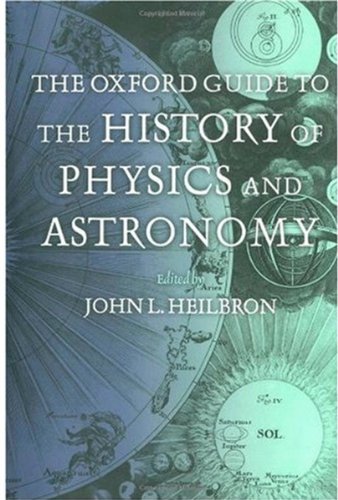
1. The Oxford Guide to the History of Physics and Astronomy
Hardcover: 384 Pages (2005-06-03)
list price: US$42.95 -- used & new: US$8.78
(price subject to change: see help)
Asin: 0195171985
Average Customer Review: 5.0 out of 5 stars
Canada | United Kingdom | Germany | France | Japan
Editorial Review

Book Description
With over 150 alphabetically arranged entries about key scientists, concepts, discoveries, technological innovations, and learned institutions, the Oxford Guide to Physics and Astronomy traces the history of physics and astronomy from the Renaissance to the present. For students, teachers, historians, scientists, and readers of popular science books such as Galileo's Daughter, this guide deciphers the methods and philosophies of physics and astronomy as well as the historical periods from which they emerged. Meant to serve the lay reader and the professional alike, this book can be turned to for the answer to how scientists learned to measure the speed of light, or consulted for neat, careful summaries of topics as complicated as quantum field theory and as vast as the universe.The entries, each written by a noted scholar and edited by J. L. Heilbron, Professor of History and Vice Chancellor, Emeritus, University of California, Berkeley, reflect the most up-to-date research and discuss the applications of the scientific disciplines to the wider world of religion, law, war, art and literature. No other source on these two branches of science is as informative or as inviting. Thoroughly cross-referenced and accented by dozens of black and white illustrations, the Oxford Guide to Physics and Astronomy is the source to turn to for anyone looking for a quick explanation of alchemy, x-rays and any type of matter or energy in between. ... Read more

Customer Reviews (2)

5-0 out of 5 stars Well Rounded Overview
I saw this book while browsing at Borders. I've been finding that I need more reference material in my home library, especially with a renewed interest in Anstronomy and a sudden curiousitywith Physics. I find the book as much entertaining as it is informative. And, its become a real pleasure to sit down with it for 30 minutes at a time and read about the human as well as the mechanical aspects of these two fascinating subjects.

5-0 out of 5 stars Stars in my eyes
'The Oxford Guide to the History of Physics and Astronomy', edited by John Heilbron, is a wonderful reference resource, but also an interesting book to read.It is organised as an encyclopedic dictionary, with over 200 entries that range in size from half a page to several pages in length.This covers history from the a little past the Renaissance to the present (with occasional references to earlier discoveries and events), including entries in other sciences such as geography and oceanography and how they relate to the issues in physics and astronomy.

Entries include topics, biographies, short essays, inventions and concepts.The biographical entries are generally paired - figures such as Einstein and Newton warrant their own entries (as does Benjamin Franklin for some inexplicable reason), but sometimes the pairings don't quite seem to fit (Carl Sagan and Stephen Hawking, for example, are both popularisers of physics and astronomy, but perhaps deserve somewhat better pairings).For the concept of the pairings, inspiration seems drawn from Plutarch, whose magnum opus 'Lives' paired biographies of notable figures.

The overall organisation is alphabetical, but there is also a complex hierarchy of entries as well that includes primary articles for comprehensive disciplines, principle subdivisions within the disciplines, and third level entries on specific items within the subdivisions (including biographies).There are extensive cross-references as well, in addition to supplemental reading lists.

In some ways, this book is a subset of the greater work, 'The Oxford Companion to the History of Modern Science' - there is a complete listing of entries for that work included in this text, to show how this area of science fits within the greater whole (for one thing).

One thing I found about this book, however,is that it is a compelling read.When I first received the book, I stopped to look up a few items, and found myself still reading through articles and following the cross-references more than an hour later.Despite being a reference book, it is an accessible and inviting text to for the reader, which is the mark of a good history text.For anyone interested in physics, astronomy, or the history of science, this is a text to be prized.
... Read more


2. From Clockwork to Crapshoot: A History of Physics
by Roger G. Newton
Hardcover: 352 Pages (2007-01-31)
list price: US$29.95 -- used & new: US$16.45
(price subject to change: see help)
Asin: 0674023374
Average Customer Review: 5.0 out of 5 stars
Canada | United Kingdom | Germany | France | Japan
Editorial Review

Book Description

Science is about 6000 years old while physics emerged as a distinct branch some 2500 years ago. As scientists discovered virtually countless facts about the world during this great span of time, the manner in which they explained the underlying structure of that world underwent a philosophical evolution. From Clockwork to Crapshoot provides the perspective needed to understand contemporary developments in physics in relation to philosophical traditions as far back as ancient Greece.

Roger Newton, whose previous works have been widely praised for erudition and accessibility, presents a history of physics from the early beginning to our day--with the associated mathematics, astronomy, and chemistry. Along the way, he gives brief explanations of the scientific concepts at issue, biographical thumbnail sketches of the protagonists, and descriptions of the changing instruments that enabled scientists to make their discoveries. He traces a profound change from a deterministic explanation of the world--accepted at least since the time of the ancient Greek and Taoist Chinese civilizations--to the notion of probability, enshrined as the very basis of science with the quantum revolution at the beginning of the twentieth century. With this change, Newton finds another fundamental shift in the focus of physicists--from the cause of dynamics or motion to the basic structure of the world. His work identifies what may well be the defining characteristic of physics in the twenty-first century.

... Read more

Customer Reviews (1)

5-0 out of 5 stars Six thousand years of physics
The book describes six thousand years of science, beginning with Babylon and Egypt, which developed many practical applications and rules in the natural world. The author progresses quickly to ancient Greece and the beginning of abstract reasoning and speculation. We learn about the tight connection between mathematics and physics, indeed this book may be regarded as a history of math as well. Newton's writing is clear and easy to follow - at least until the time of Einstein, relativity and quantum mechanics. Then the subject matter makes it difficult to follow the narrative, and I had to re-read parts several times.

You will learn just what a "quantum jump" is (p. 224). It is very small, and happens in the electron shell of the atom. There is some comment (p. 270) on why Lord Kelvin's limit on the age of the earth was overthrown. You will also learn how and why probability and statistics have become prominent parts of our understanding of matter and energy, and why the firm deterministic laws of physics have had to be abandoned. The book ends with the modern, - and still tentative, - understanding of the structure of the atom. The atom in turn enlightens our understanding of the universe, and the history of the cosmos since the "Big Bang." On the whole, a very satisfying read. ... Read more


3. Black Bodies and Quantum Cats: Tales from the Annals of Physics
by Jennifer Ouellette
Paperback: 336 Pages (2005-12-01)
list price: US$15.00 -- used & new: US$5.74
(price subject to change: see help)
Asin: 0143036033
Average Customer Review: 4.5 out of 5 stars
Canada | United Kingdom | Germany | France | Japan
Editorial Review

Book Description
Physics, once known as “natural philosophy,” is the most basic science, explaining the world we live in, from the largest scale down to the very, very, very smallest, and our understanding of it has changed over many centuries. In Black Bodies and Quantum Cats, science writer Jennifer Ouellette traces key developments in the field, setting descriptions of the fundamentals of physics in their historical context as well as against a broad cultural backdrop. Newton’s laws are illustrated via the film Addams Family Values, while Back to the Future demonstrates the finer points of special relativity. Poe’s “The Purloined Letter” serves to illuminate the mysterious nature of neutrinos, and Jeanette Winterson’s novel Gut Symmetries provides an elegant metaphorical framework for string theory.

An enchanting and edifying read, Black Bodies and Quantum Cats shows that physics is not an arcane field of study but a profoundly human endeavor—and a fundamental part of our everyday world. ... Read more

Customer Reviews (11)

1-0 out of 5 stars Not what i was looking for.
I have read many scientific publications in my life so when I do read book with a scientific focus I have many standards that I like to have fulfilled(in other words im very anal lol).The only reason that I rate this book as low as I did is only because I was completely expecting a book like Stephen Hawking's, A Breif History of Time (great book by the way!!!)I have taken physics in highschool and in college and I felt that her delivery of many physics concepts were too dumbed down and many fruitful aspects of them were left out for the sake of either complexity or any other reason(cannot think of why else they would be left out lol).I also found that many of the ways she tried to deliver the physics topics were rather questionable and left me with a bitter tase in my mouth.Overall I was dissapointed because I bought the book without doing any backround research on it beforehand.If you are looking for a Physics book like those written by Stephen Hawkings then this isn't the book for you.If you are interested in Physics and have no prior knowlege of the subject then this is the book for you.Sorry for any misspelled words, names, ect..

Ps.. Because i am a biology major I had to add this in...at the end of the second chapter she states that "some textbooks in Alabama still contain a disclaimer stating that evolution is just a "theory""...but i mean evolution IS a theory...its not neccesarily considered a fact even though there is overwhelming evidence in support of it.I believe evolution is true but maybe i'm just misinterpreting what she ment by this statement.To me I thought that it implied that evolution is a fact when in reality it isn't.Evolution as I see it is the best way to decribe life and how it came to be AS OF NOW, (maybe there will be a better theory in the future?)because fact is too strong a word it doesnt leave room for the grey areas....but thats just my opinion. and if I have misunderstood this statement i am truely sorry i just think there is nothing wrong with being a theory lol.

5-0 out of 5 stars like sjg, she entices you into an amusing essay
Real science made fun.In easy bites, she starts with an anecdote, like SJ Gould and teases you into understanding principles of physics you never thought you coud learn. In an antiscience age, in an antirational age, this is to be cherished

Marvin Thalenberg MD

5-0 out of 5 stars Way more fun than I thought I'd have...
I found this a curiously fun sort of read-different from my usual choice of reading entertainment.I don't typically read science books, mostly because I'm lazy and don't want to work at understanding something really technical (many science writers put off the general public by delving too deeply), but hey folks, the author makes the science easy to grasp.And the writing style is witty, light and intelligent.Ouellette has a gift for marrying science, history and storytelling.
What's especially appealing is the way the author connects seemingly esoteric science with our everyday life-Reddi-whip (the physics of foam), velcro (biomimicry)-and illuminates the process by which scientists and inventors impact our lives.I loved the references to literature and pop culture that segue into the science or serve as examples of the science in action.
There's something for everyone.Science fans will get an enlightening and lively look into the history and people behind the discoveries.Those more interested in history will learn a thing or two about the science (painlessly).And old English majors, like me, will appreciate the storytelling.

5-0 out of 5 stars Science Writing for the Masses
If Jennifer Ouellette had been writing books like this when I was a kid, she'd have been my favorite explicator of science. Instead, I was reading Isaac Asimov, who was fun and interesting but a scientist himself, with a tendency to focus on minute details that were sometimes a little bewildering to someone just getting her feet wet. Ouellette knows not only how to get her physics-phobic audience's attention, but avoids bogging them down in technicalities.

Occasionally, the techniques of writing for a general audience call for the sacrifice of precision in favor of broader generalities, like "rounding off" the technical details of lens grinding, which are best left to a more in-depth discussion of the topic. But as a non-scientist who's been reading science writing for the last 30 years as well as teaching it at the university level, I can truthfully say that very little is lost in this book. In this case, "a spoonful of sugar helps the medicine go down," to quote Mary Poppins. Not too many people are eager to read about physics, whether it's cloaked in pop culture or not, but Ouellette slyly draws you in with doses of the Olsen Twins, the Addams Family, and the DaVinci Code. By the end of the book, you'll catch yourself thinking that maybe physics isn't so terrifying, and certainly not boring. And if you're not getting the nitty-gritty details here, well, you can always go read Richard Feynman, or try plowing through Stephen Hawking.

And you're not going to read about flying monks in any of their books.

2-0 out of 5 stars Fun but Flawed
Jennifer's Ouellette's venture into the esoteric realms of science is light and fun, but, I'm sorry to say, it is sprinkled with factual errors. Here are just a few:

In her discussion of telescopes, she says the objective lens of a refracting telescope is concave, to gather light. This is just not so. The objective lens is always convex. Millions of teleswcope and astronomy buffs know this. How come the two academioc gurus who praise this book in its front matter didn't catch it? They couldn't have read it carefully. Most high school physics students would spot the error.

More errors: In her discussionof spherical aberration in lenses she says the aberration is the result of faulty grinmding of the lenses. Not so. The aberrration is inherent in the spherical curvature itself. A lens that is ground to a perfect spherical curvatue will still exhibit the aberration. The fault is not in the grinding, but in the design.

Spherical lenses, that is, lenes with surfaces that are part of a perfect sphere, are the easiest to grind; that's why lenses have been made this way for centuries. Only recently, since about 1920, have methods for making aspheric lenses been developed. Aspheric lenses have non-spherical curvatures which correct for the aberrations caused by spherical surfaces. A common aspheric lens is the Schmidt corrector lens used in many reflecting telescopes.

My credentials? I worked for American Optical Company as a lens grinder. Later, as a TV science writer, I wrote a TV script in collaboration with Dr. John strong, physicist at the Johns Hop0kins University. Strong put the aluminum reflecting surface on the Hale telescope at Mt. Palomar and was known world-wide for his design of a diffraction grating ruling engine capable of making 6 inch gratings.

I have also written a column on science and natuire for a weekly newspaper for over 15 years. Like Ms. Ouellette, I try to keep my science writing light enough to be interesting to a general readership, but I try very hard to get my facts straight.

Perhaps the author and her publisher should employ the services of a scientifically trained editor to pick out the mistakes before publication.

For better science writing, Ken Volduzi ... Read more


4. A Brief History of Time
by Stephen Hawking
Paperback: 224 Pages (1998-09-01)
list price: US$18.00 -- used & new: US$9.99
(price subject to change: see help)
Asin: 0553380168
Average Customer Review: 4.5 out of 5 stars
Canada | United Kingdom | Germany | France | Japan
Editorial Review

Amazon.com
Stephen Hawking, one of the most brilliant theoretical physicists in history, wrote the modern classic A Brief History of Time to help nonscientists understand the questions being asked by scientists today: Where did the universe come from? How and why did it begin? Will it come to an end, and if so, how? Hawking attempts to reveal these questions (and where we're looking for answers) using a minimum of technical jargon. Among the topics gracefully covered are gravity, black holes, the Big Bang, the nature of time, and physicists' search for a grand unifying theory. This is deep science; these concepts are so vast (or so tiny) as to cause vertigo while reading, and one can't help but marvel at Hawking's ability to synthesize this difficult subject for people not used to thinking about things like alternate dimensions. The journey is certainly worth taking, for, as Hawking says, the reward of understanding the universe may be a glimpse of "the mind of God." --Therese LittletonBook Description
A Brief History of Time, published in 1988, was a landmark volume in science writing and in world-wide acclaim and popularity, with more than 9 million copies in print globally. The original edition was on the cutting edge of what was then known about the origins and nature of the universe. But the ensuing years have seen extraordinary advances in the technology of observing both the micro—and the macrocosmic world—observations that have confirmed many of Hawking's theoretical predictions in the first edition of his book.

Now a decade later, this edition updates the chapters throughout to document those advances, and also includes an entirely new chapter on Wormholes and Time Travel and a new introduction. It make vividly clear why A Brief History of Time has transformed our view of the universe. ... Read more

Customer Reviews (335)

5-0 out of 5 stars Do I need to talk about this book
This is a fine book for people who love physics of those who are curious about the universe they are in. A great book by a great scientist.

5-0 out of 5 stars a pleasure to read
Many years after its initial release, this book is still a great pleasure to read.Written in a conversational tone, much of it is probably readily understandable to most readers.However, some parts of it, especially toward the end, aren't exactly simple by any means.Any curious reader, even if not particularly interested in physics or astronomy, will find this little book to be a gem.An extra treat is a few pages at the end describing prominent events from the lives of Einstein, Galileo, and Newton.Highly recommended read.Author of Adjust Your Brain: A Practical Theory for Maximizing Mental Health.

3-0 out of 5 stars Bumpy RIDE!!!!!!!
Hawkins may provide amazing insight into Astrophysics and have a Brillant Mind. However, he does a medicore job in explaining things and his writting style is often "choppy" and hard to read. He just does not expand on things well. The concepts in the book can be hard to grasp and the writting can make it very hard to stay focus.
I find other authors to be a much better selection like Neil Tyson with equal insight for the layman.

The book does provide alot of amazing insight into things like Black Holes, Time Travel, Entropy, Relativity and other cosmic delights.

5-0 out of 5 stars An excellent overview of modern physics.
If you can find it, I recommend this version over the original "Brief History of Time".This version was written about 8 years later and as such incorporates much that has been learned over the intervening years.In addition, the illustrations greatly enhance the text.They are not only a joy to look at, but actually make the book more understandable.The original work has been characterized as one of the most popular, but unread books of all time.Much of the unread characterization stems from the fact that this is a difficult book unless one has had some minimal understanding of physics.Minimal is, however, the appropriate word as one need not be a physicist to get a lot from this book, but one should not be put off by a discussion of quarks, gluons, gravitons, wormholes or string theory.

The first chapters deal with the classical view of physics and the universe.This is followed by discussions of the theory of relativity and quantum mechanics.It is important to note that these are not rigorous discussions, indeed no mathematics is used and the discussion is entirely devoted to the basic ideas and implications of these theories.At least one reviewer has criticized the fact that these subjects have not been developed in any detail, but rather are just expounded.I think that this misses the point.This is not a physics text; rather it tries (I think very successfully) to show the reader the beauty and implications of modern physics.I found the discussion of modern particle physics to be one of the best very elementary treatments that I have ever read.Next he discusses black holes and the origin of the universe.Again, I found his discussion of black holes to be one of the best very elementary treatments that I have ever read.The last chapters on wormholes, time travel and grand unified theories are more speculative than the preceding chapters, but the reader is clearly forewarned that this is the case.(The most speculative, and in my opinion least clear chapter, was the one on wormholes and time travel, which was not in the original version of "A brief History of Time".)

I liked this book a lot and do not agree with those who found it to be unclear and very difficult to follow, but I can see how those with no physics background at all would find it too difficult to finish.This version has the virtue of pictures which make following Hawking's text a bit easier to follow and as he states in the forward "Even if you only look at the pictures and their captions you should get some idea of what is going on."

1-0 out of 5 stars This book is a fake!
As a physicist I am flabbergasted and slightly depressed by the success of this book. First of all this book presents as if they were equally certain some pieces of orthodox science together with some of the author's dubious speculations. The lay reader is not told which are which. Secondly, the author obviously has no knowledge of the actual history of physics and yet he shamelessly "describes" it to the reader.

Hawking seems to have gathered together all the bad cliches about various physical issues and has taken out all the valuable ideas. He explains nothing, he just asserts that "we physicists know that..., we physicists have demonstrated that...". I cannot see how anyone can actually learn anything about physics from this book, about why we know what we know. And yet, judging from the amount of praise this book receives, it seems that quite a lot of people have fallen under the spell that they have been allowed access to some secret. They haven't and I find this trickery immoral.

Quantum physics and astrophysics are really interesting. They don't deserve to be thrashed in this unashamed manner. If you want to learn something about physics, there are other books which do a much better job, for example Asimov's Atom: Journey Across the Subatomic Cosmos. ... Read more


5. The Trouble With Physics: The Rise of String Theory, The Fall of a Science, and What Comes Next
by Lee Smolin
Paperback: 416 Pages (2007-09-04)
list price: US$15.95 -- used & new: US$5.99
(price subject to change: see help)
Asin: 061891868X
Average Customer Review: 4.5 out of 5 stars
Canada | United Kingdom | Germany | France | Japan
Editorial Review

Book Description
In this groundbreaking book, the renowned theoretical physicist Lee Smolin argues that fundamental physicsthe search for the laws of natureis losing its way. One of the major problems, according to Smolin, is the growing gulf between the speculations of theorists and reality as revealed by experiment. Ambitious ideas about extra dimensions, exotic particles, multiple universes, and strings have captured our imaginations. But these ideas have not been tested experimentally, and somestring theory, for exampleseem to offer no possibility for experimental tests. And because these ideas have tied up funding and talent to the detriment of other pursuits, they threaten to impede the progress of science. With clarity, passion, and authority, Smolin charts the rise and fall of string theory and takes a fascinating look at what will replace it. ... Read more

Customer Reviews (88)

5-0 out of 5 stars Just a great read
I really enjoyed this book. Picked it up in the airport, and didn't put it down until the flight landed. Couldn't wait to get home to read more.

The author has a fantastic way of relating a technical story.

5-0 out of 5 stars Compelling reading, even if you disagree
This book is a MUST read for anyone who believes in the importance of science as a human endeavour.

I have read many popular books on the subjects of cosmology, particle phycics, quantum mechnanics, String theory, etc.Along the way I have read countless books that purport to be for the layman; most start strong covering the topics one would expect (wave-particle duality, the uncertainty principal, special relativity, etc.), but then quickly digress into overly technical explanations that lose most laymen.A great example is Hawking's much-touted A Brief History of Time -- I'm convinced that most people who own this book have never read the whole thing.I know I didn't.

Lee Smolin's book is a rare exception.Here is a brilliant and articulate scientist capable of describing exceptionally complex ideas in very simple terms.He understands exactly where his typical reader's limits of knowledge sit, and works carefully withing those limits.He is also sure to note when he is glossing important details that true practitioners in his field would want to elaborate on.For this alone, Smolin's book is a must-read for anyone wanting to understand the broad issues being explored in today's most advanced physics programs.

More importantly, though, this is a truly COURAGEOUS book.

Smolin states that, while it is a worthwhile endeavour, String theory has unfairly dominated major research programs for too long.For sociological and political reasons, Smolin argues that String theory has squeezed out healthy scientific debate about the "foundational" issues surrounding the unification of quantum mechanics and relativity.Smolin himself is an advocate of quantum gravity, an alternate approach to String theory.It's important to note that Smolin never claims that Loop Quantum Gravity (his favoured approach) is right; his primary point is that it is an axample of an alternate approach that it is worthy of exploration but that receives little attention.

What makes Smolin brave is that he tackles his own professional community.As anyone who has achieved some success in a field will tell you, this takes a lot of guts.And though he presents all of his arguments without malice, there is little doubt that the String theory establishment would not appreciate the way it is characterized in Smolin's book.I can only imagine the nasty response that Smolin has received (actually, there are many blogs that attack Smolin mercilessly -- when not dismissing him as a crack).

Smolin ends his books with a reflection on the general state of science in the US.He paints a bleak picture of a highly "professionalized" discipline which rewards those low-risk research programs most likely to garner large grants, and a culture where reliable technical skill is valued more than risky and innovative ideas.

Even if you disagree with Smolin's assertions (and I am sure that there are many who do), he is compelling writer with interesting things to say.


5-0 out of 5 stars The Impending Crash of the "Kaluza-Klein Runaway Express" to nowhere

Each decade since the 60s, the leading researchers in advance physics have stepped away from their work just long enough to give us a "quick-and-dirty" status report on the latest developments in their field.

George Gamow (One, Two, Three infinity) did it at the beginning of the 60s; Gary Zukav (Wu Li Masters) did it at the end of the 70s; Heinz Pagels (Perfect Symmetry) did it at the end of the 80s; Timonthy Ferris (The Whole Shebang) did it at the end of the 90s; and now Lee Smolin's (The trouble with Physics) is doing the same for the current decade.

Never was this ride more difficult, nor clearer nor more exhilarating than as is demonstrated in the present volume. Professor Smolin takes us on a wild but sober ride across the landscape of current research in particle physics. For those of us who are frustrated physicists but whose brains are too ossified, or who no longer can read and understand the dizzying math in the technical journals, this summary is a welcomed contribution. In this panoramic view just slightly above the heads of what a layman can understand, Smolin invites us into his lab to meet his colleagues and his, and their theories.

Being a born maverick, skeptic and purest, all rolled into one, the view we get is not the normal ride of a "true believer" trying to peddle the latest "new theoretical fad," but that of a skeptic: grazing, browsing, and sampling, but in search of the "finest wares in the physics shop." Professor Smolin makes no bones about, nor does he mind us knowing, that he is from the "old school," where theories are forced to intersect with, and then be confronted by experimental results or else they are not accepted or respected as theories at all. As a "born-again" traditionalist, he is perfectly suited to give us an enjoyable guided tour.

The tour is a panoramic view of the quest for the unification of Quantum and Relativity theories into a general theory of everything (GUT), a quest, like that preceding both Relativity and Quantum Mechanics at the turn of the last Century, has again been described as the final frontier of physics: the integration of all the forces in nature to be brought together into one nice tidy theoretical coda. This quest has become the Holy Grail of the physical sciences and of Cosmology.

Exhibit 1 of this pursuit is the heavily touted "String Theory," and its progeny Super symmetry and Super string Theory, which all hit the stage with a bang, but since, as Professor Smolin so carefully demonstrates, have all run into heavy weather indeed, and which have, for the most part, now been forced to "cool their heels" and take a seat on the sidelines of traditional experimental developments.

A major part of "the trouble with physics" is what can only be called the "Kaluza-Klein cu de sac," or better yet the "Kaluza-Klein runaway train to nowhere."

Without giving away the plot of the book, the Kaluza-Klein formula proved to be a mathematically easier way to reinvent Relativity, by expanding the physics to several new dimensions."On paper" the Kaluza-Klein derivations looked as good as Einstein's original formulation, provided of course that one is willing to overlook a few of its not so minor "fatal side effects," such as having to "roll-up' or "curl" the unwanted and untidy extra dimensions, and being willing to forego confrontations with normal experimental results.

I agreed with Professor Smolin even before I read his book: "Curling up" (or hiding) unwanted dimensions, is no way to do good physics. Yet, this unholy technique became the template that catapulted a whole generation of physicists into prominence in the world of 21st Century physics. Smolin himself admits having rode that train part way down the track until, that is, he saw the train wreck just over the horizon about to happen. When he saw it, he ever-so-discretely dismounted, leaving his "research budget fat and tenured colleagues" to endure the impending crash all by themselves. Now that he is on the safe side of the shore, where respectable experimental physics is still being done, the train is slowing down, even as it nears impact.

There does not seem to be any possibility of rescue in sight. Five stars!

4-0 out of 5 stars I recommend this book
Excellent review of pertinent physics and the problems with academia.
We wish more academians would open up a little more. On the other hand,
we don't want them to expose their little minds, we might cut off their funding.
Bligh

5-0 out of 5 stars This book Keeps the theorits honest
One of the most balanced and factual account of the current state of the art of Physics I have read. I wish I could get a more indepth reasoning of the unsolved problems in Physics. ... Read more


6. Landmark Experiments in Twentieth Century Physics
by George L. Trigg
Paperback: 320 Pages (1995-04-19)
list price: US$11.95 -- used & new: US$7.31
(price subject to change: see help)
Asin: 048628526X
Average Customer Review: 4.0 out of 5 stars
Canada | United Kingdom | Germany | France | Japan
Editorial Review

Book Description

Clear, detailed presentations, with extensive quotations from original research papers, cover groundbreaking research on the wave nature of X-rays, superconductivity, the neutrino, lasers, many other subjects. 120 illustrations. 1975 edition.
... Read more

Customer Reviews (1)

4-0 out of 5 stars Great book as a reference
for advanced undergraduate\graduate students, this book is remarkable.
I bought it together with "Great experiments in physics" by Shamos and together they complete each other, this book emphasizing the 20th century and the second dealing more with earlyer era from galileo through newton to herz and the beginning of the 20th century.

having these 2 books at hand, are extremely valuable to a physics student who wishes to really understand the methods used in order to deduct the theories outlined in other textbooks.

usually today's textbooks do a poor job at detailing the art of
experiment making, experiment analysis and the physics being deduced from it, they simply present the theory without letting
the student apreciate the ways scince is being made.

this book (and the other) fill this gap very well.

I recomend however to have a fairly good grasp of the experiment
theory before reading the relevant chapter in the book since there is an assumption that the reader is somewhat familiar with
the physics behind it.

I gurantee, that after reading how an experiment was set, and
understanding the analysis of the outcome, your grasp of the underlying physics will be a lot more solid and deep.

since every textbook is an abridged version of the experiments
reports, an understanding of these reports must by that logic
give you a better understanding.
... Read more


7. Forces and Fields: The Concept of Action at a Distance in the History of Physics
by Mary B. Hesse
Paperback: 336 Pages (2005-06-17)
list price: US$18.95 -- used & new: US$11.62
(price subject to change: see help)
Asin: 0486442403
Canada | United Kingdom | Germany | France | Japan
Editorial Review

Book Description

An in-depth look at the science of ancient Greece, this volume examines the influence of antique philosophy on 17th-century thought. Additional topics embrace many elements of modern physics: the empirical basis of quantum mechanics, wave-particle duality and the uncertainty principle, and the action-at-a-distance theory of Wheeler and Feynman. 1961 edition.
... Read more

8. The Rise of the Standard Model: A History of Particle Physics from 1964 to 1979
Hardcover: 744 Pages (1997-11-13)
list price: US$106.00 -- used & new: US$63.97
(price subject to change: see help)
Asin: 0521570824
Canada | United Kingdom | Germany | France | Japan
Editorial Review

Book Description
Based on a conference held at Stanford University, this book gives the most comprehensive and up-to-date account of an exciting physics revolution--the rise of the Standard Model. The third volume of a series recounting the history of particle physics, this volume focuses on the Standard Model, which explains the microstructure of the world in terms of quarks and leptons and their interactions.Major contributors include Steven Weinberg, Murray Gell-Mann, Michael Redhead, Silvan Schweber, Leon Lederman, and John Heilbron. A collaboration of physicists and historians of science, the wide-ranging articles explorethe detailed scientific experiments, the institutional settings in which they took place, and the ways in which the many details of the puzzle fit together to account for the Standard Model. ... Read more


9. The History of Physics
by Isaac Asimov
 Hardcover: 762 Pages (1984-05)
list price: US$29.95
Isbn: 0802707513
Average Customer Review: 5.0 out of 5 stars
Canada | United Kingdom | Germany | France | Japan

Customer Reviews (2)

5-0 out of 5 stars great overview of physics
This book was one of polymath Asimov's prodigious outputs. He takes us through long centuries of often slow progress in physics. With short but succinct biographies of great physicists. Of these, needless to say, Isaac Newton and Albert Einstein stand out. If you are new to physics, try paying close attention to how Asimov assessed those two greats.

But the book also gives attention to other notables who contributed to physics. From Galileo to Faraday to Maxwell. You can get an appreciation for the significance of what each did to expand our view of physics.

5-0 out of 5 stars A very good book!
When i first got this book i was worryed about it being boring, and it wasnt. once again issac asimov has put out a great book. He not only puts in the math to tell how and why things happen in Physics he also tell intext so that those whose Trigonomety and above skill arent that great canstill understand it. He goes from Falling bodies to light waves to Ions andradiation to anti-particles if you are just starting out in Physics or needsome more addvanced info this is the book to read. it however is not foreveryone.Some may find it very dry reading.I, howeverfound it very fasinating, and an excelent reference in explaining thebasics of Physics. ... Read more


10. Concepts of Space: The History of Theories of Space in Physics: Third, Enlarged Edition
by Max Jammer
Paperback: 261 Pages (1994-01-07)
list price: US$14.95 -- used & new: US$9.02
(price subject to change: see help)
Asin: 0486271196
Average Customer Review: 5.0 out of 5 stars
Canada | United Kingdom | Germany | France | Japan
Editorial Review

Book Description

Historical surveys of the concept of space considers Judeo-Christian ideas about space, Newton's concept of absolute space, space from 18th century to the present. Numerous original quotations and bibliographical references. "Admirably compact and swiftly paced style." — Philosophy of Science. Foreword by Albert Einstein.
... Read more

Customer Reviews (2)

5-0 out of 5 stars Struggle to define and understand fundamental concepts
This book shows just how tortuous has been the struggle in physics (and science in general) to arrive at and comprehend its fundamental concepts.The very first paragraph in Einstein's foreword is worth the price of the entire book, if one truly understands what Einstein has said.Most of us came into physics via ordinary textbook courses, where unfortunately most of the approach was to quickly master the equations and their methods of application.Somehow we never understood that the very foundations of physics are still very much at issue, and our teachers either did not realize this themselves, or considered such musings trivial, or were just too busy to enlighten us. Most of us think that things like space, mass, time, charge, field, potential, zero, and unity are obvious, and it can come as a major shock to one's system to find out that they are not.Most such fundamental concepts still do not have a satisfactory definition.Jammer's book, while cumbersome by its very scholarship, does give one a grasp of just how difficult the foundations problems -- such as the nature of space -- really are. If one is seriously interested in this sort of "deep" problem, then one must discover the literature oneself.Jammer's book is a must.I gave the book a 9 instead of a 10 because of its overall ponderous nature, but highly recommend it to anyone who is deeply interested in the foundations concepts of physics, how we got where we are, what we did along the way, what we may have yet missed, and just how firmor shaky are our concepts today.We also recommend Jammer's other studies of the concept of force and the concept of mass.

5-0 out of 5 stars An encompasing, albeit overtly scholarly, look at "Space".
A very deep book, filled with excerpts in native languages from ancient Greek to modern German, French, and Russian, and with tensor mathematics and other such nonsense. If you want to have your concept of space and time ripped out from under you and your horizons dramatically broadened, check this one out!

(BTW, I gave this a 9 instead of a 10 solely because of the weightiness of the material.) ... Read more


11. Evolution of Physics
by Albert Einstein, Leopold Infeld
Paperback: 1 Pages (1967-10-30)
list price: US$14.00 -- used & new: US$2.78
(price subject to change: see help)
Asin: 0671201565
Average Customer Review: 5.0 out of 5 stars
Canada | United Kingdom | Germany | France | Japan

Customer Reviews (14)

5-0 out of 5 stars Very good for many different readers
As the authors state, ".. thought and ideas, not formulas, are the beginning of every physical theory".True to this statement, this book focuses on thoughts and ideas and does not use any formulas at all.This makes it good as an adjunct for standard texts that contain the formulas, but not as a substitute for such books.This book is divided into four sections: the rise of the mechanical view, the decline of the mechanical view, field and relativity, and quanta.It is thus about how the mechanical view of Newton evolved into the modern view of physics (relativity theory and quantum mechanics).

I would like to focus on how this book might be perceived for three different classes of readers.
(1) For those who have never taken a physics course (or did and tried to forget the experience as soon as possible) --The lack of any mathematics may be comforting to this class of reader, but it will nonetheless not be an easy read for them.The basic concepts, such as inertia, may be difficult to grasp for those with no previous physics background, but the author's do a good job of describing things.(A task made more difficult without recourse to the shorthand of mathematics.) I would, however, recommend this book only to those who are motivated to go well beyond their comfort zone.However, if they focus on the concepts that are being described and are patient in following the lines of reasoning, they should be richly rewarded.
(2) For those who have taken physics courses, but do not have advanced degrees in physics--I put myself in this group and I thoroughly enjoyed this book.I liked this book because it focuses on the why (the basic underlying theories of physics), rather than on the how (problem solving).In doing so, it provided a much better understanding of what is behind the equations than I found in physics texts.I got a very clear picture of the deficiencies of Newtonian mechanics and Maxwell's equations, and how this led to relativity theory.I found this very illuminating as it more clearly showed me Einstein's thought process.If found this even clearer than that presented in Einstein's book on relativity (prepared for a general readership).Of all the groups of readers, I think that people in this group will get the most from this book.
(3) For those with advanced degrees in physics - People in this group may have already been exposed to the concepts described here, but this book will still be very helpful in that it shows clearly Einstein's logic in developing relativity theory and the quantum theory of light.Much of this may be old hat to this group, but the book will still be of interest from a historical perspective.

I think that this book does an admirable job of appealing to and satisfying the needs of readers who approach the subject with diverse backgrounds.

5-0 out of 5 stars An excelent book on physics
An excellent book about physics, its history and its philosophy. The concepts are well explained, discussed, compared in a conversational and rigorous style. And done with the contribution of Einstein.
With this book you will understand what physics really is; what is behind the science undertaking; what is science after all. A must book to serious interested readers

5-0 out of 5 stars Excellent book
Outstanding book to understand the way of thinking which resulted in introducing the various concepts associated with Physics. Thoughwritten for general audience, this book needs to be read with care, and constant attention to see the remarkable connection between seemingly unrelated concepts like light, heat, electricity. Read this along with the book "Einstein's Heros by Arianrhod" to enjoy a different aspect of Physics.

5-0 out of 5 stars Science as Human Creation
This book provides a still useful account, from 'the horses' mouths', of what Alfred Korzybski called the Newtonian and non-Newtonian views in physics. As Korzybski noted, all human beings form a view of so-called 'reality'. Understanding how scientists do this can have value for the rest of us. In this excellent book, the authors emphasize general formulations and a non-mathematical approach: "Most of the fundamental ideas of science are essentially simple, and may, as a rule, be expressed in a language comprehensible to everyone" (29). The book includes chapters on "The Rise of the Mechanical View," "The Decline of the Mechanical View," "Field, Relativity," and "Quanta." Readers will be rewarded with clear explanations of some potentially forbidding notions. These are interspersed with useful comments on physico-mathematical method, theory and the goals of science. Einstein's and Infeld's discussion demonstrates their view that "Science is not just a collection of laws, a catalogue of unrelated facts. It is a creation of the human mind, with its freely invented ideas and concepts. Physical theories try to form a picture of reality and to establish its connection with the wide world of sense impressions. Thus the only justification for our mental structures is whether and in what way our theories form such a link" (310).

5-0 out of 5 stars Science, history, and a bit of philosophy
Physics can be difficult to learn when theories and formulae are thrown at you with no historical context.You begin learning about motion, and then electricity and magnetism, and it's almost impossible to see a coherent connection between the ideas.Many people have heard of relativity and quantum theory, but do not have even a general notion of what they aim to explain.

Like mathematics, you can learn physics without knowing about the people behind its development (though you will encounter many of their names in important expressions), but it never hurts to study how such ideas began, and how they came to be what they are today.Einstein and Infeld's book is aptly titled.They show how and why certain concepts came into being and what significance they hold.Beginning with "The Rise of the Mechanical View," they describe vectors, motion, forces, and energy. With "The Decline of the Mechanical View," they show how the behavior of electricity, magnetism, and light waves poses problems for the mechanical view.

The next two (and most interesting) sections explore field, relativity, and quanta, and how they have proved more accurate in describing physical phenomena than what was previously known.Einstein and Infeld describe everything with a minimum of mathematics so that anyone with an interest in the development of physics can understand the contents.Although such math is necessary for a precise understanding of physics, the aim of the authors, which they frequently repeat throughout, is to give the reader a broad understanding of the general underlying principles.They have succeeded in giving an account of where the human construction of physics started, what has been covered since then, and where it is heading.It is a simply written book, suitable for readers who don't know physics and want to learn, but also helpful for students of physics who want to see a broader picture of its evolution. ... Read more


12. Quantum Generations: A History of Physics in the Twentieth Century
by Helge Kragh
Paperback: 512 Pages (2002-03-04)
list price: US$29.95 -- used & new: US$29.13
(price subject to change: see help)
Asin: 0691095523
Average Customer Review: 4.0 out of 5 stars
Canada | United Kingdom | Germany | France | Japan
Editorial Review

Amazon.com
We've seen our most fundamental beliefs about the nature of the universe change so many times over the past century that it's almost old hat. Danish science historian Helge Kragh looks at these revolutions and their effects in Quantum Generations: A History of Physics in the Twentieth Century.This well-told series of interlocking stories skillfully blends hard science with biography; Kragh intends to reach a broad audience and succeeds in maintaining interest on all levels. Starting in the 10 years before 1900, he shows us that the state of physics was not as moribund as textbooks would have us believe--in fact, much of the groundwork for the revelations of relativity and quantum mechanics was laid then.Moving along through the highlights of the past hundred years, we read of Heisenberg, Lorentz, Feynman, and many more scientists building on their predecessors' work.

Only the most pathologically math-phobic need fear this book; Kragh has done nonphysicists a favor by restricting his scientific discussions to terms understandable by most well-informed readers.Though he does neglect certain important fields (e.g., optics and materials science), the cohesion and relative brevity resulting from this decision make for a better book. Whether you have an abiding interest in the roots of modern physics or want to learn more about recent developments in unification theories, you'll find Quantum Generations a pleasant yet challenging review. --Rob LightnerBook Description

At the end of the nineteenth century, some physicists believed that the basic principles underlying their subject were already known, and that physics in the future would only consist of filling in the details. They could hardly have been more wrong. The past century has seen the rise of quantum mechanics, relativity, cosmology, particle physics, and solid-state physics, among other fields. These subjects have fundamentally changed our understanding of space, time, and matter. They have also transformed daily life, inspiring a technological revolution that has included the development of radio, television, lasers, nuclear power, and computers. In Quantum Generations, Helge Kragh, one of the world's leading historians of physics, presents a sweeping account of these extraordinary achievements of the past one hundred years.

The first comprehensive one-volume history of twentieth-century physics, the book takes us from the discovery of X rays in the mid-1890s to superstring theory in the 1990s. Unlike most previous histories of physics, written either from a scientific perspective or from a social and institutional perspective, Quantum Generations combines both approaches. Kragh writes about pure science with the expertise of a trained physicist, while keeping the content accessible to nonspecialists and paying careful attention to practical uses of science, ranging from compact disks to bombs. As a historian, Kragh skillfully outlines the social and economic contexts that have shaped the field in the twentieth century. He writes, for example, about the impact of the two world wars, the fate of physics under Hitler, Mussolini, and Stalin, the role of military research, the emerging leadership of the United States, and the backlash against science that began in the 1960s. He also shows how the revolutionary discoveries of scientists ranging from Einstein, Planck, and Bohr to Stephen Hawking have been built on the great traditions of earlier centuries.

Combining a mastery of detail with a sure sense of the broad contours of historical change, Kragh has written a fitting tribute to the scientists who have played such a decisive role in the making of the modern world.

... Read more

Customer Reviews (6)

4-0 out of 5 stars Physics in a nutshell . . .
Quantum Generations is a history of physics in the twentieth Century. What a pleasure to have the history put into perspective and all in one place. From fundamental theories to particle discoveries, to the growth and progress physics and other sciences have given our society, this book keeps our interest. Those who enjoy physics or history will find this book compelling.

Ever wonder what people mean when they are talking about "unification theory?" How about Quantum Cosmology? Well, you can get an excellent overview of these topics in Kragh's book. To further assist the reader, the appendix lists, for each chapter, relevant books for additional study.

I have found the information here to fill in the gaps that were left from my own engineering training and recent self-directed learning. Kragh's book will definitely be on my reference shelf as I continue to try and understand where we are heading with science and technology these days. But most of all, I hope books such as this might inspire our young people to decide to matriculate in the sciences so that we can be assured of continued increases in our knowledge of the universe.

5-0 out of 5 stars a means to understanding what happened...
I am extraordinarily relieved to find this book. My previous attempts at understanding quantum physics fell into confusion due to an absence of context. It is only this meticulously crafted abstraction of all of the various discoveries, speculations and personalities that has equipped me with sufficient knowledge to begin a coherent understanding of what happened to physics, metaphysics and philosophy.

The author achieves a sublime sense of distance from the controversies that captures the basic processes without twisting them to any apparent agenda.

I would recommend this book to every inquisitive individual as an antidote for the last few decades of nonsense that has passed for popular physics. The math is minimal and not essential to the information about processes.

This book would be especially useful to any high school student who feels the allure of revolutionary discoveries in science.

2-0 out of 5 stars A cure for insomnia...
I used this as a textbook in a college course on the history of 20th century physics.Kragh may be factual, and he may be a good historian, but he simply is not a good writer.(Even the professor admitted it was a good book to aid in falling asleep.)Emilio Segre offers a more personable view in From X-rays to Quarks, which I found far more valuable.

3-0 out of 5 stars Extensive History of Modern Physics
This is good History book about Modern Physics, starting from Maxwell to current level. Author provides considerable statistical data that also proves some claims about the success of some nations, and importance of some subjects etc. Author always identifies individuals with their nationality and I got a feeling that he also has a bias to German Physicists. Neverthelese it is a good Chronological and very lively description of the developments with a lot of references. The book does not get into the details of all the problems, tests, interpretations such as EPR, Aspec or Schro's Cat etc. So if you do not know particular Physical Problems and issues that led into certain theories, you do not get the reasons behind the developments. A lot of History is covered, Theory of Mass, Theory of Electron, Quantum Mechanics, Nuclear Physics, Political relations and influences on subjects and individuals. Atom Bomb, quantum electrodynamics, etc.It is very encylopedical knowledge that may guide you certain subjects if you are intereseted to explore. Author paints a good picture of the socio political conditions of the time. Simply said a lot of Historical Information and if you know physics and problems behind these developments from other sources than this book will be complete.

5-0 out of 5 stars Outstanding book in a field with many good histories.
This book stands out for having fresh insights and authoritative writing even in a field, history of modern physics, with much competition.Probably not a good first book on the subject but if you have familiaritywith the subject at all, this is a must. Not the only book that shows howdevelopment of QM was different than we were taught in elementary courses,but one of the clearest. More details of the physics would be great butsomehow its lack does not compromise the virtues of this book. ... Read more


13. Energy, Force and Matter: The Conceptual Development of Nineteenth-Century Physics (Cambridge Studies in the History of Science)
by Peter M. Harman
Paperback: 192 Pages (1982-04-30)
list price: US$32.99 -- used & new: US$23.99
(price subject to change: see help)
Asin: 0521288126
Canada | United Kingdom | Germany | France | Japan
Editorial Review

Book Description
By focusing on the conceptual issues faced by nineteenth century physicists, this book clarifies the status of field theory, the ether, and thermodynamics in the work of the period. A remarkably synthetic account of a difficult and fragmentary period in scientific development. ... Read more


14. Thirty Years that Shook Physics: The Story of Quantum Theory
by George Gamow
 Paperback: 240 Pages (1985-07-01)
list price: US$10.95 -- used & new: US$5.75
(price subject to change: see help)
Asin: 048624895X
Average Customer Review: 4.5 out of 5 stars
Canada | United Kingdom | Germany | France | Japan
Editorial Review

Book Description

Entertaining, rigorous introduction to the development of quantum theory traces the subject's history, from Max Planck's revolutionary discovery of quanta and Niels Bohr's model of the atom to anti-particles, mesons, and Enrico Fermi's nuclear research. Numerous line drawings. 1966 edition.
... Read more

Customer Reviews (11)

5-0 out of 5 stars Great book
If one can't explain a concept to an educated layman it only meanswedont understand it. This is a difficult task and not everyone can do it. Dr. Gamow gets across the essence & beauty of Quantum Mechanics so artfully that one is truly captured with awe. Only a master of the subject can accomplish such a job. Its also a great book for those who want to read about the history of development of QM.

4-0 out of 5 stars The thirty golden years in physics
I really can't think of anyone else who can explain Quantum Physics in simpler terms than George Gamow did in this book. He explains some of the major breakthroughs in Quantum Theory made by Max Planck, Neils Bohr, Pauli Wolfgang, Werner Heisenberg, Paul Dirac, Erwin Schrodinger and the likes in the first 3 decades of the 20th century. You don't need to have any pre-knowledge on the subject to understand this book, because George Gamow had done an exceptional job in explaining those mind-boggling theories so clearly that most people should be able to grasp the physical concepts behind them. Another thing that adds to the pricelessness of this book is that George Gamow put in a lot of his firsthand personal accounts of some of the scientific giants as well as their amusing little stories that give readers a chance to see the less-known yet more approachable sides of them. Despite the fact that some tiny errors and out-dated information can be found here and there, "Thirty Years That Shook Physics" is still a very readable layman's guide to Quantum Physics.

5-0 out of 5 stars A great book from the master!
A reprinted Dover edition of a lovely set of biographies of the physicists of the Golden Period, from the pen of George Gamow. The original 1966 edition has been out of print for a number of years. This 1985 edition is beautifully reproduced, and it includes fascinating pictures, sketches, and poems, done by Gamow himself. He was born in Odessa, in what was then Russia, --before the Soviet Union. The story of his escape to the West is straight out of a thriller. Only it is real! Later in the US, Gamow was referred to by a journalist,--- some time during the Cold War, as "the only scientist in America with a real sense of humor". With his lovely books, we have now all come to experience how Gamow can take the most technical stuff and make it simple. Fun too! The book:--Intellectual treats, whimsy, but deep. It contains penetrating and personal biographies of Niels Bohr, Paul Ehrenfest, Wolfgang Pauli, Werner Heisenberg, Albert Einstein, and recollections from the conferences in the 1930ties in Copenhagen, Brussels, and in the Solvay Institute. Illustrated with lovely drawings by Gamow himself. A book with pictures and conversations! Much of it can be understood by a child, and other parts might require a little concentration. All of it is great fun. The author Gamow started in nuclear physics, during the Golden Age of Physics, worked with Niels Bohr, then later in the US, on the Manhattan Project during WWII, and after the war, he was professor in Boulder Colorado. He has a building on campus named after him! The books he wrote are pearls, and they have been equally popular with my parent's generation as with mine. Luckely some have been reprinted! Other Gamow titles: Biography of Physics, Atomic Energy [dedicated to the hope of lasting peace], Physics of the Strapless Evning Gown,...We are lucky that Dover has reprinted some of them. Gamow's list of scientific accomplishments includes a 1948 landmark paper on the origin of chemical elements, the Big Bang model, and later work with F. Crick on DNA and genetic coding.-- Do more Gamow editions, Dover!

5-0 out of 5 stars The story of quantum theory:
The first three decades of the twentieth century saw history's most concentrated burst of human knowledge of nature. The world described by the greatest of scientists, Isaac Newton, changed quickly to a very strange and startling world described notably by Planck, Einstein, Bohr, Pauli, Schrodinger, Heisenberg, Dirac, Fermi, and a few others. George Gamow was one of these individuals. His lucent knowledge of the important ideas of the quantum theories and of the men who developed these ideas, makes for very interesting reading.
In his "Thirty Years that Shook Physics," Gamow the physicist is also found to be Gamow the artist -- his excellent drawings augment the narrative -- and Gamow the light hearted humorist. Because of the author's close friendships with Bohr and Pauli (and to a lesser extent, Dirac) the reader will meet not only the thoughts of these characters, but the characters themselves. It seems that quantum physicists like to have fun too. The book concludes with an illustrated text of a play composed and performed at the 1932 Copenhagen conference, although it can be followed it is something of an 'inside joke', if you will.
The book was written in 1965 and Gamow, noting difficulties with quantum theory, expected to see a new and equally radical revolution in physical theories before the end of the century. Although quantum theory has been hugely successful in its application, a new theory is still anticipated. [M-theory?] This book is an excellent account of the emergence of quantum theory, presented in the words of one of its principals.

5-0 out of 5 stars Quantum Theory Plus Gamowian Humor - A Great Combination
George Gamow's "Thirty Years That Shook Physics" is an exceptional book, an entertaining look at the physicists (including himself) that participated in the unveiling of quantum theory.

His book is enlivened by unique photos of the great physicists and mathematicians, their families and friends. We see Niels Bohr and his wife on a motorcycle, Wolfgang Pauli and George Gamow (in lederhosen) on a steamer on a Swiss Lake, Werner Heisenberg in swim trunks, Enrico Fermi playing tennis without a shirt, George Gamow and Leon Rosenfeld resting on a snow covered peak (supposedly discussing nuclear physics), and Niels Bohr and Albert Einstein chatting at a technical session in Brussels.

Many contemporary books on physics for the layman, following publisher's dictates, scrupulously avoid all mathematics. Writing in the 1960's, Gamow assumed that algebraic equations, graphs, and diagrams of experimental setups would actually help clarify explanations and not send readers fleeing in panic. Algebra is necessary; more advanced math is not. Gamow is fun to read, but be prepared to think.

It is amusing how many of the Amazon reviewers mention that they first encountered Gamow in their youth. I too read Gamow, reveling in the excitment of scientific work and discovery.

Gamow adds a bit of fun and comedy to science. We all learn (but may have forgotten) about the Pauli Exclusion Principle that only two electrons with opposite spins can occupy the same quantum orbit. Gamow also introduces us to a lessor known observation, the Pauli Effect, which states that the mere presence of Wolfgang Pauli, a theoretical physicist, near a laboratory ensured that the experimental apparatus would break.

Gamow concludes his history of quantum theory with a light-hearted play created by students of Niels Bohr and presented one evening during technical meetings in 1932 in Copenhagen. "The theme of this dramatic masterpiece has Pauli (Mephistopheles) trying to sell to the unbelieving Ehrenfest (Faust) the idea of a weightless neutrino (Gretchen)."

Gamow has remained in print since the 1960's, due largely to his unique style and for his obvious enthusiasm for physics and for people that do physics. I heartily recommend this book for the layman, and for any student of science, high school or college.

Recently, his popular "Mr. Tompkins in Wonderland" and "Mr. Tompkins Explores the Atom" have been released again, with some updates for recent discoveries. A typical review claims: "will vastly fascinate the whimsical, and is also scientific". Don't miss Gamow. ... Read more


15. Exploring the World of Physics: From Simple Machines to Nuclear Energy
by John Hudson Tiner
Paperback: 160 Pages (2006-05-01)
list price: US$13.99 -- used & new: US$9.05
(price subject to change: see help)
Asin: 0890514666
Average Customer Review: 5.0 out of 5 stars
Canada | United Kingdom | Germany | France | Japan
Editorial Review

Product Description
• Discussion questions are found at the end of each chapter.• Free, downloadable study guide.• Sixth book in the series with over 150,000 in print.• Home school educators will appreciate this latest installment.The latest installment of the wildly successful “Exploring” series, this textbook supplement explains physics in remarkably clear detail.Complemented with black-and-white illustrations, the book uses ordinary speech to explain the concepts of physics. The author’s goal is to “write at a 6th grade level, but explain the concepts so that a motivated 4th grader can understand the material.” Physics equations and formulas are kept to a minimum. The author starts with the simple and goes on to the complex, and the development is somewhat historical in nature, but is intended to be an introductory book for beginning physics students. Material of a more difficult nature is found in sidebars entitled “For More Study.” ... Read more

Customer Reviews (1)

5-0 out of 5 stars Great book for those wanting to learn Physics
I bought this book for my High School daughter, to prepare her for her physics class.It's an excellent starting point for physics, covers most of the basics.While her teacher spends most of his time lecturing against our President and the war in Iraq, my daughter has learned more from this book than in the classroom.It's laid out much better and covers more than her school textbook.Highest recommendation! ... Read more


16. Quips, Quotes, and Quanta: An Anecdotal History of Physics
by Anton Z. Capri
Paperback: 208 Pages (2007-09-24)
list price: US$28.00 -- used & new: US$26.55
(price subject to change: see help)
Asin: 9812709207
Canada | United Kingdom | Germany | France | Japan
Editorial Review

Product Description
This book deals with the history of physics, covering important developments in physics from the end of the nineteenth century to about 1930. Major topics include relativity theory (both special and general) and quantum mechanics.This book is unique in that it concentrates on anecdotes about the physicists creating the new ideas. Both thematic and biographical in nature, it contains a heavy emphasis on personal incidents or quotes. Readers will be entertained with humorous incidents in the lives of some famous scientists, and simultaneously learn quite a bit of modern physics without the mathematical details, but with the important concepts. Academics and anyone interested in science in the most general sense are likely to want to read this book. ... Read more


17. Men Who Made a New Physics: Physicists and the Quantum Theory
by Barbara Lovett Cline
Paperback: 288 Pages (1987-06-15)
list price: US$20.00 -- used & new: US$13.99
(price subject to change: see help)
Asin: 0226110273
Average Customer Review: 5.0 out of 5 stars
Canada | United Kingdom | Germany | France | Japan
Editorial Review

Book Description

Cline recounts the development of quantum theory, capturing the atmosphere of argument and discovery among physicists in the 1920s. She explores the backgrounds of the major figures—Rutherford, Bohr, Planck, Einstein—separately, but draws them together as they begin to consider each other's questions about the nature of matter.
... Read more

Customer Reviews (3)

5-0 out of 5 stars The development of the Quantum Theory and its contrast to relativity are explored.
This book outlines the personalities of the major figures of physics, Rutherford, Bohr, Plank, Einstein, Schrodinger, Dirac, Born, etc. while explaining the development of quantum theory. The book also talks about relativity and compares it to quantum theory; that is, it compares the thought processes of the creators of both theories. To quote the book, 'in one important sense relativity theory is not a radical departure from traditional scientific thought. It does not challenge determinsim, the burning question, Erwin Schrodinger called it.' Quantum theory does challenge determinism; that is, in quantum theory, one cannot obtain exact information, and as a consequence, make exact predictions. This is due to the uncertainty principle of Heinsenberg. Einstein did not like this, and the book in the end details the conversations between Einstein and Bohr at the Solvay conference and beyond.

5-0 out of 5 stars Excellent; Brings the characters to life!
The authors have done a great job with this book. Apart from explaining some of the Physical principles in "lay speak", they have also succeeded in conveying a deep sense of the human characters involved. Thetriumphs, the tribulations, the friendships and the intellectual rivalries- they are all here!

A delightful read - highly recommended to ALL withan interest in Science and DEFINATELY for those who wish to pursue thestudy of Physics.

5-0 out of 5 stars Wonderful book
For an exiting layman's visit to the physics of the 20th century and an intimate biography of the men who created the new physics this book is easily the first on my lis ... Read more


18. From Quanta to Quarks: More Anecdotal History of Physics
by Anton Z. Capri
Hardcover: 168 Pages (2007-09-26)
list price: US$54.00 -- used & new: US$48.85
(price subject to change: see help)
Asin: 9812709169
Canada | United Kingdom | Germany | France | Japan
Editorial Review

Product Description
This enlightening book, a sequel to QUIPS, QUOTES, AND QUANTA, helps readers to understand how physicists think about and look at the world. Starting with the discovery and investigation of cosmic rays, the book proceeds to cover some major areas of modern physics in laymen's terms. Unlike other books that deal with the history of physics, this volume concentrates on anecdotes about the physicists who created the new ideas, with a heavy emphasis on personal incidents and quotes. At the same time it presents, in every day language, the ideas created by these physicists. Both thematic and biographical in nature, readers will be entertained with humorous events in the lives of some famous scientists. Readers will also learn quite a lot about modern physics without the mathematical details, but with the important concepts intact. ... Read more


19. The Second Creation: Makers of the Revolution in Twentieth-Century Physics
by Robert P. Crease, Charles C. Mann
Paperback: 484 Pages (1996-02)
list price: US$24.95 -- used & new: US$15.00
(price subject to change: see help)
Asin: 0813521777
Average Customer Review: 5.0 out of 5 stars
Canada | United Kingdom | Germany | France | Japan
Editorial Review

Book Description
The Second Creation is the intimate story of the decades-long scientific quest for "unification," a theory that draws together all matter and energy, from the hottest supernovas to the whirring fragments of the atom. Based on scores of in-depth interviews with such brilliant scientists as Max Planck, Erwin Schrodinger, Richard Feynman, Murray Gell-Mann, Sheldon Glashow, and Steven Weinberg, Robert Crease and Charles Mann vividly portray the tense, exciting world of investigators at the last frontier of knowledge. In telling the richly human story of the two generations of scientists who set out to find the "theory of everything," the authors recount a sweeping saga that moves from the early days of Albert Einstein and Niels Bohr arguing in a Copenhagen park to the vast, mile-long atom smashers of today. The Second Creation is a definitive group portrait of twentieth-century physics.Robert P. Crease is an associate professor of philosophy at SUNY--Stony Brook. Award-winning science writer Charles C. Mann is a contributing editor of The Atlantic Monthly and Science magazine. His most recent book is Noah's Choice. ... Read more

Customer Reviews (6)

5-0 out of 5 stars Here it is!The comprehensive history of particle physics you've been looking for!
While not for the feint of heart, this exceptionally well-researched tome (clocking-in at over 400 pages) is a must-have for anyone interested in the history of particle physics in the 20th century.Although a b