e99 Online Shopping Mall

Geometry.Net - the online learning center Help  
Home  - Physics - Quantum Physics (Books)

  1-20 of 100 | Next 20

click price to see details     click image to enlarge     click link to go to the store

$9.99
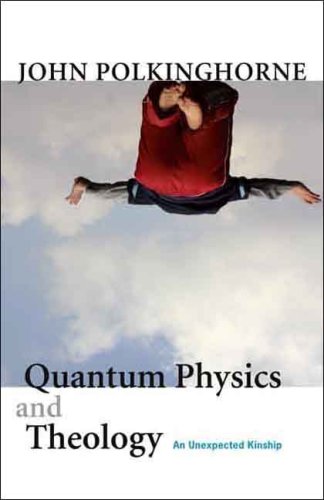
1. Quantum Physics and Theology:
$8.78
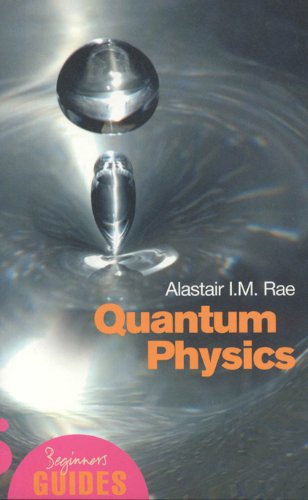
2. Quantum Physics: A Beginner's
$11.22
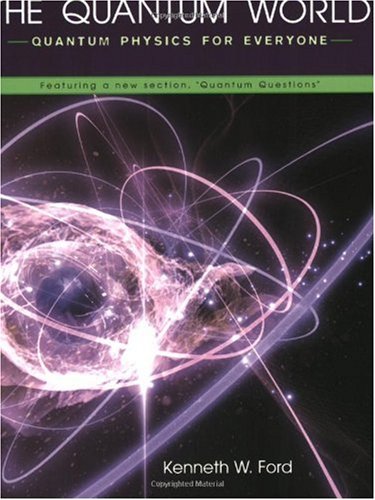
3. The Quantum World: Quantum Physics
$65.99
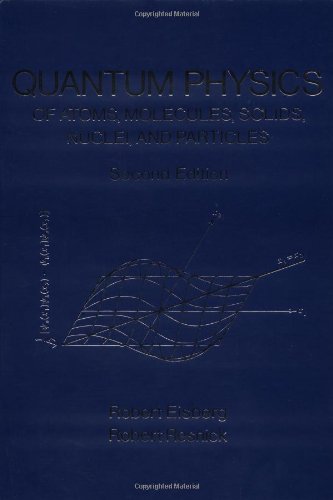
4. Quantum Physics of Atoms, Molecules,
$8.00
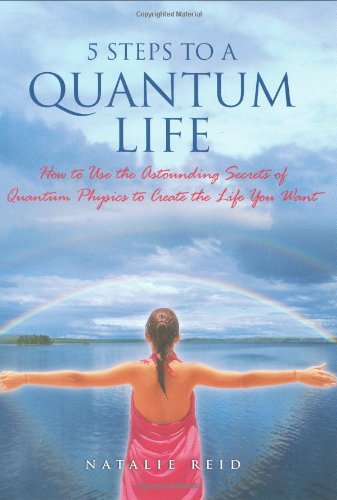
5. 5 Steps to a Quantum Life: How
$10.90
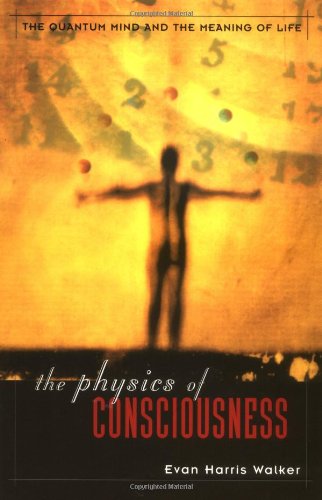
6. The Physics of Consciousness:
$12.85
7. Mathematics of Classical and Quantum
$13.42
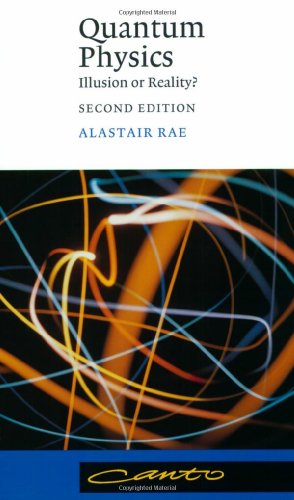
8. Quantum Physics: Illusion or Reality?
$15.95
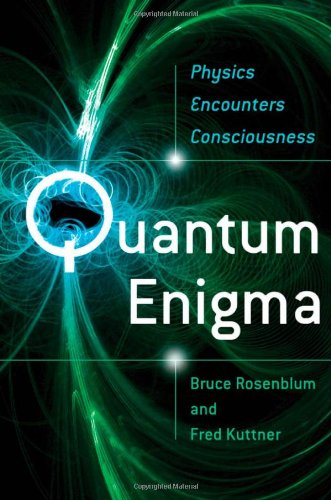
9. Quantum Enigma: Physics Encounters
$14.32
10. Mathematica for Theoretical Physics:
$44.38
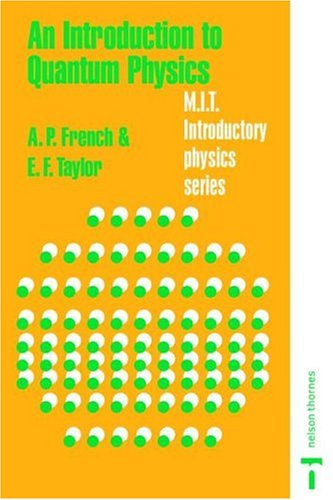
11. An Introduction to Quantum Physics
$11.09
12. Schaum's Outline of Quantum Mechanics
$17.95
13. Philosophical Problems of Quantum
$70.75
14. A Quantum Approach to Condensed
$10.12
15. Taking the Quantum Leap: The New
$6.59
16. Physics of the Soul: The Quantum
$5.99
17. Q IS FOR QUANTUM: An Encyclopedia
$57.99
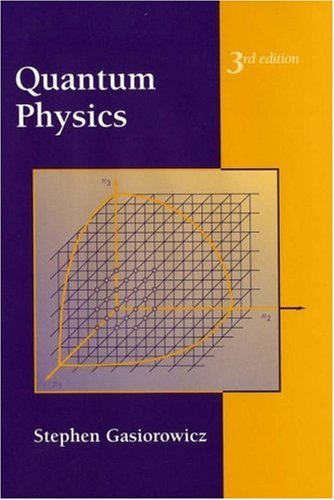
18. Quantum Physics
$17.94
19. Relativity and Quantum Mechanics:
$7.86
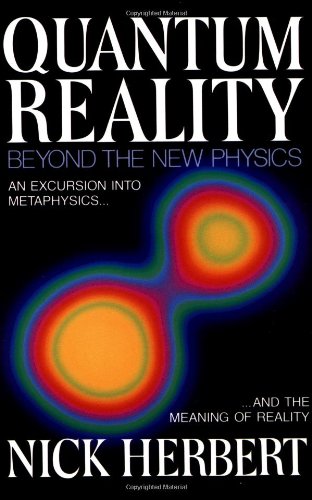
20. Quantum Reality: Beyond the New

1. Quantum Physics and Theology: An Unexpected Kinship
by John Polkinghorne
Paperback: 128 Pages (2008-02-19)
list price: US$15.00 -- used & new: US$9.99
(price subject to change: see help)
Asin: 0300138407
Average Customer Review: 4.5 out of 5 stars
Canada | United Kingdom | Germany | France | Japan
Editorial Review

Book Description

Despite the differences of their subject matter, science and theology have a cousinly relationship, John Polkinghorne contends in his latest thought-provoking book.From his unique perspective as both theoretical physicist and Anglican priest, Polkinghorne considers aspects of quantum physics and theology and demonstrates that the two truth-seeking enterprises are engaged in analogous rational techniques of inquiry. His exploration of the deep connections between science and theology shows with new clarity a common kinship in the search for truth.

The author identifies and explores key similarities in quantum physics and Christology. Among the many parallels he identifies are patterns of historical development in quantum physics and in Christology; wrestling with perplexities such as quantum interpretation and the problem of evil; and the drive for an overarching view in the Grand Unified Theories of physics and in Trinitarian theology. Both theology and science are propelled by a desire to understand the world through experienced reality, and Polkinghorne explains that their viewpoints are by no means mutually exclusive.
... Read more

Customer Reviews (3)

5-0 out of 5 stars Quantum physics and theology
The book is easy to read even though the complexity of the theme it works. Polkinhorne explores the connections between science and religion, making his point clear and easy to understand.

5-0 out of 5 stars brief history of quantum physics and theology
In this slim well written volume Polkinghorne gives us a succinct comparison of the rational processes of inquiry required in both quantum physics and Chistian theology. As he says in his preface if you're looking for a book on quantum physics he has written a different work treating that subject specifically.He has also written elsewhere about his Christian faith and theology.This book's real value lies in its encouragement towards further reading.

Polkinghorne reaffirms his commitment to "critical realism" largely derived from Michael Polanyi.He then takes us on a fascinating journey of the intellectual history of quantum physics and theology. He draws a series of parallels in the two disciplines. Starting with a discussion of how science uses experience and understanding in the process of discovery he explains how the relationship between theory and experiment played a part in Einstein's development of the theory of relativity.That is paralleled by a discussion of how Christology is shaped by the historical record of Christ found in the Gospels. That supports his adoption of "bottom up" theology. This format is followed throughout the book - first discussing an aspect of the history of science and quantum physics followed with a history of some aspect of theology.Overall, this makes for some fascinating reading, if at times a little confusing as to exactly how these different histories are paralleled.

Some of the scientific subjects covered are: the development of relativity, quarks, atomic structure, waves and particles, quantum indeterminacy and quantum field theory.The theological subjects include Christology, the historical Jesus, the incarnation, the doctrine of two natures, doctrine of the Trinity, miracles and eschatology.Polkinghorne finishes up with a discussion of some human aspects of intellectual inquiry such as the role of genius, insight, imagination, thought experiments and how the choice of words influences conceptual formulation.

Polkinghorne's aim is to get scientists to appreciate the rational inquiry demanded of theological reflection and perhaps to do some reading in theology. Likewise, he encourages theologians to appreciate the intellectual rigor of scientific inquiry and to study science to see what that might add to their own theological formulations.I think this book succeeds in stimulating the reader in those directions.

4-0 out of 5 stars A champion of the Word
John Polkinghorne is one of the most complete theologians in the Anglican Communion - if not in the whole Christian Church. Using the Church's long established three way approach to understanding scripture, he reads his bible, considers,seriously, the history of its interpretation and thinks profoundly about what it all can mean. All though the essay uses complex issues im both physics and theology it provided me a major helping of food for thought. It is one of those texts that can be read again and again. ... Read more


2. Quantum Physics: A Beginner's Guide
by Alastair I. M. Rae
Paperback: 192 Pages (2006-03-25)
list price: US$14.95 -- used & new: US$8.78
(price subject to change: see help)
Asin: 1851683690
Average Customer Review: 4.0 out of 5 stars
Canada | United Kingdom | Germany | France | Japan
Editorial Review

Book Description
Of all modern scientific theories, quantum theory has perhaps done more than any other to change the way we think about basic structure of the universe. This clear and accessible introduction covers quantum physics in theory and in practice, and explains why it has become known not just as a theory, but as a revolution. ... Read more

Customer Reviews (9)

3-0 out of 5 stars Beginner, But Not Very
I like how it breaks things down into subcategories, it's kind of like an overview of physics. If you want to know what quantum physics covers and not get into too much detail about the subject this is the book for you. In this sense it is a beginner's guide. It doesn't break things down into simpler ways of understanding but covers very basic ideas of quantum physics.

5-0 out of 5 stars Surely this will do the trick
Like many of my intelligent-seeming purchases, this is for a friend.I did find myself thumbing through this book, however, and found that the layout seems quite straightforward.While I doubt that this book's spine will ever be excercized beyond it's paperback capacity, I have taken the proverbial horse to the science-flavored water.

3-0 out of 5 stars Focuses mainly on quantum effects and applications
Focuses mainly on quantum effects and applications. A relatively small book, it's a pretty easy read, though it does get somewhat technical at times. Simplified math is typically put in as optional sidebars. It is written in a fairly straight forward way. I felt it tended to "jump around" a bit, on occasion mentioning an unexplained term or fact, which might or might not be expounded on later, though this was rather minor. It has one chapter on underlying reality interpretations.

4-0 out of 5 stars QM primer for the pure layman
In pop science literature on quantum mechanics (QM) this booklet is a bit of an oddity. Rae really does address "beginners", i.e. readers with very little or no background in mathematics and physics. However, unlike most pop science writers he does not shy away from simple mathematics, even though all the math is contained in seperate "math boxes" which one can easily skip without loss of continuity. Rae does an excellent job explaining the basics of QM, but still IMO - given the targeted audience -not as good asJ.P. McEvoy and Oscar Zarate's "Introducing Quantum Theory" (Icon Books).

Many readers are probably attracted to this kind of book in search of an explanation of the "weirdness" of QM. Although Rae splendidly epitomizes the many interpretations of QM in the last chapter, there are more comprehensive books out there covering this particular topic, including Rae's own "Quantum Physics: Illusion or Reality?" !

The main strength of this beginners's guide really is the way he explains the many manifestations of QM in our daily lives, from chemistry, power generation and climate change to computing and cryptography. As Rae is the first to admit, in such a short text he can do little else but scratch the surface, but nonetheless his descriptions are very lucid, well illustrated, and above all founded on a deep understanding of the essentials of QM. The biggest miracle of all is perhaps that he manages to convey this essence to readers who otherwise would probably never have dreamed of opening a book containing a single equation.

All in all, the definite primer on QM for the pure layman. For those who already have some background in physics and/or mathematics, the chapters on semiconductors, superconductivity and cryptography are a nice and simple introduction to these vast and fascinating subjects.

PS: my edition does contain two bizarre mistakes: Joule was an English and not a French physicist (p. 9), and Schrodinger was an Austrian and not a German physicist (p. 24). Not that it matters much.

4-0 out of 5 stars If you know motion is discontinuous and random, you may finally understand quantum mechanics.
Rae's book is helpful for one to study quantum mechanics. But it cannot answer how to really understand QM. In fact, this is still a puzzle for everyone. For example, it is still unclear what on earth the wave function describes and whether or not the wave function really collapses.

As indicated by the well-known double-slit experiment, the solution hides in the real form of quantum motion in all probability. A recent analysis, which is given in the book Quantum Motion - Unveiling the Mysterious Quantum World, implies that quantum motion is actually the random discontinuous motion of particles, and the microscopic and macroscopic motions are both the displays of such quantum motion. As a result, what the wave function describes is the random discontinuous motion of microscopic particles. This picture makes quantum mechanics comprehensible for both physicsts and laymen.

When we realize that motion is discontinuous and random in reality, we may finally understand the mysterious quantum world, where an electron can pass through two slits at the same time. A popular introduction of quantum motion can be found at the website given by my name. ... Read more


3. The Quantum World: Quantum Physics for Everyone
by Kenneth W. Ford
Paperback: 304 Pages (2005-10-15)
list price: US$17.95 -- used & new: US$11.22
(price subject to change: see help)
Asin: 067401832X
Average Customer Review: 4.5 out of 5 stars
Canada | United Kingdom | Germany | France | Japan
Editorial Review

Book Description

As Kenneth W. Ford shows us in The Quantum World, the laws governing the very small and the very swift defy common sense and stretch our minds to the limit. Drawing on a deep familiarity with the discoveries of the twentieth century, Ford gives an appealing account of quantum physics that will help the serious reader make sense of a science that, for all its successes, remains mysterious. In order to make the book even more suitable for classroom use, the author, assisted by Diane Goldstein, has included a new section of Quantum Questions at the back of the book. A separate answer manual to these 300+ questions is available; visit The Quantum World website for ordering information.

There is also a cloth edition of this book, which does not include the "Quantum Questions" included in this paperback edition.

... Read more

Customer Reviews (20)

5-0 out of 5 stars Review By a Non-Physicist
Three themes are intertwined throughout this book:

1. Historical and biographical data on the men who, over about 50 years, discovered and described the weird world of quantum phenomenon and particle physics.The use of common sense had to be suspended during these investigations.

2. Accurate and intimidating descriptions of the particles and their interactions.I think it was Richard Feynman who said something like, "If I want to know the particulars about one of these particles, I know where to look it up."

3. Running commentary on how the quantum world works.

Of the three, the first is well-done and interesting, the second is relentless but necessary (for the career physicist), and the third is simply brilliant.It explains in clear language why the quantum world is so unlike the common sense world we thought we lived in.Difficult concepts come alive - such as wave/particle duality, the exclusion principle, the uncertainly principle, symmetry, and entanglement, or as Einstein called it, "spooky action at a distance."Unless you live like a Mennonite or are on a boy scout campout, quantum physics technologies effect the way you live your daily life - the internet even grew out of early efforts of physicists to keep each other more immediately informed about advances in particle physics.For non-physics majors, consider reading on despite lack of total understanding or you might bog down in details.As the point of view changes, concepts are restated and you'll get another try at it.This stuff is weird!

This is a great book that I highly recommend for any physicist who wants to brush up on particle physics and quantum phenomena, any undergrad or grad student in physics, or any other scientist types who are persistent enough to really want a handle on this fascinating but difficult subject.

5-0 out of 5 stars A Good Book for Non-scientists
I found this book to be very interesting. The only minor drawback is the intense focus on the many kinds of sub-atomic particles (Hadrons, Fermions, Leptons, Pions, W particles, etc.), but I really liked the way the information was presented. A good book for the non-scientist. Makes the completely complicated quantum theory quasi-understandable, if not fathomable. I think it was Neils Bohr you said that something like "anybody who claims to understand quantum mechanics really doesn't", as it is weird science based on probabilities. Not many equations in the book; a few in the footnotes.

5-0 out of 5 stars A good introduction to Quantum Physics
This is a good and readable introduction to Quantum Mechanics with a good collection of questions at the end that will be handy for educators (an answer manual is available to them).The quantum world is so far away from our daily experience that it should not surprise us that the concepts we use in classical physics such as defined trajectories, particles, waves, exact position, etc. get blurred in the quantum world. However, there are fascinating experiments, the best known is the double slit experiment, that show us the weirdness of the quantum, epitomized in the famous Wheeler's question: "How come the quantum?".

The quantum world is fundamentally probabilistic. For example, you do not who whether a specific atom of a radioactive substance will disintegrate in the next second, the only thing you can know is the probability that it will decay.

The book also traces the history of the main discoveries in particle physics and has a good number of photos of the main characters.

To conclude: anybody not familiar with QM and who wants to acquire a minimum scientific culture about one of the two main revolutions in physics of the XXth century (and the one that has had the widest impact in our modern economy) needs to read this book.

I particularly enjoyed the explanation of alpha and beta radioactivity and the discussion on CP violation, "the reason we are here", according to Nobel Prize winner Val Fitch. On the other hand, I missed some clarifications that will confuse the lay reader: why neutrinos are not their own antiparticles or how come there are 8 gluons if there are nine pairs of colour/anticolour.On the other hand, the important Uncertainty Principle is only discussed on page 213, whereas it is mentioned several times before in the book.

4-0 out of 5 stars Very accessible, but all over the place
Emit one photon at a certain point, then detect it at another point.In between, that one photon has traveled EVERY POSSIBLE PATHWAY between the two points.The location where you detect it is determined by probability, not certainty.

This book blew my mind, as I had left physics behind over a decade prior.It was very accessible, but disjointed.I suppose it is difficult to compose a flowing narrative about a subject that no one truly understands.Credit Ford for helping us learn, even if we have to keep flipping back and forth to remind ourselves what leptons and bosons and fermions are.

4-0 out of 5 stars Great theory book
This book an exellent introduction to Quamtum physics but it also talks about the history of quantum mechanics, which is quiet interresting and makes it easier to read.

I was look for an introduction to the Quantum World and this was the one. Sadly, I'm the kind of person who forget what I just read. This book is filled with theory (i.e. all sorts of leptons, quarks, force carriers, etc.) and consequently, really hard to remember.

Im in High School now and I was just curious about Quantum mechanics. I just had some really BASIC knowledge in QM and this book explained me all the rest easily althrought some explanations were incomplete like for the Weak interraction: it just says it is carried by the W and Z particle. The book does say what "carried" means (that is, force carrier) but it doesn't say actually how's it works.

Overall, this book explained a lot of things about QM but it demands the reader to remember a lot of things, especially the particles, their charge and their family (leptons, bosons, fermions, etc.).

This book CAN'T be read like a novel because you have to remember a lot of things but it's still easier to read than a book about relativity or math because it contains only few equations and doesn't ask you to "think" exept for the part when you have to know particles decay and their charge.

You must at least have some basic knowledge about Quantum Mechanics OR simply about physics before reading this. If you're interresed about QM and don't want to have all the complicated sutff (this book doesn't even say the value of Plank's constant), I deeply recommand this book. ... Read more


4. Quantum Physics of Atoms, Molecules, Solids, Nuclei, and Particles
by Robert Eisberg, Robert Resnick
Hardcover: 864 Pages (1985-01)
list price: US$133.95 -- used & new: US$65.99
(price subject to change: see help)
Asin: 047187373X
Average Customer Review: 4.0 out of 5 stars
Canada | United Kingdom | Germany | France | Japan
Editorial Review

Book Description
A revision of a successful junior/senior level text, this introduction to elementary quantum mechanics clearly explains the properties of the most important quantum systems. Emphasizes the applications of theory, and contains new material on particle physics, electron-positron annihilation in solids and the Mossbauer effect. Includes new appendices on such topics as crystallography, Fourier Integral Description of a Wave Group, and Time-Independent Perturbation Theory. ... Read more

Customer Reviews (17)

4-0 out of 5 stars good but please a little more explanation!
I think this book is surely meant to go along with a class, I don't think it is entirely suited for independent study.The reason I feel this is that the discussion questions at the end of each chapter seem to be asking about stuff that isn't really addressed in the chapter, and requires additional knowledge unrelated to what is given in the book to answer.Also, there are no solutions to the practice problems, so you will never be able to test your own accuracy.I really believe in having solutions in the back of the book, otherwise how are you to rate your own progress and understanding?In concert with a course however and with a teacher to fill in any information gaps, I think this is a fine book!All the explanations seem clear, and the steps in the derivation processes are easy to follow!

5-0 out of 5 stars Awesome Physics Book!
This is an awesome physcis book.It really allowed me to wrap my mind around some of them really big concepts.Sometimes my brain hurt!But I kept reading, just knowing it would make me smarter than George.He thinks he knows everything but he doesn't.Anyway, the book is better than a basket of spare ribs with extra sauce!

5-0 out of 5 stars wonderful and enlightening to read!
This book catches my attention to a point that I cannot put it down until I have finished a chapter. It is true that the book is focused on understanding the physical concepts with little math...this can be confusing at times...but I still think highly of it.

1-0 out of 5 stars Buy Griffiths Instead
This book was confusing, chaotic, and utterly disapointing.If your professor assigns this book I suggest you do not buy it but borrow from a friend.Instead use Griffiths to learn QM.Since moving onto graduate school I have learned just how little I learned from this book.Moreover, I was confused about simple issues in QM which Cohen-Tannoudji quickly and clearly dispelled.This book actually hurt my education.I can not for the life of me understand how anyone could give this book 3, 4, or even 5 stars.

5-0 out of 5 stars Great introduction, focused on understanding
This book is an excellent introduction to Quantum Physics. This book gives the non-expert reader an insight into the tremendous explanatory power of quantum mechanics. It describes why and how Quantum Mechanics was developed, and it is primarily concerned with the understanding of concepts and ideas, rather than focusing on mathematical techniques. For this reason it might appear a little verbose to some readers.

The first five chapters gives the reader a good insight into the history of Quantum Physics and to why classical mechanics was insufficient. Chapter 6 is an excellent overview of how to solve the Schroedinger Equation in a few specific cases, at the same time as the reader is given a very good "feeling" for how Quantum Mechanics works. The remainder of the chapters focuses on specific situations, applications and phenomena's.

There are plenty of books that use less mathematics, but I do not believe they give a good understanding of the topic. There are also plenty of books that uses a lot more complex mathematics, but they are not for beginners. I recommend this book as an introduction to Quantum Physics for undergraduate physics students, engineers, science professionals, and mathematically literate others.

For reference, these are the chapters in the book:
(1) Thermal Radiation and Plank's Postulate
(2) Photons--Particlelike Properties of Radiation
(3) De Broglie's Postulate--Wavelike Properties of Particles
(4) Bohr's Model of the Atom
(5) Schroedinger's Theory of Quantum Mechanics
(6) Solutions of Time-Independent Schroedinger Equations
(7) One-Electron Atoms
(8) Magnetic Dipole Moments, Spin, and Transition Rates
(9) Multielectron Atoms--Ground States and X-Ray Excitations
(10) Multielectron Atoms--Optical Excitations
(11) Quantum Statistics
(12) Molecules
(13) Solids--Conductors and Semiconductors
(14) Solids--Superconductors and Magnetic Properties
(15) Nuclear Models
(16) Nuclear Decay and Nuclear Reactions
(17) Introduction to Elementary Particles
(18) More Elementary Particles

I liked Appendix A, "The Special Theory of Relativity". In only sixteen pages, the authors succeed to correctly explain the special theory of relativity. I also liked Appendix C, "The Boltzmann Distribution", which was good concise description of classical statistical mechanics (you need to understand it, to understand why it was not good enough). ... Read more


5. 5 Steps to a Quantum Life: How to Use the Astounding Secrets of Quantum Physics to Create the Life You Want
by Natalie Reid
Paperback: 202 Pages (2007-09-31)
list price: US$14.95 -- used & new: US$8.00
(price subject to change: see help)
Asin: 097921100X
Average Customer Review: 5.0 out of 5 stars
Canada | United Kingdom | Germany | France | Japan

Customer Reviews (3)

5-0 out of 5 stars WOW!This book will change your life!
WOW! This book is amazing! I have been reading about the quantum for quite a while, and have seen "What the Bleep" and read "The Secret".As interesting as they were, I gleaned no tools from them with which I could actually affect change in my life.Dr. Reid's "5 Steps to a Quantum Life" not only clearly explains how the quantum works,it contains simple, user-friendly tools in the form of meditations and exercises which instruct the reader vividly on how to USE the knowledge.This is the book I have been waiting for!For the holidays,I am giving a copy to everyone I love; it's that good!

5-0 out of 5 stars Excellent: Even Better than The Secret
I absolutely loved this book.I liked The Secret, but it left me with more questions than answers.Ms. Reid's book provides the missing pieces to the puzzle of creating the life I want.5 Steps to a Quantum Life provides insight, helpful information and a whole host of useful exercises, meditations and practices to create the things I want in my life.After a couple weeks, I can already see tangible ways that these practices are working for me in my life.I've recommended this book to all my frieds and they are loving it as well.A must read!

5-0 out of 5 stars Strongly recommended for personal and community library Self-Help & Self-Improvement reference collections
"5 Steps To A Quantum Life: How To use The Astounding Secrets Of Quantum Physics To Create The Life You Want" by Natalie Reid offers the reader a practical and thoroughly 'user friendly' five-step process to improve daily life. Reid shows how we create our own reality and, utilizing our expanding knowledge of quantum physics and how our subconscious mind perceives and interprets our experiences and observations, how we can affect and influence that reality to improve our lives. Drawing from her many years of experience and expertise in psychology, meditation, mind-body work, and the study of quantum physics, Reid has written a seminal study and guide that can be readily accessed and incorporated by any non-specialist general reader with an interest in improving the quality of their life emotionally, physically, financially, socially, and professionally. Enhanced with chapter notes, a glossary, and an extensive bibliography, "5 Steps To A Quantum Life" is strongly recommended for personal and community library Self-Help & Self-Improvement reference collections and supplemental reading lists. ... Read more


6. The Physics of Consciousness: The Quantum Mind and the Meaning of Life
by Evan Harris Walker
Paperback: 384 Pages (2000-12)
list price: US$20.00 -- used & new: US$10.90
(price subject to change: see help)
Asin: 0738204366
Average Customer Review: 4.0 out of 5 stars
Canada | United Kingdom | Germany | France | Japan
Editorial Review

Amazon.com
It's not every day you hear a physicist ask what happens when we die.Evan Harris Walker, sparked by the early, tragic loss of his love, does just that and more in The Physics of Consciousness, a book in the same vein as Fritjof Capra's The Tao of Physics, but with a firmer grounding in scientific understanding. Walker marries the traditions of Southern literature--a longing for the past, a resignation toward the present, and a determined optimism about the future--to a technical explanation of the limits of materialism; a weird synthesis, certainly, but charming and engaging nonetheless. Since his primary topic is consciousness, Walker turns to neuroscience and Buddhism (its spiritual equivalent) for inspiration.His quantum-mechanical approach to synaptic transmission and "the speed of consciousness" are difficult to evaluate and seem a bit overstretched, but his discussions of the history and current events of physics are lucid and ironically lend weight to his antimaterialistic arguments. Is this, as he hopes, another step toward 21st-century religion, or just another New Age reinterpretation of the spooky world of the ultrasmall?Don't bet on either--The Physics of Consciousness will jog your brain in new ways and, if nothing else, you'll find a new appreciation for how little we really know about ourselves. --Rob LightnerBook Description
How quantum physics will explain the nature of reality and the human mind. For decades, neuroscientists, psychologists, and an army of brain researchers have been struggling, in vain, to explain the phenomenon of consciousness. Now there is a clear trail to the answer, and it leads through the dense jungle of quantum physics, Zen, and subjective experience, and arrives at an unexpected destination. In this tour-de-force of scientific investigation, Evan Harris Walker shows how the operation of bizarre yet actual properties of elementary particles support a new and exciting theory of reality, based on the principles of quantum physics-a theory that answers questions such as "What is the nature of consciousness, of will?" "What is the source of material reality?" and "What is God?"

"A breathtaking journey into the very atoms of the brain...In his rare fusion of intellectual ambition with emotional urgency, Walker exposes the emptiness of a science that avoids the ultimate questions." -Booklist ... Read more

Customer Reviews (33)

5-0 out of 5 stars Phyiscs and Consciousness
Physics and consciousness are hot topics in the quantum community and this book goes on to correlate between the outside reality (physical) and the inside reality (spiritual) It gives you a new way of looking at reality and to understand that different planes of realities exist. This is an excellent book.

Regards,
Enigma Valdez

4-0 out of 5 stars Thoughtful, but sometimes misleading.
Evan Harris Walker has written an entirely different book than you may have expected from reading the title.Certainly, the book discusses all of what is included in the title, but with a trifle more sophistication than I had expected.Readers who are not already familiar with thinking about Quantum Theory and philosophy of mind will probably find the book a rough ride.While Walker takes pains to explain the concepts, his are not certainly not the clearest available.

What is unnerving to me about this book is the lack of respect paid to the unwitting non-specialist reader.Walker argues for a specific interpretation of quantum theory, an interpretation from which the rest of his argument laregly hangs, but fails to duly note the capriciousness of his philosophical choices.The fact is that his interpretation is based on an intuition, one that he tries to force down the reader's throat via an emotional and tragic tale from his past.He uses the story, which is weaved throughout the narrative, to cultivate the appropriate emotional response from his reader so that his interpretations and philosophical presuppositions look inevitable.He is quite masterful actually, but the uninitiated reader will probably not be able to see through the rhetoric.

Walker's intuitions are certainly well argued for in this book and, if they match your own, you will probably find this book to be a powerful confirmation for what you already believed.However, please be aware that Walker's interpretations and opinions are not necessary conclusions from science and are not the only consistent approaches to interpretation.This book is, then, an exploration in the justification of a faith via various lines of evidence from science, philosophy and experience.Recommended to the experienced reader.

3-0 out of 5 stars The Nature of Consciousness and the Meaning of Life
The Nature of Consciousness and the Meaning of Life
Michael J. Vandeman, Ph.D.
December 20, 2005
Copyright(c) Michael J. Vandeman, 2005

"Consciousness is not to be found among physical objects", E. H. Walker, p.147

I think that there must be very few books that live up to the promise implicit in their title. It is very tempting to exaggerate, in order to get people to buy the book. (By contrast, Walt Whitman's Leaves of Grass, one of my favorite books, does discuss leaves of grass, but also a lot more!) As far as I can tell, Evan Harris Walker's The Physics of Consciousness: Quantum Minds and the Meaning of Life discusses neither the physics of consciousness, quantum minds, nor the meaning of life.

Woven throughout the book is a very charming and entertaining thread devoted to describing Walker's relationship with his high school sweetheart, Merilyn Ann Zehnder, and her tragic death from leukemia. I enjoyed this glimpse into the author's life, but I don't see how it contributed to fulfilling the book's promise. I suppose it gave some "human interest" to a book that otherwise could be too taxing on the brain, or served as a dramatic device -- interrupting the physics thread and creating suspense.

For me, by far the greatest value of the book was the fascinating and very detailed recounting of the history of physics -- especially the description of particle physics and quantum mechanics. It's comforting to know that quantum mechanics and relativity are an accurate reflection of the world -- all of it! It's also fascinating to watch humanity (who, according to Reg Morrison (The Spirit in the Gene), are genetically predisposed to spirituality or religion) be forced to relinquish one myth after another to the persuasive power of science. Walker's writing is lucid and generally easy to understand -- quite a feat, considering the difficulty of the subject matter and the fact that its essence can be expressed only in mathematical form! For me the book brought together numerous disparate bits of physics that I hadn't fully grasped or integrated. For that, I am very grateful.

Walker then takes a giant leap and asserts, without citing any evidence, that consciousness is different from anything ever studied or described by physics -- it's "special". He seems to assume that this is so obvious that it doesn't need proof, but, on the contrary, not only does it require evidence, but it is actually false, which derails the rest of his arguments. Remember, he has just finished describing the fact that current physical theories describe the entire universe (at least since it was 10-43 seconds old), from subatomic particles to galaxies, with enormous precision! So it is illogical to suddenly claim that there is something -- consciousness -- which is not described by those equations! (And yet, he later contradicts himself by equating consciousness with a quantum mechanical "tunneling" of electrons.) That consciousness is "special" is an assumption. If it falls, then the rest of the book -- and probably all other writing and thinking about consciousness -- also falls.

Here are some of Walker's statements in support of this assumption: "Science is incomplete and must be greatly expanded if it is to meet the challenge of this data." (p.159) "If we approach what is in those equations [of physics] exclusively in terms of those ideas physicists have put there, we will see that there are some things that are missing and that cannot be derived from the things that have gone into those equations. The equations have positions and intervals, quantities and forms, and they describe responses. But feelings are not there, nor is pain, C#, or the colors we see in the budding red rose. 'Motives' are there, but emotions are not. Conscious being is not in these equations. [That is an assumption! In other words, he is begging the question, not answering it.] If consciousness is to play its role in physics, it must be included in its own right, on its own terms. [That's funny -- ethics, philosophy, art, music appreciation, and government are also not in those equations, but no one has ever suggested that we need to expand physics in order to explain them!]. ... It will be necessary to introduce something new into physics on its own terms. This is how it has always been in physics when we have wished to understand something totally new. This is how we must do things now." (p.176) "Consciousness is something that exists in its own right and has its own identity. It is distinct from all other objects, processes, energies, and realities that physics or science as a whole reveals." (p.178) "Consciousness is nonphysical. ... It is real and nonphysical." (p.182) "The classical machine cannot have consciousness, and it cannot have any identity of its own." (p.253)

Walker then describes his theory of the functioning of the synapse, and argues that consciousness is the quantum mechanical "tunneling" of electrons across the synapse: "There, in those minute switches, at the miniscule intersynaptic cleft -- that is where the quantitative link between mind and brain is to be found." (p.194)

He then goes on to make the absurd assertion that nothing exists until it is observed by a conscious observer! "Only our observation of the object [a die thrown onto a craps table] leads it to take on one out of all its possible orientations and come to rest with one of its six faces up." (p.270) "We have seen matter and space as the natural consequence of nothing more than the fact that conscious observers exist." (p.331) In order to understand this assertion, we need to think about quantum mechanics and the Heisenberg uncertainty principle. Heisenberg showed that when one tries to measure either the location or momentum of an object, the act of measuring itself disturbs the object, so that one can determine either characteristic to arbitrary precision, but not both. This is not simply a defect in our equipment! This is the fundamental nature of matter! For example, if we shoot an electron at a phosphorescent target, until it hits the target and creates a flash of light, it has no position, but exists only as an infinite set of possible locations and momenta, with varying degrees of probability.

But it is not the observer that determines where and how the die will land! It is the table and the forces of gravity and electromagnetism! The observer enters the picture only after the die has settled into its final resting position. This is Walker's means of injecting (human, or at least animal) consciousness (and, ultimately, meaning and God) into physics. It fails. (However, I wish that Walker had spent more time on this matter, since it is the crux of his argument. I had trouble following the part that centered on Bell's Theorem, where supposedly quantum mechanics triumphs, and belief in concrete reality has a stake driven through its heart. This section (Chapter 8) was intriguing, but very difficult to understand.)

In mathematics there is a tool called "reductio ad absurdum". One makes an assumption, and then argues logically from that assumption to arrive at a conclusion that is "absurd" (obviously false). That proves that the assumption upon which the argument was based must be false (for example, one can assume that a number exists which is zero divided by zero; from this one can "prove" that 1 = 2). Thus, in the present case, the assumption that consciousness exists as something "special", not describable by physics, is false: it leads to absurd conclusions.

The other serious error that Walker makes is that he identifies consciousness with wakefulness. The state of being awake, which, according to my physiology text, is controlled by the brain's reticular activating system, is only one meaning of "conscious" ("having mental faculties undulled by sleep, faintness, or stupor: awake" (Webster, p.238)). The more important use of the word is being conscious of something: "aware of and responding to one's surroundings" (Compact Oxford English Dictionary). Wakefulness is a necessary (except possibly for dreams), but not a sufficient, condition for being aware of something. Although I am awake, I am rarely aware (conscious) of the traffic outside my house, nor even the temperature of my own skin. I am very good at focusing on one thing, and ignoring everything else. (No wonder we men are so often accused of being "insensitive"!)

A third serious error is that Walker identifies consciousness with something that takes place in a very specific location: the nerve synapse. This would imply that organisms without nerves cannot be conscious. However, Donald Griffin (Animal Thinking) has argued convincingly that thinking (complex decision-making) goes back as far as single-celled organisms, which are aware of chemicals in their environment and respond appropriately -- approaching or avoiding them based on whether they represent food, mate, or threat. Green plants detect (are aware of) sunlight and turn their leaves so as to maximize the energy they receive. Humans are genetically 98.6% identical with chimpanzees, so it is unlikely that so important a characteristic as consciousness could be present in humans but not in chimps. But we also share a large percentage of our genome with all animals, and in fact with all living things! Since consciousness (awareness of things and events outside the organism) is so integral to all life, it most likely is not simply a matter or nerve synapses, and probably is an essential feature of all living things: "All living beings, not just animals but plants and microorganisms, perceive. ... Mind and body, perceiving and living, are equally self-referring, self-reflexive processes already present in the earliest bacteria". (Margulis & Sagan, p.32) "Life ... is awareness and responsiveness; it is consciousness and even self-consciousness." (ibid., p.177) "Mobile microbes make selections -- they choose." (ibid., p.179) "The gulf between us and other organic beings is a matter of degree, not of kind." (ibid., p.182) "Thinking and being are the same thing." (ibid., p.188)

So how can we determine what consciousness is? Obviously, the laws of physics that apply within living organisms are identical to the laws that hold outside them. Walker admits that the laws of physics apply to the entire known universe. ("Life is less mechanistic than we have been taught to believe [we obey probabilistic quantum mechanics, rather than the deterministic Newtonian physics]; yet, since it disobeys no chemical or physical law, it is not vitalistic [i.e., there is nothing "magic" or "special" about life]." (Margulis & Sagan, p.178)) But this implies that there is nothing "special" about life -- nor about consciousness! And it implies that anything that can happen inside a living organism can also happen outside living things (if a distinction between living things and nonliving things even makes sense) -- including consciousness! The splitting of H2O into hydrogen and oxygen takes place in green plants, but it can also happen outside them. Every event that can happen within a living organism can potentially (given the right conditions) also happen outside them. In fact, if we assume that life and consciousness are "special", then (by reductio ad absurdum) it follows that they don't exist! No wonder they are so hard to define and describe! It is hard to define something that doesn't exist (such as, for example, God). ...

So what is consciousness? Simply the registering of an effect. A scale is conscious of weight. It is not conscious of (able to measure) anything else. If it could be arranged so as to weigh itself (I don't know if that is physically possible), then it would be self-conscious (in that one dimension). We are also capable of being conscious of weight. I can feel pressure on my skin from a weight resting on top of it, and I can also hold the weight in my hand and feel the strain on my arm muscles. These are just two possible ways of being conscious of weight, neither of which is the same method used by the scale. I am also conscious of light, which the scale is not. But I am not conscious of ultraviolet radiation, although a bee and a UV meter are. A robot is conscious, but not of enough things to survive on its own -- not enough to survive in this rough-and-tumble world. Humans are visually conscious of the movement of distant objects, but we are nowhere as perceptive as birds. Of course, being conscious of more dimensions doesn't make one superior, except in the narrow sense of those dimensions. Bacteria are undoubtedly superior in their consciousness of chemical nuances. In any case, there are obviously many ways to be conscious, not just one, just as there are many different ways to store information. Consciousness is not a fundamental constituent of reality -- nor anything new or unitary.

To show how life and non-life (whatever they are, if they even exist!) shade into each other, look at a couple of examples. Frogs in Canada freeze solid every winter and thaw out again in the spring. While frozen, they are neither alive (they don't meet any of Margulis and Sagan's criteria, since they are doing absolutely nothing) nor dead (death is, by definition, final). Okay, maybe you believe that the frozen frogs are alive, and doing something, although you don't know what. The frogs don't contain much extra energy, so if they were doing anything, all their stored energy would get used up, and they would have none left to allow them to awaken in the spring. If that example doesn't convince you, then look at the seeds stored in the pyramids for 3,000 years. Dead, or alive? Since they were able to germinate upon being given water, they couldn't have been dead, according to Margulis and Sagan and every other biologist. But they can't have been alive either, because if they were doing anything during those 3,000 years, all of their tiny store of energy would have long since been exhausted. Viruses and prions are two more examples of life shading into non-life; viruses are not considered alive, but they perform some of the same functions as living things, such as reproduction. In other words, it is not possible to detect the difference between life and non-life: i.e., there is no real difference! Life is an indefinable state of matter, kind of like (but even less definable than) the liquid- vs. solid state of water.

Thus, the real mystery is not consciousness; the real mystery is how humans can miss what is "hidden" in plain sight -- right in front of our noses! Obviously, we can't know directly whether any other organism is conscious. We can only infer that from its behavior. That goes for our own friends and family, pre-verbal or dumb (unable to talk) humans, animals, plants, bacteria, etc. Bacteria and protists (e.g. protozoa) act as if they are conscious. Or perhaps I should say that we sometimes act like them -- turning our faces toward the sun, sniffing out attractive smells from the kitchen, reacting instinctively to environmental hazards. Try this experiment: turn on the television, but turn off the sound. You will be amazed at the things you become conscious of (the mole on an actor's nose, the blond hair and brown eyebrows, the funny way people move, etc.), that you had been forced to ignore due to trying to follow (be conscious of) the (verbal) story. Meditation is another experiment in consciousness. Try meditating on the self-conscious scale. ... It's no wonder that no one has discovered what consciousness is. If consciousness is a white horse (or nothing special at all), but you insist that it is a green dragon, you can look all you want, but you will never find it. ...

Two more things remain to be discussed: will, and the meaning of life. On page 333 Walker admits: "But for all this terror, there is one thing that is worse: the thought that all the suffering and all the pleasure of life have no meaning." I don't see how the meaning of my life, or any life, depends on the existence or importance of consciousness. While life has no single, canonical meaning (else we would long ago have discovered what it is!), each person's life has -- to them -- the meaning that he or she chooses to give it. (Of course, we get some ideas from others, past or present.) The same goes for morality and ethics: what is moral is what we think (based partially on input from others) is moral. Science and physics have little to do with any of this, except to keep us honest. Science can only tell us what is, never if it should be. Therefore it cannot be blamed for any alleged decline in morality. I suspect that "immorality" is like a recessive gene -- impossible to eliminate. We also can't depend on evolution to "improve" humankind. Evolution is like justice: blind. It only ensures the survival of those who survive -- not necessarily those with any given characteristic (including alleged "fitness", whatever that is).

Then what about free will? (Walker simply refers to "will", and sidesteps this question.) The fall of Newton's deterministic physics, and the triumph of "probabilistic" quantum mechanics, implies that our behavior is neither predetermined nor predictable. (That's nice! It would be pretty boring, otherwise!) The "butterfly effect" rules. But this also doesn't imply that our behavior is under our own control. And since it is apparently decided at a molecular (hence quantum) level, the Heisenberg uncertainty principle prevents us from ever knowing causation for certain. In other words, we probably don't have free will, but we have no way of ever knowing for sure, and we feel that we have free will, so ... who cares? (Well, the criminal justice system may care, thinking that people should only be held responsible for what they deliberately do. But it's impossible to know for sure, and ... nature (evolution) doesn't care.)
In spite of centuries of thought and research into human-, animal, and plant behavior we still don't know why people commit murder -- or much else. Can you resist eating that cookie? If humans were rational, no one would smoke, right? I know that I am irrational, because no matter how often I see people behave irrationally, I still continue trying to treat them as if they were rational, by reasoning with them!

This paper would be incomplete without discussing the purpose of life -- something Walker skipped, even though he is obviously interested in it. The purpose of life is to have fun! I mean, what else could it be?! (Of course, that excludes hurting wildlife or other people, even if you happen to think that that's fun.) And I certainly had fun reading this book, and thinking about it. ...

(...)

5-0 out of 5 stars A great reference for quantum physics in real life
I was given this book by a friend several years ago, along with another book on quantum physics.This book stood out because of the approach Walker took to presenting his material.I had many insights into quantum physics as it relates to my own life while reading this book (three times so far), but the gem of the book in my opinion is contained in the appendix.I come back to Walker's insights into consciousness as presented in the last part of the book, and in the appendix many times to refresh my understanding of how quantum physics applies to my daily experience in life.This is particularly interesting when looking at how events affect my consciousness, and has given me insight into how to apply quantum physics in my daily life.Outstanding book to read, but if you have only a passing interest in quantum physics, you may want to prepare yourself to take more of an interest in the subject, as this book will be much more rewarding if you do.

5-0 out of 5 stars Double fantasy
In this insightful work, "The Physics of Consciousness" Evan Harris Walker concludes that "Consciousness is Reality."Many philosophers and scientist have suggested that consciousness can never be explained because of its subjective nature, but Walker disagrees.

Methodically quantifying the various processes involved in information exchange in the brain in terms of "bits", Walker is able to extrapolate approximations of the speed and capacities of the information being manipulated in neural activities.

With this information in hand, Walker proceeds to treat the mind/brain activities in Descartean fashion, maintaining that in order to fully understand the relationship between the part and the whole, a dualistic notion of mind and matter must be entertained. The dualities of wave vs. particle, and observer vs. observed in the strange quantum world of state vector collapse, give us a clue as to what transpires in the brain.

Walker contends that the 24 trillion synapses in the brain delineate the transition point beween mind and matter.Most have rejected quantum effects across the synapses because of the relatively large distances and energy it takes to make the leap, but these individuals have not taken into account several known facets of quantum physics such as the principles of tunneling, indistinguishability, and state vertor collapse.

Walker says that the mind itself consists of two parts--consciousness and "will".Consciousness does not have to be a part of a living entity, but is a factor in all quantum events in nature.The "will", which defines what we are, is the catalyst that collapses the wave function into one discrete, non-local event from a myriad of possibilities. According to the principles established by Bell's non-locality theorem, this state vector collapse travels out into the universe at large, and always maintains a link to our individual and collective minds.As a bonus, Walker has answered another mystery as deep as consciousness itself--the nature of time.Time is real and asymmetrical.It is the irreversibility of the state vector collapse that gives time its arrow.

This is without exception the most satisfying and believable description of the naure of consciousness I have read to date.This work is a bit difficult at times for the non-scientist, but in the end patients pays off.With great effort he has made the concepts of the principles of "indistinguishability" and "non-locality" understandable, and he has brought us to a definitive link between mind, time, and nature.

Even so, I found his distinctions between consciousness, thought, and "will" a bit confusing if not contradictory at times.But he has something very important to say about the nature of mind. And, as a result of his thorough understanding of quantum theory, he has come closer than previous scholars to finally nailing down the nature of consciousness.

Running parallel to his main thesis is a delightful reminiscence of his high school lover who died after graduation in the summer of 1952.Excerpts from his diary and rememberances of the lost love of days gone by, make Walker's work both a scholarly and endearing tale.

This review by David Kreiter Author of "Quantum Reality: A New Philosophical Perspective" ... Read more


7. Mathematics of Classical and Quantum Physics
by Frederick W. Byron, Robert W. Fuller
Paperback: 661 Pages (1992-08-20)
list price: US$24.95 -- used & new: US$12.85
(price subject to change: see help)
Asin: 048667164X
Average Customer Review: 5.0 out of 5 stars
Canada | United Kingdom | Germany | France | Japan
Editorial Review

Book Description

Well-organized text designed to complement graduate-level physics texts in classical mechanics, electricity, magnetism, and quantum mechanics. Topics include theory of vector spaces, analytic function theory, Green's function method of solving differential and partial differential equations, theory of groups, more. Many problems, suggestions for further reading.
... Read more

Customer Reviews (22)

4-0 out of 5 stars Excellent math reference for physicists
As the title says, it's one of the best books for mathematics in physics. Not simple at first glance (not indicated for first students, I guess), but good to review some math...

5-0 out of 5 stars Great Physical Mathematics
Great mathematical physics book.I bought it as a supplement text for a mathematical physics course as well as help in quantum physics course.Got me through a lot of Quantum homeworks.I still use this book as a reference for math and physics concepts.The ordering of the book is a little weird and skips the some of the basic concepts in linear algebra but explores a wide variety of other topics including Green Functions, Cauchy-Riemann, Fourier analysis and transforms, Dirac notation, ect.At the end of topic the book works through examples.A must have for physicist, engineers, and mathematicians.

5-0 out of 5 stars astonishing!
this book chose the best way to convey the mathematics behind a physical idea just by proving it through the mathematics involved . With that , one has a lucid idea about the language of physical laws . I can simply assure anybody who wants to buy this book that it is worthy .

5-0 out of 5 stars The real deal.
Over my head, but clearly a solid rung in the ladder for those who are capable of mastering quantum physics. Not that I couldn't - it would just take 10-20 years that I don't have.

5-0 out of 5 stars Very good but very old school
This is a great book, esp. at the price; but it is going on for forty years old, and it is showing its age: theoretical physics once looked like this, and maybe it still does for undergraduates, but the content does not correspond, or even really give you a proper idea of what you can expect these days in theoretical (and particularly mathematical) physics at research level:no differential manifolds, no Lie groups, no differential forms, no algebraic topology, no symplectic geometry, and certainly no clifford algebras (! - yeah, I know, the last is unfair).

It's still great, and you should buy it, esp. at the ridiculous price, but you are going to have to read other stuff as well, and the other stuff will look a lot less like what you learned in school. ... Read more


8. Quantum Physics: Illusion or Reality? (Canto)
by Alastair I. M. Rae
Paperback: 170 Pages (2004-10-25)
list price: US$19.99 -- used & new: US$13.42
(price subject to change: see help)
Asin: 0521542669
Average Customer Review: 5.0 out of 5 stars
Canada | United Kingdom | Germany | France | Japan
Editorial Review

Book Description
The concept of Quantum Physics led Einstein to state that "God does not play dice". The difficulty he, and others, had with Quantum Physics was the great conceptual leap it requires taking from conventional ways of thinking about the physical world. Alastair Rae's introductory exploration into this area has been hailed as a "masterpiece of clarity" and is an engaging guide to the theories offered. This revised edition contains a new chapter covering theories developed during the past decade. Alastair Rae has been a Lecturer, a Senior Lecturer, then Reader in Quantum Physics in the School of Physics and Astronomy at University of Birmingham from 1967-2003. His publications include the First Edition of Quantum Physics, (Cambridge, 1994) and Quantum Mechanics (Institute of Physics, 2002), now in its Fourth Edition. First Edition Pb (1994): 0-521-46716-0Download Description
Albert Einstein's celebrated remark that "God does not play dice" was his response to a set of new scientific ideas now known as quantum physics.These theories threatened the ordered determinism of the Newtonian universe, presenting the radical challenge of an unstable world disturbed by our very attempts to measure or observe it.Quantum physics introduces the alarming possibilities that the observer's mind is the only reality, or that there may be parallel universes. Alternatively, its contradictions may suggest that despite its manifest successes, quantum physics still leaves us in need of a further revolution in thought and the final complete theory of the physical universe. Alastair Rae's introductory exploration has been hailed as "a masterpiece of clarity," and offers an engaging guide to the theories offered. ... Read more

Customer Reviews (6)

5-0 out of 5 stars For those with a little background a great book
Be warned, this book assumes you know a little about quantum physics to begin with.It's not going to walk you through all the basics of the field.But for those who've had an introduction to the concepts of quantum physics, it's a great examination of the conceptual problems of quantum physics.Don't be fooled by its short length -- this is a book to be read slowly, re-read, an digested.The discussion of the EPR paradox and Bell's Theory is especially good, because it's more technical and mathematical than those in other intro books, and while therefore more difficult, it's also more rewarding.

5-0 out of 5 stars Don't tell God what to do
A. Rae struggles with the conceptual and philosophical implications of quantum physics (qf).
His book contains excellent explanations of the destruction of determinism, because uncertainty and indeteterminism are built into qf's very foundations. He also rejects the 'hidden variables' solution to solve qf's apparent contradictions. He shows also the fundamental opposition between Einstein and Bohr.
Unfortunately, this book contains a comment on the out-of-date Popper-Eccles discussion on the body/mind problem and their statement that the mind is not subject to the laws of physics. This problem has been resolved (see V. Ramachandran's linguistic solution in 'Phantoms in the brain', or G. Edelman's 'A universe of consciousness').
But I found certain flaws in the author's reasoning due mainly to the choice of bad examples.
Firstly, let me state one fundamental specification: reality is a process, not a fact (L. Smolin).
That is the reason why his ultimate question 'If reality is only what is observed ...' is not a good one.
A qf measurement does not create the 'only' reality. Protons, electrons, dead or alive cats, DNA mutations exist, even if they are not observed. A qf measurement is part of the universal process. In qf we only measure complementarities (properties) as Bohr stated.
Secondly, A. Rae states that macroscopic processes are irreversible (the second law of thermodynamics) and microscopic ones reversible.
For reversibility he chooses as example the collision of two molecules. I doubt firmly that in our universe after the collision the molecules can (without an exterior intervention) go back to their initial states. Those interactions are 'theoretically' reversible.
On the other hand, the life or death of a cat is a macroscopic event. The cat example is a good 'figure' to explain the qf theory, but it is a bad one to build a conceptual or philosophical theory on it. Nobody will calculate the outcome of a certain event based on a dead/alive scenario if a simple look at the cat's condition can eliminate 50% of the possibilities. The same goes for the DNA mutations.
The theory of I. Prigogyne (his books are difficult) is certainly a step in the good direction. As reality is a process, indeterminism should also be the fundamental cornerstone for classical physics, but naturally not in our daily Euclidian life.
In the case of the 'many worlds' question, I prefer Rudolf Peierls's solution where he proposes to speak of many world 'possibilities' (see P. Davies' 'The ghost in the atom').
This is a thought-provoking book. Not to be missed.

4-0 out of 5 stars Long review for a good short book
Since the formulation of quantum theory in the 1920s the Copenhagen Interpretation of reality has been the mainstream view among physicists. But this interpretation has been uncomfortable for many, because it raises a number of paradoxes. The lack of cause and effect, (indeterminism), the so called "observer effect (quantum measurement problem), and non-locality, are among them.
Waisting no time in this 118 page book, Alastair Rae grabs the reader in the very first sentence of the book by quoting Albert Einstein's famous pronouncement: "Does God play dice [with the universe]?"
Using impeccable logic and only a bit of mathematical jargon, which can be circumvented by the reader, Rae sets out to solve many of these paradoxes. Citing experiments with polarized photons of light, he asks: What exactly constitutes a measurement? Does a measurement occur when a record is made? Or does it take consciousness to collapse the wave into a definitive particle? Is there a resolution to the Schrodinger's Cat paradox? How can we explain nonlocality?
Rae systematically entertains and rebuts in a convincing and objective way many different philosophies put forward to make sense of quantum reality. Some have claimed, most notably Niels Bohr, that it's the interaction of the partilce with a macor-measuring device that instigates the collapse. Others believe that it takes a consciousness to create reality. Still others, looking for a way to save determinism, and circumvent the measurement problem latch on to Hugh Everett's many-world interpetation.
Ironically as Rae points out most scientists claim to be "positivists", believing that it is meaningless to speculate on unobservable quantities. yet, they apparently have no problem believing in a myriad of unobservable and unmeasureable universes, completely and irreversibly cut off from our own.
In the final two chapters Rae objectively entertains what he believes is the most likely resolution of the quantum measurement problem. His idea was first proposed by Ilya Prigonine who won the Nobel Prize for his work in the field of irreversible chemical thermodynamics. The classical idea put forward by Prigonine states that there is an irreversible arrow of time and the second law of thermodynamics is never violated.Citing Prigonine's work, Rae explains: If no measurement is made of a quantum system no impression has been made on the universe, and the information which could have been obtained can be reversed and destroyed. If, however, a measurement is made, a change of some sort has occurred, either in the measuring device or our brain. The measurement has impacted the universe in some manner, and as a result the macro system must now follow the second law of thermodynamics, which has and arrow of time and hence is irreversible.
Rae states that "if we follow Prigogine's approach, indeterminism becomes an implicit part of classical physics.
Has Alastair Rae accomplished what he set out to do in this Book? Not quite.At the beginning of the book he states that he will tackle the problem of indeterminism, yet he spends most of his time attempting to explain the quantum measurement problem which is something quite different. And when he does address determinsim it falls short on several points.
First, a Prigogine macro system is indeed unpredictable, but it is not indeterminate as Rae seems to imply. Rather, it is a determinate and irreversible system having and arrow of time and an initial cause, no matter how subtle.
Secondly, he fails to address the process of nuclear decay, and the jump of the electron from one orbit to another--both of which are "real" and indeterminate.
Finally, in regard to the quantum measurement problem. Rae does not take into account recent experiments done with photons as cited in Scientific American (November 1991). In this particular experimental set-up at the Universtity of Rochester, researchers demonstrated that "The mere possibility that the paths can be distinguished is enough to wipe out the interference pattern." There is no measurement made, no record made, and no interaction with a macro system. Yet, the collapse of the wave happens without interacting with a macro sytem. Therefore, it seems that Ray's explanation of a resolution to the problem by creating a record in a classical Prigogine system is invalid.
This is still a very well written, concise, and provacative book and I would recommend it for those who want to understand the basic principles and paradoxes of quantum reality. This review written by: Quantum Reality1, author of "Quantum Reality: A New Philosophical Perspective."

5-0 out of 5 stars Thank you, Alastair Rae
It has only been once in a great while that a thin little tome has taught me so much, and been so much fun.Before Quantum Physics by Alastair Rae, the last one I remember was Richard Feynmann's QED.I now feel like I have at least a near understanding of Bell's Theorem, EPR, SQUIDS, and an assortment of things and concepts that were tantalizing but vague until now.Thank you, Alastair, you're a good teacher.And, the little surprise at the end, Prigogine's possible answer.I'd always found him intriguing.Now I know why.

5-0 out of 5 stars Quantum Physics
I'm not a math physics person, but I enjoy learning what I can about them, which is why I purchased this book.I almost put it aside as I felt some of the first few pages were over my head, but I decided to look upon it asstretching exercises for the mind, and managed to reach a tolerablecomprehension of the material.Thereafter the book was both understandableand thoroughly readible.I found intriguing the philosophical implicationsof quantum physics.Particularly interesting was the author's discussionof Popper and Eccles's concepts of the 3 worlds of reality: the world ofobjects, of the human mind and of the products of the human mind.Theimplication of human consciousness in cetain physical interactions and thepossiblity that consciousness actually creates reality itself was the topicof several pages.The author also briefly touches upon artificialintelligence, multiple-world hypothesis, the effect of size on expectedtheoretical outcomes, and time and its direction.It was a thoroughlyenjoyable book. ... Read more


9. Quantum Enigma: Physics Encounters Consciousness
by Bruce Rosenblum, Fred Kuttner
Paperback: 224 Pages (2008-05-01)
list price: US$15.95 -- used & new: US$15.95
(price subject to change: see help)
Asin: 019534250X
Average Customer Review: 4.5 out of 5 stars
Canada | United Kingdom | Germany | France | Japan
Editorial Review

Book Description
In trying to understand the atom, physicists built quantum mechanics and found, to their embarrassment, that their theory intimately connects consciousness with the physical world. Quantum Enigma explores what that implies and why some founders of the theory became the foremost objectors to it. Authors Bruce Rosenblum and Fred Kuttner explain all of this in non-technical terms with help from some fanciful stories and anecdotes about the theory's developers. They present the quantum mystery honestly, with an emphasis on what is and what is not speculation. Quantum Enigma's description of the experimental quantum facts, and the quantum theory explaining them, is undisputed. Interpreting what it all means, however, is controversial. Every interpretation of quantum physics encounters consciousness. Rosenblum and Kuttner therefore turn to exploring consciousness itself--and encounter quantum physics. Free will and anthropic principles become crucial issues, and the connection of consciousness with the cosmos suggested by some leading quantum cosmologists is mind-blowing. Readers are brought to a boundary where the particular expertise of physicists is no longer a sure guide. They will find, instead, the facts and hints provided by quantum mechanics and the ability to speculate for themselves. "A remarkable and readable presentation of the basic mysteries of science, our universe, and human life. Critically important problems in our understanding are interestingly discussed with perception, depth, and careful objectivity."--Charles Townes, winner of the Nobel Prize in Physics "Lively and thought-provoking."--The Washington Times "This book is unique. The clearest expositions I have ever seen."--George Greenstein, Professor of Astronomy, Amherst College "An immensely important and exciting book."--Raymond Chester Russ, editor of Journal of Mind and Behavior "Exposes the hidden skeleton in the physicist's closet."--Nick Herbert, author of Quantum Reality ... Read more

Customer Reviews (19)

5-0 out of 5 stars Exposes physics' dirty little secret-- It's all based on consciousness!
Quantum Enigma exposes the skeleton in theoretical physics' closet.The authors do not force any conclusions but leave that to the reader.The book will help you understand what quantum theory and its interpretations say, and inspires further questioning and contemplation.

After a historical tour of the fundamentals of theoretical physics, the authors present the story of how quantum theory was forced onto physics.Mainstream scientists felt that having consciousness create physical reality was absurd and that somehow the theory wasn't complete.But the predictions of quantum theory have never been shown wrong.

The authors make very clear that the quantum enigma, their term for having quantum theory based ultimately on consciousness, is physics' skeleton in the closet in the sense that mainstream physics does not embrace it, almost as if it were an embarrassment.The reason being that from the point of view of quantum theory, physical reality does not exist and that what we see is created by the observer.It seems as if physics has abolished the physical world all together.What an embarrassment indeed!

However the scientific value of this theory is unquestionable.There is mention of technologies that rely on quantum mechanics, supposedly one-third of our economy.Pragmatism aside, the main conclusion I can reach is that quantum physics can serve as the basis for a paradigm-shift about how we view the world and ourselves as a part of it.For quantum physics suggests that we have the ability to choose how we want our world to be, and that separateness is an illusion-- everything is connected through quantum entanglement.We must force physics to pull the skeleton out of the closet and expose the enigma.

During the course of reading, the reader will wonder about the main premise: "is it true consciousness creates physical reality by collapsing the wavefunction?" or "do we need to worry about big things like rocks, cats, people being in a state of superposition or does it only apply to tiny things like atoms?"You cannot blame the book for leaving out answers to these vital questions because in truth nobody knows.This book will at least give you the information you need to even know what these questions mean and why they are so hard for science to answer.

In summary, this was a captivating read which could act as a starting point for further philosophical inquiry into consciousness, reality and what science is capable of saying about the universe at this time.

5-0 out of 5 stars Requires Some Thinking But Almost No Math
I agree with other reviewers about the merits of this book. It's worth stressing that the book's focus is not on how quantum mechanics works; rather, it is on the implications of quantum mechanics. Generally, if a scientific theory uses math, you must understand the math to understand the theory. With quantum mechanics, however, even if you understand the math, you will still find quantum mechanics baffling. Richard Feynman, perhaps the greatest physicist since Einstein, said with only a touch of hyperbole: "I don't understand it [quantum mechanics]. Nobody does." The good news here is that you don't have to understand the math to get to a clear idea of why people who do understand the math can be befuddled by the implications. So this book pretty much dispenses with mathematics. You can't explain Bell's theorem without some mathematical thinking, but nothing beyond arithmetic is required, not even algebra or geometry. Nonetheless, some parts of the book will have to be read slowly, probably several times. If you don't already understand how waves can interfere with each other, this book's explanation probably won't help you. But you can take the interference on faith and move on. The authors do an excellent job of showing that quantum mechanics yields results that defy common sense. And as their subtitle promises, they hammer at the point that quantum mechanics seems to demand a conscious observer, which creates a major problem for traditional views of how science is supposed to proceed. In fact, it creates a major problem for the common-sense view that material objects exist independently of our observing them. Various interpretations and modifications of the theory try to dodge the need for a conscious observer, with limited success. I've read a number of popular books on quantum mechanics and this one does the best job overall of exploring the implications. (If you're looking for a book that uses some serious math [specifically, linear algebra] without requiring an extensive math background, try Albert, Quantum Mechanics and Experience.)

5-0 out of 5 stars Importance of Einstein's inquisitiveness.
Remember "Blue Velvet" movie and frequently shouting "don't you f@#$ look at me!!" Frank (played with raving mania by Dennis Hopper)? Maybe Frank knew something we do not. But.. jokes aside - it is again about Einstein mostly, and about his two famous quips: "I like to think that the moon is there even if I am not looking at it" and: "God does not play dice". He related to measurement/observation problem and Nature's randomness. His questions, musings and skepticism spawned further research into "what is going on?" bringing quantum physics and consciousness enigma into the light. As we read the text, we learn that physicists can be divided into two groups: these who does not want to enter the hazy border of physics and philosophy, and much smaller but not less respected cluster of open-minded scientists who are not afraid to investigate and ask dipper questions. Second group consist(ed) among others Schrodinger himself and John Wheeler - dreamer and colleague of Einstein. There is something wrong with the way science is conducted, and authors clearly point at it quoting many names and opinions. For example: reductionism may be soon in retreat and reasoning by induction has logical problems. Mathematics is not always a panacea for theory -says Stephen Hawking: "The usual approach of science of constructing a mathematical model cannot answer the questions of why there should be a universe for the model to describe" (string cosmologists take heed!). Even philosopher and physicist Victor Stenger ("The Unconscious Quantum") - strong believer in empirical facts/observations and total critic of consciousness admits that we do not live in deterministic Newtonian clockwork universe. I mention him here because I read several of his books not without pleasure. In conclusion: "Quantum Enigma" is a fascinating and provocative book. The only small disappointment comes from marginal treatment of Roger Penrose's interpretation of quantum weirdness that goes without any need to invoke observers or parallel universes. For details one may check June 2005 Discover magazine. Soon after this book was published, May 12th 2007 New Scientist magazine printed information aboutplanned experiments at the University of California , Santa Barbara. The researchers believe they will have ruled out one of the most popular explanations for how quantum things turn classical and that decoherence theory cannot be correct. Experiment will offer an inside into the fundamental nature of quantum measurement, and possibility to take a quick peek inside the box, glimpse the cat's state and observe "superposition" marching one step at a time. This could be a very profound discovery..stay alerted.

5-0 out of 5 stars Quantum questions at their best
A good concise format for the most pressing quantum questions.
A very good read. Recomended for anyone needing more input on how our peception of reality, changes as quantum questions arise..

IM

5-0 out of 5 stars Absolute must-read
I just finished reading Quantum Enigma and it has left me stunned.

Although I am sure many folks would not agree, I think the topic of this book examines the most important questions facing us humans -- the fundamental nature of consciousness and "reality", and how the two interact.The authors explain how quantum theory clearly shows that microscopic particles behave in a way that does not "make sense".Not only can those particles exist in two places at once, but the theory shows that they only exist when observed by something or someone.And since our everyday macroscopic objects are theoretically made up of those tiny particles, what does that mean about the chair I am sitting on?Is it there only because I am here?As stated on page 156, "There is no way to interpret quantum theory without in some way addressing consciousness."

This is not a "pop-quantum" book like the Tao of Physics or The Dancing Wu Li Masters.Nor does it present nonsensical extrapolations of quantum theory to spiritual phenomena, as in the "What the Bleep..." movie.But it does explore realms where most physics text books do not go -- the juncture of physics and philosophy.It shines a bright light on physicists' "skeleton in the closet", the enigmatic meaning of quantum theory.

The book is written in a friendly and entertaining manner, without sacrificing depth or seriousness.I enjoyed the photos of the great minds of quantum theory - Bohr, Heisenberg, Einstein, etc - the guys who knew from the start that quantum theory required a different world view.

It may be true, in some sense, that nothing exists unless and until "observed"!How can that possibly be?The authors don't provide an answer, but the beauty of this book for me was the courageous and competent way in which it asks the questions. And they freely admit that "The more deeply you think about quantum mechanics, the more strange it seems."No kidding.

--Joel Nisson


... Read more


10. Mathematica for Theoretical Physics: Electrodynamics, Quantum Mechanics, General Relativity, and Fractals
by Gerd Baumann
Hardcover: 410 Pages (2005-08-16)
list price: US$69.95 -- used & new: US$14.32
(price subject to change: see help)
Asin: 0387219331
Average Customer Review: 4.0 out of 5 stars
Canada | United Kingdom | Germany | France | Japan
Editorial Review

Book Description

This second edition of Baumann's Mathematica® for Theoretical Physics shows readers how to solve physical problems and deal with their underlying theoretical concepts while using Mathematica® to derive numeric and symbolic solutions. Each example and calculation can be evaluated by the reader, and the reader can change the example calculations and adopt the given code to related or similar problems.

The second edition has been completely revised and expanded into two volumes: The first volume covers classical mechanics and nonlinear dynamics. Both topics are the basis of a regular mechanics course. The second volume covers electrodynamics, quantum mechanics, relativity, and fractals and fractional calculus.

New examples have been added and the representation has been reworked to provide a more interactive problem-solving presentation. This book can be used as a textbook or as a reference work, by students and researchers alike. A brief glossary of terms and functions is contained in the appendices.

The CD-ROM accompanying each of the two volumes contains Mathematica® notebooks as well as Mathematica® programs. The notebooks contain the entire text of the corresponding volume and can interface with Mathematica®. The examples given in the text can also be interactively used and changed for the readers purposes.

The Author, Gerd Baumann, is affiliated with the Mathematical Physics Division of the University of Ulm, Germany, where he is professor. He is the author of Symmetry Analysis of Differential Equations with Mathematica®. Dr. Baumann has given numerous invited talks at universities and industry alike. He regularly hosts seminars and lectures on symbolic computing at the University of Ulm and at Technische Universität München (TUM), Munich.

... Read more

Customer Reviews (1)

4-0 out of 5 stars A very good book
This is a very good book in it's subject. The examples taken from Quantum Mechanics ,Fractals and General Relativity are quite impressive.But I would expect even more problems taken from the field of Electrodynamics.I think that this book is a"must have" for anyone who's interesting in computational methods for solving basic problems of theoretical physics. ... Read more


11. An Introduction to Quantum Physics (Mit Introductory Physics Series)
by A.P. French, Edwin F. Taylor
Paperback: 696 Pages (1979-11-30)
list price: US$69.95 -- used & new: US$44.38
(price subject to change: see help)
Asin: 0748740783
Average Customer Review: 3.5 out of 5 stars
Canada | United Kingdom | Germany | France | Japan
Editorial Review

Book Description
Provides comprehensive coverage of all the fundamentals of quantum physics. Full mathematical treatments are given. Uses examples from different areas of physics to demonstrate how theories work in practice. Text derived from lectures delivered at Massachusetts Institute of Technology. ... Read more

Customer Reviews (12)

3-0 out of 5 stars Good Secondary Resource
This book should seriously be used ONLY with another text. A good one (in my opinion) is Griffiths. It goes into great depth (sometimes too much) conceptually and is very weak with the mathematics. Another reviewer said somethings about not giving many applications, and i agree. It gets the idea down, but no more than that. Griffiths along side this is awesome, and if you have time after those two, take a look at Shakars book; its a little harder mathematically, but if you hit those three together, youll prolly have a good idea of what QM is about. Feynman Lectures also help.
Point being: Dont use this book alone, very good otherwise.

4-0 out of 5 stars Better than most
Although I would agree that this is probably the best book to begin your study of quantum mechanics with, there are still serious flaws with the book.I just finished taking a class that used this text and I found that a major problem is that it never actually 'get's to the point.'Instead of telling you how to apply a technique to solving problems, the text simply assumes that you'll be able to figure that out yourself.So much of the notation goes unexplained and important points go unemphasized.I would suggest using this book if you're a first time student of quantum mechanics but supplement it with another book that explains how to do problems (Liboff or Griffiths).

5-0 out of 5 stars Great treatment of basic topics
Several of the other reviews here express my general, very positive feelings about this book, so I'll concentrate on two specific examples which illustrate the teaching emphasis of the book's authors.

Chapters 6 and 7 introduce quantum states with a brilliant discussion of Dirac's bracket notation using polarization of light as the driving example.The student at this level typically already knows what to expect when, for example, linearly polarized light passes through a linear analyzer oriented at an angle with respect to the polarization axis.The authors develop a set of projection amplitude