
|
Help |
| Home - Psychology - Personality (Books) | |
e99 Online Shopping Mall
|
|
Help |
| Home - Psychology - Personality (Books) | |
| Back | 21-40 of 100 | Next 20 |
click price to see details click image to enlarge click link to go to the store
| 21. Personality and the Foundations of Political Behavior (Cambridge Studies in Public Opinion and Political Psychology) by Jeffery J. Mondak | |
 | Paperback: 248
Pages
(2010-06-07)
list price: US$25.99 -- used & new: US$21.34 (price subject to change: see help) Asin: 0521140951 Canada | United Kingdom | Germany | France | Japan |
|
Editorial Review Product Description | |
| 22. Borderline Personality Disorder For Dummies by Charles H. Elliott PhD, Laura L. Smith PhD | |
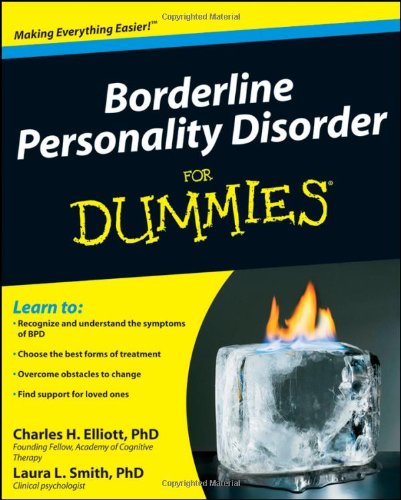 | Paperback: 384
Pages
(2009-07-27)
list price: US$19.99 -- used & new: US$10.48 (price subject to change: see help) Asin: 0470466537 Average Customer Review: 
Canada | United Kingdom | Germany | France | Japan |
|
Editorial Review Product Description Your clear, compassionate guide to managing BPD — and living well Looking for straightforward information on Borderline Personality Disorder? This easy-to-understand guide helps those who have BPD develop strategies for breaking the destructive cycle. This book also aids loved ones in accepting the disorder and offering support. Inside you'll find authoritative details on the causes of BPD and proven treatments, as well as advice on working with therapists, managing symptoms, and enjoying a full life. Review the basics of BPD — discover the symptoms of BPD and the related emotional problems, as well as the cultural, biological, and psychological causes of the disease Understand what goes wrong — explore impulsivity, emotional dysregulation, identity problems, relationship conflicts, black-and-white thinking, and difficulties in perception; and identify the areas where you may need help Make the choice to change — find the right care provider, overcome common obstacles to change, set realistic goals, and improve your physical and emotional state Evaluate treatments for BPD — learn about the current treatments that really work and develop a plan for addressing the core symptoms of BPD If someone you love has BPD — see how to identify triggers, handle emotional upheavals, set clear boundaries, and encourage your loved one to seek therapy Open the book and find: The major characteristics of BPD Who gets BPD — and why Recent treatment advances Illuminating case studies Strategies for calming emotions and staying in control A discussion of medication options Ways to stay healthy during treatment Tips for explaining BPD to others Help for parents whose child exhibits symptoms Treatment options that work and those you should avoid Customer Reviews (8)
| |
| 23. Toward a Psychology of Being, 3rd Edition by Abraham H. Maslow | |
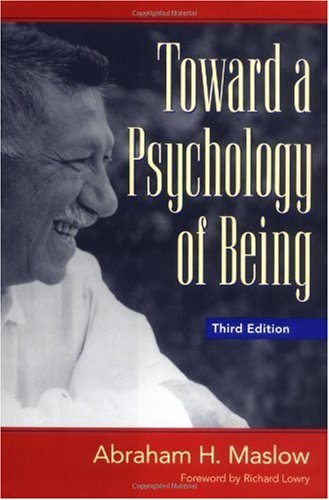 | Hardcover: 320
Pages
(1998-11-09)
list price: US$80.00 -- used & new: US$55.31 (price subject to change: see help) Asin: 0471293091 Average Customer Review: 
Canada | United Kingdom | Germany | France | Japan |
|
Editorial Review Product Description Abraham Maslow's theories of self-actualization and the hierarchy of human needs are the cornerstone of modern humanistic psychology, and no book so well epitomizes those ideas as his classic Toward a Psychology of Being. A profound book, an exciting book, its influence continues to spread, more than a quarter century after its author's death, beyond psychology and throughout the humanities, social theory, and business management theory. Of course, the book's enduring popularity stems from the important questions it raises and the answers it provides concerning what is fundamental to human nature and psychological well-being, and what is needed to promote, maintain, and restore mental and emotional well-being. But its success also has to do with Maslow's unique ability to convey difficult philosophical concepts with passion, precision, and astonishing clarity, and, through the power of his words, to ignite in readers a sense of creative joy and wholeness toward which we, as beings capable of self-actualization, strive. This Third Edition makes Abraham Maslow's ideas accessible to a new generation of psychology students, as well as businesspeople, managers, and trainers interested in applying the study of human behavior to management techniques. An energetic and articulate scholar, Professor Maslow was the author of more than twenty books, including Eupsychian Management; Psychology of Science; Religions, Values, and Peak Experiences; Motivation and Personality; and Principles of Abnormal Psychology (with B. Mittelmann). He also edited New Knowledge in Human Values and wrote nearly one hundred articles. His teachings continue to be a staple for psychologists and psychology students. "Capacities clamor to be used, and cease their clamor only when they are well used. . . . Not only is it fun to use our capacities, but it is necessary for growth. The unused skill or capacity or organ can become a disease center or else atrophy or disappear, thus diminishing the person." —Abraham Maslow Toward a Psychology of Being, Third Edition Abraham Maslow doesn't pretend to have easy answers, absolutes, or solutions that bring the relief of finality—but he does have a deep belief in people. In this Third Edition of Toward a Psychology of Being (the original edition sold well over 100,000 copies), there is a constant optimistic thrust toward a future based on the intrinsic values of humanity. Professor Maslow states that, "This inner nature, as much as we know of it so far, seems not to be intrinsically evil, but rather either neutral or positively 'good.' What we call evil behavior appears most often to be a secondary reaction to frustration of this intrinsic nature." He demonstrates that human beings can be loving, noble, and creative, and are capable of pursuing the highest values and aspirations. This Third Edition will bring Professor Maslow's ideas to a whole new generation of business and psychology readers, as well as anyone interested in the study of human behavior. Customer Reviews (10)
I believe we have to take these factors into account when discussing the merits of a book.This price is really out of hand. ... Read more | |
| 24. Handbook of Personality Psychology | |
 | Paperback: 987
Pages
(1997-06-02)
list price: US$165.00 -- used & new: US$228.98 (price subject to change: see help) Asin: 0121346463 Average Customer Review: 
Canada | United Kingdom | Germany | France | Japan |
|
Editorial Review Product Description Customer Reviews (2)
| |
| 25. The Transformed Self: The Psychology of Religious Conversion (Emotions, Personality, and Psychotherapy) by Chana Ullman | |
 | Hardcover: 252
Pages
(1989-06-30)
list price: US$134.00 -- used & new: US$106.39 (price subject to change: see help) Asin: 0306431343 Canada | United Kingdom | Germany | France | Japan |
| 26. Personality: Classic Theories and Modern Research (4th Edition) by Howard S. Friedman, Miriam W. Schustack | |
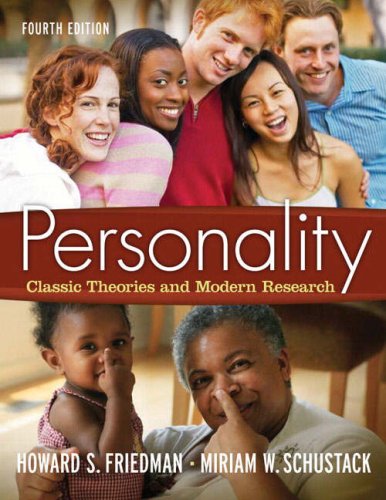 | Hardcover: 592
Pages
(2008-10-09)
list price: US$137.27 -- used & new: US$74.95 (price subject to change: see help) Asin: 020557968X Average Customer Review: 
Canada | United Kingdom | Germany | France | Japan |
|
Editorial Review Product Description This successful text puts “personality” back into the personality course, integrating the classic insights of the personality theorists with modern research in a manner that will fascinate and encourage deeper thought. This text explores classic theory from a perspective that encourages critical thinking and fosters intellectual insight with respect to human nature. For example, it shows the relevance of classic theory to topics of personality and culture, evolution, ego, gender, and person-situation interactionism. Employing the highest scientific standards, Personality also uses a wide range of unique and provocative pedagogical devices that have been shown to motivate students. Hailed as the best-written, most relevant personality textbook on the market, Friedman and Schustack's fourth edition brings the field of personality to today's diverse student body. Customer Reviews (14)
| |
| 27. Research Methods in Personality and Social Psychology (The Review of Personality and Social Psychology) (v. 11) by Clyde A. Hendrick, Margaret S. Clark | |
| Paperback: 352
Pages
(1990-01-01)
list price: US$26.00 -- used & new: US$292.98 (price subject to change: see help) Asin: 0803936494 Canada | United Kingdom | Germany | France | Japan | |
|
Editorial Review Product Description In Research Methods in Personality and Social Psychology contributors describe key research techniques and strategies (such as design of an interaction laboratory, psychophysiological methods and use of reaction time as a measure), present various research designs (meta-analysis, covariance structure modelling and dyadic research) and address the classic distinction between idiographic and nomothetic approaches to research. | |
| 28. Homeopathic Psychology: Personality Profiles of the Major Constitutional Remedies by Philip Bailey | |
 | Paperback: 440
Pages
(1995-11-30)
list price: US$25.00 -- used & new: US$15.19 (price subject to change: see help) Asin: 155643099X Average Customer Review:
Canada | United Kingdom | Germany | France | Japan |
|
Editorial Review Product Description Customer Reviews (18)
| |
| 29. Personality by Jerry M. Burger | |
 | Hardcover: 544
Pages
(2010-03-08)
list price: US$178.95 -- used & new: US$116.99 (price subject to change: see help) Asin: 0495813966 Average Customer Review:
Canada | United Kingdom | Germany | France | Japan |
|
Editorial Review Product Description Customer Reviews (8)
| |
| 30. Faith And Psychology: Personality, Religion And the Individual (Exploring Faith S.) by Leslie J. Francis | |
 | Paperback: 160
Pages
(2005-06-30)
list price: US$12.00 -- used & new: US$12.00 (price subject to change: see help) Asin: 0232525447 Canada | United Kingdom | Germany | France | Japan |
| 31. Oxford Handbook of Personality Assessment (Oxford Library of Psychology) | |
 | Hardcover: 768
Pages
(2009-07-14)
list price: US$175.00 -- used & new: US$136.50 (price subject to change: see help) Asin: 0195366875 Canada | United Kingdom | Germany | France | Japan |
|
Editorial Review Product Description | |
| 32. Handbook of Child Psychology, Vol. 3: Social, Emotional, and Personality Development, 6th Edition (Volume 3) | |
 | Hardcover: 1152
Pages
(2006-03-31)
list price: US$235.00 -- used & new: US$100.95 (price subject to change: see help) Asin: 0471272906 Canada | United Kingdom | Germany | France | Japan |
|
Editorial Review Product Description Volume 3: Social, Emotional, and Personality Development, edited by Nancy Eisenberg, Arizona State University, covers mechanisms of socialization and personality development, including parent/child relationships, peer relationships, emotional development, gender role acquisition, pro-social and anti-social development, motivation, achievement, social cognition, and moral reasoning, plus a new chapter on adolescent development. | |
| 33. Personality Types: Jung's Model of Typology (Studies in Jungian Psychology By Jungian Analysts) by Daryl Sharp | |
 | Paperback: 128
Pages
(1987-11)
list price: US$25.00 -- used & new: US$13.85 (price subject to change: see help) Asin: 0919123309 Average Customer Review:
Canada | United Kingdom | Germany | France | Japan |
Customer Reviews (3)
| |
| 34. Perspectives on Personality (6th Edition) by Charles S. Carver, Michael F. Scheier | |
 | Hardcover: 560
Pages
(2007-06-25)
list price: US$144.20 -- used & new: US$91.99 (price subject to change: see help) Asin: 0205522629 Average Customer Review:
Canada | United Kingdom | Germany | France | Japan |
|
Editorial Review Product Description The various perspectives of the field of personality provide the organizing framework for this text. Each perspective is presented in two chapters and is introduced by a prologue that describes the assumptions and themes of the perspective. Customer Reviews (6)
| |
| 35. A History of Personality Psychology: Theory, Science, and Research from Hellenism to the Twenty-First Century by Frank Dumont | |
 | Hardcover: 574
Pages
(2010-03-31)
list price: US$120.00 -- used & new: US$77.99 (price subject to change: see help) Asin: 0521116325 Canada | United Kingdom | Germany | France | Japan |
|
Editorial Review Product Description | |
| 36. The Essential Family Guide to Borderline Personality Disorder: New Tools and Techniques to Stop Walking on Eggshells by Randi Kreger | |
 | Paperback: 250
Pages
(2008-10-15)
list price: US$14.95 -- used & new: US$8.90 (price subject to change: see help) Asin: 1592853633 Average Customer Review:
Canada | United Kingdom | Germany | France | Japan |
|
Editorial Review Product Description For family members of people with borderline personality disorder (BPD), home life is routinely unpredictable and frequently unbearable. Extreme mood swings, impulsive behaviors, and suicidal tendencies—common conduct among those who suffer from the disorder—leave family members feeling confused, hurt, and helpless. In her pioneering first book Stop Walking on Eggshells, co-authored with Paul T. Mason, Randi Kreger outlined the fundamental differences in the way that people with borderline personality disorder (BPD) relate to the world. Now, with The Essential Family Guide to Borderline Personality Disorder, she takes readers to the next level, giving them straightforward tools to get off the emotional roller coaster and repair relationships with loved ones with BPD. Kreger answers the questions family members most want to ask about: the symptoms and treatment of BPD, including why BPD is so misdiagnosed; how symptoms can differ by age and gender; and how addiction and other disorders complicate BPD. She then outlines how families can set boundaries and communicate differently in order to help themselves and their loved ones cope with this bewildering form of mental illness. Customer Reviews (21)
| |
| 37. Who Am I, Really?: Personality, Soul and Individuation (Studies in Jungian Psychology By Jungian Analysts) by Daryl Sharp | |
 | Paperback: 144
Pages
(1994-12)
list price: US$25.00 -- used & new: US$15.00 (price subject to change: see help) Asin: 0919123686 Canada | United Kingdom | Germany | France | Japan |
| 38. The foundations of personality by Abraham Myerson | |
 | Paperback: 420
Pages
(2010-08-01)
list price: US$34.75 -- used & new: US$23.61 (price subject to change: see help) Asin: 1176622714 Canada | United Kingdom | Germany | France | Japan |
|
Editorial Review Product Description | |
| 39. Personality Assessment in Police Psychology: A 21st Century Perspective | |
 | Paperback: 384
Pages
(2010-06-14)
list price: US$55.95 -- used & new: US$55.95 (price subject to change: see help) Asin: 0398079153 Canada | United Kingdom | Germany | France | Japan |
| 40. The Psychology of Ultimate Concerns: Motivation and Spirituality in Personality by Robert A. Emmons PhD | |
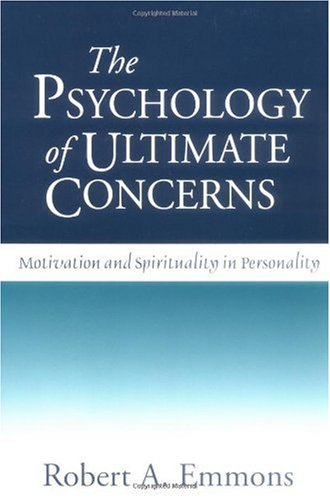 | Paperback: 230
Pages
(2003-07-16)
list price: US$30.00 -- used & new: US$20.00 (price subject to change: see help) Asin: 1572309350 Canada | United Kingdom | Germany | France | Japan |
|
Editorial Review Product Description | |
| Back | 21-40 of 100 | Next 20 |
 Good Info, Bad Advice
 Purchased Book Review
 HORRID. Even my professor hates this textbook.