e99 Online Shopping Mall

Geometry.Net - the online learning center Help  
Home  - Psychology - Psychology And Religion (Books)

  1-20 of 100 | Next 20

click price to see details     click image to enlarge     click link to go to the store

$58.66
1. The Psychology of Religion, Third
$31.00
2. The Psychology of Religion and
$55.00
3. Handbook of the Psychology of
$11.26
4. Psychology As Religion: The Cult
$34.95
5. Psychology and Religion : An Introduction
$67.48
6. Psychology of Religion: Classic
 
$8.65
7. Psychology and Religion (The Terry
$49.00
8. Invitation to the Psychology of
$17.95
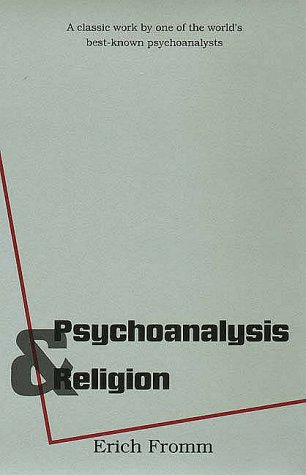
9. Psychology and Religion: Eight
$28.64
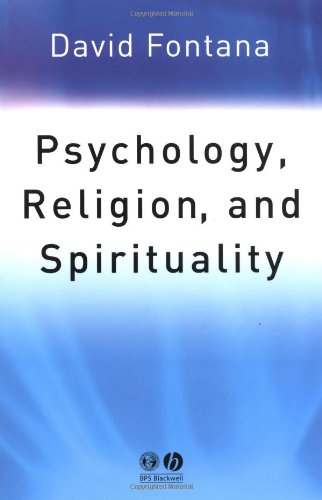
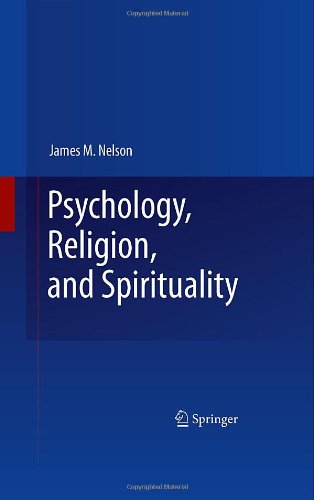
10. Psychology, Religion and Spirituality
$39.99
11. The Psychology of Religion: Empirical
$5.67
12. Integration of Psychology and
 
13. Psychology of Religion
 
$32.60
14. Religion and the Clinical Practice
$33.75
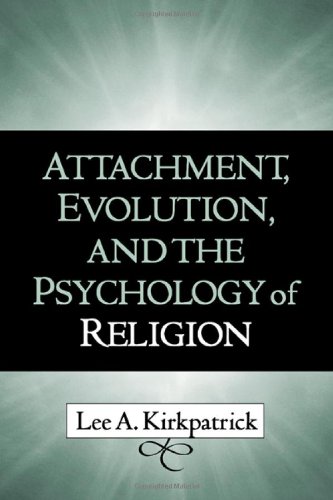
15. Attachment, Evolution, and the
$4.15
16. Psychology and Western Religion:
 
17. Insearch Psychology and Religion
 
18. Psychology Of Religion
$24.45
19. C.G. Jung's Psychology of Religion
$34.85
20. Psychology and Religion: Classical

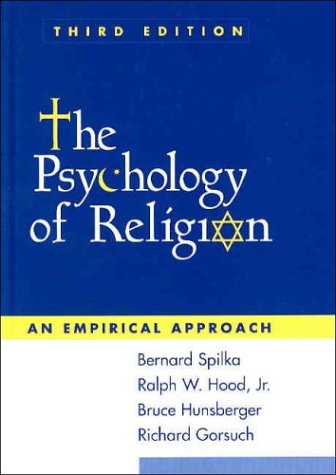
1. The Psychology of Religion, Third Edition: An Empirical Approach
by Bernard Spilka, Jr., Ralph W. Hood, Bruce Hunsberger, Richard Gorsuch
Hardcover: 671 Pages (2003-08-06)
list price: US$79.00 -- used & new: US$58.66
(price subject to change: see help)
Asin: 1572309016
Average Customer Review: 5.0 out of 5 stars
Canada | United Kingdom | Germany | France | Japan
Editorial Review

Book Description

Now in a fully revised and expanded third edition, this landmark text provides comprehensive, up-to-date coverage of an increasingly rich and varied field. The authors synthesize classic and contemporary research on religious thought, belief, and behavior across the lifespan; the forms and meaning of religious experience; the social psychology of religious organizations; and connections to biology, morality, coping, and mental health. As in previous editions, the focus is on scientific work that is moving the psychology of religion into the mainstream of academic psychology, rather than broad interpretative and conceptual discussions. Organized for optimal use in advanced undergraduate- or graduate-level courses, every chapter features thought-provoking quotations, sidebars, and examples that bring key concepts to life.

New in the Third Edition
*Restructured and expanded to accommodate the rapidly growing literature
*Fully updated with the latest findings and interpretations
*New chapter on religion and biology
*New chapter on empirical foundations
*Coverage of such timely topics as religious extremism and clerical child abuse
... Read more

Customer Reviews (3)

5-0 out of 5 stars It's A *Must* For Serious Researchers!!
First of all, I consider this book a "Must", in every theologian's, psychologist's, sociologist's, or researcher's in humanities book collection. It's got tons of information on various subjects, by dozens of researchers on the field, of the past and the present. It's referring to a lot of empirical research, with tables as accompanying features. It's good for the beginning and seasoned researcher, as well.

The only drawbacks, I've seen, are the minor mispellings and syntax errors, which sometimes (when you're trying to figure out what's the meaning of a theory, or to find the correct reference article at the back of the book) get annoying. But that's all in the "game"! Besides, we should all read the "original text", if we wish to understand something correctly! ;D

5-0 out of 5 stars EMPIRICAL ALRIGHT!
Wow jeez dam - this is a college student coming out of a PSY Religions class (undergraduate thank you very much!!). This is definately an empirical approach. Studies, references, surveys gALORE! This is really great when studying religion, which can be so ...wishy-washy I'll say. I agree with the other commentor -the references are quite valuable when studying in this area, and a lot of other studies as well. Spilka et. al. do a wonderful job of succinctly speaking on what seems to be nearly every highly desired topic in the subject, and more. WELL DONE SPILKA AND those-of-you-who-don't-get-your-name-in-the-reference-and-have-to-settle-with-ET-AL...YA ET ALS!!!!

5-0 out of 5 stars no serious student of the topic should be without this book
This book is _the_ reference on the topic of the psychology of religion.The reference section itself is worth the price of the book!As a text, it would be more appropriate to a graduate level than an undergraduate level class, but then few schools offer a class on the subject at all.However, anyone interested in pursuing this topic would do well to have a copy of this book on their shelf, preferably within reach at all times. ... Read more


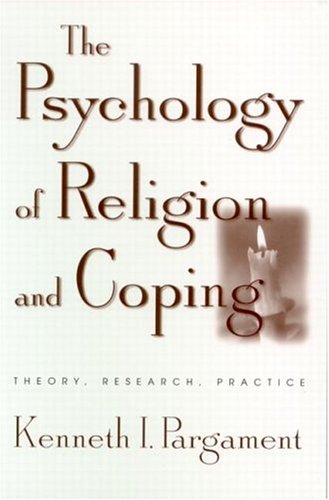
2. The Psychology of Religion and Coping: Theory, Research, Practice
by Kenneth I. Pargament
Paperback: 548 Pages (2001-02-15)
list price: US$36.00 -- used & new: US$31.00
(price subject to change: see help)
Asin: 1572306645
Average Customer Review: 5.0 out of 5 stars
Canada | United Kingdom | Germany | France | Japan
Editorial Review

Book Description

When faced with a crisis, why do some people turn to religion to help them cope, while others turn away? Is religious belief merely a defense or a form of denial? Is spirituality a help or a hindrance in times of stress? Building a much-needed bridge between two different worlds of thought and practice--religion and psychology--this volume sensitively interweaves theory with first-hand accounts, clinical insight, and scientific research.The book underscores the need for greater sensitivity to religion and spirituality in the context of helping relationships, and suggests a range of ways that faith might be used more fully to help people in crisis.
... Read more

Customer Reviews (3)

5-0 out of 5 stars indispensible
A serious scholar of psychology and religion should have this book prominently displayed on the bookshelf, particularly those with a clinical bent.In fact, a good clinical psychologist would benefit from this one too, as often patients turn to religion in their attemtpts to cope, yet clinicians receive little to no training on the subject of religion.

5-0 out of 5 stars Extremely important research!
This was a key reference book when I wrote "Spiritual Health Psychology" (ISBN: 0966841735).Dr. Pargament has helped to establish the scientific link between the endorsement of religious beliefs andbehaviors and a healthier lifestyle.Must reading for any therapist and/orscientist who wants to fully understand the link between religion andhealth.

5-0 out of 5 stars An excellent integration of religion and psychology
Pargament provides an excellent summary of the clinical, research, and theological lierature on religion as it relates to coping and well-being. he also develops a useful,jargon-free framework for integrating psychology and religion. This book will be of interest to mental health clinicians, researchers in the field, as well as members of the lay public. ... Read more


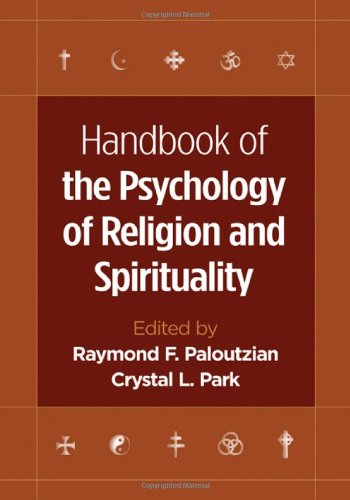
3. Handbook of the Psychology of Religion and Spirituality
Hardcover: 590 Pages (2005-08-24)
list price: US$79.00 -- used & new: US$55.00
(price subject to change: see help)
Asin: 1572309229
Average Customer Review: 5.0 out of 5 stars
Canada | United Kingdom | Germany | France | Japan
Editorial Review

Book Description

From foremost authorities in the field, this comprehensive volume synthesizes the breadth of current knowledge on the psychological processes underlying spirituality, religious behavior, and religious experience. Presented are cutting-edge theories, conceptual frameworks, methodologies, and empirical findings emerging from all psychological subdisciplines. Coverage includes the neural and cognitive bases of religiousness; social, personality, and developmental issues; religion as a meaning system; and implications for behavior, mental health, and clinical practice. Seamlessly edited, the Handbook provides a definitive portrait of the current state of the science, fosters the development of integrative theory, and identifies vital directions for future research.
... Read more

Customer Reviews (2)

5-0 out of 5 stars Essential reading to separate fiction from fact
The research in this book essential for understanding the complexity of religious beliefs and practices. For years, I have objected to the ways that many fine authors have portrayed religious activity in America; if writers like Dawkins, Harris, and others had accessed this book, they might find that not only are most religious practices benign, but they would also discover that America is far more secular than many people suspect. For example, in the child development chapters, I discovered that teens are far more skeptical of their parent's religion than I would have thought. I was also intrigued to discover that some young children, even when raised in anti-religious families, still maintained their belief in God. There are even some independent youngsters who will stand by their belief in the reality of the Easter Bunny, even when presented with evidence to the contrary!

The chapters on fundamentalism are particularly important because the researchers detail how authoritarian ideologies govern small communities of people.This raises the question: is religion the culprit when violence erupts, or authoritarianism (a socio-political ideology that lies at the root of genocidal acts of hatred)?

If you want to speak knowledgeably about the religious landscape of America, this is the book you must own. Don't trust public-opinion polls; they only show you 10% of the picture.

5-0 out of 5 stars Finest Review of Research of These Subjects in 20 Years
Paloutzian and Park have gathered an excellent group of scholars to make contributions to this book. The articles in the field review the research conducted in this field from before Starbuck (1899) and James (1902) to 2004. Each article not only reviews the literature but makes major contributions to the issue it discusses such as Paloutzian's article on conversion and Alemeyer and Hunsberger on fundamentalism and authoritarian.
Many of the articles have practical applications for both secular and religious counselors. Oman and Thoresen article on spiritual and health strongly suggests that these two issues are deeply related. I strongly recommend any one conduction research on the psychology needs to own this important work. ... Read more


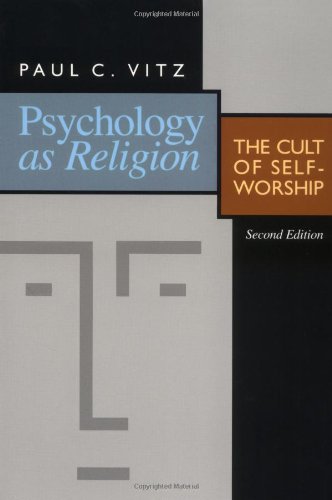
4. Psychology As Religion: The Cult of Self-Worship
by Paul C. Vitz
Paperback: 173 Pages (1994-05)
list price: US$18.00 -- used & new: US$11.26
(price subject to change: see help)
Asin: 0802807259
Average Customer Review: 3.5 out of 5 stars
Canada | United Kingdom | Germany | France | Japan

Customer Reviews (7)

1-0 out of 5 stars Same Vitz, different day
In the mid 60s I had Paul Vitz as a psychology prof for three semesters at NYU. In those days he was a flag-waving atheist and Skinnerian behaviorist. If any students might challenge him on that, he would not only use his position at the podium to make a scathing spectacle of them in front of the whole class, but also to issue veiled threats that they could flunk the course if they persisted. Now he promotes Catholicism with comparable bile. Same Vitz, different fundamentalism.

4-0 out of 5 stars Religion or science?
Reviewer Helms misses the point, it seems to me. Dr. Vitz correctly identifies psychology as social science as no science at all, but a belief system. (Vitz clearly distinguishes experimental and social psychology and exempts the scientificexperimental type from his critique).
The Christian model of man as a creature fallen from his relationship with his creator into a pit of self offers a solution: reunion. The humanist's solution to man's unhappiness is a stronger self, or a self submitting itself with other selves to a greater self (the state, etc.). The Christian ideal, if followed, leads to peace. The humanist's leads to conflict ("will to power", one self or state vs another self or state).
For all the talk of the damage done in the name of religion, the mishief has come not from religion of man submitting him-self tohis creator and its rules, but from the arrogance of self-righteousness. The isms of the 20th Century had nothing to do with religion involving God. 200 million people were killed in the struggle for humanist utopias. The religion of self and the ideologies it spawns (Dostoevsky: socialism is a Tower of Babel without God, e.g.) had its chance and failed miserably.
Science is simply a search for truth through observation and when done honestly is self-correcting. Religion is a faith-based search for truth. If psychology continues believing in the value of self- confidence, esteem, assurance, worth, help, realization, actualization, determination, sufficiency, etc., in spite of observable evidence of the anti-human results of their promotion, is it sclence or a belief system? Dr. Vitz's book does an excellent job showing us that distinction.

5-0 out of 5 stars Very good book for genuine & intellectual persons
"Psychology As Religion: The Cult of Self-Worship"

A very good book to read. Would be best read by those with (minimum) high school intelectual background. The book covers more on the misleading 'sef-centred/help' psychology which are very prevalent nowadays, along with it's potential negative/destructive effect to the society as a whole.

Since before 1980, in the book, the writer proposed some social & moral [degeneration] model/scheme which would be expected to happening in modern society beyond 2000 due to the 'Selfist Psychology'. Most of the scientific predictions made there are coming into existence today, along with its negative effects.

Best Regards:
Michael

1-0 out of 5 stars Just More Desperate Science Bashing By the Religious Right..
I don't know where to begin deconstructing this idiotic book.Although the author certainly did his homework, detailing the history of Psychology with great accuracy, its entire premise is without merit.The oldest enemies of Science have always been Christians, and this book is just another attempt to reconcile the superstitious beliefs of Christianity with the FACTS Christians are presented with every day which refute their beliefs.And PLEASE don't start with that tired old argument of "Psychology is just a bunch of theories."From the heliocentric solar system, to gravity, to the origins of life on our planet, to the Big Bang, EVERYTHING is just theory...but we still have electricity, internal combustion engines, medicine, and countless other scientific marvels that make our lives incalculably more enjoyable and fruitful than they would be if we simply followed the Bible's explanations.Vitz is simply adding Psychology to Christianity's long list of the persecuted (Copurnicus, Galelio, Blacks, Gays, Women, etc., etc.)

Religion/Science battles aside, the whole idea of Psychology being a religion is preposterous.Religion is a philosophy based upon blind acceptance, not facts.Psychology is a SCIENCE, a totally different philosophy which requires tentative acceptance of the simplest correct explanation for an event based upon observation, AND willingness to accept new explanations when evidence suggests we are wrong.Religions are designed to be static, and their followers never admit to having "changed the rules," even though they often do so to fit their own needs as people become less and less naieve (read as "more and more educated").

In short, this book is ridiculous propaganda from a Right-Wing Conservative Christian who has written numerous books in an attempt to fend off the ensuing doom of his own superstitious beliefs.It's a "if you can't beat 'em, bash 'em" mentality that drives this author, and anyone with even a cursory understanding of Psychology will resist the temptation to buy this waste of paper.

4-0 out of 5 stars What religion will we teach in public schools?
Paul Vitz attempts to expose psychology for what it really is, i.e., religion.He begins by giving the reader a brief biography on the fathers of the modern psychology movement along with some of their theories.The opening chapter was dry reading but I suppose necessary as a historical backdrop.My interest peaked when I immediately recognized Carl Rogers and Abraham Maslow since I was forced to study them for 26 years while in the military.Vitz also discusses Carl Jung, Erich Fromn, and Rollo May as being significant contributors to the movement.
Vitz quickly transitions into explaining the concept of self-esteem which he promotes as the center of the entire selfism movement.This became important to me as it seems no matter where you turn, a lack of or poor self-esteem appears to be the cause of every ill known to mankind.For a movement to be so widespread to the point where psychology has been woven into the gospel message, Vitz says that the self-esteem concept has "no clear intellectual origins."That's a surprising claim considering the impact selfism has had on academia and the practice of counseling.
Vitz states that self-esteem should be understood as an emotional response and not a cause.He says it is a reaction to what we have done and what others have done to us.High self-esteem is a desirable feeling to have (like happiness), but the feeling itself isn't the cause of anything.In trying to obtain a feeling of self-esteem, the only successful way is to do good to others or accomplish something.In so doing, you'll get all the self-esteem you want.However, the downside is people begin to pursue happiness as a far greater goal than the goal of obtaining personal holiness.
Not only is selfism a self-defeating goal for the Christian, Vitz goes on to make the case that it is also simply bad science and a warped philosophy.The little clinical evidence that does exist is mostly based on empirical observations and doesn't stand the test of solid scientific problem solving.He exposes flaws in each step of the process, from stating the problem, forming and testing the hypothesis, to testing the conclusion.He also identifies several philosophical contradictions and in some cases, actual misrepresentations.The spread of this bad science and faulty philosophy is believed by the author to have contributed to the destruction of families.Additionally, the entire recovery group mentality convinces the person with "low self-esteem" that their ills are due to trauma inflicted on them in the past.Recovery group therapy strokes the patient with self-pity thereby convincing the clients are victims.Once labeled, the "victim" now assumes the attitude of victimhood.
Values clarification has become the model taught in schools and begins with the assumption that man is naturally good.Since the developers of values clarification reject moral teachings, Vitz claims that if responsible adults, i.e., teachers, don't promote good values then someone else will.Providing a permissive environment supposedly nourishes the child by granting satisfaction for the child's desires and interests.However, this philosophy is bankrupt because kids will assume the values of irresponsible sources in lieu of responsible ones.This combined with the aforementioned teachings has produced a society of victims where everyone is pointing to blame someone else for their misfortunes.
Vitz takes three chapters to present a Christian analysis and criticism of humanistic self-theories.He gives the credit to our educational system for the transformation of our society into a culture of pure selfism.He notes that the New Age movement has many founders, but Abraham Maslow's theories have been the most influential.Vitz argues his Christian critique within a historical framework and the impact it has had on the evolution of our society.Unfortunately he gives scant attention to biblical references for his position, but does show how the selfism heresy affects teachings on depression, idolatry, and suffering.He closes his work with the observation, "never have so many people been so self-conscious, so aware of the self as something to be expressed...., the self has become an object to itself."(I think this may make the case that self-esteem has become a new barometric indicator to the question everyone asks, "How are you doing today?")
Overall, Vitz's book uses a cerebral approach in attempting to prove that self-worship is simply a religion.Biblical counselors looking for material to help their counselees break free of a selfish worldview of life will be disappointed.Then again, Vitz didn't write his book for that purpose.Moreover, he provides a wealth of information and a refreshing argument against those who say, "You can't teach religion in public schools." This leaves the reader with an irony: it's not a question of should we or should we not teach religion in public schools, but instead, what religion will we teach; selfism or Christianity? ... Read more


5. Psychology and Religion : An Introduction
by Michael Argyle
Paperback: 304 Pages (2000-02)
list price: US$34.95 -- used & new: US$34.95
(price subject to change: see help)
Asin: 0415189071
Average Customer Review: 4.5 out of 5 stars
Canada | United Kingdom | Germany | France | Japan
Editorial Review

Book Description
Should psychology try to explain religion or try to understand it? Pioneers in psychology like Sigmund Freud and William James took opposing views on the matter, and it has been a hotly debated issue ever since. While psychology has been used in the past to attack religion, recent psychological findings have been more sympathetic to matters of faith. How should we understand their relationship today?

In Psychology and Religion, Michael Argyle, one of the world's most famous experimental psychologists, provides a comprehensive and accessible survey of what psychologists know about religion--and what they don't. Offering fascinating and surprising insights into people and their religious worlds, Argyle examines the results of psychology's study of religion--including those of his own important experiments--and explores a wide range of topics such as: the importance of religion in the works of Freud, Jung and James; the proven effects of religion on the behavior of individuals and groups; how psychologists study religious activities like prayer, worship and ritual; and how psychologists have revealed the significance of change in religion, particularly in understanding the impact of new religious movements. ... Read more

Customer Reviews (2)

5-0 out of 5 stars Great Book!
This is an excellent introduction to the psychology of religion.The book is filled with amazing statistics about the people who populate various denominations.The author addresses religious experience, religious socialisation, the psychology of worship, ritual and prayer, effects of religion on human behavior, and the growth of religious movements, etc.This book is informative, but highly readable.I have no background in psychology and found the book to be enjoyble and accessible.As a Christian, I had no problems with the conclusions the author draws, and did not sense that the author was trying to"explain away" the psychological dimension of belief as another reviewer indicated.

4-0 out of 5 stars Great studies - bad introduction and conclusion
This book is a great tool for understanding why some people are religious and some not. It looks at things like socializaion, personality, benefits and costs of beliefs to mental health and happiness, and many more. The book is filled with statistics to back up the findings. Also included is much analysis of what portions of the population believe and what they believe in. All of the authors findings are not his alone but more a summary of what the study of the psychology of religion has come to find.

The bad part of this book is when the author tries to draw conclusions from the findings. He is constantly trying to be even-handed and never to say that the findings could ever be used to question the validity of religion. He even tries to give the views of those opposed to religion based on psychology and then show why they are wrong. When he does this, he give pathetic imcomplete explanations, uses terrible logic, and completely misrepresents these views he is trying to explain away. I recommend you read the book and skip the intro and conclusion. ... Read more


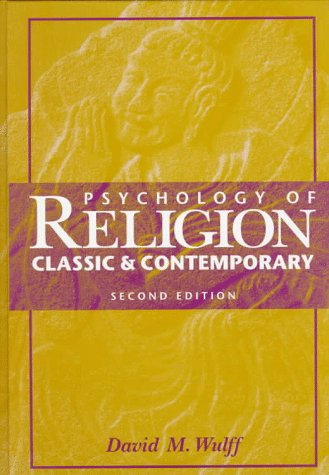
6. Psychology of Religion: Classic and Contemporary
by David H. Wulff
Hardcover: 784 Pages (1997)
list price: US$106.95 -- used & new: US$67.48
(price subject to change: see help)
Asin: 0471037060
Average Customer Review: 4.5 out of 5 stars
Canada | United Kingdom | Germany | France | Japan
Editorial Review

Book Description
An unbiased, comprehensive introduction to the psychology of religion. This book integrates clinical, theoretical, and empirical literature, as well as biographical information of the lives of significant psychologists and their works. It contains new research on meditation, the correlational study of religion, religion and mental health, object relations theory, pluralism and social constructionism. ... Read more

Customer Reviews (6)

5-0 out of 5 stars a nearly ideal introduction to the field
"Disguised as a textbook, this magnificent handbook encompasses the field in twelve chapters of forty to sixty pages. Exposition and insight flourish at every turn. Chapter 1 outlines history of the field; chapter 2 examines biological approaches to bodily states (G. Stanley Hall); chapter 3 presents behavioral theory and comparative studies of ritual behavior (in dogs and apes). Chapter 4 outlines laboratory experimentation, while chapter 5 probes statistical studies. Chapter 6 on Freud leads to chapter 7 on object-relations theory and narcissism (Suttie, Pruyser, Kohut) and thence to chapter 8 on Erikson. All are gems of synthesis and discernment. Chapter 9 on Jung and chapter 10 on James offer masterpieces of exposition and critique. Chapter 11 on the German descriptive tradition explores authors neglected in North America (Otto, Spranger, Girgensohn). Chapter 12 on the American humanisticsynthesis expounds Allport, Fromm and Maslow, as well as transpersonal psychology. Case studies from major religions (particularly Jewish, Christian, Buddhist and Hindu) dot the text. An epilogue assesses the field in light of both the humanities and the social sciences....Indexes of persons and concepts are superb.

"David Wulff has written the closest thing to a German-style handbook that North Americans are likely to see. Exhaustiveness, clarity in both organization and explication, and common sense combine to produce a nearly ideal introduction to the field. History of the discipline shines.... [The] bravura pieces on Freud, Erikson, Jung and James are among the best anyone has written on the masters. The same can be said of the chapter on "Object Relations Theory and Religion." Nearly every chapter climaxes with several pages of "Evaluation," in which the author weighs pros and cons. The style is lucid and nuanced but never boring. Until this volume appeared, few would have thought such a handbook to lie within the capacity of a single author. For a single scholar to synthesize literature of the past 125 years while exuding poise, common sense and uncommon insight exceeds all expectations. This work set a standard for handbooks in the social sciences....

"This masterpiece accomplishes something that cries out to be done for sociology of religion and anthropology of religion. Dispensing exposition, critique and hints for further research, Wulff makes the field accessible and attractive. Mastery resounds."

--comments on the first edition of this book, by William M. Johnston, Recent Reference Books in Religion: A Guide for Students, Scholars, Researchers, Buyers & Readers (rev. ed., 1998), pp. 275-276.

2-0 out of 5 stars May the Generic Transcendent save us
No help supposedly from science, especially not those "rational fundamentalists" who are "absolutizing the scientific method". Wulff says "the behaviorist paradigm has proven inadequate even for the prediction of the behavior of rats and pigeons". Yet behaviorists have worked with severely impaired autistic youths and enabled some to return to public school.

No help supposedly from religious fundamentalism: the "correlational studies" Wulff cites question the relative mental health of religious fundamentalists. Who created the correlation studies? And is it, after all, just a correlation, which could be due to many factors including favorable ones. For example, people who take responsibility may have more anxiety than those who slack off.

No help supposedly from atheism, other "correlational studies" Wulff cite (one with a whopping seven participants) indicate atheists often ended up that way after the loss or parent or an unhappy youth. Missed Sunday school maybe?

Instead seek out the mystics. They wil transcend this world. And in this time of crisis, it's up to psychologists of religion to "give the experience of transcendence the prominance it deserves".

I read the entire book (although much of it seems material a general reader in psychology may well have encountered elsewhere) but the epilogue seemed to make sense of Wulff's way of presenting the earlier survey. In the epilogue, Wulff presents a "summary schema" of 4 fundamental attitudes in the psychology of religion. Conveniently, 3 of them he's able to essentially dismiss due to their expressing literal and/or reductive views. The remaining view is the one conducive to sensitivity to others' transcendent experiences and also the one Wulff cites only positive "correlational study" results for.

Wulff's glossary definitions seem consistent with his evaluationsin the main text. Behaviorism is an "ideology". Evolutionism is just a "view", not a scientific theory. Creationism similarly is a "view", not a belief. This levelling may be a result of Wulff's application of postmodernism (which seems not to be applied to itself or to Wulff's special place for transcendence). Wulff favors Transcendence as "the crucial, ultimate dimension toward which all religious expression is directed...". At this point it may not be clear whether one is studying the psychology of religion or Wulff's religion within psycholgy. Is it important whether the Good Samaritan who saves a stranger had a transcendental experience? When that atheist or Fundamentalist or scientist reaches out a helping hand, you may want to take it.

It seems unlikely that those with vested interests about religion will stay away from working within the psychology of religion. The student of the psychology of religion will have to be especially on guard for bias. After all, how likely is it that anyone could be unbiased in this area?

5-0 out of 5 stars A thorough review of psychology of religion
This is a great resource for anyone looking for a thorough overview of the psychology of religion literature.Although it's a bit expensive (what textbook isn't these days?), it will pay dividends to both researchers beginning a review of the relevant research in this field and to the casual reader who's interested in the subject, but wants more than the typically trite, overly-simplistic pop-psychology they'll find in most large-chain book stores.

5-0 out of 5 stars This is the best book on the subject
I have looked at all the textbooks on psychology of religion because I teach the subject at the University of Redlands. This is by far the best textbook on the topic. The depth and scope of Wulff's writing is phenomenal. He takes a historical and biographical approach that is very intriguing. My students love the book too.

5-0 out of 5 stars Comprehensive yet Digestable
I picked up this book as an amateur both in psychology and in religion, but with a desire to learn more about both.It really hit the spot.It's comprehensive - covering eveything fromclassic Freudian analysis to the newest brain scan results - and at the same time totally digestable.It was nice to see Wulff extensively quoted in a recent Newsweek article about "neurotheology".I give it five stars for both form and content. ... Read more


7. Psychology and Religion (The Terry Lectures Series)
by Carl Gustav Jung
 Paperback: 138 Pages (1960-09-10)
list price: US$16.00 -- used & new: US$8.65
(price subject to change: see help)
Asin: 0300001371
Average Customer Review: 3.5 out of 5 stars
Canada | United Kingdom | Germany | France | Japan

Customer Reviews (3)

3-0 out of 5 stars Not great, but short
This one won't change the way you see religion, but if you're curious what Jung would say, it's somewhat worth the read.At least it's shorter than Man and His Symbols.

3-0 out of 5 stars Great book on the unconscious
The Psyche is a very important area he looks at in the whole book. I consider the whole book to be a theory on unraveling the unconscious. He argues for the existence of the psyche and he says, " the only form of existence we know of immediately is psychic." He continues that psychical dangers are much more dangerous than epidemics or earthquakes. While I accept with Jung that psychical dangers are dangerous, I believe he has overemphasized the role or place of the Psyche. This is vividly seen in the context of religion. Rather than religious faith being the deepest part of man, it is only a means aided by its symbols to understand the unconscious self.
Unlike Sigmund Freud who looks at religion as an illusion, Jung sees some usefulness in religion and holds that religion is not created by persons as escape valves but they are victims of religion. He sees religion as the collective unconscious that is present in every person's unconscious. The task of religion is to reveal what is in the unconscious and the psyche. This is the reason he validates the use of Christian symbols in uncovering the unconscious.
Jung describes archetypes as "forms or images of a collective nature which occur practically all over the earth as constituents of myths and at the same time as autochthonous, individual products of unconscious origin." Using his theory on archetypes to analyze some of his patient's dreams, he tries to return to the primordial remote times when these things existed. I find his theory on archetypes very problematic. My question is how these primordial things get into the psyche? Are these archetypes present at the time of birth of every child? His theory I believe will presuppose that if we all were helped to unravel the unconscious, we will think alike and behave alike since if we go back to a million or more years ago, we either were children of the same parents or evolved from one family of animals.
He sees in dream a means of unraveling the unconscious. Jung's book is helpful in understanding the psyche and the unconscious. It is however not helpful in understanding authentic religious experiences in people.

5-0 out of 5 stars A Jungian Theological Psychoanalytical must-have!!
This is an excellent work of both psychology and religion, hence the name. There have been other books by Jung that have narrower subjects or more challenging views but this one, takes my Jungian cake. It is so general butyet is exactly what one needs to study or just explore the extremelydifficult topic of Psych and Religion. A winner in my book. ... Read more


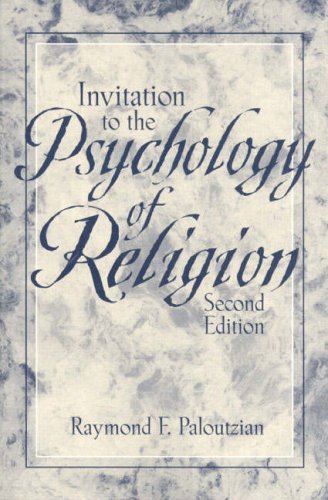
8. Invitation to the Psychology of Religion (2nd Edition)
by Raymond F. Paloutzian
Paperback: 400 Pages (1996-02-13)
list price: US$77.40 -- used & new: US$49.00
(price subject to change: see help)
Asin: 0205148409
Average Customer Review: 2.5 out of 5 stars
Canada | United Kingdom | Germany | France | Japan
Editorial Review

Book Description
This is the only newly revised book on themarket to target the mid-levelundergraduate student. Providing awell-balanced and thorough look at thepsychological literature, this book ismeant to be “an invitation to thepsychology of religion, not anencyclopedia of it,” and therefore,particular emphasis has been placed onwriting style as well as scholarship. ... Read more

Customer Reviews (2)

1-0 out of 5 stars Keep looking......Very boring!
This book was utilized in a psychology of religion class I just took and it is boring beyond belief.Much of the research that was used in the examples were questionable. (Sample sizes were too small and control of extraneous variables in some seemed non-existant).This field of psychology is very young and needs books that can present credible research in a way that can stimulate interest.This book constantly says more research is needed in this or that area, but does little to show that the field has any credibility to it.

4-0 out of 5 stars A smooth intro to the psychology of religion
The psychology of religion, unlike such well entrenched divisions in psychology as developmental or social psychology, is in its infancy. So much so that it is only beginning to establish itself in the institutions of higher learning.

Thus, one of Dr. Paloutzian's objective in writing this book is to encourage students to see the value of doing psychological studies in religion. Surveying the various research undertaken in the past and present, the author gives a summary of the accomplishments of the discipline as well as the areas in which further studies are needed.

Responding to the clamor for an introductory material to the psychology of religion, Paloutzian has written this readable overview of the field. Being introductory in nature the author does not give lengthy discussions of the theories and empirical studies he cites. His goal is not to expound on these but to whet the appetite of reader and then lead him to the pertinent authors and works. On the other hand in the first few chapters Paloutzian elucidates on the various methodologies employed in the psychology of religion, as well as defining what the psychology of religion is and is not.

For those interested in the psychological aspects of religion, or even for those simply curious to know what this seldom heard of area of study is, Paloutzian's work offers a smooth and enlightening entry into this most fascinating field. ... Read more


9. Psychology and Religion: Eight Points of View (Littlefield Adams Quality Paperbacks)
by Andrew R. Fuller
Paperback: 320 Pages (1994-01-25)
list price: US$28.95 -- used & new: US$17.95
(price subject to change: see help)
Asin: 0822630362
Average Customer Review: 4.0 out of 5 stars
Canada | United Kingdom | Germany | France | Japan
Editorial Review

Book Description
Presents theories of eight pioneers of religious psychology, including Freud, Jung, Skinner, and examines the limits of their psychological explanations of religion. ... Read more

Customer Reviews (1)

4-0 out of 5 stars A great introduction to the Psychology of religion
This is a watershed book by a great teacher and psychologist. See also- Insight Into Value

Christopher Hellstrom
Author of The March ... Read more


10. Psychology, Religion and Spirituality
by David Fontana
Paperback: 272 Pages (2003-06-09)
list price: US$37.95 -- used & new: US$28.64
(price subject to change: see help)
Asin: 1405108061
Canada | United Kingdom | Germany | France | Japan
Editorial Review

Book Description
At a time when religious fundamentalism is having a huge impact upon the world, this book helps us to understand how people acquire, conceptualise and practise religion at both personal and social levels. At a time when religious fundamentalism is having a huge impact upon the world, this book helps us to understand how people acquire, conceptualise and practise religion at both personal and social levels.


  • Explores religion both as a social phenomenon and as a form of inner experience.
  • Explains why people believe what they do.
  • Looks at the effects of religious and spiritual belief upon behaviour, and upon physical and psychological health.
  • Outlines the various approaches to religious and spiritual experience.
  • Surveys all relevant research.
... Read more

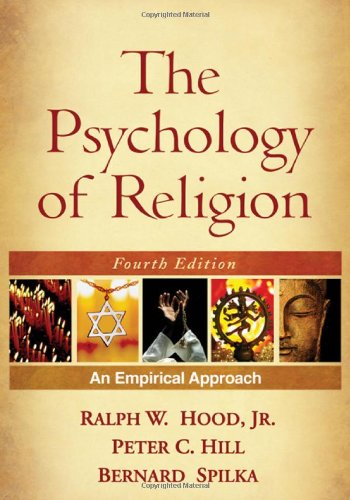
11. The Psychology of Religion: Empirical Approach, An: Second Edition
by Jr., Ralph W. Hood, Bernard Spilka, Bruce Hunsberger, Richard Gorsuch
Hardcover: 546 Pages (1996-08-02)
list price: US$65.00 -- used & new: US$39.99
(price subject to change: see help)
Asin: 1572301163
Average Customer Review: 5.0 out of 5 stars
Canada | United Kingdom | Germany | France | Japan
Editorial Review

Book Description

This volume presents the most comprehensive survey of the empirical literature on the psychology of religion available today. Like its predecessor, the second edition of The Psychology of Religion emphasizes scientific work that is moving the psychology of religion into the mainstream of academic psychology, rather than broad interpretive and conceptual discussions of religion. Ideally structured as a text, the volume's chapters each integrate findings according to the theory or theories that best illuminate them, allowing instructors the flexibility to assign any or all of the chapters according to the design of their courses. Completely revised and updated, this second edition incorporates data on the impact of family and schools into an expanded chapter on religious socialization, and also includes a new discussion of religion and coping. Throughout, the text is greatly enhanced by the wealth of empirical research that has been conducted during the past decade.
... Read more

Customer Reviews (3)

5-0 out of 5 stars Things Everyone Should Know!
Everyone should own this book. Many people make assumptions about religion, such as its effect on people's moral behavior for instance, without actually taking the time to find out if their assumptions are true. (As it turns out, level of religiousity including atheism is not a good predictor of whether or not someone will engage in helping behavior, or cheat on an exam, for instance.) Instead of repeating prejudices and inventing wild armchair theories, this book describes actual experiments and other research studies concerning a wide variety of topics concerning religion, in an objective, unbiased fashion. One interesting finding is that religious fundamentalists as a group are the most prejudiced toward all minority groups, while atheists are the least so. Is it the fault of religion? Not that simple! The authors explain that since the scores of mainstream Christians on measures of prejudice turn out to be much more similar to the atheists, and since fundamentalists also score very high on measures of authoritarianism, it's authoritarianism that leads to prejudice. However, these particular subtopics are just a tiny sliver of what this book actually covers.

5-0 out of 5 stars Entheogens: Professional Listing
"The Psychology of Religion" has been selected for listing in "Religion and Psychoactive Sacraments: An Entheogen Chrestomathy"http://www.csp.org/chrestomathy

5-0 out of 5 stars Entheogens: Professional Listing
"The Psychology of Religion" has been selected for listing in "Religion and Psychoactive Sacraments: An Entheogen Chrestomathy" http://www.csp.org/chrestomathy ... Read more


12. Integration of Psychology and Theology, The
by John D. Carter, S. Bruce Narramore
Paperback: 144 Pages (1979-11-11)
list price: US$16.99 -- used & new: US$5.67
(price subject to change: see help)
Asin: 0310303419
Average Customer Review: 5.0 out of 5 stars
Canada | United Kingdom | Germany | France | Japan
Editorial Review

Book Description
This volume of the Rosemead Psychology Series examines the relationship of psychology to theology and discusses whether they contradict each other or can be integrated with one another. It includes a reference listing, annotated bibliography, and index. ... Read more

Customer Reviews (1)

5-0 out of 5 stars Integration, a not so new concept!
This book is wonderfully written, and helped me to be able to understand an integration process for the scientific study of Psychology, while continuing to use the truth of God's Word.Before I read this, I was reluctant to even discuss many of the prinicples of Psychology--discounting them because I assumed that it was completely unrelated to the Bible.Carter and Narramore present the point that "All truth is God's truth".Since many of the psychological theories have been proven true about the ways in which the mind works, they can be taken into consideration like any other scientific principle.I would definitely recommend this book to anyone who is seeking to understand more about the ways in which these two areas of study do not need to be separated anymore. ... Read more


13. Psychology of Religion
by Mary Jo Meadow, Richard D. Kahoe
 Hardcover: 512 Pages (1984-01)
list price: US$28.95
Isbn: 0060444118
Canada | United Kingdom | Germany | France | Japan

14. Religion and the Clinical Practice of Psychology
 Hardcover: 617 Pages (1996-05)
list price: US$49.95 -- used & new: US$32.60
(price subject to change: see help)
Asin: 1557983216
Canada | United Kingdom | Germany | France | Japan
Editorial Review

Book Description
This book presents a comprehensive treatment of religion as a variable inmental health and psychological treatment. A collection of essays from the foremost authorities in the field, it examines the ways in which religionmay be addressed in clinical practice and offers a thorough appreciationof the history of the antagonism and overlap between the two perspectivesand of the psychological theory and empirical research that has beenengendered from Freud to the present. ... Read more


15. Attachment, Evolution, and the Psychology of Religion
by Lee A. Kirkpatrick
Hardcover: 400 Pages (2004-10-18)
list price: US$45.00 -- used & new: US$33.75
(price subject to change: see help)
Asin: 1593850883
Average Customer Review: 4.0 out of 5 stars
Canada | United Kingdom | Germany | France | Japan
Editorial Review

Book Description

In this provocative and engaging book, Lee Kirkpatrick establishes a broad, comprehensive framework for approaching the psychology of religion from an evolutionary perspective. Within this framework, attachment theory provides a powerful lens through which to reconceptualize diverse aspects of religious belief and behavior. Rejecting the notion that humans possess religion-specific instincts or adaptations, Kirkpatrick argues that religion instead emerges from numerous psychological mechanisms and systems that evolved for other functions. This integrative work will spark discussion, debate, and future research among anyone interested in the psychology of religion, attachment theory, and evolutionary psychology, as well as religious studies. It will also serve as a text in advanced undergraduate- and graduate-level courses.
... Read more

Customer Reviews (4)

4-0 out of 5 stars Very Interesting
Although I have read other theories with which I agree more (evolutionary theories elaborated upon by Atran and Boyer), the Attachment Theory perspective is a very interesting point of view on how people form and maintain relationships with supernatural beings. The book as a whole makes some pretty persuasive arguments for the Attachment Theory and does it with humor and facts combined. For a subject that has great potential to be dry and boring, Kirkpatrick leads the reader through the points in a very fluid and entertaining way. Again, I really enjoyed this book, both as a Psych major and as a Philosophy & Religion major.

5-0 out of 5 stars An eminently readable and balanced approach to the psychology of religion
I began reading this book in the library of the college where I teach psychology, and after finishing Kirpatrick's introduction I knew I had to purchase the book for myself.

Kirpatrick provides a rigorously scientific approach to the psychology of religion.Couching religious belief, or at least parts of our religious belief, in the context of attachment theory is both intuitively appealing and empirically supported.Wrapping the whole in the metatheoretical framework of evolutionary psychology is the final piece that puts everything together, and Kirkpatrick does just that, in an eminently readable way.

Certainly there is much more research to be done in this area before we can even begin to provide potential answers to all questions about religious belief, but Kirkpatrick does an excellent job summarizing the state of the research at present, and drawing reasonable--and interesting--interpretations.

Finally, I was impressed by the intellectually balanced approach Kirkpatrick provides.There is no hint of an agenda or an axe to grind; theist and atheist alike can read this book and learn from it without having their sensibilities offended.I thoroughly enjoyed this book, and I highly recommend it.

5-0 out of 5 stars an intelligent look at religion
Kirkpatrick has given us a scholarly, comprehensive and comprehendable discussion of an extremly important part of human experience.This work is well and carefully documented for the scholar and clearly written for the casual (but curious) reader.It's too bad Dennett didn't read this before he wrote "Breaking the Spell."He could have saved hinself a couple of years and sent us to read "Attachment, Evolution, and the Psychology of Religion."

2-0 out of 5 stars a marginal contribution, at best, to religious studies
My excitement upon purchasing this book did not last long.Kirkpatrick argues that a person's "attachment" style, shaped at an early age by his relationship with his primary caregiver, plays a role in his subsequent relationships with peers, lovers, spouses, and even God.I find the theory and evidence marshalled in support of this argument unpersuasive.

Suppose a mother is cold and avoidant in her relationship with her infant.According to Kirkpatrick, this environmental stimulus leads the infant to form an internal model of social interaction in which ALL agents are seen as cold and avoidant.Having learned not to trust or depend on others, the infant grows up to become a cold and avoidant himself.He doesn't hug his parents, he doesn't buy his wife flowers, he doesn't warm to the idea of a benevolent God.

I don't buy it.Some of the studies Kirkpatrick describes in support of his thesis are interesting, but most are so profoundly confounded with hereditary factors that they cannot possibly support the conclusions that Kirkpatrick forces upon them.The evidence from behavioral genetics shows that, typically, fifty percent of the variance in stable behavioral treats is caused by genetic variation in the population.Moreover, many behavioral geneticists now accept that NONE of the variance is attributable the environment that siblings in a household share (which assuredly includes parental childrearing style).With this data in hand, we see that the dogma of attachment theory dissolves.Yes, nurturant parents produce children who grow up to become nurturant adults.Yes, mean parents produce children who grow up to become mean adults.Yes, clingy parents produce children who grow up to become clingy adults.But this is all because children inherit the genes for these traits from their parents.Adopted children, who are objects of the same parental "attachment style" as the other children in their household, grow up to become as different from their adoptive siblings as can be.The theoretical arguments against attachment theory, based on evolutionary grounds, are also powerful; but in this case data suffices to cast it thoroughly in doubt.

What is left of Kirkpatrick's book?The last hundred pages are useful in overviewing the theory of religion as spandrel that has been developed in recent years, but they fail to redeem the whole.The same ground has been already covered by Pascal Boyer and Scott Atran in much greater detail.In any case, Kirkpatrick is not a particularly compelling writer.

Individual differences in religiosity is a gold mine waiting to be tapped, but Kirkpatrick's approach is a dead end in my view.Save your money and pass on this one.

Recommended instead:THE NURTURE ASSUMPTION by Judith Rich Harris, RELIGION EXPLAINED by Pascal Boyer, THE BLANK SLATE by Steven Pinker, IN GODS WE TRUST by Scott Atran ... Read more


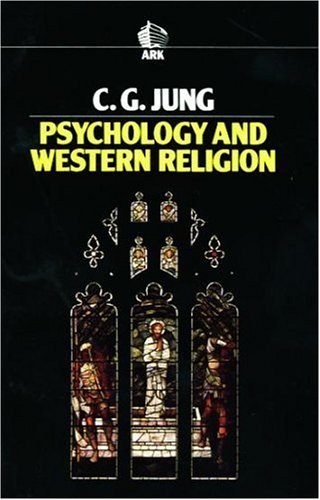
16. Psychology and Western Religion: (From Vols. 11, 18 Collected Works) (Jung Extracts)
by C. G. Jung
Paperback: 307 Pages (1984-12-01)
list price: US$23.95 -- used & new: US$4.15
(price subject to change: see help)
Asin: 0691018626
Average Customer Review: 5.0 out of 5 stars
Canada | United Kingdom | Germany | France | Japan
Editorial Review

Book Description

Extracted from Volumes 11 and 18. This selection of Jung's writings brings together a number of articles that are necessary for the understanding of his interpretation of the religious life and development of Western man: views that are central to his psychological thought.

... Read more

Customer Reviews (1)

5-0 out of 5 stars Jung on Christianity
The psychology of Carl Jung (1875-1961) is the system of psychology mostreceptive to the beneficial influence of religion in a person's life.Inthis selection of writings, mostly from Volume 11 of the Collected Works,Jung focuses on the strengths and limitations of western religion.ForJung, western religion is the organic unity of Church Christianity and its"shadows": Gnosticism and alchemy.Two thirds of the book consist of twolong essays, "A Psychological Approach to the Dogma of the Trinity" (1942)and "Transformation Symbolism in the Mass" (1942).In these essays, aswell as the shorter ones, Jung walks a fine line.His analysis couldscandalize a traditional (and otherwise unimaginative) Christian believer;at the same time, Jung's profound respect for the depth and wisdom ofChristianity stands in stark contrast to the flippant disregard someelements of the New Age movement pay it.For Jung, Christianity (with itsshadows) is an organic system that contains, though sometimes in obscureways, everything needed for psychology growth and individuation.Foranyone who was raised Christian but who now finds Christianityunaccountably unsatisfactory, this book could catalyze renewed spiritualexplorations in any one of number of directions. ... Read more


17. Insearch Psychology and Religion (Jungian Classic Series 2)
by James Hillman
 Paperback: Pages (1979)

Isbn: 0882145010
Canada | United Kingdom | Germany | France | Japan

18. Psychology Of Religion
by Johnson Paul E.
 Hardcover: Pages (1959)

Asin: B00106T5BS
Canada | United Kingdom | Germany | France | Japan

19. C.G. Jung's Psychology of Religion and Synchronicity (Suny Series in Transpersonal and Humanistic Psychology)
by Robert Aziz
Paperback: 280 Pages (1990-04)
list price: US$29.95 -- used & new: US$24.45
(price subject to change: see help)
Asin: 0791401677
Average Customer Review: 5.0 out of 5 stars
Canada | United Kingdom | Germany | France | Japan

Customer Reviews (1)

5-0 out of 5 stars Lucid, Approachable & Comprehensive Book on Synchronicity
I found this book comprehensive and readable in regards to Jung's theories on Synchronicity/Religion - and learned more
about Jung's general concepts of psychology (such as the unconscious and individuation) through this book than many other books I have read on Jung (or even books by Jung himself).

The scholarly presentation of the book by Aziz, who spent many years preparing the work I found outstanding.The introduction of fundamental concepts, leading into other Jungian theories, backed up by examples and other psychological real-world parallels is impressive in the book.

Overall, any serious student of the great psychologist Carl Jung or student of Synchronicity/Dreams I think should waste no time ordering this book! (heh)And even the casual layman who is curious about what Jung meant by "Synchronicity" - Aziz is emminently approachable because of his clear writing style.

This book perhaps may well be the most up-to-date scholarly work on Jung that appears solidly authentic, rational, and clear-headed on Jung's very serious approach to religion - synchronicity - and the "objective" autonomous unconscious.

... Read more


20. Psychology and Religion: Classical Theorists and Contemporary Developments
by Fuller Andrew
Paperback: 368 Pages (2007-12-28)
list price: US$34.95 -- used & new: US$34.85
(price subject to change: see help)
Asin: 0742560228
Canada | United Kingdom | Germany | France | Japan
Editorial Review

Book Description
This book surveys the major theoretical positions in the psychology of religion.William James, Sigmund Freud, Carl Jung, Gordon Allport, Abraham Maslow, Erich Fromm, Alan Watts, and Viktor Frankl are each accorded an entire chapter.A chapter is devote ... Read more


  1-20 of 100 | Next 20

Prices listed on this site are subject to change without notice.
Questions on ordering or shipping? click here for help.

site stats