e99 Online Shopping Mall

Geometry.Net - the online learning center Help  
Home  - Pure And Applied Math - Algebraic Geometry (Books)

  Back | 21-40 of 100 | Next 20

click price to see details     click image to enlarge     click link to go to the store

$118.65
21. Algebraic Geometry III: Complex
$50.89
22. Computational Methods in Commutative
 
23. Elementary Algebraic Geometry
$179.00
24. Real Algebraic Geometry (Ergebnisse
$58.98
25. Algebraic Geometry and Arithmetic
$58.13
26. Fundamental Algebraic Geometry
$40.47
27. Ideals, Varieties, and Algorithms:
$14.95
28. Computational Algebraic Geometry
$19.95
29. Algebraic geometry. A new treatise
$30.00
30. Algebraic Geometry 2: Sheaves
$32.39
31. The Geometry of Schemes
$27.69
32. Positivity in Algebraic Geometry
$50.00
33. Algebraic Geometry: A First Course
$66.59
34. Algebraic and Analytic Geometry
$26.00
35. Geometry of Conics (Mathematical
$45.38
36. Mirror Symmetry and Algebraic
$42.11
37. Conics and Cubics: A Concrete
$90.00
38. Spin Geometry. (PMS-38)
$26.00
39. Toposes, Algebraic Geometry and
$22.99
40. Elementary Algebraic Geometry

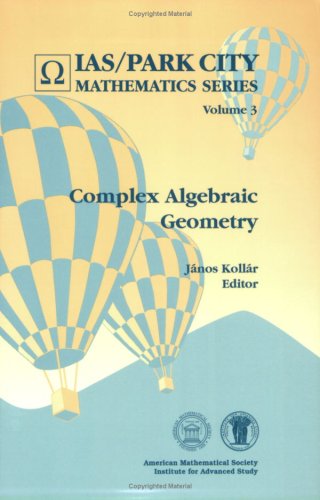
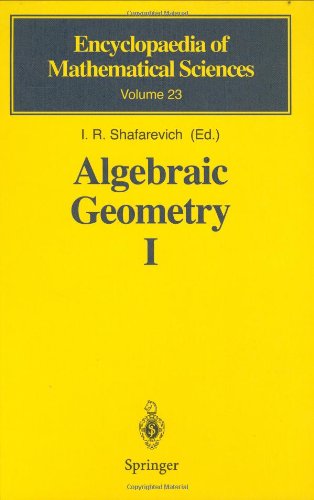
21. Algebraic Geometry III: Complex Algebraic Varieties. Algebraic Curves and Their Jacobians (Encyclopaedia of Mathematical Sciences)
Hardcover: 270 Pages (1997-12-16)
list price: US$139.00 -- used & new: US$118.65
(price subject to change: see help)
Asin: 3540546812
Canada | United Kingdom | Germany | France | Japan
Editorial Review

Book Description
The first contribution of this EMS volume on complex algebraic geometry touches upon many of the central problems in this vast and very active area of current research. While it is much too short to provide complete coverage of this subject, it provides a succinct summary of the areas it covers, while providing in-depth coverage of certain very important fields.
The second part provides a brief and lucid introduction to the recent work on the interactions between the classical area of the geometry of complex algebraic curves and their Jacobian varieties, and partial differential equations of mathematical physics. The paper discusses the work of Mumford, Novikov, Krichever, and Shiota, and would be an excellent companion to the older classics on the subject. ... Read more


22. Computational Methods in Commutative Algebra and Algebraic Geometry
by Wolmer Vasconcelos, Wolmer V. Vasconcelos
Paperback: 400 Pages (2004-07-12)
list price: US$72.95 -- used & new: US$50.89
(price subject to change: see help)
Asin: 3540213112
Canada | United Kingdom | Germany | France | Japan
Editorial Review

Book Description

From the reviews:

"... Many parts of the book can be read by anyone with a basic abstract algebra course... it was one of the author's intentions to equip students who are interested in computational problems with the necessary algebraic background in pure mathematics and to encourage them to do further research in commutative algebra and algebraic geometry. But researchers will also benefit from this exposition. They will find an up-to-date description of the related research ... The reviewer recommends the book to anybody who is interested in commutative algebra and algebraic geometry and its computational aspects."

Math. Reviews 2002

"... a sophisticated notebook, with plenty of suggestions, examples and cross references ... It is a welcome new and deep exploration into commutative algebra and its relations with algebraic geometry. It is full of results, from simple tricks to more elaborate constructions, all having in common a computational and constructive nature..."

Jahresberichte der DMV 1999

... Read more

23. Elementary Algebraic Geometry (Graduate Texts in Mathematics)
by K. Kendig
 Hardcover: 309 Pages (1977-06-30)
list price: US$49.95
Isbn: 038790199X
Canada | United Kingdom | Germany | France | Japan

24. Real Algebraic Geometry (Ergebnisse der Mathematik und ihrer Grenzgebiete. 3. Folge / A Series of Modern Surveys in Mathematics)
by Jacek Bochnak, Michel Coste, Marie-Francoise Roy
Hardcover: 430 Pages (1998-09-18)
list price: US$179.00 -- used & new: US$179.00
(price subject to change: see help)
Asin: 3540646639
Canada | United Kingdom | Germany | France | Japan
Editorial Review

Book Description
This book is a systematic treatment of real algebraic geometry, a subject that has strong interrelation with other areas of mathematics: singularity theory, differential topology, quadratic forms, commutative algebra, model theory, complexity theory etc. The careful and clearly written account covers both basic concepts and up-to-date research topics. It may be used as text for a graduate course. The present edition is a substantially revised and expanded English version of the book "Géometrie algébrique réelle" originally published in French, in 1987, as Volume 12 of ERGEBNISSE. Since the publication of the French version the theory has made advances in several directions. Many of these are included in this English version. Thus the English book may be regarded as a completely new treatment of the subject. ... Read more


25. Algebraic Geometry and Arithmetic Curves (Oxford Graduate Texts in Mathematics)
by Qing Liu
Paperback: 600 Pages (2006-08-24)
list price: US$74.00 -- used & new: US$58.98
(price subject to change: see help)
Asin: 0199202494
Average Customer Review: 5.0 out of 5 stars
Canada | United Kingdom | Germany | France | Japan
Editorial Review

Book Description
This new-in-paperback edition provides a general introduction to algebraic and arithmetic geometry, starting with the theory of schemes, followed by applications to arithmetic surfaces and to the theory of reduction of algebraic curves.The first part introduces basic objects such as schemes, morphisms, base change, local properties (normality, regularity, Zariski's Main Theorem).This is followed by the more global aspect: coherent sheaves and a finiteness theorem for their cohomology groups. Then follows a chapter on sheaves of differentials, dualizing sheaves, and Grothendieck's duality theory.The first part ends with the theorem of Riemann-Roch and its application to the study of smooth projective curves over a field.Singular curves are treated through a detailed study of the Picard group.The second part starts with blowing-ups and desingularisation (embedded or not) of fibered surfaces over a Dedekind ring that leads on to intersection theory on arithmetic surfaces.Castelnuovo's criterion is proved and also the existence of the minimal regular model.This leads to the study of reduction of algebraic curves.The case of elliptic curves is studied in detail.The book concludes with the fundamental theorem of stable reduction of Deligne-Mumford.This book is essentially self-contained, including the necessary material on commutative algebra.The prerequisites are few, and including many examples and approximately 600 exercises, the book is ideal for graduate students. ... Read more

Customer Reviews (1)

5-0 out of 5 stars Very good exposition
Liu's book has two distinct parts to it. The first 7 chapters combine to give a wonderful exposition of the language of schemes; the other chapters are of a specialised nature and concentrate on arithmetic curves. I will talk about the former. (So when I say "this book", I am only referring to the first 7 chapters)

The book starts off with a chapter on some topics in basic commutative algebra - localisation, flatness and completion. Once this is done, the stage is set to introduce schemes in the next chapter and prove their basic properties. Chapter 3 talks about morphisms of schemes and base change. Chapter 4 continues with a discussion of morphisms and also presents some results about some special types of schemes (normal, regular). It culminates with a proof of Zariski's main theorem.The next chapter takes up sheaf cohomology and is followed up with a chapter on differential calculus on schemes (Kahler differentials, duality theory). Lastly, chapter 7 takes up divisors, proves the Riemann Roch theorem and culminates with some applications to curves.

At a first glance, this would basically look like Hartshorne - the most popular book for an introduction to schemes. However, there are few differences which I will point out. Firstly, Hartshorne emphasizes geometric applications and, as such, uses algebraically closed fields freely. Liu, on the other hand, does not hesistate to give arithmetic applications whenever possible and, therefore, tries to relax the hypotheses on the base field whenever possible. Secondly, Liu is much more readable than Hartshorne which, in its supreme elegance, is a tad dense for a first reading. Unlike Hartshorne, a majority of important results are not presented in the exercises (though many are!). Moreover, unlike Harshorne, this book develops all the necessary commutative algebra along the way (chapter 1,2 of Atiyah-Macdonald should be good enough to read this book). Coming back to the geometry, Hartshorne's chapter 4,5 form an excellent resource for classical geometric applications for theory of schemes. Moreover, chapter 1 presents a very readable and scheme-free account of classical algebraic geometry (pre-Grothendieck) in the language of varieties. Liu's book, however, does not emphasize classical or geometric applications and is not the best place to start if one wishes to learn about varieties.

In the current literature on algebraic geometry, there is a noticeable void. Namely, on one hand, we have Grothendieck's "Elements" (EGA) which present all results about schemes and sheaf cohomology in utmost generality, prove everything with excruciating detail, and are almost unreadable as texts (they're a great references). On the other hand, we have Hartshorne which is basically a beautiful summary of EGA along with geometric applications, but is quite hard to read for an introduction. The book under review is not as concise as Hartshorne's book, presents arithmetic applications and is more readable in a reasonable amount of time than EGA.

In conclusion, this book should be an invaluable resource to anyone who wishes to learn about schemes, especially with arithmetic applications in mind. For those inclined towards geometry, an account of schemes from this book coupled with applications from another book (like Hartshorne) would be a good combination. ... Read more


26. Fundamental Algebraic Geometry (Mathematical Surveys & Monographs)
by Barbara Fantechi, Lothar Gottsche, Luc Illusie, Steven L. Kleiman, Nitin Nitsure
Paperback: 339 Pages (2006-12-10)
list price: US$79.00 -- used & new: US$58.13
(price subject to change: see help)
Asin: 0821842455
Canada | United Kingdom | Germany | France | Japan
Editorial Review

Product Description
Alexander Grothendieck's concepts turned out to be astoundingly powerful and productive, truly revolutionizing algebraic geometry. He sketched his new theories in talks given at the Séminaire Bourbaki between 1957 and 1962. He then collected these lectures in a series of articles in Fondements de la géométrie algébrique (commonly known as FGA).Much of FGA is now common knowledge. However, some of it is less well known, and only a few geometers are familiar with its full scope. The goal of the current book, which resulted from the 2003 Advanced School in Basic Algebraic Geometry (Trieste, Italy), is to fill in the gaps in Grothendieck's very condensed outline of his theories. The four main themes discussed in the book are descent theory, Hilbert and Quot schemes, the formal existence theorem, and the Picard scheme. The authors present complete proofs of the main results, using newer ideas to promote understanding whenever necessary, and drawing connections to later developments.With the main prerequisite being a thorough acquaintance with basic scheme theory, this book is a valuable resource for anyone working in algebraic geometry. ... Read more


27. Ideals, Varieties, and Algorithms: An Introduction to Computational Algebraic Geometry and Commutative Algebra (Undergraduate Texts in Mathematics)
by David Cox, John Little, Donal O'Shea
Hardcover: 560 Pages (2007-02-14)
list price: US$54.95 -- used & new: US$40.47
(price subject to change: see help)
Asin: 0387356509
Average Customer Review: 4.0 out of 5 stars
Canada | United Kingdom | Germany | France | Japan
Editorial Review

Book Description

Algebraic Geometry is the study of systems of polynomial equations in one or more variables, asking such questions as: Does the system have finitely many solutions, and if so how can one find them? And if there are infinitely many solutions, how can they be described and manipulated?

The solutions of a system of polynomial equations form a geometric object called a variety; the corresponding algebraic object is an ideal. There is a close relationship between ideals and varieties which reveals the intimate link between algebra and geometry. Written at a level appropriate to undergraduates, this book covers such topics as the Hilbert Basis Theorem, the Nullstellensatz, invariant theory, projective geometry, and dimension theory.

The algorithms to answer questions such as those posed above are an important part of algebraic geometry. Although the algorithmic roots of algebraic geometry are old, it is only in the last forty years that computational methods have regained their earlier prominence. New algorithms, coupled with the power of fast computers, have led to both theoretical advances and interesting applications, for example in robotics and in geometric theorem proving.

In addition to enhancing the text of the second edition, with over 200 pages reflecting changes to enhance clarity and correctness, this third edition of Ideals, Varieties and Algorithms includes: A significantly updated section on Maple in Appendix C; Updated information on AXIOM, CoCoA, Macaulay 2, Magma, Mathematica and SINGULAR; A shorter proof of the Extension Theorem presented in Section 6 of Chapter 3.

From the 2nd Edition:

"I consider the book to be wonderful. ... The exposition is very clear, there are many helpful pictures, and there are a great many instructive exercises, some quite challenging ... offers the heart and soul of modern commutative and algebraic geometry." -The American Mathematical Monthly

... Read more

Customer Reviews (1)

4-0 out of 5 stars Careful about production error
This is the 3rd edition of a popular reference on the subject. There was some production error with earlier version of the book. Even with the latest version, the authors have provided 14-page worth of correctionsfor the 1st printing of the 3rd edition. See www.cs.amherst.edu/~dac/iva/3ed1.pdf.
So buyers may be better off waiting for a corrected later version from the publisher. ... Read more


28. Computational Algebraic Geometry (London Mathematical Society Student Texts)
by Hal Schenck
Paperback: 208 Pages (2003-10-06)
list price: US$31.99 -- used & new: US$14.95
(price subject to change: see help)
Asin: 0521536502
Average Customer Review: 5.0 out of 5 stars
Canada | United Kingdom | Germany | France | Japan
Editorial Review

Book Description
Recent advances in computing and algorithms make it easier to do many classical problems in algebra. Suitable for graduate students, this book brings advanced algebra to life with many examples. The first three chapters provide an introduction to commutative algebra and connections to geometry. The remainder of the book focuses on three active areas of contemporary algebra: homological algebra; algebraic combinatorics and algebraic topology; and algebraic geometry.Download Description
The interplay between algebra and geometry is a beautiful (and fun!) area of mathematical investigation. Recent advances in computing and algorithms make it possible to tackle many classical problems in a down-to-earth and concrete fashion. This opens wonderful new vistas and allows us to pose, study and solve problems that were previously out of reach. Suitable for graduate students, the objective of this book is to bring advanced algebra to life with lots of examples. The first chapters provide an introduction to commutative algebra and connections to geometry. The rest of the book focuses on three active areas of contemporary algebra: Homological Algebra (the snake lemma, long exact sequence inhomology, functors and derived functors (Tor and Ext), and double complexes); Algebraic Combinatorics and Algebraic Topology (simplicial complexes and simplicial homology, Stanley-Reisner rings, upper bound theorem and polytopes); and Algebraic Geometry (points and curves in projective space, Riemann-Roch, Cech cohomology, regularity). ... Read more

Customer Reviews (1)

5-0 out of 5 stars Excellent comprehension
I will not say this book is an introduction but that its a confusion remover for a serious student of algebraic geometry. This book I consider a part of the much needed revolution happening in algebraic geometry which means that if you browse or spend time reading a book you must learn something. Excellent coverage of a fascinating subject. Enjoy! ... Read more


29. Algebraic geometry. A new treatise on analytical conic sections
by William Martin. Baker
Paperback: 360 Pages (2007-11-26)
list price: US$19.95 -- used & new: US$19.95
(price subject to change: see help)
Asin: 140697076X
Average Customer Review: 5.0 out of 5 stars
Canada | United Kingdom | Germany | France | Japan

Customer Reviews (1)

5-0 out of 5 stars Old - But Not Out of Date!
I picked up this book and cannot put it down. What a great text! The reader will have to know their (High School) Algebra and Geometry. Have a Reference available if you have been away for some time.

After this book, you may be ready for Geometry of Curves (Chapman Hall/CrcMathematics Series), followed by Plane Algebraic Curves (Student Mathematical Library, V. 15) and/or Introduction to Plane Algebraic Curves.

The former is more Analysis/Topology based and the latter Algebra. They are German texts, you will certainly need a strong foundation in Analysis and Abstract Algebra. Prepare well!

There are a host of books on AG - Those above are inexpensive, except Geometry of Curves (Chapman Hall/CrcMathematics Series), light and quite prepratory for advanced study.

PJO ... Read more


30. Algebraic Geometry 2: Sheaves and Cohomology (Translations of Mathematical Monographs)
by Kenji Ueno
Paperback: 184 Pages (2001-03)
list price: US$30.00 -- used & new: US$30.00
(price subject to change: see help)
Asin: 0821813579
Average Customer Review: 4.0 out of 5 stars
Canada | United Kingdom | Germany | France | Japan
Editorial Review

Book Description
Modern algebraic geometry is built upon two fundamental notions: schemes and sheaves. The theory of schemes was explained in Algebraic Geometry 1: From Algebraic Varieties to Schemes, (see Volume 185 in the same series, Translations of Mathematical Monographs). In the present book, Ueno turns to the theory of sheaves and their cohomology. Loosely speaking, a sheaf is a way of keeping track of local information defined on a topological space, such as the local holomorphic functions on a complex manifold or the local sections of a vector bundle. To study schemes, it is useful to study the sheaves defined on them, especially the coherent and quasicoherent sheaves. The primary tool in understanding sheaves is cohomology. For example, in studying ampleness, it is frequently useful to translate a property of sheaves into a statement about its cohomology.

The text covers the important topics of sheaf theory, including types of sheaves and the fundamental operations on them, such as ...

coherent and quasicoherent sheaves.
proper and projective morphisms.
direct and inverse images.
Cech cohomology.

For the mathematician unfamiliar with the language of schemes and sheaves, algebraic geometry can seem distant. However, Ueno makes the topic seem natural through his concise style and his insightful explanations. He explains why things are done this way and supplements his explanations with illuminating examples. As a result, he is able to make algebraic geometry very accessible to a wide audience of non-specialists. ... Read more

Customer Reviews (1)

4-0 out of 5 stars A good book, but not Hartshorne
This is a good book on important ideas. But it competes with Hartshorne ALGEBRAIC GEOMETRY and that is a tough challenge.It has roughly the same prerequisites as Hartshorne and covers much the same ideas.The three volumes together are actually a bit longer than Hartshorne.I had hoped this would be a lighter, more easily surveyable book than Hartshorne's.The subject involves a huge amount of material, an overall survey showing how the parts fit together could be very helpful, and the IWANAMI SERIES has some terrific, brief, easy to read,overviews of such subjects--which give proof techniques but refer elsewhere for the details of some longer proofs.

But it turns out that Ueno differs from Hartshorne in the other direction:He gives more explicit nuts and bolts of the basic constructions. Overall it is easier to get an overview from Hartshorne.Ueno does also give a lot of "insider information" on how to look at things.It is a good book.The annotated bibliography is very interesting.But I have to say Hartshorne is better.

If you get stuck on an exercise in Hartshorne this book might help.If you are working through Hartshorne on your own, you will find this alternative exposition useful as a companion.You might like the more extensive elementary treatment of representable functors, or sheaves, or Abelian categories--but you could get those from references in Hartshorne as well.

Someday some textbook will supercede Hartshorne. Even Rome fell after enough centuries. But here is my prediction, for what it is worth:That successor textbook will not be more elementary than Hartshorne. It will take advantage of progress since Hartshorne wrote (almost 30 years ago now)to make the same material quicker and simpler.It will include number theory examples and will treat coherent cohomology as a special case of etale cohomology---as Hartshorne himself does briefly in his appendices. It will be written by someone who has mastered every aspect of the mathematics and exposition of Hartshorne's book and ofMilne's ETALE COHOMOLOGY, and like both of those books it will draw heavily on Grothendieck's brilliant, original, but thorny Elements de Geometrie Algebrique.Of course some people have that level of mastery, notably Deligne, Hartshorne, and Milne who have all written great exposition.But they can't do everything and no one has yet boiled this down to a textbook successor to Hartshorne.If you write this successor *please* let me know as I am dying to read it. ... Read more


31. The Geometry of Schemes
by David Eisenbud, Joe Harris
Paperback: 312 Pages (2001-11-29)
list price: US$39.95 -- used & new: US$32.39
(price subject to change: see help)
Asin: 0387986375
Average Customer Review: 4.5 out of 5 stars
Canada | United Kingdom | Germany | France | Japan
Editorial Review

Book Description
The theory of schemes is the foundation for algebraic geometry proposed and elaborated by Alexander Grothendieck and his co-workers. It has allowed major progress in classical areas of algebraic geometry such as invariant theory and the moduli of curves. It integrates algebraic number theory with algebraic geometry, fulfilling the dreams of earlier generations of number theorists. This integration has led to proofs of some of the major conjectures in number theory (Deligne's proof of the Weil Conjectures, Faltings' proof of the Mordell Conjecture). This book is intended to bridge the chasm between a first course in classical algebraic geometry and a technical treatise on schemes. It focuses on examples, and strives to show "what is going on" behind the definitions. There are many exercises to test and extend the reader's understanding. The prerequisites are modest: a little commutative algebra and an acquaintance with algebraic varieties, roughly at the level of a one-semester course. The book aims to show schemes in relation to other geometric ideas, such as the theory of manifolds. Some familiarity with these ideas is helpful, though not required. ... Read more

Customer Reviews (5)

4-0 out of 5 stars Supplement
This book is a strategic step in my campaign to be able to read EGA.Namely, I bought "The Geometry of Schemes" in order to get a better intuition for schemes (which, sadly, Hartshorne failed to provide).So far so good.There are pictures and the Eisenbud clarity I so like.I still don't get schemes, but since I haven't really read too much of the text that is to be expected.

4-0 out of 5 stars good for a diffrent point of few.
I like the book in a way he explains the connection between alg. geom. and com. algebra. So, if you're quiet good in on of those both theories (this is ness. for this book), then it is a good book to learn more about the other side. To be good means you had at least one good course.
It's more or less a student book (4 year or further on) to get a better few to the connection of alg geom with com algebra.

5-0 out of 5 stars Crystal clear overview of a traditionally abstract subject
The theory of schemes is usually thought to be highly abstract and esoteric, and one that makes the study of algebraic geometry even more difficult. The authors definitely dispel this notion in this book, which could have been called "A Concrete Introduction to Schemes", because of the clarity with which the concepts are introduced and explained. After studying this book, one will understand and appreciate the power of schemes in algebraic geometry. The authors do an even better jobthan they did in their earlier and short work "Schemes: The Language of Modern Algebraic Geometry", which is now out of print.

In chapter 1, the main definitions are given and the basic concepts behind schemes outlined. That schemes are more complicated than varieties is readily apparent even in this beginning chapter, where they are thought of as corresponding to the spectrum of a commutative ring with identity. Very elementary exercises are given to help the reader gain confidence in the constructions involved. They authors do have to discuss some sheaf theory, but they show its relevance nicely in this chapter. They also discuss the notion of a fibered product as a generalization of the idea of a preimage of a set under the application of a function and relate it to the construction of the functor of points. The role of the functor of points as reducing schemes to a kind of set theory is brought out beautifully here.

The next chapter gives many examples of schemes, with the first examples being reduced schemes over algebraically closed fields, these being essentially the ordinary varieties of classical algebraic geometry. The authors then give examples of schemes, the local schemes, which are more general than varieties. When departing from the assumption of a field that is not finitely generated, extra points will have to be added to classical varieties. The fact that only one closed point appears is compared to the case of complex manifolds, via the concept of a germ. This is a very helpful comparison, and one that further solidifies the understanding of a scheme in the mind of the reader. The authors give the reader a short peek at the etale topology in one of the examples. Examples are then given where the field is not algebraically closed, generalizing classical number theory, and non-reduced schemes, where nilpotents are present. The chapter ends with examples of arithmetic schemes where the spectra of rings are finitely generated over the integers.

Projective schemes are the subject of Chapter 3, and are defined in terms of graded algebras and invariants of projective schemes embedded in projective space are discussed. The Grasmannian scheme is discussed in detail as an example of a projective scheme. Interestingly, Bezout's theorem, very familiar from elementary algebraic geometry, is generalized here to projective schemes.

Constructions from classical algebraic geometry are generalized to schemes in Chapter 4. The first one discussed is the notion of a flex, which deals (classically) with the locus of tangent lines to a variety. The flexes are defined in terms of the Hessian of the variety, the latter being generalized by the authors to define a scheme of flexes. The notion of blowing up is also generalized to the scheme setting, with the authors motivating the discussion by blowing up the plane. The discussion of blow-ups along non-reduced subschemes of a scheme and blow-ups of arithmetic schemes is fascinating and the presentation is crystal clear. Fano varieties are also generalized to Fano schemes in the chapter. Most of the information about these schemes are contained in the exercises, and some of these need to be worked out for a thorough understanding.

The next chapter is more categorical in nature, and deals with generalizations of the classical Sylvester construction of resultants and discriminants to the scheme setting.

In the last chapter the authors return to the functor of points, and motivate the discussion by asking for a parametrization of families of schemes. The authors show, interestingly, that using the functor of points one can more easily compute geometric information about a scheme than using its equations. They illustrate this for the Zariski tangent space. Then after an overview of Hilbert schemes they close the book by introducing the reader to moduli spaces and a hint of algebraic stacks. No end in sight for this beautiful subject..........

5-0 out of 5 stars A very good start
This book is clear, well written, and has a nice balance of generalities and examples. If you know the basics of rings and modules, this book will show you what schemes are and why they are useful for several different problems: for example, number theory, or studying singularities. I find it a helpful companion to Hartshorne's ALGEBRAIC GEOMETRY. But this book does not get to cohomology, and so cannot actually get to the working methods in the subject. For that, you need Hartshorne.

5-0 out of 5 stars Very good book
Very good book for scheme theoritical approach to Algebraic Geometry ... Read more


32. Positivity in Algebraic Geometry I: Classical Setting: Line Bundles and Linear Series (Ergebnisse Der Mathematik Und Ihrer Grenzgebiete)
by Robert Lazarsfeld
Paperback: 387 Pages (2007-05-18)
list price: US$34.95 -- used & new: US$27.69
(price subject to change: see help)
Asin: 3540225285
Canada | United Kingdom | Germany | France | Japan
Editorial Review

Book Description

This two volume work on "Positivity in Algebraic Geometry" contains a contemporary account of a body of work in complex algebraic geometry loosely centered around the theme of positivity. Topics in Volume I include ample line bundles and linear series on a projective variety, the classical theorems of Lefschetz and Bertini and their modern outgrowths, vanishing theorems, and local positivity. Volume II begins with a survey of positivity for vector bundles, and moves on to a systematic development of the theory of multiplier ideals and their applications. A good deal of this material has not previously appeared in book form, and substantial parts are worked out here in detail for the first time. At least a third of the book is devoted to concrete examples, applications, and pointers to further developments.

Volume I is more elementary than Volume II, and, for the most part, it can be read without access to Volume II. Both volumes are also available as hardcover editions as Vols. 48 and 49 in the series "Ergebnisse der Mathematik und ihrer Grenzgebiete".

... Read more

33. Algebraic Geometry: A First Course (Graduate Texts in Mathematics)
by Joe Harris
Hardcover: 328 Pages (1995-12-01)
list price: US$69.95 -- used & new: US$50.00
(price subject to change: see help)
Asin: 0387977163
Average Customer Review: 3.0 out of 5 stars
Canada | United Kingdom | Germany | France | Japan
Editorial Review

Book Description
This book is intended to introduce students to algebraic geometry; to give them a sense of the basic objects considered, the questions asked about them, and the sort of answers one can expect to obtain. It thus emplasizes the classical roots of the subject. For readers interested in simply seeing what the subject is about, this avoids the more technical details better treated with the most recent methods. For readers interested in pursuing the subject further, this book will provide a basis for understanding the developments of the last half century, which have put the subject on a radically new footing. Based on lectures given at Brown and Harvard Universities, this book retains the informal style of the lectures and stresses examples throughout; the theory is developed as needed. The first part is concerned with introducing basic varieties and constructions; it describes, for example, affine and projective varieties, regular and rational maps, and particular classes of varieties such as determinantal varieties and algebraic groups. The second part discusses attributes of varieties, including dimension, smoothness, tangent spaces and cones, degree, and parameter and moduli spaces. ... Read more

Customer Reviews (4)

1-0 out of 5 stars Not for a beginner
This book is not a good first text for a person trying to learn algebraic geometry.Prof. Harris gives very limited explanations and few clear examples.Try Shafarevich, Basic Algebraic Geometry vols I & II or Miles Reid, Undergraduate Algebraic Geometry.For both books, you would need commutative algebra, at least at the level of Miles Reid, Undergraduate Commutative Algebra.

5-0 out of 5 stars 22 lectures = 5 stars
Last year we used this title as a main reference for the first two quarters of a year-long introductory sequence on algebraic geometry, at the beginning graduate student level (2nd year). Our professor --who was himself a former student of Harris, and a specialist in the Mori program-- backed up the presentation with personal lecture notes, moving mostly in parallel to the book's topics. In the third quarter of the sequence, we moved up to cover the theory of sheaves and schemes from Robin Hartshorne's advanced treatise. Prior to this point, my only exposure to the subject was from the corresponding chapter in Dummit and Foote's algebra, and also from a recent introductory text, "An Invitation to Algebraic Geometry" by Karen Smith et al. At this stage of my studies I was mainly testing the waters; my ineterest on the one hand was driven by a curiosity for the subject itself, which has a reputation for being difficult and hard to grasp, and on the other hand, from its pivotal role in the formulation of new physical theories of mirror symmetry and string theory (for more in this direction, see the 1999 AMS title by A. Cox and S. Katz).

Back to the present text, as the editorial notes correctly point out, this Harris book emphasizes the classical algebraic geometry from the 19th & early 20th centuries prior to the introduction of highly abstract machinery, due to the work of A. Groethendieck in the 50's and 60's. Therefore it's quite natural to base the treatment mostly on the examples and concrete constructions, which were the guiding principles of the abstract development in the first place. This approach also makes the subject accessible for the newcomers who may not have an advanced background in commutative algebra or category theory, and who may not be intending to specialize in the area but merely wish to gain a general understanding of the ideas involved. I found my experience with the subject very fulfilling, and enjoyed many aspects of the presentation. I only suspect many of you could have a similar rewarding experience embarking upon this journey! For the application-oriented readers, I should recommend the Springer-Verlag title "Ideals, Varieties and Algorithms" by Cox et al. which has separate chapters on the Groebner bases, invariant theory, and the robotics.

1-0 out of 5 stars too many examples
I was confused by the many examples. Most of the times I did not see how they fit together in the theory. Perhaps I would have appreciate it more, had I known some algebraic geometry first.

5-0 out of 5 stars Definitely a good start in algebraic geometry
If one is planning to do work in coding theory, cryptography, computer graphics, digitial watermarking, or are hoping to become a mathematician specializing in algebraic geometry, this book will be of an enormous help. The author does a first class job in introducing the reader to the field of algebraic geometry, using a wealth of examples and with the goal of building intuition and understanding. It is great that a mathematician of the author's caliber would take the time to write these lectures here put into book form. It is rare to find a book on algebraic geometry that attempts to make the subject concrete and understandable, and yet points the way to more modern "scheme-theoretic" formulations.

In lecture 1, the author introduces affine and projective varieties over algebraically closed fields. Linear subspaces of n-dimensional projective space P(n) are shown to be varieties, along with any finite subset of P(n). He delays giving rigorous definitions of degree and dimension, emphasizing instead concrete examples of varieties. The twisted cubic is given as the first example of a concrete variety that is not a hypersurface, along with their generalizations, the rational normal curves.

The Zariski topology, considered by the newcomer to the subject as being a rather "strange" topology, is introduced in lecture 2. The author does a great job though explaining its properties, and introduces the regular functions on affine and projective varieties. The Nullstellensatz theorem, needed to prove that the ring of regular functions is the coordinate ring, is deferred to a later lecture. Rational normal curves are further generalized to Veronese maps in this lecture, and the properties of the corresponding Veronese varieties discussed in some detail. Also, the very interesting Segre varieties are discussed here. With these two examples of varieties, the reader already can develop a good geometric intution of the behavior of typical varieties. The Veronese and Segre maps are then combined to give another example of a variety: the rational normal scroll. More concrete examples of varieties are given in the next two lectures, including cones, quadrics, and projections. A "fiber bundle" approach to forming families of varieties parametrized by a given variety is outlined here also.

The author finally gets down to more algebraic matters in lecture 5, with the Nullstellensatz proven in great detail. He also discusses the origins of schemes in algebraic geometry, giving the reader a better appreciation of just where these objects arise, namely the association to an arbitrary ideal, instead of merely a radical ideal.

Grassmannian varieties are then introduced in lecture 6, along with some of its subvarieties, such as the Fano varieties. The join operation, widely used in geometric topology, is here defined for two varieties.

More connections with the modern viewpoint are made in lecture 7, where rational functions and rational maps are discussed. The author takes great care in explaining in what sense rational maps can be thought of as maps in the "ordinary" sense, namely they must be thought of as equivalence classes of pairs, instead of acting on points. The very important concept of a birational isomorphism is discussed also, along with blow-ups and blow-downs of varieties.

Many more concrete examples of varieties are given in lectures 8 and 9, such as secant varieties, flag manifolds, and determinantal varieties. In addition, algebraic groups on varieties are discussed in lecture 10, allowing one to discuss a kind of glueing operation on varieties, just as in geometric topology, namely by taking the quotient of varieties via finite groups.

The author then moves on to giving a more rigorous formulation of dimension, giving several different definitions, all of these conforming to intuitive ideas on what the dimension of an algebraic variety should be, and also one compatible with a purely algebraic context. Again, several concrete examples are given to illustrate the actual calculation of the dimension of a variety, both in this lecture and the next one.

The next lecture is very interesting and discusses an important problem in algebraic geometry, namely the determination of how many hypersurfaces of each degree contain a projective variety in P(n). The solution is given in terms of the famous Hilbert polynomial, which is determined for rational normal curves, Veronese varieties, and plane curves in this lecture. The author also explains the utility of using graded modules in the determination of the Hilbert polynomial, something that is usually glossed over in most books on this topic. This discussion leads to the Hilbert syzygy theorem.

Some analogs of basic contructions in differential geometry are defined for varieties in the next four lectures, based on an appropriate notion of smoothness. The tangent spaces, the Gauss map, and duals discussed here.

Then in lecture 18 the author makes good on his promise in earlier lectures of making the notion of the degree of a projective variety more rigorous. The well-known Bezout's theorem is proven, after introducting a notion of transversal intersection for varieties. As usual in the book, several examples are given for the calculation of the degree, including Veronese and Segre varieties, in this lecture and the next.

The behavior of a variety at a singular point is studied in lecture 20 using tangent cones. The author proves the resolution of singularities for curves here also.

Lecture 21 is very important, especially for the physicist reader working in string and M-theories, as the author introduces the concept of a moduli space. Most results are left unproven, but the intuition gained from reading this lecture is invaluable. The all-important Chow and Hilbert varieties are discussed here. The book the ends with a fairly lengthy overview of quadric hypersurfaces. ... Read more


34. Algebraic and Analytic Geometry (London Mathematical Society Lecture Note Series)
by Amnon Neeman
Paperback: 432 Pages (2007-09-24)
list price: US$80.00 -- used & new: US$66.59
(price subject to change: see help)
Asin: 0521709830
Canada | United Kingdom | Germany | France | Japan
Editorial Review

Book Description
This textbook, for an undergraduate course in modern algebraic geometry, recognizes that the typical undergraduate curriculum contains a great deal of analysis and, by contrast, little algebra. Because of this imbalance, it seems most natural to present algebraic geometry by highlighting the way it connects algebra and analysis; the average student will probably be more familiar and more comfortable with the analytic component. The book therefore focuses on Serre's GAGA theorem, which perhaps best encapsulates the link between algebra and analysis. GAGA provides the unifying theme of the book: we develop enough of the modern machinery of algebraic geometry to be able to give an essentially complete proof, at a level accessible to undergraduates throughout. The book is based on a course which the author has taught, twice, at the Australian National University. ... Read more


35. Geometry of Conics (Mathematical World) (Mathematical World)
by A. V. Akopyan, A. A. Zaslavsky
Paperback: 134 Pages (2007-12-13)
list price: US$26.00 -- used & new: US$26.00
(price subject to change: see help)
Asin: 0821843230
Canada | United Kingdom | Germany | France | Japan
Editorial Review

Product Description
The book is devoted to the properties of conics (plane curves of second degree) that can be formulated and proved using only elementary geometry. Starting with the well-known optical properties of conics, the authors move to less trivial results, both classical and contemporary. In particular, the chapter on projective properties of conics contains a detailed analysis of the polar correspondence, pencils of conics, and the Poncelet theorem. In the chapter on metric properties of conics the authors discuss, in particular, inscribed conics, normals to conics, and the Poncelet theorem for confocal ellipses.The book demonstrates the advantage of purely geometric methods of studying conics. It contains over 50 exercises and problems aimed at advancing geometric intuition of the reader. The book also contains more than 100 carefully prepared figures, which will help the reader to better understand the material presented ... Read more


36. Mirror Symmetry and Algebraic Geometry (Mathematical Surveys & Monographs)
by David A. Cox
Paperback: 469 Pages (1999-09)
list price: US$51.00 -- used & new: US$45.38
(price subject to change: see help)
Asin: 082182127X
Average Customer Review: 5.0 out of 5 stars
Canada | United Kingdom | Germany | France | Japan
Editorial Review

Book Description
Mirror symmetry began when theoretical physicists made some astonishing predictions about rational curves on quintic hypersurfaces in four-dimensional projective space. Understanding the mathematics behind these predictions has been a substantial challenge. This book is the first completely comprehensive monograph on mirror symmetry, covering the original observations by the physicists through the most recent progress made to date. Subjects discussed include toric varieties, Hodge theory, Kähler geometry, moduli of stable maps, Calabi-Yau manifolds, quantum cohomology, Gromov-Witten invariants, and the mirror theorem. ... Read more

Customer Reviews (1)

5-0 out of 5 stars Excellent overview of mirror symmetry
This book is one of the few monographs on mirror symmetry that is not a collection of articles written by specialists. It attempts to put mirror symmetry on a mathematically rigorous foundation and does so to a large degree. The book opens with a review of the motivations for mirror symmetry in quantum field theory and superstring theory. The content of this chapter is straightforward reading for physicists/string theorists but mathematicians may have trouble with the physical reasoning employed. The chapter explains the motivation for the mathematical constructions performed in the rest of the book. The author does a good job of presenting the mathematics in a form that is as rigorous as possible. The predictions made by physicists to quantities in in algebraic geometry are too interesting from a mathematical standpoint to let lay couched in the formalism of path integrals. The book gives many examples of mirror symmetry constructions that are rigorous mathematically, most of these involving toric varieties. A general methodology for finding the mirror of a given Calabi-Yau manifold is still unknown according to the author. By far the best chapter in the book is the one on quantum cohomology, as this tool has so many applications in algebraic and symplectic geometry. One is always impressed on the originality and breadth of ideas that have been employed in this subject. There are several topics in mirror symmetry that are not discussed in the book, but even with these omissions, this is a fine addition to the literature on the subject. One question that immediately arises when thinking about mirror symmetry is there is anything that is interesting in the case of Calabi-Yau manifolds over finite fields. The special case that comes to mind is for elliptic curves. Are mirrors of Calabi-Yau manifolds easier to find in the finite field case and does the mirror have a group operation related to the one on the original manifold (elliptic curve)? These questions are not addressed in this book, but answering them may have important ramifications for applications of mirror symmetry to the field of cryptography for example. ... Read more


37. Conics and Cubics: A Concrete Introduction to Algebraic Curves (Undergraduate Texts in Mathematics)
by Robert Bix
Hardcover: 352 Pages (2006-07-24)
list price: US$59.95 -- used & new: US$42.11
(price subject to change: see help)
Asin: 038731802X
Average Customer Review: 4.0 out of 5 stars
Canada | United Kingdom | Germany | France | Japan
Editorial Review

Book Description

Conics and Cubics is an accessible introduction to algebraic curves. Its focus on curves of degree at most three keeps results tangible and proofs transparent. Theorems follow naturally from high school algebra and two key ideas, homogeneous coordinates and intersection multiplicities.

By classifying irreducible cubics over the real numbers and proving that their points form Abelian groups, the book gives readers easy access to the study of elliptic curves. It includes a simple proof of Bezouts Theorem on the number of intersections of two curves.

The book is a text for a one-semester course. The course can serve either as the one undergraduate geometry course taken by mathematics majors in general or as a sequel to college geometry for prospective or current teachers of secondary school mathematics. The only prerequisite is first-year calculus.

The new edition additionally discusses the use of power series to parametrize curves and analyze intersection multiplicities and envelopes.

... Read more

Customer Reviews (1)

4-0 out of 5 stars Welcome Addition to the Literature
This book may be the most elementary introduction to algebraic geometry.Still it is roughly senior level and unlike the review above I am not sure that it is suitable for students in secondary education.Nonetheless, itfills a niche that has been largely vacant in the undergraduate literatureand I recommend it to serious students and undergraduates alike. ... Read more


38. Spin Geometry. (PMS-38)
by H. Blaine Lawson, Marie-Louise Michelsohn
Hardcover: 440 Pages (1990-02-01)
list price: US$120.00 -- used & new: US$90.00
(price subject to change: see help)
Asin: 0691085420
Average Customer Review: 4.5 out of 5 stars
Canada | United Kingdom | Germany | France | Japan
Editorial Review

Book Description

This book offers a systematic and comprehensive presentation of the concepts of a spin manifold, spinor fields, Dirac operators, and A-genera, which, over the last two decades, have come to play a significant role in many areas of modern mathematics. Since the deeper applications of these ideas require various general forms of the Atiyah-Singer Index Theorem, the theorems and their proofs, together with all prerequisite material, are examined here in detail. The exposition is richly embroidered with examples and applications to a wide spectrum of problems in differential geometry, topology, and mathematical physics. The authors consistently use Clifford algebras and their representations in this exposition. Clifford multiplication and Dirac operator identities are even used in place of the standard tensor calculus. This unique approach unifies all the standard elliptic operators in geometry and brings fresh insights into curvature calculations. The fundamental relationships of Clifford modules to such topics as the theory of Lie groups, K-theory, KR-theory, and Bott Periodicity also receive careful consideration. A special feature of this book is the development of the theory of Cl-linear elliptic operators and the associated index theorem, which connects certain subtle spin-corbordism invariants to classical questions in geometry and has led to some of the most profound relations known between the curvature and topology of manifolds.

... Read more

Customer Reviews (2)

5-0 out of 5 stars Excellent
Who would have known that the equation discovered by P.A.M. Dirac in the 1920's would have the enormous appllications to mathematics that it currently has. This book is an excellent overview of these applications, written by two individuals who are responsible for the development of many of these. Dirac's theory of course had its origins in physics, and physicists, particularly those working in high energy physics, will find this book interesting and helpful.

The authors give a brief introduction and then move on to the representation theory of Clifford algebras and spin groups in chapter 1. The reader can see the origin of Clifford algebras and an introduction to the Pin and Spin groups. Clifford algebras are classified as matrix algebras over the real or complex numbers, and the quaternions. It is the representation theory of Clifford algebras however that has resulted in the impressive results outlined in the book Noting that the tensor product of Clifford algebras is not necessarily a Clifford algebra, the authors introduce a Z(2)-grading on a Clifford algebra, which results in a multiplicative structure in the representations of Clifford algebras. The Lie algebras of the Pin and Spin groups are discussed along with applications to geometry and Lie groups. By far the most interesting discussion though is on K-theory, which allows one to define a ring structure on vector bundles. Distinguishing a base point in the base space, relative K-groups are defined, and shown to be equal for the base space and its i-fold suspension. Bott periodicity results are stated but their proof is delayed until chapter 3. A detailed discussion is given of the Atiyah-Bott-Shapiro isomorphism and KR-theory.

The connection between spin and differential geometry is discussed in chapter 2. The first few sections is a review of standard results in the spin structure of vector bundles, such as Stiefel-Whitney classes and spin cobordism. For Riemannian vector bundles, each fiber has a quadratic form that gives rise to a Clifford algebra on the fiber. The question as to when a vector bundle over the Riemannian base space can be found that has fibers each an irreducible module over this Clifford algebra leads to a consideration of spin manifolds and spin cobordism, when the total space is chosen to be the tangent bundle. The Dirac operator acting on a bundle over this Clifford bundle allows the construction of all the standard elliptic operators such as the signature, Atiyah-Singer, and the Euler characteristic. The authors discuss these constructions in detail along with the notion of of Cl(k)-linear operators.

The Dirac operator can be viewed in Euclidean space as the square root of a Laplace operator, but over general manifolds it is the Laplacian with a correction term dependent on the curvature and Clifford multiplication. The Bochner vanishing theorems are discussed in great detail, along with the results on the existence of exotic spheres.

An entire chapter is spent on index theorems, wherein the authors present the results in terms of the approach used by Atiyah and Singer, instead of the heat kernel methods of Gilkey and Patodi. Physicists might prefer the later approach, due to its connections with applications, but the abstract K-theory approach undertaken by the authors is elegant and their presentation is excellent. The role of physics in index theorems is a fascinating one though, especially the use of supersymmetry to simplify the proofs of some of the results. The authors do not discuss this approach, but point out, interestingly, that it does not work when one is dealing with torsion elements in K-theory. These cannot be detected using cohomology nor can the modulo-two invariants appearing in the index theorems be computed from local densities.

The last chapter is a long one and discusses applications in differential topology and geometry, emphasizing index thoerems and Riemannian manifolds of positive scalar curvature. The authors outline just when the indexes are integers (the integrality theorems) and use spin geometry to discuss the immersion problem for manifolds and the vector field problem. Exotic n-spheres again make their appearance, wherein it is shown that some of these have very few symmetries and are very asymmetric objects. A short introduction to elliptic genera is given. Interestingly, C*-algebras are briefly mentioned as tools to decide whether for every compact spin manifold with positive scalar curvature all higher A-genera must be zero. Spin-c manifolds are not treated, the authors instead concentrating their attention to Kahlerian geometry. In this context the Clifford algebra multiplication has a beautiful relationship with the complex structure. A brief discussion is given of the pure spinors of Cartan and twistor spaces. The theory of holonomy and calibrations, the later due to one of the authors, is discussed in great detail. The discussion begins in the consideration of when universal covering spaces are not Riemannian manifolds and their holonomy groups have been classified. The idea of a calibration arises from the consideration of submanifolds that are homologically volume-minimizing. These become calibrations when the integrals of p-forms on them are the volumes, and these p-forms have vanishing differentials on oriented tangent p-planes on the manifold. The authors give an interesting discussion of the relation between spinors and calibrations.

4-0 out of 5 stars Essential for grad students in geometry/topology
As a graduate student in mathematics I survived on this encyclopedic work.Anyone interested in differential geometry or differential topology will eventually need something in this book.

Prerequisites are graduate-levelalgebra and analysis, and some topology and differential geometry.Heintroduces the subject of pseudodifferential operators and Sobolev spaces,but it's easy to get lost in that part unless you first read Shubin's book"Pseudodifferential operators and Spectral theory".Also, thequick shuffling of Lie group information can be disheartening if you're notused to it.Harvey's book "Spinors and Calibrations" is a moreelementary book if this is the case.

This book touches on many importanttopics like the Atiyah-Singer Index Theorem, the Bochner method,Riemann-Roch, and mathematical physics, but you will probably want tosupplement your reading with individual books on each of these topics. ... Read more


39. Toposes, Algebraic Geometry and Logic: Dalhousie University, Halifax, January 16-19, 1971 (Lecture Notes in Mathematics)
Paperback: 200 Pages (1972-10-20)
list price: US$26.00 -- used & new: US$26.00
(price subject to change: see help)
Asin: 3540059202
Canada | United Kingdom | Germany | France | Japan

40. Elementary Algebraic Geometry (Student Mathematical Library, Vol. 20) (Student Mathematical Library, V. 20)
by Klaus Hulek
Paperback: 213 Pages (2003-02-01)
list price: US$35.00 -- used & new: US$22.99
(price subject to change: see help)
Asin: 0821829521
Average Customer Review: 3.0 out of 5 stars
Canada | United Kingdom | Germany | France | Japan
Editorial Review

Book Description
This is a genuine introduction to algebraic geometry. The author makes no assumption that readers know more than can be expected of a good undergraduate. He introduces fundamental concepts in a way that enables students to move on to a more advanced book or course that relies more heavily on commutative algebra.

The language is purposefully kept on an elementary level, avoiding sheaf theory and cohomology theory. The introduction of new algebraic concepts is always motivated by a discussion of the corresponding geometric ideas. The main point of the book is to illustrate the interplay between abstract theory and specific examples. The book contains numerous problems that illustrate the general theory.

The text is suitable for advanced undergraduates and beginning graduate students. It contains sufficient material for a one-semester course. The reader should be familiar with the basic concepts of modern algebra. A course in one complex variable would be helpful, but is not necessary. It is also an excellent text for those working in neighboring fields (algebraic topology, algebra, Lie groups, etc.) who need to know the basics of algebraic geometry. ... Read more

Customer Reviews (1)

3-0 out of 5 stars Trees, not forest
First, a calibration: I am a total neophyte to algebraic geometry, and haven't taken a university algebra course since a few decades ago when I was a physics major. This book is one of several on the subject (along with some books on commutative algebra) that I'm using to get an amateur's orientation.

As so often happens, this book looked great in the bookstore. It is thin, reasonably well-illustrated compared to other books in the field, and even helps you gets your toes wet in sheaves, category theory and some other neat topics.

That said, I believe the prerequisites in the preface (university algebra, with a complex variables course optional) are understated; e.g. it helps to know something about fibres, lifts and other topics from geometry. It might be relevant that these notes were prepared at a German university; you should consider that "undergraduates" there are heading toward the equivalent of a US M.S. degree, not B.S./B.A.

More detrimental is that the presentation slogs from one proof to another and too rarely pauses for breath to consider the "big picture" significance of what you're proving. Notwithstanding that Joe Harris's "Algebraic Geometry: A First Course" is even less of a piece of cake for me than it might be for you, his style is a breath of fresh air when it comes to enlightening you as to some geometric context and payoff for all this effort. Other supplements I found helpful include Reid and Schenck. ... Read more


  Back | 21-40 of 100 | Next 20

Prices listed on this site are subject to change without notice.
Questions on ordering or shipping? click here for help.

site stats