e99 Online Shopping Mall

Geometry.Net - the online learning center Help  
Home  - Pure And Applied Math - Algebraic Topology (Books)

  Back | 21-40 of 100 | Next 20

click price to see details     click image to enlarge     click link to go to the store

$38.64
21. Lectures on Algebraic Topology
$7.73
22. Topology: An Introduction to the
$22.00
23. Simplicial Objects in Algebraic
$49.48
24. Topology and Geometry (Graduate
$50.00
25. Algebraic Topology from a Homotopical
 
26. Lectures on algebraic topology
$29.95
27. Algebraic Topology: A Student's
$29.00
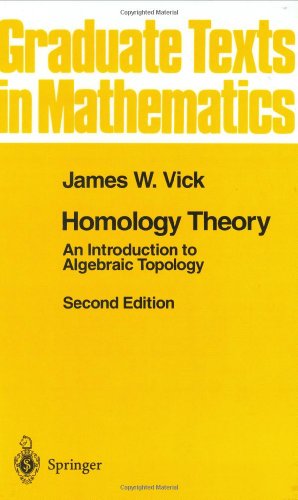
28. Homology Theory: An Introduction
$58.13
29. Fundamental Algebraic Geometry
 
30. Graphs, surfaces, and homology:
$7.95
31. Probabilities on Algebraic Structures
 
$5.49
32. Algebraic Topology
 
33. Homology theory;: A first course
 
34. Foundations of Algebraic Topology
 
35. Algebraic Topology: An Introduction
 
36. Lectures on Algebraic Topology
 
37. Homotopy Theory: An Introduction
$6.95
38. A Combinatorial Introduction to
$40.40
39. Topological Methods in Algebraic
$69.99
40. A User's Guide to Algebraic Topology

21. Lectures on Algebraic Topology (Classics in Mathematics)
by Albrecht Dold, A. Dold
Paperback: 400 Pages (1995-02-15)
list price: US$49.95 -- used & new: US$38.64
(price subject to change: see help)
Asin: 3540586601
Average Customer Review: 4.5 out of 5 stars
Canada | United Kingdom | Germany | France | Japan
Editorial Review

Book Description
Springer-Verlag began publishing books in higher mathematics in 1920, when the series Grundlehren der mathematischen Wissenschaften, initially conceived as a series of advanced textbooks, was founded by Richard Courant. A few years later, a new series Ergebnisse der Mathematik und Ihrer Grenzgebiete, survey reports of recent mathematical research, was added.
Of over 400 books published in these series, many have become recognized classics and remain standard references for their subject. Springer is reissueing a selected few of these highly successful books in a new, inexpensive softcover edition to make them easily accessible to younger generations of students and researchers. ... Read more

Customer Reviews (2)

5-0 out of 5 stars Singular homology, products and manifolds
This is a book mainly about singular (co)homology. To be able to do calculations on more complex objects, CW complexes are introduced. The book concentrates on products and manifolds. It is aimed at a graduate level audience and in that context it is self contained. Homological algebra is developed up to the level needed in the text. There is a fair amount of examples and exercises.

I am really curious about the economists, mentioned in the editorial review, using this text as a standard reference.

4-0 out of 5 stars Elgant treatment of homology theory.
Though entitled "Algebraic Topology", this text covers only (co)homology theory. You should look for other texts if your interest is in homotopy theory. This being said, the treatment is elegant (at least forits time of publication), especially the chapter covering the mothod ofacylcic models. ... Read more


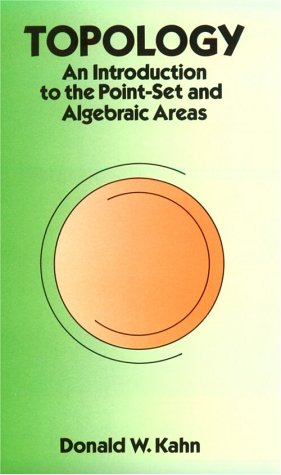
22. Topology: An Introduction to the Point-Set and Algebraic Areas
by Donald W. Kahn
Paperback: 217 Pages (1995-07-19)
list price: US$12.95 -- used & new: US$7.73
(price subject to change: see help)
Asin: 0486686094
Average Customer Review: 4.0 out of 5 stars
Canada | United Kingdom | Germany | France | Japan
Editorial Review

Book Description

Excellent text offers comprehensive coverage of elementary general topology as well as algebraic topology, specifically 2-manifolds, covering spaces and fundamental groups. The text is accessible to students at the advanced undergraduate or graduate level who are conversant with the basics of real analysis or advanced calculus. Problems, with selected solutions. Bibliography. 1975 edition.
... Read more

Customer Reviews (6)

4-0 out of 5 stars Good book / Great supplement
I used this book as a supplement for math590(ind.study) on simplicial homology groups. This book is good because its cheap, concise, and rigorous (and characterizes all compact surfaces as well as proves the simplicial approximation theorem). There are hints and answers to the exercises which are numerous and vary in difficulty. I think this is the best all around book Dover offers on topology; Maunders is completely in a league of its own.

5-0 out of 5 stars Who cares who writes the reviews
It is the author's ability to properly convey the ideas of the given subject that should be addressed not who the author chose to review it.Having read books by several of the "well-known' authors in the area of Topology, i.e. Munkres, Kelley and Bourbaki, I found this book quite informative, lively and lives up to the author's assertion that there is a definte need for books that are less dense(terse, pedantic) and which get right to the point, illustrating and presenting the material essential for an introductory exposure to Topology.The exercises are well chosen and extend the material presented in the text which is a complementary bonus since there appears an unfortunate trend in some texts to have seemingly irrelevant exercises at the end of each section.Also I found this to be good book for independent study and strongly recommend it to all highly motivated undergraduates.

4-0 out of 5 stars Very good - for a dover book
This is a good book.Which, as math students with little money know makes it an exceptional dover book.He covers point-set topology quickly, which I like (algebraic topology is much more interesting), and most of the coverage of concepts is good.I further like the proofs in the first chapter of implications between Zorn's lemma, the axiom of choice, and the well-ordering principle.I had not seen these proofs outside of a book on set theory.

2-0 out of 5 stars Not Funny, Professor
While a good sense of humor is as necessary to reading (and hopefully to learning) topology as is mental acuity, self-serving Reviews by Authors are offensive and similar "contributions" by Authors' relatives (ifthat is in fact what we have here)are even more so given the price oftextbooks these days. Why doesn't the good professor submit the results ofa survey of his students (anonymous and conducted by someone other thanhimself, we would hope)who have used this book as a text? Better yet, wouldthe professor submit an open letter to a peer-reviewed journal solicitingsuch evaluations from colleagues at other schools which haveused his text?

5-0 out of 5 stars Excellent Text--Dad you were right.
I find this to be an excellent treatment of concepts with have been made quite difficult in other texts. ... Read more


23. Simplicial Objects in Algebraic Topology (Chicago Lectures in Mathematics)
by J. P. May
Paperback: 170 Pages (1993-01-15)
list price: US$22.00 -- used & new: US$22.00
(price subject to change: see help)
Asin: 0226511812
Average Customer Review: 5.0 out of 5 stars
Canada | United Kingdom | Germany | France | Japan
Editorial Review

Book Description

Simplicial sets are discrete analogs of topological spaces. They have played a central role in algebraic topology ever since their introduction in the late 1940s, and they also play an important role in other areas such as geometric topology and algebraic geometry. On a formal level, the homotopy theory of simplicial sets is equivalent to the homotopy theory of topological spaces. In view of this equivalence, one can apply discrete, algebraic techniques to perform basic topological constructions. These techniques are particularly appropriate in the theory of localization and completion of topological spaces, which was developed in the early 1970s.

Since it was first published in 1967, Simplicial Objects in Algebraic Topology has been the standard reference for the theory of simplicial sets and their relationship to the homotopy theory of topological spaces. J. Peter May gives a lucid account of the basic homotopy theory of simplicial sets, together with the equivalence of homotopy theories alluded to above. The central theme is the simplicial approach to the theory of fibrations and bundles, and especially the algebraization of fibration and bundle theory in terms of "twisted Cartesian products." The Serre spectral sequence is described in terms of this algebraization. Other topics treated in detail include Eilenberg-MacLane complexes, Postnikov systems, simplicial groups, classifying complexes, simplicial Abelian groups, and acyclic models.

"Simplicial Objects in Algebraic Topology presents much of the elementary material of algebraic topology from the semi-simplicial viewpoint. It should prove very valuable to anyone wishing to learn semi-simplicial topology. [May] has included detailed proofs, and he has succeeded very well in the task of organizing a large body of previously scattered material."—Mathematical Review

... Read more

Customer Reviews (1)

5-0 out of 5 stars Fast delivery
The book was in the same conditions as described when I bought it and it came in time. ... Read more


24. Topology and Geometry (Graduate Texts in Mathematics)
by Glen E. Bredon
Hardcover: 557 Pages (1997-10-17)
list price: US$74.95 -- used & new: US$49.48
(price subject to change: see help)
Asin: 0387979263
Average Customer Review: 4.5 out of 5 stars
Canada | United Kingdom | Germany | France | Japan
Editorial Review

Book Description
This book is intended as a textbook for a first-year graduate course on algebraic topology, with as strong flavoring in smooth manifold theory. Starting with general topology, it discusses differentiable manifolds, cohomology, products and duality, the fundamental group, homology theory, and homotopy theory. It covers most of the topics all topologists will want students to see, including surfaces, Lie groups and fibre bundle theory. With a thoroughly modern point of view, it is the first truly new textbook in topology since Spanier, almost 25 years ago. Although the book is comprehensive, there is no attempt made to present the material in excessive generality, except where generality improves the efficiency and clarity of the presentation. ... Read more

Customer Reviews (6)

3-0 out of 5 stars a different perspective
While I agree with reviewers generally that this is a good book, i should warn that bredon isnt for the faint of heart. He makes use of simple language from category theory, doesnt always completely introduce his discussions (see for example the chapter on the tangent bundle where tangent bundle is never defined), and some other things that are nuisances to the newcomer.

I do think this is a good modern readable textbook, but for the student who has a solid foundation in mathematics. I didnt find it as accessable as other topology books, say Hatcher or Lee's books (but lee's are not as complete).

5-0 out of 5 stars excellent for first year graduate study
This was the assigned book in my first year grad topology course. It has good examples, interesting exercises. I like the emphasis on geometrical examples, constructions. It's not easy to read, but interesting.

5-0 out of 5 stars Among the best textbooks in algebraic topology.
As the previous reviewers have commented, this book is very accessible and detailed. I should add that the authour never lets you get lost in the labyrinth of abstract nonsense; the treatment is always geometric rather than homologico-algebraic. The only complaint I have is, the book would be more useful with chapters on spectral sequences, cobordism and K-theory.

5-0 out of 5 stars The Graduate Sudent's Topology Bible
If you want to learn topology, this book is the place.Though this text can require some maturity, the range of topics and the clarity of exposition are outstanding.My only complaint is that an additional appendix covering the basics of category theory would have been quite useful.Bredon not infrequently uses the language of category theory (though always in a non-essential way).Since this text is aimed at 1st year graduate students, I think the tacit assumption that the student has already encountered these topics is not justified.That such a minor point is my chief complaint speaks volumes of my esteem for this text.

5-0 out of 5 stars My secret weapon in topology
Today I told someone that Bredon's "Topology and Geometry" book was my secret weapon.I say this because it has mostly everything a grad student in topology needs to know in order to be fluent in the subject.Ibought it not because I was taking a class from it--I got it because I sawit at the library and realized that this is the 'end all' topology book forme and that I will not need to buy all those 'other' books in topologyanymore.I will warn you though--some of the proofs are terse, so you haveto be somewhat 'mathematically mature'.It is definately harder thanMunkres' "Topology: A first course" (the red book).But it goesbeyond the point set crap that gets (in my opinion) too much airtime.Iwish I would have taken a class under this book. ... Read more


25. Algebraic Topology from a Homotopical Viewpoint
by Marcelo Aguilar, Samuel Gitler, Carlos Prieto
Hardcover: 512 Pages (2002-06-13)
list price: US$79.95 -- used & new: US$50.00
(price subject to change: see help)
Asin: 0387954503
Average Customer Review: 2.0 out of 5 stars
Canada | United Kingdom | Germany | France | Japan
Editorial Review

Book Description
The purpose of this book is to introduce algebraic topology using the novel approach of homotopy theory, an approach with clear applications in algebraic geometry as understood by Lawson and Voevodsky. This method allows the authors to cover the material more efficiently than the more common method using homological algebra. The basic concepts of homotopy theory, such as fibrations and cofibrations, are used to construct singular homology and cohomology, as well as K-theory. Throughout the text many other fundamental concepts are introduced, including the construction of the characteristic classes of vector bundles. Although functors appear constantly throughout the text, no knowledge about category theory is expected from the reader. This book is intended for advanced undergraduates and graduate students with a basic knowledge of point set topology as well as group theory and can be used in a two semester course.Marcelo Aguilar and Carlos Prieto are Professors at the Instituto de Matemticas, Universidad Nacional Autonoma de Mexico, and Samuel Gitler is a member of El Colegio Nacional and professor at the Centro de Investigacion y Estudios Avanzados del IPN. ... Read more

Customer Reviews (1)

2-0 out of 5 stars A bad book
Good for reference sometimes but has too much garbage/symbols and unnecessary details everywhere. Spends pages proving something which can be explained with a small picture and remarks. Not recommended. ... Read more


26. Lectures on algebraic topology (Mathematics lecture note series)
by Marvin J Greenberg
 Paperback: 235 Pages (1967)

Isbn: 0805335544
Canada | United Kingdom | Germany | France | Japan

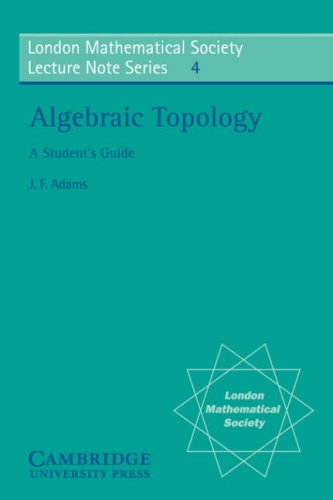
27. Algebraic Topology: A Student's Guide (London Mathematical Society Lecture Note Series)
by J. F. Adams
Paperback: 306 Pages (1972-06-30)
list price: US$29.95 -- used & new: US$29.95
(price subject to change: see help)
Asin: 0521080762
Canada | United Kingdom | Germany | France | Japan
Editorial Review

Book Description
This set of notes, for graduate students who are specializing in algebraic topology, adopts a novel approach to the teaching of the subject. It begins with a survey of the most beneficial areas for study, with recommendations regarding the best written accounts of each topic. Because a number of the sources are rather inaccessible to students, the second part of the book comprises a collection of some of these classic expositions, from journals, lecture notes, theses and conference proceedings. They are connected by short explanatory passages written by Professor Adams, whose own contributions to this branch of mathematics are represented in the reprinted articles. ... Read more


28. Homology Theory: An Introduction to Algebraic Topology (Graduate Texts in Mathematics)
by James W. Vick
Hardcover: 242 Pages (1994-01-07)
list price: US$69.95 -- used & new: US$29.00
(price subject to change: see help)
Asin: 0387941266
Average Customer Review: 4.0 out of 5 stars
Canada | United Kingdom | Germany | France | Japan
Editorial Review

Book Description
This book is designed to be an introduction to some of the basic ideas in the field of algebraic topology. In particular, it is devoted to the foundations and applications of homology theory. The only prerequisite for the student is a basic knowledge of abelian groups and point set topology. The essentials of singular homology are given in the first chapter, along with some of the most important applications. In this way the student can quickly see the importance of the material. The successive topics include attaching spaces, finite CW complexes, the Eilenberg-Steenrod axioms, cohomology products, manifolds, Poincaré duality, and fixed point theory. Throughout the book the approach is as illustrative as possible, with numerous examples and diagrams. Extremes of generality are sacrificed when they are likely to obscure the essential concepts involved. The book is intended to be easily read by students as a textbook for a course or as a source for individual study. The second edition has been substantially revised. It includes a new chapter on covering spaces in addition to illuminating new exercises. ... Read more

Customer Reviews (2)

4-0 out of 5 stars Has the good and bad
This is a terrific book on homology theory, covering all the standard topics, plus some nice topics that are hard to find in other introductory books. The motivation for theory is presented in both algebraic/categorical and geometric flavors. The structure of the book is mostly solid, getting straight to the point with singular homology instead of wasting time with simplicial homology and its results (a rarity with algebraic topology books). My only complaints are that the book is riddled with typos and chapter 5 (on products in homology and cohomology) is quite messy.

4-0 out of 5 stars Masterful
This introduction to singular homology combines a strong historical sense with an easy mastery of modern methods. The massive contributions of Poincare and Brouwer are credited, and their geometrical motivations are clear. At the same time the book neither minimizes nor apologizes for modern algebraic machinery, but treats categories and acyclic models and more as natural means to simplify the subject. The book goes through Poincare duality and a good account of the Lefschetz fixed point theorems. It is at once very visual and algebraically slick.The only problem with this approach is that the author seems a bit uncomfortable descending into the nuts and bolts of the longer proofs of two key results (the acyclic model theorem, and the duality theorem). He handles the details unevenly and makes some actual mis-statements. Here the reader needs the experience and confidence to make some corections. ... Read more


29. Fundamental Algebraic Geometry (Mathematical Surveys & Monographs)
by Barbara Fantechi, Lothar Gottsche, Luc Illusie, Steven L. Kleiman, Nitin Nitsure
Paperback: 339 Pages (2006-12-10)
list price: US$79.00 -- used & new: US$58.13
(price subject to change: see help)
Asin: 0821842455
Canada | United Kingdom | Germany | France | Japan
Editorial Review

Product Description
Alexander Grothendieck's concepts turned out to be astoundingly powerful and productive, truly revolutionizing algebraic geometry. He sketched his new theories in talks given at the Séminaire Bourbaki between 1957 and 1962. He then collected these lectures in a series of articles in Fondements de la géométrie algébrique (commonly known as FGA).Much of FGA is now common knowledge. However, some of it is less well known, and only a few geometers are familiar with its full scope. The goal of the current book, which resulted from the 2003 Advanced School in Basic Algebraic Geometry (Trieste, Italy), is to fill in the gaps in Grothendieck's very condensed outline of his theories. The four main themes discussed in the book are descent theory, Hilbert and Quot schemes, the formal existence theorem, and the Picard scheme. The authors present complete proofs of the main results, using newer ideas to promote understanding whenever necessary, and drawing connections to later developments.With the main prerequisite being a thorough acquaintance with basic scheme theory, this book is a valuable resource for anyone working in algebraic geometry. ... Read more


30. Graphs, surfaces, and homology: An introduction to algebraic topology (Chapman and Hall mathematics series)
by P. J Giblin
 Paperback: 329 Pages (1977)
list price: US$12.95
Isbn: 0470989947
Canada | United Kingdom | Germany | France | Japan

31. Probabilities on Algebraic Structures
by Ulf Grenander
Paperback: 224 Pages (2008-02-04)
list price: US$12.95 -- used & new: US$7.95
(price subject to change: see help)
Asin: 0486462870
Canada | United Kingdom | Germany | France | Japan
Editorial Review

Book Description

A systematic account of the theory of probability for certain sample spaces with algebraic structure, this text covers semi-groups, groups, linear vector spaces, and algebra. It states and studies fundamental probabilistic problems for these spaces, focusing on concrete results rather than on general and complete answers. 1963 edition.
... Read more

32. Algebraic Topology
by C. R. F. Maunder
 Paperback: 384 Pages (1996-06-14)
list price: US$16.95 -- used & new: US$5.49
(price subject to change: see help)
Asin: 0486691314
Average Customer Review: 3.5 out of 5 stars
Canada | United Kingdom | Germany | France | Japan
Editorial Review

Book Description

Thorough, modern treatment, essentially from a homotopy theoretic viewpoint. Topics include homotopy and simplicial complexes, the fundamental group, homology theory, homotopy theory, homotopy groups and CW-Complexes, and other topics. Each chapter contains exercises and suggestions for further reading. 1980 corrected edition.
... Read more

Customer Reviews (2)

3-0 out of 5 stars Shouldn't be your first text in algebraic topology.
It is a decent book in algebraic topology, as a reference.At first, I found this textbook rather hard to read. Too manylemmas, theorems, etceteras. Three suggestions:

1. Needs more pictures, especially for the simplicialhomology Chapter.

2. CW complexes should be covered before duality and not after.

3. Needs more examples and exercises.

Overall, the book is very good, if you have already someexperience in Algebraic Topology. I found that the Croom'sbook "Basic concepts of Algebraic Topology" is an excellent first textbook. Too bad it is out of print, since it is very popular, every time I get it from the library, someone else recalls it. The combination of these two books probablyis the right thing to have: Maunder's book picks up whereCroom has left you.

4-0 out of 5 stars Not bad.
Maunder's text may not be the "best" book on algebraic topology, but I still recommend this one to those who find other more advanced texts like Spanier rather inaccessible. Warning: the chapter on cohomology andduality is not very well-organaized (compared to other chapters), so youmay want to consult Bredon's book instead. ... Read more


33. Homology theory;: A first course in algebraic topology (Holden-Day series in mathematics)
by S. T Hu
 Hardcover: 247 Pages (1966)

Asin: B0006BOF7M
Canada | United Kingdom | Germany | France | Japan

34. Foundations of Algebraic Topology
by Samuel Eilenberg, Norman E. Steenrod
 Hardcover: 328 Pages (1952-01-01)

Isbn: 069107965X
Canada | United Kingdom | Germany | France | Japan

35. Algebraic Topology: An Introduction
by William S Massey
 Hardcover: Pages (1967)

Asin: B000GLE9W8
Canada | United Kingdom | Germany | France | Japan

36. Lectures on Algebraic Topology
by GreenbergMarvinJ
 Paperback: Pages (1967)

Asin: B000YBY3OY
Canada | United Kingdom | Germany | France | Japan

37. Homotopy Theory: An Introduction to Algebraic Topology (Pure and applied mathematics, 64)
by Brayton Gray
 Hardcover: 381 Pages (1975-10)

Isbn: 0122960505
Average Customer Review: 4.0 out of 5 stars
Canada | United Kingdom | Germany | France | Japan

Customer Reviews (1)

4-0 out of 5 stars A fine introduction
Homotopy theory is one of the hardcore topics in algebraic topology that usually takes a formidable amount of technical machinery in order to progress in its development. This is somewhat paradoxical considering that defining homotopy groups is very straightforward. The author has given the reader a fine introduction to homotopy theory in this book, and one that still could be read even now, in spite of the developments in homotopy theory that have taken place since the book was published (1975). The book emphasizes how homotopy theory fits in with the rest of algebraic topology, and so less emphasis is placed on the actual calculation of homotopy groups, although there is enough of the latter to satisfy the reader's curiosity in this regard. In the book the author states that "the deeper one gets into mathematics, the closer one sees the connections". This is readily apparent in his coverage, as he gives a good general view of how algebra and topology are intertwined in the study of homotopy theory.

The calculation of the fundamental group in homotopy theory is done by first considering covering spaces. Noting that this approach is useless in proving that a space is simply connected, the author moves on to the van Kampen theorem, and he uses it to show that the n-dimensional sphere is simply-connected. The calculation of the nth homotopy group for n > 1 is done using locally trivial bundles, which are the simplest generalizations of covering spaces. These bundles have the homotopy lifting property, and one can use this to relate the homotopy on the fibers to that of the base of the bundle. The author also shows how to get homotopy information from projective space fiberings.

That the n-th homotopy group can be given a group structure is done in the context of compactly generated Hausdorff spaces by first using the reduced suspension as the domain. The group structure is alternately defined using an H-space structure on the range. The duality between these points of view is then proved by the author.

In the simplicial category, the author proves the Blakers-Massey Theorem. The homotopy groups of spheres in certain selections of dimensions are then calculated. The homotopy theory of spaces more general than simplicial complexes, the CW complexes, is treated in detail by the author. The notion of weak homotopy equivalence is introduced, and a proof of the Whitehead theorem, showing that weak homotopy equivalence between CW complexes is the same as homotopy equivalence, is proven.

The author does a fine job of discussing K(pi,n)'s and Postnikov systems, which are introduced as tools to find a space that will realize a sequence of homotopy groups. Geometric intuition takes its leave here, the reader now being properly embedded in the true abstraction of algebraic topology. Obstruction theory makes its first appearance here.

Spectra, one of the most esoteric of topics in homotopy theory, also makes its appearance in this book. Its relation to homology and cohomology is brought about via the suspension functor. The homology of CW complexes is discussed, along with the generalization to more general spaces, using singular homology, which is defined in terms of spectra. This approach is different than what is usually done in books on algebraic topology. Homotopy theory is related to ordinary homology in 0 and higher dimensions and the Whitehead theorem, giving a homotopy equivalence if the homology of simply connected CW complexes is an isomorphism, is proven.

The multiplicative properties of cohomology is discussed in detail, and the author brings in the heavy guns from homological algebra. These tools are all used to analyze orientation and duality issues in paracompact topological manifolds. The author introduces duality as a generalization of that in Euclidean n-space, wherein one can find an (n-k)-dimensional subspace for each k-dimensional subspace.

Cohomology operations, which are the modern tour-de-force of algebraic topology, are discussed first as coefficient transformations, and then as natural transformations between spectra. The cup and cap products, and their generalizations in the Steenrod squaring operations , are discussed in fair detail. Spectral sequences are not used in the book, and so they are only assumed in order to study the algebra of stable operations over the integers modulo 2. This is done with the assistance also of Adem relations, which are relations among the Steenrod squares.

K-theories, which are introduced as examples of 'extraordinary' cohomology theories, are discussed briefly, in the context of vector bundles, but the Bott periodicity theorem is not proven. Instead, the author uses it to solve the Hopf invariant and vector field problems. The Gauss map is defined and then used to give the classification theorem for vector bundles. The Whitney sum of vector bundles, along with the Grothendieck construction, give the K-theory functor. Applications of K-theory to Lie groups are delegated to the exercises.

The author also includes a brief discussion of cobordism, which is done with the assistance of some notions from differential topology, such as the normal bundle and the concept of a tubulur neighborhood. The cobordism ring is shown to be graded, and assuming the Whitney embedding theorem, the Thom isomorphism between the cobordism ring and the homotopy of MO, where MO(k) is the tangent bundle over the universal k-plane bundle over BO(k). The homotopy of MO is calculated by first calculating the cohomology of BO and MO over the integers modulo 2. The Stiefel-Whitney classes are introduced here, and used to show that real projective 2n-spacecan be viewed as a ring generator of the cobordism ring. A most interesting discussion, as it shows to what extent the homology and cohomology derived from unoriented cobordism is different from ordinary homology and cohomology over the integers modulo 2. As is shown, every homology class over the integers modulo 2 is represented by a map from a manifold. ... Read more


38. A Combinatorial Introduction to Topology
by Michael Henle
Paperback: 310 Pages (1994-03-14)
list price: US$14.95 -- used & new: US$6.95
(price subject to change: see help)
Asin: 0486679667
Average Customer Review: 4.5 out of 5 stars
Canada | United Kingdom | Germany | France | Japan
Editorial Review

Book Description

Excellent text for upper-level undergraduate and graduate students shows how geometric and algebraic ideas met and grew together into an important branch of mathematics. Lucid coverage of vector fields, surfaces, homology of complexes, much more. Some knowledge of differential equations and multivariate calculus required. Many problems and exercises (some solutions) integrated into the text. 1979 edition. Bibliography.
... Read more

Customer Reviews (7)

4-0 out of 5 stars A reader's opinion
This is the second time I have bought this book since I offered
the first one to my son. An excellent introduction to the topic!

5-0 out of 5 stars A good start
Historically, combinatorial topology was a precursor to what is now the field of algebraic topology, and this book gives an elementary introduction to the subject, directed towards the beginning student of topology or geometry. Due to its importance in applications, the physicist reader who is intending eventually to specialize in elementary particle physics will gain much in the perusal of this book.

Combinatorial topology can be viewed first as an attempt to study the properties of polyhedra and how they fit together to form more complicated objects. Conversely, one can view it as a way of studying complicated objects by breaking them up into elementary polyhedral pieces. The author takes the former view in this book, and he restricts his attention to the study of objects that are built up from polygons, with the proviso that vertices are joined to vertices and (whole) edges are joined to (whole) edges.

He begins the book with a consideration of the Euler formula, and as one example considers the Euler number of the Platonic solids, resulting in a Diophantine equation. This equation only has five solutions, the Platonic solids. The author then motivates the concept of a homeomorphism (he calls them "topological equivalences") by considering topological transformations in the plane. Using the notion of topological equivalence he defines the notions of cell, path, and Jordan curve. Compactness and connectedness are then defined, along with the general notion of a topological space.

Elementary notions from differential topology are then considered in chapter 2, with the reader encountering for the first time the connections between analysis and topology, via the consideration of the phase portraits of differential equations. Brouwer's fixed point theorem is proved via Sperner's lemma, the latter being a combinatorial result which deals with the labeling of vertices in a triangulation of the cell. Gradient vector fields, the Poincare index theorem, and dual vector fields,which are some elementary notions in Morse theory, are treated here briefly.

An excellent introduction to some elementary notions from algebraic topology is done in chapter 3. The author treats the case of plane homology (mod 2), which is discussed via the use of polygonal chains on a grating in the plane. Beginning students will find the presentation very understandable, and the formalism that is developed is used to give a proof of the Jordan curve theorem. Then in chapter 4, the author proves the classification theorem for surfaces, using a combinatorial definition of a surface.

The author raises the level of complication in chapter 5, wherein he studies the (mod 2) homology of complexes. A complex is defined somewhat loosely as a topological space that is constructed out of vertices, edges, and polygons via topological identification. He proves the invariance theorem for triangulations of surfaces by showing that the homology groups of the triangulation are same as the homology groups of the plane model of the surface. This is an example of the invariance principle, and the author briefly details some of the history of invariance principles, such as the Hauptvermutung, its counterexample due to the mathematician John Milnor, and Heawood's conjecture, the latter of which deals with the minimum number of colors needed to color all maps on a surface with a given Euler characteristic. Integral homology is also introduced by the author, and he shows the origin of torsion in the consideration of the "twist" in a surface.

In the last part of the book, the author returns to the consideration of continuous transformations, tackling first the idea of a universal covering space. Algebraic topology again makes its appearance via the consideration of transformations of triangulated topological spaces, i.e. simplicial transformations. He shows how these transformations induce transformations in the homology groups, thus introducing the reader to some notions from category theory. The elaboration of the invariance theorem for homology leads the author to studying the properties of the group homomorphisms via matrix algebra, and then to a proof of the Lefschetz fixed point theorem. The book ends with a brief discussion of homotopy, topological dynamics, and alternative homology theories.

The beginning student of topology will thus be well prepared to move on to more rigorous and advanced treatments of differential, algebraic, and geometric topology after the reading of this book. There are still many unsolved problems in these areas, and each one of these will require a deep understanding and intuition of the underlying concepts in topology. This book is a good start.

5-0 out of 5 stars Splendidly intuitive yet rigorous
This covers the basics of algebraic topology with simplexes, covering in essence the fundamental ideas behind of the work of Poincare, Brouwer, and Alexander. He proves the Jordan curve theorem, classifies all compact surfaces, and the relationship with vector fields. The homology groups are defined and used.

There are excellent examples, clear writing, and humour. An outstanding introduction.

One nice feature is that he bases his notions of continuity on "nearness" not epsilon-delta.

5-0 out of 5 stars An excellent read
Ignore those that suggest this book is too "elementary". This is a wonderful text that concretizes the more abstract notions of algebraic topology. True, it should not be your only text on algebraic topology, andthe proofs are not as rigorous as a pedant might want, but it clearlyconveys the geometric underpinnings of topology and deserves a space on anytopologist's bookshelf.

3-0 out of 5 stars Not for resolute students of algebraci/diff. topology.
I believe the two existing reviews are over-ratng. True, the book is accessible to anyone without prior knowledge of topology/algebra, but the treatment is too "elementary".For example, the author doesn'teven introduce the word "mod 2 homology".If you are resolutelyto study algebraic (or differential) topology, this is NOT the book to"study". Try Bredon or Fomenko-Novikov or May. For the subjectcovered, look for the book by Stillwell. ... Read more


39. Topological Methods in Algebraic Geometry (Classics in Mathematics)
by Friedrich Hirzebruch
Paperback: 234 Pages (1995-02-24)
list price: US$49.95 -- used & new: US$40.40
(price subject to change: see help)
Asin: 3540586636
Canada | United Kingdom | Germany | France | Japan

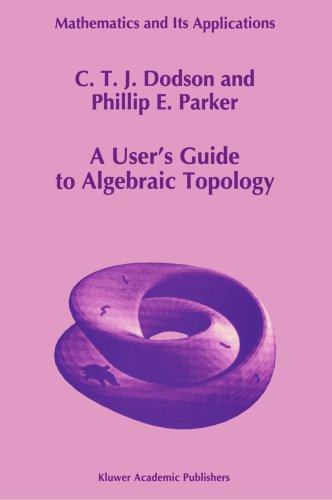
40. A User's Guide to Algebraic Topology (Mathematics and Its Applications)
by C.T. Dodson, P.E. Parker, Phillip E. Parker
Paperback: 420 Pages (1997-01-31)
list price: US$119.00 -- used & new: US$69.99
(price subject to change: see help)
Asin: 0792342933
Canada | United Kingdom | Germany | France | Japan
Editorial Review

Book Description
This book arose from courses taught by the authors, and isdesigned for both instructional and reference use during and after afirst course in algebraic topology. It is a handbook for users whowant to calculate, but whose main interests are in applications usingthe current literature, rather than in developing the theory. Typicalareas of applications are differential geometry and theoreticalphysics.
We start gently, with numerous pictures to illustrate the fundamentalideas and constructions in homotopy theory that are needed in laterchapters. We show how to calculate homotopy groups, homology groupsand cohomology rings of most of the major theories, exact homotopysequences of fibrations, some important spectral sequences, and allthe obstructions that we can compute from these. Our approach is tomix illustrative examples with those proofs that actually developtransferable calculational aids. We give extensive appendices withnotes on background material, extensive tables of data, and a thoroughindex.
Audience: Graduate students and professionals in mathematics andphysics. ... Read more


  Back | 21-40 of 100 | Next 20

Prices listed on this site are subject to change without notice.
Questions on ordering or shipping? click here for help.

site stats