e99 Online Shopping Mall

Geometry.Net - the online learning center Help  
Home  - Pure And Applied Math - Computer Science (Books)

  Back | 41-60 of 100 | Next 20

click price to see details     click image to enlarge     click link to go to the store

$24.95
41. Guide to Graduate Engineering
$52.25
42. Epistemic Logic for AI and Computer
$117.41
43. The Cartoon Guide to the Computer
$50.00
44. Computer Science: A Structured
$4.45
45. Great Jobs for Computer Science
$3.87
46. Concise Encyclopedia of Computer
$79.98
47. Languages and Machines: An Introduction
$2.90
48. Schaum's Outline of Essential
$5.00
49. Discrete Mathematics for Computer
$26.00
50. Philosophy and Computer Science
 
$34.75
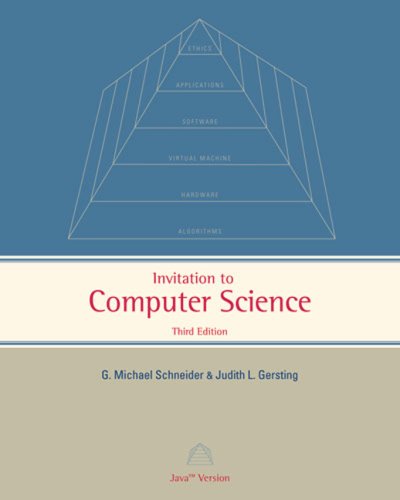
51. Invitation to Computer Science
 
52. An Introduction to Logic Programming
 
53. Prolog for Computer Science
$8.90
54. Foundations of Computer Science
$81.95
55. Milestones in Computer Science
$5.51
56. An Introduction to Computer Science
$46.50
57. Handbook of Logic and Proof Techniques
$53.80
58. Concrete Mathematics: A Foundation
$20.36
59. How Computers Work (9th Edition)
$184.99
60. Gre: Practicing to Take the Computer

41. Guide to Graduate Engineering & Computer Science Programs in Canada - 2001 Edition
Paperback: 276 Pages (2001-01-01)
list price: US$24.95 -- used & new: US$24.95
(price subject to change: see help)
Asin: 1894122798
Average Customer Review: 1.0 out of 5 stars
Canada | United Kingdom | Germany | France | Japan
Editorial Review

Book Description
This guide provides in-depth two-page profiles on engineering and computer science programs across Canada. It features a complete range of engineering programs including civil, chemical, electrical, mechanical, geological and environmental disciplines. The profiles highlight each program's unique features and strengths, admission requirements, expenses and more. Expert articles provide insights on trends and careers in engineering and computer science. Plus, tips on admissions and choosing a program help to answer every future graduate student's questions. ... Read more

Customer Reviews (1)

1-0 out of 5 stars Empty book with very little useful information
I bought this book assuming that i could get some sort of inside information about engineering programs in Canada.Upon flipping through the pages I found that most of the information was vague and easy to find anywhere on the internet.Furthermore, the 3 universities I am most interested in: UBC, Waterloo, amd University of Toronto (among the top engineering schools in Canada) were not even included in this book. ... Read more


42. Epistemic Logic for AI and Computer Science (Cambridge Tracts in Theoretical Computer Science)
by J.-J. Ch. Meyer, W. van der Hoek
Paperback: 368 Pages (2004-03-25)
list price: US$55.00 -- used & new: US$52.25
(price subject to change: see help)
Asin: 0521602807
Canada | United Kingdom | Germany | France | Japan
Editorial Review

Book Description
Epistemic logic has grown from its philosophical beginnings to find diverse applications in computer science as a means of reasoning about the knowledge and belief of agents. This book, based on courses taught at universities and summer schools, provides a broad introduction to the subject; many exercises are included together with their solutions. The authors begin by presenting the necessary apparatus from mathematics and logic, including Kripke semantics and the well-known modal logics K, T, S4 and S5. Then they turn to applications in the contexts of distributed systems and artificial intelligence: topics that are addressed include the notions of common knowledge, distributed knowledge, explicit and implicit belief, the interplays between knowledge and time, and knowledge and action, as well as a graded (or numerical) variant of the epistemic operators. The problem of logical omniscience is also discussed extensively. Halpern and Moses' theory of honest formulae is covered, and a digression is made into the realm of non-monotonic reasoning and preferential entailment. Moore's autoepistemic logic is discussed, together with Levesque's related logic of 'all I know'. Furthermore, it is shown how one can base default and counterfactual reasoning on epistemic logic. ... Read more


43. The Cartoon Guide to the Computer
by Larry Gonick, Mark Wheelis
Paperback: 249 Pages (1991-08-14)
list price: US$15.00 -- used & new: US$117.41
(price subject to change: see help)
Asin: 0062730975
Average Customer Review: 4.0 out of 5 stars
Canada | United Kingdom | Germany | France | Japan
Editorial Review

Book Description
A fun and easy way to learn about computers, now redesigned to match the other cartoon guides. Illustrated with cartoons throughout. ... Read more

Customer Reviews (3)

5-0 out of 5 stars Old Text, but still very Relevant
This book will not help you design applications around XML, nor show you how to use the SDK/IDE's for Java, C++/C#, etc.Nor will it explain how to write drivers for new devices, it is an excellent survey and introduction to the core concepts of information technologies.

The text includes some humor, and some history. But it clearly explains the basics of information theory, and logical operations.While computing hardware and software has become more complex and subtle, the data algorithms and logical operations performed have not changed since 1950. What has changed is the speed and degree of parallelism that is used to increase hardware and software performance (speed and power).

The cartoon format makes the book appear much less instructive than it actually is.But the illustraions clarify the text, as if to remind readers that a picture is worth many words.Unlike most hardcover texts, this one is likely to be read by bright or curious kids (the ones who go ot to excel in life).So, it's actually a much better book for teaching than most of the others offered by publishers (because students pick it up to read on their own).

Try this test: ask someone about computing, calculation theory, and logical operations before AND after they read this book. You might be surprised at how much they learn -- it even works on those adults and old people who never seem to be able to learn anything.


2-0 out of 5 stars A nice history, but out of date.
"The Cartoon Guide to the Computer" by Larry Gonick is another of his informative cartoons about different subjects.This book was originally titled "The Cartoon Guide to Computer Science", and was published in 1983.So much has happened in the world of computers since 1983, that this book has become very dated.This book still works as a history of Computers, but the parts of the book which focus more on the current state of computers is no longer relevant, nor was it when the book was published again in 1991 by HarperPerennial.

The areas that are well done include the history of the subject and related subjects, the overview of how computers work, the sections on logic and binary numbers.The parts that are poor are those on the PC, and BASIC programming, which suffer from being out of date and no longer relevant.There are several subjects that are missing too, such as networking and the Internet.If you are seeking a light-hearted trip down memory lane in the field of computers, then this might be a good choice, otherwise you may want to look elsewhere.In 1983, this probably would have been a four star book, but today I can only give it two.

5-0 out of 5 stars Learning can't be any funnier or more creative
Covers from logic (gate) design up through floating point and (Shannon) communication theory with flair for humor && information. Best used as a light read OR semester course introducing computing for ages 4 & up. ... Read more


44. Computer Science: A Structured Programming Approach Using C (3rd Edition)
by Behrouz A. Forouzan, Richard F. Gilberg
Paperback: 1156 Pages (2005-02-01)
list price: US$82.95 -- used & new: US$50.00
(price subject to change: see help)
Asin: 0534491324
Canada | United Kingdom | Germany | France | Japan

45. Great Jobs for Computer Science Majors 2nd Ed.
by Jan Goldberg
Paperback: 224 Pages (2002-09-24)
list price: US$14.95 -- used & new: US$4.45
(price subject to change: see help)
Asin: 0071390391
Average Customer Review: 4.5 out of 5 stars
Canada | United Kingdom | Germany | France | Japan
Editorial Review

Book Description

Answers the question, "What can I do with a major in . . . ?"

Students can explore their career options within their field of study using the Great Jobs series as their guide. From assessing individual talents and skills to taking the necessary steps to land a job, every aspect of identifying and getting started in a career choice is covered. Readers learn to explore their options, target an ideal career, present a major as an asset to a job, perfect a job search, and follow through and get results.

Download Description
Students can explore their career options within their field of study using the Great Jobs series as their guide. From assessing individual talents and skills to taking the necessary steps to land a job, every aspect of identifying and getting started in a career choice is covered. Readers learn to explore their options, target an ideal career, present a major as an asset to a job, perfect a job search, and follow through and get results. ... Read more

Customer Reviews (3)

4-0 out of 5 stars Useful and informative.
I read this book and "The Secret Path to Contract Programming Riches." Together, they helped me basically skip normal employment and get a computer programming job almost immediately after finishing school. This book helped me see what options I had - I never knew there were so many!

I was very interested in programming/consulting and this book helped direct my focus to achieve my goal. Although it doesn't tell you exaclty how to become a programmer/consultant, expecially right out of school, which is very hard, it helped me search for more knowledge and that's how I came upon "The Secret Path to Contract Programming Riches...,"which showed me exactly what to do to become a contract programmer as quickely as I can.

If you are like me, "Great Jobs for Computer Science Majors" will be but one of many great books in your life that helps shape your destiny and career fulfillment.

5-0 out of 5 stars Great Jobs for Computer Science Majors
I'll make it short and sweet. If you buy this book and follow it step bystep, not only will you have a great paying job, but you will have fun,too.

I got a great paying job at a large corporation and I have not evengraduated yet. That is how good this book is!!!!!!!!!

5-0 out of 5 stars Great book
As a computer scince major I found this book very useful. It go tme think about what I really wanted to do and what my options where. the great books is very well done I have a few of there books, they are a must read for college students ... Read more


46. Concise Encyclopedia of Computer Science
Paperback: 640 Pages (2004-09-15)
list price: US$75.00 -- used & new: US$3.87
(price subject to change: see help)
Asin: 0470090952
Canada | United Kingdom | Germany | France | Japan
Editorial Review

Book Description
The Concise Encyclopedia of Computer Science has been adapted from the full Fourth Edition to meet the needs of students, teachers and professional computer users in science and industry.  As an ideal desktop reference, it contains shorter versions of 600f the articles found in the Fourth Edition, putting computer knowledge at your fingertips. 

Organised to work for you, it has several features that make it an invaluable and accessible reference.  These include:

  • Cross references to closely related articles to ensure that you don’t miss relevant information
  • Appendices covering abbreviations and acronyms, notation and units, and a timeline of significant milestones in computing have been included to ensure that you get the most from the book.
  • A comprehensive index containing article titles, names of persons cited, references to sub-categories and important words in general usage, guarantees that you can easily find the information you need. 

 Classification of articles around the following nine main themes allows you to follow a self study regime in a particular area: 

  • Hardware
  • Computer Systems
  • Information and Data
  • Software
  • Mathematics of Computing
  • Theory of Computation
  • Methodologies
  • Applications
  • Computing Milieux.

Presenting a wide ranging perspective on the key concepts and developments that define the discipline, the Concise Encyclopedia of Computer Science is a valuable reference for all computer users. ... Read more


47. Languages and Machines: An Introduction to the Theory of Computer Science (3rd Edition)
by Thomas A. Sudkamp
Hardcover: 672 Pages (2005-02-24)
list price: US$113.00 -- used & new: US$79.98
(price subject to change: see help)
Asin: 0321322215
Average Customer Review: 3.0 out of 5 stars
Canada | United Kingdom | Germany | France | Japan
Editorial Review

Amazon.com
Languages and Machines is a user-friendly text that covers the key ideas of the theory of computation clearly and thoroughly. Examples and numerous diagrams, including diagrams that illustrate the principle of induction, aid in the understanding of the material. Relative to other books containing similar information, this text contains in-depth coverage of languages and parsing.Book Description

The third edition of Languages and Machines: An Introduction to the Theory of Computer Science provides readers with a mathematically sound presentation of the theory of computer science.The theoretical concepts and associated mathematics are made accessible by a "learn as you go" approach that develops an intuitive understanding of the concepts through numerous examples and illustrations.

... Read more

Customer Reviews (12)

2-0 out of 5 stars No Examples ,No Answers,No Hints
Besides the fact that the book is "dry", in which most Math theory based books are,the examples are just the basis step towards solving a problem.I equate it to teaching a child how to add, and just giving them the example "1 + 0", then assume they can figure out the rest.There are no answers, either in the back of the book for particular exercies, nor was a study guide made available.What is really shocking is that it's the most expensive book out there! Not to mention that there isn't any programming steps made available.Great text for a Math major ... horrible textbook for Computer Science Majors, mainly becausecomputer science majors would want to see programming examples and may not be as strongly math oriented as a Math major would be.

4-0 out of 5 stars A Good Book for a Tough Subject
Abstract language theory is hard, but Languages and Machines does a very good job of explaining the subject step by step. The topics are covered extremely thoroughly and with just the right amount of rigor.As for those who claim it's not exciting enough, you can't get blood out of a stone.Only the most dedicated computer scientist and mathematicians will find this topic interesting.Even so, this book does a superb job of tying theory to application (e.g., the machines one can use language theory to build) for even the most obscure concepts (like the Greibach Normal Form).

That being said, there are a few problems.First, the author's claim that this is a book for undergrads is not credible (except perhaps at MIT or CalTech).Even my graduate students have to read sections multiple times to "get it".Second, the author needs to provide solutions to selected problems at the back of the textbook.Most theory books do this, but not this one.This is a major weakness, especially given the difficulty of the material.Lastly, Sudkamp's proofs are extremely dry and very difficult to follow.He should take a cue from Sipser's excellent book (Intro to Theory of Computation) and introduce "proof ideas" to give the big picture for important proofs.

4-0 out of 5 stars emphasises the Turing machine
[A review of the 3RD EDITION, 2005.]

Sudkamp gives a formal and rigorous explanation of what constitutes a language. Where this is deliberately taken to include both natural (spoken) languages and programming languages. To do this, you should note that the treatment is necessarily non-trivial. It is not a lightweight book, conceptually.

The book summarises decades of work in this field, that have attempted to reduce human languages to a form that could be "understood" by a machine. So he explains the various techniques that have arisen. Like finite state machines (finite automata).

Notably, he discusses what is a Turing machine. A universal computing engine, that all other computers can map to. Such a Turing machine might be deterministic or non-deterministic. You can learn very powerful unifying ideas.

From the construct of a Turing machine, the book uses this to delve into problems that are NP complete or P complete. The implementation of a solution as steps to be done by a Turing machine are elegant, and show how such a machine, while an idealisation, can be used to give provable results.

1-0 out of 5 stars horrified
The book is incredibly boring.If you're condemned to read it (say, it's required reading for your qualifiers), I strongly recommend that you find a group of people to study w/ and pool your resources to only buy a single copy.The lack of answers at the back of the book makes self study difficult, and groupwork might be the only way to stay awake.

I wish to God I could think of another book to recommend over this one.I imagine any will do.

4-0 out of 5 stars Taught by the author!
Hey,
I was fortunate enough to learn this course from the author of the book. The book by itself might seem tough. The fault lies in the fact that subject matter is not altogether too simple to understand without someone teaching it to you!

With the help of the instructor, we did learn a lot about formal languages, finite automaton, regular grammer, etc.

The key to understanding this material (and using this book effectively) is solving as many problems as possible, preferably in a group setting so that solutions can be discussed.
Note: For most problems, there exists multiple solutions, and the approach is what needs to be learned and discussed.

Recommended, with some reservations...Good luck! ... Read more


48. Schaum's Outline of Essential Computer Mathematics
by Seymour Lipschutz
Paperback: 256 Pages (1982-04-01)
list price: US$15.95 -- used & new: US$2.90
(price subject to change: see help)
Asin: 0070379904
Average Customer Review: 3.5 out of 5 stars
Canada | United Kingdom | Germany | France | Japan
Editorial Review

Book Description

The mathematical knowledge needed for computer and information sciences­­including, particularly, the binary number system, logic circuits, graph theory, linear systems, probability and statistics­­get clear and concise coverage in this invaluable study guide. Basic high school math is all that's needed to follow the explanations and learn from hundreds of practical problems solved step-by-step. Hundreds of review questions with answers help reinforce learning and increase skills.

... Read more

Customer Reviews (4)

4-0 out of 5 stars Well written but all over the map as far as subject matter
I found this Schaum's outline to be a very well written book on a variety of elementary mathematical subjects probably most suitable for someone who has just graduated high school and is a freshman starting some kind of technical degree. However, beyond that, I am not sure exactly who the target audience is supposed to be. The book contains some information on the very basic computer math that a college freshman engineering or ITstudent would need to know such as binary number systems and computer codes and math. However, some of the other material is very much oriented towards the aspiring computer engineer but is not really mathematical such as the sections on logic, flowcharts, sets and relations, and logic gates. Other sections are mathematical but don't necessarily have anything to do with computers and could be just as helpful to a student of applied mathematics such as the sections on linear algebra, linear equations, statistics, and graph theory.

Thus my recommendation would be that if you need a good tutorial on a variety of mathematical and pseudo-mathematical topics that tie in well with a technical degree of any kind, the low price of admission on this odd little outline is probably worth it. Just don't expect it to rescue you in any one course in particular. It will more likely rescue you in particular sections of several courses instead.

5-0 out of 5 stars Great book which helped me tremendously
This book tremendously helped me understand computers and their relationship to mathematics and helped clear about doubts all through the semesters in college that I studied computer science. I strongly recommend this book to anyone majoring in computer science, information technologies, computer programming, etc ... as this book serves as a pillar to understanding the fundamentals of computer hardware and software.

4-0 out of 5 stars A cheap and good book
The book is pretty much suitable for students who has finishedhigh school maths but requires revision on maths for computing. A few chapters are simple enough for students to run over quickly. There is asupplementary questions and solved questions with working for student tounderstand and practice on. Overall the book is good enough to refresh yourmemory on computer maths.

1-0 out of 5 stars very poorly structured
For a start this book is never intended to be used by itself but as a supplement,so any attempt to use it as a textbook will only reslut in frustartion. Furthermore its not geared to teach as many VERY importantconcepts are simply ommited and the author makes far too many assumptionswhich all results in an incomplete book. The book attempts to cut studytime but also ends up cutting too much in clear and sufficent explanations.Use this book once you have completly mastered whathever topic you areinvolved in,and even then its only good for the practise problems at theend of each chapter. All in all DONT buy this book if you are trying tolearn something...use it ONLY for reviwing and just as a supplement. ... Read more


49. Discrete Mathematics for Computer Science (with Student Solutions Manual CD-ROM)
by Gary Haggard, John Schlipf, Sue Whitesides
Hardcover: 624 Pages (2005-02-01)
list price: US$144.95 -- used & new: US$5.00
(price subject to change: see help)
Asin: 053449501X
Canada | United Kingdom | Germany | France | Japan
Editorial Review

Book Description
Master the fundamentals of discrete mathematics with DISCRETE MATHEMATICS FOR COMPUTER SCIENCE with Student Solutions Manual CD-ROM! An increasing number of computer scientists from diverse areas are using discrete mathematical structures to explain concepts and problems and this mathematics text shows you how to express precise ideas in clear mathematical language. Through a wealth of exercises and examples, you will learn how mastering discrete mathematics will help you develop important reasoning skills that will continue to be useful throughout your career. ... Read more


50. Philosophy and Computer Science (Explorations in Philosophy)
by Timothy Colburn
Paperback: 224 Pages (1999-12)
list price: US$36.95 -- used & new: US$26.00
(price subject to change: see help)
Asin: 156324991X
Canada | United Kingdom | Germany | France | Japan

51. Invitation to Computer Science Laboratory Manual: C++ and Java
by Kenneth Lambert, Thomas Whaley
 Paperback: 268 Pages (2006-02-20)
list price: US$38.95 -- used & new: US$34.75
(price subject to change: see help)
Asin: 1418837547
Average Customer Review: 5.0 out of 5 stars
Canada | United Kingdom | Germany | France | Japan

Customer Reviews (1)

5-0 out of 5 stars Text Book
I received the book quickly and it was in the condition the buyer said it was in. ... Read more


52. An Introduction to Logic Programming Through Prolog (Prentice Hall International Series in Computer Science)
by J. M. Spivey, Michael Spivey
 Textbook Binding: 352 Pages (1996-03-05)
list price: US$37.33
Isbn: 0135360471
Average Customer Review: 5.0 out of 5 stars
Canada | United Kingdom | Germany | France | Japan

Customer Reviews (1)

5-0 out of 5 stars This is a very very useful book for beginners.
The book is useful to everyone interested in the subject of Logic Programming. It contains all aspects of Logic Programming in a clear and highly comprehensive manner. The concepts of SLD-resolution, negation asfailure and many others have been presented so lucidly that a person withalmost no knowledge in the subject can read them like stories. I liked thechapter of hardware simulation very much. I strongly recommend the book atleast to those who have already made up their minds to switch to anothersubject. Readers may just look at the book once to verify my words. ... Read more


53. Prolog for Computer Science
by M. S. Dawe, C. M. Dawe
 Paperback: 186 Pages (1994-11)
list price: US$31.95
Isbn: 0387198113
Canada | United Kingdom | Germany | France | Japan

54. Foundations of Computer Science
by Behrouz A. Forouzan, Sophia Chung Fegan
Paperback: 384 Pages (2002)
list price: US$70.95 -- used & new: US$8.90
(price subject to change: see help)
Asin: 0534379680
Average Customer Review: 5.0 out of 5 stars
Canada | United Kingdom | Germany | France | Japan
Editorial Review

Book Description
Foundations of Computer Science: From Data Manipulation to Theory of Computation successfully provides students with an overview of the many specializations within the field of computer science. Although many incoming freshman students are familiar with computers, they are often unaware of the broad field of computer science beyond the task of programming. Behrouz Forouzan has developed a five-part approach to introduce students to different aspects of the discipline without overwhelming them with technical detail. These topics include computer and data, computer hardware, computer software, data organization, and advanced topics. Throughout the book, Forouzan emphasizes the concept rather than the mathematical model, and difficult topics are supplemented with visual aids as needed to help students grasp concepts. ... Read more

Customer Reviews (1)

5-0 out of 5 stars it is satisfy KIS rule
KIS = Keept It Simple

i am surprise to have a booke like it
it is cover many aspect of computer scince and put the reader at the begining road, it acts as a key to many sciences inside computer science.


yeh i know it give an intruduction but think first we takl about
Introduction To Computer Science

It is so nice book...
I like it.

... Read more


55. Milestones in Computer Science and Information Technology
by Edwin D. Reilly
Hardcover: 392 Pages (2003-08-30)
list price: US$81.95 -- used & new: US$81.95
(price subject to change: see help)
Asin: 1573565210
Canada | United Kingdom | Germany | France | Japan
Editorial Review

Book Description
Using the same approach as the popular Milestones in Science and Technology and Milestones in Health and Medicine, this unique reference features more than 600 concise entries describing the most significant advances in the field of computer science and information technology. Arranged in a convenient A-to-Z format, entries explain topics in a wide variety of categories, including:

  • Hardware
  • Software
  • Theory
  • Mathematics
  • Programming
  • Languages
  • Memory
  • Architecture
  • Applications
  • Graphics Each entry presents a history of the topic's milestones, describes its current status, and recommends a source for additional research. Entries link key developments and discoveries to notable researchers and companies, from the famous figures like Alan Turing and Bill Gates to lesser-known names like Gordon Moore and Zuse. More than 30 illustrations, helpful cross-references, four indexes, and selected sources for additional reading help users navigate this reference and supplement their research. Whether you're researching cutting-edge technologies such as MP3, data encryption, and Beowulf clusters, or historical topics like Fortran, Packard Bell, and the Alto computer, students from high school and college, scholars, and the general public can easily find the facts and dates surrounding the most significant developments in the history of computing. Each entry presents a history of the topic's milestones, describes its current status, and recommends a source for additional research. Entries link key developments and discoveries to notable researchers and companies, from the famous figures like Alan Turing and Bill Gates to lesser-known names like Gordon Moore and Zuse. More than 30 illustrations, helpful cross-references, four indexes, and selected sources for additional reading help users navigate this reference and supplement their research. Whether you're researching cutting-edge technologies such as MP3, data encryption, and Beowulf clusters, or historical topics like Fortran, Packard Bell, and the Alto computer, students from high school and college, scholars, and the general public can easily find the facts and dates surrounding the most significant developments in the history of computing. ... Read more

  • 56. An Introduction to Computer Science Using Java
    by Samuel N. Kamin, M. Dennis Mickunas, Edward M. Reingold
    Paperback: 784 Pages (2001-12-11)
    list price: US$105.00 -- used & new: US$5.51
    (price subject to change: see help)
    Asin: 0072323051
    Average Customer Review: 2.5 out of 5 stars
    Canada | United Kingdom | Germany | France | Japan
    Editorial Review

    Book Description
    An Introduction to Computer Science Using Java by Kamin and Mickunas is designed for a CS1/Intro to Programming course in which java is used.The authors emphasize the process of programming, which teaches students how to develop correct, efficient, well-structed and stylish programs.

    In this new edition, the authors put more emphasis on object-oriented programming, greatly expanding their coverage and using a more graphical approach.At the same time, the text has retained its coverage of the traditionally fundamental computer science topics such as the development of correct programs, iteration, arrays, recursion, and algorithm analysis.This blend prepares students to become sophisticated computer programmers, not simply JAVA programmers.

    One of the unique aspects of the text are the debugging sections.In appropriate places throughout the text, the authors provide students with information on how to debug their programs.In addition, there are such pedagogical aids as "Bug Alerts" and a wide range of exercises, including new quick review exercises throughout the chapter. ... Read more

    Customer Reviews (13)

    1-0 out of 5 stars This book SUCKS!
    I'm currently a Computer Science major at the University of Memphis and unfortunately they used this book for their Introduction to Computer Science class. Sad to say, I failed the class because this book failed me! There's only so much that a professor can explain and you will need a reliable text, well written, with lots of examples on java programming to supplement the lectures. However, this awful text does not explain the basics of programming but instead bombards you with Computer Science concepts that are way over a beginner's head. It was useless to all of students in the class and nearly everyone had to go out and buy a second book, like "Headfirst Java" by Kathy Sierra. However, after spending $108.00 on this book, I refused to go out and purchase another text. So as the semester progressed and the students who'd purchase a different book grasped the programming concepts, I still grappled with this garbage and ultimately failed the class. So BEWARE, THIS BOOK SUCKS!

    4-0 out of 5 stars CS
    This books covers both first and second year
    concepts in computer science, as well as a variety
    of topics relevant to using Java.For an introduction
    to Java with minimal computer science, consult Deitel
    and Deitel.I would also recommend the book "Discrete
    Mathematics" by Rosen, or a similar book, to be used
    in conjunction with this text.If you learn using
    this book or perhaps SICP by Abelson (used at MIT),
    you will be much better off in the long run than using a
    less rigorous approach.

    4-0 out of 5 stars Not such a bad book at all
    Of course, they talk about getting JDK from Sun website in the *preface*. If you want to start out on your own this book is a good place to do that. A page of minor errata is available from Kamin's website, which perhapsbothered previous readers. Good book with a conversational style.

    1-0 out of 5 stars A mis-introduction...
    Throughly confusing. Of very little value to the cs student. Detrimental to the aspiring Java professional.

    1-0 out of 5 stars This book is terrible!
    This book is used by the Univ of Auckland for its stage 1 CS textbook and it won't be used next yr.

    As Java is a high level OOL, the authors did a very poor job in explaining even the very basic concept of OOP. (e.g.class, method, etc) ... Read more


    57. Handbook of Logic and Proof Techniques for Computer Science
    by Steven G. Krantz
    Hardcover: 300 Pages (2002-01-17)
    list price: US$62.95 -- used & new: US$46.50
    (price subject to change: see help)
    Asin: 081764220X
    Canada | United Kingdom | Germany | France | Japan
    Editorial Review

    Book Description

    Logic plays a central conceptual role in modern mathematics. However, mathematical logic has grown into one of the most recondite areas of mathematics. As a result, most of modern logic is inaccessible to all but the specialist. This new book is a resource that provides a quick introduction and review of the key topics in logic for the computer scientist, engineer, or mathematician.

    Handbook of Logic and Proof Techniques for Computer Science presents the elements of modern logic, including many current topics, to the reader having only basic mathematical literacy. Computer scientists will find specific examples and important ideas such as axiomatics, recursion theory, decidability, independence, completeness, consistency, model theory, and P/NP completeness. The book contains definitions, examples and discussion of all of the key ideas in basic logic, but also makes a special effort to cut through the mathematical formalism, difficult notation, and esoteric terminology that is typical of modern mathematical logic. T

    This handbook delivers cogent and self-contained introductions to critical advanced topics, including:

    * Godel`s completeness and incompleteness theorems

    * Methods of proof, cardinal and ordinal numbers, the continuum hypothesis, the axiom of choice, model theory, and number systems and their construction

    * Extensive treatment of complexity theory and programming applications

    * Applications to algorithms in Boolean algebra

    * Discussion of set theory and applications of logic

    The book is an excellent resource for the working mathematical scientist. The graduate student or professional in computer science and engineering or the systems scientist who needs to have a quick sketch of a key idea from logic will find it here in this self-contained, accessible, and easy-to-use reference.

    ... Read more

    58. Concrete Mathematics: A Foundation for Computer Science (2nd Edition)
    by Ronald L. Graham, Donald E. Knuth, Oren Patashnik
    Hardcover: 672 Pages (1994-03-10)
    list price: US$74.99 -- used & new: US$53.80
    (price subject to change: see help)
    Asin: 0201558025
    Average Customer Review: 4.0 out of 5 stars
    Canada | United Kingdom | Germany | France | Japan

    Customer Reviews (28)

    4-0 out of 5 stars A difficult but worthwhile mathematics text
    This book's title can be misleading. I would say it is more of an advanced textbook on the mathematics that is a foundation for computer science than a foundational book on the mathematics of computer science. I think this misreading of the title and thus the book's content is what is behind much of the heartache that readers have when trying to tackle it. This book expands on the "Mathematical Preliminaries" portion of "The Art of Computer Programming" series of books by Knuth, and thus this book has a style much like that series of books. The book is complete and clear, but it is also densely packed with lots of theory and proofs and will require much effort and time to understand well. It is really not meant to be an applied mathematics textbook at all. I show the table of contents next. Note that there are exercises at the conclusion of each chapter with solutions in the back of the book. However, most of the exercises are not so simple that you can just glimpse at the solution and figure out how to get from A to B. I recommend it if you have the time. It can really bring out thoughts and the beauty of mathematics that you may not have considered before.

    1. Recurrent Problems.
    The Tower of Hanoi.
    Lines in the Plane.
    The Josephus Problem.
    Exercises.

    2. Sums.
    Notation.
    Sums and Recurrences.
    Manipulation of Sums.
    Multiple Sums.
    General Methods.
    Finite and Infinite Calculus.
    Infinite Sums.
    Exercises.

    3. Integer Functions.
    Floors and Ceilings.
    Floor/Ceiling Applications.
    Floor/Ceiling Recurrences.
    'mod': The Binary Operation.
    Floor/Ceiling Sums.
    Exercises.

    4. Number Theory.
    Divisibility.
    Factorial Factors.
    Relative Primality.
    'mod': The Congruence Relation.
    Independent Residues.
    Additional Applications.
    Phi and Mu.
    Exercises.

    5. Binomial Coefficients.
    Basic Identities.
    Basic Practice.
    Tricks of the Trade.
    Generating Functions.
    Hypergeometric Functions.
    Hypergeometric Transformations.
    Partial Hypergeometric Sums.
    Mechanical Summation.
    Exercises.

    6. Special Numbers.
    Stirling Numbers.
    Eulerian Numbers.
    Harmonic Numbers.
    Harmonic Summation.
    Bernoulli Numbers.
    Fibonacci Numbers.
    Continuants.
    Exercises.

    7. Generating Functions.
    Domino Theory and Change.
    Basic Maneuvers.
    Solving Recurrences.
    Special Generating Functions.
    Convolutions.
    Exponential Generating Functions.
    Dirichlet Generating Functions.
    Exercises.

    8. Discrete Probability.
    Definitions.
    Mean and Variance.
    Probability Generating Functions.
    Flipping Coins.
    Hashing.
    Exercises.

    9. Asymptotics.
    A Hierarchy.
    O Notation.
    O Manipulation.
    Two Asymptotic Tricks.
    Euler's Summation Formula.
    Final Summations.
    Exercises.

    A. Answers to Exercises.
    B. Bibliography.

    5-0 out of 5 stars Great book... some reviewers simply don't get it.
    I have the First Edition and came here to look into the Second Edition. There are several negative reviews and basically those folks have fundamental misunderstandings. So I'll add my review.

    First, what kind of book is it? It is not an introductory-level math book with lots and lots of repetition. It is a book on hard math, done in a concise manner by brilliant teachers who assume students are very comfortable with calculus, probability, etc. You really cannot afford to skip around and dabble as if this were an introductory algebra course or something. (I'm not being elitist. I did not attend Stanford and don't consider myself a math genius and am not making this a "we versus the unwashed masses" issue, as I have really struggled with the material myself.)

    Second, what is the book about? Several reviewers have theories on where the "Concrete" part of the title comes from, but the bottom line is that it's a book on the discrete math that you need to know for theoretical computer science. (For example, discrete calculus versus the continuous calculus we all learned in school.) Any Analysis of Algorithms course, for example, will confront you with recurrence equations and lots of discrete math.

    Third, how is the book organized? At first, it appears rather disjoint. The authors have a sort of, "Hey, look at that flower," and "hey, look under this rock" kind of approach as you walk down a path but the path itself isn't really spelled out. None-the-less, the book does build step-by-step from examples of recurrence equations (Towers of Hanooi, Josephus) in Chapter 1, to Generating Functions in Chapter 7.

    Perhaps they could have made the path more explicit, but I can't see how they'd organize it much differently. They could throw entire chapters into Appendices, but things build on each other in such a way that you'd simply have to skip around from the main chapters to the Appendix anyhow.

    Fourth, what other books cover this material? I'm not well-qualified to talk about the entire universe of books, but I must say that the three Analysis of Algorithm books I have for my current class definitely give only the very basics of this material and really only present two possibilities: 1) fiddle around with the equation, possibly using a graphic representation, until you see a pattern and make a guess, then prove it by induction, or 2) if your algorithm is one specific class, plug some numbers into this 3-part formula and if one of the parts applies an answer will pop out for you. Concrete Math is gives you many powerful tools to solve such problems.

    Fifth, what is the flavor of the book? The authors have an informal writing style -- outside of the very formal math and proofs -- and the book has marginal notes that were contributed by the "beta-tester students" as the book was being written.

    Some reviewers have criticized the marginal notes, and I simply have to shake my head and be glad I don't have to work alongside them. Yes, many of the notes are puns or other humor, but those are a nice break from the heavy math. And many of the notes provide great hints and perspectives from students who are also learning the material. I wish all technical books had such notes, but only a Knuth could get a publisher to go to the trouble.

    So that's my review. An excellent book that's very intense and covers a hard, very technical topic. It's like learning math from algebra to differential equations all over again in a different language, and perhaps the negative reviewers simply never understood this. If you're not a programmer who needs to rigorously analyze algorithms, skip the book unless you simply want to learn for the joy of learning.

    2-0 out of 5 stars smug math book
    This is one of those math books where the authors enjoy making inexplicable leaps between equations that really don't follow in a smooth logical fashion one from another.They are terrible at explaining things.They like to boast that they are from Stanford, (subtext: implied: if you are not from Stanford you probably wouldn't understand it anyway, you poor pitiful low-income commoner).I absolutely hate the tone of this book.And the side comments in the margins are inane, weak and mostly irritating.I threw it aside in disgust and went back to Warren Weaver.

    5-0 out of 5 stars Concrete Math is fun
    This book is great.It is the funnest math book I have worked with, and I appreciate the intensity of the mathematics -- something that is falling out of the norm in computer science.The book is also a great source of fantastic combinatorics.

    5-0 out of 5 stars I wish every book were written like this!
    This book is perhaps one of the most beautifully written books I have ever read. All the proofs presented here are elegant. When reading the proofs in this book, you can feel that one sentence logically and smoothly follows from the previous sentence. This is partly because of the elegant and effective notations adopted by the authors. [Note: Donald Knuth, one of the authors, has been one of the biggest proponents of good mathematical notations. See his book titled "Mathematical Writing".]

    Other reviewers have provided a summary of this book. So, I will only say that every computer scientist and combinatorialist should read at least chapters 1, 2, 5, 7, and 9. Chapter 5 is very highly recommended. Trust me: once you have mastered these chapters, you will be able to do things your colleagues just can't. Even just familiarizing yourself with the notations in this book will help you produce proofs that you probably won't be able to otherwise. [Great ideas are of course always important in every proof - but without good notations, you probably won't be able to come up with the ideas in the first place.]

    There is pretty much nothing bad about this book that I am aware of. I will just say though that it takes a lot of time and effort to acquire mastery of the material. As for my own story, I started reading chapter 1 and 2 when I just got interested in discrete mathematics. It took me about 1/2 year (part time) to get through this. I came back to this book again when I took a course on "generatingfunctionology". I found that chapter 5 and 7 were indispensable. I was also forced to reread chapter 2 again because the lecturer, as most people do, just waived his hands when it comes to manipulating sums and binomial coefficients. However, all the effort that I put in paid off in the end as I could solve problems in the final exam which all my other friends could not.

    In summary, I strongly recommend this book to every computer scientist and combinatorialist. I will finally remark that, if you are serious about learning concrete mathematics, you will probably find that generating functions pop up pretty much everywhere. To understand these beasts, I highly recommend Sedgewick and Flajolet's "Introduction to Analysis of Algorithms" and "Analytic Combinatorics" (not yet published, but next-to-final draft is available at Flajolet's web site), and Wilf's "Generatingfunctionology". ... Read more


    59. How Computers Work (9th Edition) (How It Works)
    by Ron White, Timothy Edward Downs
    Paperback: 464 Pages (2007-11-24)
    list price: US$34.99 -- used & new: US$20.36
    (price subject to change: see help)
    Asin: 0789736136
    Average Customer Review: 4.5 out of 5 stars
    Canada | United Kingdom | Germany | France | Japan
    Editorial Review

    Amazon.com
    Updated to include all the recent developments to the PC and complete with a CD-ROM, the third edition of How Computers Work is like a cool science museum in a book. But make no mistake--this is not a book for children. How Computers Work aims to teach readers about all the intricacies held within the machine, and it's a daunting task. The author, Ron White, doesn't dumb down his material; instead he provides thorough and substantive definitions. The pages of fun and colorful graphics ease the tension, though, and bring the abstract concepts--the difference between RAM and ROM, for example--into real life.

    The book has incredible depth, explaining everything you could want to know about your computer, with each piece of hardware being given full treatment over two to five pages. (Macintosh and UNIX users should be aware, though, that the book's model is the "Wintel," a Windows PC with an Intel microprocessor.) The book is well-structured and can easily be used as a reference resource beyond the first reading. --Jennifer Buckendorff Book Description

    Having sold more than 2 million copies over its lifetime, How Computers Work is the definitive illustrated guide to the world of PCs and technology. In this new edition, you’ll find detailed information not just about every last component of hardware found inside your PC, but also in-depth explanations about home networking, the Internet, PC security, and even how cell phone networks operate. Whether you’re interested in how the latest graphics cards power today’s most demanding games or how a digital camera turns light into data, you’ll find your answers right here.

    Ron White is a former executive editor and columnist for PC Computing, where he developed the visual concept behind How Computers Work. Founder of one of the

    earliest PC user groups, he has been writing about computers for 25 years and is known for building wildly extreme computers.

    Timothy Edward Downs is an award-winning magazine designer, illustrator, and photographer. He has directed and designed several national consumer, business, technology, and

    lifestyle magazines, always infusing a sense of “how it works” into every project.

    A full-color, illustrated adventure into the wonders of TECHNOLOOGY

    This full-color, fully illustrated guide to the world of technology assumes nothing and explains everything. Only the accomplished Ron White and award-winning Tim Downs have the unique ability to meld descriptive text with one-of-a-kind visuals to fully explain how the electronic gear we depend on every day is made possible. In addition to all the content you’ve come to expect from prior editions, this newly revised edition includes all-new coverage of topics such as:

    •How tablet PCs put the power of a PC quite literally in your hands

    •How Windows Vista makes your Windows desktop translucent and makes your PC more secure

    •How advances in optical disc technology such as dual-layer DVD, HD-DVD, and Blu-Ray discs continue to push the envelope

    •How Apple’s new iPhone is revolutionizing what cell phones can do

    •How BitTorrent technology enables anyone to share information with everyone

    For a decade, How Computers Work has helped newbies understand new technology, while at the same time hackers and IT pros have treasured it for the depth of knowledge it contains. This is the perfect book about computing to capture your imagination, delight your eyes, and expand your mind, no matter what your technical level!

    Category: General Computing

    Covers:PCs/Hardware

    User Level:Beginning–Intermediate

    ... Read more

    Customer Reviews (80)

    4-0 out of 5 stars How Computers Work Review
    Great book for information concerning the computer and the technology connected to it.However, it is not for a beginner or novice individual just starting out with a computer.

    5-0 out of 5 stars Great Book for any Level
    This book is really easy to understand and will leave you with a good understanding of the computer. Not only does it explain computers but other things you might be interested in are brought into the light too. For example, TiVo, MP3 players, printers, and monitors are in this book with detailed pictures and descriptions just like with the computer section. This book is a must buy for anyone with curiosity about computers or their cousins.

    5-0 out of 5 stars Ron White fan
    Besides the fact that I have every edition of Ron White's HOW COMPUTERS WORK, your marketing department is so effective that they have now conned me into buying two copies of the 8th Edition.I trust that this means that you will be sending me a single copy of the 9th Edition in the near future.

    3-0 out of 5 stars No disk
    This book did not come with the cd that came with earlier editions.

    4-0 out of 5 stars Great on basics
    Very good pictures. You'll walk away with a true understanding about how computers work. ... Read more


    60. Gre: Practicing to Take the Computer Science Test (3rd ed)
    by Educational Testing Services
    Paperback: 100 Pages (1997-11)
    list price: US$13.00 -- used & new: US$184.99
    (price subject to change: see help)
    Asin: 0446396281
    Average Customer Review: 2.5 out of 5 stars
    Canada | United Kingdom | Germany | France | Japan
    Editorial Review

    Book Description
    These practice workbooks and guides contain essential information for those preparing for GRE subject tests, including practice questions, full-length practice tests that were actually administered at international GRE subject test administrations, answer sheets, correct answers, score conversion tables, and performance data for students who took the tests. ... Read more

    Customer Reviews (10)

    1-0 out of 5 stars lousy
    This book has numerous omissions. Do not rely entirely on this book, but supplement it with others that you can easily find by searching Google for CS GRE practice (including free practice materials from ETS).

    By the way, For the general test, I found Powerprep Software: Test Preparation for the Gre General Test to be a worthwhile buy.

    1-0 out of 5 stars Save Your Money
    Textbooks and notes from past classes would be far more helpful than this book. The only valuable pieces of information are the section describing the content of the test and the practice test. Both of these are available in the free booklet you can download at the GRE site. (The practice test is exactly the same.)

    2-0 out of 5 stars looking for CS GRE books? this might help
    This books gives you general idea of test and let's you know what are the things you might not be prepared for. I don't have much else to say about this.

    Well, I searched for CS GRE books everywhere, couldn't find any; but finally found few books which might be of help if you are giving CS GRE.

    You mainly need books for

    Introductory programming (Pascal and C)
    Logic Design
    Data Structures
    Theory of Computation
    Computer Architecture
    Mathematics

    some operating system and compiler

    So get 5 solid books for these and you will be all set. And here are good books I found for preparing these topics. Finally :-( ( I have only a week left to prepare when I found these books)

    Schaum's outline in digital logic
    Schaum's outline essential computer mathematics

    these two (above) are excellent

    and
    schaum's outline Data Structures in C++
    schaum's outline Operating Systems
    schaum's outline theory and problems

    are good

    All of these books have required theory in them, followed by problems and solutions. Very well explained, easy to follow and just the right amount of info needed for CS GRE.

    Hope this helps. Good Luck ~ sameer

    3-0 out of 5 stars Other sources for help
    My intention with this review is actually not to evaluate this book, but insteado to suggest to other graduate applicants some very interesting sources of information for the GRE/Computer Science test.

    The first book I would like to recommend is Fundamentals of Data Structures, by Ellis Horowitz and Sartaj Sahni. It helped me to review subjects like binary trees, hashing, sorting, searching, and graphs.

    The second recommendation is Compilers: Principles, Techniques and Tools, by Aho, A., R. Sethi, and D. Ullman. There are many questions related to context-free grammars in the exam, and this book helped me to solve many of sample questions in the GRE:Practicing to Take the Computer Science Test book.

    There are some questions related to digital logic and binary arithmetics. One book very well written that could help on practicing binary operations is An Introduction to Computer Logic, by H. T. Nagle.

    In addition, the test generally features some questions with a small algorithm or piece of program, written in C, Pascal or structured english. A very good book, which has helped me not only to practice for this questions, is The C Programming Language, by B. Kernighan and D. Ritchie.

    Moreover, there are some questions related to computer architecture. A good source in this field is Computer Organization and Architecture, by W. Stallings.

    Finally, a good book that covers almost all the subjects is Computer Science, an Overview, by J. Gleen Brookshear. It is a nice material for a final review, and also comes with questions/answers of binary arithmetics.

    I hope this essay be helpful for you as a guide to find material to complement the practicing tests.

    2-0 out of 5 stars Useful, but only just
    This book contains some sample questions on each topic of the GRE Computer Science Subject Test. After practicing these questions, one can try out the Full-length test which looks and feels exactly like the actual test.

    Thisbook will be useful as a last minute review for the test. One can try to dothe sample test and measure oneself before the actual test. However, thedetails of the test and steps to prepare, etc are exactly the same as thoseon the Bulletin, which is availible for free download at gre.org oravailible when you apply for the test.

    A more detailed specification ofthe syllabus and some more sample question will be worthy additions. ... Read more


      Back | 41-60 of 100 | Next 20

    Prices listed on this site are subject to change without notice.
    Questions on ordering or shipping? click here for help.

    site stats