e99 Online Shopping Mall

Geometry.Net - the online learning center Help  
Home  - Pure And Applied Math - K-theory (Books)

  1-20 of 100 | Next 20

click price to see details     click image to enlarge     click link to go to the store

$64.10
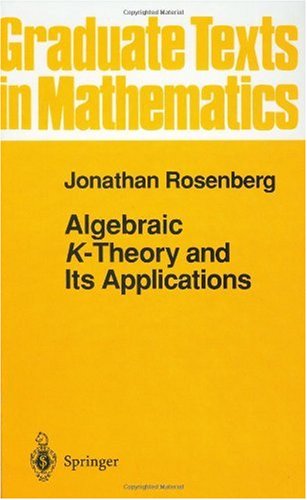
1. Algebraic K-Theory and Its Applications
$115.34
2. An Algebraic Introduction to K-Theory
$40.00
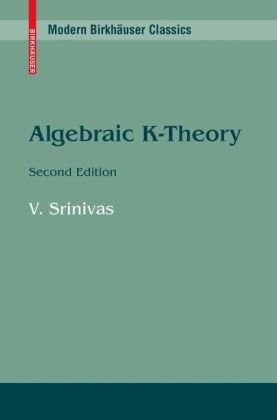
3. Algebraic K-Theory (Progress in
$47.25
4. Complex Topological K-Theory (Cambridge
$28.92
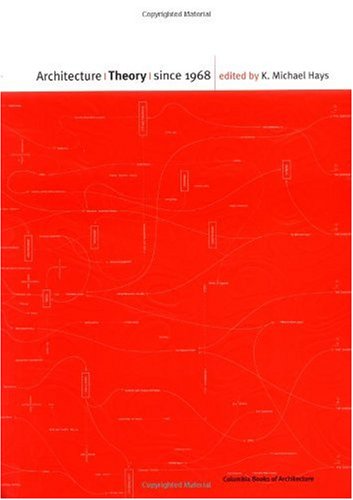
5. Architecture Theory since 1968
$17.75
6. Reflections on Leadership: How
$32.00
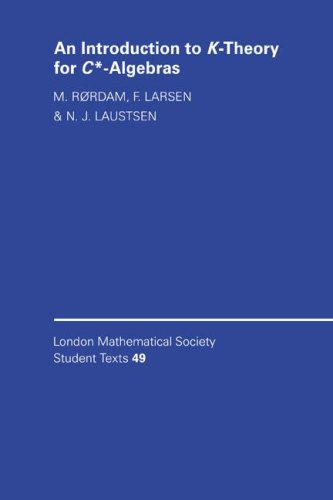
7. An Introduction to K-Theory for
$111.00
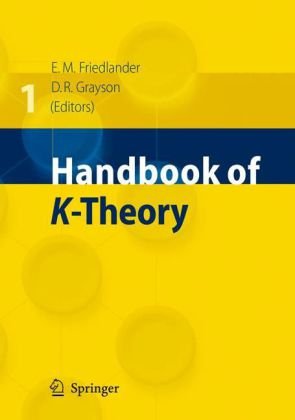
8. Handbook of K-Theory, 2 volume
9. Social Theory and Social Structure
$87.37
10. Basic Bundle Theory and K-Cohomology
$59.00
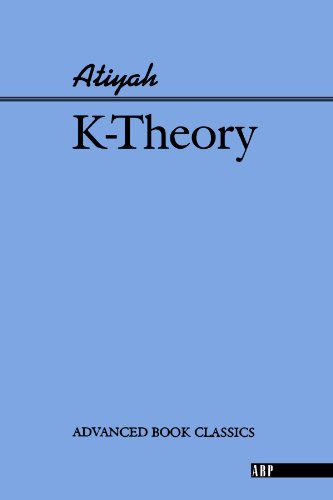
11. K-Theory (On Demand Printing of
$38.38
12. K-Theory for Operator Algebras
$42.75
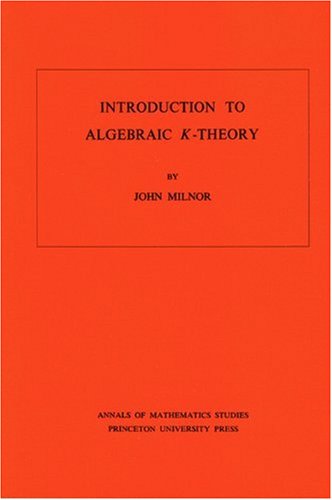
13. Introduction to Algebraic K-Theory.
$20.00
14. Microeconomics: Theory & Applications
$31.68
15. Topological and Bivariant K-Theory
 
16. Algebraic K-theory (Mathematics
 
$108.42
17. Parsing Theory: LR(k) and LL(k)
$103.47
18. L2-Invariants: Theory and Applications
$8.99
19. Thinking Strategically: The Competitive
$46.00
20. Algebraic K-Theory I. Proceedings

1. Algebraic K-Theory and Its Applications (Graduate Texts in Mathematics)
by Jonathan Rosenberg
Hardcover: 392 Pages (1995-12-22)
list price: US$79.95 -- used & new: US$64.10
(price subject to change: see help)
Asin: 0387942483
Average Customer Review: 5.0 out of 5 stars
Canada | United Kingdom | Germany | France | Japan
Editorial Review

Book Description
Algebraic K-Theory plays an important role in many areas of modern mathematics: most notably algebraic topology, number theory, and algebraic geometry, but even including operator theory. The broad range of these topics has tended to give the subject an aura of inapproachability. This book, based on a course at the University of Maryland in the fall of 1990, is intended to enable graduate students or mathematicians working in other areas not only to learn the basics of algebraic K-Theory, but also to get a feel for its many applications. The required prerequisites are only the standard one-year graduate algebra course and the standard introductory graduate course on algebraic and geometric topology. Many topics from algebraic topology, homological algebra, and algebraic number theory are developed as needed. The final chapter gives a concise introduction to cyclic homology and its interrelationship with K-Theory. ... Read more

Customer Reviews (1)

5-0 out of 5 stars Very effective and understandable overview of K-theory
Speaking somewhat loosely, algebraic K-theory could be viewed as an attempt to generalize the invariants of linear algebra (such as determinants and canonical forms) to the case of projective modules. In modern mathematical classification, it is to be distinguished from topological K-theory, although both have a lot in common in terms of the general mathematical machinery used and were motivated from similar research interests. This book gives a superb overview of algebraic K-theory, and could be read by anyone who has taken a course in commutative algebra or a course in the theory of rings.The reader will see a common theme throughout algebraic K-theory, namely that of abelianization, which is very prevalent throughout modern mathematics.

In chapter 1, the author begins the construction of K0. After defining projective modules (over a ring R with a unit), and he characterizes finitely generated projective R-modules. The isomorphism classes of finitely generated projective R-modules form an abelian semigroup, the completion of which is the well-known Grothendieck group, and which is defined to be K0(R). The author also develops an alternative approach to K0 using idempotent matrices, thus making a connection with the general linear group. He shows both approaches are essentially equivalent, via the well-known "Morita invariance." Several examples of K0 are discussed, such as when R is a principal ideal domain, a local ring, and a Dedekind domain. The author also discusses to what extent K-theory can be viewed as a "homology for rings". This is relative K-theory, which is defined for two-sided ideals in R. Also, he gives the reader a taste of topological K-theory.

Just as one studies linear transformations of vector spaces and their invariants in linear algebra, the study of automorphisms of free and projective modules is done in K-theory, particularly via the construction of the K1 functor. In chapter 3, the author constructs K1 via the use of matrices, with a more categorical approach delayed until chapter 4. The group of "elementary matrices" for a ring R is defined, and K1(R) is defined to be GL(R)/E(R). The vanishing of K1(R) is equivalent to saying that every matrix in GL(R) and be row or column reduced to the identity matrix. When R is a field, the calculation of K1(R) reduces to ordinary linear algebra via the use of the determinant, and as a consequence K1(R) becomes trivial. When R is a local ring, then there exists a generalization of the determinant, which induces an isomorphism between K1(R) and the matrix group of its units modulo its commutator. When R is a Euclidean ring, K1(R) is isomorphic to its group of units, but when R is a principal ideal domain or a Dedekind domain, the author shows that K1(R) is not so elementary. He again gives a brief discussion of the application of K-theory, via the K1 functor, to topology. The relative K1 theory is also discussed.

Chapter 4 is an overview of how to construct K-theory for categories, instead of just rings. The categories considered are those that are ones wherein it is sensible to speak of an object as being constructed from more elementary objects, and are "abelian" categories, i.e. those that allow such homological results as the Five-Lemma. For a ring R, such categories include those of the category of finitely generated R-modules, the category of R-modules with a finite-type projective resolution, as well as of course the category of finitely generated projective R-modules. After discussing the connection between K0(R), K1(R) and K1 of the Laurent polynomial ring in R (the Bass-Heller-Swan theorem), the author introduces the notion of "negative K-theory", which gives the construction of an exact sequence of an ideal "arbitrarily far to the right", and thus allows the computation of K0(R/I) given information about R and I.

In chapter 5 the author describes the construction of the K2 functor as accomplished by the mathematician John Milnor. This entails a review of the theory of universal central extensions, which the author does in the first section. Following up on the idea that the K-theory of rings measures in some sense the abelian invariants of the non-abelian group GL(R), for a ring R, K2(R) is related to central extensions of E(R) by abelian groups: K2(R) is the kernel of the map of the universal extension of E(R), called the Steinberg group, to E(R). Some examples of the calculation of K2(R) are given, such as for the case where R is a field, wherein K2(R) is generated by the "Steinberg symbols." If R is a finite field, then K2(R) is zero. The lengthy concentration on the case where R is a field is done in order to point out the connection of K2 with number theory. When R is a field, the well-known Brauer group relates K2(R) to finite-dimensional non-abelian division algebras over R, and the author discusses this is fair detail.

The construction of the higher algebraic K-functors, i.e. Ki(R) for i greater than or equal to 3, is done in chapter 5 using the +-construction due to Daniel Quillen. It is here that topological considerations are brought to the forefront, since the Quillen approach is to construct the higher K-functors in terms of the homotopy groups of a particular space, called the classifying space. In particular, the (higher) K-theory of a ring R is defined as the product of the group of units of the classifying space of R and K0(R). The author shows that this definition of K-theory does coincide with that of K0 and K1 done earlier in the book. A brief but interesting survey (with proofs omitted) of the applications of the higher K-groups ends the chapter.

I did not read the last chapter on cyclic homology, and so its review will be omitted. ... Read more


2. An Algebraic Introduction to K-Theory
by Bruce A. Magurn
Hardcover: 690 Pages (2002-01-15)
list price: US$138.00 -- used & new: US$115.34
(price subject to change: see help)
Asin: 0521800781
Average Customer Review: 5.0 out of 5 stars
Canada | United Kingdom | Germany | France | Japan
Editorial Review

Book Description
This book is both an introduction to K-theory and a text in algebra.These two roles are entirely compatible.On the one hand, nothing more than the basic algebra of groups, rings, and modules is needed to explain the clasical algebraic K-theory.On the other hand, K-theory is a natural organizing principle for the standard topics of a second course in algebra, and these topics are presented carefully here.The reader will not only learn algebraic K-theory, but also Dedekind domains, class groups, semisimple rings, character theory, quadratic forms, tensor products, localization, completion, tensor algebras, symmetric algebras, exterior algebras, central simple algebras, and Brauer groups. The presentation is self-contained, with all the necessary background and proofs, and is divided into short sections with exercises to reinforce the ideas and suggest further lines of inquiry. The prerequisites are minimal: just a first semester of algebra (including Galois theory and modules over a principal ideal domain).No experience with homological algebra, analysis, geometry, number theory, or topology is assumed.The author has successfuly used this text to teach algebra to first year graduate students. Selected topics can be used to construct a variety of one-semester courses; coverage of the entire text requires a full year. ... Read more

Customer Reviews (1)

5-0 out of 5 stars Didactic perfection
Mathematics, particularly research mathematics, or mathematics that is close to the frontiers of research would be considerably easier to learn if mathematicians would both explain what they are going to do and explain what historical context motivates the problems or issues they are interested in. This would grant the needed insights and "intuitions" into the subject, which are absolutely necessary if one is to understand a particular mathematical topic in depth. In their papers, monographs, and textbooks, mathematicians could perhaps include at various places in the text some `fundamental insights' into the concepts that are being discussed. In addition, they could describe in detail what their goals are and what strategies they are going to use to solve the problems as they develop.

Unfortunately not many works of mathematics are written in this manner, and so those who wish to learn a given topic must frequently undertake time-consuming literature searches and solve myriads of exercises and problem sets in order to gain the needed insight. This takes large blocks of time, and poses an even greater challenge for those, such as physicists, who not must not only master the physics but also the mathematical formalism used to frame physical theories. Physicists would welcome, and even in many cases grab at straws to learn mathematics in a way that they need to in order to push forward the frontiers of their own subject.

This book though is very different, and is one of the best works of mathematics put in print in the last three decades. The author has given the reader a work that is not only mathematically rigorous but also fits the learning framework discussed above. There is no doubt that K-theory is a highly esoteric subject, but it can be learned much more easily by the study of this book. Within its covers there are myriads of fundamental insights that the author shares with the reader that make the learning of K-theory much more palatable and actually downright fun. It should not be thought however that the reader does not have to exercise a fair amount of cognition when wrestling with the intricacies of K-theory. This is true for K-theory as with other branches of mathematics, but those hungry for a true understanding of K-theory will deeply appreciate the author's efforts in this book.

The goal of K-theory is to generalize linear algebra, the latter of which deals with linear transformations on vector spaces over fields. K-theory tries to find out, and make rigorous, what constructions in linear algebra carry over when the field is replaced by a ring R and the vector space is replaced by a module over this ring. The first issue that must be dealt with is that of the concept of dimension, which for the case of a vector space is well defined (it is the cardinality of its basis). But an R-module does not necessarily have a basis. So the strategy deployed by the author is find the R-modules that do have a dimension. To find out what it means for an R-module to have a basis, the author constructs R-modules that are generated by elements that are not "linearly related." These are called `free' R-modules and the generating set is called an `R-basis.' The author then characterizes free modules that have a finite basis. That this is a non-trivial exercise is proven by the fact that every nontrivial finite Abelian group is a Z-module, where Z is the ring of integers. In addition, every set is a basis of a free R-module so one must find `presentations' of R-modules. These allow the construction of R-modules satisfying certain needed properties. And then, as expected if one is to extend linear algebra, the author constructs `matrices' of R-linear maps between finitely generated free R-modules. However, a free R-module can have a basis with unequal cardinality, and therefore the author finds those rings R whose free modules have unique dimension and those over which every module is free. The needed property is called an `invariant basis number' and it turns out that most rings have an invariant basis number. But some finitely generated R-modules the author points out are too "small" to be free, and so he finds the appropriate generalization of free modules. These are the famous `projective modules' and are the objects on which algebraic K-theory is based.

The designation of "projective" refers to the familiar notion of a projection in ordinary vector space theory, i.e. a linear, idempotent operator. The author describes projective modules as being the `direct summands' of free R-modules, and so to obtain the needed generalization of dimension he constructs Abelian monoids of R-modules under the direct sum operation. This involves finding a universal construction of an Abelian group from a semigroup and this leads to the famous Grothendieck group K0(R) of finitely generated projective R-modules. The finitely generated projective R-modules are `stably isomorphic' if they become equal in K0(R); they are `stably equivalent' if they become congruent in K0(R) modulo finitely generated free modules. The strategy then becomes that of adding R to two finitely generated R-modules to make them stably isomorphic (or stably equivalent). In addition, one must find out to what extent K0(R) determines whether a finitely generated projective R-module is free. This brings up the notion of an R-module being `stably free', and the author finds those stably free R-modules which are free. This involves the notion of the `matrix completion' of a ring and of "shortening" unimodular rows. The author also studies the connection of K0 with number theory, eventually showing that the projective class group is isomorphic to the ideal class group when R is a Dedekind domain.

K0(R) is an element of a sequence of Abelian groups associated to each ring R. To find K1(R), the author finds an analog of the row operations in ordinary linear algebra. The elements of K1(R), the `Bass-Whitehead group' are row-equivalence classes of invertible matrices. A group homomorphism from K1(R) to a group G is the analog of the determinant in ordinary linear algebra, and is often called the `Whitehead-Bass' determinant. K1(R) can be thought of as the "abelianization" of the general linear group GL(R). The elements of K2(R) consist of the relations among the generators of the group of row operations on a matrix. The "standard" relations among these operations give the `Steinberg group', and K2(R) is the center of this group. ... Read more


3. Algebraic K-Theory (Progress in Mathematics (Birkhauser Boston))
by V. Srinivas
Hardcover: 364 Pages (1995-11-29)
list price: US$89.95 -- used & new: US$40.00
(price subject to change: see help)
Asin: 0817637028
Canada | United Kingdom | Germany | France | Japan

4. Complex Topological K-Theory (Cambridge Studies in Advanced Mathematics)
by Efton Park
Hardcover: 224 Pages (2008-03-31)
list price: US$75.00 -- used & new: US$47.25
(price subject to change: see help)
Asin: 0521856345
Canada | United Kingdom | Germany | France | Japan
Editorial Review

Book Description
Topological K-theory is a key tool in topology, differential geometry and index theory, yet this is the first contemporary introduction for graduate students new to the subject. No background in algebraic topology is assumed; the reader need only have taken the standard first courses in real analysis, abstract algebra, and point-set topology. The book begins with a detailed discussion of vector bundles and related algebraic notions, followed by the definition of K-theory and proofs of the most important theorems in the subject, such as the Bott periodicity theorem and the Thom isomorphism theorem. The multiplicative structure of K-theory and the Adams operations are also discussed and the final chapter details the construction and computation of characteristic classes. With every important aspect of the topic covered, and exercises at the end of each chapter, this is the definitive book for a first course in topological K-theory. ... Read more


5. Architecture Theory since 1968
Paperback: 824 Pages (2000-02-28)
list price: US$44.00 -- used & new: US$28.92
(price subject to change: see help)
Asin: 0262581884
Average Customer Review: 4.5 out of 5 stars
Canada | United Kingdom | Germany | France | Japan
Editorial Review

Book Description
In the discussion of architecture, the prevailing sentiment of the past three decades has been that cultural production can no longer be understood to arise spontaneously, as a matter of social course, but is constructed through ever more self-conscious theoretical procedures. The development of interpretive modes of various stripes--poststructuralist, Marxian, phenomenological, psychoanalytic, as well as others dissenting or eccentric--has given scholars a range of tools for rethinking architecture in relation to other fields and for reasserting architecture's general importance in intellectual discourse.

This long-awaited anthology is in some sense a sequel to Joan Ockman's Architecture Culture 1943-1968, A Documentary Anthology (1993). It presents forty-seven of the primary texts of contemporary architecture theory, introducing each by detailing the concepts and categories necessary for its understanding and evaluation. It also presents twelve documents of projects or events that had major theoretical repercussions for the period. Several of the essays appear here in English for the first time. ... Read more

Customer Reviews (5)

4-0 out of 5 stars Great for learning more in depth about architecture theory
A bit of a tough read though.

3-0 out of 5 stars Woa!
I'm a graduate student in architecture, and for a theory course we read selections from this book, and two other similar theory anthologies, Kate Nesbitt's "Theorizing a New Agenda for Architecture," and Niel Leach's "Rethinking Architecture." All books attempt to do roughly the same thing, and I have to say the Hays (this one) was the one I got the least out of.

I'll start with one minor criticism, which wouldn't condemn the book, but is extremely infuriating: the page numbers are printed on the inside upper corners of the pages near the spine, not the outside upper corners as is standard practice in books. This makes it difficult to flip through and find what you're looking for, and is just sort of a mind-bogglingly idiotic thing to do. Compounding the problem, many pages are simply not numbered!

That little complaint aside, I guess Hays does do a pretty good job with his selection of essays. If anything it illustrates how much the discourse has obfuscated itself over the last 30+ years. To give you the the flavor of the book, here are a few selections:

"The concept of architecture is itself an inhabited constructum, a heritage wich comprehends us even before we could submit it to thought. Certain invariables remain, constant, through all the mutations of architecture. Impassable, imperturbable, an axiomatic traverses the whole history of architecture. An axiomatic, that is to say, an organized ensemble of fundamental and always presupposed evaluations. This hierarchy has fixed itself in stone; henceforth, it informs the entirety of social space."
(Jacques Derrida)

"The combination of the system theory of the urban realm with its dynamic interpretation as a pressurized field gives rise to an assembly language based on impregnation, with system elements existing simultaneously, and at least virutally, everywhere, emerging to actualization only within nodes (conjunctions) of mutually interfering systems."
(Stanford Kwinter)

"This suggests the idea of architecture as "writing" as opposed to architecture as image. What is being "written" is not the object itself - its mass and volume - but the act of massing. This idea gives a metaphoric body to the act of architecture. It then signals its reading through an other system of signs, called traces. Traces are not the be read literally, since the have no other value than to signal the idea that three is a reading event and that reading should take place; trace signals the idea to read. Thus a trace is a partial or fragmentary signal; it has no objecthood."
(Peter Eisenman)

They are not all quite like that of course, but most will not find this 'easy' reading. Learning to read english like this is a skill that takes some time to develop. Hays's little blurbs preceding each writer are decent enough, grounding you a little before you take on the selection, but they are not spectacular.

I simply cannot recommend this book to anyone other than students forced to read it or those with a highly devoted interest in contemporary architectural theory. Anybody else will find it useless. (The Nesbitt and Leach were somewhat better)

5-0 out of 5 stars Greatest Hits
This is a great book for students and professionals alike.As a collogue once said, "A Hayes book is like buying a greatest hits CD, all the good things are there".Hayes compilation saves time by retrieving the most influential articles since 1968 and places them in one place, most with a preface to the article.Must have for any student.Pages are also east to underline and annotate in the margins.

5-0 out of 5 stars No House of Cards
I praise Michael Hayes for his succinct and accurate notation and massive inter-article references. This text is the bible of a discipline that ostensibly began in the twentieth century, as self-conscious writing began to absorb architecture as a theme or subject.

Each successive wave of theorization about architecture contains similar elements of concern and patterns of approach, each multivalent through time or the pen of the author. Hayes gathers the contentious groups and individuals who have jumped into the fray of Architectural Theory and presents them neatly, their most salient essays all within one binding.

5-0 out of 5 stars All texts of postmodernism in one book
This book, which is very beautifully printed, shows us all the relevant texts of the post-modernarchitecture debate. Although this debate is very difficult to understand, all the texts are introduced by a very cleartext. References and literature is everywhere and exhaustive. ... Read more


6. Reflections on Leadership: How Robert K. Greenleaf's Theory of Servant-Leadership Influenced Today's Top Management Thinkers
Hardcover: 368 Pages (1995-05)
list price: US$43.00 -- used & new: US$17.75
(price subject to change: see help)
Asin: 0471036862
Average Customer Review: 4.0 out of 5 stars
Canada | United Kingdom | Germany | France | Japan
Editorial Review

Book Description
"I believe that [Bob Greenleaf's] essay, 'The Servant as Leader' is the most singular and useful statement on leadership that I have read in the last 20 years. Despite a virtual tidal wave of books on leadership during the last few years, there is something different about Bob Greenleaf's essay, something both simpler and more profound . . . For many years, I simply told people not to waste their time reading all the other managerial leadership books. 'If you are really serious about the deeper territory of true leadership,' I would say, 'read Greenleaf.' " —from Chapter 20 by Peter M. Senge, Director of the Center for Organizational Learning at MIT's Sloan School of Management and author of The Fifth Discipline: The Art and Practice of the Learning Organization

"There is a building momentum for enlightened leadership in the for-profit world, the social sector, and many areas of government today . . . Good books that deal with the beliefs and convictions that nurture this movement are not easy to find. This is one. Reflections on Leadership is a worthy and worthwhile gift to all those who attach high value both to their responsibilities and to the people with whom they work." —from the Foreword, by Max DePree, Chairman and CEO of Herman Miller Inc. and author of Leadership Is an Art and Leadership Jazz "I could give you three examples of major businesses who have used this business of servant-leadership training . . . at times of terrible crisis and have worked themselves out of the crisis. Practicing servant-leadership . . . had absolutely enormous incredible benefits for them . . . and then they threw it away. Because, as soon as the crisis passed, they said 'why exert ourselves?' The great problem is not how to . . . teach servant-leadership in the first place, but to get organizations to continue to use it and embed it in part of their culture." —from Chapter 7 by M. Scott Peck, author of The Road Less Traveled

"Reflections on Leadership is fitting tribute to a man whose own sense of service has given all of us hope that at long last leaders will recognize that power of purpose is far stronger than power of position. After nearly 30 years, Robert K. Greenleaf's work has struck a resonant chord in the minds and hearts of scholars and practitioners alike. His message lives through others, the true legacy of a servant-leader." —Jim Kouzes, Chairman and CEO of TPG/Learning Systems and coauthor of The Leadership Challenge and Credibility

"We are each indebted to Greenleaf for bringing spirit and values into the workplace. His ideas will have enduring value for every generation of leaders." —Peter Block, Founding Partner, Designed Learning Inc. and author of The Empowered Manager, Flawless Consulting, and Stewardship: Choosing Service Over Self-Interest

In the twenty-five years since Robert K. Greenleaf first articulated his vision of "servant-leadership," the world has seen a steady expansion in the influence of the man and his ideas. Hailed as the "grandfather" of the modern empowerment movement in business leadership, Greenleaf described true leaders as those who lead by serving others —empowering them to reach their full potential. He saw the ideal leader as one who transforms and integrates an organization; a steward with a commitment to the growth of people and the building of a community.

Reflections on Leadership demonstrates the scope of Greenleaf's impact on contemporary management theory and offers key essays by Greenleaf and his leading business and intellectual disciples. They include such influential thinkers as M. Scott Peck, author of The Road Less Traveled, and Peter Senge, author of The Fifth Discipline.

"Despite all the buzz about modern leadership techniques, no one knows better than Greenleaf what really matters." —Working Woman magazine

Reflections on Leadership opens with two remarkable essays by Greenleaf himself. One of them, "Reflections from Experience," published here for the first time, presents Greenleaf's prophetic observations on the use of executive power in an organization. In "Life's Choices and Markers," Greenleaf recounts five significant influences that led him to develop his revolutionary ideas on the nature of leadership.

"Servant-leadership deals with the reality of power in everyday life—its legitimacy, the ethical restraints upon it and the beneficial results that can be attained through the appropriate use of power." —The New York Times

In Reflections on Leadership, a host of notable management thinkers explore the implications of the servant-leadership concept in such areas as:

  • Business ethics
  • Team-building and servant-leadership
  • Corporate risk-taking
  • Spirit in the workplace
  • Becoming a servant-leader
  • The future of leadership

For those who have already benefited from Greenleaf's ideas and wish to deepen their understanding, this is an essential book. It is also the ideal introduction for those eager to draw on a source of wisdom that has inspired so many others. ... Read more

Customer Reviews (1)

4-0 out of 5 stars First Class Leadership
Reflections on Leadership is a first class book demonstrating the influence of Robert K. Greenleaf's Servant Leadership philosophy on top management thinkers. The book begins by sharing how Greenleaf developed hisphilosophy.Part two is a bit of a sales pitch for why and how servantleadership has benefited leaders. The truly valuable portions of the bookare Part Three which shows how to put servant leadership into action intoday's tough business world, and Part Four which tells some stories ofpeople putting it into action.It is written by people who seem to befollowers of Greenleaf, and have bought into his servant leadership.Thebook did deal with some of the tough questions about Greenleaf'sphilosophy, but would have been improved had it actually quoted somecritics and responded to their criticisms.I used it for a textbook for acourse I teach, and the students, who were all too young to know aboutGreenleaf, found it a revelation that the servant leadership they took forgranted actually came from somewhere!I personally enjoyed it's broadeningvision of how servant leadership can influence even today's modern theoriesand practices of leadership and management. ... Read more


7. An Introduction to K-Theory for C*-Algebras (London Mathematical Society Student Texts)
by M. Rørdam, F. Larsen, N. Laustsen
Hardcover: 254 Pages (2000-07-31)
list price: US$39.99 -- used & new: US$32.00
(price subject to change: see help)
Asin: 0521789443
Average Customer Review: 5.0 out of 5 stars
Canada | United Kingdom | Germany | France | Japan
Editorial Review

Book Description
Over the past twenty-five years K-theory has become an integrated part of the study of C*-algebras. This book gives a very elementary introduction to this interesting and rapidly growing area of mathematics. The authors cover the basic properties of the functors K and K1 and their interrelationship. In particular, the Bott periodicity theorem is proved (Atiyah's proof), and the six-term exact sequence is derived. The theory is well illustrated with 120 exercises and examples, making the book ideal for beginning graduate students in functional analysis, especially operator algebras, and for researchers from other areas of mathematics who want to learn about this subject. ... Read more

Customer Reviews (1)

5-0 out of 5 stars Nice place to start...
It's a very clear book with virtually no typos/mistakes and lots of nice exercises (if you are willing to do them - highly recommended). Really an introductory text, so you might need to consult the more advanced books of Wegge-Olsen, Blackadar after this one for more information on the subject. Nice place to start, especially if it is for self-study. ... Read more


8. Handbook of K-Theory, 2 volume set
Hardcover: 1163 Pages (2005-09-27)
list price: US$139.00 -- used & new: US$111.00
(price subject to change: see help)
Asin: 354023019X
Average Customer Review: 5.0 out of 5 stars
Canada | United Kingdom | Germany | France | Japan
Editorial Review

Book Description

This handbook offers a compilation of techniques and results in K-theory.

These two volumes consist of chapters, each of which is dedicated to a specific topic and is written by a leading expert. Many chapters present historical background; some present previously unpublished results, whereas some present the first expository account of a topic; many discuss future directions as well as open problems. The overall intent of this handbook is to offer the interested reader an exposition of our current state of knowledge as well as an implicit blueprint for future research. This handbook should be especially useful for students wishing to obtain an overview of K-theory and for mathematicians interested in pursuing challenges in this rapidly expanding field.

... Read more

Customer Reviews (1)

5-0 out of 5 stars Interesting overview of modern developments in K-theory
K-theory is now a highly developed but esoteric subject, and touches many different areas in mathematics, including operator theory and functional analysis, algebraic geometry, and geometric topology. In addition, it has found its way into theoretical physics, thanks to the advent of string theory and its more modern metamorphosis M-theory. Everything about K-theory is fascinating, and this two-volume set gives a general overview of the subject from the standpoint of a collection of researchers who have been involved in its development. It is not written for those who are interested in learning K-theory, since it emphasizes developments lying in the frontier of the subject. Students of K-theory, and non-experts (such as this reviewer) can still gain a lot however from its perusal, due to the clarity exhibited in each article along with the copious references at the end of each. Historians of mathematics who want to trace the history of K-theory will also find the volumes of great interest.

K-theory has been developed in both a topological and algebraic context, with the former being more easily grasped for newcomers. It is in the context of algebraic geometry where research in K-theory has shown the greatest activity. Earlier developments in K-theory emphasized its role in the classification and study of vector bundles, and these developments led many to find suitable formulations for algebraic varieties and general schemes. What is now called `motive theory' involves the study of how well known constructions in algebraic topology can be carried over to algebraic geometry. One article in this handbook that gives a good motivation for this study is the one by Daniel Grayson on the motivic spectral sequence. In the article Grayson discusses different approaches to finding a `motivic' version of the Atiyah-Hirzebruch spectral sequence, the latter of which relates topological K-theory to singular cohomology. The trick is not only to find a suitable spectral sequence but also one that is computable. The author shows various ways in which spectral sequences can be constructed, such as the use of long exact sequences in homotopy theory and by using filtrations of a spectrum (such as the familiar Postnikov tower of a space). These are well known in algebraic topology, but for (nonsingular) varieties or (regular) schemes in algebraic geometry one needs another approach that respects as much as possible the general ideas in algebraic topology. One of the approaches discussed is actually fairly intuitive, since it relates K-theory to chain complexes, the latter of which are constructed from direct-sum Grothendieck groups of commuting automorphisms. This approach reflects the well-known strategy of studying the behavior of groups by relating them to the homotopy of a particular space (the mathematician Daniel Quillen used this idea to arrive at his definition of the higher K-groups). Grayson also discusses another approach to obtaining motivic cohomology by using the higher Chow groups, and the work of the mathematician Vladimir Voevodsky on using (affine) homotopy theory of schemes. Voevodsky's work is also motivated by a familiar idea in algebraic topology, namely that of a simplicial space. Voevodsky replaces the simplices by affine spaces over a field, along with the smooth varieties over this field and the colimits of diagrams between these varieties. The colimits are presheaves on these varieties, which are then made into sheaves in a topology called the Nisnevich topology (which is finer than the Zariski topology but coarser than the etale topology). The affine simplices are contractible, and allow the usual techniques of algebraic topology to be applied. In particular, spectra can be defined, called `motivic spectra', and the algebraic K-theory of these spectra results in the motivic spectrum. The Voevodsky construction of a motivic spectral sequence uses a suitable filtration of this motivic spectrum, called the `slice filtration.' The slice filtration involves taking suspensions of the suspension spectra of smooth varieties. Grayson discusses the viability of this approach via the conjectures that were made by Voevodsky, one of which was proved when the field is assumed to have characteristic zero.

Jonathan Rosenberg writes another interesting article in the handbook on the use of K-theory in geometric topology. One immediately thinks of vector bundles in this context and indeed Rosenberg outlines the role of K-theory in the study of flat vector bundles. The K-theory spectrum of the complex numbers arises here, in that every class in this spectrum arises from some flat vector bundle over a homology n-sphere. Also discussed, and definitely a more contemporary topic, is the Waldhausen A-theory, which is a variant of algebraic K-theory, and is highly complex in both its formulation and the proof of its main results. Rosenberg shows how to define the Waldhausen A(X) when X is a pointed space in terms of the infinite loop space whose homotopy groups are the stable homotopy groups of the loop group of X. With multiplication defined by concatenation of loops, this loop space is a `homotopy ring' and if X is path-connected there is map from the loop space to the group ring of the first homotopy group of X. A(X) is then the K-theory space of the ring up to homotopy. The advantage of A(X) according to Rosenberg is that there is essentially a linear map from it to the K-group of the first homotopy group ring, which in some cases is an equivalence. For the case of compact smooth manifolds and its space of pseudo-isotopies, A(X) gives information on higher Whitehead and Reidemeister torsion. Rosenberg ends the article with a very brief discussion of the application of K-theory to symbolic dynamics. In this area of chaotic dynamical systems one is interested in what transition matrices will give equivalent symbolic dynamics. One can define an equivalence relation between them, called `shift equivalence.' K-theory assists in the study of shift equivalence by defining a C*-algebra associated to the shift, and studying the zeroth K-group of this C*-algebra. ... Read more


9. Social Theory and Social Structure
by Robert K. Merton
Hardcover: 702 Pages (1968-08-01)
list price: US$35.00
Isbn: 0029211301
Average Customer Review: 4.0 out of 5 stars
Canada | United Kingdom | Germany | France | Japan

Customer Reviews (3)

4-0 out of 5 stars Sociological Classic
Back when quality was necessary for tenure, Robert Merton taught sociology at Columbia University. Like most sociologists at his time, he was very universal in his application of theories and insights. This book is a collection of his "best" theories and insights over structural-functionalist paradigm.

His "latent and manifest" consequence is still used by sociologists in examining societal actions. For instance, patriotism allows citizens to take pride in their country's freedoms, the manifest consequence. At the same time, patriotism also prevents citizens from criticizing their country's administration, preventing the actual exercise of their freedoms, the latent consequence.

The dominant criticism leveled at Merton's work is the oversight of not analyzing power and defintion. Criticism of this nature usually comes from other theorists specializing in Marxist approaches.

Another classic one should own.

3-0 out of 5 stars Ahead of his time
The philosophy of science of Robert K. Merton (1910-2003) is dated from the perspective of the contemporary pragmatism prevailing in today's academic philosophy of science; see: philsci.com.But Merton is still ahead of his time relative to today's academic sociologists, who construe sociology as social psychology.Merton studied under Talcott Parsons at Harvard, and was chairman of the department of sociology at Columbia.In this Social Theory and Social Structure originally published in 1949 he departs from Parsons' psychologistic romanticism with his own rendering of the functionalist type of explanation for sociology: He says that "social function" refers to observable objective consequences and not to subjective dispositions such as aims, motives, or purposes, and that the consequences of interest are those for the larger structures in which the functions are contained. He says failure to distinguish between objective sociological consequence and subjective disposition inevitably leads to confusion, because the subjective disposition may but need not coincide with the objective consequence; the two may vary independently.That confusion remains today among sociologists attempting to make "structural-equation" models.His concept of functional analysis in turn occasioned his distinction between "manifest" and "latent" functions: Manifest functions have objective consequences contributing to the adjustment of the social system and are intended and recognized by the participants in the social system.Latent functions also have objective consequences for the social system but are not intended or recognized by the participants in the social system. Latent functions are thus beyond the reach of any psychologistic sociology.Sociologists unwilling to enroll in an undergraduate level "Introduction to Contemporary Philosophy of Science" would benefit from the pragmatism in this book.

Thomas J. Hickey www.philsci.com

5-0 out of 5 stars A Classic of Modern Sociology
Social Theory and Social Structure has influenced a generation ofsociologists and remains a viable and important source for those who are just now entering the field.Many common-place concepts can be traced to this book, for example, "reference groups", "self-fulling prophecy", and the "anomie theory of deviance", to name a few.Merton, in this book, also introduced the notion of "theories of the middle-range" to sociology.Although the idea has been, and still is controversial, the suggestion that sociologists develop middle-range theories which come between grand theories and more narrow empirical observations struck a chord with some.

For anyone contemplating a career in sociology, social work, criminology, or public administration, this book should be high on the reading list. ... Read more


10. Basic Bundle Theory and K-Cohomology Invariants (Lecture Notes in Physics)
by D. Husemöller, M. Joachim, B. Jurco, M. Schottenloher
Hardcover: 340 Pages (2008-01-08)
list price: US$99.00 -- used & new: US$87.37
(price subject to change: see help)
Asin: 3540749551
Canada | United Kingdom | Germany | France | Japan
Editorial Review

Book Description

Based on several recent courses given to mathematical physics students, this volume is an introduction to bundle theory with the aim to provide newcomers to the field with solid foundations in topological K-theory. A fundamental theme, emphasized in the book, centers around the gluing of local bundle data related to bundles into a global object.

One renewed motivation for studying this subject, which has developed for almost 50 years in many directions, comes from quantum field theory, especially string theory, where topological invariants play an important role.

... Read more

11. K-Theory (On Demand Printing of 09394) (Advanced Book Classics)
by Michael Francis Atiyah, Atiyah
Paperback: 240 Pages (1994-05-01)
list price: US$59.00 -- used & new: US$59.00
(price subject to change: see help)
Asin: 0201407922
Average Customer Review: 5.0 out of 5 stars
Canada | United Kingdom | Germany | France | Japan
Editorial Review

Book Description
These notes are based on the course of lectures I gave at Harvard in the fall of 1964. They constitute a self-contained account of vector bundles and K-theory assuming only the rudiments of point-set topology and linear algebra. One of the features of the treatment is that no use is made of ordinary homology or cohomology theory. In fact, rational cohomology is defined in terms of K-theory. ... Read more

Customer Reviews (1)

5-0 out of 5 stars Solid introduction;but..
You'd think, at these notorious prices, that the publisher would havemade a solid effort to cast these notes in a more engaging and readable form (i.e. to have them beautifully typeset, and dothem somejusticelong after they were first published), as this still istheauthoritative reference on the subject.

Shame, really.
... Read more


12. K-Theory for Operator Algebras (Mathematical Sciences Research Institute Publications)
by Bruce Blackadar
Paperback: 320 Pages (1998-09-13)
list price: US$45.00 -- used & new: US$38.38
(price subject to change: see help)
Asin: 0521635322
Average Customer Review: 5.0 out of 5 stars
Canada | United Kingdom | Germany | France | Japan
Editorial Review

Book Description
K-theory has helped convert the theory of operator algebras from a simple branch of functional analysis to a subject with broad applicability throughout mathematics, especially in geometry and topology, and many mathematicians of diverse backgrounds must learn the essential parts of the theory.This book is the only comprehensive treatment of K-theory for operator algebras, and is intended to help students, non specialists, and specialists learn the subject. This first paperback printing has been revised and expanded and contains an updated reference list. This book develops K-theory, the theory of extensions, and Kasparov's bivariant KK-theory for C*-algebras. Special topics covered include the theory of AF algebras, axiomatic K-theory, the Universal Coefficient Theorem, and E-theory. Although the book is technically complete, motivation and intuition are emphasized. Many examples and applications are discussed. ... Read more

Customer Reviews (2)

5-0 out of 5 stars A well-written book on a difficult subject
K-theory is a challenging subject; Kasparov's KK-theory even more so. But Bruce Blackadar's textbook manages to present both of these in a clear and coherent fashion, readable both by mathematicians and physicists. The ideal reader of this book will already be familiar with the basics of operator algebras and will have had some exposure to K-theory (perhaps through Wegge-Olsen's remarkable book) and noncommutative geometry; but an extensive background is not needed.

One especially good feature of this book is the wealth of examples it contains, especially those examples of most relevance to string theory. (Where K-theory is finding some of its most interesting applications today) A wide range of subjects such as "topological" K-theory (the K-theory of gauge fields) and supersymmetry (referred to as "grading," following mathematicians' notation) round out this presentation of one of the most exciting subjects on the border of mathematics and physics.

5-0 out of 5 stars A difficult book on a difficult subject
The books covers not only K-theory but also KK-theory that was introduced by G. G. Kasparov. The original article by Kasparov are very hard to read because of the generality of his approach. Furthermore the theory was muchsimplified by Skandalis et al. The second part of the book offers a veryreadable introduction to KK-theory. Now the new edition even contains ashort exposition of E-theory.

"Elements of KK-theory" by K. K.Jensen and K. Thomsen is good introduction too. ... Read more


13. Introduction to Algebraic K-Theory. (AM-72) (Annals of Mathematics Studies)
by John Milnor
Paperback: 200 Pages (1972-01-01)
list price: US$45.00 -- used & new: US$42.75
(price subject to change: see help)
Asin: 0691081018
Canada | United Kingdom | Germany | France | Japan

14. Microeconomics: Theory & Applications
by Edgar K. Browning, Mark A. Zupan
Hardcover: 624 Pages (2003-05-06)
list price: US$123.95 -- used & new: US$20.00
(price subject to change: see help)
Asin: 0471230642
Average Customer Review: 3.5 out of 5 stars
Canada | United Kingdom | Germany | France | Japan
Editorial Review

Book Description
Provides a rich array of over 100 examples that show how theory works in real companies, industry, and government.
* Applications throughout the book and in four unique applications chapters demonstrate the importance of microeconomics to sound decision making.
* Makes microeconomics interesting, relevant, and easy to understand. ... Read more

Customer Reviews (3)

5-0 out of 5 stars This book really helped me...
It is a really good book. I know it helped me understand a lot of concepts. It has good examples and is easy to comprehend.

4-0 out of 5 stars Easy to understand, yet fairly thorough
I was taught intermediate micro using this book.For that class, I found this book helpful and easy to follow.I still use it as a reference for simple concepts that I've forgotten.

1-0 out of 5 stars a high school textbook
This is a horrible textbook and I mean it.The only possible use I can think of is to use it as a high school textbook. ... Read more


15. Topological and Bivariant K-Theory (Oberwolfach Seminars)
by Joachim Cuntz, Ralf Meyer, Jonathan M. Rosenberg
Paperback: 262 Pages (2007-09-14)
list price: US$39.95 -- used & new: US$31.68
(price subject to change: see help)
Asin: 3764383984
Canada | United Kingdom | Germany | France | Japan
Editorial Review

Book Description

Topological K-theory is one of the most important invariants for noncommutative algebras equipped with a suitable topology or bornology. Bott periodicity, homotopy invariance, and various long exact sequences distinguish it from algebraic K-theory.

This book describes a bivariant K-theory for bornological algebras, which provides a vast generalization of topological K-theory. In addition, it details other approaches to bivariant K-theories for operator algebras. The book studies a number of applications, including K-theory of crossed products, the Baum-Connes assembly map, twisted K-theory with some of its applications, and some variants of the Atiyah-Singer Index Theorem.

... Read more

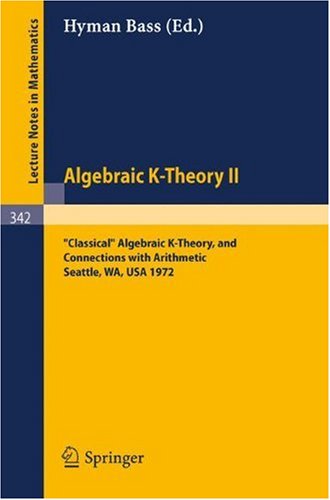
16. Algebraic K-theory (Mathematics lecture note series)
by Hyman Bass
 Paperback: 762 Pages (1968)

Asin: B0006BVKKM
Canada | United Kingdom | Germany | France | Japan

17. Parsing Theory: LR(k) and LL(k) Parsing (E A T C S Monographs on Theoretical Computer Science)
by Seppo Sippu, Eljas Soisalon-Soininen
 Hardcover: 426 Pages (1991-01)
list price: US$129.00 -- used & new: US$108.42
(price subject to change: see help)
Asin: 0387517324
Canada | United Kingdom | Germany | France | Japan
Editorial Review

Book Description
This is the second volume of a two-volume set representing an up-to-date reference work on the theory of deterministic parsing of context-free grammars. Volume I is an introduction to the basic concepts of formal language theory and context-free parsing. Volume II contains a thorough treatment of the theory of the two most important deterministic parsing methods. The two volumes together form an integrated work with chapters, theorems, lemmas, etc. numbered consecutively. The emphasis is on LR(k) and LL(k) methods, and special attention is paid to the efficient implementation of LR(k) and LL(k) parsers. Construction algorithms for parsers are derived from general graph-theoretic methods. Complexity questions about parsable grammars are analysed. The work can be used as a textbook in graduate and senior undergraduate courses on parsing theory and compiler design. ... Read more


18. L2-Invariants: Theory and Applications to Geometry and K-Theory (Ergebnisse der Mathematik und ihrer Grenzgebiete. 3. Folge / A Series of Modern Surveys in Mathematics)
by Wolfgang Lück
Hardcover: 595 Pages (2002-09-17)
list price: US$159.00 -- used & new: US$103.47
(price subject to change: see help)
Asin: 3540435662
Canada | United Kingdom | Germany | France | Japan
Editorial Review

Book Description
In algebraic topology some classical invariants - such as Betti numbers and Reidemeister torsion - are defined for compact spaces and finite group actions. They can be generalized using von Neumann algebras and their traces, and applied also to non-compact spaces and infinite groups. These new L2-invariants contain very interesting and novel information and can be applied to problems arising in topology, K-Theory, differential geometry, non-commutative geometry and spectral theory. It is particularly these interactions with different fields that make L2-invariants very powerful and exciting. The book presents a comprehensive introduction to this area of research, as well as its most recent results and developments. It is written in a way which enables the reader to pick out a favourite topic and to find the result she or he is interested in quickly and without being forced to go through other material. ... Read more


19. Thinking Strategically: The Competitive Edge in Business, Politics, and Everyday Life
by Avinash K. Dixit, Barry J. Nalebuff
Paperback: 408 Pages (1993-04)
list price: US$17.95 -- used & new: US$8.99
(price subject to change: see help)
Asin: 0393310353
Average Customer Review: 4.5 out of 5 stars
Canada | United Kingdom | Germany | France | Japan

Customer Reviews (37)

1-0 out of 5 stars Shallow analysis of many real life situations
I apologize to all those who liked this book, but I felt the authors were playing with a tool that was new to them thinking they had found a "Holy Grail". They sorely missed the critical elements of numerous examples. You cannot break down the Cuban Missile Crisis in to elements of chance nor Ted Williams batting style. Being successful in negotiation or business is based on truly understanding your customer, your vendors and your competition. The Cuban Missile Crisis was a clash of cultures that was solved when protagonists actually talked to each other and realized that they were really on the same page but had stumbled into a situation as a result of years of non-communication. This was not game theory. The solution had nothing to do with odds but had everything to do with Kennedy and Khrushchev coming to know each other and each understanding that the other wanted a non-apocalyptic solution that satisfied each's home political realities. The solution developed over the 13dys and the odds changed drastically as the protagonists communicated. The authors missed in this example and many others the value of dynamic complex person-to-person communication and reduced all to absurdly simplistic discussion of game theory and percentage of outcomes. This book was in short a grave disappointment.
"To a man with a hammer, everything looks like a nail."

5-0 out of 5 stars yeahhhhhhhh
I want to learn game theory and after reading this book I am even more pumped. This is really cool and its not cmplicated at all for a beginner.

5-0 out of 5 stars Understanding the Game of Business
I first read this book as a recommended textbook in my final year in the University of London, and this book has stuck with me since.

Without going into the mind-boggling mathematical details about game theory, the authors have actually provided clear guidelines on how the business, negotiations and strategic games are played, and how you can emerge a winner.

Rather than a "pop version of game theory" as another reviewer claim this to be, I view this more as a "Self-help/ self-development version of understanding the games in life and business".

4-0 out of 5 stars Thinking Strategically
This book was short and interesting. Not only does it give points on thinking startegically for business but also in your daily life.

5-0 out of 5 stars GT Is In Everyday Life
"Thinking Strategically" is a helpful and likeable primer for those who want to dabble and/or learn about general everyday concepts of Game Theory.It's also for those who don't want to get too deep into the minutia of the mathematics, calculus, and statistical probability of Game Theory.The real-life examples and matrices used in this book are applied by the author and can be applied by anyone in many everyday-life scenarios: getting a cab, negotiating private contracting work, or general bargaining, for example.In Business, whether two competing magazines should both advertise, have only one advertise, or have both not advertise.(Better for both not to advertise.) Cartels are also examined.

Other matrices, examples, and anecdotes, are applied in this book in business, politics, and sports.E.g., the strategy of an NFL football team's offense and defense, Stalin's "Scorched Earth Defense," and how a pitcher rotates his pitching selection are explained quite well, as examples.It seems a good portion of human instincts and traits are involved in the aspects of Game Theory.We already intuitively know about these elements before reading this introductory book.But we can apply GT with more awareness after being exposed to the theory.

The renown concept of the "Prisoner's Dilemma:"If two suspects work together they can both mutually benefit themselves together and individually by cooperating.Obviously, this is partly why suspects are separated when they're questioned and interrogated.But they can still both cooperate, even if separated.But will one sell out the other, or will both sell out each other, leading to longer sentences and harsher penalties for both, because one or the two of them decided to use the most Dominate Strategy?

In Game Theory, it takes two to Tango.And most of the time it's not beneficial to play the "Dominant Strategy."

One of the many examples was the taxi driver who picked up two people (potential customers) in front of a hotel.After telling the driver where they wanted to go, the driver refused to turn on his meter and said he would charge a lower price than the meter because he liked the country where the passengers were from.The driver the stated the price he would charge.The passengers responded by asking the driver to turn on the meter, and at the end of the ride the driver could charge less than the meter.Ah-ha, but the driver didn't agree.And even grew grew angry and didn't take them.They later proved he was being disingenuous by taking a metered taxi to their destination which was the lower than than the "special discount" offered by the first guy.

One important point above: it's difficult to use Game Theory with a) irrational people and b) people who don't realize the win-win concept of mutual benefits.Unfortunately reality creeps in....when you deal with people who don't practice "Game Theory," who shoot themselves in the foot and waste your time and energy.

Internationally IMO, Game Theory is lacking and sorely needed in certain parts of the world.In Japan this book sold well.Unfortunately it didn't sell much in the surrounding nations.

One of the author's former students recommended this book to me. The author made an astute decision to change the spelling of his name.College undergrads can be puerile at times.:)

A good book."Look ahead and reason back."
... Read more


20. Algebraic K-Theory I. Proceedings of the Conference Held at the Seattle Research Center of Battelle Memorial Institute, August 28 - September 8, 1972: Higher K-Theories (Lecture Notes in Mathematics)
Paperback: 344 Pages (1973-01-01)
list price: US$46.00 -- used & new: US$46.00
(price subject to change: see help)
Asin: 3540064346
Canada | United Kingdom | Germany | France | Japan

  1-20 of 100 | Next 20

Prices listed on this site are subject to change without notice.
Questions on ordering or shipping? click here for help.

site stats