e99 Online Shopping Mall

Geometry.Net - the online learning center Help  
Home  - Religion - Freemasonry (Books)

  1-20 of 100 | Next 20
A  B  C  D  E  F  G  H  I  J  K  L  M  N  O  P  Q  R  S  T  U  V  W  X  Y  Z  

click price to see details     click image to enlarge     click link to go to the store

$9.00
1. The Lost Keys of Freemasonry (Also
$9.10
2. A New Encyclopaedia of Freemasonry
$4.69
3. Duncan's Ritual of Freemasonry
$10.49
4. The Complete Idiot's Guide to
$19.95
5. Freemasonry: Symbols, Secrets,
$8.89
6. A Dictionary of Freemasonry
$9.36
7. Freemasonry: Rituals, Symbols
$8.97
8. Freemasonry: A Journey Through
$7.50
9. Symbols of Freemasonry (Beliefs
$10.63
10. Christianity and American Freemasonry
$4.89
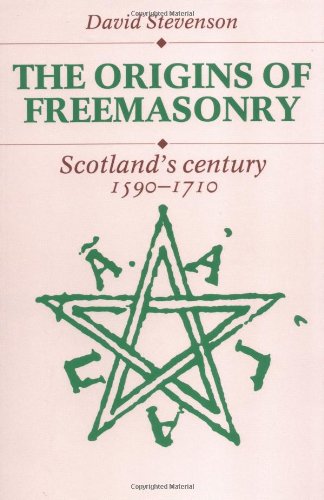
11. The Origins of Freemasonry: Scotland's
$7.95
12. The Question of Freemasonry and
$11.94
13. Masonic Enlightenment - The Philosophy,
$7.49
14. Freemasonry and the Birth of Modern
$8.76
15. Isaac Newton's Freemasonry: The
$3.92
16. The Secrets of Freemasonry
$7.19
17. The Magus of Freemasonry: The
$17.24
18. The Secrets of Solomon's Temple:
$12.18
19. The Origins of Freemasonry: Facts
 
$14.50
20. Comprehensive View of Freemasonry

1. The Lost Keys of Freemasonry (Also Includes: Freemasonry of the Ancient Egyptians / Masonic Orders of Fraternity)
by Manly P. Hall
Paperback: 352 Pages (2006-08-17)
list price: US$18.95 -- used & new: US$9.00
(price subject to change: see help)
Asin: 1585425109
Canada | United Kingdom | Germany | France | Japan
Editorial Review

Book Description
Here is Manly P. Hall's classic work on history's most secretive brotherhood- reset and collected with two additional celebrated Hall volumes on occult Masonry.

Freemasonry is the subject of perennial fascination-recently the cover story of a national newsmagazine, the premise of the movie National Treasure, and the anticipated basis of a forthcoming novel by Dan Brown. The twentieth century's great scholar of occult and esoteric ideas, Manly P. Hall was a Mason himself and nurtured a lifelong interest in the secret fraternal order, making it the focus of one of his earliest and best-loved books, The Lost Keys of Freemasonry. In this celebrated work, he examines the ethical training required of a Freemason, and the character traits a Mason must "build" within himself. Hall's 1923 volume is now reset and made available exclusively in this new edition, along with the author's two further classics on Masonry:

- Freemasonry of the Ancient Egyptians (1937), which explores the roots of Freemasonry in the initiatory temple rites of Pharaonic Egypt; and
- Masonic Orders of Fraternity (1950), a fascinating work of short history that chronicles the reemergence of Freemasonry in Europe in the seventeenth and eighteenth centuries. It surveys the lives of Masonry's modern architects and the secretive organizations that immediately preceded the brotherhood.

This three-in-one volume features the original illustrations of each book, for a total of nearly thirty images, including recreations of scenes and rites from Masonry's unusual history. Italso includes a new index encompassing all three titles. ... Read more


2. A New Encyclopaedia of Freemasonry (Ars Magna Latomorum) And of Cognate Instituted Mysteries: Their Rites, Literature and History (Combined Edition: Two ... Rites Literature and History/2 Volumes in 1)
by Arthur Edward Waite
Hardcover: 1024 Pages (1994-04-19)
list price: US$14.99 -- used & new: US$9.10
(price subject to change: see help)
Asin: 0517191482
Average Customer Review: 4.0 out of 5 stars
Canada | United Kingdom | Germany | France | Japan
Editorial Review

Book Description
Provides a complete view of the history, literature and myths surrounding Freemasonry.Comprehensive explanations of their secret rituals and symbolism.Including alchemy, astrology, Kabbalism, ceremonial magic, animal magnetism and more. ... Read more

Customer Reviews (15)

5-0 out of 5 stars A great source of knowledge
This is one of the most insightfull books I had the pleasure of putting my hands on! I recommend this for every MM!

4-0 out of 5 stars A Magnum Opus
This compendium is probably one of the most complete one is likely to come across and was the magnum opus of Arthur Waite.It can be rather arcane in its explanations, but it is not meant to be light reading, but rather a definitive work.In this Waite certainly succeeds.

5-0 out of 5 stars A New Encyclopaedia of Freemasonry (Ars Magna Latomorum) And of Cognate Instituted Mysteries: Their Rites, Literature and Histor
This book is full of a lot of info. and a must have for all masons. I found that it helped me through my degree work as I became a mason..

4-0 out of 5 stars Freemasonry's Alpha and Omega Resource Book
A New Encyclopedia Of Freemasonry may just be the best pure resource work on the subject today. This is not your typical Freemasonic expose where someone sells-out the fraternity. Come here looking for handshakes, passwords, rituals and secrets, hoping to catch Freemasons at play, and you'll be bitterly disappointed. This is not the cheap seats, so don't expect any home-run balls to come soaring in.

Besides, this is no easy read by no means. This work is clearly written for scholars andveterans of the craft, with a charitable appeal to beginning Freemasons truly aspiring to learn as much as they can, so it is, therefore, an invaluable resource tool for both constituencies; but I nevertheless recommend it too, for sincerely curious outsiders. There is something here of interest for everyone's level, even though the book is not for everyone.

This is Freemasonry from A to Z, and everything allegedly associated with it directly or indirectly--from A to Z.It is an extremely comprehensive layout of Freemasonry, Secret societies, and Religious doctrine. And whether or not all three of these subjects should be grouped in this one tome or any tome, for that matter, I cannot say (and surely wouldn't if I could). But then, when you speak of Freemasonry, and you know what you're talking about....oh so many subjects come to mind--depending on who you're talking to.

5-0 out of 5 stars A must have for a Freemason
This is a must have for any freemason. This is a comprehensible reference of almost all masonic and related definitions. It is extremely helpful to have it handy when reading masonic articles. ... Read more


3. Duncan's Ritual of Freemasonry (Dover Value Editions)
by Malcolm A. Duncan
Paperback: 288 Pages (2007-02-27)
list price: US$7.95 -- used & new: US$4.69
(price subject to change: see help)
Asin: 0486455955
Average Customer Review: 4.5 out of 5 stars
Canada | United Kingdom | Germany | France | Japan
Editorial Review

Book Description

A must for every Mason, this volume serves as a guide for neophytes as well as a reference for the initiated. Its revelations of closely guarded secrets make it valuable even to readers outside the fraternity. More than 100 illustrations accompany simple, accurate explanations of gestures, symbols, tools, and terms.
Download Description
The 1866 classic ritual and monitor of Freemasonry available in PDF format. ... Read more

Customer Reviews (34)

5-0 out of 5 stars Just what I was looking for
I was looking for a book like this. I am New to the fraternity and am trying to learn as much as possible. If you are interested in learning more about the fraternity this book is for you.

4-0 out of 5 stars the real duncan's ritual
this book is good for the first three degrees, but after that you need the revised version of duncan's ritual part 2 for scottish rite. peace goes out to all my scottish rite brethen.

5-0 out of 5 stars SEE BETTER, LIVE BETTER
LARGER BOOK DIMENSIONS EQUALS LARGER PRINT WHICH MAKES STUDY MORE PRODUCTIVE.

4-0 out of 5 stars Good for research purposes
There is no point to owning this book unless you're researching Masonic ritual; many things here are outdated, and then since ritual varies (sometimes significantly) from jurisdiction to jurisdiction, it's not really very good as a "study guide" or even an expose.However, as a reference for the researcher, it's great - highly recommended, in fact!

5-0 out of 5 stars The necessary study guide for Freemasonry period.
"Duncan's Ritual" is perfect. Needs no improvement. Written to help expose the secrets of Freemasonry. And now suggested reading of Masons everywhere. Easy to read (for Masonic ritual). And now available in a size small enough to fit into a large pocket! Great for those Freemasons and wannabe Freemasons on the go! ... Read more


4. The Complete Idiot's Guide to Freemasonry (Complete Idiot's Guide to)
by S. Brent Morris
Paperback: 334 Pages (2006-05-02)
list price: US$18.95 -- used & new: US$10.49
(price subject to change: see help)
Asin: 1592574904
Average Customer Review: 5.0 out of 5 stars
Canada | United Kingdom | Germany | France | Japan
Editorial Review

Book Description
Mysteries revealed … truths uncovered … and myths dispelled.

What is the truth about the Masons suggested in Dan Brown’s The Da Vinci Code? Can Freemasonry really be dated back as far as Babylon? Did they really coordinate the Boston Tea Party and the American Revolution? What really goes on at a Mason lodge during an initiation? Here is the real story behind the secret society that now boasts nearly five million members (and has included such illustrious fellows as George Washington and Benjamin Franklin), as revealed by a Master Mason.

• Offers a highly illustrated field guide to Masonic jewelry and symbols
• Includes further reading, a glossary, a list of famous Freemasons and information on Freemasonry in popular culture
• Morris is a Master Mason ... Read more

Customer Reviews (18)

5-0 out of 5 stars Great Book
I enjoyed it thoroughly--did a great job of separating fact from fiction.I highly recommend it.

5-0 out of 5 stars The Compete Idiots Guide To Freemasonry
I have been a Freemason for over five years and have read over 40 Freemason related books.This book is the first one that comprehensively covers the entire Masonic field.I often lend this book to friends who are considering joining a Masonic Lodge.

5-0 out of 5 stars FREEMASONRY DESTROYS PREJUDISM
IWAS SURPRISED ABOUT THIS BOOK, IT'S FULL OF INFORMATION THAT DESTROYS PREJUDISM ABOUT FREEMASONRY. THERE'S A LOT OF SIMBOLISM THAT COULD BE MISINTERPRETATED AND OBVIOUSLY PREJUDICED. SO, THIS BOOK IS AN IDEAL GUIDE TO REVEAL THE MISTERY OR "SECRET" AND GET WELL INFORMATED ABOUT THIS ANCIENT AND EXCELLENT FRATERNITY THAT CONSTRUCTS BETTER HUMANS IN ALL OVER THE WORLD.

ESTE LIBRO ME SORPRENDIÓ, ESTÁ LLENO DE INFORMACIÓN QUE DESTRUYE LOS PREJUICIOS SOBRE LA MASONERÍA. HAY MUCHO SIMBOLISMO QUE PUEDE SER MALINTERPRETADO Y OBVIAMENTE PREJUZGADO. POR TANTO, ESTE LIBRO LO CONSIDERO UNA GUIA IDEAL PARA CONOCER LA MASONERÍA Y SUS "SECRETOS" ASI COMO PARA ESTAR MEJOR INFORMADO ACERCA DE ESTA ANTIGUA Y EXCELENTE INSTITUCIÓN QUE HA CONSTRUIDO MEJORES SERES HUMANOS EN TODO EL MUNDO.

5-0 out of 5 stars Excellent, simple overview
I enjoyed this book greatly, as a new Mason I found it gave helpful information and helped answer some of my wife's questions and concerns about the Lodge. Not a complete history, based on other research I have done, but a good concise history.

4-0 out of 5 stars Interesting if nothing else
Lots of good general information.Not state specific, and doesn't have any of the "secrets" in it, but a lot of truth for all memebers of the family or freinds to read. ... Read more


5. Freemasonry: Symbols, Secrets, Significance
by W. Kirk MacNulty
Hardcover: 320 Pages (2006-10-30)
list price: US$45.00 -- used & new: US$19.95
(price subject to change: see help)
Asin: 0500513023
Average Customer Review: 4.0 out of 5 stars
Canada | United Kingdom | Germany | France | Japan
Editorial Review

Book Description
The ultimate book on Freemasonry, with a rich collection of symbols and lore that illuminate the famous fraternal society.

"The Craft," with an estimated four million Freemasons worldwide, remains the largest fraternal organization in the world. Written by an active Freemason, this book comprehensively explains Freemasonry through its fascinating visual culture, rich in mysterious and arcane symbols of life, death, and morality that have evolved over centuries of secrecy and that have profound philosophical meaning.

Ceremonial regalia, paintings, manuscripts, tracing boards, ritual swords, furniture, prints, ephemera, and architecture: the book is copiously illustrated with many specially researched items from Freemasonry archives. This unrivaled compendium will appeal both to Freemasons wishing to learn the full story of their order and to a general audience that is intensely curious about this traditionally secretive and closed movement.

The coverage includes
• the historical and philosophical background of the order, including the Knights Templar, the medieval stonemasons' guilds, and esoteric traditions such as Kabbalah and Hermeticism
• its history from the earliest Masons to the present day, including famous members and scandals
• its geographical spread from Japan to California, Sweden to South Africa
•300 illustrations, 200 in color ... Read more

Customer Reviews (5)

5-0 out of 5 stars Review from a life member of the Scottish Rite Research Society.
This is a great introduction to the WORLD (Caps added for emphasis) of Freemasonry written in plain language for the Mason and Non-Mason. The full color/black and white pictures are excellent. Brother MacNulty is a loyal Man of the Craft and shares some of his cherised thoughts about the Craft with you within the pages of this book but he is careful not to spoon feed deep esoteric knowledge about the Craft because the Craft is not designed for babies. THE CRAFT IS DESIGNED FOR MEN. We Masons will guide you and give you the tools you need to find the ultimate answers for yourself, AS A MAN! Brother MacNulty is one of the brightest Masonic stars to come out from the state of Virginia. And like me, he is a member of both American and British Freemasonry. The knowledge resulting in his dual membership is reflected in this excellent book. Read "Freemasonry; A Journey Through Ritual and Symbol, also by Brother MacNulty, for a deeper understanding of the Craft. And finally, read "The Way of The Craftsman", also by Brother MacNulty, if you are a Master Mason interested in the ESOTERIC UNDERSTANDING OF THE CRAFT. I could say more to address the funny anti-masons but will not because that would be spoon feeding.

3-0 out of 5 stars An interesting but shallow inside-look at Freemasonry
This book written by a long-standing member of the Masons is more of a picture-book than a book in the ordinary sense. There is very little text at all, it consists mainly of large pictures, and is hence a very short "read". That being said, he includes a lot of fascinating pictures, drawings and paintings both known and unknown from before. The book serves adequately as a decent introduction to Freemasonry, but don't expect this to be very honest. You notice immediately that it is written by one of the brothers, since he only vaguely hints at everything, and you don't really feel you get to know anything that is of real interest.

It contains a lot of interesting images that show you just how deep in high society this travesty runs. If you read between the lines though, you will quickly see a connection between Judaism, Freemasonry and the ruling "elites". It saddens me to see all these fine men in the early 1900's throwing their intellectual energy away into something so filled with subversive elements. What did the men of Europe have to do with Kabala and its various spawns and cousins? These men could have saved the West when it was still a relatively easy thing to accomplish, but instead they chose to sell out their souls to this meaningless Semitic non-sense.

Recommended, but read with caution, because this is not the real face of Freemasonry, that ugly grin hides beneath the "for the good of society"-facade. A very educating and penetrating essay to read regarding the subject is Julius Evola - "The Relationship between Judaism and Freemasonry", an essay I highly recommend and that you will find easily available on the internet.

(I read a different edition of the book)

5-0 out of 5 stars Freemasonry:Symbols, Secrets, Significance
I would recommend this publication to particularily any new Mason or someone considering applying, as being the most complete overview of the brotherhood of Masonry I have found.It would also certainly be beneficial to some of those who have been in Masonry for awhile as a "rusty nail training" piece.The pictures and diagrams included in it are excellent quality accurately describing the rich heritage of the society.While it explains very well historical operative masonry to modern day speculative practice the author is careful to preserve the secrets within the degrees.

5-0 out of 5 stars Freemasonry Enlightened
I am a Master Mason and also a 32nd degree Scottish Rite Mason so feel qualified to give an opinion, recognizing that other may not share my viewpoint.

Masonry is not for everybody, but this book goes a long way to tell the story in a manner that many non-Mason's can understand.There is very little these days that is "secret" and our Lodge is very open, even having its installations open to the public.

I concur that Masonry is not a religion, but it does reinforce my Christian beliefs, as well as those other religions we have in our Lodge.

This is a good book, not perfect, but well worth having and reading.I am enjoying reliving much of what I learned along the way and seeing how Masons around the globe work.

I recommend this book to those wanting to know more about this great Fraternity, home to many generations of Americans, including a large number of our founding Fathers.

2-0 out of 5 stars masonic disinfo.com and disneyworld is lovely
great coofetable book for grandpa to show the family what he is been doing every week when he meets his friends to do charitable work
but in realityland
beatiful pictures beatiful stories beatiful explanations that say basically nothing except superficial bla bla
one always wonders if the guy writing this
is leaving all the really interesting stuff,connections, persons and vital data out on purpose
to keep theprofane dumbed down
or if they themselves are so dumbed down to believe the crap they are writing
hard to imagine really given that they spend a lifetime studying this stuff and still havent been able to see a bigger picture than there local lodge
so if you re looking for a historical account by even the most sloppy standards this book is rubbish
if youre looking for explanations of the esoteric meanings beyond the most obvious superficial layer of things this book is rubbish
if you re looking for anything more than a thinly veiled advertisment brochure by a devout disciple of the craft
dont buy !
if you re looking for a brief introduction with glossy pictures
and are prepared to be misled
buy ! ... Read more


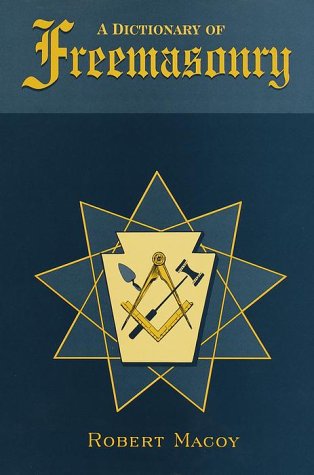
6. A Dictionary of Freemasonry
by Robert Macoy
Hardcover: 704 Pages (2000-10-03)
list price: US$14.99 -- used & new: US$8.89
(price subject to change: see help)
Asin: 0517692139
Average Customer Review: 4.5 out of 5 stars
Canada | United Kingdom | Germany | France | Japan
Editorial Review

Book Description
Here is a remarkable history, encyclopedia and symbolic dictionary of Freemasonry all in one convenient volume and attractively illustrated with 300 nineteenth-century engravings.

The 600-year-old brotherhood of Freemasons (based on a 3,000-year-old tradition) is one of the most widely known fraternal organizations in the world. Robert Macoy compiled this work in order to present comprehensive information on Freemasonry in an accessible form.

        Using the full resources of the Fraternity available to him, Macoy sought to sort out the truth from a myriad of half truths, rumors, superstitions and interpretations. He presents the rise and problems of Freemasonry and its kindred association both ancient and modern.

        The "General History of Freemasonry," which begins this volume, is a fascinating introduction to a very complicated subject often fraught with vagaries. The two A-to-Z reference works that follow--one an encyclopedia with listings of terms, people, places, and events that make up the extensive history of the Freemasons, and the other a dictionary of symbols--contribute to making this a very complete sourcebook on Freemasonry.

From Aaron, the Abelites, and the All-Seeing Eye to the Year of Masonry, Zenith, and the Rite of Zinnendorf, this is a remarkable book on a subject that runs through the course of human history. ... Read more

Customer Reviews (4)

3-0 out of 5 stars Freemasonry: A Dictionary
This book, first published many years ago, is a must for any student of Freemasonry and the meanings of its many symbols and ceremonies, according to interpretations of the early years of the last century.

5-0 out of 5 stars good fast shiping
sorry took so long i am new with useing this . shiping was fast and product was great.

5-0 out of 5 stars Do you want to know more? Become a Freemason
Having to study about Freemasonry, being interested in all the things it represented, a dictionary was absolutely a good suggestion.
Honestly, I couldn't imagine I would have found so many interesting things in this Dictionary, divided in two parts and full of illustrations.
While working on my book (which only incidentally is about Freemasonry), this Dictionary helped me in more than one occasion.
Very well explained and extremely useful, it is a good companion of another book, Edward Waite's "A New Encyclopaedia of Freemasonry".
If you want to know more, all you have to do is knock on a Temple's door.

5-0 out of 5 stars Wonderful Guide To Masonic Information
Getting accurate, correct, and truthful Masonic information can sometimes feel harder then pulling teeth.Freemasonry is a subject that alot of people don't know about and fewer truly understand, which makes gleaning useful information difficult.Even talking to some Masons might leave you with more questions then answers after your done.

However Roberet MacOy's work in "A Dictionary of Freemasonry" provides light to anyone seeking Masonic history and information.MacOy's work is part history, part encylopedia, and part dictionary.It starts with a brief history of Freemasonry and lists the terminology in two different volumes using an A-Z dictionary format.It explains the people, places, terms, and symbols that you would ever want to know about and much more.

Every lodge should have a few copies of this work on hand and anyone with an interest in Freemasonry must have one on their bookshelf too.If you doing Masonic research, its priceless, but if just want to learn about Masonry, its informative and easy to follow and provides more information then you can well, shake a stick at, a big stick too. ... Read more


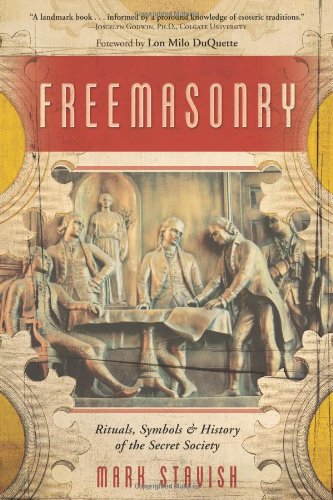
7. Freemasonry: Rituals, Symbols & History of the Secret Society
by Mark Stavish
Paperback: 233 Pages (2007-09-01)
list price: US$15.95 -- used & new: US$9.36
(price subject to change: see help)
Asin: 0738711489
Average Customer Review: 4.5 out of 5 stars
Canada | United Kingdom | Germany | France | Japan
Editorial Review

Book Description
A Secret and Spiritual Brotherhood

As one of the world's most famous mysterious societies, Freemasons remain the largest fraternal organization in the world.Some of the most heroic and creative thinkers in history belonged to the order, including George Washington, Benjamin Franklin, Goethe, and Mozart.What links the philosophy of these great minds with the estimated four million Freemasons who actively maintain this ancient brotherhood today?

From sacred geometry to legendary Masonic rites, author and Freemason Mark Stavish divulges the philosophy of Masonry and the moral code that all Masons share.Learn how Masonry's higher degrees, particularly Scottish Rite, were influenced by occult beliefs and practices, and how Masonry is linked to King Solomon, Gothic architecture, magic practice, alchemy, and Qabala.

With exercises and suggested readings, this fascinating exploration is an essential learning tool that will answer questions and shed light on other Masonic mysteries, including initiation and the Lost Word. ... Read more

Customer Reviews (5)

5-0 out of 5 stars Lucid Exposition of Freemasonry & more...
This book may surprise you! Not that it is lucid and well-written, which are characteristics found in Stavish's works on alchemy and Kabbalah, but rather in the breadth of material that he covers. The subtitle really sums up the content of the book - it is about the rituals, symbols and history. However to really appreciate this you need to read through the chapters, and then the light starts to shine through. The Scottish Rite, the Royal Arch, the initiations of as mason, the Lost Word - all of these and many other areas of Freemasonry are explained in a clear and fascinating manner, which admirably brings to life the subject material.

The esoteric influences of alchemy, Hermeticism, sacred, geometry, Qabalah and the grimoires are all discussed, as well as key developments in the growth and fruition of Freemasonry. For me the most important single thread in the book is the emphasis on the spirituality inherent in Freemasonry, which is usually ignored by those who would rather detract and denigrate from a position of ignorance.

The virtues that a mason strives to cultivate are those which build societies and take them forward - honesty, integrity, friendship, consideration, the seven liberal arts and sciences. Freemasonry at its best exemplifies the magickal process of inner realisation manifested through outer harmony. When the sensationalism is stripped away, you are left with the process of building to last, in both a physical and spiritual sense, and this is the message of this volume.

This exposition of the moral code, history and essence of Freemasonry is a book that should interest many people, both Freemasons and non-Freemasons alike, for the messages contained within it are universal.

4-0 out of 5 stars Free Masonary
The author has begun to give me, a Mason, an insight to our meaning than anything I have read. He clearly shows that Free Masonary is not just another repository of extraneous movements. The truths of each of these movements, when added to the growth of Free Masonary was important. With the addiditional reading material he recommends, this will solidfy the true meaning behind our beliefs and practices. A quest for truth and freedom never ends. He gives life to the symbols we see.

5-0 out of 5 stars A Book About More Than Just Freemasonry
As the author of Freemasonry - Rituals, Symbols and History of the Secret Society I decided to write a review to better explain the uniqueness and importance of this book. While focused on Freemasonry as a movement, this book is really an exploration and examination of the esoteric environments the surrounded the formation of the first Grand Lodge in 1717, why that is important and what it means to those of us interested in esotericism today. The reader is challenged at the end of each chapter to undertake exercises to better help them understand the mind set of the day, the philosophy of Natural Magic, or even if circumstances required it, how would they go about establishing a 'secret society'.I strongly recommend this book for anyone interested in practical as well as historical esotericism, the ideas, exercises and reading list are designed to give the reader a well rounded education - a foundational goal of Masonry - as well as a solid survey of Freemasonry and its relationship to esoteric and occult groups of the past and present.Pick up a copy and read it, you will be glad you did.

4-0 out of 5 stars Well Worth the Price of Admission
This is an interesting book about Freemasonry written by a Freemason. Once I got started I didn't want to put it down. It explores the intellectual and spiritual climate of the late Middle Ages and Renaissance periods in Western Europe when Freemasonry was putting down roots, plus many other aspects of both mystic and operative Masonry. Stavishshows how the common thread linking them all together is Geometry. The book is illustrated very sparingly, so if you're looking for one that has lots of Masonic symbols I wouldn't recommend it.

5-0 out of 5 stars A LIBERAL ARTS EDUCATION IN FREEMASONRY
From the Foreword, by Lon Milo DuQuette, 32°

What has been lacking for the modern Mason, and what Brother Stavish now mercifully presents us, is a straightforward, and step-by-step, study of Freemasonry and the myriad movements and ideas that gave birth to Craft in all its manifestations. Moreover, he sets it all vis á vis 21st century science, philosophy and mysticism, and challenges the reader to do the same. This book is a one-volume liberal arts education in Freemasonry, and never before in the history of the Craft has it been more important for individual Masons to be so educated. I wish I could put Brother Stavish's book in the hands of every newly-raised Brother, not simply for his own benefit, but for the benefit of those individuals throughout his life who will look to him as worthy example of a knowledgeable and enlightened member of the Fraternity. ... Read more


8. Freemasonry: A Journey Through Ritual and Symbol (Art & Imagination)
by W. Kirk MacNulty
Paperback: 96 Pages (1991-09)
list price: US$19.95 -- used & new: US$8.97
(price subject to change: see help)
Asin: 0500810370
Average Customer Review: 4.5 out of 5 stars
Canada | United Kingdom | Germany | France | Japan
Editorial Review

Book Description
About the Art & Imagination Series: Explore a range of interests, philosophies, religions, and cultures—from Kabbalah to Freemasonry, Buddhism to Hinduism, myth to magic. The distinguished authors bring a wealth of knowledge, visionary thinking, and accessible writing to each intriguing subject in these lavishly illustrated, large-format paperback books. ... Read more

Customer Reviews (24)

5-0 out of 5 stars Extraordinary Journey Through Symbolism
Masonry is part art, part science, part philosophy.This is a great little book.I highly recommend all of this author's books, especially the Way of the Craftsman.He is writing more the initiate than the profane, but one of the best modern Masonic writers out there.A true adept rivaling Hall or Pike is scope and ability.

5-0 out of 5 stars Very Good Read
I really like the way the author ties Freemasonry to the psychology of the 17th and 18th centuries and how the symbolism of the craft relates to different psychological states in a person's development.The book is a bit short, with the majority of the pages dedicated to pictures.But I'm happy to have a book with such detailed pictures.I highly recommend this book.

4-0 out of 5 stars Not All-Encompassing, but Illuminating to a Degree
First of all, the 133 illustrations in this thin little volume are excellent, resplendent with Masonic symbolism and indicative of Freemasonry's multifaceted history. True, a few of the pictures are just a bit tangential to the subject at hand, though these do serve the function of showing the larger context of Freemasonry, that which has influenced it and that which has been influenced by it. But by far the majority give the reader a very well-rounded and fascinating visual crash-course in Freemasonry itself. Still, it is a crash-course, a starting point for the uninitiated but interested outsider like me and perhaps a lavish but cursory review for those who have gone deeper into the subject.

The text of the book comes in two parts, an extended introductory essay and brief captions accompanying the many illustrations. The former is a bit eccentric, interpreting the three degrees of Freemasonry in the light of Jungian psychology and briefly explaining the diagrams depicting each along those lines. In general this seemed persuasive for the most part andworked well in making the rituals and images intelligible, but as the author makes clear at the beginning this is by no mean the official interpretation or even necessarily a common one. I can't help but feel that addressing the standard Masonic understanding and then adding the Jungian spin might have made this book a little more helpful. As for the latter, the captions do a pretty good job in placing the illustrations, but very little of the rich symbolism is explained in any depth, and much flies by with no comment. I tended to find this just a bit frustrating, though perhaps the short format of the book makes it inevitable. That being so, it might have made sense to enlarge the spotty bibliography at the end into a "suggested reading" page for those whose curiosity was thus aroused. And with such a wealth of intriguing images, this fine little book can scarcely fail to have that effect.

4-0 out of 5 stars A Worthy Addition to the Library of Any Freemason or Masonic Scholar.
Though not a book of great length, it's only 96 pages, "Freemasonry: A Journey through Ritual and Symbol" offers the reader a glimpse into the Craft of Freemasonry through its 133 illustrations and the secrets hidden in its text.

Freemasonry has been defined in many ways, but herein W. Kirk MacNulty gives us a workable definition in a single sentence when he writes `Freemasonry is a very old, secular, fraternal society which requires the belief in a Supreme Being as its principle qualification for membership and which is dedicated to the practice of tolerance, respect and understanding of others; the encouragement of high standards of morality among its members; and the performance of charitable works.

We see the history of Freemasonry from its ancient past, to the formation of the Grand Lodge in London, England in 1717, followed quickly by Grand Lodges being established in Ireland in 1725, in Scotland in 1736, in Germany in 1737, in Denmark in 1745 and in the Netherlands in 1756.We also see Lodges established under the Grand Lodge of England being formed in America, in Boston in 1733, and in Charleston in 1735.

We are then introduced to the three degrees of Freemasonry: The First Degree Entered Apprentice, The Second Degree Fellowcraft, and The Third Degree Master Mason.While W. Kirk MacNulty tries to explain the significance of each of these degrees, he does not seek to reveal the arts, parts and points of the hidden mysteries of Ancient Freemasonry.We are offered insight into the psychology of each Degree without, as is too often the case, simply reprinting the candidate's manual for these Degrees.

"Freemasonry A Journey Through Ritual and Symbol" has numerous illustrations showing the beauty of the operative Mason's Craft.We are shown the 16th Century stone-carvings from the flying buttresses at the Cathedral of St. John at S'Hertogenbosch, Holland; we see illustrations of the Masonic Tracing Boards, and we see illustrations which conceal or reveal many of the secrets of Freemasonry.Each of these many illustrations is interesting in its own right as examples of the artist's skill, but more so when one studies each illustration seeking the hidden mysteries it may contain.

I enjoyed "Freemasonry A Journey Through Ritual and Symbol" and consider it a worthy addition to the library of any Freemason or Masonic Scholar.

5-0 out of 5 stars Kirk's Writings
Knowing Kirk Personally, and a brother and studying under him, I can say I have not met a freemason who lives by the craft such as him. I do recomend finding the rarer book which goes into further depth, The way of the craftsman. ... Read more


9. Symbols of Freemasonry (Beliefs Symbols)
by Daniel Beresniak
Hardcover: 128 Pages (2000-09)
list price: US$19.95 -- used & new: US$7.50
(price subject to change: see help)
Asin: 2843232015
Average Customer Review: 4.5 out of 5 stars
Canada | United Kingdom | Germany | France | Japan
Editorial Review

Book Description
There are over ten million freemasons in the world.The supposed power of their occult network is often feared, and yet freemasonry is not a closed doctrine.Richly illustrated, Symbols of Freemasonry provides a synthesis of one of mankind's oldest existing secular brotherhoods.It is designed both for the initiated and for newcomers interested in gaining a better understanding of this fascinating but often misrepresented society. ... Read more

Customer Reviews (8)

4-0 out of 5 stars Masonic symbols.
The illustrations in this book are excellent! Unfortunately,the print is ridiculously small.
The author does cover a lot of basic information about Freemasonry; an interesting topic was the concept of time related to the building of various temples. Solomon's temple or the second temple constucted by Zerubbabel.
The Masonic year began in March. In the past Hebrew names of months were used. There are a lot of Hebrew connections to Freemasonry. Those connections relate to,among other areas,cabbala and also the Tree of Life.

Speculative masonry rejected the legend of the craft which honored the tower of Babel and Nimrod for a preferred link to King Solomon.

There is a legend telling of how 3 architects discovered an ancient temple attributed to Enoch and the discovery of "a brilliantly shining triangle". I had not formerly heard of an Enochian temple.

The last descendant of Cain was Tubal-Cain-a blacksmith. Biblically speaking,Cain was a builder and built a city. I don't see a Scripture that claims that Cain "founded a dynasty of creators". But that doesn't make it fiction.

Hiram the architect was a son of a widow. There is a tie with Horus,also the son of a widow.

There was a fascinating chapter about the Two Pillars and possible identifications to different mythological or Biblical figures.

The subject of the "forbidden fruit" of Genesis was something new. Could it have been a fig or a pomegranate instead of an apple? The argument that they are more common to the Jerusalem area makes sense. Something to ponder anyway.

"Khor" is the Hebrew form of "Horus" the Egyptian god. That looks very much like the "Kore" of the Old Testsament.

A list of Masons in history was a trivia bonus.

Despite the small print,this book is an educational tool for anyone interesting in taking an outsider's curious look at Freemasonry.
The author details different rites of Masonry and where they originated. He really covers a lot of ground despite the small size of the book.

5-0 out of 5 stars Great little book to read/view
A nice compliment to any Freemason history buff.Deals with the different symbols used in Freemasonry, and has some beautiful pictures to go along with the book.

5-0 out of 5 stars A beautiful depiction of continental craft
Freemasonry is mankind's oldest existing fraternal brotherhood with a presence weaving its way through millennia of history. Its past members include kings, presidents, chancellors, military leaders, and heads of business. It has been home to writers, philosophers, the world's greatest composers, and men of all shapes, sizes, and colors, both humble and notorious. This work features the symbols and icons that have attracted these people to this ancient order along with the deeper philosophy and ethos they represent.

It is important to note two things regarding this work. Firstly this rendition is extremely specific to European craft in general and the masonry of France in particular. As my fellow brothers undoubtedly know there are subtle derivations and departures between the work of France and that of the Grand Lodges of the United States, however regardless of your nationality you will find this book both beautiful and enlightening. Second, if you're looking to learn the "secrets" of Master masons without joining our organization, this book will not reveal them to you. Nothing that is found within is not readily available from other sources. If you want to be one, ask one.

Berensiak's Symbols of Freemasonry is a gorgeous book. Its visuals are an eclectic mix of wonderfully photographed symbols and items to beautiful full page renditions of famous works of art. My only complaint is the books physical size; I would have liked to it be a larger "coffee table" size work that could be prominently displayed.

4-0 out of 5 stars A View of European Freemasonry
This book does not "give away"the secrets of a Masonic lodge, and maynot be appreciated by the Non-Mason. This is not a dry exposition of the symbols of a lodge room. What it is,is an artfull view of European Freemasonry. For the American Mason it will allow for some clues to the differant emphasis in work between America and abroad. Lovely book to look at!

5-0 out of 5 stars The most lavish visual treatment of Masonic symbolism
While MacNulty's "Freemasonry: A Journey through Ritual and Symbol" may be more comprehensive and more directly related to Masonry as it exists in England and the USA, this lovely book makes a much nicer gift. This is a miniature version of an earlier coffee-table-sized version, which is worth the extra price if you can find it. The essays and very informative and are written from the perspective of French Masonry--a system working under what we in the USA call the Scottish Rite. Thus, many symbols of the Scottish Rite are discussed alongside the blue lodge symbols, with no particular line of division drawn between them.

This volume is especially eye-opening to students of esoteric symbolism who have not previously considered Masonic plant and animal symbolism grouped as such.

Non-Masons may find this book difficult to read unless they are already experienced in Masonic jargon, but all will find the photography beautiful to look at. ... Read more


10. Christianity and American Freemasonry
by William Joseph Whalen
Paperback: 215 Pages (1998-11)
list price: US$16.95 -- used & new: US$10.63
(price subject to change: see help)
Asin: 0898706726
Average Customer Review: 4.5 out of 5 stars
Canada | United Kingdom | Germany | France | Japan

Customer Reviews (7)

5-0 out of 5 stars Great researched book for those desiring more information on this subject.
This book is just as advertised, it is not sensationalist but well researched and presents the real facts. You will not go wrong purchasing this book if this subject interests you.

3-0 out of 5 stars A worthwhile account of Christian objections to Freemasonry
William Whalen, a retired Professor of journalism at Purdue University and a Catholic layman, has written a very readable, well-organized and complete book detailing the Church's (most specifically, the Roman Catholic Church's) objections to the Masonic fraternity and the practice of Freemasonry.He presents his material in a straightforward, non-polemical fashion that is far from the almost hysterical, conspiracy laden ranting which nearly all anti-Masonic works fall into. That is not the same thing as calling the Church's objections to Freemasonry rational or temperate, for they demonstrably are not.

When and where religious institutions have differed with Freemasonry, it has largely been because of the fear that the Masonic conception of "that natural religion in which all men agree" might take the Church's place in society, pastoral eyes apprehensively fixed on the secret rituals, initiatic vows, ethical philosophy and the notion that all men of whatever faith might worship a Great Architect of the Universe around a common Altar.In short, Freemasonry was seen to have become a rival to Churchly devotion for the attention and resources of its members.

There has always been conflict between any two opposing ideas. For centuries organized religion fought scientific thought and progress with the explanations of Scripture. The doctrine of the divine right of kings ran headlong into the doctrine of the rights of man.Galileo was tortured and Giordano Bruno roasted alive for making assertions about the nature of the universe that today every civilized human being accepts as self-evident, because their assertions displaced the authority of the Church.

This should be no surprise: the author of the Roman Catholic Church's condemnation ofFreemasonry, Pope Leo XIII, was the prolific author of a host of encyclicals condemning not just Freemasonry, but such threats to ecclesiastical power as humanism, freedom of expression, parliamentary democracy, a universal franchise, women's emancipation, "modernism" and countless other horrors. Typical is the sentiment in his encyclical "Inscrutabili Dei Consilio" (1878) which succinctly states the Church's position:

"[And] If any one of sound mind compare the age in which We live, so hostile to religion and to the Church of Christ, with those happy times when the Church was revered as a mother by the nations beyond all question, he will see that our epoch is rushing wildly along the straight road to destruction; while in those times which most abounded in excellent institutions, peaceful life, wealth, and prosperity the people showed themselves most obedient to the Church's rule and laws. Therefore, if the many blessings We have mentioned, due to the agency and saving help of the Church, are the true and worthy outcome of civilization, the Church of Christ, far from being alien to or neglectful of progress, has a just claim to all men's praise as its nurse, its mistress, and its mother.That kind of civilization which conflicts with the doctrines and laws of holy Church is nothing but a worthless imitation and meaningless name. Of this those peoples on whom the Gospel light has never shown afford ample proof, since in their mode of life a shadowy semblance only of civilization is discoverable, while its true and solid blessings have never been possessed."

Clearly, the (then) pontiff did not view the Dark Ages in which unquestioned obedience was the Church's due and unbridled ignorance civilization's lot as anything other than a happy, peaceful and just society, a culture to be admired and emulated.

Freemasonry is a philosophy which cannot exist side by side with certain ideologies, among them absolutism, superstition and tyranny. Either the latter must be consigned to the dustbin of history or Freemasonry must be annihilated. Wherever men have believed that one man or some men are above the law which applies to the many; wherever government is by men and not by law, there Freemasonry is unwelcome.

Freemasonry stands and has always stood for freedom of political thought; for freedom of religious thought and conscience; for the dignity and worth of the individual: in Freemasonry, as it is said, "We meet upon the level.". In Freemasonry there is no compulsion. In Freemasonry is no religious sect elevated above others: indeed, therein lies the problem for the Christian Church.Because of its rubric that any who be admitted to the Craft confess a belief in a supreme intelligence that rules the cosmos and in the immortality of the soul, and nothing more, it is viewed as contrary to the exclusivist claims of Christianity. It is, in other words, not Christianity, and therefore worthy of condemnation.

Dr. Whalen's book focuses on the Craft as practiced in America, but also touches upon the English and Grand Orient Lodges of the continent. He reviews the Blue Lodge degrees (Entered Apprentice, Fellow Craft, and Master Mason) with just the right amount of detail and avoids the needless repetition often found in "exposes."He explains the history of the Blue Lodge, the Scottish and York Rites, the Shrine, Prince Hall Lodges, and other aligned bodies. For the most part, he lets Masonry speak for itself, citing Masonic sources both supporting and in opposition to his - and the Church's - claims.

I highly recommend this work for anyone interested in the history of Freemasonry and in its opposition by the Christian Church, and specifically to those interested in understanding the Catholic Church's objections to the Craft.

5-0 out of 5 stars As a Catholic with a Masonic history....
The issue is important to me, as a Catholic and a formerly active member of a Lodge.I don't agree with all of this book, but I give it a high rating because it is rational and seems to be authentic, that is, the author seems sincere and sane unlike almost all other anti-masonic writings out there.If the *supposed* conflict between Christianity and Freemasonry is pertinent to you, this is a book worth purchasing.

5-0 out of 5 stars The truth is revealed
I'm Roman Catholic. This is a truly remarkable book that is informative and well researched and tells the truth about Freemasonry being a subversive cult against the Catholic Church. All Catholics should read it so they will see the true and dark evil that has and is contaminating society. Masons will always deny their demonic schemes and plans in fomenting revolutions, engineering secular humanism, and their anti-Catholic attacks. People, be devoted to the Blessed Virgin Mary and you will be able to win the battle against Freemasonry, which is the devil's religion that has warped society.

5-0 out of 5 stars clear, concise and to the point
I was doing a little research on freemasonry and came across this book. I like it. It's clear, concise, objective and lacks the sensationalism that some masonry books have.
Masons in good standing were interviewed (anonymously) as well as some that were disgruntled. The rituals are explained and accompanied with some illustrations as well as an explanation as to why the Roman Catholic church has the stance that it does against membership. Clears up a lot of misconceptions while not compromising any truth. Gave it to my bro who was in the middle of the first steps of initiation. (He wanted to know what he was in for). Of course, that's not why I wanted him to have it! LOL ... Read more


11. The Origins of Freemasonry: Scotland's Century, 1590 to 1710
by David Stevenson
Paperback: 263 Pages (1990-09-28)
list price: US$16.99 -- used & new: US$4.89
(price subject to change: see help)
Asin: 0521396549
Average Customer Review: 5.0 out of 5 stars
Canada | United Kingdom | Germany | France | Japan
Editorial Review

Book Description
This book is a new edition of David Stevenson's classic account of the origins of Freemasonry, a brotherhood of men bound together by secret initiatives, rituals and modes of identification with ideals of fraternity, equality, toleration and reason.Beginning in Britain, Freemasonry swept across Europe in the mid-eighteenth century in astonishing fashion--yet its origins are still hotly debated today.The prevailing assumption has been that it emerged in England around 1700, but David Stevenson demonstrates that the real origins of modern Freemasonry lie in Scotland around 1600, when the system of lodges was created by stonemasons with rituals and secrets blending medieval mythology with Renaissance and seventeenth-century history. This fascinating work of historical detection will be essential reading for anyone interested in Renaissance and seventeenth-century history, for freemasons themselves, and for those readers captivated by the secret societies at the heart of the bestselling The Da Vinci Code. David Stevenson is Emeritus Professor of Scottish History at the University of St. Andrews.His many previous publications include The Scottish Revolution, 1637-1644; Revolution and Counter-Revolution in Scotland, 1644-1651; and The First Freemasons; Scotland, Early Lodges and their Members. His most recent book is the The Hunt for Rob Roy (2004). Previous edition Hb (1988) 0-521-35326-2 Previous edition Pb (1990) 0-521-39654-9 ... Read more

Customer Reviews (8)

5-0 out of 5 stars Not for the faint of heart...
Outstanding scholarly work. Not an easy read, but full of the details and exacting research one expects from an academic of Stevenson's stature. I am on my second time through this book.
Any Brother who considers himself a Masonic scholar should be in possession of this book.

4-0 out of 5 stars Great for Masonic History Nuts
Though sometimes the reading is a little dry, this book is full of great history. Origins of some aspects of masonry few have heard of. Any Mason who loves history, will find it interesting.

5-0 out of 5 stars An historic perspective (by a non-mason)
Prof. Stevenson, a non-mason, has stumbled upon freemasonry while specialising in the history of the Scottish covenanters. He adds academic structure and his formidable historic knowledge to the unwritten part of Scottish masonry, - an oral tradition of memorized texts and a rich variety of lodge rituals, -way before George I's (a Hanoverian who spoke no English) attempt in 1717 to create a system of control by establishing the Grand Lodge of England. Mr. Stevenson may be forgiven for not understanding masonic imagery, however he has given us a well presented insight into Scottish masonry. His impressive work sets new standards in masonic history, based on verifiable and reproducable evidence rather than on wishful thinking. A highly recommendable book.

4-0 out of 5 stars Half the story, and well done!
This well-researched and (necessarily) somewhat-speculative work covers the sustainment of Freemasonry in Scotland in the time just before Masonry went public in 1717. The title is less accurate than the subtitle, however, for it creates more questions than it answers. For convincing speculation on the actual origins of Freemasonry (and one that fits well before this book if one will take William Schaw as patron and not creator of the Craft), read "Born in Blood" by John J. Robinson.

5-0 out of 5 stars At Last! Some Factual Pre-1717 Masonic History!
The question of Freemasonry's origins and history prior to the establishment of the Grand Lodge of England in 1717 is such a morass of speculation, supposition, and wishful thinking that professional historians- Stevenson included - feel the need to justify their researches in thissubject lest they be tainted by its disrepute among their fellows. Againstsuch a background this book really stands out. Stevenson bases his researchon actual records of almost a hundred Scottish Masonic lodges that datefrom the 1600's, along with municipal records, other guilds' records,diaries, and royal statutes.

What emerges from this mass of informationis a compelling story of the origin of Scottish Lodges as tradeassociations established by royal decree in the late 1590's and theirdevelopment by 1710 into mutual benefit and social societies involving abroader range of members. Stevenson's most important finding, establishedearly in the book, is that both before and after the establishment of theLodges, masons were also members of municipally chartered, or incorporated,building trades guilds along with carpenters, wrights, and the detestedcowans or unskilled laborers. The Lodges, in essence, were parallel andcompeting organizations with the municipal "Incorporations", ofwhich the masons were also members. Stevenson illustrates the powerstruggles between the Lodges and the "Incorporations", as well asthe search for influence on the part of various noble patrons. Along theway we get a good look at the frequently theorized, but never welldocumented transition from operative to speculative membership (it did nothappen the way you might think!). Stevenson covers such topics asinitiation practices (both Masonic and other), the "Mason Word",the number and names of the degrees, the development of the Master Masondegree, and the frequency, content, and location of meetings. There is aninteresting and illustrative biography of an early gentleman Freemason,Robert de Moray. Stevenson also proposes a curious and rarely consideredsource for much of the ritual and symbolism. Many Freemasons will probablyenjoy comparing the ritual as worked in their jurisdictions with theScottish material from the late 1600's that Stevenson discloses.

All isnot lost, however, for those who prefer to see Masonic origins in ancientEgypt, the Knights Templar, the Commacine Masters, or other more romanticsources. Stevenson does not claim to have the whole story of Masonicorigins. He wonders himself why William Schaw, the Director of Works underKing James I, wanted to "re-establish" Lodges of stonemasons(complete with esoteric practices) in competition with the existingbuilding guilds. Stevenson freely admits that the oldest evidence ofFreemasonry, those fascinating documents called the "OldCharges", are English in origin. The only claim he makes on behalf ofScotland is that it was there and in that century that whatever Freemasonrywas in 1590 took root and developed into the fraternity that we mightrecognize as Freemasonry today. Hence the title "The Origins ofFreemasonry - Scotland's Century". Stevenson has firmly nailed downthis corner of the puzzle of Masonic history. All future authors on thesubject must insure that their theories fit his facts. I highly recommendthis book to all Freemasons and anyone interested in their history. Too badI cannot award six stars... ... Read more


12. The Question of Freemasonry and the Founding Fathers
by David Barton
Paperback: 132 Pages (2005-10-01)
list price: US$7.95 -- used & new: US$7.95
(price subject to change: see help)
Asin: 1932225374
Average Customer Review: 4.0 out of 5 stars
Canada | United Kingdom | Germany | France | Japan
Editorial Review

Product Description
The Question of Freemasonry and the Founding Fathers tackles the controversy surrounding the involvement of Freemasonry in the formation of America. This book answers many questions, including: How many of the Founding Fathers were Freemasons? Is Freemasonry incompatible with Christianity? Did the Founders imbed Masonic symbolism in Washington, DC and in our currency? Was George Washington a Freemason and a Christian? Is American Freemasonry the same today as it was 200 years ago? Using historical documents dating from before the American Revolution, this book definitively resolves these questions and is a must read for Christians and others who are concerned about the spiritual roots of America's founding. ... Read more

Customer Reviews (1)

4-0 out of 5 stars Who founded America?
This book established two unrefutable facts:

1) Freemasonry had only a small influence in the construction of the US Constitution


2) The Illuminati had only a small influence in freemasonry at the time the US Constitution was being constructed


The Questions this book does not answer:

1) Did the Illuminati have any influence on the construction of the US Constitution

2) Were agents of the Illumnati working in government at the time the US Constitution was constructed


Late 18th Century Freemasonry held a strong Christian bias and not that of Secularism.While all Founding Fathers were not traditional Christians, they all promoted the Christian ethic as an essential to freedom.Illuminism seems to have gained a presence in Freemasonry somewhere near the mid to late 19th century, though it may have been present earlier.

These facts help us answer the last two questions:

1) No, the Illuminati did not have a significant influence, if any, on the construction of the United States since A. it did not gain a significant influence until the mid to late 19th cent. and B. the Founding Fathers did not believe that the Constitution was compatible with any civilization that did not observe Judeo-Christian principles.

2) Maybe, it is possible that sympathizers worked in government at this time.One such sympathizer was Thomas Jefferson who did not have a deeper understanding of the doctrines and practices held to be essential to the goals of Weishaupt's Illuminati. ... Read more


13. Masonic Enlightenment - The Philosophy, History and Wisdom of Freemasonry
Paperback: 180 Pages (2006-06-01)
list price: US$18.95 -- used & new: US$11.94
(price subject to change: see help)
Asin: 1887560750
Average Customer Review: 5.0 out of 5 stars
Canada | United Kingdom | Germany | France | Japan
Editorial Review

Book Description
A Masonic education from the first page to last. Includes: "The Meaning of Initiation" by Frank C. Higgins; "Operative Masonry: Early Days in the Masonic Era" by Robert I. Clegg; "Masonic Jurisprudence" by Roscoe Pound; "Freemasons in the American Revolution" by Charles S. Lobingier; "A Bird's-Eye View of Masonic History" by H.L. Haywood; "Women and Freemasonry" by Dudley Wright; "In the Interests of the Brethren" by Rudyard Kipling; "The Egyptian Influence on Our Masonic Ceremonial and Ritual" by Thomas Ross; "Anderson's Constitutions of 1723" by Lionel Vibert; "The Rise and Development of Anti-Masonry in America, 1737-1826" by J. Hugo Tatsch; "The Spiritual Significance of Freemasonry" by Silas H. Shepherd; "Rosicrucianism in Freemasonry" by H.V.B. Voorhis; "The New Atlantis and Freemasonry" by A.J.B. Milborne;"Masonry and World Peace" by Joseph Fort Newton and more. ... Read more

Customer Reviews (3)

5-0 out of 5 stars A great choice of Masonic material
Mike Poll has pulled together a variety of essays from past generations and presented them for the enlightenment of Masons today. These are time-tested thoughts and ideas which older members may have encountered decades ago but which newer members may have never seen. Regardless of your Masonic age, you'll find this small book a delight to read. Whether you devour it on a snowy evening or read a single essay while waiting for car repair to finish, you'll find it a perfect companion and WELL worth the price.

5-0 out of 5 stars Good knowledge
I enjoyed this book and the many stories in it. I think that it gives a new mason a stronger understanding of masonry and may answer some questions.

5-0 out of 5 stars Review by a life member of the Philalethes Society.
All I can say about this book is WOW! It is great, and as metioned on it's back cover, it really is a portable Masonic Education. All Master Masons will benefit from the wide range of Masonic subjects covered in this small book no matter how long they have been on the path. The book consists of easily read short Masonic essays by past authors who were recognized experts at the time of their original writing. Brother Michael R. Poll is a highly talented Masonic Editor who is leaving a wonderful legacy of Masonic books full of Masonic and Rosicrucian Knowledge to future generations. Read his books Master Masons and eat anti-masons for lunch and giggles, like I do. ... Read more


14. Freemasonry and the Birth of Modern Science
by Robert Lomas
Paperback: 384 Pages (2004-03-04)
list price: US$16.95 -- used & new: US$7.49
(price subject to change: see help)
Asin: 1592330649
Average Customer Review: 4.5 out of 5 stars
Canada | United Kingdom | Germany | France | Japan
Editorial Review

Book Description
A fascinating book from Robert Lomas, co-author of The Hiram Key and The Second Messiah. Freemasonry and the Birth of Modern Science continues the Freemasonry saga by exploring its roots in The Royal Society, a group dedicated to the pursuit of scientific study.

In a time when superstition and magic governed reason, the repressive dogma of Christian belief silenced many, and where a turbulent political and economical background dominated, these men forbade any discussion of religion at their meetings. Lomas claims that modern experimental science was born out of The Royal Society, which was secretly funded by The Invisible College, which is known today as Freemasonry. ... Read more

Customer Reviews (2)

4-0 out of 5 stars Science separated from Religion and Politics
I found this introduction into the world of Freemasonry an enjoyable tale.It is a recounting of the English Civil War and the Restoration of the throne after Oliver Cromwell the lord protector. I was not that familiar with this part of history except seeing the movie Cromwell with Richard Harris and not understanding all the factions so I thought it was quite fascinating.

It tells the story of men whom where on both sides of the conflict in the English Civil War but came together to try to build a scientific society where pure science was the goal and politics and religion were not involved.This began the free exchange of ideas and the idea and publication of scientific journals. This allowed the scientist in the society concentrate on experimentation and the others their monetary assets to fund the experiments instead of the government. The entire membership was interested in science and all tried to contribute their part.

The story has a tendency to be pedantic by the fact that he tells the tale through the lives of several of the first members and it becomes repetitive.I don't know if this is a mansonic thing because they have to do great deal of memorization.

The book goes into the effect of the society up to the present day. The appendix was quite good in the fact that it gave a much better idea of what freemasonry is all about.
Overall, I thought it was a good read for the interesting history and learning more about Freemasonry.I would like to learn more about the subject.

5-0 out of 5 stars I Never Realised this about Freemasony
Before readiung this book I was inclined to think that Freemasonry was just a slightly spooky charitable dinning club. Lomas's study of the formation of the Royal Society of London made me realise just how important a society freeemasonry is.
This book shows Sir Robert Moray. Charles I and II and Oliver Cromwell in a new light for me. I hadn't realised how Freemasonic ideas had influenced both the growth of science and of American democracy.

Keep up the good work Robert. I'll be looking out for your next book to learn more about Freemasonry ... Read more


15. Isaac Newton's Freemasonry: The Alchemy of Science and Mysticism
by Alain Bauer
Paperback: 160 Pages (2007-03-22)
list price: US$14.95 -- used & new: US$8.76
(price subject to change: see help)
Asin: 1594771723
Average Customer Review: 1.0 out of 5 stars
Canada | United Kingdom | Germany | France | Japan
Editorial Review

Book Description
An exploration of how modern Freemasonry enabled Isaac Newton and his like-minded contemporaries to flourish

• Shows that Freemasonry, as a mystical order, was conceived as something new--an amalgam of alchemy and science that had little to do with operative Freemasonry

• Reveals how Newton and his friends crafted this “speculative,” symbolic Freemasonry as a model for the future of England

• Connects Rosslyn Chapel, Henry Sinclair, and the Invisible College to Newton and his role in 17th-century Freemasonry

Freemasonry, as a fraternal order of scientists and philosophers, emerged in the 17th century and represented something new--an amalgam of alchemy and science that allowed the creative genius of Isaac Newton and his contemporaries to flourish. In Isaac Newton’s Freemasonry, Alain Bauer presents the swirl of historical, sociological, and religious influences that sparked the spiritual ferment and transformation of that time. His research shows that Freemasonry represented a crossroads between science and spirituality and became the vehicle for promoting spiritual and intellectual egalitarianism. Isaac Newton was seminal in the “invention” of this new form of Freemasonry, which allowed Newton and other like-minded associates to free themselves of the church’s monopoly on the intellectual milieu of the time.

This form of Freemasonry created an ideological blueprint that sought to move England beyond the civil wars generated by its religious conflicts to a society with scientific progress as its foundation and standard. The “science” of these men was rooted in the Hermetic tradition and included alchemy and even elements of magic. Yet, in contrast to the endless reinterpretations of church doctrine that fueled the conflicts ravaging England, this new society of Accepted Freemasons provided an intellectual haven and creative crucible for scientific and political progress. This book reveals the connections of Rosslyn Chapel, Henry Sinclair, and the Invisible College to Newton’s role in 17th-century Freemasonry and opens unexplored trails into the history of Freemasonry in Europe. ... Read more

Customer Reviews (3)

1-0 out of 5 stars Don't take his word
The Grand Orient of France ignores some very important rules of Freemasonry and therefore are not recogized by other Grand Lodges, leaving them clandestine.I'm not saying that this fellow cannot do research, but if your views are already skewed by clandestine masonry then who is to say your research isn't as well?

1-0 out of 5 stars Nothing to see here
This disappointing book by Grand Master of the Grand Orient de France, Alain Bauer reads more like a slightly extended after dinner speech. The actual meat of the text is just 80 pages long, culled from other (better) books. It is padded with additional, and almost totally unrelated, material, including a timeline of the development of French Freemasonry, for no apparent reason. Unfortunately a bad case of misleading packaging.

1-0 out of 5 stars Isaac Newton's Freemasonry
A huge disappointment. No light to be found here.

The title suggests that the subjects of alchemy, science, and mysticism will be explored through the mind and actions of Isaac Newton.But the text fails to deliver.

... Read more


16. The Secrets of Freemasonry
by Elijah Muhammad
Paperback: 41 Pages (1997-04-01)
list price: US$7.95 -- used & new: US$3.92
(price subject to change: see help)
Asin: 1884855059
Average Customer Review: 3.0 out of 5 stars
Canada | United Kingdom | Germany | France | Japan
Editorial Review

Book Description
Powerful and easy to read insight into one of the world's oldest organization.Elijah Muhammad makes a strong case with irrifutable truths that their symbolism points directly to the Blackman and woman's historical experience. ... Read more

Customer Reviews (4)

1-0 out of 5 stars NOT SERIOUS FREEMASONRY AT ALL
The way to sell a book about freemasonry is to simply put the words "secret" and "freemason" on the cover.Note that there are over 200 titles easily available online about this aspect of Freemasonry.I add here only for people seriously interested in Freemasonry (both its mainstream orthodox history) and its occult aspects (such as the Golden Dawn) that this book is not on the reading lists of mainstream and regular masonic Grand Lodges.There are much better books to provide you with information on Freemasonry.If you're looking for "secrets" in regards to masonry, be aware that the only secrets of mainstream masonry are handshakes, passwords, ("modes of recognition"), and memorizing portions of the ritual (which varies from state to state, province to province, lodge to lodge, etc).All other "secrets" are determined by a person's philosophy, orientation (religious, philosophical, symbolical, etc).........This book is not considered "serious" or authoritative in any way.Scholarly masons and even occult masons would consider this book garbage.The other reviews here have clearly been written by individuals unaquainted with "real" Freemasonry (also known as "regular" or recognized freemasonry, and they are certainly not acquainted with freemasonry's widely recognized roots in the Egyptian/Greek/Roman "mystery traditions", it's Rosicrucian elements, occult leanings of the 17th, 18th, and 19th, centuries).Much better books are available.

5-0 out of 5 stars Masonry and Race.....
Elijah Muhammad was on to something! A lot of his info astounded Black Masons. Even a lot of his early followers were those who left the Masonic Order. However the book is a little vague but if you peace together his various statements on the matter from different source you can get the affect of what he is trying to convey about FreeMasonry. I suggest a this with two books that brings more light on the subject African Origins of Freemasonry by Zachary P. Gremillion and Huevolution of Sacred Muur Science by Timothy Myers El. These two books breaks down what Elijah Muhammad began to convey to his followers.

3-0 out of 5 stars It's Decent
The title of the book leads the reader to believe that all the secrets of a secret society such Freemasonry are/were going to be revealed. The truth is that the essential secret or basis of Freemasonry is revealed by The Honorable Elijah Muhammad. One has to understand that The Honorable Elijah Muhammad was divinely commissioned and sent to ex-slave in the West for his resurrection and to make him fit to be accepted among his own Islamic brethen world over before the Final Judgement. How does that pertain to Freemasonry? The essential element or ritual in Freemasonry deals with the story of Hiram Abiff. Hiram Abiff was the master architect of Solomon's Temple. He was attacked at high noon, struck in the head and was killed. He was dragged from East to West and buried in a shallow grave. Many were sent to search for Hiram and they found him dead. They tried to resurrect him but had no power. It would take a Master (God) to resurrect the Master Architect. Hiram Abiff is symbolic for African peoples. The story of Hiram Abiff is a similitude of the African Holocaust, the suffering of African peoples in the West and how African-Americans are wollowing in a shallow grave of ignorance. The Master is a symbol of God or a God-sent person equipped with the spiritual power to raise the mentally dead to life.So this is all symbolism for African History and the African Holocaust and preludes or answers why Islam was literally and figuratively revealed to African-Americans. If this doesn't make sense, then you will have to study The Honorable Elijah Muhammad, his mission and ministry and revisit this book and then it will all come together.Much of what I said is also wrapped in Scriptual stories in the Bible. Look in the books Ezekial, Isaiah, Daniel and Hababbuk.

In this book The Honorable Elijah Muhammad goes about the process of explaining the story of Hiram Abiff and how it relates to African-American and how it was a beautiful enigmatic story that describes an actual historical event and people.

3-0 out of 5 stars I FOUND IT INTERESTING
I CAN ONLY WONDER WHERE THIS "GREAT" BROTHER HAS RECIEVED HIS INFORMATION ABOUT THIS "FRATERNITY". ... Read more


17. The Magus of Freemasonry: The Mysterious Life of Elias Ashmole--Scientist, Alchemist, and Founder of the Royal Society
by Tobias Churton
Paperback: 320 Pages (2006-06-27)
list price: US$16.95 -- used & new: US$7.19
(price subject to change: see help)
Asin: 1594771227
Canada | United Kingdom |