e99 Online Shopping Mall

Geometry.Net - the online learning center Help  
Home  - Religion - Gnosticism (Books)

  1-20 of 100 | Next 20
A  B  C  D  E  F  G  H  I  J  K  L  M  N  O  P  Q  R  S  T  U  V  W  X  Y  Z  

click price to see details     click image to enlarge     click link to go to the store

$15.88
1. Ancient Gnosticism: Traditions
 
$50.33
2. Gnosis: The Nature And History
$6.89
3. Gnosticism: New Light on the Ancient
$14.85
4. Living Gnosticism: An Ancient
$15.52
5. What Is Gnosticism?
$5.18
6. Forbidden Faith: The Secret History
$27.40
7. Rethinking "Gnosticism": An Argument
 
$9.99
8. Gnosticism: The Path of Inner
$17.98
9. GNOSTICISM, JUDAISM, AND EGYPTIAN
$6.79
10. Science, Politics, And Gnosticism
$6.81
11. The Wisdom of the Knowing Ones:
$18.00
12. The Psyche in Antiquity: Gnosticism
 
$13.00
13. History of Gnosticism
$20.00
14. The Allure of Gnosticism: The
$26.95
15. Neoplatonism and Gnosticism (Studies
 
$27.17
16. Pre-Christian Gnosticism: A Survey
$4.25
17. The Beliefnet Guide to Gnosticism
$26.50
18. Images of the Feminine in Gnosticism
19. The Elements of Gnosticism (The
 
20. Nag Hammadi, Gnosticism, &

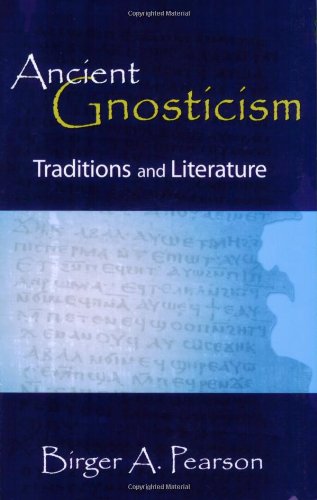
1. Ancient Gnosticism: Traditions And Literature
by Birger A. Pearson
Paperback: 362 Pages (2007-06-20)
list price: US$25.00 -- used & new: US$15.88
(price subject to change: see help)
Asin: 0800632583
Average Customer Review: 5.0 out of 5 stars
Canada | United Kingdom | Germany | France | Japan
Editorial Review

Book Description
Even as public interest is attracted to this esoteric religion, Escholarshave debated its origins, its relationship to Judaism and Christianity, andeven whether one distinctive and separate Gnostic "religion" ever existed.Birger Pearson's expert and accessible introduction brings the reader intothe debate. Directly addressing the nettling questions of origins anddefinition, Pearson situates the advent of Gnosticism within theGreco-Roman religious world and critically appraises the sources. Withillustrations, maps, timeline, and bibliography, Pearson's volumefacilitates the pursuit of gnosis, at least historically, by generalreaders, students and scholars alike. ... Read more

Customer Reviews (1)

5-0 out of 5 stars Accessible to religious scholars and lay readers alike.
Written by Gnosticism expert Birger A. Pearson (Professor Emeritus of Religious Studies, University of California Santa Barbara), Ancient Gnosticism: Traditions and Literature is an overview of all primary literary evidence for ancient Gnosticism, offering a crystal clear introduction to each writing, including the recently published "Gospel of Judas". Chapters cover the classic schools of Christian Gnosticism, Hermetic Gnosis, Manicheism, and the Mandaeans. Chapters are keyed to standard translations of Gnostic writings, including "The Nag Hammadi Scriptures: The International Edition" edited by Marvin W. Meyer, for easy cross-reference. Maps and recommendations for further reading round out this comprehensive introduction to who the Gnostics were and what they believed, accessible to religious scholars and lay readers alike. ... Read more


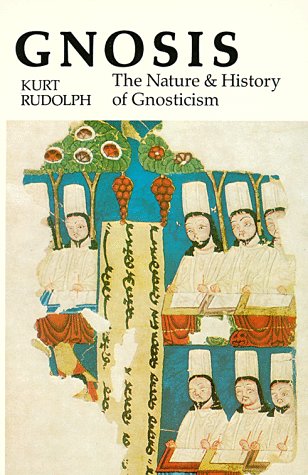
2. Gnosis: The Nature And History of Gnosticism
by Kurt Rudolph
 Paperback: 412 Pages (1998-06)
list price: US$60.00 -- used & new: US$50.33
(price subject to change: see help)
Asin: 0567086402
Average Customer Review: 4.5 out of 5 stars
Canada | United Kingdom | Germany | France | Japan
Editorial Review

Book Description

Presents a readable and appealing introduction to what otherwise might seem an inaccessible religion of late antiquity.

... Read more

Customer Reviews (11)

5-0 out of 5 stars Gnosticism 101
If your passion is Gnosticism than this book is for you.One you would keep in your library.Very complete.I wish I owned the hard cover.This book will orient you to Gnosticism complete.I recommend reading this book BEFORE you read the Nag Hammadi Library.Not a book for everybody simply because you may not want to go into this much detail on the subject.After reading this book I can read more detailed Gnostic scriptures and have a much better understanding of what it is I am reading.This book was originally written in German by the Gnostic Scholar Kurt Rudolph.I enjoyed this book!

1-0 out of 5 stars to Heady
This book may be helpful to some, not me. It all seemed to be to heady, if that is a word, and I didn't feel the urge to go past the first page. As I said maybe for some, not for me.

5-0 out of 5 stars A "Must Have" for Modern Gnostics
GNOSIS: The Nature & History of Gnosticism by Kurt Rudolph is one of the ultimate resources on the subject of gnosis. A scholar of the very finest caliber, Rudolph meticulously explores the earliest origins of a loosely connected spiritual movement that can be historically traced back to at least the year One Common Era. Within this context the author alludes to the fact that Pagans, not just Christians, were associated to the Gnostic view of a universe under the domination of the Demiurge (Satan or exploitation). The author describes the inevitable conflict between the myriad Gnostics sects and the Church Establishment. The Gnostics were concerned with individual liberation, while the early Church was obsessed with imposing a rigid fundamentalism and considered the Gnostics to be the worst heretics-and dealt with them accordingly. The author also demonstrates the fact that Gnostics were involved in astrology, numerology & magic. He also states the compatibility of modern Gnosticism and socialism

The Gnostic Gospels
The Gnostic Bible
Living Gnosis: A Practical Guide to Gnostic Christianity
The Laughing Jesus: Religious Lies and Gnostic Wisdom

5-0 out of 5 stars A Good Overview
For someone looking for a reasonably detailed and well-written introduction to Gnosticism, this is an excellent starting point. Covering most of the major Gnostic phenomena, it covers a difficult topic in a way that is pretty easy to get into.

Sometimes, it is a bit "wordy" and heavy going, though overall, it is an excellent intro.

I thoroughly enjoyed it.

5-0 out of 5 stars Touchdown!
Rudolph the East German scores a touchdown on the zero yard line with this important expose of gnostics living and dead. While Hans Jonas tends to dwell on the myth of the pearl and the e-mail to soul trapped in Egypt, Rudolph crosses the line, and suffice it see his marshland journal of the Mandeans and the spread of the Manichees which reached the Pacific and installed gnosticism as a state relion in Uighurstan knows no equal. There are also pictures for the kids to color in. ... Read more


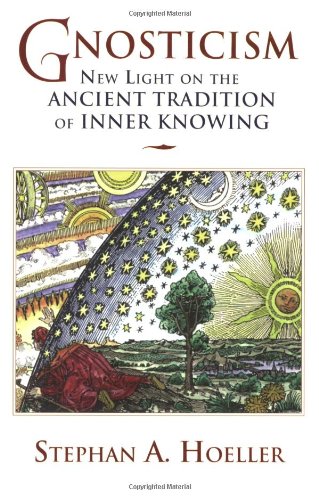
3. Gnosticism: New Light on the Ancient Tradition of Inner Knowing
by Stephen A Hoeller
Paperback: 220 Pages (2002-08-25)
list price: US$16.95 -- used & new: US$6.89
(price subject to change: see help)
Asin: 0835608166
Average Customer Review: 4.0 out of 5 stars
Canada | United Kingdom | Germany | France | Japan
Editorial Review

Book Description
This authoritative introduction reveals Gnosticism as the indigenous mystical tradition of the West and considers its message to Judeo-Christianity in the twenty-first century. ... Read more

Customer Reviews (18)

1-0 out of 5 stars Very Disappointing
I do not believe i have read a book written in a worse manner. Firstly, there are constant references to Jung and depth psychology, as if either had any importance to the history of gnosticism, and this detracts very much from the readability of the book. Secondly, the author makes almost as many references to ideas shared between gnosticism and "esoteric" spirituality without expounding on them, leaving the reader confused about some of the more troublesome beliefs of gnosticism. thirdly, the writing is almost intolerably lax (a chapter subtitled "will the real gnostic please stand up?" comes to mind), and the author seems to make assumptions about the level of familiarity of the reader with gnosticism. fourthly, and perhaps most importantly, it feels as though there is very little information about historical gnosticism.
for another review that i felt was honest, though a bit harsh, see the other one star review.

5-0 out of 5 stars Hard to imagine a better introduction to gnosticism
This is a wonderful book.I love this book, from the cover with the colourized woodcut of the Quester breaking through to another world, to the informative back cover.I recommend it to anyone interested in Gnosticism, the history ofChristianity, or even to someone justlooking to read something learned, fascinating, but unusual.I particularly recommend it to the person who may feel they have gnostic sensibilities.To such a person this book will be a revelation.In Gnosticism Dr. Hoeller took so many of what were to me intriguing loose ends and wove them into the beginnings of a substantial personal gnostic fabric.After reading this book, I was left feeling much happier in the knowledge that I was following, and indeed was a part of, an ancient tradition, and that there have always been others, and are currently a significant minority of others, who think in a similar way to me.Indeed, the book leaves one with the feeling that doors have been opened, but that, consequently, much more can now be accomplished, always bearing in mind that, 'The subject (Gnosticism) is not one that lends itself to an all too elementary treatment; rather, it requires a certain subtlety of thinking and a proclivity for an intuitive perception.' Preface, xi.

While Dr. Hoeller is always a consummate scholar, the book is written in a contemporary, readable, and extremely entertaining style.It has an excellent index, bibliography, and a helpful glossary.Highly recommended.

4-0 out of 5 stars A Great Introduction
This is a great place to begin for the seeker who wishes to learn about the path of Gnosticism.The problem is that Gnosticism is largely an umbrella term for a wide body of sometimes conflicting beliefs and traditions, which pre-date even Christianity.Much of the books available, while scholarly, are often long-winded and confusing.Perhaps this is due to the nature of the Gnostic path itself, being heavily based on myth and symbol, unique to each individual.Dr. Stephan A. Hoeller, whose contributions to the 20th century Gnostic revival are immeasurable, has done a fine job of assembling some of the basic tenets, influences, and history of Gnosticism, in this introductory book.

1-0 out of 5 stars Not recommended
This book was painful to read, full of psychological and metaphysical mumbo jumbo. About all the lay person can expect to get out of this book is that the author worships the likes of Carl Jung. There must be a better first book on Gnosticism.

5-0 out of 5 stars Well written easy to understand introduction.
Not a religious or spiritual person myself, this was a great book for introducing me to the values, history and evolution of Gnostic thought.The writer was not being preachy or ridiculing the Gnostic belief system.It was a great factual representation of it.If you are at all curious about Gnosticism, this is a great place to start. ... Read more


4. Living Gnosticism: An Ancient Way of Knowing
by Jordan Stratford
Paperback: 132 Pages (2007-11-01)
list price: US$14.95 -- used & new: US$14.85
(price subject to change: see help)
Asin: 1933993537
Average Customer Review: 4.5 out of 5 stars
Canada | United Kingdom | Germany | France | Japan
Editorial Review

Book Description
Twenty-two centuries ago in Alexandria, a sect of philosopher-poets fashioned a myth the strands of which weave through Christianity, Judaism, Islam and Greek philosophy, and inspired the legends of the Holy Grail. Long banished to the realm of notorious heresy, the myths of the Gnostics took root in the fertile imagination of the nineteenth century's artistic movements and esoteric circles, bearing fruit in the daily spiritual practice of thousands today. In 1945, a library of Gnostic writings surfaced form the Egyptian desert, allowing the movement--after 1500 years of propaganda and slander--to speak with its own voice. Rich in imagery, nostalgic in tone, Gnosticism quietly restores Wisdom to her place as a Goddess in Western religion, reveres Eve as the first saint, and acknowledges Mary Magdelene as foremost of the Apostles. ... Read more

Customer Reviews (5)

5-0 out of 5 stars Living Gnosticism
A must read for anyone interested in Gnosticism. Unlike so many other books I have read on the subject the author discusses his concepts in language anyone can understand.

Well worth the read!

4-0 out of 5 stars Gnosticism is not orthodox Christianity, nor is it Paganism
Gnosticism, says Canadian Gnostic priest Jordan Statford (and blogger), is not a Jewish or Christian heresy, but stands alone, "too heretical for other faiths. . . . the Secret Church of the Holy Grail."

His new book, Living Gnosticism: An Ancient Way of Knowing, defines it as "a pre-Christian religious tradition that fuse Judaism, Greek philosophy, and the Mystery Schools of the ancient world.

"Originating in the intellectual 'café societies' of Alexandria around 200 BCE, the original Gnostics were Greek-educated Jews, living in Egypt, on the doorstep of the Roman Empire. Theirs was the realm of diverse and interplaying cultures, of ideas and imagination. Gnostics unflinchingly explored the borders of myth and archetype, of metaphors and dreams, of creativity and poetic expression."

(Sometimes he makes them sound like beatniks of the ancient Mediterraean.)

Also included are

* A dictionary of Gnostic terms such as archon and demiurge.

* A ritual calendar that starts with Candlemas, equating Bridget with Sophia, both as "goddesses" of wisdom and creativity, and runs through the feast of the apostle John, December 27. (Not real goddesses but "symbol[s] for an aspect of something greater.")

* A question-and-answer section, viz., "Do Gnostics deny the historical Jesus?"

Answer: He is an archetype; "these stories don't need to be historically true to be valuable."

* An introduction to the various Gnostic churches of North America: the Apostolic Johannite Church, the Ecclesia Gnostica, the Ecclesia Gnostica Mysteriorum, the Gnostic Church of Mary Magdalene, the Order of St. Esclarmonde (a Cathar mystic executed by the Inquisition).

It's an excellent introduction to the topic.

There is no original sin in Stratford's Gnosticism; instead there is a story of loss. (I have suggested before that this story underlies the appeal of such fantasies as Anna Anderson's claim to be the Grand Duchess Anastasia.)

All Gnostics are in exile from heaven; they need to be reminded of their divine spark within; they need to be told that "the system" is not the world. And salvation comes not from faith-there is the rupture with orthodox Christianity-nor from works, but through enlightenment, gnosis.

Stratford wants to contrast Gnosticism with the "credal" or doctrinal religions. I think the opposite term to "credal" (following Harvey Whitehouse) is "imagistic" - not dependent on doctrine but on small-scale experience involving all the senses.

Stratford, in fact, wishes to link one of Gnosticism's arms to contemporary Paganism, but I am not so sure of that.

Ultimately there is a chasm between them. Gnosticism cannot be separated from a belief that the world was simply made wrong: "There's that certainty that something is wrong with the universe, and creeping paranoia that (a) this is somehow not the real world and (b) the forces in charge of this world are hiding something secret, something powerful." It is a religion of psychic exile.

By contrast, Paganism allows sacred relationships "with the tangible, sentient, and/or nonempirical," to use Michael York's definition from Pagan Theology: Paganism as a World Religion.

We may say that there is more to the world than This Side (the "nonempirical" part, but we don't reject any of it. The gods pop up everywhere: Aphrodite in a shoe-store window display, as Ginette Paris once said.

Some Pagans may feel alienated (for good cause), but we have no reason to be in exile. This is our world, the parts that you can see and the parts that you cannot.

5-0 out of 5 stars Highly Recommended
Living Gnosticism, by Gnostic Priest Jordan Stratford, manages to be both poetic and highly informative.

There are quite a few books about Gnosticism floating around, but this is written from within the tradition, by an active participant a growing Gnostic community.

There is a little bit of something for everyone here.Those new to Gnosticism will find it a very readable and comprehensive introduction.Those who have been around a while will find Fr. Jordan's perspective and poetry refreshing and inspiring.

5-0 out of 5 stars Good introduction to gnosticism as a contemporary faith
Those who follow Jordan Stratford's writing will not be surprised by the poetic sensibilities and thoughtful reflection which run through this small and beautifully designed volume.

Readers may differ from Stratford in their evaluations of some historical and theological matters, but this is not a book intended as a contribution to academic debate.Rather, we are presented with contemporary gnosticism (and its heritage) as seen through the eyes of one of its most articulate practitioners.

This book will be of considerable interest to the gnostic community, to spiritual seekers intrigued by gnosticism, as well as to those who study new religious movements and independent sacramental churches.

4-0 out of 5 stars Gnosticism as poetry
Not meant as a a competition to academic studies of Gnosticism, Fr Jordan lives & writes as a Gnostic priest within the independant Gnostic Church movement.

Modern Gnosticism is not focussed on polemic or dogmatic theology, but is meant to be a guide to each individuals' experience of the Divine directly. Fr Jordan writes of the mythologies & allegories of Gnosticism that relate directly to the mystical experience; stories that appeal to the soul rather than merely to the intellect.

If you are a student of Gnosticism, there is material here for you; but if you wish to know more about the living Gnostic Path than is available in other books, from someone actually living within it, then this book is meant for you.

... Read more


5. What Is Gnosticism?
by Karen L. King
Paperback: 368 Pages (2005-04-30)
list price: US$17.50 -- used & new: US$15.52
(price subject to change: see help)
Asin: 0674017625
Average Customer Review: 3.5 out of 5 stars
Canada | United Kingdom | Germany | France | Japan
Editorial Review

Book Description

A distinctive Christian heresy? A competitor of burgeoning Christianity? A pre-Christian folk religion traceable to "Oriental syncretism"? How do we account for the disparate ideas, writings, and practices that have been placed under the Gnostic rubric? To do so, Karen King says, we must first disentangle modern historiography from the Christian discourse of orthodoxy and heresy that has pervaded--and distorted--the story.

Exciting discoveries of previously unknown ancient writings--especially the forty-six texts found at Nag Hammadi in 1945--are challenging historians of religion to rethink not only what we mean by Gnosticism but also the standard account of Christian origins. The Gospel of Mary and The Secret Book of John, for example, illustrate the variety of early Christianities and are witness to the struggle of Christians to craft an identity in the midst of the culturally pluralistic Roman Empire. King shows how historians have been misled by ancient Christian polemicists who attacked Gnostic beliefs as a "dark double" against which the new faith could define itself. Having identified past distortions, she is able to offer a new and clarifying definition of Gnosticism. Her book is thus both a thorough and innovative introduction to the twentieth-century study of Gnosticism and a revealing exploration of the concept of heresy as a tool in forming religious identity.

... Read more

Customer Reviews (12)

5-0 out of 5 stars A helpful overview of a complex field
King, who has published widely in the field of gnostic literature,provides a good overview of scholarly writings on gnosticism, evaluating the different views on the subject in a scholarly way that is easy to understand without in any sense being oversimplified.Gnosticism has long been understood as a perversion of "normative" Christianity (and, of course, there's disagreement over what that was or is); this has led people to evaluate gnosticism in light of Christianity rather than looking at what gnosticism is in and of itself; there is still disagreement over the roots of gnosticism and how its original practitioners understood it.King's work addresses the issues that have become attached to the study of this movement, interpreting them and offering her own conclusions as well.Chapter titles include "Gnosticism as Heresy," "Adolf von Harnack and the Essence of Christianity," and "The History of Religions School."She deals with the Nag Hammadi finds in some depth as well.

This book would be particularly helpful for people who are new to the study of Gnosticism; it is not necessary to be a scholar to understand King's writing.

3-0 out of 5 stars Gnosticism: Not defined here
Karen L. King is a religious historian that in this book reexamines the concept of Gnosticism. She attempts to sort out conflicting interpretations of those controversial beliefs in early Christian history. Drawing on the Nag Hammadi texts discovered in Egypt in 1945, King maintains that the understanding of Gnosticism has been distorted by hostile commentaries of early Orthodox Church partisans. Though she has nothing to support this hypothesis of a so-called power struggle. Her point that there probably is no entity called "Gnosticism" is deserving of discussion and research.

5-0 out of 5 stars Understand ancient religion, not the unreal polemical category "Gnosticism"
This book by Karen King is not about Gnosticism, because Gnosticism never existed.This book is about the history of the modern folly of inventing an unreal category and then purporting to describe it.This book is about the history of modern scholarship of a fabricated construct labelled 'Gnosticism'.King reveals Gnosticism as an artificial, synthetic, nonexistent entity.Ancient and modern studies of Gnosticism have approached the subject with motives of defining true Christianity.No individual writing fits the various definitions of Gnosticism.Gnosticism is an unreal, artificial, false, and harmful category.All definitions of 'Gnosticism' have always been artificial and unreal and have heavily misrepresented, to the point of complete polemical fantasy, the writings they purport to generally categorize.

The only way we can begin to understand the writings that have been lumped together into the fantastically ill-fitting category of 'Gnosticism' is to read each individual writing and analyze it in its cultural context.Individual writings must be considered individually on their own terms: what was the actual context for the writing?What did the author mean and mean to accomplish?How did various audiences of that writing read it; what did that particular writing mean to them?King provides a concrete example of such an approach to understanding ancient religious thought on its own terms, in her subsequent book The Secret Revelation of John.

Michael A. Williams falls into the same kind of trap as other scholars in his advice to rename the chimera of Gnosticism 'Biblical Demiurgicalism'.We can hint at the problem by stating that there were diverse Chrisitianities, diverse Judaisms, diverse Gnosticisms, and diverse paganisms, but such a move isn't effective; grossly oversimplifying reification instantly sets in again.It's not merely that there were diverse variants of Gnosticism.Rather, there were diverse combinations of philosophy, quasi-Christian, quasi-Jewish, quasi-Hellenistic, and quasi-Persian elements all over the map.It is not the case that certain of these combinations clearly group together forming a distinct, discernible religion that was or should be called 'Gnosticism'.

King reveals it as embarrassing how modern scholars were so uninterested in understanding each so-called 'gnostic' writing on its own terms, and were wholly motivated by polemic and apologetic concerns, to define who are the true Christians.They have been motivated by theological concerns, while claiming to be presenting scientific history.Various groups of ancient writers were involved in a project of deliberate hermeneutic and polemical reinterpretation of various venerable source materials; modern scholars need to read the resulting writings as such.

King provides various other detailed points about the modern and ancient folly that has brought about the completely problematic framework that is now failing and collapsing, for defining a category of 'Gnosticism'.This book stands to become a classic, a turning point, in conjunction with Michael A. Williams' book Rethinking 'Gnosticism'.

Readers might feel that this book fails to provide a definition of Gnosticism.The publisher doesn't seem to understand the book; they miss the point of the book: the front flap claims that 'she is able to offer a new and clarifying definition of Gnosticism'.She does not; she disproves that the category 'Gnosticism' maps to a set of writings or distinct grouping of ancient practices.King predicts that the term 'Gnosticism' will fall into disuse as providing no explanatory value, and calls for understanding ancient religious practice and individual writings on their own terms, with special attention to hermeneutic and polemical strategy in the writings.

5-0 out of 5 stars From polemics to pragmatics
King has done historians of philosophy and religion an immense service with this study.A thorough, comprehensive and closely analysed investigation of the historiography of "Gnosticism", this book will keep students and scholars engaged for some time.Although the title isn't answered in a strict, straightforward manner, the content of the book demonstrates why this is nearly impossible.In fact, King even offers the views of those who would dispense with the term altogether.In the end, the author shows that a tight definition of the term is of less importance than gaining an understanding of what Gnosticism is about.

The author starts from a firm position."Gnosticism" in the West has long been labelled a "heresy" among the Christian churches.Most of the Christian churches, at least, since there are those who have adopted some tenets of Gnosticism into their creeds.The early Christian movements, striving for survival in the "pagan" Roman Empire, all sought some form of unity and discipline as a foundation.They sought an "orthodoxy" under which to operate.Others, nearly as many in number, granted the individual the primary role.The former group, typified by the bishop of Lyons, Irenaeus, laid the beginnings of what would become "orthodox" Christianity.They decreed the "outsiders" as "heretics".King brings Irenaeus and other critics of non-conformity together under the rubric of the "polemicists".For centuries, what we knew of the Gnostics was contained in the writings of those who condemned them.

The era of "Higher Criticism" of biblical texts may have helped foster modern examination of Gnostic writings.Among the leaders of this "wave" of research was Adolf von Harnack.Von Harnack viewed Gnosticism as an offshoot of Greek - or Hellenic - culture and philosophy.If anybody can be named as detaching Gnosticism from being a branch of Christianity, it is this scholar.Casting Christianity against a Hellenic background, von Harnack sought to find elements that would give the movement unique status and explain its expansion.

Following von Harnack, more [mostly] German scholars in the late 19th and early 20th Centuries formed the Religious History School.King examines the work of such figures as Richard Reitzenstein, Wilhelm Bousset, Rudolf Bultmann.Detaching Jesus from traditional Christianity, these scholars developed what has come to be known as the "Gnostic Redeemer" myth.Revising the roots of the Jesus myth, they pushed the story back in time and place to the Persian [Iran] region.It migrated westward to be absorbed by peoples along the Levant, thence into western Europe.The essence of this version of Christianity centres on Jesus lacking a human body, and providing a more direct link to the Deity.King notes how strong a challenge this proved to orthodoxy, since it transformed how followers of this idea viewed their relation to the deity.

For King, two books published in the mid-1930s, set a new course for Gnostic scholarship.Walter Bauer and Hans Jonas reset the definitions [each had his own] of Gnosticism, while at the same time increasing awareness of its impact.Bauer granted Gnosticism a more substantial role than the early Christian condemning writers had done.Jonas wanted a clear identity to define a "movement" within Eastern Mediterranean concepts, but set apart from Hellenist philosophies.

It was the Nag Hammadi finds in 1945 that led to the greatest crisis in definition for Gnosticism.The forty-six books unearthed from an Egyptian hillside has sparked a new wave of scholarship, but little more in clarifying meaning.The Nag Hammadi texts, King notes, vary in definition and relationship to both Jesus and the deity.Although the role of Mary Magdalene has been raised from the licentious woman depicted in the Synoptic gospels, little else is cleansed of confusion.Reflecting on the Nag Hammadi scripts, modern scholarship has attempted new definitions.Although Michael Williams has gone so far to suggest scrubbing the term altogether, King sees his proposed substitute as too cumbersome.Besides, she notes, a new term doesn't make its definition more specific.

There are those who carp that King doesn't answer the question posed in the title.Her answer to that charge lies in the text itself.The vast literature on "Gnosticism" can't answer that question, why should she bear the onus of defining the undefinable?What she has accomplished is an articulate call for either a better term, clearly expressing meaning, or wiser analysis of the writings.Since Gnosticism has been applied to frameworks running from an "Oriental philosophy" to a "competitive Christianity", easy definitions will remain elusive.

A further question, only lightly touched on here, is whether "Christian Gnosticism" is a true challenge to "orthodox" Christianity.Given that the works King cites, from Ireneaus through the Nag Hammadi texts, display a wide variation in how Jesus is to be considered and how humans relate to their deities, it's clear that there is room for yet more scholarship.King proposes finding a pragmatic solution that will shed the ancient duality the polemicists began centuries ago.[stephen a. haines - Ottawa, Canada]

4-0 out of 5 stars Is there a Gnosticism
King provides and excellent recapitulation of previous scholarship on "Gnosticism" all the while contending that there probably isn't a monolithic entity called "Gnosticism" to recover. Her treatment of the her forerunners in "Gnostic" studies is both illuminating, succinct and well-done. She allows them space, pays credence to the legacy they left and then urges the reader to move beyond. Her synthesizations are fantastic. Much like the question of What is Christianity, the question of what is Gnosticism probably had significant diversity within the ancient world. King suggests that by constructing a category we ultimately enact violence upon the range of traditions encompassed by the Nag Hammadi texts.
My critique of King's analysis is one that applies to the deconstructionist movement in general. Though she includes a section on "What now?" I cannot help but wonder if she sufficiently answers that question. She does have notes on methodology and pushes for a new rubric under which we can study the entity formerly known as Gnosticism, but I find the book deficient in where scholarship can proceed from here. Her goal is laudable, reconfiguing the conceptions about Gnosticism, but she does not fully develop her idea for future studies. ... Read more


6. Forbidden Faith: The Secret History of Gnosticism
by Richard Smoley
Paperback: 256 Pages (2007-05-01)
list price: US$15.95 -- used & new: US$5.18
(price subject to change: see help)
Asin: 0060858303
Average Customer Review: 4.5 out of 5 stars
Canada | United Kingdom | Germany | France | Japan
Editorial Review

Book Description

The success of books such as Elaine Pagels's Gnostic Gospels and Dan Brown's Da Vinci Code proves beyond a doubt that there is a tremendous thirst today for finding the hidden truths of Christianity – truths that may have been lost or buried by institutional religion over the last two millennia.

In Forbidden Faith, Richard Smoley narrates a popular history of one such truth, the ancient esoteric religion of gnosticism, which flourished between the first and fourth centuries A.D., but whose legacy remains even today, having survived secretly throughout the ages.

... Read more

Customer Reviews (9)

5-0 out of 5 stars Quiet Faith, Hidden Truth
I came across this book during the course of my usual duties as a bookstore employee. I had seen books on the topic before but never had I been struck by any of them (at least not strongly). I had just finished reading the extended newer edition of 'The Essential Rumi' by Coleman Barks (I had read the previous publishing twice) and his recommendation on the back of this book sold me. I looked into Richard Smoley's past works, checked the amazon reviews, and came back to purchase it the next day (as well as perform the neccessary duties assigned to me during my working hours). This book introduced me to many mystical movements, inspired individuals, and small divisions of the christian church that I had no foreknowledge of . Most of my background has been in eastern religions; the strongest focus being on the poetry and writings of the sufis of Islam. This book was a great introduction to the esoteric traditions that stemmed from multiple interpretations of the teachings of christ. Most important to me was that this book reflected many concepts I had been wrestling with in my head for some time. This book presents a lot of information in a quick and understandable format and for the person who is interested in the evolution of mystical thought (not to mention the commonalities shared by the diverse spiritual movements of the world), this would be a great addition to one's library. My interest does not lie in New Age interpretations of historical texts and if you're like me, this will not dissappoint. Very well written and does not stray into fantastic personal interpretations of history. Presents possibilities, commonalities, historical fact, and to some's dismay, does not hold The Da Vinci Code in high regard (thank Jehovah, suckers).

5-0 out of 5 stars Another gem from Richard Smoley
Having read Smoley's previous books and the magazine (Gnosis) he edited for many years, I was pleased to see him take up the history of Gnosticism. His background in philosophy and religion and his fluid, accessible style of presenting complicated material make this book a great intro to the subject.

5-0 out of 5 stars Get over yourself!
Richard Smoley's greatest gift to the reader is his historic rendering of Man's eternal struggle in search of a spiritual Self, one in touch with special knowledge, the "thought of God."


We are introduced to myriad, varied concepts of God-ness, from an Absolute Good, to an eternal Janus-like Duo of the Good and the Evil; to a God who must not be soiled by contact with his physical creations and therefore creates and enlists lesser gods, demiurges, to execute such chores, putting layers of separation increasingly between the Ultimate and the creation. At the bottom of this cosmological barrel is physical Man seeking spiritual perfection through an endless maze of filters.


Oversimplified, Gnosis is seen as a vilification of the body, a prison in which we struggle for the Self. Smoley, addressing the ego quotes from "A Course in Miracles" (Helen Shucman, 1975):


"Into eternity, where all is one, there crept a tiny,

mad idea, at which the Son of God forgot to laugh."


We are introduced to thinkers and quacks, saints and lunatics, historic and virtual: Thomas, Hermes Trimegistus, Zoroaster, Descartes, Philip K. Dick, Ram Das, Plato, Neo and Agent Smith, the Da Vinci Code, the quantum physics of the human experience, even Saddam Hussein.We hear the words of William Butler Yeats calling the human spirit one "fastened to a dying animal;" and the author's own observation. "Human beings are creatures that are capable of viewing the body as an 'other.'" Does this "other" seek an immortal imaginary friend in the likes of Jesus?


From all the struggle and neuroses and the "spiritual wickedness in high places," we are nonetheless provided a recipe for hope, its key ingredient being "loss of preoccupation." How to live in this world is to overlook it.


Early on, it may be Thomas, who provides an early, sane glimmer of hope. For my own purposes, I've distilled his take as, "Don't sweat the small stuff. It's all small stuff."

5-0 out of 5 stars Faith, Reason & Gnosis
What a great book!Gnosticism can be difficult to understand but Mr. Smoley makes it very easy to read and comprehend the Legacy.Richard Smolely did an excellent job of researching the tenets of Gnosis throughout "known" history.It got a little boring and it was a stretch during the Medeival Church era but it was worth it to find out where he was going with it at the end of the book.

For example he analyzes the movie "The Matrix".It really is not a Gnostic movie.I never considered this but when "Thomas" Anderson discovers he is not in the real world, their reality is "worse" than the Matrix.This is NOT Gnosticism.What is Gnostic is what follows: "The only character who expresses anything close to true Gnosticism is, ironically, Agent Smith----the truly disembodied mind who is forced to take on physical form and interact in the simulated physical world within the Matrix.As he says to Morpheus:'I can taste your stink and every time I do, I fear that I've somehow been infected by it.'He is desperate to return to a pure state of disembodied existence, just as any true Gnostic would.Yet he is the embodiment of the enemy."

And then he further gathers the following from Meister Echardt "I put detachment higher than love."For Echart, it is detachment from the world and its experiences that leads on toward God."Experience must always be an experience of something, but detachment comes so close to zero that nothing but God is rarefied enough to get into it, to enter the detached heart."This statement is practically a one sentence summary of the path of Gnosis.........

This is exactly what happens during meditation if done correctly....when one looks......inward!

This book is loaded with "Secret Knowledge" or Gnosis!

Richard Smoley is clearly a Gnostic Scholar.I shall keep this book in my library for future reference.

Jesus said "Become of Passers-by".......Gospel of "Thomas" (Nag Hammadi Library).

4-0 out of 5 stars A history of the Gnostics
Buy this book if you would like to read a study of the entire history of the Gnositcs from what Jesus said in the biblical gospels all the way up to what the Da Vinci code had to say about Dan Brown's theories of Gnosticism. The authors covers all bases in between he discusses the Egyptian roots of Gnosticism, the Cathars, the sages of the renaissance, Rosicrucianism, and the Knights Templar. The book explains how Gnosticism changed up to the current time with most of the myth and symbolism being dropped in favor of a more psychological approach through archetypes and symbolism. This journey will take you through the thougts of Boehm, Blake, Phillip Dick and many others. At the end of the book high explains Gnostic theology and what the future may hold for reason, faith, and gnosis. If you are interested, buy this book- ... Read more


7. Rethinking "Gnosticism": An Argument for Dismantling a Dubious Category
by Michael Allen Williams
Paperback: 360 Pages (1999-04-12)
list price: US$32.95 -- used & new: US$27.40
(price subject to change: see help)
Asin: 0691005427
Average Customer Review: 4.0 out of 5 stars
Canada | United Kingdom | Germany | France | Japan
Editorial Review

Book Description

Most anyone interested in such topics as creation mythology, Jungian theory, or the idea of "secret teachings" in ancient Judaism and Christianity has found "gnosticism" compelling. Yet the term "gnosticism," which often connotes a single rebellious movement against the prevailing religions of late antiquity, gives the false impression of a monolithic religious phenomenon. Here Michael Williams challenges the validity of the widely invoked category of ancient "gnosticism" and the ways it has been described. Presenting such famous writings and movements as the Apocryphon of John and Valentinian Christianity, Williams uncovers the similarities and differences among some major traditions widely categorized as gnostic. He provides an eloquent, systematic argument for a more accurate way to discuss these interpretive approaches.

The modern construct "gnosticism" is not justified by any ancient self-definition, and many of the most commonly cited religious features that supposedly define gnosticism phenomenologically turn out to be questionable. Exploring the sample sets of "gnostic" teachings, Williams refutes generalizations concerning asceticism and libertinism, attitudes toward the body and the created world, and alleged features of protest, parasitism, and elitism. He sketches a fresh model for understanding ancient innovations on more "mainstream" Judaism and Christianity, a model that is informed by modern research on dynamics in new religious movements and is freed from the false stereotypes from which the category "gnosticism" has been constructed.

Download Description
Most anyone interested in such topics as creation mythology, Jungian theory, or the idea of "secret teachings" in ancient Judaism and Christianity has found "gnosticism" compelling. Yet the term "gnosticism," which often connotes a single rebellious movement against the prevailing religions of late antiquity, gives the false impression of a monolithic religious phenomenon. Here Michael Williams challenges the validity of the widely invoked category of ancient "gnosticism" and the ways it has been described. Presenting such famous writings and movements as the Apocryphon of John and Valentinian Christianity, Williams uncovers the similarities and differences among some major traditions widely categorized as gnostic. He provides an eloquent, systematic argument for a more accurate way to discuss these interpretive approaches. The modern construct "gnosticism" is not justified by any ancient self-definition, and many of the most commonly cited religious features that supposedly define gnosticism phenomenologically turn out to be questionable. Exploring the sample sets of "gnostic" teachings, Williams refutes generalizations concerning asceticism and libertinism, attitudes toward the body and the created world, and alleged features of protest, parasitism, and elitism. He sketches a fresh model for understanding ancient innovations on more "mainstream" Judaism and Christianity, a model that is informed by modern research on dynamics in new religious movements and is freed from the false stereotypes from which the category "gnosticism" has been constructed. ... Read more

Customer Reviews (8)

4-0 out of 5 stars Taking it a little too far
Michael Allen William's "Rethinking `Gnosticism': An Argument for Dismantling a Dubious Category" has become very influential within scholarly circles. Few books or articles about Gnosticism have been written since this book which do not, at the least, address his argument. Scholars are now much more careful to acknowledge that "Gnostic" is a widely varying and loosely constructed model.
In his book, Williams attempts to show that no proposed definition of Gnosticism fits the varying currents and ideologies normally categorized as "Gnostic". His approach is to examine common characteristics attributed to Gnosticism and illustrate Gnostic ideologies where such a trait is absent. His argument is well constructed and persuasive. However, it contains some notable flaws.
Although Williams is absolutely correct that no one definition of Gnosticism can do justice to all the ideologies which fall under it, this is in no way unique. Similar arguments have been made to dismantle terms like "syncretism," "paganism," and even "magic". Yet, as most scholars have argued since the publication of Williams' book, large categories like Gnosticism serve only as a starting point. Few of these umbrella terms could accurately describe all their subsets. The word Gnostic still gives an outline of various movements. Terms such as "Sethian" or "Valentinian" fill in the sketch. In this capacity, Gnosticism is still a useful model.
Another criticism I have for Williams' book is his tendency to straddle the line between a work intended for everyone and one intended for those who already have significant knowledge of the subject matter. His book is probably too complex for a beginner in early Christian studies, yet too much time is spent on explaining concepts which are taken for granted by those who are familiar with them. If there were anything I would change about the book, it would be to write it for the layperson, or for an expert, and not attempt to compromise.
All in all, I highly recommend this book for anyone who has already made some study of early Christian history and/or Gnosticism. If nothing else, it certainly allows one to understand just how variant Gnostic circles could be.

5-0 out of 5 stars The definitive argument for reviving the spirit
Michael Allen Williams has produced an outstanding work which I suspect will pull the rug out from under the feet of anyone who thought they understood Gnosticism. His approach is so thorough and so fresh that I still haven't gotten up from off the ground.

Here are just a few of William's observations:

1) That that which we consider Gnostic was not necessarily world rejecting but was often world embracing, a positive effort to make sense of Jewish and Christian teachings in light of Platonism and other teachings current in the world at that time.

2) The myth of the demuirge was not "anticosmic" and may have led those who accepted it to greater, rather than less, involvement in the greater society. The modern label of "anticosmic" seems to Williams a cliche which fails to capture the ethical concerns of the early Christians who consider Gnostic. This calls into question Carl B. Smith's definition of Gnostic in his recent work "No longer Jews" which, though written after Willams work, relies on a negative anticosmicism as a key part of Smith's narrow definition of Gnosticism.

3) Williams notes that "everything we know from these sources [ e.g. those grouped as "gnostic"]themselves suggests not persons who were defiantly indifferent to all questions of right and wrong in human behavior and human relationships, but rather persons who quite often appear to be preoccupied with the very issue of achieving (or restoring) human excellence."

4) William calls into question Carl B. Smith's later view in "No Longer Jews". Williams writes that "I do think that it is probably a mistake to single out Jewish tradition, or those 'fringes' of Jewish tradition, as the locale for the origin of the entire diverse assortment of phenomena usually called 'gnosticism'. It is true that Smith opts for a narrower definition of Gnosticism but that definition is in conflict in its assessment of "anticosmicism" with William's view. Who is right I leave to the scholars but it makes me wonder if Smith's certainty is misplaced when a scholar of the apparent caliber of Williams differs. To be fair to Smith, he often refers to Williams in "No Longer Jews" and appears to constructively challenge Williams assessment but not enough to alleviate my concerns based on the issues Williams raises.


5) Williams see innovation as a key theme for the "Gnostic" groups who have been accused of being parasites. Williams suggests they may have functioned as "antibodies" and not "parasites". Innovation would count if Christian teaching were understood to be dynamic rather than a one-time static dump from heaven to earth. One would wonder reading Williams why Darrell Bock"The Missing Gospels" why Bock went to such lengths to distance the activities of the first century of Christianity with those of the second.

6) That "Gnostics" are characterized by revolt seems misleading to Williams, who favors innovation as a way to understand the efforts of various "Gnostics".

7) Williams favors "biblical demiurgical" as a way of understanding the early Christians who did could not accept that the cosmos was created by their God. The use of a new term (albeit this one a mouthful) avoids theconfusion that one might feel when reading on the back cover jacket of "No Longer Jews" that that book provides an extensive survey of the issues surrounding the rise of Gnosticism". Smith's survey doesn't include a great deal about Gnosticsm as most people would understand it to be until one encounters in the book Smith's narrowing definition.

Exposed to Williams and to "Rethinking Gnosticism" I greatly appreciate his scholarship conducted in a spirit of openness. I suspect this is the kind of openness of thought that the early Gnostics aspired to.

5-0 out of 5 stars Demiurgal urges
"Gnostics" have had a bad press, especially among orthodox Christian historians. They've been booted out of the household of faith, pontificated over and generalized to death. Williams does the decent thing and brings them out from under the grey clouds of polemic so we can get a clearer view.

Untangling some of the specific groups that have been squeezed into the "gnostic" pigeonhole, it becomes apparent that these people were as different in their day as differing sects in American Christianity are now.

I wouldn't make this my first venture into reading on this subject - but it will be stimulating for anyone who knows the basics. Anyone who wants to make an intelligent comment on "gnosticism" in the early church needs to come to grips with the issues Williams raises.

Readable and provocative... what more could you ask!

3-0 out of 5 stars A Timely Rethink
After reading one book which specifically mentions and disagrees with Michael Allen Williams' position, ("No Longer Jews: The Search for Gnostic Origins" by Smith), I figured that "Rethinking 'Gnosticism'" would be an important read.

Williams' basic position is that there is not enough evidence to support and maintain the category of "Gnosticism", and he proposes a term "biblical demiurgic tradition". Throughout the book, Williams systematically addresses central issues that have been cited as making up the Gnostic category, such as Gnostic interpretation, concepts of the body, ethical issues, and so on.

I would like to mention a couple of examples where I find Williams' discussion lacking. These are only examples, and will precede some good points from "Rethinking 'Gnosticism'" as well.

Firstly, Williams largely presents the category of Gnosticism in very simplistic terms, claiming that it is presented as "cliche" or "caricatures" of the religions so categorised. For ethics, Williams presents the ascetic or libertine options as the ones emphasised by previous understandings of Gnosticism. In contrast, while these elements have been discussed by other authors of note, they have not been presented in a way that obscures the complexity of Gnostic ethics in all its range, (a point in reference would be the Valentinians, who were very mild, middle-of-the-road types). In this sense, Williams seems to be shooting at shadows a bit.

Secondly, Williams claims that the Gnostics had, at times, a more positive attitude to the body. While there is great complexity and variation among differing Gnostic sects, the basic negative view is fairly consistent. Even the Valentinians take a reasonably negative view to it, though they are relatively mild by Gnostic standards. The apparent positive statements and knowledge Gnostics found "encoded" in the body that Williams mentions do not negate this underlying negativity to the material world overall and the body in particular.

While I disagree with Williams' overall position, I still feel that this book has definite value for someone studying Gnosticism's history and controversies. Williams reminds us that we must not get trapped by the "cliches and caricatures" that can easily influence our understanding. He does well at reminding the reader of some of the complexities of Gnostic thought.

One aspect I particularly thought Williams handled well was the aspect of asceticism and libertinism. He draws out important details and discusses the evidence in fresh ways. While I do not think the evidence is there to support his position of throwing the category of Gnosticism out of the window, he does make some interesting and strong points in the details. While this is not consistently so, Williams does raise some very good issues.

Despite some of the problems I have with Williams' overall conclusions, his book is an important contribution to the study of Gnosticism. He has dared rock the boat and get some rethinking going, which is always healthy. I would recommend the book to anyone who seeks an understanding of the problematic side of studying Gnosticism.

5-0 out of 5 stars Fertilizing a field in danger of being burned over
(I wrote this review back in 2000 and spelled my name slightly differently, so it got separated from my other reviews; I'm copying it here to live with the rest of my immortal opinions...) I will confess to having read William's book only once. It deserves at least a second reading. His careful and critical attention to all the texts of the Gnostic tradition requires sustained attention. His point of view, however, is very welcome. Gnosticism has been rather too easily straight-jacketed into a monolithic & dogmatic form: elitist, dualist, either puritanical or libertine, world-hating and earth-hating. On the other hand, it has been romanticized by the hermeneutics of victimization as a feminist harbor in a sea of patriarchy. What Williams concludes is that the common thread among the "Gnostics falsely so-called" (pace Irenaeus) is "biblical demiurgism". This means first, a deep attachment to the biblical narrative and second, a deep dissatisfaction with the biblical deity. The use of myth, imagination, subversive re-reading of texts and the primacy of experience are common, too, as ways of retaining the story and transcending the deity. Gnosticism has too often served for orthodoxy the role that Modernism played for early 20th Century Catholicism; it was given far more ideological coherence & unity of purpose than really existed. I am a great admirer of Gnostic tradition, but the despisal of matter and the physical creation always stuck in my craw. The sin of Balaam: beating the donkey which saves you from the the avenging angel you can't see. Anyway, this book enables me to inhabit that tradition more integrally, being myself a "biblical demiurgist". It encourages a more respectful reading of the texts, without readymade lenses. And while I'm at it, despite Christian assertions of the goodness of creation and its enshrinement in the sacramental system, Christian practice --along with the practice of many religions-- performs a functional equivalent of "Gnosticism" in demonizing matter as the sinful flesh...forgetting that in the Story, it was a proud and beautiful angel who engineered the fall of the universe. I'll read this book again with more care and I encourage anyone with an interest in the subject and some familiarity with the tradition to do so, too. It did not erase the Gnostic tradition for me, but opened it up. Great work, Professor Williams. Thanks. ... Read more


8. Gnosticism: The Path of Inner Knowledge
by Martin Seymour-Smith
 Hardcover: 61 Pages (1996-03)
list price: US$12.00 -- used & new: US$9.99
(price subject to change: see help)
Asin: 0062513052
Average Customer Review: 5.0 out of 5 stars
Canada | United Kingdom | Germany | France | Japan

Customer Reviews (1)

5-0 out of 5 stars The Living Path of Inner Knowledge
This beautiful little book is a marvelous introduction to Gnosticism. The many superb illustrations are perfectly integrated with the text for art can indeed speak directly to the forces of the unconscious. So you have a perceptive text appealing to your conscious mind, while the illustrations attempt to penetrate by way of the unconscious.

Gnosticism was the school of spiritual philosophy that flourished in the Greco-Roman world that focused on the attainment of gnosis (divine knowledge intuitively accessed)- as opposed to the focus on faith, good deeds, and contrition of orthodox Christianity. Indeed Gnosticism may have been the original "Christianity" for orthodox Christianity seems to owe its structure to opposition to the Gnostic principles. As the author perceptively points out, the Gnosticism of the first two centuries were anathema to orthodox thinking because it revealed the essential materialism of the latter. This reminds us of what Voltaire said about Machiavelli: the so-called moralists hated him not because he was wicked, but because he exposed their trade secrets...

There was never a single monolithic Gnostic creed, but certain tenets do seem to have been more or less held in common. There was the principle of gnosis- a different kind of knowledge of higher things obtained by direct intuition (based of both making oneself worthy to receive it, as well as, divine grace.) Contrary to what traditional critics state, this type of knowledge was open to anyone- the only "secret" was individual worthiness. There was also the concept that we all contain particles or sparks of the Creator within ourselves- the purpose of life is to reunite these sparks with their Source. These sparks are also the basis of the concept that to find our connection to God we have to first look within. There is also the idea that the world of creation is fallen and evil, but the corollary to this is that it forces us to deal with the evil and imperfect and thereby accelerate our spiritual growth. Then again reincarnation and cyclic time were also central concepts.

The connections with depth psychology are pointed out- as well as very perceptive comments on its connections to existentialism and deconstructionism.

It is remarkable that so much philosophical and historical background is packed in such a gem-like package, but then you could claim that of the entire Hidden Wisdom Library (I especially recommend the companion volumes on Kabbalah and Theosophy.)
... Read more


9. GNOSTICISM, JUDAISM, AND EGYPTIAN CHRISTIANITY
by BIRGER, A. PEARSON
Paperback: 252 Pages (1990-01-01)
list price: US$20.00 -- used & new: US$17.98
(price subject to change: see help)
Asin: 0800637410
Canada | United Kingdom | Germany | France | Japan

10. Science, Politics, And Gnosticism
by Eric Voegelin
Paperback: 102 Pages (2005-01-30)
list price: US$12.00 -- used & new: US$6.79
(price subject to change: see help)
Asin: 1932236481
Average Customer Review: 5.0 out of 5 stars
Canada | United Kingdom | Germany | France | Japan
Editorial Review

Book Description
First published in 1968, Science, Politics and Gnosticism comprises two essays by Eric Voegelin (1901-85), arguably one of the most provocative and influential political philosophers of the last century. In these essays, Voegelin contends that certain modern movements, including positivism, Hegelianism, Marxism, and the "God is dead" school, are variants of the gnostic tradition he identified in his classic work The New Science of Politics. Voegelin attempts to resolve the intellectual confusion that has resulted from the dominance of gnostic thought by clarifying the distinction between political gnosticism and the philosophy of politics. Including an introduction by the noted Voegelin scholar Ellis Sandoz, this book's brief exposition of key Voegelinian concepts makes it especially valuable for those seeking a deeper understanding of the fundamental thrust of Voegelin's thought. ... Read more

Customer Reviews (5)

5-0 out of 5 stars Great guide to modern politics
Voegelin has done the public a great service by tracing a common thread of gnosticism amongst modern political philosophies.He goes to Marx's juwish roots in order to expose the theme of the golem that underlies Marxian thought as laid out in Marx's Political and Economic Manuscripts.The Kabbalistic underpinnings of socialistic philosophy forecasts these philosophies as gnostic philosophies.

Although Voegelin indulges in almost pure abstraction (characterisitic of his German education) it is quite accurate since it exposes the naked truth a la Jack Kerouac of these ideas.

The gnostic character of modern philosophies, such as Hegel, Comte, Marx, feminism and so on comes out in the theme of "alienation."Alienation from the rest of society is the result of some form of discord or disharmony.Recourse to a "secret knowledge" will reveal the solution to this problem of disharmony.Applying this secret knowledge will result in an "immanenitizing of the eschaton."

The last concept comes from Roman Catholic scholarship in defining the heresy of gnosticism.In article 676 of the Catholic catechism, it says that: "The AntiChrist's deception already begins to take shape in the world every time the claim is made to realize within history that messianic hope which can only be realized beyond history through the eschatological judgment.The Church has rejected even modified forms of this falsification of the kingdom to come under the name of millenarianism, especially the "intrinsically perverse" political form of a secular messianism."Voegelin says that gnosticism tries to bring about a heaven on earth or "immanentize the eschaton."When Kabbalists such as Marx go to the tree of life to get enlightenment to solve problems here and now, zen buddhist like, he tries to be the divine savior of himself.

Thus, Marxism is gnostic since it teaches of alienation of the proletariat whose special knowledge of communism, as embodied in the communist manifesto, assists him in remedying this defect in the socio-economic structure, this disharmony, and the very possibility of this ability to heal his own problem is an immanentizing of the eschaton, of creating heaven on earth without God's help.

The feminist argues that there is discord in the social structure due to patriarchy.The special knowledge of the superiority of matriarchy will remedy this and bring an end to wars, domination and so on.Thus, female chauvanism is to replace male chauvanism (clearly reaching a hypocritical end).

This is just the icing on the cake.Voegelin goes through many ideas, but the aforementioned summary constitutes a common theme uniting all of his discussion in this terse yet dense book.

5-0 out of 5 stars A lucid yet in-depth scrutiny of the interplay of complex ideals
Science, Politics & Gnosticism presents two essays, the title piece, "Science, Politics & Gnosticism", and "Ersatz Religion: The Gnostic Mass Movements of Our Time" by Eric Voegelin (1901-85), one of the most influential political philosophers of the twentieth century. Voegelin contends that certain modern movements, including positivism, Hegelianism, Marxism, and the "God is dead" school are variants of the gnostic tradition. Striving to settle the confusion that arises from the dominance of gnostic thought, Voegelin further strives to classify distinctions between political gnosticism and the philosophy of politics. A lucid yet in-depth scrutiny of the interplay of complex ideals and their reverbations upon mass political movements, Science, Politics & Gnosticism is especially recommended reading for advanced students of philosophy and political science.

5-0 out of 5 stars Political Science on a Rack
Oh, the visionary has a new system to save the world? Put that in section II B, tray 5, right next to the same idea that sprouted 1000 years ago under a different name.
Voegelin has boiled down the rules for understanding all secular visions of salvation, which invariably play on some human dissatisfaction, the diagnosis of which always omits a key "given" of human nature, which is thus marketed as changeable, but isn't, leading to fanatical attempts to control people, devolving into scaring them into submission with the threat of death.
The opposite of the Christian love ethic which posits a brotherhood in relation to a heavenly Father, according to Voegelin.
Voegelin here achieves a scientific method of explaining how non-christian ideas relate to Christian ideas of social organization. He was very popular in Cold War times, but is also versatile enough here to help with the great conversation we are all having in relation to terrorism. This book is simple, direct and profound.

4-0 out of 5 stars The Murder of God and other Exhilarating Ideas
These two essays describe the inability of modern political thought to get a grip on the confusion and horror of the 20th century, mainly because that thought itself has not been immune from the very disorders it seeks to study. The roots of modern disorder are found in "Gnosticism," which is usually defined narrowly as a form of Christian heresy, but thought of by Voegelin as a typical response to the universal human problems of uncertainty, meaninglessness and alienation. Thus seemingly disparate movements like communism, fascism and positivism are placed within a Gnostic tradition stretching back to antiquity.

After describing the characteristics of ancient Gnosticism, Voegelin defines his own approach to the "science of politics," derived mainly from Plato and Aristotle. He then proceeds to analyze thinkers such as Hegel, Marx, Nietzsche and Heidegger and to isolate what he feels to be their dominant motives. The one great theme of all Gnosticisms, ancient or modern, is the desire to do away with the notion of a given, "objective" world. If the project of world-transformation is to be made plausible, then nothing can be seen to be outside of human power. Social reality is a constructed thing, not a thing given or found, thereby allowing it to be "deconstructed."

In the second, shorter essay, "Ersatz Religion," Voegelin describes the complex of ideas characteristic of modern Gnosticism such as millenialism, utopianism and positivism. As the title of the essay suggests, the religious impulse does not die after the murder of God; it gets redirected into "political religions." Politics then becomes a matter of belief and fanaticism, instead of rational discourse and debatable opinions. Despite the abstractness of some of its theoretical concerns, this book is very readable and jargon-free. Those with no prior reading in philosophy may need to look up a term now and again such as "ontology." I recommend it as a good, short introduction to the kind of sober and ordered thought that we so desperately need after the century of Hitler, Stalin, Mao, and Pol Pot.

5-0 out of 5 stars A great place to start
Eric Voegelin was one of the most profound philosophers of history of the twentieth century. More than any other thinker I know, he was able to articulate a body of thought that recognizes the human need for a groundingin transcendent truth and analyses the vicissitudes of the inevitablesearch for meaning. His work deserves to be widely read, but perhapsbecause of its imposing bulk--his masterwork, "Order andHistory," weighs in at five fat volumes of complex reasoning, vividexegeses of the symbolic forms of the past five thousand years, and indepthand illuminating readings of philosophers from Parmenides to Heidegger--itis not. "Science, Politics, and Gnosticism" is a perfect horsd'oeuvre of a book, and serves well not as a systematic introduction to thefull scope of his vision but as a tasty morsel of his maturing thought at acrucial point in his oeuvre. Voegelin's incisive critique of ideologicalthinking in this book is lucid and mercifully accessible. I would hope thata reader comes away from this potent little classic inspired to dig deeperinto the mine of wisdom that Voegelin's work offers. ... Read more


11. The Wisdom of the Knowing Ones: Gnosticism: The Key to Esoteric Christianity
by Manly P. Hall
Paperback: 170 Pages (2000-02-01)
list price: US$10.95 -- used & new: US$6.81
(price subject to change: see help)
Asin: 0893144274
Average Customer Review: 3.0 out of 5 stars
Canada | United Kingdom | Germany | France | Japan
Editorial Review

Book Description
If any group, which shared in the Christian mystery, possessed the esoteric secrets of the early Church, it was the Gnostics.This order preserved to the end the high ethical and rational standards which confer honor upon a teaching.The Church therefore attacked Gnosticism vigorously and relentlessly, recognizing these mystical philosophers as being the most formidable adversaries to the temporal power of Christian theology. ... Read more

Customer Reviews (3)

3-0 out of 5 stars Not For Beginners
If I were to recommend a book on Gnosticism to someone who knows little or nothing on the subject but would like an overview, this would NOT be the book I would recommend.That's not to say this book wasn't without it's merits but it's a little overly complicated and narrow in it's scope of understanding. It also was a little boring in parts and I found myself having to "push through" to the end.

I did gain a clearer understanding of ancient Gnosticism compaired with more modern Gnostic beliefs presented by authors such as Samael Aun Weor.This book was also very unique in that it dealt with a lot of the ancient symbology around Gnosticism which is something I've never seen before.

If you already have a basic understanding of Gnosticism and you're looking to expand your knowledge this book might be for you, If you want information about ancient Gnostic symbols this book is for you, If you want an introduction to Gnosticism I say look elsewhere.

1-0 out of 5 stars Banal Regurgitations
Let's keep in mind that Hall wrote back in the 1930s and 1940s, when there was far less in print on esoterica than today.Still, Hall's book on gnosticism is overly complicated and terribly pedantic.One has the sense, too, that Hall is regurgitating received ideas.There is no hint of real scholarship, or of an individual approach to the material.I'm biased, however, by the fact that Hall fancied himself as a master of all esoterica, given the breadth of his writings.If I knew as much about anything as Hall knows about everything . . . Add to this Hall's fervent championing of freemasonry as a repository of real wisdom, and one has to wonder who Hall was, and where he got the ego to appoint himself as an authority on sacred teachings.There are far better books on gnosticism.

5-0 out of 5 stars An Interesting Look at Gnosticism
Although I had heard of the term "Gnosticism" previously, I was never quite sure what it really entailed - all I knew was that it was some form of religion or spirituality.So I purchased this book with the goal of gaining an understanding of this form of esoteric christianity - and, after having read it, I think this is probably the best book I could have chosen for this purpose.

In "The Wisdom of the Wise Ones", Hall discusses the beliefs held by the Gnostics; the parallels between Gnosticism and both Eastern & Western philosophies; Alexandria - the seat of mysticism; what happened to Gnosticism; as well as the symbolism used by this group.


Here are some of the insights I gained re: Gnosticism:

*Gnosticism is a form of esoteric christianity

*Gnostics didn't take bible stories literally - instead, they searched for the hidden meanings

*Gnostics were very tolerant of other religions - believing that a person's religion was based on their current emotions & perceptions.In other words, we interpret things differently based on "where we are" at the time.

*They viewed spirit as the highest state of matter, and matter as the lowest state of spirit

*They saw human beings as the bridge between nature & God

*They believed that each soul ascends through successive stages of being - learning & growing along the way

*They saught to find the middle-ground between the 2 most prevalent theologies of the time - christianity & paganism

*They believed that it's the mystery, not the interpretation that's real (and our interpretation = our religion)

*They believed that everyone would grow & change over time, and as such, their interpretations (religious choices)would grow & change as well.


Through reading this book, I was also reminded that much of what we deal with today - such as violence, scams, war & conspiricies - isn't new.The people who lived thousands of years ago were dealing with the same things...


Overall, I found "The Wisdom of the Knowing Ones" to be quite interesting.So, if you are interested in learning about Gnosticism, or enjoy reading about ancient cultures, I would highly recommend it.


... Read more


12. The Psyche in Antiquity: Gnosticism and Early Christianity : From Paul of Tarsus to Augustine (Studies in Jungian Psychology By Jungian Analysts, 2)
by Edward F. Edinger
Paperback: 160 Pages (1999-07)
list price: US$18.00 -- used & new: US$18.00
(price subject to change: see help)
Asin: 0919123872
Average Customer Review: 4.5 out of 5 stars
Canada | United Kingdom | Germany | France | Japan

Customer Reviews (3)

3-0 out of 5 stars Slow going
This work by a well known Jungian is slow going and relies too much on esoteric quotes form C.G. Jung. When he writes about the New Testament, Edinger is very informative though his style is tedius. The suplementary quotes from Jung are too long, over used and distrative.Jung's view on Christianity are hindered by his ambivalence about it and trying too hard to mythologize its message and mysteries.Edinger would have beeb better served using Jungian authors who are also believers.

5-0 out of 5 stars True Courage
How many of us have the courage, the understanding and the wisdom to really know, let alone live our destiny?Edinger qoutes Jung (CW17,par296)as saying, "A man can make a moral decision to go his own way only ifhe holds that way to be best.If any other way were held to be better,then he would live and develope that other personality instead of hisown" (p. 26)Sounds like a Koan of sorts, yet if one is trulystriving to individuate, "blindly pursuing our way," we mayeventiallybe on the "Road to Dasmascus."What to do?We needguides, "Old Wise Men and Women." A Yoda or two to interpret thesymbols, the numinosum...this book is like bumping into Yoda in the deeppart of the forest, when conflicts are almost too much to bare.

5-0 out of 5 stars Brilliant!
I must sometimes grit my teeth and slog through Edinger to discover his pearls of wisdom. Not this time. This work I found quite accesible, the material thoroughly digested, well laid out and clearly explained. My copyis already massively underlined and dog-eared. (I'm presuming you'd havesome knowledge of Jung before reading this book.) ... Read more


13. History of Gnosticism
by Giovanni Filoramo
 Hardcover: 288 Pages (1990-10)
list price: US$46.95 -- used & new: US$13.00
(price subject to change: see help)
Asin: 0631157565
Average Customer Review: 4.5 out of 5 stars
Canada | United Kingdom | Germany | France | Japan

Customer Reviews (3)

5-0 out of 5 stars Perhaps the best for understanding Gnosticism
A wealth of insights. Filoramo seems to have the best understanding of what the ancient Gnostics were about as anyone I've read. Arguably surpassing

* Hans Jonas The Gnostic Religion
and
* Simone Petremont A Separate God: The Christian Origins of Gnosticism

Jonas is excellent for understanding the Gnostics from the modern viewpoint of existentialism (be sure to get an edition of Jonas, e.g. the 2nd, that includes the Epilogue: "Gnosticsm, Nihilism and Existentialism") and Petrement may be most intriquing for her agressive speculations to uncover the development of Christian Gnosticism from issues raised by the Pauline and Johanine communities. But for understanding the Gnostics on their own terms and without undue speculation, I haven't found the likes of Filoramo.

"A History of Gnosticism" is not just history but also sociology, mythology and psychology in a powerful mix. If I thought before that Gnosticism spoke to my condition, that it was more than "DaVinci Code" fad, Filoramo has strongly confirmed its power to me.

Filoramo presents Gnosticism as arising at a time in which people had a new and growing self-awareness, times of great change in which inner conflicts were also becoming great. Such conflicts didn't lend themselves to easy definition: it took a new burst of mythologies to express them. Evils seem hard to dismiss, the body itself seemed demonized. At a time when conditions seemed overwhelming, the desire for a savior became more urgent.Gnostic myths, whether of Jesus or Sophia, pointed to a victory overearthly powers and over death itself.

Filorma works closely with Sethian and Valentinian Gnostic texts to reveal the themes that the Gnotics developed and how they addressed theirconcerns. He relates his insights about the Gnostic texts to their historical conditions, the fluidity of working in small egalitarian groups that encouraged so much myth-making and the sense of marginalization that kept Gnostics questing and meeting for centuries. Trapped in bodies and time, forced to gradually learn spiritual lessons in exile from their divine origins, Gnostics armed themselves with myths to do battle withpowers of darkness while here on earth.

Filorama does not try, as Petrement has done, to find a single origin for Gnosticism. He does not even argue for an exclusively Christian origin. What he presents is rich movement that welled up freshly to express keyconcerns and responses within Western history that address the problems of individuation that continue to have significant meaning for us today. Thankfully those teachings have not been lost and there are people such as Filorama who are able to convey their spirit to those of us today who see not a fad but a recovery of profound spiritual help.

4-0 out of 5 stars Detailed Discussion
This book by Filoramo is fairly short, weighing in at 269 pages, (189 pages excluding notes, index and so on). In that short text, Filoramo manages to pack a huge amount of information and give the reader enough to think about for a long time.

While the book describes the main and central ideas of Gnosticism, it gives a large amount of detail on each one. I honestly found some it hard to get my head around, and that is something I need to mention. I honestly feel that Jonas' and Rudolph's introductions, ("The Gnostic Religion" and "Gnosis" respectively), are easier for someone just looking for something to start with.

However, the main positive side of this book, in my opinion, is that Filoramo devotes a lot of time connecting Gnosticism to the wider religious and social environment that it found itself in. He also devotes a significant amount of time dealing with those traditions that feed into Gnosticism. Should you be seeking to understand Gnosticism as a part of a wider context, this book does that admirably well. Filoramo seems to present Gnosticism, not as a surprising aberration, but as an understandable result of earlier religious and cultural ideas. In this, Filoramo has written a fine book that does not waste time in unnecessary words and rubbish.

He also discusses briefly the history of scholarship in Gnosticism, which is fairly useful for putting his own book in a wider context.

Another positive is the sheer amount of endnotes that Filoramo provides. For anyone who wishes to follow up on particular areas of his book, he has provided a large number of references for you to check. Also, he has provided a large bibliography for further reading, should you be interested. Filoramo also quotes extensive sections of the texts from the Nag Hammadi Library as well, which is awesome.

One problem is that is some of the writing itself. The translator has used some pretty specialised words, which I did not know, and could not find in my dictionary. While this has happened only a few times, and does not effect the overall meaning so much, it did mean that I could not understand a few sentences. Also, some of the sentences are pretty long, using a lot of clauses in each one. This makes it hard, sometimes, to keep track of what the point is.

A second issue that I have is that Filoramo makes some comments that are not sustainable from evidence about the status of Marcion as a Gnostic. Marcion has prompted debate as to whether he fits into the Gnostic tradition. Kurt Rudolph says that Marcion cannot be understood without Gnosticism and he rests firmly inside Gnosticism. While quoting Clement of Alexandria in support of his idea that Marcion's ascetism was not based on ethics, (whereas he claims Gnostic ascetism was), he attempts to show why Marcion cannot be a Gnostic. However, he ignores much evidence to the contrary, including sources from the same century as Marcion who clearly considered Marcion a Gnostic.

That being said, the book is overall pretty good. I would still recommend Hans Jonas' The Gnostic Religion or Kurt Rudolph's Gnosis: The Nature and History of Gnosticism for an introduction to Gnostic belief over this book. However, this book is an excellent opportunity to view Gnosticism in its wider context, as part of a fermenting history of ideas and influences. I thoroughly enjoyed reading it. It was hard going, but worth it to the end.

4-0 out of 5 stars illumination of an obscure religious chapter
One of the most enshrouded mysteries from the early Christian era centers around the historical origin and disappearance of gnosticism.Giovanni Filoramo, Professor of Religious Studies at the University of Turin, has produced _A_History_of_Gnosticism_, originally published in Italian as _L'attesa_della_fine,_Storia_della_gnosi_. In this brief volume, Filoramo examines the fragmentary history of gnosticism and its adherents.Gnosticism began as an anticosmic and nihilistic vision expounded upon by recent scholars including Carl Jung and Hans Jonas.As the first and most dangerous heresy to the church, this philosophy was condemned by the established theologians during the first four centuries, and has remained obscure ever since.

Much of what we know today about gnosticism stems from the Nag Hammadi library--a collection of manuscripts discovered in 1945 at Gibel el-Tarif.Polemic writings denouncing the cult also provide illumination.Filoramo illustrates the attempts by church apologists to trace gnosticism to Simon Magnus (see Acts 8:9-24) through a succession of schools, most importantly the Valentinians.The background of gnosticism is one of a cult born into a religious world in ferment where oriental theology had been flowing for centuries to the rather anemic religious culture of the northern Mediterranean.

The debate between _mythos_ (myth) and _logos_ (reason), settled supposedly in fifth century BC Athens (in favor of the latter), raged in the first Christian century.Mythos, originally intended to defend traditionalist religious heritage from attack by rationalists, transforms to a new identity over time.In the case of gnosticism, its development led to a philosophy dismissing the physical world as a manifestation of an ignorant and arrogant Demiurge.(The Christian view maintains that while mankind had allowed sin to despoil God's beauty, nonetheless the creation of the heavens and the earth are a manifestation of God's wisdom and power.)

Their gloomy assessment of the world was highlighted in the Valentinian school which regarded creation as the abortive outcome of the sin of Sophia--"Woman born of woman" followed by unconventional interpretations in the creation of Adam and Eve.To the gnostics, Christ--the Son of God--appeared to be capable of liberating humanity and revealing gnosis to his di