|
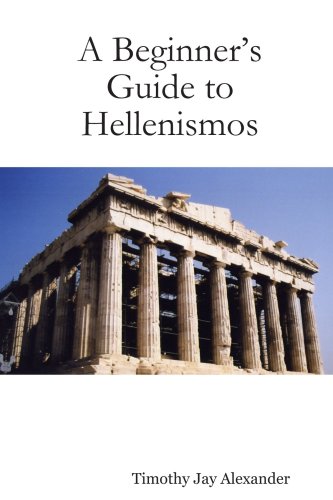
Editorial Review Product Description Hellenismos is the ancient Greek religion reborn. Do you hear the call of the old Gods? This book is a thorough introduction to Hellenic Polytheistic Reconstructionism. Written by Timothy Jay Alexander, owner of the popular Pagan website Mind-N-Magick.com, "Hellenismos Today" is an exceptional guide to the character and diversity of the modern religious beliefs and practices of Hellenismos. For experienced Hellenic Reconstructionists, this is an excellent tool to introduce friends and family to your beliefs and practices. ... Read more Customer Reviews (4)
A wonderful read
The first thing the author does is make clear to the reader that the book is about a modern day religious practice and not a history lesson. I found this to be very important due to the fact that many people mistakingly believe that modern day Hellenics worship in exactly the same way as the ancients did. In Hellenismos Today Mr. Alexander makes clear that while the beliefs are based upon an ancient religion it still recognizes modern day ways and adjusts its practices accordingly.Another thing i found quite refreshing is Mr. Alexander's acknowledgment that while he's intent is not to bash another religion he will not whitewash facts about that religion.
I very much enjoyed reading the list of the 'Maxims of Delphi' which are basically the 'rules' of the hellenic belief system. The only downside i found to it was the part where the author states that the only ethic he believes to be outdated is the one which states "Rule your wife" the author states that in modern society "Rule your spouse" is more accurate. Now while I quite agree with this there is another rule which states 'Educate your sons' I believe it would have been good for the author to state that in modern day times 'educate your children' would be more appropriate.
In the chapter Magic vs. Mystical, Mr. Alexander touches on some of the core differences between the two and why magic is not generally practiced among most hellenics and that while the use of it is fine in religions that allow it, it is not so within Hellenism. I also belive that this cahpter holds one of the best lines in the book "If you believe like a Hellenic Reconstructionist but act like a Wiccan, you will be smacked down for it."
Overall I found Hellenismos Today to be thus far one fo the best introductory books to Hellenic Polytheism I've had the pleasure of reading. I belive the author writes in such a way to allow even those with a very limited knowledge of ancient Greece and the Greek Gods to better understand and appreciate what is truly a very beautiful and empowering religion. I'd recommend that anyone wanting to learn more about about Hellenic beliefs add this book to their personal library.
A light and easy introduction to Hellenic Reconstructionism
First impressions: The book is chock full of original sources. Of 133 pages, 58 pages are Mr. Alexander's own work. The rest is a list of the Delphic Maxims (four pages long), excerpts from Hesiod's Works and Days and Theogony, and Julian's Oration to the Sun.
These appendices are a good feature, if you ask me. I like the fact that Mr. Alexander put so much of the original works at the hands of a novice.
On to the book itself.
Chapter 1 has a good discussion of the roots of Neopagan-Recon tensions, such as the taking of deities out of their cultural and historical contexts, soft polytheism v. hard polytheism, the impious and disrespectful "use" of deities, esp. via magick, and the questionable historical claims by many neopagans. I especially like his use of the term Fakelore to describe the latter. He briefly discusses emanationism, the ultimate unity of which the Gods are thought by some to partake in.
I especially like this passage: "I have to be clear here, Reconstructionist religions are not the ancient religions themselves. They are modern religions based on ancient cultures and their spiritual practices." (Page 15)
Some of the slight differences between Mr. Alexander and myself arise from the fact that he focuses on the public cultus, or popular religion, rather than the more philosophical approach of the intellectual elites, which I personally tend to follow. Considering the apparent high demand for the works of the sophists, and the philosophers, and the known dramatic performance of the dialogs in public places, I think the average person would have more exposure to these ideas than he gives credit. It is also known that people would seek out philosophers for advice, much as many today would turn to their priest, so they had some sort of unofficial status. This is, however, a quibble as I admit, and a characteristic of the Classical and Hellenistic era.
Chapter 2: He emphasizes the lack of a founder as compared to the revealed religions. He briefly discusses the Minoans. Since they are often held up as a matriarchal goddess-based society, it would be nice if he had helped dispell that bit of fakelore with more than just a brief mention that this idea has been discredited. However, this is a pet peeve of mine, since I am really interested in the Bronze Age religion of the Greeks.
He gives a nice, if a bit spare history of Greece civilization and religion.
"Hellenic Reconstructionism allows for a great deal of diversity in beliefs and practice because of the very nature of ancient Greece." (pg. 19).
I also like how he describes each city state as practicing what could be considered a separate denomination or religion from each other. He really emphasizes the local nature of ancient Greek religion, pan-Hellenic festivals and institutions aside.
I would disagree with his use of the term cult to refer to a practice or belief outside the mainstream. The word cult, simply means worship, and to pay cult is to offer worship. Hence the use of terms like Cult image. While a beginner may not be aware of this, since one will encounter the term much in one's research, it would be a wise thing to make this definition clear to the reader.
I enjoy how he is trying to be fair and balanced with regards to all the approaches to Hellenic reconstructionism, especially by emphasizing the diversity of practice. His focus on personal devotions in this chapter is also a good one, as for now, this is the primary form of devotion available to us until there is a sufficient increase in numbers to provide for congregations.
Chapter 3: I find this chapter a little weak, as he gives little information on the Gods, though I agree people should take a deeper research approach to the Gods. However, I think he takes too literally the idea that everyone has some idea of the Gods from our education in mythology. This is true, however, one advantage OSNT has over HT is that Mr. Campbell provided hard to find epithets, divine animals and plants, and suggestions for devotional activities which would be very useful for the beginner in ritual and prayer. These are details most people would not find in most treatments of mythology.
Mr. Alexander then repeats a discussion of hard v. soft polytheism, and gives another quick rundown on the one and the many.
"One must not succumb to contemporary thinking having the Greek Gods locked into an archetypal typecast. While the Gods may have their primary governances, they are complex beings with concerns that cover a multitude of venues." (p. 23)
This is a vital point, and I'm glad he makes it. This is, however, something a beginner might not notice from studying most discussions of mythology and the Gods, which tends to collapse everything about a God to one type or archetype.
His use of Aphrodite to illustrate this is done brilliantly, IMHO, and I really found the examples useful. The example would be very helpful to a beginner. Its too bad that something similar could not be done for all the Gods.
Chapter 4. Cosmology is treated in this chapter. He gives a good discussion of Emanationism, very suitable for a layman. I especially like the fractal analogy, which is very appropriate, and one which I had not thought of before. I also like how he emphasizes that the universe came about and operates through natural causes and is scientifically understandable. The Greeks invented science as we know it, and were the first scientific cosmologists.
Chapter 5: Ethics is handled in this chapter, and I think this is the strong poit of the book. The very first paragraph goes over the various sources of ethics for our faith, and gives good clues to a beginner where to look. I also really enjoy this passage:
"The Maxims are more focused on how one should behave rather than limiting or condemning individual personal behavior." (p. 29).
This is a good summary of how our ethical code differs from some others, which are more about what not to do, than what to do.
He then analyzes three particular Maxims:
HONOR THE GODS, GIVE BACK WHAT YOU HAVE RECEIVED, NOTHING TO EXCESS
The analysis of these as the roots and summation of piety, reciprocity and meodration is very well handled. While the discussion of this in detail could easily be an essay for each maxim, a simple summary as that which is presented is fully appropriate for an introductory text. I also enjoy again further discussions of the diversity of our community, especially in terms of politics and regions. We are not monolithic, and I think that is a strength.
Chapter 6 is about clergy. Mr. Alexander focuses on a very localist form of priesthood, especially focused on the family. I have come to conclude that for the foreseeable future, we should focus on domestic religion, centered on the family, and at most a few friends. Later as we grow, and congregations begin to form, more formal priesthoods will be needed. He and I agree that there can be, and should be various types of priesthoods, much as in the ancient world there were hiereuses and their assistants, all of whom had sacerdotal functions. I also think that as we moderns often have an expectation that clergy should have a teaching and pastoral function, teaching and counselor priests or ministers may be required inthe future. Mr. Alexander downplays this, though he does not reject the need or utility of professional priests, and it could be that we disagree on this point.
We do agree on the need for legal ordination, in order that the priests may perform certain public ceremonies. (The only one that I can think of that is vital, is marriage, and he does bring up cases where this is not as necessary).
"Families intrinsically had the right to perform welcomings, weddings, funerals, and other rituals without having to go through intermediaries. Providing ordination credentials on request returns these rights back to individuals and their families as they should be." (p. 40).
I agree wholeheartedly with that sentiment. He mentions the ULC, and I have considered myself, getting ordination through them to have the legal standing to perform certain functions perhaps, at some time in the future.
Chapter 7 deals with rituals. It is a nice little chapter, which emphasizes how each family or locality may vary in its uses. He includes also a sample prayer to Aphrodite, and the basic steps of a ritual. One area that I find OSNT to be a bit better at is the more detailed ritual instructions which can really help jumpstart the beginner. However, since Mr. Alexander emphasizes the familial domestic religion, which can have its own rituals, I can understand the scarcity of detail here.
(I think Mr. Alexander, who is likely reading this, may find my post on Domestic Religion a few days ago of interest).
Chapter 8 deals with holidays. He gives the months of Athens (with a very simplified correspondence to the Gregorian calendar), with the key rituals of each month, and also the major festivals. When I first skimmed the book, I had felt this was a weak chapter. However, I don't think so on my second, more detailed examination). A nice touch is a mention of the possible honoring of the local spirits, something we often over look today.
Chapter 9 deals with divination. He gives some basic background, but not a whole lot of information for the beginner to work with here. This could have been fleshed out some more. For someone coming from a Neopagan perspective, this would not be too bad, since they are usually fairly aware of divinatory tools. However, for the non-Neopagan beginner, they may have no knowledge of any divinatory devices or techniques, and making a few suggestions may have been in order.
Chapter 10 deals with magic and mysticism. Mr. Alexander tells me in conversation that this is the most controversial chapter, and I can see why. I will cut straight to the chase:
"Any form of magic performed where the practitioner believes that they are wielding power in and of themselves would be hubris. Any form of magic where the practitioner believes that they are commanding or are in control of the Gods will be seen as impious." (pp 59-60).
Right there, he will alienate some of our community who are wedded to magick, and to some possible Neopagan converts. I agree, any magick that compels the Gods is hubris and impious.
He however, assumes that these are the only two options. The Hellenistic era magicians believed that they were using a form of technology...manipulating occult influences, properties and connections (correspondences) to attain changes. This is not power in and of themselves, but an outside source of power. In principle this is no more hubris, than our making of tools using scientific correspondences, connections and properties.
I would caution however, that magic was in and of itself frowned upon even if not illegal (and usually the following types of magic were illegal), especially as much of it was aimed at cursing people, compelling love, and other unsavory and unethical ends. Any known magician would have, shall we say, a negative reputation. Apuleius was charged with magic, and had to defend himself in court.
Mr. Alexander also leaves out Theurgy which is a form of magic aiming at mystical ends, to unite with The One or the Gods. This crosses the line between mysticism, which he has little problem with apparently, and magic, which he dislikes. However, theurgy was practiced only by Neoplatonists, and only some of them. Plotinus and Porphyry condemn the practice, for instance. There is also the problem that little information on authentic ancient Theurgy survives for us to reconstruct.
For me, while I am interested in theurgy, this discussion is not such a big deal, as magic plays a minor role in my faith, which is almost entirely devotional anyway, and I rarely do any theurgical work at all. However to those who are interested in magic, this condemnation of their practices would be seen as a major attack. I must emphasize however, that the Hellenic Reconstructionist community is strongly divided on the matter of magic, and Mr. Alexander's view is shared by a fairly good portion of our community, and so I have little objection to his objections to magic.
To sum up, I found the book rather useful, if a bit short on meaty substance that could be useful to the beginner seeking a quick foundation for practice. I have little problem recommending the book to others despite this, and may well give it to my mother to read. I hope that in a future edition, some more of the sort of basics I mention in here will be added to the book, improving its utility. I think some of this could have been included in the first edition, especially considering that this edition has only 58 pages of work. Surely a few more pages of divine epithets, and a more detailed sample ritual could have been added to the manuscript.
My Review
I have been interested in paganism for many years and for a long time thought Wicca was all there was but I was never able to connect with it. A friend recommended this book to me and it really hit home. Thanks to this book I have found Hellenismos and I think the path that is right for me.
Excellent Read
I thoroughly enjoyed this book.It starts by identifying Hellenismos as a Reconstructionist religion, which it is.There are some in the Hellenic community that would take umbrage with that, but this should not at all be controversial.Personally, I feel it is an accurate use of the term, as other authors before Mr. Alexander have the same definition, notably, Drew Campbell, author of Old Stones, New Temples.
Upon perusing the Table of Contents, I was impressed with how much information Mr. Alexander was able to provide, especially for an Introductory Guide (his term).The Gods and Goddesses section is just as it should be, a general run through of the Olympians and Daemons.I believe it should be up to the practictioner of Hellenismos to learn more, as does Mr. Alexander.I am impressed that he stresses learning about the gods in their totality, and not allowing oneself to be duped into worshipping an archetype or popular perception.I also was impressed with the clear and precise way the author was able to discuss soft and hard polytheism in a way that makes it easily understandable to the reader.Syncretism and electicism are also terms that are easily confused, even among experienced pagans, and I was glad to see that Mr. Alexander was able to show that these are not terms that can be used interchangeably.
The Cosmology section did not go into great detail, and honestly, I am glad.As an Introductory Guide, anything too in depth would only confuse.Suffice it to say that what Mr. Alexander stated is the truth; that no matter what philosophical idea one subscribes to, "the universe exists naturally and functions in a scientifically explainable way."
Mr. Alexander delves into another sticky area of Hellenismos; magick.The battle rages between Hellenes as to whether magick is an acceptable practice within the religion.Mr. Alexander draws his line in the sand and explains the differences (in his opinion) of magick and mysticism.Whether you agree with him or not, it is a well presented argument.
What is particurlarly important, at least in my mind, is the role of clergy within Hellenismos.I believe there is a need differentiate it from the popular perception of clergy (Christianity).The author is clearly knowledgeable regarding this subject, and in my opinion, it is the best chapter in this book.
I appreciated the Suggested Reading List, as I suspect that many who read Hellenismos today will want to continue their study of Hellenic Polytheism.
I applaud the efforts of Mr. Alexander to write a book on a very misunderstood religion.While it is true that most people that find their way to Hellenismos are academic and intellectually oriented, he recognizes that spirituality is valid within the religion and has it's place as well.
I am sure that there are many who will not agree with Mr. Alexander's opinions.For me personally, I found myself nodding in agreement with most, if not all of what he had to say. Thankfully, this book has not whitewashed the beliefs and practices of Hellenic Polytheism to make it palatable to the masses. I highly recommend this book to those who are just starting to learn about Hellenismos, and to those who are drawn to the Greek Pantheon, regardless of path.
... Read more
|