e99 Online Shopping Mall

Geometry.Net - the online learning center Help  
Home  - Religion - Islam (Books)

  1-20 of 100 | Next 20
A  B  C  D  E  F  G  H  I  J  K  L  M  N  O  P  Q  R  S  T  U  V  W  X  Y  Z  

click price to see details     click image to enlarge     click link to go to the store

$7.86
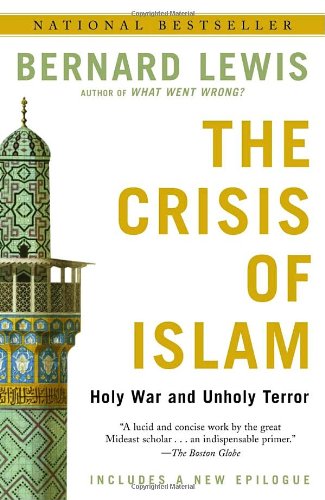
1. The Crisis of Islam: Holy War
$11.00
2. The Politically Incorrect Guide(tm)
$7.38
3. Islam: A Short History (Modern
$7.00
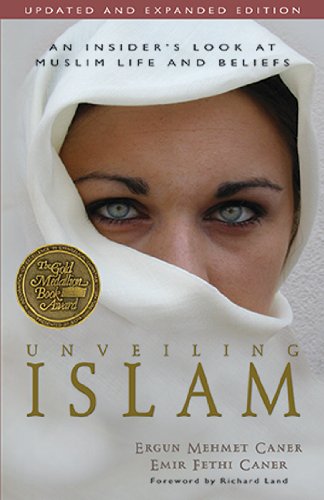
4. Unveiling Islam: An Insider's
$14.45
5. Reconciliation: Islam, Democracy,
$15.61
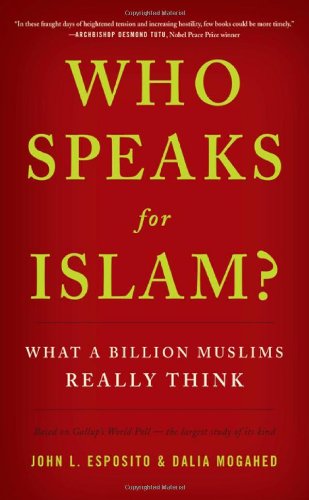
6. Who Speaks For Islam?: What a
$38.95
7. Global Political Islam
$13.83
8. The Trouble with Islam : A Muslim's
$18.81
9. God's Crucible: Islam and the
$12.37
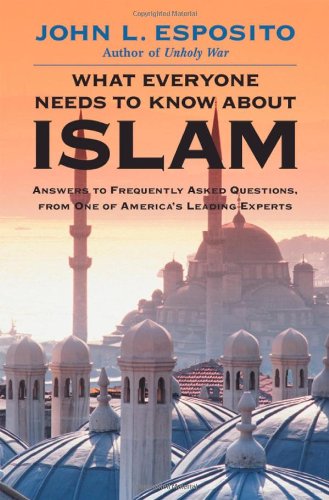
10. What Everyone Needs to Know about
$10.87
11. The Complete Idiot's Guide to
$15.00
12. Women and Gender in Islam: Historical
$4.48
13. Answering Islam: The Crescent
$11.52
14. Islam: A Mosaic, Not a Monolith
$11.79
15. Islam for Dummies
$15.30
16. Arguing the Just War in Islam
$16.66
17. The Vision of Islam (Visions of
$11.35
18. Antichrist: Islam's Awaited Messiah
$8.99
19. Treasures of Islam: Artistic Glories
$16.73
20. Marching Toward Hell: America

1. The Crisis of Islam: Holy War and Unholy Terror
by Bernard Lewis
Paperback: 224 Pages (2004-03)
list price: US$13.95 -- used & new: US$7.86
(price subject to change: see help)
Asin: 0812967852
Average Customer Review: 3.5 out of 5 stars
Canada | United Kingdom | Germany | France | Japan
Editorial Review

Amazon.com
After the terrorist attacks of September 11,many Americans yearned to understand why Muslim extremists felt such passionate animosity toward the Western world, particularly the United States. Since that historic attack there have been many books and discussions about this very question, but few of them offer such a readable and relevant response as this excellent offering by renowned historian Bernard Lewis (What Went Wrong?). For modern Westerners, Islam is an especially foreign religion and culture to understand. For instance, Westerners typically dismiss things as unimportant when using the expression "that's history." But for those raised in Muslim households, history—even ancient history—is just as important (if not more important) as the present. And to better understand the hostilities rooted in this history—one could start with recognizing the long-standing resentment the Islamic community harbors from having its homelands torn apart and re-packaged into random political states by occupying Europeans (Westerners). Or stretch back in time to the brutality of the Crusades. Or go straight to the U.S. political meddling in the region throughout the latter 20th century.

This is not a pity fest for Muslims. Lewis even-handedly explores the sources of Islamic antagonism toward the West while also explaining how a supposedly peace-worshipping religion could be so distorted by violent extremism. He notes that the American way of life—especially that of fulfillment through material gain and sexual freedom—is a direct threat to Islamic values (which is why night clubs—places where men and women publicly touch one another—are targets of bombings). But it is basic Western democracy that especially threatens Islamic extremists, notes Lewis, because within its own community more and more Muslims are coming to value the freedom that political democracy allows. For anyone wanting an intelligent and accessible primer on the Islamic-Western conflict, this is an excellent place to begin. Gail HudsonBook Description
In his first book since What Went Wrong? Bernard Lewis examines the historical roots of the resentments that dominate the Islamic world today and that are increasingly being expressed in acts of terrorism. He looks at the theological origins of political Islam and takes us through the rise of militant Islam in Iran, Egypt, and Saudi Arabia, examining the impact of radical Wahhabi proselytizing, and Saudi oil money, on the rest of the Islamic world.

The Crisis of Islam ranges widely through thirteen centuries of history, but in particular it charts the key events of the twentieth century leading up to the violent confrontations of today: the creation of the state of Israel, the Cold War, the Iranian Revolution, the Soviet defeat in Afghanistan, the Gulf War, and the September 11th attacks on the United States.

While hostility toward the West has a long and varied history in the lands of Islam, its current concentration on America is new. So too is the cult of the suicide bomber. Brilliantly disentangling the crosscurrents of Middle Eastern history from the rhetoric of its manipulators, Bernard Lewis helps us understand the reasons for the increasingly dogmatic rejection of modernity by many in the Muslim world in favor of a return to a sacred past. Based on his George Polk Award–winning article for The New Yorker, The Crisis of Islam is essential reading for anyone who wants to know what Usama bin Ladin represents and why his murderous message resonates so widely in the Islamic world. ... Read more

Customer Reviews (134)

5-0 out of 5 stars Fantastic!It delivers on it's promise.
This book is a must for anyone trying to understand Islam and Islamic fundamentalism.This book is short and sweet but packs a well reasoned, fact backed, punch.Read it!

1-0 out of 5 stars Is there a way to put no stars on these reviews?
The author is an infamous neoconservative.The best way to describe the book is that it's racist, oversimplified, biased, and ignorant.I hope the people who read this book ralize that it will only breed more ignorance and arrogance.Shame on you, Mr. Lewis!

As someone who has and worked in the Middle East, as well as studied it, let me recommend The Looming Tower, No God but God, The Shia Revival, and The Great War for Civilisation. Thease are accurate, eye-opening, insights into such a complex topic.

3-0 out of 5 stars Don't Expect Much
This book might suffice as a general introduction, but nothing more.I don't know much about the middle east, or about Islam in general, so I found much of this book fascinating; however, I also found much of it to be suspect.

One reason for my suspicion is the alarming lack of endnotes--especially in juxtaposition to the prevalence of quotes and "facts."One to 5 endnotes per chapter in a alleged non-fiction book is unacceptable.Additionally, as many other reviewers have also noted, the statistics and assertions Lewis sets forth are used in a rather deceptive manner and seldom appear to strike at the truth.It's hard to say that Lewis is deeply biased, since he attacks both sides (perhaps not equally).Instead I think the shortcomings of this book owe entirely to laziness, or, more likely, to the tight publishing schedule of a multi-book deal.

If you go into this book expecting reasonable analysis and sound conclusions you will be disappointed; if you go in expecting a gloss, a signpost pointing the way, then this book may suit you well.

3-0 out of 5 stars Not one of my favorite books
This was recommended reading for us before we deployed to Iraq in 2005, but quite frankly I didn't think that much of it. While the author has some interesting points I found many of the arguments he made self-defeating and some of the history behind his assumptions invalid.

2-0 out of 5 stars Disappointing but still worth the read
Disappointing simplification of Arab American relationship or lack thereof, its link to the decline of Islamic political power and the frustration of Muslims. Mr Lewis is successful in drawing up a picture of failures of Islam through the American prisms. Unfortunately, the arguments must be viewed in a broader context to be credible for those of us who have also lived outside the US. His linking of Islam hostilities to the Nazis and the Soviet Union is a bit weak, although some truth could be found in it. Overall, an interesting book for those who want to understand Americans' misconception of Islam written by a scholar within the middle of it. ... Read more


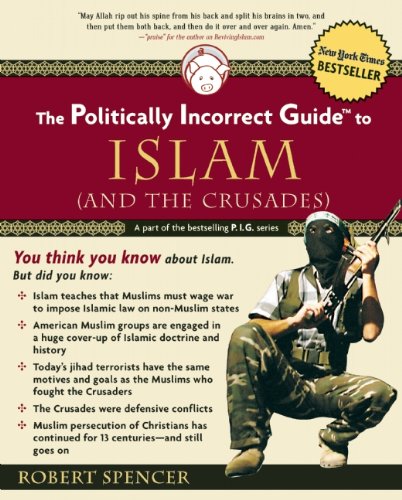
2. The Politically Incorrect Guide(tm) to Islam (and the Crusades) (Politically Incorrect Guides)
by Robert Spencer
Paperback: 270 Pages (2005-08-01)
list price: US$19.95 -- used & new: US$11.00
(price subject to change: see help)
Asin: 0895260131
Average Customer Review: 4.0 out of 5 stars
Canada | United Kingdom | Germany | France | Japan
Editorial Review

Book Description
Islam expert Robert Spencer reveals Islam's ongoing, unshakable quest for global conquest and why the West today faces the same threat as the Crusaders did--and what we can learn from their experience. ... Read more

Customer Reviews (487)

3-0 out of 5 stars A good primer, but I suggest alot of further reading
I bought this hopeing for a bit more humor, something to put the FUN back into fundementalism.I didnt get much "funny" from this book, but it did contain alot of good information that people should definately know. However I would not hand this offf to some one that didnt already have a decent concept or background in religious study.It is not an in depth look into Islam, it is a focus on modern apologetic arguemnts and the tenets of Islam that have allowed the "crazy folk" to do what they do and think as they think.The topics range from the argument we hereabout the crusades to politcal developments in the last century to the smoke screen OUR media has used to keep the public from knwoing anything useful about the true nature of the Islamic world and its mission.I sugges tthis book but I suggest others to read along with it such as History of Jihad, and of course dont take everything " as is", the author has a point he's making and at times other investigation and deliberation are sacrificed in order to keep that point.

1-0 out of 5 stars Facts please, ALL of them
I like some of the Politically Incorrect books but in some of them"politically incorrect" becomes a synonym for "basically ignorant". This book is a case in point, as is the guide to the Middle East. Cherrypicking quotes, showing off ignorance of both Islamic and Christian history in the ME, and pursuing a politically biased agenda does not a revelation make.

5-0 out of 5 stars excellent and informative
This book was very popular while my unit was in Afghanistan. It's very useful to help wrap your brain around some of the fundamental differences in Islamic vs western thinking. Forget the golden rule forget live and let live. Anyone who thinks they are informed about Islam should at least read this book, agree with it 100% or not.

5-0 out of 5 stars Politically Incorrect Guide to Islam
Judging by the amount of abuse that Robert Spencer receives from islamonazis and their jew-hating allies, Robert Spencer's work at Jihadwatch which embodies as its basis the research of this book, this book and his work are important revelations to the uninitiated of the facts of islamic doctrine in the roots of modern popular islamic fascism.

It is a scholarly work from a man who has a Ph.D. in Islamic Studies.Condemned by his enemies as a Jew, the epithet, of all nazis, islamic or otherwise, in an attempt to obfuscate the truth, Robert Spencer is in fact, not Jewish, and this work is significant in understanding the mentality of islamists and their relentless programs of propaganda as exemplified by organizations such as C.A.I.R.

4-0 out of 5 stars Refreshing read
There is no better book on Islam than this one. A very Non-PC book and a fair guide to what every sane Westerner must know about the religion of Islam in a non-PC fashion. ... Read more


3. Islam: A Short History (Modern Library Chronicles)
by Karen Armstrong
Paperback: 272 Pages (2002-08-06)
list price: US$14.95 -- used & new: US$7.38
(price subject to change: see help)
Asin: 081296618X
Average Customer Review: 3.5 out of 5 stars
Canada | United Kingdom | Germany | France | Japan
Editorial Review

Amazon.com
The picture of Islam as a violent, backward, and insular traditionshould be laid to rest, says Karen Armstrong, bestselling author of Muhammad and A History of God. Delving deepinto Islamic history, Armstrong sketches the arc of a story that begins with thestirring of revelation in an Arab businessman named Muhammad. His concern withthe poor who were being left behind in the blush of his society's new prosperitysets the tone for the tale of a culture that values community as a manifestationof God. Muhammad's ideas catch fire, quickly blossoming into a political empire.As the empire expands and the once fractured Arabs subdue and overtake the vastPersian domain, the story of a community becomes a panoramic drama. With greatdexterity, Armstrong narrates the Sunni-Shi'ite schism, the rise of Persianinfluence, the clashes with Western crusaders and Mongolian conquerors, and thespiritual explorations that traced the route to God. Armstrong brings us throughthe debacle of European colonialism right up to the present day, putting Islamicfundamentalism into context as part of a worldwide phenomenon. Islam: A ShortHistory, like Bruce Lawrence's Shattering the Myth and MarkHuband's Warriors of theProphet, introduces us to a faith that beckons like a minaret to thosewho dare to venture beyond the headlines. --Brian BruyaBook Description
No religion in the modern world is as feared and misunderstood as Islam. It haunts the popular imagination as an extreme faith that promotes terrorism, authoritarian government, female oppression, and civil war. In a vital revision of this narrow view of Islam and a distillation of years of thinking and writing about the subject, Karen Armstrong’s short history demonstrates that the world’s fastest-growing faith is a much more complex phenomenon than its modern fundamentalist strain might suggest. ... Read more

Customer Reviews (135)

5-0 out of 5 stars Coming from my place of ignorance
This is, indeed, an elementary work, but as such, I found it enlightening. I gained a sense of the premises of the Koran and how Islam succeeded, within a century of its founding, to spread to North Africa and Spain. I hadn't known a thing about the Mongol invasions, or when Sufism arose, or how the Sunni's and Shia's actually diverged. It was interesting to read about the rise and fall of empires in the middle ages, and the strength of the Ottoman Empire into the 20th century. Reading this book was an engaging and eye-opening experience for me.

5-0 out of 5 stars Islam:A Short History
Islam: A Short History (Modern Library Chronicles)
This book has gotten some bad 'press' here."It's too much History" - well that's just what it is!It is clear, concise and well presented.It contains just what most people would want to know about the "what, where, and why" of Islam.It contains a glossary of Arabic terms, notes, suggestions for further reading, an index and study questions.All in all a very well thought out and presented work that all non-Muslim peoples could benefit from reading.

/Rev. Scholtes

5-0 out of 5 stars GREAT INTELLIGENT BOOK, MUST READ
I really think this book must be a reference to all those who want to know more about Islam away from the hate-filled sad creatuers who live just to defame Islam.

It is a must read for all REASONABLE people.

5-0 out of 5 stars A great introduction to the history of Islam.
This is a really great book to understand Islam. I truly loved this book, and because of its small size, I was able to devour it within two days!

The most interesting chapter as far as I am concerned was on the present conflict between the Jews and the Muslims.

Muslims never hated the Jews. In fact, Muslims and Jews lived together side by side in peace since the beginning of time (so to speak). Prophet Mohammad ordered Muslims to respect Jews and live with them in peace since they are `people of the book' (meaning they have had their own revelations and are thus believers in God). Prophet Mohammad ordered Muslims not to try to convert Jews to Islam against their wish. In fact, Muslims believe in all of the prophets of Judaism, and most if not all are mentioned in the Muslim holy book known as the Qur'an.

Prophet Ibrahim, the father of both Muslims and Jews, had many children. The Jews come from the lineage of one of Ibrahim's sons, while the Moslems come from another of Ibrahim's sons. Therefore, Muslims and Jews are cousins.

Throughout history, Muslims and Jews have fought together side by side. During the crusades they fought together to protect the holy land. During the Muslim occupation of Spain Muslims and Jews fought together side by side against the Europeans. During the British occupation of Palestine, both Moslems and Jews fought together against the British. There has never been any enmity within Jews and Muslims throughout history. It is only after the invasion by the Jews of Palestine, and the formation of the State of Israel on Palestinian land, that the aggression between Muslims and Jews started. That started the flame of hatred between them, and Muslim clerks twisted the sayings of Prophet Mohammad and the Qur'an for political reasons. In other words, they put words into the Prophet's mouth. Things he never said or did not mean were suddenly attributed to him. The Arab world, being uneducated, would blindly follow the teachings of the clergy, and this is where we are today. The hatred between Jews and Muslims is political. It is the same hatred the French had towards the Germans when they invaded Paris during World War II. If the United States were to be invaded today by the Russians or Chinese (or any other nation), the Americans would have the same hatred towards their aggressors as the Muslims have today of the Jews. Like the Muslims, the American citizens would be fighting the aggressor to regain their land by any means possible, even if it means twisting the words of Jesus Christ. For example, love thy neighbor, but only if he loves you. If someone slaps you, turn the other cheek, but then beat the hell out of him! You get the point. The conflict in Palestine is man and woman against man and woman, not Judaism against Islam.

This book will really give you a crash course on Islam. It starts off by explaining why a new prophet was needed in the Arab World. According to Armstrong, the Arabs felt left out for they did not have a prophet of their own. The Jews had many prophets, and there were manuscripts left to them from past prophets. The Arabs did not have monotheistic religious texts of their own in the Arabic language, and thus felt left out. Thus the arrival of Prophet Mohammad, an Arab, was a great welcome to many Arabs. The Qur'an, the holy book descended to Prophet Mohammad, was in the Arabic language, and thus directly accessible to all Arabs, unlike Jewish texts.

Prophet Mohammad did have Arab enemies, of course. Not all Arabs embraced his religion at first. As is so well known today, self-interest and politics plays a big role.

A very important point Armstrong makes is that Islam is a religion of peace. In fact, Islam is derived from the Arabic root "Salema", meaning peace and purity. Prophet Mohammad was against wars. In fact, he made an important treaty with the Meccans to prove his point. Prophet Mohammad preached non-violence. All the Muslim wars and conquests that took place after the death of Prophet Mohammad were politically motivated, not religious in any way. It is very easy to twist the words of a prophet, and all religions have done that with their prophets (look at how many different versions of the Bible are out there). Furthermore, there were many wars waged between Muslims themselves as to who should succeed the prophet. Most of the Prophet's friends and close relatives were eventually murdered as a result. All these actions would have been condemned by the Prophet. Again, man was fighting for his own self-interest and ambition and not in accordance with the holy teachings of Islam (again, as has happened in all religions).

The book then goes on with the history of Islam after the era of the Prophet (632-661). Armstrong explains the era of the Umayyads, the Abbasids, and the esoteric movements. The Muslim world had reached its height in glory, and the whole known world feared the Muslims. The Muslims contributed to philosophy, science, mathematics, and medicine, and Arabic texts were translated into Latin and Greek. The Muslim empire at the time was what the United States is today to the rest of the world.

The Crusades are also explained, as well as the interesting era of the Mongols (1220-1500).The chapter on the Mongol was very interesting, filled with facts and stories I never knew. For example, the Mongols contributed a lot to Islamic art and architecture as well as to the strategies of war. After the Mongol conquests, the Mongols and the Muslims lived together in peace, and were even integrated together. Many Mongols later became Muslims.

Armstrong then moves on to the era of imperial Islam (1500-1700), and introduces the reader to the Safavid Empire, the Moghul Empire, and the Ottoman Empire.

The book ends with a chapter on Islam agonists, and explains how the west finally conquered the Islamic world starting in 1750. This chapter is extremely interesting and entertaining, and will give you a glimpse at the present state of the Muslim world.

Armstrong mentions the book `The Satanic Verses', by Salman Rushdie. Even though the Ayatollah Khomeini condemned the author, and issued a Fatwa (a decree) to have the author killed (with a million dollar reward), all the Islamic clergy of other Islamic nations were against the Ayatollah's decree, citing freedom of speech and expression as an Islamic right. Now isn't this interesting? Again, for political reasons, Muslim citizens are stripped from their freedom of expression, speech, and thought. Outsiders looking at the way of life of Muslims should realize that the way Muslims live is not according to the teachings of their Prophet Mohammad, but according to the selfish greed of their leaders! This is really a very important point for westerners to understand.

This is a very important book and should be read by everyone interested in knowing more about the state of the Arab world and Islam. I highly recommend this book!

4-0 out of 5 stars Good book for general explanation
This book will explain the basics of Islam, which is all I was looking for. ... Read more


4. Unveiling Islam: An Insider's Look at Muslim Life and Beliefs
by Ergun Mehmet Caner, Emir Fethi Caner
Paperback: 176 Pages (2002-03-01)
list price: US$12.99 -- used & new: US$7.00
(price subject to change: see help)
Asin: 0825424003
Average Customer Review: 3.0 out of 5 stars
Canada | United Kingdom | Germany | France | Japan
Editorial Review

Book Description
(Foreword by Richard Land) An insider's look at the reality of Islam by two former Sunni Muslims widely respected for their ability to clearly explain the Muslim mind. More than 150,000 copies in print! ... Read more

Customer Reviews (139)

1-0 out of 5 stars Sick
Sick and disgusting. Islam is not necessarily the best religion but it isn't evil. ANY religion can be portrayed as evil. It is all from your perspective. THis book has a biased author. Obviously someone who converted to anothe religion from Islam is not going to speak to higly of it. Look for more of a historical and informative book. Not an opinion.

1-0 out of 5 stars this book should have been titled "Smearing Islam"
IF YOU WANT AN UNBIASED VIEW ON ISLAM: DONT WASTE YOUR TIME!!

This book does not even deserve one star. If you want to know how much evangelical radicals hate Islam and Muslims, then go ahead and read. If you want an unbiased view on Islam, Please save your time and read other books that present the facts as they are. I recommend " what do muslims believe?"
this is hateful propaganda against Islam and Muslims. Goes as far as to call Allah " the Hater." FABRICATED sayings of the Muslim prophet Mohammed, as well as countless INACCURATE information, even in facts that were not used to smear Islam. For example, it says that the prophet Mohammed did not receive a revelation after his first revelation until three years after, when in fact it was only 3 months. In that statement they had just wiped out an essentials 3 years of his life known as "calling in secret." book claims that Women in Islam are considered "genetically inferior." It uses verses from the Quran OUT OF CONTEXT. very HATEFUL and VILE. Im disgusted that such a book would even get so much attention. Just another book thats part of the smearing campaign against Islam. another crappy piece of lit that will make the authors rich. Unfortunately, this book will only add to the existing fear and hate Americans have against a world religion and 1/5th of the worlds population.

5-0 out of 5 stars Islam is peace
For your information, Islam is also understood as peace, it is true that the authentic word for peace is Salaam, but Islam is from the same word and the same meaning (i.e: intense --> intesify).

If you come to study all of the phsycological book on how to find life-long happiness you'll come to discover that all of the studies that they have unleashed in the 21th century was already discovered in Islam, it is a peaceful religion.

5-0 out of 5 stars A very insighful introduction to Islam
My church recently had as a guest a former Muslim (now Christian) from Pakistan to talk about Islam. He mostly shared about the basics of Islam, then recommended this book (among others) for further information. I chose to purchase this book and I am very glad I did. "Unveiling Islam" is written by Ergun and Emir Caner, two American-raised brothers who were formerly Muslim, but are now Christian. "Unveiling Islam" is an easy-to-read, precise, and well-informed book which simply tells the truth about the teachings of Islam. Is the introduction, the authors state more than once that the purpose of the book is not to incite hatred toward Islam, but rather to educate people about the teachings of Islam. Very few, if any, of their statements about Islam are unsupported. As former Muslims, they are very knowledgeable about the Koran and they make use of this knowledge to back up their statements about Islam with specific references to the Koran. They also use many Bible references, usually for the purpose of comparing the Koran with the Bible.
While "Unveiling Islam" is a very good source for information about Islam, my personal opinion is that it is still just a basic introduction to Islam. In my opinion, you could learn far more about Islam beyond this book by meeting a practicing Muslim, getting to know him/her, and learning about their point of view. The authors themselves suggest this same idea more than once in the book. Another way to get more information about Islam is to get a reliable English translation of the Koran (yes, there are unreliable translations) to see for yourself what it says.
In short, if you are simply interested in a basic understanding of Islam and its teachings, then this is probably a perfect book for you. As I mentioned before, it is an easy-to-read, precise, and well-documented book. I really enjoyed reading this book, and learned a lot from it, and I think you will as well.

5-0 out of 5 stars excellent
Excellent book..Would suggest that our politicians read this book. This is not about being a republican or democrate. This is about being an American and how to keep America secure... ... Read more


5. Reconciliation: Islam, Democracy, and the West
by Benazir Bhutto
Hardcover: 352 Pages (2008-02-12)
list price: US$27.95 -- used & new: US$14.45
(price subject to change: see help)
Asin: 0061567582
Average Customer Review: 4.0 out of 5 stars
Canada | United Kingdom | Germany | France | Japan
Editorial Review

Book Description

Benazir Bhutto returned to Pakistan in October 2007, after eight years of exile, hopeful that she could be a catalyst for change. Upon a tumultuous reception, she survived a suicide-bomb attack that killed nearly two hundred of her countrymen. But she continued to forge ahead, with more courage and conviction than ever, since she knew that time was running out—for the future of her nation, and for her life.

In Reconciliation, Bhutto recounts in gripping detail her final months in Pakistan and offers a bold new agenda for how to stem the tide of Islamic radicalism and to rediscover the values of tolerance and justice that lie at the heart of her religion. With extremist Islam on the rise throughout the world, the peaceful, pluralistic message of Islam has been exploited and manipulated by fanatics. Bhutto persuasively argues that America and Britain are fueling this turn toward radicalization by supporting groups that serve only short-term interests. She believed that by enabling dictators, the West was actually contributing to the frustration and extremism that lead to terrorism. With her experience governing Pakistan and living and studying in the West, Benazir Bhutto was versed in the complexities of the conflict from both sides. She was a renaissance woman who offered a way out.

In this riveting and deeply insightful book, Bhutto explores the complicated history between the Middle East and the West. She traces the roots of international terrorism across the world, including American support for Pakistani general Zia-ul-Haq, who destroyed political parties, eliminated an independent judiciary, marginalized NGOs, suspended the protection of human rights, and aligned Pakistani intelligence agencies with the most radical elements of the Afghan mujahideen. She speaks out not just to the West, but to the Muslims across the globe who are at a crossroads between the past and the future, between education and ignorance, between peace and terrorism, and between dictatorship and democracy. Democracy and Islam are not incompatible, and the clash between Islam and the West is not inevitable. Bhutto presents an image of modern Islam that defies the negative caricatures often seen in the West. After reading this book, it will become even clearer what the world has lost by her assassination.

... Read more

Customer Reviews (4)

2-0 out of 5 stars Mistakes in text about Castro and others
She claims Castro's revolution was in 1957 it was really in 1959. She talks of Libya being a constitutional monarchy from 1959-69. She's right about teh end date but Libya's King Idris (whom Gadhafi overthrew in '69) was head of Libya before 1959! She admits the Shah's rule had some justice and I praise her for admitting that the US reinserted the Shah in 1953 rather than inserting him (as many authors wrongly do to make the Shah seem even less legit). But she is afr too easy on Khomeini's rule as he was much more deadly than the Shah ever was!

4-0 out of 5 stars good so far
Have only finished the first two chapters so far.Easy enough to read. There could be more chapter breaks.Exciting.Thoughts seem a little scattered, probably due to the passion it has obviously been written with.Lots of history helps to understand Muslim perspective.Religious.Can't say that I think Ms Bhutto has a firm understanding about Christianity or Judaism, but that's acceptable.

It has helped me to sort through my feelings about the Islamic religion that have developed through media exposure and little study or communication with followers of the faith.Always good to get information about a religion from a member of the faith.Also good to get information about the government from someone on the inside.

The book has done for me what it sets out to do, and that is RECONCILE me to see the religion of Islam as another religion of the world, and no longer one that seems to spawn bad things.

I think anyone trying to make a decision about who to vote for in the US Presidential election and the Pakistani elections should take what this book says into consideration.

5-0 out of 5 stars A Brilliant Woman - A Legacy Lost
Benazir's assassination is one of the biggest tragedies our world has seen in recent years. She was a brave woman, and yes, a polarizing and controversial woman in Pakistan, but also, in my opinion - a true believer in democracy and political freedom. As Prime Minister of Pakistan, she never really was able to bring her vision to reality, due to oposing forces that never let her complete both her terms, but her return to her native land in 2007 brought a promise of hope and prosperity to the Pakistani people. She was a brave and inspiring woman, and her untimely death is one of the most unfortunate events in recent times.

Through "Reconciliation: Islam, Democracy & The West", her legacy lives on, providing a coherent and articulate picture of her world-view, specifically as it relates to religion, geo-politics and specifically, Pakistan's future. Benazir and her co-author, Mark Siegel, provide a though-provoking and interesting view of where the world is headed, and through her words, we learn the extent of her vision which is now lost to us. A great read for those interested in the region and world politics and conflict, and also for those, who want to get an insight into the mind of one of the world's bravest women.

5-0 out of 5 stars A MUST READ
This is an incredible book with an extremely important message.The world lost an amazing leader and a fascinating woman when Benazir Bhutto was assasinated, but her last words will resonate for generations to come.A MUST READ. ... Read more


6. Who Speaks For Islam?: What a Billion Muslims Really Think
by John L. Esposito, Dalia Mogahed
Hardcover: 230 Pages (2008-02-28)
list price: US$22.95 -- used & new: US$15.61
(price subject to change: see help)
Asin: 1595620176
Canada | United Kingdom | Germany | France | Japan
Editorial Review

Book Description

In a post-9/11 world, many Americans conflatethe mainstream Muslim majority with the beliefs and actions of an extremist minority. But what do the world’s Muslims think about the West, or about democracy, or about extremism itself? Who Speaks for Islam? spotlights this silenced majority. The book is the product of a mammoth six-year study in which the Gallup Organization conducted tens of thousands of hour-long, face-to-face interviews with residents of more than 35 predominantly Muslim nations — urban and rural, young and old, men and women, educated and illiterate. It asks the questions everyone is curious about: Why is the Muslim world so anti-American? Who are the extremists? Is democracy something Muslims really want? What do Muslim women want? The answers to these and other pertinent, provocative questions are provided not by experts, extremists, or talking heads, but by empirical evidence — the voices of a billion Muslims.
... Read more

7. Global Political Islam
by Peter Mandaville
Paperback: 388 Pages (2007-10-09)
list price: US$43.95 -- used & new: US$38.95
(price subject to change: see help)
Asin: 0415326079
Canada | United Kingdom | Germany | France | Japan
Editorial Review

Book Description

This book offers an accessible and comprehensive account of political Islam in the twenty-first century.

Drawing on insights from comparative politics, sociology, international relations and Islamic studies, it explains the complex interaction between political Islam, nationalism, state and society, and globalization. An ideal teaching text, Global Political Islam also provides the necessary historical background and conceptual tools for understanding contemporary Muslim politics. The book contains detailed up-to-date case studies of political Islam in a variety of key settings such as Egypt, Turkey, Jordan, Saudi Arabia, Pakistan, Iran, Afghanistan, and Palestine. It also explains the evolution of Islamic radicalism through a detailed account of Al Qaeda and the global jihad movement. Transnational Islamic networking receives considerable attention, as does the role of new media and information technologies in political Islam. Fully illustrated throughout, featuring maps, supplementary textbox case studies, a glossary, and suggestions for further reading, this is the ideal introduction to the crucial rule of political Islam in the contemporary world.

... Read more

8. The Trouble with Islam : A Muslim's Call for Reform in Her Faith
by Irshad Manji
Hardcover: 240 Pages (2004-01-16)
list price: US$22.95 -- used & new: US$13.83
(price subject to change: see help)
Asin: B000FUTQ6E
Average Customer Review: 3.5 out of 5 stars
Canada | United Kingdom | Germany | France | Japan
Editorial Review

Amazon.com
This "call for reform" reads like an open letter to the Muslim world. Irshad Manji, a Toronto-based television journalist, was born to Muslim parents in South Africa. Her family eventually fled to Canada when she was two years old. Manji shares her life experiences growing up in a Western Muslim household and ask some compelling questions from her feminist-lesbian-journalist perspective. It is interesting to note that Manji has been lambasted for being too personal and not scholarly enough to have a worthwhile opinion. Yet her lack of pretense and her intimate narrative are the strengths of this book. For Muslims to dismiss her opinions as not worthy to bring to the table is not only elitist; it underscores why she feels compelled to speak out critically. Intolerance for dissent, especially women's dissent, is one of her main complaints about Islam. Clearly, her goal was not to write a scholarly critique, but rather to speak from her heartfelt concern about Islam. To her fellow Muslims she writes:

I hear from a Saudi friend that his country's religious police arrest women for wearing red on Valentines Day, and I think, Since when does a merciful God outlaw joy—or fun? I read about victims of rape being stoned for "adultery" and I wonder how a critical mass of us can stay stone silent.

She asks tough questions: "What's with the stubborn streak of anti-Semitism in Islam? Who is the real colonizer of the Muslims—-America or Arabia? Why are we squandering the talents of women, fully half of God's creation?" This is not an anti-Muslim rant. Manji also speaks with passionate love and hope for Islam, believing that democracy is compatible with its purest doctrine. Sure, she's biased and opinionated. But all religions, from Christianity to Buddhism to Islam should be accountable for how their leadership and national allegiances personally affect their followers. One would hope that this honest voice be met with a little more self-scrutiny and a little less anti-personal, anti-feminine, and anti-Western rhetoric. --Gail HudsonBook Description

"I have to be honest with you. Islam is on very thin ice with me....Through our screaming self-pity and our conspicuous silences, we Muslims are conspiring against ourselves.We're in crisis and we're dragging the rest of the world with us.If ever there was a moment for an Islamic reformation, it's now.For the love of God, what are we doing about it?"

In blunt, provocative, and deeply personal terms, Irshad Manji unearths the troubling cornerstones of mainstream Islam today: tribal insularity, deep-seated anti-Semitism, and an uncritical acceptance of the Koran as the final, and therefore superior, manifesto of God. In this open letter to Muslims and non-Muslims alike, Manji asks arresting questions. "Who is the real colonizer of Muslims - America or Arabia? Why are we all being held hostage by what's happening between the Palestinians and the Israelis?Why are we squandering the talents of women, fully half of God's creation?What's our excuse for reading the Koran literally when it's so contradictory and ambiguous?Is that a heart attack you're having?Make it fast.Because if more of us don't speak out against the imperialists within Islam, these guys will walk away with the show."

Manji offers a practical vision of how the United States and its allies can help Muslims undertake a reformation that empowers women, promotes respect for religious minorities, and fosters a competition of ideas. Her vision revives Islam's lost tradition of independent thinking. This book will inspire struggling Muslims worldwide to revisit the foundations of their faith. It will also compel non-Muslims to start posing the important questions without fear of being deemed "racists."In more ways than one, The Trouble with Islam is a clarion call for a fatwa-free future.
... Read more

Customer Reviews (219)

3-0 out of 5 stars Good, but how objective is it?
It is obvious that reform is needed when Muslims kill each other daily.The core issues identified are well founded, but how likely is it that we will gain enough ground with reforms when the basic ideology is believe as I believe or be killed?Born Muslim, I can't see our way out of this except through close examination, including scientific questionning of basic beliefs and practices.

4-0 out of 5 stars Difference as an Icebreaker
Irshad Manji frames her book, The Trouble With Islam, as a letter to "fellow Muslims."As a Catholic, there are many ways in which Manji isn't addressing me, but I still took much from The Trouble With Islam.And, in fact, there are several moments when Manji does directly address the responsibilities of non-Muslims.While this certainly wasn't her main focus, I definitely appreciate how The Trouble With Islam works to challenge Muslim and non-Muslims alike to be more reflexive about problems and struggles, and most importantly, to challenge us all to take actions to make the world better for us all.

The tone which Manji uses throughout her "letter" is somewhat of a casual/intimate one.It was almost as if I could "hear" her talking with me as I read her words on the page.Numerous passages demonstrate Manji's wry sense of humor, her outrage at contradiction and injustice, and her dedication to her faith.In this way, The Trouble With Islam is crafted to reveal Manji to her readers on a personal level, and hence to foster her readers to feel similarly connected. (It also helps to make the book a quick read).

Although I wasn't familiar with many of Manji's references, to passages in the Koran, to Islamic customs and practices, to the nuances of conflict in the Middle East, etc. I found the text accessible.Manji offered a lot of knowledge to those, like me, who have only a rudimentary understanding of Islam and Muslim culture.Yet, at the same time, I'm confident that fellow Muslims would also find the text to offer them valuable insight to Islam.In her own quest to understand Islam, Manji describes the struggles she faced, as well as the conclusions she came to.Far from insisting that readers come to the same conclusions, she instead presents her findings for others' to consider and evaluate for themselves. Indeed, it is individuality that Manji proposes as the guiding value that will move us all forward to a better world--not the kind of individuality that is selfish, but the kind that prizes our infinite differences and ultimate uniqueness.As she writes, the differences among us should serve as "incentives to know one another."

Manji's argument here is clear:once we truly respect this level of individuality, the plurality of interpretations which she is so keen to facilitate and support as the means to end the "trouble" with Islam, becomes that much more attainable.

2-0 out of 5 stars Disappointing and frustrating
I started to read this book hoping it would an earnest, honest inquiry into the very real problems facing Muslims.These are easy enough to eliterate: extremist fundamentalism, female genital mutilation, anti-Semitism, a general dearth of economic and social progress, and a knee-jerk tendency to blame all these problems on Israel and the West.I briefly met Manji once, at an NDP conference in Canada years before this book was published, and was interested in hearing her perspective.

But one cannot separate a book from its context.Manji's book was first published in 2003, in the aftermath of the U.S. invasion of Iraq.And it is depressing to see how familiar, and tired, many of the book's arguments seem now.For a disquietingly large part of the rhetoric is an echo of the arguments American conservatives used to justify the Iraq war.Manji brings up all sorts of irrelevancies - the anti-Semitism at an otherwise obscure Durban conference, the distortion of the UN's inaction in Rwanda (this failure was a direct goal of US policy at the time), the presence of Syria on a UN human rights council that has no real power anyway - as proof of how Muslim "sickness" has apparently been coddled by political correctness.

By the end of the book, Manji has departed all sense of originality and mindlessly parrots points that could have been written by any right-wing talking head.She derides "liberals" and "multiculturalism", apparently forgetting that her own life as a Muslim in a Western country would not be possible without them.She even takes a totally gratuitous dig at African-Americans, accusing them of "victimhood" for the sin of - wait for it - not visiting the Carter Center in Atlanta!Even more ironically, President Carter went on to write a book called "Peace not Apartheid" about the Israeli-Palestinian conflict, a description of Israel that Manji spends half a chapter trying to refute.That too misses the mark - Manji goes on and on about the favorable conditions of Israeli Arabs, apparently not realizing that the "apartheid" analogy is meant to describe the treatment of Palestinians, which even she admits is deplorable.Yet she puts the blame entirely on the Palestinian side for the failure of the 2000-01 peace talks, never minding that, in 2001, it was Israel that pulled out of the Taba talks, in anticipation of Ariel Sharon's election that year.

Pushing even further into right-wing territory, Manji says "Bring on the Emergency Law" - the Egyptian law which she actually admits has been corruptly used to torture and kill many innocent people!Does she realize the eerie parallel between her rhetoric and those of a legion of dictators who have used the real or imagined threat of fundamentalism to destroy democracy?She even goes so far as to second US Christian fundamentalists who claim that "militant secularists" have driven religion out of the public place.Most mind-boggling of all, she even attacks one of the Muslim world's bravest and most outspoken feminists - Tasmina Nasrin - for being too "secular".

Such contradictions abound.Manji does implore white Europeans to extend citizenship and otherwise do more to welcome their Muslim minorities.Yet she either does not believe or does not care that books such as hers (she basically accuses Danish Muslims of being welfare bums, for one) only strengthen the harshly negative stereotypes that white Europeans tend to hold about Muslims and nonwhites in general.

Manji does not take a position on the Iraq war in the book, but in interviews and articles elsewhere has made clear her initial support for it.With that, she jumps the shark.Even Manji has had to admit that the invasion, far from helping the status of women in Iraq, has sent it back into medieval times.And it is also clear that Afghan women are not much better off than they were under the Taliban - indeed, many are still under the Taliban.

Manji's prescription for Muslims seem to be centered on extending microcredit loans to poor women.This is actually a pretty good idea, if unlikely to by itself solve culturally-based problems such as female genital mutilation or honor killings.But it is telling that few of those gushing praise of Manji's attacks of Muslims have done much to actually implement this idea.Four of the five top recipients of US foreign aid are Muslim - Iraq, Afghanistan, Turkey, and Egypt - and virtually none of that money goes to microcredit. In other words, Manji's book has done a lot to worsen the fear and distrust many Western Muslims, while accomplishing almost none of its putative goals.

One cannot but agree with the words of a prominent liberal Canadian Muslim, Tarek Fatah: "This book was meant more to help Muslim-haters feel secure in their thinking than to help Muslims."That may have been deliberate or not on Manji's part, but it has happened.

4-0 out of 5 stars The Trouble With Islam Today
A very revealing text--open, honest, frank. I have lived in the Middle East, however, and found most Muslim people very kind, tolerant, and peaceful but often offended by what they perceive is the typical American culture which involves immorality, drugs, violence and anti-religious.That, unfortunately, is not the way it really is. The text, The Trouble With Islam Today, really has a lot of truth but probably doesn't reflect most of the typical Muslim culture or mores.We must be careful not to ascribe all radical and hate mongering to the average Muslim just as they must be cautious about perceiving American or Western culture and values which is commonly portrayed in TV, news media, or in films.

5-0 out of 5 stars Insiders View
Wow, what a different book than what I expected. It had thought that it would simply be a personal rant against the preceived evils of islam from the authors preceptive.Want the book turned out to be was a well written thought out discussion of the development of the rigid self defeating culture of rigidity that islam has become.It was a treatment of the history of islam that was fresh and helpful.If you are loooking for a book to help a non-muslim to understanding what is going on in the world today, with the muslim world this is the book to get ... Read more


9. God's Crucible: Islam and the Making of Europe, 570-1215
by David Levering Lewis
Hardcover: 384 Pages (2008-01-21)
list price: US$29.95 -- used & new: US$18.81
(price subject to change: see help)
Asin: 0393064727
Average Customer Review: 2.5 out of 5 stars
Canada | United Kingdom | Germany | France | Japan
Editorial Review

Book Description
In this panoramic history of Islamic culture in early Europe, a Pulitzer Prize-winning historian reexamines what we once thought we knew.

At the beginning of the eighth century, the Arabs brought a momentous revolution in power, religion, and culture to Dark Ages Europe. David Levering Lewis's masterful history begins with the fall of the Persian and Roman empires, followed by the rise of the prophet Muhammad and the creation of Muslim Spain. Five centuries of engagement between the Muslim imperium and an emerging Europe followed, from the Muslim conquest of Visigoth Hispania in 711 to Latin Christendom's declaration of unconditional warfare on the Caliphate in 1215. Lewis's narrative, filled with accounts of some of the greatest battles in world history, reveals how cosmopolitan, Muslim al-Andalus flourished—a beacon of cooperation and tolerance between Islam, Judaism, and Christianity—while proto-Europe, defining itself in opposition to Islam, made virtues out of hereditary aristocracy, religious intolerance, perpetual war, and slavery. A cautionary tale, God's Crucible provides a new interpretation of world-altering events whose influence remains as current as today's headlines. 8 pages of color illustrations; 4 maps. ... Read more

Customer Reviews (7)

4-0 out of 5 stars The Perils of Extremism
"God's Crucible" is Pulitzer-Prize winning scholar David Levering Lewis's contribution to the ever-growing body of literature that seeks a better understanding of Islam and the roots of its long and complicated struggle with the west.Unlike other scholars of Islamic and Middle Eastern history who have dashed off books in the wake of September 11 --Bernard Lewis (whom the author consulted) and Michael Oren are among the best known -- Levering Lewis's prior books have focused on Martin Luther King Jr, W.E.B. DuBois, and the leaders of the Harlem Renaissance.This gave Lewis a fresh perspective in writing "God's Crucible" as he was not burdened by what he might have written in earlier books.Still, it is clear that Lewis himself did not really know where his research would take him, what his main points would be, or even what to call this book before he started (a friend, Sandra Masur, suggested the eventual title, "God's Crucible"). With that said, this is a useful and thoughtful book.

"God's Crucible" refers to al-Andalus, or Muslim Spain, as the site of the first clash of civilizations between Islam and the Christian west.Lewis's "God's Crucible" emphasizes three major themes: (1) the rise of Islam was enabled by perpetual conflict between the Roman Empire and the Iranian Empires (Parthian, Sassanian, Persian); (2) Islam and its Caliphates almost immediately were infected by the inevitable power struggles that plague all such institutions, and even in the so-called glory-days of the first Caliphate, Islam was not monolithic; and finally (3) coexistence between Islam and Christianity in al-Andalus (if not entirely peaceful) engendered the transmission of knowledge and ancient texts from the more-advanced civilization of the caliphs in the east to the backward, medieval Christians of Europe.

The first theme is that the centuries-old imperial struggle between Latin Rome and Persian Iran created the conditions for the disunited Arab tribes living in the deserts of Arabia to unite, found a new religion, and create a greater Islamic Empire.This "Caliphate" subsequently encompassed Arabia, all of modern Iran, and stretched west across North Africa to the pillars of Hercules and north into Europe up to the Pyrenees.Perpetual conflict arguably began in 53 BC when Marcus Crassus infamously brought an invasion force across the Euphrates River Valley.Crassus's expedition met with disaster at Carrhae, resulting in his own destruction and that of seven legions.The Roman Emperors never entirely lost their thirst for expansion into the east however, and Emperors such as Trajan, Severus, Justinian, Constantine, and Heraclius would all bring armies into the fertile crescent in an effort to subdue this troublesome region.This perpetual warfare fatally weakened both the Roman and Persian Empires to the point that although Khosrow II of Persia had thought he won a decisive victory in Jerusalem in 615 AD by bringing back the relics of the Holy Cross, his victory was largely Pyrrhic.A new force led by Muhammad was emerging from the barren sands of Arabia.

Muhammad was born in Mecca, a small town on a popular Roman trade route, in 570 AD.In the month of Ramadan in the year 610, the 40-year old Muhammad began to hear messages from God that he spread to others through his teachings.By the time he died in 632 AD, Muhammad had united all of the tribes of Arabia into a powerful military force that rapidly expanded into the vacuum left by the militarily exhausted Roman and Persian Empires.Riddled with internal decay, the Persian Empire was soon swept away by Islamic forces while these same forces concurrently spread like wildfire across formerly Roman North Africa and into Spain.By 711 AD, Islamic Armies had advanced into and established a firm foothold in Spain, or al-Andalus.But this newly created Islamic Empire was hardly united.

Lewis's second theme is that Islam itself was never monolithic, and that while the caliphs did not distinguish between church and state, both church and state suffered major cleavages early in the first Caliphate.Almost immediately after Muhammad's death, conflict arose over who his legitimate successors should be.One faction argued that it should be Muhammad's familial descendants, who became the Shi'ites, while another faction thought the community of the faithful should choose their own rulers to follow Muhammad, who became the Sunnis.These factions remain locked in perpetual conflict to this day.On the state side, the Umayyad caliphs ruled from 711-750, but suffered defeat at Poitiers (in southern France) in 732.While not catastrophic, this defeat weakened the Umayyads at a time when they were also plagued with rebellion from the North African Berbers.The Abbasids eventually took advantage of this Umayyad weakness and overthrew the caliphate, establishing their own in 750 and moving its capitol from Damascus to Baghdad.But this story gets more complicated.An incredible 19-year-old Umayyad named Abd al-Rahman I escaped from certain death in North Africa into al-Andalus, eventually establishing a power base there that enabled him to rule for 25 years.Nicknamed "The Falcon" for his cunning, and with survival being the mother of all necessity, Rahman I cooperated with Christians to defeat Abassid armies dispatched to bring him to heal.With these dynamics at play, the conditions were created in al-Andalus for Islamic and Christian coexistence in "God's Crucible."

This brings us to Lewis's third theme: that important knowledge from the center of Islamic civilization in Baghdad made its way across North Africa, onto the "conveyor belt" of Toledo, and into Christian Europe.Lewis argues that this knowledge provided critical building blocks for the Renaissance and western awakening centuries later.He also seems to lament how the Christian response to jihad, which became officially sanctioned Holy War, gradually erased the "middle ground" that had existed in al-Andalus that allowed the transmutation of such valuable knowledge.al-Andalus deteriorated into extremism on both sides.In this lament, he seems to be speaking directly to the modern world of the dangers and lasting harm caused by extremism.

In conclusion, this is a useful and thoughtful book that sheds much-needed light on a period of history that is rarely examined or understood.The book contains abundant maps, a glossary of terms, and a genealogy of both Muslim and Christian rulers.Still, I would hesitate to recommend this book to everyone as it often wanders a field, is dense with difficult names and places, and reads as if it were written for an academic rather than a general audience.Lewis himself says that this project started out as a small book that became a large one, and the reader is left to wonder if the abundance of Lewis's research and the complexity of his subject caused him to write a book that surpasses the reach of those he likely intended it for.In a larger scope though, "God's Crucible" is an important contribution to understanding Islam's long struggle with the Christian west, which is a topic that will remain with all of us for some time.

1-0 out of 5 stars I'm alas - I'm a Islami Salami
Yes, I definitely agree with the thesis of David Levering Lewis, the author of God's Crucible: Islam and the Making of Europe, 570-1215, that we would all be better off if Islam had conquered Western Europe in the 8th century. Had that occurred, we could all participate in stoning our wives to death when they cheat on us. Also, we wouldn't have to listen to all this whining from feminists about date rape - we'd be watching rape victims whipped in public, as devout Muslims now do in Saudi Arabia. And we wouldn't have to put up with a woman running for president of the United States - or at least, she'd have to wear her burka while campaigning. And no black people running for office either - they would still be slaves, for no culture has done more to perpetuate the practice of human slavery over the past thousand years than Islam, from selling black Africans by the thousands to Western slave traders in the 17th and 18th centuries, to continuing to murder and enslave Christian animists in Southern Sudan to this very day.

Let us all thank Professor Lewis for pointing out the just how much better of we would be had the enlightenment of Islam prevailed over the decadence of Western culture twelve hundred years ago.

2-0 out of 5 stars Audio CD stinks - Narrator is horrible
I think the book is actually quite good.
But the narrator of the audio cd is a disaster.
He has a deep powerful voice but his reading style lacks any kind ofstorytelling ability. He has this plodding, monotone style that turns the whole book into one, never ending run-on sentence.
Tantor should have known better than to hire a someone with poor articulation. No cadence, no inflection.

1-0 out of 5 stars OMFG
not even worth a comment,
yet as a fictional book it can be amusing.

2-0 out of 5 stars Great bits of fact lost in a sea of bad conclusions and revisionism
The Battle of Tours in 732 was a pivotal moment in world history. Historians like Gibbon consider it a seminal moment in Western Civilization. Had Charles Martel's outnumbered Franks lost that battle, we all might be turning towards Mecca every day for our daily prayers, but they defeated Al Ghafiqi's forces and halted the first of several waves of invasion of Western Europe from the Islamic world. Lewis however, thinks this was a less than ideal outcome, claiming that Europe and indeed the entire world would have been better off had the Muslim armies conquered Europe.

During the Dark Ages, Europe was excessively tribal, violent, mired in poverty, economically backwards and generally uncivilized by any definition of the term. The Islamic world during this same period was the center of the enlightenment, economically robust, scientifically advanced and unified under a common banner of Islam. Lewis, unlike many of his contemporaries, does not hide or obscure the more inconvenient truths about the Muslim who invaded the Iberian peninsula. He writes at some length about the Muslims wars of conquest, their use of slavery, and the treatment of Christians and Jews as second class citizens. Despite his acknowledgement of this he seems to be under the impression that the Islamic rule of Spain was "tolerant" and had this rule spread to Western Europe the Golden Age of Islamic society would have ended the above mentioned deficiencies in European society.

Its almost a reverse of the "White Man's Burden" where the black and brown people of Africa and the Middle East civilize the savages of Western Europe.

But we know how things played out. Western Civilization entered its golden age around the time that Isabella had managed to expel the Muslims from Spain and the Islamic world began its long, slow and painful decline. While Mongol armies stormed the Middle east, and fanatical tribalism once again crept into the Islamic world,the West was developing the seeds of the Renaissance, Scientific Theory, the widespread use of moveable type, representative democracy, abolition of slavery, capitalism and universal suffrage.

True, we don't know where we would be today if Islam conquered Europe, but a quick look at the Middle East today is a clue. ... Read more


10. What Everyone Needs to Know about Islam
by John L. Esposito
Hardcover: 224 Pages (2002-11-01)
list price: US$21.95 -- used & new: US$12.37
(price subject to change: see help)
Asin: 0195157133
Average Customer Review: 4.0 out of 5 stars
Canada | United Kingdom | Germany | France | Japan
Editorial Review

Book Description
In the aftermath of the terrorist attacks of September 11th, there has been an overwhelming demand for information about Islam. As a leading expert, John Esposito has found himself called upon to speak to a wide range of audiences, including members of Congress, the Bush administration, government agencies, the military, and the media. Out of this experience, he has identified the most pressing questions people consistently ask about Islam.In What Everyone Needs to Know about Islam, Esposito presents in question-and-answer format the information that most people want to know. Esposito provides succinct, accessible, sensitive, and even-handed answers to questions that range from the general--"What do Muslims believe?" and "Who was Muhammad?"--to more specific issues like Is Islam compatible with modernization, capitalism and democracy? How do Muslims view Judaism and Christianity? Are women second-class citizens in Islam? What is jihad? Does the Quran condone terrorism? What does Islam say about homosexuality, birth control, abortion, and slavery?The editor of The Oxford Encyclopedia of Modern Islam and The Oxford History of Islam, and author of Unholy War and many other acclaimed works, John Esposito is one of America's leading authorities on Islam. This brief and readable book is the first place to look for information on the faith, customs, and political beliefs of the more than one billion people who call themselves Muslims. ... Read more

Customer Reviews (28)

5-0 out of 5 stars Excellent Reference for Laypeople
John Esposito has written an excellent reference on Islam and Muslim culture for laypeople. He has organized his book into an easy question-and-answer format so readers can skip to whatever topic they want to know about. Very important questions people have about Islam are answered directly and concisely.

His writing reflects his deep knowledge of Islam and engagement with Muslims. He is very respectful of Islam and tries to place controversial issues within their proper context. As a result, this work is a much-needed attempt to build bridges of understanding between Muslims and non-Muslims. Too often have some Western writers written about Islam with the sole intention of damning or criticizing it. Esposito, on the other hand, approaches Islam in a neutral and objective way. He seeks to explain Islam and Muslims rather than condemn them.

Overall, I recommend this book to both Muslims and non-Muslims. For non-Muslims, this book will explain what they must know about Islam in order to avoid falling into ignorant bigotry against Muslims. On the other hand, Muslims will appreciate Esposito's expert articulation of many issues in the Muslim world today.

The title says it all. This is what everyone must know about Islam, both Muslims and non-Muslims. So if you really want to learn about Islam, this is a great book to start with.

5-0 out of 5 stars a welcome new edition
Book collectors and Esposito buffs will welcome this annotated reissue of Esposito's 2002 classic, now in a handsome new edition.

The publisher has also seen fit to rename the book, probably to draw in a wider audience.The previous title was "The Art of Appeasement and Sticking Your Head in the Sand."

5-0 out of 5 stars FAQ Islam
I really did enjoy this book.It answered a lot of "why?" questions I had about Islam and it's relation to other religions, lands, and ideals.It's a quick read and gives you an overview of the basics.I found it to be factual and not partial, exactly what the doctor ordered.I like opinions when I want opinions.I didn't want to learn about the basics with a taint of preference.

5-0 out of 5 stars Accurate, factual, easy to read
Since I was born a muslim myself and am very familiar with the teachings and I have read most of the Quran, I found this book to be a very factual and easy to read. Anyone who wants to learn about Islam with an accurate and unbiased view and easy to read I highly recommend this book

5-0 out of 5 stars Excelllent information on ISLAM
I really enjoyed this book. it was easy reading and included all the information I wanted to know. It also explained everything in a simple basic way. I have a really good understanding of Islam and definitely know that there is such a variety in Islam Religion. Islam is so much more than what the news portray. I recommend this to anyone that is interested in learning about Islam. ... Read more


11. The Complete Idiot's Guide to Understanding Islam, 2nd Edition (Complete Idiot's Guide to)
by Yahiya Emerick
Paperback: 448 Pages (2004-11-02)
list price: US$18.95 -- used & new: US$10.87
(price subject to change: see help)
Asin: 1592572723
Average Customer Review: 3.5 out of 5 stars
Canada | United Kingdom | Germany | France | Japan
Editorial Review

Amazon.com
It may surprise readers to discover that Islam is the fastest-growing religion in the world, according to The Complete Idiot's Guide to Islam. "However, even more eye-opening is the fact that Islam is the fastest growing religion in North America," writes author Yahiya Emerick (How to Tell Others About Islam). Paradoxically, Islam is also one of the most misunderstood and maligned religions in North America. Fortunately, Emerick has written a viable antidote to the widespread confusion and ignorance. Using the Idiot's Guide's formula of questions and answers, sidebars, and small, easy-to-digest essays, Emerick makes Islam accessible to anyone who is inclined to learn more about this influential religion. Readers have much to glean from this comprehensive and balanced guidebook--primarily that Islam is a prayerful, peace-loving religion that has been misused in the name of terror, just as Hitler and other extremists have misused Christianity throughout history. Emerick devotes an entire section to "Looking at Women in Islam," in which readers can sort through even more misconceptions. The Idiot's Guide title belies the integrity of the book, which is an important contribution for our times. --Gail HudsonBook Description
An up-close and up-to-date look at an often misunderstood faith.

This completely revised and updated guide explores the tenets of the Qu’ran (a.k.a. Koran), examines the history of the religion and its relationship to Christianity and Judaism, and features an expanded section on the true story behind “jihad.” It explores Islamic views on war and terrorism, including the Muslim perspective on the tragic events of September 11, and the subsequent U.S. presence in both Afghanistan and Iraq.

• Excellent sales for the first edition
• Islam is the fastest growing religion in America, with more than six million devoted followers
• Features an expanded section on women in Islam, including their status within the Taliban, and the Islamic practice of polygamy
Download Description
It may surprise readers to discover that Islam is the fastest-growing religion in the world, according to The Complete Idiot's Guide to Islam. "However, even more eye-opening is the fact that Islam is the fastest growing religion in North America," writes author Yahiya Emerick (How to Tell Others About Islam). Paradoxically, Islam is also one of the most misunderstood and maligned religions in North America. Fortunately, Emerick has written a viable antidote to the widespread confusion and ignorance. Using the Idiot's Guide's formula of questions and answers, sidebars, and small, easy-to-digest essays, Emerick makes Islam accessible to anyone who is inclined to learn more about this influential religion. Readers have much to glean from this comprehensive and balanced guidebook--primarily that Islam is a prayerful, peace-loving religion that has been misused in the name of terror, just as Hitler and other extremists have misused Christianity throughout history. Emerick devotes an entire section to "Looking at Women in Islam," in which readers can sort through even more misconceptions. The Idiot's Guide title belies the integrity of the book, which is an important contribution for our times. --Gail Hudson ... Read more

Customer Reviews (92)

1-0 out of 5 stars I was an idiot for buying this book!
I was looking for an explanation of the Islam religion.What they REALLY believe.This was fiction.This was not open and honest, it was a picture painted on a canvas but if you could take that image and peel it away you would see something completely different.I am now purchasing The Politically Incorrect Guide to Islam and The Truth About Muhammad: Founder of the World's Most Intolerant Religion.If I can save one person from buying The Complete Idiot's Guide to Understanding Islam, I will be happy.There is more to Islam than this.

5-0 out of 5 stars Simple and clear
The book is well written, and has much to offer the general reader. Others tend to fall into one of two camps: completely esoteric, how-many-angels-can-dance-on-the-head-of-a-pin types, and then the "Nuke Em All. Let Allah Sort Em Out" types.

What marks this out for the general reader is the fact that its written by a Westerner, clearly for Westerners in the post 9/11 era. Its an excellent introduction to the religion, and offers an excellent alternative to the hate filled diatribes currently being promoted on AM radio.

1-0 out of 5 stars Propaganda or simply apology?
The title says it all - one would have to be completely in the dark concerning even the very basics of Islam to even consider this book as having anything more than the function of a thinly-veiled apologetic on Islam's behalf.

I'm afraid it is simply a work of fictional propaganda. In the opinion of this Masters student in the study of Islam - it is worse than worthless, it is harmful. An interested enquirer would be best suited with examining Robert Spencer or Patrick Sookhdeo.

5-0 out of 5 stars Excellent Book for Anyone
This book is exactly what it says and more.It is written and organized very well.You can follow this book from front to back as well as any topic you are interested without being confused.I found it particularly useful for the simple things that other books ignored about daily life.Written from the perspective of a converted muslim, the writer makes it very clear the essence of this misunderstood religion very well for anyone who's not familiar with this religion.At the same time, it's well researched and informative even for the muslims.My best regards for the writer.

5-0 out of 5 stars Fabulous source of information
I found this book to be clear, easy to understand, and full of information on a variety of questions regarding Islam. It's writen very well and is great for people who have never heard of, or learned about Islam. It's even great for people who do have some history with Islam. A joy to read and I highly recommend it. ... Read more


12. Women and Gender in Islam: Historical Roots of a Modern Debate
by Leila Ahmed
Paperback: 304 Pages (1993-07-28)
list price: US$22.00 -- used & new: US$15.00
(price subject to change: see help)
Asin: 0300055838
Average Customer Review: 4.5 out of 5 stars
Canada | United Kingdom | Germany | France | Japan

Customer Reviews (8)

5-0 out of 5 stars Excellent Resource
Leila Ahmed's "Woman and Gender in Islam: Historical Roots of a Modern Debate" is an outstanding contribution to the field of Middle Eastern Women's Studies. Ahmed explores and effectively dissects the many intersections between women, gender, and Islam. Her book is readable and makes an excellent sourcebook for those who are interested in the historical foundations of women and Islam.

Particular focus is placed on Egyptian women.

5-0 out of 5 stars Everyone should read this
By far the best scholarly and historical work amidst the increasing number of books on this topic.Particularly interesting is the discussion of how Muslim caliphs adopted the Persian custom of having huge imperial harems.Of course, this is one of the aspects of "Muslim" culture that really tantalized the early Orientalists, as discussed by Edward Said in his book on the subject.

4-0 out of 5 stars Good history book
This is a good book for anyone to read who doesn't know much about Islam.The author gives several chapters of in-depth history of the rise of Islam.It is interesting to read--not dry and boring like a lot of other detailed history books.

5-0 out of 5 stars Brilliant and informative.
Leila Ahmed gives a brilliant and informative read about the history of women in Islam.Her book maintains both factual information along with anecdotal pieces which only enhance our understanding of the lives involved in the religion and politics of Islamic civilisations.While the book focuses on Egypt, it should be understand that Egypt is taken as a very typical regime with the exception of perhaps Morocco and Saudi Arabia as polar extremes.Ahmed clearly has a humanistic objective of equality in all her points, though never too harshly.The book carries a very clear picture of issues and can even help a lot of us consider what Western false concepts of female equality we truly have.

5-0 out of 5 stars A serious work with no apologies for her feminism
This book was assigned reading in my NYU course about the Middle East. Written by Leila Ahmed, a professor of Near Eastern studies at the University of Massachusetts at Amherst and the Director of the Women's Studies program there, it reinforced some basic information we studied from other textbooks, with a particular emphasis on women's role in Middle Eastern history. The book is well researched, with little-known documentation from pre-Islamic history on up to the present, citing what is known of ancient marriage laws and including literary writings and histories of some 19th and 20th Century women writers. Her particular feminist position is apparent throughout and there are no apologies for this. Often she writes about the veil and blames colonialism for using it as a misunderstood interpretation of women's subjugation.

The second half of her book concentrates specifically on Egypt and it was fascinating. However, I would have liked to see more about the other countries, especially as she got into modern times. I also would have enjoyed reading her insights about the changes and challenges occurring today. It is refreshing to see a serious work such as this written by an Islamic woman and I hope she continues bringing her skills in research and interpretation to the public. Recommended. ... Read more


13. Answering Islam: The Crescent in Light of the Cross
by Norman L. Geisler, Abdul Saleeb
Paperback: 368 Pages (2002-08-01)
list price: US$18.99 -- used & new: US$4.48
(price subject to change: see help)
Asin: 0801064309
Average Customer Review: 3.0 out of 5 stars
Canada | United Kingdom | Germany | France | Japan
Editorial Review

Book Description
Answering Islam evaluates the claims of orthodox Islam from a Christian point of view, appealing especially to the Qur'an and the Bible. The authors, a Christian apologist and a former Muslim, provide apologetic answers to prepare Christians for ministry in the Islamic context. This second edition contains two new appendices, a new preface written in light of September 11, 2001, and updated information throughout. ''This book is a theological masterpiece, the most lucid and comprehensive theological analysis and critique of Islam from a Christian perspective I have ever seen. It is invaluable as a tool for understanding the most serious religious challenge to Christianity in the modern world.'' R. C. Sproul, Ligonier Ministries ... Read more

Customer Reviews (89)

5-0 out of 5 stars Very comprehensive and complete explanation of Islam and Christianity
This book is very complete and thorough in the information provided. I definetely recommend it to anyone wanting to know anything about Islam. The reasoning and the critical thinking skills Geisler uses are undisputable when presented to anyone wanting to know the real truth and is willing to weigh the evidences of both religions.

5-0 out of 5 stars We Can Answer
Get this book and learn it well,It's 100% on the money.It will help anyone to not be taken in by Islam.also read my book the story of how i was Sharper Than A Two Edged Sword-by Nadia N.Rehmani. you can get it also on Amazon.booksurgepublishing company published it for me.Nadia

5-0 out of 5 stars Answering Islam,: A GREAT read for the Christian apologist & the awakened Muslim
This is an excellent book and it addresses the concerns that the liberated West has about the threat of the backwards society in the Islamic Middle East. Oppression of women, intolerance, violence etc. are all some of the issues that this book looks at from the Christian eye as these horrible calamities are in the Muslim limelight. It's not just media, because we all know media is not blatantly out to get a certain group of people. Many of these problems today are in fact Muslim problems, and this book addresses these problems, the root causations behind them, and how a Christian can defend Christ and advocate for the triumph of good over evil in dialogue. This is the perfect book for a novice apologist who wants to jump start his or her knowledge base on teh topic.

5-0 out of 5 stars Scholarly Polemic Confronting Islam, Defending Christianity
'Answering Islam' is not focused on the political, prophetic, or current events aspect of Islam, but primarily examines Islam the religion, though the historical and political aspects are not totally neglected.The academic tone is not outright combative, but does convey a sense of Islam is wrong, Christianity is right, and here's why.For confirmation that this outside representation of Islam is fair, I'd recommend also learning of Islam by reading Islamic writings, including the Qu'ran, and conversing with Muslims personally.I have done this and consider 'Answering Islam' to be an accurate but general representation, noting (as the authors do themselves) that Muslims are not a monolithic group and there are many theological disagreements amongst them.The book also includes helpful appendices (including on sects), glossary, subject index, and a bibliography and a reading list for further study.Though written from a Christian perspective and including a defense of Christianity section, the book is not evangelistic so much as it is explanatory.

5-0 out of 5 stars Understanding Terrorists
If you want to know what makes terrorists tick - this is a great read.By understanding Islam and portions of the Koran, one can understand how radical jihadists justify killing innocents.If you don't know anything about Islam the religion this is also a great resource.For example, I had no idea Islam came onto the scene well afer Judiasm and Christianity.Understanding this, it clearly appears to be a "cut-n-paste religion", borrowing heavily from each, and a blatant attempt to usurp each.Ergo - why you have muslims claiming Jerusalem as "their" holy city, the temple mount as "their" holiest site, Jesus was just a prophet, etc. etc. etc.Just a copycat religion - with servere overtones urging violence within their "holiest text" - leading to the violent behavior of some, and condoning / complacent behavior by the majority.Well written, cool and objective, and really just the facts. ...