e99 Online Shopping Mall

Geometry.Net - the online learning center Help  
Home  - Religion - Mesopotamian (Books)

  1-20 of 100 | Next 20
A  B  C  D  E  F  G  H  I  J  K  L  M  N  O  P  Q  R  S  T  U  V  W  X  Y  Z  

click price to see details     click image to enlarge     click link to go to the store

 
$59.38
1. Mesopotamian Cosmic Geography
 
$30.31
2. Mesopotamian Myths the Legendary
 
$20.88
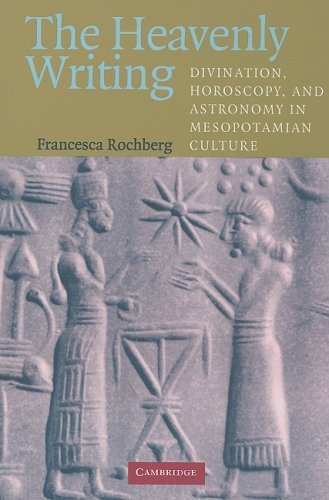
3. The Heavenly Writing: Divination,
 
4. Mesopotamian Astrology: An Introduction
$36.00
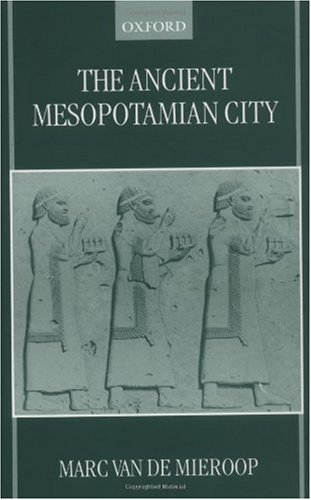
5. The Ancient Mesopotamian City
$170.99
6. Mesopotamian Chronicles (Writings
$29.90
7. BATTLES ON THE TIGRIS: The Mesopotamian
$223.47
8. Gudea's Temple Building: The Representation
$25.70
9. Prophecy in Its Ancient Near Eastern
$37.53
10. House Most High: The Temples of
 
$46.30
11. Early Mesopotamian Incantations
$41.94
12. Sex and Eroticism in Mesopotamian
$20.54
13. The Treasures of Darkness: A History
$24.84
14. Delights from the Garden of Eden:
$124.99
15. Mesopotamian Mathematics 2100-1600
 
$54.63
16. Time at Emar: The Cultic Calendar
$70.78
17. The Anatomy of a Mesopotamian
 
$146.44
18. Mesopotamian Planetary Astronomy-Astrology
$155.26
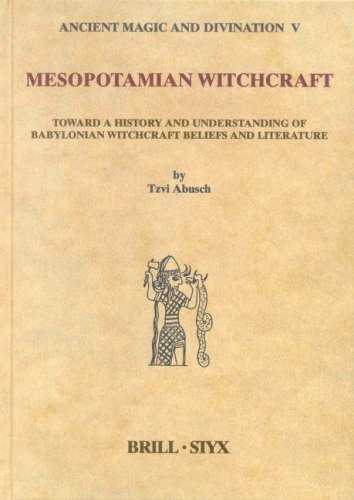
19. Mesopotamian Magic: Textual, Historical,
 
20. The Table Talk of a Mesopotamian

1. Mesopotamian Cosmic Geography (Mesopotamian Civilizations, 8)
by Wayne Horowitz
 Hardcover: 410 Pages (1998-12)
list price: US$62.50 -- used & new: US$59.38
(price subject to change: see help)
Asin: 0931464994
Canada | United Kingdom | Germany | France | Japan

2. Mesopotamian Myths the Legendary Past (The Legendary Past)
by Henrietta McCall
 Paperback: 80 Pages (1990-10)
-- used & new: US$30.31
(price subject to change: see help)
Asin: 0714120634
Canada | United Kingdom | Germany | France | Japan
Editorial Review

Book Description
A vast legacy of powerful creative writing was revealed when nineteenth-century scholars managed to decipher the mysterious wedge-shaped symbols of cuneiform script, inscribed on clay tablets over 5,000 years ago by the ancient Mesopotamians.Strikingly familiar themes emerged, forcing the Victorian world to review its belief in the Bible as the sole source of literal truth.Imagine the impact of the Epic of Gilgamesh -- the saga of a man in search of the secret of eternal life -- which includes scenes of a flood predating the story of Noah and the Ark.In contrast, an alternative version of human origins is described in the Mesopotamian Epic of Creation, while the tale of Etana foreshadows the Greek myth of Ganymede.These and other stories are here retold, based on the latest translations, and illustrated with the works of both contemporary and later artists inspired by the rediscovery of these ancient characters and themes.Not only are the myths a foundation of our Western literary tradition, they are also compelling stories in their own right. ... Read more


3. The Heavenly Writing: Divination, Horoscopy, and Astronomy in Mesopotamian Culture
by Francesca Rochberg
 Paperback: 360 Pages (2007-10-29)
list price: US$29.99 -- used & new: US$20.88
(price subject to change: see help)
Asin: 0521716616
Average Customer Review: 5.0 out of 5 stars
Canada | United Kingdom | Germany | France | Japan
Editorial Review

Book Description
Celestial phenomena in ancient Mesopotamia was observed and interpreted as signs from the gods as well as physical phenomena. Relating the various ways the heavens were contemplated and understood, this study traces the emergence of personal astrology from the tradition of celestial divination and how astronomical methodology developed for horoscopes.Its importance lies in its treatment of Babylonian celestial sciences (celestial divination, horoscopy, and astronomy) as subjects relevant to the history of science and culture. ... Read more

Customer Reviews (1)

5-0 out of 5 stars A knowledgeable guide
Francesca is an amazing instructor at her college, and her years of expertise in the field are truly insightful. The book thoroughly educates and provokes further thought. ... Read more


4. Mesopotamian Astrology: An Introduction to Babylonian & Assyrian Celestial Divination, Cni 19 (Cni Publications, 19)
by Ulla Koch-Westenholz, Ulla Susanne Koch
 Hardcover: 223 Pages (1994-01)
list price: US$81.00
Isbn: 8772892870
Canada | United Kingdom | Germany | France | Japan

5. The Ancient Mesopotamian City
by Marc Van De Mieroop
Paperback: 288 Pages (1999-12-09)
list price: US$83.00 -- used & new: US$36.00
(price subject to change: see help)
Asin: 0198152868
Average Customer Review: 4.5 out of 5 stars
Canada | United Kingdom | Germany | France | Japan
Editorial Review

Book Description
Urban history starts in Mesopotamia: the earliest known cities developed there as a result of long indigenous processes and, for millennia, the city determined every aspect of Mesopotamian civilization. Marc Van De Mieroop examines urban life in the historical period, investigating urban topography, the role of cities as centres of culture, their political and social structures, economy, literature, and the arts. He draws on material from the entirety of Mesopotamian history, from c. 3000 to 300 BC, and from both Babylonia and Assyria, arguing that the Mesopotamian city can be regarded as a prototype that inspired the rest of the ancient world and shared characteristics with the European cities of antiquity. ... Read more

Customer Reviews (2)

4-0 out of 5 stars Fascinating, though scholarly
In this book, Professor Van De Mieroop looks at the Mesopotamian city, from earliest Sumer to the Babylonian and Assyrian empires. Included in this work are chapters covering everything politics, organization of neighborhoods (districts might be a better word), clans, economics, and more. The author's grasp of the subject is obviously profound, and any student of Mesopotamia can gather a great deal of information from this book. On the downside, though, the book was obviously written for an academic audience, rather than for general readers. This means that the book is often dry and verbose. However, that said, it is a fascinating work, one with a great deal to offer anyone interested in the Mesopotamian city.

5-0 out of 5 stars An instant classic!
This book is a long overdue survey of the urban experience in the first literate society. This work goes beyond the 'origin of cities', to tell ushow they worked, and what really went on! Informative and accessible, Iwould recommend this book to anyone with an interest in ancient history. ... Read more


6. Mesopotamian Chronicles (Writings from the Ancient World) (Writings from the Ancient World)
by Jean-Jacques Glassner, Benjamin R. Foster
Hardcover: 386 Pages (2005-07-15)
list price: US$171.00 -- used & new: US$170.99
(price subject to change: see help)
Asin: 9004130845
Canada | United Kingdom | Germany | France | Japan
Editorial Review

Product Description
This English translation of Glassner’s Chroniques Mésopotamiennes (Paris: Les Belles Lettres, 1993) collects all chronicle literature of ancient Mesopotamia from the early second millenium to Seleucid times. The volume, which incorporates revisions and additions by the author and a transcription of the cuneiform, includes every example of Sumerian, Assyrian, and Babylonian historiographic literature, and magisterial essays on the genre and on Mesopotamian historiography in general. ... Read more


7. BATTLES ON THE TIGRIS: The Mesopotamian Campaign of the First World War
by Ron Wilcox
Hardcover: 224 Pages (2006-09)
list price: US$39.95 -- used & new: US$29.90
(price subject to change: see help)
Asin: 1844154300
Average Customer Review: 5.0 out of 5 stars
Canada | United Kingdom | Germany | France | Japan
Editorial Review

Book Description
In 1914 the British expedition to Mesopotamia set out with the modest ambition of protecting the oil concession in Southern Persia but, after numerous misfortunes, ended up capturing Baghdad and Northern Towns in Iraq.

Initially the mission was successful in seizing Basra but the British under Generals Nixon and Townshend, found themselves drawn North, becoming besieged by the Turks at Kut.After various failed relief attempts the British surrendered and the prisoners suffered appalling indignities and hardship, culminating in a death march to Turkey.

In 1917 General Maude was appointed CinC but, as usual in Iraq, policy kept changing.Hopes that the Russians would come into the war were dashed by the Revolution.Operations were further frustrated by the hottest of summers.Fighting against the Turks continued right up to the Armistice.The conduct of the Campaign was subject to a Commission of Inquiry which was highly critical of numerous individuals and the administrative arrangements. ... Read more

Customer Reviews (2)

5-0 out of 5 stars Amazing history
The story of the First World War in Mesopotamia, modern day Iraq, is one of the most interesting, and oft-ignored, stories.During the first world war the British established an expiditionary force in the Gulf of Arabia, much as was done in 1991 and 2003 by the American army, and they struck northwest for Baghdad.The capture of Baghdad was regarded as a side-show, like Gallipoli, but it was also a strike against the Ottoman Empire.From Baghdad the rail lines stretched towards Syria and Istanbul, the capital of the Ottoman Empire.

In 1915 the British general launched his attack up the Tigris and quickly became bogged down at Kut.His surrender the next year was a great defeat for British arms and an embarrasment.It was a harrowing battle and siege and is one of the great stories of the war.

This is a well written book, fascinating military history full of drama.

Seth J. Frantzman

5-0 out of 5 stars The most unusual battles during WWI
This book provides a look at one of WWI's most interesting, and certainly most unusual, campaigns - in terms of geography, action, and personalities.In addition, the writing style flows effortlessly.The author, Ron Wilcox, has also thankfully included orders of battle, numerous maps, and several photographs.A fascinating look at WWI's most forgotten campaign - outstanding!

Despite the fact that Iraq/Mesopotamia is largely a desert, Britain's Mesopotamian campaign largely involved fighting on rivers and through large flooded areas.Like many great historic rivers, the Tigris has annual floods which submerge broad swathes of land during the flood season.And given the abhorrent, near non-existent state of roads and railways the rivers Tigris and Euphrates provided the only practicable transport route throughout southern Mesopotamia.Thus, we find British and Indian soldiers launching canoe-based attacks against Turkish positions built-up above the flooded ground.And we also see the repeated use of river craft for fire support on shore (which is very reminiscent of the American Civil War campaigns on the Mississippi and Cumberland rivers).

Besides the novelty of many of the attack and defense methods (which would have been suicidal in most other WWI theatres), the leadership in this campaign was quite extraordinary.Notwithstanding his forced surrender at Kut el-Amarna in early 1916, General Townshend was nothing short of a miracle worker.Time and time again from early 1915 Townshend and his mostly Indian troops won victory after victory pushing the Turkish troops ever further upriver.Townshend probably made more rapid progress in mileage than any other British commander during the war, and what's more, he did it on a logistical shoestring.(A similar effort made today by British or American forces would probably require 40-50x as much logistical support.)

As his successes mounted, the Indian Gov't and the War Committee gave the Mesopotamian force increasingly ambitious goals.The minarets of legendary Baghdad sounded their siren call to the politician's imagination - imagine the regional prestige to be won by capturing the greatest city in the Middle East away from the Turks!Unfortunately, conditions on the ground were manifestly unsuitable for such an effort.Food and ammunition were limited.But by far the worst issue were the unspeakable medical conditions - like something right out of the Middle Ages.Sick lists almost always exceeded the number of those fit and able to fight.

Despite his reservations Townshend gave the Baghdad advance his best shot at Ctesiphon, but the Turkish forces were under Nurredin's new management and had also been dramatically reinforced.After being convincingly blocked Townshend planned to retreat downstream to regroup and reinforce this troops.However, he was instructed to remain at Kut and was soon completely surrounded and cut off by Turkish forces.After several months and a failed relief effort Townshend and his troops were forced into a humiliating surrender.But much worse than that, they suffered (and profusely died) of malnutrition, beatings, filth, and neglect at the hands of their Turkish captors.

Almost an entire year passed as the British/Indian force under General Lake was heavily reinforced, resupplied, and provided with sufficient logistical transport to conduct a future sustained campaign of advance.However, Lake was replaced by General Maude before the next advance began, so Maude became the conqueror of Baghdad a year after Townshend's surrender.With the conquest of Baghdad, the terrain completely changed and British/Indian forces were able to spread out pushing the Turks back towards Anatolia proper.Also included is the story about how Dunsterville led a bizarre effort through Bolshevik/Persian territories to secure the Baku oilfields against the Turks. ... Read more


8. Gudea's Temple Building: The Representation of an Early Mesopotamian Ruler in Text and Image (Cuneiform Monographs, 17) (Cuneiform Monographs, 17)
by Claudia E. Suter
Library Binding: 348 Pages (2000-09-01)
list price: US$230.00 -- used & new: US$223.47
(price subject to change: see help)
Asin: 9056930354
Canada | United Kingdom | Germany | France | Japan

9. Prophecy in Its Ancient Near Eastern Context: Mesopotamian, Biblical, and Arabian Perspectives (Symposium Series (Society of Biblical Literature), No. 13.)
Paperback: 161 Pages (2000-10)
list price: US$29.95 -- used & new: US$25.70
(price subject to change: see help)
Asin: 0884140261
Canada | United Kingdom | Germany | France | Japan

10. House Most High: The Temples of Ancient Mesopotamia (Mesopotamian Civilizations, Vol 5)
Hardcover: 209 Pages (1993-08)
list price: US$39.50 -- used & new: US$37.53
(price subject to change: see help)
Asin: 0931464803
Canada | United Kingdom | Germany | France | Japan

11. Early Mesopotamian Incantations and Rituals (Yale Oriental Series, Babylonian Texts)
by Albrecht Goetze, Mary I. Hussey, Jan van Dijk
 Hardcover: 267 Pages (1986-09-10)
list price: US$60.00 -- used & new: US$46.30
(price subject to change: see help)
Asin: 0300031475
Canada | United Kingdom | Germany | France | Japan

12. Sex and Eroticism in Mesopotamian Literature
by Dr Gwendo Leick
Paperback: 336 Pages (2003-05-30)
list price: US$41.95 -- used & new: US$41.94
(price subject to change: see help)
Asin: 0415311616
Canada | United Kingdom | Germany | France | Japan
Editorial Review

Book Description
Sex and Eroticism in Mesopotamian Literature allows a glimpse of a world with a sexual culture and erotic values very different from our own, through exploration of the earliest preserved written evidence on the subject - the Sumero-Akkadian cuneiform sources of the 21st to 5th centuries BC.
Drawing on sophisticated and astonishing literary texts - courtly love poems and bridal songs, myths, narratives and incantations - Gwendolyn Leick uncovers a fascinating range of perspectives on the subject of passion and pleasure. The reader is treated to eloquent and freely-expressed views on topics from prostitution, love magic and deviant sexual practice to gender, fertility and potency.
This revealing and candid volume celebrates a wealth of erotic material from one of the world's earliest literate civilizations, and encompasses archaeological, religious, historical, anthropological and gender-based themes and approaches. It will be of interest to students and teachers in all these disciplines.
... Read more


13. The Treasures of Darkness: A History of Mesopotamian Religion
by Thorkild Jacobsen
Paperback: 273 Pages (1978-09-10)
list price: US$23.00 -- used & new: US$20.54
(price subject to change: see help)
Asin: 0300022913
Average Customer Review: 4.5 out of 5 stars
Canada | United Kingdom | Germany | France | Japan

Customer Reviews (4)

4-0 out of 5 stars Good Prime Source Usage--Well Ordered
I. Author, Title, Publication Data.
As an introduction to Mesopotamian religions, Thorkild Jacobsen's Treasure of Darkness: A History of Mesopotamian Religionis exemplary primarily because of the author's background as an expert in the fields of Oriental philology and archeology. The book is full of prime source texts throughout, some of which are Jacobsen's own updated translations. Reading this as a student has been a broadening experience. This is due the fact that less is taken for granted because of the unusual amount of Semitic texts included. A fuller appraisal of the strengths and weaknesses of this work shall be noted in its proper place after a full assessment of the material has been given.

II. Assessment: Content and Methodology.
(a) Content and Methodology.
Treasures of Darkness is ordered logically on a chronological pane and in addition to the religions themselves, it touches upon weighty issues of historical methodology in each successive section. Jacobsen starts with the fourth millennium, and each section thereafter deals with a successive millennium and its representative metaphors. According to Jacobsen, the metaphors are as follows: (1) the fourth millennium is represented by the Provider metaphor; (2) the third millennium with the Ruler metaphor; (3) the Second with a Parent metaphor alongside the Creation and Gilgamesh epics; (4) lastly, the first millennium with Warrior-King and Hero metaphors.

Before delving into the particulars of each epoch, he commences his treatment of the ancient Mesopotamian religions by identifying and clearly defining the terms "religion", "Mesopotamian" and "Ancient". In so doing, he touches upon methodological questions that not only determine the nature of the study of these religions but of the history of all antiquity-religious or otherwise. It is, in fact, a historiographical statement. He doesn't posit that religion can in any way be understood apart from the historical, cultural and geographical details of the time period from which it arose. We may note, then, that the study of Israelite religion falls within the purview of the investigative directives governing the study of Mesopotamian religion and therefore succumbs to uniform strictures that determine its definition. The idea that Israelite religion was contemporaneous with Mesopotamian religion, thereby succumbing to a common methodology of investigation might not seem noteworthy or new, but when we take into consideration that our understanding of "Israel" can in no way depart from the methodological assumptions that are held at the inception of the scholarly task, it becomes apparent there are no "findings" peculiar to Israel in the true sense of the word.To be sure, Jacobsen does differentiate between different forms of cultic response among the various religions. For instance, after mentioning that in earliest Mesopotamia the power and the form in which the numinous was manifested (i.e., basic pantheism-moon and moon-god) were essentially the same,he notes contrariwise, that the power speaking to Moses disassociates itself from the burning bush (p. 6). Nevertheless, Jacobsen's methodology was one issue with which I was confronted not only at the beginning but throughout. It was a theological consideration in the end-how does this methodology affect my understanding of revelation? Can I find what "God" means by assuming Jacobsen's point of departure?

Of all the terms examined by Jacobsen, therefore, religion receives attention first and sets the parameter within which the rest of the material is examined. He adopts ideas from Rudolph Otto's The Idea of the Holy (p. 1, 245) who posits that religion refers to "unique experience of confrontation with power not of this world." This power is necessarily not of this world and therefore it is indescribable in terms derived from worldly or human experience. Any positive description of the numinous must be analogical. Ordinary worldly experiences serve as metaphors that can be utilized to communicate by way of the suggestiveness of these ordinary experiences upon the human psyche, the nature of the original confrontation with the numinous. Furthermore, the experience of the numinous demands a response. Myth and theology, Jacobsen asserts, are mental responses whereas cult or worship are their active corollaries. Mental responses (myth and theology), however, are unable to provide accurate descriptions of the Wholly Other.

It is not difficult to understand the utter importance of Jacobsen's assumption in respect to communicating experience of the numinous. Any such communication is wholly human and culturally conditioned-and here the method of historiography is apparent. The significance of this idea is brought out more clearly if one is privy to the controversy at the beginning of this century represented on one side by the likes of Karl Barth, Paul Tillich and Emil Brunner. The controversy surrounded the nature of revelation, the authority of the Bible and the question of whether language was an adequate medium through which humanity may grasp the nature of God. Brunner for example patently claimed that God and the medium of conceptuality are mutually exclusive. Israel had a conception of language peculiar to its own cultural context which was in all probability opposed to a Neo-Orthodox construction. Words were not only employed as analogicaltools to aid in describing the nature of God, but seem in certain places to have been sufficient as to also become a medium of conceptuality by which Yahweh's very essence was to be known. If language to the ancient Hebrews was insufficient to describe God's nature, there would not have been reservations in regard to avoiding the spelling and the verbalization of his entire name. In addition, there are numerous other passages in which we find that rational exchange between God and man in regard to the divine will was mediated through language. According to Otto's suggestion, by way of Jacobsen, that exchange, if metaphors are wholly human and culturally conditioned (pp. 1-17) would have been a rational exchange between man and man or man and Manat best.
The locus of organization for Treasures of Darkness centers around Jacobsen's understanding of religious metaphor. To reiterate more directly, metaphor is an instrument of transference, a bridge, a means of communicating and handing down religious forms and content (original numinous experiences) from a previous age to subsequent generations.
In addition to what's been said about the structure thus far, one other point needs to be pointed out. It was stated that Jacobsen approaches the study chronologically. He begins with the fourth millennium and works forward into the first millennium as far as 600 b.c. From each millennium Jacobsen selects what he considers to have been the primary representative metaphors and after presenting portions of original texts, provides analysis and inferences. As a structuring device, this works well. The total structure of this work, with its chronological approach along with a clearly outlined and explained historical methodology (consisting of at least 10% of the book), not only makes this field accessible but provides even beginners with a framework within which they themselves can attempt a synthesis of their own.

(b) Interaction with the Old Testament.
Jacobsen does not give much attention to the Old Testament directly. Indeed, there are very few citations of Old Testament texts. On the other hand, however, there is nothing in Treasures of Darkness that is not useful in illuminating our understanding of the society out of which Israelite religion and tradition developed. Furthermore, having done a fine job of providing a penetrating and panoramic introduction, it sheds a great deal of light especially in the area of Biblical criticism. So, although Jacobsen does not particularly treat West-Semitic religions (i.e., Israelite tradition) and texts, the large amount of textual and historical data provides a gateway through which to tackle questions related to the origin and development of the Israelite tradition. For example he states that at the time Israel's religious thinking began to form, Mesopotamian influence and ideas were so pervasive that the attitude of personal religion "may be considered to have been part of the general cultural environment" (p. 152). It would seem that personal religion, in which a given deity was one's own personal god that cared for her or him was not peculiar to the Israelite tradition. This is not the proper place to dive into the discussion of source derivation-what's been said here simply illustrates the point that though Jacobsen does not devote as much as a single chapter exclusively to biblical data, the entire work is valuable to biblical studies in one way or another. None of it is irrelevant because, beside the obvious fact that all human institutions are culturally conditioned, what may be elucidated from the text of Scripture depends on parallel or `background' material. Jacobsen provides a great deal of that.
The preceding answers in part the question as to which portions of the Old Testament receive most attention. One can say that because Treasures of Darkness is primarily interested in background material, all aspects of the Old Testament are given equal treatment. But a distinction can nevertheless be made. Essentially, it can be said that the background material in this work most directly illuminates our understanding of the Psalms. The Psalter resembles a lot of contemporary texts that share the same forms. These forms resulted from the rise of personal religion in the Ancient Near East. The advent of personal religion sees its beginning at the turn of the second millennium. This new mood simply encompasses the idea that the individual matters to God and that God cares about him or her personally and deeply. Characteristic features of this new religious sentiment included such other ideas as a worshiper's need for guidance, expectance of divine anger and punishment for sin, and trust in divine compassion (Psalm 38) (p. 147). Jacobsen points out that, when we look to the origins of this personal religion we see a narrowing toward its source. These attitudes are first seen in "Penitential Psalms", "Letters to Gods" in which men complained to their personal gods; these ideas are not restricted to Sumerian works but also appear in Akkadian, Hebraic as well as Egyptian (p. 154). One such prayer from Egypt to the god Re-Har-akhti: "Do not punish me for my many sins; for I am one who does not know himself, I am a man without sense. I spend the day following after my own mouth, like a cow after grass. . . come to me . . . thou who protectest millions and rescuest hundreds of thousands, the protector of the one who cries out to him" (p. 148). This, Jacobsen places alongside Psalm 25:4-7: "Remember, O Lord, thy tender mercies and thy lovingkindness; for they have been ever of old. Remember not the sins of my youth, nor my transgressions: according to thy mercy remember thou me for thy goodness' sake O Lord" (p. 147). Likewise, another prayer from Mesopotamia adheres to the same exact form, the only difference being that a female deity is called upon in this particular prayer.
Because of the ubiquity of this religious sentiment and the amount of material, we can gain deeper insights into the theology of the Psalter and are better equipped in interpreting it.

III. Assessment-Related Matters.
(a) Religions of the Ancient Near East.
As to whether adequate attention is given to the religions of the Ancient Near East, there can be no doubt that more than enough is included in this work. The title of the book itself, "A History of Mesopotamian religion" suggests this much. But beyond the obvious, it can be further noted that the work is detailed and densely packed with literature from that region. Assyrian, Egyptian, Semitic, Sumerian and Akkadian texts are all included throughout the book. From the Dumuzi cult representative of the fourth millennium to the Neo-Babylonian god Marduk representing the first millennium (sixth century B.C.), prime source material is given to illustrate the pantheon of Near Eastern religions.
A work such as this, however, should not be seen merely as a conglomeration of such texts.Jacobsen does at times give a broad and sweeping theory to distill the main elements of a millennium's worth of religious mood.
In summing up the second millennium, for example, Jacobsen surmises that the parent metaphor is suggestive of the essential elements in the Mesopotamian response to numinous experience. In the former "great existential myths and epics" man took stock of himself and considered his place in the universe. The second millennium stories react to and critique those of a previous age (p. 223). The stories of Atrahasis, Gilgamesh and Enuma elish react to the earlier metaphors of provider and ruler metaphors, testing the implications of these ideas through stories (p. 225). Humanity, having been a subject and slave in the older myths, gained sonship in the newer myths (226). Therefore, by the time of the Apostle Paul, we see in his sermon on Mars Hill that the divine sonship of humanity had gained universal assent. It provided Paul a common ground from which he led some of the Greek philosophers to Christianity.The idea began as a reaction against the subjugation and enslavement of humanity in myths preceding the second millennium. One age reacts against another while leaving a vestige of previous myths.
As evidence of this historical process (reminiscent of Hegelian dialectical historiography), Jacobsen points to modifications observed in the major religious metaphors as they are utilized as vehicles of religious expression in a subsequent millennia (233). In every age vestiges of a previous one remains. This theory runs into exigencies. Jacobsen notes that the transition from the second millennium to the first saw such dramatic changes that it seemed no vestiges of a previous epoch remained. The problem more precisely was that the first century became increasingly brutal and the parent metaphor no longer seemed to exist in the first millennium (p. 236). He says, however, that vestiges of the parent metaphor idea tended to remain despite the presence of an increasingly brutal world because holy war is given such a definition as to suggest helplessness and complete trust in a god. Dependence is the axiom of holy war p. 237.

(b) Biblical Criticism-the question of how and when the OT came into being.
It seemed to me that the most valuable aspect of this book is its usefulness in this area of biblical criticism. Because Jacobsen provides a panoramic tour through successive ages of religious development, it is interesting to compare and contrast these developments surrounding the biblical text with developments found within the text of the Bible itself. For example, if we begin with the fourth millennium, Jacobsen shows that the various city gods in whom the early city settlers believed seemed to have been powers associated with the economies of the region in which the city was located. The earliest form of Mesopotamian religion was worship of powers of fertility-the powers ensuring human survival (p. 26). A myth in the southern region of Mesopotamia is related to the marsh life and the economies associated with it (i.e., fishing and hunting). Along the Euphrates there is mentioned a Nanshe or goddess of fish. Along the costs there is the god Nanzu or "the Lord knows the waters." Such crude parallels are not found in the Bible. Israel does not worship a god related to its particular economy. To be sure there are other skeptical theories of the origins of the Hebrew religion. There is, for example, the theory that the reason Israel's god became disassociated from physical idols was because the weight and size of these idols made nomadic living cumbersome. And Abraham was a nomad. In any case, the Israelite religion is not as crude, pantheistic or polytheistic as its neighbors.
Economics was not the only factor that provided motivation to revise one's theology. At the beginning of the third millennium b.c., ever present fear of famine was no longer the main reminder of the precariousness of the human condition. Sudden death by the sword in wars or raids by bandits joined famine as equally fearsome threats. A sudden need for protection produced an evolution in the nature of the gods.The old gods of rain and thunderstorm through a process of humanization were seen as warriors and kings. The inference is simple: Theology about god's nature seemed to have developed as the human story unfolded.
There seems to be a greater connection between Israelite religion and this idea. Although it is difficult to say that Yahweh's nature developed as the human story unfolded, one can say with a degree of certainty that Israel's idea of the nature of reality and the nature of God's plan progressively changed. We see, for example, a move from particularism in the earlier texts of the Old Testament, to a universalism in the prophets. This process continues until it reaches its zenith in the theology of Paul. Likewise, the dramatic shifting and shaking of the Jewish foundations that occurred as a result of the apostolic interpretation of the Old Testament was another successive stage of development in which the nature of God was completely revised. And obviously, the development did not cease with the close of the apostolic age, it continued beyond it as the Church came to grips with its understanding of Christology.
One could also note the developmental process within one group of biblical texts. The different theologies of Proverbs and Ecclesiastes are stark. Proverbs promises that if you live in such and such a manner, you are guaranteed such and such a life. Ecclesiastes turns such a perspective on its head. Job, moreover explicitly denies that righteousness will guarantee the favor of God. Such an understanding of the historical process which Jacobsen makes very clear, helps us better understand the developments found within the Christian cannon because it is also subject to these same cycles.

IV. What are the strongest and weakest aspects of the book?
Firstly, in my opinion, the best part of this book is the fact that it is as deep as it is wide. It was breathtaking at times to say the least. The best part was the first thirty pages or so where Jacobsen provides a synthesis of the methodology he has adopted in studying the religions of the Ancient Near East. It has a psychological component to it that allows me to experience the lives of these ancient peoples alongside them. Their religious ideas were not divorced from the concrete matters of their living. I sensed more clearly the difficulties that must have faced people living at that time. It was this psychological response to the geo-political atmosphere that initiated the winds of change as exemplified in the religious sentiments of the age. Jacobsen begins every chapter by explaining what he thought to have been the existential angst of the age he was about to examine. This was a very good idea because, as I said, it makes us better historians if we can feel the things which the individuals we are studying felt.

This much being said, the weakness was that this book does not do enough of what I just said it did well. Jacobsen does say much more about methodology than what's found in the introductory pages. The need for a synthesis falls into a secondary place. Jacobsen provides an overwhelming amount of prime source texts. It is a bit too much. The work could have been better if a deeper treatment of these texts were given. Otherwise, it was a pleasure to read this work and something to which I shall subsequently return.

5-0 out of 5 stars Into the light...
The book 'Treasures of Darkness: A History of Mesopotamian Religion' by Thorkild Jacobsen is a text used by courses in my seminary and others to provide a background to religious feeling and development over a long stretch of human history -- nearly three thousand years. Whether one accepts that the patriarchs of Abraham, Isaac and Jacob are real historical figures or not, no one can plausibly deny that the religious development of the peoples of Canaan (and indeed of all the ancient world around the eastern Mediterranean to the Indus river) were affected by the cultural and religious developments in Mesopotamia, the centre of the region, and a fertile region second to none known in the world, on a par with the Nile, around which another major civilisation arose.

This is a text of history of Mesopotamia in its own right. By the time history gets back this far, the lines become very blurred, rather like parallel lines intersecting on the horizon. Literature, religion, archaeology, sociology, psychology -- all of these disciplines become intertwined in Jacobsen's text as he looks at Sumerian society.

The book is organised with an introduction, then according to time divisions of fourth, third, and second millennia, then concludes with an epilogue into the first millennium, during which the Bible as we know it (and most ancient history such as is commonly known occurred) came to be.

Ancient Mesopotamian Religion: The Terms
The first chapter introduces basic concepts for doing religious studies of any historical era, as well as those specific to this text. Key concepts such as understanding the numinous, the confrontation with power not of this world, the use of metaphor and the importance and limitations on literalness are explored. With regard to what makes Mesopotamian religion unique, Jacobsen explores this with direct quotation from texts from the periods of Sumerian history. One thing that is important in the development of religion is the shift toward human identification. No longer do 'sun gods' and 'nature gods' dominate.

The ancient Mesopotamians also saw this divinity as immanent, rather than transcendent. It is something within, at the centre, rather than something beyond. Because of this, the idea of a god living in a certain place or having special 'holy places' was a strong one -- a god was more present (sometimes only present) in certain places that usually became pilgrimage points or temples. (One can see here the obvious parallel of the ancient Israelites with God who lives more fully on a mountain in Sinai or in a temple in Jerusalem.)

What is true for us is also true for the ancient Mesopotamians in their religious development -- over the course of three thousand years, a dramatic development has taken place (just as thousands of years of development have wrought great changes in Judaism and Christianity), but there is always a tension and interplay of ideas between the old and the new.

Religion through the Millennia
Looking at modern religions, ancient religious impulses and concerns rooted in nature have never completely faded. But during the third millennium, divine powers began to be seen as rulers and helpers of cities and tribes. There was personality beginning to be added to divinities, and they had particular human interests. Gods and goddesses became patrons of rulers and cities on earth, again reflecting the very real needs of the people at the time, whose security rested with rulers and a new invention in the world, the organised military force. Once again, one can see these issues relevant in ancient biblical texts.

Into the second millennium, the distance of gods and goddess lessened, as people came to regard them not only as patron of cities, remote and distant rulers, or impersonal forces (although all of these elements survived in the divine images and characters) but also as personal patrons, someone/thing that could intervene in times of trouble, that could be thanked in times of personal prosperity, that could be sought for personal inspiration. Household gods and personal relationships with deities became common. Again, we can see this not only in the ancient biblical texts, but right up to the present day. It is from this second millennium that the Akkadian epic Gilgamesh derives; when we think of Gilgamesh today, it is this version we know. However, the elements of the Gilgamesh epic go back into the earliest parts of Sumerian history.

Minor criticisms
This is a generally excellent work. Jacobsen writes with an elegant but not overblown style, with liberal use of translated original texts to illustrate points. However, I consider it an important if not crucial point for histories such as this to have visual illustrations, maps, timelines, charts and other visual aids. Linguistically-oriented as I am, I appreciate a good narrative, but I also find that drawing on multiple intelligences reinforces the learning. There are a mere eight illustrations in this text, and three charts (oddly enough, not listed among the illustrations). There are no maps. Given the several thousand years of history being presented here, surely one map could be included? Similarly, there are no depictions of the original languages used, or the cuneiform script in which many of the original documents were penned. Line art, computer generated graphics, and photographs are readily available; the inclusion of a few would enhance this text greatly.

Overall, however, this is an excellent text, and one that will give great reading pleasure and considerable insight to the reader. Discover the ancient stories of snakes and floods. Encounter the gods who live on mountains and in temples. All hundreds if not thousands of years before the book we call the Bible came into being.

4-0 out of 5 stars Splendor in the Dark
Jacobsen is a giant in his field, but as an introduction to the subject "Treasures of Darkness" can be heavy going.Most helpful to me was the way that he tackles the myths chronologically, starting the book with the Dumuzi cults recored in the earliest Sumerian sources and ending with the stories of Marduk and Gilgamesh from later records.In between he covers topics from the rise of kingship to the growth of personal religion in a way that makes the beliefs come alive as an evolving response to the world rather than an inert collection of tablets.

Jacobsen has a tendency to present speculation as fact--you wouldn't guess from reading this alone that many of his points are disputed--and the translations are a little stilted, at least to my ears.But his book goes a long way to turning the fragmentary evidence into a coherent philosophy of nature, humanity and the gods.Mesopotamian religion is often described as pessimistic;Jacobsen restores some of the awe, love and splendor that might have made it a convincing world view for thousands of people we'll never otherwise know.

5-0 out of 5 stars Without a doubt, the best Author on the subject!
This Author grabs the Mesopatamian nail and hits it on the head...every time, without fail. He has a vivid writing style and approaches each new subject without so much as a hint of Ethnocentrism. He eloquently states each new topic through the eyes of the subject, a must-read on the topic of the Mesopotamians. ... Read more


14. Delights from the Garden of Eden: A Cookbook and a History of the Iraqi Cuisine
by Nawal Nasrallah
Paperback: 664 Pages (2003-02-21)
list price: US$41.95 -- used & new: US$24.84
(price subject to change: see help)
Asin: 140334793X
Average Customer Review: 5.0 out of 5 stars
Canada | United Kingdom | Germany | France | Japan
Editorial Review

Book Description
This new Iraqi cookbook contains more than four hundred recipes covering all food categories. There is ample choice for both vegetarian and meat lovers, and many that will satisfy a sweet tooth. All recipes have been tested and are easy to follow.

Introducing the recipes are thoroughly researched historical and cultural narratives that trace the development of the Iraqi cuisine from the times of the Sumerians, Babylonians and Assyrians, through the medieval era, and leading to its interaction with Mediterranean and world cuisine.

Of particular interest are the book's numerous folkloric stories, anecdotes, songs, cultural explications of customs, and excerpts from narratives written by foreign visitors to the region. Arabic calligraphy, and photos, paintings and sketches add to the pictorial appeal of the book. ... Read more

Customer Reviews (12)

5-0 out of 5 stars Incredible!
I received this cookbook as a birthday gift two years ago. When I opened it, I was excited to find a Middle Eastern cookbook, but was not expecting it to 'measure up' to the 10 or so Middle Eastern/North African cookbooks in my collection, as the author is not well known as are the authors of many of the other books. After all this time, I have made quite a few recipes from this book, and all were fantastic. That being said, I feel that I haven't even scratched the surface of this book. The number of good recipes in the book is astounding, and the history portion of the book is very interesting. I highly recommend the book for anyone interested in learning more about cooking Middle Eastern food, and learning about its roots.

5-0 out of 5 stars Buy 3 and give them to friends
A great cookbook. Easy to follow for those not familiar with Arabic/Middle Eastern Cooking. Good back stories and illustrations. A true one of a kind work. Be sure to buy this treasure before it goes out of print. A delight as the title suggests.

5-0 out of 5 stars Just what i was looking for!!!
Thanks to Nawal for writting this excellent cookbook which includes almost all the iraqi recipes in such nice order.

As a kurd I found many recipes that brought back memories from my childhood, even the terms/words used!

I looked through the whole book briefly, the recipes look easy and well written, not many pictures but I doubt they are needed. Can't wait to try more recipes.

I know I will treasure this book for life..

5-0 out of 5 stars making Iraqi cooking appealing (five stars)
This book is unlike any other cookbook that I have pruchased or read. It is written with clarity and with great efforts to simplify every resipe to anyone who is not familiar with Iraqi cooking. The author explains every dish; its orgion, its flavor and its popualrity in Iraq. I bought five copies and gave them as gifts. everyone got it enjoyed reading it and cooked some dishes

5-0 out of 5 stars Delights from the Garden of Eden
This is the second copy that I have ordered because I gave mine away as a gift. I love this cookbook, and although there is not any color photos the author does a good job of explaining. I would tell anyone who is a food lover to get this book. It is full of wonderfull recipes,as well as indepth history of origin. ... Read more


15. Mesopotamian Mathematics 2100-1600 BC: Technical Constants in Bureaucracy and Education (Oxford Editions of Cuneiform Texts)
by Eleanor Robson
Paperback: 352 Pages (1999-07-29)
list price: US$214.00 -- used & new: US$124.99
(price subject to change: see help)
Asin: 0198152469
Canada | United Kingdom | Germany | France | Japan
Editorial Review

Book Description
Mathematics was integral to Mesopotamian scribal culture: indeed, writing was invented towards the end of the fourth millennium BC for the express purpose of recording numerical information.By the beginning of the second millennium the earliest known body of 'pure' mathematics was one of the key elements of scribal training, and is thus pivotal to our understanding of the educational practices and intellectual history of ancient Mesopotamia. The main body of this book is a mathematical and philological discussion of the two hundred technical constants, or `coefficients', found in early second millennium mathematics. Their names and mathematical functions are established, leading to improved interpretations of several large mathematical topics. The origins of many coefficients - and much of the more practical mathematics - are traced to late third millennium accounting and quantity surveying practices. Finally, the coefficients are used to examine some aspects of mathematics education in early Mesopotamia. ... Read more


16. Time at Emar: The Cultic Calendar & the Rituals from the Diviner's House (Mesopotamian Civilizations 11)
by Daniel E. Fleming
 Hardcover: 352 Pages (2000-10)
list price: US$57.50 -- used & new: US$54.63
(price subject to change: see help)
Asin: 1575060442
Canada | United Kingdom | Germany | France | Japan

17. The Anatomy of a Mesopotamian City: Survey and Soundings at Mashkan-Shapir
by Elizabeth Caecilia Stone, Paul E. Zimansky, Piotr Steinkeller, Vincent C. Pigott
Hardcover: 504 Pages (2004-07-01)
list price: US$74.50 -- used & new: US$70.78
(price subject to change: see help)
Asin: 1575060825
Canada | United Kingdom | Germany | France | Japan

18. Mesopotamian Planetary Astronomy-Astrology (Cuneiform Monographs, 18) (Cuneiform Monographs, 18)
by David Brown
 Library Binding: 334 Pages (2000-09-01)
list price: US$152.00 -- used & new: US$146.44
(price subject to change: see help)
Asin: 9056930362
Canada | United Kingdom | Germany | France | Japan

19. Mesopotamian Magic: Textual, Historical, and Interpretative Perspectives (Studies in Ancient Magic and Divination, 1) (Studies in Ancient Magic and Divination, 1)
by Karel Van Der Toorn, Tzvi Abusch
Hardcover: 318 Pages (2000-09-01)
list price: US$160.00 -- used & new: US$155.26
(price subject to change: see help)
Asin: 9056930338
Canada | United Kingdom | Germany | France | Japan

20. The Table Talk of a Mesopotamian Judge
by D.S. Margoliouth
 Hardcover: Pages (1922)

Asin: B0013L5KJQ
Canada | United Kingdom | Germany | France | Japan

  1-20 of 100 | Next 20
A  B  C  D  E  F  G  H  I  J  K  L  M  N  O  P  Q  R  S  T  U  V  W  X  Y  Z  

Prices listed on this site are subject to change without notice.
Questions on ordering or shipping? click here for help.

site stats