e99 Online Shopping Mall
|
|
Help |
| Home - Religion - Rosicrucianism (Books) | |
|   | Back | 21-40 of 100 | Next 20 |
click price to see details click image to enlarge click link to go to the store
| 21. The Individuality Of Rosicrucianism by H. Spencer Lewis | |
![]() | Paperback: 8
Pages
(2006-09-15)
list price: US$9.95 -- used & new: US$5.29 (price subject to change: see help) Asin: 1430407204 Canada | United Kingdom | Germany | France | Japan |
|
Editorial Review Book Description | |
| 22. Quest for the Phoenix: Spiritual Alchemy and Rosicrucianism in the Work of Count Michael Maier (1569-1622) (Arbeiten Zur Kirchengeschichte) by Hereward Tilton | |
![]() | Hardcover: 322
Pages
(2003-08)
list price: US$123.20 -- used & new: US$123.20 (price subject to change: see help) Asin: 3110176378 Average Customer Review: Canada | United Kingdom | Germany | France | Japan |
Customer Reviews (2)
| |
| 23. The Progress Of Rosicrucianism In Germany by Arthur Edward Waite | |
![]() | Paperback: 48
Pages
(2005-12-08)
list price: US$15.95 -- used & new: US$9.44 (price subject to change: see help) Asin: 1425332919 Canada | United Kingdom | Germany | France | Japan |
|
Editorial Review Book Description | |
| 24. Rosicrucianism and Freemasonry by Frank C. Higgins | |
![]() | Paperback: 8
Pages
(2006-09-15)
list price: US$9.95 -- used & new: US$5.29 (price subject to change: see help) Asin: 1428691502 Canada | United Kingdom | Germany | France | Japan |
|
Editorial Review Book Description | |
| 25. The Human Temple: Rosicrucianism and Freemasonry by Khei, George Winslow Plummer | |
![]() | Paperback: 48
Pages
(2005-12-30)
list price: US$15.95 -- used & new: US$9.44 (price subject to change: see help) Asin: 1425315976 Canada | United Kingdom | Germany | France | Japan |
| 26. English vs. German Rosicrucianism by F. de P. Castells | |
![]() | Paperback: 16
Pages
(2006-09-15)
list price: US$12.95 -- used & new: US$7.36 (price subject to change: see help) Asin: 1428677461 Canada | United Kingdom | Germany | France | Japan |
|
Editorial Review Book Description | |
| 27. Rosicrucianism And The Golden Dawn by Frank Wittemans | |
![]() | Paperback: 48
Pages
(2005-12-08)
list price: US$15.95 -- used & new: US$9.44 (price subject to change: see help) Asin: 1425326951 Canada | United Kingdom | Germany | France | Japan |
|
Editorial Review Book Description | |
| 28. What Rosicrucianism Teaches - Pamphlet by H. Spencer Lewis | |
![]() | Paperback: 8
Pages
(2006-09-15)
list price: US$9.95 -- used & new: US$5.29 (price subject to change: see help) Asin: 143040700X Canada | United Kingdom | Germany | France | Japan |
|
Editorial Review Book Description | |
| 29. Rosicrucianism In France by Arthur Edward Waite | |
![]() | Paperback: 48
Pages
(2005-12-08)
list price: US$15.95 -- used & new: US$9.44 (price subject to change: see help) Asin: 1425332951 Canada | United Kingdom | Germany | France | Japan |
|
Editorial Review Book Description | |
| 30. Rosicrucianism and Freemasonry by Herbert Silberer, Smith Ely Jelliffe | |
![]() | Paperback: 48
Pages
(2005-12-30)
list price: US$15.95 -- used & new: US$9.44 (price subject to change: see help) Asin: 1425365159 Canada | United Kingdom | Germany | France | Japan |
| 31. Rosicrucianism In The 19th Century - Pamphlet by Frank Wittemans | |
![]() | Paperback: 16
Pages
(2006-09-15)
list price: US$12.95 -- used & new: US$7.36 (price subject to change: see help) Asin: 1430440317 Canada | United Kingdom | Germany | France | Japan |
|
Editorial Review Book Description | |
| 32. History of Rosicrucianism by Richard Wolff | |
| Paperback:
Pages
(1973)
Asin: B000KNPJGM Canada | United Kingdom | Germany | France | Japan | |
| 33. Polarity And Rosicrucianism - Pamphlet by Freeman B. Dowd | |
![]() | Paperback: 16
Pages
(2006-09-15)
list price: US$12.95 -- used & new: US$7.36 (price subject to change: see help) Asin: 1428685162 Canada | United Kingdom | Germany | France | Japan |
|
Editorial Review Book Description | |
| 34. Cross and Crucible Johann Valentin Andreae (1586-1654) Phoenix of the Theologians: Volume I Andreae's Life, World-View, and Relations with Rosicrucianism ... internationales d'histoire des idées) by J.W. Montgomery | |
| Hardcover: 595
Pages
(1973-01)
list price: US$399.00 -- used & new: US$399.00 (price subject to change: see help) Asin: 9024750547 Average Customer Review: Canada | United Kingdom | Germany | France | Japan | |
Customer Reviews (2)
| |
| 35. Rose Cross over the Baltic: The Spread of Rosicrucianism in Northern Europe (Brill's Studies in Intellectual History) by Susanna Akerman | |
| Hardcover: 263
Pages
(1998-06)
list price: US$153.00 -- used & new: US$144.11 (price subject to change: see help) Asin: 9004110305 Average Customer Review: Canada | United Kingdom | Germany | France | Japan | |
Customer Reviews (1)
| |
| 36. The Rose Cross and the Age of Reason: Eighteenth-Century Rosicrucianism in Central Europe and Its Relationship to the Enlightenment (Brill's Studies in Intellectual History) by Christopher McIntosh | |
| Hardcover: 220
Pages
(1997-08)
list price: US$86.00 Isbn: 9004095020 Average Customer Review: Canada | United Kingdom | Germany | France | Japan | |
|
Editorial Review Book Description Customer Reviews (3)
Much has been made by conspiracy theorists of Adam Weishaupt's Illuminati, attributing to it all manner of sinister influence. Yet, as McIntosh shows, a system of hautes-grades Freemasonry called the Gold- und Rosenkreuz both had a longer life and achieved actual political influence the Illuminati never did. Two cabinet ministers of the Prussian King Frederick William II, Johann Christof Wöllner and Johann Rudolf von Bischoffswerder, were the chiefs of this order, and the king was a member. Under the ministry of Wöllner and Bischoffswerder, the Prussian government sought to enforce a rigorous Lutheran orthodoxy against the rising tide of "enlightened" scepticism and scientism. Wöllner and Bischoffswerder have been described as "the first self-consciously conservative politicians in German history." Throughout the Holy Roman Empire, Gold- und Rosenkreuz circles found themselves in rivalry with Illuminati groups, as McIntosh describes in his chapter on "The Polemical Stance of the Gold- und Rosenkreuz." While this episode of Masonic history has understandably been neglected by the conspiracy theorists, because it does not fit their preconceptions, some German historians have represented the Gold- und Rosenkreuz as a completely reactionary, anti-Aufklärung force. McIntosh shows that this was really not true, and that the Gold- und Rosenkreuz represented a different size of the phenomenon we refer to as the Enlightenment. The philosophical ferment of the eighteenth century incorporated Adam Smith, Samuel Johnson, and Edmund Burke as well as Voltaire, Helvétius, LaMettrie and Rousseau. It is facile to equate the Enlightenment with the views of a few French philosophes. Although the political influence of the Gold- und Rosenkreuz petered out with the death of Frederick William II, its cultural influence lasted well into the nineteenth century and extended as far east as Russia, and as far west as Great Britain, where the Societas Rosicruciana in Anglia was founded using the ritual and grade structure of the Gold- und Rosenkreuz. This, in turn, gave rise to the Hermetic Order of the Golden Dawn, which attracted a curious blend of literary and artistic figures, wealthy dilettantes, and a few charlatans like Mathers and Crowley. What I wish McIntosh had pointed out more explicitly is that the importance of secret and semi-secret groups in politics is inversely proportional to the degree of freedom in the body politic. In Great Britain, the wellspring of speculative Freemasonry, the Craft never developed a political character, because the country was a constitutional monarchy. Representative government (if not complete democracy) and substantial latitude in public discourse (if not perfect freedom of speech) already existed there by the eighteenth century. Prussia, in contrast, was an absolute monarchy. Public dissent from the policies of government was suppressed as thoroughly as possible. In such a climate, masonic lodges became hospitable refuges for those having political aims,which were facilitated by members' pledges of secrecy and mutual assistance. Everywhere "political" freemasonry continues to exist in continental Europe and Latin America similarly had or has a comparable pattern of repressing open political dialogue. Furthermore, as Eric Voegelin has pointed out in his "New Science of Politics," there is an affinity between gnosticism and totalitarianism. The latter has philosophical roots in the former. On the continent of Europe there are two streams of gnosticism that arguably have led to competing totalitarian systems. One, flowing from French philosophes like d'Alembert and Rousseau, through Weishaupt, to early nineteenth-century German rationalist philosophers, ultimately ends in the swamp of Marxism. The other, represented by the occultism of the Gold- und Rosenkreuz, flows through German romanticism, antiquarianism, and pseudo-scientific philology, among others to Nietzsche, Lanz "von Liebenfels," Glauer "von Sebottendorf," as well as through Blavatsky, Guénon, Evola, and empties into Fascism and Nazism. However different these systems may seem, both propose to build utopian societies in which men will be "as gods." It should be no surprise that they have come a-cropper even more disastrously than did the efforts of Wöllner and Bischoffswerder.
Much has been made by conspiracy theorists of Adam Weishaupt's Illuminati, attributing to it all manner of sinister influence. Yet, as McIntosh shows, a system of hautes-grades Freemasonry called the Gold- und Rosenkreuz both had a longer life and achieved actual political influence the Illuminati never did. Two cabinet ministers of the Prussian King Frederick William II, Johann Christof Wöllner and Johann Rudolf von Bischoffswerder, were the chiefs of this order, and the king was a member. Under the ministry of Wöllner and Bischoffswerder, the Prussian government sought to enforce a rigorous Lutheran orthodoxy against the rising tide of "enlightened" scepticism and scientism. Wöllner and Bischoffswerder have been described as "the first self-consciously conservative politicians in German history." Throughout the Holy Roman Empire, Gold- und Rosenkreuz circles found themselves in rivalry with Illuminati groups, as McIntosh describes in his chapter on "The Polemical Stance of the Gold- und Rosenkreuz." While this episode of Masonic history has understandably been neglected by the conspiracy theorists, because it does not fit their preconceptions, some German historians have represented the Gold- und Rosenkreuz as a completely reactionary, anti-Aufklärung force. McIntosh shows that this was really not true, and that the Gold- und Rosenkreuz represented a different size of the phenomenon we refer to as the Enlightenment. The philosophical ferment of the eighteenth century incorporated Adam Smith, Samuel Johnson, and Edmund Burke as well as Voltaire, Helvétius, LaMettrie and Rousseau. It is facile to equate the Enlightenment with the views of a few French philosophes. While the political influence of the Gold- und Rosenkreuz petered out with the death of Frederick William II, its cultural influence lasted well into the nineteenth century and extended as far east as Russia, and as far west as Great Britain, where the Societas Rosicruciana in Anglia was founded using the ritual and grade structure of the Gold- und Rosenkreuz. This, in turn, gave rise to the Hermetic Order of the Golden Dawn, which attracted a curious blend of literary and artistic figures, wealthy dilettantes, and a few charlatans like Mathers and Crowley. What I wish McIntosh had pointed out more explicitly is that the importance of secret and semi-secret groups in politics is inversely proportional to the degree of freedom in the body politic. In Great Britain, the wellspring of speculative Freemasonry, the Craft never developed a political character, because the country was a constitutional monarchy. Representative government (if not complete democracy) and substantial latitude in public discourse (if not perfect freedom of speech) already existed there by the eighteenth century. Prussia, in contrast, was an absolute monarchy. Public dissent from the policies of government was suppressed as thoroughly as possible. In such a climate, masonic lodges became hospitable refuges for those having political aims,which were facilitated by members' pledges of secrecy and mutual assistance. Everywhere "political" freemasonry continues to exist in continental Europe and Latin America similarly had or has a comparable pattern of repressing open political dialogue. Furthermore, as Eric Voegelin has pointed out in his "New Science of Politics," there is an affinity between gnosticism and totalitarianism. The latter has philosophical roots in the former. On the continent of Europe there are two streams of gnosticism that arguably have led to competing totalitarian systems. One, flowing from French philosophes like d'Alembert and Rousseau, through Weishaupt, to early nineteenth-century German rationalist philosophers, ultimately ends in the swamp of Marxism. The other, represented by the occultism of the Gold- und Rosenkreuz, flows through German romanticism, antiquarianism, and pseudo-scientific philology, among others to Nietzsche, Lanz "von Liebenfels," Glauer "von Sebottendorf," as well as through Blavatsky, Guénon, Evola, and empties into Fascism and Nazism. However different these systems may seem, both propose to build utopian societies in which men will be "as gods." It should be no surprise that they have come a-cropper even more disastrously than did the efforts of Wöllner and Bischoffswerder.
McIntosh's judgment is that theevaluate literature so far has painted occultism, especially Germanesotericism, as anti-Enlightenment in structure, doctrine, and function.This is commonly explained by the pietism of its members, who wereresistant tor openly hostile to Cartesian science and metaphysics. The"G und R" also became involved in a conservative, perhaps evenreactionary monarchy in Prussia (King Frederick William II). As thisRosicrucian movement gained power, it drew the ire of a number ofEnlightnment critics, and a secret society, the Bavarian Illuminati, wasformed in part to oppose it. McIntosh demonstrates conclusively thatsimply judging the G und R as anti-Enlightenment is not the case, and hesuggests a more nuanced view. To do this, McIntosh identifies threemodalities of thought that were operative at the time in 18th centuryGermany, an Enlightenment mode, represented byKant and others, theOrthodox churches (Catholic, Lutheran, and Reformed) and a variety ofHermetic Neoplatonism, informed by Kabbalistic (both Jewish and Christian)discourse and alchemy, both theorectical and practical. Between theOrthodox religious views (the Counter-Enlightenment) and the Aufklarer, theNeoplatonic intellectual mode argued for a metaphysics illuminated bydivine quintessance at every level. Drawing on classic Gnosticism andGerman Protestant Pietism, this Hermetic strain that gave birth to the Gund R shared some characteristics with each of the other two movements.Like orthodox Christianity, the G und R held to a mostly world-negativecosmology and pessimistic epistemology, and taught that before all else menmust fear and rever Jesus Christ. However, Pietism, Kabbalah and otherinfluences gave it a strong emphasis on self-development towards theKingdom of the Paraclete, and as such nationalistic development toward thisidea as well. Reason and Science were encouraged so long as they took placewithin this religious telos, and many of the G und R and associatedoccultists found themselves on this list of prohibited books in Rome.Relations with the clergy were sometimes tense, and the G und R at timesmade moves to silence Counter-Enlightment clergy when they felt theirinterests threatened. What this text adds to a dicussion ofesotericism and intellectual culture is a better framework of understandingthe relationship of these metaphysical and religious movements and theirinfluence on culture. In much of the scholarly literature and popularimagination, such religious and magical movements represent a return to"irrationality" and as such can easily be dismissed byEnlightenment discourse as unworthy cultural productions. McIntosh's textrecontextualizes occultism and shows that it can (and has) had a pervasivecultural impact at crucial times and places. ... Read more | |
| 37. The Rational of Rosicrucianism by George Winslow Plummer | |
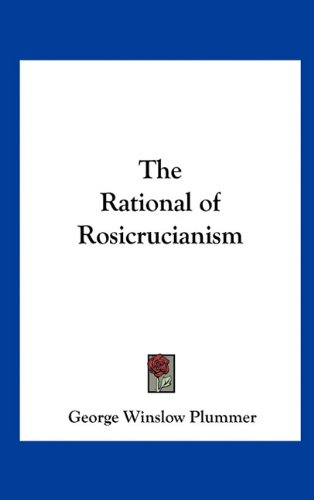
![]() | Paperback: 48
Pages
(2004-09-20)
list price: US$15.95 -- used & new: US$9.34 (price subject to change: see help) Asin: 1417950447 Canada | United Kingdom | Germany | France | Japan |
|
Editorial Review Book Description | |
| 38. Alchemy, a Comprehensive Bibliography of the Manly P. Hall Collection of Books & Manuscripts: Including Related Material on Rosicrucianism and the by Ron Charles Hogart | |

![]() | Hardcover: 314
Pages
(2005-10-30)
list price: US$125.00 -- used & new: US$95.92 (price subject to change: see help) Asin: 0893145424 Canada | United Kingdom | Germany | France | Japan |
|
Editorial Review Book Description Extensive biographical and bibliographical descriptions of 164 books and 245 manuscripts from the PRS Library, assembled over a period of sixty-five years and the repository for many rare and scarce esoteric items. Related material on Rosicrucianism and Jacob Boehme's writings are included, as well as the Bacstrom manuscripts in eighteen volumes with English translations of early alchemical books, a volume of manuscripts from Count Cagliostro's library, Comte de St. Germain's triangular manuscript on vellum, a portion of Ripley's Scroll in full color, the William Law edition of Jacob Boehme with manikin plates attributed to Rubens, and more. Printed in a limited edition of one thousand copies, folio volume, 9" x 12", library binding, 314 pages handsomely illustrated with eight full-color plates and facsimiles of title pages and frontispieces. | |
| 39. Nineteenth century sense: Being the paradox of Spiritus sanctus and of Rosicrucianism by James Edmund Garretson | |
| Unknown Binding: 250
Pages
(1893)
Asin: B000880A9A Canada | United Kingdom | Germany | France | Japan | |
| 40. A Catholic looks at Rosicrucianism, by Hubert Vecchierello | |
| Unknown Binding: 82
Pages
(1939)
Asin: B00089RZV0 Canada | United Kingdom | Germany | France | Japan | |
|   | Back | 21-40 of 100 | Next 20 |