e99 Online Shopping Mall

Geometry.Net - the online learning center Help  
Home  - Religion - Shin Buddhism (Books)

  1-20 of 100 | Next 20
A  B  C  D  E  F  G  H  I  J  K  L  M  N  O  P  Q  R  S  T  U  V  W  X  Y  Z  

click price to see details     click image to enlarge     click link to go to the store

$13.22
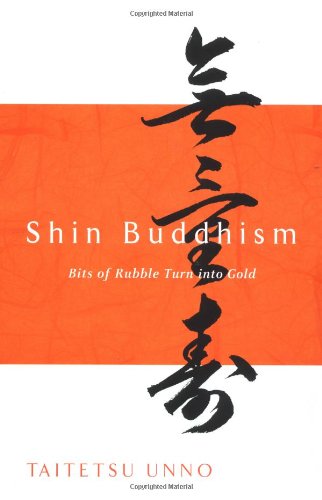
1. Shin Buddhism: Bits of Rubble
$45.00
2. Rennyo: The Second Founder of
$8.38
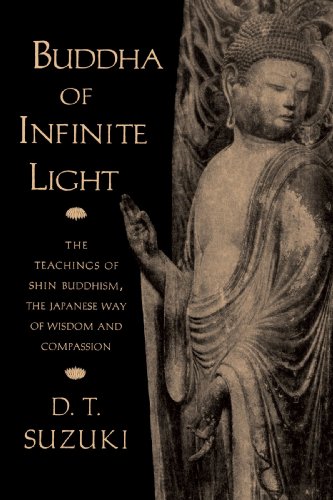
3. Buddha of Infinite Light: The
$11.59
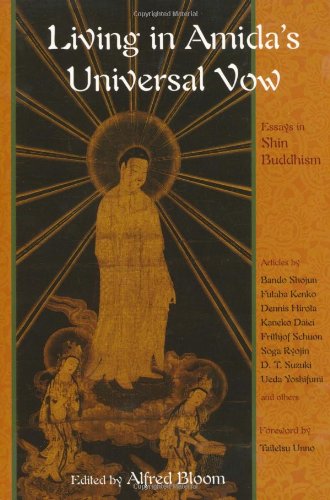
4. Living in Amida's Universal Vow:
$13.95
5. A Study Of Shin Buddhism
 
6. Buddhism in a New Light Eighteen
$19.00
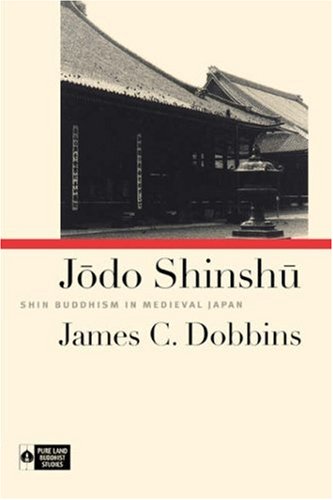
7. Jodo Shinshu: Shin Buddhism in
 
8. Shoshinge: The Heart of Shin Buddhism
$21.25
9. Toward a Contemporary Understanding
 
$1.89
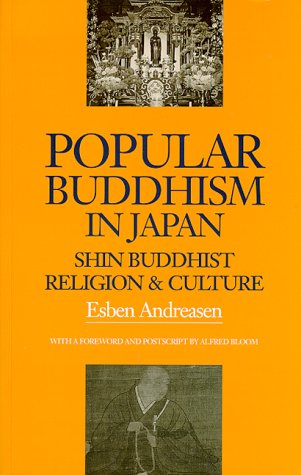
10. Popular Buddhism in Japan: Shin
 
11. An introduction to Shin Buddhism
 
12. Notes on Once-calling and many-calling:
 
13. Shin Buddhism: Monograph Series
 
14. Hymns of the pure land (Shin Buddhism
 
15. Passages on the pure land way:
 
16. Shin Buddhism
 
17. Shin Buddhism
 
18. A miscellany on the Shin teaching
 
19. Shin Buddhism
 
20. Lectures on Shin Buddhism

1. Shin Buddhism: Bits of Rubble Turn into Gold
by Taitetsu Unno
Paperback: 288 Pages (2002-09-17)
list price: US$19.00 -- used & new: US$13.22
(price subject to change: see help)
Asin: 0385504691
Average Customer Review: 5.0 out of 5 stars
Canada | United Kingdom | Germany | France | Japan
Editorial Review

Book Description
Interest in Buddhism continues to grow throughout North America, and more and more readers are moving beyond the familiar Zen and Tibetan traditions to examine other types of Buddhism. In Shin Buddhism, Taitetsu Unno explains the philosophy anc practices of "Pure Land" Buddhism, which dates back to the sixth century C.E., when Buddhism was first introduced in Japan.

While Zen Buddhism flourished in remote monasteries, the Pure Land tradition was adopted by the common people. With a combination of spiritual insight and unparalled scholoarship, the author describes the literature, history, and principles of this form of Buddhism and illuminates the ways in which it embodies this religion's most basic tenet: "No human life should be wasted, abandoned, or forgotten but should be transformed into a source of vibrant life, deep wisdom, and compassionate living." As a practice that evolved to harmonize with the realities of everyday life, Shin Buddhism will be particularly attractive to contemporary Western readers.Download Description

Interest in Buddhism continues to grow throughout North America, and more and more readers are moving beyond the familiar Zen and Tibetan traditions to examine other types of Buddhism. In Shin Buddhism, Taitetsu Unno explains the philosophy and practices of "Pure Land" Buddhism, which dates back to the sixth century C.E., when Buddhism was first introduced in Japan.

While Zen Buddhism flourished in remote monasteries, the Pure Land tradition was adopted by the common people. With a combination of spiritual insight and unparalled scholoarship, the author describes the literature, history, and principles of this form of Buddhism and illuminates the ways in which it embodies this religion's most basic tenet: "No human life should be wasted, abandoned, or forgotten but should be transformed into a source of vibrant life, deep wisdom, and compassionate living." As a practice that evolved to harmonize with the realities of everyday life, Shin Buddhism will be particularly attractive to contemporary Western readers.

... Read more

Customer Reviews (4)

5-0 out of 5 stars Excellent Choice
I cannot say enough about this product.Dr. Unno writes with such expertise and his books can be read by everyone not just scholars.It is as good as "River of Fire, River of Water".I recommend this for anyone interested in Pure Land Buddhism

5-0 out of 5 stars It turns with the seasons
I first read this book when it was published in 2002.I was younger then in so many ways and thought I was hot stuff.What Unno wrote stuck to me like a post-it to a mirror.With only a little heat it slid right off.

I am older now and I leave whatever specialness I might have to the appraisal of the compassionate cosmos.What Unno wrote has become the mirror itself. I highly recommend this book and suggest the reader return to it after some years to see how its insights weather.

4-0 out of 5 stars Slow to start, but really builds up nicely
I really would give this 4.5 stars if I could.Taitetsu Unno is a brilliant writer, and despite being Japanese, he truly knows how to write for a Western audience.My only complaint were the early chapters where he's mostly talking about how great the 'nembutsu' and not much else.It's kind of feel-good fluff.

However, by the second section, he really delves into so many aspects of Buddhism, from a Jodo ShinShu perspective (I am a newly converted Shin Buddhist myself).The chapters are surprisingly relevant and the topics build from the simple topics in the first few chapters into progressively more deep and theological issues for Buddhists.This book has a subtle, but very compelling flow to it.

Taitetsu is clearly a well-read person as he quotes from many interesting sources, and clearly conveys their meaning to the reader.

This really was time well-spent reading, and I definitely recommend this to anyone who's curious about Shin Buddhism.It's the largest school of Buddhism in Japan (not Zen or Soka Gakkai), yet the least known here.Read this book and find out what it's about.

5-0 out of 5 stars An excellent follow-up to "River of Fire..."
Rev. Unno's book "Shin Buddhism: Bits of Rubble Turn Into Gold" is essentially a follow-up work to his wonderful introductory text "River of Fire, River of Water". But while that work provided an overview of Shin Buddhism in of itself, this work provides a broader view of how Shin Buddhism affects the lives of those who practice it, as well as exploring the deeper issues of the Nembutsu-faith.

Weaving a complex yet easily-understood tapestry from personal experience, anecdotes, Pure Land teachings, and philosophical insight, Rev. Unno unfurls an examination of the depth and breadth of impact of Jodo Shinshu in peoples' lives. This school of Mahayana Buddhism, Jodo Shinshu, is essentially a Buddhism for the common man, emphasizing faith in the "other power" of Amida Buddha as its central tenet, as opposed to the complex battery of practices eschewed by other (and more familiar to the West) schools of Buddhism. A branch of the Pure Land school which was formed in the early 13th century in Japan, Jodo Shinshu emphasizes the "true entrusting" in Amida, the embodiment of wisdom and compassion from which all Buddhist thought emanates. And while this form of Buddhism is largely unknown in the West outside of the ethnic Japanese community, it is a powerful...and easily-accessible...path among the 84,000 Paths to Enlightenment as the diverse streams of religious and philosophical thought are known in Buddhism.

Rev. Unno here shows us how this faith affects those who accept it, and why. Just as "River of Fire..." explained the 'what' of Jodo Shinshu, "Bits of Rubble..." explains the 'how' in like manner...which is clear, concise, and readily-understandable. As a text for both beginners/explorers and those steeped in the faith, it succeeds at delivering meaningful messages and points on which to ponder. I would suggest reading "River of Fire, River of Water" before this, as there seems to be something of a continuity from that book's information and manner of imparting it into this one's. But do read this one after that to gain valuable insight into what Shin brings into peoples' lives. Like that prior book, I recommend this one without hesitation. ... Read more


2. Rennyo: The Second Founder of Shin Buddhism (Nanzan Studies in Asian Religions)
by Minor Rogers
Paperback: 456 Pages (1991-02)
list price: US$45.00 -- used & new: US$45.00
(price subject to change: see help)
Asin: 0895819309
Canada | United Kingdom | Germany | France | Japan
Editorial Review

Book Description
The first book length study of Rennyo (1415-1499), a Jodo Shinshu priest who transformed the Honganji religious order into the most powerful Buddhist organization in Japan. It includes an annotated translation of Rennyo's major letters, the source of much of his influence.

"...This reasearch will be the standard source on Rennyo for years to come..." Choice ... Read more


3. Buddha of Infinite Light: The Teachings of Shin Buddhism, the Japanese Way of Wisdom and Compassion
by Daisetz T. Suzuki
Paperback: 96 Pages (2002-02-12)
list price: US$14.95 -- used & new: US$8.38
(price subject to change: see help)
Asin: 1570624569
Average Customer Review: 4.5 out of 5 stars
Canada | United Kingdom | Germany | France | Japan
Editorial Review

Book Description
Shin is the uniquely Japanese flowering of the type of Buddhism known as "Pure Land." It originated in the thirteenth century with the charismatic and prophetic figure Shinran (1172-1263), whose interpretation of the traditional Pure Land teachings was extremely influential in his own lifetime and remain so today. In a period when Japanese Buddhism was dominated by an elitist monastic establishment, Shinran's Shin teaching became a way of liberation for all people, regardless of age, class, or gender. Although Shin is one of Japan's greatest religious contributions—and is still the most widely practiced form of Buddhism in Japan—it remains little known in the West. In this book, based on several lectures he gave in the 1950s, D. T. Suzuki illuminates the deep meaning of Shin and its rich archetypal imagery, providing a scholarly and affectionate introduction to this sometimes misunderstood tradition of Buddhist practice. ... Read more

Customer Reviews (8)

4-0 out of 5 stars Great introduction to Jodo Shinshu Buddhism
Ever since the first Englishman translated the final words of the Buddha as "work out your own salvations with diligence," the English-speaking West has associated Buddhism almost exclusively with the cool, detached path of self-power and the attainment of enlightenment through the individual cultivation of wisdom, ethics, and meditation. Perhaps it is due to this limited understanding of the Buddhadharma, perhaps it is because so many Westerners have come to Buddhism in order to escape from a theistically oriented religion; whatever the reason, out of the millions of Westerners who now find themselves attracted to the Buddhadharma, few are familiar with the Buddhist path of Other-power, a path which finds its clearest expression in the Jodo Shinshu Buddhism of Japan.

Thankfully the folks at Shambhala Publications have decided to fill this gap in knowledge by updating and republishing a classic work by D.T. Suzuki, perhaps most well known in the West for his work on the Zen traditions of Japanese Buddhism. The result is this short, clearly written work which attempts to explain the essential teachings of Jodo Shinshu Buddhism (aka Shin Buddhism) in a way that situates them squarely within a more familiar Buddhist worldview.

Suzuki admits up front that his presentation of Shin Buddhism, stripped of what he calls "accretions," will go directly against more traditional interpretations, and so obviously this book is not an exhaustive treatment of its subject. Instead the book sketches the basic premise of Shin Buddhism (i.e., Amida Buddha has vowed that anyone who calls out to him with sincere faith will be reborn in the Pure Land, a stainless realm whence anyone can attain enlightenment) and discusses its essential practice of reciting the *nembutsu* ("Namu-Amida-Butsu") in the context of standard Buddhist philosophical concepts (e.g., selflessness, emptiness, compassion, etc.).

So for Suzuki, the practice of reciting the nembutsu is not about calling out to a god for salvation, although that is certainly how it first appears. Instead "Namu" symbolizes self-power, "Amida Butsu" Other-power, and the conjunction of the two in the nembutsu is emblematic of the essential nonduality of oneself and the enlightened mind of the Buddha. Likewise, Suzuki explains that we cannot practice the sincerity necessary to call out to Amida because sincerity is the "perfect forgetting of oneself." In other words, what initially seems "too easy" is seen on closer analysis to be nigh impossible. This is why Shinran's modification of existing Pure Land Buddhist doctrines was, and is, so radical; for him, the nembutsu isn't a prayer or mantra to be put into practice (after all, what good would such practice be given our hopeless self-centeredness?) but an expression of gratitude for having already been swept up into the Pure Land through the absolute grace of Amida's compassion. For Shinran, the Pure Land itself is not merely understood as a post-mortem destination but is a radical re-envisioning and sanctification of the present moment. The strict separation between what is self and what is not-self, between what is samsara and what is nirvana, blurs; "When sincerity and insincerity are transcended, then Amida comes into our inner self and identifies himself with this inner self. Or, we can say, this self find itself in Amida. And when we find this self in Amida, we are in the Pure Land" (p. 41).

This is a great introduction to an often-overlooked school of Buddhist thought and practice.

5-0 out of 5 stars A fine addition to a Shin Buddhism library
D.T.Suzuki is well known in the West for his discussions on Zen Buddhism, but many are not aware that he has a strong background in Shin Buddhism (Jodo Shinshu) as well.His mother was a follower of Shin Buddhism, and has had a big influence on his life.This book is a good explanation of Shin Buddhism from the outside perspective of someone who isn't deeply involved in the more orthodox Hongwanji Branch of Shin Buddhism, but is nevertheless very familiar with it.

While many Shin Buddhism books explain what Shin Buddhism is, most are not well-suited Westerners who look at Shin Buddhism and have their doubts about Other-Power, the efficacy of the nembutsu, and so on.Suzuki nicely addresses these issues, and other concerns Westerners would have.

The book is short, but helps fill in gaps other Shin books leave wanting.This should be part of anyone's library if they're exploring Shin Buddhism, or wanting to take their knowledge further.

Namo Amida Butsu

5-0 out of 5 stars Necessary forShin Buddhism Studies!
This book is one of the classics for Teaching of Shin buddhism.
I felt that it had a bit of modernization to it, possibly due to translation Etc... and with the mention of Science and Metaphysics, even Voltaire which you don't hear about very often in a Shin guide.

I found it quick and to the point but it did skip around too much for my small one track mind.

5-0 out of 5 stars Wow!Were's the Zen, Mama?
Just kidding!

This is an excellent primer in Shin Buddhism, written by a man who I actually thought was only a practitioner/teacher of Japanese Zen.It's really cool how Suzuki, as well as a few others, can convey the Shin tradition in a way that resonates with those of us who have practiced Zen.

While this IS a great introduction and interpretation of Jodo Shinshu, this really isn't the best introduction to Buddhism as a whole.If you want to know more about basic Mahayana Buddhism, then I recommend you buy a few books by Thich Naht Han.If you want to learn about the Theravada, then read Kornfield.But by all means, look into this Shin Buddhist practice, because the more I study it, the more I am pursuaded that it might very well be the best form of Buddhism for those of us who have to work for a living and then take care of our familes, as opposed to those who "hide out" in the tranquility of Zen Centers, Dharma Retreats, and Kai Kans (damn things!).

Have fun!

3-0 out of 5 stars less than expected from a master like daisetz
this book is way to short and daisetz jumps from one subject to the next way to fast. Although he does a good job of explaining the various points of Shinto, you'll fell as though he could have done better. If you want a good book by Daisetz I'd suggest "Zen Buddhism: selected writings of D.T.Susuki". ... Read more


4. Living in Amida's Universal Vow: Essays on Shin Buddhism (Perennial Philosophy Series)
by Alfred Bloom
Paperback: 344 Pages (2004-06-25)
list price: US$19.95 -- used & new: US$11.59
(price subject to change: see help)
Asin: 0941532542
Average Customer Review: 5.0 out of 5 stars
Canada | United Kingdom | Germany | France | Japan
Editorial Review

Book Description
This is the first comprehensive collection of essays on Shin Buddhism by many of the most important Shin scholars and religious authorities of the last one hundred years.Download Description
Shin Buddhism arises from the teachings of Shinran, a profoundly compelling spiritual authority of 13th century Japan. Shinran taught men from all walks of life to find solace and strength in Amida Buddha, a compassionate aspect of the Cosmic Buddha who renounced his own enlightenment until all men could be saved through his power. The place of Shin Buddhism in the contemporary spectrum of Buddhist traditions has been gaining in significance and depth of scholarship. From many angles, scholars are exploring the relation of this teaching to the ancient tradition from which it emerged as well as discerning its contemporary relevance. Living in Amida's Universal Vow offers a broad spectrum of essays concerning Pure Land and Shin Buddhism. The selection of authors ranges from major teachers in modern Shin Buddhism to more recent scholars who are making significant contributions to the study of the tradition. It also furnishes material on the social perspective of Shin Buddhism and its ethical orientation, as well as comparative approaches. As the foundation of the largest popular Buddhist sect in Japan (and overseas in the West), the many-faceted aspects of Shin Buddhism merits increased attention. Though Zen and Tibetan Buddhism have generated much interest in the West among students and some practitioners, Shin Buddhism has always reached out to the masses with the message of Amida Buddha's universal compassion. Groundbreaking in its content and approach, this book succeeds in showing the continued relevance of Shin Buddhism to both scholars and seekers alike. ... Read more

Customer Reviews (1)

5-0 out of 5 stars Namu Amida Butsu
The reader from North Carolina makes a good case for reading book jackets: in this case the subtitle "Essays on Shin Buddhism."While Amida is not tangential to these essays, the subject matter is eternal life in the Infinite Light of Amida Buddha.This is a very different matter than approaching Amitabha/Amitayus as a deity or a member of a pantheon of buddhas, which, perhaps, is what the reader was after.

LIVING IN AMIDA'S UNIVERSAL VOW is not an introductory text on either Buddhism in general or Shin Buddhism in particular.It assumes a basic familiarity with the subject of Shin; more, it presumes that one is already engaged with the Universal Vow and is seeking to deepen and broaden one's appreciation of its scope.

Some of the essays are easier reading than others; some are more personal and intimate than others.Shin is a subtle practice, easy on the one hand, harder than you might imagine on the other.It has not received the attention paid to Zen, Vipassana or Tibetan Buddhism, therefore it has not had to lively up its presentation for American consumption.Perhaps because of that, Shin's evolution in the West has been more organic, more private, and more painful.

By presenting this book, Dr. Bloom has opened Shin studies to a wider readership, one which may be prepared to accept Shin on its own terms as a practice of faith, different from Zen or Vipassana or Vajrayana, but perhaps more suited for those of us acutely aware of our passion-bound finitude. ... Read more


5. A Study Of Shin Buddhism
by Gessho Sasaki
Paperback: 152 Pages (2007-03-01)
list price: US$21.95 -- used & new: US$13.95
(price subject to change: see help)
Asin: 1432584413
Canada | United Kingdom | Germany | France | Japan

6. Buddhism in a New Light Eighteen Essays that Illuminate Our Buddhist Practice
by Shin Yatomi
 Paperback: Pages (2006)

Isbn: 1932911146
Canada | United Kingdom | Germany | France | Japan

7. Jodo Shinshu: Shin Buddhism in Medieval Japan (Institute of Buddhist Studies)
by James C. Dobbins
Paperback: 264 Pages (2002-04-01)
list price: US$19.00 -- used & new: US$19.00
(price subject to change: see help)
Asin: 0824826205
Average Customer Review: 5.0 out of 5 stars
Canada | United Kingdom | Germany | France | Japan

Customer Reviews (1)

5-0 out of 5 stars Excellent analysis of the development of Joudo Shinshuu
The book provides detailed and profound information on the development of the Joudo Shinshuu sect of Japanese buddhism, which is the biggest of Japan's buddhist sects today and also the one whose beliefs arguably bear the most resemblance to those of Christianity. The orthodox view of Joudo history held by the members of the sect itself is covered as well as the "historical" view through the eyes of the scholar. The important - that is to say unique - parts of the Joudo belief are covered in detail, especially the process of the establishment of Amida as a kind of saviour whose mercy paves those who rely upon him the way to rebirth in the Pure Land - in sharp contrast to other sects of buddhism, which focus upon satori (enlightenment) through one's own efforts - mainly meditation (jou), study (e) and the strict observance of the rules for buddhist monks (kai). The evolution of Joudo belief and organization from the time of its founders Hounen and Shinran through the middle ages is also looked at in detail.

Overall a convincing analysis of this interesting Japanese sect by a renowned scholar, aiming at an audience of scholars and people interested in facts and solid argumentation instead of mainstream esoteric ballyhoo. ... Read more


8. Shoshinge: The Heart of Shin Buddhism
by Alfred Bloom
 Paperback: 108 Pages (1986-11)
list price: US$8.95
Isbn: 0938474065
Canada | United Kingdom | Germany | France | Japan

9. Toward a Contemporary Understanding of Pure Land Buddhism: Creating a Shin Buddhist Theology in a Religiously Plural World (S U N Y Series in Buddhist Studies)
Paperback: 257 Pages (2000-04)
list price: US$22.95 -- used & new: US$21.25
(price subject to change: see help)
Asin: 0791445305
Average Customer Review: 4.5 out of 5 stars
Canada | United Kingdom | Germany | France | Japan

Customer Reviews (2)

5-0 out of 5 stars A valuable study
Given the 'hardening of the orthodoxies' which seems to have set in elsewhere - studies like this seem like a breath of fresh air. We live in a 'pluralistic' world, with a plurality of religious traditions - and, despite the retreat into conservative narrowness, the good side of contemporary life is that more and more people seem to be recognising the need for inter-cultural dialogue and mutual understanding. Indeed, we might even say that the retreat into insular attitudes is a knee-jerk reaction to the undeniable fact that we are living in a pluralistic world, and must rise to the occasion.

The debates or dialogues in this study, chaired by Dennis Hirota, endevour to find a contemporary understanding of Shin Buddhism, capable of yielding shared meaning in dialogue with other religions in a pluralistic world. Shin Buddhism was bound to come to the fore here, from a Buddhist perspective, because it has a place for 'other-power' (tariki) - analogous to the role of God in Theistic religious systems. Shin Buddhists see the value of this analogous relationship, but question the extent to which it can be stretched. Amida is not a 'creator-God' - so the 'creationist' side of theology poses certain problems here.@On the other hand, certain aspects of Christian theology are open to re-interpretation. The 'death of God' theology places a minimum stress on the problematic aspects of creationism, and the emergent 'process theology' is much more akin to Asian thought. There is plenty of food for thought here, and anyone truly alive to the challenges faced by the spiritual community, world-wide, will gain vital insight by digesting the issues raised in this book.

4-0 out of 5 stars Opens Up New Avenues in Shin Buddhism
This book opens up new possibilities in expressing Pure Land Buddhism in a contemporary context.By setting up a dialog between the three contributors it explores the possibilities and challenges the reader to think in different directions.In the words of J. P. McDermott in a review in CHOICE (November 2000):

Three leading Japanese Shin Buddhist scholars and two major Western philosophical theologians come together, under the editorship of Hirota (Asian studies, Chikushi Jogakuen Univ., Japan) to produce a unique volume aimed at a contemporary understanding of Pure Land Buddhism. Part of Hirota's intent is "to disclose aspects of truth in the Shin path and possible venues for understanding the practicer's religious awareness. . . ." Beginning with a series of questions raised by Gordon Kaufman, (emer., Harvard), the three Buddhist authors outline new ways of interpreting the Pure Land Shin tradition. The thinking in their essays is influenced by Western theology-process thought, for example---and history of religions categories. The result is a new hermeneutic, or a constructive Shin Buddhist "theology"---which of these two is a matter of discussion within the volume. Next the volume presents essays by Kaufman and John Cobb responding to, and reflecting on, the pieces by the Shin Buddhists, who in turn reflect on their original formulations in light of the comments by Kaufman and Cobb, as well as in response to one another. The volume is anexcellent, groundbreaking example of cross-cultural---dare one say syncretistic?---academic "theology." Graduate students; faculty and researchers; professionals and practitioners. -- J. P. McDermott, Canisius College

I also agree with McDermot.And I add that anyone interested in exploring the cross-cultural and theological possiblities in an East-West dialog should read this book. ... Read more


10. Popular Buddhism in Japan: Shin Buddhist Religion & Culture (Latitude 20 Books)
 Paperback: 199 Pages (1997-12)
list price: US$19.00 -- used & new: US$1.89
(price subject to change: see help)
Asin: 0824820282
Average Customer Review: 3.0 out of 5 stars
Canada | United Kingdom | Germany | France | Japan

Customer Reviews (1)

3-0 out of 5 stars Light book, but provides good documents
Buddhism is one of the major religions in Japan, but it is not the Buddhism one thinks of in India, or that commonly comes to mind in the West. The Japanese religious tradition tends towards Mahayana Buddhism, rather than Theravada. Mahayana, especially in its Japanese forms, such as in Shin Buddhism (Pure Land Sect), actually has remarkable parallels to Christianity, with notions such as hell, an afterlife in a paradise-like realm, sin and salvation. Andreasen concentrates on this sect of Shin Buddhism, rather than Zen Buddhism or Theravada.

In this book, Andreasen's treatment of Japanese Buddhism is rather light. He does not delve into the details and complexities of his subject, nor does he attempt analysis. However, what he has done very well in this book is bring together a large number of documents which are very enlightening (sorry) for the reader and eminently readable. Andreasen's own writing is easy to understand and clear, if not deep.

For the collection of documents, it is a book worth looking into. But for a much more detailed and exhaustive look at Mahayana Buddhism, I would recommend looking at Paul Williams book 'Mahayana Buddhism: The Doctrinal Foundations'. ... Read more


11. An introduction to Shin Buddhism
by Kōshō Yamamoto
 Unknown Binding: 328 Pages (1963)

Asin: B0007ISIT0
Canada | United Kingdom | Germany | France | Japan

12. Notes on Once-calling and many-calling: A translation of Shinran's Ichinen-tanen mon'i (Shin Buddhism translation series)
by Shinran
 Paperback: 104 Pages (1980)

Isbn: 493849003X
Average Customer Review: 5.0 out of 5 stars
Canada | United Kingdom | Germany | France | Japan

Customer Reviews (1)

5-0 out of 5 stars Shin Buddhism: An Important Issue
This short book, almost a pamphlet, represents a key writing by the Japanese Pure Land luminary, Shinran Shonin (1173-1263 CE), founder of what came to be called Jodo-Shinshu Buddhism, or simply Shin Buddhism.

Thecrux of this booklet focuses on the practice of the Nembutsu, or"calling the name of the Buddha Amida." Amida Buddha is theBuddha of Infinite Light (wisdom) and Infinite Life (compassion), who savesall beings who call his name. This "calling" or Nembutsu may beonce or many thousands of times during one's lifetime.

Shinran's bookletis a commentary on an even shorter booklet circulating in his own daycalled "Once-Calling and Many Calling" written by another author.There was a debate in Shinran's time whether it was sufficient to call theBuddha's name only once, or whether one needed to call the Buddha's nameconstantly in order to attain salvation by Amida Buddha.

Shinran'scarefully worded answer is summed up: Once-calling is Many-calling, andvice versa. The way in which he arrives at this conclusion is worth theprice of the book to find out.

This booklet has been reprinted in a neweredition of Shinran's Complete Works, a 2-volume hardcover set whichcontains every commentary, poem, and letter ever written by Shinran in hislong and inspiring life. The nice thing about having the little book onOnce-calling and Many-calling is, of course, it is handy. I have a fondnessfor small books, especially small books that have a powerful and directmessage.

This is definitely worth having if one wants to know more aboutShin Buddhism, or Japanese Buddhism in general. I heartily recommend it. ... Read more


13. Shin Buddhism: Monograph Series
by Taitetsu; Tokunaga, Michio; Shigaraki, Takamaru; Kakehashi, Jitsuen Unno
 Paperback: Pages (1993)

Isbn: 1877604070
Canada | United Kingdom | Germany | France | Japan

14. Hymns of the pure land (Shin Buddhism translation series)
by Shinran
 Unknown Binding: Pages (1922)

Asin: B0008B9GK6
Canada | United Kingdom | Germany | France | Japan

15. Passages on the pure land way: A translation of Shinran's Jōdo monrui jushō (Shin Buddhism translation series)
by Shinran
 Unknown Binding: 142 Pages (1982)

Isbn: 0895810476
Canada | United Kingdom | Germany | France | Japan

16. Shin Buddhism
by D.T. Suziki
 Hardcover: Pages (1970)

Asin: B000J52VZS
Canada | United Kingdom | Germany | France | Japan

17. Shin Buddhism
by SuzukiDT
 Hardcover: Pages (1970)

Asin: B000YC49GU
Canada | United Kingdom | Germany | France | Japan

18. A miscellany on the Shin teaching of Buddhism
by Daisetz Teitaro Suzuki
 Unknown Binding: 151 Pages (1949)

Asin: B0007J0FO0
Canada | United Kingdom | Germany | France | Japan

19. Shin Buddhism
by D. T. Suzuki
 Hardcover: Pages (1970)

Asin: B000GVWIBM
Canada | United Kingdom | Germany | France | Japan

20. Lectures on Shin Buddhism
by Takashi Hirose
 Unknown Binding: 91 Pages (1980)

Asin: B0007BLRFY
Canada | United Kingdom | Germany | France | Japan

  1-20 of 100 | Next 20
A  B  C  D  E  F  G  H  I  J  K  L  M  N  O  P  Q  R  S  T  U  V  W  X  Y  Z  

Prices listed on this site are subject to change without notice.
Questions on ordering or shipping? click here for help.

site stats