e99 Online Shopping Mall

Geometry.Net - the online learning center Help  
Home  - Religion - Unitarian Universalism (Books)

  1-20 of 100 | Next 20
A  B  C  D  E  F  G  H  I  J  K  L  M  N  O  P  Q  R  S  T  U  V  W  X  Y  Z  

click price to see details     click image to enlarge     click link to go to the store

$13.35
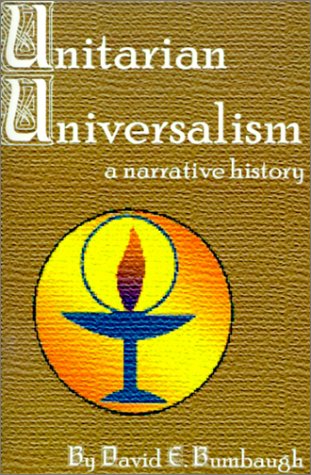
1. Unitarian Universalism: A Narrative
 
$5.45
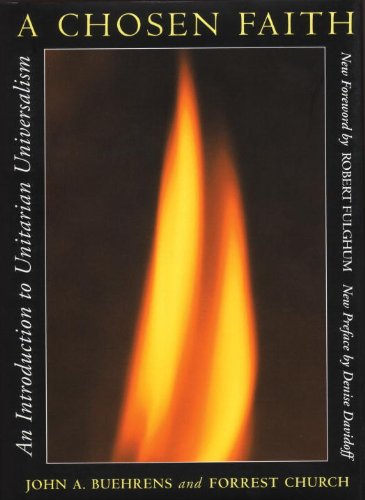
2. A Chosen Faith: An Introduction
$9.60
3. Unitarian Universalism Is a Really
$20.99
4. To Re-Enchant the World: A Philosophy
 
$14.00
5. Christian Voices in Unitarian
$3.95
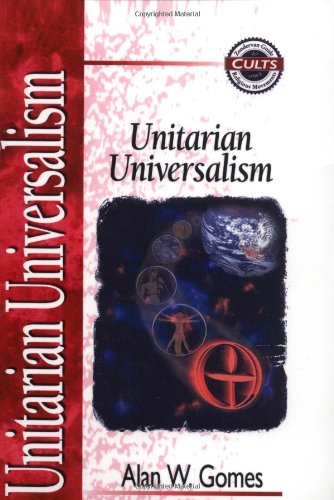
6. Unitarian Universalism
 
$12.63
7. With Purpose and Principle: Essays
 
$5.50
8. 100 Questions That Non-Members
 
$87.80
9. Historical Dictionary of Unitarian
$17.11
10. Sacred Service in Civic Space:
$12.00
11. The Church Where People Laugh:
 
$7.90
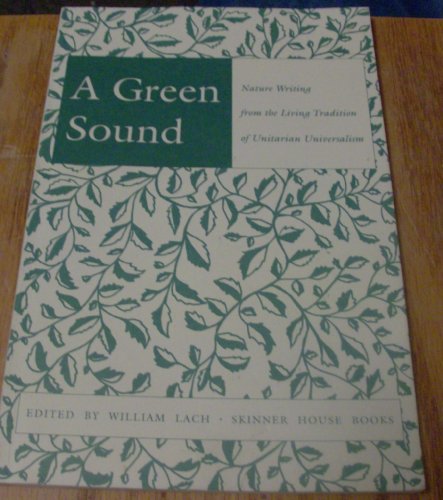
12. A Green Sound: Nature Writing
 
13. Unitarian Universalism Selected
$18.00
14. What Would We Do Without Music
 
$11.99
15. Freethinking Mystics with Hands:
 
$14.99
16. The Almost Church: Redefining
 
17. Around the church around the year:
$9.44
18. What Do Unitarians Believe?
 
19. Born again Unitarian Universalism
 
20. A Global Conversation: Unitarian

1. Unitarian Universalism: A Narrative History
by David E. Bumbaugh
Paperback: 226 Pages (2001-03)
list price: US$15.00 -- used & new: US$13.35
(price subject to change: see help)
Asin: 0970247907
Average Customer Review: 4.0 out of 5 stars
Canada | United Kingdom | Germany | France | Japan

Customer Reviews (4)

4-0 out of 5 stars Unitarian Universalism: A Narrative History
If you are intrested in reading about different points of view and different faith systems this book is an intresting read. It gives the reader an intresting alternate view of Christianity and the thoughts about the trinity belief. A very engaging book to excercise your mind and open it to new points of view.

3-0 out of 5 stars Competently crafted history of the UU denomination, with emphasis on Unitarianism
On the first page of this book, author David Bumbaugh explains that the UU denomination is peculiar in that it is bound together by a shared history, rather than a shared theology or set of doctrines. He then spends the next 200 pages outlining the histories of the two foundational denominations, the Unitarians and Universalists, from their beginnings in formative Christian discourse to their merger in 1961 to the new challenges facing the secular humanism that has dominated UU since the mid-20th century.

This book should be on the bookshelf of every UU, since it provides an easy-to-read overview of our denominational history. Because Bumbaugh does such a thorough job of discussing the various theological actions and reactions of the Reformation, this book is also recommended reading for Christians of all denominations who want to know more about the formation of their faith. After all, as Bob Marley pointed out, "if you knew your history, then you would know where you're coming from."

That said, my sole criticism of this history is that it provides much more information on Unitarianism than it does on Universalism. As the author notes in his section on the May 1961 merger of the two liberal post-Christian denominations, the Universalists often feared being subsumed into the larger Unitarian milieu, and this history suggests that those fears were justified. While the author acknowledges that Universalism as a denomination did not really exist in Europe, he also does not go into a detailed exploration of the roots that it DOES have, whereas he spends scores of pages describing proto-Unitarian trends in European Christendom. Perhaps there really is a paucity of information available on pre-18th century proto-Universalist ideas, and that dearth explains its under-representation in the book.

All in all, a good book for historians of Christianity and UU and also for those interested in liberal religion in general.

4-0 out of 5 stars An Excellent History of Unitarian Universalism
This relatively short book provides an amazingly in-depth overview of Unitarian and Universalist history.Spending more time on Unitarian history, famous Universalists and their backgrounds are also discussed.This book is unusual in that it is not divided by chapters, and there are typos scattered throughout the text.One that I found particulary humorous was where Ballou's birth year was given as 1771, but then a paragraph later it states he may have held universalist views as early as 1773.Remarkable childhood, if it were true!

All in all, this is a very good book for people to read who love religious history and/or want to get a feel for the history of Unitarian Universalism.

5-0 out of 5 stars Helps you understand how UU'ism developed.
The book is easy reading and will help you understand how Unitarianism and Universalism evolved. I was raised as a Unitarian and I know more about other religions than I do my own.

And certainly if you are not a Unitarian Universalist, but want to understand what it's all about, this book explains the specific ideas behind UUism and where they came from.

I should have read this book a long time ago, but I'm glad I read it now! ... Read more


2. A Chosen Faith: An Introduction to Unitarian Universalism
by John A. Buehrens
 Paperback: 221 Pages (1998-06-01)
list price: US$16.00 -- used & new: US$5.45
(price subject to change: see help)
Asin: 0807016179
Average Customer Review: 4.5 out of 5 stars
Canada | United Kingdom | Germany | France | Japan
Editorial Review

Amazon.com
A Chosen Faith: An Introduction to Unitarian Universalism, by John A. Buehrens and Forrest Church, is hard to describe. The book is a history of the denomination, with lively passages depicting the lives and ministries of important Unitarian-Universalist leaders such as Ralph Waldo Emerson and William Ellery Channing. Yet it is also a collection of testimonies by contemporary laypeople and ministers, who describe their churches' responses to questions ranging from "How do I know when to get married?" to "How should the government treat single mothers?" The funny and wise introduction was written by Robert Fulghum, who indulges the often invoked criticism that Unitarian Universalism's ideals are interchangeable with those of PBS. And, finally, it contains some straightforward explications of the denomination's core principles. The Church's aversion to creeds will be off-putting to some readers--at times, it seems Unitarian Universalists believe in nothing so much as not committing to any one belief. But there's something universally refreshing about this protean faith: most religious people, at one time or another, find that God leads them to reject some tenets of their religion. Unitarian Universalists have a true genius for accepting God's most surprising Words, which makes A Chosen Faith a valuable resource for all of us. --Michael Joseph GrossBook Description
Affirming diversity, dialogue, and personal choice in religious living, providing common ground and community for people from a wide variety of backgrounds and beliefs, and encouraging the work for social justice that religion inspires, Unitarian Universalism has become an increasingly appealing religious alternative. A Chosen Faith is a clear, helpful introduction to this growing religious movement. Two long-time ministers and denominational leaders, John A. Buehrens and Forrest Church, describe the sources and history of Unitarian Universalism, how those traditions are adapted in congregations today, and how they each came to choose Unitarian Universalism as a career and a way of life. This revised edition includes two new chapters as well as a new foreword by best-selling writer and Unitarian Universalist Robert Fulghum. "An excellent introduction for anyone interested in the nature of Unitarian Universalist religious beliefs, the history of those movements, and the emphasis on openness, tolerance, and social concerns."-Michael J. McBride, Religious Studies Review "Simply superb. I know of nothing comparable to it. The old-timer as well as the 'come-outer' will find A Chosen Faith irresistible. It will be a gift for everyone, for the minister, for the laity, for theological students. Engaging, seductive, infectious." -James Luther Adams ... Read more

Customer Reviews (15)

5-0 out of 5 stars "Must Read"
this book is an excellent intro to UU thought; anyone who is open-minded and liberal should read it

4-0 out of 5 stars Good introduction to the UU church, will not answer deep theological questions
This book is what its title says it is: an introduction to Unitarian Universalism. It combines a brief history of the denomination (which, in one respect, goes back centuries, but in another goes back to the 1961 merger of the Unitarian and Universalist denominations, whereupon the Unitarian Universalist Association ceased to be a "liberal Christian" denomination and became the "non-creedal religion" it is today) with an overview of UU principles, mixed with the author's personal reminiscences.

Unitarian Universalism is a tough religion to categorize or summarize. For those used to faiths where you are given a creed to follow and answers to life's deep questions, it can be difficult to understand the appeal of a religion that gives you questions rather than answers. There are no "authoritative" answers within the church regarding the existence of God or the nature of souls and the afterlife or why good people suffer, so the author of this book can only give his personal opinion without presuming to speak for Unitarian Universalism in general.

If you want to know more about Unitarian Universalism in general, this is a good book to start with. If you are wondering whether Unitarian Universalism might be the "right" religion for you, then you won't find the answer to that in this or any book. You need to attend a UU church and talk to the members of the congregation and see if it's a good "fit" for you. And be aware that no two UU congregations are the same -- some are heavily theistic, with a lot of spiritual/religious overtones (though none explicitly endorse or require members to believe in a deity), while others are much more "humanist." Some UU congregations are even explicitly pagan/"Earth-centered" in nature, though these are rare. The point is, if one congregation doesn't feel right to you, you might find another one does. You will find some UU members who are very comfortable with "religious language" while others recoil at any mention of God. Some regard this as a positive thing about Unitarian Universalism, the fact that it is so personal and unique to each individual's experience, others find the lack of uniformity or consensus frustrating.

I think it is this tension between "theists" and "humanists" within the UUA that prompted a previous reviewer's negative review of this book. As an atheist UU myself, I disagree with his assessment that this book is "hostile" to humanists/atheists. The thing is, the author is more theistic himself and so he has a more benevolent view of Unitarian Universalism's theistic (Christian, in fact) heritage. He doesn't explicitly say "There is a God," and admits he's unsure, but one gets the impression that he believes in some sort of higher power or at least would like to, and so he has a kindly attitude towards fellow believers. This may grate on determinedly atheistic UUs who would prefer that there be no mention at all of deities or spirituality in UU services. Personally, I don't find such religious references offensive as long as I am not being asked to subscribe personally to a belief in any gods or made to feel excluded because I don't. But as far as theology goes, this book only offers the author's PERSONAL theology; it cannot lay out a theological foundation for all UUs, because every UU approaches theology differently.

5-0 out of 5 stars Great introduction to UUism.
I highly recommend this book to all people who are curious about Unitarian Universalism.It covers history, beliefs and makes you feel welcome no matter where you stand.Well written and very informative, whether you just want to know who the UUs are or believe you are one, READ THIS BOOK!

1-0 out of 5 stars A Tragic Stain on a Wonderful Religion
Revs. Buehrens and Church unquestionably have the institutional credentials to write an introduction to Unitarian Universalism. Nonetheless, I think this book is a travesty. To my eyes, it is full to overflowing with unfair and offensive attacks (which are in fact heavily contrary to the message of Unitarian Universalism) upon atheists, humanists and other skeptics whose belief systems do not toe the theological line drawn by the authors. There is nary a kind word about atheists in this book.

Five years ago, as a non-believer interested in Unitarian Universalism, "A Chosen Faith" was my first written introduction to the religion. The book taught me, among many other things, that my religious perspective was actually a "demonic pseudoreligion"; that UUs agreed with C.S. Lewis that "the opposite of belief in God is not a belief in nothing; it is a belief in anything"; that I was a spiritual "vacuum"; and that raising children without religion means ushering them into fundamentalist cults. In short, the book taught me that Unitarian Universalists would find me and my (non-) beliefs disgusting. This is the message secular people of many stripes will take away from "A Chosen Faith"--but it is far, far from the truth about UUism.

I am now a Unitarian Universalist, very much despite having read this book. My journey into the religion has consisted in large part of understanding (because I've been convinced by wonderful UUs, many of them Christians, pagans, theists, deists...) that Buehrens and Church are flat wrong about the place of atheism, humanism and skepticism within Unitarian Universalism.

We Unitarian Universalists covenant, in our statement of principles, "to affirm and promote the free and responsible search for truth and meaning." I believe "A Chosen Faith" repeatedly violates this covenant. As such, I think it is an extremely poor choice to serve as an introduction to Unitarian Universalism. If you are a UU, please do not inflict this book on a nonbeliever you care about. For anyone else in search of a good and fair introduction to UUism, I'm afraid you'll have to look elsewhere. (Try uua.org, for starters.)

5-0 out of 5 stars Eye Opening
For about ten years now I have struggled to find my spiritual niche.I was brought up Methodist Christian and never felt comfortable about my faith, that is until I read this book.The beliefs and practices of the Unitarian Church completely coincide with mine and many other family members and friends of mine.After reading this book I am now very optimistic about having a spiritually fulfilling life. ... Read more


3. Unitarian Universalism Is a Really Long Name
by Jennifer Dant
Hardcover: 30 Pages (2008-03)
list price: US$12.00 -- used & new: US$9.60
(price subject to change: see help)
Asin: 1558965084
Canada | United Kingdom | Germany | France | Japan
Editorial Review

Book Description
This one-of-a-kind picture book is a colorful introduction to Unitarian Universalism for children ages five to nine. Simple language and appealing illustrations offer children accessible answers to commonly asked questions such as: Who are we? What do we believe? How do we worship?Who leads us? Do we read the Bible? What is our religious symbol? Do we pray? What is Sunday school? How do we celebrate? "This appealing book answers children's basic questions about Unitarian Universalism with friendly words and charming pictures—an excellent resource!"—Janeen Grohsmeyer, author of A Lamp in Every Corner "Jennifer Dant and Anne Carter have given our children the gift of a clear, coherent and cheery introduction to the Unitarian Universalist religious journey."—Jeanne Nieuwejaar, author of The Gift of Faith ... Read more


4. To Re-Enchant the World: A Philosophy of Unitarian Universalism
by Richard Grigg
Paperback: 108 Pages (2004-12-20)
list price: US$20.99 -- used & new: US$20.99
(price subject to change: see help)
Asin: 1413466915
Average Customer Review: 4.5 out of 5 stars
Canada | United Kingdom | Germany | France | Japan
Editorial Review

Book Description
Since the seventeenth century, Western culture has been undergoing what historians and sociologists call secularization, the process via which religious institutions lose more and more of their power in society.Whereas Western society was once held together by the Christian Church, it is now held together by the rational procedures dictated by modern capitalism.But the rules of capitalism, whether ultimately helpful or harmful to our society's development, are not values or spiritual principles.Instead, they are simply technical dicta about the most efficient means to an economic end. One visible aspect of the process of secularization is the weakening, and perhaps eventual withering away, of traditional religious institutions.This process is already fully visible in Western Europe, and is evident, on a more subterranean level, in American society as well.Secularization threatens to "disenchant" the world (Max Weber), to cut us off from the sense of the sacred and of Mystery.But the withering of the old religious institutions does not mean that religion and spirituality themselves will simply disappear.Rather, they can take on new forms, as is evident in the New Age movement in American society.Yet, there is a difficulty with New Age sorts of spiritualities when compared with the old-time religion: these new spiritualities tend to be very individualistic, if not idiosyncratic.Sociologists point out that our spiritual practices will never appear fully real to us unless they have inter-subjective validity, unless they are supported by a social "plausibility structure" (Peter Berger).That is, my view of the world has the aura of reality as long as most of the people around me acknowledge that view and reinforce it.But individualistic New Age pieties seem to have no such social reinforcement underpinning them. Hence the central argument of To Re-Enchant the World: the Unitarian Universalist community accomplishes the unique task of re-enchanting the world by bringing a host of individual spiritualities into a single community where all of them are affirmed and thus granted social plausibility.The U.U. community, then, is a particularly powerful site for the re-enchantment of the world: it puts us back in touch with the sacred and with what the book labels the Mysterious Depth of reality. While Unitarian Universalists can bring many different spiritual ways into the U.U. community, five are analyzed in depth in the book, namely, humanism, a focus on nature, engagement with the arts, commitment to social justice, and devotion to a Source/Creative Abyss of the universe.The book also considers rituals common to the U.U. community and the experience of sacred space, sacred time, and sacred word in that community. Finally, To Re-Enchant the World makes some predictions about the future of Unitarian Universalism and even touches on the delicate issue of U.U. proselytizing.The book as a whole attempts to present a philosophical analysis of Unitarian Universalism that draws upon the most important intellectual currents in contemporary Western culture.The book operates with the conviction that while other American religious denominations can have their "systematic theologies," there is no reason why Unitarian Universalists cannot have philosophies of U.U. pluralism. ... Read more

Customer Reviews (3)

3-0 out of 5 stars Erudite book for the serious UU
This little book is reasonably interesting, though it tends towards the dry - probably more suitable for someone already on the UU path more than the idly curious. I found it helpful, and it answered a lot of questions I had about Unitarianism.

5-0 out of 5 stars A call for a return to a universalist roots
Unitarian Universalism is a small but influential religious movement in the United States and Europe.However, Griggs convincingly argues that given the desecularizationof the U.S., Unitarian Universalism - with its emphasis on an individual's right to determine her own religious beliefs and the belief that we can all view the sacred - provides a powerful religious vision for this culture.While not explicitly arguing from a Universalist perspective, I believe Grigg's book is a contemporary call to return to a more Universalist philosophy - that all religious communities can provide insight to the sacred and that we can create sacred spaces in our community for others to share - though the space may be sacred for different reasons.The book is short - too short - because I didn't want to put it down, and then I was done with it.The book energized me and I wanted to continue to explore these ideas. I look forward to more with this author.

5-0 out of 5 stars A Grand Synthesis of Philosophical and Religious Ideas
The central claim of Richard Grigg's "To Re-Enchant the World: A Philosophy of Unitarian Universalism" is to show "...that contemporary Unitarian Universalism, with its unique ability to bring together a plethora of different spiritualities within a single community, is a particularly powerful site for the re-enchantment of the world, for the rebirth of the sacred." (p.13)
In this his book succeeds admirably.Drawing on strains of thought from philosophy, psychology, poetry and a little dose of humor from pop-culture icons in the Simpson's TV series he weaves together a fine vision of what Unitarian Universalism strives for: a grand synthesis of religious ideas from the diversity of human culture.Grigg even includes a chapter for "A Contrarian Interlude" where he critiques his own book and answers possible objections.
In 100 pages, including informative footnotes on sources, Richard Grigg has given us a wonderfully compact, yet substantive book on contemporary UU thought.
... Read more


5. Christian Voices in Unitarian Universalism: Contemporary Essays
by Kathleen Rolenz
 Paperback: Pages (2006-01)
list price: US$14.00 -- used & new: US$14.00
(price subject to change: see help)
Asin: 1558965068
Average Customer Review: 5.0 out of 5 stars
Canada | United Kingdom | Germany | France | Japan

Customer Reviews (1)

5-0 out of 5 stars Introduction to UU Christianity
This collection of essays provides the curious reader an answer to the question "How Can You Be a Unitarian Universalist and a Christian?"An excellent read and a good introduction to the topic!This book has been used in several UU church discussion groups. ... Read more


6. Unitarian Universalism
Paperback: 96 Pages (1998-03-01)
list price: US$7.99 -- used & new: US$3.95
(price subject to change: see help)
Asin: 0310488915
Average Customer Review: 2.5 out of 5 stars
Canada | United Kingdom | Germany | France | Japan
Editorial Review

Book Description
Fast, informed answers to the challenges of false religions -- This is an age when countless groups and movements, new and old, mark the religious landscape in our culture. As a result, many people are confused or uncertain in their search for spiritual truth and meaning. Because few people have the time or opportunity to research these movements fully, the Zondervan Guide to Cults and Religious Movements series provides essential information and insights for their spiritual journeys.The second wave of books in this series addresses a broad range of spiritual beliefs, from non-Trinitarian Christian sects to witchcraft and neo-paganism to classic non-Christian religions such as Buddhism and Hinduism. All books but the summary volume, Truth and Error, contain five sections:-A concise introduction to the group being surveyed-An overview of the groups theologyin its own words-Tips for witnessing effectively to members of the group-A bibliography with sources for further study-A comparison chart that shows the essential differences between biblical Christianity and the group -- Truth and Error, the last book in the series, consists of parallel doctrinal charts compiled from all the other volumes.Three distinctives make this series especially useful to readers:-Information is carefully distilled to bring out truly essential points, rather than requiring readers to sift their way through a sea of secondary details.-Information is presented in a clear, easy-to-follow outline form with menu bar running heads. This format greatly assists the reader in quickly locating topics and details of interest.-Each book meets the needs and skill levels of both nontechnical and technical readers, providing an elementary level of refutation and progressing to a more advanced level using arguments based on the biblical text.The writers of these volumes are well qualified to present clear and reliable information and help readers to discern truth from falsehood. ... Read more

Customer Reviews (21)

3-0 out of 5 stars Not bad for someone who doesn't get it.
As a former evangelical Christian and current Unitarian-Universalist, I was pleased to see that my chosen heresy was includeed in a series of diatribes against cults. We made the cut! Even better, his account of our history is accurate, if sketchy, and his description of our beliefs is mostly fair.(Why does he ignore the UU principles?When someone asks me what UUs believe, I pull out a little card printed with the Principles.)

Sure, it's mean spirited -- he refers to the growth of Unitarianism as an "infection," and repeatedly calls us "irrational" and unfavorably compares our social stances with those of his own preferred cult. (If Gomes can pick his definition of "cult" then so can I -- and at least mine has objective support: check the OED.) But look at the publisher: Zondervan. Given that, the vitriol is much more subdued than I'd expected.

On Gomes wacky claim that Christians are better multiculturalists than Unitarians (apparently the Christians have an "objective, biblical basis" for denouncing racism while Unitarians do not), I have to ask: If there is an objective, biblical basis for denouncing racism, why have so many orthodox Christians failed to do so? I'm not that old, but I remember a time when evangelical Christians accused liberal Christians of supporting civil rights, condoning interracial marriage, and allowing Black pastors to serve White congregations. (For the under-twenty crowd, to evangelicals these were Bad Things, and they had chapter and verse to back it up.) Now evangelicals want to play "less racist than you for the Bible tells me so." Um, yeah, whatever.

On the witnessing tips: these are suprisingly accurate. Yes, UUism attracts me because of its social stands and its antiauthoritarianism. It also attracts me because it encourages me to examine my own experience, reason, and conscience.Yes, you should treat your UU targets as individuals. You should be prepared to defend your own faith. And by all means turn arguments around: UUs love a good discussion. These are great ideas, and you'd think they'd go without saying.

But really: UUism "provides a person with an opportunity to be religious without having many moral restraints"? Come on. When I compare my UU congregations with the evangelical Christian church I was raised in ... the evangelical church was much, much woolier. I don't have fingers and toes enough for the extramarital affairs, the teen pregnancies, the divorces, larcenies, gluttonies, addictions and abuses and general lack of moral restraints. (Or for that matter, the great public confession and repentance and wailing and gnashing of teeth when any of these peccadilloes was discovered.) On the other hand, the UU congregations have been positively boring as grounds for gossip.

So I'd add this piece of advice: don't assume that your UU target is some kind of moral degenerate. I have never met a UU who joined because he or she wanted to behave badly. It's more common that a UU believes the church supports his/her efforts to live a more moral life. So don't assume you have some kind of an ethical upper hand.

I was converted to UUism by a Christian evangelist who railed against Unitarians just the way Gomes does.Contrary to his aim, UUs sounded pretty attractive to me: a church that encouraged you to listen to your own conscience?I tried it out, and it fit. Hopefully Gomes's mostly-fair description of UUism will reach a few evangelicals in the same place that I was back then.

As an amateur mathematician, I can't help but chime in on a discussion from previous reviews.On Gomes's claim that 2 + 2 = 4 is a universal truth: it's not. Lisa correctly points out that differences of notation and context give us different values. amazonian blows hard about how Lisa is equivocating and that 1 + 1 = 2 whether she likes it or not. amazonian has missed the point: if you can get different results by equivocating, then it's not an absolute truth. The statement, 1 + 1 = 2 is true within the context of the Peano Axioms (and base > 2 notation). On the other hand, in Boolean Algebra 1 + 1 = 1; in arithmetic of classes mod 2, 1 + 1 = 0. In fact, in these other systems the claim 1 + 1 = 2 isn't even false: it's nonsense.So it all depends on your assumptions.

Kind of like religion. Ask any UU.

5-0 out of 5 stars Another Reader
I found the book to be as it claimed, no more, no less.Anyone who cannot allow others to disagree with their personal belief system without writing scathing diatribes are themselves guilty of intolerance.The most level headed reviewer was "amazonianberean".People who give heated or emotional reviews about a book the way so many have here only show that the author is RIGHT ON THE MARK!

1-0 out of 5 stars "Cult" is a loaded word
I find it interesing that Gomes would take such a loaded word as "cult" and redefine it as meaning "any religion that does not believe in the inerrancy of the Christian bible."While Gomes is straightforward with his definition of the word "cult" he relies on its emotional impact to impart a sense of unease aroundUnitarian-Universalist principles.Given that his intended audience is fellow Biblical literalists, it almost seems that there must be constant vigilance against strange new ideas lest the faithful stumble into actually thinking for themselves.

If you think I'm being harsh up here, consider how much he has to jigger and twist his arguments to refute one of the most, if not the most, open religious creeds on the planet:

"It is impossible for UUs to exclude all exclusivistic positions since the very act of excluding these positions is itself an act of exclusivism.This act, in turn, would have to be excluded which is in turn another act of exclusivism needing exclusion, and so on."

"For example, both Christians and UUs denouce racism and the KKK.The difference is that Christians have an objective, biblical basis (Gal. 3:28) while UUs have no objective basis, given their relativistic view of truth."

"It is not arrogant to claim 2+2=4 and *only* 4, even though this claim excludes other answers as correct.... If it is arrogant to believe that one is right and others wrong, then UUs are arrogant since they believe that they are right and Christian 'fundamentalists' are wrong."

Outside of the brief outline of UU history in the beginning of the book, there are pages and pages of these kind of arguments, assuming an arrogance within Universalist-Unitarianism as a whole that just doesn't exist.

BTW, as a mathematician I really itch to point out that 2+2=11 in base 3 and 2+2=5 for high values of 2 (a joke reminding physicists and engineers about problems associated with round-off error).Even his example of 'absolute truth' is not absolute.

3-0 out of 5 stars How a Biblical Literalist sees UUism
This book provides an interesting view on Unitarian Universalism from the view point of Alan W. Gomes, a professor of theology who believes the Christian Bible is "without error" (page 47) and is to be "interpreted literally" (page 50).The book brings up some points that I myself have wondered about UUism, or at least some of the members of the movement.For example, for a faith that claims tolerance and understanding are key principles, many members are surprisingly intolerant and prejudiced about Christian fundamentalism (along with other ideas they disagree with).Also, for a faith that claims to believe in "The inherent worth and dignity of every person", the UUA's pro-abortion stance is interesting to say the least (see page 66).On the other hand, Gomes often seems to take ideas out of context and then ridicules them.For example, on page 66 he takes the statement "no idea, ideal, or philosophy is superior to a single human life" with no context and takes it to mean that no idea or ideal is worth dying for, instead of another possible interpretation that no idea is worth killing for.Then, Gomes uses his interpretation to claim that UUs are inconsistent for upholding UU martyrs like Servetus.Another example of an interesting statement by Gomes is "UUs give no reason for rejecting the miraculous occurrences involving Jesus, other than that they offend their "scientific" sensibilities." (page 62).Many UUs I have meet consider offending their scientific sensibilities more than enough reason to not believe something. For a Biblical literalist, Gomes does do a good attempt at trying to understand the positions of Unitarian Universalist.However, he does seem to misunderstand various aspects of the faith.His discussion of it ranges from useful insights into common views to outright misunderstanding and what looks like quoting out of context.

If you believe in Biblical literalness, this is a fairly good introduction to what UUs believe compared to your world view.If you are a UU interested in what Christian Fundamentalists believe about UUism, this is a good view of that as well.As a Unitarian Universalist, I am sure that if I wrote a book on Christian Fundamentalism, I would make many, if not more of the types of mistakes that Gomes makes about UUism.If you wish to read this book to learn how to convert UUs to believing that the Christian Bible is without error and should be interpreted literally, I don't think that any of the arguments that Gomes gives about this will be very convincing toa UU.

1-0 out of 5 stars An appeal to reason?
Consider the main point behind this series of books. Mr. Gomes and his cadre of writers condemn the Freemasons, Unitarians, Deists, etc. because of doctrinal differences. Gomes goes so far as to categorically state that these other `cult' people are not true Christians. That would mean that Washington (Freemason), Adams (Unitarian), and Jefferson (Deist or Unitarian - depending on the biographer) were not true Christians. This puts a rather large hole in the argument that the founding fathers were Christian or that the United States was founded as a Christian nation. The glaring flaw in Gomes' argument is that he doesn't even understand the basis for doctrinal divisions within Christianity and instead relies on a warmed over version of `God said this', therefore `I believe this', and therefore `my belief trumps all others because they are false!' What Gomes' narrow focus ignores are the literally thousands of versions of the Bible, many of which are in conflict with each other, or contain internal inconsistencies. His real argument is: I have picked through various Bibles and from all of those I have chosen one version, therefore, `I believe this', because `God said this', so `I believe this', etc. The glaring circularity of Gomes' argument clearly places the quality of his writings in doubt. He would be better informed if he read `Misquoting Jesus' by Bart D. Ehrman or other similar texts. It is clear to anyone who has read the Bible and understood even a fraction of it (without trying to distort it into some absurd doctrine), that the editors and compilers of the text have some very bizarre constructions. Consider Genesis 18:21 which claims that Jehovah is unsure about some events in his discussion with Abraham and is going to `go and find out'(Please verify this for yourself-the various Bibles have different wordings). Would an omnipresent deity need to go anywhere? Would an omniscient deity need to find out anything? (The various English translations are fairly consistent and adequately represent the meaning of the original Hebrew.) It is because of these apparent `inconsistencies' that persons actively searching for Truth have tried to sort things out. One example of this is "the Jefferson Bible: The Life and Morals of Jesus of Nazareth' (the 1989 version has an introduction by Forrest Church-a Unitarian). Thomas Jefferson (author of the Declaration of Independence, third President, etc.) sought to eliminate all inconsistent material from the Gospels and focus only on the core philosophies of Christ. He, like other Unitarians, felt that their spirituality was best served by a continual search for Truth with an open heart and mind. This contrasts sharply with the methods of Mr. Gomes who appears to have a closed heart and mind. (Which approach do you think is most similar to that of Christ?)
(In response to another reviewer, 'amazonianberean', any attempt to support Gomes and refute the contradictory texts by claiming terms have been 'couched' so they can be understood fails miserably. Couched terms by definition require a specific verbal context i.e. not a literal one. I guess you could argue this if you throw biblical literalism out the window, which disproves the basis for both Mr. Gomes beliefs and his writings.)
Furthermore, Mr. Gomes is unaware that Unitarianism is against dogma, which has lead to religious pluralism. No two Unitarians will have identical views of religion, but they will freely discuss their views with others to further everyone's journey to enlightenment. Based on Mr. Gomes' ignorance concerning: his own biases, the history of Biblical text, and the nature of Unitarian thought, most people should consider his work a complete waste of time. It does serve a good example, however, of how the hearts of some `so called' evangelicals are filled more with bigotry than the love of Christ. ... Read more


7. With Purpose and Principle: Essays about the Seven Principles of Unitarian Universalism
 Paperback: 128 Pages (1998-05)
list price: US$12.00 -- used & new: US$12.63
(price subject to change: see help)
Asin: 1558963693
Canada | United Kingdom | Germany | France | Japan

8. 100 Questions That Non-Members Ask About Unitarian Universalism
by John Sias
 Paperback: 50 Pages (1994-06-30)
list price: US$5.95 -- used & new: US$5.50
(price subject to change: see help)
Asin: 0965449734
Average Customer Review: 4.5 out of 5 stars
Canada | United Kingdom | Germany | France | Japan
Editorial Review

Book Description
A book of 100 specific and sometimes controversial questions and answers written in understandable language.

Now in its fifth printing, with 11,000 off the press, 100 Questions has been the best selling new book in the denomination in each of the last four years. ... Read more

Customer Reviews (8)

5-0 out of 5 stars Lifelong UUer loves this book
As a second generation Unitarian who has spent her whole life in the church, I highly recommend this excellent review of UU "theory" if you will. I also recommend checking out the UUA's website for other excellent UU books.

3-0 out of 5 stars Not the Best Intro
This is a short, but flawed introduction to Unitarian Universalism.There are some factual inaccuracies (the Universalist P.T. Barnum was not a founder of Tufts), and also a bit of a bias toward the humanist wing of modern UUism.

Try the Unitarian Universalist Pocket Guide or another introduction to Unitarian Universalism instead of or at least in addition to this book.

5-0 out of 5 stars Good information
I found this quick read to be helpful in answering the questions I had of Unitarian Universalism. Because it is small and easily read, I have been able to pass it on to relatives and friends who are curious as to why I'm looking into this new church. It's a good starting point if you are investigating UU.

5-0 out of 5 stars Great for UU's and others
The question and answer format reads easily.Good for new UU's who have general questions and good for experienced UU's as a way to rekindle ideas.Very true comment about stumbling onto unitarian universalism.I would have joined the church years ago had I known more about it. tls

5-0 out of 5 stars Accurate, Simple and Concise
This is a great book for all UU's to check out. It only takes about an hour to go through and it's a great holistic look in Q and A format of what the majority of Unitarian Universalists stand for. ... Read more


9. Historical Dictionary of Unitarian Universalism (Historical Dictionaries of Religions, Philosophies and Movements)
by Mark W. Harris
 Hardcover: 608 Pages (2003-12-20)
list price: US$110.00 -- used & new: US$87.80
(price subject to change: see help)
Asin: 0810848694
Average Customer Review: 5.0 out of 5 stars
Canada | United Kingdom | Germany | France | Japan
Editorial Review

Book Description
The book provides a complete overview of Unitarian and Universalist history all over the world. While the emphasis is on North America, many listings provide an adequate background for the development of the Unitarian faith in Europe as far back as the 16th century. Other parts of the world are included as well with biograpihcal, theological and geographical listings. Most of the book consists of alphabetical listings of all major leaders of the movements, many famous person associated with the movement, important events and histories of institutions. ... Read more

Customer Reviews (1)

5-0 out of 5 stars an indispensable reference
Rev. Mark Harris's "Historical Dictionary" is an indispensable reference for anyone interested in the history of Unitarians, Universalists, and Unitarian Universalists.

Rev. Harris is a parish minister serving one of America's oldest congregations, the First Parish of Watertown, Massachusetts, which traces its history to 1630.He also is a diligent and careful historical scholar.

His book is organized alphabetically, comprising biographical entries for notable Unitarians and Universalists, as well entries for important organizations and institutions that have played a role in the denominations' historical development.

It opens with an entry on the Rev. Francis Ellingwood Abbot, who served the Dover, New Hampshire, Society of Unitarian Christians - until New Hampshire's courts ruled him insufficiently "Christian."John and Abigail Adams are here too.So is John Quincy Adams.

Rev. Abner Kneeland is here too, who served as a Universalist minister before he was prosecuted by the State of Massachusetts, convicted, and imprisoned - for blasphemy.

All round, I think this is the best reference in print for quick references on Unitarian and Universalist biography.

Critical institutions, organizations, and events are covered too.The entry on Harvard College, for example, describes the controversy surrounding the Henry Ware's appointment to the Hollister Divinity Chair in 1805, which divided Congregationalism and contributed to the formation of the Unitarian denomination.

Eric Alan Isaacson ... Read more


10. Sacred Service in Civic Space: Three Hundred Years of Community Ministry in Unitarian Universalism
by Kathleen R. Parker
Paperback: 368 Pages (2007-06-11)
list price: US$18.00 -- used & new: US$17.11
(price subject to change: see help)
Asin: 0979558905
Average Customer Review: 5.0 out of 5 stars
Canada | United Kingdom | Germany | France | Japan

Customer Reviews (1)

5-0 out of 5 stars Unitarian Universalists in Social Justice Work
"To minister is to serve."So begins the opening chapter of 'Sacred Service in Civic Space,' an historical account of the leadership provided by Unitarian Universalists in most of the social justice movements in American history.Parker describes who, how and why Unitarian Universalists have unrelentingly worked to humanize the criminal justice system, develop health and mental health services, end the nuclear arms race and work for peace and against war, abolish slavery and protect and legislate civil rights for minorities and all others disenfranchised or oppressed.While tracing the major social justice movements in U.S. history, she spotlights religious liberals who provided leadership in those movements, and she describes the theological tenets which served to motivate liberal religious clergy and laypersons to work tirelessly for social justice.Unitarian Universalists, she states, have always understood social justice work to be an expression of their liberal faith.

This book is especially recommended to persons interested in the history of religion in the United States and the history of liberal religious involvement in the work for social justice in civil rights, peace, healthcare reform and criminal justice in the United States. ... Read more


11. The Church Where People Laugh: A Treasury of Jokes, Quotations, Observations, and True Stories About Unitarians, Universalists, and Unitarian Universalists (UUs)
Paperback: Pages (2001)
-- used & new: US$12.00
(price subject to change: see help)
Asin: B000CECSY0
Canada | United Kingdom | Germany | France | Japan
Editorial Review

Product Description
Over 300 jokes, quotes, anecdotes on the most liberal of organized Protestant religions. Fold-and-staple binding. Authored by 2nd-generation UU. ... Read more


12. A Green Sound: Nature Writing from the Living Tradition of Unitarian Universalism
 Paperback: 64 Pages (1992-07)
list price: US$12.00 -- used & new: US$7.90
(price subject to change: see help)
Asin: 1558963014
Canada | United Kingdom | Germany | France | Japan

13. Unitarian Universalism Selected Essays 2000
by Unitarian Universalist Ministers' Association
 Paperback: Pages (2000)

Asin: B000P15J0A
Canada | United Kingdom | Germany | France | Japan

14. What Would We Do Without Music ? : A CD Benefitting First Unitarian Universalist Church of Detroit
by Lee Thume, Shades of Gold
Audio CD: Pages (2007)
-- used & new: US$18.00
(price subject to change: see help)
Asin: B0011DTMOA
Canada | United Kingdom | Germany | France | Japan
Editorial Review

Product Description
20 original songs composed by Lee Thume, performed by her combo Shades of Gold and several guest soloists. Jazzy easy listening with liberal messages of love and friendship. ... Read more


15. Freethinking Mystics with Hands: Exploring the Heart of Unitarian Universalism
by Tom Owen-Towle
 Paperback: 104 Pages (1998-05)
list price: US$12.00 -- used & new: US$11.99
(price subject to change: see help)
Asin: 1558963677
Canada | United Kingdom | Germany | France | Japan

16. The Almost Church: Redefining Unitarian Universalism for a New Era
 Paperback: 88 Pages (2004)
-- used & new: US$14.99
(price subject to change: see help)
Asin: 097553890X
Average Customer Review: 5.0 out of 5 stars
Canada | United Kingdom | Germany | France | Japan
Editorial Review

Product Description
Redefining Unitarian Universalism ... Read more

Customer Reviews (1)

5-0 out of 5 stars A MUST-READ for all UUs!!!
Never a truer word written!The message of this author is simple, yet bold and courageous.

As a 4th-generation Unitarian (Universalist) myself, I never had the luxury of having a starry-eyed vision of the denomination.Many people who first encounter the faith as adults are victim to just that.Their almost palpable joy and relief at finding religious liberalism and embodied within a faith so different than the one in which they may have been raised -- one with which they may have strongly disagreed, one they may have felt completely disillusioned with, one they may callously have been abused by -- seems to blind them to reality.

There is no perfect faith, there is no perfect religion, and there is no perfect denomination - not even Unitarian Universalism.

Any institution created by and/or entrusted to human beings will be subject to the laws of human nature.That includes Unitarian Universalism.The denomination would have been (and still will be) well served to keep its feet firmly planted on the ground, remaining ever vigilant about its institutional introspection and mindfulness.

This book, written by an outsider (a non-UU), has had the courage to tell difficult truths simply and with clarity.Had Unitarian Universalism been the beneficiary of its wisdom much earlier (and had chosen to actively embraced it), there very likely would have been a 5th generation of UUs in my family. Sadly for the denomination, they did not ...and so there is not.

While it's too late for my family, it's not too late for those who are currently proud to call themselves UU and find the faith and it's fellowshipping deeply enriching to their lives and their spiritual journeys.But, heeding the wake-up call of this book and choosing to ardently foment substantial major change within the faith is needed to ensure that the future of the faith -- those children raised in the bosom of UU religious liberalism - will remain committed to the denomination.

I was once one of those children, yet that chance was squandered. Now an adult, Unitarian Universalism is a denomination with which I have strong disagreements, feel completely disillusioned with, and was callously abused by.Durall's book has touched upon some aspects of the discontent felt by other former UU children like me who now consider ourselves "recovering UUs." ... Read more


17. Around the church around the year: Unitarian Universalism for children, kindergarten to grade 2
by Jan Evans-Tiller
 Unknown Binding: 144 Pages (1990)

Isbn: 1558961747
Canada | United Kingdom | Germany | France | Japan

18. What Do Unitarians Believe?
by Samuel J. May
Paperback: 48 Pages (2007-01-17)
list price: US$15.95 -- used & new: US$9.44
(price subject to change: see help)
Asin: 1430477695
Canada | United Kingdom | Germany | France | Japan
Editorial Review

Book Description
This scarce antiquarian book is included in our special Legacy Reprint Series. In the interest of creating a more extensive selection of rare historical book reprints, we have chosen to reproduce this title even though it may possibly have occasional imperfections such as missing and blurred pages, missing text, poor pictures, markings, dark backgrounds and other reproduction issues beyond our control. Because this work is culturally important, we have made it available as a part of our commitment to protecting, preserving and promoting the world's literature. ... Read more


19. Born again Unitarian Universalism / F. Forrester Church
by F. Forrester Church
 Unknown Binding: 95 Pages (1982-01-01)

Asin: B0006Y7XZ0
Canada | United Kingdom | Germany | France | Japan

20. A Global Conversation: Unitarian / Universalism At The Dawn Of The 21st Century : A Theological Symposium June 25-30, 2001
 Paperback: 384 Pages (2002)

Isbn: 0972313400
Canada | United Kingdom | Germany | France | Japan

  1-20 of 100 | Next 20
A  B  C  D  E  F  G  H  I  J  K  L  M  N  O  P  Q  R  S  T  U  V  W  X  Y  Z  

Prices listed on this site are subject to change without notice.
Questions on ordering or shipping? click here for help.

site stats