e99 Online Shopping Mall

Geometry.Net - the online learning center Help  
Home  - Science - Acoustics (Books)

  1-20 of 100 | Next 20
A  B  C  D  E  F  G  H  I  J  K  L  M  N  O  P  Q  R  S  T  U  V  W  X  Y  Z  

click price to see details     click image to enlarge     click link to go to the store

$21.94
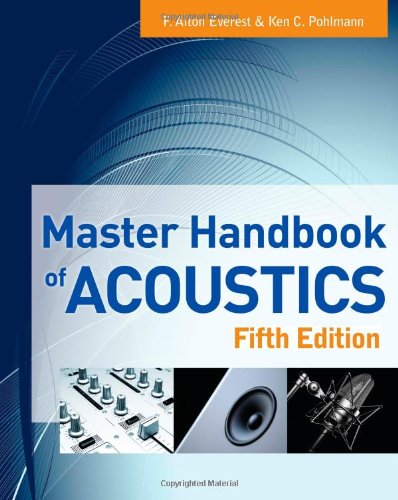
1. Master Handbook of Acoustics
$10.31
2. The Hal Leonard Acoustic Guitar
$11.99
3. Acoustic Design for the Home Studio
$12.60
4. Acoustic Guitar Songs for Dummies
$10.50
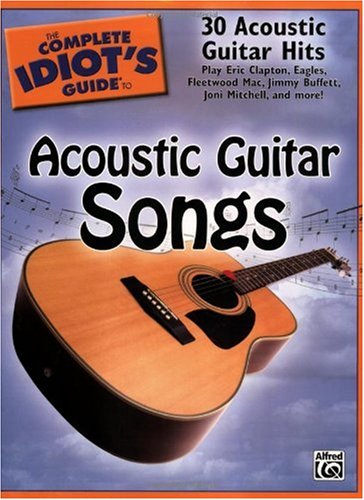
5. The Complete Idiot's Guide to
$55.70
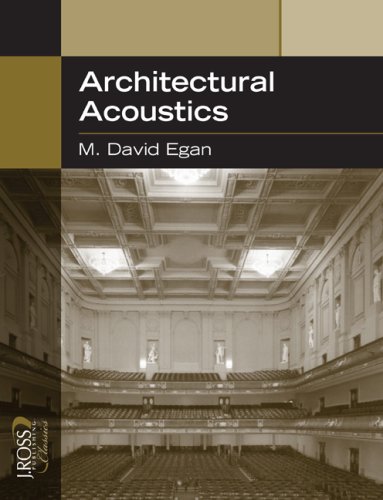
6. Architectural Acoustics (J. Ross
$15.85
7. Acoustic Kitty
$44.00
8. Fundamentals of Acoustics
$4.39
9. Fingerpicking Acoustic Rock: 14
$19.70
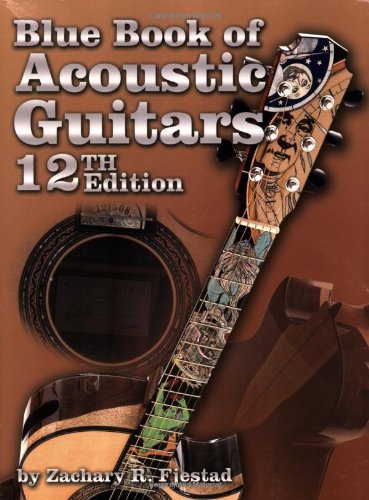
10. Blue Book of Acoustic Guitars:
$8.93
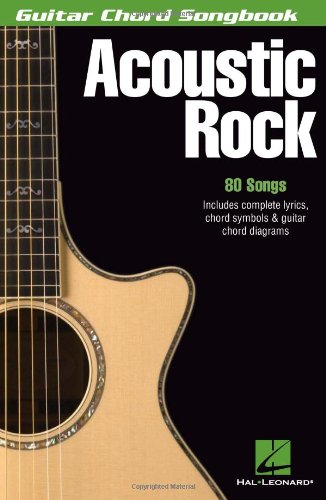
11. ACOUSTIC ROCK HITS FOR EASYGUITAR
$16.47
12. Acoustic Guitar Fingerstyle Method:
$19.62
13. 100 Tips for Acoustic Guitar:
$12.87
14. Best Acoustic Guitar Songs Ever
$89.87
15. Fundamentals of Physical Acoustics
$12.79
16. Acoustic Blues Guitar Essentials
$88.80
17. Architectural Acoustics (Applications
$88.85
18. Musical Acoustics
$15.59
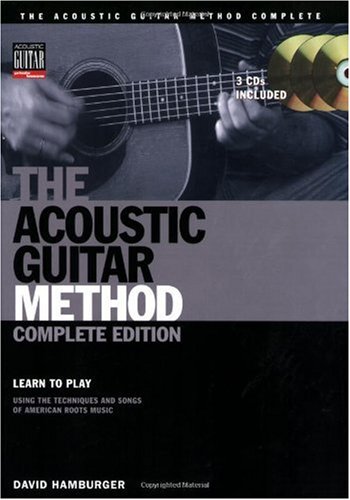
19. The Acoustic Guitar Method - Complete
$9.99
20. Acoustic Guitar Primer for Beginners

1. Master Handbook of Acoustics
by F. Alton Everest
Paperback: 592 Pages (2000-09-22)
list price: US$39.95 -- used & new: US$21.94
(price subject to change: see help)
Asin: 0071360972
Average Customer Review: 4.0 out of 5 stars
Canada | United Kingdom | Germany | France | Japan
Editorial Review

Book Description
The goal of this book is to apply the principles of acoustics to the audio arts. This involves serving as an interpreter of major trends and the literature for students and practitioners in the audio field. Along with covering the more theoretical aspects of acoustics, the book applies the theory to the design of specialized audio spaces such as the home listening room, the control room, and the multi-track-recording studio. ... Read more

Customer Reviews (24)

5-0 out of 5 stars excellent book
this book is an excellent overview and introspection into the world of usable acoustics.it tends to focus on the applicable, everyday world of acoustics instead of the completely theoretical--which was a huge help in my Church production job.
i highly recommend it as a reference text and background book to anyone in music production.

5-0 out of 5 stars Master Handbook Of Acoustics
I have found this a very usefull and well written book. It is being used as a reference for a college course I am studying. It does require some knowledge of electronic principles but is clear and understandable. I would recommend it to any serious student of sound and acoustics.

4-0 out of 5 stars Title may be misleading
There are two common definitions of the word "acoustics."The most general is "an area of physics dealing with sound and sound waves" and the second is "the qualities of a room that determine audibility and fidelity of sound in it."This book is a very good reference for the latter, but if you're looking for the former, look elsewhere.Also, I'm not sure I would describe it as a Handbook, but rather as a reference text.

It is good for what it does cover and is relatively easy to read.

5-0 out of 5 stars A book for the advnaced
A great book, but can be too advanced for some. A lot of physics is included - which is great - but perhaps some previous knowledge or some side reading is a good idea.

Over all, excellent book, and a goldmine to buy.

5-0 out of 5 stars A recording studio masterpiece
OK, so this does not cover ALL acoustincs. If one is interested in recording or playback acoustics, this is THE BEST. As an engineer and producer who has been involved in the construction of a dozen studios, I have the clients and architects read this before we start hard design parameters. For lay listeners, the chances are good your audio budget is better spent on acoustic treatment rather than a more exotic cable. For all of the above, this book will explain the what, why and how to get results. For professionals, it explains how to obtain designable results. I find it an easy read, and I refer to it occasionally, particularly when discussing room acoustics with neophyte "sound men" and audio engineers. I'd read it if I were you. ... Read more


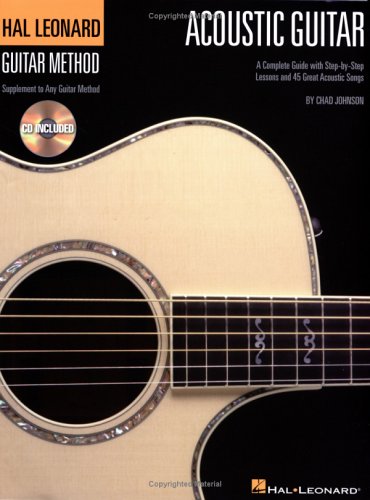
2. The Hal Leonard Acoustic Guitar Method: A Complete Guide with Step-by-Step Lessons and 45 Great Acoustic Songs
by Chad Johnson
Paperback: 80 Pages (2004-06-01)
list price: US$16.95 -- used & new: US$10.31
(price subject to change: see help)
Asin: 0634064525
Average Customer Review: 4.0 out of 5 stars
Canada | United Kingdom | Germany | France | Japan
Editorial Review

Book Description
The Hal Leonard Acoustic Guitar Method uses real songs to teach you all the basics of acoustic guitar in the style of The Beatles, Eric Clapton, John Mellencamp, the Indigo Girls, Robert Johnson, James Taylor and many others. Lessons include: strumming; fingerpicking; using a capo; open tunings; folk, country and bluegrass styles; acoustic blues; acoustic rock; and more. Songs include: Angie * Barely Breathing * Behind Blue Eyes * Building a Mystery * Change the World * Dust in the Wind * Fast Car * Here Comes the Sun * Jack and Diane * Landslide * Leaving on a Jet Plane * Maggie May * More Than Words * Name * You've Got a Friend * Yesterday * and more. In standard notation and tablature. ... Read more

Customer Reviews (8)

4-0 out of 5 stars Not too bad.
The book is not for beginners. You have to have a little more experience in notes before you take up this book. It is also not a step-by-step lesson. Basically it's a song book. It's good none the less.

5-0 out of 5 stars Very Cool Stuff
Down-to-earth advice and a practical approach with real-song examples. These examples remind you that you're not dealing with the same old dull practices without even knowing what they're gonna be used for. I've come to discover what's going on behind those fantastic songs, and realize I can do that too !
If you're interested in accompaniment/rhythm guitar - strumming, picking, riffs,... check it out.

4-0 out of 5 stars Good but not for beginners.
I had seen this book in stores before I bought it, so I knew what I was getting into.

I think, over all, it's a good buy.But if you're just learning guitar, I'd wait until you got through Hal Leonard' s guitar method books (1-3), or some other basic guitar method.After a brief review of stumming patterns, the book takes off quite quickly with difficult syncopated rythyms and fancy chords.

The other thing is that, even though it boasts having a lot of songs,I think around forty-five, most of them are just a few measures and riffs from those songs.Only at the end of each chapter is there a complete song to learn.

3-0 out of 5 stars Not for beginners
I am a novice and this was not useful.I am keeping it around for when I get to the intermediate stages because there are some good information for once you know and understand the chords and how to read music.

5-0 out of 5 stars For the Advancing Beginner
One thing to note with this book is right on the cover it says "supplement to Any Guitar Method". This is a book for someone who has learned the very basics and wants to see how all those chords, scales and strumming patterns apply to real music. It does assume a basic level of competence with the guitar. If you are brand new to the guitar, get this book in 6 months or so.

While browsing through the guitar section at a local bookstore, this book caught my eye because it shows real world examples of the techniques I've been currently practicing.

Again this is not for the beginner nor is it intended to be. But if you have the basics down and want to push your guitar playing to the next level this book will certainly get you there.
... Read more


3. Acoustic Design for the Home Studio
by Mitch Gallagher
Paperback: 264 Pages (2006-07-10)
list price: US$19.99 -- used & new: US$11.99
(price subject to change: see help)
Asin: 159863285X
Average Customer Review: 4.5 out of 5 stars
Canada | United Kingdom | Germany | France | Japan
Editorial Review

Book Description
With the advances in digital technology, musicians can now produce their own music at home. Over the years the gear has gotten much better, and musicians have learned a great deal about recording. So why do so many musicians and engineers have difficulty getting truly professional-sounding results? One reason? Acoustics. If the room you're working in has poor acoustics, it will be extremely difficult -- if not impossible -- to produce excellent results. You can't capture a true sound if the microphones don't hear the instruments and vocals correctly. You have to be able to hear what's truly going on with your tracks to make the proper decisions about editing, equalizing, processing, and mixing them. Acoustics can be a complex, math-laden science, but treating a room to make it sound great and function optimally as a recording studio needn't be difficult nor require hours in front of a calculator or computer screen. Improving a studio's acoustics can be simple and inexpensive -- all you need is some guidance. Acoustic Design for the Home Studio focuses on creating a greatsounding home or project studio in an existing room. It teaches the basic principles of acoustics that affect you in your home or project studio and how to solve any acoustical problems you may have without laying out much (or any) money. Whether you're converting abedroom, a garage, a basement, or a corner of the living room, this book will help you improve the sound of the environment in which you're making music.The principles are easy to understand and the materials used for treating a room are readily available. Diagrams and photos of actual rooms created with the designs are included to illustrate concepts. Whether you want to pursue a no-cost solution, use "off -the-shelf" acoustic materials, or even splurgewith an unlimited budget, you'll learn how to put your room together easily and effectively. ... Read more

Customer Reviews (3)

4-0 out of 5 stars Studio for the home recordist on the cheap
There are a lot of books on setting up and working in a home studio - very few on treating the frequency response - fewer on doing it on the cheap using the room you have.This is such a book.The case studies are useful and after seeing a few, a pattern emerges and the mystique falls away and you realize that its not such a black art and you can do it yourself using various inexpensive materials.I definitely found this to be a great reasource for getting my room response under control while spending just a couple hundred dollars.

This book is a gem.

5-0 out of 5 stars Tips on getting the most from such a project.
It used to be that musicians went to a professional studio to make recordings; but with all the advancements in computer and recording technology, such a studio is affordable for the home - and ACOUSTIC DESIGN FOR THE HOME STUDIO tells how to make a room perfect for the recording sound desired. Tips on how to sound-proof a home or project studio tell how to use an existing room, whether it be garage or bedroom, and provide diagrams, photos of revamped rooms, and tips on getting the most from such a project.

Diane C. Donovan
California Bookwatch

5-0 out of 5 stars Good Studio Design Regardless of your Budget
The equipment available today at the 'advanced amateur' level far exceeds that which was available to the professional only a few years ago. But the quality of the recordings being made do not come up to professional standards. Apart from skill at using the equipment, the biggest difference is the studio where the work is being done.

If the sound is being bounced all around the room in an uncontrollable manner, this will be recorded faithfully by the equipment. The equipment cannot distinguish the sounds you want (and hear) but takes in what your ears are rejecting.

This is an excellent book that gives a bit of the theory of acoustics and studio design and then gives practical examples of studios that were constructed using these principles. There are a number of designs described which cover a range in cost from near nothing to designs that you'd better discuss with your wife before you start spending money. Most of these designs do not involve altering the basic structure of the room itself, just panels you might attach and then take down when you move.

This book is an excellent introduction to a fairly arcane subject. ... Read more


4. Acoustic Guitar Songs for Dummies (For Dummies)
Paperback: 256 Pages (2006-04-01)
list price: US$19.95 -- used & new: US$12.60
(price subject to change: see help)
Asin: 1423407776
Average Customer Review: 3.0 out of 5 stars
Canada | United Kingdom | Germany | France | Japan
Editorial Review

Book Description
This songbook will have even beginning guitarists playing 34 of the best acoustic rock songs ever with the help of performance notes and guitar tab arrangements. Songs include: About a Girl * Angie * Blackbird * Crazy Little Thing Called Love * Drive * Dust in the Wind * Free Fallin' * Iris * Landslide * Layla * Leaving on a Jet Plane * Maggie May * Tears in Heaven * 3 AM * You've Got a Friend * and more. ... Read more

Customer Reviews (4)

4-0 out of 5 stars Spot on transcription!
After years of wanting, I finally purchased an acoustic guitar. Naturally I wanted a quality book to start playing. I chose this book for its full transcription of the songs. I play piano and have experienced the full song transcription versus the "easy piano" sheet music. This book doesn't simply include just the chords or just the voice, it's the full guitar track in both notes and tab. The book does show the chords unlike the other review says (2nd to last page). It also include notes on each song to help you understand how the artist plays it. Highly recommended!

2-0 out of 5 stars Shocked and offended
I have not had a chance to look too much at the book yet, but the first time I opened it up I was shocked and offended.I just glanced at a page and saw profanity in the lyrics of a song.I feel that this is totally unnecessary.I have heard the song in question on the radio and no profanities were in the lyrics.I percieve this book as being for all ages and this type of language is totally uncalled for.

2-0 out of 5 stars Great book - except...
While the book has some interesting insights as to the styles, history, and instructional hints, the biggest item this book lacks is no guitar chord diagrams.This is clearly a HUGE oversight, as this being an easy, dummy type book, should make it so for the average Joe reader.The letter name of the chord is listed, but you have to refer to another book to show you how to finger it.I'll probably return mine (or sell it).

5-0 out of 5 stars The tips you need....
Ever tried TAB?This book has detailed performance notes and tablature for 34 guitar classics.Herriges uses five different icons to break each songs down and tell you what to focus on.His guitar notation legend is also very helpful, explaining concepts like pre-bending, wide vibratos, and tapping.The very last page is a chord chart with fingerings.So now you've got the fingerings and tips for pieces like 'Free Fallin,' 'Leaving on a Jet Plane,' 'Norwegian Wood (This Bird Has Flown),' and 'Iris.' ... Read more


5. The Complete Idiot's Guide to Acoustic Guitar Songs (Complete Idiot's Guide to)
by Alfred Publishing
Paperback: 192 Pages (2007-09-04)
list price: US$19.95 -- used & new: US$10.50
(price subject to change: see help)
Asin: 0739046276
Canada | United Kingdom | Germany | France | Japan
Editorial Review

Book Description
Start playing whole songs—not just chords!

This unique songbook will have beginning guitarists playing songs from their favorite classic and contemporary artists immediately. Instead of hours practicing chord progressions or strumming simple songs, you’ll learn to actually play the music with simplified arrangements of the songs and technique tips scattered throughout the music. This collection of more than 30 songs features the work of artists from Jerry Garcia to Green Day.

... Read more


6. Architectural Acoustics (J. Ross Publishing Classics)
by M. David Egan
Paperback: 448 Pages (2007-01-30)
list price: US$64.95 -- used & new: US$55.70
(price subject to change: see help)
Asin: 1932159789
Average Customer Review: 5.0 out of 5 stars
Canada | United Kingdom | Germany | France | Japan
Editorial Review

Product Description
Authored by David Egan, one of the foremost authorities in the field of architectural acoustics, this architecture classic presents in a highly illustrated format the principles of design for good hearing and freedom from noise in and around buildings. The more than 540 illustrations are not merely supplements to the text but serve as the core of the basic principles of sound and hearing, sound absorption and noise reduction, sound isolation and criteria for noise, control of HVAC systems noise and vibrations, auditorium acoustics design, and electronic sound systems. Architectural Acoustics is a must have for architects, interior designers, engineers, consultants, students and all others concerned with the design and construction of buildings.An unabridged J. Ross Publishing republication of the edition published by McGraw-Hill, New York, 1988, 448pp.Key Features- Offers more than 540 illustrations to visually explain basic acoustic engineering principles with complete clarity and tables of engineering data that further enhance understanding and the usefulness of the text- Contains many valuable checklists of design aids, data tables of sound absorption and sound isolation properties for a wide variety of building materials- Presents case study examples of common problems and step-by-step practical solutions - Provides handy access to useful formulas, a metric system conversion table, a summary of common building acoustics terms, and extensive references ... Read more

Customer Reviews (9)

4-0 out of 5 stars Architectural Acoustics--Egan
Over the years I have bought two text books on this difficult subject, and never could get past more than two chapters.In contrast, this book is both readable and extremely well organized with a summary of the main points at the end of each chapter.For any formulas used in the text, he defines the symbols along with the formula.No looking back to early chapters.

Highly recommended.

5-0 out of 5 stars best introduction to architectural acoustics
Even after having collected and read quite a few of the modern textbooks on architectural acoustics, Egan's Architectural Acoustics (1988 hardback edition in my case) still stands as the most accessible first foray into the subject.I frequently use this book in my consulting practice when I need to illustrate a fundamental concept, such as sound isolation, auditorium shaping, or the basic acoustical conditions necessary to support various styles of music. Even though the binding has mechanically failed, I have not yet been able to bring myself to part with the book long enough to have it rebound.Perhaps the new softcover binding will actually hold up better to repeated reading, as this book will surely receive and deserve!

5-0 out of 5 stars Use This Book!
Since first encountering Egan's text a little more than 20 years ago, I've continued to return to it for solid information. Complex material is presented in a way that allows me to apply it to unique conditions at hand.Some of the world-class acoustics consultants with which we've had the privilege to work rely on Egan to help communicate complex ideas.Without compromising too much real technical nuance, the ideas are so clearly communicated that I was able to offer the book to members of a church in eastern Europe working to improve the condition of their worship space.

5-0 out of 5 stars Excellent book for architects
I am an acoustical consultant... I have read a lot of books onarchitectural acoustics. I found this book unique of its kind. The concepts are introduced by plenty of figures and illustrations with informative text that make the discussed subject easy to read and comprehend especially by the architects. Writing on the figures and using checklists added a lot of understandibility. Also the text itself is informative and directly address the subject. In other words, the book is excellent and comprehensive.

5-0 out of 5 stars Must have
I'm a architecture student and I think this book is like a bible of acoustics in architecture. It brings detailed info for designing places with good acoustic performance whit various technics and for the mostdifferent type of places like a simple residential to auditoriums andconcert rooms. I have other acoustics books (like William Cavanaugh's) andthey always make mention to David Egan's book. If you're in search on booksabout architectural acoustics, I think that must be the first one to buy.It's a must have in any architect biblioteque. ... Read more


7. Acoustic Kitty
by Bob Rybarczyk
Paperback: 288 Pages (2007-12-12)
list price: US$15.95 -- used & new: US$15.85
(price subject to change: see help)
Asin: 1601453973
Canada | United Kingdom | Germany | France | Japan
Editorial Review

Book Description
When an isolated but brilliant CIA engineer is asked to help turn cats into surveillance devices, he soon learns that his new co-workers are even more bizarre than his new assignment. Which, naturally, is why he begins spying on them. ... Read more


8. Fundamentals of Acoustics
by Lawrence E. Kinsler, Austin R. Frey, Alan B. Coppens, James V. Sanders
Hardcover: 560 Pages (1999-12-30)
list price: US$132.95 -- used & new: US$44.00
(price subject to change: see help)
Asin: 0471847895
Average Customer Review: 4.0 out of 5 stars
Canada | United Kingdom | Germany | France | Japan
Editorial Review

Book Description
The classic acoustics reference! This widely-used book offers a clear treatment of the fundamental principles underlying the generation, transmission, and reception of acoustic waves and their application to numerous fields. The authors analyze the various types of vibration of solid bodies and the propagation of sound waves through fluid media. ... Read more

Customer Reviews (9)

4-0 out of 5 stars Good book on the mathematics of acoustics for engineers
This book is aimed squarely at engineering students who want to learn the mathematics of acoustics. There is very little in the realm of standing back and asking "So what does this all mean?". From the very first chapter the author dives into deriving equations that use calculus, Laplace transforms, the Fourier series and transform, circuit analysis, digital filters, and the Z- transform as well as some differential equations. There are few examples in the book, but there are problem sets that expect you to understand the theory and math well enough to apply it numerically with more intuitive knowledge than is presented. It can be done, but you'll have to read carefully when doing the exercises to figure out how to get from A to B. If you are interested in acoustics this is probably an essential reference pertaining to the mathematical aspects of the science, but you'll need other books to get the big picture. I'd recommend the old Schaum's Outline of Acoustics by Seto as a companion to this book since it has lots of examples. Unfortunately, it is out of print and you'll probably have to hunt for it.

5-0 out of 5 stars An excellent textbook
This is a classic engineering text on acoustics for upper division college students.It first appeared in 1950.And now it is back fifty years later in a fourth edition.In the meantime, the original two authors have passed away.However, Coppens and Sanders have done a fine job in keeping the book up-to-date.

Plenty of exercises have been added, and answers to many odd-numbered problems are in the back of the book.I think it is an excellent introduction to the field (yes, I expect you to have studied calculus and differential equations as an underclassman).It's my favorite of the classic engineering acoustics textbooks.

Two new chapters have been added in this edition, one on nonlinear acoustics and the other on shock waves.That's a very good idea.If I were teaching an acoustics class with an earlier edition of the book, I'd refer students to Landau Volume 6 (Fluid Mechanics) to get some of this missing information.

Actually, I wish the authors had added a couple more chapters, one on ultrasonics and another on instruments of music.That still would not cover all of acoustics, but I feel these topics are fairly important.

Anyway, I really like the book, and I'd be happy to teach a class using it.

2-0 out of 5 stars Not an introductory text
This text in not an introductory work, it is geared toward upper division college or graduate level engineering work.By this I am referring to the math level in the book.If you are not willing to work with partial differential equations, integrals, dot products, cross products and dell operators stay away from this book, it is intended for engineering students and not for audio, broadcast, or film students looking for a greater understanding of sound/acoustics.

Here is a list of the chapters:
Fundamentals of vibration; Transverse motion - the vibrating string; Vibrations of bars; The two-dimensional wave equation: vibrations of memberanes and plates; The acoustic wave equation and simple solutions; Transmission phenomena; Absorption and attenuation of sound waves in fluids; Radiation and reception of acoustic waves; Pipes, cavities, and waveguides; resonators, ducts, and filters; Noise, signal, detection, hearing, and speech; Environmental acoustics; Architectural acoustics; Transduction; Underwater acoustics.

3-0 out of 5 stars OK, but better texts available
Personally, I was disappointed by the fourth edition of this venerable text, for it has become increasingly mathematical and problem oriented. If you like sitting down and whiling away your afternoon with a problem set -- this is the text for you. But if instead you wish to study acoustics through a pedagogical method that is more verbal and graphical in nature -- better texts are available.

Indeed, in my opinion, prior editions (1950, 1962, 1981) of this same text are superior, particularly the second edition. Although these too have their share of integral calculus and complex algebra, the quantity is more appropriate for a discipline that is mostly science and engineering but with aspects of art to it as well.

Bear in mind that aside from a few specialized areas -- like ultrasonics and its use in medical imaging and non-destructive testing, or the use of digital processing in sound generation and vibration analysis -- little new has come about in the field of acoustics since World War II. Thus unlike with most fields of science, there is no necessity to have the most modern texts to gather a wholly modern understanding of the field (with a few minor exceptions).

Indeed, I recently examined almost every text relating to acoustics contained in the circumferential stacks of the Barker Engineering Library under the Great Dome of M.I.T. (and sadly, there aren't as many texts as one might hope). I was surprised both at the age of most volumes in the collection -- and the fact that most had not been checked out of the library in years.

Indeed, from the "Date Due" slips in the back, you could see the field was very popular in the 1960's and 1970's, but popularity seemed to wane in the early 1980's -- approximately contemporaneously, curiously, with the introduction of the digital CD format of audio recording.

By the mid-1990's, at M.I.T., at least, interest in acoustics among faculty and students seem to have declined precipitiously, if the popularity of library texts and the quantity of student theses published in the field is any indication.

Of all the general texts on acoustics that I examined -- to me, one clearly stood out above the others. It was published in 1957 by Harry F. Olsen, Ph.D., the lead acoustical scientist at the RCA Research Laboratories in Princeton, New Jersey. It is entitled, "Acoustical Engineering", although the text contains all the fundamental science as well. This volume was reprinted in 1991 and is currently available.

Olsen's work is surely a magnum opus, comprising 736 pages and 567 illustrations. It has its fair share of math, but the concepts are often additionally explained through well-crafted line drawings, showing, for example, wave forms drawn in progressive fashion in serial graphs, some of which are designed so that one can even mentally rotate the graphics to gather a three-dimensional perspective. Furthermore, the graphs are often supplemented by art showing equivalent mechanical and electrical analogs, to further assist in understanding.

Best of all, Olsen explains virtually everything acoustical you would ever want to know, from theories of acoustical wave propagation, to an enormous variety of loudspeaker designs, to the mathematical reasoning behind Johann Sebastian Bach's tempered tuning of musical instruments, an artistic practice that is almost universal today.

Thus if it is a text for a problem-oriented course in acoustics that one seeks -- the fourth edition of the "Fundamentals of Acoustics" is a fine text. However, if one wishes to have a ready reference that is extraordinarily comprehensive, or a pedagogical work that doesn't focus on mathematical derivations, better choices can surely be made.

3-0 out of 5 stars OK, but better texts available
Personally, I was disappointed by the fourth edition of this venerable text, for it has become increasingly mathematical and problem oriented.If you like sitting down and whiling away your afternoon with a problem set -- this is the text for you.But if instead you wish to study acoustics through a pedagogical method that is more verbal and graphical in nature -- better texts are available.

Indeed, in my opinion, prior editions (1950, 1962, 1981) of this same text are superior, particularly the second edition.Although these too have their share of integral calculus and complex algebra, the quantity is more appropriate for a discipline that is mostly science and engineering but with aspects of art to it as well.

Bear in mind that aside from a few specialized areas -- like ultrasonics and its use in non-destructive testing, or the use of digital processing in sound generation and analysis-- little new has come about in the field of acoustics since World War II. Thus unlike with most fields of science, there is no necessity to have the most modern texts to gather a wholly modern understanding of the field.

Indeed, I recently examined almost every text relating to acoustics contained in the circumferential stacks of the Barker Engineering Library under the Great Dome of M.I.T. (and sadly, there aren't as many texts as one might hope).I was surprised both at the age of most volumes in the collection -- and the fact that most had not been checked out of the library in years.

Indeed, from the "Date Due" slips in the back, you could see the field was very popular in the 1960's and 1970's, but popularity seemed to wain in the early 1980's -- approximately contemporaneously, curiously, with the introduction of the digital CD format of audio recording.

By the mid-1990's, at M.I.T., at least, interest in acoustics among faculty and students seem to have declined precipitiously, if the popularity of library texts and the quantity of student theses published in the field is any indication.

Of all the general texts on acoustics that I examined -- to me, one clearly stood out above the others.It was published in 1957 by the lead acoustical scientist at the RCA Research Laboratories in Princeton, New Jersey, Harry F. Olsen, Ph.D. It is entitled, "Acoustical Engineering", although it contains all the fundamental science as well.This text was reprinted in 1991 and is currently available.

Olsen's work is surely a magnum opus, comprising 736 pages and 567 illustrations. It has its fair share of math, but the concepts are often additionally explained through well-crafted line drawings, showing, for example, wave forms drawn in progressive fashion in serial graphs, some of which are designed so that one can even mentally rotate the graphics to gather a three-dimensional perspective.Furthermore, the graphs are often supplemented by equivalent mechanical and electrical analogs, to further assist in understanding.

Best of all, Olsen explains virtually everything acoustical you would ever want to know, from theories of acoustical wave propagation, to an enormous variety of loudspeaker designs, to the mathematical reasoning behind Johann Sebastian Bach's tempered tuning of musical instruments, an artistic practice that is almost universal today.

Thus if it is a text for a problem-oriented course in acoustics that one seeks -- the fourth edition of the "Fundamentals of Acoustics" is a fine text.However, if one wishes to have a ready reference that is extraordinarily comprehensive, or a pedagogical work that doesn't focus on mathematical derivations, better choices can surely be made. ... Read more


9. Fingerpicking Acoustic Rock: 14 Songs Arranged for Solo Guitar in Standard Notation and Tab
Paperback: 64 Pages (2006-12-01)
list price: US$7.95 -- used & new: US$4.39
(price subject to change: see help)
Asin: 1423407288
Canada | United Kingdom | Germany | France | Japan
Editorial Review

Book Description
The arrangements in this book are carefully written for intermediate-level guitarists. Each solo combines melody and harmony in one superb fingerpicking arrangement. Also includes an easy introduction to basic fingerstyle guitar. 14 songs: Angie * Babe, I'm Gonna Leave You * Band on the Run * Bridge over Troubled Water * Every Rose Has Its Thorn * I'd Love to Change the World * Knockin' on Heaven's Door * Landslide * Layla * More Than Words * Norwegian Wood * Seven Bridges Road * Suite: Judy Blue Eyes * Wanted Dead or Alive. ... Read more


10. Blue Book of Acoustic Guitars: 11th Edition (Blue Book of Acoustic Guitars)
by Zachary R. Fjestad
Paperback: 750 Pages (2007-11-15)
list price: US$29.95 -- used & new: US$19.70
(price subject to change: see help)
Asin: 1886768749
Average Customer Review: 2.5 out of 5 stars
Canada | United Kingdom | Germany | France | Japan
Editorial Review

Product Description
If you re looking for a single publication with the most complete information and up-to-date pricing on thousands of acoustic and acoustic-electric models, this newest 11th Edition Blue Book of Acoustic Guitars is the only book for you.Completely revised, this newest edition is packed full of the following features and benefits: Expanded to over 700 pages, over 800 acoustic guitar manufacturers, trademarks, and luthiers are identified and described, including hundreds of B&W images. Includes complete information on almost all new makes/models and vintage acoustic guitars. Pricing has been extensively revised, including up-to-date values on vintage instruments. Serialization charts/listings have been updated, allowing you to determine the year of manufacture and production totals on many popular makes/models. A completely updated Trademark Index provides you with the contact information on almost all current manufacturers and luthiers. ... Read more

Customer Reviews (2)

2-0 out of 5 stars Woefully incomplete
When I tried to look up several models of Alvarez Yairi listed on EBay, none of them were in the book.
When I wanted to determine the value of my Dauphin classical guitar (for which there are plenty of references on the Web), it wasn't there.
Clearly, while it is good for what it is, its applications are limited

3-0 out of 5 stars A pretty good book when you have no other reference
This is my first book on guitar prices. I bought it hoping that I would learn more about vintage prices and model availability.

It is a thick and heavy book. Paper quality is average. Also there are little pictures considering the amount of models listed. For some models (which are very special) I would have liked to see a picture.
I checked a few non-Martin brands and found that a lot is still missing. Gurian is only described very short, one price is given for all models (which is just nuts because they had simple mahogany models up to BRW models or very limited classical guitar models). Hanika (a very good German builder with a similar production size as Lowden) is not included.

I noticed very quickly already that the suggested (Martin) prices are very related to the American market. So it makes it a little harder to use it for the European market. I think that assuming 1 USD = 1 Euro comes closer to European prices for the higher end models. For the lower end models (or models which are less collectable or not so interesting) I would say European prices are twice as high as indicated (so let's say 1 USD = 1.5 Euro). Just my thoughts.
Back to the book itself: I have looked up numerous Martin models and found it very hard sometimes to find them. The Martin chapter has been divided into the usual series (like Special Edition or Golden Era), but that means for instance that the original OM-28 and the recent OM-28V are listed together but the OM-28 GE is listed under Golden Era section. I can partly understand why they did this, but I found it is typically the point of view from the manufacturer (think in series) opposite to the view of buyer/player (think in a specific model and its variations).

A link to the internet providing updated information is not provided. I assume that if you buy the CD-ROM version there will be the possibility of updates. ... Read more


11. ACOUSTIC ROCK HITS FOR EASYGUITAR 2ND EDITION WITH NOTES & TAB
Paperback: 72 Pages (1995-09-01)
list price: US$12.95 -- used & new: US$8.93
(price subject to change: see help)
Asin: 0793550874
Average Customer Review: 3.0 out of 5 stars
Canada | United Kingdom | Germany | France | Japan
Editorial Review

Book Description
Easy arrangements in notes and tab for 20 acoustic favorites: Angie * Band on the Run * Best of My Love * Dust in the Wind * Free Fallin' * Iris * Man on the Moon * Night Moves * Patience * Pink Houses * Tears in Heaven * Yesterday * and more. ... Read more

Customer Reviews (1)

3-0 out of 5 stars I was hoping for more
This book has a few outdated songs tabed quite well.They are pretty easy so I guess this would be a decent book to start learning songs with (after some chord practice). ... Read more


12. Acoustic Guitar Fingerstyle Method: Book with 2 CDs
by David Hamburger
Paperback: 8 Pages (2007-12-01)
list price: US$24.95 -- used & new: US$16.47
(price subject to change: see help)
Asin: 1890490709
Canada | United Kingdom | Germany | France | Japan
Editorial Review

Book Description
Whether you're a first-time fingerstylist who's studying with a teacher or on your own, The Acoustic Guitar Fingerstyle Method by David Hamburger gives you the detailed, comprehensive instruction you need to improve your skills. This book introduces you to the two most essential fingerstyle approaches for playing American roots music: Travis picking and the steady-bass style. In each lesson, you'll learn new techniques, concepts, and chord voicings along with ways to practice and get them under your fingers. Then you can use what you just learned to play a classic song or solo break from the blues, ragtime, folk, country, and ragtime traditions. 18 In-Depth Lessons, including: Travis Picking Basics, Switching Chords, Eighth Notes and Syncopation, Picking Pattern Fills, Double Stops, and much more. 15 songs to play, including: John Henry * Delia * St. James Infirmary * Nobody's Fault but Mine * Houston Blues * Alberta * and more. ... Read more


13. 100 Tips for Acoustic Guitar: You Should Have Been Told (100 Tips) (100 Tips)
by David Mead
Paperback: 128 Pages (2006-01-02)
list price: US$21.95 -- used & new: US$19.62
(price subject to change: see help)
Asin: 1860744001
Average Customer Review: 4.5 out of 5 stars
Canada | United Kingdom | Germany | France | Japan
Editorial Review

Product Description
100 Tips for Acoustic Guitar is a handbook for all things acoustic. Broken down into a series of graduated exercises, spiced with words of wisdom from some of the names in the business, here at last is a handbook to developing your technique and learning theory painlessly. With a full audio CD supporting the exercises within, 100 Tips For Acoustic Guitar is an essential guide for every guitar enthusiast, whether you want to be a campfire accompanist or the next John Williams! ... Read more

Customer Reviews (2)

4-0 out of 5 stars Most intelligent design i've ever seen
David Mead has taken all the fat and left the meat in this guide for guitarists of all skill levels. These are the questions you should be asking but didn't know how or what to ask for.

Has missed out on a couple subjects of which I thought was important(like left hand technique). Over all however, this is the most intelligent book to motivate and inspire a guitarist who wants to enjoy the journey to mastering an instrument.I work in a music shop so I am subjected to a whole lot of useless literature on the subject of learning guitar.

i hope it works out for you as well as it did for me.

5-0 out of 5 stars Not just for beginners
If you're a self taught guitarist and you feel like you haven't learned much in the past few months or years...buy this book. ... Read more


14. Best Acoustic Guitar Songs Ever
Paperback: 256 Pages (2006-12-01)
list price: US$19.95 -- used & new: US$12.87
(price subject to change: see help)
Asin: 1423418476
Canada | United Kingdom | Germany | France | Japan
Editorial Review

Book Description
Notes-and-tab transcriptions of 35 classic acoustic hits from the 1960s to today, including: Against the Wind * Babe, I'm Gonna Leave You * Crazy on You * Daughter * Dust in the Wind * Every Rose Has Its Thorn * Free Fallin' * Iris * Landslide * Maggie May * More Than Words * Norwegian Wood * Signs * Tears in Heaven * Wanted Dead or Alive * You've Got a Friend * and more. ... Read more


15. Fundamentals of Physical Acoustics
by David T. Blackstock
Hardcover: 560 Pages (2000-02-22)
list price: US$140.00 -- used & new: US$89.87
(price subject to change: see help)
Asin: 0471319791
Average Customer Review: 5.0 out of 5 stars
Canada | United Kingdom | Germany | France | Japan
Editorial Review

Book Description

AN AUTHORITATIIVE, UP-TO-DATE INTRODUCTION TO PHYSICAL ACOUSTICS

Easy to read and understand, Fundamentals of Physical Acoustics fills a long-standing need for an acoustics text that challenges but does not overpower graduate students in engineering and physics. Mathematical results and physical explanations go hand in hand, and a unique feature of the book is the balance it strikes between time-domain and frequency-domain presentations.

Fundamentals of Physical Acoustics is intended for a two-semester, first-year graduate course, but is also suitable for advanced undergraduates. Emphasis on plane waves in the first part of the book keeps the mathematics simple yet accommodates a broad range of topics:propagation, reflection and transmission, normal modes and simple waveguides for rectilinear geometries, horns, inhomogeneous media, and sound absorption and dispersion.

The second part of the book is devoted to a more rigorous development of the wave equation, spherical and cylindrical waves (including the more advanced mathematics required), advanced waveguides, baffled piston radiation, diffraction (treated in the time domain), and arrays. Applications and examples are drawn from:

  • Atmospheric acoustics
  • Noise control
  • Underwater acoustics
  • Engineering acoustics
  • Acoustical measurements

Supplemented with more than 300 graphs and figures as well as copious end-of-chapter problems, Fundamentals of Physical Acoustics is also an excellent professional reference for engineers and scientists. ... Read more

Customer Reviews (6)

4-0 out of 5 stars Not finished yet.
Having only got through the first few pages I can say that it is well written and written in a style that explains everything clearly.
No complaints at all.

5-0 out of 5 stars A fairly practical book for a complex topic
I knew I liked this book when I read section C of the introduction:

"How is the wave equation derived? Three common physical systems that carry waves - the electrical transmission line, the flexible string, and the compressible fluid - are considered in this section."

I needed a practical book to help me when I somehow volunteered myself to perform some acoustic experiments at work. They kind of said "Hey, you're a physicist. Can you do this?" And then I said "Uh... sure." I read through what I could find in Halliday and Resnick, a book I like for its simplicity. But then I needed something more complicated, so I bought Morse and Ingard, which was way too much. Then I found this book.

And its a good thing I did. The book uses the wave equation to solve each of these problems, and if you pay attention, you can assemble a nice, general approach to solving problems of this nature, and you'll have a list of analogous variables when you're done. The whole book is written like this. It's not an ASM Handbook by any means, but it is more practical than Morse and Ingard, has more drawings and diagrams, and I was surprised to find one of the cleanest, simplest descriptions of Bessel functions I've seen yet. The book addresses the complex problems without doing endless integrals, and it whenever possible it works through the problem and doesn't rely on phrases like "the reduction of step X to step Y is left as an exercise for the student" in its derivations. I appreciate this - it makes the book more friendly as a reference text.

Also, when I was a graduate student I never paid attention to literature references in text books because I (naively) considered them to be outdated. But a literature search is one of the best tools I have available to me in the working world - if you have access to a literature database, you will find the literature references at the end of some chapters to be very useful.

Consider it a useful reference text, and probably a practical textbook as well.


5-0 out of 5 stars Best intro to acoustics for engineers especially
This book is geared towards graduate and upper undergraduate students in physics and engineering.The first nine chapters of the book are restricted to plane waves. Thus the first half of the book introduces the reader to a wide variety of acoustical concepts such as propagation, reflection, transmission, refraction, normal modes, horn theory, absorption, and dispersion. All the while, the first half of the book keeps mathematical complexity to a minimum. The second half of the book relies more on advanced mathematics and is a survey of advanced topics dependent on the reader understanding the first nine chapters of the book. For the second half of the book, it will be helpful if you know calculus as well as differential equations. Each chapter has plenty of exercises so you can practice what you've learned.

Although the coverage is not as broad as Kinser's book on acoustics, this book does a much better job of explaining the foundations of acoustics including the math, which can get quite involved. I really love how Blackstock makes use of figures when explaining concepts and adding in the mathematics to the figure explanation in a way that you will remember the material. My advice is that if you are looking for a good introduction to acoustics, this is the book to read. Once you conquer this and you want something broader that goes into such topics as nonlinear acoustics and underwater acoustics, you probably want to look at Kinsler's "Fundamentals of Acoustics". The following is the table of contents:

1.Introduction
2.Detailed Development of the Acoustical Wave Equation.
3.Reflection and Transmission of Normally Incident Plane Waves of Arbitrary Waveform.
4.Normal Incidence Continued: Steady-State Analysis.
5.Transmission Phenomena: Oblique Incidence.
6.Normal Modes in Cartesian Coordinates: Strings, Membranes, Rooms, and Rectangular Waveguides.
7.Horns.
8.Propagation in Stratified Media.
9.Propagation in Dissipative Fluids: Absorption and Dispersion.
10. Spherical Waves.
11. Cylindrical Waves.
12. Waveguides.
13. Radiation from a Baffled Piston.
14. Diffraction.
15. Arrays.

5-0 out of 5 stars Wonderful Book
I think this is one of the best books on Physical Acoustics.
I would recommend this book to anyone starting to learn acoustics. This statement does not mean that advanced students should not go for this book, as it also covers advanced materials.

My opinion about the book can resumed as follows:

- Clear and concise
- Very good presentation
- Relatively easy to follow
- Very good for self-studying (plan to study the book is recommended by the author)
- There is a derivation (or instructions on how to get) to almost every equation in the book.
- Not too theoretical. Many practical interpretations of the mathematical results are given. (percentage of mathematics well balanced)
- The author makes apparently difficult material simple!

From this book one can jump to more advanced texts (Theoretical Acoustics by Morse and Ingard and Acoustics - An Introduction to its Physical Principles and Applications by Pierce).

Fundamentals of Acoustics by Kinsler et al is also a good book for a beginner, but I think this one is much better.

Moral of the story, I really like this book!

Ps: This is an opinion of a beginner on Physical Acoustics more interested in air applications, that never had lessons about this topic. I don't know if my opinion will change as my knowledge on this field increases:) I doubt it!

5-0 out of 5 stars Excellent text and reference
I find this book clear and concise.This is the reference I use most often at work when I want insight into the physics behind a noise or vibration problem. ... Read more


16. Acoustic Blues Guitar Essentials (Acoustic Guitar Magazine's Private Lessons)
Paperback: 72 Pages (1999-03-01)
list price: US$19.95 -- used & new: US$12.79
(price subject to change: see help)
Asin: 1890490105
Canada | United Kingdom | Germany | France | Japan
Editorial Review

Book Description
Straight from the experts at Acoustic Guitar magazine! The 12 "private lessons" in this book/CD pack are full of helpful examples, licks, great songs, and excellent advice on blues flatpicking rhythm and lead, fingerpicking, and slide techniques from some of the finest teachers around, including Mike Christiansen, Acoustic Guitar music editor Dylan Schorer, Stefan Grossman and many others. The book shows all examples in both standard notation and TAB, and the CD allows you to play and replay the lessons and songs until you've perfected them. ... Read more


17. Architectural Acoustics (Applications of Modern Acoustics)
by Marshall Long
Hardcover: 872 Pages (2005-12-23)
list price: US$108.00 -- used & new: US$88.80
(price subject to change: see help)
Asin: 0124555519
Average Customer Review: 5.0 out of 5 stars
Canada | United Kingdom | Germany | France | Japan
Editorial Review

Book Description
Architectural Acoustics presents a comprehensive technical overview of the field at a level suitable for working practitioners as well as advanced undergraduate or introductory graduate architecture or engineering course. The book is structured as a logical progression through acoustic interactions. Beginning with an architectural history, it reviews the fundamentals of acoustics, human perception and reaction to sound, acoustic noise measurements and noise metrics, and environmental noise. It then moves into wave acoustics, sound and solid surfaces, sound in enclosed spaces, sound transmission loss, sound transmission in buildings, vibration and vibration isolation, noise transmission in floor systems, noise in mechanical systems, and sound attenuation in ducts.

Chapters on specific design problems follow including treatment of multifamily dwellings, office buildings, rooms for speech, sound reinforcement systems, rooms for music, multipurpose rooms, auditoriums, sanctuaries, and studios and listening rooms. While providing a thorough overview of acoustics, it also includes the theory of loudspeaker systems and sound system modeling as well as an in-depth presentation of computer modeling, ray tracing and auralization. It will be particularly beneficial for architects and engineers working in fields where speech intelligibility, music appreciation, and noise isolation are critical.

* Comprehensive guide to the basics of acoustical science and its applications to architectural design.
* Author is renowned expert engaged in acoustical engineering for 20 years
* Covers the latest environmental regulations and health and safety research related to sound inside and outside of buildings. ... Read more

Customer Reviews (5)

5-0 out of 5 stars Excelent book on Acoustics
Having read some architectural acoustics books, I can recommend this one as one of the best.It is an excellent resource. In fact, I should not have spent some of my money on some oldie books, which were cheap but not as good.

This is an up to date book, and it is worth every penny you spend. If you are a student or someone interested in the topic architectural acoustics, it is a good resource but it has many formulas (sorry if you do not like physics).

With it I have been able to specify to an architect who does not know hardly anything about acoustics how to correct his design for a contemporary church. I also recommend "Handbook for Sound Engineers" as a compliment to this book, for people that are trying to get the best of both worlds -- acoustics and audio.These are both good buys, and can help you very much.Remember that to be a good consultant you need to have a good library of books and this one would be an excellent part of your reference library.

4-0 out of 5 stars Very Nice
The ultimate guide to architectural acoustics covering many topics in a single and nice priced book, It has everything covered and explained to a good level, my only complain is that only basic measurement techniques are explained. However it is a great complilation of knowledge in a single package.

5-0 out of 5 stars If you only buy one book on architectural acoustics......
In his preamble the author refers to the fact this book took him more than 10 years to write.Given the level of detail and the comprehensive nature of this book, this is not surprising.

There may be better acoustical books available relating to specific niches of acoustics, such as Beranek and Barron's works on concert halls and there are certainly more simple introductions to the subject, such as Egan's book of the same name, but for anybody who doesn't mind grappling with some mathematical equations, this is definitely the best and most comprehensive book on this subject of the 15 or so that I possess.

Like the author, I am also a practicing acoustical consultant and a lecturer in this subject.It's probably splitting hairs, but I suspect that my architecture students might not respond well to this book due to the fact that the illustrations are generally limited to fairly simple black and white drawings and the mathematical approach may intimidate some, but for other acoustical consultants and engineers interested in the field of building acoustics, I would definitely recommend this text.

5-0 out of 5 stars Looks like a new classic on Architectural Acoustics
I just received my copy, and have yet to dive into. However it appears up to date (2006) in that it covers modelling and auralization concepts. The scope of the book is expanded compared to Eagan's excellent text. Take a look at the table of contents on line for an idea of the topics.

It appears to be well written. The mathematics of sound are covered. This should be a standard reference text for a general knowledge of architectural acoustics.

July 2007 - I use this book as one of my primary references. It has excellent breadth and detail.

5-0 out of 5 stars Professional Review
I have a copy of Long's Architectural Acoustics and have read a number of sections.The book is remarkably complete and Long has correctly embodied current literature.I recommend it for professionals and architects who have some mathematics.Leo Beranek ... Read more


18. Musical Acoustics
by Donald E. Hall
Hardcover: 496 Pages (2001-08-22)
list price: US$183.95 -- used & new: US$88.85
(price subject to change: see help)
Asin: 0534377289
Average Customer Review: 5.0 out of 5 stars
Canada | United Kingdom | Germany | France | Japan
Editorial Review

Book Description
Musical acoustics presents a unique opportunity to see science and art working together. This book is a balanced presentation of all aspects of musical acoustics. It explains how our ears and brains interpret musical events, and connects traditional physical analyses to musical reality. The purpose of the book is two fold: (1) To help readers use simple physical concepts as tools for understanding how music works, and (2) To use readers' interest in music to motivate the study and appreciation of scientific methods. Any given chapter will challenge readers with several points that are not obvious on the first reading. Starred sections are optional and are not a prerequisite to later sections. ... Read more

Customer Reviews (3)

5-0 out of 5 stars i love this book

It is a nice introductory book both for music and physics.. physics students who are learning wave theory should consider reading at least some chapters of this book..

5-0 out of 5 stars Great starting point for studying the intersection of science and sound
This book is an excellent starting place for someone who wants a somewhat quantitative treatment of the science of sound as it relates to music, but does not have the advanced math background necessary to digest something like "The Physics of Musical Instruments". The chapters and sections in this third edition are the same as in the previous edition, however some changes have been made to the content. The book is updated with more current references to the end-of-chapter bibliographies, and there is some new material, especially in areas affected by the personal computer's role in the digital processing of sound.

The author provides an integrated understanding of three major areas: the production of sound by various sources, the propagation of sound from source to listener, and the perception of sound by the human brain.
For easier reading, each chapter starts with an introductory section that sets up the chapter. There are also summaries and lists of symbols, terms, and relations highlighting the most important terms and quantitative expressions in each chapter. There are realistic and interesting exercise sets containing both qualitative and quantitative questions for each chapter, with most chapters containing 20-25 exercises. There are also projects included that provide out-of-class assignments that generally require students to do research. There are approximately three of these in each chapter. Finally, several new photographs have been added to this third edition, particularly of the inner ear structure and of the vocal cords in motion.

Like the previous reviewer, I make a habit of purchasing and reading several textbooks a year, and sometimes I am very disappointed and sometimes I am not. This is one of those purchases that I found most worthwhile. If you are interested in the intersection of math, acoustics, perception, and musical instruments I highly recommend it. A math background up to the level of algebra and geometry should be sufficient to understand the quantitative portions of the book. The table of contents is as follows:

1. THE NATURE OF SOUND.
Acoustics and Music. Organizing Our Study of Sound. The Physical Nature of Sound. The Speed of Sound. Pressure and Sound Amplitude.
2. WAVES AND VIBRATIONS.
The Time Element in Sound. Waveforms. Functional Relations. Simple Harmonic Oscillation. Work, Energy, and Resonance.
3. SOURCES OF SOUND.
Classifying Sound Sources. Percussion Instruments. String Instruments. Wind Instruments. Source Size. Sound from the Natural Environment.
4. SOUND PROPAGATION.
Reflection and Refraction. Diffraction. Outdoor Music. The Doppler Effect. Interference and Beats.
5. SOUND INTENSITY AND ITS MEASUREMENT.
Amplitude, Energy, and Intensity. Sound Level and the Decibel Scale. The Inverse-Square Law. Environmental Noise. Combined Sound Levels and Interference.
6. THE HUMAN EAR AND ITS RESPONSE.
The Mechanism of the Human Ear. Limits of Audibility and Discrimination. Characteristics of Steady Single Tones. Loudness and Intensity. Pitch and Frequency. Pitch and Loudness Together. Timbre and Instrument Recognition.
7. ELEMENTAL INGREDIENTS OF MUSIC.
Organizing Musical Events in Time. Melody and Harmony. Scales and Intervals. The Harmonic Series.
8. SOUND SPECTRA AND ELECTRONIC SYNTHESIS.
Prototype Steady Tones. Periodic Waves and Fourier Spectra. Modulated Tones. Electronic and Computer Music.
9. PERCUSSION INSTRUMENTS AND NATURAL MODES.
Searching for Simplicity. Coupled Pendulums. Natural Modes and Their Frequencies. Tuning Forks and Xylophone Bars. Drums, Cymbals, and Bells. Striking Points and Vibration Recipes. Damped Vibrations.
10. PIANO AND GUITAR STRINGS.
Natural Modes of a Thin String. Vibration Recipes for Plucked Strings. Vibration Recipes for the Piano. Piano Scaling and Tuning.
11. THE BOWED STRING.
Violin Construction. Bowing and String Vibrations. Resonance. Sound Radiation from String Instruments.
12. BLOWN PIPES AND FLUTES.
Air Column Vibrations. Fluid Jets and Edgetones. Organ Flue Pipes. Organ Registration and Design. Fingerholes and Recorders. The Transverse Flute.
13. BLOWN REED INSTRUMENTS.
Organ Reed Pipes. The Reed Woodwinds. The Brass Family. Playable Notes and Harmonic Spectra. Radiation.
14. THE HUMAN VOICE.
The Vocal Apparatus. Sound Production. Formants. Special Characteristics of the Singing Voice.
15. ROOM ACOUSTICS.
General Criteria for Room Acoustics. Reverberation Time. Reverberation Calculation. Reverberant Sound Levels. Sound Reinforcement. Spatial Perception.
16. SOUND REPRODUCTION.
Electric and Magnetic Concepts. Transducers. Microphones. Amplifiers. Recording. Loudspeakers. Multiphonic Sound Reproduction.
17. THE EAR REVISITED.
Types of Pitch Judgment. Pitch Perception Mechanisms. Modern Pitch Perception Theory. Critical Bands. Combination Tones. Loudness and Masking. Timbre.
18. HARMONIC INTERVALS AND TUNING.
Interval Perception. Intervals and the Harmonic Series. Musical Scales. The Impossibility of Perfect Tuning. Tuning and Temperament.
19. STRUCTURE IN MUSIC.
Melodies and Modes. Chords and Harmonic Progressions. Consonance and Dissonance. Musical Forms and Styles.
20. EPILOGUE: SCIENCE AND ESTHETICS.
APPENDIX A. WRITTEN MUSIC.
APPENDIX B. THE METRIC SYSTEM.
Units for Physical Measurements. Scientific Notation and Computation.
APPENDIX G. GLOSSARY.
APPENDIX H. HINTS AND ANSWERS TO SELECTED EXERCISES.
Index.
The Chromatic Scale; The Chromatic Series Slider.

5-0 out of 5 stars Fascinating
This book is a thorough overview of physics behind music.In the first part of the book, Hall lays the foundation with an investigation into waves, sound propagation, sound measurement, and the human ear.The middle third of the book takes up families of instruments, and how they work to create musical sounds.The last part of the book investigates room acoustics, sound reproduction, and the perception of intervals, tunings, and musical structure.Each chapter includes references and suggestions for further reading, numerous mathematical exercises for practicing the concepts covered in the chapter, and a list of potential projects for further investigation.The book includes a glossary and answers to selected problems, as well as an index.

I read quite a few textbooks for work and occasionally just for interest's sake, but this one really stands out.After reading the first few chapters, I found myself wishing I could sit in on Hall's lectures.His style is intensely personal, and his explanations are incredibly clear.I'll admit that sometimes my eyes glossed over while slogging through some of the numbers and charts, but it was mainly my fault for not being a more active reader.In order to get the most from this book, you really need to read it with calculator in hand, or better yet, an Excel spreadsheet open, ready to try out the numbers and scenarios that Hall provides us with.Nevertheless, the math is kept quite simple- -no calculus; if you can do algebra, you should be able to get through the book.

I've found the information in the book to be quite useful.Hall's description of how resonance works in drums has helped me make sense of my tabla teacher's pickiness about where my fingers strike the tabla heads.And at last I understand the physics behind why some rooms in my house are acoustically dead, and others are alive.Hall has opened up a new world of ideas for me, and I will be thinking them through for years to come.I would recommend this book to anyone who wants to know how music really works. ... Read more


19. The Acoustic Guitar Method - Complete Edition: Learn to Play Using the Techniques and Songs of American Roots Music (Acoustic Guitar (String Letter))
by David Hamburger
Paperback: 136 Pages (2002-08-01)
list price: US$24.95 -- used & new: US$15.59
(price subject to change: see help)
Asin: 1890490555
Average Customer Review: 4.5 out of 5 stars
Canada | United Kingdom | Germany | France | Japan
Editorial Review

Book Description
A complete collection of all three Acoustic Guitar Method books and CDs in one volume! Learn how to play guitar with the only beginning method based on traditional American music that teaches you authentic techniques and songs. Beginning with a few basic chords and strums, you'll start right in learning real music drawn from blues, folk, country and bluegrass traditions. You'll learn how to find notes on the fingerboard, expand your collection of chords by learning songs in various keys, and learn different kinds of picking patterns. When you're done with this method series, you'll know dozens of the tunes that form the backbone of American music, using a variety of flatpicking and fingerpicking techniques.Songs include: Bury Me Beneath the Willow - Delia - Frankie and Johnny - The Girl I Left Behind Me - House of the Rising Sun - Ida Red - In the Pines - Little Sadie - Man of Constant Sorrow - Sally Goodin - Scarborough Fair - Will the Circle Be Unbroken? - and many more. ... Read more

Customer Reviews (10)

5-0 out of 5 stars The next best thing to lessons
I've strummed my acoustic guitar since the heyday of the Kingston Trio, briefly taking lessons, and plowing through Lord knows how many "easy guitar method" books.
But only after I stumbled onto Hamburger's book did I really begin to play. His common sense explanations, practice exercises and recorded examples--played a tempo and then slow--have given me confidence. While his lessons are basic, the text is rooted in serious musicianship and musical theory, and does not insult my intelligence as an experienced choral singer.
I've learned more from Hamburger's book in a a few weeks than I had in
40 years.

4-0 out of 5 stars Let's Play the guitar
A practical, simple, and effective method to learn or develop techniques to play the acoustic guitar ithout the need of an instructor.

4-0 out of 5 stars Great book for the beginning guitarist
About a year ago I got a wild hair and decided to buy a guitar. I ended up getting a used Taylor Big Baby. First and only instrument I've really tried to learn how to play. Since I can't afford lessons, I got this book. I'm most of the way through it and am quite happy with the instruction I've received so far. I'm not sure that an intermediate guitarist would get a lot from this book that they couldn't get from better sources, but for a beginner I think it's great.

Unlike another book/CD combo I got, Hamburger has you immediately start playing songs. Very simple songs, granted, but songs nonetheless, which is very satisfying as a rank beginner who isn't sure they want to put the effort into really learning how to play guitar (and it does take A LOT of effort). He teaches how to play some really wonderful old folk songs, mostly American, but also at least one English. I've learned how to play quite a few of them so far, including two of my favorites, Scarborough Fair and House of the Rising Sun. I've also learned a bunch of chords and some strumming and finger-picking patterns, and how to read tablature (I'm afraid I skipped the notation reading part). Am I ready to go on the road? Hardly. But I feel like Hamburger has given me a solid foundation on which to build more advanced skills. I've even been able to jam (sort of) with a friend who's been playing for many years.

I would definitely have liked more strumming patterns. He shows you a couple, but I wish there were more. Learning different strumming patterns from my friend and from websites really added new life to the songs I learned from Hamburger's book. He might also have briefly shown more complex versions of some of the songs. He wouldn't have to break it down step by step like he does with the basic versions, but a taste of what is possible would have been nice. He does at least offer suggestions for albums to buy if you want to hear the professionals play the songs he teaches you---hearing Ralph Stanley sing Man of Constant Sorrow was definitely inspiring.

For a total beginner, I highly recommend this book. It's a lot of fun. I've not only learned how to play guitar, I've learned a lot about American folk music. I definitely plan on checking out his other books once I'm finished with this one.

5-0 out of 5 stars Great book for beginners and intermediate players
This is a great book for intermediate players to brush up on. The song are easy to play and the instructions are very clear. Strongly suggest for any guitar player.

4-0 out of 5 stars Excellent beginning guitar method (and great teaching tool)
This is an excellent resource for a beginning guitarist. I've been playing off and on for more than 25 years, but when my 11-year-old expressed an interest in playing guitar, I wasn't sure where to start (after teaching him "Wild Thing" of course). I needed a well structured, engaging instructional set that we could work through together. I headed to the library and a couple of book and music stores to page through everything they had. This was the onlybook/CD method that really fit the bill. It assumes no prior knowledge of the instrument, has clear, concise lessons that build naturally upon one another, uses real songs rather than just chords and scales and -- as an added bonus -- is based on the styles of music I generally play (blues & bluegrass), so it's pretty familiar territory.

It is working out wonderfully. My son likes the pace and the songs (mostly), I have a good roadmap for teaching him and we're having a great time going through it together.

This would not be a great method for a kid wanting to learn on his own or someone who wasn't into roots music. If you have any prior knowledge of the guitar, the pace is excruciatingly slow, but it is perfect for a total beginner. The only real downside is the binding. It's hard to keep the book open while reviewing the lessons. Spiral binding would have made the book much easier to use. ... Read more


20. Acoustic Guitar Primer for Beginners (Book & CD-ROM)
by Bert Casey
Paperback: 74 Pages (1998-01-10)
list price: US$14.95 -- used & new: US$9.99
(price subject to change: see help)
Asin: 1893907252
Average Customer Review: 5.0 out of 5 stars
Canada | United Kingdom |