e99 Online Shopping Mall

Geometry.Net - the online learning center Help  
Home  - Science - Astronomy (Books)

  1-20 of 100 | Next 20
A  B  C  D  E  F  G  H  I  J  K  L  M  N  O  P  Q  R  S  T  U  V  W  X  Y  Z  

click price to see details     click image to enlarge     click link to go to the store

$21.68
1. NightWatch: A Practical Guide
$10.93
2. Astronomy For Dummies (For Dummies
$54.94
3. Astronomy: A Beginner's Guide
$71.00
4. Foundations of Astronomy (with
$36.93
5. Astronomy Today (5th Edition)
$12.00
6. A Child's Introduction to the
$88.99
7. Astronomy Today (6th Edition)
$7.00
8. Astronomy: A Self-Teaching Guide,
$13.98
9. Astronomy Hacks: Tips and Tools
$26.61
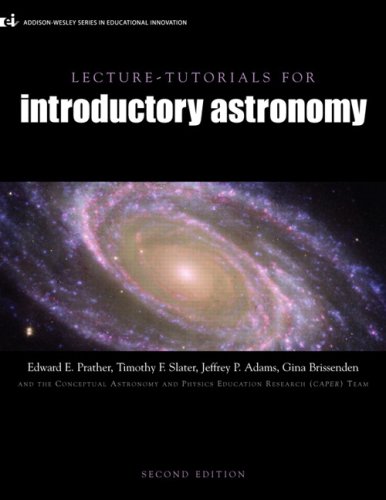
10. Lecture Tutorials for Introductory
$62.30
11. Astronomy Today Vol 1: The Solar
$62.89
12. Astronomy Today Vol 2: Stars and
$11.21
13. The Complete Idiot's Guide to
$6.32
14. Bad Astronomy: Misconceptions
$35.00
15. Astronomy: A Beginner's Guide
$72.85
16. 21st Century Astronomy, Second
$22.50
17. Handbook of CCD Astronomy, 2nd
 
$45.79
18. Pathways to Astronomy
 
$59.45
19. Explorations: An Introduction
$41.23
20. The History and Practice of Ancient

1. NightWatch: A Practical Guide to Viewing the Universe
Spiral-bound: 192 Pages (2006-09-12)
list price: US$35.00 -- used & new: US$21.68
(price subject to change: see help)
Asin: 155407147X
Average Customer Review: 5.0 out of 5 stars
Canada | United Kingdom | Germany | France | Japan
Editorial Review

Amazon.com
The third edition of Nightwatch continues its tradition of being the best handbook for the beginning astronomer. Terence Dickinson covers all the problems beginners face, starting with the fact that the night sky does not look the way a modern city-dweller expects. He discusses light pollution, how to choose binoculars and telescopes, how to pronounce the names of stars and constellations, telescope mounts, averted vision, and why the harvest moon looks especially bright. Most of the lovely photographs in the book were taken by amateurs, which gives the section on astrophotography a particularly inspirational gleam.

Dickinson's star charts are very handy, each covering a reasonable field of view and mapping the most interesting amateur objects. He gives good advice for planet watching, which he notes "is one of the few astronomical activities that can be conducted almost as well from the city as from dark rural locations."

Altogether, the watchword for Nightwatch is indeed "practical"--this is a book to be used, not just read. Spiral-bound to lie flat or to fold back undamaged, it's a field guide that pulls its own weight in the field. Author Timothy Ferris says, "Like a good night sky, Nightwatch is clear and wind-free. Try it and see for yourself." --Mary Ellen Curtin Book Description

Thoroughly revised, updated and expanded.

The first three editions of NightWatch sold more than 600,000 copies, making it the top-selling stargazing guide in the world for the last 20 years. The key feature of this classic title is the section of star charts that are cherished by backyard astronomers everywhere. Each new edition has outsold the previous one because of thorough revisions and additional new material.

NightWatch has been acclaimed as the best general interest introduction to astronomy. The fourth edition has improvements over the 3rd edition in every chapter, including:

  • The famous charts, ideal for stargazers using a small telescope or binoculars
  • A complete update of the equipment section, including computerized telescopes
  • An enlarged photography section, including how-to instructions for using the new generation of digital cameras for astronomical photography, both with and without a telescope
  • The tables of future solar and lunar eclipses, planetary conjunctions and planet locations, updated through 2018.

This edition includes for the first time star charts for use in the southern hemisphere. There are also dozens of new photographs throughout the book that show the latest thrilling discoveries made by current space observatories and probes.

... Read more

Customer Reviews (84)

5-0 out of 5 stars Hurry Buy THIS book
If you are a beginner, buy this book immediately.It is probably fabulous for the rest of you, too.:)I am just getting started myself and have spent just a short time with it.I look forward to learning and appreciating it even more.Beginners absolutely need it.Try to read before you get a telescope, but even if you have made a purchase,will be able to help you make best use of it and help you avoid frustration.

This book is first of all beautiful with many color photographs to enhance the comprehensive text.The content is engaging and easy-to-understand.

Buy, enjoy, and have fun.Also, the book is worth the $35.00 price, but Amazon has a great discount.

5-0 out of 5 stars must have
A must havebook for any star gazer.For either the amateur or the professional.

5-0 out of 5 stars A Classic
It came highly recommended and it's easy to see why.A very good book!

5-0 out of 5 stars Updated version of a classic text!
The overwhelming number of reviews for this book on Amazon is a testimonial to its stature as a classic introductory stargazing book.The fact that the reviews are uniformly positive testifies to its exceptional quality.Now in its fourth edition, Nightwatch has been introducing amateur astronomers to the night sky for over two decades.Terence Dickinson is a prolific astronomy author and this is one of his most important and enduring works.
This is essentially the same as the older editions, some of which I also own.Four new things have been added to the new edition.Tables and data have been update through 2018, there are now southern hemisphere charts (for a Northern hemisphere book, who cares?), there is an updated section on digital astrophotography and some updated information on buying a telescope.I have read many introductory stargazing books and I always find the information about buying a telescope the least interesting. More often than not, the telescope is purchased first and the book is purchased later.An extended section on purchasing a telescope after the fact, after the proverbial horse has left the barn, seems wasteful.Dickerson's section is interesting however.I have not read all his works, but I have read several and Dickerson has uniformly dismissed "go-to" telescopes in favor of "learning the sky."This may be worthwhile for the serious amateur astronomer, but the serious amateur already knows the sky.The true novice may be aided by a telescope that aids him in finding celestial objects so that his cold and dark nights don't end prematurely in frustration. The frustrated novice may never become the "serious" amateur astronomer who benefits from knowing the sky.
To my knowledge, this is the first book in which Dickerson embraces GPS-guided "go-to" telescopes which require no knowledge of the sky.In an age of light pollution when the opportunity to view the sky are diminishing for most of us urban dwellers, Dickerson acknowledges the utility of GPS telescopes which have become self-guiding and essentially "idiot-proof."If you can get it into the darkness and onto a tripod, it can find for you a celestial object.This is truly an amazing advance in amateur astronomy and Dickerson finally acknowledges and embraces this development.
As a book, this is a thorough introductory text on stargazing.It is concise and the prose is well-written.Anyone wanting to pursue astronomy as a serious hobby will undoubtedly want more, but this is an excellent starting point.And for nearly a quarter century, this is where many budding amateur astronomers have started.This text is recommended without reservations.If you want to learn the sky, start here.

5-0 out of 5 stars This is "the book" to buy!
If you are seriously interested in astronomy, or you are a beginner or intermediate astronomy enthusiast with a telescope(or you are considering purchasing one), this fine gem of a book is a must buy. I bought the previous edition and discovered that I often return to use this book in my outdoor telescopic tours more than any other guide I own. Had I known what I now know when I first got started, this would have been the first and maybe last book I ever bought! The spiral binding is especially field-friendly as well as the heavy water-resistant cover. Don't leave home without of copy in hand of this most excellent book. ... Read more


2. Astronomy For Dummies (For Dummies (Math & Science))
by Stephen P. Maran
Paperback: 336 Pages (2005-05-06)
list price: US$19.99 -- used & new: US$10.93
(price subject to change: see help)
Asin: 0764584650
Average Customer Review: 4.5 out of 5 stars
Canada | United Kingdom | Germany | France | Japan
Editorial Review

Product Description
Astronomy For Dummies ... Read more

Customer Reviews (22)

5-0 out of 5 stars Expectation
If there is a rank below amateur, then I hold it.This book is crisp, delightful and helpful.

4-0 out of 5 stars Good for beginners
Thorough on most matters, though a little light on the Big Bang, quasars, antimatter, and Stephen Hawkings. But strong on SETI and other revolving planets. And I enjoyed the space mission coverage. Overall, gets the job done.

4-0 out of 5 stars Good but
A fine book except for one major flaw on page 236. Intelligence is not a rare accident in biological evolution. Readers and authors who think so should study E. Raymond Capt's "The Glory of the Stars."

5-0 out of 5 stars Review
A good beginning book for Astronomy.Worth the money for someone just getting started.

5-0 out of 5 stars Astronomy For Dummies
This book really helped me out. In my astronomy class, we were required to read between 6 and 7 chapters per week. That is an enormous amount of information to try to soak in. Astronomy for Dummies explained everything beautifully, thus helping me to understand and retain the information. The author's great sense of humor keeps you interested in the material as well.Astronomy for Dummies helps make learning fun. ... Read more


3. Astronomy: A Beginner's Guide to the Universe (5th Edition)
by Eric Chaisson, Steve McMillan
Paperback: 576 Pages (2006-03-06)
list price: US$111.60 -- used & new: US$54.94
(price subject to change: see help)
Asin: 013187165X
Average Customer Review: 3.0 out of 5 stars
Canada | United Kingdom | Germany | France | Japan

Customer Reviews (2)

5-0 out of 5 stars Awesome
The book was just as i expected!!! it was new, no marks, and no bent pages! it was a great price and it looks like i just bought it from a book store!! shipped really fast! THANKS

1-0 out of 5 stars Publisher Fails!
This textbook is an adequate basic astronomy text that covers all of the bases and as might be expected has many updates reflecting recent research in the field.However, much of the really cool photography, demonstrations, animations, and illustrations are not in the book but are supposed to be on the web-site to which purchasers are given free access for more than an academic year.Although the book was released months ago, the web-site will not be available before the end of May 2006.The Prentice Hall Product Support people took over three weeks to find this out and were unable to offer any other solution to the problem which was shared by half of my class section.Do not purchase this book; it is a ripoff.If you must buy it, buy an older edition that comes with the CD (which the rest of my section purchased.)You won't have to deal with Prentice-Hall.Even better, try "Discovering the Universe" which is better written and comes with a CD. ... Read more


4. Foundations of Astronomy (with AceAstronomy, Virtual Astronomy Labs Printed Access Card)
by Michael A. Seeds
Hardcover: 736 Pages (2006-02-10)
list price: US$132.95 -- used & new: US$71.00
(price subject to change: see help)
Asin: 0495015784
Average Customer Review: 3.5 out of 5 stars
Canada | United Kingdom | Germany | France | Japan
Editorial Review

Book Description
With this newly revised 9th edition of FOUNDATIONS OF ASTRONOMY, Mike Seeds' goal is to help students use astronomy to understand science and use science to understand what we are. Fascinating and engaging, this text illustrates the scientific method and guides students to answer these fundamental questions: "What are we?" and "How do we know?"In discussing the interplay between evidence and hypothesis, Seeds provides not just facts, but a conceptual framework for understanding the logic of science. The book vividly conveys his love of astronomy, and illustrates how students can comprehend their place in the universe by grasping a small set of physical laws. Crafting a story about astronomy, Mike shows students how to ask questions to gradually puzzle out the beautiful secrets of the physical world. Mathematics is incorporated into the text (and in separate sections for easy reference), but the book's arguments do not depend on mathematical reasoning, keeping even math-averse students engaged. The revision addresses new developments in astrophysics and cosmology, plus the latest discoveries, including evidence of a new world beyond Pluto and new evidence of dark energy and the acceleration of the universe.Students are also provided with an online assessment tool, called AceAstronomy. Designed specifically to help students prepare for tests and exams, AceAstronomy improves conceptual understanding by providing a personalized learning plan based on a pre-test diagnostic. ... Read more

Customer Reviews (2)

4-0 out of 5 stars amature review
As an amature I found this text an excellent overview of the astronomy world. It is well organized and presented a basic overview of most all topics. It is well written and clear and would be very usefull for any one starting out in astronomy and interested in gaining a broad knowledge of the subject. Subjects covered lay a good foundation and also act as a spring board to other books with greater depth. I have kept and used this text for many years. It is great.

3-0 out of 5 stars Be careful with "Printed Access Card Ace Astronomy , Virtual Astronomy Labs"
I've worked through the first 3 chapters of the book and so far it is quite good.Review questions and problems in the book are valuable to validate what you learned.

However, one reason I selected this book was the stated access to online materials (as part of the "Product" purchased).The online materials (especially the tests) are also quite helpful.Once registered, you only have access to the materials for 180 days.While that sounds like a lot of time, if you are learning in your spare time, this will most likely not be enough. After a few phone calls, it seems that you may be able to purchase more time for $30-$40, but it is not real clear if adn how to do this.

... Read more


5. Astronomy Today (5th Edition)
by Eric Chaisson, Steve McMillan
Hardcover: 848 Pages (2004-07-26)
list price: US$118.20 -- used & new: US$36.93
(price subject to change: see help)
Asin: 0131445960
Average Customer Review: 4.0 out of 5 stars
Canada | United Kingdom | Germany | France | Japan
Editorial Review

Book Description
Chaisson/McMillan's writing style and pedagogically driven art program are recognized as being scientifically accurate yet accessible to non-science majors. The integrated media program contains the market's only E-book. It provides readers with innovative and interactive tools to learn and test their understanding of astronomy concepts.Topics covered include Astronomy and the Universe, Our Planetay System, Stars and Stellar Evolution, Galaxies and Cosmology, and more.For one or two-semester introductory astronomy course. ... Read more

Customer Reviews (10)

1-0 out of 5 stars Extremely bad textbook...
The authors of this book say it is for the laymen. Bull. This book is not only exceptionally difficult to comprehend with all the manifold "big terms and measurments" they throw at you, but is also annoying, and does not provide answers. God it's annoying.

The diagrams for something you are reading are not even on the page you are reading, so you have to flip two or three pages to find which diagram they are talking about--as paradoxical as that sounds. They (diagrams) are difficult to understand, and sometimes just a damn mess.

I can't even tell you how many times I almost fell asleep reading their (the author's ramblings) piles of excess information--literally mountains and heaps of excess, useless, complex, redundant, information that only professional astronomers or math-adepts could understand.

This book is so not for someone who wants to take a casual astronomy course. After I am done with it, I'm going to set it on fire. Stay away from this thing.

1-0 out of 5 stars New Book that was NOT a new Book
Simply put - I purchased this Astronomy book through Amazon because the price was the same as elsewhere but I would save on shipping.I expected a NEW book but received a Used Book in good condition.
The Book itself so far seems well laid out and interesting but the course I am taking has just reached the 1/3 mark toward completion.

5-0 out of 5 stars For the Non-Science Major
This book is designed to be the astronomy book that non-science majors would use to meet their one-year of science requirement as part of their undergraduate degree. As such it is written without the mathematics content that would be normal in a course aimed at astronoly or physics students. In addition, this particular book has several advantages. To identify just a few:

1. Throughout the book there is an emphasis on teaching the scientific method. This area has been strengthened in this edition because (I'm guessing) the current attempts by the un-intelligent design people todisparage scientific theories.

2. Revised to include the latest discoveries being made by the Mars rovers and the down grading of poor Pluto to a minor planet.

3. Updating the current theories regarding dark matter and dark energy.

In summary this is a well written, well illustrated text, ideally suited for the non-scientists.

5-0 out of 5 stars Astronomy Today 5th edition
I have had a lifetime love of Astronomy but have lacked the mathmatical background for a thorough understanding.Most popular books on the subject rarely cover the field in the manner that I desire.Astronomy Today is a textbook for a beginning course in astronomy at the college level and does, in fact, cover a great deal of information without the need for mathmatical knowledge.The authors express their ideas and information in clear, concise language and clearly manifest an enthusiasm for their subject.I have enjoyed the book immensely.

4-0 out of 5 stars A Paradox of Blind Astronomers!
This is an excellent textbook, but I deducted one star (from a possible five-star rating) because of the absurd comments made by the authors in the beginning of the book. In this fourth edition of Astronomy Today, a textbook published by Prentice Hall for college students, the authors open the very first chapter with the following statements:

"Of all the scientific insights attained to date, one stands out boldly: Earth is neither central nor special. We inhabit no unique place in the universe. Astronomical research, especially within the past few decades, strongly suggests that we live on what seems to be an ordinary rocky planet called Earth, one of the nine known planets orbiting an average star called the Sun, a star near the edge of a huge collection of stars called the Milky Way Galaxy, which is one galaxy among countless billions of others spread throughout the observable universe."

Huh!? Earth isn't special? Compare the other planets in our Solar System to Earth and tell us it isn't special. And Earth is "...an ordinary rocky planet..."? It's the only planet we know of with vast oceans of liquid water, a breathable atmosphere, lush vegetation, and a spectacular collection of life forms. The authors of this textbook must have been "out to lunch" when they wrote that trite introduction, or... this is just another deliberate attempt by "philosophers of gobbledygook" to strip the Earth of its special place in the universe and to squash any special characteristics that may differentiate it from everything else in the cosmos. I strongly suspect the latter viewpoint is the correct one.

The fact is the Earth is indeed a very special place, and the Sun is a very special star. In fact, the Sun-Earth relationship represents a very special arrangement that permits life to thrive upon our planet. Mercury, Venus and Mars may be nothing more than ordinary rocky planets, but Earth is truly unique from all the other planets in our Solar System, and may be truly unique in all the universe.

I stand by my initial rating of the textbook: 4 stars and an excellent read. I just have a wee bit of a problem with blind astronomers.
... Read more


6. A Child's Introduction to the Night Sky: The Story of the Stars, Planets, and Constellations--and How You Can Find Them in the Sky
by Michael Driscoll
Hardcover: 96 Pages (2004-05-01)
list price: US$19.95 -- used & new: US$12.00
(price subject to change: see help)
Asin: 157912366X
Average Customer Review: 4.5 out of 5 stars
Canada | United Kingdom | Germany | France | Japan
Editorial Review

Book Description
Children eight and up will enjoy this conversational but information-packed introduction to astronomy and stargazing, which includes the achievements of the great scientists, the history of space exploration, the story of our solar system, the myths behind the constellations, and how to navigate the night sky. Whimsical color illustrations on every page and handy definitions and sidebars help engage younger readers and develop their interest. The special star wheel helps locate stars and planets from any location at any time of year. This is the third in Black Dog & Leventhal's successful series including The Story of the Orchestra and A Child's Introduction to Poetry. ... Read more

Customer Reviews (7)

5-0 out of 5 stars Beautiful book - out of this world
My 6 year old son had a class project about the night sky, I purchased this book and was blown away by the detail and artwork, the viewing wheel was a great addition to the book used to great effect by young and old.I gave the book to his Teacher and she was so impressed with it that she used it as a teaching resourse and took inspiration for some lessons out of it, if you only buy one book for your child on astronomy let it be this one

5-0 out of 5 stars Very Educational
I must have flipped though 20+ books about the solar system & stars before I found this one. Once I had this in my hand, I would not put it down. This book has more details, than all the others. It's more like a child's science book. I learned things I did not know or had forgot.

5-0 out of 5 stars Can be a great book for elementary age with adult/older child's help
We purchased this book for my daughter as a reward for a good report card.Her 1st grade class has been learning about space.While the book may seem a little advanced for first graders it is definitely a book that they can used to reference with an adult's help.The book is broken down in and way and written so that the common person without astronomy knowledge can learn from it and transfer that to the child.This book can also be used as a great resource for teachers teaching younger kids about our universe.Included with this book is a glow in the dark star chart that helps anyone find the constellations.This book provides an easy way to have quality time with a child that is also educational.If you are looking for a one stop shopping book about space that a child can used for a while then this is it!

5-0 out of 5 stars great astronomy 101 for the middle school and older child
The subtitle of the book is the Story of the Stars, Planets and Constellations -- and How You Can Find Them in the Sky.It should read The Stars, The Planets, the Astronomers, the Universe and Everything.The books has definitions, factoids, readable text, stories, illustrations, pictures, a star wheel/star finder, stickers and everything that has anything to do with our world and our universe.Not for small children (too much text/ too much information), but the best introduction to astronomy I have seen for middle school and older children presented in a very very approachable/ user friendly format.Well done!

4-0 out of 5 stars excellent gift
I purchased this book as a gift for my 9 year old nephew.He absolutely loved it!He enjoys reading the book with his mom and loves the fact that it came with the glo-in-the-dark stars. ... Read more


7. Astronomy Today (6th Edition)
by Eric Chaisson, Steve McMillan
Hardcover: 848 Pages (2007-07-19)
list price: US$118.20 -- used & new: US$88.99
(price subject to change: see help)
Asin: 0132400855
Average Customer Review: 3.0 out of 5 stars
Canada | United Kingdom | Germany | France | Japan

Customer Reviews (1)

3-0 out of 5 stars How Complete?
I bought the Astronomy Today:Stars and Galaxies, 4th edition paperback several years ago. Amazon lists the HARDBOUND 6th edition as having 848 pages, while the 6th edition two section paperbacks have a total of 1024 pages listed. I have NOT SEEN the 6th edition so I don't know what the 176 pages consist of.
... Read more


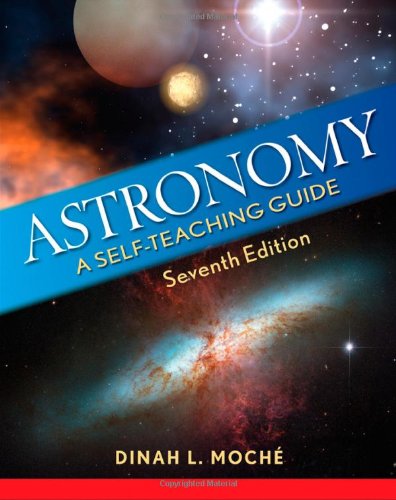
8. Astronomy: A Self-Teaching Guide, Sixth Edition
by Dinah L. Moche
Paperback: 368 Pages (2004-02-19)
list price: US$19.95 -- used & new: US$7.00
(price subject to change: see help)
Asin: 0471265187
Average Customer Review: 3.5 out of 5 stars
Canada | United Kingdom | Germany | France | Japan
Editorial Review

Book Description
"A lively, up-to-date account of the basic principles of astronomy and exciting current field of research."-Science Digest
For a quarter of a century, Astronomy: A Self-Teaching Guide has been making students and amateur stargazers alike feel at home among the stars. From stars, planets and galaxies, to black holes, the Big Bang and life in space, this title has been making it easy for beginners to quickly grasp the basic concepts of astronomy for over 25 years. Updated with the latest discoveries in astronomy and astrophysics, this newest edition of Dinah Moché's classic guide now includes many Web site addresses for spectacular images and news. And like all previous editions, it is packed with valuable tables, charts, star and moon maps and features simple activities that reinforce readers' grasp of basic concepts at their own pace, as well as objectives, reviews, and self-tests to monitor their progress.
Dinah L. Moché, PhD (Rye, NY), is an award-winning author, educator, and lecturer. Her books have sold over nine million copies in seven languages. ... Read more

Customer Reviews (9)

3-0 out of 5 stars Astronomy: A self teaching guide
I have always been fascinated with astronomy but the language/references have been a bit over my head sometimes.I am looking forward to becoming a more savvy "star gazer".The book seems to be what I have been looking for.

2-0 out of 5 stars good introduction, but....
This book is a good introduction to astronomy, but, they put the answers for all the tests right next to (and often directly underneath) the questions. That makes it very hard to take the tests sincerely because it's so easy to accidentally glance at the answers.

5-0 out of 5 stars a nice little book for intro to astronomy
Obviously there are no people who are completely clueless about astronomy since we all were taught as children (at least I was) about the planets in our solar system and about other galaxies.Beyond that most people would not know much about astronomy;which is where this nice little book comes in handy.It has enough information on astronomy subjects without mathematics and without being textbook-like. I think the value of this book is the combination of illustrations and text thatstimulate an interest to explore the topics(in another, more extensive book)if this is so desired. And if not, then it is still a good overview of astronomy.Good book for the price!

1-0 out of 5 stars Yet another deceptive book...
Wanting to teach myself a little astronomy, I purchased this book, since it somehow had acquired a noble status among similar literature. Upon receiving the book and looking through it, I simply wondered "how?". It seems that most books of this type suffer from similar defects. The design seems to be based off a children's activity book. Wide margins, plentiful empty, white space, and text that is big and ugly. Is it possible to publish a book of this purpose with a crisp, small font, several paragraphs per page, and clean, sharp diagrams/illustrations? Apparently not. Perhaps I'm alone in desiring an efficient, textbook-like layout. It seems possible that the complete text of this book could have been printed on 50 pages. Anyway, there's more. The book has been reprinted several times due to its popularity. Again, I'm at a loss for why. Though the cover, perhaps, has changed, the photos that litter its pages, seem to have not. Imagine for a moment taking a photo of Jupiter through a sheet of black tracing paper. Now imagine the resultant sharpness and resolution. Breathtaking, no? The overall quality of diagrams, illustrations, and photos is woeful. Lastly, this book, in sharing the rudiments of astronomical science felt compelled to discuss the wonderful world of SETI!!! SETI is a money-sucking escapade in speculative failure.This book, as most others do, discussess the pseudo-scientific merits of the SETI program, complete with reproductions of the diagrams we've sent along into outer space of a generic ( though peaceful looking), naked man and woman.Hmmm...You will find some science in this book, but if you hope to master the basics of astronomy and take part in an honest discussion regarding the limited understanding we still have of many things universal, I recommend looking elsewhere.

4-0 out of 5 stars An armchair guide to the cosmos
I'm an armchair astronomer.While I save up to buy that telescope, I read books like this, attend star parties (dark sky gatherings where amateur astronomers let wannabes like me peek through their scopes) and daydream about the day when my future telescope sees first light.
This is a great book for people like me.It's the equivalent of a very thorough undergraduate "Introduction to Astronomy" class. The author makes good use of illustrations throughout the book to explain difficult concepts like stellar spectra, distances to astronomical objects, and how astronomers determine the temperature, mass, and composition of stars.
New discoveries are being made every day in astronomy,and of course it's impossible for a book to be as current as today's newspaper.Readers of this book will want to update themselves on certain topics, such as extrasolar planets, human spaceflight, SETI, the explosion of CCD photography in amateur astronomy, among others. A list of resources to do just that is provided in the back of the book. I highly recommend this book for anyone who wants to be entertained and enlightened at the same time.If you're like me, preparing to morph from armchair to amateur status, this book provides an excellent foundation. ... Read more


9. Astronomy Hacks: Tips and Tools for Observing the Night Sky (Hacks)
by Robert Thompson, Barbara Fritchman Thompson
Paperback: 410 Pages (2005-06-17)
list price: US$24.95 -- used & new: US$13.98
(price subject to change: see help)
Asin: 0596100604
Average Customer Review: 5.0 out of 5 stars
Canada | United Kingdom | Germany | France | Japan
Editorial Review

Book Description
Why use the traditional approach to study the stars when you can turn computers, handheld devices, and telescopes into out-of-this-world stargazing tools? Whether you're a first timer or an advanced hobbyist, you'll find Astronomy Hacks both useful and fun. From upgrading your optical finder to photographing stars, this book is the perfect cosmic companion. This handy field guide covers the basics of observing, and what you need to know about tweaking, tuning, adjusting, and tricking out a 'scope. Expect priceless tips and tools for using a Dobsonian Telescope, the large-aperture telescope you can inexpensively build in your garage. Get advice on protocols involved with using electronics including in dark places without ruining the party.Astronomy Hacks begins the space exploration by getting you set up with the right equipment for observing and admiring the stars in an urban setting. Along for the trip are first rate tips for making most of observations. The hacks show you how to:

  • Dark-Adapt Your Notebook Computer
  • Choose the Best Binocular
  • Clean Your Eyepieces and Lenses Safely
  • Upgrade Your Optical Finder
  • Photograph the Stars with Basic Equipment
The O'Reilly Hacks series has reclaimed the term "hacking" to mean innovating, unearthing, and creating shortcuts, gizmos, and gears. With these hacks, you don't dream it-you do it--and Astronomy Hacks brings space dreams to life. The book is essential for anyone who wants to get the most out of an evening under the stars and have memorable celestial adventures. ... Read more

Customer Reviews (54)

5-0 out of 5 stars Good book to read before buying a telescope
My wife gave me a decent telescope for Christmas and by luck got one that's pretty good.This book makes some specific recommendations that would have been useful to have read first.

5-0 out of 5 stars Wonderful Book
A must have book for anyone getting into astronomy, whether with binoculars or a telescope.It's also a good to buy and read before you buy binoculars or a telescope, as it helps you decide what need to get.I was very impressed with it, and couldn't put it down, which says a lot about a technical book.

4-0 out of 5 stars A book to grow with as your skills/experience/interest grow
Gazing at the night sky is part of our nature.Whether for scientific and/or aesthetic purposes, we humans are fascinated by the enormity and beauty of the heavens.

The authors explain how astronomy gives them an "unchanging framework that places us in context within the universe.We look at the Great Orion Nebula, for example, and realize that the light we see tonight began its journey about 1,550 years ago, when the Roman Empire was in its final days."

This book is a comprehensive (almost 400 pages) guide to getting the most out of your nocturnal viewings.It will be useful for the complete amateur, the hobbyist and even offer some tips for the seasoned astronomer.

Don't be frightened by the word "Hacks" in the title.Like other O'Reilly Hacks books, this is not a compilation of illegal or unethical computer programs.It is a reclaiming of the original meaning of the word "hacks."Before the media started using the term hackers for everyone from mischievous teens to dangerous criminals, a Hacker was someone who used a creative workaround or discovered a more elegant, or quick-and-dirty, solution to a problem.

You probably won't read this book from cover to cover.Depending on where you are starting from and where you want to go, you will find sections that pertain to your interest and experience.Early in the book is a guide to choosing binoculars and telescopes. I like the hack that explains how to measure your "entrance pupil size" using Allen wrenches.This will suggest the optimal telescope for my eyes.

The book also gives tips, guidelines and even etiquette for venturing out alone or with others on an observation trip.

There is some solid information as to how our eyes function in the dark.If you are eager to see stars, you can skip some of this but I found it interesting.Especially the explanation of why all cats are gray in the dark.

After about 100 pages you will get into star identification and cataloging.It begins with the Bayer Catalog, (Johann Bayer published the first comprehensive star atlas in 1603) and then includes more modern catalogs.

The authors provide lists of, say, the 88 modern constellations and include a pronunciation guide so you don't sound like a newbie.
As an "urban observer" (about 8 miles from downtown), I have different equipment needs and techniques than a country dweller.There is a whole section dedicated to Urban Observing Skills.

For the adventurous, there is a game plan to complete a Messier Marathon (seeing and logging all 110 Messier Objects in one night.

Astronomy has long been linked to photography and there are a lot of hacks dealing with taking pictures of the images you observe.

Those who have gone beyond the beginner stage will appreciate all the hacks and modifications you can make to your telescope and other equipment to improve your experience.And the book concludes with hacks to make your PC a better tool in your observations.

This book provides a nice starting point for people interested in the night sky.But it's not a beginner's book.As your skills and interest grow, you will continue to uncover new and useful ideas from this book.

5-0 out of 5 stars Superb Astronomy Hack
What can I say that has not been said by other reviewers? One of the most informative book available to the amateur astronomer! A must buy.

5-0 out of 5 stars Useful Astronomy Tips
This is a good book to read if you are starting out in astronomy and are beginning to purchase your equipment. It will lead you down the correct path to make wise decisions, just keep in mind that there is many other brand name equipment to choose from other than what is stated in the book. They do mention this after giving a brand name preference, do your homework. The tips are vary helpful and are almost required when purchasing an Asian dob. I like how the book explains how to avoid inferior equipment and give a wiser choice. This book will enhance the novice's enjoyment of amateur astronomy.
John Smith
... Read more


10. Lecture Tutorials for Introductory Astronomy (2nd Edition) (Addison-Wesley Series in Educational Innovation)
by Edward E. Prather, Tim P. Slater, Jeff Adams, Gina Brissenden, CAPER
Paperback: 144 Pages (2007-08-11)
list price: US$33.00 -- used & new: US$26.61
(price subject to change: see help)
Asin: 0132392267
Average Customer Review: 5.0 out of 5 stars
Canada | United Kingdom | Germany | France | Japan
Editorial Review

Book Description

KEY MESSAGE: Funded by the National Science Foundation,Lecture-Tutorials for Introductory Astronomy is designed to help make large lecture-format courses more interactive with easy-to-implement activities that can be integrated into existing course structures. The Second Edition of the Lecture-Tutorials for Introductory Astronomy contains nine new activities that focus on planetary science, system related topics, and the interactions of Light and matter. These new activities have been created using the same rigorous development cycle that was used for the highly successful first edition. The Night Sky: Position, Motion, Seasonal Stars, Solar vs. Sidereal Day, Ecliptic, Star Charts. Fundamentals of Astronomy: Kepler’s 2nd Law, Kepler’s 3rd Law, Newton’s Laws and Gravity, Apparent and Absolute Magnitudes of Stars, The Parse, Parallax and Distance, Spectroscopic Parallax.Nature of Light in Astronomy: The Electromagnetic (EM) Spectrum of Light, Telescopes and Earth’s Atmosphere, Luminosity, Temperature and Size, Blackbody Radiation, Types of Spectra, Light and Atoms, Analyzing Spectra, Doppler Shift. Our Solar System: The Cause of Moon Phases, Predicting Moon Phases, Path of Sun, Seasons, Observing Retrograde Motion, Earth’s Changing Surface, Temperature and Formation of Our Solar System, Sun Size. Stars Galaxies and Beyond: H-R Diagram, Star Formation and Lifetimes, Binary Stars, The Motion of Extrasolar Planets, Stellar Evolution, Milky Way Scales, Galaxy Classification, Looking at Distant Objects, Expansion of the Universe. For all readers interested in astronomy.

... Read more

Customer Reviews (4)

4-0 out of 5 stars Necessary Evil
Needed this for a college class, the bookstore on campus didn't sell the textbook and workbook (this product) separately, so I bought it here. It isn't the best book for learning or supplemental material for that matter, but if you need it for class, you need it for class

5-0 out of 5 stars A Really Enjoyable Introduction to Astronomy
It's been a long coming, but it's finally here! Astronomy instructors and authors have produced a wonderfully readable and thoroughly comprehensible introduction to the science of astronomy. Each topic in this book really is a mini-tutorial as proclaimed by the cover title. The book format is actually written in a laboratory worksheet fashion (the sheets can be detached from the book along their perforated edges) with each worksheet dedicated to a specific astronomy concept (e.g., position, motion, Keplar's Third Law, etc.). One pass through this ingeniously designed "book of tutorials" and the beginner to the wonderful world of the cosmo is truly ready to move on to more advanced astronomy books and/or astronomy courses. My congratulations (and gratitude) to the Pearson Addison-Wesley Publishing Company for making the concept of learning enjoyable once again.

If you are at all interested in astronomy, but recoiled away from the subject after opening a typical "introductory" college textbook, then you would do yourself a tremendous favor by purchasing this book. You won't be disappointed!

5-0 out of 5 stars Excellent
This item was in excellent condition and came in a timely manner.It helped a lot with my class.

5-0 out of 5 stars Excellent Hands-On Suppliment
Adam's "Lecture Tutorials" collection is an excellent suppliment to any astronomy textbook.While most text books include a couple of introductory chapters on naked-eye astronomy the material included is often surface deep at best and downright confusing at worst.Much of this is because the topics covered (i.e.-the celestial sphere, daily and yearly motions of the stars, sun and moon, etc) are highly abstract and require activities that force the student to move away from memorization towards an understand of the apparent motions and what causes them.

The Lecture Tutorials are a test ed set of just such activities based on a wealth of astronomy education research.They can be used in both large scale classes and smaller groups to get students to work through the difficult misconceptions and misunderstands that oftentimes beset the subjects being studied.

The activities range throughout the standard astronomy curriculum but, in my opinion, the best activites are those that focus on the apparent motions of the Sun, Moon and stars.

I recommend this to any student trying to better understand the subject and for any educator who wants help moving their students from "fun facts" to deeper understanding. ... Read more


11. Astronomy Today Vol 1: The Solar System (6th Edition) (Astronomy Today)
by Eric Chaisson, Steve McMillan
Paperback: 480 Pages (2007-07-29)
list price: US$70.00 -- used & new: US$62.30
(price subject to change: see help)
Asin: 0136155499
Canada | United Kingdom | Germany | France | Japan
Editorial Review

Book Description

This straightforward volume presents a broad view of astronomy spanning known facts, evolving ideas, and frontier discoveries. The authors combine qualitative reasoning and analogies with familiar objects and phenomena to awaken readers to the excitement of the universe around them. Incorporates new understanding and emphases in contemporary astronomy, including the latest data on topics ranging from adaptive optics and solar system formation to extrasolar planets and the recent missions to Mars. Top-notch illustration program exploits the full range of the electromagnetic spectrum, including images taken at radio, infrared, ultraviolet, X-ray, or gamma-ray wavelengths, in addition to visible-light photographs. For anyone interested in learning more about astronomy.

... Read more

12. Astronomy Today Vol 2: Stars and Galaxies (6th Edition) (Astronomy Today)
by Eric Chaisson, Steve McMillan
Paperback: 544 Pages (2007-07-29)
list price: US$70.00 -- used & new: US$62.89
(price subject to change: see help)
Asin: 0136155502
Average Customer Review: 5.0 out of 5 stars
Canada | United Kingdom | Germany | France | Japan
Editorial Review

Book Description

This straightforward volume presents a broad view of astronomy spanning known facts, evolving ideas, and frontier discoveries. The authors combine qualitative reasoning and analogies with familiar objects and phenomena to awaken readers to the excitement of the universe around them. Incorporates new understanding and emphases in contemporary astronomy, including the latest data on topics ranging from adaptive optics and solar system formation to extrasolar planets and the recent missions to Mars. Top-notch illustration program exploits the full range of the electromagnetic spectrum, including images taken at radio, infrared, ultraviolet, X-ray, or gamma-ray wavelengths, in addition to visible-light photographs. For anyone interested in learning more about astronomy.

... Read more

Customer Reviews (1)

5-0 out of 5 stars Great Buy!
Book was in great condition and for a good price. Exactly what I need for San Antonio College 1370 Star and Galaxies Class. ... Read more


13. The Complete Idiot's Guide to Astronomy, Third Edition
by Christopher De Pree, Alan Axelrod
Paperback: 416 Pages (2004-06-01)
list price: US$18.95 -- used & new: US$11.21
(price subject to change: see help)
Asin: 1592572197
Average Customer Review: 4.5 out of 5 stars
Canada | United Kingdom | Germany | France | Japan
Editorial Review

Book Description
On the cutting edge of cosmology...

Updated and revised, this third edition covers new advances and discoveries and is repositioned to focus more on provocative cosmology topics. Highlights include the latest news regarding the possibility of life on Mars, images of newly discovered extrasolar planets and asteroid flybys, the latest information on the Big Bang, the latest speculation on the possibility of extraterrestrial life, the most up-to-date information and images from current missions, and NASA's next steps.Download Description
The Complete Idiot's Guide(r) to Astronomy, 2E is the most comprehensive astronomy book for beginners, covering: the history of space exploration, our solar system, galaxy, and beyond, tools of the trade-including equipment available for amateurs, and exciting, controversial topics such as the search for extraterrestrial intelligence and the Big Bang theory. ... Read more

Customer Reviews (7)

5-0 out of 5 stars Excellent first primer
It had been 20 years since I'd read an astronomy text, and I wanted to get back up to date, so I tried this book, and it was a good choice. This would make a good, first book on astronomy for almost anybody. It's clearly and concisely written, and it requires almost no math and only a basic understanding of physics. (The purists and techies might object to that, but remember, this is an "idiot's guide." :-)) It could probably be used by a high school student. The basic concepts and information on astronomy are discussed without getting very technical.

The authors also discuss the history of astronomy from its earliest origins to the most recent theories. The different areas of astronomy, such as planetary astronomy, stellar astronomy, observational astronomy, astrophysics, and cosmology are all covered in detail in separate chapters. The coverage is very good and new results up through the late 90s and turn of the new millenium, including recent probe missions, telescropic findings, are included. I was out of date around 1980 so I was especially interested in the more recent developments of the last 10 years, which as I said is covered quite well.

I noticed a few things had changed since I was last reading up on astronomy. Back then, the universe was thought to be as old as 24 billion years, but today it's only thought to be about 14.5 billion years old. There were several methods of estimating the age of the universe, which were the recessional velocities of the galaxies, the age of the oldest, reddest globular clusters circling our Milky Way galaxy, and the 25 centimeter background radiation. The oldest figure of 24 billion years was from the globular cluster research done by the late, great Harlow Shapley early in the last century. But anyway, apparently recent research has revised than down a good 10 billion years.

I also notice that modern astronomy texts don't seem to have as many beautiful color plates of nebulae and galaxies as in the old days, but no doubt that relates to keeping costs down. The color photos in this book, although fewer in number, often come from the Hubble Space Telescope, and the ones of the Hubble Deep Field which contain 10,000 galaxies are truly awe-inspiring and are better than anything they could get back then, so the books make up for the lack of quantify perhaps with better quality.

Since I was out of date, the chapters I was most interested in were the last two on galactic evolution and cosmology, in which many of the most important new theoretical and observational developments are discussed. Back in my day, it was thought the universe was expanding but could eventually brake to a halt and start contracting, as in the oscillating universe theory, and it was thought this cycle could take 70 billion years. Now it's thought that the expansion is actually still gathering momentum and speed, which was a surprising result to me.

The book concludes with an appendix and glossary of astronomical terms. Overall a very nicely done, well written and readable account of the subject for the beginning student.

5-0 out of 5 stars One of the Easiest Guides to Amateur Astronomy
I own dozens of amateur astronomy books. Almost all of them are "hard." Why are they so difficult? They are difficult to the beginning amateur because most writers of these books are professional astronomers or physicists: pros who seem to get carried away with irrelevant points during the writing of these guides. I could see this every time I looked in many of the books: too much talk about the celestial sphere, page after page of mythology, endless telescope diagrams, famous science battles, mind-numbing physics, & so on. The meat of the matter was lost.

Not so with this book. De Pree & Axelrod - two pros - finally got it right. The Complete Idiot's Guide to Astronomy is different from all the rest. Snappily-written, fun, & easy to understand, this guide sticks to all the important points of amateur astronomy. This book really respects the amateur astronomer. It has been in my library for about 5 years, & I return to it frequently.

Buy this book if you want to painlessly learn amateur astronomy. You won't be disappointed.

5-0 out of 5 stars Simply Marvelous
There is truly a great wealth of information in this book, ranging from a "history" of astronomy profiling the great astronomers of the past and their accomplishments, to what kinds of things (stars, planets, etc) you should search for in the sky, the kind of telescope you should buy (if you are so inclined), along with information about our moon, our solar system and beyond. Also included is information about the different kinds of stars out there (everything from "white dwarves" to "red giants"), how the universe was created and how many other potential universe there are "out there." Particularly interesting to me were the descriptions of the various planets and also how "black holes" get formed.

The book's appendices also contain a wealth of information, a list of upcoming solar and lunar eclipses, a list of constellations, and other sources of information. Anyone with an interest in astronomy, be it an "amateur astronomer" setting up his telescope to search the skies or a lay person like me who wonders what other worlds are like will enjoy this book.

5-0 out of 5 stars Broad in Scope.
This book could be called the "Swiss Army Knife" of Astronomy
books. Rich, complete. Has much to offer the novice and pro alike.
From the History of Astronomy and its many essentric
players, to the use of todays powerful Radio telescopes.
This is not a dry Technical manual but a book packed with all
the words and tools of modern Astronomy, liberally
sprinkled with humor and trivia. Want to know who what when and
where? Or how far, how big and how hot? When I have a question
this is the book I reach for. From backyard to Hubble, its all in
here. Chris DePree's love of Astronomy
(and teaching it!) shows in this wonderful book. Cudos!

3-0 out of 5 stars Felt like an....
While the "tone" of the book was written for us non-astronomers in mind, I could've used more illustrations--even pencil drawing ones--for many of the concepts such as angular size.

Being a visual person, I probably should have looked at it first before ordering it. Someone who isn't as visual will probably do well with this book, as it's filled with a lot of excellent information throughout.

1-24-02 update: After posting my review on this book, Professor Chris DePree e-mailed me and apologized for my problems with his book, explained why there were so few illustrations (budget constraint), and asked for any more comments so they could improve the 2nd edition. Wow, was I impressed! ... Read more


14. Bad Astronomy: Misconceptions and Misuses Revealed, from Astrology to the Moon Landing "Hoax"
by Philip C. Plait
Paperback: 288 Pages (2002-03-01)
list price: US$15.95 -- used & new: US$6.32
(price subject to change: see help)
Asin: 0471409766
Average Customer Review: 4.5 out of 5 stars
Canada | United Kingdom | Germany | France | Japan
Editorial Review

Book Description
Advance praise for Philip Plaits Bad Astronomy

"Bad Astronomy is just plain good! Philip Plait clears up every misconception on astronomy and space you never knew you suffered from." —Stephen Maran, Author of Astronomy for Dummies and editor of The Astronomy and Astrophysics Encyclopedia

"Thank the cosmos for the bundle of star stuff named Philip Plait, who is the worlds leading consumer advocate for quality science in space and on Earth. This important contribution to science will rest firmly on my reference library shelf, ready for easy access the next time an astrologer calls." —Dr. Michael Shermer, Publisher of Skeptic magazine, monthly columnist for Scientific American, and author of The Borderlands of Science

"Philip Plait has given us a readable, erudite, informative, useful, and entertaining book. Bad Astronomy is Good Science. Very good science..." —James "The Amazing" Randi, President, James Randi Educational Foundation, and author of An Encyclopedia of Claims, Frauds, and Hoaxes of the Occult and Supernatural

"Bad Astronomy is a fun read. Plait is wonderfully witty and educational as he debunks the myths, legends, and 'conspiracies that abound in our society. 'The Truth Is Out There'–and it's in this book. I loved it!" —Mike Mullane, Space Shuttle astronaut and author of Do Your Ears Pop in Space? ... Read more

Customer Reviews (35)

5-0 out of 5 stars Bad Astronomy and Good Insights
PERSPECTIVE: physician with an interest in astronomy

It's interesting to look at the American educational system to see exactly how much basic astronomy and space science is not taught, or at least, not taught well. Asking the average person to explain why we have tides or why the sky is blue is bound to elicit answers that vary from the slightly off to the ridiculous. One could argue that having a grasp on these most basic of "why's" isn't needed for our daily lives to proceed - the truth is, its embarrassing how much many people not only don't know, but also don't care, about how our planet and our solar system really work... and then easily believe frankly inane "ideas" such as how Venus split off from Jupiter 3,000 years ago, or that the Apollo moon landings were a hoax.

Like Sagan and Gould before him, Phil Plait has the amazing gift of being able to easily explain potentially confusing scientific concepts with such simplicity and wit that anyone, regardless of their level of education, can understand them. His writing is easy and conversational, and this book is a joy to read. He enhances some points with a modest number of clear illustrations. Furthermore, he is very forthright about where he himself has been wrong in the past, and is more than eager to explain why - an important trait notably missing from the non-scientists whose work he discusses.

Topics covered include misconceptions concerning the earth itself (balancing eggs on the equinox), the solar system (tides, seasons, moon phases), and the galaxy (star observations, meteorites, planetary alignments), as well as non-scientific errors, both deliberate and sincere (moon landing hoax, astrology, creationism), and common astronomical fallacies in movies.

FINAL WORD: A HIGH five of five stars.Necessary for everyone (and I mean everyone) to read, and doubly so for educators from early grade school to post-graduate level.

4-0 out of 5 stars Some Bad language in Bad Astronomy
I bought this book for my 14 year-old nephew.I wanted to preview it for my 9 year-old daughter.In flipping through I did find one expletive on page 103 (opening sentence to chapter 11), but the story is funny, so I will just black it out.I think some of the chapters would lose my daughter in comprehension.I'll wait a couple of years for her copy.
Here is an except from the final paragraph of chapter 8: "Finally, in this section we'll travel back in time and space to where it all began, the Big Bang.Something about contemplating the beginning of everything twists our already tangled minds, and descriptions of the Big Bang usually confuse the issue more than unravel it.The irony of the Big Bang, I suppose, is that it is even odder than our oddest theories could possibly suppose."

3-0 out of 5 stars put up or shut up
Oh my!land sakes the flag moves! What does it all mean? Maybe the moon really does have an atmosphere, but we didnt find out for sure until we actually landed got out put up the flag and low and behold, a breeze made the flag flap! Does this mean that we didnt go to the moon? No what it means is that sometimes just because we have a theory about something regardless of what it is, does not mean that our theory was right to begin with. Sometimes our professionals leading the charge dont want to admit that they were wrong about something, so they just leave us to believe the original theory even if their theory turns out to be wrong. As far as the moonhoax promoters go, put up or shut up. There's an obscure piece of moon jumping footage that is hard to find, but it is out there that is from the apollo 11 moon landing. When Neil Armstrong goes to get back in the lem, he stands flat footed on the lem pad grabs the ladder with both hands, bends his knees and jumps straight up and lands on the 3rd step which is about 4 1/2 feet above the lem pad. The greatest recorded vertical jumps in the last century were only 42 an 44 inches. get out your messuring tapes right now and do a standing vertical leap and see how high you get. Now after you do that put a back pack on that weighs about 75 pounds. Now put 25 pound ankle weights on, 1 for each ankle. now your ready to try and duplicate Neil Armstrongs "1 giant leap" if you or maybe the great "AIR JORDAN" cant get as high as Neil did, "54" inches, then maybe its time to accept the fact that "YES "we did go to the moon, now GET OVER IT! OH while you still have the back pack and leg weights on, try and duplicate John Youngs "JUMP SALUTE" just the way he did it, with only just slightly bending the knees. He got about 18 or so inches off the lunar surface. If you cant duplicate these jumps or cant find a basketball player or a high jumper to get anywhere close to Neil Armstrongs "54 inch" vertical jump, thens its time to close the books on the moon hoax theory, because we did indeed go to the moon, but they found out that the moon was already occupied and the astronauts were not well received. This is why we've never gone back to the moon and thats what all the cover up is really all about. Yes there is life out there and our closest neighbors are not light years away, but are right up there on the moon not wanting any part of our violent behavior to influence their world in any way. So we were told to get off the moon and dont came back.WARD FRAZIERU.S. ARMY PROJECT M.A.R.S MINDCONTROL SURVIVOR 1984-1986GREENSBURG INDIANA.

5-0 out of 5 stars Great book for us non-astronomy experts
I bought this book expecting to read the usual stuff about why some people think that the moon landing was a hoax and how astrology doesnt really work (as explained on the cover). But i was suprised to learn about so many things that I actually thought really did exist in the world of astronomy. I really did think that the water spun in a different direction in australia, and that the sky was blue because thats what a lot of oxygen looks like and many other things that turned out not to be true. Many times i thought "oh what! that isnt real!?"

There is also a nice section that takes delivers a blow to the creationists and their wacko claims.

I highly reccomend this book to anyone curious about astronomy and anyone that wishes to learn about all the ailment of bad astronomy that you never knew you suffered from.

5-0 out of 5 stars Astronomy for the masses
The average American knows more about what Julia Roberts eats for breakfast than what the Coriolis effect is, and Dr. Plait thinks that should change.I think this book should be mandatory reading for anyone remotely interested in astronomy and/or science fiction.His website is just as informative. ... Read more


15. Astronomy: A Beginner's Guide to the Universe, Fourth Edition
by Eric Chaisson, Steve McMillan
Paperback: 552 Pages (2003-07-23)
list price: US$104.00 -- used & new: US$35.00
(price subject to change: see help)
Asin: 0131007270
Average Customer Review: 4.5 out of 5 stars
Canada | United Kingdom | Germany | France | Japan
Editorial Review

Book Description
A brief, introductory astronomy book designed for readers with little or no scientific background, A Beginner's Guide uses an exceptionally clear writing style. The authors present a broad view of astronomy without complex mathematics, yet the book discusses important concepts without simplification.The book's organization follows the popular and effective “Earth-Out” progression, starting with our planet and then moving through the solar system. A study of the Sun as a model star follows, then the book covers the Milky Way Galaxy, cosmology, and the universe as a whole.Because of its easy-to-read yet comprehensive coverage of astronomy, this book can serve as excellent reference material for those readers interested in learning about our universe. ... Read more

Customer Reviews (7)

5-0 out of 5 stars Astronomy book
I was very pleased with the timeliness of delivery as well as the condition of this book.Excellent condition.

5-0 out of 5 stars Solid Intro Astronomy Book
This textbook presents information about the Earth, solar system, and universe in a clear manner that avoids technical jargon while staying scientifically respectable.The author demonstrates the practical uses of mathematics throughout the book and the end of chapter questions challenge the reader's grasp of the material. It's a rarity for such a readable book to be written by a person with this author's impressive educational creditials.I would definitely recommend this text and any other written by Chaisson.

5-0 out of 5 stars good condition and speedy delivery
item arrived in 2 days and was in perfect condition. completely satisfied. would recommend to others!

2-0 out of 5 stars Way too expensive for a paperback
Attractive book but not a good value.All the information is available for free on the internet where it is periodically updated and can be referenced for free without wearing out.

5-0 out of 5 stars Astronomy Text Book
Text book arrived in excellent condition (brand spankin' new) and in a timely manner (about 3 business days). I got a great deal too! No problems whatsoever. Thanks a bunch! ... Read more


16. 21st Century Astronomy, Second Edition
by Jeff Hester, David Burstein, George Blumenthal, Ronald Greeley, Bradford Smith, Howard Voss, Gary Wegner
Paperback: 726 Pages (2006-12-19)
list price: US$93.75 -- used & new: US$72.85
(price subject to change: see help)
Asin: 0393924432
Average Customer Review: 5.0 out of 5 stars
Canada | United Kingdom | Germany | France | Japan
Editorial Review

Book Description
This extraordinarily readable, cohesive text presents twenty-first century astronomy as a dynamic story of theory building and theory testing, as a fascinating process of observation and discovery. The authors' primary goal is to build students' scientific literacy by emphasizing how science works and why it is relevant, rather than by cataloging a large mass of individual details. With a clear focus on core concepts and carefully crafted pedagogical aids, 21st Century Astronomy chronicles scientists at work on the most important questions about the Universe, highlighting the excitement of making new discoveries and the puzzlement created by new lines of inquiry.

"One of the most exciting things about astronomy is that sometimes you get up in the morning and discover that we know fundamental things about the Universe that we didn't know the day before. The recent release of the results from the Wilkinson Microwave Anisotropy Probe (WMAP) satellite observatory are one of those historical moments."—Jeff Hester ... Read more

Customer Reviews (2)

5-0 out of 5 stars A Favorite Astronomy Textbook
This is my third year teaching introductory astronomy.I've used three textbooks.Last year I got a copy of 21st Century Astronomy free--publishers are always trying to get professors to adopt their textbooks.Anyway, I really like this one.I haven't been able to use it in a class yet, but I would like to.I use it already to help me prepare for lectures.It's clear and don't talk down to the reader.Many textbooks get weighted down with frills, but not this one.The graphics are clear but never superfluous.In keeping with its title, it includes may up to date topics.

The other texts I have used are Kaufman, Seeds, and Bennet et al. (which I liked a lot too--it's a little bulky though.)

5-0 out of 5 stars Out of this world
Wonderful explanations.This is the astronomy book I never had as a kid!I'm a biologist and always thought I had the good fortune of working in the most interesting field.It sounds trite, but this book has opened my eyes to a universe out there.Now I even sort of understand black holes and the implications of relativity. ... Read more


17. Handbook of CCD Astronomy, 2nd Edition (Cambridge Observing Handbooks for Research Astronomers)
by Steve B. Howell
Paperback: 222 Pages (2006-04-03)
list price: US$41.99 -- used & new: US$22.50
(price subject to change: see help)
Asin: 0521617626
Average Customer Review: 5.0 out of 5 stars
Canada | United Kingdom | Germany | France | Japan
Editorial Review

Book Description
Charge-Coupled Devices (CCDs) are the state-of-the-art detector in many fields of observational science. Updated to include all of the latest developments in CCDs, this second edition of the Handbook of CCD Astronomy is a concise and accessible reference on all practical aspects of using CCDs. Starting with their electronic workings, it discusses their basic characteristics and then gives methods and examples of how to determine these values. While the book focuses on the use of CCDs in professional observational astronomy, advanced amateur astronomers, and researchers in physics, chemistry, medical imaging, and remote sensing will also find it very valuable. Tables of useful and hard-to-find data, key practical equations, and new exercises round off the book and ensure that it provides an ideal introduction to the practical use of CCDs for graduate students, and a handy reference for more experienced users. ... Read more

Customer Reviews (3)

5-0 out of 5 stars a very valuable book, entertaining too
For a graduate student who has not had an observational astronomy course, the process of self-teaching the essentials of CCD astronomy is not a smooth one.You really don't know what kind of things you have to worry about before going to a telescope!

Though this book does not cover comprehensively the topic of detection techniques in scientific contexts (too much for such a small book), it has an excellent, totally readable introduction to the basics of CCD detection in astronomy.The author obviously has been in the field for a long time, so his numerous anecdotes from his rich, past expericnes are entertaining as well as enlightening.It is such a short book but very satisfying, which is rare for a technical science book.

This book would make a perfect textbook or supplement reading for any decent undergraduate observational astronomy course.Highly recommended as the first reading for observers.

5-0 out of 5 stars An essential reference
Steve is the master of the art of CCD photometry.This is an essential book for professional astronomers and amateurs alike.

5-0 out of 5 stars The Best amature CCD reference
This book is a must-have reference for serious CCD imager. It is what Ihave looked for since I start using the CCD system! I wish it was publishedthat time so that I didn't have tosearch hundreds of WebPages for sameinformation.

It includes many equation and scientific data (for example..Si pixel turns photons to electrons, several useful S/N equations, imageprocessing .. from dark frame substracing to calculating expose time offlat field image

again .. mail me if you need more information atwiphu@kirdkao.org ... Read more


18. Pathways to Astronomy
by Stephen E. Schneider, Thomas T. Arny
 Paperback: 699 Pages (2006-02-28)
list price: US$99.40 -- used & new: US$45.79
(price subject to change: see help)
Asin: 0072499656
Average Customer Review: 5.0 out of 5 stars
Canada | United Kingdom | Germany | France | Japan

Customer Reviews (1)

5-0 out of 5 stars Easy to read
I used this book in my Astronomy class and it was very easy to read.It has very short chapters and they are to the point and interesting. ... Read more


19. Explorations: An Introduction to Astronomy, Volume 1 (Solar System) with Starry Night Pro DVD, version 5.0 (Explorations)
by Thomas T Arny
 Paperback: 594 Pages (2008-01-04)
list price: US$62.50 -- used & new: US$59.45
(price subject to change: see help)
Asin: 0077234073
Average Customer Review: 5.0 out of 5 stars
Canada | United Kingdom | Germany | France | Japan
Editorial Review

Book Description
Arny: Explorations-An Introduction to Astronomy, 5th edition, is built on the foundation of its well-known writing style, accuracy, and emphasis on current information. This new edition continues to offer the most complete technology/new media support package available. That technology/new media package includes: 23 Interactives (located on the text ARIS Presentation center); ARIS website (that allows instructors to take their course to the web if they choose); and Starry Night Planetarium Software (packaged free with each new text). Available in Volumes: Volume 1 contains the Solar System (ISBN: 0077234073) / Volume 2 contains the Stars & Galaxies (ISBN: 0077234065). ... Read more

Customer Reviews (1)