e99 Online Shopping Mall

Geometry.Net - the online learning center Help  
Home  - Science - Biogeography (Books)

  1-20 of 100 | Next 20
A  B  C  D  E  F  G  H  I  J  K  L  M  N  O  P  Q  R  S  T  U  V  W  X  Y  Z  

click price to see details     click image to enlarge     click link to go to the store

$66.99
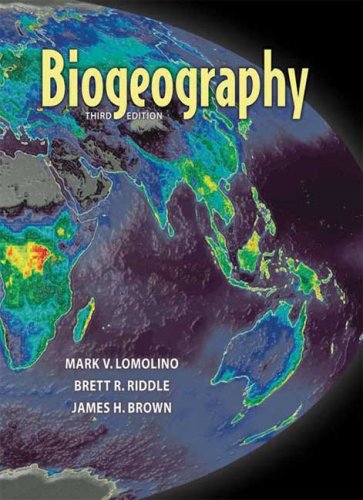
1. Biogeography, Third Edition
$33.80
2. Foundations of Biogeography: Classic
$35.80
3. The Theory of Island Biogeography
$50.26
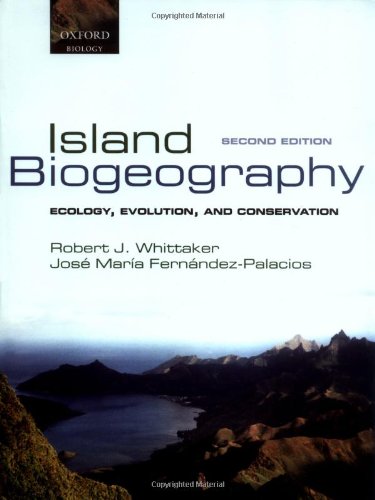
4. Island Biogeography: Ecology,
$81.39
5. Biogeography: Introduction to
$64.99
6. Biogeography: An Ecological and
$51.50
7. Historical Biogeography: An Introduction
$80.00
8. Ecology and Biogeography of Pinus
$90.00
9. Biogeography: An Ecological and
$129.00
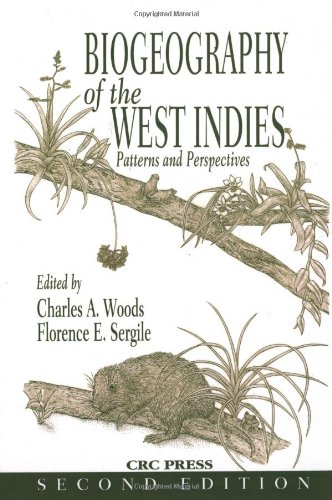
10. Biogeography of the West Indies:
$181.07
11. Earthworm Ecology and Biogeography
$29.30
12. Fundamentals of Biogeography (Routledge
$54.95
13. Frontiers of Biogeography
$197.87
14. Biogeography, Time and Place:
$67.30
15. Foundations of Systematics and
$17.40
16. Island Biogeography : Ecology,
$119.00
17. Primate Biogeography: Progress
$48.30
18. The Great Cacti: Ethnobotany and
$83.39
19. Biogeography in a Changing World
$98.45
20. Island Biogeography in the Sea

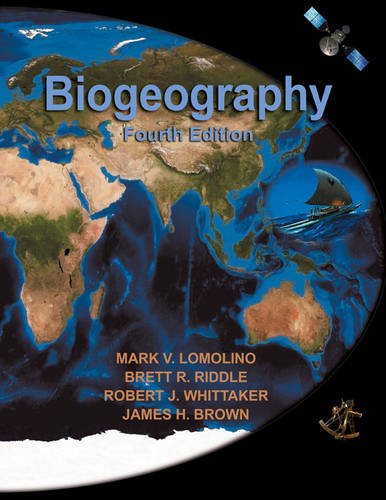
1. Biogeography, Third Edition
by Mark V. Lomolino, Brett R. Riddle, James H. Brown
Hardcover: 845 Pages (2005-06-30)
list price: US$94.95 -- used & new: US$66.99
(price subject to change: see help)
Asin: 0878930620
Average Customer Review: 4.0 out of 5 stars
Canada | United Kingdom | Germany | France | Japan
Editorial Review

Book Description
Like its predecessor, Biogeography, Second Edition, aims to integrate the specialized subdisciplines that threaten to divide the field. It combines ecological and historical perspectives to show how contemporary environments, earth history, and evolutionary processes have shaped the distributions of species and the patterns of biodiversity. It illustrates general patterns and processes using examples from different groups of plants and animals from diverse habitats and geographic regions.

Biogeography, Second Edition, consists of 19 chapters, organized into five sections. The book is beautifully illustrated with hundreds of figures and maps, and contains a glossary and extensive bibliography. Starting from simple facts and principles, and assuming only a rudimentary knowledge of biology, geography, and earth history, the book seeks to explain the relationships between the patterns of plant and animal distributions and the mechanistic processes that have produced them. Throughout, the emphasis is on the interplay between unifying concepts and the evidence that supports or challenges these ideas. ... Read more

Customer Reviews (2)

4-0 out of 5 stars Brilliant text--but not substantially different than the second edition
Biogeography, Third Edition, is a beautiful new edition of a classic, but one that I suspect was encouraged by the publisher to sell more books rather than make much needed corrections and updates to the text.I certainly hope that the binding on this edition holds up a bit better than the second edition.

Brown and Lomolino's Biogeography is THE authoritative introductory text in this field.I suppose if you can't lay your hands on a cheap used copy of the second edition, or want a pristine new copy for posterity, you can't go wrong by purchasing this book.

4-0 out of 5 stars An excellent introductory approach to Biogeography
This book written by some of the best authors known in the field comprises a quite extensive overall view of biogeography, its fundaments, beginnings, divisions, schools and relatively new applications and inner relations with other sciences.It contains also a copy of the original zoogeographic regions map created by Wallace. This book resembles the whole biogeography curse taught in the Faculty of Sciences of the Universidad Nacional Autonoma de Mexico, UNAM. which is quite exceptional and has the best scientists-profesors in Latin America. If you are looking for a "has it all" biogeography book this one is a must have for undergraduates and graduates students interested in comparative biology, systematics and distributions of taxa within time and space. The review has only four stars for strictly brand new additions of up to date biogeographical information are not included in this edition, yet, but for a three year old book it is a minor problem. ... Read more


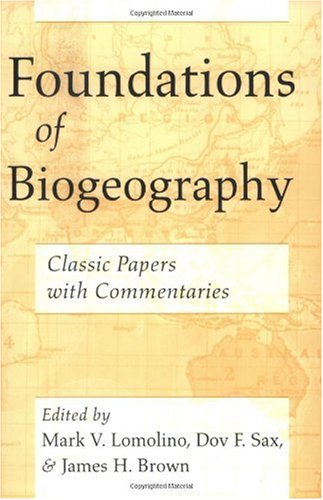
2. Foundations of Biogeography: Classic Papers with Commentaries
Paperback: 1328 Pages (2004-07-01)
list price: US$45.00 -- used & new: US$33.80
(price subject to change: see help)
Asin: 0226492370
Average Customer Review: 5.0 out of 5 stars
Canada | United Kingdom | Germany | France | Japan
Editorial Review

Book Description

Foundations of Biogeography provides facsimile reprints of seventy-two works that have proven fundamental to the development of the field. From classics by Georges-Louis LeClerc Compte de Buffon, Alexander von Humboldt, and Charles Darwin to equally seminal contributions by Ernst Mayr, Robert MacArthur, and E. O. Wilson, these papers and book excerpts not only reveal biogeography's historical roots but also trace its theoretical and empirical development. Selected and introduced by leading biogeographers, the articles cover a wide variety of taxonomic groups, habitat types, and geographic regions. Foundations of Biogeography will be an ideal introduction to the field for beginning students and an essential reference for established scholars of biogeography, ecology, and evolution.

List of Contributors
John C. Briggs, James H. Brown, Vicki A. Funk, Paul S. Giller, Nicholas J. Gotelli, Lawrence R. Heaney, Robert Hengeveld, Christopher J. Humphries, Mark V. Lomolino, Alan A. Myers, Brett R. Riddle, Dov F. Sax, Geerat J. Vermeij, Robert J. Whittaker
... Read more

Customer Reviews (4)

5-0 out of 5 stars Comprehensive and thorough
This is a comprehensive collection of papers cleverly compiled by the editor. A very interesting aspect is that it covers a wide range of topics within biogeography along with an equally wide range of study organisms. Articles from several decades of research are available in one book which enables readers to see how the field has evolved over time. It is an excellent supplement to Brown and Lomolino's or Glen McDonald's Biogeography textbooks. I would consider adding it as a required book for a class in Biogegraphy.

5-0 out of 5 stars A biogeographer's bible (but also good for the amateur naturalist)
Biogeography is a vast subject and in the introduction of this mammoth volume of almost 1300 pages it is argued that it should be treated as a separate major discipline within the framework of life sciences.Foundations charts the history of biogeography from Linnaen roots in the 18th century to the mid 1980s by collecting together and reproducing in whole or in part classic papers, articles and book chapters that represent innovation, refinement and expansion in the horizons of this subject.The selection overall represents the corpus of material upon which modern biogeographic studies flourish.The burden of choice in the selections used has rested on the shoulders of the editors and a small army of recognisable experts individually appointed to take care of each of the seven parts of the work dealing with separate themes in a roughly chronological framework.Each part begins with an introductory section which relates the items selected to the theme under consideration - representing both a commentary and a corrective to the "historical" material to follow.

To a large extent biogeography is a linkage of evolutionary and speciation studies to Earth history and geography in the contexts like climates, barriers and habitats.From key innovators there is a roll call of some of the best known workers encompassing geology, zoology botany and palaeontology.

In 1858 the ornithologist P. L. Sclater defined the zoogeographic realms still largely accepted to this date.Darwin, Wallace and J. D. Hooker amongst a coterie of sadly lesser known botanists argued out and complimented each others ideas of evolution in relation to geography.The identification of the ice ages and subsequently plate tectonics via A. Wegener and the synthesis of resulting thought probably represents the historical highlight of Foundations.The role call continues with G. G. Simpson, W. Hennig, L. Croizat, E. Mayr, D. Lack, E. O. Wilson and J. M. Diamond representing just a selection of the authors signposting a radiation of ideas.

Foundations is very much a multidisciplinary spread and not just a historical progression.Important concepts are highlighted and explored within further themes such as Vicariance and Dispersal, Diversification, Islands, Assembly rules and Gradients asking why there are so many species in the tropics.
The work is no primer and would take quite a lot of study unless an eclectic approach is taken to start with.It contains some of the most important papers in the field ever written - eminently quotable and often inaccessible and complex mathematical theory in parts.There could be some argument about the selection and potential biases.Overall the format represents a highly collectible reference of scriptural proportions to naturalists and historians alike and the work will enhance future research.As broached in the introduction the format is repeatable making this an important edition of a larger historical enterprise.

5-0 out of 5 stars Biogeography papers
This series of papers provides an in depth background to the field of Biogeography. Many of the papers reprinted here are difficult to obtain else where.

Excellent, like like the rest of the "Foundations of..." series.

5-0 out of 5 stars An excellent sourcebook
This collection is a worthy companion to Chicago Univ. Press' earlier FOUNDATIONS OF ECOLOGY.Spanning the period (literally) of Linnaeus to MacArthur BIOGEOGRAPHY presents a wealth of key sources (many now hard to find)which, when coupled with the Commetaries can form the core of a solid course on Biogeography.While some folks may complain that the collection stops too soon (early 1970's) I think the editors have been wise to really restrict themsleves to classics with real staying power, rather than run the risk of being more "contemporary" by including things that may be little more than 9 days' wonders.I would STRONGLY reccomend this book for any grad student or professor interested in ecology, biogeography, or evolution. I doubt my copy will spend much time on the shelf! ... Read more


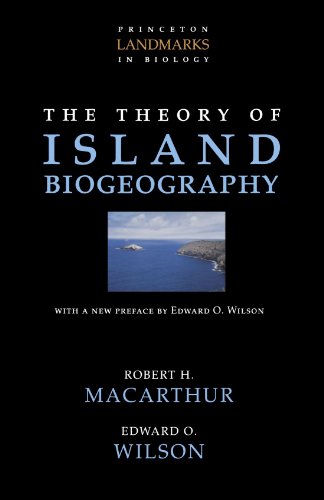
3. The Theory of Island Biogeography (Princeton Landmarks in Biology)
by Robert H. MacArthur, Edward O. Wilson
Paperback: 224 Pages (2001-04-01)
list price: US$45.00 -- used & new: US$35.80
(price subject to change: see help)
Asin: 0691088365
Average Customer Review: 4.5 out of 5 stars
Canada | United Kingdom | Germany | France | Japan
Editorial Review

Book Description

Biogeography was stuck in a "natural history phase" dominated by the collection of data, the young Princeton biologists Robert H. MacArthur and Edward O. Wilson argued in 1967. In this book, the authors developed a general theory to explain the facts of island biogeography. The theory builds on the first principles of population ecology and genetics to explain how distance and area combine to regulate the balance between immigration and extinction in island populations. The authors then test the theory against data. The Theory of Island Biogeography was never intended as the last word on the subject. Instead, MacArthur and Wilson sought to stimulate new forms of theoretical and empirical studies, which will lead in turn to a stronger general theory. Even a third of a century since its publication, the book continues to serve that purpose well. From popular books like David Quammen's Song of the Dodo to arguments in the professional literature, The Theory of Island Biogeography remains at the center of discussions about the geographic distribution of species. In a new preface, Edward O. Wilson reviews the origins and consequences of this classic book.

... Read more

Customer Reviews (3)

5-0 out of 5 stars dated, but excellent for seeing where the field began
This is a wonderful book that spawned a new sub-field in ecology as well as providing a major theoretical approach to conservation issues.Island biogeography provided us with a new way to view biodiversity as it related to space.A wonderful book.

5-0 out of 5 stars Reprint of MacArthur's and Wilson's Seminal Ecological Tome
Originally published as part of the Princeton University Press' Monographs in Population Biology series, Robert MacArthur's and Edward O. Wilson's "Theory Of Island Biogeography" is regarded by many as the most influential tome in theoretical ecology published in the latter half of the 20th Century. Its importance is due to its success in predicting the causes and outcomes of variations in species diversity across a wide range of habitats, not only tropical islands. Furthermore it is the underlying theory behind current research in conservation biology. And it has played a magnificient role in analyzing fluctuations in taxonomic diversity from both marine and continental fossil records across the span of more than half a billion years of Earth history. MacArthur and Wilson conceived of a simple, yet conceptually fruitful equilibrium model of species diversity, recognizing that species diversity is often in a state of flux between varying rates of species immigration (or perhaps, speciation) and extinction. This then novel way at looking at species diversity combined MacArthur's sound mathematical reasoning with Wilson's excellent field biogeographic research (Yet those who are not mathematically inclined should not feel intimidated; their theoretical arguments are made through lucid, exquisite prose.). Without a doubt, their equilibrium theory of island biogeography is one of the finest achievements of 20th Century ecology.

4-0 out of 5 stars The young lion revisited
Robert McArthur was on he knew was his last speaking trip across the country when I heard him in Boulder in the winter of 1974.He didn't talk about death; he talked about life and how it works. He wrote one shortequation on the blackboard, then talked about it for an hour. No long afterhe was dead, but he was the real young lion, he changed ecology forever.His start was simple: look at avifauna in terms of foliage heightdiversity, but he did not stop there.

Wilson? He's brilliant in his ownway, of course, but I'm betting his contribution to Island Biogeography wascriticism and editing.

People have spent a lot of time attacking partsof this book, an equation here, an equation there. And if you don't likeequations at all, skip them and go for the ideas.This was the seminalbook, the start of the New Era, where complex ideas can be encapsulated ina brief expression, then turned around and it's implications tested. Itwill teach you how to think. ... Read more


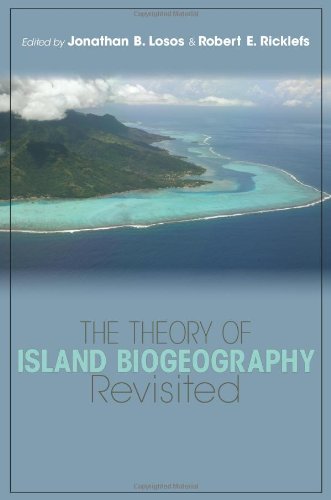
4. Island Biogeography: Ecology, Evolution, and Conservation
by Robert J. Whittaker, Jose Maria Fernandez-Palacios
Paperback: 416 Pages (2007-02-08)
list price: US$65.00 -- used & new: US$50.26
(price subject to change: see help)
Asin: 0198566123
Canada | United Kingdom | Germany | France | Japan
Editorial Review

Book Description
Island biogeography is the study of the distribution and dynamics of species in island environments. Due to their isolation from more widespread continental species, islands are ideal places for unique species to evolve, but they are also places of concentrated extinction. Not surprisingly, they are widely studied by ecologists, conservationists and evolutionary biologists alike.There is no other recent textbook devoted solely to island biogeography, and a synthesis of the many recent advances is now overdue. This second edition builds on the success and reputation of the first, documenting the recent advances in this exciting field and explaining how islands have been used as natural laboratories in developing and testing ecological and evolutionary theories. In addition, the book describes the main processes of island formation, development and eventual demise, and explains the relevance of island environmental history to island biogeography. The authors demonstrate the huge significance of islands as hotspots of biodiversity, and as places from which disproportionate numbers of species have been extinguished by human action in historical time. Many island species are today threatened with extinction, and this work examines both the chief threats to their persistence and some of the mitigation measures that can be put in play with conservation strategies tailored to islands. ... Read more


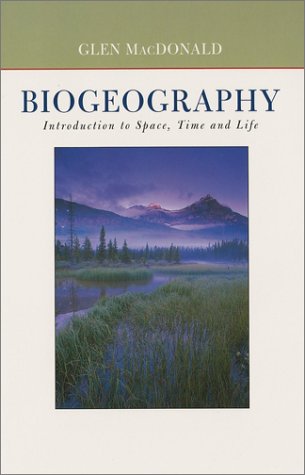
5. Biogeography: Introduction to Space, Time, and Life
by Glen MacDonald
Hardcover: 512 Pages (2001-10-31)
list price: US$114.95 -- used & new: US$81.39
(price subject to change: see help)
Asin: 0471241938
Average Customer Review: 4.0 out of 5 stars
Canada | United Kingdom | Germany | France | Japan
Editorial Review

Book Description
Illustrative examples from recent research publications and "classic" studies are prominently featured throughout the book.
Research techniques are highlighted in "special interest" boxes. Illustrations and descriptions of research techniques are provided with examples such as fire-scars from trees used to reconstruct disturbance, fossil pollen used to reconstruct vegetation change and plant migration, transect and quadrate sampling.
Includes key biogeographical theories that link space and time to the distribution of life. Some of these theories include: 1. Ranges, Reflicts, Refuges, Corridors, Barriers, 2. Centers of Origins, 3. Cladistics, 4. Variance, 5. Island BioGeography, 6. Diversity Theory, 7. Gap Analysis for Conservation. ... Read more

Customer Reviews (1)

4-0 out of 5 stars The first thorough synthesis of Biogeography
I waited a long time for this book to come out, after hearing about it at a professional conference.I was at first disappointed by the lack of more colorful graphics, but then when I was able to read the text thoroughly, it was clear that content was the reason to buy this.
While others have tried providing syntheses for biogeography, this is the first and only one that has struck me as appropriate for classroom use.It would be quite suitable for an upper-division undergraduate course in Biogeography and many in Biology will also find this volume useful, especially those in Ecology or Conservation Biology.

All in all, MacDonald's first stab at a modern synthesis of a growing field hits the mark, and should only improve with time and further editions. This volume, although pricey in hardback form, will make a great companion to Quammen's "Song of the Dodo Bird" in elucidating the complexity and beauty of biogeography. Kudos to the author. ... Read more


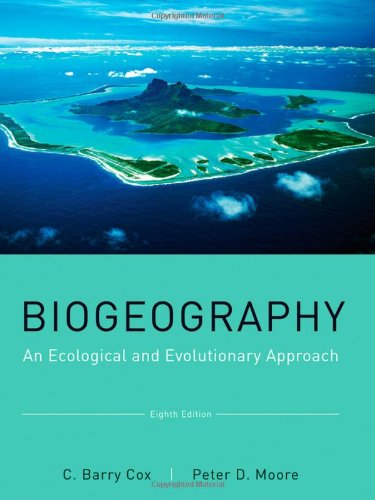
6. Biogeography: An Ecological and Evolutionary Approach
by C. Barry Cox, Peter D. Moore
Paperback: 440 Pages (2005-02-04)
list price: US$83.95 -- used & new: US$64.99
(price subject to change: see help)
Asin: 1405118989
Canada | United Kingdom | Germany | France | Japan
Editorial Review

Book Description
The latest edition of this highly successful and popular textbook has been completely revised and updated to include the latest developments in biogeography. It offers excellent insight into the multi-disciplinary nature of biogeography, providing the student with a sound historical base, up-to-date factual content and a clear explanation of current controversies.

  • New chapter on molecular evidence for the interpretation of patterns of biogeography
  • New section on the biogeography of parasitic diseases
  • Strong use of references providing a platform for advanced students to follow further debate in the current literature
  • Balanced treatment of continental biogeography, island biogeography and marine biogeography
  • ... Read more

    7. Historical Biogeography: An Introduction
    by Liliana Katinas, Paula Posadas, Jorge Victor Crisci
    Hardcover: 264 Pages (2003-06-15)
    list price: US$51.50 -- used & new: US$51.50
    (price subject to change: see help)
    Asin: 0674010590
    Canada | United Kingdom | Germany | France | Japan
    Editorial Review

    Book Description
    Though biogeography may be simply defined--the study of the geographic distributions of organisms--the subject itself is extraordinarily complex, involving a range of scientific disciplines and a bewildering diversity of approaches. For convenience, biogeographers have recognized two research traditions: ecological biogeography and historical biogeography.

    This book makes sense of the profound revolution that historical biogeography has undergone in the last two decades, and of the resulting confusion over its foundations, basic concepts, methods, and relationships to other disciplines of comparative biology. Using case studies, the authors explain and illustrate the fundamentals and the most frequently used methods of this discipline. They show the reader how to tell when a historical biogeographic approach is called for, how to decide what kind of data to collect, how to choose the best method for the problem at hand, how to perform the necessary calculations, how to choose and apply a computer program, and how to interpret results. ... Read more


    8. Ecology and Biogeography of Pinus
    Paperback: 546 Pages (2000-07-31)
    list price: US$80.00 -- used & new: US$80.00
    (price subject to change: see help)
    Asin: 0521789109
    Average Customer Review: 5.0 out of 5 stars
    Canada | United Kingdom | Germany | France | Japan
    Editorial Review

    Book Description
    Pinus is a remarkable genus of trees with a very large distribution range in the northern hemisphere. Where they occur, pines usually form the dominant vegetation cover and are extremely important components of ecosystems. They also provide a wide range of products for human use. In many cases exploitation and other human pressures are threatening the survival of natural pine forests, although pines are also widely grown in commercial plantations, both within and outside their natural range. This book presents a definitive review of pine ecology and biogeography written by forty of the world's leading authorities on this important genus. In the face of increasing human pressure and global climate change, it provides an essential source of reference for all those concerned with the management of natural and planted pine forests. ... Read more

    Customer Reviews (1)

    5-0 out of 5 stars Wonderful book; wealth of ecological data & insight
    This is a terrific book with a lot of appeal not only to people interested in pines, but to a wide audience of ecologists, land managers, foresters and graduate students in ecology. There are 22 chapters by authors from 4continents, with close to 3000 references. The book offers a wealth ofinsight into the effects of humans, fire, evolution and systematics ofpines, reproduction and life histories, pines and invasive ecology andmore.It may be too expensive for many readers, but get your library tobuy a copy, at least.J. Gurevitch, Associate Professor of Ecology andEvolution, State Univ. of NY at Stony Brook. ... Read more


    9. Biogeography: An Ecological and Evolutionary Approach
    by C. Barry Cox, Peter D. Moore
    Paperback: 298 Pages (2000-01)
    list price: US$72.95 -- used & new: US$90.00
    (price subject to change: see help)
    Asin: 086542778X
    Average Customer Review: 5.0 out of 5 stars
    Canada | United Kingdom | Germany | France | Japan

    Customer Reviews (1)

    5-0 out of 5 stars Why the physical, tangible, real world is the way it is.
    This excellent textbook is less than 300 pages, and yet I didn't feel like I learned any less than someone who read a 1000 page textbook on the same subject.This is a comprehensive, introductory volume that is, surprisingly for a textbook, extremely well written. This book delivered Biogeography to my mind, and my great teacher Dr Patrick Armstrong of Univeristy of Western Australia made it come alive in my head.Everything you need to lead you into the fascinating study of our tangible world is here.Read it! ... Read more


    10. Biogeography of the West Indies: Patterns and Perspectives, Second Edition
    Hardcover: 608 Pages (2001-06-27)
    list price: US$159.95 -- used & new: US$129.00
    (price subject to change: see help)
    Asin: 0849320011
    Canada | United Kingdom | Germany | France | Japan
    Editorial Review

    Book Description
    As a review of the status of biogeography in the West Indies in the 1980s, the first edition of Biogeography of the West Indies: Past, Present, and Future provided a synthesis of our current knowledge of the systematics and distribution of major plant and animal groups in the Caribbean basin. The totally new and revised Second Edition, Biogeography of the West Indies: Patterns and Perspectives, emphasizes recent ideas and hypotheses in the field and includes many new chapters and contributions. The authors use the broadest possible interpretations of the concepts of biogeography, consider anthropological and geological factors, and discuss the conservation of endemic species.Drawing together contributions from the leading experts in biogeography and biodiversity, this book introduces new patterns and developments that add to our understanding of how plants and animals are dispersed throughout the region. Many contributions use new techniques such as molecular systematics to test older studies based strictly on morphological data. Unique in its inclusion of a wide variety of organisms and in its coordination of scientific data and conservation strategies, Biogeography of the West Indies: Patterns and Perspectives, Second Edition provides the only encyclopedic discussion available on the biogeography of the Antilles. ... Read more


    11. Earthworm Ecology and Biogeography in North America
    by Paul F. Hendrix
    Hardcover: 256 Pages (1995-02-22)
    list price: US$199.95 -- used & new: US$181.07
    (price subject to change: see help)
    Asin: 1566700531
    Canada | United Kingdom | Germany | France | Japan
    Editorial Review

    Book Description
    It is generally recognized that where earthworms are abundant they can exert significant influence on the structure and function of soils. Compared to other biogeographic regions of Earth, however, surprisingly little is known about the earthworm fauna of the western hemisphere and their role in soil processes. This book is the first comprehensive review and analysis of the state of understanding of earthworm biogeography and ecology in North America. Topics of in-depth discussion include earthworm systematics, biogeography and ecology, influences on soil structure and ecosystem nutrient dynamics, and implications for ecosystem management. Each chapter provides a general review and statement of current understanding, an assessment of current research problems, recent developments and advances, and priorities for future research and applications. This book is a must for researchers and students studying the soil-related facets of terrestrial ecology. ... Read more


    12. Fundamentals of Biogeography (Routledge Fundamentals of Physical Geography Series)
    by Richard Huggett
    Paperback: 464 Pages (2004-09-02)
    list price: US$59.95 -- used & new: US$29.30
    (price subject to change: see help)
    Asin: 0415323479
    Canada | United Kingdom | Germany | France | Japan
    Editorial Review

    Book Description
    Fundamentals of Biogeography offers a fresh, up-to-date introduction to biogeography, explaining the ecology, geography and history of animals and plants. The book defines and examines populations, communities and ecosystems - examining where different animals and plants live and how they came to be living there, investigating how populations grow, interact and survive, how equilibrium communities are formed and how communities change, and predicting the shape of communities in the twenty-first century.

    Fundamentals of Biogeography presents an engaging introduction for students and all those interested in gaining a deeper understanding of the key topics and debates within the fields of biogeography, ecology and the environment.Download Description
    Illustrated throughout with informative diagrams and including chapter summaries, guides to further reading and an extensive glossary of key terms this text reveals how life has and continues to adapt to its biological and physical surroundings. ... Read more


    13. Frontiers of Biogeography
    Paperback: 436 Pages (2004-11-23)
    list price: US$54.95 -- used & new: US$54.95
    (price subject to change: see help)
    Asin: 0878934782
    Canada | United Kingdom | Germany | France | Japan
    Editorial Review

    Book Description
    The period between 1975 and 2000 was one of fundamental change in historical biogeography, island biogeography, and marine biogeography, and saw the emergence of new fields, including phylogeography and macroecology, as well as applications of biogeography for conserving biological diversity. ... Read more


    14. Biogeography, Time and Place: Distributions, Barriers and Islands (Topics in Geobiology) (Topics in Geobiology)
    Hardcover: 416 Pages (2007-11-14)
    list price: US$229.00 -- used & new: US$197.87
    (price subject to change: see help)
    Asin: 1402063733
    Canada | United Kingdom | Germany | France | Japan
    Editorial Review

    Product Description

    Biogeography considers the distribution of biological units over a wide range of scales. The units range from genotypes, populations and species to families and higher taxa. Processes can be local, such as the isolation on islands due to sea-level fluctuations, or large-scale tectonic processes that separates continents and creates oceans. In all processes time is an important factor and by combining data on recent patterns with paleontological data the understanding of the distribution of extant taxa can be improved. This volume focuses on speciation due to isolation in island-like settings, and the evolution of large-scale diversity as the result of origination, maintenance and extinction.

    ... Read more

    15. Foundations of Systematics and Biogeography
    by David M. Williams, Malte C. Ebach
    Hardcover: 310 Pages (2007-11-15)
    list price: US$79.95 -- used & new: US$67.30
    (price subject to change: see help)
    Asin: 0387727280
    Canada | United Kingdom | Germany | France | Japan
    Editorial Review

    Book Description

    This volume draws attention to the seminal studies and important advances that have shaped systematic and biogeographic thinking and continue to influence its direction today. It traces concepts in homology and classification from the 19th century to the present through the provision of a unique anthology of scientific writings from Goethe, Agassiz, Geoffroy St. Hilaire, Owen, Naef, Zangerl and Nelson, among others. In addition, current attitudes and practices in comparative biology are interrogated, particularly in relation to evolutionary studies leading to a re-statement of the principal aims of the discipline. In order to alert prospective students to pitfalls common in systematics and biogeography, the book highlights three principal messages: biological classifications and their explanatory mechanisms are separate notions; most, if not all, homology concepts pre-date the works of Darwin; and that the foundation of all comparative biology is the concept of relationshipneither 'similarity' nor 'genealogical hypotheses of descent' are sufficient.

    ... Read more

    16. Island Biogeography : Ecology, Evolution and Conservation
    by Robert J. Whittaker
    Paperback: 304 Pages (1999-02-18)
    list price: US$65.45 -- used & new: US$17.40
    (price subject to change: see help)
    Asin: 0198500203
    Average Customer Review: 5.0 out of 5 stars
    Canada | United Kingdom | Germany | France | Japan
    Editorial Review

    Book Description
    Islands, being discrete, internally quantifiable, numerous, and varied entities, provide us with natural laboratories for developing theories and models of how evolution works. Work on evolution on islands has a long-established biogeographical pedigree, stretching back to the work of Darwin and Wallace, and generating ideas, theories, and models that have played a central role in the development of mainstream ecology, evolutionary biology, and biogeography.Island Biogeography is a new textbook, aimed at advanced undergraduates and graduate students. The first comprehensive book to be written on the topic since 1981, it provides a much needed synthesis of recent developments across the discipline, linking current theoretical debates with applied island ecology. The book covers the following diverse themes: the nature and formation of island environments, and their special contribution to global biodiversity; micro- and macro- evolutionary change on islands, and the frameworks by which these changes may be understood; island ecological theories concerning species numbers, species assembly, and composition; a critical assessment of the contribution of island theories to conservation biology; and finally, an assessment of the human impact on island biodiversity, setting out the tremendous scale of anthropogenic extinctions, and assessing the current threats and remedies.Written by an author who has been researching and teaching island biogeography for many years, Island Biogeography is wide-ranging, authoritative, and accessible to students from across geography and the life sciences. The first truly modern textbook on a fascinating and important subject in evolution and ecology. ... Read more

    Customer Reviews (1)

    5-0 out of 5 stars Excellent, well-organised and highly-readable
    This book is an excellent and much-needed textbook of Island Biogeography. The approach taken by Dr. Whittaker blends detail and overview, and the book is well-organised, informative and interesting. He says at thebeginning of the book that he hopes to "provide access for students ofdiffering backgrounds and disciplines to the full array of islandbiogeographical themes and issues." I think this book does justthat.

    The book starts by stressing the importance of islands as arenasfor the study of the natural world: 'natural laboratories' in which thecomplexity of nature may be simplified, enabling the development andtesting of theories of general importance. Dr. Whittaker then moves fromthe general and long-term (beginning with the physical and biologicalproperties of islands themselves) to the more specific and shorter-term(including island evolution, species richness and endemism, and islandtheories). He finishes by applying the theories and insights gained fromwork on islands to present-day conservation issues.

    There is sufficientdetail to give the reader a fair understanding of the issues addressed, butnever so much that the text gets dull or bogged. Throughout, the book iswell-referenced, with appropriate and informative references, and providesplenty of encouragement for the reader to delve further into theliterature. Considerable clarity is achieved, even when discussingcomplicated and contentious issues, and on many occasions Dr. Whittakerdemonstrates his considerable ability to be insightful and pertinent. Hemaintains a fair and balanced outlook, even when he addresses opinions andauthors that oppose his own work. There is also an air of pragmatism to hisarguments that others would do well to emulate. This is borne out, forinstance, in his treatment of the SLOSS (single large or several smallnature reserves) debate, and in the way he manages to reconcile a number ofdichotomies in the literature by noting that various apparently-conflictingtheories actually represent different points along continua. As might beexpected from the background of the author, Chapters 7 and 8, which dealwith island ecological theory, are particularly impressive: erudite andauthoritative, while still being interesting and highly readable. Thesechapters deal with areas in which Dr. Whittaker is well known for hisprofessional contribution (in which he has published papers of considerableinternational repute).

    Overall, I thoroughly recommend this book toanyone with any interest in island biogeography. Written primarily as atextbook for undergraduate students, it will provide very sound reading forstudents encountering the subject for the first time. It will be all themore useful for the fact that (to my knowledge), there is no other textbookwritten within the last 20 years that covers an equivalent subject area.But it will also interest experts in the field, who may well learnsomething from it, as well as finding it a useful reference for relatedliterature. It will be a good addition to any science-related library, aswell as to the personal collections of students of relevant subjects. ... Read more


    17. Primate Biogeography: Progress and Prospects (Developments in Primatology: Progress and Prospects)
    Hardcover: 535 Pages (2006-05-24)
    list price: US$149.00 -- used & new: US$119.00
    (price subject to change: see help)
    Asin: 0387298711
    Canada | United Kingdom | Germany | France | Japan
    Editorial Review

    Book Description

    Biogeography is a vital component in many aspects of Primatology, including studies of evolution, speciation systematics, population genetics, and community ecology. Despite its integral position in studies of primate evolution and ecology and the broad representation of research on this subject in journals, field guides, and edited volumes on different regions of the world, Primate Biogeography is a subject that is rarely addressed as a discipline in its own right.

    This comprehensive source introduces the reader to Primate Biogeography as a discipline, highlights the many factors that may influence the distribution of primates, and reveals the wide range of approaches that are available to understanding the distribution of this order.

    ... Read more

    18. The Great Cacti: Ethnobotany and Biogeography (Southwest Center Series)
    by David Yetman
    Hardcover: 320 Pages (2007-12-01)
    list price: US$59.95 -- used & new: US$48.30
    (price subject to change: see help)
    Asin: 0816524319
    Canada | United Kingdom | Germany | France | Japan
    Editorial Review

    Book Description
    Towering over deserts, arid scrublands, and dry tropical forests, giant cacti grow throughout the Americas, from the United States to Argentina—often in rough terrain and on barren, parched soils, places inhospitable to people. But as David Yetman shows, many of these tall plants have contributed significantly to human survival.Yetman has been fascinated by columnar cacti for most of his life and now brings years of study and reflection to a wide-ranging and handsomely illustrated book. Drawing on his close association with the Guarijíos, Mayos, and Seris of Mexico—peoples for whom such cacti have been indispensable to survival—he offers surprising evidence of the importance of these plants in human cultures. The Great Cacti reviews the more than one hundred species of columnar cacti, with detailed discussions of some 75 that have been the most beneficial to humans or are most spectacular. Focusing particularly on northwestern Mexico and the southwestern United States, Yetman examines the role of each species in human society, describing how cacti have provided food, shelter, medicine, even religiously significant hallucinogens.Taking readers to the exotic sites where these cacti are found—from sea-level deserts to frigid Andean heights—Yetman shows that the great cacti have facilitated the development of native culture in hostile environments, yielding their products with no tending necessary. Enhanced by over 300 superb color photos, The Great Cacti is both a personal and scientific overview of sahuesos, soberbios, and other towering flora that flourish where few other plants grow—and that foster human life in otherwise impossible places. ... Read more


    19. Biogeography in a Changing World (Systematics Association Special Volumes)
    Hardcover: 232 Pages (2006-11-01)
    list price: US$89.95 -- used & new: US$83.39
    (price subject to change: see help)
    Asin: 0849380383
    Average Customer Review: 5.0 out of 5 stars
    Canada | United Kingdom | Germany | France | Japan
    Editorial Review

    Book Description
    Hampered by a confusing plethora of approaches and methods, biogeography is often treated as an adjunct to other areas of study. The first book to fully define this rapidly emerging subdiscipline, Biogeography in a Changing World elucidates the principles of biogeography and paves the way for its evolution into a stand-alone field.

    Drawing on contributions from leading proponents of differing methods within biogeography, the book clearly defines the differing, sometimes conflicting, perspectives in the field and their correspondingly different methodological approaches. This gives readers the opportunity to refocus on a range of issues including the role of biological processes such as vicariance, dispersal and extinction in biogeographical explanation, the possibility of biogeographical pattern, and the role of geological reconstructions in biogeographic explanation. The book also explores the disciplines current relationship with other disciplines and discusses potential developments. ... Read more

    Customer Reviews (1)

    5-0 out of 5 stars The first book on a new science
    Biogeography is a new discipline being formed by people approaching the problems of plant and animal distribution by combining the skills from diverse fields. The problem with biogeography is that it is so new that there isn't even a standard definition of what it is.

    In August of 2005 a symposium was held with the title 'What is Biogeography.' The symposium provided a forum for a range of viewpoints and the way it is practiced. This book brings together the papers from the meeting, plus additional material, to provide a broad-based perspective on the nature of biogeography. The wide range of authors come from all across Europe and America.

    A major part of the book, but a bit understated, is the exploration of the discipline's current relationship with other disciplines and discusses portntial development. This is intended to pave the way for its evolution into a stand-alone field. ... Read more


    20. Island Biogeography in the Sea of Cortez
    Hardcover: 690 Pages (2002-11-21)
    list price: US$98.45 -- used & new: US$98.45
    (price subject to change: see help)
    Asin: 0195133463
    Canada | United Kingdom | Germany | France | Japan
    Editorial Review

    Book Description
    This updated and expanded A New Island Biogeography of the Sea of Cortes, first published nearly 20 years ago, integrates new and broader studies encompassing more taxa and more complete island coverage. The present synthesis provides a basis for further research and exploration in upcoming years of the biologically fascinating Sea of Cortes region. The Gulf region is increasingly being exploited, for its natural resources by way of marine fisheries, and for its stunning natural beauty by way of a burgeoning tourism industry. Further, the region's human population is increasing apace. It is appropriate, therefore, that this volume discusses these evolving circumstances, and the efforts of the Mexican government to regulate and manage them. The new Biogeography includes a section on the conservation issues in the Sea of Cortes, past accomplishments and conservation needs as yet outstanding. This book should be of strong interest to conservation biologists, ecologists, and evolutionary biologists more generally. ... Read more


      1-20 of 100 | Next 20
    A  B  C  D  E  F  G  H  I  J  K  L  M  N  O  P  Q  R  S  T  U  V  W  X  Y  Z  

    Prices listed on this site are subject to change without notice.
    Questions on ordering or shipping? click here for help.

    site stats