e99 Online Shopping Mall

Geometry.Net - the online learning center Help  
Home  - Science - Bioinformatics (Books)

  1-20 of 100 | Next 20
A  B  C  D  E  F  G  H  I  J  K  L  M  N  O  P  Q  R  S  T  U  V  W  X  Y  Z  

click price to see details     click image to enlarge     click link to go to the store

$16.09
1. Bioinformatics For Dummies (For
$68.31
2. Bioinformatics and Computational
$41.90
3. An Introduction to Bioinformatics
$15.00
4. Mastering Perl for Bioinformatics
$23.73
5. Beginning Perl for Bioinformatics
$64.62
6. Bioinformatics: Sequence and Genome
$11.95
7. Developing Bioinformatics Computer
$38.00
8. Essential Bioinformatics
$58.23
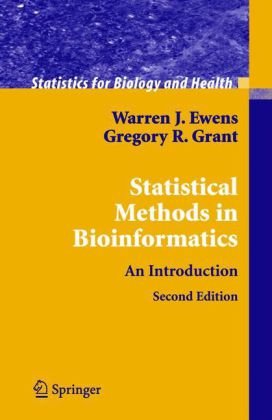
9. Statistical Methods in Bioinformatics:
$84.95
10. Understanding Bioinformatics
$42.56
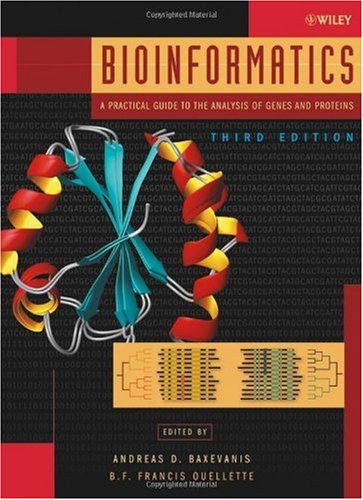
11. Bioinformatics: A Practical Guide
$85.83
12. Bioinformatics and Functional
$60.99
13. Fundamental Concepts of Bioinformatics
$40.79
14. Introduction to Bioinformatics
$69.80
15. Bioinformatics and Molecular Evolution
$66.86
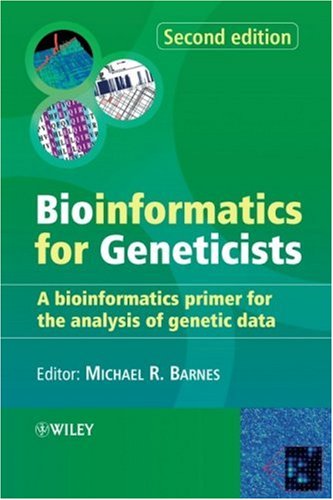
16. Bioinformatics for Geneticists:
$11.07
17. Instant Notes in Bioinformatics
$14.94
18. Immunological Bioinformatics (Computational
$67.28
19. Pattern Discovery in Bioinformatics:
$50.00
20. Java for Bioinformatics and Biomedical

1. Bioinformatics For Dummies (For Dummies (Math & Science))
by Jean-Michel, Ph. D. Claverie, Cedric, Ph.D. Notredame
Paperback: 436 Pages (2006-12-18)
list price: US$29.99 -- used & new: US$16.09
(price subject to change: see help)
Asin: 0470089857
Average Customer Review: 4.5 out of 5 stars
Canada | United Kingdom | Germany | France | Japan
Editorial Review

Book Description
Were you always curious about biology but were afraid to sit through long hours of dense reading? Did you like the subject when you were in high school but had other plans after you graduated? Now you can explore the human genome and analyze DNA without ever leaving your desktop!

Bioinformatics For Dummies is packed with valuable information that introduces you to this exciting new discipline. This easy-to-follow guide leads you step by step through every bioinformatics task that can be done over the Internet. Forget long equations, computer-geek gibberish, and installing bulky programs that slow down your computer. You’ll be amazed at all the things you can accomplish just by logging on and following these trusty directions. You get the tools you need to:

  • Analyze all types of sequences
  • Use all types of databases
  • Work with DNA and protein sequences
  • Conduct similarity searches
  • Build a multiple sequence alignment
  • Edit and publish alignments
  • Visualize protein 3-D structures
  • Construct phylogenetic trees

This up-to-date second edition includes newly created and popular databases and Internet programs as well as multiple new genomes. It provides tips for using servers and places to seek resources to find out about what’s going on in the bioinformatics world. Bioinformatics For Dummies will show you how to get the most out of your PC and the right Web tools so you’ll be searching databases and analyzing sequences like a pro! ... Read more

Customer Reviews (13)

4-0 out of 5 stars Using the free software on internet sites to help your research
The first chapter is a short review of DNA and RNA sequences, amino acids, and protein. The other chapters teach you to use the free software found on the Internet to work with your research.Information is also given which helps explain some biochemicals. My skills are in Software Development using C++ language, and I need more information on biochemicals to understand the problems and to develop algorithms to solve them.
My only criticism is that I would like the book to give more biochemical theory before taking up the subject of Internet software.
Overall, this is a good beginner's book on biochemistry.


5-0 out of 5 stars Good
I am a couple years into a PhD in bioinformatics, but this is the book I started with.I knew some biology and some computer science, but I still found a lot of the databases, etc. confusing and the field has a decided lack of simplified documentation (though it is getting better).

Of course, bioinformatics is a pretty broad topic and no book could possibly cover everything.

If you do not know any biology at all you probably should also get a basic text on genetics/molecular biology (or read thema at the NCBI web site books section for free).You don't need anything in depth to read the dummies book, just at the level of an introductory biology book.Hint: DNA to RNA, RNA to Protein.Andyou want to know why proteins are similar because proteins with similar amino acid sequences often have similar chemical properties and therefore similar functions, so if you know what one protein does you can guess what a protein like it probably does.
:-)

And despite the name of the book the authors are REAL bioinformaticists (T-Coffee rocks!)

5-0 out of 5 stars Yes, It's Really Written at the For Dummies Level.
This book kind of blew me away. Bioinformatics is such a big word.

Then in the second chapter they tell you 'How Most People Use Bioinformatics.' And all of a sudden they have you on line to the National Library of Medicine at the National Institute of Health. They have you looking at protein sequences, and you even understand what they are saying.

This is a 'For Dummies' book. It is written in their traditional style, assuming that you know very little -- well to be sure they say they are making the assumption that 'You likely have a background in molecular biology. If you don't - or if you need to brush up on your molecular biology - Chapter 1 gives you a brief overview of the basics.'

I found that the first few chapters went down pretty easily. By part IV it had gone further than I wanted to go, and I quit reading.

BUT if I were going to be taking a course in bioinformatics, or even thinking about taking such a course, or just looking at a degree in biology, I'd spend a week or two getting around this book. It's written a hell of a lot better than any text you're likely to get assigned, and at its price it's quite a deal.

5-0 out of 5 stars Great introductory text
This is an excellent introduction to Bioinformatics. It does assume some very basic knowledge of biology- perhaps a couple of paragraphs could help the total newbies.

Have you noticed that reviews of bioinformatics books tend to follow certain patterns? The Computer Scientists and mathematicians complain that there is not enough detail about the algorithms, the biologists complain that they could not get through the math, and everyone complains that there is not enough detail about their favorite programs! Let us face the fact that this is a very broad field, and most people that want to learn about it will never design algorithms.

5-0 out of 5 stars great beginner
In spite of the title (I don't know many dummies interested in multiple sequence alignments) this reference is written by experts in the field of bioinformatics and is very accessable for the beginner.I purchased this book as a beginning graduate student so that I could learn which programs to use to compare amino acid and nucleic acid sequences as well as prepare them for publication and this book was perfect for this end.This text doesn't delve into the algorithms or much theory (which is learned through practice and other sources), nevertheless, I recommend this for the researcher for a crash course or quick reference.This book really helped me get my feet wet in this area (and recently publish a nice alignment) and will certainly reduce my workload next semester for my bioinformatics course! ... Read more


2. Bioinformatics and Computational Biology Solutions Using R and Bioconductor (Statistics for Biology and Health)
Hardcover: 473 Pages (2005-08-31)
list price: US$89.95 -- used & new: US$68.31
(price subject to change: see help)
Asin: 0387251464
Average Customer Review: 3.0 out of 5 stars
Canada | United Kingdom | Germany | France | Japan
Editorial Review

Book Description

Bioconductor is a widely used open source and open development software project for the analysis and comprehension of data arising from high-throughput experimentation in genomics and molecular biology. Bioconductor is rooted in the open source statistical computing environment R.

This volume's coverage is broad and ranges across most of the key capabilities of the Bioconductor project, including importation and preprocessing of high-throughput data from microarray, proteomic, and flow cytometry platforms:

Curation and delivery of biological metadata for use in statistical modeling and interpretation

Statistical analysis of high-throughput data, including machine learning and visualization

Modeling and visualization of graphs and networks

The developers of the software, who are in many cases leading academic researchers, jointly authored chapters. All methods are illustrated with publicly available data, and a major section of the book is devoted to exposition of fully worked case studies.

This book is more than a static collection of descriptive text, figures, and code examples that were run by the authors to produce the text; it is a dynamic document. Code underlying all of the computations that are shown is made available on a companion website, and readers can reproduce every number, figure, and table on their own computers.

... Read more

Customer Reviews (2)

2-0 out of 5 stars technically accurate but pedagogically flawed
If you're like me, you came upon this book because you decided to use R for analysis of microarray data, but you're mired in its gory and frustrating details.

Yes, you need a reference book. But not this one, and certainly not this edition.Better documentation can be found elsewhere (dare I say online?).

The code examples given are technically accurate and run as advertised, but they are of the "monkey see, monkey do" variety.They provide little intuition for how to use R for oneself, outside the covers of this text.For example, Chapter 23 discusses linear models for microarray data (using the "limma" package), and several code examples contain the parameter 'adjust = "fdr"'.The reader is never enlightened that this refers to a "false discovery rate" adjustment.

In other cases, example code is simply missing.Chapter 21 covers the Rgraphviz graphing library, with a figure showing the three common graphical layouts -- but no example code for producing these graphs is given (I had to find it outside the book).

For those trying to use R for computational biology, I recommend getting an overview of the R programming language first (Venables and Ripley's book "Modern Applied Statistics with S" is a great text), and only then wading into references such as this one, if at all.

4-0 out of 5 stars Book contains many chapters to help get you started
I purchased this book to learn specific details and look at applications for the functions present in bioconductor.I have had trouble applying some of the chapters to custom data because they are written for specific microarray/data formats.Overall, this book is a good value because it contains examples of how bioconductor can be used to aid in hypothesis testing, but I struggle to apply what I have read to the different types of data I have.The section on Statistical analysis for genomic experiments and the section on gaphs and networks should be the reason you purchase this book. They are very helpful and interesting. The case studies were not very helpful in my opinion. ... Read more


3. An Introduction to Bioinformatics Algorithms (Computational Molecular Biology)
by Neil C. Jones, Pavel A. Pevzner
Hardcover: 454 Pages (2004-08-01)
list price: US$58.00 -- used & new: US$41.90
(price subject to change: see help)
Asin: 0262101068
Average Customer Review: 4.5 out of 5 stars
Canada | United Kingdom | Germany | France | Japan
Editorial Review

Book Description
This introductory text offers a clear exposition of the algorithmic principles driving advances in bioinformatics. Accessible to students in both biology and computer science, it strikes a unique balance between rigorous mathematics and practical techniques, emphasizing the ideas underlying algorithms rather than offering a collection of apparently unrelated problems.

The book introduces biological and algorithmic ideas together, linking issues in computer science to biology and thus capturing the interest of students in both subjects. It demonstrates that relatively few design techniques can be used to solve a large number of practical problems in biology, and presents this material intuitively.

An Introduction to Bioinformatics Algorithms is one of the first books on bioinformatics that can be used by students at an undergraduate level. It includes a dual table of contents, organized by algorithmic idea and biological idea; discussions of biologically relevant problems, including a detailed problem formulation and one or more solutions for each; and brief biographical sketches of leading figures in the field. These interesting vignettes offer students a glimpse of the inspirations and motivations for real work in bioinformatics, making the concepts presented in the text more concrete and the techniques more approachable.

PowerPoint presentations, practical bioinformatics problems, sample code, diagrams, demonstrations, and other materials can be found at the Author's website. ... Read more

Customer Reviews (7)

5-0 out of 5 stars Uma excelente introdução à bioinformática
Este livro é excelente por várias razões. Entre elas posso citar o fato de estar totalmente voltado ao aprendizado por exemplos, sempre de forma a relacionar um problema computacional com um problema em bioinformática. É um livro muito abrangente, cobre muito bem os tópicos relacionadosa alinhamentos e comparações de sequências. Seu capítulo sobre Algoritmos com Grafos é o meu preferido. O autor consegue passar as noções fundamentais com muita simplicidade, de forma que qualquer pessoa possa aprender num ritmo bem rápido.

4-0 out of 5 stars Excellent algorithms exercise & bioinformatics intro
This is the first book that I've read regarding bioinformatics, so Im updating this as my class moves along. You better have a grasp of basic data structures prior to beginning this book and background with a programming language as there is very little hand-holding in this text. A bio background makes it all more interesting but certainly is not critical. There are no sample code or sources printed with the book nor is there an included CD nor answers to exercises. There is an associated web site where some ideas may be had and errata found/reported, but its not very active that I have seen. The pseudo code in the book is very python-like so easy to make use of. I personally transfer the book's concepts to C/C++ (habit) without much problem, except sometimes my results differ from the book. Apparently these are book bugs, so be sure to check the web site out if unexpected things pop up.
Presently my class is in chapter 8 (of 12) and looking back I would like to caution that some data processing algorithms will drive a computer's CPU quite hard so be aware of battery-munching & heat. My only bones with this book so far are the alphabet soup of variables and lack of answers to exercises. It would be nice if variable definitions were refreshed at the beginning of pseudo code samples.
I like this book as an algorithms text over traditional texts because the applications are much more fascinating. Imagine searching for something and you don't know where that something is. On top of that add not even knowing exactly what it is you are looking for. And when you do find it, its not even in the data searched! This may sound unlikely or even impossible, but it is neither. Rather, its very cool.
4-stars

3-0 out of 5 stars Should really be called Intro Data Structures and Algorithms
I knew most of the stuff before I opened the first page.It's basically teaching data structures 101 using a few watered down bioinformatic problems for motivation.The lack of applied problems involving real data was most disappointing.It does have a lot of the type questions that some nerd (me one day :P) might ask you on a job interview.The questions are also a good way to kill time if you have nothing better to do.I give the book credit for stressing dynamic programming.I believe that this is one of the most important concepts in problem solving.

3 stars because I think it is a fairly good introduction for fledgling computer scientists BUT not a good reference for comptuer scientists trying to apply their skills to solve bioinformatic problems.

5-0 out of 5 stars A very good introduction!
This bookgives a broad overview of algorithmic methods used in bioinformatics. It is well writen and the mathematics needed to understand is undergraduate level. Reading this book makes appetite to apply these methods to problems or to dig deeper in the corresponding method.

Overall, a very good book, and due to its introductory level, one can recommend to all people interested in bioinformatics from all disciplines.

5-0 out of 5 stars The First Undergraduate Text
Bioinformatics is probably the fastest growing field in both biology and computer science. The problems have come from the computer science department and the biology department having such fundamentally different goals. The computer scientists see the computer as an end in itself with no real thought on trying to do something useful with it. The biologists see the computer as just another tool in their laboratory. And the biological problems are huge, massive computers like the new Cray's and large Linux clusters are being devoted to biological applications.

This book is intended to fit into the chasm between biology and computer science. It discusses computer the algorithmic principles in terms of practical techniques that make sense to the undergraduate biologist. The book is well suited for a first class for the budding bioinformaticist.

Each main chapter in the book first introduces an algorithm, then it discusses the biologically relevant problems that this algorithm addresses, it includes a detailed problem and one or more solutions. Finally the chapter concludes with brief biographical sketches of leading figures in the field.

This is the first book of its type, and it's likely to remain a classic in the field through many editions and many years. ... Read more


4. Mastering Perl for Bioinformatics
by James D. Tisdall
Paperback: 377 Pages (2003-06)
list price: US$39.95 -- used & new: US$15.00
(price subject to change: see help)
Asin: 0596003072
Average Customer Review: 4.0 out of 5 stars
Canada | United Kingdom | Germany | France | Japan
Editorial Review

Book Description
Historically, programming hasn't been considered a critical skill for biologists. But now, with access to vast amounts of biological data contained in public databases, programming skills are increasingly in strong demand in biology research and development. Perl, with its highly developed capacities in string handling, text processing, networking, and rapid prototyping, has emerged as the programming language of choice for biological data analysis.Mastering Perl for Bioinformatics covers the core Perl language and many of its module extensions, presenting them in the context of biological data and problems of pressing interest to the biological community.This book, along with Beginning Perl for Bioinformatics, forms a basic course in Perl programming.This second volume finishes the basic Perl tutorial material (references, complex data structures, object-oriented programming, use of modules--all presented in a biological context) and presents some advanced topics of considerable interest in bioinformatics. The range of topics covered in Mastering Perl for Bioinformatics prepares the reader for enduring and emerging developments in critical areas of bioinformatics programming such as:

  • Gene finding
  • String alignment
  • Methods of data storage and retrieval (SML and databases)
  • Modeling of networks (graphs and Petri nets)
  • Graphics (Tk)
  • Parallelization
  • Interfacing with other programming languages
  • Statistics (PDL)
  • Protein structure determination
  • Biological models of computation (DNA Computers)
Biologists and computer scientists who have conquered the basics of Perl and are ready to move even further in their mastery of this versatile language will appreciate the author's well-balanced approach to applying Perl's analytical abilities to the field of bioinformatics. Full of practical examples and real-world biological problem solving, this book is a must for any reader wanting to move beyond beginner level Perl in bioinformatics. ... Read more

Customer Reviews (8)

4-0 out of 5 stars Only chapters 4, 5 and 9 make it a worthwhile "Masters" book
This book is definitely written for the biologist that knows some perl and not the experienced perl programmer. To the biologists who have some experience, this book will open up many new possibilities, but to a person with a few years of perl experience, many sections are skimpy and wasteful on topics better covered by other Perl books.

For example, for anyone with truely massive datasets, it might have been worth the mention of the performance cost/benefits of using BerkleyDBs and hash joins (180-3500 times). With improvements of 2-3 orders of magnitude for large sets, it would have been worth a complementary example in chapter 6 so that readers can weigh the alternatives for certain situations.

The book, however, is well worth the price just for chapters 4, 5 and 9.

4) Sequence Formats and Inheritance
5) A Class for Restriction Enzymes
9) Introduction to Bioperl

5-0 out of 5 stars A good follow-on to Tisdall's other Perl book
This book is a continuation of Tisdall's "Beginning Perl for Bioinformatics" and thus illustrates more advanced Perl programming techniques. This book not only talks about Perl programming, but it goes into some detail on the subject of bioinformatics itself. It is assumed that the CS-type reader has a good understanding of biology and the goals of bioinformatic programming. Otherwise, the examples and projects within the book will not make sense. The following is a description of the book's contents:

Part I: OBJECT-ORIENTED PROGRAMMING IN PERL
Chapter 1. Modular Programming with Perl - Talks about using modules so that other people can reuse your programs and you can reuse other people's modules in your own programs.

Chapter 2. Data Structures and String Algorithms - Talks about all of the different data structures available through Perl and how to build up special structures in Perl that you might need to describe complex data. Also mentions various string algorithms that are used in analyzing biological data and implements them in Perl.

Chapter 3. Object-Oriented Programming in Perl - Introduces object-orientation in Perl via a module that includes a class that keeps track of genes.

Chapter 4. Sequence Formats and Inheritance - How to convert sequence files into alternate formats such as FASTA and GCG. The object-oriented concept of inheritance is also introduced.

Chapter 5. A Class for Restriction Enzymes - By writing a more complex class, you get a bigger dose of object-orientated programming in biology.

Part II: PERL AND BIOINFORMATICS
Chapter 6. Perl and Relational Databases - Talks about SQL and the design of relational databases. MySQL is examined specifically.

Chapter 7. Perl and the Web - You learn about web programming in Perl by seeing how to put a laboratory on the Web via Perl and CGI.

Chapter 8. Perl and Graphics - Graphics programming in Perl is demonstrated when you learn to write a program that displays changing data to the Web. The graphical Perl module PD is discussed and demonstrated in a program.

Chapter 9. Introduction to Bioperl - Introduces the reader to Bioperl, which is a group of open source Perl modules used for bioinformatics programming. They provide many basic facilities so you don't have to worry about them.

Part III: Appendixes
Appendix A. Perl Summary
Appendix B. Installing Perl

I really thought this was a 5-star book. However, it is not obvious from the title that this is really volume two of a two volume set of books on Perl programming for the biologist, so I can see where the lower ratings might have come from.

3-0 out of 5 stars Perhaps the CGI could have been omitted?
This is the sequel to his earlier beginner's book on Perl. Now, he goes further into usages of Perl. While experienced programmers will not find these terribly challenging, they are not the intended audience.

Of the topics, the most important is where he shows you how to interface with a SQL database. Given the sheer mass of sequence data generated these days, it is inevitable that efficient database usage be done. So he gives a quick tour of relational database design. With examples of how Perl has modules to submit and query the database. The treatment is somewhat cursory, since he has other, non-database topics to cover.

Of those, he includes CGI programming. This might be questionable. CGI code has proved incredibly hard to scale. Maybe he felt the necessity to include code for handling web servers. Unfortunately, a typical reader won't have enough experience to be aware of CGI's problems. The danger is that she actually starts coding CGI Perl. The true debugging and maintenance costs will not show up till later.

4-0 out of 5 stars Good Companion text
This first half of the book focuses entirely on Object-Oriented(OO) Perl. The second half follows up with a general survey of various perl implementations of particular programming issues involving databasing, cgi, graphics, modules, etc, and BioPerl.

This book does a good job of applying Perl in OO for Biology in the first half of the book. In the second half he overviews a few broad topics in bioinformatics; he doesn't go super specific, but its a sufficient overview and for me sparked more interest in understanding how I can use perl to handle my informatics issues.

In the first half, the author does an excellent job on detailing the ins and outs of perl references and how to construct complex data structures. Indeed they are a bit strange looking at first, but the author breaks it down really good so pretty much anyone can understand it.

For me the most intriguing part of the book was in the second half, which included relational databases, graphics, and bioperl. In particular, the chapter that covers Perl DBI and DBD::mysql was really cool. That secion was very helpful for me because I am familiar with php/mysql, but have not ever used Perl to interact with Mysql before.

I especially liked the gif draw aka GD chapter. I had no idea how cool GD is. But moreover how it can be integrated with Perl to generate really cool looking plots. Before this book I always used gnuplot. But Tisdall shows you how to get to work with GD pretty good using basic practical examples.

The chapter on BioPerl was especially helpful as well. In particular, he shows you what he did to install the beast. He shows you how to use the CPAN shell and again its really beneficial to read through. It motivated me to pursue other topics in bioperl and how I can use it to query different ncbi databases for example.

Overall, the text provided a good overview on OO Perl and on various other topics involving Perl for Bioinformatics in general. I am glad I bought it. It was really very practical/useful - I refer to it all the time actually!

4-0 out of 5 stars Great book, leads to others for true mastery
Published in late 2003, this clearly-written book picks up where "Beginning Perl for Bioinformatics" leaves off.Perl is very commonly used in the field of bioinformatics, and this book does a good job of surveying the more advanced topics in perl from the bioinformatics point-of-view.For a more thorough treatment of each of these topics though, the student will need to explore more specialized titles.

While Tisdall's first volume teaches the core of procedural programming in Perl, this one takes you into the world of object-oriented (OO) programming.The first two chapters explore namespaces, modules, packages, references and data structures, all of which are prerequisites to OO programming.Common bioinformatics algorithms are introduced such as dynamic programming and approximate string matching.

The next three chapters, 3-5, are the meat of this title.Here objects, methods and classes are introduced.Rather than just throwing out independent examples, these topics are developed by starting and building upon a Gene class, the first of several through which Tisdall guides the reader.Due to the practicality of these examples, they can even be used and improved by the reader for use in their own work.

After this decent treatment of OO programming the book takes a turn into other realms of perl, each of which seems to have been written as a short introduction and for which other O'Reilly titles offer more complete coverage.These topics include the use of Perl to access relational databases, CGI programming and graphics generation using GD.If interested in any of these the reader should check out "Programming the Perl DBI", "CGI Programming with Perl" and "Perl Graphics Programming", respectively.

Tisdall wraps up with a much-needed coverage of Bioperl, a large collection of Perl modules for common bioinformatics operations.I looked forward to this section most of all and was fairly disappointed with its brief, 28-page coverage.The entire chapter can currently be downloaded for free from O'Reilly's website as a PDF, but the Bioperl website has better examples and even a contributed course, though good documentation is still lacking in some areas.

In all, I like this book because it does a good review of introducing object-oriented programming in Perl using relevant bioinformatics examples and introduces the reader to other topics including the DBI, CGI, and GD modules.While I believe this makes the book very useful, the coverage of each of the topics in this book will certainly not give the reader a mastery of any of them.For that, one will need to check out the three previously mentioned titles, along with "Learning Perl Objects, References & Modules."This book does a fine job of introducing these four titles from the bioinformatician's perspective. ... Read more


5. Beginning Perl for Bioinformatics
by James Tisdall
Paperback: 400 Pages (2001-10-15)
list price: US$39.95 -- used & new: US$23.73
(price subject to change: see help)
Asin: 0596000804
Average Customer Review: 4.5 out of 5 stars
Canada | United Kingdom | Germany | France | Japan
Editorial Review

Amazon.com
Biology, it seems, is a good showcase for the talents of Perl. Newcomers to Perl who understand biological information will find James Tisdall's Beginning Perl for Bioinformatics to be an excellent compendium of examples. Teachers of Perl will likewise find the text to be filled with fresh programming illustrations of growing scientific importance. Seasoned Perlmongers who want to learn biology, however, should search elsewhere, as Tisdall's emphasis is on Perl's logic rather than Mother Nature's.

Departing from O'Reilly's earlier monograph Developing Bioinformatic Computer Skills, Tisdall's text is organized aggressively along didactic lines. Nearly all of the 13 chapters begin with twin bullet lists of Perl programming tools and the bioinformatic methods that require them. Likewise, the chapters end with exercises. String concatenation is illustrated with gene splicing, and regular expressions are taught with gene transcription and motif searching.

Tisdall emphasizes sequence examples throughout, leading up to an introduction to a Perl interface for the NIH GenBank biological database and the widely used BLAST sequence alignment tool. After a brief discussion of three-dimensional protein structure, he returns to sequence extraction and secondary structure prediction.

Tisdall's goal is to boost the beginning programmer into a domain of self-learning. He imparts essential etiquette for the success of programming newbies: use the wealth or resources available, from user documentation to Web site surveys to FAQs to How-To's to news groups and finally to direct personal appeals for help from a senior colleague. A well-plugged-in bioinformatics Perl student will soon discover Bioperl, an open-source effort to bring research-grade bioinformatic tools to the Perl community. Bioperl is described briefly at the end of Tisdall's book and will reportedly be a forthcoming title of its own in the O'Reilly bioinformatics series.

Although he introduces bioinformatics as an academic discipline, Tisdall treats it as a trade throughout his book. He indicates that open questions and computational hard problems exist, but does not describe what they are or how they are being tackled. Ultimately, Tisdall presents bioinformatics as another arrow in a bench scientist's quiver, very much like HPLC, 2D-PAGE, and the various spectroscopies.

As odd as a "bioinformatics-as-tool" book may be to its research proponents, the reduction of bioinformatics to trade status both deflates and vindicates the years of research, as Tisdall's work attests. --Peter LeopoldBook Description
With its highly developed capacity to detect patterns in data, Perl has become one of the most popular languages for biological data analysis. But if you're a biologist with little or no programming experience, starting out in Perl can be a challenge. Many biologists have a difficult time learning how to apply the language to bioinformatics. The most popular Perl programming books are often too theoretical and too focused on computer science for a non-programming biologist who needs to solve very specific problems.

"Beginning Perl for Bioinformatics" is designed to get you quickly over the Perl language barrier by approaching programming as an important new laboratory skill, revealing Perl programs and techniques that are immediately useful in the lab. Each chapter focuses on solving a particular bioinformatics problem or class of problems, starting with the simplest and increasing in complexity as the book progresses. Each chapter includes programming exercises and teaches bioinformatics by showing and modifying programs that deal with various kinds of practical biological problems. By the end of the book you'll have a solid understanding of Perl basics, a collection of programs for such tasks as parsing BLAST and GenBank, and the skills to take on more advanced bioinformatics programming. Some of the later chapters focus in greater detail on specific bioinformatics topics. This book is suitable for use as a classroom textbook, for self-study, and as a reference.

The book covers:

Programming basics and working with DNA sequences and strings

Debugging your code

Simulating gene mutations using random number generators

Regular expressions and finding motifs indata

Arrays, hashes, and relational databases

Regular expressions and restriction maps

Using Perl to parse PDB records, annotations in GenBank, and BLAST output

... Read more

Customer Reviews (25)

5-0 out of 5 stars A practical introduction to programming for biologists
Although this book was written for biologists with no previous programming experience who have decided they need to learn to program in PERL, it is also useful for programmers entering the field of bioinformatics who need to learn the language. However, you should have some background in biology or else you'll be lost as to the purpose of the examples. That's because almost all of the examples and exercises are based on real biological problems, and this book will give you a good introduction to the most common bioinformatics programming problems and the most common computer-based biological data. This book is over five years old, but it still stands alone in that what it does it does better than any other book I've run across. The follow-on to this book is "Mastering Perl for Bioinformatics", and I recommend that book for both CS and biologist types that want to get into the more advanced parts of PERL and yet stay in the realm of learning the language via real biological problems. The following is ashort run down of each chapter:

1. Biology and Computer Science - Covers some key concepts in molecular biology, as well as how biology and computer science fit together.

2. Getting Started with Perl - Shows you how to get Perl running on your computer and also talks about Perl's benefits.

3. The Art of Programming -Provides an overview as to how programmers accomplish their jobs. Some of the most important practical strategies good programmers use are explained, and where to find answers to questions that arise while you are programming is carefully laid out. These ideas are made concrete by brief narrative case studies that show how programmers, given a problem, find its solution.

4. Sequences and Strings - You start writing Perl programs with DNA and proteins. The programs transcribe DNA to RNA, concatenate sequences, make the reverse complement of DNA, and read sequence data from files. This is the first chapter to conclude with exercises.

5. Motifs and Loops - Continues demonstrating the basics of the Perl language with programs that search for motifs in DNA or protein, interact with users at the keyboard, write data to files, use loops and conditional tests, use regular expressions, and operate on strings and arrays.

6. Subroutines and Bugs -Extends the basic knowledge of Perl in two main directions: subroutines, which are an important way to structure programs, and the use of the Perl debugger, which can examine in detail a running Perl program.

7. Mutations and Randomizations - Genetic mutations, fundamental to biology, are modelled as random events using the random number generator in Perl. This chapter uses random numbers to generate DNA sequence data sets, and to repeatedly mutate DNA sequence. Loops, subroutines, and lexical scoping are also discussed.

8. The Genetic Code - How to translate DNA to proteins, using the genetic code. It also covers a good bit more of the Perl programming language, such as the hash data type, sorted and unsorted arrays, binary search, relational databases, and DBM, and how to handle FASTA formatted sequence data.

9. Restriction Maps and Regular Expressions - An introduction to Perl regular expressions. The main focus of the chapter is the development of a program to calculate a restriction map for a DNA sequence.

10. GenBank - The Genetic Sequence Data Bank (GenBank) is central to modern biology and bioinformatics. In this chapter, you learn how to write programs to extract information from GenBank files and libraries. You will also make a database to create your own rapid access lookups on a GenBank library.

11. Protein Data Bank - Develops a program that can parse Protein Data Bank (PDB) files. Some interesting Perl techniques are encountered while doing so, such as finding and iterating over lots of files and controlling other bioinformatics programs from a Perl program.

12. BLAST - Develops some code to parse a BLAST output file. Also mentioned are the Bioperl project and its BLAST parser, and some additional ways to format output in Perl.

13. Further Topics - Looks at topics beyond the scope of this book. These topics include sequence alignment methods like the Smith-Waterman algorithm and microarray techniques that enable the measurement of the relative levels of thousands of gene transcripts at a time. These topics are only briefly mentioned, and you are shown places outside of the book to get further information.

Appendix A - Resources for Perl and for bioinformatics programming, such as books and Internet sites.

Appendix B - Summary of those parts of the Perl language that will be most useful as you read this book.

4-0 out of 5 stars Reasonable book for learning Perl
For the students of molecular biology and genetics, and also other bioinformatics-related departments, this book is an above-average supply to study Perl.

5-0 out of 5 stars Mostly for the Biologist
People come to Bioinformatics from either the bio side or the CS side, with a few from various other disciplines. This book is best for the bio person who is getting into programming, not the programmer who is getting into bio.

For you CS types, I attended a tutorial by Tisdall on this material some years ago. One of the attendees asked why you needed an editor to code in Perl. That is the level that we are dealing with here!

It is a crime that biology and biochem students are not taught any perl- this is a very useful tool that will be more important as time goes on.

Perhaps someone could write a book on bioinformatics Perl for programmers someday, but that is not the goal of this book.

5-0 out of 5 stars Beginning Perl for BioInformatics
Excellent book.The perl programming language is the most versitile and powerful software tool available today.This book was written for Biologists to learn this incredible programming language.Examples are pulled from real problems Biologists face and explained in terms they can understand.The book is clearly written.

5-0 out of 5 stars excellent introduction...
i find this book is an excellent intoudction for one of the most intersting topic..The book is so easy to read if you know the elementary of molecular biology and begining introudction about perl.I do recommed this book to start with if you interested about programming for bioinformatics.You will be able to build simple bioinformatics programmes after reading this book as well as you will be able to understand easily how the commerically avaliable bioinformatics programs are working. ... Read more


6. Bioinformatics: Sequence and Genome Analysis
by David W. Mount
Paperback: 692 Pages (2004-07)
list price: US$95.00 -- used & new: US$64.62
(price subject to change: see help)
Asin: 0879697121
Average Customer Review: 3.0 out of 5 stars
Canada | United Kingdom | Germany | France | Japan
Editorial Review

Book Description
As more species' genomes are sequenced, computational analysis of thesedata has become increasingly important. The second, entirely updatededition of this widely praised textbook provides a comprehensive andcritical examination of the computational methods needed for analyzingDNA, RNA, and protein data, as well as genomes. The book has beenrewritten to make it more accessible to a wider audience, includingadvanced undergraduate and graduate students. New features include chapter guides and explanatory information panels and glossary terms. New chapters in this second edition cover statistical analysis of sequence alignments,computer programming for bioinformatics, and data management and mining.Practically oriented problems at the ends of chapters enhance the value of the book as a teaching resource. The book also serves as an essentialreference for professionals in molecular biology, pharmaceutical, andgenome laboratories. ... Read more

Customer Reviews (20)

2-0 out of 5 stars One of the worst text-books I have ever read
I used this book in an introduction level class to bioinformatics and it was worse then useless. The book is much more a survey of literature then anything else and so if you are not already very familiar with the topics the book does not provide enough details for you to get very far at all. Although to be fair most of the books on bioinformatics out at the time and the two years after were not much better, but I felt this was near the bottom of the pile. "Fundamental Concepts of Bioinformatics", ISBN: 0-8053-4633-3 when it came out was miles better, although even that book had tons of warts. If you are looking for a reference then this book is okay, but by the time I am writing this review you assuredly can find a more modern book.

Part of the problem with books on bioinformatics is that, every book makes very different assumptions on your base level of knowledge of the various critical subjects needed: biology, chemistry, computer science and math. Most strike a pretty poor balance on the assumptions made and vary from way too basic to useless to anyone who is not already familiar with the field. My suggestion is to check out any book you are considering because how good the book is will vary greatly on your background.

2-0 out of 5 stars more challenging than trying to unravel the human genome.
I used this book to teach a bioinformatics course in a foreign language because it was only one of two available in both english and chinese.I'm not sure it wouldn't have been less confusing to simply use a english textbook and let the students translate the text for themselves.To give the author credit, he has compiled an enormous quantity of information and made it available in a single location and that is no mean feat.At the very least, it is a valuable starting point to find both useful references to better explanations and software appropriate to almost any analysis you might want to do.On the downside, the prose is a tangled mess and is beyond comprehension in places.there are points where, even though i understand the underlying theories used throughout the book, i still couldn't figure out some of the examples used to illustrate particular methods.For example, there are some figures which have captions which run for a page and a half.Finally, in the majority of cases, the figures are taken directly from key papers on each topic, and associated explanations consist of sentences copied verbatim from the text. I may be doing the author a gross injustice here, but in many of the explanations, i was left with the same impression i get when reading students papers when they have copied something out of a textbook, without really understanding what is going on.Having said all of the above, i would still recommend taking a look at this book, but be ready to access the excellent list of references if you want a more insightful understanding of many of the methods described throughout.

2-0 out of 5 stars Leaves something to be desired
I took Dr. Mount's class at the U. or Arizona, and he's a really smart guy, but the man can't explain anything. It's not just his book either; his lectures are just as cryptic. I went to class thinking I understood the concepts, but then I got totally confused when he lectured. I would try to clarify things with the book, and again, I'd get even more confused. Someone who reviewed this book earlier said that he tends to use 10 words where he should use 1; I couldn't agree more. The figures in this book also need a major overhaul, and he should definitely include more examples of the many complex concepts he talks about. While I have no doubt that there is plenty of useful information in there, getting anything out of it is a chore. I would only recommend this book to someone who already had a strong knowledge of bioinformatics concepts.

4-0 out of 5 stars Bioinformatics: Sequence and Genome Analysis by David W. Mount [Paperback]
Book is a good reference textbook for Bioinformatics.Of course the material covered is technical and dense, but that is unavoidable for the subject matter that the book covers.

4-0 out of 5 stars A good book despite criticism
I don't understand such a lot of bad comments about this book. In this book concepts are presented in an intelligent way, because the book is as quantitative as the biologist's requirements are. Everithing is sufficient to comprehend which are the things' mathematical basis but avoiding time-comsuming and ready-to-forget extra info. Other books are only for matematicians because they are sometimes full of numbers and complicated equations, while other ones are so simple that I imagine them usefull only for non-biologists (matematicians again above all).
This is a book that is usefull as an introduction for the initial graduate level bioinformatician (biologist) and as a short description of the techniques that we use to matematiciansaimed to collaborate.

Finally I am not in agreement with some coments about what is Bioinformatics. Most of them carried out by some non-biologists here. Bioinformatics is Biology. Of course we use mathematics, but as far as we USE them, bioinformatics is not mathematics. We do not develope Mathematics, but Biology state of the art. Bioinspired algorithms, in the other hand, are pure mathematical concepts, even if they are insipred in biology. Let Bioinformatics be what it is, a quantitative and statistical part of pure Biology.

This is a good book if you are not an expert in Bioinformatics but you have in mind to be one. Study this book entirely as your first one and go directly to the difficult ones. For me, it is the shorter reading path to bioinformatics expertise nowadays. ... Read more


7. Developing Bioinformatics Computer Skills
by Cynthia Gibas, Per Jambeck
Paperback: 442 Pages (2001-04-15)
list price: US$34.95 -- used & new: US$11.95
(price subject to change: see help)
Asin: 1565926641
Average Customer Review: 3.5 out of 5 stars
Canada | United Kingdom | Germany | France | Japan
Editorial Review

Book Description
Bioinformatics--the application of computational and analytical methods tobiological problems--is a rapidly evolving scientific discipline. Genomesequencing projects are producing vast amounts of biological data for manydifferent organisms, and, increasingly, storing these data in publicdatabases. Such biological databases are growing exponentially, along withthe biological literature. It's impossible for even the most zealous researcherto stay on top of necessary information in the field without the aid ofcomputer-based tools. Bioinformatics is all about building these tools.Developing Bioinformatics Computer Skills is for scientists andstudents who are learning computational approaches to biology for the firsttime, as well as for experienced biology researchers who are just starting touse computers to handle their data. The book covers the Unix file system,building tools and databases for bioinformatics, computational approaches tobiological problems, an introduction to Perl for bioinformatics, datamining, and data visualization.Written in a clear, engaging style, Developing Bioinformatics ComputerSkills will help biologists develop a structured approach to biologicaldata as well as the tools they'll need to analyze the data. ... Read more

Customer Reviews (29)

1-0 out of 5 stars horrible
This book is the worst I've ever purchased. It has been no help whatsoever.It had a couple examples of PERL programming...big deal.

The 5-star ratings are obvious shills (one reviewer wrote a very long review and has never reviewed anything else)

4-0 out of 5 stars Good introduction, somewhat uneven
This book is a good introduction to Bioinformatics and to what it takes to get started in the field. Some reviewers deride it as too superficial or as too Unix-centric, but I think those are two of its strengths. The authors lay no claim to having written the definitive work on the subject of Bioinformatics, and they freely admit that they come in with a certain bias. If you are serious about Bioinformatics this won't be your last book anyway, but it'll get you started.

That said, I found the material a bit uneven. The authors tend to jump from almost trivial stuff to very complex in a heartbeat, and they sometimes use a concept or command before it can be properly understood One example: Introducing the Unix commands head and tail, then moving on to split and csplit. The introduction to regular expressions as needed by csplit follows a few pages later.

Nevertheless, I plan to use this book as a companion text to my own sequence of computer classes for biologists, and I think it will serve that purpose very well.

3-0 out of 5 stars Useful only for a reference book
We are all well aware that it is impossible to write a book on bioinformatics satisfying all types of readers. That is the reason why we are spending much time on finding a book that we can say "This book is just for me!"

Well, this book is not a self-teaching book by itself. Don't expect that things will become clear to understand after reading this book.

If your expectation is just to taste flavor of bioinformatics and to use it as a reference book, then this book is right for you.

4-0 out of 5 stars Quite good introduction
This is a quite good book for people who have little background in Bioinformatics or Computer Science. I have to say it was pretty good in introducing basic ideas in Bioinformatics, and online resources.

However, I think the authors can do a better job in providing more details in certain areas, for example, in Perl programming, and in sequence alignment. Some parts of the book is so simple that the contents in those parts are not quite useful.

I would recommend this book to people who are new to Bioinformatics. But not to people who have taken one or two
introductory classes.

5-0 out of 5 stars A Great Book For Exploring the Bioinformatics Field
It's no deep secret many Information Technology (IT) professionals today are facing a rough road finding gainful employment. In fact, according to Information Week, nearly 10% of the US IT workforce vanished in the last two months of 2002. More aptly put, some 272,530 American IT professionals in October were unemployed by December. This data is corroborated by the Bureau of Labor Statistics. Where did they all go? Many almost certainly got jobs in other professions and many still could be seeking employment. Employment counselors are encouraging IT professionals to "repurpose" those hard earned tech skills.

Bioinformatics is a ripe apple waiting to be eaten. Bioinformatics simply stated is the computational and analytical methods to biological problems. If this sounds like an open ended explanation, it is. In fact, according to O'Reilly's definitive publication on the topic, "Developing Bioinformatics Computer Skills" by Cynthia Gibas and Per Jambeck, there are several different definitions to Bioinformatics, but suffice to say all revolve around applying IT to the management of biological data.

Chapters one through six delineate the basics including the typical and common software and hardware requirements for Bioinformatics. I will tell you right now if you want to be successful in this fresh field, you must learn Unix. The book points out why. Unix is used extensively in universities and academia where the abundance of software for scientific data analysis is developed. Not to mention in the mid nineties, the only workstations able to visualize protein data structure in real-time were Silicon Graphics and Sun Unix workstations. Linux fans rejoice! As the book points out, "Linux is an excellent platform for developing software, so there's a rich library of tools available for computational biology and research in general."

Sound interesting? At this point you could be overwhelmed and ask yourself, "Where do I start?" Well, you may want to purchase O'Reilly's "Developing Bioinformatics Computer Skills" to see what the fuss is all about, determine whether you have what it takes to succeed in this new field, and most importantly, get an introduction to the software tools for biological applications from the inside out. Bioinformatics is a growing field that will continue for the unforeseeable future.

If you're serious about turning around that stagnant IT career and expanding your education, you may find yourself in the same enviable position you were three years ago...needed and wanted! But don't let me mislead you. As the book points out, Bioinformatics is first and foremost a biological science. ... Read more


8. Essential Bioinformatics
by Jin Xiong
Paperback: 352 Pages (2006-03-13)
list price: US$59.00 -- used & new: US$38.00
(price subject to change: see help)
Asin: 0521600820
Average Customer Review: 4.5 out of 5 stars
Canada | United Kingdom | Germany | France | Japan
Editorial Review

Book Description
Essential Bioinformatics is a concise yet comprehensive textbook of bioinformatics, which provides a broad introduction to the entire field. Written specifically for a life science audience, the basics of bioinformatics are explained, followed by discussions of the state-of-the-art computational tools available to solve biological research problems. All key areas of bioinformatics are covered including biological databases, sequence alignment, genes and promoter prediction, molecular phylogenetics, structural bioinformatics, genomics and proteomics. The book emphasizes how computational methods work and compares the strengths and weaknesses of different methods. This balanced yet easily accessible text will be invaluable to students who do not have sophisticated computational backgrounds. Technical details of computational algorithms are explained with a minimum use of mathematical formulae; graphical illustrations are used in their place to aid understanding. The effective synthesis of existing literature as well as in-depth and up-to-date coverage of all key topics in bioinformatics make this an ideal textbook for all bioinformatics courses taken by life science students and for researchers wishing to develop their knowledge of bioinformatics to facilitate their own research. ... Read more

Customer Reviews (3)

4-0 out of 5 stars Good bookfor beginners
The book is written in an easy and concise way. It is a very useful book for beginners. If the reader knows the basics, he needs a more advanced book.

5-0 out of 5 stars Essential Bioinformatics for Life Scientists.
This compact, economical book (at least for bioinformatics) covers the usual basics of bioinformatics (Databases, alignments, phylogeny, gene prediction, structure prediction, transcriptome analysis, proteome analysis) but is unique in its approach.Recognizing most life scientists need to understand basic bioinformatis, but lack extensive mathematical modeling, computer command line or programming experience Jin Xiong has written a text that describes common bioinformatics tools to perform each of the above studies. Using diagrams and figures in lieu of complex mathematical formulas, Xiong explains how the tools work.Each task in bioinformatics has many comoputing tools - the strengths and weaknesses of each, and guidance in critical evaluation of the output are explained.There are capstone problems at the end of the book that are extremely helpful in enhancing understanding of the tools. The text is easy to read.

In the preface. Xiong describes that the book is a compilation of notes from several years of teaching bioinformatics. Therefore they presumably have been revised based on student review.However, this is a first edition -there are a lot of typos, misspellings, and some figures have errors.Hopefully these will be fixed for this is a fine introductory book.

The text is for those new to bioinformatics. Unlike many bioinformatics books, there is no coverage of programming (PERL or SQL for ex,).Therefore, those who are already skilled in this area will likely not find this particularly useful.Familiarity with the UNIX operating system will help readers do the problems.

5-0 out of 5 stars Good Introductory Book for the Student or Researcher
The author gives a pretty good summary of this book in the preface: 'I needed a text that was comprehensive enough to cover all major aspects in the field [bioinformatics], technical enough for a college level course, and sufficiently up to date to include most current algorithms while at the same time being logical and easy to understand... The book is aimed at graduate and undergraduate students in biology, or any practicing molecular biologise, who has no background in computer algorithms but wishes to understand the fundamental principles of bioinformatics and use this knowledge to tackle his or her own research problems.'

The book was developed over several years, first being issued in the form of Xerox'd lecture notes to test the acceptability by students. Subsequently the notes were revised, expanded and now assembled into book form.

There are now a large number of standard software packages designed for use in the bioinformatics area. Many of these are discussed. However, it is not intended for this book to be a manual on these packages. Instead it discusses the software from a standpoint of when and where specific packages can be used to solve your problem of the moment.

As a field, bioinformatics is expanding and developing at an extremely rapid rate. This book is up to date as of early 2006. ... Read more


9. Statistical Methods in Bioinformatics: An Introduction (Statistics for Biology and Health)
by Warren J. Ewens, Gregory Grant
Hardcover: 588 Pages (2005-09-30)
list price: US$89.95 -- used & new: US$58.23
(price subject to change: see help)
Asin: 0387400826
Average Customer Review: 5.0 out of 5 stars
Canada | United Kingdom | Germany | France | Japan
Editorial Review

Book Description

Advances in computers and biotechnology have had a profound impact on biomedical research, and as a result complex data sets can now be generated to address extremely complex biological questions. Correspondingly, advances in the statistical methods necessary to analyze such data are following closely behind the advances in data generation methods. The statistical methods required by bioinformatics present many new and difficult problems for the research community.

This book provides an introduction to some of these new methods.The main biological topics treated include sequence analysis, BLAST, microarray analysis, gene finding, and the analysis of evolutionary processes.The main statistical techniques covered include hypothesis testing and estimation, Poisson processes, Markov models and Hidden Markov models, and multiple testing methods.

The second edition features new chapters on microarray analysis and on statistical inference, including a discussion of ANOVA, and discussions of the statistical theory of motifs and methods based on the hypergeometric distribution. Much material has been clarified and reorganized.

The book is written so as to appeal to biologists and computer scientists who wish to know more about the statistical methods of the field, as well as to trained statisticians who wish to become involved with bioinformatics. The earlier chapters introduce the concepts of probability and statistics at an elementary level, but with an emphasis on material relevant to later chapters and often not covered in standard introductory texts. Later chapters should be immediately accessible to the trained statistician. Sufficient mathematical background consists of introductory courses in calculus and linear algebra. The basic biological concepts that are used are explained, or can be understood from the context, and standard mathematical concepts are summarized in an Appendix. Problems are provided at the end of each chapter allowing the reader to develop aspects of the theory outlined in the main text.

Warren J. Ewens holds the Christopher H. Brown Distinguished Professorship at the University of Pennsylvania. He is the author of two books, Population Genetics and Mathematical Population Genetics. He is a senior editor of Annals of Human Genetics and has served on the editorial boards of Theoretical Population Biology, GENETICS, Proceedings of the Royal Society B and SIAM Journal in Mathematical Biology. He is a fellow of the Royal Society and the Australian Academy of Science.

Gregory R. Grant is a senior bioinformatics researcher in the University of Pennsylvania Computational Biology and Informatics Laboratory. He obtained his Ph.D. in number theory from the University of Maryland in 1995 and his Masters in Computer Science from the University of Pennsylvania in 1999.

Comments on the First Edition. "This book would be an ideal text for a postgraduate course[and] is equally well suited to individual study. I would recommend the book highly" (Biometrics). "Ewens and Grant have given us a very welcome introduction to what is behind those pretty [graphical user] interfaces" (Naturwissenschaften.). "The authors do an excellent job of presenting the essence of the material without getting bogged down in mathematical details" (Journal. American Staistical. Association). "The authors have restructured classical material to a great extent and the new organization of the different topics is one of the outstanding services of the book" (Metrika).

... Read more

Customer Reviews (2)

5-0 out of 5 stars Lots of material made accessible
I'm a Statistics PhD student so you can condition on my prior to get at what's really going on with this book.

Bioinformatics is a departure from "regular" statistics and looks awfully messy at first pass.The sorts of assumptions one typically makes in other areas of statistical inference are patently false, so new techniques and intuitions have to be built up in order to attack these kinds of problems.This book does an excellent job of balancing the technical details with the necessary intuitions so one can really get a firm grasp on what's going on.

I wouldn't recommend this book to someone who hasn't done statistics at at least an advanced undergrad level (e.g., comfortable with Probability at the Ross-level and Statistical Inference at the Casella/Berger-level).But for people really interested in the material and coming from a solid statistical background the book is an excellent resource.

I would also strongly recommend it to teach out of.

5-0 out of 5 stars Most Elegant Account of Bioinformatics
I was impressed with the 1st edition of this book for its most comprehensive and elegant of statistical techniques in bioinformatics. The book is slightly below the level of the now classic M S Waterman (1995)book:Introduction to Computational Biology: Maps, Sequences and Genomes (Interdisciplinary Statistics). But this book is more update in some areas and has much more background materials on probability and statistics, which should provide a solid basis for understanding bioinformatics. Its pedagorical sense is unparalleled. It would make a very good choice for a stat/math oriented introduction to bioinformatics (as opposed to algorithimc/database oriented approach in cs). ... Read more


10. Understanding Bioinformatics
by Marketa Zvelebil, Jeremy Baum
Paperback: 772 Pages (2007-08-29)
list price: US$110.00 -- used & new: US$84.95
(price subject to change: see help)
Asin: 0815340249
Average Customer Review: 5.0 out of 5 stars
Canada | United Kingdom | Germany | France | Japan

Customer Reviews (1)

5-0 out of 5 stars understanding bioinformatics
The book I ordered was old but the one I received appeared as brand new. And also it reached unexpectedly sooner during Christmas holidays!! ... Read more


11. Bioinformatics: A Practical Guide to the Analysis of Genes and Proteins
Hardcover: 560 Pages (2004-10-29)
list price: US$90.95 -- used & new: US$42.56
(price subject to change: see help)
Asin: 0471478784
Average Customer Review: 3.5 out of 5 stars
Canada | United Kingdom | Germany | France | Japan
Editorial Review

Book Description
Reviews of the Second Edition
"In this book, Andy Baxevanis and Francis Ouellette . . . have undertaken the difficult task of organizing the knowledge in this field in a logical progression and presenting it in a digestible form. And they have done an excellent job. This fine text will make a major impact on biological research and, in turn, on progress in biomedicine. We are all in their debt."
--Eric Lander, from the Foreword to the Second Edition
"The editors and the chapter authors of this book are to be applauded for providing biologists with lucid and comprehensive descriptions of essential topics in bioinformatics. This book is easy to read, highly informative, and certainly timely. It is most highly recommended for students and for established investigators alike, for anyone who needs to know how to access and use the information derived in and from genomic sequencing projects."
--Trends in Genetics
"It is an excellent general bioinformatics text and reference, perhaps even the best currently available . . . Congratulations to the authors, editors, and publisher for producing a weighty, authoritative, readable, and attractive book."
--Briefings in Bioinformatics
"This book, written by the top scientists in the field of bioinformatics, is the perfect choice for every molecular biology laboratory."
--The Quarterly Review of Biology
This fully revised version of a world-renowned bestseller provides readers with a practical guide covering the full scope of key concepts in bioinformatics, from databases to predictive and comparative algorithms. Using relevant biological examples, the book provides background on and strategies for using many of the most powerful and commonly used computational approaches for biological discovery. This Third Edition reinforces key concepts that have stood the test of time while making the reader aware of new and important developments in this fast-moving field. With a new full-color and enlarged page design, Bioinformatics, Third Edition offers the most readable, up-to-date, and thorough introduction to the field for biologists.
This new edition features:
* New chapters on genomic databases, predictive methods using RNA sequences, sequence polymorphisms, protein structure prediction, intermolecular interactions, and proteomic approaches for protein identification
* Detailed worked examples illustrating the strategic use of the concepts presented in each chapter, along with a collection of expanded,more rigorous problem sets suitable for classroom use
* Special topic boxes and appendices highlighting experimental strategies and advanced concepts
* Annotated reference lists, comprehensive lists of relevant Web resources, and an extensive glossary of commonly used terms in bioinformatics, genomics, and proteomics
Bioinformatics, Third Edition is essential reading for researchers, instructors, and students of all levels in molecular biology and bioinformatics, as well as for investigators involved in genomics, clinical research, proteomics, and computational biology. ... Read more

Customer Reviews (14)

3-0 out of 5 stars Bent edges
Book came quickly but edges were bent, not like a new book. Returned it and got full refund.

3-0 out of 5 stars Somewhat more than an out-of-date catalog of tools
The book is a collection of chapters by different authors addressing software tools for various problems: database search, multiple sequence alignment, gene prediction, protein structure prediction, etc.A big flaw is that all of the authors assume a different level of prior background and have rather different emphases.

I'd have to agree with the other reviewer that Chapters 1 & 17, which constitute 10% of the book, are wasted paper.No one in 2001 (when the book was published), let alone 2004, needs Chapter 1's lengthy explanation of what e-mail and web browsers are.And the perl program at the anticlimax of Chapter 17 was ... anticlimactic.

The book is to a great extent a catalog of available software tools.With the exception of the chapters on multiple alignment and phylogeny, the emphasis is on not on how the tools work but how to operate them -- to the of saying "at this URL there is a web page where you can either paste in your sequence or upload a file".The idea of invoking a program through a Unix command line is more than once presented as a truly daunting prospect.The authors generally do a good job of emphasizing that the programs are the beginning of analysis and not the end; the results must always be viewed somewhat skeptically with an expert eye.

If you're coming at the book as a biologist, you will probably find it to be a useful catalog of software, though undoubtedly dated by now.If you're coming at it from the informatics side, you're going to need some background... a book like Dwyer's, Setubal and Meidanis's, or Mount's will get you up to speed on the algorithm aspects of the field with simplified versions of many of the big problems.Then you can look at this book to find good pointers to the ways the real-world versions have been addressed.

The book was published three years ago and, being to a large extent an index of the work of others, is necessarily no longer up to date in a fast-moving field.It needs a revision and, in the meantime, it would make more sense to snag a used copy than to pay full price for a new book.

4-0 out of 5 stars A survey for tool users
Like any survey, it seems to touch the major features only. And, as others have pointed out, the tools change but the book doesn't.

I think this is a good, brief introduction to the wide variety of bioinformatic tools and databases on the internet. It describes the major features of each, and the kinds of results that each tool is good for. After that, the serious user will go to the sources of each tool or database, to learn more about the specifics as of the moment. No book can hope to keep up with the weekly enhancements at the major repositories.

I emphasize that this is for tools users, not tool makers. It addresses the working scientists who already know their subjects and their needs. This skips over the algorithms in favor of higher level descriptions, and skips over many of the biological reasons for the tools described. Better-informed tool users get better answers from the tools, true. At some point, though, the biologists want to skip the theory, skip the introduction to subjects in which they're experts, and get on with their science. I don't think this book was ever meant for people - and I'm one - who want full details of the algorithms.

I agree, the book treats its many subjects in a shallow way. I think that is by intent, since the book's real goal is breadth and its target is a reader who knows the basic science. It's a bit off the center of my interests, but I've found it helpful.

4-0 out of 5 stars Bioinformatic for the beginner...
I guess that everybody interrested by this kind of book knows already a little about bioinformatic and wants to improve his bioinformatician skill. So forget about this book:
This is really a well-documented introduction to all the methods currently used by every biologist or biology student, such as Blast, Clustal, multiple alignement or use of web-interface for submiting sequence.
So get it if you need a clear introduction to the field, but if you already know a little bit about bioinfo, immediately choose a more detailed book.

2-0 out of 5 stars Poorly organized overpriced book
Although the book is presented as an introduction to the topic, its organization assumes that the reader has already been working in the area. Two of the chapters (1 and 17) are a waste of space. The first chapter presents a (useless) introduction to internet, while chapter 17 attempts (and fails to do so) to explain Perl in the context of bioinformatics. For the same money you can find far better books in the market. The good thing is that I only borrowed the book :) ... Read more


12. Bioinformatics and Functional Genomics
by Jonathan Pevsner
Paperback: 792 Pages (2003-11-04)
list price: US$110.00 -- used & new: US$85.83
(price subject to change: see help)
Asin: 0471210048
Average Customer Review: 4.5 out of 5 stars
Canada | United Kingdom | Germany | France | Japan
Editorial Review

Book Description
Wiley is proud to announce the publication of the first ever broad-based textbook introduction to Bioinformatics and Functional Genomics by a trained biologist, experienced researcher, and award-winning instructor. In this new text, author Jonathan Pevsner, winner of the 2001 Johns Hopkins University "Teacher of the Year" award, explains problem-solving using bioinformatic approaches using real examples such as breast cancer, HIV-1, and retinal-binding protein throughout. His book includes 375 figures and over 170 tables. Each chapter includes: Problems, discussion of Pitfalls, Boxes explaining key techniques and math/stats principles, Summary, Recommended Reading list, and URLs for freely available software. The text is suitable for professionals and students at every level, including those with little to no background in computer science.Download Description
Wiley is proud to announce the publication of the first ever broad-based textbook introduction to Bioinformatics and Functional Genomics by a trained biologist, experienced researcher, and award-winning instructor. In this new text, author Jonathan Pevsner, winner of the 2001 Johns Hopkins University "Teacher of the Year" award, explains problem-solving using bioinformatic approaches using real examples such as breast cancer, HIV-1, and retinal-binding protein throughout. His book includes 375 figures and over 170 tables. Each chapter includes: Problems, discussion of Pitfalls, Boxes explaining key techniques and math/stats principles, Summary, Recommended Reading list, and URLs for freely available software. The text is suitable for professionals and students at every level, including those with little to no background in computer science. ... Read more

Customer Reviews (3)

5-0 out of 5 stars Highly Recommended
"...an intriguing work targeted toward biologists wanting to solve problems...provides a compendium of many biological insights and breakthroughs and will be a useful resource...highly recommended." (Choice, Vol. 41, No. 7, March 2004)

5-0 out of 5 stars Excellent for bioinformatics from a user's perspective
Unlike the previous review, I found the user perspective, rather than the mathematical perspective refreshing.I have been teaching bioinformatics to CS students for several years and all too often the students are great at algorithms and theory but do not understand the user they are designing for.This book teaches just that -- how to use bioinformatics from a user or researcher's viewpoint.Medical students and biologists will find it useful for direct applicability to their work, but I also reccomend it for bioinformatics students who need to complement their theoretical background with practical use.All too often, CS students of bioinformatics can design a great database with powerful access tools, but with a horrible interface because they don't have this perspective.

Now, for the book itself.It is easy to read and covers all aspects of bioinformatics from a sequence perspective (information retrieval, BLAST, gene expression and microarrays, proteomics and protein bioinformatics, genomes and disease).The coverage of databases and URLs is thourough and the text is easy to read, yet useful.The book is comprehensive with one area seemingly missing -- it would have been useful to include a chapter on systems biology and/or cellular modeling and the tools available (i.e. E-Cell).The book is especially useful to a researcher who is trying to explore all aspects of a particular gene, protein, disease, or pathway using bioinformatics tools.

The book is in stark contrast to the other Pevser (that is Pevzner) who wrote a bioinformatics book that surveyed algorithm theory underlying bioinformatics.

This book is also useful for less technical professionals in industry -- the managers, lawyers and venture capitalists that pervade the biotech landscape all need to communicate effectively and they can surely learn that here, provided they have some background in cell biology first.

3-0 out of 5 stars Bioinformatics for computational dummies
A genious attempt to present bioinformatics as if it is a discipline without any computational content. Perfect for students who lost any hope to understand what is the engine drivingbioinformatics tools but want simply to memorize how to use them instead. Must be a very comfortable reading for biologists but is as exciting as a long carefully designed restaurant menu for a mathematician. If the author wants to raise a new generation of biologists with this book then biology and *real* bioinformatics will be divorced forever. ... Read more


13. Fundamental Concepts of Bioinformatics
by Dan E. Krane, Michael L. Raymer
Paperback: 320 Pages (2002-09-12)
list price: US$100.40 -- used & new: US$60.99
(price subject to change: see help)
Asin: 0805346333
Average Customer Review: 4.5 out of 5 stars
Canada | United Kingdom | Germany | France | Japan
Editorial Review

Book Description

Fundamental Concepts of Bioinformatics is the first book co-authored by a biologist and computer scientist that is specifically designed to make bioinformatics accessible and provide readers for more advanced work. Readers learn what programs are available for analyzing data, how to understand the basic algorithms that underlie these programs, what bioinformatic research is like, and other basic concepts. Information flows easily from one topic to the next, with enough detail to support the major concepts without overwhelming readers. Problems at the end of each chapter use real data to help readers apply what they have learned so they know how to critically evaluate results from both a statistical and biological point of view. Focus on fundamentally important algorithms at the core of bioinformatics. For anyone interested in bioinformatics (in biology or computer science), computational biology, molecular biology, or genomics.

... Read more

Customer Reviews (2)

5-0 out of 5 stars A great textbook and reference book for both students and researchers.
Bioinformatics is a burgeoning interdisciplinary field that holds great promise in handling large scale biomedical data by computational approaches. The book "Fundamental Concepts of Bioinformatics" is a very important textbook and reference book for both biology and computer science students and researchers, as well as for those professionals in medical science, and the pharmaceutical industry. It goes with saying that many laboratory approaches are expensive and time consuming, and cannot hope to keep up with the rapid growth of avail