e99 Online Shopping Mall

Geometry.Net - the online learning center Help  
Home  - Science - Chemical Engineering (Books)

  1-20 of 100 | Next 20
A  B  C  D  E  F  G  H  I  J  K  L  M  N  O  P  Q  R  S  T  U  V  W  X  Y  Z  

click price to see details     click image to enlarge     click link to go to the store

$110.12
1. Elements of Chemical Reaction
$82.50
2. Introduction to Chemical Engineering
$86.45
3. Basic Principles and Calculations
$62.91
4. Chemical Engineering Volume 2
$75.00
5. Introductory Chemical Engineering
$68.04
6. Practice Problems for the Chemical
$119.94
7. Perry's Chemical Engineers' Handbook,
$81.23
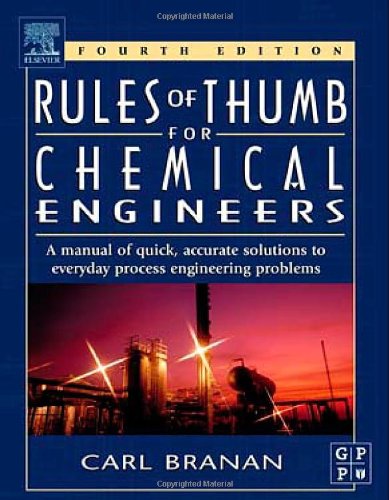
8. Rules of Thumb for Chemical Engineers
$62.19
9. Chemical Reaction Engineering,
$160.02
10. Chemical Engineering Reference
$60.85
11. Chemical Engineering Volume 3,
$130.00
12. Chemical Engineering Design and
 
13. Petroleum Refinery Engineering
$76.30
14. Numerical Methods for Chemical
$44.68
15. Unit Operations of Chemical Engineering
$116.92
16. Engineering and Chemical Thermodynamics
$41.58
17. Introduction to Chemical Engineering
$54.08
18. Chemical Engineering Design, Fourth
$89.75
19. Introduction to Chemical Engineering
$56.99
20. Chemical, Biochemical, and Engineering

1. Elements of Chemical Reaction Engineering (4th Edition) (Prentice Hall International Series in the Physical and Chemical Engineering Sciences)
by H. Scott Fogler
Hardcover: 1120 Pages (2005-09-02)
list price: US$135.00 -- used & new: US$110.12
(price subject to change: see help)
Asin: 0130473944
Average Customer Review: 4.5 out of 5 stars
Canada | United Kingdom | Germany | France | Japan

Customer Reviews (16)

4-0 out of 5 stars Very clear about concepts
The book was very clear in the concepts it introduced. Laid out clearly the derivations and especially appreciated the topic sentence on the side of each paragraph. Although the book is clear in the text, I wish the summaries at the end of each chapter would list the assumptions that it makes for each equation so you don't have to look back to the rest of the chapter.

5-0 out of 5 stars Absolutely worth buying
This book is good not only as a text book because of the simple way it presents the subject, the problems, and the complementary examples on the CD. It is also a great reference, because it has every chapter sumarized by the end, with the formulas. It includes multiple examples both on the book and the Cd, and allows full use of computational tools applied on the problem solving.

4-0 out of 5 stars Excellent Book
Best book by far that I have had as undergrad.Highly recommended.We all love it at the University of Utah.

5-0 out of 5 stars Great Book
This has been the best chemical engineering book in my undergraduate education, BY FAR. Not only does the book rpesent concepts that are easy to understand, but they are also reinforced continually with plenty of example problems from the accompanying CD. The CD also has a few modules and "games" to help out. All in all, from the standpoint of an undergraduate dealing with this course material, the book is excellent in helping students with different learning styles learn the material. I have no knowledge whether the depth of the subject is thorough enough for real world applications, but I suspect it is.

5-0 out of 5 stars Excellent Book
In contrast with what my fellow Ann Arbor reviewer (and most likely UM ChE student), I tended to think that Fogler's book was an excellent way by which to learn the principles of Chemical Reaction Engineering. The book is well organized and while the chapters may skip some, the principle chapters (1-6 in the sixth printing) are the recommended starting chapters.Once passing through chapters 1 - 6, the topics do deviate some, but the fundamental principles necessary to understand any of the topics in chapters 7 and beyond are well established prior to engaging the later material.While my colleague from Ann Arbor may be correct in noting that there are several different printings of the third edition text, Fogler provides adequate typo errors on the text website. In terms of POLYMATH, Fogler does rely on this computer software to show many of the examples in his book.For a good bulk of the examples and homework problems, however, the operation of POLYMATH is extremely easy. If one knows how to type equations into a table and press a 'calculate' button, one can easily run POLYMATH. Fogler provides the program on the CD that accompanies the text. It makes solving differential equations (and their solution curves) much easier than doing so by hand.

I must say that this is the best Chemical Engineering textbook I've had as a student (Geankopolis was a close second). Fogler establishes the principles of CRE well, and the language of the text is not above and beyond reading comprehension.The style Fogler uses is very algorithmic, which, after utilizing the algorithm over and over again, makes reactor design problems much easier to deal with.

Having been one of Fogler's students, I will agree that he tries very hard to relate to students.He is the only professor I've had that tries to learn each student's name.While there might be a few interesting (cheesy) examples and illustrations in the book, they do at times provide some comical relief from the rigors of Chemical Reaction Engineering. Not to mention, the additional material (Interactive Computer Modules, Real World Examples, Chaper Notes, Self Tests) that Fogler provides on the text CD an website are available to further enrich the mind of a struggling learner.

This book, at least from a student's perspective, is wonderful! ... Read more


2. Introduction to Chemical Engineering Thermodynamics (The Mcgraw-Hill Series in Civil and Environmental Engineering)
by J.M. Smith, Hendrick C Van Ness, Michael Abbott
Hardcover: 840 Pages (2004-11-12)
list price: US$173.44 -- used & new: US$82.50
(price subject to change: see help)
Asin: 0073104450
Average Customer Review: 4.0 out of 5 stars
Canada | United Kingdom | Germany | France | Japan
Editorial Review

Book Description
Introduction to Chemical Engineering Thermodynamics, 7/e, presents comprehensive coverage of the subject of thermodynamics from a chemical engineering viewpoint. The text provides a thorough exposition of the principles of thermodynamics and details their application to chemical processes. The chapters are written in a clear, logically organized manner, and contain an abundance of realistic problems, examples, and illustrations to help students understand complex concepts. New ideas, terms, and symbols constantly challenge the readers to think and encourage them to apply this fundamental body of knowledge to the solution of practical problems.

The comprehensive nature of this book makes it a useful reference both in graduate courses and for professional practice. The seventh edition continues to be an excellent tool for teaching the subject of chemical engineering thermodynamics to undergraduate students. ... Read more

Customer Reviews (4)

4-0 out of 5 stars Pretty good for a book you grow to hate
As far as text books go, this one is not bad.It's decently well written and put together.There are a lot of graphs and diagrams to explain the material.There are not as many example problems as there need to be, but the questions at the end of the chapter are very straightforward.Not a very extensive reference section either.

5-0 out of 5 stars Wonderful book, fast shipping from amazon
No one can even think about any flaw for that book. Wonderful book. Amazon's service is the best too

5-0 out of 5 stars Solid textbook
This is a solid thermo textbook. Goes over concepts and theories fairly well. There are plenty of worked out examples throughout the chapters and appendixes so you know what you're doing. The authors explain everything in a clear and cohesive manner. Somethings are overwhelming, but it is thermodynamics. Plenty of appendixes for steam tables, interroplation, unit conversions, and virial equation constants, etc.

I suggest you get the Schaum's outline as a good reference too.

1-0 out of 5 stars False advertisement
I received the book, but not what I was expecting. The book was advertised as a hardback, but the book received was paperback.The book was an international edition, and not for resale in North America. ... Read more


3. Basic Principles and Calculations in Chemical Engineering (7th Edition) (Prentice Hall International Series in the Physical and Chemical Engineering Sciences)
by David M. Himmelblau, James B. Riggs
Hardcover: 1072 Pages (2003-12-18)
list price: US$133.00 -- used & new: US$86.45
(price subject to change: see help)
Asin: 0131406345
Average Customer Review: 5.0 out of 5 stars
Canada | United Kingdom | Germany | France | Japan
Editorial Review

Book Description
Now in its sixth edition, this book is the definitiveintroduction to chemical engineering principles and calculations.A CD-ROM andcomputer disk are included, offering worked out problems for each section of the book,plus POLYMATH, FORTRAN programs, and YAW's data. Coversthe principles and techniques of chemical engineering involving gases, vapors, liquids andsolids; shows how to formulate and solve problems in chemical engineering; anddescribes the proper use of units, physical properties and computers in solving material andenergy balances.For chemical engineers and technicians, andprofessionals in the fields of environmental engineering and petroleum engineering. ... Read more

Customer Reviews (7)

5-0 out of 5 stars Great Textbook
This was the book that got me started in Chemical Engineering. Nowadays, I solve a problem every few years and need a refresher. The first chapter starts out with details on units and basic concepts. The next chapter evolves into more and more complicated material balances. The following chapters discuss concepts such as adiabatic flame temperature, Clausius-Clapeyron's equation (vapor pressure relates to heat of vaporization), average heat capacity and enthalpy of flue gases, psychrometry (water-air only), etc.. In the final section, the complexity of combined heat and material balances is addressed.

In all, this is an excellent book for an introduction to Chemical Engineering or, as I use it now, as a great reference. I've had to retire my first copy and am using a new version. One bit of advice: get good copies of large and small psychrometry charts: 10-110 F dry bulb (small chart); 10-260+ (large chart).Put these in an envelope in the flap of the book for quick access.

If this review was helpful, please add your vote.

5-0 out of 5 stars A well written book
I bought this book when I was taking my course in material and energy balances, I have got the one by Felder and Rosseau which I thought, no offence to the authors, totally awful, and not good for self-teaching at all. I have another title ("Introduction to Chemical Processes") by Regina Murphy which although not on the same level as this, is a much light-hearted approach to the same subject matter. On the whole for anyone who wants to teach and understand material and energy balances for Chemical Engineers, this book is one I would recommend highly.

5-0 out of 5 stars From an Industrial Practitioner of Process Measurement & Control
This book is an excellent reference on Chemical Engineering Principles and Calculations for any engineer or practitioner working in the process industries. I am an Electronic Engineer, but I have been working for the last 16 years as an Instrumentation, Automation and Process Control Engineer for the Oil & Gas Industry. As a result I have been involved with Chemical Engineering issues in a day to day basic.

I have found this book to be an ideal self-study guide. In this Edition the authors have included several categories of problems sets to assist in self-study. Self-assessment tests with answers (in Appendix A) follow each section, and thought and discussion problems follow the self-assessment tests.

If a non Chemical Engineer can learn Chemical Engineering Principles from this book, I guarantee that any Chemical Engineering student or practitioner will find this readable textbook very useful.

5-0 out of 5 stars Chemical/Process Engineer
This book is well worth the money.I was very impressed by the examples and excellent explanations.Highly recommend this book to any chemical or process engineer

5-0 out of 5 stars A winner text!
This book is a classic . With all my respects to the next authors , this book belongs from its initial release to a selected dinasty of works made with an unusual passion style , and that invisible factor seems to make the clear difference . The presentation , the precise comments and the appraoch given to every chapter where the essential concepts of Mass balance or Energy balance are so brilliantly shown that it is literally impossible for you not to win with this .
And after you bought it you will wonder in silent voice of course ( Do we need a teacher for Chemical Engineering Principles? ) .
If you acquire this one and then the Whitwell and Tonner (see my review) , How can you lose ?
Fundamental for Chemical , Production and Industrial Engineering. ... Read more


4. Chemical Engineering Volume 2 (Chemical Engineering)
by J H Harker, J R Backhurst, J.F. Richardson
Paperback: 1232 Pages (2002-06-15)
list price: US$75.95 -- used & new: US$62.91
(price subject to change: see help)
Asin: 0750644451
Average Customer Review: 5.0 out of 5 stars
Canada | United Kingdom | Germany | France | Japan
Editorial Review

Book Description
Chemical Engineering Volume 2 covers the properties of particulate systems, including the character of individual particles and their behaviour in fluids.Sedimentation of particles, both singly and at high concentrations, flow in packed and fluidised beads and filtration are then examined.

The latter part of the book deals with separation processes, such as distillation and gas absorption, which illustrate applications of the fundamental principles of mass transfer introduced in Chemical Engineering Volume 1. In conclusion, several techniques of growing importance - adsorption, ion exchange, chromatographic and membrane separations, and process intensification - are described.

* A logical progression of chemical engineering concepts, volume 2 builds on fundamental principles contained in Chemical Engineering volume 1 and these volumes are fully cross-referenced
* Reflects the growth in complexity and stature of chemical engineering over the last few years
* Supported with further reading at the end of each chapter and graded problems at the end of the book ... Read more

Customer Reviews (4)

5-0 out of 5 stars Adquisición
Quisiera saber donde poder comprarl

5-0 out of 5 stars A must for any Chemical Engineer
I found this book to be an excellent text and an invaluble resource for any Chemical Engineer whether a student or a working professional. The book is well laid out and a surprisingly easy read even for those beginning achem eng course. I would recommend it to anyone.

5-0 out of 5 stars An excellent book for professionals and university students.
A very good summary of chemical engineering. You can find everything you need related to mass and heat transfer. Very special thanks to Richardson and Coulson.

Mehmet ARAS, Chemical Engineer, Bayer Pharmaceuticals Co.

5-0 out of 5 stars A must for any undergraduate chem eng design project!
As a graduate chemical engineer, fortunate to be one of Ray Sinnott's students, it is with great pleasure that I write about his book. The design project is a crucial part of any undergraduate program encompassing chemical engineering or related topics,ie Bio-chemical engineering and Process Bio-technology to name just a few. It is not until the student (of one of the most complex and challenging degree schemes) becomes involved with the "design project" do they realise the problems that need to be overcome to just start the most simple of tasks. The text is a valuable tool to quick and accurate methods to start the basic design of the majority of traditional unit operations. The text of course relies on the user to have some engineering knowledge and paves the way for the application of the more rigorous software design packages that are available today.Coverage is given is to many topics in the book especially in the areas of safe design/operation and costing, with many further references given at the end of chapter. This is a book that you will buy and continue to use all your practicing life, as myself and friends will testify!! There is no other text book that I have come across which gives so much practical information, yet so easily accessed. James Evans M.Eng.(University of Wales, Swansea.(UK)) ... Read more


5. Introductory Chemical Engineering Thermodynamics (Prentice Hall International Series in the Physical and Chemical Engineering Sciences)
by J. Richard Elliott, Carl T. Lira
Hardcover: 560 Pages (1999-04-15)
list price: US$104.00 -- used & new: US$75.00
(price subject to change: see help)
Asin: 0130113867
Average Customer Review: 3.0 out of 5 stars
Canada | United Kingdom | Germany | France | Japan

Customer Reviews (10)

5-0 out of 5 stars Overall and Excellent Textbook
I have used this textbook for the last three years in my undergraduate chemical engineering thermodynamics course.Material is presented in a general way and teaches students general problem solving strategies so they can solve any problem, not just a few convenient special cases.There are numerous examples provided for each section of the text and each example is presented step by step.There are a wide range of problems provided at various levels of difficulty from easy to very difficult.In addition, the authors provide a number of Excel spreadsheets and computer programs so that students can solve very complicated phase equilibria problems with little effort.

The only negative comment I have is that the last copy of this textbook I recieved was printed poorly, and the binding fell apart after only one semester of use.The previous two copies I received did not have this problem.

In response to the poster who said their tutor called it a "waste of money", one should keep in mind that this is a chemical engineering textbook, while the Boles text is geared toward mechanical engineers.By the time chemical engineering students take thermodynamics, they have had ayear of chemistry, followed by organic chemistry and physical chemistry (or are taking p-chem at the same time as their thermodynamics course).In addition, ChE majors also get basic thermodynamics (1st Law energy balances) in Material and Energy Balances.This text picks up right where the MEB course ends.

5-0 out of 5 stars Amir Vahid
I have read the book that was written by Prof. Elliott and Prof. Lira while I was a M.Sc student in Iran. Chapter 15 captured my interests and that's why now I am a Ph.D. student in Prof. Elliott's group. I would suggest the authors to update Chapter 15 and give more FORTRAN programs related to this chapter to readers and explain it in a more coherent way. Also, they should compare their's with Sandler's thermo book to gather some new ideas for the next edition. The name of the book also should be changed for future edition since it's objective is for both undergraduate and graduate students. Finally, I should say that this book was the best thermo book I have ever read.
Amir Vahid
[...]

1-0 out of 5 stars Introductory? Says who?
I bought this book a few weeks ago thinking that it will give me a good base to begin my first thermo course next year. I was so lost and confused by the book that I immediately sought help, and my tutor told me that I hadcompletely wasted my money.If you are someone who has never done thermobefore, like myself, save your money for something more useful: there isnothing introductory about this text.Try checking out Thermodynamics: AnEngineering Approach by Boles (a MUCH better introductory text-book).

3-0 out of 5 stars Makes you work!
I think the text was pretty good; it made you consult references frequently, and that is a necessary skill to have as an engineer.As an engineer you have to know how to pick up theoryand put it to use quickly. The problems were rough and time consuming, but that's because no problemsin engineering are easy!When completed, though, you are satisfied.Tothe last guy:"physics" is the one major that can do anything! Everything in science is either physics or bug collecting, whether you likeit or not :)But, engineering is more marketable.

4-0 out of 5 stars This is an INTRODUCTORY to thermodynamics text
How do you write a textbook explaining everything in detail?You can't and this is why students have instructors.This book is an INTRODUCTORY text for thermodynamics.For example, you can't derive departure functionsfor every equation of state.There are just too many of them.The bookdid have many useful example problems.Still it wasn't enough.I justcompleted my thermodynamics course at the University of Akron and I had todevelop my own comprehensive view of the ideas stated in the book.It wasvery useful as a tool, but don't expect to teach yourself thermodynamicsfrom it.That's what your instructor is for.You can understand conceptsby concentrating on the many useful analogies given in the book.Forexample, the parking lot analogy which explains radial distribution.Ihave some advice when going through this book.You are chemical engineermajors; the one major that can do anything.At this stage of the game, youshould start thinking like an engineer thinks.For example, the guy whowanted to know why dh=0 for throttles.He should be try to figure out thaton his own.That is what engineers are supposed to do.Instructorsexplain this in class, as well.I agree that Chapter 4 was very vague, butagain, this is an introductory course. We have two more years of learning. In conclusion, don't expect to learn everything about thermodynamics fromthis book.You won't.But do expect to learn the basic principles aboutthermodynamics.That is the strong point of this book. ... Read more


6. Practice Problems for the Chemical Engineering PE Exam: A Companion to the Chemical Engineering Reference Manual, 6th ed.
by Michael R. Lindeburg
Paperback: 480 Pages (2003-11)
list price: US$108.00 -- used & new: US$68.04
(price subject to change: see help)
Asin: 1591260086
Canada | United Kingdom | Germany | France | Japan

7. Perry's Chemical Engineers' Handbook, Eighth Edition (Chemical Engineers Handbook)
by Don W. Green, Robert H. Perry
Hardcover: 2400 Pages (2007-10-23)
list price: US$199.00 -- used & new: US$119.94
(price subject to change: see help)
Asin: 0071422943
Average Customer Review: 4.5 out of 5 stars
Canada | United Kingdom | Germany | France | Japan
Editorial Review

Book Description

Get Cutting-Edge Coverage of All Chemical Engineering Topics— from Fundamentals to the Latest Computer Applications

First published in 1934, Perry's Chemical Engineers' Handbook has equipped generations of engineers and chemists with an expert source of chemical engineering information and data. Now updated to reflect the latest technology and processes of the new millennium, the Eighth Edition of this classic guide provides unsurpassed coverage of every aspect of chemical engineering-from fundamental principles to chemical processes and equipment to new computer applications.

Filled with over 700 detailed illustrations, the Eighth Edition of Perry's Chemcial Engineering Handbook features:

  • Comprehensive tables and charts for unit conversion
  • A greatly expanded section on physical and chemical data
  • New to this edition: the latest advances in distillation, liquid-liquidextraction, reactor modeling, biological processes, biochemical andmembrane separation processes, and chemical plant safety practices with accident case histories

Inside This Updated Chemical Engineering Guide

- Conversion Factors and Mathematical Symbols • Physical and Chemical Data • Mathematics • Thermodynamics • Heat and Mass Transfer • Fluid and Particle Dynamics Reaction Kinetics • Process Control • Process Economics • Transport and Storage of Fluids • Heat Transfer Equipment • Psychrometry, Evaporative Cooling, and Solids Drying • Distillation • Gas Absorption and Gas-Liquid System Design • Liquid-Liquid Extraction Operations and Equipment • Adsorption and Ion Exchange • Gas-Solid Operations and Equipment • Liquid-Solid Operations and Equipment • Solid-Solid Operations and Equipment • Size Reduction and Size Enlargement • Handling of Bulk Solids and Packaging of Solids and Liquids • Alternative Separation Processes • And Many Other Topics! ... Read more

Customer Reviews (31)

5-0 out of 5 stars Great version of this classic handbook
As a Chemical Engineer, I reference Perry's Handbook weekly. The CD-ROM version is much more accessible to those of us in this new computer saavy generation. The searchability (index? what's that?) and interactivity make this a worth-while buy, especially if you don't already have a paper copy ofPerry's. You can select data from a table and paste into other applications, instead of staring at the tiny print of a huge book and typing all the numbers by hand. You can also find topics quickly by the contents (which are linked to other parts of the book) and the search features. All in all, a good buy for me. WARNING! This is ONLY compatible with Windows machines. A Mac user will be able to see the information, but not use the search functions or the interactive data tables.

4-0 out of 5 stars An unbeatable resource
Perry's Chemical Engineers' Handbook handbook is really a mixed bag, and how useful it turns out to be is really a matter of what kind of information you are looking for. I've always felt that this is the definitive book if you want raw facts and numbers. The entire volume is crammed with technical data that, for some, can't be found elsewhere. All the groundwork is covered; conversion factors, symbols, kinetics, interdisciplinary studies (several), thermodynamics, and just about anything else that coincides with the field of engineering. On a personal level, I've used it on several occasions when collecting field data, but its uses go well beyond that. For the sheer amount of information covered, the volume remains fairly well organized, and never veers too far from what you are researching.

The downside is that it can often seem overwhelming to students or those with passing involvement or interest. Despite the dependable presentation, it can be difficult to understand for people who haven't been brought up to speed on the variation of the topic they wish to examine. Even though the all the data is present, understanding it won't be easy until you've familiarized yourself and comprehend the tables and usage. Some claim that the book was written primarily for academics, though I don't see that as true. Anyone can use the book effectively once they get the hang of it.

Even though it might have some drawbacks, I truly can't see how anyone in the field of Chemical Engineering could not have this book on their shelf. It is the ultimate source of chemical data and interdisciplinary studies. If you don't yet own this one, I really can't see how you can go wrong in purchasing it.

5-0 out of 5 stars This is so funny
Check out what that kid wrote on October 25, 1999. He gave the book one star. Someone find him and tell him how much of an idiot he is.He wrote the dumbest thing I have ever seen.Who the hell reads Perry's cover to cover.Is he really that dumb just go buy a book about making bombs if you want to "make bombs".Another thing any normal person would realize after the first million pages is that Chemical Engineers don't learn how to make bombs.what a retard.Oh yeah, good book

4-0 out of 5 stars Good service
I got the book in a very short time and the process was also quick. 2 years ago, I had a problem with an Amazon affiliated store and took me such a long time to get my money refunded but this time, Amazon did a great job.

Thank you for shipping in time!

5-0 out of 5 stars Practicing Professional Feedback
Well, I have used it a couple of times for / during many of our field assignments, where we needed authentic information. The charts & tables contained in it are highly useful ... Read more


8. Rules of Thumb for Chemical Engineers
by Carl R. Branan
Paperback: 496 Pages (2005-08-16)
list price: US$103.00 -- used & new: US$81.23
(price subject to change: see help)
Asin: 0750678569
Average Customer Review: 4.5 out of 5 stars
Canada | United Kingdom | Germany | France | Japan
Editorial Review

Book Description
This new edition of the most complete handbook for chemical and process engineers incorporates the latest information for engineers and practitioners who depend on it as a working tool. New material explores the recent trends and updates of gas treating and fractionator computer solutions analysis. Substantial additions to this edition include a new section on gasification that reflects the many new trends and techniques in the field and a treatment on compressible fluid flow.

This convenient volume provides engineers with hundreds of common sense techniques, shortcuts, and calculations to quickly and accurately solve day-to-day design, operations, and equipment problems.Here, in a compact, easy-to-use format, are practical tips, handy formulas, correlations, curves, charts, tables, and shortcut methods that will save engineers valuable time and effort.

* The standard handbook for chemical and process engineers

* All new material on pinch point analysis on networks of heat exchangers and updates on gas treating in process design and heat transfer

* Hundreds of common sense techniques and calculations ... Read more

Customer Reviews (5)

5-0 out of 5 stars Useful but read the fine print
This reference is highly useful for consulting work. It has its limits. A true rule-of-thumb book for chemical engineers would require volumes so I would say the author did well, hence the 5 stars. A good example of the limits of this book are what he does with knock-out pots. He limits his presentation to reflux drums instead of expanding his study to KO pots in general. The section on reflux drums is difficult to use because the tables presented for liquid holding times is difficult to understand, let alone use. The reader would be tempted to use this method for KO pots unless he sees the fine print in the corner of the page. Look for these caveates.

The index is good, which is critical for such a reference. If I had a choice between buying Hicks or Branan, it would be a hard choice. I would probably advise the cheaper book, Branan. Besides, Hicks, "Standard Handbook of Engineering Calculations," covers a broad range of engineering calculations. Branan is more focused on chemical engineering. It is unfortunate that it is not expanded to cover more of the field.

If this review was helpful, please add your vote.

3-0 out of 5 stars Question about Units used (US and Metric?)
Hi

I do not have a copy of the current edition, but a year ago I investigated purchasing a previous edition. What deterred me at the time was that all tips, tricks and equations etc. were in US units and thus only of very limited appeal to the Metric world.

A question to a reviewer of the 4th edition - has the book become "international", i.e. quoting metric and US units? If not, it shall remain of limited desirability in the free world.

Roland

5-0 out of 5 stars From an Industrial Practitioner - This is an Excellent Quick Reference
This book is an excellent and priceless reference on Process Equipment Fundamentals and Quick Calculations for any engineer or practitioner working in the process industries. I am an Electronic Engineer, but I have been working for the last 16 years as an Instrumentation, Automation and Process Control Engineer for the Oil & Gas Industry. As a result I have been involved with Chemical Engineering issues in a day to day basic.

I have found this book to be an excellent tool aid to analyze operational problems that affect process performance.

Chemical engineers working in operations and design for the process industries will find this book most useful.

5-0 out of 5 stars A MUST HAVE books for Chemical Engineers
This is one of the few MUST HAVE books for Chemical Engineers doing process engineering.When I travel (for work) I always take "Transport Phenomena" (aka BSL), The GPA Databook and "Rules of Thumb for Chemical Engineers".Rules of Thumb... is a great reference for process design and trouble shooting field problems.

A Practical Tip: The best thing to do with "Rules of Thumb for Chemical Engineers" is to carefuly remove the binding and put it into a 3-hole notebook (e.g., the GPA databook) and then file all the classic process design articles with the appropriate chapters.

5-0 out of 5 stars Outstanding compilation
This is a 400+ page perfect-bound book, 8-1/2 x 11 inch formt, packed with tips and short cuts for practicing chemical engineers. Branan has essentially scoured the popular press (e.g, Chemical Engineering Magazine,Hydrocarbon Processing, etc.) for articles and data. He's captured thatdata and organized it into his volume. In so doing, he omits most of theexplanatory text and derivations. Instead, he prints the actual data,formulas, recommendations, and definitions (and, of course, references tothe source material). This makes for a highly accessible book withtremendous practical value.

There are four main sections: 1) equipmentdesign, 2) process design, 3) plant design, and 4) operations.

Forexample, one of the chapters within plant design is called"Safety." It contains the following parts: - Estimating LEL andFlash (provides method for estimating LEL given the stoichiometry ofcombustion and a vapor pressure curve) - Tank Blanketing (method fordetermining inert gas requirements for breathing losses and working losses;includes data maps of the US) - Equipment Purging (for dilution,pressure-cycle, and vacuum-cycle purging) - Static Charge from Fluid Flow(reprint of an article from Hydrocarbon Processing) - Mixture Flammability(method and examples for estimating) - Relief Manifolds (describes methodadopted by API)

In short, if you are practicing process engineering forplant design or maintenance, you should have this book. ... Read more


9. Chemical Reaction Engineering, 3rd Edition
by Octave Levenspiel
Hardcover: 688 Pages (1998-08-13)
list price: US$142.95 -- used & new: US$62.19
(price subject to change: see help)
Asin: 047125424X
Average Customer Review: 3.5 out of 5 stars
Canada | United Kingdom | Germany | France | Japan
Editorial Review

Book Description
Chemical reaction engineering is concerned with the exploitation of chemical reactions on a commercial scale. It's goal is the successful design and operation of chemical reactors. This text emphasizes qualitative arguments, simple design methods, graphical procedures, and frequent comparison of capabilities of the major reactor types. Simple ideas are treated first, and are then extended to the more complex. ... Read more

Customer Reviews (10)

3-0 out of 5 stars PRETTY GOOD
This book is gokay for introduction of Chemical Reactors and all that.However, I would highly recommend that you purchase a used one.It just not worth buying a new copy.

1-0 out of 5 stars Worst Chem E book ever
I think this is the worest Chem E book ever.too bad its one of the only aviablable books for reaction engineering since levenspeil was the first to do alot of these things back in the 50s and 60s.there are numerous mistakes in every chapter.Be weary when using this book to study from.

4-0 out of 5 stars A decent undergraduate book
CRE is not a bad book. The author does a good job of explaining reactor design fundamentals, from simple kinetic models to complex reactor systems involving heat/material transfer or multiple reaction contents.He lays the groundwork well early on be using simple, clear examples.There are numerous typos (mostly in the text, though, not the problems. The text itself is in large and legible type.In addition, the book is not overcrowded-like a lot of life science books-with meaningless pictures, text, history, etc (but it might take the boredom meter to a new level for some readers).Although not a big deal, Levenspiel uses some language that makes you kinda wonder what planet he came from.Also, the author puts all the variable nomenclature at the beginning of the book, which is really annoying because you have to flip back and forth until you memorize each character variable.Other than that, it should be adequate to get you through the course w/o a great deal of trouble.

2-0 out of 5 stars Too detailed
As a final year undergraduate, I find that this book is fairly useless. Although the information is in there, it is nigh on impossible to find. It would probably be of use to someone who is working on research in that field, but to a student who has not yet done such detailed work, don't bother. Save your money and spend it on beer.

4-0 out of 5 stars A good book at higher level
I used this book as a textbook in my undergraduate. In an undergraduate study, it is necessary to have new concepts explained to you in a unified manner so that ones sees where all the chemical engineering subjects areheading to. Chemical reaction engineering (CRE) basically deals with energyand material balance applied to chemical reactors to achieve a givenpurpose. The book tells you all the fundamentals about the chemicalreaction engineering, the underlying principles but fails to draw thismessage straight that CRE is nothing but application of energy and materialbalance. And at undergraduate level, I could not draw this inference on myown and learned it in the graduate class when I took the advanced levelcourse. The book also does not deal with the modern tools of solvingreactor design problems with computers. We used Fogler's text book for first few classes in Graduate school. I would recommend this book which could be used as an undergraduate as well as graduatetext/reference book. If you need to go to the earlier work and want topursue research in this field, then Levenspiel is good as it has someoriginal work references ( I believe this is an old book on CRE). Once youhave the feel for the subject than the use of this book is undisputed. Butif you are using this book to study CRE first time then I would recommendyou use some good text book.

Additional comments 6 years later: I am currently using this books to solve some real industry problems and it has become clear to me how good this book is. Though I stick to my earlier comments which were written when I was fresh in to my graduate school for two reasons: how I felt about this book in my undergrad class and how much I learned from Fogler in Graduate level class. But Levenspiel does good justice to all the concepts in chemical reaction engineering and would definitely recommend it as a reference book. It provides many ways to analyze a chemical data and interpret it to determine the kinetics. ... Read more


10. Chemical Engineering Reference Manual for the PE Exam, 6th ed.
by Michael R. Lindeburg
Hardcover: 1120 Pages (2003-11)
list price: US$254.00 -- used & new: US$160.02
(price subject to change: see help)
Asin: 1591260078
Average Customer Review: 3.5 out of 5 stars
Canada | United Kingdom | Germany | France | Japan

Customer Reviews (4)

5-0 out of 5 stars Two books which I will stay away from.
I already read this book. As we all know there is a rank in engineering, and a colleague of mine called the NCEES and was simply told that if you want your PE wake up and go to work. We are still thinking.

1-0 out of 5 stars Not good
Like mentioned before written by a non Ch E.
Especially Kinetics is very very week.
I wouldn't recommend it to anybody.
Get yourself a copy of mccabe smith, van ness, Chemical process principles and Levenspiel. That's all you need.

3-0 out of 5 stars Written by a non-chemE
I just wrote a long review and the browser crashed...

The book is lacking in bread-and-butter chemE material.Mass transfer problems are all very simple and solutions are only presented graphically (what if there isn't a graph on the test?).The Kinetics section is only 8 pages long!!!That is only 8 pages to summarize the reaction rates, Plug flow, CSTRs and other goodies.It really need more kinetics.

I'd still buy it again.

5-0 out of 5 stars Must have for the exam
This is a must have for the PE just like Perry's handbook for Chemical engineering.The whole Lindeburg series is good.The practice problem companion has 450 problems!

Also recommend other classic Chemical engineering books:
Levenspiel - Kinetics
McCabe-Smith-Harriott - Unit Ops
Crane Technical Paper 410

Other study materials:
PE practice problems from NCEES
PE exam from Nandagopal
Six-minute problems for PE exam ... Read more


11. Chemical Engineering Volume 3, Third Edition: Chemical and Biochemical Reactors & Process Control (Chemical Engineering Technical Series)
Paperback: 778 Pages (1994-01-01)
list price: US$70.95 -- used & new: US$60.85
(price subject to change: see help)
Asin: 0080410030
Canada | United Kingdom | Germany | France | Japan
Editorial Review

Book Description
The publication of the third edition of 'Chemical Engineering Volume 3' marks the completion of the re-orientation of the basic material contained in the first three volumes of the series. Volume 3 is devoted to reaction engineering (both chemical and biochemical), together with measurement and process control. This text is designed for students, graduate and postgraduate, of chemical engineering. ... Read more


12. Chemical Engineering Design and Analysis: An Introduction (Cambridge Series in Chemical Engineering)
by T. Michael Duncan, Jeffrey A. Reimer
Hardcover: 400 Pages (1998-09-13)
list price: US$130.00 -- used & new: US$130.00
(price subject to change: see help)
Asin: 052163041X
Average Customer Review: 5.0 out of 5 stars
Canada | United Kingdom | Germany | France | Japan
Editorial Review

Book Description
Students taking their first chemical engineering course plunge into the "nuts and bolts" of mass and energy balances, often missing the broad view of what chemical engineers do. This innovative text offers a well-paced introduction to chemical engineering.The text helps students practice engineering.They are introduced to the fundamental steps in design and three methods of analysis: mathematical modeling, graphical methods, and dimensional analysis.In addition, students apply engineering skills, such as how to simplify calculations through assumptions and approximations; how to verify calculations, significant figures, spreadsheets, graphing (standard, semi-log and log-log); and how to use data maps. It also describes the chemical engineering profession.Students learn engineering skills by designing and analyzing chemical processes and process units in order to assess product quality, economics, safety, and environmental impact. This text will help students develop engineering skills early in their studies and encourage an informed decision of whether to study chemical engineering.Solutions manual available. ... Read more

Customer Reviews (3)

5-0 out of 5 stars CHEMICAL ENGINEERING DESING AND ANALYSIS
INGENIERIA QUIMICA DISEÑO Y ANALISIS

5-0 out of 5 stars CHEMICAL ENGINEERING DESING AND ANALYSIS
T MICHAEL DUNCAN,JEFFREY A.REIMER

5-0 out of 5 stars An excellent introduction for the beginning student
This book presents the concepts of chemical engineering at a basic levelfor a student at the introductory level. Topics are discussed logically andconcisely with an appropriate level of detail to give the student a solidfoundation for further study. This book assumes only a basic high schoollevel math and chemistry education. As a first year college student, Ifound the book extremely helpful. It explained the material in a clear andstraightforward manner. I recommend this book to any student interested inbeginning a career in chemical engineering. ... Read more


13. Petroleum Refinery Engineering (Chemical Engineering)
by Wilbur L. Nelson
 Hardcover: 960 Pages (1958-01-01)
list price: US$95.00
Isbn: 0070462682
Canada | United Kingdom | Germany | France | Japan

14. Numerical Methods for Chemical Engineering: Applications in MATLAB
by Kenneth J. Beers
Hardcover: 486 Pages (2006-10-30)
list price: US$85.00 -- used & new: US$76.30
(price subject to change: see help)
Asin: 0521859719
Average Customer Review: 5.0 out of 5 stars
Canada | United Kingdom | Germany | France | Japan
Editorial Review

Book Description
Suitable for a first year graduate course, this textbook unites the applications of numerical mathematics and scientific computing to the practice of chemical engineering. Written in a pedagogic style, the book describes basic linear and nonlinear algebric systems all the way through to stochastic methods, Bayesian statistics and parameter estimation. These subjects are developed at a level of mathematics suitable for graduate engineering study without the exhaustive level of the theoretical mathematical detail. The implementation of numerical methods in MATLAB is integrated within each chapter and numerous examples in chemical engineering are provided, with a library of corresponding MATLAB programs. This book will provide the graduate student with essential tools required by industry and research alike. Supplementary material includes solutions to homework problems set in the text, MATLAB programs and tutorial, lecture slides, and complicated derivations for the more advanced reader. These are available online at www.cambridge.org/9780521859714. ... Read more

Customer Reviews (1)

5-0 out of 5 stars excellent intro to applied math, not just for chemical engineers
This is extremely well written, combining both intuition and rigour. It has good accompanying matlab demos.It should be of interest to many people who use numerical methods (integration, optimization, eigen analysis, etc), not just chemical engineers. ... Read more


15. Unit Operations of Chemical Engineering
by Warren L. McCabe, Julian Smith, Peter Harriott
Paperback: 1152 Pages (2005-02-01)
list price: US$91.40 -- used & new: US$44.68
(price subject to change: see help)
Asin: 0071247106
Average Customer Review: 4.0 out of 5 stars
Canada | United Kingdom | Germany | France | Japan
Editorial Review

Book Description
This text contains much updated and new material in new areas such as fool processing, electronics, and biochemical applications. It is a text written for undergraduate students in the junior or senior years. An elementary knowledge of material and energy balances and of thermodynamic principle is assumed. ... Read more

Customer Reviews (11)

5-0 out of 5 stars A Chemical Engineering Classic
Some prior reviewers are mistaken about this book being an annotation of Perry or of little value. The "unit operations" are the framework of chemical engineering. McCabe and Smith was the definitive work on unit operations when I was a student in the 1960's. Updated and with additional authors, it still is.

5-0 out of 5 stars Excellent book
Warren McCabe has written a unit operations book that is most adequately utilized for fluid mechanics.The separations sections are slightly abbreviated, and lack more refined details that might be found in a more specialized work.However, as a student in a separations course, I found myself referencing this book several times.The examples in the chapters were 'open-ended' enough to require real engineering problem-solving skills. Overall, an extremely well put-together text.

5-0 out of 5 stars fluid mechanics ,transprtation of fluids
it is the best books i have ever read in my semester ofchemical engineering. the topic i like the most, is transportation offluids .this book is recommended by my professor. the matter of turbulent flow and laminar flow is just fantastic.

thank you!

1-0 out of 5 stars This book is inadequte
I feel that this book is inadequte for students and professionals alike. It does not explain well how systems act in real life situations, like most academia books

4-0 out of 5 stars Good for students yet too general for professionals
I work in the chemical operations sector.I will highly recommend this book for 3rd or 4rth year future chemical engineers.It contains viable information on many units that they will just have to know about.However,I will not recommend it for working operation engineers.It is too generalfor us, it doesn't problem shoot units such as pumps and compressors.Idon't think that I have much use for this book, specially that I own thePerry's Handbook. ... Read more


16. Engineering and Chemical Thermodynamics
by Milo D. Koretsky
Hardcover: 580 Pages (2003-11-12)
list price: US$142.95 -- used & new: US$116.92
(price subject to change: see help)
Asin: 0471385867
Average Customer Review: 3.5 out of 5 stars
Canada | United Kingdom | Germany | France | Japan
Editorial Review

Book Description
This is a conceptually based text that will provide the reader with a solid foundation in chemical thermodynamics. While being accessible, it will also be rigorous enough to provide the basis for more advanced treatises. ... Read more

Customer Reviews (3)

2-0 out of 5 stars Where is the beef? Totally not recommendable for NE1, sorry!
There are many intro texts on thermo out on the market the most valuable and popular of which have been listed and categorized in Koretsky's Appendix F2. Dazzled by the brilliant quality of most other WHE Wiley Higher Education books you have spotted this BRAND NEW Wiley product somehow somewhere and now ask yourself how it compares, since you cannot find it in your J-college library or on site bookstore. If you did, you would not even go for my review here, I am sure.Short, it does +not+ compare: it's not even a competitor! So I should not be reviewing it here in my AMAZON.COM-review 'list of truely competing thermo texts'. I still do because you have always been interested in WHE titles, and especially in its NEW publications. Otherwise you would not be here reading this review ;-)
First you will immediately notice that the book is remarkably short (498p) and not prettily layout; this is +not+ a matter of taste: the book typeset +is+ ugly and makes it look old (-fashioned)! Second, you will notice the inaccurate ("incomplete") notation of state variables dependencies, state functions, equations and formulas, as compared to Sandler's-book. Third, after page browsing through the entire book, you will notice that the book +is+ different in conception, structure and actual setup from most other thermo books. Good or not? Well, all chapters begin very promising with long narrative introductions but after having read the (surprisingly short) chapters you ask yourself 'was that all?' and 'wasnt anything missed out and where's the beef?'. And you are right, the book +is+ incomplete in numerous respects. On the one hand, the explanations of concepts together with the nice and many figures (generally you dont see that many illustrations in thermo texts, do you?) are very good and helpful. Text, side equations/formulas and examples are integrated into one solid unitary flow, which makes the thermo (intro) narration easy to read and follow. On the other hand, this unity/flow doesnt allow for a systematic, well-structured, organized development of main formulas: the disorganization of presented material can lead to considerable confusion (similar to SmithVanNess-book!).
Tragically the beef (the Appendices start on page 499. the very last page number is 553, so the book +is+ short in scope) has been cut down to some concise and superficial yet neat treatment of the most often used and practical equations in thermo, only. Incomplete book, in fact I am missing many many basic formulas, usually presented in form of collection of equations or a collective table.
Examples are stepwise detailed, good!, but contentwise trivial, bad! Same with the end-of-chapter problems which hardly surpass the introductory educational level. Wiley's new product: Missing depth, missing advanced material, missing completeness, missing comprehensiveness. So why buy? Only for the good narrative flow and good explanation/visualization of concepts? No. Better choose one from the Appendix F2!
I dont expect any other reviewer to defend the overall quality of this rare disappointment by WILEY HIGHER EDUCATION. I dont expect any student (libraries yes) to decide for this text if he/she's given free purchase choice among all competitors (Koretsky's cannot be called a competitor!). I do expect the publisher to discontinue it after this first edition c2004. But hey, before WILEY does so...go and get a copy of the FREE ThermoSolver software. It is the most outstanding and recommended feature of Koretsky's book and a true masterpiece of software engineering!
Rated two stars. One for the highly useful software, half a star for the collective of the few Pro's (helpful figures, many figures, integrative flow of narration, good explanation of concepts), and another half for WILEY's courage to release a didactically new, conceptually based teaching approach to introductory chemical thermodynamics (but what a failure the total outcome, the end product!). If you are bored (like me), feel free to check out a library copy, otherwise stay with your purchased Sandler's and supplemental readings published by Prentice Hall, Butterworth-Heinemann, Wiley-Interscience, and Springer (see Appendix F2, and the commented list in Poling/Prausnitz/O'Connell 5th ed. 2001). And if you can wait, a new edition of Sandler's (4/E) is expected to be out in spring 2006! (more prospective info at wiley.com or globalbooksinprint.com)

4-0 out of 5 stars First edition, but oh well
This text is good for exactly what it claims:the undergraduate.If you're looking for a good general text on thermodynamics that you can use throughout your career (even as a graduate student), this is NOT it.But if you're looking for an easy-to-approach and helpful book that spoon-feeds you the (admitedly difficult the first time) concepts of thermodynamics, this is the text for you.Koretsky himself is upfront about this in the preface.There are a lot of funny errors in this printing (look in the front cover to see that the units for gravitational acceleration are m^2/s and that a m^3 is only 10^-3 L.That would be a LOT of Coke).But hey, even BS&L (the hailed transport phenomena text of chemical engineering) is full of them (if you don't believe me, check out the correngia on Bird's website at U of W).The charts in the back are somewhat complicated to use, at least a lot more than my favorite textbook of all time, Felder and Rosseau's Introduction to Chemical Engineering. In conclusion, good for the confused and undergraduate, of little value to the graduate and practicing.

5-0 out of 5 stars Glib but I Like It.
VLE by EOS done by hand useing VanderWaal instead of peng-robinson which requires computer.By truncating exponent author makes compressor & turbine calculations, such as for a brayton cycle analysis, possible with a cheap $10 calculater instead of an expensive $100 RPN device.I'm keeping it. ... Read more


17. Introduction to Chemical Engineering Computing
by Bruce A. Finlayson
Paperback: 360 Pages (2006-01-09)
list price: US$54.95 -- used & new: US$41.58
(price subject to change: see help)
Asin: 0471740624
Average Customer Review: 4.0 out of 5 stars
Canada | United Kingdom | Germany | France | Japan
Editorial Review

Book Description
An innovative introduction to chemical engineering computing

As chemical engineering technology advances, so does the complexity of the problems that arise. The problemsthat chemical engineers and chemical engineering students face today can no longer be answered with programs written on a case-by-case basis. Introduction to Chemical Engineering Computing teaches professionalsand students the kinds of problems they will have to solve, the types of computer programs needed to solve

these problems, and how to ensure that the problems have been solved correctly.

Each chapter in Introduction to Chemical Engineering Computing contains a description of the physicalproblem in general terms and in a mathematical context, thorough step-by-step instructions, numerous examples,and comprehensive explanations for each problem and program. This indispensable text features Excel,MATLAB(r), Aspen PlusTM, and FEMLAB programs and acquaints readers with the advantages of each.

Perfect for students and professionals, Introduction to Chemical Engineering Computing gives readers the professional tools they need to solve real-world problems involving:
* Equations of state
* Vapor-liquid and chemical reaction equilibria
* Mass balances with recycle streams
* Mass transfer equipment
* Process simulation
* Chemical reactors
* Transfer processes in 1D
* Fluid flow in 2D and 3D
* Convective diffusion equations in 2D and 3DDownload Description
An innovative introduction to chemical engineering computing As chemical engineering technology advances, so does the complexity of the problems that arise. The problemsthat chemical engineers and chemical engineering students face today can no longer be answered with programs written on a case-by-case basis. Introduction to Chemical Engineering Computing teaches professionalsand students the kinds of problems they will have to solve, the types of computer programs needed to solve these problems, and how to ensure that the problems have been solved correctly. Each chapter in Introduction to Chemical Engineering Computing contains a description of the physicalproblem in general terms and in a mathematical context, thorough step-by-step instructions, numerous examples,and comprehensive explanations for each problem and program. This indispensable text features Excel,MATLAB(r), Aspen PlusTM, and FEMLAB programs and acquaints readers with the advantages of each. ... Read more

Customer Reviews (1)

4-0 out of 5 stars Introduction to Chemical Engineering Computing
The book covers the various computational tools required by students and chemical engineers and gives a broad spectrum of chemical engineering subjects with the exception of process control. It would be nice to see more examples with Excel spreadsheet and Matlab in the revised edition. As an introductory text in Chemical engineering computing, I think FEMLAB should be excluded, and perhaps more emphasis on HYSYS or ASPEN process simulator. In all, Professor Finlayson has done a remarkable job in introducing his lectures at the University of Washington to the readers.

A. Kayode Coker ... Read more


18. Chemical Engineering Design, Fourth Edition: Chemical Engineering Volume 6 (Coulson & Richardson's Chemical Engineering)
by R K Sinnott
Paperback: 1056 Pages (2005-07-08)
list price: US$65.95 -- used & new: US$54.08
(price subject to change: see help)
Asin: 0750665386
Average Customer Review: 4.5 out of 5 stars
Canada | United Kingdom | Germany | France | Japan
Editorial Review

Book Description
Chemical Engineering Design is one of the best-known and widely adopted texts available for students of chemical engineering. It deals with the application of chemical engineering principles to the design of chemical processes and equipment. Revised throughout, the fourth edition covers the latest aspects of process design, operations, safety, loss prevention and equipment selection, among others. Comprehensive and detailed, the book is supported by problems and selected solutions. In addition the book is widely used by professionals as a day-to-day reference.

* Best selling chemical engineering text
* Revised to keep pace with the latest chemical industry changes; designed to see students through from undergraduate study to professional practice
* End of chapter exercises and solutions ... Read more

Customer Reviews (3)

4-0 out of 5 stars Great Product
This book is an excellent book for a Chemical Engineer final year student or Chemical/Process Engineer professional. It outlines the whole spectrum for Process Engineer design, from management skills for a project, preferrable site location, actual design of Process equipment/vessels, etc. This book is definately an execellent buy for a Chemical/Process Engineer.

5-0 out of 5 stars A very complete and helpful guide for process design
It's a very complete guide for process design. It considers both standards and directives form US and EU. The main considerations about how to start and carry out the first steps on process design are very complete and helpful.

5-0 out of 5 stars Great Catalog for options are available
I found this book be an excellent summary of equipment capacities. There a several tables showing ranges of equipment based on a particular process variable and pro/con tables to aid in your selection. What is in short supply are anything but basic design equations for equipment. This is also true for an old favorite of mine: "Handbook of Separation Techniques for Chemical Engineers" by Philip A. Schweitzer. This textbook is less current, may be more useful for basic design, though more narrow.

My suggestion is to have Schweitzer and Sinnott's book in the design section of your professional library. Be careful with this book because it is paperback.

If this review was helpful, please vote. Thank you.
... Read more


19. Introduction to Chemical Engineering Thermodynamics
by J.M. Smith
Paperback: 789 Pages (2001-05-01)
list price: US$90.90 -- used & new: US$89.75
(price subject to change: see help)
Asin: 0071189572
Average Customer Review: 3.5 out of 5 stars
Canada | United Kingdom | Germany | France | Japan
Editorial Review

Book Description
Introduction to Chemical Engineering Thermodynamics, 6/e, presents comprehensive coverage of the subject of thermodynamics from a chemical engineering viewpoint. The text provides a thorough exposition of the principles of thermodynamics and details their application to chemical processes.The chapters are written in a clear, logically organized manner, and contain an abundance of realistic problems, examples, and illustrations to help students understand complex concepts.New ideas, terms, and symbols constantly challenge the readers to think and encourage them to apply this fundamental body of knowledge to the solution of practical problems.

The comprehensive nature of this book makes it a useful reference both in graduate courses and for professional practice. The sixth edition continues to be an excellent tool for teaching the subject of chemical engineering thermodynamics to undergraduate students. ... Read more

Customer Reviews (11)

5-0 out of 5 stars Most Established Thermo text is also most up to date
In the new 7th edition I saw for the first time an equation of state explicit for density.

5-0 out of 5 stars A fundamental text !
As Chemical Engineering demands from you three Thermodynamics , this book is for you . I do not remember any other book so well written and with so clear explanation about the fugacity concepts for instance . The solved problems about the first and second law of Thermodynamics are extraordinary .
After you are engaged with this text you will forget your teacher without missing him .

2-0 out of 5 stars Useless
Ok, so i am a chemical engineering student, and this is supposed to be the textbook. Which allegedly would later on make it a forced reference for a student. However, the only useful information is the steam tables, because the properties and other things are insufficient, trust me, the book has sitted on my shelf unused for a year and a half. I have not sold it because no one here would buy it. The explanations are poor. If you want to know about thermodynamics, this is really not your book, I would rather recommend a Fisicochemistry book.

As for properties tables and the such, well, the information you are really going to use is all summed up in the Chemical Engineer's Handbook, which is a must for any ChE, even if you're just a student (believe me, it has saved me a lot of times).

2-0 out of 5 stars Old, outdated classic cant compete with modern thermo books!
Although the book is totally introductory, it does *not* serve well to teach you something. Contents, concepts, structure, didactics, writing style and layout are more than obsolete: this text is the worst US-textbook on thermo ever (engineering thermo/chemical thermo/chemical engineering thermo), believe me! If you do not share my opinion, then it must be due to your absolute ignorance regarding this field or your pretended incompetence. This book is neither worth buying, owning, working with, nor looking at. Do not waste your time with this superficial and totally introductory, conveying-nothing text. The reason why this has been a best-seller from the late 1940's to the late 1980's (four decades!) is its age: it has been the *very* first, (c)1949, and thus, the most well-known, popular book on chem eng thermo. 'The eldest' is always being respected the most ("a classic"), but this does not mean that a best-selling classic is the best. Forget this outdated title of the (outdated?) McGraw-Hill Chemical Engineering Series and profit from the new fresh look and uptodate, modern approach taken by competitive book series (Wiley, Prentice Hall, Wiley-Interscience, and...McGraw-Hill ;). Smith's 6th edition book is an incredibly poor monograph! And by the way, it is rather a treatment of Engineering Thermodynamics than a treatment of Chemical (Engineering) Thermodynamics!! Since this obsolete classic cannot compete with the new titles, I give a 2-stars rating only. 50 years ago, Smith was the de facto standard intro text (and it remains an "Introducation" throughout the 800 pages!), now this has changed.
Please also read my pos reviews of thermo books by Stanley I. Sandler 1999 (for advanced learners), Noel de Nevers 2002 (for beginners), and Stanley M. Walas 1985 (for workers). For a complete listing of relevant thermo titles have a look at table 8-1, pages 8.2-8.4, in Poling/Prausnitz/O'Connell 5th ed. c2001.

5-0 out of 5 stars It's complete, easy to read and comprehensive
This book is written specifically for chemical engineers.It covers topics such as EOS for non-ideal multicomponent mixtures, chemical reaction thermodynamics and thermodynamics of solutions. I suggest it to everyone who have trouble with this course. ... Read more


20. Chemical, Biochemical, and Engineering Thermodynamics
by Stanley I. Sandler
Hardcover: 960 Pages (2006-01-18)
list price: US$151.95 -- used & new: US$56.99
(price subject to change: see help)
Asin: 0471661740
Average Customer Review: 3.5 out of 5 stars
Canada | United Kingdom | Germany | France | Japan
Editorial Review

Book Description
A modern, accessible, and applied approach to chemical thermodynamics
Thermodynamics is central to the practice of chemical engineering, yet students sometimes feel that the discipline is too abstract while they are studying the subject.

By providing an applied and modern approach, Stanley Sandler's Chemical, Biochemical, and Engineering Thermodynamics, Fourth Edition helps students see the value and relevance of studying thermodynamics to all areas of chemical engineering, and gives them the depth of coverage they need to develop a solid understanding of the key principles in the field.

Key Features
* Highlights applications of thermodynamics to subjects that chemical engineering students will see in later courses.
* Realistic problems introduce students to the types of challenges they will encounter in industry and graduate research.
* The Fourth Edition has been reorganized into 15 chapters, providing shorter chapters that introduce students to the subject in more bite-sized pieces.
* Presents biochemical examples, particularly in Chapters 11 and 12, and in all of Chapter 15 entitled "Biochemical Applications of Thermodynamics."
* Coverage of environmental and safety applications of thermodynamics provides course material useful for ABET accreditation.
* Includes a brief introduction to the new field of product engineering in Chapter 12.
* Instructional objectives and nomenclature lists at the beginning of each chapter provide useful study tools.
* Students can solve problems using MATHCAD(r), MATLAB(r) and Visual Basic programs that accompany this textbook.
* An accompanying CD features a 120-day trial version of MATHCAD, as well as MATHCAD worksheets, an extensive properties database, and Windows-friendly Visual Basic and MATLAB programs for equation of state and UNIFAC calculations. (These worksheets and programs are also available online at the book website.)
* Also included on the CD are PDF files of important data figures that students can download and print for use in solving homework problems.
www.wiley.com/college/sandler ... Read more

Customer Reviews (25)

5-0 out of 5 stars EXCELLENT BOOK FOR ChE's
I cannot believe that some people have given this book a bad review because they think that this book goes to in depth, covering areas that any engineer would not need. This book is extremely important for chemical engineers, dealing with 1st and 2nd law, cycles, chemical equilibrium, and reactors, areas of extreme importance for chemical engineers.

What I like about this book is how the author starts from the big picture, and from there specific examples are derived. Let's put it this way, if you are a chemical engineer, this book will definetely help you understand one of the hardest classes in our curriculum; ChE thermodynamics.

I should also emphasize that the understanding of this class is also going to depend on who teaches it.

5-0 out of 5 stars One of the best Thermodynamic books ever!!!
The book level is indeed a little bit high for an undergraduate student, in the other hand, it's very practical in representing how to perform REAL and USEFUL calculations. I have two degrees in chemical and Process Engineer, and if you are a person who must work very often with process programming and simulation, this book is e